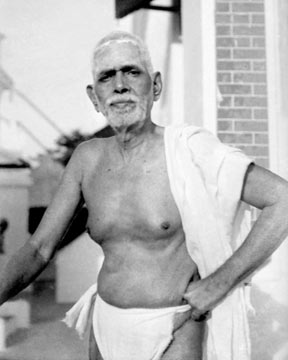

Your true nature is always the undivided, nondual Brahman,
Which is a mass of Being-Consciousness-Bliss,
Motionless, ancient, still,
Eternal, without attributes,
Without confusions, without sheaths,
Without parts, without impurity,
Completely free from any illusion of duality,
Full, peerless, and the One.
From Song of Ribhu, Chapter two.
The Ribhu Gita is a spiritual text that was extensively used by Bhagavan Sri Ramana Maharshi. It was one of the first books he read after Self-Realization, one whose message clearly accorded with what he had realized within himself. For many years during his life it was read to those at Ramanasramam. It is still read at Ramanasramam today. Ramana’s use and recommendation of this text has brought it into much wider visibility among those interested in his teachings and Advaita Vedanta.

A number of teachers in the tradition of Sri Ramana have been using these translations of the Ribhu Gita in their teaching. Above is a picture of Papaji reading from the English Translation of the Sanskrit version.
The Ribhu Gita is a book that is best read aloud, a few verses at one time. It is in an ancient form designed to be chanted, and they way it is written is most conducive to reading aloud, even if one is reading it to oneself.
The Ribhu Gita presents the timeless teaching of Self Knowledge, emphasized by Advaita Vedanta. Its fundamental tenet is the identity of the Self with Brahman, a term signifying the vast Absolute. This scripture presents the teaching given by the sage, Ribhu, to Nidaga to become enlightened into his true nature.
According to Annamalai Swami, “Bhagavan often said that we should read and study the Ribhu Gita regularly. In the Ribhu Gita it is said, ‘That bhavana “I am not the body, I am not the mind, I am Brahman, I am everything” is to be repeated again and again until this becomes the natural state.”
In describing the Self or Brahman, negation is primarily used because the Self can never be an object, can never be what is perceived or conceived. By negation in the process of Self-inquiry, the ignorance of identifying ones own existence with an individual body and mind is destroyed. This “destruction” of ignorance is really not the destruction of anything real, as the false identification as an individual just consists of assumptions, ideas. What remains after this so-called destruction is not anything new. It is not something achieved. It is not a transformation. It is what has been your innermost identity all the time.
As all differences are an illusory appearance
On Brahman, which is not different from the Self,
Due to conditionings of the Self like the defect of nescience (ignorance)
And conditionings of Brahman like maya (Illusion, delusion),
One should realize, by a practice of negation,
That all appearances are not a whit different from the substratum
And one should cognize the originless, endless,
Undivided identity of the Self and Brahman.
From Song of Ribhu, Chapter One
“The text is a relentless reiteration of uncompromising Advaita―that the Supreme Brahman, ‘That,’ is all that exists and exists not, that nothing else exists, the Self is Brahman and Brahman is the Self, I am that, I am all, and That is myself. This Awareness is moksha (liberation) which is attained by the way of knowledge and the certitude I-am-Brahman,” says Dr. H Ramamoorthy, one of the co-translators, in his Translator’s Introduction to the English translation of the Sanskrit version published by The Society of Abidance in Truth in 1995.
The origins of the Ribhu Gita are uncertain. It is contained within the Sivarahasya, an ancient Sanskrit epic devoted to Siva. It has been compared to the better-known Bhagavad Gita, contained within the epic, Mahabharata. Similar dialogs between Ribhu and Nidagha on the Self and Brahman are also found within the traditional 108 Upanisads, so it appears that the origin of the Ribhu Gita dates from the Upanisadic period, generally thought to be about 600 BCE.
The Ribhu Gita exists in two forms, the traditional Sanskrit version, and a Tamil version rendered in the late 1800s by Bhikshu Sastrigal, also known as Ulagantha Swamigal. Both versions have been translated into English by Dr. H. Ramamoorthy, a Sanskrit and Tamil scholar, and Nome, a Self-Realized sage in the United States of America, who realized the Truth revealed by Sri Ramana Maharshi and the Ribhu Gita in 1974. Both books, The Ribhu Gita and The Song of Ribhu (the Sanskrit and Tamil versions of the text) have been printed by the society of Abidance in Truth (SAT) and are available from their website (www.satramana.org).
These English translations have become the basis for a widening appreciation of this ancient nondual work. Translations have been made from these English translations into a number of other languages, including Italian, and Hindi. The Song of Ribhu has also been reprinted by Sri Ramanasramam and is available from their bookstore.
In addition to these two complete translations, there have been a number of partial translations published. One is a small pamphlet, Essence of Ribhu, available by download from Sri Ramanasramam – www.sriramanamaharshi.org . The other is The Heart of the Ribhu Gita, by F Jones, Los Angeles: Dawn Horse, 1973.

Nome has been teaching Self-inquiry, as taught by Sri Ramana, for about 30 years. He gives satsangs and holds retreats at the temple of The Society of Abidance in Truth (SAT), in Santa Cruz, CA, USA. For more information go to http://www.satramana.org. He has translated and published a number of books of Advaita Vedanta that otherwise would not be available in English. Many of these translations were done in collaboration with Dr. Ramamoorthy.
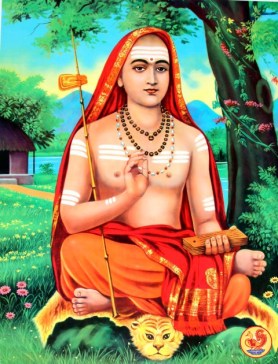
Editor’s note: The doctrines of Karma and Reincarnation play an important role in laying the ethical foundations of conduct in Hinduism, Buddhism, and Jainism. In Bhagavad Gita, the sacred scripture of Hinduism, the path of Karma Yoga (The Yoga of Action) leading to liberation (Moksha) is laid out and explained by Sri Krishna.
In popular understanding, the term Karma can have connotations of both cause and effect. Karma can mean action and activity. It can also mean the fruit or the results of such action and activity that we have to bear. For example, ethical, noble, and selfless actions (karmas) are said to lead to good fortune in the future or in a future life. The opposite of that is true as well.
According to Hinduism, how one leads one’s life determines the mental state in the last moments. The mental atmosphere, ideas, and images occurring in the last moments of life lead to a particular type of rebirth (Bhagavad Gita, Ch. 8, verse 6).
In the article given below, Sri Sunder Hattangadi, a retired psychiatrist and a serious student of Sanskrit, discusses the concept of Karma with references to the classical scriptures of Hinduism. This piece is written at a very high level and a short bibliography is provided at the end for those interested in more information. Even though many Sanskrit terms are used in the text, Sunder-Ji provides excellent English translations to the Sanskrit verses which makes the article very readable by people of all backgrounds.
The original writing was posted by Sunder-Ji to the Advaitin list. The Advaitin list is one of the largest lists in the world to discuss the doctrine of Advaita Vedanta as taught by Adi Shankracharya. Sunder-Ji is a member and a moderator of the Advaitin list. His exceptional mastery of both English and Sanskrit make his works of great value.
I did restructure Sunder-Ji’s article a bit but not with much confidence in my judgment. If any errors have occurred, these will be corrected as soon as pointed out by Sunder-Ji and other learned members of the Advaitin list.
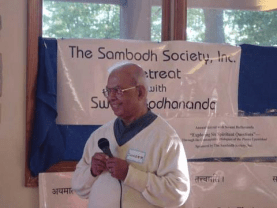
Sri Sunder Hattangadi
The Hindu Doctrine of Karma
Perhaps no word captures the mystery of human existence as suggestively as the word Karma. It is a word that evokes such a host of associated ideas – ethical-moral, psychological, metaphysical, and mystical – that one can easily lose one’s bearings in trying to understand it.
Krishna himself declares in Gita (4:17) – gahanA karmaNo gatiH – “hard to understand is the true nature of action”[`viShamA durj~neyA…yAthAtmyaM tattvam’]. It may be compared to exploring the Himalayan ranges to reach the peak of Kailasa, Shiva’s abode.
Simply defined, karma means action. The stem word, karman, is derived etymologically from the root verb (dhAtu) kRRi, to do, which also generates a multitude of other cognate words that are inextricably related to Karma – e.g. kartA (doer), kartavya/kArya (duty), kAraNa (cause), karaNa (instrument), and so on.
The definitions of Karma are modified by the prefixes, or adjectives, or compound words that are added to it, for example: Karmas may be described as sAtvika, rAjasika or tAmasika; nitya, naimittika; sa~nchita, kriyamANa (Agami), and prArabdha; kAmya, niShkAma; nyAyya, viparIta; shAstra-vidhanokta or avidhipUrvaka; akarma, vikarma, naiShkarmya; svabhAvaja/sahaja.
The Bhagavad-Gita, which Shankara has called `samasta-vedArtha-sAra-sa~Ngraha’ or the `epitome of the essentials of the whole Vedic teaching’ (or Spiritual Knowledge), is the incomparable vade mecum in explaining all the implications of the word Karma. It is a triune synthesis of dharma-shAstra, karma yoga-shAstra, and mokSha-shAstra. Any reader has a wide choice of verses to select in understanding this unique word. The present article is only one such selection, by no means exhaustive, and is only meant to serve as a pointer to other treasures.
Karma and Moksha: Action and Liberation
The word `karma’ yields over 300 words when associated with other prefixes and words to form compound words. The frequency of the word is relatively small in the Vedas & Upanishads, though the major portions of the Vedas (saMhita-s, brAhmaNa-s) are known as Karma-Kanda, i.e. dealing with rituals of worship. They, and the `dharma-shAstra’-s (scriptures on conduct), deal with the do’s and don’ts for the effective functioning of individuals, families, and society. The word has been repeated over a hundred times in the Gita.
The whole pursuit of Reality, the abode of Immortality (13:13) and Imperishable Bliss (5:21), is the effort to transcend the bondage or limitations caused by action. Every ego-centric action leaves an impression (vAsanA) on the mind (or chitta – the memory store-house) serving as a seed to germinate into further action, and results in consequences (karma-phala), that have to be experienced (enjoyed or suffered) in the present or subsequent life. These tendencies (vAsanA-s) can be countered by proper discipline of unselfish actions which leave impressions (saMskara-s). This wiping out of vAsanA-s (vAsanA-kShaya) itself is known as liberation (mukti).
The goal of action is to attain `actionlessness’, (naiShkarmya – Gita 3:4, 18:49). Immortality, freedom from delusion and sorrow and sin, peace, bliss, freedom from desire and anger, are the fruits of this pursuit, as attested in the following verses.
Gita 18:5, yaj~na-dAna-tapaH-karma pAvanAni manIShiNAm – purifiers of the wise.
5:11: “yogins perform action, without attachment for the purification of self.”
4:24 – “Brahman verily shall be reached by one who always sees Brahman in action.”
4:33 – “All action is comprehended in wisdom”.
4:37 – ” Wisdom-fire reduces all actions to ashes.”
Shankra Bhashya on Gita 3:16 states: ` ….till one attains the qualifications for Devotion to the knowledge of the Self, one who knows not the Self and is therefore qualified (for action only) should resort to Devotion to action as a means of attaining Devotion to knowledge.”
In Gita 4:25-32, Krishna defines the manifold yajna-s which are born of action (Bhashya: “in deed, speech and thought”, the not-Self, for the Self is actionless. If you realize that these are not my actions, I am actionless, I am unconcerned, you will be released by this right knowledge, from evil, from the bond of samsara”).
In Gita, 5:8-9, are described other actions (“seeing, hearing, touching, smelling, eating, going, sleeping, breathing, speaking, letting go, seizing, opening and closing the eyes”,) which are expressed by a truth-knower as “I do nothing at all, the senses move among the sense-objects.”
Actions, or the flux of events or changes in phenomena, happen in Prakriti (Gita 7:4) or in Kshetra (13:5-6) when applied to an individual. 3:27 – “Actions are wrought in all cases by the energies of Nature (Prakriti). One whose mind is deluded by egoism thinks `I am the doer’. ”
How does Vedanta view Karma?
Gita 18:13 – (also 2:46, 4:33) Bhashya – “all action ceases when the knowledge of the Self arises, so that Vedanta, which imparts Self-knowledge, is the `end of action’; (sA~Nkhye kRRitAnte)”.
Other References From Upanishads and Bhagavad Gita on Karma
The classical definition of karma is given in Gita 8:3: bhUtabhAvodbhavakaro visargaH karmasaj~nitaH – “The offering which causes the origin of physical beings is called action (Karma)”.
Shankara Bhashya on this is: “The sacrificial act which consists in offering cooked rice, cakes and the like to the Gods (Devatas) and which causes the origin of all creatures, is known by the term Karma; for it forms the seed as it were of all beings; it is in virtue of this act that all beings, animate and inanimate, come into existence, after passing through rain and other regions of life.”
Brihadaranyaka Upanishad, 1:6:1, states: “This Universe is formed of three entities: name, form, and action.”
Taittiriya Upanishad, 1:11:2-4, gives the guidelines – “……should you have any doubt with regard to duties or customs, you should behave in those matters just as the Brahmana-s (learned ones) do, who may happen to be there and who are able and noble thinkers, who are adept in those duties and customs, who are not directed by others, who are not cruel, and who are desirous of merit…..”
[Jaimini’s Karma Mimamsa codifies in aphorisms (3,454 in 16 chapters) the Karma Kanda (`dharma-jij~nAsA’) of the Veda-s, just as Badarayana’s Brahma Sutra-s (555 in 4 chapters) formulate the Upanishadic `brahma-jij~nAsA’ (Jnana Kanda).
Gita 3:14-15 – “From food creatures come forth; the production of food is from rain; rain comes forth from sacrifice; sacrifice is born of action; know thou that action comes from Brahman; and Brahman comes from the Imperishable. Therefore the all-pervading Brahman ever rests in sacrifice.”
Shankara Bhashya : “…Yajna or sacrifice spoken of refers to what is called `apUrva’; and this is the result of the activities of the sacrificer and his priests (ritviks) engaged in a sacrifice. These activities are enjoined in the Veda (Brahman), and the Veda comes from the Imperishable, the Paramatman, the Highest Self. Because the Veda has arisen from the Highest Self, the Akshara, the Imperishable, as the breath comes out of a man, therefore, the Veda, though all comprehending as revealing all things, ever rests in sacrifice, i.e., it treats mainly of sacrifices and the mode of their performance.”
As the reader can see, the word Karma has a rich history and heritage. A discussion of it is intimately tied to other topics such as reincarnation (rebirth) and moksha (liberation). Please review the following references for more information.
References:
http://www.sankara.iitk.ac.in/gitaindex.htm [Complete Works of
Shankara]
http://www.gitasupersite.iitk.ac.in/ [various commentaries on
Gita]
https://luthar.com/wp-content/uploads/2007/07/karma_mimansa.pdf [Jaimini
Sutra-s on Karma Mimamsa]
http://www.archive.org/details/thekarmamaimaacm00keituoft
http://www.mimamsa.org/articles/brief_introduction.html
http://www.geocities.com/profvk/gohitvip/contentsbeach11.html (waves
9&11) [by Prof.V.Krishnamurty]
http://www.hinduismtoday.com/archives/1994/2/1994-2-09.shtml
https://luthar.com/wp-content/uploads/2007/07/waystotruth.pdf [by Ananda Wood]
Back To The Truth – Dennis Waite ; 2007 Ch 2; O Books, UK
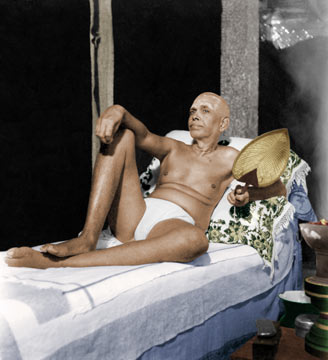
Bhagavan Ramana Reclining

I received some excellent and thoughtful comments from Sada-Ji (Dr. K. Sadananda) on the article, “The Method of Deep Body Relaxation.” These comments with minor editing are given below. Thank you Sada-Ji.
Editor
**************************************
Comments on “Deep Body Relaxation” By Dr. K. Sadananda
Harshaiji – PraNAms
Here are some comments on your article about “Deep Body Relaxation.”
Shava Asana is always done at the end of yoga exercises as a relaxation technique.
However, I would like to add a word of caution for going from Shava to Shiva – that is lying down and doing regular meditation. There is a good reason why the Lotus Posture (Padmaasan) is universally recommended for meditation. Shava or the corpse is considered as inauspicious while Shiva means auspiciousness itself
Also, it should be kept in mind that when one is in meditation, the normal breathing process will slow down and mind becomes quiet and calm. These conditions are conducive for the mind to go to sleep easily. Hence for most meditators, sleep becomes a big hurdle to overcome. Therefore, the Shava Asana (Corpse pose lying on the floor or bed) may not be useful for meditation.
Sleep is the opposite of meditation. In meditation one attempts to stay conscious and awake. That is one of the reasons why meditation is not recommended in the night when the mind is tired, but in the early mornings when the mind is fresh and vibrant. The period around 4am in the morning is considered best for meditation (it is called brahma muhurtham in Sanskrit).
The Lotus posture insures that the person who is meditating does not fall forward. Sitting in the lotus pose is recommended so that the student is stable and firm on the ground.
Yogic texts all advise that the vertebral column and the neck be in straight line (without going into the details of kundalini aspects).
This way one can stay in meditation for any length of time – awake-vigilant and meditative. Indeed that is the state of mind in meditation to be aimed at.
As Harshaji states, one can easily go to sleep in the Shava Asana. In fact one should go to sleep in that pose thinking of the Lord.
Then one can have Yoga Nidra and blissful heavenly relaxation.
But for Vedantic inquiry, the mind has to be sharp. Our own experience is that we can read stories or popular magazines lying down. But for any serious work, we have to sit up and study. Knowledge can take place only when the mind is sharp. Then, what to talk about the subtlest knowledge about one’s own self. So the recommendation is to do meditation in the sitting pose – if you can.
If you cannot, then alternate poses are recommended.
Now the question is whether one should do meditation in a lying down pose such as Shava Asana! Of course you can do! It is like a drunkard who went to ask a priest, “Sir, can I drink while praying to God?” Priest of course said, “No. you should not drink while praying.”
The drunkard thought about this and re-framed his question and asked again, “Sir, can I pray while drinking?” “Yes of course”, said the priest. So, can one meditate while lying down? The answer is, “of course you can meditate any time and anywhere.” No problem!
Should one lie down to meditate? No, that is not advisable. Sri Krishna himself recommends sitting down and meditating in the 6th Chapter of Bhagavad Gita.
Of course for relaxation – what Harshaji says is correct.
But For a meditator, relaxation is not the goal, but it is only a by-product. Vedantic meditation requires a calm, quiet, and vigilant mind. It is a subtle inquiry within of the very essence of life itself. If relaxation becomes a goal, the meditative mind will only long for that. If the mind settles in that groove, it will not be ready to take a higher flight.
Deep Body Relaxation
I used to teach Yoga, relaxation, and meditation classes in the late 1970s in NYC to make a living. After the Hatha Yoga sequence was done, students were led through a guided deep body relaxation in Shava Asana (the corpse pose where everyone lies down and relaxes each part of the body). After teaching Yoga for many years, it seemed to me that for most students, the guided meditation while lying down was absolutely the most favorite part of the class. Many students would continue in the Shava Asana for half an hour or more after the class was over. Some became so relaxed that they would fall asleep.
Over the years, I have come to feel that the best posture for meditation is not always the Lotus posture as many Yoga traditions claim, but simply lying down in Shava Asana. The sleeping posture is universal and sets no high bar for anyone to have to overcome. Therefore, it is the perfect posture for attaining Self-Realization. In fact, we know that the Sage of Arunachala, Sri Ramana Maharshi, became Self-Realized in that posture.
Deep body relaxation can be mastered by anyone slowly and many people experience physical, mental, and spiritual benefits from it. I have personally found it to be immensely useful in a variety of ways. My own experience of the Heart, Oneness of Being, came when I was very young. I had been meditating for many hours, sitting straight in a cross-legged position, and my back was aching and so tired that I lay down to rest for a few minutes. I was not trying to relax but it was in that resting posture that this deep conscious relaxation came over me and the truth of being revealed itself with complete clarity.
The Relaxation Method
The relaxation method I use is easy. I simply bring attention to every part of the body and consciously experience it and relax it. I start with each individual toe on both feet and relax these. I also focus on the bottom of the feet and relax these. Then I focus on the upper feet and relax these. Then I come to the ankles and relax these and keep moving up to the legs and other parts of the body and so on.
Sometimes, in my teaching, I have combined this method with visualization of white light filling the different parts of the body from the head to the toes. This is a beautiful way to use the intelligence and imaginative and visual faculty of the mind to fill the body with deep relaxation and to create a sanctuary of peace for one self.
Of course, Hatha Yoga is important for many people and sitting in meditation with a straight spine has its own health and energy oriented benefits. Meditation on energy centers along the spine is facilitated by sitting straight in a cross-legged posture. It also helps in doing certain pranayama and deep breathing exercises.
For many people who cannot sit cross- legged, sitting straight on a chair with support for the elbows is helpful. There are many ways to meditate. The main thing is that one should be comfortable in one’s posture.
Sincere Practice Leads to Self-Discovery
One, who is serious about meditation and relaxation and practices it with sincerity, slowly discovers what postures and exercises are the most helpful for her/his body and mind. Each person is unique in terms of what they find useful.
Finding a good yoga teacher is much easier today than it was when I was teaching. Back in the 1970s, in the U.S. and other Western countries, Yoga was popular only in big cities like Manhattan and Los Angles among the actors and actresses and the elite. But now it has become more mainstream and one can find Yoga classes in virtually any city.
Deep body relaxation seems to be universally attractive to people, because it allows for letting go of accumulated tension. It is easy to learn and do and with practice and experience becomes natural.


You must be logged in to post a comment.