“Those who leave the path of Self Enquiry, the way of liberation, and wander off along the myriad forest tracks, will encounter only confusion”. Bhagavan Ramana.
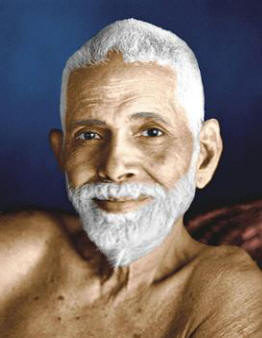

This posting is the first in a series in which I will try to show some of the experience of walking Arunachala’s ‘Inner Path.’ The Inner Path is a pradakshina path that has been maintained by various volunteers for many years. This path is close to the Holy Hill, much less traveled, and many find it to be the most quiet and peaceful way to walk around the mountain.
To give a good sense of the Inner Path, there will be a number of postings, one for each of what I see as ‘sections’ of the path. For many of these sections I will have one or more postings of what we have found near the path. I will call these postings, “Off the Path.” I think this provides a good framework to show you what we are finding as we continue to explore Arunachala.
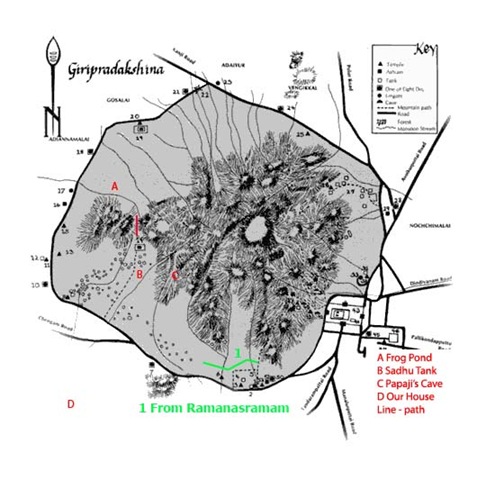
This first posting covers the path from Sri Ramanasramam to the location near where Perumpakkam Road meets Bangalore Road, and there is a popular walkway from the road to the Inner Path.
This is shown in the map view below, marked in green:
Arunachala from Ramanasramam
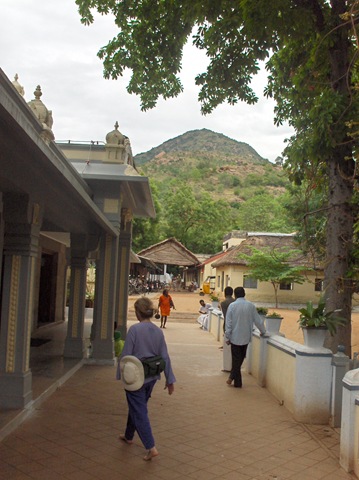
The to back gate
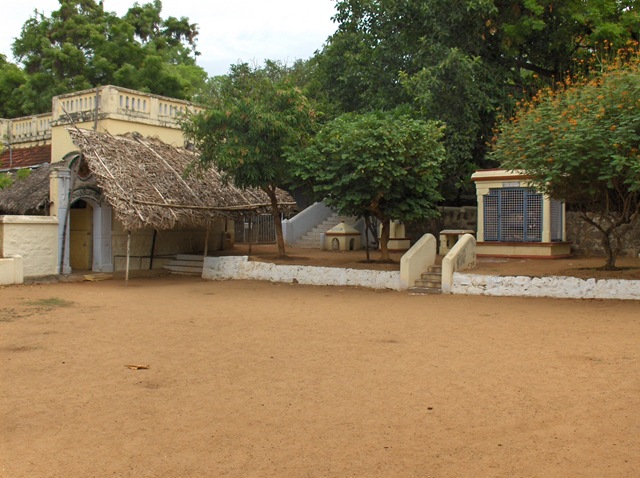
Through the gate
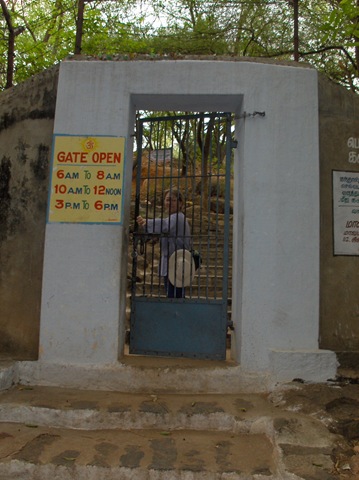
First, a few steps from the start of the path. Often there are one or two ‘mountain guides’ sitting here who can be engaged to assist newcomers and make sure they can find their destinations.
We started out this day about 7:15 AM, and none were there yet.
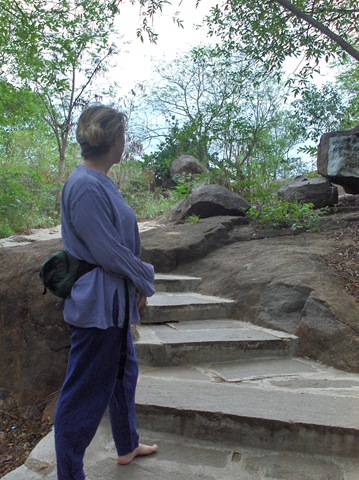
Up the path
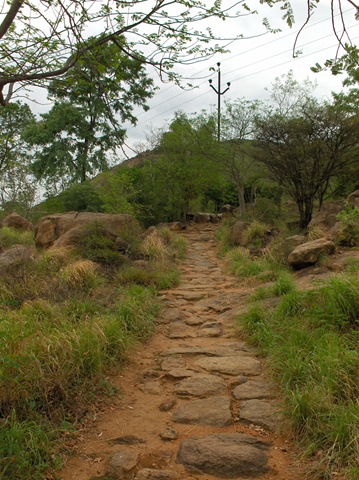
Take the left branch of the path here.
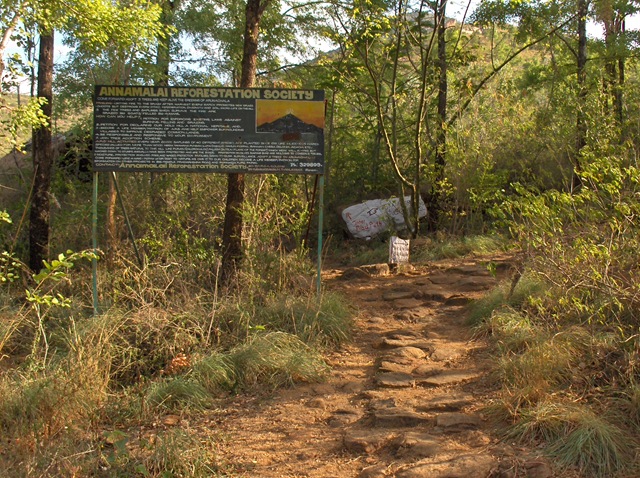
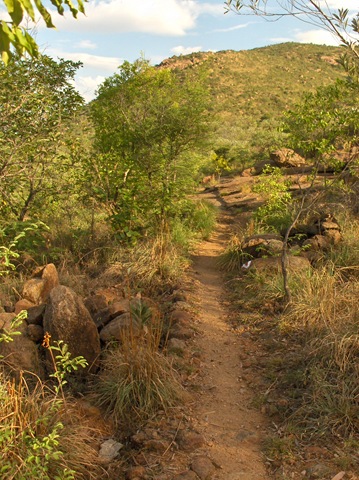
Looking up the hill.
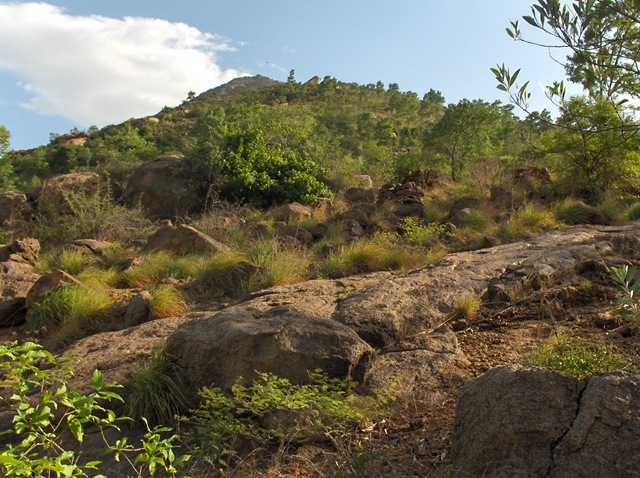
Looking away from the mountain. Here we are looking west from the path. A small hill can be seen. This hill is off Bangalore Road, before the turnoff to Girivalam (“Hill-Round”) Road.
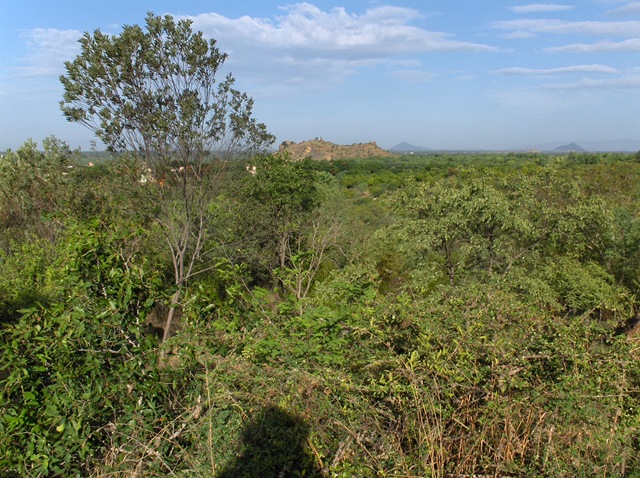
Following the path.
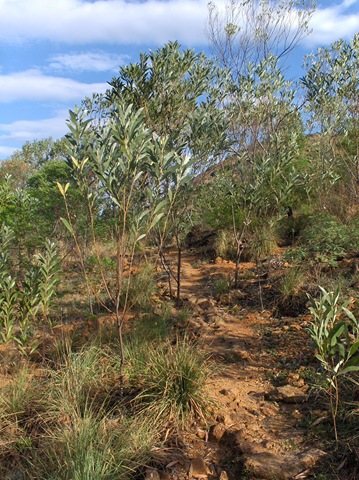
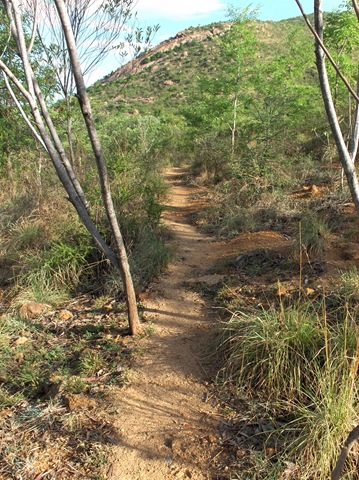
Looking up at the hill, the first view of the peak.
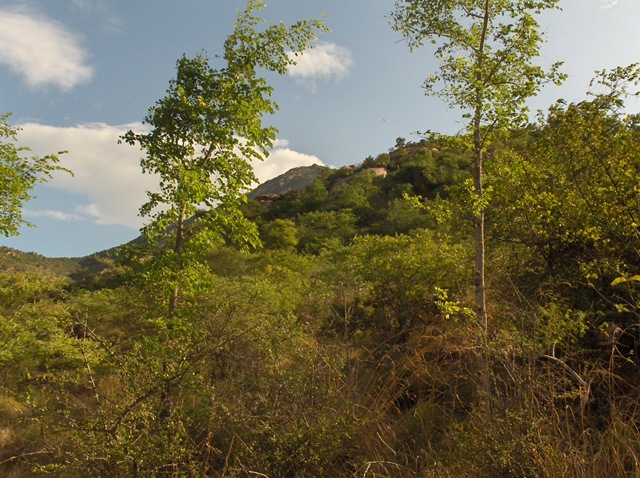
Ahead is one of the ‘arms’ of Arunachala. In the map above, you can see this to the left of Ramanasramam, jutting out from the mountain. This arm is one of the main landmarks of this part of the path.
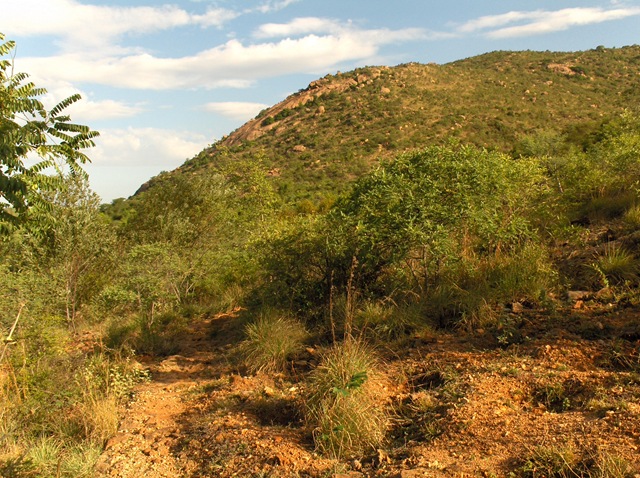
Trail markers line the path so walkers can be sure they stay on the path. These markers remind me of the fire in the cauldron at the top of Arunachala each year at Deepam.
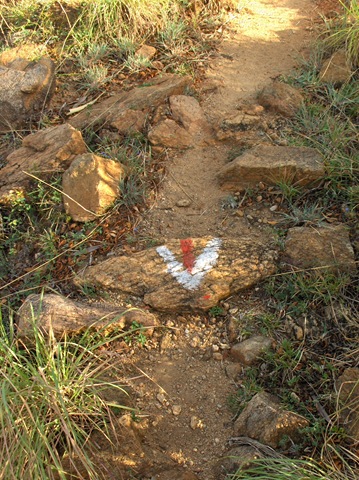
The peak is more visible now.
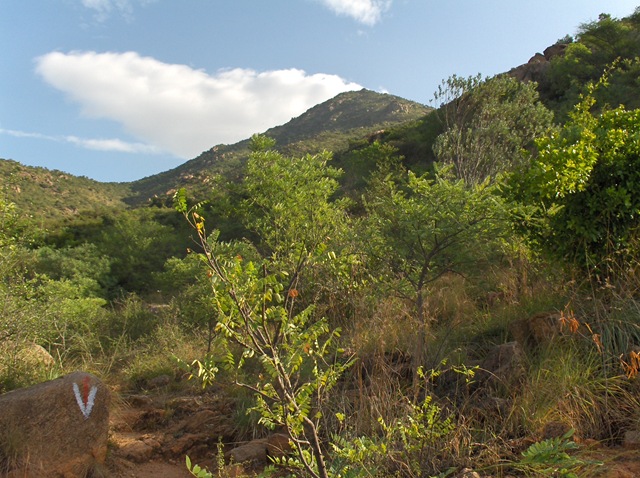
Walking the path.
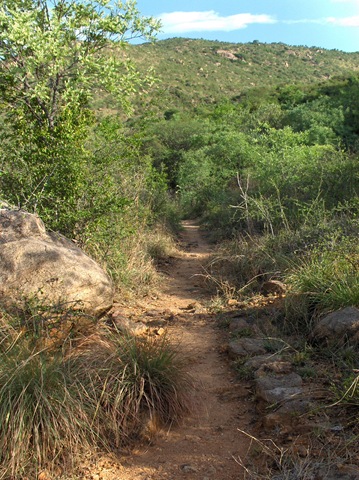
This type of cactus is found in many places around Arunachala. They remind me just how hot the weather is here most of the year. This cactus is about eight feet high.
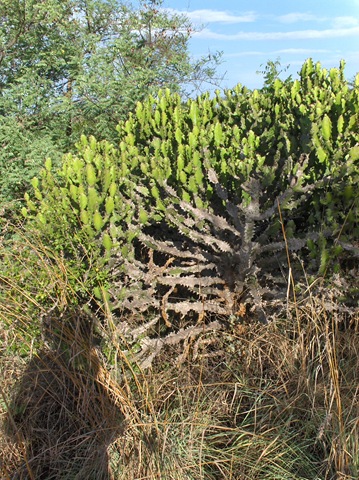
There is a stone wall. Cross it and turn left, down the hill.
We turned right once, to explore a rock formation up the hill here. We found a tribe of Langur Monkeys up the hill. As we approached, the young monkeys and their mothers scampered higher up the hill. The king of the tribe held his ground, and as we approached bared his fangs several times. We “pranamed” him to show that we do not want to give him any trouble, and we turned around.
A bit more about these monkeys can be found at this link to ArunachalaGrace.blogspot.
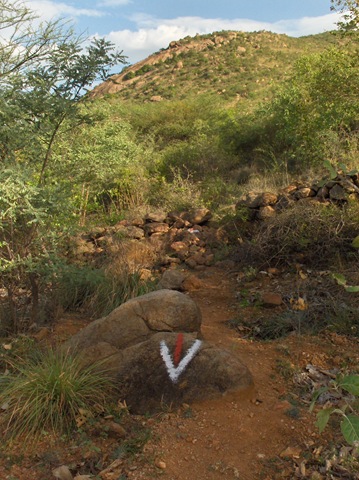
We come to a stream, with a water catchment basin. Both are dry now. Sometimes you will see people sitting here.
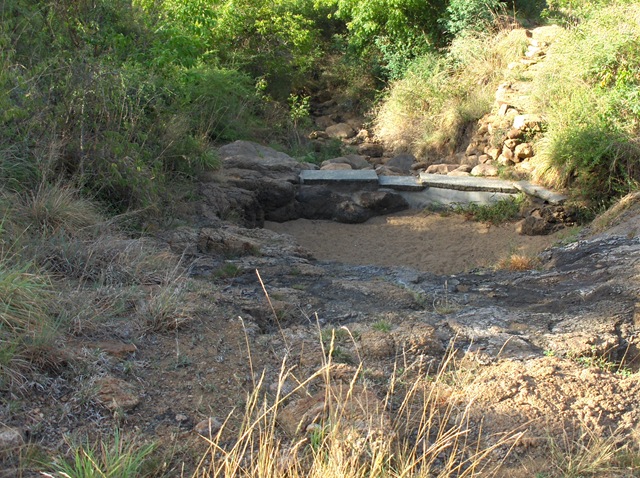
Onward on the path.
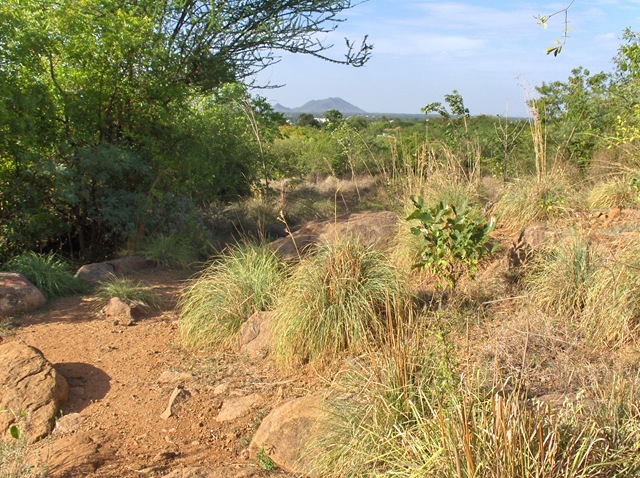
Arunachala from this location.
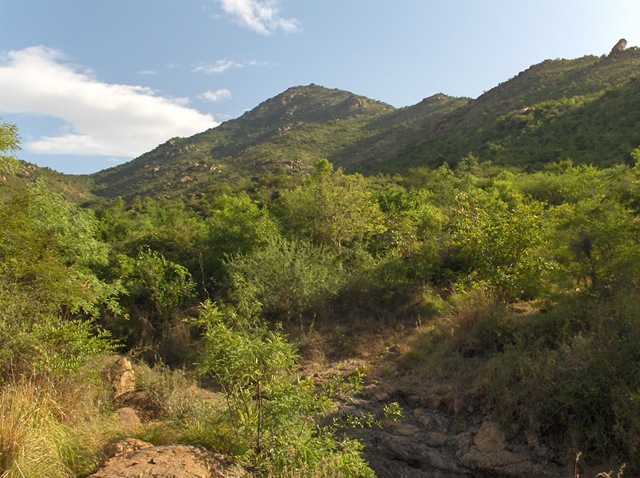
Carol and Richard, with Arunachala as backdrop.
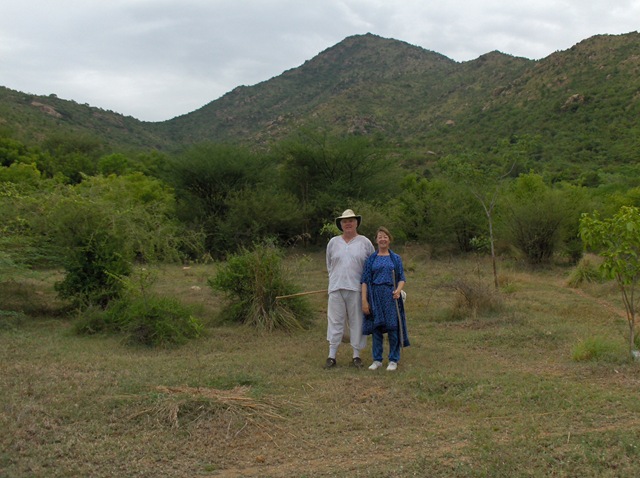
We follow the path along the stream. Bear left. The right fork is a shortcut. I will show this in a later posting.
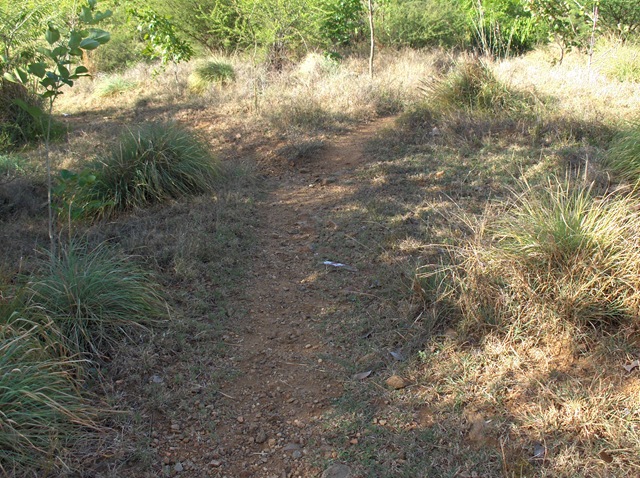
Following the path.
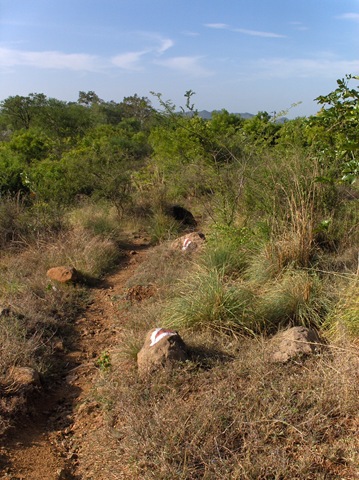
The streambed is to the right.
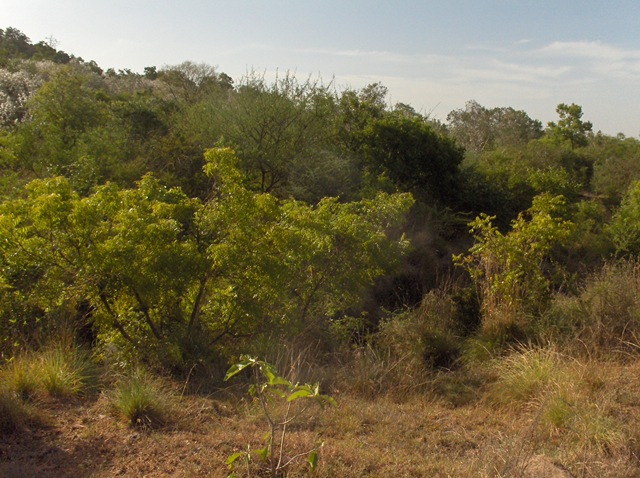
Another view of Arunachala …
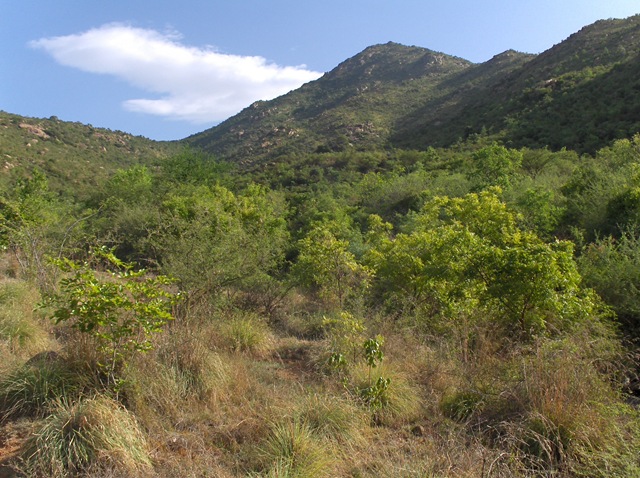
And we keep walking the path.
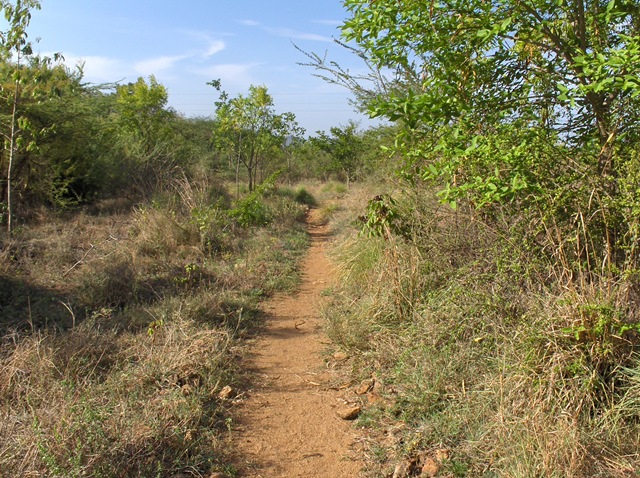
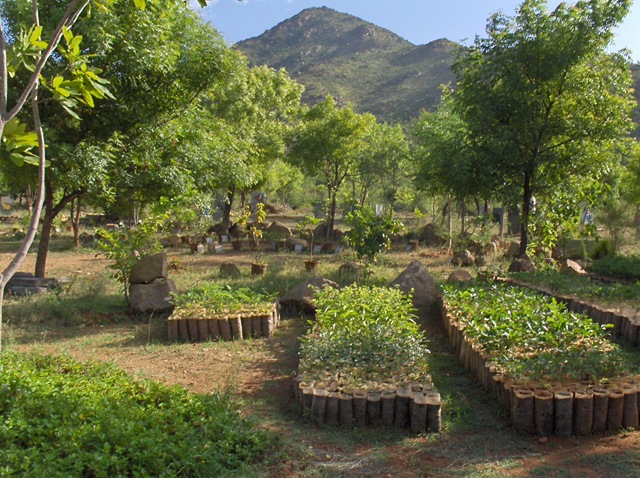
We are approaching the area where one of the major Arunachala Reforestation efforts operates from. Here we get the first view of the Museum/Visitors Centre at the Mountain of Medicine, currently under construction.
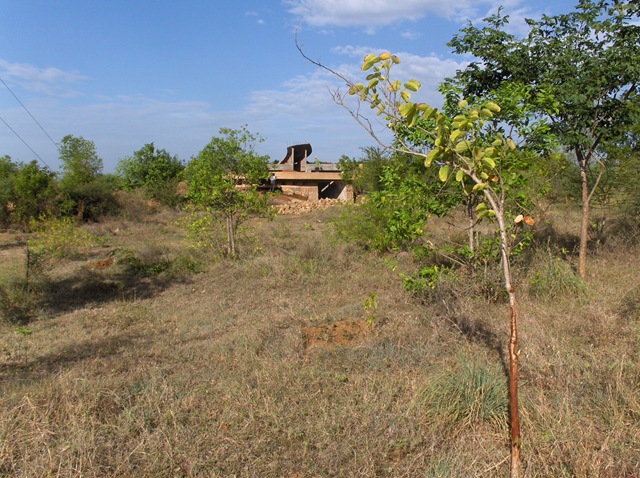
Here is a close up.
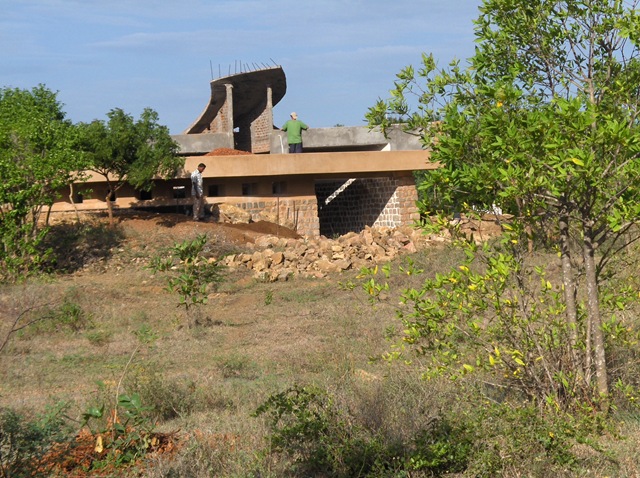
And another view.
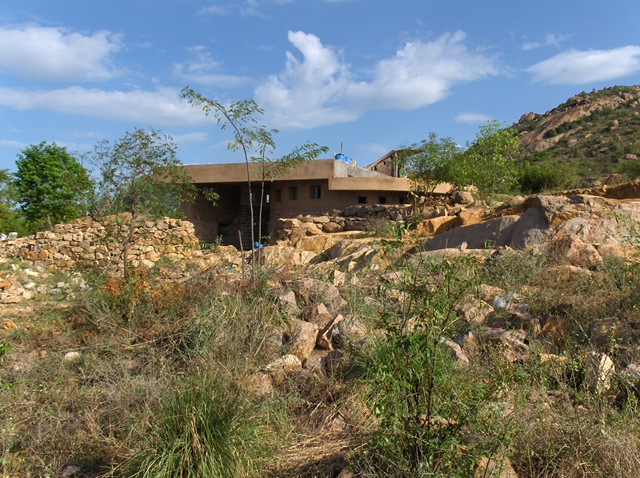
Walking through the area, you can see all the seedlings being grown up to planting size.
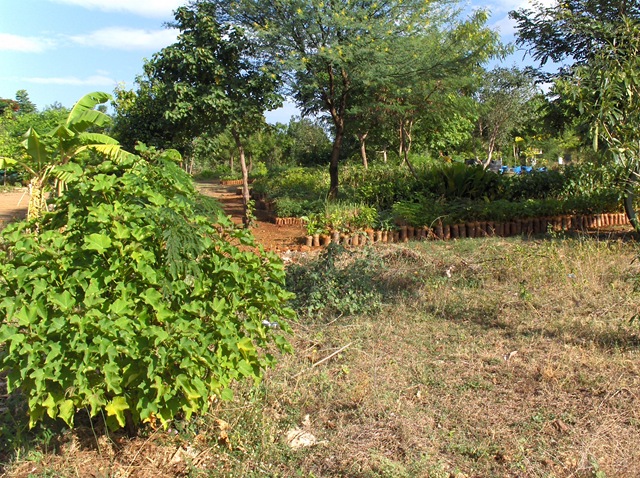
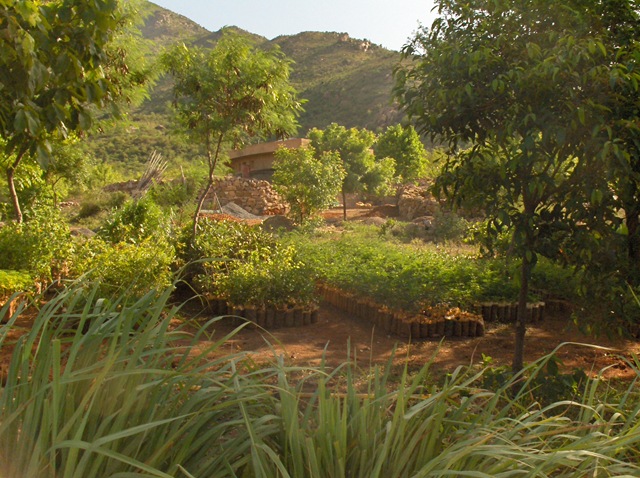
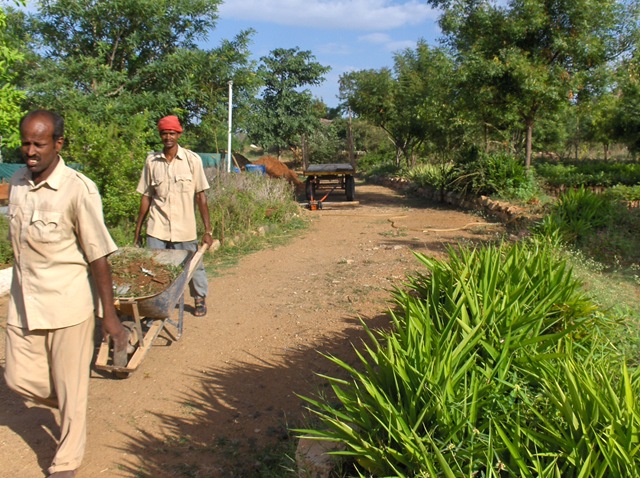
And workers.
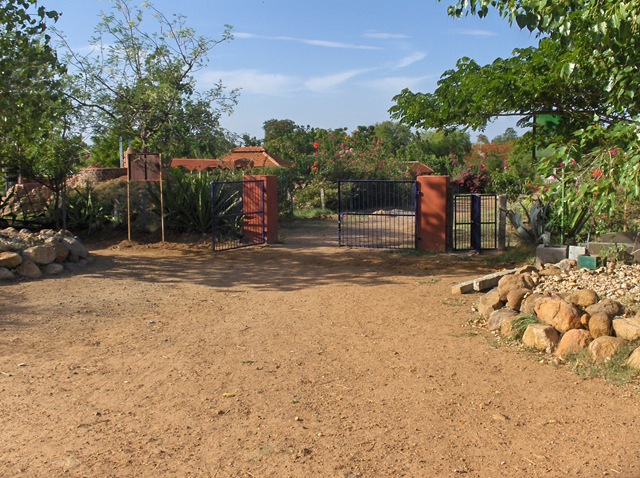
The gate out, to Bangalore Road, and the Children’s Park.
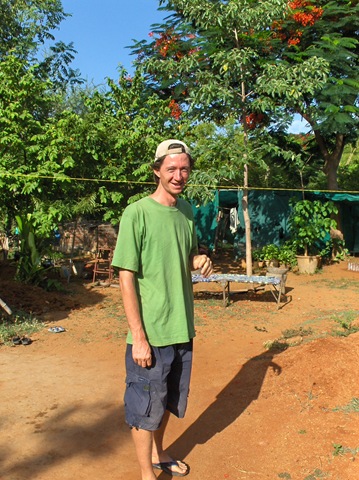
Govind, the Westerner that is behind all this good work.
Arunachala, from the Mountain of Medicine.
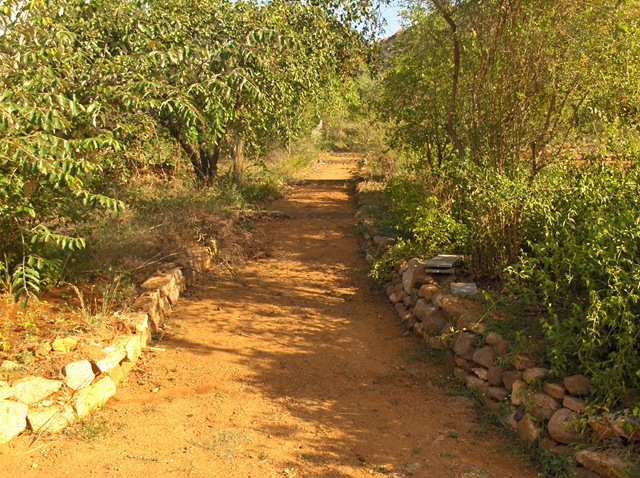
Leaving the Mountain of Medicine, to continue on the path.
To find our more about this wonderful effort, view this posting by David Godman.
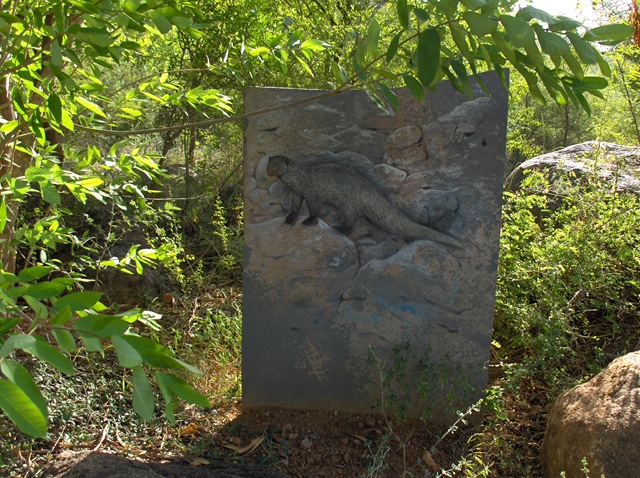
One of many paintings on rock slabs of local birds and animals.
Back on the path.
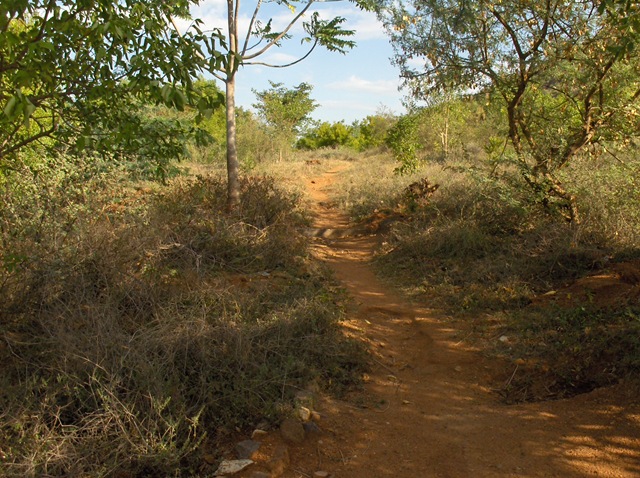
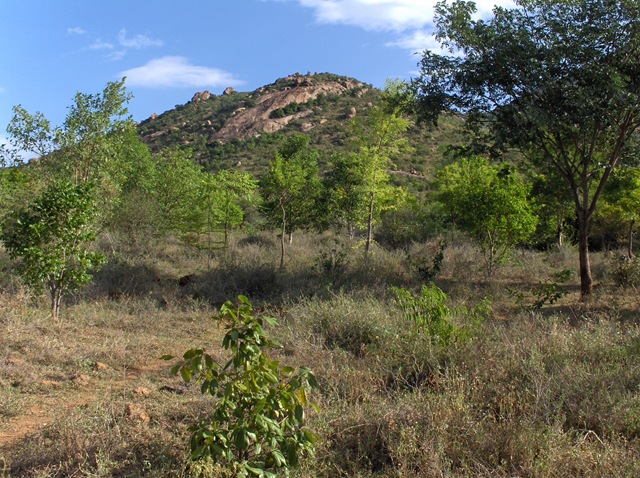
Looking towards the Hill.
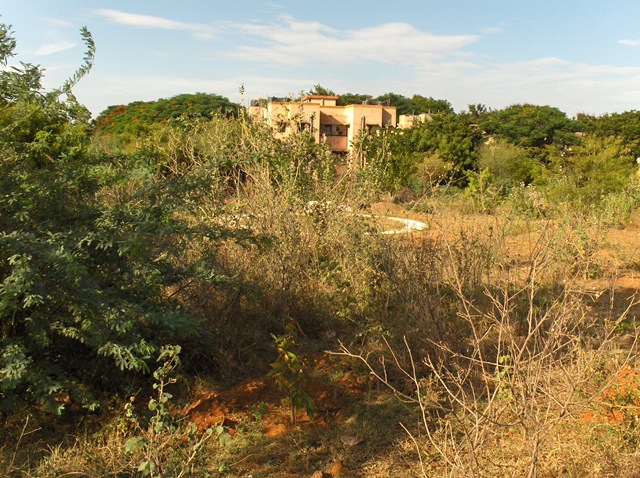
Looking towards the street. Here a housing development can be seen.
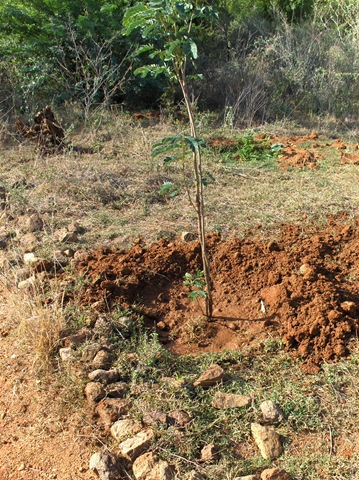
Tree planting, recently done.
Views of Arunachala.
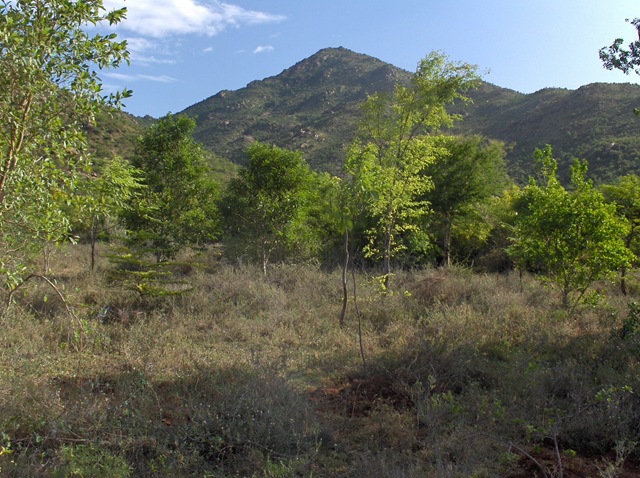
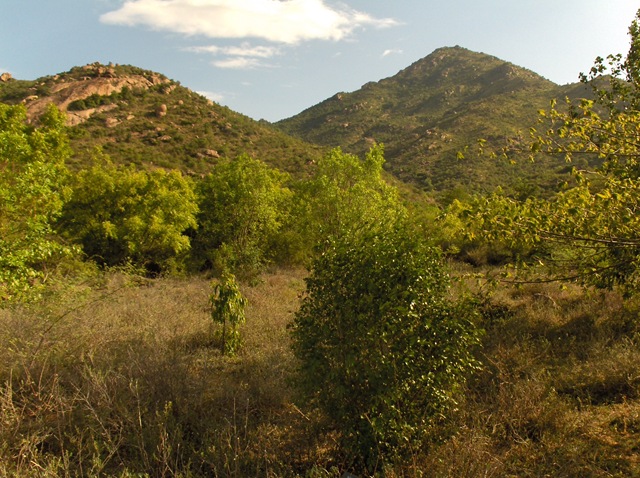
More holes are dug, waiting for rains before doing more planting.
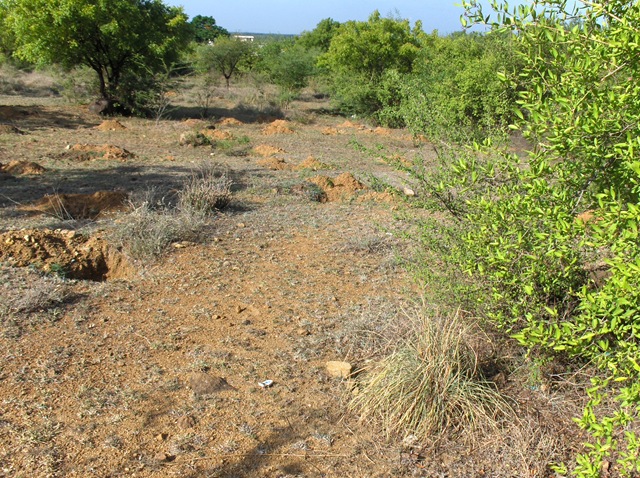
The view away from the mountain. If you do a close-up of this hill, you will see an ancient altar at the top.
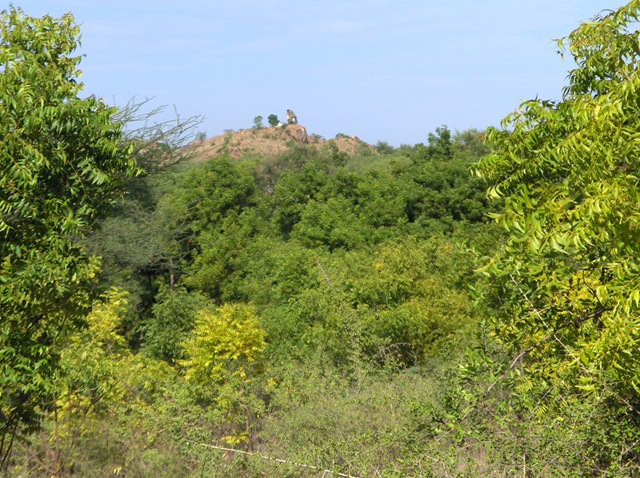
One last look at Arunachala. Notice in the foreground another of the types of cactus that are to be found around the mountain.
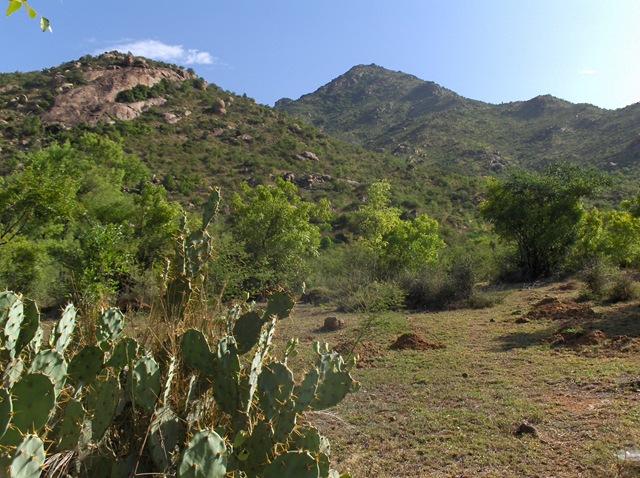
Then the gate that marks the end of this section of the Inner Path.
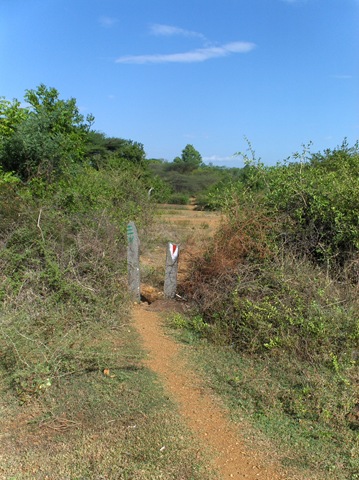
Looking out to the road.
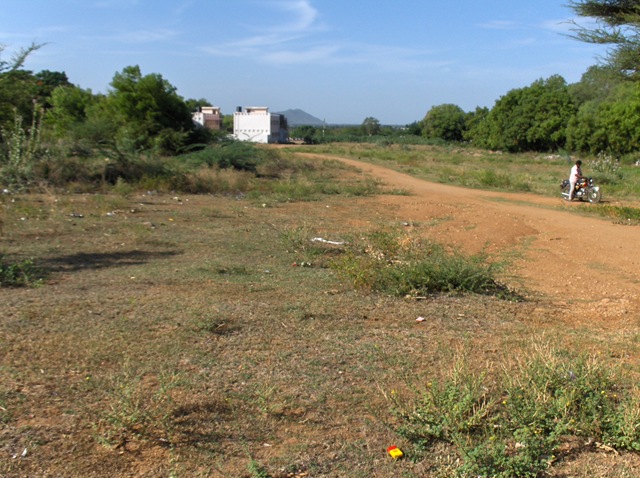
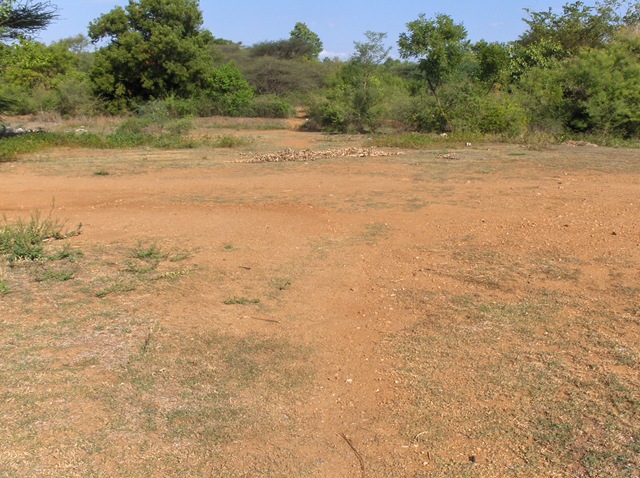
Looking forward to the next section of the Inner Path.
In this sequence of sonnets are laid out the basic tenets of Sri Ramana’s teachings.
This was previously published in The Mountain Path.
RAMANA CORONA
All beings yearn to be happy, always;
Happiness without a tinge of sorrow,
To enjoy a life of carefree days,
Taking no burden of thought for tomorrow.
When restless mind’s at peace in deep sleep,
What glimpse of worry, grief or despair?
So happiness lies therein, buried down deep.
How to find this treasure, awake, aware?
Ask the question, who am I, and from where?
That’s the essential means of the holy task,
Ending ego’s ‘me’ and ‘my’, that’s there.
No pleasure endures in things of this Earth,
Enquire within, who basks behind our mask?
To regain that Selfhood we lost at birth.
To regain that Selfhood we lost at birth,
First consider well the cinema screen,
To understand that, gains merit and worth.
On the screen there appears a tense drama,
The film begins and we enjoy the show.
Fire, flood, sex, death, a vast panorama;
The screen’s unchanging, but the film’s a shadow.
The simile teaches, strange as it may be,
That both seer and seen make up the mind.
On Consciousness as screen, all action’s based.
To know that is true, is the clue to be free,
A guiding beacon that’s so rare to find.
That’s the Sage wisdom by which we are graced.
That’s the Sage wisdom by which we are graced,
We’re taught the silver screen as a metaphor.
Seated in theatre stalls, now we are placed,
To proceed with clarity and enquire some more.
The bright theatre lamp is the light supreme,
Illuminating both actors and the scene.
We see stage and the play only by light,
Yet when action ends, the lamp remains bright.
Just as woven cloth and its colour white
Are never, ever perceived as apart,
So when mind and light both unite,
They form ego, knotted and bound in the heart.
Of all that we’ve ever learned since birth,
That’s the high wisdom proclaimed on Earth.
That’s the high wisdom proclaimed on Earth,
How to make mind to merge in its source?
Only by enquiring with all of one’s force,
The central question regarding its birth,
The ultimate scrutiny of “Who Am I”?
As thoughts froth forth like waves on the ocean,
They’ll all be slain by such introspection,
Unveiling the Self, the lost inward eye.
Pearls lay buried on the deep ocean floor,
Attracting divers to search for this goal.
Holding their breath they plunge to the core
Of the ocean bed, for the pearl oyster’s soul.
To gain this gem in the heart’s sacred place,
Just seek for the source where mind is based.
Just seek for the source where mind is based.
You travel alone on a mystery train;
By this metaphor we’re comfortably placed,
To travel by providence free from pain.
So put all your heavy luggage on the rack,
Only a fool carries it on his head!
Be glad, accept the predestined track,
Rest quietly, safe at home on your bed!
Surrender in joyful jubilation!
Surrender utterly to God’s almighty will,
Surrender with total resignation,
Surrender knowing all will be well,
Surrender whole heartedly with one accord,
Take safe refuge in the all loving Lord!
Take safe refuge in the all loving Lord!
For life’s a dream and sleeping dreams are short,
The waking dream is long; both stem from thought.
The Real is beyond both this waking and sleep.
The sword of enquiry slays dream states deep,
So reaching their substratum, numinous,
The state of pure consciousness, Self luminous!
Blissfully aware, yet awake in sleep.
As the cockerel crows ready to sup,
At the roseate dawn of first morning light,
Awareness pours into the near empty cup,
Granting a moment’s taste of Self insight.
This light is the eye that forever sees,
Who can be known by enquiring “who frees?”
Who can be known by enquiring “who frees?”
The Master who lives in the cave of the heart,
Not separate from one’s Self, being the start,
Of the final search from bond to release.
The Sage appears when the soul is ready,
With strong gaze of grace he says “be aware
That God and his wisdom are already there!”
He acts as a brake to make the mind steady,
While mercy flows freely in sunshine and air,
Hindered only by our being unready.
If you come to him, meekly with an empty cup,
His grace is then bound to fill it up.
The Master’s glance is the grace of the Lord,
He cuts you free with his mighty sword.
He cuts you free with his mighty sword,
To guide you surely, on the upward way
To Self Realisation, your real birthday!
Consummation of “That” the Sage’s word,
Is “rest in the Self,” which is always heard.
In him, place great trust and affirm, say yea
As certainty! Our Real Self blazes away,
Ever surrendered to the almighty Lord,
Revealing great peace for Realisation’s sake,
Renouncing belief that a rope is a snake.
The seeker surely becomes “the great find”,
His own blissful being, the summit in kind,
This great Teaching eternally frees,
One with the Self, as the Absolute sees.
One with the Self, as the Absolute sees,
He answers all our prayers and our pleas;
We must first enter that dear sacred part,
Not the fleshy pump that throbs on the left,
But the sacred core: by being skilful and deft,
We find that on the right; is the real Heart!
By harnessing breath, being adept and bright,
We dive with great skill and all of our might,.
There dwelling in depths of our true Heart’s cave,
Lives the shining ”Unity” blazing as Self,
Pulsation of I-I, where all shadows cease.
So fixing gaze there, finally, off we stave,
Perverted, wandering, demonic mind elf,
Returning to “Self”, our birthright of peace.
Returning to “Self”, our birthright of peace,
Is knowing that all this vile body performs
Was predestined before it ever took form.
So from stress, despair and fretting, pray cease!
Our freedom dwells in our natural State,
Renouncing the “ Am The Doer” notion,
Detached from fruit of form’s puppet motion,
Yet grace can avert even predestined fate!
Be like a skilled actor on this stage of strife!
Play with goodwill the part you’ve been given,
No matter how strangely you find you are driven,
Knowing who, truly you are, in this life.
Until fate pulls down the final curtain,
Know you’re Self not body, know that is certain!
Know you’re Self not body, know that is certain!
In this Realisation, there’s no cause to leave home,
You can strive in the city, there’s no need to roam.
To change style of life would all be in vain,
For mind remains with you, until it is slain.
Demonic ghost ego, source and fabric of thought
Create body and world, whereby we are caught.
Change of place, never changed the way we behave,
Whether living at home, in a forest or cave.
There are two ways by which our bonds may be freed:
Either ask “to whom is this strange fate decreed?”
Or surrender false ‘me’ to be then stricken down,
So praying intensely for ‘my will’ to cease,
We leave it to grace, to grant us release.
We leave it to grace, to grant us release.
God will do this through the gaze of his Sage,
He sends down His messenger for every age,
To those who yearn and pray for great peace.
The Realised Sage lives on here and now,
Without confusing the Self with the mind.
Humble, compassionate, loving and kind,
Wisely profound, as his way clearly shows.
He steers the vessel of firm devotees,
Fulfilling everyone’s spiritual need.
In deep silence, he sits, with perfect ease,
To awaken those, whom his teaching well heed.
Graciously, his great glance of initiation,
Drives the mind inwards, to Self Realisation!
Driving the mind inwards, to Self Realisation,
He grants safe passage through life’s stormy ocean;
What frail soul will ever be excluded
From the presence of the holy Supreme?
No matter how depraved or deluded,
His mercy never ends, and will always redeem,
Raising the soul from the depth of depression,
To free one from the ‘I am this body’ obsession.
From passions that churn desire and aversion,
His fair breeze wafts clear equanimity;
Enmeshed no more in worldly adversity,
Never perturbed by praise nor foul enmity,
We learn that there’s the greatest giving
In knowing all are Self, and so truly living.
In knowing all are Self, and so truly living,
We thank the great Sage who is ever giving.
We praise the Lord, who leads us to his feet,
His gracious gaze is eternally sweet,
Without ceasing, he’s forever reviving,
He grants that freedom, our real surviving.
He severs the grip of bondage’s chains,
He frees the soul, where confusion reigns,
He bestows both compassion and deep peace,
He sends out his grace to grant us release.
He teaches the truth that Consciousness is all,
And Self Enquiry to raise us up from our fall.
We praise God Almighty whom is ever living,
This crown of my verses is our thanksgiving!
To regain that Selfhood we lost from birth,
That’s the Sage wisdom by which we are graced,
This is the high wisdom proclaimed on Earth.
Just seek for the source where mind is based.
Take refuge in the all loving Lord,
Who can be known by enquiring ‘who frees?’
He cuts you loose with his mighty sword,
One with the Self, as the Absolute sees.
Returning to Self, our birthright of peace,
Know you’re Self, not body, know that is certain!
We leave it to grace, to grant us release.
He drives the mind inwards, to Self Realisation,
In knowing all are Self, and so truly living,
This crown of my verses is our thanksgiving!
![clip_image001[4]](https://luthar.com/wp-content/uploads/2008/07/clip-image0014.jpg)
Life is a pure flame, and we live
by an invisible Sun within us.
Alan Jacobs is Chairman of the Ramana Maharshi Foundation UK , and author of The Bhagavad Gita a Poetic Transcreation and The Principal Upanishads A Poetic Transcreation.
This article published with permission from The Mountain Path.
Alan Jacobs
(An Article published in the July Issue of The Mountain Path)
“Just as the pearl diver ties a stone to his waist ,
to the bottom of the ocean bed, and there takes the pearls,
so each one of us should be endowed with non-attachment,
dive within himself and obtain the Self-Pearl.
The first clear statement pointing to the practice of Diving Into the Heart appears in Bhagavan’s second written work entitled, Who Am I, composed in 1901. Thus my chosen quotation, from the Collected Works of Ramana Maharshi verse 19, of this seminal work, is quoted at the head of this article.

Ramana used different metaphors and phraseology to describe this practice, which forms one of the key approaches to Self Enquiry, but the metaphor of the Pearl Of Great Price pointing to Liberation is on also used by Jesus Christ and is often found in the poetry of Jaludin Rumi and the Sufi Mystics.
It is however, in the Ramana Gita that the Second Verse in Chapter Two, has become immortalized by the great Tamil Poet and Yogi, Ganapati Muni, who in 1915 was rewarded by Sri Ramana himself, with the answer which is popularly named as the Eka Sloki. Of over three Hundred verses in the Ramana Gita, all the questions and answers were transcribed by the Muni into Sanskrit verse, with the exception of this one, which was composed metrically by Bhagavan himself, in 1915, also in Sanskrit. This was his first composition in that language, rather than Tamil
There are several fine English translations of the famed Eka Sloki of Sri Bhagavan Ramana Maharshi, but I have selected the poetic metrical one used in the current edition of Bhagavan’s Collected Works on page 151, under the title The Self in the Heart where in the eighth stanza of the Supplement to the Forty Verses (1928), it was repeated by Ramana exactly as he gave it in the Ramana Gita, but now in Tamil.
IN THE INMOST CORE, THE HEART
SHINES AS BRAHMAN ALONE,
AS I-I, THE SELF AWARE.
ENTER DEEP INTO THE HEART
BY SEARCH FOR SELF, OR DIVING DEEP,
WITH BREATH UNDER CHECK.
THUS ABIDE EVER IN ATMAN.
Later, in Verse three of Chapter two, the Muni writes in 1917 “This verse is the utterance of Bhagavan Maharshi himself and is the essence of the Upanishads and Vedanta! Then in verse 47 of the Marital Garland of Letters Bhagavan himself writes ‘Oh Let me by Thy Grace, dive into Thy Self, wherein merge only those divested of their minds and thus made pure, O Arunachala.’ Further more to add to the pointers in which Sri Bhagavan obviously emphasizes this suggested practice for us, we have in the Upadesa Sarum or Thirty Verses different metaphor, but pointing to the same or similar practice. In verse 11 he writes:
“Holding the breath controls the mind
like a bird caught in a net.
Breath regulation helps absorption
In the heart.”
We shall be discussing the finer distinctions between breath control and breath regulation as I begin to look at approaches to the actual practice, but meanwhile we have the most important 28th and 29th verse in the Ulladu Narpadu or Forty Verses on Reality.
28. Controlling speech and breath, and diving deep within oneself – like one who, to find a thing that has fallen into water, dives deep down – one must seek out the source whence the aspiring ego springs.
29. Cease all talk of I and search with inward diving-mind whence the thought of I springs up. This is the way of wisdom. To think instead, I Am not this, but that Am I, is helpful in the search but it is not the search itself.
There have been numerous translations and commentaries on these two verses. The one I personally found to be most helpful was in the Sat Darshan Bhashya by K (Sri Kapali Sastriar) the respected, brilliant, and erudite, young disciple of Ganapati Muni .The original text was written in Tamil by Bhagavan but the Muni translated it into Sanskrit. He then asked Kapali, who was highly fluent in the use of the English language, Prosody, and Vedantic Philosophy, to write the commentary, and translate the verses metrically into English, thereby preserving much of the original ‘rasa’ or delight of Ramana’s own Metre. According to Kapali Sastriar’s Diaries, in his Collected Works, (published by the Aurobindo Ashram), where Kapali eventually took up residence, this text and commentary was shown to Sri Bhagavan, amended, and where necessary improved. The numeration in this translation differs as the invocatory verses were numbered one andtwo, thus the verses under discussion appear as 30 and 31.
S.S Cohen, for example makes the cogent point, in his commentary on verse 28, he writes “Deep Diving is a metaphor that implies salvaging the ego from the depths of ignorance into which it has fallen, not amateurishly, but very expertly and unremittingly, or else success will be sporadic and even doubtful”. At this point it is worthy of mention that Sri Kapali Sastriar also wrote an exhaustive commentary on the Ramana Gita, published by Ramanasramam. His Diaries vividly recount his meeting with Ramana, which took place, and the text approved after ammendation. This was composed in Sanskrit in 1941. It also includes a comprehensive commentary on the famous second verse of the second chapter, the Eka Sloki, much too long for this Essay, but well worth studying by those interested in pursuing this practice. However K’s commentary on these verse in the earlier Sat Darshan Bhashya is both long and powerful. On these verses. He makes many powerful points, and some of these I have extracted.
For example in (V 30) he writes that ‘just as one forgets all other thoughts and keeps aside all other cares, and holding breath and speech gets into the well and plunges deep to find the lost article’. This method called Plunge is suggested , and this is the real test of earnestness….. the attempt involves gathering up all one’s divided interests and dissipated energy into a concentrated effort of the whole man, of his Being in all its entirety…. V.31, then alone real quest for the Self may be said to begin…..’ It is my own opinion and that of others with whom I have discussed this important practice that Diving and Plunging are synonyms for this approach to Self Enquiry . On page 26 of this Sat Darshan Bhashya (published by Ramanasramam), in one of the introductory chapters, entitled Sadhana and Siddhi K writes “…..it throws the whole being into a consuming fire as it were, takes hold of the life breath which is lost in the bodily feeling , and separating it from the bodily grip enters it into the Heart…such is the real Jijnasa, the genuine earnest desire and search for the Self.
Before moving onto the actual approach and experience of this great practice, it is necessary to point out that there are numerous references on ‘Diving’, in the celebrated Talks with Ramana Maharshi .As these are not separately indexed I note some important ones here. In Talks 252 Page 210 he gives A full answer to the question ‘how is the mind to enter the heart?’, which is much too long to quote here, and anything taken out of context would fail to do justice to the text, and it would be preferable to look up the original. Similarly, In an answer also much too long to quote here is Talks No.616 on page 576, where there is a very long dissertation on the ’Jivanadi’ during which Bhagavan “ says ….. the seekers aim must be to drain away the vasanas from the heart and let not the reflecting medium obstruct the Light of Eternal Consciousness .This is achieved by the search for the origin of the Ego and by Diving into theHeart. This is the direct method for Self Realisation……I feel this is a key quote.
It is, however, in the recently published Padamalai, the Teachings of Ramana Maharshi recorded by Muruganar and edited and annotated by David Godman, that the richest haul for the potential ‘Pearl Fisher or Diver’ may be found. Again these are not separately indexed so I list some here. On Page 92…One’s own reality is Ananda, if you were to dive knowingly into the Atman, with the conviction born of this experience, then the state of Self would be experienced.(From The Power of the Presence Vol. 1 p.263-4.) On Page101 , No’s 50 & 51. “To whatever extent you dive with a one pointed mind within the Heart, to that extent you will experience bliss. In so doing the vexation of the clamorous and exceedingly cruel ego ghost, the mind, will perish leaving not a trace. On Page 146.No.53 ….Q. How to seek the mind? Bhagavan: “Dive within .You are now aware that the mind rises up from within. So sink within and seek. There is further comment on breath control being an aid, and where the breath sinks, the I Thought arises…when the attempt is made, it will itself take you to the goal. In Talks. No 195,Page 160.On Page 234 no.210 David Godman gives all of Muruganar’s Guru Vachaka Kovai verse 46 in which he quotes Ramana as having said “….put aside completely the extremely extensive Vedas and Agamas because their true benefit is getting established in the enquiry of diving within oneself….. On Page 232 No.18 he quotes “to whatever extent that mind-consciousness dives within, to that same extent will the bliss of the Self spring forth and reveal itself…
So we see the extent to which Sri Bhagavan repeatedly points to the importance of this practice over and over again . To cap it all we find The Eka Sloki was mounted during Bhagavan’s lifetime, obviously with his consent, above his ornate marble couch in the New Hall, where the verse is engraved in Gold Sanskrit letters on, a tablet of polished black marble . As Sri C. Sudarsanam writes “the Kavya Kanta was so overjoyed with this Eka Sloki when Bhavagan first gave it , that he proclaimed it as Ramonopanishad, Hardopanishad , and is reported as saying ‘the time for that , (a commentary on the Eka Sloki) has yet to come. I shall compose something like the Bhagavad Gita as a commentary.’ That is how the Ramana Gita with the traditional eighteen chapters, in Sanskrit poetic metre was born.
Before discussing the practice, from my own experience, and all I have read , and discussed with other Devotees, it is necessary to point out that it is only one of the different approaches to Atma Vichara, given by Sri Ramana to suit the dispositions of different seekers, according to their temperaments and maturity. Devotees who earnestly wish to practice some form of Atma Vichara find they are, as it were, ‘Initiated’ , by a strong intimation from the Sat-Guru in the Heart ,pointing to a suitable approach for them, or an approach which is the easiest for them to commence. and in some cases, even setting up the Enquiry in the Heart as a direct experience. This is obviously a great manifestation of Grace, when the Self sees that the earnest seeker is sufficiently mature enough to commence Atma Vichara.
In my own case I found it very difficult, like many western seekers, to maintain the attention needed for the Self Enquiry approach initially prescribed in ‘Who Am I’? but when I came across ‘Diving Into the Heart’ it was a revelation! as here was a radical practice I could pursue, by stopping my restless mind through breath control and regulation. I have been enjoying this form of Self Enquiry for some years and have great faith and personal evidence in its efficacy. In my enthusiasm I even composed a long Narrative Poem , published privately called ‘The Pearl Fishers’, which describes the practice. Of course Ramana’s long essay called Self Enquiry at the beginning of his Collected Works summarizes the different approaches and the necessary, optional preparatory and support practices, including regulation of the breath (verses 21-26), and in Chapter Six of the Ramana Gita, and verse 4 Chapter 2 of Spiritual Instruction. they are expanded as aids for necessary mind control.
Each practitioner of Self Enquiry will be drawn to that approach which he finds the easiest and appeals to him most. Some even have several arrows in their ‘atma vichara quiver’ with Aum as their bow. When however we come to Diving into the Heart, there is a useful treatise called ‘The Technique of Maha Yoga’ by Shri N.R.Narayana Aiyar in which he describes his own practice of Diving Into the Heart, as enjoyed by this earnest Sadhak, and first published by Ramanasramam in 1962. Briefly this short book summarises in general terms, his own experience and understanding of Self Enquiry, preparatory and support practices in the first twenty six pages .But on page 26he leads one into his own personal Sadhana of Diving Into the Heart by the key passage I have already partially quoted from Talks 616 page 576…… ‘the seekers aim should be to drain away the vasanas from the heart and let no reflection obstruct the Light of Consciousness. This is achieved by the search for the source of the ego. This is the direct method. The state free from vasanas is the primal state and eternal state of purity….’. He then quotes in Bhagavan’s description of the Locus of the Self, the famous quotation from the Supplement to the Forty Verses.
‘Two digits to the right of the centre of the chest is the Heart like a lotus bud. Breath, mind and the Light of Consciousness originate from here’.
There are many supporting passages in the Ramana Literature where Bhagavan indubitably affirms this location from his own direct experience. But we also know that Ramana stated elsewhere in Talks 403 page 378 that ‘you are the centre of Dhyana and that is the Heart. Thus a location is given with reference to the body……’even when the limbs are amputated you are there but with defective senses(adjuncts). So a centre must be admitted. That is called the Heart. The Heart is not merely the centre but the Self. Heart is only another name for the Self. Doubts only arise when you identify it with something tangible and physical…..’ However in Talks No.131 page 116 Ramana also states …’of course there is also the practice of meditation on the heart centre. It is only a practice and not investigation. Only the one who meditates on the heart can remain aware when the mind ceases to be active and remains still’ From this statement, as a practitioner of Diving or Plunging I have deduced, along with trusted and advanced Devotees in Ramanasramam and Tiruvannamalai with whom I have discussed the question, that the right side of the chest must not be seen as an object to be focused on, but merely as a doorway or portal in which one can enter to commence the search for the source of the ‘I Thought’. The point of entry may be found as the author of ‘The Technique of Maha Yoga’ writes, and Ramana also suggests , ‘watch the movement of the breath…and observe where breath rises and sinks inside the chest….’ . As in the Upadesa Sarum (and elsewhere) Bhagavan writes ‘the source of breath and mind is the same. Earnest Practitioners invariably find , as I have, that the Locus where a palpitation can sometimes be felt, is on the right side of he chest, where Sri Bhagavan himself affirms it to be.
Now regarding breath control and breath regulation, the Eka Sloki clearly states this as an option. Diving can be practiced with or without restraint of breath. We once had a Yahoo Group Discussion Group called Atma Vichara, with over two hundred subscribing members, world wide .Some reported that as soon as they approached the door-way of the heart with devotion and attention, the sacredness of the inner shrine automatically made the mind go quiet, and breath regulation was therefore unnecessary for them. Many practioners, however, especially those like myself with the usual Western rajasic restless mind, find breath restraint invaluable. Although Breath Control is summarised in ‘Self Enquiry’ from verses 21-25, it is more fully detailed by Bhagavan in his answer to the Muni and his disciples in Chapter Six of the Ramana Gita called ‘Mind Control’.
Ramana’s approach to this practice is very simple, and is not the extensive Pranayama which needs the supervision of a competent Teacher. One clear demonstration of full inhalation, retention and exhalation would be adequate . In verse five he states ‘control of life force means merely watching the course of its movement. By constant watch over its course (flow), Kumbhaka (retention) is achieved. This is an invaluable aid for calming the agitated mind at any time. In verse 6 Bhagavan, does recommend Hatha Yoga as an additional aid for those disposed towards this health giving and purificational practice, which would include some Pranayama. Many, like myself, find it is a valuable support practice for Atma Vichara. Here a competent Teacher is essential. In verse 7 we are asked to breathe out fully (Rechaka) with the necessary time required, and then fully inhale for another unit of the same time (Puraka). Then Kumbhaka or Retention may be held for four counts of the time taken for inhalation. It is during this period of holding the breath , that I finds is the best time to Plunge or Dive into the Heart by entering the portal on the right side of the chest using focussed attention, like a laser beam, from the chakra between the eye brows, to penetrate as deeply as one can, searching for the source of the ‘I Thought’, until one is forced to fully exhale, with Bhastika or diaphramtic exhalation with a guttural or hissing sound, which, more effectively, expels residual thought and vrittis.
This differs from the approach of the author of The Technique of Maha Yoga where he recommends (page 57) ‘to slowly Exhale and watch the exhalation movement in the chest. With the sinking movement in the chest dive into the Heart. Here I assume he is relying on the Pranic Force to enter the heart , with focussed attention . But I find focused attention issuing from the chakra or pineal gland, between the eye brows, far more powerful and would include the Pranic Force on exhalation as well. But obviously as in all matters of Sadhana it is for each Sadhak to find his own most effective way which is most amenable for him, guided by the Sat-Guru within his own Heart.
Another important prerequisite to this practice is given in verse three of the famed Arunachala Pancharatna or Five Gems to Arunachala where Bhagavan writes ‘He who turns inward with untroubled mind to search within where the Consciousness of ‘I’ arises, Realises the Self, and dissolves in Thee O Arunachala!’ .
Chapter Nine of the Ramana Gita in which the great Eka Sloki first appeared, has a whole explanation on the Granthi Bheedam or Knot. In verse three, Ramana states that theassociation of the Self with the Body is called the Granthi (Knot). It is my intuitive feelingthat Bhagavan’s powerful sword of Diving Into the Heart will eventually cut this identification and sever the knot . A full explanation to the Granthi Bheedham can be found in Spiritual Instruction Verse 12, Collected Works Ramanashramam Edition page 63.
Bhagavan often stated that a moderate Vegetarian Satvic Diet with milk products was a great aid in atma vichara, and there are many references to this in his ‘Talks’ where the importance of a Satvic Diet is clearly indexed. Finally there is the question of posture and here Bhagavan is very clear when he writes ‘of the eighty four main postures siddha is the most excellent’ in verse 27 section 3 of Self Enquiry. This is Siddhasana when the left heel is placed over the crotch and the right heel over that.’ Narayana Aiyer warns that this process of dedicated Diving Into the Heart may take a number of years, and this writer fully agrees from my own experience over many years. One assumes it depends on the skill employed in the practice of concentrated probing, with devotion, and the force of attention available, and the strength of the occlusions and vasanas resisting expulsion, as well as the gunas active at the time.
Obviously it will differ with each Sadhak, and no Plunge or Dive, in the search for the source of the I Thought can ever be exactly the same for anyone at any time. I find that each Dive is different in quality depending on the force of attention gathered, like an artist, when he prepares to draw an object, or a mathematician concentrating on a difficult problem, or gazing into the wick of a lit candle. In some cases one feels one strikes a wall , or sheath, and the attention cannot penetrate .But invariably one finds one can penetrate deeper and deeper until one reaches the abyss when one can go no further. Then on the exhalation a great deal of residual thought or vrittis are expelled. The more zeal , and determination one devotedly feels, that this isthe most urgent vital act and necessary effort one can make, the deeper it goes. One is immediately detached from any identification previously agitating the mind.
I find it is quite easy to commence the day with three or four dives, and then the opportunity or energy to proceed may happen another three or four times during the day. There is, however considerable Grace involved , as this practice churns the nadis, and the nervous system would be overstrained if achievement was too sudden .If their is a strain on the Nadis , Bhagavan says that with persistence all will come right in the end. This is expanded in the valuable chapter on ‘Self Enquiry Misconceptions’ in David Godman’s excellent anthology ‘Be As You Are’. Patience must be exercised for ripeness and maturity to fructify, and then Grace mercifully chooses the right moment for appropriate glimpses of the Real Self, in all its magnificence, as a forerunner to Realisation, when no further Sadhana is needed.
There is, however, from my own experience, no doubt that the practice gracefully weakens identification with troublesome thoughts whenever it is applied. Also pulsations are often felt on the right side of the chest , where a niche can be found in which one may rest for sitting in silent meditation. Again, however, every bold adventure into deep sea pearl fishing will be different, for each sadhak, and unique according to his own endeavour.
A baffling question arises, however, insofar as even when reaching the bottom ofthe abyss with concentrated attention, nothing is discovered, and the space probed seems empty. Wise, experienced devotees with whom I have discussed this question inform me that while the practice is still done from the mind, nothing should be expected. But at a certain point, after earnest and regular persistence in the practice the enquiry moves into the Heart, through Grace. Then atma vichara spontaneously arises, and one is drawn into the Heart, when the source of the I Thought may eventually be found with the necessary release. I have found this happens to me more and more, but I have not reached the stage where it becomes frequent or permanent.
Keeping in mind that one is searching for the root of the I Thought with zeal, and holding the breath, one should not expect an answer or result .The purification of latent tendencies are buried deeply in the subconscious, and what is happening can not be known by the reflected, limited, normal consciousness of the empiric mind. I am totally convinced, however, from my own experience, that Grace and effort are firmly interlinked.
This practice may be a great help for some Devotees, as it has for me. Especially for those who find other approaches too difficult because of lack of necessary yogic preparation, concentration practice, or inability to control the mind, even using Mantra Japa. There is no doubt that the implication of the Maharshi’s many repetitions of this practice, in his own writings and Talks, is of major significance. It is if our Ramana Sat-Guru appears and tells us Dive within the Heart and Realize the Self!
————————–
Note from Richard: I did a final pass at editing and formatting this article for Alan and am posting it for him. If there are any problems with the work that I did, I am sorry.
The Guru Vachaka Kovai, the Garland of Guru’s sayings, is a comprehensive collection of the Maharshi’s Sayings , composed and strung together by the great Tamil Poet Muruganar.This translation is by Professor K. Swaminathan.
In Part 1 , after the invocation there is a long section called ‘The Quest’, and part 2 is entitled the Unreality Of The World, and continues from verse 63 to 70.. Verse 69 states
“The world perceived by the poor jiva
Lapsed from its own Being true,
Buried in darkness, and believing
That it is but the body, alas,
The world thus seen is non-existent;
Yes, it is indeed unreal.
The thrust of this verse, and those like it is underlined by the often quoted passage in Letters from Sri Ramanasramam, 24th August, 1946, quoted in the marvelous book Muruganar’s Padamalai, edited by David Godman. On page 283 of the Chapter entitled The Reality Of The World Appearance we read.
Bhagavan:” In the sadhak stage [the stage of being a spiritual seeker] you have got to say that the world is an illusion. There is no other way. When a man forgets he is Brahman, who is Real, permanent and omnipresent, and deludes himself into thinking that he is a body in the universe which is filled with bodies that are transitory, and labours under that delusion, you have got to remind him that the world is unreal and a delusion. Why? Because his vision which has forgotten its own Self is dwelling in the external material universe. It will not turn inwards into introspection unless you impress on him that all this external universe is unreal. When once he realizes his own Self, and also that there is nothing other than his own Self, he will come to look upon the whole universe as Brahman.”
Like very many sadhak’s I found it difficult to be convinced that the world we perceive is ‘unreal’. I realized that the concepts of space, time, and causality are inherent in the organ of cognition and create the screen of consciousness on which the world stage, actions and pictures are projected. Also that quantum physics has confirmed that what we see, feel, smell , touch and taste is not what it appears to be, but subtle energies in constant movement. But, It was not until I read the Advaita Bhoda Deepika, The Lamp of Non-Dual Knowledge, a short work, highly spoken of by Bhagavan that I followed the complete logic of this point of view.
I summarize my findings as follows, largely based and inspired by Chapter 1 of this marvelous treatise, entitled On Superimposition.
1.All is Absolute, pure, infinite Consciousness, non-dual, Supreme Intelligence, the Self-Existent Self or Brahman.
2. Maya or Illusion, the powers of veiling and projection are inherent powers in Brahman.
3.These powers manifest an apparent, but unreal Universe. Unreal because it was NOT before manifestation and will NOT BE after dissolution. Therefore it is likened to a dream in the Supreme Intelligence or Mind of Brahman. Thus the apparent Universe is but an appearance based on Brahman. It does not exist apart from Brahman. It could be termed, therefore, a confusion between the Real and the Unreal, or neither Real nor Unreal, or both Real and Unreal. In the Vedanta, the term Real is applied to the Immutable or Unchanging. The apparent world is constantly changing, in a state of flux, becoming and decaying, so it cannot be termed Real in this sense, whereas Brahman is immutable, unchanging and eternal.
4.The ignorant ‘jiva’ (the ajnani) or individual soul is reborn and dies continuously through many lifetimes, until Self Realization. It carries forward from each life the seeds of many latent tendencies from previous lives, although its True Nature is also the Absolute Pure Consciousness of Atman-Brahman. But because of the implicit Maya, projection and veiling, inherent in the Self of Pure Consciousness or Brahman, it identifies with its insentient body and creates a Universe from its latent tendencies (vasanas) through the mind, (organ of cognition, the brain and sensorial adjuncts). The mind is a wondrous power in the Self. The world it sees, composed of latent tendencies, and thoughts is therefore of the nature of a dream, even an hallucination, and may be termed ‘unreal’.
5. The latent tendencies inherent in each jiva at the time of each life, are selected by Isvara, an adjunct of Brahman, for its spiritual development. So all is benign, based on Love, essentially. This is stated By Bhagavan in answer to a question by Paul Brunton quoted in the book Conscious Immortality on Page 130 , Chapter 10.
6. The mind-body complex, personal individuality, other sentient beings, and the Universe of multiplicity, are therefore a superimposition on the Self which is now living from reflected Consciousness, mirrored by egotism and the latent vasanas.
7. Through Grace, the jiva receives the teachings of Advaita from a Jnani, and when fit, through assimilation of this Knowledge and mental purification through right intellectual discrimination, spiritual practice and devotion, he or she is shown the way to awaken from the dream of suffering and transient joy (samsara). The means are through Self Enquiry into the source of the ego, the Self and the illusory nature of the Universe.
8. At the same time one lives one life as if it was real, knowing it to be unreal, and accepting all that happens as ultimately for the best.
9. When there is an awakening from the dream of life, the transmigration of the jiva is over. The immortal Self of infinite Consciousness is Realized directly and one lives from that state of ‘sahaja’ until the mind-body falls off in death, and one is absorbed into Brahman or Infinite Consciousness, no longer a separate individual identified with its body-mind. All is the Self, and the world is seen to be Real because its substratum is now known to be Brahman.
I hope this essay, into a difficult metaphysical question may be helpful to seekers baffled by the world illusion.
Re-reading Bhagavan's Eight Stanzas to Arunachala, a marvelous poem, I came across this verse which sums up my Essay. I add it as an addition, as it seems to sum the whole question up, very succinctly.
6. Thou art Thyself, the One Being, ever aware as the Self-luminous Heart! In Thee there is a mysterious power (Shakti) which without Thee is nothing. From it proceeds the phantom of the mind emitting its latent subtle dark mists, which illumined by Thy light (of consciousness) reflected on them, appear within as thoughts whirling in the vortices of parabdha, later developing into the psychic worlds and projected outwardly as the material world transformed into concrete objects which are magnified by the outgoing senses and move about like pictures in a cinema show. Visible or invisible, oh hill of grace, without Thee they are nothing!
Alan Jacobs
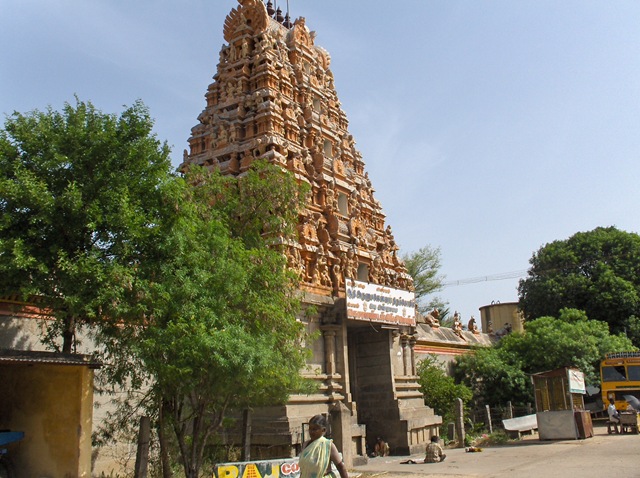
Adi Annamalai is the oldest temple around Arunachala. It was built hundreds of years before Arunachaleswarar Temple, which per Wikipedia, “The earliest known record of the temple is in the works of the poet Nakkirar of the third Tamil Sangam period. At that time, the temple might have been a simple wooden structure. The present masonry structure and gopurams (temple towers) date back approximately 1200 years.”
Adi Annamalai clearly predates Arunachaleswarar Temple, so is older than 2000 years. I suspect the gopuram is also about 1200 years old, from the same period as Arunachaleswarar Temple.
“The name of this Temple, Adi Annamalai means ‘first’ or ‘ancient’ Annamalai (Arunachaleshwarar). Its size is small and it occupies only 1/2 acre in size – compared with the 25-26 acre size of Arunachaleswarar Temple on the Tiruvannamalai side of the Hill. The legend of Adi Annamalai recounts that Brahma, after His dispute with Vishnu about the fiery column, made a lingam and went to the other side of the Hill to worship Shiva. Thus, this lingam is supposed to be the first, ancient and original lingam of Annamalai and hence the name Adi Annamalai.” This quote is from Arunachala Grace Blog. Here is a good article from them on Adi Annamalai.
There are many legends about this temple. The one I like the best is of a secret cave that goes from the temple to inside Arunachala, where all the Siddhis are.
You can see the temple in Google maps, click here.
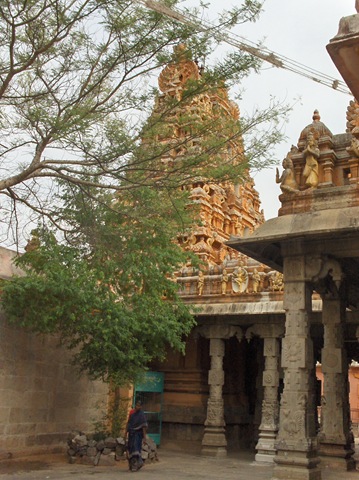
Turning off the Hill Round Road, going through the small village of Adi Annamalai, you come to the temple, with its tower visible from far away.
 n
n
And enter through the gopuram.
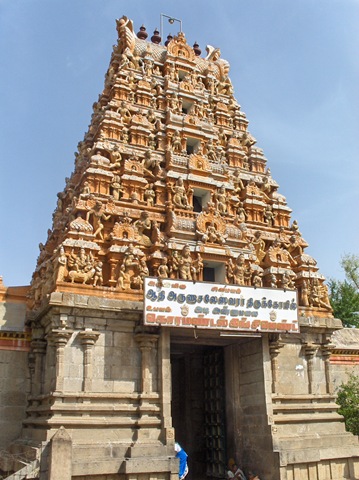
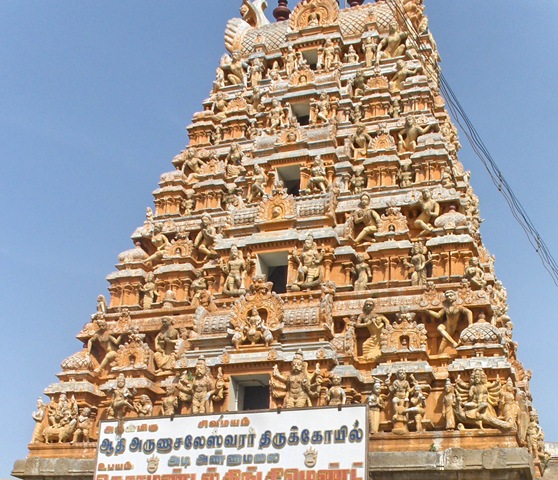
If you look closely at the gopuram, you will see images that illustrate many ancient stories of the gods. A repeated figure is that of a man, straining to hold up the tower. Since the wall has its own support all this effort is not needed. This image is to illustrate the futility of ego-driven action, ‘trying to hold up the universe’ when it is really God, Siva, Brahman, your Self, that is doing ‘all the work.’
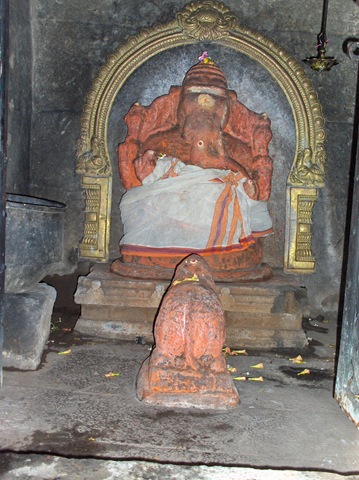
We are not allowed to take photos inside the main shrine. The photos below were taken walking around within the temple walls.
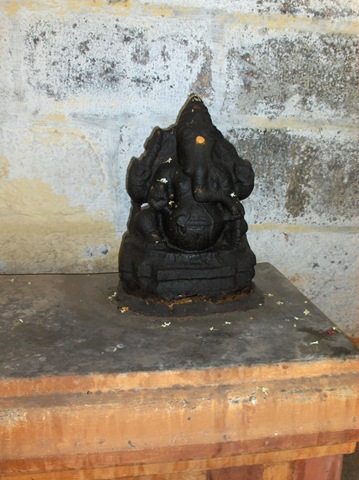
First is Ganesh, the remover of obstacles. This is the first god seen in the Siva temples. Here Ganesh is enclosed in a small shrine that is locked when the priest is not there.
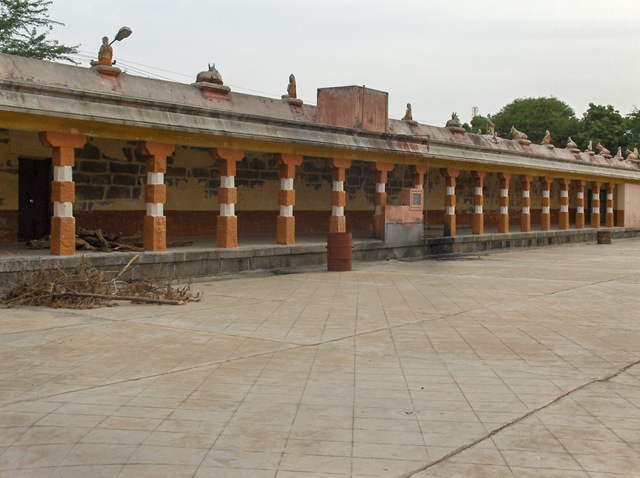
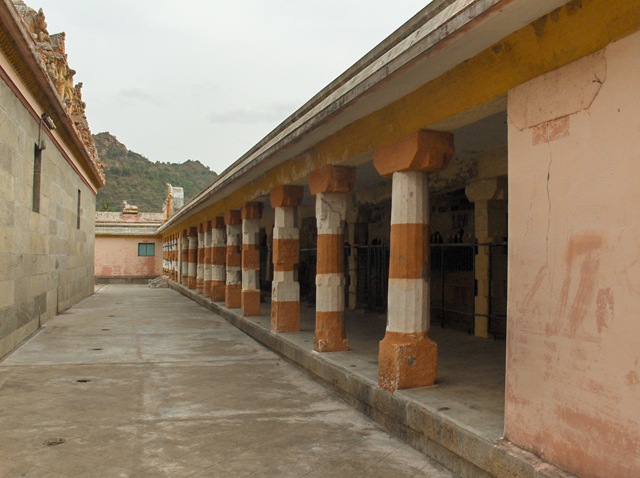
Walking in the usual clockwise direction, here is a hall of pillars. Note all the statues on top of the wall. Similar statues are on all four sides of the temple.
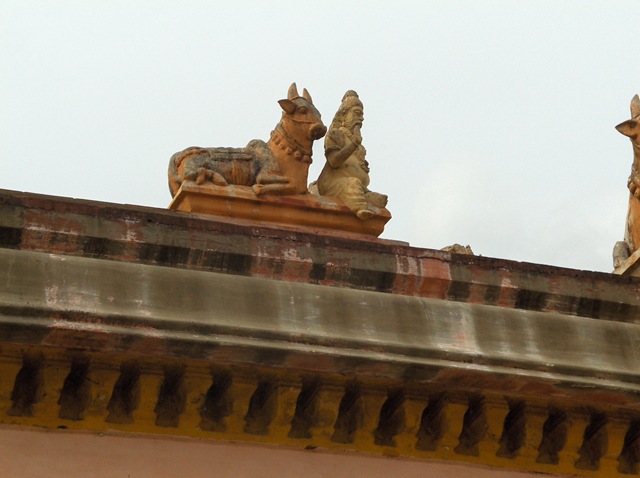
Here is a close up of one on this wall:
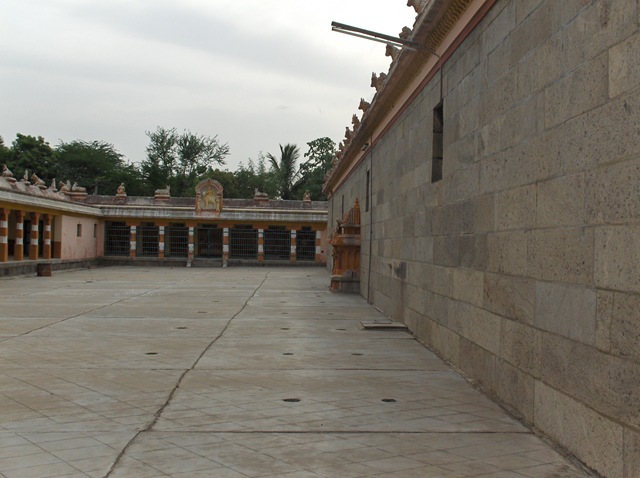
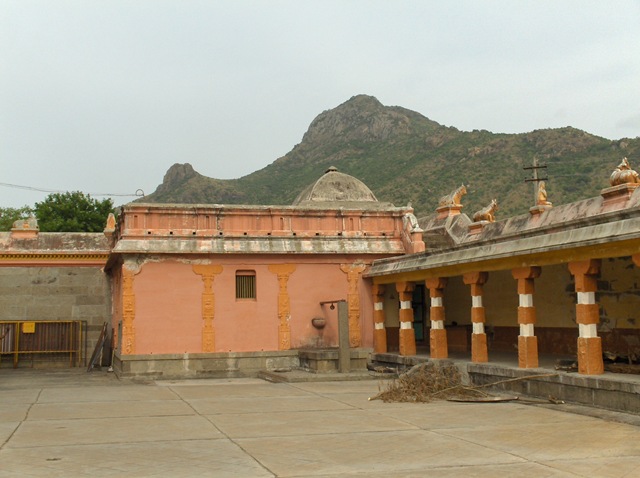
Looking to the back of the temple, we can see the Dakshinamurthy shrine protruding from the wall.
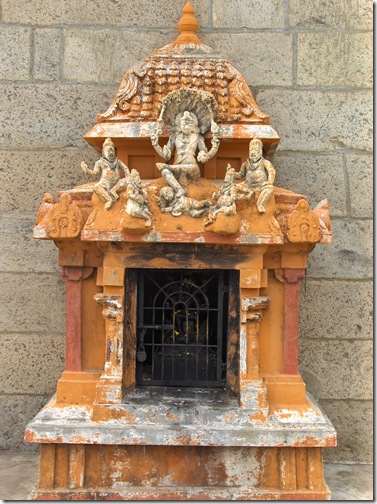
Here is Dakshinamurthy, the Southward-facing god. From the Wikipedia entry, “Dakshinamurti literally means ‘one who is facing south (dak?i?a)’ in Sanskrit. South is the direction of Death, hence change. In every Siva temple the stone image of Dakshinamurthy is installed, facing south, on the southern circumambulatory path around the sanctum sanctorum.”
Dakshinamurthy has a special place in our hearts. Dakshinamurthy is said to be the primordial Guru. He is pictured as a young man, with four older disciples sitting with him. Dakshinamurthy taught only in silence. Sri Ramana Maharshi is spoken of comparing him to Dakshinamurthy. It is also said that Arunachala is Dakshinamurthy. Certainly both teach in silence. Ramana says that real silence is when no ego-‘I’ arises.
Looking back from Dakshinamurthy, one can see Arunachala. Here is the face of ‘The Elephant.’ I wrote an entry about Arunachala in this area, see
.
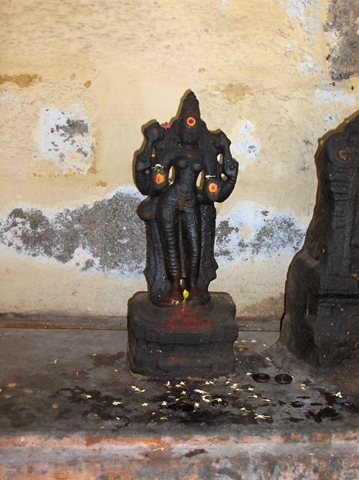
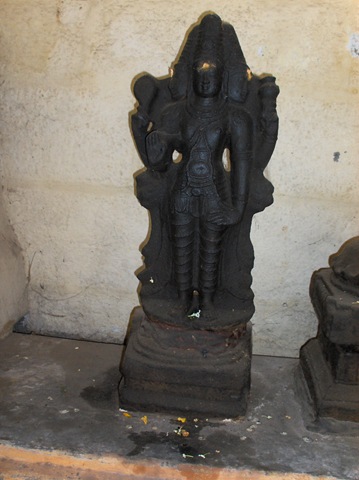
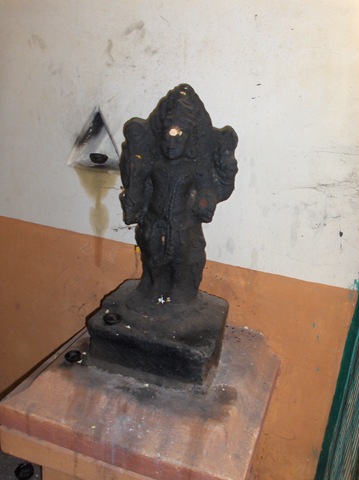
Behind the shrine, behind the pillars on the back wall of the temple, there are quite a number of statues, I think of various local gods, and gods of local significance. You can see, looking at the wear on some of these, just how ancient they must be, hundreds of years, certainly, thousands of years, probably.
Most of them I do not recognize. They have names, written in an archaic Tamil, above each statue. As I find out these names, I will add them to this post. Some are small, just a few inches tall. Others are several feel high.
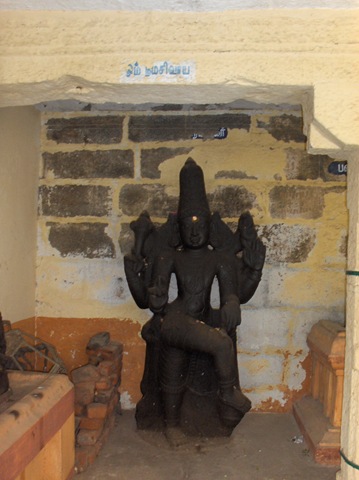
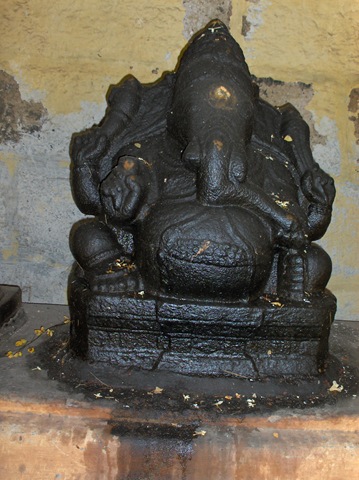
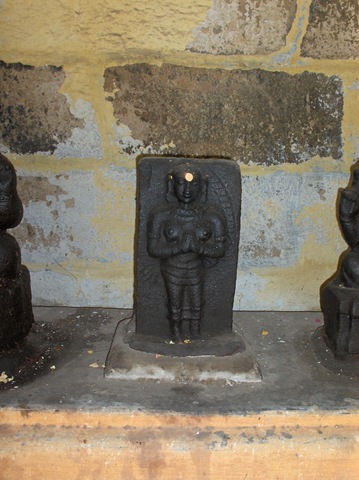
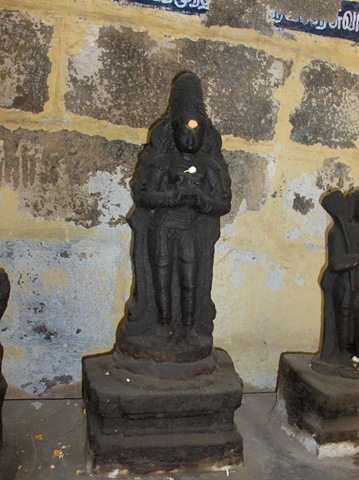
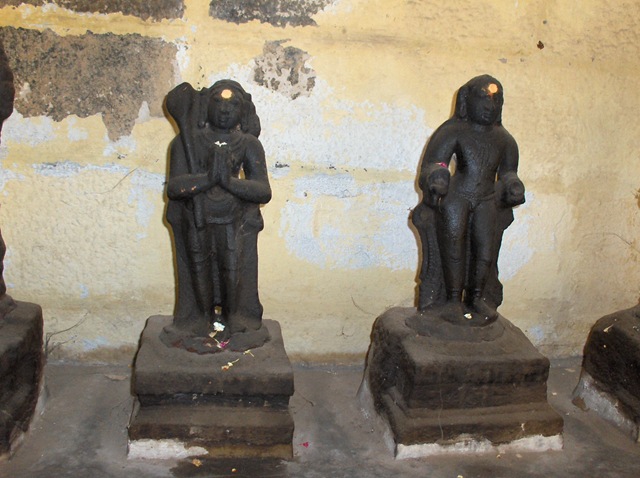
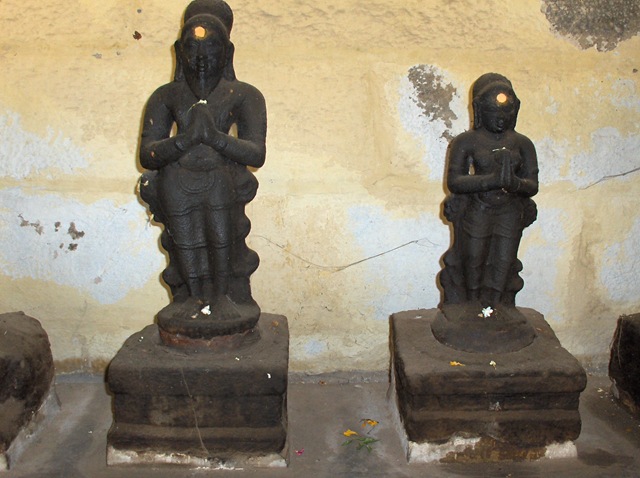
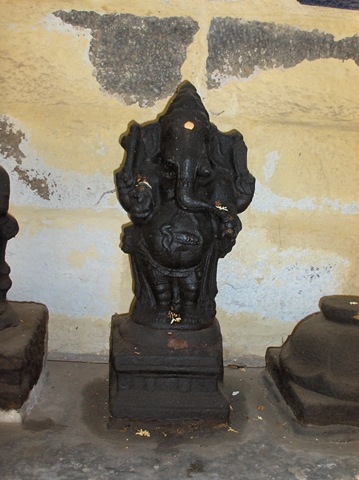
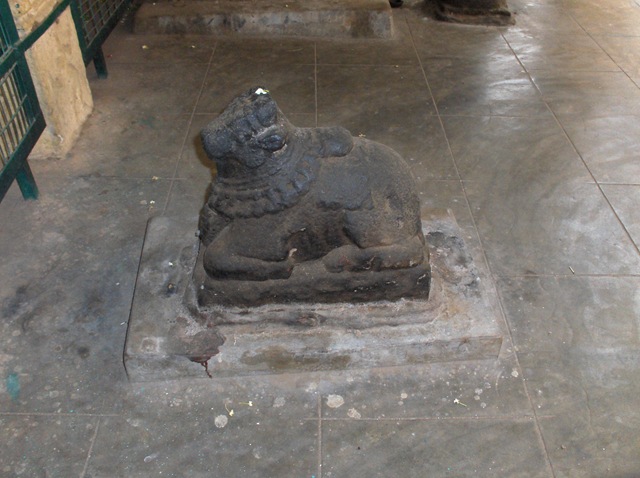
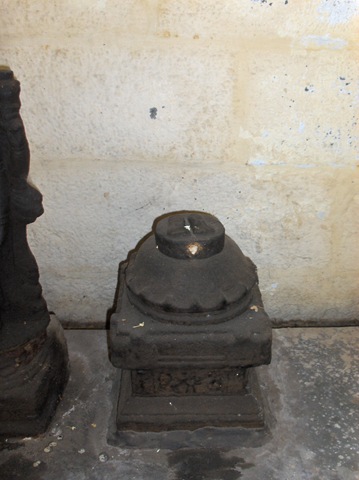
Here is one of three Nandis, guarding several ancient lingams behind the fence.
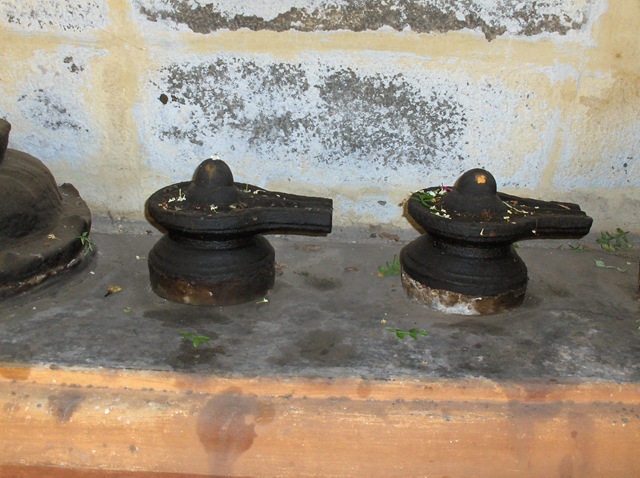
Here are the first two lingams.
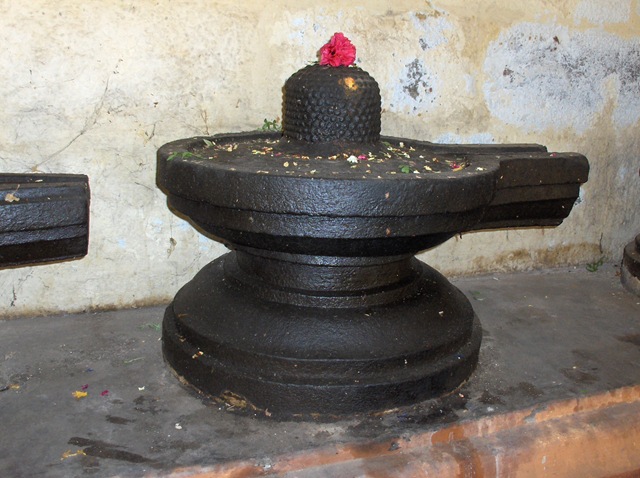
Here is the third. Note the additional carving on the upper part. Someone thought this was special. It is the only one that has a flower placed on top of it.
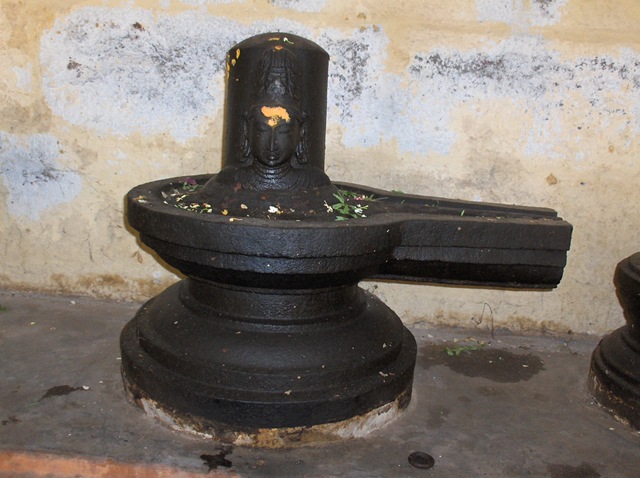
Here is the fourth. Notice that it has a face, surely Siva’s face, carved into it.
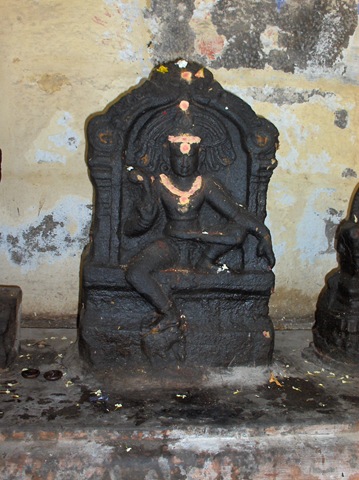
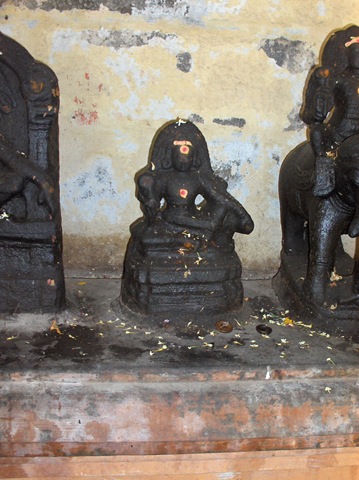
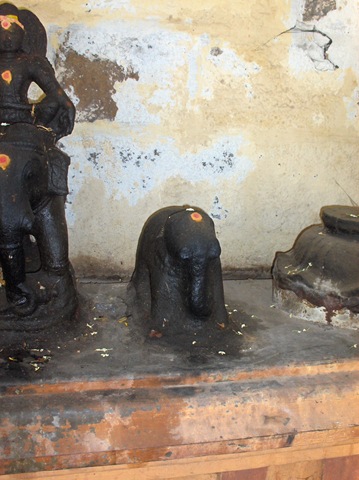
I love this one. Is that Siva on the elephant?
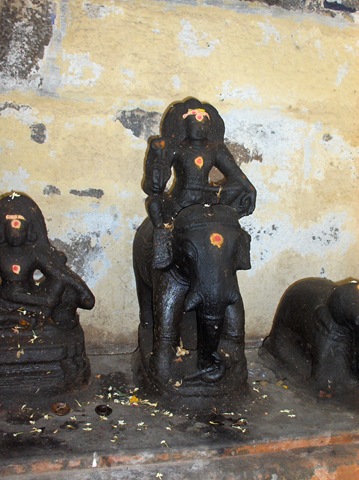
Notice how old this elephant must be. The top of the statue has been rubbed away by countless hands touching it, probably over hundreds of years.
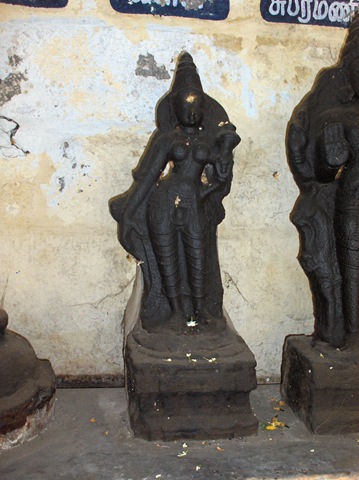
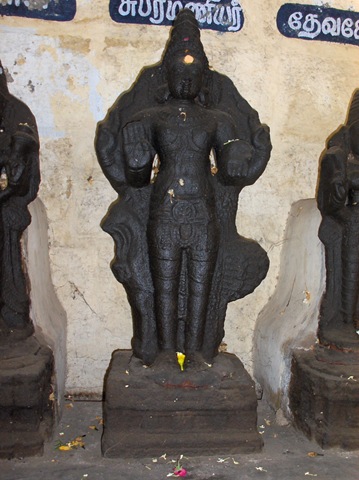
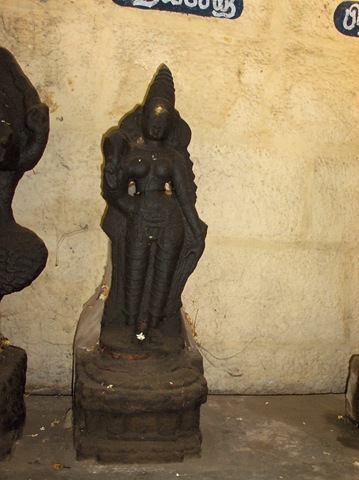
Looking back at the hall of statues.
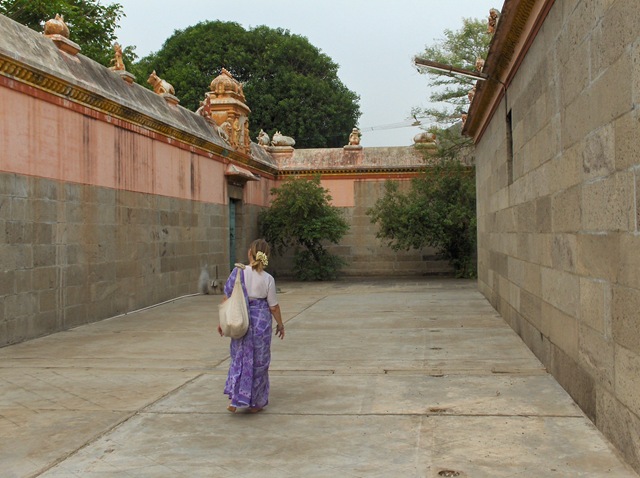
We walk back toward the front of the Temple.
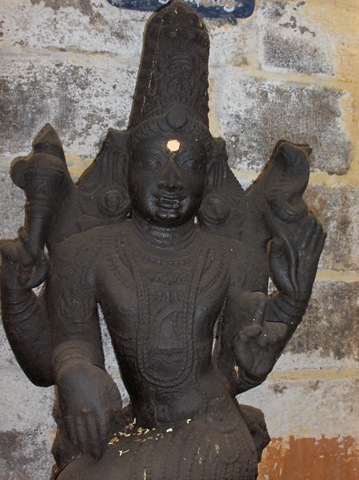
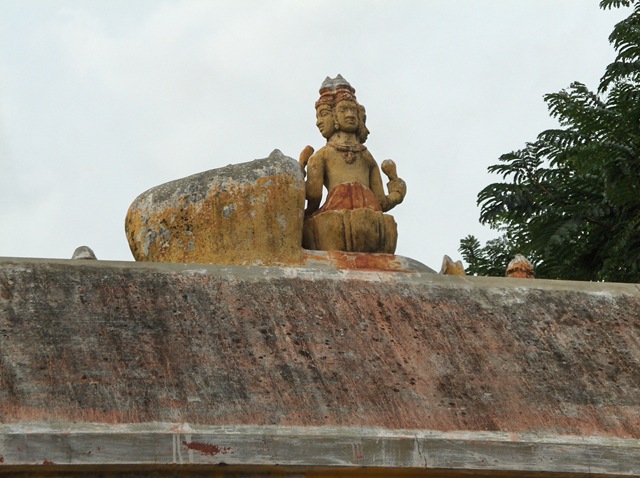
Another statue. This god has three faces (that I can see).
The gopuram, seen from within the temple walls.
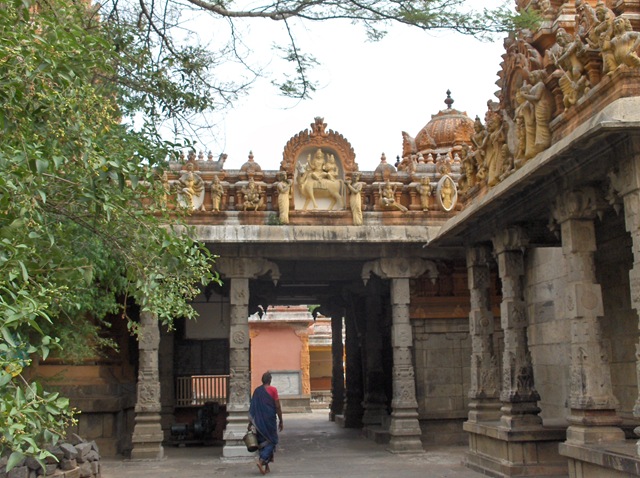
The main entryway, from the North side. To the right is the inner temple. To the left, back outside.
A group of local Tiruvannamalai people have organized themselves and are doing wonderful work to clean up, repair and open up an area on Arunachala that is near to the popular Sri Ramana Maharshi sites of Virupaksha Cave and Skandanasram.
They have organized as a part of “Global Watch Trust.” You can see more about this organization at http://www.globalwatchtrust.com. This site is not yet updated to include this project.
In this area, this project is cleaning trash, clearing brush, repairing and improving paths, planting, and building benches and meditation areas. It improves access to Guhai Namashivaya Shrine and an ancient Ganesh shrine, and provides a way to reach three hillside caves that are said by local villagers to have been frequented by Sri Ramana. The Trust has been given permission to do this work by The Forest Authority, Arunachaleshwar Temple and Sri Ramanasramam.
To get to this area, start like you are going to Virupaksha Cave. Below shows where this ‘road’ meets the street, at the northeast corner of Arunachaleshwar Temple.

Walk up the road until you see, to the left, this street. Notice the blue Global Watch Trust sign on the wall.

Continue walking up the hill.

Here they have made a small shrine at the base of a tree.

Part of the work done is to clean up trash and clear brush away from the paths. This path is marked with stone borders and shows the effects of trash and brush removal. Keep walking up this path.

When you get the this banyan tree, this is the ‘hub’ for the improved paths that access the various caves and shrines on this part of the hill.
IF you look closely you will see a man reclining on a branch of the Banyan tree. This is one of the key people behind all the activity, a young man who grew up around this part of the hill, Saravan. I think this project is largely Saravan’s vision. Saravan guided us through this area and showed us the work that had been done.

Turn left at the Banyan tree, and take this new path just a few meters to go to Guhai Namashivaya Shrine. I am told this shrine is about 500 years old.

Here are Saravan and my wife, Carol, outside Guhai Namashiva Shrine. This shrine is an important locale in the history of Sri Ramana Maharshi. This is where he provided answers to questions on slips of paper that became the second of his small books, “Who am I?” This is probably the best known of Ramana’s works.
More information can be found about Guhai Namashivaya at http://www.arunachalasamudra.org/guhainamasivaya.html

Returning to the Banyan tree, looking up the hill, to the right, outside this photo, is the stone path to Virupaksha cave. Directly up the hill is the path to the caves.
When finished, this area will have a nice stone path in the middle, surrounded by flowers and planting on both sides. There will be benches to sit and meditate and to enjoy this place.

Take the path to caves and a part of the hill that is mainly unseen by visitors.

Looking from the path, Arunachaleshwar Temple can be seen, with gopurams rising above the trees.

On the path, we pass by a small cave, big enough for perhaps two or three people to sit in.

The next feature is an old Ganesh shrine, with this water tank. This shrine has been vandalized and the Ganesh idol taken. The Global Watch Trust plans to replace this idol.

Here you can see the back of the shrine and the tank.

Another small cave near the Ganesh Shrine. This cave is big enough for a person to lie down and sleep, but not big enough to stand up.

Climbing further up the path we will get to the crown jewel (I think) of this area.
I would recommend good shoes or sandals and strong legs for the next part of the journey. The path is a bit steep in a couple of places.
Below Carol and Sarsvan are crossing a rock face. Note that they each have clippers in their hands, to work on a bit more brush cutting on the path.

As the path gets higher, the view of Arunachaleshwar Temple is breathtaking. I think the big rock in the midground is a part of Guhai Namashivaya Shrine.

The path continues up the hill. Here it is dirt and pretty easy walking. After this there is a section up through more rocks. This is the only section that I think is tricky. The biggest trick right now is that there is a place where the path goes up the hill and to the left. Take the left. This is not presently marked. Hopefully, this will be done.
Some of this path is a ‘fire road’ up the hill.

Now the cave entrance is visible.
I think this cave is a special place. The people who live on the hill below here say that Ramana stayed in this cave, I guess during what are generally known as the ‘Virupaksha days.’
We have been here just two times and already it is one of our favorite places on Arunachala.

Here is the cave entrance. Saravan and a helper, over the last few months, have put in the concrete walls, floors and benches, and painted them. Flowing water has left stains that make the walls look older than they are.

Behind me on the path, Saravan and Carol have pruning clippers and are cutting back brush from the path.

Here we are looking east from the Cave across Tiruvannamalai.

Arunachaleshwar Temple view.

Looking up from the cave, we see Arunachala. If you look closely maybe you can see about 3/4 up the photo, on the right, a coconut palm. This is Skandanasram.
If you look closely in the foreground, you will see red oleander flowers. Saravan planted these bushes three years ago. These flowers are used as puja flowers, and he wanted them to be available for those who use this cave for worship.

In the cave, an oil lamp has been lighted.

Carol sits in the cave, meditating.
We think this is one of the special places on this hill. Peaceful and serene, it is a great place to open your heart to Arunachala.

The first part of this project was a vision from Saravan as to what could be done in this area, with encouragement from the founder of Global Watch Trust, Sathya. Together they put together a plan and a team to clean up and enhance this part of the Arunachala hill to properly respect the sacred heritage that is here.
An important part of the process has been involving the villagers who live on this part of the hill. This started with a ceremony and a ‘gifting.’ School notebooks were gifted to the children in an evening ceremony that included the local villagers. The purpose of this was to educate the villagers on the importance of this area so they might not use it as a trash dump, and to enlist their help in the work to clean up the hill.
Below is a photo of the books that were to be gifted, and the team from Global Watch Trust.

Here the gifting is being done. Many locals are gathered together here.

As work started, local officials came to the group. Each interaction was similar, starting with “What are you doing?” and “No, you cannot do this.” After some discussion, permission was granted. First were officials from Arunachaleshwar Temple, then the Forest Authority, the Sri Ramanasramam.
One big part of the effort was done with a crew consisting of local volunteers and the Global Watch Trust team, shown below. Together they worked to do the major cleanup of the hillside.

For many years this area has been used for trash. The first thing needed was to clean up the trash.


Brush has overgrown the paths and area around the Banyan tree. All this needs to be cut away, and cuttings disposed of.

While the brush cutting is going on, a part of the team gathers to discuss the details of path repair for this area.

More trash to be cleaned.


Here is the approach path with trash cleaned and brush cleared. Now work must be done to repair the path.

The ancient Banyan tree is to the left, with rocks built up at its base. In the surrounding area, brush and small trees have grown up, crowding each other for space and sun. They need to be cut back so the area can be opened up and a new path built.

Here they are clearing brush from the base of the Banyan tree.

Here is a part of the path shown above that needed repair. Now it is easy and pleasant walking.

Saravan stands by the Banyan tree. Now it is cleaned up, brush cut back, trash picked up, etc.

What has been shown here is just a part of the job. to continue the job, Global Watch Trust has been sponsoring a small team to work with Saravan to continue with the path building, planting, and improving these areas by adding cement benches to sit and meditate, etc.
Work has stopped for now. Global Watch Trust needs to find people who are able to provide some support for this work.
Global Watch Trust has funded the effort that you see in these pages out of their own funds. Those funds have run out, and for work to continue donations are needed. Evan small donations are a big help. Rs 1000 ($25 or 15 Euros) pays for one day’s work on the project. 40 days work have been done so far, and so much has been accomplished.
If you are able to help, donations can be made through the Global Watch Trust web site. Go to http://www.globalwatchtrust.com/ and click the ‘donate’ button. Credit Cards and PayPal are accepted. Also they ask, until their site is updated, that you also send an email to ceo@levicent.com and let them know that this donation is to be used for the Arunachala Hill project.
1
Listen, in this exposition,
To the gist of the secret of all the settled conclusions.
There is not duality or nonduality, which are talked about.
Only the peaceful Brahman is ever existent.
Brahman, which is the One that exists
Without defect, always, everywhere, is you and I.
All are of the nature of that Supreme Brahman.
Hence, you should start inquiring into this.
2
I am ever of the nature of the Supreme Brahman.
I am ever of the nature of the Supreme Siva.
I am ever of the nature of the Supreme Self.
I am ever of the nature that is higher than the highest.
I am ever of the nature that is pure.
I am ever of the nature that is perfectly full.
I am ever of the nature of the undivided Supreme.
Inquire steadfastly into this every day.
3
I am ever the imperishable Existence.
I am ever the shining Consciousness.
I am ever the peerless Bless.
I am ever the one undivided essence.
I am ever the all pervasive.
I am ever the One that is all.
I am ever the undivided Supreme Brahman.
Inquire steadfastly into this every day.
4
I am ever the Supreme denoted by the word “That.”
I am ever the Supreme denoted by the word “you.”
I am ever the Supreme denoted by the word “are.”
I am ever the one undivided essence.
I am ever the innermost of all.
I am ever the exterior of all.
I am ever the undivided Supreme Brahman.
Inquire steadfastly into this every day.
5
I am ever of the nature of the eternal.
I am ever of the nature of the attributeless.
I am ever of the nature of the taintless.
I am ever of the nature of the sheathless.
I am ever of the nature of the partless.
I am ever of the nature of the unafflicted.
I am ever of the nature of the all-pervasive Supreme.
Inquire steadfastly into this every day.
6
I am ever of the nature of the infinite.
I am ever of the nature of the undecaying.
I am ever of the nature of the imperishable.
I am ever of the nature of the blissful.
I am ever of the nature of liberation.
I am ever of the nature of the liberator.
I am ever of the nature of the undivided Supreme.
Inquire steadfastly into this every day.
7
I am of the nature of the cause of all.
I am of the nature that is completely full.
I am of the nature of all the individuals and the Supreme.
I am of the nature that is not even an atom.
I am of the nature of the ever peaceful.
I am ever of the nature of the One.
I am of the nature of the undivided Supreme.
Inquire steadfastly into this every day.
8
I am of the nature of all activity.
I am of the nature of the doer of all.
I am of the nature of the protector of all.
I am of the nature of the destroyer of all.
I am ever of the nature that is not anything.
I am of the nature that is established as myself.
I am ever of the nature of the undivided Absolute.
Inquire steadfastly into this every day.
9.
I am of the nature of all the elements.
I am of the nature of the composites of all elements.
I am of the nature of the witness of all.
I am of the nature of the evidence of all.
I am of the nature that has nothing ever apart from it.
I am ever of the nature of nonduality.
I am of the nature of the undivided Absolute.
Inquire steadfastly into this every day.
10
I am ever of the nature of “you.”
I am ever of the nature of “I.”
I am ever of the nature of others.
I am ever of the nature of the Self of all.
I am ever of the nature of the motionless.
I am ever of the nature of the connectionless Supreme.
I am ever of the nature of the undivided Absolute.
Inquire steadfastly into this every day.
11
I am ever of the nature of full of Consciousness.
I am ever of the nature of a mass of Consciousness.
I am ever of the nature of Consciousness alone.
I am ever of the nature clothed in Consciousness.
I am ever of the nature of the space of Consciousness.
I am ever of the nature of Consciousness.
I am ever of the nature of Consciousness-Brahman.
Inquire steadfastly into this every day.
12
I am of the nature of the substratum of all.
I am of the nature of the form of all.
I am of the nature that has not an atom apart from it.
I am of the nature that is only myself.
I am ever of the nature of the bodiless.
I am of the nature of the pure space.
I am of the nature of the pure Supreme Brahman.
Inquire steadfastly into this every day.
13
I am of the nature of the Guru of all.
I am also of the nature of all the disciples.
I am of the nature of all the means.
I am also of the nature of all the ends.
I am of the nature of all the Vedanta.
I am of the nature of what is to be comprehended through them.
I am of the nature of the pure Supreme Brahman.
Inquire steadfastly into this every day.
14
I am ever of the nature of the ancient.
I am ever of the nature of the complete.
I am ever of the nature of the imperishable.
I am ever of the nature of the indestructible.
I am ever of the nature of That which alone is.
I am ever of the nature of the sorrowless.
I am ever of the nature of the Supreme Brahman.
Inquire steadfastly into this every day.
15
I am ever of the nature of the undivided, Supreme God.
I am ever of the nature of the blemishless Supreme Knowledge.
I am ever of the nature of the Supreme Existence.
I am ever of the nature of the Supreme Bliss.
I am ever of the nature of the Supreme Light.
I am ever of the nature of the Supreme Abode.
I am ever of the nature of the Supreme Brahman.
Inquire steadfastly into this every day.
16
I am of the nature of the innermost of all.
I am ever of the nature of the Self of all.
I am of the nature of the all-auspicious.
I am of the nature that has not an atom of impurity.
I am of the nature of the supreme fourth state.
I am of the supreme nature transcending the fourth state.
I am ever of the nature of the Supreme Brahman.
Inquire steadfastly into this every day.
17
I transcend all time.
I transcend all space.
I transcend all objects.
I ever transcend everything.
I am of the nature that has not an atom of conceit.
I am of the nature that has not an atom of attachment.
I am of the nature of the immaculate Supreme Brahman.
Inquire steadfastly into this every day.
18
I am ever of the nature of Existence alone.
I am ever of the nature of Consciousness alone.
I am ever of the nature of only the good.
I am ever of the nature of the middle path.
I am ever of the nature of the nondual.
I am of the nature of the Self of all.
I am ever of the nature of the Supreme Brahman.
Inquire steadfastly into this every day.
19
I am ever the unfading Bliss.
I am all pervasive and motionless.
I am ever volitionless.
I am the Supreme and cannot be comprehended by anything.
I am ever without intellect and such.
I am ever the abode that transcends the intellect.
I am ever the Supreme Brahman.
Inquire steadfastly into this every day.
20
I am of the nature that is without an atom of delusion.
I am of the nature that has no attributes of illusion.
I am of the nature that is that is without mind or such.
I am of the nature that is without desire or such.
I am of the nature that is without form or such.
I am of the nature that is without any modifications of these.
I am of the nature of the immaculate Supreme Brahman.
Inquire steadfastly into this every day.
21
I am of the nature without any waker and others.
I am of the nature without waking and such.
I am of the nature of the Knowledge of the fourth state.
I am of the nature of the Supreme Siva.
I am of the nature that is defectless.
I am of the nature of Consciousness, devoid of worldly misery.
I am ever of the nature of the Supreme Brahman.
Inquire steadfastly into this every day.
22
I am ever of the nature of the Lord.
I am ever of the nature of Supreme Knowledge.
I am ever of the nature of the all pervasive.
I am ever of the nature of empirical knowledge.
I am ever of the nature of being all.
I am of the nature of Existence-Consciousness-Bliss.
I am ever of the nature of the Supreme Brahman.
Inquire steadfastly into this every day.
23
I am ever Brahman, the taintless.
I am ever Brahman, the partless.
I am ever Brahman, the afflictionless.
I am ever Brahman, the pure.
I am ever Brahman, the attributeless.
I am ever Brahman, the peerless.
I am ever the pure Supreme.
Inquire steadfastly into this every day.
24
I am the world with all names and forms.
I am of the nature of the substratum of all.
I am the front, the back, the sides, the top, and the bottom.
I am of the nature of the undivided Knowledge.
I am of the nature of the Bliss that is myself
Without an atom apart from it.
I am ever of the nature of the undivided Supreme.
Inquire steadfastly into this every day.
25
I am of the rare nature unattainable by the ignorant,
Who have no Knowledge of the Self.
I am of the nature of the Supreme, easily attainable
By those with Knowledge of the Self.
I am of the nature of the Supreme,
The all pervasive, undivided Space of Consciousness.
I am of the nature of the pure Supreme Brahman.
Inquire steadfastly into this every day.
26
I am ever of the nature of the undivided Absolute,
Without the sextet of modifications. (birth, growth, death, etc.)
I am ever of the nature of the undivided Absolute,
Without bondage and ever free.
I am ever of the nature of the complete Bliss,
Remaining undisturbed.
I am ever of the nature of the Supreme Brahman.
Inquire steadfastly into this every day.
27
I am ever of the nature of the peaceful Brahman,
Without a trace of sankalpa (fixed idea, concept, volition) or delusion.
I am ever of the nature of the Supreme Brahman,
The undivided Light without day or night.
I am ever of the nature of the undivided Supreme Bliss,
With an atom of an ego or such.
I am ever of the nature of the Supreme Brahman.
Inquire steadfastly into this every day.
28
I am ever of the nature of the Supreme Brahman,
The undivided Knowledge without an ego.
It is the ego that is ever the misery of worldly existence.
The great Truth is that there is no ego
And that these is not an atom apart from me.
I am the undivided, complete, and full.
I am ever the Supreme Brahman.
Inquire steadfastly into this every day.
29
You are “I”; I am “I”; all else that is, is “I.”
There is no doubt about this.
Without any duality, be continuously immersed in the meditation
That the pure “I” is the Supreme Brahman.
There is no delusion, no consequences of delusion,
And no difference of any kind whatever-nothing at all.
I am the Supreme Brahman.
Inquire steadfastly into this every day.
30
Without me, there is nothing that is the meaning for the term “That.”
Without me, there is nothing that is the meaning for the term “you.”
Without me, there is nothing that is the meaning for the term “are.”
Without me, there is nothing undivided.
Without me, there is no reality or unreality.
Without me, there is no intelligence or insentience.
Without me, there is not a thing, ever.
Be ever immersed in the meditation that I am Brahman.
31
Without me, there is no difference as “this man.”
Without me, there is no difference as “this woman.”
Without me, there is no difference as “this thing.”
Without me, there is no difference as “that thing.”
Without me, there is no difference such as “is here.”
Without me, there is no difference such as “is not here.”
Without me, there is not an atom of difference.
Be ever immersed in the meditation that I am Brahman.
32
What is seen as “this” is Brahman only.
What is seen as myself is Brahman only.
What is seen as “that” is Brahman only.
What is seen as manifold is Brahman only.
What is seen as stable is Brahman only.
What is seen as unstable is Brahman only.
Whatever is looked at as “What is this?” is Brahman alone.
Be ever immersed in the meditation that I am That.
33
The primal ignorance is Brahman alone.
The emerging thought is Brahman alone.
The body with a form is Brahman alone.
The individual senses are Brahman alone.
Time and space Brahman alone.
All things that are seen are Brahman alone.
All is only Brahman, the abode, and that is myself.
Be ever immersed in the meditation that I am That.
34
Space and other elements are Brahman alone.
All that pertains to nature is Brahman alone.
What is thought of as “I,” “I” is Brahman alone.
What is thought of as “not I” is Brahman alone.
What are thought of as “you” and “I” are Brahman alone.
All thoughts are Brahman alone.
The originless Brahman alone is real, that That is myself.
Be steadfastly immersed in this inquiry.
35
There is no such things as the words or the sentences they constitute.
There is not Gita or other treatises or their authors.
There is none of the unreal world or jiva-s.
There is no Iswara who bestows desired things.
The Supreme Brahman, which is drossless, attributeless,
Timeless, blemishless, intersticeless, all pervasive, and motionless, is all.
I am that Brahman.
Be steadfastly immersed in this inquiry.
36
I am Brahman; I am Brahman; I, indeed am all.
I am Brahman; I am all.
Daily and continuously be immersed in this inquiry
Until this mode of “I am Brahman” becomes stabilized.
After this “I am Brahman” bhava (conviction) is stabilized,
Cast this off, too, and, becoming Brahman,
Be established changeless
In the undivided, blissful Experience.
37
Those who sincerely practice (the Knowledge)
That I am the Supreme Brahman—
Of the nature of the eternal, partless, delusionless, taintless,
Afflictionless, blemishless, motionless, ancient mass of Bless,
The Reality, the utterly peaceful Consciousness—
Will have the awareness of Nonduality
And thereby become the undivided Supreme.
There is no doubt of this.
38
Hence, until all differentiation disappears, one should always remain
In this beneficent bhava (conviction)
That all is Brahman
And I am, indeed, that Supreme Brahman—
With love, with ardor, and without differences
Until all uncertainty and confusion disappear totally—
And, unmindful of anything else,
Be in repose in Bliss.
39
In this exposition thus given to me by the Supreme Siva,
The4re is not an atom of doubt.
It is the Truth, the Truth. There is no doubt about it.
Whoever listens to this, and understand this—even once—
Will be liberated and become
The one Supreme Brahman.
I have graciously told you this true meaning,
Which is extremely rare to find anywhere.
40
Son! Only those who
Smeared with holy ashes,
Decked with rudraksha, and devoted to Siva,
Are ever in meditation upon the Supreme Siva
Will be rid of the sorrowful bondage of worldly existence
And become of the nature of that one Supreme Siva.
This the great sage Ribhu explained to Nidagha
The mediation of Oneness.
41
It is the perfectly full form of our Lord in a state of joyous dance that tells
Of the meditation that the wonderful beings that appear, the mysterious world that appears as if dual, and the ancient Lord (Isvara) who is eulogized
Are all the perfectly full Absolute and nothing apart,
And I am ever that Absolute; I am all.
______________________________________________________________
For more on the Ribhu Gita, go to
Copyright: SAT 2000 – www.satramana.org
Published by SAT – http://store.satramana.org/
Also Published by Ramanasramam and available in the bookstore.
Here in Tiruvannamalai for many Westerners the focus is on Sri Ramana Maharshi and Ramanasramam. Many of these go up Arunachala to the caves where Ramana lived and taught and gave darshan.
One of these caves is Skandashram. It is perhaps one mile from Ramanasramam, up a well cared-for path, up the side of the mountain.
Ramana lived at Skandashram from 1915 to 1922. This is where his mother joined him, and started preparing meals at the ashram, rather than having prepared food carried up, as had been the case since the earliest years. After the mahasamadhi of Mother, and her subsequent interment at the base of the hill, Ramana then took residence at her samadhi, the location of the present day Ramanasramam.
I show here photos from a recent walk up the hill to Skandashram. We started about 7:15 in the morning, before it was too hot. We left out the back gate of Ramanasramam.
Going through Sri Ramanasramam
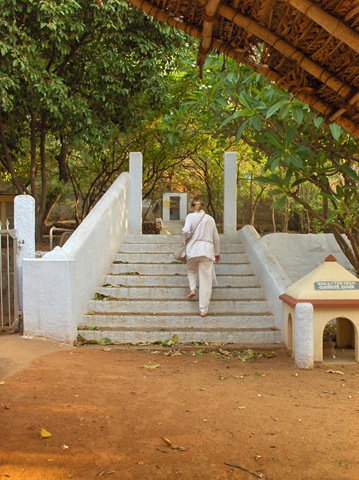
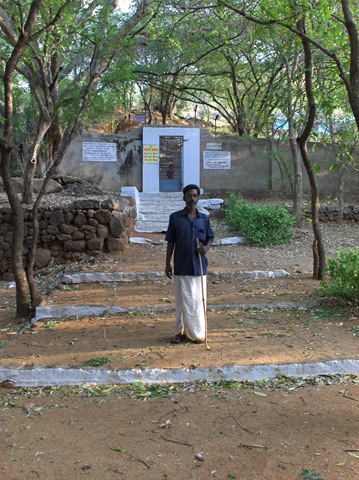
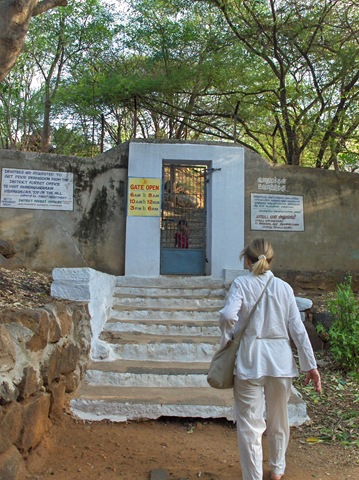
Starting up the hill
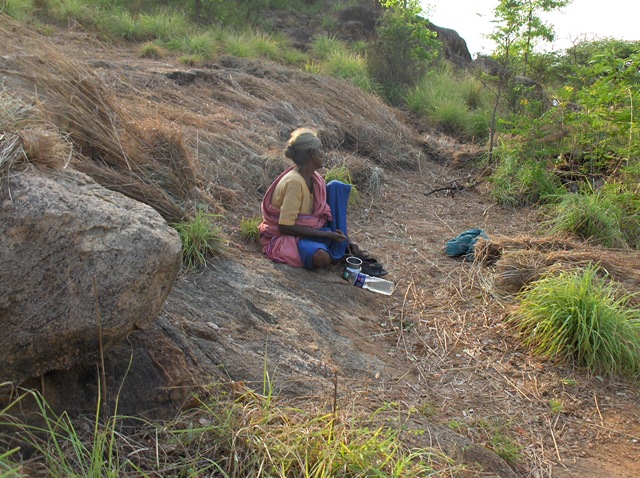
A woman working with gathered material
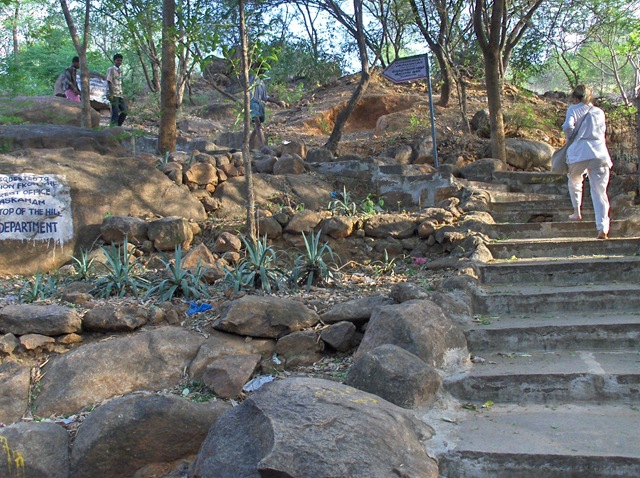
Up the path we go
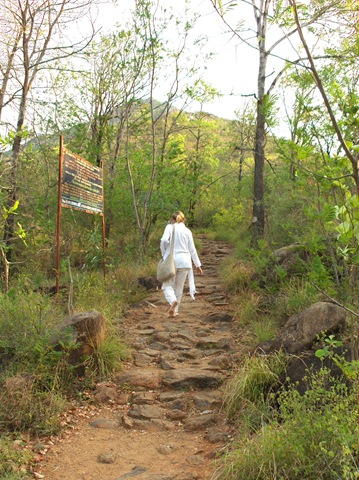
The path is ‘paved’ with stone, from Ramanasramam all the way to Skandashram, stones set into the dirt, forming a path about three feet wide. In steep areas there are steps. Someday these stones will be smooth, after 100,000’s of feet have passed over them. Each stone was carried to the path and set into the ground by unnamed workers.
On both sides of the path you will notice tree plantings, done as part of the Arunachala reforestation project that has been going on the the last few years. Ramanasramam has increased interest in Arunachala both around the world, and in India. It is this increased interest in Arunachala that has brought this project about.
Take the right fork. To the left is an entry into the inner pradakshina path.
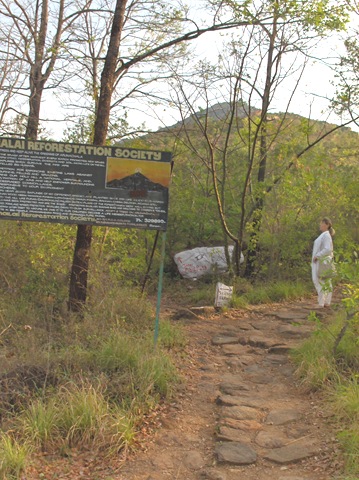
Carol is barefoot. Arunachala, the whole mountain, is considered to be a temple, and in India you take off your shoes in a temple. Many Westerners do not do this, but Carol goes barefoot on the walk to Skandashram. I do wear sandals. Carol gets more ‘punya,’ spiritual merit.
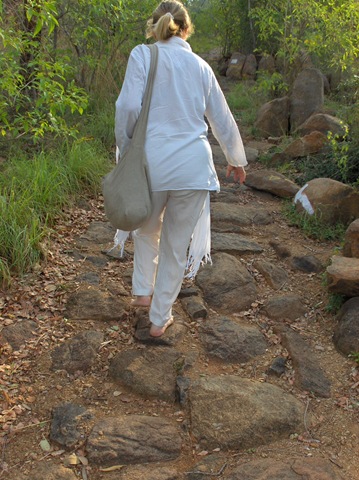
And up the hill …
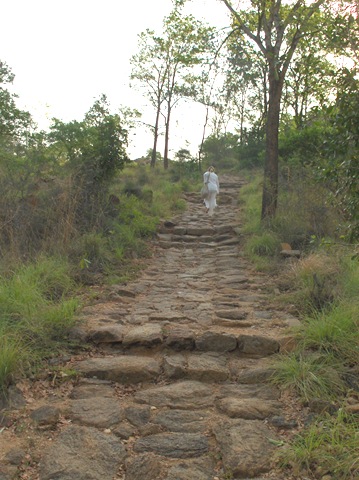
Often there are people sitting and meditating here
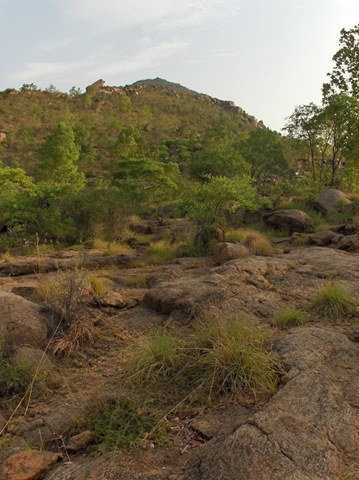
Up the path
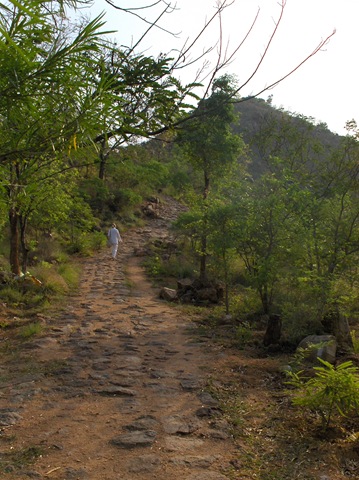
View along the way down to the city
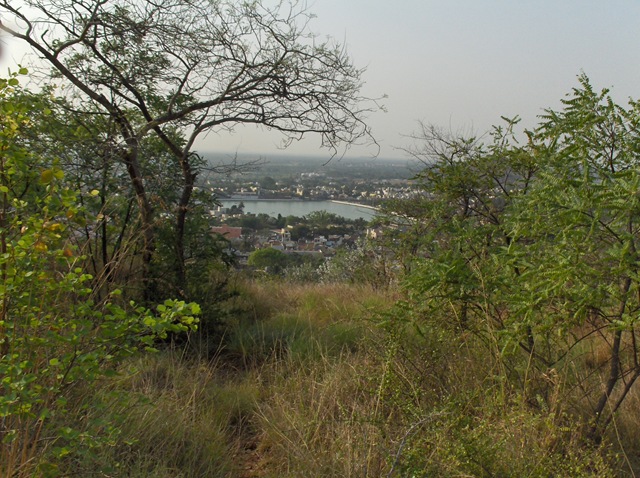
Keep going up
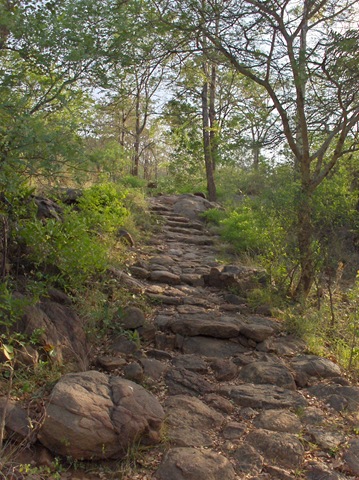
A Sadhu is usually here – “Sivo Hum,” he may say
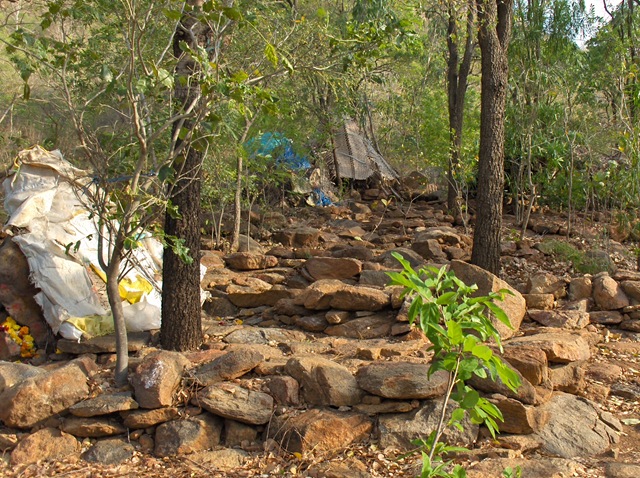
There are stone carvers along the way
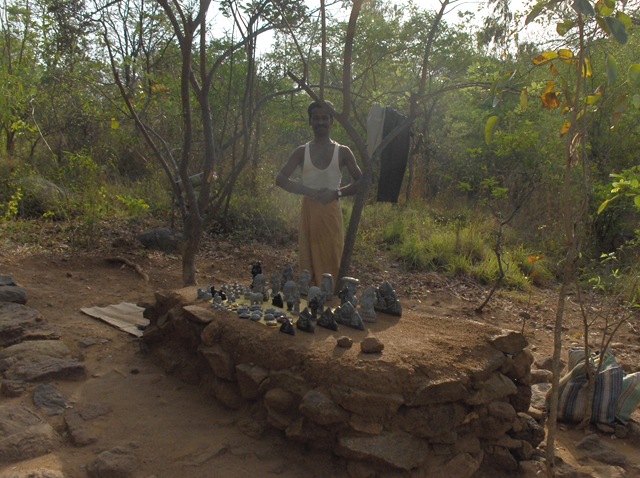
Up to the top of the path
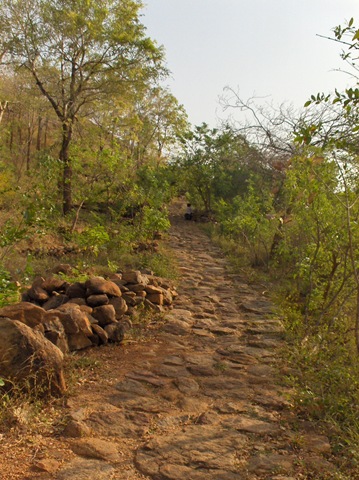
The view from the top of the path
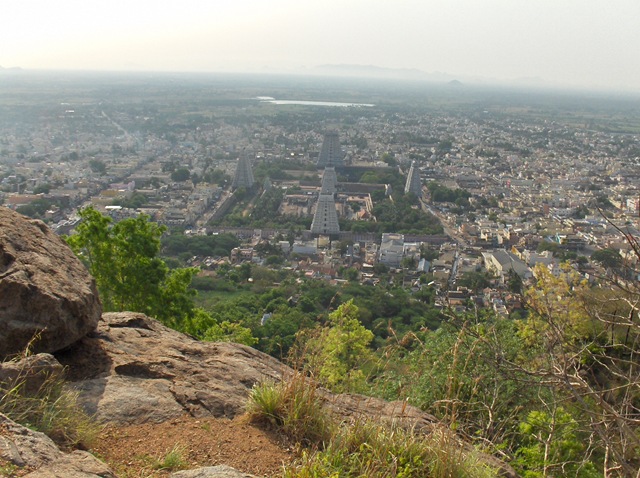
And now to Skandashram. Skandashram is the in clump of trees in the center of the photo.
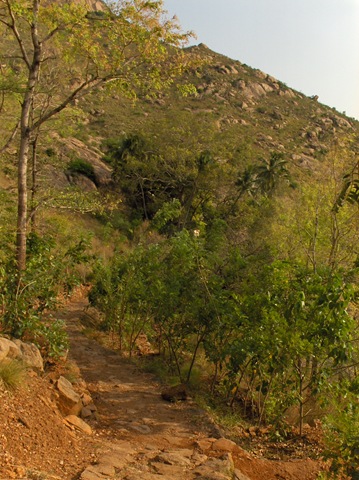
Here we are, but the gate is locked
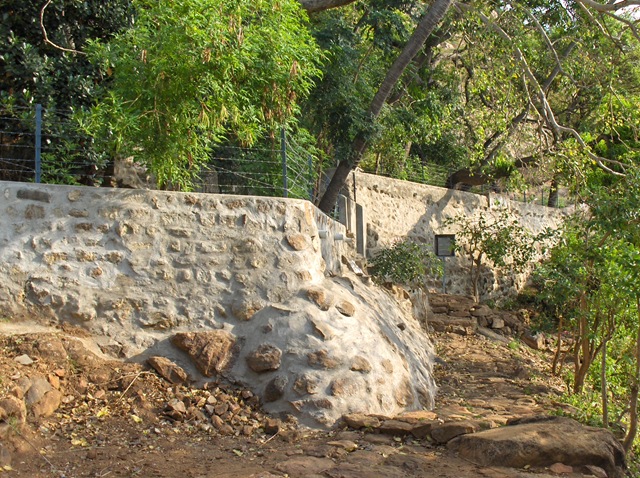
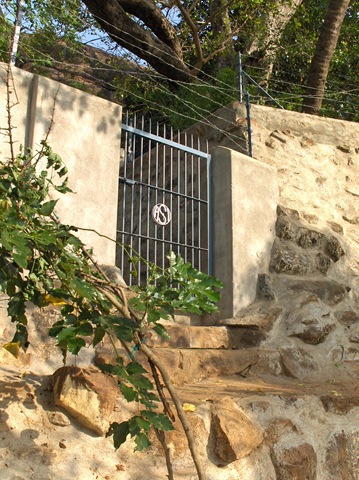
Path down to Virapakshu Cave. It is pretty steep.
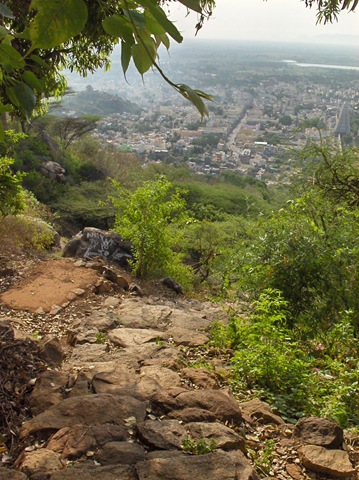
Opening the gate, walking in. The attendant unlocks the gates.
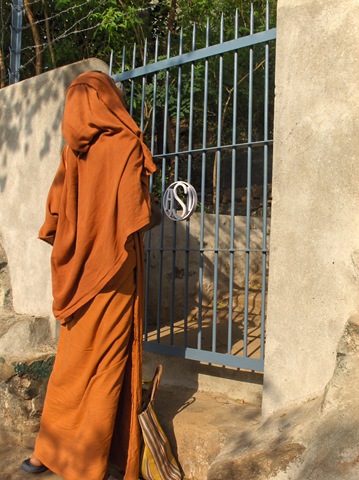

Skandashram
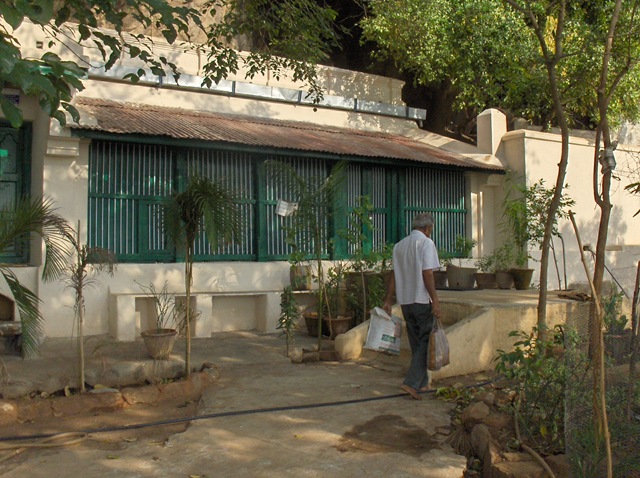
View from Skandashram
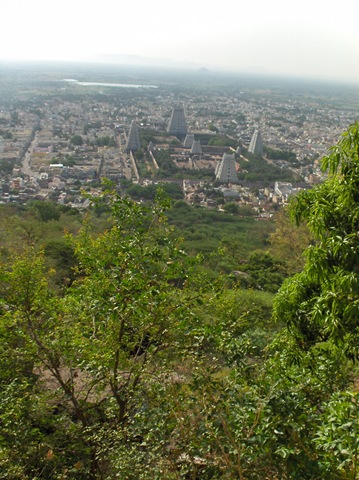
Entering Skandashram
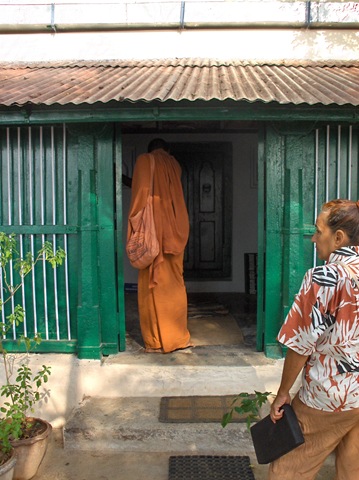
The inner chamber, with the attendant getting ready for the morning chant. This chant is wonderful to listen to. The voice is resonant, and you can hear the love for the teaching in the voice. When we go up to Skandashram, we try to get there for this morning chant. We will sit in the outer chamber, and listen to the chant and meditate, and continue the meditation after the chant is finished.
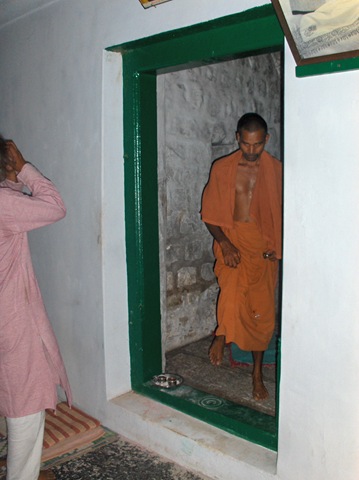
Looking out from the porch
The Mother’s Quarters
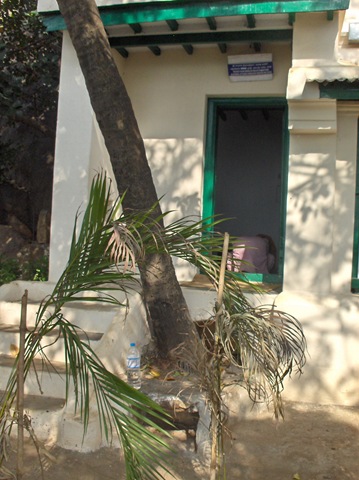
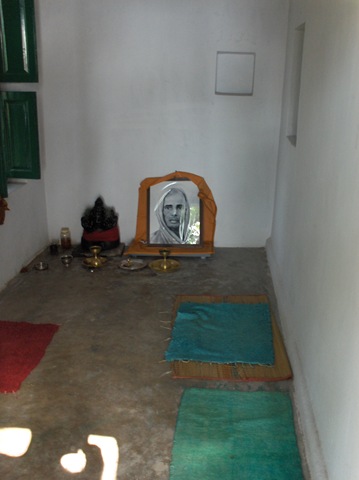
One last look around
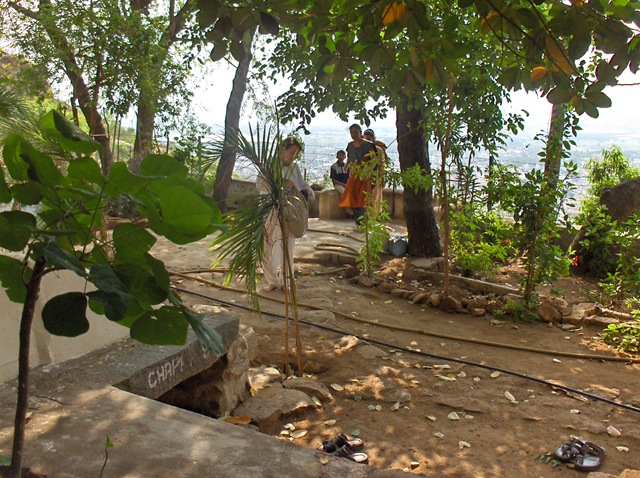
One last look at Skandashram
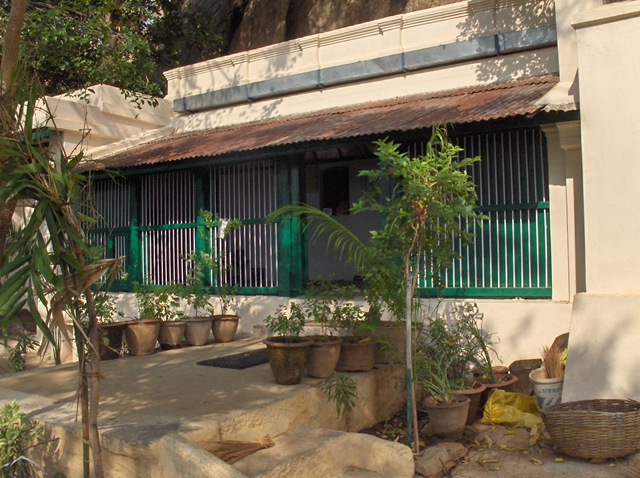
Back down the path
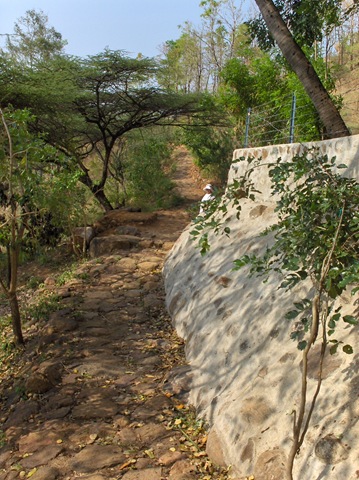
The walk down the hill was harrowing. A tree with a bees nest had fallen, and the bees chased some people down the hill. I was one of these. A swarm of bees circled around my head, stinging the back of my head several times. I was able to brush then out of my ears and off my mouth and face without getting stung there. Finally, about halfway down the hill, they stopped following me.
This is why the photos end with the one above.
Advaita and Western Neo-Advaita-A Study
By Alan Jacobs
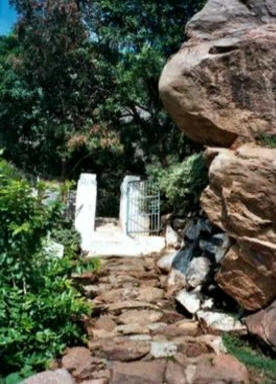
‘If the blind lead the blind
both shall fall into the ditch.’
(Matt. 15:14,15) Continue reading


You must be logged in to post a comment.