Harsha's avatar

Sacral releasing Pose

Sacral releasing Pose

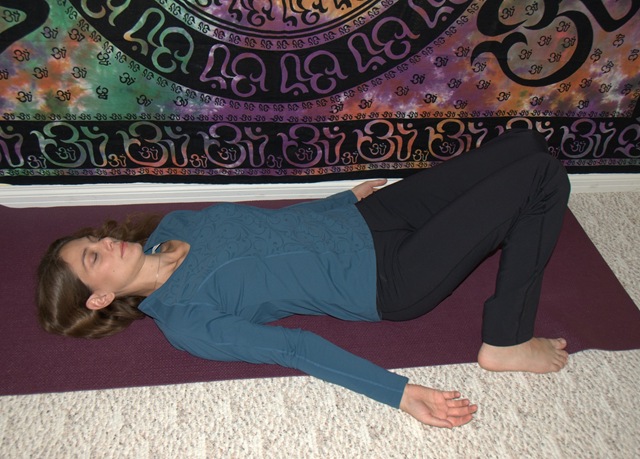
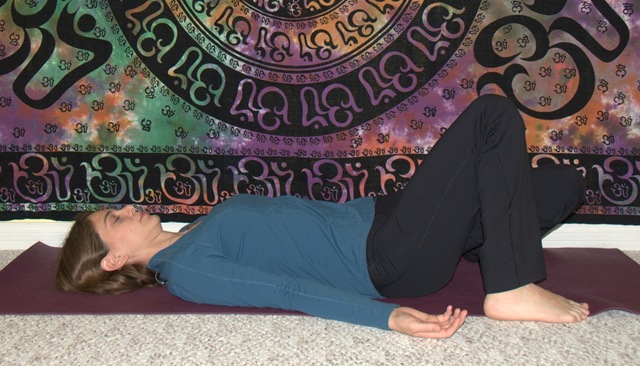
This pose is amazing for releasing and opening the sacrum. In spiritual tradition of yoga, it is said that the kundalini Shakti energy lies dormant like a coiled snake sitting at the base of the spine. When we do certain meditations or yoga poses, it is said that we can awaken this dormant energy and activate a spiritual energy to begin its journey up the spinal column and up into the brain.  Please use caution and mindfulness in this pose if you have herniated disks, or arthritis in the spine.

sacrum 1

1. Lay on your back with your knees bent. Bring your knees together and your feet about shoulder width apart.

2. Lift your pelvis slightly and move your tailbone toward your heels. Flatten the small of your back to the floor. (Or as flat as it will go)

3. Let your knees lean into each other, letting them also pull forward. (let this movement be natural, and not forced). Let the lower back relax as much as you can.

4. Hold this position for at least 30 seconds, allowing the muscles in your legs, and pelvis to relax.

sacrum opener

5. Bring your awareness into your sacrum. Imagine that you are breathing light, energy and nourishment into your sacrum. Imagine that you are drawing that nourishment all the way up your spine and into your brain.

6. Start to bring your knees down toward the floor, one at a time. Stretching the inner thigh.

7. As you bring your knee toward the floor, let the pelvis rock from side to side massaging the back of your pelvis. Continue to imagine that you are drawing nourishment and light into your sacrum, and allowing it to flow all the way up your spine. Use the rocking action of the pelvis to increase the amount of energy flowing into the sacrum and up the spine.

8. Return to position #1, and rest for another 30 seconds or longer.

Benefits ~ Loosens and releases the sacrum. Relaxes the muscles of the pelvis, and lower back. Massages and Oxygenates the back of the pelvis. Increases flexibility in the abductor, and adductor muscles in the thighs.

© written and modeled by Christine Wushke, Photo’s by Dianne Wushke.

Christine Wushke is a certified yoga and meditation teacher with over 15 years of experience. Her aim is to create a sacred space for students to effortlessly find the presence of stillness and an inner silence. Christine’s mission is to raise consciousness on the planet by empowering people to realize their own Divinity and to uncover a deep peace within. Christine is committed to assisting you in your journey, and helping you to realize directly for yourself the truth of what you are, and the stillness of truth within. In addition to her yoga and meditation training, Christine is also a registered massage therapist. In the past two years she has studied extensively in the spiritual tradition of Advaita Vedanta. Her teaching style is largely influenced by Iyengar yoga, and the nondual tradition of Advaita.

www.journeytolight.net

www.innerlightyoga.blogspot.com

Harsha's avatar

You Are What You Eat

cornucopia


by Swami Sadasivananda

Are we Really what we Eat?
The Need for a Vegetarian Diet!

Every one has heard the saying: “You are what you eat.” But according to the scriptures and saints of the major Eastern religions, as well as of early Christianity, a more precise reckoning of this euphemism is, in fact, a twofold statement: “You are what you think, and you think like what you eat!”

Science tells us that the food we eat is transformed into energy that fuels the physical body. Only in our recent times has science acknowledged that there is also another energy imbued within our food, of a far more subtle nature, that influences not only the physical sphere of our being, but more importantly, the mental realm of our existence. Although modern science holds the trophy for “The slowest learners on earth”, they are now admitting that the most profound and powerful effect food has on man occurs at the psychological plane of existence.

This fact is, of course, based on the Maxim of physics that all elements in existence are essentially energy, and that energy is constant. The constancy of energy is defined by its nature of being impervious to essential altercation. The energy in the beginning of a process is the same at the end of the said process. What goes in, stays in!

In terms of ingestion of digestible matter, the quality of the energy, scientifically and specifically the vibratory rate, that dominated the nature of the plant or animal that is being eaten, is directly transferred through the digestive process and into the mind of the consumer. Thus our mind, our perception, and finally our spirit become what we eat!

If the energy is heavy or inert, little can be done with it to produce the state of silence and clarity needed to reflect the truth of spirit. Certain actions darken the mind and make it thick or heavy, vibrating very slowly–sometimes seemingly not at all. On the other hand, some actions lighten the mind, making it fluid and subtle, vibrating at a very high level. It is this latter condition that is needed for attaining the state of liberation–or rather, the state that liberates the spirit from the illusion of bondage and suffering. It is really the mind that becomes liberated, but that liberation also affects the essentially ever-free spirit and sets it free from involvement with the mind. And to attain such liberation the mind must be purified and refined. Thus, vegetarian diet becomes one of the best and strongest means for its purification.

“When we realize that any physical object has all the levels which we do, namely, the physical, biomagnetic, sensory, intellectual and will bodies, we can understand the importance of the kind and quality of food we eat. For not only does the physical substance of the food become assimilated into our physical body, so also do the subtler energies become united to our inner levels. This is the teaching of the Chandogya Upanishad:

“Mind consists of food. That which is the subtle part of milk moves
upward when the milk is churned and becomes butter. In the same
manner, the subtle part of the food that is eaten moves upward and
becomes mind. Thus, mind consists of food.” 1

“It is obvious, then, that the food we eat is going to determine the quality and condition of all the levels of our being. Our food has the same levels we do, and the different energies of the food are absorbed into our corresponding levels. Therefore when we eat something, it not only affects us on all levels of our existence, it becomes those levels. In this very real sense we indeed are what we eat. In esoteric philosophy our various levels are looked upon as separate bodies through which our consciousness operates. Since those bodies are formed essentially from the food we eat, they will be conditioned by and function according to the kind of energy extracted from the food. We are very much like the child’s toy that is a series of colored rings stacked on a rod. That is, we are successive layers of subtler and subtler energy that are connected to the physical body. From these energy levels the different life  processes are empowered and administered. When the energies within us are positive, they produce harmonious states of mind and behavior. But when the energies are negative, they move in a random and chaotic manner and produce negative states of mind and, consequently, negative behavior. Moreover, these toxic energies can also manifest as physical illnesses or defects. Substances that are toxic to the body–such as meat, alcohol, nicotine, and drugs–are toxic on the inner levels as well, and their ingestion poisons all our bodies by putting into them negative energies which are going to manifest in the disrupting manner just described. On the other hand, fruits, vegetables, and grains are reservoirs of pure, basic life energies that are very light and malleable. These energies are easily assimilated into all our bodies and made to take on our specific, unique life vibrations and karmic patterns.” 2

Thus, we must accept, and can on no legitimate grounds refute the facts of the twofold statement: “You are what you think, and you think like what you eat!”  Therefore, it can be gleaned, from both the material as well as the spiritual viewpoint, why Sri Ramana Maharshi stressed a vegetarian diet.

Question: I have heard it said that the Maharshi set no rules of conduct or lifestyle within the Ashram that came up around him. Therefore, how can what is being said regarding a vegetarian diet be essential for spiritual attainment?

It is in fact openly stated, and recorded within several of the published core teachings at the Ashram that Bhagavan Ramana set forth only one regulation for the devotees living within the Ashram, as well as for those living outside that followed his teaching. This one rule of life regarded the maintaining of a sattvic (pure) diet.

Question: Did Bhagavan ever explain why maintaining purity of diet was important, and what constituted a sattvic or pure diet?

He did explain the reason why a vegetarian diet was, and is even to this day, maintained at all times. This discipline was central to his guidance of effective means of sublimating (uplifting) the mind and its direction towards reflection upon its True Nature. His guidance stressed an ever purer awareness or quality of mind, which paved the way towards awareness within the heart, the essential home of our Eternal Self.

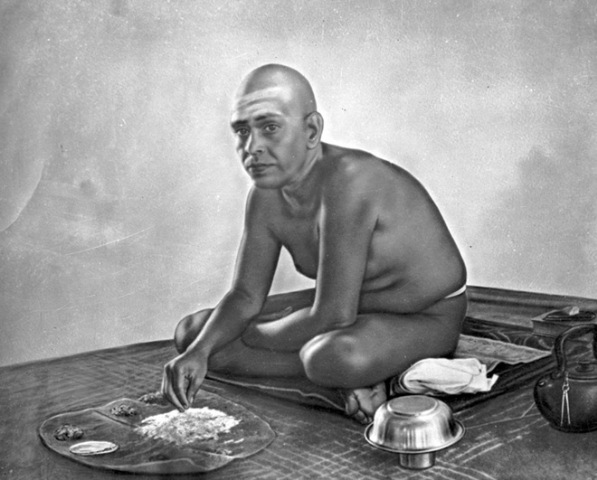
Bhagavaneating

 In Bhagavan’s own words we find recorded:

Devotee: What diet is prescribed for a sadhak (one engaged in spiritual practices)?
Maharshi: Sattvic food in limited quantities.
D.: What is sattvic food?
M.: Bread, fruits, vegetables, milk, etc.
D.: Some people take fish in North India. May it be done?
(The Maharshi made no answer.)
D.: We Europeans are accustomed to a particular diet; change of diet affects health and weakens the mind. Is it not necessary to keep up physical health?
M.: Quite necessary. The weaker the body the stronger the mind grows.
D.: In the absence of our usual diet our health suffers and the mind loses strength.
M.: What do you mean by strength of mind?
D.: The power to eliminate worldly attachment.
M.: The quality of food influences the mind. The mind feeds on the food consumed.
D.: Really! How can the Europeans adjust themselves to sattvic food only?
M.: (Pointing to Mr. Evans-Wentz) You have been taking our food.
Do you feel uncomfortable on that account?
Mr. Evans-Wentz: No. Because I am accustomed to it.
D.: What about those not so accustomed?
M.: Habit is only adjustment to the environment. It is the mind that matters. The fact is that the mind has been trained to think certain foods tasty and good. The food material is to be had both in vegetarian and nonvegetarian diet equally well. But the mind desires such food as it is accustomed to and considers tasty.
D.: Are there restrictions for the realised man in a similar manner?
M.: No. He is steady and not influenced by the food he takes.
D.: Is it not killing life to prepare meat diet?
M.: Ahimsa stands foremost in the code of discipline for the yogis.
D.: Even plants have life.
M.: So too the slabs you sit on!
D.: May we gradually get ourselves accustomed to vegetarian food?
M.: Yes. That is the way. 3

In this example, and as is seen throughout the teachings of Sri Ramana Maharshi, Bhagavan is stressing: “It is the mind that matters.” Furthermore, “The mind feeds on the food consumed”, and “The weaker the body the stronger the mind grows.”

In the following story, we are being shown that a pure diet will not only elevate the quality of the mind, but will also keep the body free from illness: “One afternoon at 3 o’clock, a devotee who was going to Madras gave a small tin containing some ointment and said that if that medicine was applied to Bhagavan’s legs, the pain would decrease, and that if Bhagavan would continuously use it, he would bring a dozen tins of it from Madras. Bhagavan replied, saying: “Enough. The Karpura Thailam I am using now is adequate. Why do I require such costly medicines? If diet is properly regulated, no medicine will be required. When these medicines are used, the ailment apparently disappears, but it starts again. That is because of some irregularity in diet.” 4

One of the close disciples who lived with Bhagavan, Arthur Osborne, related what the Maharshi taught him: “It should be explained for non-Hindu readers, that the practice of vegetarianism is not only out of disinclination to take life or eat flesh, though that is one reason for it; it is also because unsattvic food tends to increase animal passions and impede spiritual effort.” 5

Although the Ashram food was strictly vegetarian, Alagammal, Bhagavan’s mother, like some very devout Brahmins, went still further and considered some vegetables (i.e. onions) also unsattvic (impure). When Bhagavan would sit with the devotees in the kitchen and peel onions, Alagammal would weep bitterly. In response, Bhagavan would retort while holding up an onion: “Behold the powers of this small bulb.” She would then weep all the more loudly. Bhagavan had the final word, and would say mockingly: “Mind that onion! It is a great obstacle to Moksha (Deliverance)! It should be said here that Sri Bhagavan did not disapprove of orthodoxy in general. In this case there was excessive attachment to the forms of orthodoxy and that was what he attacked. In general he laid stress on the importance of sattvic (pure) food. He did not often give any injunctions at all concerning outer activity; his usual method was to sow the spiritual seed in the heart and leave it to shape the outer life as it grew. The injunctions came from within.” 6

1 Chandogya Upanishad, 6.5.4, 6.6.1,2,5.
2 Spiritual Benefits of a Vegetarian Diet, Swami Nirmalananda, Atmajyoti Press.
3 Talks with Sri Ramana Maharshi, recorded by Sri Munagala Venkataramiah, Sri Ramanashramam 2006, Talk 22, p. 20.
4 Letters from Sri Ramanashramam, Suri Nagamma, Sri Ramanashramam 2006, Letter #266 December1949, p. 640.
5 Ramana Maharshi and the Path of Self-Knowledge, Arthur Osborne, Sri Ramanashramam 2006, p. 82.
6 Ibid. p. 81.

cornucopia - Copy

Reprinted  with permission of Swami Sadasivananda
To subscribe to his newsletter, go to http://www.ramanateaching.org/contact.html
For more information on Swamiji, click here:   About Swami Sadasivananda
Teachings of Bhagavan Sri Ramana Maharshi web site: http://www.ramanateaching.org
Ask your question in relation to Bhagavan’s teachings, meditation and spirituality at:
http://www.ramanateaching.org/faq

Harsha's avatar

Call of the Conch-Part 2: By Joyce Sweinberg


WARNING:  THE  STILL AND VIDEO IMAGES IN THIS ARTICLE
ARE GRAPHIC DEPICTIONS OF VIOLENCE TO DAIRY COWS AND THEIR OFFSPRING.

vishn69

We need to realize that milk is not an “Innocent”
animal product as it is thought to be, but is a
highly violent, cruel, and immensely exploitative food.
The most important factor in cow abuse is the economic factor;
we need to realize that as long as we, the consumers
of milk and leather, continue to buy these violent products,
the exploitation of the cow and the killing of her calves
will continue to occur.
~Shri Kamlesh

 “The female dairy cow spends her life confined in close quarters with other cows, being pumped with hormones calculated to produce pregnancy after pregnancy as long as she is capable of bearing calves, both to increase the population of the cows for milk and meat production and to spur the female to produce more milk. When her calves are born, they are taken from her within a few days of birth, giving rise to the grief of separation for both the mother and the child.”  https://luthar.com/call-of-the-conch-1.  The videos below depict the artificial insemination of the dairy cow, the birth of the calves, and the removal of the calf shortly after birth…on it’s way to either the slaughterhouse if it is male, or to its own pathetic future as a female dairy cow, soon to face the same fate as the grieving mother who gave birth to her,  bearing in her heart the infant grief of separation from her mother and facing the maternal grief in the heart of a mother forced to face the loss of her child.

The motherless child…

http://www.youtube.com/watch?v=wiRxkU_opyQ&feature=player_embedded

http://www.youtube.com/watch?v=_ZrX1rTddho

  http://www.youtube.com/watch?v=_kM387cI4rk&feature=player_embedded

http://www.youtube.com/watch?v=hAiIIZMKPC0&feature=player_embedded

Contrasts a dairy calf searching for his mother on a farm with undercover footage of calves at a slaughterhouse.

“Roughly 50% of the calves are male calves which are considered to be the by-products of the milk industry and do not have any value. These male calves are the most unfortunate souls of the milk industry; they are the silent sufferers in the background that no one bothers to notice. They sacrifice their lives so that we can drink the milk which was meant for them.These calves meet their deaths wherever factory farming occurs both in India and in the western world.

India.

Before mechanized farming, the male calves were highly sought after as draught animals that would till the land and become the farmer’s best friend. But with tractors taking over the role of draught animals, the male calves are useless and the farming/milk industry no longer feels it necessary to sustain them.

Due to the cultural heritage of India, where beef eating is not popular and cow killing is illegal, these calves are not slaughtered for calf-meat or “veal” as in the western countries. But since they pose no value to the farmer these calves are killed in the most horrific manner.

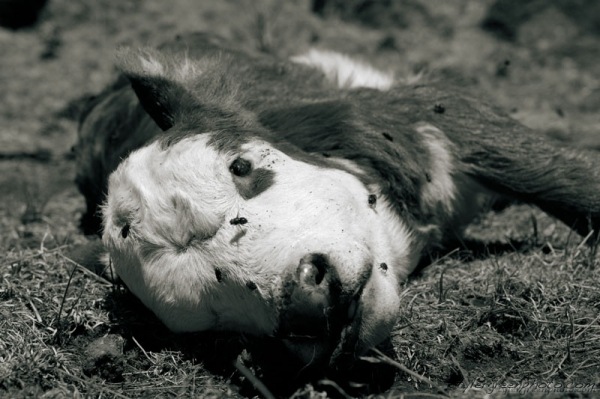
 dead-calf

Most male calves in India are separated soon after their birth… they are strangulated to death, starved and then even buried alive in compost mounds to dispose their bodies. In some cases a stuffed animal like structure is covered with the hide of the dead calf and placed near the cow, so that she continues to give milk thinking that the stuffed doll is her living calf! Many are slaughtered in illegal slaughter houses to make fancy “calf leather” belts, purses, wrist bands etc.

Western Countries.

In the west the male calves are seen as sources of “calf-meat” or veal, which is the most perverted food any human can eat. The specialty of veal meat is that it is very tender, fatty and succulent and to achieve this, the calves are taken from their mothers immediately after birth and raised so as to deliberately induce borderline anemia.

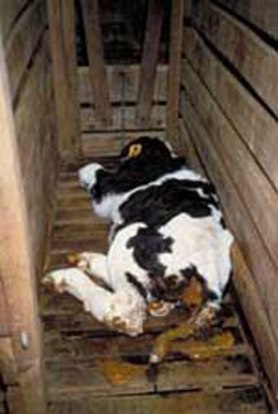
 sick_calf

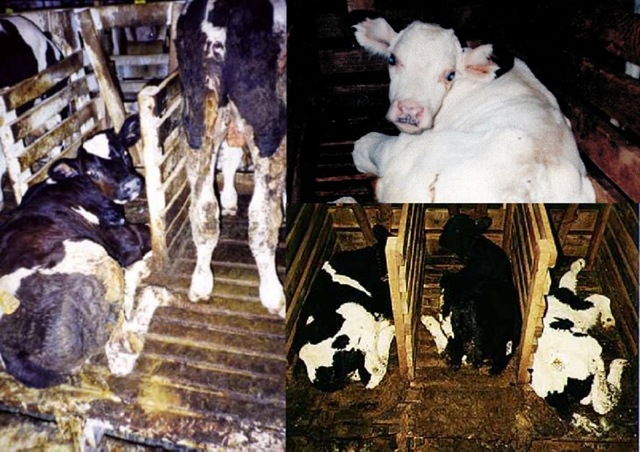
veal

They are then confined in small cages called as veal-crates, usually measuring 2-feet-wide, in which they cannot turn around or stretch their limbs all their lives. This is done so that their flesh does not build muscle which is considered to be tough to eat. After about 3-5 months of living confined to their cages, these innocent calves are then slaughtered to satisfy humans’ perverted thirst for flesh.


cattle-veal-13 preg-conveyorbeltbig

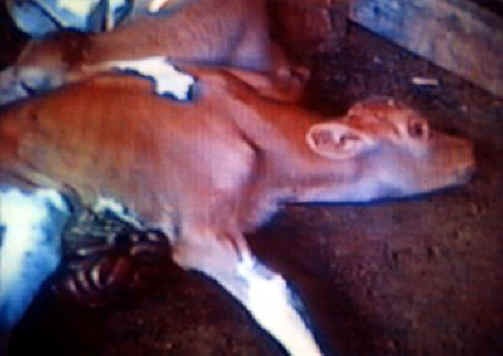
The plight of the female calves is worse, they are raised so that they can be perpetually inseminated to give us their milk for the rest of the lives. If they are so unfortunate so that they become sick or break their legs which they often do, due to being continuously pregnant they are then mercilessly slaughtered, ending as meat and leather.

It is a well known fact the cows raised for milk (Dairy cows) have to undergo much more abuse and sufferings than the cows which are raised for meat (Beef cows)”

These are NOT isolated incidents, but are in fact routine procedure to dispose the male calves as profitably as possible depending upon the location, either in India or in the west. This suffering and killings are a direct result of the milk industry, which satisfies our thirst for milk, our cravings for ice-creams, payasams and chocolates at the cost of these innocent animals.

While we enjoy our milk, the silent killings go on!   ~Shri Kamlesh*

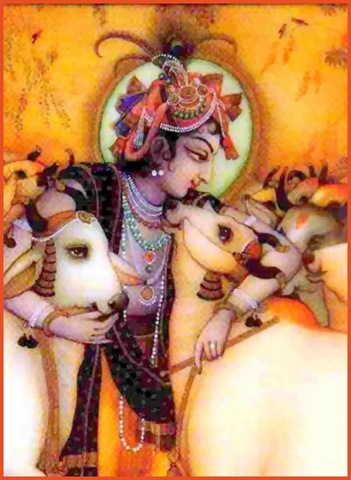
 Having one’s actions grounded in ahimsa for the Lord’s creatures, all of them, calls to our spiritual conscience with the power of the sounding of the conch. The conch, held by Vishnu, the preserver, represents life. When it is sounded, it is the sound of victory, as by Krishna and Arjuna heralding the defeat of the adharmic influences in the battlefield of the mind symbolized in the Holy Gita.  May the adharmic influences inherent in the dairy industry fall to the ground in defeat at the call of the conch.

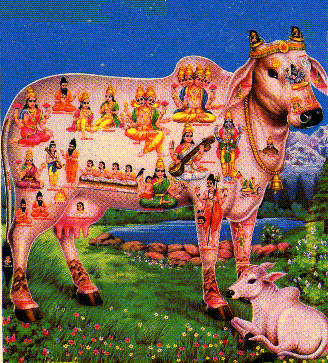
cow-gomatha_vishnu… dhenoonaamasmi kaamadhuk…

Among the cows, I am Surabhi, the wish-fulfilling cow. B.G. 10.28

 b36

 https://luthar.com/call-of-the-conch-introduction
https://luthar.com/call-of-the-conch-1

*The italicized text of Part 2 in this series was written by Shri Kamlesh, who also provided many of the images used. Any edits were to context, not to content. I offer my namaskarams to him.

Harsha's avatar

Njanappaana by Poonthaanam Nambudiri-2

translation and commentary by Smt. Savitri Puram 
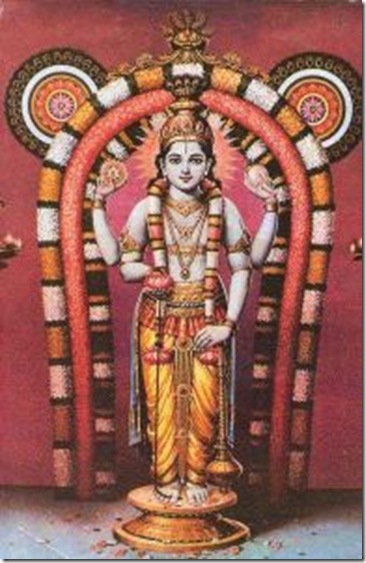
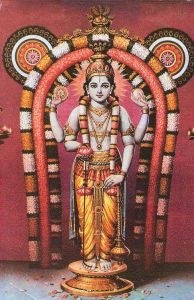
duzvdh4anypjffvi_D0_guruvayurappa

Krishna! Krishna! Mukunda! Janaardana!
Krishna! Govinda! Naarayana! Hare!
Achyuthaananda! Govinda! Maadhava! 
Sachidaananda! Naarayana! Hare!

boarder

Introduction

Njanappaana can be considered as the Bhagavad Gita of Malayalees. This is a Darshanika kaavyam or philosophical poem expressed in the most simple Malayalam language for ordinary people. Poonthanam Nambudiri, an ardent devotee of Shri Guruvayurappan, transformed his unbearable sorrow from his infant son’s death into a “yogavishesham”. He used this sad experience to build his Bhakthi soudham or house of devotion and opened it for all devotees for all time. Even though the language is very simple, this njaanappana, or song of wisdom deals with the essence of all vedas and upanishads. May Bhagavan Guruvayurappan, Bhagavathy Sarswathi Devi and Sri Poonthaanam Nambudiri bless us to become wiser by going through this great Song of Wisdom!!

This is continued from Part One… https://luthar.com/njanappaana-1

boarder

 Chuzhannitunna samsaara chakratthil
Uzhannitum namukkarinjeetuvaan
Arivulla mahatthukkal undoru
Paramaartham arul cheythirikkunnu
Eluthaayittu mukthi labhippaanaay
Chevi thannithu kelppin ellaavarum

We are restlessly moving (uzhannitum) up and down in this rotating (chuzhannitunna) wheel of material world (samsaara chkratthil). For us to know (namukkarinjituvaan), great njaanis( arivulla mahatthukkal) have preached (arul chythirikkunnu) the paramaartham (Supreme truth). All of you listen to this (kelppin ellaavarum) because to attain salvation (mukthi labhipaanaay) easily (eluthaayittu) God has given you the sravanaedriyam or ears (chevi thannithu). The meaning of “chevi thannithu” can also be taken as “give your ears” or listen to what Mhaathmaas told us.

Getting human life is rare and even after getting human life, very few people are blessed to pursue the spiritual path. But great sages of the past realized this pitiable condition of ordinary souls and have prescribed easy ways to know the Supreme Truth. One of the easiest method for Kaliyuga suggested by them is Naamasankeerthanam. Since this is the opinion of self-realized bhakthaas, Bhagavan Himself approves this method and tells in Bhagavad Gita: “yajnaanaam japayajnosmi” or Among all the sacrifices, sadhanas, austerities or forms of tapas, I am represented by japa” and thus supporting the words of Mahaathmaas.

(Bhagavan always supports Bhakthaas. When Poothaanam once read Amaraprabhu as Maraprabhu while chanting Vishnusahasra naamam, a few Sanskrit scholars made fun of him. Bhagavan could not take his dear devotee’s grief and told from the sanctum sanctorum : “I am Amara prabhu as well as Maraprabhu, meaning I am also the lord of trees or in Malayalam maram”.)

We are all going up and down on the wheel of material world rotating with extreme speed and it is very difficult to escape from that. But once we know the Supreme Truth, we will be relieved from the samsaarachakra. This Brahma jnanam is possible by sincerely chanting the auspicious names of God because Naamam or names of Lord are even greater than Naami or Lord Himself.  Hanumanji had to just chant Raama naamam to cross the ocean where as Lord Raama had to construct the bridge to cross the ocean to Lanka!

Also as explained in the previous lines [https://luthar.com/njanappana-1 ], anybody can chant naamam anytime and anywhere. So Poonthaanam is asking us to listen carefully to what Mahaathmaas have told us about Supreme Truth. Like sravanedriyam or ears can be used for hearing the greatness of Lord, all other indriyaas should be used for the purpose of serving God. Sankarrachaaryar also gives this idea in a very beautiful sloka in Soundarya Lahari:

JapO jalpa: shilpam sakalam api mudraa-virachanaa
Gathi: praadakshiNya-kramanam ashanady aahuthi-vidhi:
PraNaama: samvesha: sukham akhilam aathmaarpaNa -drushaa
Saparyaa paryaya: thava bhavathu yan mae vilasitham

Let my spoken words become manthras, let all my hand gestures become mudraas, let all my steps become circumambulation or pradakhinam to you, let my lying down to sleep become prostration to you, let the food I consume be an offering to the sacred fire lit for you, let what ever I do become a worship to you. 

Nammeyokkeyum bandhicha saadahanam
Karmam ennariyendathu mumbinaal

First and foremost (mumbinaal), we should know (ariyendathu) that karmam is the thing (saadhanam) that binds (bandhiccha) all of us (naameyokkeyum) to this world.

Even before telling us more about the easiest path for salvation, poet starts with the big word : “Karma” and how we are all bound in the cycle of birth and death by karma. Both good and bad karmaas are binding and hence we have to know what is the root cause for making us do karmaas and eradicate the root cause. In this context, an example of a burning stick is appropriate. If we move a burning stick in a circle, a burning circle will seem to appear. In reality (understanding the reality is njaanam) the circular movement of the stick causes the illusion. Likewise the wheel of time is moving with very high speed dragging us along with it and forcing us to do good as well as bad karmaas with ego (or feeling of “I am the doer). This causes the illusion of bondage. So we have to have the njaanam or knowledge to go beyond this illusion or Maya to escape from the bondage. Also the famous example of seeing a rope and misunderstanding it as a snake is appropriate. Until we know that it is only a rope, we will be scared and stressed. What will lead us to this knowledge of Brahmam? Continuous remembrance of Lord through Naamasankeerthanam will help us to detach us from the karma-bound cycle and lead us to Njaanam and moksham. 

Law of Karma is a law of justice and it is straight forward, impartial and inescapable. The only thing that can nullify the effects of Karma is Bhagavan’s grace. Bhagavan’s blessings loosen the tightly bound law of Karma and makes the otherwise impossible escape possible for us. In Kaliyuga the easiest way to obtain Bhagavan’s blessings and grace is naamasnakeerthanam. 

In Mahabharatha, Sahadeva advises his elder elder brother Yudhishtira on the subject of Karma. He says that when ever we do Karmaas with the feeling of “I am the doer” or “mine (two letter sanskrit word “mama”) those karmaas lead us to the cycle of birth and death. But when we do karmaas thinking that we are not the doer, the results of the karmaas also will not be ours. This feeling is called “I am not the doer” or not mine (in Sanskrit, it is expressed in three letters “na mama”). Karmaas performed with this attitude are not binding and and free us from the eternal cycle of birth and death. Again, how can we develop this attitude in Kaliyuga? Poonthanam assures us along with Bhagavan that Nammasankeerthanam will eventually give us this “na mama” attitude and lead us to njaanam and moksham.

How can we forget to mention Shankaraachaaryar’s lines

punarapi jananam punarapi maranam
punarapi jananii jathare shayanam
iha samsaare bahudustaare
kripayaa apaare paahi muraare

Born again, death again, birth again to stay in the mother’s womb! It is indeed hard to cross this boundless ocean of samsara. Oh Murari! Save me through Thy mercy.


Munnam ikkanda viswam aseshavum
Onnaayulloru jyothi swaroopamaay
Onnum chennangu thannodu pattaathe
Onnilum chennu thaanum valayaathe
Onnonnaayi ninakkum janangalkku
Onnukondariyaavunna vasthuvaay
Onnilum urakkaattha janagalku
Onnu kondum thiriyaatha vasthuvaay
Onnu pole onnillaathe ullathil
Onnaayulloru jeeva swaroopamaay
Ninnavan thanne viswam chamachu pol,
Moonnum onnil adangunnu pinneyum

During pralaya or dissolution (word “munnam” refers to pralayam) this whole world (viswam asheshavaum) becomes the one and only one (onnayulloru) jyothi swaroopam or parama thejopunjam. This jyothiswaroopam is only a witness, this is neither attached to anything in this world (line four) nor let anything in the world get attached to this (line 3). Those Jnaanis and Bhakthaas (predominantly of saatwic and raajasic nature) who try to figure out one by one (onnonnaayi ninakkum janangalkku) using “nethi, nethi” process or “not this, not this” process, perceive “It” as one thing through which everything is known (onukondariyaavunna vasthuvaay). For those people whose minds are restless, fickle and out of control (onnilum urakkaattha janangalkku -predominantly of Thaamasic nature) “It” cannot be comprehended or understood by any means (onnukondum thiriyaattha vasthuvaay). Outwardly each and every being is different (oonu pole onnillaathe), but the spirit or jeeva swaroopam in all  beings are the same (ullatthil onnaayulloru jeevaswaroopamaay). The same jeeva swaroopam that exists in everything (ninnavan thanne) created the whole universe (viswam chamacchupol) and “It” again (pinneyum) contains all the three . (moonnum onnil adangunnu)

During pralaya or dissolution, everything is merged in Lord and nothing remains except the parama jyothi swaroopam or light of lights (or paramaathma chaithanyam). This is compared to the disappearance of stars and moon at sunrise. Likewise, the whole universe including the sun, moon, stars and all planets dissolve and become part of that great Jyothi swaroopam. One of the prayers we chant during aarathi or deepaaraadhana expresses the same idea:

Na thathra suryo bhathi, na chandratharakam
nema viddhutho bhanthi kuthoyamagni
Thameva bhantham anubhaathi sarvam,
thasya bhasa sarvamidham vibhathi.

“There the sun does not shine, nor the moon nor the stars; these lightnings also do not shine – how then (can) this earthly fire? Verily, everything shines after Him reflecting His glory. This whole world is illuminated with His light.”

But this light of lights is “Anaadimadhyaantham” or beginningless,middleless and endless. At the end of the dissolution phase, each individual soul again takes birth depending on the accumulated karmaas. These individual souls with accumulated karmaas do not get salvation during dissolution, but just remain hidden in Easwara Chaithanyam and then take birth again to experience the results of their good and bad karmaas.

These lines specifically explains how Bhagavan is not tainted by our karmaas. Even when we disappear into the jyothi swaroopam, that jyothi swaroopam remains unaffected. So our sorrows and happiness do not affect Bhagavan and Bhagavan is not responsible for our sorrows and happiness. Our experiences are the direct results of our own karmaas. Then how does Bhagavan help us? When we realize that the jyothi swaroopam with in all of us is the same as the paramaathmachaithanyam, all our actions become an offering to the Light of Lights, “mama or mine” attitude disappears, and “na mama or not mine” attitude arises. But only in a pure mind this realization happens and in Kaliyuga, Nammasnakeerthanam is the most practical method to attain purity of mind.

“Onnukondariyaavunna vasthu” indicates that for ordinary people like us, Brahmam can be known only through the path of Bhakthi. Bhakthi leads to Njaanam. Little Prahlaada believed that everything existing was Naarayana swaroopam and when he told his father that God is omnipresent, Lord did come out from the lifeless pillar to protect Him. Gopikaas were ordinary housewives and just because of their intense and blind devotion to the Lord of Vrindavan they attained Jnaanam and moksham. Fickle minded ordinary people who are distracted every moment with the the various temptations of life cannot comprehend the greatness of Bhagavan. First the aasuric or thaamasic or demonic characteristics of our mind has to be reduced by the constant remembrance of Lord and the power of Naamam will elevate ourselves to purer and purer levels.

Last line talks about the number three. This three can refer to several things: Prakrutthi, mahatthathvam, Ahamkaaram or  Satva Gunam, Rajo Gunam, Thamo Gunam or Brahma, Vishnu, Maheswaran or  three worlds. At the time of dissolution, everything merges into the paramachaithanyam and this explains the transient nature of everything we see or feel in this world. Poonthanam explains this to develop an attitude of detachment in our mind and hence perform Nishnkaama karmam and attain the Lotus Feet of Lord by chanting His names.

Onnu kondu chamachoru viswatthil
Moonnayittulla karmangalokkeyum
Punya karmangal paapa karmangalum
Punya paapangal misramaam karmavum
Moonu jaathi niroopichu kaanumbol
Moonnu kondum thalakkunna jeevane

In this universe (virtually) created (chamachoru viswatthil) by our own Avidya or ignorance (here “onnu kondu” means “due to avidya or ignorance”), all karmaas (karmangalokkeyum) can be divided into three categories ( moonnaayittulla). They are namely Punya karmaas, Paapa karmaas and Punya-Paapa-misra karmaas. (lines 2 and 3) When we think (niroopicchu kaanumbol) about the above three types of karmaas (moonnu jaathi), we can see that jeevaathma (jeevane) is bound (thalakkunnu) by all three types of karmaas (moonnu kondum)..

Just like the moon is lit by the reflected light of the Sun, we are alive by the chaithanyam or light lit by the Light of Lights, Paramachaithanyam. A person who is ignorant of the fact that sun’ light causes the moon-light, thinks that it is moon’s own light. Similarly, this whole universe is not different from the paramaathma chaithanyam itself and with our inability to comprehend this and internalize the truth, we do three types of karmaas with “ahambhaavam” or feeling of “I and mine” and these sakaama karmaas (result oriented actions) bind us to the eternal cycle of birth and death. It is difficult to exactly differentiate punya karmaas and paapa karmaas. Some of them can be labelled with out any doubt. But, some of the karmaas can be classified only according to the context.That is why Poonthaanam mentions about the third type called mixed karmaas.

There is a small story to illustrate this point. Once a very pious sage was resting in his hermitage in the forest. A just and righteous King followed by a group of robbers entered the forest. King was running about one mile ahead of the robbers and turned east near the sage’s hermitage. (Hermitage was in junction near a river and one can go in any direction from there). While running, he specifically told the sage not to disclose which way he ran to the robbers following him. As expected robbers came and asked the sage about the direction in which the King ran. This sage who had never spoken untruth in his life did not want to say a lie to the robbers. He could have either said “I do not know” or to save the King’s life he could have even said  “west or south or north”. Instead he told them “east” to save his sathyavratham or vow of truth. Later he had to experience the negative results of his paapa karma because in that particular context, saying the truth was not a punya karma or dharmam. By saying an untruth he would have saved the life of a righteous king and his country. But he cared more for his own vow of truth than saving the life of a just and righteous King. Because of his selfishness, even though he told the truth, it became a paapa karmam.

Since all the three types of karmaas binds us, only destruction of all karmaas can free us from bondage. But it is impossible for ordinary people to live with out doing any karmaas. There is not even a moment when we are not doing karma either by body, by words or by thoughts. So the only solution is to do karmaas with renunciation of the fruits action which is called Nishkaamakarmam. Bhagavan says in Bhagavad Gita;

yasya sarve samarambha:
kama-sankalpa varjitha:
jnanagni dagdha karmanam
tam ahu: panditham budha:

He, all whose undertakings in this world are free from the bondage of expectation, who has sacrificed all the results of his actions in the fire of knowledge is a pandithan or scholar -so says intelligent people or (great seers)

Even though all these philosophical concepts are mind boggling to ordinary people like us, Poonthanam assures that Naamasnakeerthanam will clear our mind and help us to develop an attitude of surrender and intense devotion. Then Bhagavan takes over and assures us : Na mae bhaktha pranashyathi- my devotees will never perish. Bhagavan’s grace will lead us from Rakthi —> Bhakthi—-> Mukthi.

Ponnin changala onnipparanjathil
onnirumbu kondennathre bhedangal
Randinaalumeduthu panichaiytha
Changalayallo misramaam karmavum

Bondage comes from three types of karmaas and one string (changala) formed as a result of satkarmaas or punyakarmaas or good deeds is made of Gold (ponnin), another one (onnu) formed as a result of paapa karmaas or negative karmaas or dushkarmaas is made of Iron (irumbu) and the third  string ( formed as a result of the mixture of the above two types of karmaas-misrakarmam) is made of a mixture of both Gold and Iron (randinaalumeduthu pani cheytha).

Even though Gold and Iron are different metals with entirely different properties, when they are used for tying or binding some one it hardly makes any difference for the bound victim. The word “changala” and “thalakkuka” are usually used for chaining elephants. By using these words, Poonthanam brings out the fact that breaking the strings of bondage is as difficult for us as it is for an elephant to break it’s thick Iron chain. But with lot of effort, sometimes elephants do break and run to freedom. So with continuous and sincere effort human beings blessed with the power of discrimination, can break all three binding chains. Even people with predominantly satva gunaas find it hard to break the bondage effortlessly. As long as their satkarmmas are result oriented, they will not be freed from the cycle of birth and death.  They live to enjoy the results of satkarmaas, again do satkarmaas to be born again and again. Only renunciation of the fruits of action can break the bondage for Punyaatmaas (great souls), Paapis (sinned souls) and those punyaathma-paapaathma combination souls . The only difference is that when we do Paapa karmaas we are subjected to negative experiences and punya karmaas yield positive experiences and mixture of both will give both positive and negative experiences. But eternal freedom from this cycle calls for Nishkaama karmam.

Even if a cage is made of Gold, a bird sees it only as a cage in which it is trapped. It does not enjoy the beauty of Gold. It only wants freedom. Likewise our souls crave for eternal freedom to join the Parmaathma. Because of the avidya or ignorance, jeevathma goes after transient pleasures and with egoistic actions accumulates all three types of karmaas. Poonthaanam advises us to do naamasnkeerthanam which  removes ignorance and makes us realize that we are trapped in this eternal cycle of birth and death. Naamam persuades us to strive with the determination and force of a “matthagajam” or mad elephant to break this chain of bondage. Poet assures that this force to break the chain can be derived from chanting Lord’s name. By the power of Naamajapam even an athiest (who does not believe in God or in prayers) goes through different stages of Bhakthi or devotion and reach the highest state of Uttama Bhaktha or perfect devotee. A Bhaagavatotthama ( the highest type of devotee ) is one who sees the glory of Bahgavan in all animate and inanimate beings, and also perceives all beings as dwelling in Him. So all his karmaas become an offering to God and practically becomes a Jeevanmuktha. Then he discards the body when the results of the accumulated karmaas are exhausted and merges with the Paramaathma.

Where does God live? Bhagavan says to Narada:

Naham vasami vaikunte na yogi hrudaye ravau
Mad bhaktha: yatra gayanti tatra thishtami narada.

“I dwell not in Vaikundha, not in the hearts of yogis, nor in the Sun, I live where my devotees sing my glory and divine names.” 

Brahmaavaadiyaay eecchayirumbolam
karmabaddhanmaar ennatharinjaalum
Bhuvanangale srishtikkayennathu
Bhuvanaantha pralayam kazhivolam
Karmapaasatthe lamkhikkayennathu
Brahmaavinnumeluthalla nirnayam
Dikpaalakanmaarum avvannam ororo
Dikku thorum thalachu kitakkunnu

Know the fact that (ennatharinjaalum) starting from Brahamadevan and other devaas (Brahmaavaadiyaay) to flies and ants (eeccha irumbolum), all of God’s creation are bound by Karma (karmabaddhanmaarr). Creation of universe (bhuvanangale srushtikkayennathu) continues until the dissolution or pralayam of the universe (bhuvanaantha pralayam) is completed (kazhivolam). That means it is definitely (nirnayam) not easy (eluthalla) even for Brahmadevan (Brahmaavinu) to break (lamkhikkayennathu) the binding thread of karma (karmapaashatthe). In the same way (avvannam) eight devaas ruling the eight zones or quarters of the universe also (dikpaalakanmaarum) are lying bound (thalacchu kitakkunnu) in their own directions (dikku thorum).

In these lines, poet says that there is no body (it literally means any jeevaathma dwelling in any type of body) in this world who is not bound by Karmaas. Even Brahmadevan dwelling in a body continuously does srushti or creation and then of course Vishnu Bhagavan has to maintain the universe and Mahadevan has to take care of annihilation. When Dharma declines, Vishnu Bhagavan incarnates in different forms, perform necessary karmaas with out attachment and goes back to Swadhaamam or home discarding the body used temporarily. Only the Nirguna Brahmam or Paramajyothi swaroopam, who is only a witness of all these, is free of this bondage of Karma. But thrimurthis (Brahma-Vishnu-Maheswara) know that they are none other than the Brahmam and they are neither attached to the karmaas or the fruits of their karmaas. Because of their knowledge of the essence of srushti-sthithi-samhaaram (creation, maintenance and annihilation) they do not experience the uncertainties of life like other demigods or mortal human beings. They just perform karmaas with out attachment. (Vaikundhavaasi, ananthashaayi Vishnu Bhagavan and Bhagavaan’s all incarnations are not Jeevathmaa occupying a body, but Paramaathma Himself. With apaara kaarunyam or ocean of mercy, that Paramachaithanyam is letting us worship in any form (sagunam) we prefer. Even though in incarnations, Bhagavaan discards the body after the purpose of incarnation, He would appear before us in any form we worship because He is eternal with form and with out form. In one of the stories, He even takes the form of a “male buffalo” to please his devotee. Bhagavaan appeared as the minister Mangaattacchan to save Poonthaanam from robbers!)

Even Thrimurhis (Brahma, Vishnu and Shiva) do not break the chain of Karmam. So where do we stand?  By their actions, Thrimurthis are demonstrating this truth to the world. The word “Nirnayam” indicates that to destroy the karmaas each and every individual should strive. In the spiritual world there is no proxy and each person should take responsibility for their own advancement. A Guru or satsangam can help to initiate one’s effort and the rest is in each inividual’s sincere effort.  Above all of these, we need Bhagavaan’s blessings every moment and Poonthaanam’s only solution in this Kaliyuga is chanting of naamam. It is interesting to note that Poonthaanam used the words “thalacchu kitakkunnu” for the eight devaas who rule the eight directions. Dikpaalakaas are not as detached to the karmaas as Brahmadevan or in other words they are not Brahmajnaanis and hence they are helplessly lying bound in the eight directions.  Ordinary human beings are far inferior to this dikpaalakaas. To elevate ourselves from the Maanava state to Maadhava stage, Poonthanam recommends Naamasankeerthanam. In Bhagavatam, Sri Shuka Maharshi tells King Parikshit:

Kalair dosha nidhe rajan astihyeko mahaan gunaan
Kirtanaad eva krishnasya mukta sanga: param vrajet

My dear King, although Kali-yuga is an ocean of faults, there is still one good quality about this age:  Simply by chanting  Hari keerthana, one can become free from material bondage and attain salvation.

Shankarrachaaryar’s explanation on the importance of Naamajapam is very interesting. He says Naama japam gives us mukthi or salvation faster than any other form of worship or prayer because of two main reasons:

1. It is very simple and can be done by anybody, anywhere and anytime. No restrictions have to be followed.

2. Second one is the most important reason. We are not asking God for any favours or special blessings or anything in particular when we worship with naamasankeerthanam. We only glorify God with His auspicious names and try to continuously remember His divine form. Naamasankeerthanam promotes Nishkaama Bhakthi which leads us to salvation or mukthi. 

So let us chant along with Suka Muni, Shri Shankarrachaaryar, Poonthaanam Nambudiri and millions of devotees: 

Krishna! Krishna! Mukunda! Janaardana!
Krishna! Govinda! Naarayana! Hare!
Achyuthaananda! Govinda! Maadhava! 
Sachidaananda! Naarayana! Hare!

boarder

Samasthaaparaadham kshamaswa.

Sreekrishnaarpanamasthu.

Harsha's avatar

Njanappaana by Poonthaanam Numidiri-1

 
translation and commentary by Smt. Savitri Puram 

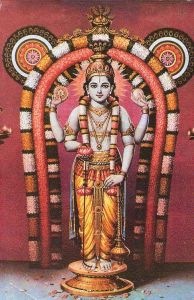
      duzvdh4anypjffvi_D0_guruvayurappa

Krishna! Krishna! Mukunda! Janaardana!
Krishna! Govinda! Naarayana! Hare!
Achyuthaananda! Govinda! Maadhava! 
Sachidaananda! Naarayana! Hare!

Introduction

Njanappaana can be considered as the Bhagavad Gita of Malayalees. This is a Darshanika kaavyam or philosophical poem expressed in the most simple Malayalam language for ordinary people. Poonthanam Nambudiri, an ardent devotee of Shri Guruvayurappan, transformed his unbearable sorrow from his infant son’s death into a “yogavishesham”. He used this sad experience to build his Bhakthi soudham or house of devotion and opened it for all devotees for all time. Even though the language is very simple, this njaanappana, or song of wisdom deals with the essence of all vedas and upanishads. May Bhagavan Guruvayurappan, Bhagavathy Sarswathi Devi and Sri Poonthaanam Nambudiri bless us to become wiser by going through this great Song of Wisdom!!boarder

Gurunaadhan thuNa chaika santhatham thirunaamangal naavinmel eppozhum
Piriyaatheyirikkanam nammude nara janmam saphalamaakkiduvaan

May my Gurunathan help me (thuna chaika) to keep the auspicious names of Lord continuously on my tongue (naavinmel eppozhum) and to make this human life (narajanmam) meaningful and fruitful!(saphalamaakkituvaan).

The only way to to make the human life fruitful and meaningful is to constantly chant the auspicious names of Lord. So, the poet is seeking the blessings of his Gurunaathan to help him retain the naamam on his tongue for ever. Who is Poonthanam’s Guru?  He is considering Guruvayurappan as his Guru because Lord is both the remover of the darkness of Anjaanam or avidya (Guru) and the protector and saviour of all (Naathan). After innumerable births in lower species,we finally got narajanmam in Kaliyuga. Kalisantharanopanishad and many other scriptures reinforce the importance of naamasankeerthanam in Kaliyuga. Naamasankeerthanam can be done any time anywhere.

Innaleyolam enthennarinjeela Ini naaleyum enthennarinjeela
Innikkanda thadikku vinaashavum Inna neramennaethumarinjeela

We really do not know what happened until yesterday or what would happen tomorrow. Neither we know when this body we see today will perish.

When we look at the literal meaning, we may feel like responding: “I know what happened until yesterday and I can roughly guess what will happen in the coming days. I am hail and healthy and unless I get into an accident or so I should be able to live many more years”.

Poonthaanam is putting his forefinger on his nose with an expression of “what a pity?” because he meant much more than the literal meaning of yesterday, tomorrow and our present body. He persuades us to think deep about the uncertainty of life. Yesterday and today also means previous janmaas and future janmaas. We do not know about our previous janmaas or good and bad karmaas we have accumulated. A great part of our good and bad experiences in this janma is the direct result of our past karmaas. We cannot undo the sins or suffering by anything other than sincere prayers. Bhagavaan is the only one who can change the results of our praarabdha karmaas and in Kaliyuga, naamasankeerthanam pleases Bhagavan more than anything. We do not know what is in store for us tomorrow. How can we make sure that our future is in safe hands? Only by offering ourselves in His strong and kind hands. Then what about today? At present we live in this body and the moment jeevathma leaves the body, it becomes lifeless like a log of wood. We have absolutely no idea when that will happen. Here Poonthaanam used the word “thati” for body to specifically tell us that body is like a log of wood or worse than a log of wood when it is lifeless. A dead body that is not preserved starts deteriorating in a few hours where as a log of wood may remain intact for several months or even years. Poonthaanam advises us to think deep about these truths and use every moment available to worship Lord with naamams. Chaitanya Mahaprabhu also said that there are no hard and fast rules for chanting naamaas. Anytime one can chant and under any circumstances one is allowed to chant. “Shuchir va ashuchir va sarva avasthaasu sarvada” meaning in any condition clean (purified) or dirty (impure) one can chant the auspicious names of Lord.

Kandukandangirikkum janangale  Kandillennu varuthunnathum bhavaan
Randu naalu dinam kondorutthane Thandiletti nadathunnathum bhavaan
Maalika mukaleriya mannante Tholil maaraappu kettunnathum bhavaan

If Bhagavan wishes, those people whom we see today may disappear (may be dead) by tomorrow. Again if Bhagavan decides, with in a few days (two or four days) a healthy man’s dead body may be carried to the funeral pyre. In the same way, by God’s wish, a king sitting in a palace (maalika) can become a beggar with a dirty bag (maaraappu) hanging from his shoulders (tholil).

Poonthaanam explains how transient is our life, wealth, poverty, sorrows and everything that we see in this world. A man walking and having fun this moment can embrace death the next moment. Everything is Lord’s wish! In Kerala, usually a dead body is tied to a wooden ladder or a piece of long wood and carried by relatives (normally by sons) to the funeral pyre. However hail and healthy one may be, when the time decided by Lord approaches, chaitanyam or jeevan disappears leaving the dead body to be carried to the funeral pyre. It can happen any time, in one day, two days or four days (randu naalu dinam kondoruthane). Here Poonthanam used the word “mannan” for king (mannante) because “mannan” also means “drushtan” or “aviveki”. He advises that those people who have money and power should have the vivekam to use both dharmically remembering that they came to this world with nothing and would go from this world with nothing. Bhagavan can take it any moment from anybody.

By Lord Krishna’s blessings, Kuchela or Sudama became wealthy overnight. What about Ravana? He lost everything that he held dear and finally he lost his life too at the hands of Lord Rama. Even if we are destined to go through sufferings due to our past karmaas, surrendering to Lord will lessen the negative effects and lead us to Satgathi. “Bagavan says in Gita: “na hi kalyaanakruth kashchid durgathim thaatha gacchathi” meaning “If you do good, it will definitely lead you to satgathi or protect you from any harm”. Poonthaanam tells this truth from his own experience of the tragic and sudden death  of his infant son.

I have heard several versions of the story. But the following is the one I heard from my parents. Poonthaanam’s son was 5 months old and anna praasham (giving rice for the first time is called “choroonu” in Malayalam and usually it is done either the 5th month or 7th month ) ceremony was fixed. He invited several relatives and that morning after feeding the baby his wife made a bed in the room next to the hall where the ceremony was to be conducted. Usually there will be an entrance to that room from the kitchen also. Baby was sleeping and his wife was busy with all the preparations. It was morning and one namboothiri lady finished her bath and put the wet clothes in the same room where the baby was sleeping. That room was dark even during day time and she did not see the baby and unfortunately wet clothes were put on the baby’s face. ( I can very well believe this because in my house, there is a room on the north side called Vatakkini which is very dark even in day time. So when our parents told us this story, we listened with tears in our eyes and we felt it could happen in any Nambudiri house.) Then the next lady came after bath and seeing the wet clothes in a corner she also put hers on the top of it. One after another a few ladies unknowingly put wet clothes on  and around the baby. Nobody noticed and it was about muhurttham time and Poonthaanam asked his wife to bring the baby. She was shocked to see what happened to her helpless baby and we can imagine the rest.

This sorrow gave birth to Njanappana and Poonthaanam advises us to realize the uncertainty of everything in this world and persuades us to think of God by continuous chanting of His auspicious names.

Kandaal ottariyunnu chilarithu Kandaalum thiriyaa chilarkkethumae
Kandathonnumae sathyam allennathu Mumbe kandangariyunnithu chilar

Some people see this truth, understand it or internalize the truth. But some people cannot comprehend the truth even when they see it everyday. But there are some others who know that all that they see are not real and it is all Maaya.

Here Poonthaanam divides humans into three categories. Utthama purushaas (or wise people or perfect human beings) are able to understand the transient nature of this world. People like Shankaraacharyar, Sreeraamakrishna Paramahasar are examples who belong to this category. Then there are Madhyama purushaas (or reasonably wise people) who understand it when they themselves or people near, dear and around them experience the ups and downs of life. Then the third category of people known as Adhama Purushaas (people with low level of wisdom) do not understand or even do not have the attitude to think more about it even if they or their beloved ones go through the negative as well as the positive experiences including successes, death, suffering and disease. Yudhishtira Maharaj says to the Yaksha who asks ” what is the biggest wonder in the world?”

Even though everybody who is born embraces death eventually, the living people refuse to believe that death will eventually embrace them also. What is more surprising than this? Even though we see it everyday we live as if death is only for somebody else.

Again Poonthanam indirectly tells us that only with Bhagavan’s blessings we can have this vivekam or power of discrimination. So we should pray Bhagavan to include us in that category of few people (the word “chilar” indicates that these kind of people are rare) who are capable of seeing the truth. In this Kaliyuga, the most doable form of worship is naamasnakeerthanam and he encourages everybody to chant auspicious names to purify our mind and elevate ourselves from the state of Adhama Purushas to the state of Uttama Purushas.

Palarkkum ariyenam ennittallo
Pala jaathi parayunnu saasthrangal

Many people (palarkkum) want to know (ariyenam)about all these (including the power of discrimination of human beings, about the mystery of God, how to go beyond Maya and attain salvation etc) and hence so many saasthraas (saathrangal) tells (parayunnu) about or explain these subjects in so many different ways (pala jaathi).

Which saasthra or which philosophy appeals to each one depends on each individual’s nature, attitude and circumstances. Some people like certain approach whereas others like a totally different approach. Saathraas contain so many different philosophies to satisfy the varied interests of ordinary people. Just like we all choose different professions or jobs for the sole purpose of survival, different people accept different saasthraas to advance spiritually and increase the awareness of parmaathma chaithanyam or God. There are Vaishnavaas, Shaivaas, Shaaktheyaas or another group who worship all 33 million gods alike etc. Goal is the same and only paths are different. There is a saying that “vitthamaeva param nrunaam janmaachaarakalodaya:” meaning people choose different ways and methods for the sole purpose of acquiring wealth.

Outwardly each and every philosophy may appear different, but once the essence is understood, the differences slowly disappear and all the paths unite to become one path. The word Saasthraas (saathrangal) is used because they advise to follow certain restrictions and rules to advance smoothly in the spiritual path. How is it possible to choose the right path and who will guide us through? Poonthanam has only one solution: chant the auspicious names of God and He will guide us through the right path.

Karmathiladhikaari janangalkku
Karma saasthrangalundu palavidham
Saankhya saasthrangal yogangal enniva
Sankhyayillyathu nilkkatte sarvavum

For those people (janangalkku) who are authorized to do karmaas like yaaga or yanja, homam, poojaas etc (karmaathil adikaari- it can even mean those who desire to do karmaas or those who are entrusted with the duty of performing karmaas) several different (palavidham) karma saashtraas are available (karma saasthrangalundu). Saankhya saasthra, yoga saasthra etc are among the innumerable or countless(sankhyayillya) saasthraas available. But for the time being, let us keep aside ( nilkkatte) all of them (athu sarvavum)

Just like the diversity of the world and its inhabitants, saasthraas also are diverse. Different types of yanjaas, poojaas, and homams are described very clearly in many scriptures. Initially even though devotees perform them with some specific desire, as the Bhakthi bhaavam matures, Bhagavan’s blessings help them to do Nishkaama karma or do karma with out expecting anything in return. There is a small conversation between Jabali Muni and a vartthaka or business man called Thulaadhaara. Even though Jabaali Muni was an embodiment of kindness, he was proud of his achievements and considered himself as the greatest Dharmishttan. Then he heard an ‘ashareeri” or wise words from God to visit Thulaadhaara. He visited him and Thulaadhaara explains to him how we all should do our swadharmam with out expecting anything in return. Thulaadhaara told him that Yanjaas and poojaas are done to show our gratitude to God, Forefathers, Rishis and other Maahaathmaas for what blessings they  have already bestowed on us. Renunciation of the results of the karma is nishkaama karma  and Nishkaama karma purifies our mind. God’s chaithanyam gets reflected only in pure minds.

Maharshi Kapila’s Saankhya philosophy regards Universe as consisting of two eternal realities Purusha and Prakriti. Pathanjali Maharshi’s yoga saasthra describes different types of yogas like Hatha yoga, Raja Yoga etc. They all lead one to the knowledge of Brahmam, but those paths are very difficult and with out an able Guru (in every sense of the word) it is impossible to follow those paths. But in this Kaliyuga, Bhaktha Kavi Poonthaanam advises us to set aside those difficult paths (which are as sharp and dangerous as the edge of a razor) and follow the most simple and enjoyable path of Bhakthi or devotion. What is the first and final step in the path of devotion? Naamasankeerthanam. Bhakthi starts with Naamam and ends with Naamam. It is for ordinary people as well as for self realized souls. No question of whether you are authorized, whether you have enough knowledge to pursue or whether you have the right comes into question in this way of worshipping Lord. Anybody can do naamajapam, anytime, anywhere. 


Krishna! Krishna! Mukunda! Janaardana!
Krishna! Govinda! Naarayana! Hare!
Achyuthaananda! Govinda! Maadhava! 
Sachidaananda! Naarayana! Hare!

Part One…To be continued…

boarder

Harsha's avatar

I am not this, I am not that; who am I? – Gururaj Ananda Yogi Satsang

-This is an edited and unpublished satsang of Gururaj Ananda Yogi. If you want to watch the video of the whole satsang you can get it in Gururaj’s channel at Vimeo

Question: I am that which causes awareness to flow from the grossness of the lower mind to the un‑differentiated bliss of the superconscious.  I am not mind, but upon me the mind rests.  I do not move, yet through me all things move.  I am neither this nor that.  What am I?

Gururaj Ananda: That you are.

Who am I if I am not the mind?  Who am I if I am not the body?  What makes you presume that you are not the body and not the mind. What point of reference have you to tell you that I am not the mind and neither the body?  Show me that point of reference.

When I say to myself, “I am that I am,” who is this that I am that I am?  Who is this Brahmas mi‑‑I am Brahma?  Who is this that could say, “I and my Father are one?”  Who is this that could say that I, as the mind and body, is non‑existent?

Then what part of you is existent to make you cognize your non‑existence?  You don’t know, that is for sure.

Your mind is a reality, your body is a reality, and the spiritual self within you is a reality, but it is only the mind that could cognize its own realness which is also, at the same time, erroneous.

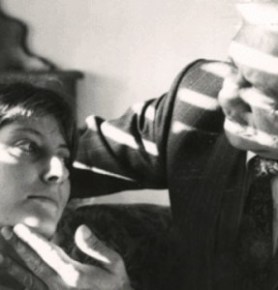
Gururaj Ananda and Cansita

You say I am this body.  Now this body has been changing so much.  I was an infant, then l grew up into adolescence, became an old man…

So this body is the same body, but over a period of time ‑‑ which you regard to be time ‑‑ has gone through various changes.  Who is that which perceives this particular form of reality?

The spirit that is within you, the Divinity that is within you, is non‑cognizable and neither would it cognize anything besides itself in its own cognition.

The mind says this is a handkerchief.  Why does the mind say this is a handkerchief?  Because my mind, or a certain recollection or experiences that has gone through me in this lifetime or even in past lifetimes, perhaps, make me cognize this to be a cloth, a piece of cloth to be used on my nose.

Now, where does this come from?  What tells you that this is a nose and that’s a handkerchief?  So you go further back to realize that my mind is saying that, then you will ask yourself what perpetuates this mind in this mold of having this particular kind of cognition?

And like that you go on and on and on until you reach a point which is zero.  Then only can you say, “I’m not the body.”  Then only can you say, “I’m not the mind.”

Look, I can touch, feel, smell, taste, go to bed and make love, go to the toilet.  Is the body then not functional?  Of course  it is functional.  Then why do I deny the body?

I deny the body because I feel within myself‑‑or rather some force is feeling within myself‑‑that I am far beyond the body and the mind.  Now, the greatest mistake that has been made‑‑or is being made by various theologies‑‑is the denial of the body and mind.  Let’s look at it from a different angle.  Do not deny this body.  Do not deny this mind.  And do not deny that which cognizes the body and the mind.

So how are you dealing with yourself, then?  We’re still going to come to the cognitive factor.  But at this moment how do you stand?  You stand in the position of saying, my body exists, my mind exists, and the cognitive factor also exists, so therefore I am existence and being existing I can deny nothing.  For I am that I am.

There is no differentation between your body and your mind and your cognitive self.  The I that cognizes the very existence of this body and this mind is thought forms which we can call the ego self that is forever trying to preserve itself in the cognitive factors of saying I am this handsome guru [comments and laughs from audience].   Who’s saying that?  That stupid ego self.

Now, what is the ego worth?  The ego is worth nothing, because it is just a formation of patterns which you have superimposed upon yourself through the various experiences that you have gone through, and that has left impressions.  And those impressions is that which we call the ego.

Now, I put my hand on this table and I remove this hand.  But an imprint is there.  The hand is not there anymore, but an impression or an imprint of the hand is existing on this table.  Get out your magnifying glass and you will see it.  What reality is there in this imprint?  Nil!

This very imprint that cognizes me as a body, this very imprint that cognizes me as a mind.  So my body and mind is totally dependent upon that imprint.  And yet, what is the reality of this imprint? Nil.  It’s an impression created through patternings of experiences.

So now if I deny this imprint, or if I do not attach value to this imprint in bringing about the recognitions of the existence of this body and this mind, then I am basing the existence of this body and this mind with something that has no substance but which has just created an impression there, presuming that this mind and this body is real.

So now, what have we done so far?  We are accepting the reality of the mind and the body, and, at the same time, we are denying the mind and the body.  Because both are true. You are not the body, yet the body; you are not the mind, yet the mind.  Then what is your reality?  And how are you going to prove this reality?

You can only prove it by inference.  Or by the very factor that reality requires no proof.  It exists because of its own existence.  The only time you can prove reality is when you have a reference point.  And where can there be any reference point as as far as Divinity is concerned.

There is consciousness and non‑consciousness.  Non‑ consciousness means you are not aware.  And conscious means that you are aware.  Now, what proof is there of awareness.  Does awareness require any proof?  Does the light burning there require any proof that it is burning?  Its very act of giving light is its own proof.

You do not need to prove anything.  Because when it comes to the highest level, you need a point of reference, and the highest level being the one, without a second, cannot have a reference point.

I exist, I exist, because I exist.  That’s all.  And because I, the real me to which I have no reference point exists, I can only refer it back to a grosser level of the mind and the body, which finds its existence in that which I cannot prove is existing.Gururaj Ananda

I’m taking the highest factor in life and bringing it down to the grossest factor and that is what I could compare things with.  But when we reach the point beyond comparison ‑‑ Beautiful word.  You’re pairing up things in comparison.  There have to be two to compare.  But what if I want to exist as I am in my full totality, then will I not lose the idea of comparing myself to anything else?  And the very moment I lose the idea of comparing myself to any subject or object, that is the very moment when I will lose the ego self, that imprint that is existing in my experience.  Or the impression of the experience.  Then where will I be?  I shall be incomparable.

I shall be the source of existence itself, which I am.  Not in reality, but in actuality.  For reality changes from day to day.  What is real to you today might be unreal to you tomorrow. You see.  But when I become actual, when I become the source and recognize that source within me, or the source recognizes itself, then I will say, let me enjoy this body.  Let me enjoy this mind, for it is a product of a collection of impressions.  And if they are there, let me make the best use of it.

Here we are fusing two factors.  The fusion lies in the fact that that which is created by impressions‑‑or maya or illusion‑‑, is brought into reality, and reality is converted into illusion.  So I make the best of both worlds.

For example, let’s see what example we can use.  Say I loved a woman very much, I was deeply involved with that woman.  Fine. And she has left me.  She has jilted me or died or whatever or jumped in the lake.  Now, is she there or is she not there?  She’s dead, we know.  But is she there or is she not there?  She is there because you think she is there.  What makes you think she is there is because those impressions, those experiences, and you are reliving something so far in the past which has no reality today, which has become an illusion.  Because she is not there.  I have developed a dependency upon her when she was there.  So what am I living on now?  On dependencies.

I am existing with a reality, which is my body and my mind.  Though in essence it is unreal, but for the moment of three score years and ten, let me do the best with it I can.  Why not. Who would deny me that right?  And why should it be denied to me? You think all these organs we have are there just for the fun of it or for the show of it?  You think I have ears and I must not hear?  Or I have eyes and I must not see?  Or a nose and not smell?  Or any other organ of my body that has been there created through an evolutionary process and not to be used.  Why should I not use every organ in this body of mine to its fullest value? Honestly and sincerely.

So these monks  say become celibate, become this and that, become this and I don’t know what all.  I say, “become yourself!”  Be yourself!

Be yourself.  How can I make myself be myself?  Ahh!  How can I make myself be myself?  And the answer to that riddle is so simple.  Do you know that beautiful hymn which I like very much, lead thou me on, kindly light, one step at a time is enough for me.  Don’t you know that beautiful hymn?

Firstly, I must admit to myself that  I’m living a fragmented life.  Part of my mind is pulling that way, part of my mind is pulling that way, part of my mind is floating up there in Chicago and another part somewhere in some heaven or some hell which has no existence in reality.

Admit to oneself that I’m fragmented.  Lead thou me on, kindly light to integration away from fragmentation.  Let me be whole.  Let me function in this life holistically.  Let me not find any more the discriminatory factors between body, mind, and spirit.  Let me regard it to be one continuum.  And this continuum, after finding through spiritual practices and meditation, when you find this continuum of yourself, mind, body, and spirit, this continuum will extend and extend and develop so much that the entire universe becomes you and you become the universe.

Existence and non‑existence, what am I going to do about it?  I’m both.  I am existing, and at the same time, the impressions which I’m existing upon is non‑existent.

So let me tell you this, that 99.999% of your problems in your mind are self‑created without any damn substance.  So that which you have created without substance… very easy way out of it‑‑pull the chain!

That is the secret of life.  Forget the past.  It is gone. Do not project yourself into the future, it might not be there. But live for this moment.  Live for this moment.  And then you’ll preserve your physical health, you’ll preserve your mental health, you’ll become integrated in mind, body and spirit, and you’ll enjoy life.  For life is joy.  So, as I always say, enjoy the joy.  Why deny yourself of that beautiful joy of this so‑ called existence when you can have fun.

What’s wrong with fun. Enjoy it.  But be honest and sincere, that’s important.

MEDITACION BARCELONA

Harsha's avatar

Mangal Aaratee

Unsaved_Production 1


  Mangal Aaratee Priyaa Preetam kee, Mangal Preeti Reeti Doun kee
Blessed prayer of lover and Beloved,  Blessed  is the ritual of their union

Mangal Kaanti Hansani Dasanan kee, Mangal murlee Beena Dhun kee
Blessed is the light of His swanlike splendour,  Blessed is the sweet rhythm of His flute

Mangal Banik Tribhangee Hari kee, Mangal Sevaa Sab Sahachar kee
Blessed Hari, omnipresent knower of three worlds,  Blessed friend of all devotees

 Mangal Sir Chandrikaa Mukut kee, Mangal Chabi Nainan mein At kee
Blessed is His crown made of Peacock’s feather,  Blessed is His glance enslaving my eyes

Mangal Chataa Phabee ang ang kee, Mangal Gaur Syaam Ras Rang kee
Blessed beauty of ornaments on Shyam’s body, Blessed are  Krishna’s activities

 Mangal Ali kati peyare pat kee, Mangal Chitvan Naagar nat kee
Blessed love of Sweetheart Govinda , Blessed allure of that magical Krishna

Mangal Shobhaa kamal Nain kee, Mangal Maadhuri Mridul Bain kee

Blessed is the beauty of His lotus eyes,  Blessed the soft and sweet voice of His Flute

 Mangal Vrinidaavan Mag At kee, Mangal Kreedan Jamunaa Tat kee
Blessed husband of Vrindavan’s gopis,  Blessed is His play on the river  banks of Jamuna

Mangal Charan Arun Taruvan kee, Mangal Karani Bhagati hari Jan kee
Blessed are His Feet under the Arun tree of the forest ,  Blessed Lord, remover of obstacles

 Mangal Jugal Priyaa Bhavaan kee, Mangal Shree Raadha Jeevan kee
Blessed pair of beautiful charming lovers,  Blessed Hari, who is the life of Radha


To listen to this Aaratee, click on the link…
http://www.youtube.com/watch?v=oeOEW5bJUHE

Mangala Aaratee1

Arati (also called  Aarti, ãrti, arathi) is performed in many Hindu temples first thing in the morning, and several times throughout the day, with a final arati in the evening.  Arati is also performed after services such as puja.  The word is derived from the syllables “Aa” which means towards, and “rati” which means the highest love for God.  As the devotee waves the lamp before the deity, the frame of mind should be one of surrender and devotion, a prayer to Divinity to annihilate the ego in the flames of the sacred fire such that complete surrender is achieved.

At the Chinmaya Mission temple where I worship, following the monthly group chanting of the Vishnu Sahasranama, we sing a beautiful Mangal Aaratee to Lord Krishna, which glorifies the love of the Lord for Radha and for the gopis, thus symbolically glorifying the Oneness of the Paramatma and the atma as embodied in the living jiva.  Something about this Aaratee drew me the first time I heard it even though I could not really make out the melody as a small group of devotees sang it one night.  I later found out the language was Hindi, and one afternoon I drove over to the Temple to request Swamiji to sing it for me so I could record it and learn the melody for the monthly chanting.  Like some other bhajans have done, this one took me over and I needed to take it a step further, learning it on my harmonium and memorizing the words.  Still, something was missing…I knew the general gist of the words had to do with auspiciousness and Lord Krishna and Shrimata Radarani, but I wanted more. I wanted to know what all the words meant.

So, I posted photos of my lyric sheet in the Roman transliteration as well as the Hindi devanagari script on my Facebook page, asking my FB friends if anyone there knew Hindi and might be able to help.  One of them did, Shravanji Manyan, and he was kind enough to make an effort which was a great help.  But, there were some lines which he felt he could not quite make out and so there will still some missing lines.  I knew that if the Lord wanted it to happen, He would make it happen.  In the meantime, believing that God helps those who help themselves, I resolved to bring it to a few people at the Mission who I thought might be able to help. 

Before I had to do that, I met a woman who joined into a small yoga group which meets at the Mission.  When our practice was finished for the morning, I pulled it out for my friend, Lakshmi, to ask for her help.  Then a new member of our yoga group, Pushpa, spoke up to say that she had a Masters in Hindi and would be glad to take a look. We started to go over some words, when she offered to take it home.  As a result, she sent me an in depth translation, word for word in a prose like fashion, which gave me a thorough outline of the lyrics. But this was not in the flow of the poetic beauty which graced the Hindi lines. I rewrote the translation to at least try to give it more of a poetic feel and do poetic justice to the author, unknown, who penned these beautiful lines.  Both the lyrics and the melody are hauntingly beautiful, taking you to the banks of the Jamuna River where Radha, the human soul and Krishna, Divinity gracing us in human form,  eternally re-enact the holy union of  His Divinity within the human soul.  There is a certain mystery and wonder to the dance of the lover and the Beloved.  May we all know the glories of this sacred Oneness.

ln004

 Samo’ham sarvabhooteshu na me dweshyo’sti na priyah;
Ye bhajanti tu maam bhaktyaa mayi te teshu chaapyaham
Unsaved_Production 1 

 I look upon all creatures equally,
none are less dear to Me and none more dear.
But those who worship Me with love and affection live in Me,
I come to life in them.” 

BG 9.29

 ln004

Offered with gratitude to the Lotus Feet of my Guru, Shri Krishna, and my Lord, Shri Krishna,
for His Grace in allowing me to love Him, to serve Him and to be His devotee,
and for gifting me with Swami Siddhanandaji in my life, in so many ways,
and in particular, for singing this beautiful work of art for me to learn,
for Shravanji Manyan and for Pushpaji Gairola,
both of whom generously offered their time and talent in
reviewing the lyrics and translating them for me,
and for the unknown poet who wrote this Aaratee through His Grace.
It is said that the Vedas have no author since
they derive from Divinity itself…so too with this Aaratee.


Harsha's avatar

Light From Eternal Lamps: By Swami Sadasivananda

image

“One must make the mind to bear on God”

ENTERING THE PALACE OF LIBERATION…

The One Thing Needful

“The eternal, unbroken, natural state of abiding in the Self is jnana. To abide in the Self you must love the Self. Since God is verily the Self, love of the Self is love of God; and that is bhakti. Jnana and bhakti are thus one and the same…. their purpose is to lead you to dhyana, to meditation, which ends in Self-realization.”  Maharshi’s Gospel I, The Teachings of Sri Ramana Maharshi. p. 17-18.

Sri Ramana Maharshi maintained this ancient form of instruction. The answers he gave to questions represent what has evolved in our modern times as a uniquely universal spiritual teaching that can be taken up by anyone the world over without adopting the limiting constraints of any one religious tradition. It has been said that these teachings were indeed God-given, for they began with the words of grace flowing from Sri Ramakrishna and continued with the blessing of perfection that was embodied as Bhagavan.

As did his predecessor, Bhagavan Sri Ramana Maharshi stressed practice that produces purification (removal of that fog of ignorance, the obstacles and habits of the mercurial mind which diminish our pure vision) as well as the grace of the knowledge of the Self as the eternal companions of those who would be led:

From the unreal to the Real,
From darkness to Light,
From death to Immortality!

NOTES FROM ARUNACHALA…

Devotees present with Bhagavan on this day said that a most important spiritual lesson was transmitted through the actions of Bhagavan as he held Lakshmi’s head during her final moments.

As Bhagavan was stroking Lakshmi’s head, she was gasping for breath in the final moments prior to her passing. Bhagavan, who all knew was capable of removing her pain and causing her spirit to easily exit the body, rather whispered in Lakshmi’s ear to “Tolerate the pain!”.

At a later day, Bhagavan said that, “Suffering is the way to Self-realization.” Our training within meditation prepares us to remain “steady in wisdom” even during the final trial of separation from the body.

image

“Practice is necessary, Grace is there.”
Reprinted from Swami Sadsivananda’s July newsletter.
To subscribe to his newsletter, go to http://www.ramanateaching.org/contact.html
For more information on Swamiji, click here:   About Swami Sadasivananda
Teachings of Bhagavan Sri Ramana Maharshi web site: http://www.ramanateaching.org
Ask your question in relation to Bhagavan’s teachings, meditation and spirituality at:
http://www.ramanateaching.org/faq

Harsha's avatar

The Heart of God:The Nature of Self-Realization. By Dr. Harsh K. Luthar

Heart Talk is All Talk

The difficulty in many of our conversations about spiritual insight is that the true understanding is not intellectual or conceptual, but absolutely direct. It is clear and direct without the medium of the mind.

Truth has never been a monopoly of a particular religion or spiritual tradition. How can it be? Some may disagree, but in my view, God does not play favorites.

We cannot make Truth our personal property but only allow the quality of Truth to overtake us and shine in us. We cannot possess God but only surrender to the Divine Will and let God take over our life.

Continue reading

Harsha's avatar

AHAM (I AM) Is The Essence Of Mantras: By Sri Venkata Sriram

Edtior’s Note: The following post appeared in the Advaitin list on Yahoo Groups and is reprinted with the permission of the author, Sri Venkata Sriram. In this article Venkat-Ji speaks about the idea of AHAM as the essence of Mantras, Vedas, and Upanishads. AHAM translated from Sanskrit means, “ME” or “I AM” and refers to the principle of I-NESS that is inherent in the existence of all beings as it is their core. Sri Bhagavan Ramana’s teaching involving the Inquiry, “Who Am I?” is essentially a meditation on AHAM, which in the Advaitic approach leads to Self-Realization. I have made only minor edits in the original version. Please bring to my attention any errors and these will be corrected right away.

AHAM (I AM) Is The Essence Of Mantras

It is to be noted that *who am I* is not a *intellectual* enquiry to be pursued.  It is the upasana of *Aham* which is the upasana of Vak – the Great Goddess of Speech which is described in Vedas as Vak / Tripurasundari.

According to legend, the 14 Maheshwara Sutras were revealed to Panini, Vyaghrapada, Upamanyu and other sages by Shiva. Panini then composed his grammar called Ashtadhyayi which is based on the 14 Sutras that were revealed during the Cosmic Dance of Shiva. They are also called the Maheshvara Sutras. At the end of the Shiva’s Cosmic Dance, he sounded his Damaruka 14 times. And from these 14 Sounds of Damaruka, evolved 14 Sutras. These 14 sutras encompass the phonetics of the Sanskrit language.

The first 4 sutras cover all the vowels.  They are :

1) a i u n
2) r l k
3) e o n
4) ai au ch.

Omit the last letter of the 4 sutras and they are a, i, u, r, l, e, o, ai, au. The entire 16 vowels from A to AHA have emanated from these letters.

The Last 10 sutras include all the consonants. They are :

5) h y v r t
6) l n
7) n m n n n m
8.) jh bh n
9) gh dh dh s
10) j b g d d s
11) kh ph ch th th ca t t v
12) k p y
13) s s s r;
14. h l.

Omit the last letter of these 10 sutras, they become entire 34 consonants ie., from K to HA. The SRICHAKRA is constructed keeping in view these entire set of 14 sutras.  Ashtadhyayi divides these 14 formulae into 43 letters which become the 43 Angles of Sriyantra.

The entire Matrikas (letters) ie., 16 vowels and 34 consonants have evolved from these 14 Maheshwara Sutras.

The 16 Vowels and 34 Consonants have become 50 Matrikas of Letters.. They are the Saktha Pitas of Sridevi.  Every Matrika has a distinct Power and Seat of Origin in our Body. These Matrikas are presided by a distinct and corresponding Devis that govern that particular seat of origin (Pita) in our Body. These Cosmic Powers that preside over each Matrika is invoked during the Antarmatrika and Bahir Matrika Nyasas.

It is to be noted that the Kamakala Akshara is derived from these 14 sutras. This *AHAM* is the essence of all the Mantras, Vedas, Upanishads as these fall in between A (WHICH IS 1ST VOWEL) AND H (WHICH IS THE LAST CONSONANT). From the first sutra, A is taken and from the last Sutra H is taken. Bindu is added and it becomes AHAM.

This is the AHAM swarupa or the I-NESS of Maheswara which is of the form of CHIT. It is from this AHAM of the Siva, the entire Cosmos in the form of Matrikas have evolved. This AHAM is the KAMAKALA. The entire vowels and consonants fall in between this A and H.

The Tantric script encodes this principle of AHAM and depicts as a INVERTED TRIANGLE which is a representation of Triputi or Triad in the form of External Object perceived, Knowledge or Perception, Observer or Perceiver otherwise called Jnatr-Jnana-Jneya.

Veda & Tantra paves the way for the piercing of this Triad which is called TRIPUTI-BHEDANA. And the methodology employed is *AHAMGRAHOPASANA* through Sagunopasana.

When Vashishta Ganapati Muni pleaded for guidance in sadhana, Bhagavan Ramana asked the Muni to enquire into the Source of the Panchakshari Mantra (NAMA SIVAYA) which is invariably collection of 5 letters in the form of Speech.

The root of all mantras in the form of Speech is *A-HA-Bindu*.  A is the 1st vowel; Ha is the Last Consonant; M-the Bindu; which is AHAM. This is what is the essence of VAK Sukta in Rg Veda which starts with *Aham rudrebhir vasubhischarami……….*.

Bhagavan Ramana Maharishi wants us to catch hold of this AHAM as it is the source of Speech and which shines in the cave of our heart. (vide ref: Ramana Gita).

The speech has 4 stages of evolution whose order of evolution is : 1) Para 2) Pashyanti 3) madhyama 4) Vaikhari.  Vaikhari is the Articular Sound what we hear.  The source of this Articulate Sound is Para which originates from Heart Cave where throbs our consciousness in the form of *AHAM* (hridaya kuhara madhye aham aham iti sphurantam…).  It is this throb or Antah sphurana, Bhagavan urges us to realise.  It is this *Aham throb* or *Antah-sphurana* which is *Brahma*.  Hence, Bhagavan Ramana says in ECSTASY *Aham* *Brahma* *Asmi*.

It is verily this *I* which shines in the heart cave as *Aham* which Bhagavn says is Brahman.

Now, what does Acharya Sankara say about the Upasana of *Aham*, let us see.

Acharya Sankara gives us a wonderful hymn for meditation, contemplation and reflection which is called *Dakshinamurthy Stotram* (DS).  Acharya has divided the entire hymn into 3 principles  : Jiva, Jagat & Ishwara. Later, he gives a clue for the Upasana which is quite *mandatory*  for those who are into the upasana of  the *aham* principle. What exactly is this *aham*, is wonderfully given in the sloka *bAlyAdiShvapi…….AHAM iti antahsphurantam sadA….* of DS.

Now, how should we enquire into the root of this *aham* or *I-ness*? Acharya has hinted in the subsequent sloka and the type of upasana to be undertaken. It is the *ahamgrahopasana* along with Sagunopasana which is suggested here.  When this upasana reaches the state of culmination, it is the realisation in *ECSTASY* that this *aham* or *antah-sphuraNa* is Brahman which is the essence of Mahavakya *aham brahmasmi*.

Mahavakyas are the *GREAT UTTERANCES IN ECSTASY* by our vedic seers.

Even in deep reflection and sadhana, when the upasaka reaches the highest pinnacle of spiritual illumination, both the terms *aham* and *brahma* drops off and what remains is ASMI.  And this state is wonderfully explained in the Rg veda in  the *Hymn of Creation or *Nasadiya Sukta*.

I repeat: Mahavakyas are the *GREAT UTTERENCES IN SPIRITUAL ECSTASY*.

Acharya Sankara also hints in his Sutra Bhashya about the sagunopasana..  He says:

“apratyAkhyAyaina kAryaprapancham, PARINAMAPRAKRRIYAM CHA shrayati SAGUNESHuPASANESHUP AYOKSHYA te iti”.

Also, in the 1st adhyaya for the sutra “tad adhInatvA darthavat”, Acharya Sankara explains the principle of Sakti to be the upAdana kAraNa for paramEshwara in the Creation. Acharya Sankara emphatically says that it is the Parinamavada to be adopted to achieve the Sagunopasana Siddhi and not for kArya-prapancha (jagat) siddhi.

Acharya Sankara in his sutra bhashya says that parinamavada (theory of transformaton) can be adopted for the purpose of saguna upasana which is the upasana of maya-sabala brahman where the substratum is Brahman only. When the upasana is ripe, and upon the dawn of right knowledge, the “reality” which the “ignorant” people perceive WOULD BECOME an “illusion”.

So, what i conclude is that Bhagavan Ramana’s Teaching is not new and is not an *Intellectual Enquiry*. It is verily the *Veda Vidya* handed down to us. Bhagavan embodies in himself the *Spirit of Vedic Seer*.  Bhagavan’s teaching is the upasana of Vak.

Bhagavan was verily the form of Dakshinamurthy who taught the Upasana of Vak in the form of *Silence*. It is this *silence* which is called Para-vak. It is this Para-Vak which sports in the deep chasms of our heart as *I* or *Aham*.

The vedas and Tantra declare this Para-Vak as Tripurasundari – which is the Great Triangle in Sriyantra and the substratum of this Para-Vak is the Absolute Principle in the Form of Shiva which is depicted as Circle or Bindu in Sriyantra.

Sriyantra is the diagrammatic representation of AHAM and Srividya is the Upasana of Vak in the form of *Ahamgrahopasana*.  Hence, to evolve a method for this *ahamgrahopasana*, Srividya Tantra came into being.

It is interesting to note that Bhagavan Ramana himself did the prana pratishta of Sriyantra at the samadhi of His mother.

tamai shri gurumurtaye namah idam shri dakshinamurthaye.

with regards,
sriram