Harsha's avatar

Nature of the Ego

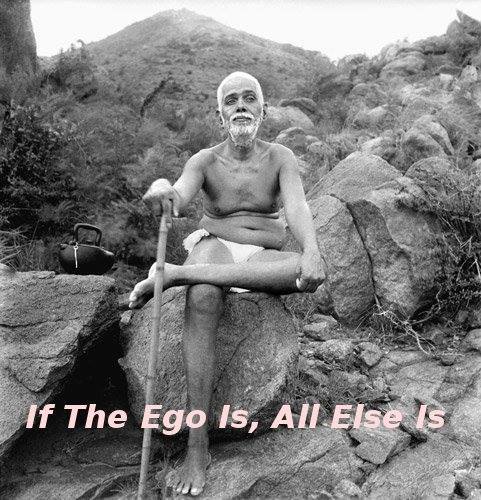
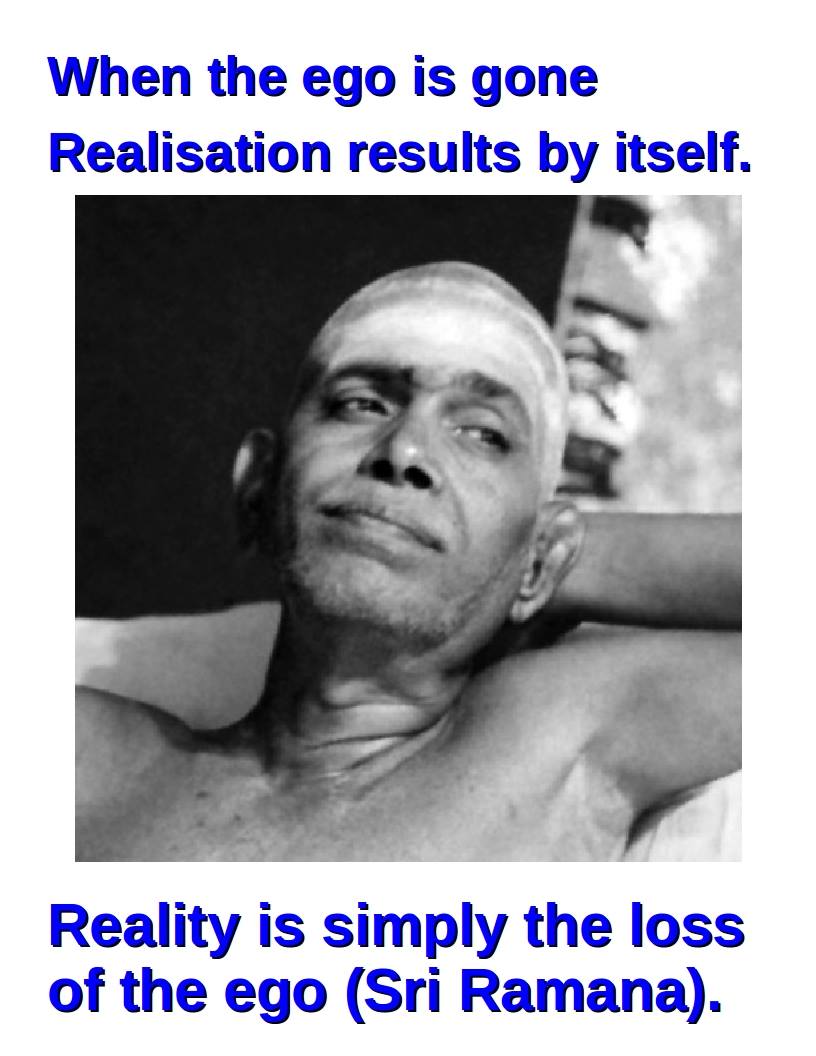
“When the ego rises, all things rise with it. When the ego is not, there is nothing else. Since the ego thus is everything, to question ‘What is this thing?’ is the extinction of all things”.

The quote above from Bhagavan Ramana is from ‘Reality in Forty Verses’ (‘Ulladu Narpadu’), v. 26. It can be found in Bhagavad’s “Collected Works”.

Here Bhagavan eloquently points out that one cannot force oneself to give up the ego. The very attempt to discard the ego, is itself based on the assumption of separation from the whole. In other words, the effort to conquer the ego is based on egotism!

Such forced efforts to overcome the ego end up only reinforcing the notion that we are “separate” from the Universal Existence. With such attempts, the nonexistent phantom of the ego appears real in our imagination.

Hence Bhagavan Ramana says, “Question, what is this thing, this ego which manifests as a sense of separateness from the whole”? Where does it come from?”

This inquiry requires us to simply bring our attention to the sense of identity, the sense of “I AM”. It is only by bringing quiet, nonjudgmental attention on the ego, that the ego can be see through as unreal. The method is simple and yet the mind has to be made pure and subtle to grasp it.

Love to all

Namaste


Harsha's avatar

Your Karma Ate My Dogma…Part 3

Mira Prabhu, residing at Arunachala in South India, explains the nature of karma in her characteristic straightforward way that everyone can understand.

Mira Prabhu's avatarmira prabhu

dalai-lama-addressSometime during the mid-90s, at a workshop at Omega, situated in Rhinebeck, upstate New York, I asked Bob Thurman, ex-Buddhist monk and father of the lovely Hollywood star, Uma Thurman, to explain the laws of karma. Bob shrugged and said he didn’t know of any. Much later, when I moved to Dharamsala from Manhattan, I realized how many versions of karmic theory there are—and not just in the Hindu world, but reflected in the four different schools of Tibetan Buddhism.Just for the record, the laws of karma according to my Gelupa Buddhist guru are as follows:
  • that karma is definite–meaning that acts that cause pleasure result in pleasure, that acts causing pain bring pain back, while neutral acts have no apparent effect;
  • that karmic energy increases exponentially–which means that if you steal one measly rupee, at least four rupees will be stolen from you;
  • that one cannot become…

View original post 723 more words

Harsha's avatar

Bhagavad Gita and Karma Yoga

No one who is born in this world can remain inactive. Bhagavad-Gita teaches that each person should follow their dharma (sacred duty) and take actions accordingly.

For example, the dharma of a teacher is to share knowledge. Dharma of a business person is to engage in commerce. Dharma of a warrior is to protect the innocent and fight for justice.

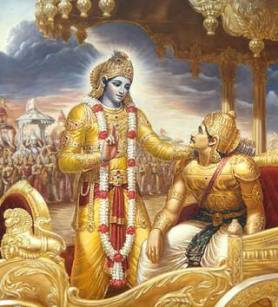
In the Bhagavad-Gita, Sri Krishna says to Arjuna that as a warrior, he has the duty to fight against injustice and lead others who look up to him.

However, Sri Krishna adds that even when one takes actions, it should be done without ego attachments as a matter of dharma that fulfills a higher purpose.

This approach to life is known as karma yoga and is taught by Bhagavan Krishna in the Bhagavad-Gita.

According to karma yoga, one should act carefully according to dharma with respect for all life.

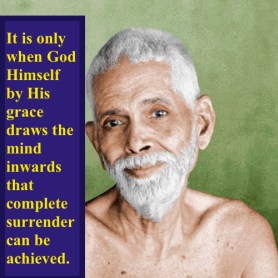
After having done one’s best, one should not be attached to the outcomes. Instead, one should surrender all the fruits (results) of the actions to Lord with the attitude, “Not my will but thy will my Lord.”

Keeping the Lord in mind in all actions purifies the mind and frees the yogi from worry and anxiety.

Harsha's avatar

Remain Calm and Aware: By Dr. Harsh K. Luthar

The feeling/awareness of one’s existence manifests through the mind as “I”. Hence we say, I do this, I do that, I am a doctor, I am a sanaysi, I am a householder, I am a student, I am a husband, I am a wife, etc.

Bhagavan Ramana’s teaching is to quietly bring attention to this sense of “I” by asking “Kohum”.

Continue reading

Harsha's avatar

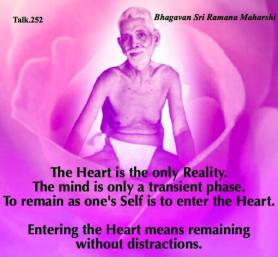
Here Lies The Heart

Mercedes De Acosta was asking Sri Ramana Maharshi about which religion, teacher, or guru she should follow that would be most helpful to her.

Bhagavan Ramana replied, “If they can help in the quest of the Self. But can they help? Can religion, which teaches you to look outside yourself, which promises a heaven and a reward outside yourself, can this help you? It is only by diving deep into the spiritual Heart that one can find the Self.”

Continue reading

Harsha's avatar

All Are In The Circle Of Love

The Sage of Arunachala, Sri Ramana Maharshi, gave us the purest teachings.

If we look at the devotees of Sri Ramana, we see that they were some of the greatest yogis and jnanis of their day.

Many of them were world class poets and scholars. But they led quiet, unpretentious, and humble lives fully content in the grace of Bhagavan Ramana.

In outward appearance, Sri Ramana appeared as an ordinary sadhu sitting quietly on the rocks of Arunachala, and wandering the holy hill at times.

The yogis of the highest wisdom upon meeting him recognized him instantly as the king of yogis, serene and content, whose very presence was the blessing they had been seeking.

The message of Sri Ramana is simple and echoes the Upanishads.

Continue reading

Harsha's avatar

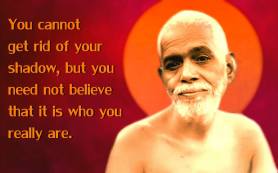
You Are Not Your Shadow

Sri Ramana used to say that wherever we go, our mind follows. We cannot escape our troubled mind riddled with endless concerns, anxieties, and fears. Even if we run away to a forest or some holy place or sanctuary, the mind is still with us.

Truly, the conflicted and conditioned mind is like our shadow.

Continue reading

Harsha's avatar

The Ego is Not Your Amigo – Part 2 of 2

From Mira Prabhu, the mystic writer living on the holy mountain of Arunachala.

Mira Prabhu's avatarmira prabhu

Harish Johari Harish Johari

I first began to consciously pursue the destruction of my own troublesome ego when I lived in hectic Manhattan. At the time, I had just begun to plot a novel based on eastern philosophy (Whip of the Wild God: A Novel of Tantra in Ancient India), and was engrossed in learning everything I could about Tantra and mysticism.

In the process, I met folks who tended to interpret Tantra mainly as a license to enjoy indiscriminate sex. My view was different: mainly from delving into the treasure trove of eastern philosophy at the New York Public Library, I had discovered that, etymologically speaking, the word Tantra derives from two Sanskrit words: tanoti and trayati—meaning: the explosion of consciousness. How one performs this magic is up to the individual; while couple-hood can certainly become a means of liberation, celibate tantrics often evolve fastersimply because…

View original post 638 more words

Harsha's avatar

Death and Self-Realization

It is the ancient teaching of sages and scriptures that our mental state at the time of death determines our next birth. If at the time of death, we fully surrender to the Lord, the Universal Being, then we merge in God and are freed from all sorrows.

We usually think of that at the time of death what we have loved and thought about during life. Hence the purest souls who have devoted their whole life to serving the God of Love merge in that Universal Love immediately at the time of death and achieve complete liberation.

Continue reading

Harsha's avatar

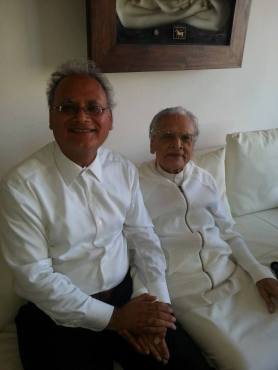
Sri Ramana and My Teacher Gurudev Sri Chitrabhanu-Ji: By Dr. Harsh K. Luthar

All of us come from different backgrounds, and we walk the path in our own unique way. Yet, we all have the same innermost longing to know the deepest mystery of our own nature and being. Reflectin…

Source: Sri Ramana and My Teacher Gurudev Sri Chitrabhanu-Ji: By Dr. Harsh K. Luthar