Category Archives: Gurus
Remain Calm and Aware: By Dr. Harsh K. Luthar
The feeling/awareness of one’s existence manifests through the mind as “I”. Hence we say, I do this, I do that, I am a doctor, I am a sanaysi, I am a householder, I am a student, I am a husband, I am a wife, etc.
Bhagavan Ramana’s teaching is to quietly bring attention to this sense of “I” by asking “Kohum”.
Continue reading
All Are In The Circle Of Love
The Sage of Arunachala, Sri Ramana Maharshi, gave us the purest teachings.
If we look at the devotees of Sri Ramana, we see that they were some of the greatest yogis and jnanis of their day.
Many of them were world class poets and scholars. But they led quiet, unpretentious, and humble lives fully content in the grace of Bhagavan Ramana.
In outward appearance, Sri Ramana appeared as an ordinary sadhu sitting quietly on the rocks of Arunachala, and wandering the holy hill at times.
The yogis of the highest wisdom upon meeting him recognized him instantly as the king of yogis, serene and content, whose very presence was the blessing they had been seeking.
The message of Sri Ramana is simple and echoes the Upanishads.
Examining One’s Mind
We are elated and happy when things go our way.
We are sad and depressed when reality unfolds differently than our expectations.
How pitiful is our lot my friends, thrown about here and there with the changing winds!
Everyday, the world, as perceived via the mind invites us to ride the roller coaster of emotions fueled by fear, anxiety, anger, and hatred.
A Sage centered in the Heart of Love is always indifferent to such an invitation.
How truly fortunate to come into the orbit of Sages who give the purest teachings of Ahimsa (nonviolence) and Self-Realization.
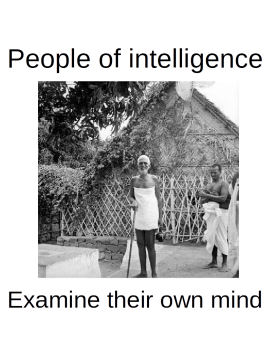
Bhagavan Ramana used to say, “Wise people examine their own minds.”
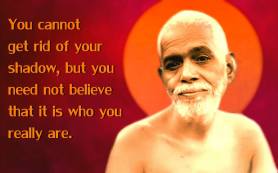
You Are Not Your Shadow
Sri Ramana used to say that wherever we go, our mind follows. We cannot escape our troubled mind riddled with endless concerns, anxieties, and fears. Even if we run away to a forest or some holy place or sanctuary, the mind is still with us.
Truly, the conflicted and conditioned mind is like our shadow.
Death and Self-Realization
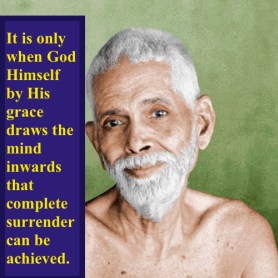
It is the ancient teaching of sages and scriptures that our mental state at the time of death determines our next birth. If at the time of death, we fully surrender to the Lord, the Universal Being, then we merge in God and are freed from all sorrows.
We usually think of that at the time of death what we have loved and thought about during life. Hence the purest souls who have devoted their whole life to serving the God of Love merge in that Universal Love immediately at the time of death and achieve complete liberation.
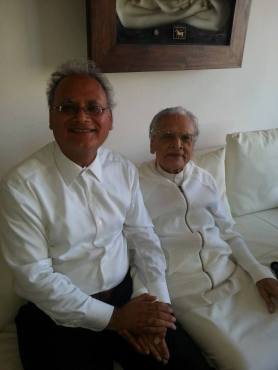
Sri Ramana and My Teacher Gurudev Sri Chitrabhanu-Ji: By Dr. Harsh K. Luthar
All of us come from different backgrounds, and we walk the path in our own unique way. Yet, we all have the same innermost longing to know the deepest mystery of our own nature and being. Reflectin…
Source: Sri Ramana and My Teacher Gurudev Sri Chitrabhanu-Ji: By Dr. Harsh K. Luthar
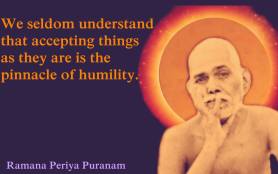
The Nature of Humility
Sri Ramana’s teaching is that the ego/mind merges in the Heart in two ways.
First, we can investigate the nature of the ego and examine the sense of “I” that we naturally feel and see where it arises. To do this, one needs to still the mind and with a purified and subtle intellect trace the “I” back to its source, the Heart. This is the yogic path of Jnana.
The second approach is to simply surrender the ego/mind without reservation to the Lord and accept that it is never our will but the Lord’s will as to what happens. If this attitude of “not my will but thine my Lord” penetrates deeply into our being, then we become accepting of everything. We see that worries and anxieties associated with ego/mind do not belong to us as we have surrendered our individual identity to the Lord. This is the approach of devotion and leads to the ego/mind merging into the Heart where the Lord sits as Eternal Existence.
“If ego rises, all will rise. If the ego merges, all will merge. The more we are humble, the better it is for us”. ~ Sri Ramana in “Gems”, Chapter XIII.
Photo art in this article is from Andreas Farasitis.
The Nature of Now
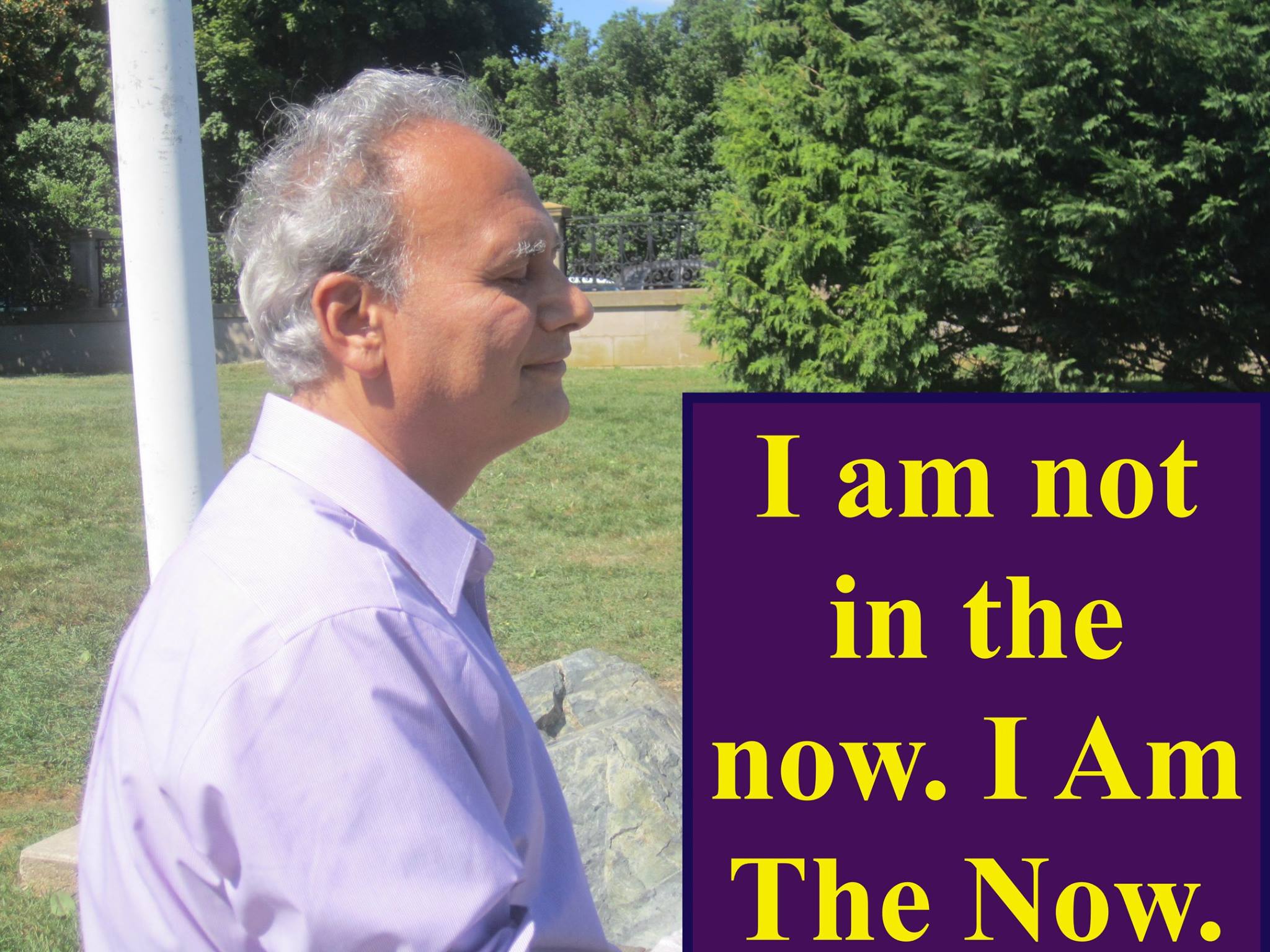
Our very nature is that of presence. We are not in the present. We are the present.
Without a calm mind, one cannot experience the ultimate reality, the underlying oneness, as one’s own Self.
Spiritual practices (prayer, meditation, deep breathing, yoga) have value because they remove the agitation of the mind.
A peaceful mind, steady in awareness, can understand the purest teaching at the most subtle level.
Therefore the practical advice of the sages is to not bother anyone and not be bothered by others.
To reach the highest state and to know one’s own Heart as the Self, one has to become absolutely indifferent to both external and internal perceptions.
The Path to Enlightenment: By Dr. Harsh K. Luthar
In this essay, I suggest that the philosophies and perspectives of the gradual or the direct path are not inherently meaningful. Their truth lies only in being teaching tools. Words and concepts such as the “direct path” and the “gradual path” are meant to point at the truth but they are not themselves the truth. The Truth must reveal itself to us in our own Heart.
A Popular Dichotomy
A popular dichotomy has emerged about Enlightenment in the West since the 1970s between the schools of “gradual enlightenment” and “instant enlightenment”. Some of this can probably be traced back to Poonja ji’s and Nisargadatta Maharaj’s disciples returning to the west in the 1970s and 1980s from India and bringing their understanding of Advaita Vedanta with them as given to them by their teachers. However, because many of these students deviate from traditional Advaita as taught in the classic lineage of Adi Shankracharya, they are referred to as neo-advaitins.
Given this thesis and antithesis between the gradual path and the direct path, I address the following question:
It is said that there are two approaches to the Truth of Being or Reality which some call Enlightenment or Self-Realization. A gradual path and a direct path. What is the truth of it? Are their really two paths? If…
View original post 2,125 more words


You must be logged in to post a comment.