
“Because, whatever noble persons do, others follow. Whatever standard they set up, the world follows.”
(3.21) Bhagavad Gita
A version of this paper was presented at the 2005 Academy of Management Meetings in Hawaii under the title: Transformational Leadership and Self-Awareness in Hinduism: A Role Model for Creating Adaptive Organizations. It was part of an Academy of Management Symposium entitled Leadership for Adaptive Organizations: Models from the Christian, Hindu and Buddhist Traditions-Spiritual Leadership. Krishna images can be found throughout the Internet, including the site http://www.vishvarupa.com/vishnu-krishna.html and http://www.krishna.com. All images reproduced here in the spirit of fair use. http://www.law.cornell.edu/uscode/17/.
We have given acknowledgement of photographers and artists to the best of our ability. Please contact us if you feel we have missed an acknowledgement.
ABSTRACT
Charismatic leadership behavior of Krishna is examined in the Hindu epic Mahabharata just prior to the start of the Mahabharata war. Using modern theories of leadership, it is suggested that Krishna’s leadership style fits both the servant-leader and the transformational models of leadership based on situational contingencies. This approach adds to the stream of literature wherein scholars have examined the leadership of various historical religious figures including Jesus of Nazareth, Nehemiah, and Mahatma Gandhi and have analyzed the implications of spiritual leadership for modern life and organizations. The paper initiates an important stream of literature since no one has yet looked at Krishna’s leadership style from the modern perspective of transformational and servant-leader models.
In this paper, I look at one of the major characters in the Hindu epic Mahabharata, namely Krishna, and analyze the leadership behavior of Krishna to see how it fits the modern management thoughts on transformational and servant-leadership models. Taking this approach is consistent with recent literature wherein scholars have examined the leadership of Jesus of Nazareth (Sendjyaa and Sarros, 2002), the leadership of Nehemiah (Maciarello, 2003), and in general explored the characteristics of spiritual leadership (Cavanaugh, 1999; Covey, 1996) and its implications for modern life and organizations.
The sociologist Max Weber (1947) conceptualized a leader as a charismatic personality whose exercise of power was rooted in the followers identifying with the leader and their strong belief in him or her as an authority. According to scholars, charismatic leaders have extraordinary characteristics which allow them to inspire their followers and gain their commitment to shared ideals and a common vision (Conger & Kanungo, 1998; Hellriegel, Slocum, and & Woodman, 2001; Smith, Montago, & Kuzmenko, 2004). In suggesting the importance of the charismatic leadership as a root model, Graham (1991) reasoned that charismatic leadership lays the conceptual foundation for understanding transformational (Burns, 1978) and servant-leader models (Greenleaf, 1977) as both of these are inspirational and moral in nature. Similarly, Farling, Stone, and Winston (1999), have concluded that the notion of transformational leadership and servant leadership have a fundamental commonality to them.
This is the first paper looking at Krishna’s charismatic leadership and how it manifested in Krishna’s playing the role of a transformative servant-leader before and during the Mahabharata war. Although the charismatic leadership of many religious leaders and prophets and even Jesus of Nazareth has been examined (Barnes, 1978), Krishna has been left out of this analysis by modern western scholars. The reasons for this are unclear, although it is possible that many traditional western scholars have viewed Krishna as a fictional character and, like Barnes (1978), tend to focus on a contemporary figure like Gandhi as being a more representative leader of Hinduism.

However, hundreds of millions of Hindus view Krishna as being quite real and historical; exactly in the same way that Christians view Jesus to be a real and historical figure. Further, Indian scholars such as Raghavan (1969), a mathematician and an astronomer, have conducted analysis on the large number of detailed astronomical references (the relative positions of planets, the stars, the sun, and the moon in the sky) found in the Mahabharata literature and have argued that the strong internal consistency of these data from the ancient skies establishes the historicity of Mahabharata and places the Mahabharata war as having occurred around 3067 B.C.
B. N. Narahari Achar (2003), a Professor of physics at the University of Memphis, used the astronomical references in Mahabharata and experimented with various simulations employing very sophisticated tools of modern technology. Using a variety of planetarium software programs (such as Skymap Pro and Red Shift) that allow the exact picture of the sky for any given day and time from any part of the earth to be recreated (from 4000 B.C.E to 8000 C.E), Achar came to the same conclusion that Raghavan had arrived at earlier. Based on various streams of evidence, a significant number of Indian scholars believe that Mahabharata war is historical in nature and actually took place around 3000 B.C. (The IGNCA Newsletter 2003 Vol. I (January – February).
Krishna’s place in Hinduism
Hinduism is a broad umbrella for many different schools of philosophy and religious thought. The common bond among Hindus is that they all accept the central truths proclaimed by the Vedas and the Bhagavad Gita. However, interpretations of these truths diverge depending on the lens of the particular Hindu tradition under which these truths are viewed. It is in the Bhagavad Gita that Krishna speaks to Arjuna about the meaning of life and how to attain the goal of life. The term “Bhagavad Gita” translates literally into English as “The Song of God”. The Bhagavad Gita is sometimes called the fifth Veda, and it is embedded in the epic civil war of Mahabharata.
The Mahabharata war was a battle between two dynasties of princes (Pandavas and Kauravas) who were cousins (Kane,1958; Pusalker, 1996). The father of Pandavas, Pandu, who had been the king, had died when his sons were still young. The kingdom, thereafter was looked after by his brother Dhritrashtra (who had been blind since childhood), until it could be passed on to the rightful inheritors, the Pandavas. However, Dhritrashtra’s sons, the Kauravas, schemed to have the Pandavas killed so that the entire kingdom would fall into their hands. When the many methods and plans employed over the years to destroy the Pandavas failed, the issue came to a head and the dispute between Pandavas and Kauravas became open. With various neighboring Kings choosing either one side or the other, the conflict escalated into a major national battle for the control of Bharata (the old name for India). Krishna played a critical leadership role in attempting to stop the war. Having failed in diplomacy, Krishna took the role of the charioteer for Arjuna in the Mahabharta war.
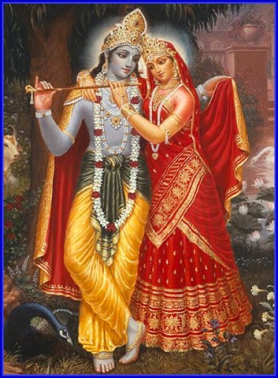
While the scholarly debate on the historicity of Mahabharata and the date it started is likely to continue, for most Hindus, the reality of Krishna has never been in question. Indeed, stories about Krishna as a mischievous child, a playful boy, a young man, a lover, a friend, and a warrior, who became the ruler of Dwarka in Western India, have captivated the Indian imagination since time immemorial. Krishna could be well described by Max Weber’s notion of ‘charisma.’ Weber defined charisma as a special quality in the personality of the leader by which he, “…is set apart from ordinary men and treated as endowed with supernatural, superhuman, or at least specifically exceptional qualities.” (1947: 48).
In Hinduism throughout the ages, Krishna has remained as the clearest example of one of the most charismatic and transformational leaders who with his great power of intuition adapted himself to every situation and inspired his followers to do their duty and achieve the goals and objectives that had been set forth. We see Krishna taking a variety of leadership roles both before and during the Mahabharata war. The two most prominent roles Krishna takes are that of a servant-leader and the transformational leader.
Krishna as a Servant-Leader
In the servant-leader model, the goal of leadership is viewed primarily as service. Servant-leaders take into account the interests of those they lead and put the interests of the followers above their own self-interest. Servant-leaders facilitate the growth and development of their followers, promote community, share power and resources, and provide the support needed to help achieve the goals that lead to the common good of individuals and the community as a whole (Greenleaf, 1977; Spears and Lawrence, 2002). In the context of this perspective, we see that Krishna meets the criteria of a servant-leader.
The following background of Krishna helps us to assess this aspect of his leadership style.

Krishna’s reputation was well established by the time of the Mahabharata war and he was revered and adored by the people he ruled along with his older brother Balarama in the city of Dwarka. Krishna and Balarama were known as the protectors of the weak and helpless in society. In particular, Krishna had great reverence for Brahmins and the Rishis (religious monks and spiritual scholars and teachers) and enjoyed helping and serving them in a variety of ways to facilitate their spiritual practices.
Krishna himself had gone through a formal religious training period with his spiritual teacher and understood the importance of maintaining age old traditions. Therefore, he had little tolerance for those who harassed the Rishis and the Brahmins in any way. Many of Krishna’s fights had evolved from attempting to protect the innocent from harm. Both Krishna and his brother Balarama were known to be superb warriors who had been through many battles. Krishna’s enemies, for good reason, had a great fear of him, although Krishna never fought without a just cause and often patiently waited to determine if aggressive action was necessary.
The Mahabharata fight between Pandavas and Kauravas posed a dilemma for Krishna and his brother Balarama as Krishna and Balarama were related to both the Pandava princes and the Kaurava princes. Krishna knew that the leader of Kaurava princes, Duryodhana, was a wicked person who had relentlessly pursued the Pandavas for years to have them killed so that Pandavas would have no claim to the throne.
The Pandavas were still alive and well due to the protection Krishna had secretly extended them through a variety of means. The Pandavas had great love for Krishna and the five Pandavas brothers and their families were dear to Krishna as well. In particular, Arjuna, one of the Pandava brothers was Krishna’s best friend since his youth. He was also married to Krishna’s sister Subhadra. Arjuna is a supreme archer and a major character in both the Mahabharata and the Bhagavad Gita. Krishna and Arjuna are inseparable during the Mahabharat war as Krishna takes the role of his charioteer and counselor.
Krishna Acts as a Diplomat
In order to avert the Mahabharata War, Krishna, although himself the ruler of the kingdom of Dwaraka, took the humble role of a mediator and negotiator to try to bring peace to the community. The Mahabharata epic details Krishna’s activities and the crucial role he played as a diplomat by attempting to achieve a last minute negotiated settlement in the conflict between Pandavas and Kauravas.
Here we see Krishna in his characteristic role of the servant-leader, not exercising his authority and power which he had in abundance, but instead trying to broker a peace by listening to both sides, empathizing with their suffering, attempting to persuade them to peace, offering them consolation and healing for the past wrongs that they may have suffered.
Even though Krishna knew the Kaurava princes to be wicked, he left no stone unturned and made a special visit to the Kaurava kingdom to speak with them and get them to agree to some minimal rights of property and conditions of fairness for the Pandavas.
In the modern management leadership literature, the servant-leader model has been recognized as important by Greenleaf (1977) and many authors have viewed this style of leadership as having a moral and a spiritual dimension (Wicks, 2002). Spears (1998), based on Greenleaf’s writings, identified ten major attributes of servant leadership that included, listening, empathy, healing, awareness, persuasion, conceptualization, foresight, stewardship, commitment to growth of people, and building community.
Several writers such as Covey (1996) and others have added more attributes including, vision, integrity, empowerment, teaching, etc., and with minor variations in the terms used, these are generally consistent with Greenleaf’s original conceptualization of the servant-leader. In the Mahabharata epic, we see Krishna engage in most of these activities in his role as a mediator and peace maker in attempting to negotiate a fair settlement between the Pandavas and Kauravas so that a civil war and the resulting bloodshed can be avoided.
Krishna’s choice to serve Arjuna as his Charioteer
When all of Krishna’s diplomacy to avert the war fails, due essentially to the evil intentions of the Kaurava princes and their oldest brother and leader Duryodhana, war becomes unavoidable and is forced upon the Pandavas. The war preparations now start in earnest and within about a month’s time, both sides have built camps and colonies to support their respective armies with weaponry, food, and places of rest and shelter in the Kurukshetra field where the battle takes place.
With the civil war being imminent, Krishna’s older brother, Balarama, decides not participate in a war where there is family on both sides and leaves the area going on a religious pilgrimage. Krishna, however, when asked by his Pandava cousin Arjuna, who is also his best friend, to be by his side in the war, feels duty bound to take the side of righteousness and justice and agrees. But he does so on the condition that he, Krishna, will not take an active part in the war and engage in battle and spill any blood.

Instead, Krishna offers to serve Arjuna and be his charioteer in the battles of the Mahabharata war. Normally, it would not be common for a great King like Krishna to play a support role for another in battle. However, by becoming Arjuna’s charioteer in the war, Krishna actively takes on and embraces the support role and demonstrates that an act of service for a just cause is, in fact, an act of leadership.
The Starting Scene of Bhagavad Gita
Krishna and Arjuna have been through many experiences together and are about the same age at the start of the Mahabharata war, both being in their mid forties (derived from Raghvan, 1969; and Achar, 2003). As the appointed hour of the war gets closer, the two massive armies face each other and conch shells are being blown on both sides. Arjuna asks Krishna, now his charioteer, to take their chariot in the middle of the two armies so that Arjuna can have a good look at the opposing army and its leaders.
Krishna then drives the chariot between the two armies and stops in the middle. Arjuna starts to carefully observe the great warriors on the opposing side, all of whom he knows well.
As Arjuna looks at his foes on the other side, he experiences a deep life crisis and along with it panic, anxiety, and confusion. Arjuna’s body starts trembling and his mouth goes dry.
Arjuna sees his cousins, uncles, and even his revered teacher Dronacharya and great grandfather Bishma, all on the other side of the war, duty bound to their evil leader Duryodhana and ready to do battle with Arjuna and his Pandava brothers.
While the oldest member of the family, his great grandfather, is on the opposing side, one of the youngest warriors of Mahabharata is on the side of Arjuna, and it is his own son Abhimanyu. Abhimanyu is 16, a talented and brave fighter who has just gotten married and unknown to him, his wife is pregnant.
Abhimanyu, simply by being around his father Arjuna, watching him and listening to him, and practicing with him is on his way to becoming a great warrior himself. Abhimanyu is full of strength and confidence that is natural to youth.
Arjuna, however, is concerned that he has not had time to complete his son’s training in the art of war strategy and the tactics of survival within enemy formations. But now there is no more time left for training and to prepare. The great war is upon them.
All of a sudden, the horrific reality of what is about to happen overwhelms Arjuna and he is thrown into great sorrow at the prospect of death and destruction of families on both sides. He understands that the ground of Kurukshetra will be turning red with the blood of warriors who will leave behind their weeping widows and children.
This is what battles bring and Arjuna has seen it all before. Perhaps the words of his oldest brother Yudhishtara and his reservations regarding this war haunt him. “Even though we are duty bound by our caste as warriors to conduct this battle, everyone should remember that war is evil in any form. To the dead, victory and defeat are the same,” Yudhishtara had said to his brothers with great sadness.
Now the Mahabharata war is about to ensue, and Arjuna, the supreme archer and veteran of many battles, experiences deep uncertainty and questions whether this is the right thing to do.
The following verses from the first chapter of Bhagavad Gita describe Arjuna’s mental state (Translations by Dr. Ramanand Prasad).
Arjuna was overcome with great compassion and sorrowfully said:
O Krishna, seeing my kinsmen standing with a desire to fight (1.28), my limbs fail and my mouth becomes dry. My body quivers and my hairs stand on end (1.29).
The bow, Gaandeeva, slips from my hand and my skin intensely burns. My head turns, I am unable to stand steady and, O Krishna, I see bad omens. I see no use of killing my kinsmen in battle (1.30-31).
I desire neither victory nor pleasure nor kingdom, O Krishna. What is the use of the kingdom, or enjoyment, or even life, O Krishna? (1.32).
Because all those for whom we desire kingdom, enjoyments and pleasures, are standing here for the battle, giving up their lives and wealth (1.33).
Teachers, uncles, sons, grandfathers, maternal uncles, fathers-in-law, grandsons, brothers-in-law, and other relatives (1.34).
I do not wish to kill them, who are also about to kill, even for the sovereignty of the three worlds, let alone for this earthly kingdom, O Krishna (1.35).
O Lord Krishna, what pleasure shall we find in killing the sons of Dhritaraashtra? Upon killing these felons we shall incur sin only (1.36).
Therefore, we should not kill our brothers, the sons of Dhritaraashtra. How can we be happy after killing our kinsmen, O Krishna? (1.37).
Though they, blinded by greed, do not see evil in the destruction of the family, or sin in being treacherous to friends (1.38).
Why shouldn’t we, who clearly see evil in the destruction of the family, think about turning away from this sin, O Krishna? (1.39).
With the destruction of the family, the eternal family traditions are destroyed, and immorality prevails due to the destruction of family traditions. (1.40)
Indeed, how does one fight evil without becoming evil? How does one fight a wicked enemy, who is intent on destruction, without becoming wicked? This is the most difficult and an age old question for humanity.
Arjuna puts it bluntly when he asks Krishna, “Though our enemies blinded by greed do not see evil in the destruction of the family, or sin in being treacherous to friends, why shouldn’t we, who clearly see evil in the destruction of the family, think about turning away from this sin, O Krishna?”
Arjuna, whose arrows have always found their mark in the past, now lays down his bow and tells Krishna that he would prefer to be slain not resisting rather than kill his cousins, uncles, and relatives on the other side, many of whom he admires, respects, and loves no matter how wicked and evil their leaders are.
We all understand that this is a natural reaction in the given context. However, in light of current scientific information, Arjuna’s question acquires a modern relevance. Scientists now tell us that all persons alive today had common ancestors. Somewhere in our deep biological evolutionary past, there is a super great grandmother that we all share. So, if we view all human beings, regardless of their nationality, religion, color, race, and ethnicity as part of our larger family, we must also understand that when nations conduct wars against each other, it is essentially distant cousins who have to battle and either kill or be killed.
The dilemma of Arjuna is not new. Arjuna admits to Krishna that he is very confused and asks for his guidance.
Krishna as a Transformational Servant-Leader
 Given the unexpected change in the mood of Arjuna, it falls upon Krishna, acting as his charioteer, to counsel him. Sensing the critical urgency of the situation, with the opposing side getting ready to strike, Krishna with his immensely charismatic personality immediately transforms himself into an authority who speaks with power and conviction to inspire Arjuna to do his just and righteous duty.
Modern leadership literature documents the association between crisis and manifestation of charisma in political leaders (House, Spangler, and Woycke, 1991). Scholars have reasoned that a crisis allows charismatic leaders with the opportunity to display their personality to a fuller extent (Bryman, 1993) and an uncertain situation enhances the leader’s ability to appear charismatic. Seen in this context, acting as a charismatic transformational leader, Krishna inspires Arjuna to have a new vision of life and empowers him to act according to his Dharma (duty) as a warrior.
Krishna does this by focusing on the immediate psychological needs of Arjuna in order to bring him out of his sorrow and confusion and offers himself (Krishna) as a role model whose ideal conduct is worth emulating. Krishna’s approach is consistent with the classic strategy of transformational leadership (Smith et al., 2004), using which, leaders are able to uplift their followers and enable them to share and follow a powerful vision of the future.
We can examine in depth Krishna’s response to Arjuna using the four components of transformational leadership behavior that are mentioned in the modern literature as idealized influence, inspirational motivation, intellectual stimulation, and individualized consideration (Bass, 1985, 1996; Bass & Avolio, 1994a, 1994b). Krishna’s goal is to pick up Arjuna’s spirits by explaining to him the nature of life, death, and the immortal spirit, and the way to overcome mental obstacles that stand in the way of doing his duty.
Given below are a few sample verses from the Bhagavad Gita to demonstrate Krishna’s use of the four behaviors commonly accepted as belonging to the realm of transformational leadership.
1. Individualized Consideration: In the following verses, we see Krishna addressing Arjuna’s personal duty as a warrior and advising him what he needs to do to achieve his goals. Specifically, Krishna points out that Arjuna, given his background as a warrior prince, cannot shirk from a battle that is just and righteous. The words used are meant to remind Arjuna that his people are depending on him to protect them from harm, and if Arjuna now retreats, there will be chaos and very serious consequences undermining his past achievements, reputation, and hindering his future potential and growth as a warrior and a person.
Krishna says to Arjuna:
If you will not fight this righteous war, then you will fail in your duty, lose your reputation, and incur sin (2.33)
The great warriors will think that you have retreated from the battle out of fear. Those who have greatly esteemed you will lose respect for you (2.35).
Your enemies will speak many unmentionable words and scorn your ability. What could be more painful than this? (2.36).
Further, as part of his individualized consideration for Arjuna, Krishna later advises Arjuna that he can develop his potentially divine nature and become an evolved soul by doing his duty as a warrior without attachment to whether it will bear fruit or not.
Krishna states:
Treating pleasure and pain, gain and loss, victory and defeat alike, engage yourself in your duty. By doing your duty this way you will not incur sin (2.38).
You have jurisdiction over your respective duty only, but no control or claim over the results. The fruits of work should not be your motive. You should never be inactive (2.47).
Therefore, always perform your duty efficiently and without attachment to the results, because by doing work without attachment one attains the Supreme. (3.19).
2. Intellectual Stimulation: Another component of transformational leadership is for the leader to open the followers up to new ideas and different ways of understanding so the followers can integrate this new knowledge into their behaviors and actions. Krishna demonstrates this approach in the following selected verses when he explains to Arjuna the nature of life and death of the body and the eternal nature of the Atma (Soul – Self -Spirit).
Krishna states:
You grieve for those who are not worthy of grief, and yet speak the words of wisdom. The wise grieve neither for the living nor for the dead (2.11).
There was never a time when I, you, or these kings did not exist; nor shall we ever cease to exist in the future (2.12).
The Atma is neither born nor does it die at any time, nor having been it will cease to exist again. It is unborn, eternal, permanent, and primeval. The Atma is not destroyed when the body is destroyed (2.20).
O Arjuna, how can a person who knows that the Atma is indestructible, eternal, unborn, and imperishable, kill anyone or cause anyone to be killed? (2.21).
Just as a person puts on new garments after discarding the old ones, similarly Atma acquires new bodies after casting away the old bodies (2.22).
Weapons do not cut this Atma, fire does not burn it, water does not make it wet, and the wind does not make it dry (2.23).
3. Idealized Influence: In this aspect of transformational leadership, the leader offers himself/herself as the ideal role model whose high ethical and moral conduct is worth emulating. We see Krishna use this approach in the following verses emphasizing that although he, Krishna, needs nothing and has nothing to obtain, yet he still does not give up action and does his duty to set an example to others.
Krishna states:
Because, whatever noble persons do, others follow. Whatever standard they set up, the world follows (3.21).
O Arjuna, there is nothing in the three worlds (earth, heaven, and the upper regions) that should be done by Me, nor there is anything unattained that I should obtain, yet I engage in action (3.22).
Because, if I do not engage in action relentlessly, O Arjuna, people would follow My path in every way (3.23).
These worlds would perish if I do not work, and I shall be the cause of confusion and destruction of all these people (3.24).
As the ignorant work, O Arjuna, with attachment (to the fruits of work), so the wise should work without attachment, for the welfare of the society (3.25).
Works do not bind Me, because I have no desire for the fruits of work. The one who understands this truth is (also) not bound by Karma. (4.14).
4. Inspirational Motivation: The last essential facet of transformational leadership is the ability to inspire and energize the followers to act on the shared vision of the leader and empower the followers with the ability to carry it out. The next few verses are examples of Krishna’s inspirational motivation and the divine touch that removes Arjuna’s confusion about the right course of action.
Krishna states:
Both you and I have taken many births. I remember them all, O Arjuna, but you do not remember (4.05).
Whenever there is a decline of Dharma and the rise of Adharma, O Arjuna, then I manifest (or incarnate) Myself. I incarnate from time to time for protecting the good, for transforming the wicked, and for establishing Dharma, the world order (4.07-08).
Dedicating all works to Me in a spiritual frame of mind, free from desire, attachment, and mental grief, do your duty (3.30).
Those who always practice this teaching of Mine, with faith and free from cavil, are freed from the bondage of Karma (3.31).
O Arjuna, I am the Atma abiding in the heart of all beings. I am also the beginning, the middle, and the end of all beings (10.20).
The Supreme Lord said: O Arjuna, behold My hundreds and thousands of multifarious divine forms of different colors and shapes. (11.05).

Therefore, you get up and attain glory. Conquer your enemies and enjoy a prosperous kingdom. All these (warriors) have already been destroyed by Me. You are only an instrument, O Arjuna (11.33).
After Krishna had explained many mysteries to Arjuna he asked:
O Arjuna, did you listen to this with single-minded attention? Has your delusion born of ignorance been destroyed? (18.72).
Arjuna answered: By Your grace my delusion is destroyed, I have gained knowledge, my confusion (with regard to body and Atma) is dispelled and I shall obey your command (18.73).
Arjuna then went on to lead his armies into the battle that has become known as the Mahabharata war, with Krishna acting as his charioteer and guide.
A ferocious and a hellish battle followed in which large numbers of armies were destroyed on both sides.
Arjuna’s worst nightmare came true when his son Abhimanyu, trapped behind a cunning enemy formation, lost his life fighting valiantly while Arjuna was preoccupied in a different field of battle and unable to reach him in time.
After experiencing the insanity and destruction that war brings to both sides, Arjuna, along with his Pandava brothers, with the counseling and support of Krishna, were victorious. Yudhishtara, the oldest Pandava prince, with some convincing from his brothers and Krishna, reluctantly took over the reigns of the new kingdom.
Conclusion
In this paper, I examined the charismatic leadership behavior of Krishna just prior to the start of the Mahabharata war to demonstrate that it fits both the servant-leader and the transformational model of leadership. This approach adds to the stream of literature wherein scholars have examined the leadership of various historical religious figures (Barnes, 1978) including Jesus of Nazareth (Sendjyaa and Sarros, 2002) and Nehemiah (Maciarello, 2003). With the growing general trend to explore the characteristics of spiritual leadership (Cavanaugh, 1999; Covey, 1996) and its implications for modern life and organizations, the paper fills a gap in the literature because no one has looked at Krishna’s role in Mahabharata in the context of modern leadership theories.
Many scholars who have analyzed both the servant-leader model and the transformational model have suggested that these models have many common elements as they are both rooted in theories of charismatic leadership and are moral and inspirational in nature (Graham, 1991; Farling et al., 1999; Smith et al., 2004).
An examination of Krishna’s leadership in Mahabharata shows that Krishna as a charismatic leader was able to potentially adapt and shift between the servant-leader and transformational leadership styles based on situational contingencies, and that this led to successful outcomes. The possibility that such adaptability can be developed by charismatic leaders in organizations would have implications for organizational survivability and prosperity and should be explored by scholars in the future.

References
Achar, B.N. (2003). Date of the Mahabharata war based on Simulations using Planetarium Software.
Barnes (1978). Charisma and religious leadership: An historical Analysis. Journal for the Scientific Study of Religion, 17 (1): 1-18.
Bass, B. M. (1996). New paradigm of leadership: an inquiry into transformational leadership Alexandria, VA: U.S. Army Research Institute for the Behavioral and Social Sciences.
Bass, B.M., Avolio, B.J. (1988). Transformational leadership, Charisma, and beyond. In Hunt, J.G., Baliga, B.R., Dachler, H.P., Schriesheim, C.A. (Eds.). Emerging Leadership vistas, (pp. 29-49). Lexington, MA: Lexington Books.
Bass B. M., Avolio B. J. (Eds.). (1994a). Improving organizational effectiveness through transformational leadership. Thousand Oaks, CA: Sage Publications.
Bass, B. M.; Avolio, B. J., (1994b). Transformational leadership and organizational culture. International Journal of Public Administration, 17(3/4), 541-552.
Burns, J.M. (1978). Leadership. New York: Harper & Row.
Cavanagh, GF. (1999), “Spirituality for managers: context and critique”, Journal of Organizational Change Management, Vol. 12 No. 3, pp. 45-53.
Conger, J.A., Kanungo, R. N. (1998). Charismatic leadership in organizations. Thousand Oaks, CA: Sage publications.
Covey, S. R. (1996). Three roles of the leader in the new paradigm. In Hesselbein, F., Goldsmith, M., & Beckhard, R. (Eds.), The leader of the future (149-159). San Francisco: Jossey-Bass.
Farling, M.L., Stone, A.G., & Winston, B.E. (1999). Servant Leadership: Setting the stage for empirical research. The Journal of Leadership Studies, 6 (1/2), 49-72.
Graham, J.W. (1991). Servant leadership in organizations: Inspirational and moral. Leadership Quarterly, 2 (2), 105-119.
Greenleaf, R.K. (1977). Servant leadership: A journey into the nature of legitimate power and greatness. Mahwah, NJ: Paulist Press.
Hellriegel, D., Slocum, J. , Woodman, R. (2001). Organizational Behavior (9th Edition). Cincinnati: South Western.
IGNCA Newsletter 2003 Vol. I January – February. (http://ignca.nic.in/nl002503.htm)
Kane, P. V., History of Dharmasastra, BORI, (Poona, 1958) Vol. III.
Maciariello, J. (2003). Lessons in leadership and management from Nehemiah. Theology Today, 60: 397-407.
Prasad, Ramanand, The Bhagavad Gita (1988), American Gita Society, Freemont CA; http://eawc.evansville.edu/anthology/gita.htm
Pusalker, A. D., “Traditional History from the earliest Time to the Accession of Parikshit”, in The Vedic Age, Majumdar, R. C., Pusalker, A. D., and Majumdar, A. K. (ed.) Bharatiya Vidya Bhavan, (Mumbai, 1996)
Raghavan, K. S., The Date of the Mahabharata War, Srirangam Printers, (Srinivasanagar, 1969).
Sendjaya, S. and Sarros, J.C. (2002). Servant leadership: It’s origin, development, and application in organizations. Journal of Leadership & Organizational Studies. Vol. 9, Iss. 2; p. 57.
Smith, B.N. Montagno, R.V. Kuzmenko, T.N. (2004). Transformational and Servant Leadership: Content and Contextual Comparisons. Journal of Leadership & Organizational Studies. Vol. 10, Iss. 4; pg. 80, 12 pgs
Spears, L.C. (Ed.). (1998). Insights on leadership: Service, stewardship, spirit, and servant leadership. New York: John Wiley & Sons.
Spears, L.C. (1998). Creating caring leadership for the 21st century. The Non-for-Profit CEO, 5 (9), 1-3.
Spears, L.C., Lawrence, M. (Eds.). (2002). Focus on leadership: Servant leadership for the 21st century. New York: John Wiley & Sons.
Weber, M. The theory of social and economic organization (Translated by A.M. Henderson and T. Parsons). New York: The Free Press, 1947.
Wicks, J. (2002). Table for Six Billion Please. In Spears, L.C., Lawrence, M. (Eds.). Focus on leadership: Servant leadership for the 21st century (pp. 269-283). New York: John Wiley & Sons.
Yukl, G. (1999). An evaluative essay on current conceptions of effective leadership. European Journal of Work & Organizational Psychology, 8(1), 33-48.
Please note that there are numerous translations of The Bhagavad Gita, many of which can be found on the Internet in addition to that of Dr. Prasad cited herein. See also http://en.wikipedia.org/wiki/Bhagavad_Gita; http://www.gitasupersite.iitk.ac.in/













 Luthar.com
You must be logged in to post a comment.