
Category Archives: Meditation
Bhagavad Gita and Karma Yoga
No one who is born in this world can remain inactive. Bhagavad-Gita teaches that each person should follow their dharma (sacred duty) and take actions accordingly.
For example, the dharma of a teacher is to share knowledge. Dharma of a business person is to engage in commerce. Dharma of a warrior is to protect the innocent and fight for justice.
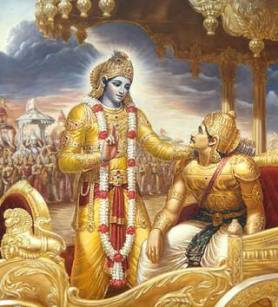
In the Bhagavad-Gita, Sri Krishna says to Arjuna that as a warrior, he has the duty to fight against injustice and lead others who look up to him.
However, Sri Krishna adds that even when one takes actions, it should be done without ego attachments as a matter of dharma that fulfills a higher purpose.
This approach to life is known as karma yoga and is taught by Bhagavan Krishna in the Bhagavad-Gita.
According to karma yoga, one should act carefully according to dharma with respect for all life.
After having done one’s best, one should not be attached to the outcomes. Instead, one should surrender all the fruits (results) of the actions to Lord with the attitude, “Not my will but thy will my Lord.”
Keeping the Lord in mind in all actions purifies the mind and frees the yogi from worry and anxiety.
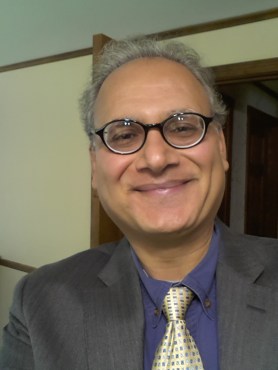
Remain Calm and Aware: By Dr. Harsh K. Luthar
The feeling/awareness of one’s existence manifests through the mind as “I”. Hence we say, I do this, I do that, I am a doctor, I am a sanaysi, I am a householder, I am a student, I am a husband, I am a wife, etc.
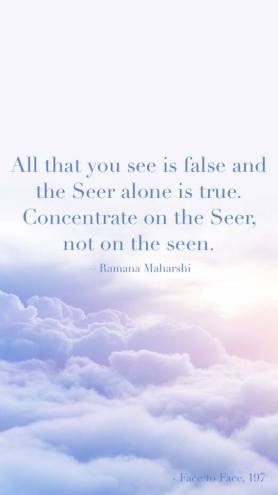
Bhagavan Ramana’s teaching is to quietly bring attention to this sense of “I” by asking “Kohum”.
Continue reading
Sri Ramana Maharshi’s Mahanirvana and the Comet in the Sky
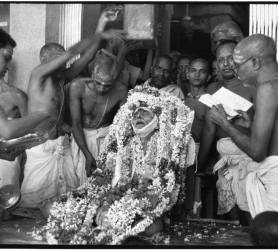
Editor’s Note: The following is the description of the luminous comet that streaked across the sky disappearing behind the holy hill of Arunachala at the time of Sri Ramana Maharshi’s Mahasamadhi. The devotees who saw it from far away realized that it was an “announcement” that Bhagavan Ramana had entered Mahanirvana.
14 April 1950:
At about 9 p.m., Monsieur Cartier-Brassen, the French photographer, who has been here for about a fortnight with his wife, related an experience of his to me.
“It is a most astonishing experience,’’ he said. “I was in the open space in front of my house, when my friends drew my attention to the sky, where I saw a vividly-luminous shooting star with a luminous tail, unlike any shooting star I had before seen, coming from the South, moving slowly across the sky and, reaching the top of Arunachala, disappeared behind it.
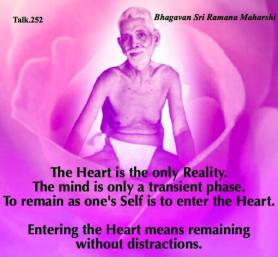
Here Lies The Heart
Mercedes De Acosta was asking Sri Ramana Maharshi about which religion, teacher, or guru she should follow that would be most helpful to her.
Bhagavan Ramana replied, “If they can help in the quest of the Self. But can they help? Can religion, which teaches you to look outside yourself, which promises a heaven and a reward outside yourself, can this help you? It is only by diving deep into the spiritual Heart that one can find the Self.”
Examining One’s Mind
We are elated and happy when things go our way.
We are sad and depressed when reality unfolds differently than our expectations.
How pitiful is our lot my friends, thrown about here and there with the changing winds!
Everyday, the world, as perceived via the mind invites us to ride the roller coaster of emotions fueled by fear, anxiety, anger, and hatred.
A Sage centered in the Heart of Love is always indifferent to such an invitation.
How truly fortunate to come into the orbit of Sages who give the purest teachings of Ahimsa (nonviolence) and Self-Realization.
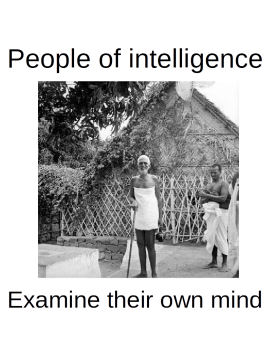
Bhagavan Ramana used to say, “Wise people examine their own minds.”
Meaning of the term “Satsang”
If one gains company of pure hearted, good people in life, one gains everything. In yogic psychology, such an association is known as “Satsang”.
At a practical level, Satsang refers to Spiritual Fellowship or company of others on the spiritual path. Satsang is a Sanskrit term and is made of two words, “Sat” and “Sang”.
Sat means “Truth”. Sat also means “Essence”. Sat also means “Existence”. Sang means to “Be With” or “Embraced By” or “In Company of”.
Combining Sat and Sang, we get Satsang, which means “In the company of or embraced by Truth or the Universal Existence”.
Death and Self-Realization
It is the ancient teaching of sages and scriptures that our mental state at the time of death determines our next birth. If at the time of death, we fully surrender to the Lord, the Universal Being, then we merge in God and are freed from all sorrows.
We usually think of that at the time of death what we have loved and thought about during life. Hence the purest souls who have devoted their whole life to serving the God of Love merge in that Universal Love immediately at the time of death and achieve complete liberation.
Sri Ramana and My Teacher Gurudev Sri Chitrabhanu-Ji: By Dr. Harsh K. Luthar
All of us come from different backgrounds, and we walk the path in our own unique way. Yet, we all have the same innermost longing to know the deepest mystery of our own nature and being. Reflectin…
Source: Sri Ramana and My Teacher Gurudev Sri Chitrabhanu-Ji: By Dr. Harsh K. Luthar
The Nature of Humility
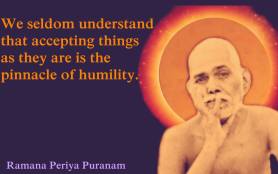
Sri Ramana’s teaching is that the ego/mind merges in the Heart in two ways.
First, we can investigate the nature of the ego and examine the sense of “I” that we naturally feel and see where it arises. To do this, one needs to still the mind and with a purified and subtle intellect trace the “I” back to its source, the Heart. This is the yogic path of Jnana.
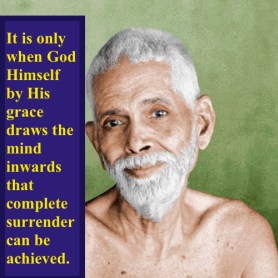
The second approach is to simply surrender the ego/mind without reservation to the Lord and accept that it is never our will but the Lord’s will as to what happens. If this attitude of “not my will but thine my Lord” penetrates deeply into our being, then we become accepting of everything. We see that worries and anxieties associated with ego/mind do not belong to us as we have surrendered our individual identity to the Lord. This is the approach of devotion and leads to the ego/mind merging into the Heart where the Lord sits as Eternal Existence.
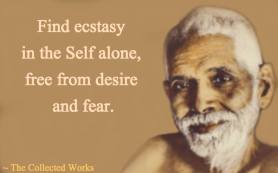
“If ego rises, all will rise. If the ego merges, all will merge. The more we are humble, the better it is for us”. ~ Sri Ramana in “Gems”, Chapter XIII.
Photo art in this article is from Andreas Farasitis.


You must be logged in to post a comment.