
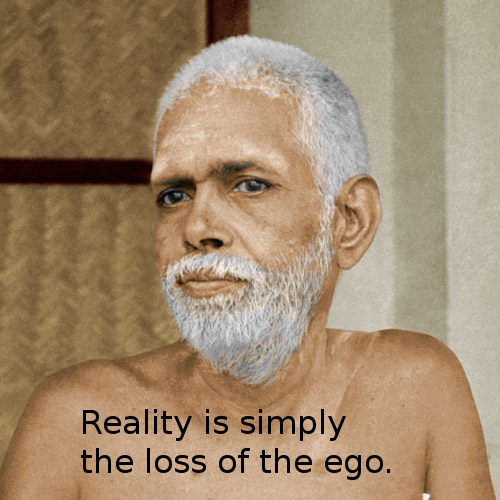
Jerry Weinstein, known lovingly to his friends and admirers as Jerrysan Rinpoche, is a retired lawyer. Jerrysan gave up a very lucrative and highly successful law practice many years ago to live the quiet life of a sage and meditate on the mysteries of life. The force of an active kundalini has been with Jerrysan for many years, showing him both the beauty and the agony of being human and aspiring to the divine union.
When Jerrysan speaks to us about his suffering and lays bare his heart, he teaches us about the human condition and our collective suffering and lays bare our own hearts. In revealing himself, he reveals us.
Jerrysan once said something like, “My heart is an ocean, like a love that has no shoreline. Yet this heart must be shattered over and over again as I progress on the path of the unknown. I have been deprived of all comforts of not only outer life but inner life as well — all reliance upon scriptures, teachers and their teachings is gone. All forms of meditation and mystical experience have been given up — in order to fully realize who I am.”
A ZEN GARDEN
By Jerry C. Weinstein
I used to go to Asia every year, especially to India, but had never been to Bali. So in August 1992, l scheduled a trip there. It’s such a long flight l decided at the last minute to do a stop-over in Japan for 5 days to break up the trip. Before l left l told my caretaker to get rid of all the weeds in my back yard, which was quite a mess.
Upon arriving in Japan l immediately went to Kyoto, which l knew to be a spiritual center with a lot of zen temples. It was then that l found myself in another world, sensing at once that destiny had guided me there. I’d been doing vipassana meditation pretty intensely for several months and was starting to feel the increased concentration and depth from this practice. In addition, I’ve always had a passionately aesthetic nature. So, l think it was a combination of these things that led to not only the temples, but particularly the zen gardens being probably the most wonderful moment of discovery I’ve ever known. There were many moments of melting in tears of joy, and many others of profound meditative stillness, induced by the sense conveyed of almost perfect harmony with nature.
It was with great reluctance that l left Kyoto for Bali, which, although it has its charms, proved to be an afterthought. Then, after flying home and pulling up in my driveway, l had the sense of being someplace else. My caretaker, instead of being content to get rid of weeds, had also cut down every tree in my backyard, making it unrecognizable.
My upstairs tenant, a staunch environmentalist, was angry at me and ready to move out. The neighbors were furious. l called my caretaker and asked how he’d managed to so misunderstand me do something so unthinkable as this? He had always been a thoughtful and responsible person, and curiously, appeared to have no idea himself.
My first reaction, since l now had a bare yard, was to arrange to have a bunch of trees planted. But somewhere within me the Kyoto experience resonated enough to lead me to postpone doing anything for awhile. The idea of having my own zen garden had an allure — the problem was l was bogged down full time in my law practice and had never even planted a tree or done any gardening in my life. So the notion of my doing anything was totally impractical. My hope was that, hey, maybe something will just evolve or manifest itself out of my meditation practice.
Less than 2 weeks after my return home my kundalini process began, with energy shooting out of my brow chakra and remaining there on a permanent basis (as well as elsewhere). There were 6 months of powerful but mostly pleasant energy sensations — interestingly, every time l looked at a tree my brow chakra would go crazy. Then certain breathing practices led to a long period of continuous headaches and other problems, making any meditation impossible. So much for the idea of a zen garden — that was the least of my concerns. So my yard just deteriorated more and more as first months, then years went by.
My yard became the junkyard of the neighborhood as weeds, beverage cans and dog crap became its main constituents. My neighbors were beyond being upset — l told one of them that someday it was going to be a zen garden, which drew a mixture of disbelief and ridicule.
My kundalini hit bottom in late 95, a time when physically l felt like l was going to die. I separated from my meditation teacher (my guru at the time) and also began winding down my law practice.
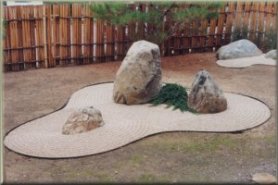
lt was then that l turned all my attention to my yard. l just stood out there, day after day, getting the feel of it and recycling ideas through my system. And so began a process that lasted for over 4 years. First, l did a formal zen sitting garden in the back, with a large area of raked, fine gravel and a meditation platform — enclosed by a fence and bordered by trees, a groove of bamboo, and a small Buddha statue in the rear corner. l often asked myself, why am l doing this? l can’t even meditate and may never be able to again. l just seemed to be driven to do it. What surprised me was that it worked — the effect was magical — friends started coming over to meditate there.
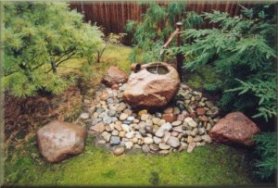
Once the back was finished l figured that was it. But 2 years later l decided to expand the garden from the back to include the side area. Once again l was completely stumped at first, but I eventually came up with a moss garden with a water feature, boulders, Japanese maples and conifers, enclosed by a bamboo fence.
l was amazed at the end result. Then last year l decided to go all the way and do the front yard also. l was just as clueless as before, and again spent day after day in front of my house, as my neighbors nervously looked on. l completely redid my front yard, enclosing it with a bamboo fence on top of a low dry stone wall. l brought in several huge boulders (which required months to select) which l arranged in various combinations surrounded by raked gravel and trees. l also tore up the straight cement walkway from the street and created a curving stone path that leads to the front door and also winds completely throughout the entire garden.
So, if anyone’s still with me here (ha ha), l now have a completely enclosed zen garden which covers my entire property and consists of 3 distinct areas. At the risk of sounding egotistical, l am pretty amazed by the physical transformation that’s occurred. Several landscape architects have wandered in and have been stunned by it. Local garden associations have pestered me to take tours through here, but I’ve resisted that so far — just doesn’t feel right. And my dear neighbors have become humble admirers.
Of course, there’s a downside too — l could write a book about all the problems I’ve encountered. Maintaining the zen garden is no small thing. But l think being able to do the garden has been wonderful for my energy process, both in terms of strengthening my connectedness to the earth and in providing an opportunity to be creative in such a fulfilling way.
For all this, l can be thankful that for some mysterious reason my caretaker decided to cut down all my trees. In recent weeks I’ve found that after nearly 7 yrs, my headaches are finally getting better, and the energy is flowing more freely again. Maybe this summer I’ll get to meditate in my garden.
Editor’s note: Jerrysan Rinpoche is a long term member of the HarshaSatsangh community. His article first appeared in the first volume of the old HS Ezine in 2001.

One of the first stops after leaving Colorado that my best friend and I took in our new home-on-wheels (“Lakshmi”) was in Sedona, AZ to go to satsang with Robert Adams. Many of you may know that Robert Adams (whose body died a few years ago) sat before Ramana for years in Tiruvannamalai.
We knew that Robert Adams was aging and that a special opportunity awaited us. Now, keep in mind that my conscious spiritual journey was rather new and I had previously immersed myself in the Satsang Mecca called Boulder.
I had really gotten a feeling for what satsang was “supposed to” look like and went to Robert Adams’ place fully armed with my finest “spiritual” clothing, “spiritual” face, “spiritual” voice, and “spiritual” sitting posture.
When we arrived, spiritually carrying our zaphus behind our hips in silence, heads held humbly down, we were quite surprised to find a room full of relaxed people hanging around, just acting normal. In fact, they were so talkative with each other and easy-going and animated that it made me wonder if we were really at the right house.
I came prepared for silence and holiness and the scene was unsettling being so ordinary. There was nothing spiritual about the place, like decorations or altars or anything that I recall. There may have been a small photo of Ramana. So I sat down and prepared to “meditate.”
Needless to say, I simply couldn’t keep my eyes closed. There was too much fun going on in the room. I struggled with it for a while, but that became so darned uncomfortable. Eventually, I just sat there figuring it would get holy, maybe, after Robert came in.
You can imagine my surprise when he did come in. While I was expecting a spiritual-looking man dressed in Indian garb, what he was actually wearing was a pair of baggy, silky jogging pants and a tee-shirt and he had on a hot pink rumpled-up baseball cap that was on crooked!
Because Robert had Parkinson’s Disease, he kind of made his way across the living room in a slow-motion shuffle and sat himself in the chair reserved for him. Everyone made room for him as he passed by and with great affection touched their palms together in reverence.
Robert sat on the chair for some time. It was real quiet in the room, but not an “it’s-time-to-be-quiet” kind of quiet. It was just naturally quiet. And no one said anything. So, trained as I was to recognize a jnani, well…. no way. This guy was plainly sitting there with his mouth open and his eyes half closed. He was hunched over with his skin just hanging on his face. There was nothing that I could “read.” And boy, did I try. I looked for some kind of radiant glow, some kind of visible wisdom, some hint of Ramana, and nothing! I looked into his eyes and it was as if no one was home. My mind was just struck dumb.
Eventually, Robert jerked his arm up, sort of pointing a finger. That was the cue for the person holding the boombox to hit “play.” I thought, “Oh. THIS must be the holy part.” I closed my eyes in full expectation of sacred words or ethereal music or at least some Sanskrit bhajans. To my utter shock, the thin and twangy voice of Willie Nelson’s “Always on my mind” came singing out!
The whole room went into an uproar. Everyone was laughing and swaying from side to side in enjoyment, singing dramatic crescendos at each chorus: “Telll meeeee. Tell me that your sweet love hasn’t died…etc.”
Robert? He just sat there, expressionless, his body unmoving, hunched in his chair. No sparkling eyes, no nothing. By then, my mouth was dangling open as well. My mind had completely come to a halt. It could not make sense of this at all. It didn’t know and could not begin to interpret what it was seeing.
The next musical selection was Kenny Rogers singing really sentimental love songs. These were no Sanskrit Bhajans about Enlightenment or God or anything. These were love songs riddled with illusion and duality. Rather than condemning them or spiritually correcting them, Robert Adams was just sitting there. Everyone was laughing so hard that tears were coming out. It was so infectious that before I knew it, I was singing along and laughing too. My sides were aching when we were through.
Afterwards, with everyone returning to normal breathing and with some sighs and residual giggles here and there, I had the thought, “Well, maybe now it will get serious.” There was a moment of silence. Then suddenly, someone said, “Hey! How about Mexican?!” This was met by an outburst of cheering! Soon everyone got up and grouped together in cars to go to a local Mexican restaurant.
Bewildered but happy to go along I arrived at a scene that I was dismayed to find rather loud and crowded and chaotic. Shortly after we were seated, I looked over at Robert. He had a bright green margarita in front of him.
Before leaving, I didn’t want to miss the opportunity to speak with Robert even though at the time I sure didn’t know what to make of him….but all that came out was something like, “I like your hat.” And he said something like, “Thanks.”
The sweet, natural happiness that I experienced in his presence was so very thick and blatant. All the ideas I had picked up about what it is to be in the presence of Truth were permanently cracked. The mind just couldn’t get around the chasm between what it thought holiness was supposed to be like and what it had actually met that day with Robert Adams. In its attempt to cross that chasm, it had fallen into it, giving rise to an absolutely undeniable experience of joyfulness and peace.
Editor’s note: Kheyala is a long term member of the HarshaSatsangh list. Her account of the Satsang with Robert Adams first appeared in Spring 2002 of the original HS-Ezine.
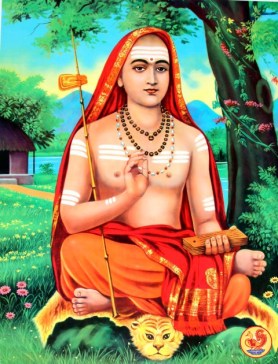
Editor’s note: The doctrines of Karma and Reincarnation play an important role in laying the ethical foundations of conduct in Hinduism, Buddhism, and Jainism. In Bhagavad Gita, the sacred scripture of Hinduism, the path of Karma Yoga (The Yoga of Action) leading to liberation (Moksha) is laid out and explained by Sri Krishna.
In popular understanding, the term Karma can have connotations of both cause and effect. Karma can mean action and activity. It can also mean the fruit or the results of such action and activity that we have to bear. For example, ethical, noble, and selfless actions (karmas) are said to lead to good fortune in the future or in a future life. The opposite of that is true as well.
According to Hinduism, how one leads one’s life determines the mental state in the last moments. The mental atmosphere, ideas, and images occurring in the last moments of life lead to a particular type of rebirth (Bhagavad Gita, Ch. 8, verse 6).
In the article given below, Sri Sunder Hattangadi, a retired psychiatrist and a serious student of Sanskrit, discusses the concept of Karma with references to the classical scriptures of Hinduism. This piece is written at a very high level and a short bibliography is provided at the end for those interested in more information. Even though many Sanskrit terms are used in the text, Sunder-Ji provides excellent English translations to the Sanskrit verses which makes the article very readable by people of all backgrounds.
The original writing was posted by Sunder-Ji to the Advaitin list. The Advaitin list is one of the largest lists in the world to discuss the doctrine of Advaita Vedanta as taught by Adi Shankracharya. Sunder-Ji is a member and a moderator of the Advaitin list. His exceptional mastery of both English and Sanskrit make his works of great value.
I did restructure Sunder-Ji’s article a bit but not with much confidence in my judgment. If any errors have occurred, these will be corrected as soon as pointed out by Sunder-Ji and other learned members of the Advaitin list.
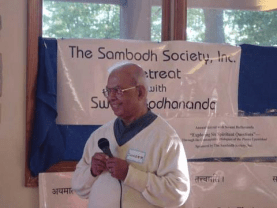
Sri Sunder Hattangadi
The Hindu Doctrine of Karma
Perhaps no word captures the mystery of human existence as suggestively as the word Karma. It is a word that evokes such a host of associated ideas – ethical-moral, psychological, metaphysical, and mystical – that one can easily lose one’s bearings in trying to understand it.
Krishna himself declares in Gita (4:17) – gahanA karmaNo gatiH – “hard to understand is the true nature of action”[`viShamA durj~neyA…yAthAtmyaM tattvam’]. It may be compared to exploring the Himalayan ranges to reach the peak of Kailasa, Shiva’s abode.
Simply defined, karma means action. The stem word, karman, is derived etymologically from the root verb (dhAtu) kRRi, to do, which also generates a multitude of other cognate words that are inextricably related to Karma – e.g. kartA (doer), kartavya/kArya (duty), kAraNa (cause), karaNa (instrument), and so on.
The definitions of Karma are modified by the prefixes, or adjectives, or compound words that are added to it, for example: Karmas may be described as sAtvika, rAjasika or tAmasika; nitya, naimittika; sa~nchita, kriyamANa (Agami), and prArabdha; kAmya, niShkAma; nyAyya, viparIta; shAstra-vidhanokta or avidhipUrvaka; akarma, vikarma, naiShkarmya; svabhAvaja/sahaja.
The Bhagavad-Gita, which Shankara has called `samasta-vedArtha-sAra-sa~Ngraha’ or the `epitome of the essentials of the whole Vedic teaching’ (or Spiritual Knowledge), is the incomparable vade mecum in explaining all the implications of the word Karma. It is a triune synthesis of dharma-shAstra, karma yoga-shAstra, and mokSha-shAstra. Any reader has a wide choice of verses to select in understanding this unique word. The present article is only one such selection, by no means exhaustive, and is only meant to serve as a pointer to other treasures.
Karma and Moksha: Action and Liberation
The word `karma’ yields over 300 words when associated with other prefixes and words to form compound words. The frequency of the word is relatively small in the Vedas & Upanishads, though the major portions of the Vedas (saMhita-s, brAhmaNa-s) are known as Karma-Kanda, i.e. dealing with rituals of worship. They, and the `dharma-shAstra’-s (scriptures on conduct), deal with the do’s and don’ts for the effective functioning of individuals, families, and society. The word has been repeated over a hundred times in the Gita.
The whole pursuit of Reality, the abode of Immortality (13:13) and Imperishable Bliss (5:21), is the effort to transcend the bondage or limitations caused by action. Every ego-centric action leaves an impression (vAsanA) on the mind (or chitta – the memory store-house) serving as a seed to germinate into further action, and results in consequences (karma-phala), that have to be experienced (enjoyed or suffered) in the present or subsequent life. These tendencies (vAsanA-s) can be countered by proper discipline of unselfish actions which leave impressions (saMskara-s). This wiping out of vAsanA-s (vAsanA-kShaya) itself is known as liberation (mukti).
The goal of action is to attain `actionlessness’, (naiShkarmya – Gita 3:4, 18:49). Immortality, freedom from delusion and sorrow and sin, peace, bliss, freedom from desire and anger, are the fruits of this pursuit, as attested in the following verses.
Gita 18:5, yaj~na-dAna-tapaH-karma pAvanAni manIShiNAm – purifiers of the wise.
5:11: “yogins perform action, without attachment for the purification of self.”
4:24 – “Brahman verily shall be reached by one who always sees Brahman in action.”
4:33 – “All action is comprehended in wisdom”.
4:37 – ” Wisdom-fire reduces all actions to ashes.”
Shankra Bhashya on Gita 3:16 states: ` ….till one attains the qualifications for Devotion to the knowledge of the Self, one who knows not the Self and is therefore qualified (for action only) should resort to Devotion to action as a means of attaining Devotion to knowledge.”
In Gita 4:25-32, Krishna defines the manifold yajna-s which are born of action (Bhashya: “in deed, speech and thought”, the not-Self, for the Self is actionless. If you realize that these are not my actions, I am actionless, I am unconcerned, you will be released by this right knowledge, from evil, from the bond of samsara”).
In Gita, 5:8-9, are described other actions (“seeing, hearing, touching, smelling, eating, going, sleeping, breathing, speaking, letting go, seizing, opening and closing the eyes”,) which are expressed by a truth-knower as “I do nothing at all, the senses move among the sense-objects.”
Actions, or the flux of events or changes in phenomena, happen in Prakriti (Gita 7:4) or in Kshetra (13:5-6) when applied to an individual. 3:27 – “Actions are wrought in all cases by the energies of Nature (Prakriti). One whose mind is deluded by egoism thinks `I am the doer’. ”
How does Vedanta view Karma?
Gita 18:13 – (also 2:46, 4:33) Bhashya – “all action ceases when the knowledge of the Self arises, so that Vedanta, which imparts Self-knowledge, is the `end of action’; (sA~Nkhye kRRitAnte)”.
Other References From Upanishads and Bhagavad Gita on Karma
The classical definition of karma is given in Gita 8:3: bhUtabhAvodbhavakaro visargaH karmasaj~nitaH – “The offering which causes the origin of physical beings is called action (Karma)”.
Shankara Bhashya on this is: “The sacrificial act which consists in offering cooked rice, cakes and the like to the Gods (Devatas) and which causes the origin of all creatures, is known by the term Karma; for it forms the seed as it were of all beings; it is in virtue of this act that all beings, animate and inanimate, come into existence, after passing through rain and other regions of life.”
Brihadaranyaka Upanishad, 1:6:1, states: “This Universe is formed of three entities: name, form, and action.”
Taittiriya Upanishad, 1:11:2-4, gives the guidelines – “……should you have any doubt with regard to duties or customs, you should behave in those matters just as the Brahmana-s (learned ones) do, who may happen to be there and who are able and noble thinkers, who are adept in those duties and customs, who are not directed by others, who are not cruel, and who are desirous of merit…..”
[Jaimini’s Karma Mimamsa codifies in aphorisms (3,454 in 16 chapters) the Karma Kanda (`dharma-jij~nAsA’) of the Veda-s, just as Badarayana’s Brahma Sutra-s (555 in 4 chapters) formulate the Upanishadic `brahma-jij~nAsA’ (Jnana Kanda).
Gita 3:14-15 – “From food creatures come forth; the production of food is from rain; rain comes forth from sacrifice; sacrifice is born of action; know thou that action comes from Brahman; and Brahman comes from the Imperishable. Therefore the all-pervading Brahman ever rests in sacrifice.”
Shankara Bhashya : “…Yajna or sacrifice spoken of refers to what is called `apUrva’; and this is the result of the activities of the sacrificer and his priests (ritviks) engaged in a sacrifice. These activities are enjoined in the Veda (Brahman), and the Veda comes from the Imperishable, the Paramatman, the Highest Self. Because the Veda has arisen from the Highest Self, the Akshara, the Imperishable, as the breath comes out of a man, therefore, the Veda, though all comprehending as revealing all things, ever rests in sacrifice, i.e., it treats mainly of sacrifices and the mode of their performance.”
As the reader can see, the word Karma has a rich history and heritage. A discussion of it is intimately tied to other topics such as reincarnation (rebirth) and moksha (liberation). Please review the following references for more information.
References:
http://www.sankara.iitk.ac.in/gitaindex.htm [Complete Works of
Shankara]
http://www.gitasupersite.iitk.ac.in/ [various commentaries on
Gita]
https://luthar.com/wp-content/uploads/2007/07/karma_mimansa.pdf [Jaimini
Sutra-s on Karma Mimamsa]
http://www.archive.org/details/thekarmamaimaacm00keituoft
http://www.mimamsa.org/articles/brief_introduction.html
http://www.geocities.com/profvk/gohitvip/contentsbeach11.html (waves
9&11) [by Prof.V.Krishnamurty]
http://www.hinduismtoday.com/archives/1994/2/1994-2-09.shtml
https://luthar.com/wp-content/uploads/2007/07/waystotruth.pdf [by Ananda Wood]
Back To The Truth – Dennis Waite ; 2007 Ch 2; O Books, UK

Editor’s note: Sada-Ji (Dr. K. Sadananda) is well known to the Hindu community in both the U.S. and in India. He is one of the most brilliant and thoughtful exponents of the Bhagavad Gita as well as the ancient philosophy of Advaita-Vedanta.
In this article, Sada-Ji discusses a practical question that frequently comes up among many students of Hinduism as well as many Westernized Hindus. The question is, “Should I become a vegetarian?”
I took the liberty to edit and restructure Sada-Ji’s original e-mail answer to this question for the purpose of this article to give it an easier reading flow. I hope that justice has been done to Sada-Ji’s explanations and that I have stayed within the limits of editorial license. Of course, any errors are mine and as soon as these are pointed out will be promptly corrected. Thank you for your understanding and patience.
***************************************************
Should I Become a Vegetarian?
Recently two questions were asked – Does Hinduism require one to believe in God? Does Hinduism require one to be a vegetarian?
In a recent article, I have addressed the first question. Here I will provide some thoughts for the second question. In relation to the first question, I have discussed what Hinduism stands for and who is truly a Hindu. In essence, Hinduism is Sanatana Dharma, and that Dharma is from time immemorial; it involves pursuit of Moksha through self-reflection, inquiry, and Self-Knowledge. Self-Knowledge in Hinduism is synonymous with Moksha (Liberation from the cycle of birth and death).
Therefore, the one who is seeking to understand the ultimate mystery of existence and thereby gaining salvation or release is a true Hindu, irrespective of the nationality, caste, creed or gender. With that catholic understanding, one can see that Hinduism becomes a way of life because the pursuit of the essential purpose of life is the goal of the ideal Hindu life. If you ask most Hindus whether they believe in God, you will get a firm “Yes”, in response.
With this perspective, it is easier to analyze all other questions including whether Hinduism requires one to be a vegetarian. Since the purpose of life is securing liberation or Moksha, until we reach that we need to maintain our body. Keeping the body healthy through proper nourishment is the Hindu Dharma. The human body is considered a temple of God. Therefore, it is sacred and should be treated with respect.
You asked whether a Hindu has to be a vegetarian. Well, it is a fact that not all Hindus are vegetarians. Hindu kings and princes and the warriors have eaten meat for thousands of years. So your question is not whether a Hindu should eat but whether you should eat meat. Since such a question has already arisen in your mind, perhaps you have developed a degree of sensitivity about harming other living forms to satisfy your physical hunger. If that is true, you may be better off not eating meat. That way you will be at peace with yourself. Since you are sensitive to this issue, your intellect may be directing you towards being a vegetarian. It is a possibility. However, your mind wants the pleasure of eating meat and your body may crave it due to past habits. So you have to reflect on this. Why has this question come up for you? What is the right thing for you to do?
Follow Your Self-Nature
When you go against your own intellect and good understanding of life you commit a sin. An act that is contrary to your SWADHARMA (your own nature) creates a conflict within you. So you have to reflect on whether being a vegetarian is natural to you or not. Now, of course, even the traditional non-vegetarians are choosing vegetarianism not because of any compassion to other animals but they are recognizing that meat is not good for their health.
I have already mentioned that Hinduism does not say to you “don’t do this and don’t do that”. You must determine your own actions based on your intellectual values, culture, education and primary goal in life. You will find that following your Swadharma (your own nature) will make you comfortable with yourself. It is not for others to judge what food is right for you! It is for you to decide.
While you are trying to decide whether to be a vegetarian do this experiment. Imagine your self to be a chicken or cow who is about to be slaughtered for food. Would you not advise the guy who wants to make a dinner out of you to be a vegetarian instead? The golden rule of “Do unto others as you would have them do unto you” can sometimes help shape our analysis.
Life Lives on Life
Life lives on life. That is the law of nature. Whether I eat an animal or plant, I am destroying a life in some form. Among all life forms, Man is different from the rest. He has the capability to discriminate right from wrong. That gives him the freedom of choice which animals and plants lack.
According to ancient teachings and our observations, plants have just a body and perhaps a rudimentary mind. Animals have both body and mind to express their feelings and suffering, but rudimentary intellect. Man has not only body and mind but also a well developed intellect to discriminate between good and bad, and to choose.
Man always has three choices: He can choose to do something, not to do it, or find another alternative way to do it that is more satisfactory. For animals and plants there is no freedom of choice. They are instinctively driven. The cow does not sit down before meals and inquires whether it should be a vegetarian or non-vegetarian. Same with the tiger or the eagle. They don’t say prayers before eating like we do. They just act according to their nature. No one can hold that against them.
Man and Sin
For a Man the discriminative intellect is much evolved. Plants and animals do not commit sin in their actions because there is no will involved in their actions. For a human, the story is different.
You may wonder why I brought sin in the argument. Let me explain. Sin is nothing but agitations in the mind. It is these agitations that prevent me in my journey to Moksha. Mind has to be pure (meaning un-agitated) for me to see the truth as the truth. (Bible also says blessed are those whose minds are pure).
To define sin more scientifically: It is the divergence between the mind and intellect. Intellect knows right from wrong. But we feel like doing things even though we know they are wrong . That is, the intellect says something but mind which should be subservient to the intellect rebels and does whatever it feels like. This divergence is sin.
After a wrong action is performed there is a guilt feeling. Intellect, although it was overruled, does not keep quiet. It keeps prodding “I told you it is wrong. Why did you do it?” With peace of mind gone, Man goes through a “Hell”. Man is not punished for the sin; he is punished by the sin! Think about it. All the Yoga schools, if you analyze clearly, are bringing this integration between the body, mind, and intellect so that there can be harmony. With harmony, there is peace.
For a true Yogi, what he thinks, what he speaks, and what he does are in perfect alignment. In our case, we think something but have no guts to say what we think. Our lips say something different from what we are thinking. Sometimes people say, “Watch My Lips or Read My Lips “. They mean to emphasize that what they say can be counted on. However, if you watch their lips as requested and follow their actions these are again different! There is no integration anywhere. Our lips and our hips have divergent paths. We live a chaotic life of freestyle dancing! Besides deceiving others, we deceive ourselves, and the worst thing is sometimes we don’t even realize that.
Animals and Sin
Now, when a tiger kills and eats, it does not commit a sin. Because its intellect is rudimentary, it does not go through any analysis before it kills and asks “should I kill or not kill this cute deer”? A tiger does not ask itself, “Should I be a non-vegetarian or a vegetarian?”. When it is hungry, to fill the natures demand, it kills its prey and eats what it needs and leaves the rest when it is full. A tiger does not overeat. There are no fat tigers in nature.
A tiger is not greedy either. It does not seek luxury beyond satisfying its needs. Animals and plants and birds and bees and insects and all living things follow a beautiful ecological system. It is only man who destroys the ecology by being greedy. But Man also has the beautiful instrument of the intellect and the ability to develop it and to meditate on the reality of the universe.
Should I be a vegetarian or non-vegetarian?
So yes, “Should I be a vegetarian or non-vegetarian?” is asked only by a man. Why does that question come? It comes due to reflection. Because man has a discriminative intellect, he can reflect on the nature of pain and suffering. Perhaps a man may think at some point in his life whether it is justifiable to harm and kill an animal to fill his belly. A person may reflect whether eating animals is consistent with the golden rule of “Do unto others as you would have them do unto you”. A man may consider whether this maxim applies to all forms of life or just other human beings.
Plants are life forms too. “Should one hurt them?” you may ask. If one can live without hurting any life forms that is the best, but that is not possible. Life lives on life – that is the law of nature. My role as a human being with discriminative intellect is to do the least damage to the nature for keeping myself alive and well.
At least, I am not consciously aware of suffering of the plants. That is why eating to live and not living to eat is the determining factor. In Bhagawad Geeta, Sri Krishna emphatically says that a Sadhaka (one who is in pursuit of Moksha) should have a compassion for all forms of life. There may come a point when it is advisable to be a vegetarian – only taking from nature what you need to keep the body in optimal health.
In one’s spiritual growth, one develops subtler and subtler intellect. That is, the mind becomes more sensitive, calmer, and self-contented. Your sensitivity to suffering of others also grows. Hence, the thought about becoming a vegetarian may come. Only you can decide what is right for you and not someone else. Any decision that is imposed on you from the outside does violence to your nature.
Many young people are now becoming vegetarians. They all have their own reasons. Fortunately vegetarianism is mainstream now and accepted. Most schools and universities offer vegetarian and even vegan meals and so the option to become a vegetarian is easier today than ever before.
Flowers grow in their own time. Whether you are vegetarian or not does not matter ultimately.
You are all flowers blooming in the light of the divine.
Hari Om and Tat Sat. – Sadananda
In the 1960s, my Gurudev, Sri Chitrabhanu- Ji, wrote a poem called “Matiri Bhavanu” on friendship and universal love in his native tongue (Gujrati) that became famous in India. It was eventually recorded as a song by a well known Indian singer named Mukesh and was set to music by an eminent Indian composer. The poem was translated into English by Gurudev Chitrabhanu- Ji and that is the version of the poem that I was most familiar with. However, at the meditation center where Gurudev taught and lectured in the 1970s, we sometimes sang the poem Maitri Bhavanu in Gujrati with great feeling.
The scene shifts now to almost 30 years later to 1994. In 1994, the thought came to me that I should read the original Gujrati version of the poem by my teacher. Gujrati is not my native tongue and, in fact, I do not understand it at all. I cannot speak in Gujrati and cannot read it. However, the Gujrati alphabets are similar to Hindi which I do know. So somehow the feeling came over me and I started to try to read and understand my teacher’s poem. It was hard but I was staring at the Gujrati words as if through will power alone I could decipher them. After some difficulty, I switched to the English description of the Gujrati sounds that you can see on the Jain Meditation Center website.
http://www.jainmeditation.org/pages/song.html
After many attempts, I actually started to understand the first stanza, and then the second, and then the third, and then the fourth. It was so beautiful and full of the universal feeling that I went into ecstasy. The result was the following poem, “Let this feeling never part!” In a very real sense this poem is the spiritual offspring of that original poem written by my teacher in his youth as a Jain monk. Recently, I came across the poem again on my old computer files and had to smile. I was just a “kid” when I wrote it. Of course, it cannot reach the same level of poetic artistry as my teacher’s poem in original Gujrati which is a true masterpiece. But I tried because something came over me. Perhaps what I lacked in talent, I was trying to make up in enthusiasm and feeling. I dedicate this poem to my Gurudev, Sri Chitrabhanu-Ji, who taught me the meaning of Ahimsa, the philosophy of nonviolence.
Let This Feeling Never Part!
The sacred stream of love divine
sweeter than the sweetest wine
flowing into this vast sunshine
springs eternal from my heart.
I pray no one should be left out
from life’s blessings in their glory
and give way to tortured doubt
with unhappy endings to their story.
Never should they be turned away
suffering from the blows of life
the poor, the wretched of this world
caught helplessly in endless strife.
If ever anyone should be in need
of comfort or help in getting up
let me not run away from them
but plant kindness as my living seed.
Let me give hope where there is despair
and mend hearts considered beyond repair
like the gentle ocean breeze that
heals all wounds and gives a fresh start
Let this feeling never part!
I should always find delight
in the warmth of universal light
but if my heart must bleed at all
let it be so in the dark of night.
No one should see the tears that come
when the wicked and cruel come in my sight
let this hand forever be raised in peace
and the violence around us come to cease.
Always this thought should be kept alive
every sinner is a future saint
there should be a place for everyone
to swim in the pouring love divine
that flows eternal from my heart
Let this feeling never part!
Unaware, if someone is unkind
let forgiveness be on my mind
until no trace is left behind
of ill will, anger, or hostility.
If I should ever slip and fall
and no one to catch me is around
let me come down gently like a leaf
so other life is unhurt on the ground.
If I have to lay for some time
contented should be my smile
composing songs of love and friendship
and resting all the while.
I will be picked up by love divine
which springs eternal in my heart
for all the beings everywhere
Let this feeling never part!
Sages have sung the song of friendship
walking with them and in their shoes
the same melody plays on my lips
the feeling of reverence for life continues.
Involuntary poets, there have been many
who felt the thrill and saw the sign
whose hearts sang out in ecstasy
as their fountain bubbled with love divine.
The blessings of nature are bestowed
on those who are firm in their belief
who are harmless to others and easily bow
before anyone, seeing only divinity.
If I should be granted just one thing
let it be the vision of love
always rising from the spring
sacred and eternal in my heart
Let this feeling never part!
**********************
NAMASTE
I bow to the light in you
which is the same light in me.
—
This article was originally written on May 9, 2006 and posted by Michael Bowes on the old HS blog.
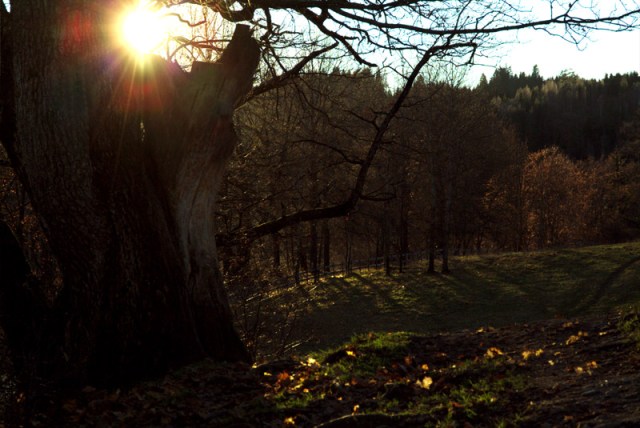
Picture below is by long term HarshaSatsangh member Alan Larus at http://www.ferryfee.com/tree.htm
One weekend in the early 1990s, my friend Narayan and I went to Saint Louis, Missouri to visit with Swami Chetanananda. Narayan and I have known Swami since the late 1980s. On Sunday morning of that weekend we were eating breakfast with Swami and the other residents of the temple, and according to the custom there, we were all reading a portion of the newspaper.
When reading the paper, Narayan nearly always goes straight to the “funnies”.
We were all reading and eating. Swami was at the head of the table, I was to his left, and Narayan was to my left. At some point Narayan nudges me and hands me the funnies. He pointed to the “Donald Duck” comic strip.
Donald Duck was in the Himalayas searching for his guru. And there were signs posted in the mountains that said “Guru”, and then an arrow would be pointing to a certain direction. And Donald followed the signs and arrows until finally, at the top of a mountain peak sat the guru with a personal computer in front of him.
Donald Duck asked the guru, “What is the meaning of life?”
The guru didn’t answer; but the computer started printing out something that couldn’t be read on the comic strip.
The gag was that personal computers were becoming the rage, and now even the guru was using one to divine the mystic truths.
But another peculiar thing was that Narayan and I were searching for a guru and a spiritual home; and now, thanks to Donald Duck, the stage was set for that possibility.
I nudged Swami and handed him the funnies while pointing to the Donald Duck comic strip. He read it and handed it back without saying a word, and continued to eat breakfast. After breakfast Swami went to prepare for his weekly public talk. The rest of us cleaned up after the meal and relaxed until the beginning of the service.
Swami began his Sunday morning talk and I really don’t remember the topic; but near the end he announced that he was going to reveal the “Meaning of Life”. He was going to reply to the question in the funnies.
Swami started by saying, “The meaning of life is bliss.”; and the following is a very loose paraphrase of what he said to explain that statement:
There is an “ocean of bliss” that is the source, the cause and support of all that we see; And in its manifest forms that bliss is experienced as amrita, rasa, love, joy, happiness, fun, hope, peace and even as pain and suffering. Pain and suffering serve as motivation for us to find a way to return to our original state of bliss.
We were all born from bliss. We arrive in this world because one day or one night our parents engaged in a blissful activity, and as a result we were born. From that day on, all of our conscious and even subconscious activities are meant to help us either directly or indirectly to achieve bliss and happiness.
As children all we really wanted to do was play. Our true unconditioned nature is playful. But, as we start to get a little older, we are forced to go to school and we are conditioned by society to perform certain useful functions.
But bliss, happiness, satisfaction, etc. are still the primary objective of all of our behaviors. Our parents and our society force us to go to school so that we can get a job, so that we can earn money, so that we can be happy.
We marry because we believe that another person will fulfill us and make us happy. We have children because we think that will make us happy. Everything that we do is ultimately for happiness and bliss. Even so called, “selfless love” only serves to satisfy ourselves. We believe that by performing our self-ordained duties that we will be satisfied.
A short time after I heard these words from Swami, I directly experienced that “ocean of bliss”. Our own true nature is something that cannot be imagined, and it is truly inexpressible. Since then, even though I have gone through some dark times, it isn’t possible for me to worry or lose my connection to that blissful being, the “ocean of bliss” that is our own true nature. And I have a lot of fun. I can’t seem to avoid it.
I began to experience this truth because of an encounter with the “funny paper”.
Love and peace to all,
Michael Bowes





Michael Bowes is well known to us as an authentic and genuine and a very experienced yogi and a devotee of Sri Bhagavan Ramana. Internationally, he is well travelled and has been to India. He has visited various Ashrams and Gurus and Swamis in both the U.S. and abroad.
Michael has an uncanny ability to see to the heart of the matter and his spiritual insights pierce through the veils of sentimentality and conceptual baggage. Michael is a long term member of the HarshaSatsangh community and his presence has been a gift.
Given below is the second part of a three part story from Michael about his visit to a Swami in India. This is Part II.
You can see Part I at the following link.
https://luthar.com/2006/01/page/2/
************************************************************************
By Sri Michael Bowes
Many persons would love to meet their guru. Imagine meeting a Swami of the Shankara Order who was exuding peace, love, and siddhis. Imagine an unknown Swami who, on his first trip to the West attracted a very large following in a very short time. Many persons were convinced that the Swami was an exceptional spiritual beacon. A letter came inviting me to India.
Thinking that I had met a true guru, a person who seemed to be surrounded by mystical events, I traveled to the other side of the earth to be with him in India. But after being there for a short time, and through the grace of the guru, I had already become wary.
The Ashram was situated on a quiet, peaceful farm in South India. The farm was owned by Govindan and his family. There was Mother, his wife, and there were daughter and son. I never got their names – they were Mother and daughter and son.
Govindan had a nice room with a bed and a desk and some chairs. There was a ceiling fan and he had a water purifier there. I would often go there and visit. Mother lived in the kitchen. She slept on a mat on the bare concrete floor. I never did find out where daughter and son slept; but I think that it might have been in the cowshed.
Mother and daughter cooked for us on a wood fire. Sometimes there were many persons there. The food was great. In part one, I mentioned that Govindan, and Shyam and I went to Ramana Ashrama and some other locations; but before we did, I wanted to give Mother a small gift. I also wanted to give something to daughter. I had already given a significant sum to Govindan because they were feeding me and giving me a nice place to stay.
Mother didn’t want to take the money, so I had to leave it on the floor in the kitchen. I also left some money for daughter and then Govindan, Shyam and I left for Tamil Nadu. A couple days after our return, and after the grace of Ramu, the Swami’s attendant called me to his room. Swami was just finishing the morning puja when I walked in. Mother and daughter were there along with some others.
The Swami welcomed me and I paid my respects to all. Mother and daughter were standing and the Swami was seated near the shrine. Swami said, “Mother has something to tell you.” I looked at Mother and her eyes revealed the depth of her emotion. The Swami spoke and said, “Mother wants you to know that she used the money that you gave her and bought these earrings. I have blessed these earrings, and Mother wants me to give these earrings to you and then she wants you to hand the earrings to her.”
I was overjoyed. The Swami placed these teeney, tiny, gold and diamond earrings on a flower, and handed them to me. Then I handed the flower with the earrings to Mother. Mother put them in her ears immediately and she was nearly shining. Daughter had bought a gold nose-pin with her money and so the same process was repeated for daughter. She also seemed quite happy. It was fun for me.
Then Swami said, “Mother has something else to tell you.” I looked at Mother and it seemed that she was about to cry. Swami said, “Mother wants you to know that no one has ever done such a wonderful thing for her. Mother says that men have always cursed her and abused her. Mother says that this is the best thing that has ever happened to her.”
I was stunned. I looked at Mother and I’ll never forget the look on her face. Suddenly I realized – they don’t say her name. She lives on the concrete floor in this primitive kitchen. She and daughter don’t even eat with us. She got this little bit of money and she wants me to know that this is the most wonderful thing that has ever happened to her. I was shocked. I could barely believe this. I can’t begin to explain how I felt.
As everyone was leaving, the Swami asked me to stay. I was really, really sad. I sat down next to him and he said: “Michael, don’t give these people anymore money.” If you want to give someone money, give it to me.”
My very limited patience began to wear thin. I tried to explain that I had given Mother and daughter just a little bit of money and that I gave money to Govindan because he had built a room and was feeding me and everything. Swami said, “Govindan is a retired railway station master. He gets Rupees 1800 every month. Don’t give them any money. If you want to give money, give it to me.” He went on to say that he had some kind of trust set up and that he already had $700 and that everything was all worked out. I told him that I understood, bowed and left the room. I knew that I needed to get away from this Swami; but I couldn’t go home just yet…
 Luthar.com
You must be logged in to post a comment.