Harsha's avatar

Walking up to Skandashram: By Richard Clarke

Here in Tiruvannamalai for many Westerners the focus is on Sri Ramana Maharshi and Ramanasramam. Many of these go up Arunachala to the caves where Ramana lived and taught and gave darshan.

One of these caves is Skandashram. It is perhaps one mile from Ramanasramam, up a well cared-for path, up the side of the mountain.

Ramana lived at Skandashram from 1915 to 1922. This is where his mother joined him, and started preparing meals at the ashram, rather than having prepared food carried up, as had been the case since the earliest years. After the mahasamadhi of Mother, and her subsequent interment at the base of the hill, Ramana then took residence at her samadhi, the location of the present day Ramanasramam.

I show here photos from a recent walk up the hill to Skandashram. We started about 7:15 in the morning, before it was too hot. We left out the back gate of Ramanasramam.

Getting started

Going through Sri Ramanasramam
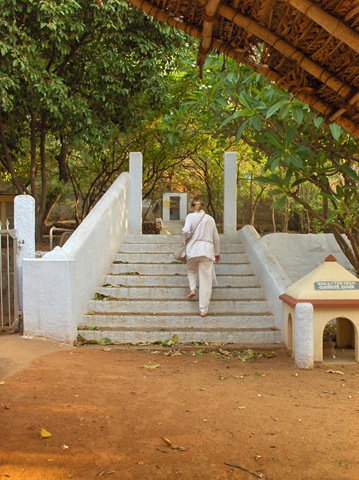
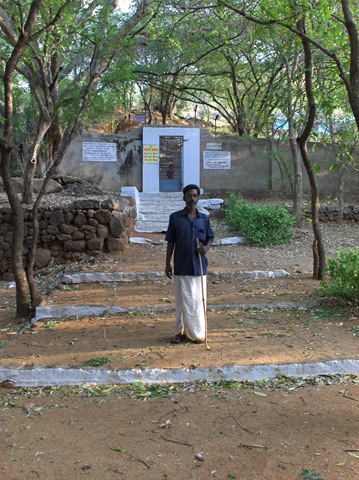
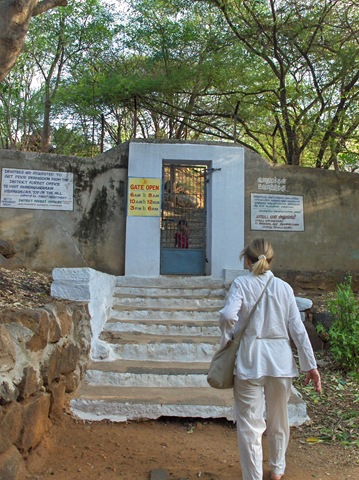
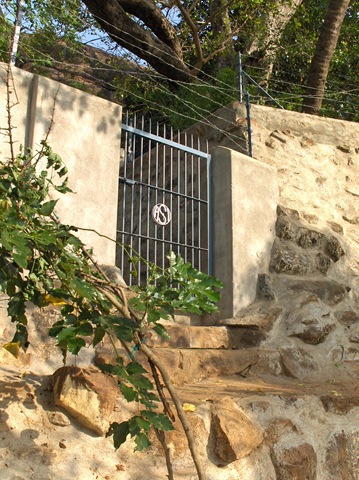
Carol walking through Ramanasramam to path to Skandashram One of the guides who accompany newcomers The gate from Ramanasramam

Starting up the hill

Starting on the path

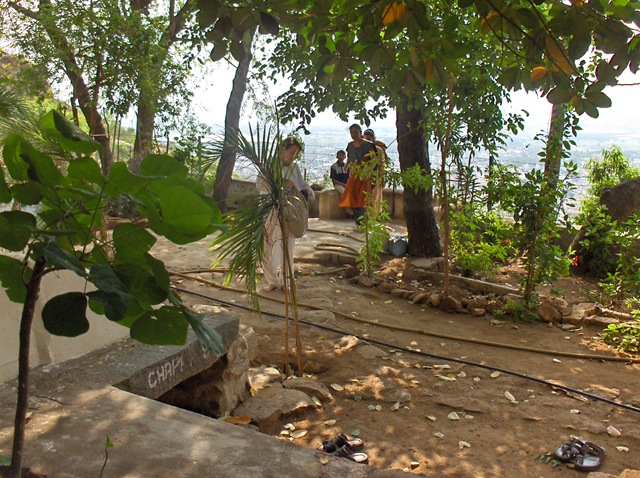
A woman working with gathered material
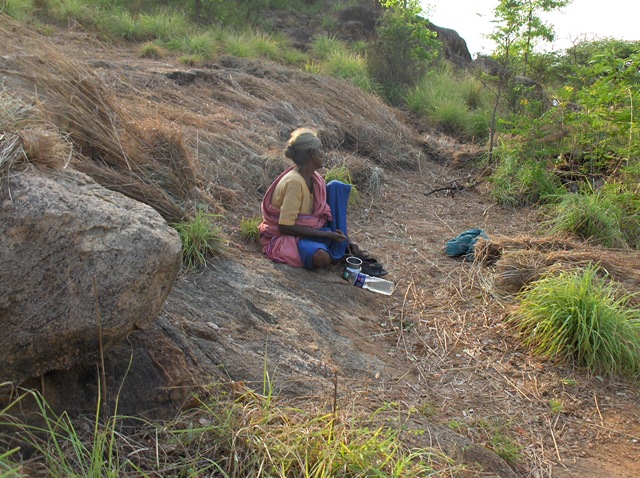
Village woman collecting plants

Up the path we go

Starting to climb up the path

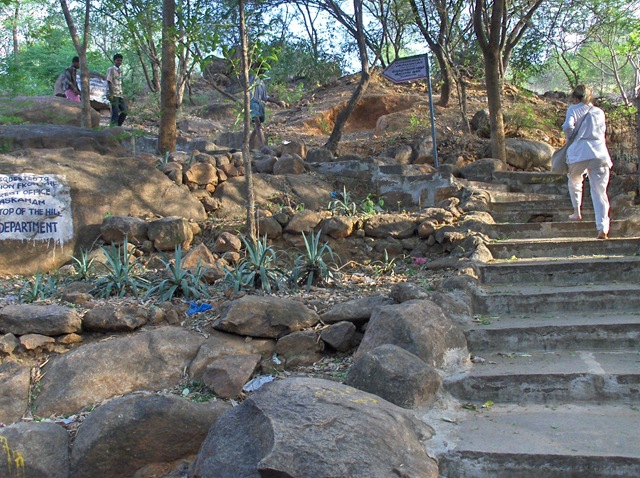
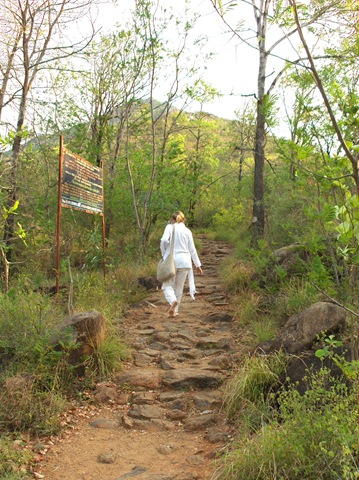
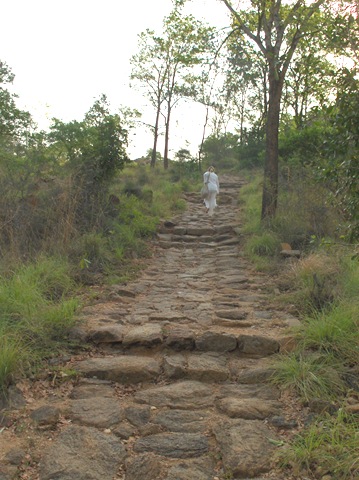
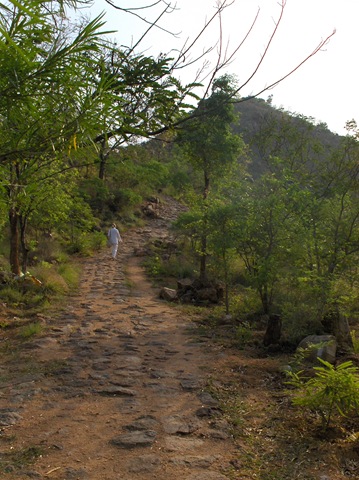
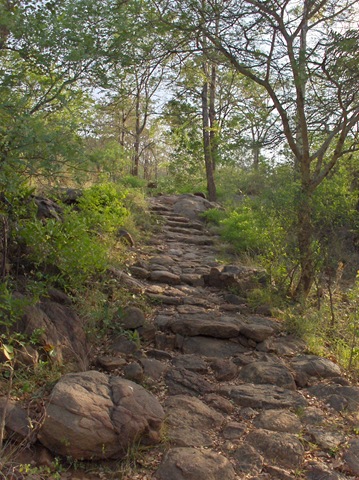
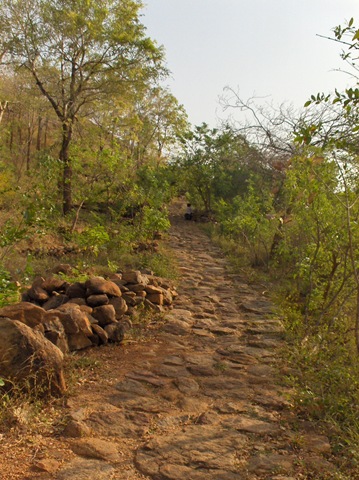
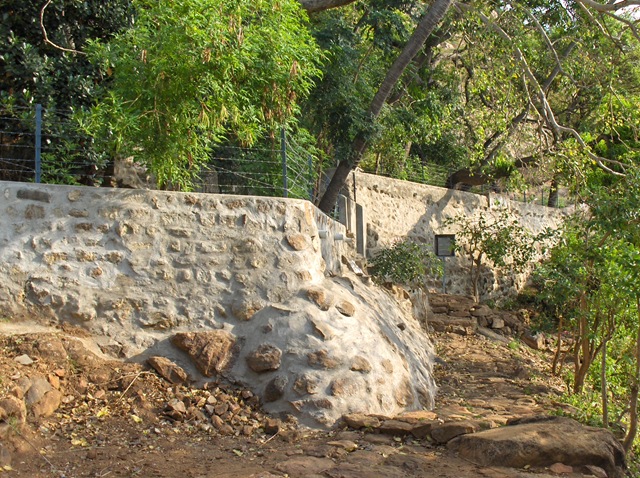
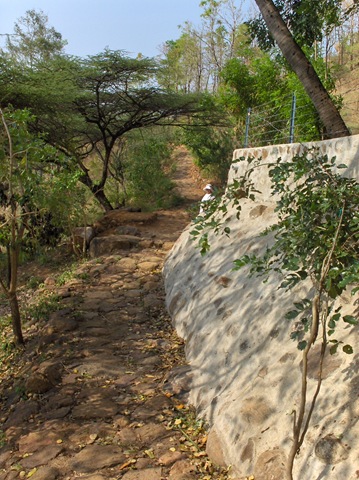
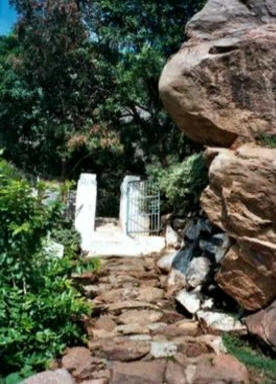
The path is ‘paved’ with stone, from Ramanasramam all the way to Skandashram, stones set into the dirt, forming a path about three feet wide. In steep areas there are steps. Someday these stones will be smooth, after 100,000’s of feet have passed over them. Each stone was carried to the path and set into the ground by unnamed workers.

On both sides of the path you will notice tree plantings, done as part of the Arunachala reforestation project that has been going on the the last few years. Ramanasramam has increased interest in Arunachala both around the world, and in India. It is this increased interest in Arunachala that has brought this project about.

Take the right fork. To the left is an entry into the inner pradakshina path.
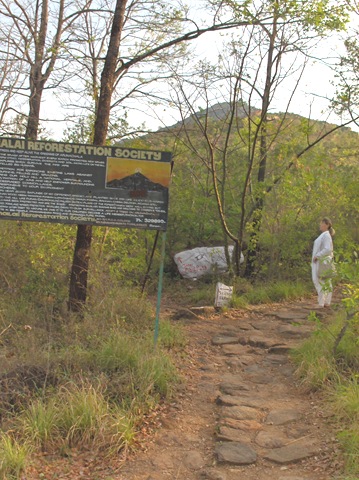
The path forfs, Skandashram to the right

Up the hill

Carol is barefoot. Arunachala, the whole mountain, is considered to be a temple, and in India you take off your shoes in a temple. Many Westerners do not do this, but Carol goes barefoot on the walk to Skandashram. I do wear sandals. Carol gets more ‘punya,’ spiritual merit.
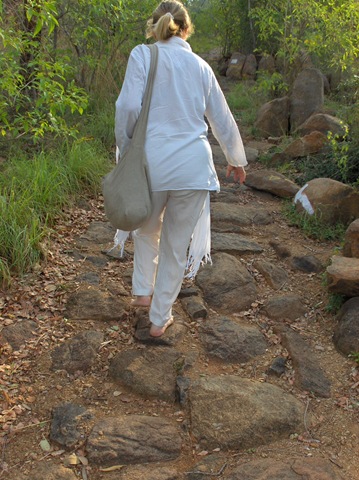
Carol walks barefoot up the path

And up the hill …

Climbing stairs here

Often there are people sitting and meditating here
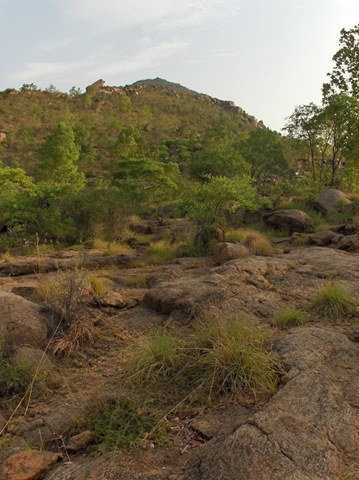
To the  left, a place to sit and meditate

Up the path

Up the path

View along the way down to the city
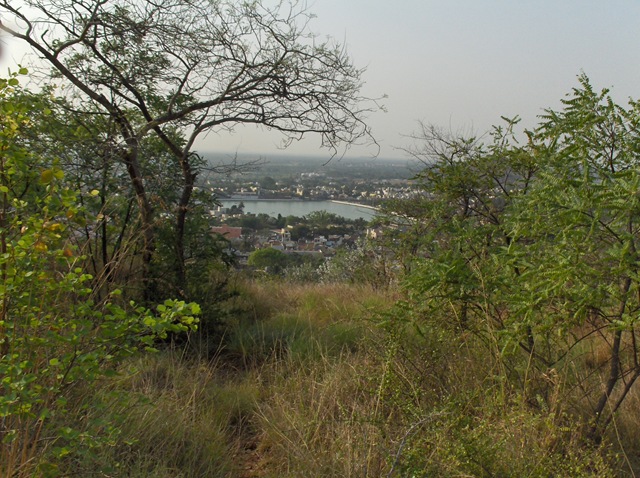
View to the right of the path

Keep going up

The path keeps going up

A Sadhu is usually here – “Sivo Hum,” he may say
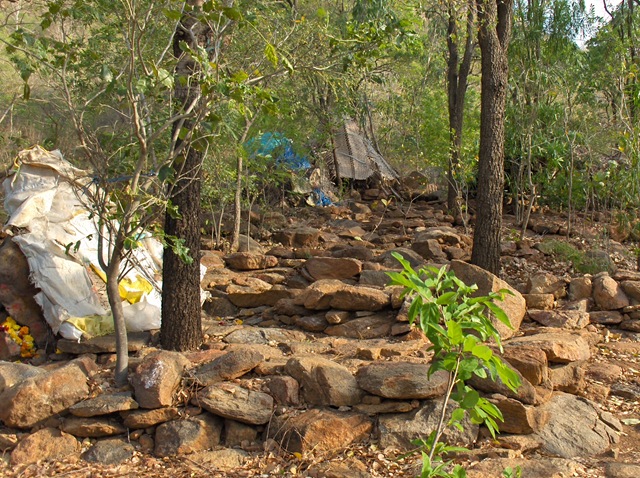
Sadhu's spot

There are stone carvers along the way
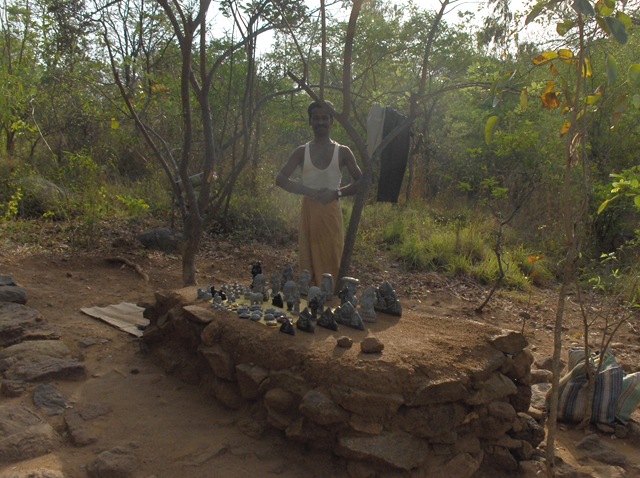
Stone carver

Up to the top of the path

Up to the top

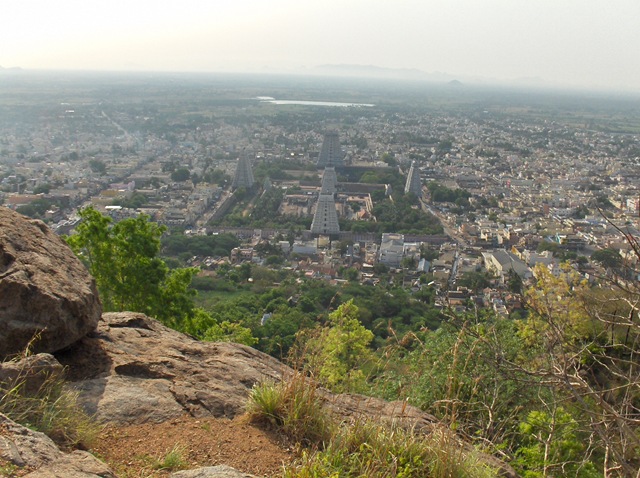
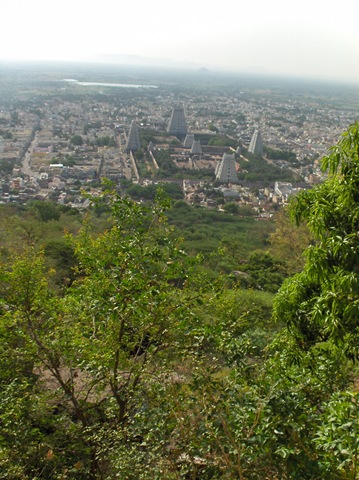
The view from the top of the path

View from the top - Aranachaleswara Temple

And now to Skandashram. Skandashram is the in clump of trees in the center of the photo.
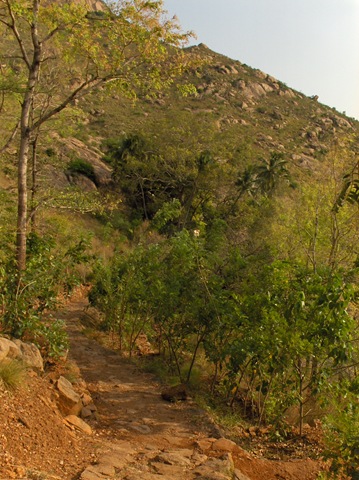
Final leg of the path

Here we are, but the gate is locked

Skandashram Skandashram gate

Path down to Virapakshu Cave. It is pretty steep.
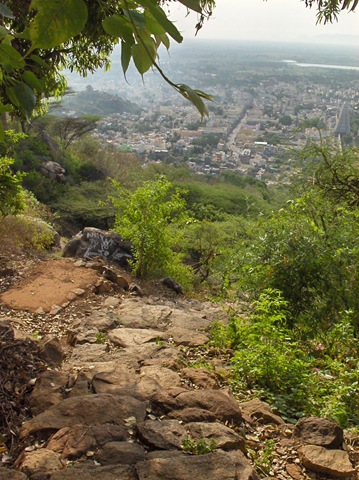
Aranachaleswara Temple from Skandashram

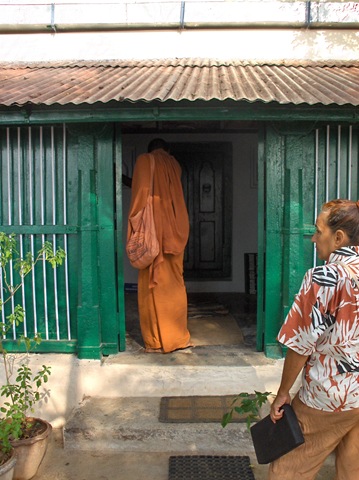
Opening the gate, walking in. The attendant unlocks the gates.
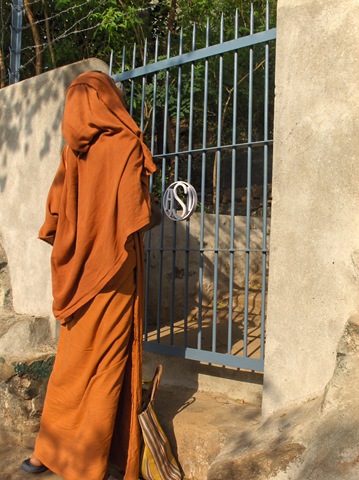
Opening the gate Entering Skandashram grounds

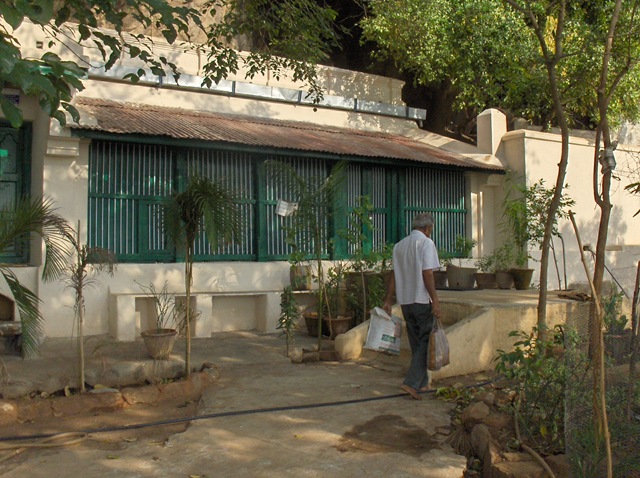
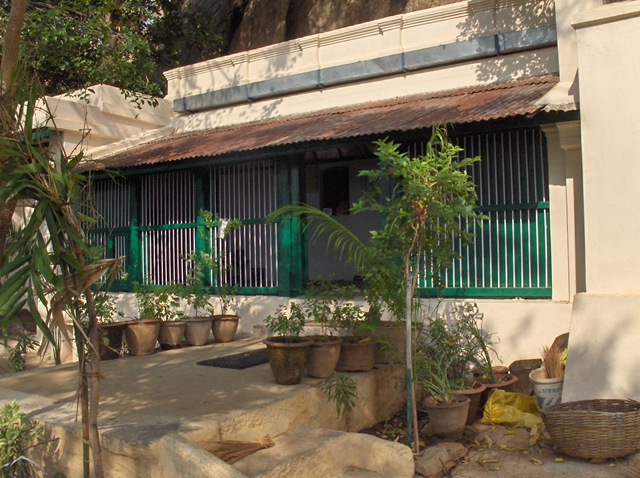
Skandashram

Skandashram

View from Skandashram

HPIM4355

Entering Skandashram

Entering Skandashram

The inner chamber, with the attendant getting ready for the morning chant. This chant is wonderful to listen to. The voice is resonant, and you can hear the love for the teaching in the voice. When we go up to Skandashram, we try to get there for this morning chant. We will sit in the outer chamber, and listen to the chant and meditate, and continue the meditation after the chant is finished.
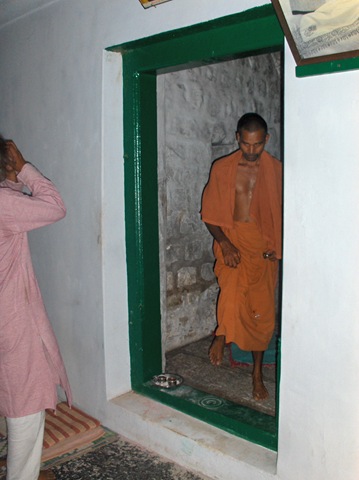
Innter chamber

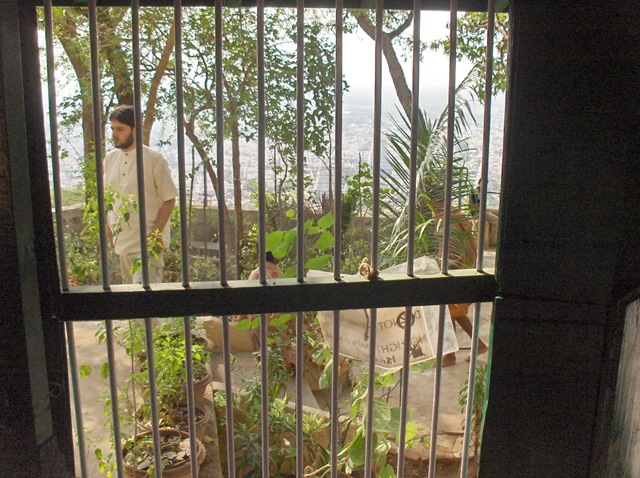
Looking out from the porch

Looking out

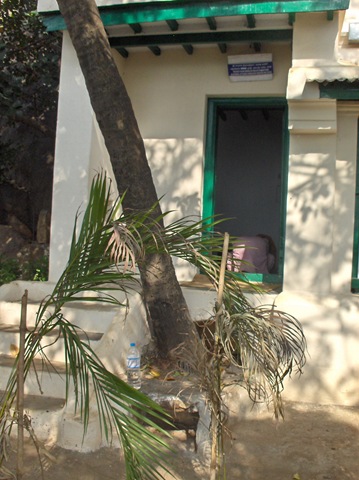
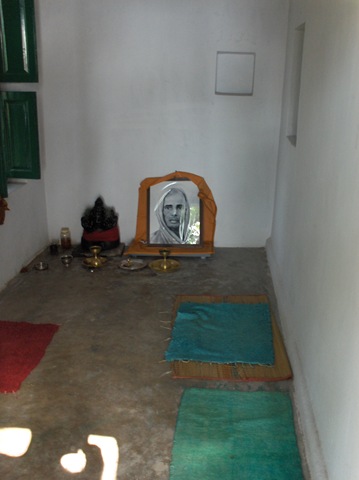
The Mother’s Quarters

Mother's room Altar in Mother's room

One last look around

Skandashram grounds

One last look at Skandashram

Skandashram

Back down the path

Path back to Ramanasramam

The walk down the hill was harrowing. A tree with a bees nest had fallen, and the bees chased some people down the hill. I was one of these. A swarm of bees circled around my head, stinging the back of my head several times. I was able to brush then out of my ears and off my mouth and face without getting stung there. Finally, about halfway down the hill, they stopped following me.

This is why the photos end with the one above.
Harsha's avatar

Sri Ramana’s Teaching and Western Neo-Advaita: By Alan Jacobs

Advaita and Western Neo-Advaita-A Study
By Alan Jacobs

‘If the blind lead the blind
both shall fall into the ditch.’
(Matt. 15:14,15) Continue reading

Harsha's avatar

Sri Bhagavan Ramana Maharshi: By Dr. Harsh K. Luthar

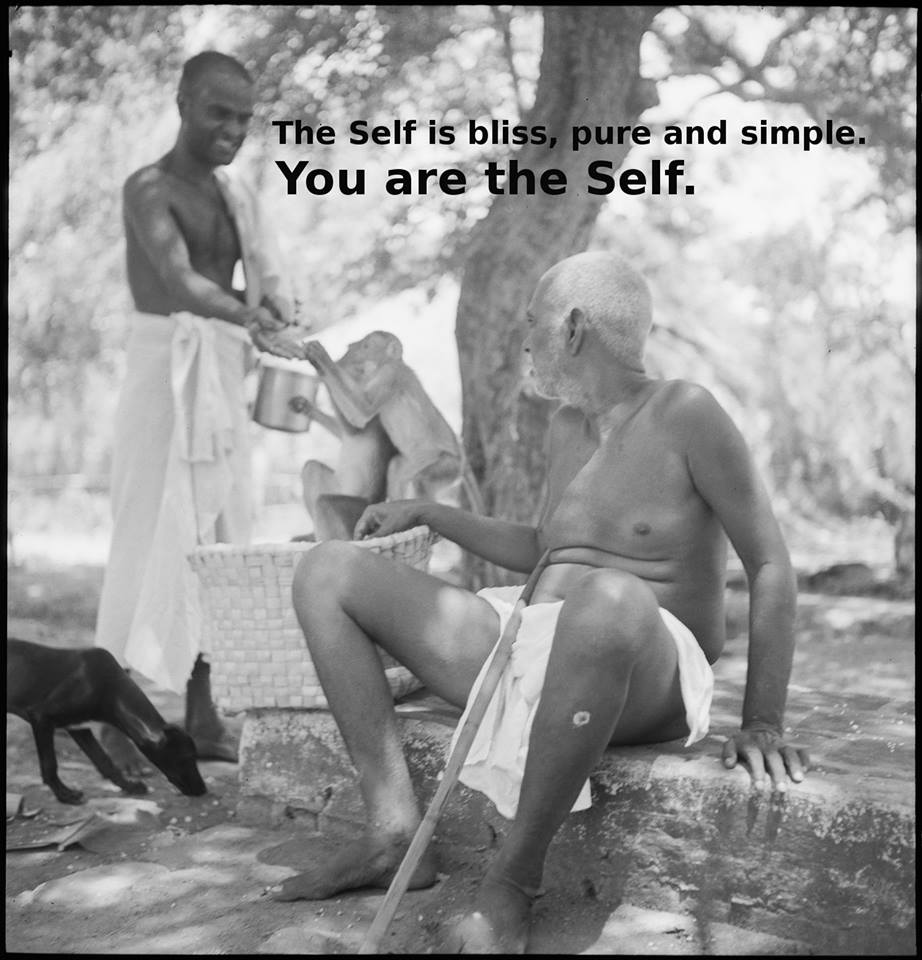
You are the Self

Sri Ramana used to say that just like an elephant wakes up upon seeing a lion in the dream, in the same way the devotee wakes up to his own True Reality, upon seeing the Guru in this world dream.

Once someone asked Sri Ramana how could one’s own True Guru be found. The Sage replied, “By intense meditation”. Another time Sri Ramana said that the disciple is more important than the Guru. If the disciple has faith, even a stone can serve as the Guru.

This morning, I am being visited by Dr. Lakshyan Schanzer, a well known Master Yoga Teacher and a Psychologist. Lakshyan has studied with a number of famous Gurus over the last 30 years including Swami Satchitananda, who found the community of Yogaville near Charlottesville, VA, here in the U.S. Lakshyan lived in that community for a while and also visited India to study with other teachers as well.

After Lakshyan and I talk this morning, we will go to an Indian Restaurant called “Rasoi” in Providence, RI for an “all you can eat” vegetarian lunch Buffet. I skipped breakfast in preparation for that anticipated big meal.

I should mention that Lakshyan has studied not only with the traditional Gurus but also spent time with Nisargadatta Maharaj. His account of the visit to Maharaj is on the following url.

https://luthar.com/2007/02/10/meeting-nisargadatta-maharaj-by-dr-lakshyan-schanzer/

Of course, I respect all Gurus and traditions. But my mind has naturally been inclined to Sri Ramana since I was very young. It just does not go in any other direction at all. Ammachi used to come here and many people lined up on their knees to get a hug from her. I respected these devotees but for me such things have absolutely no meaning. I accept that for others, it may be a lifetime experience. No matter how well known or famous or charismatic a Guru, I never feel any attraction other than for the person as a human being.

Sri Ramana is truly like the bright afternoon Sun at the height of the summer for the devotees. When the Sun itself is shining, one does not need candle lights to see the way.

Well, no words can be adequate. Sri Ramana’s devotees from the early 1900s to 1950 were some of the greatest saints and yogis of the day. But they were content to stay in Bhagavan’s shadow. Having found the Heart, one remains in the Heart as the Heart. No other place to go or be except where one already is and what one already is.

Namaste and love to all

Harsha's avatar

Mahasivaratri with Arunachala: By Richard Clarke

The night of March 6 – when there was no moon – was Mahasivaratri this year. This night honors Siva, seen in nonduality as Being-Consciousness absolute. It is the association with Siva that makes Arunachala such a holy mountain.

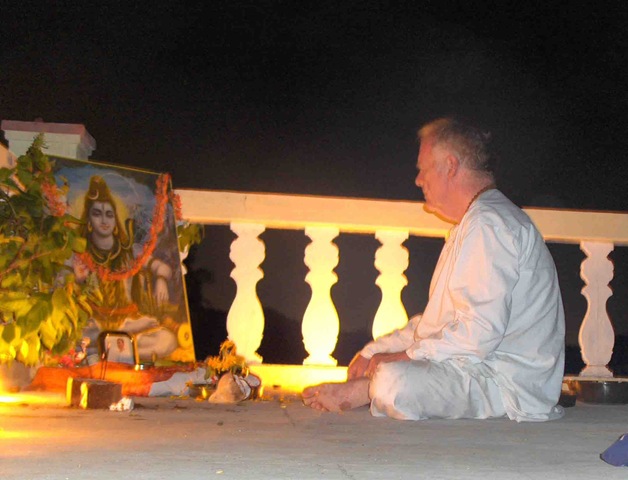
Instead of going into town to a temple, or doing pradakshina – walking around Arunachala – we decided to hold a Siva Puja at our house. Here are some photos.

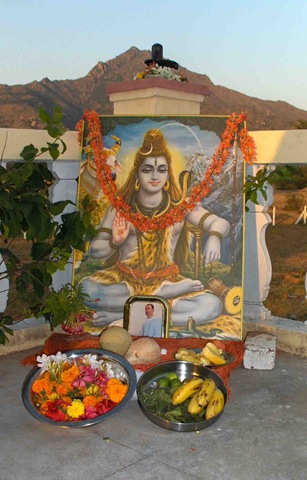
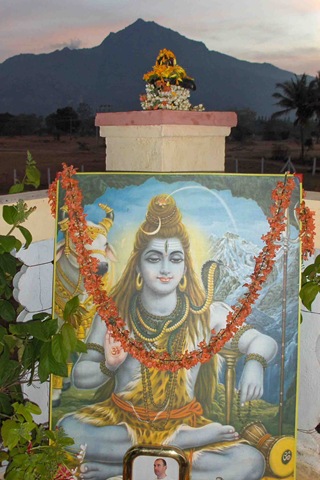
The Altar set up near sun down

Mahasivaratri altar

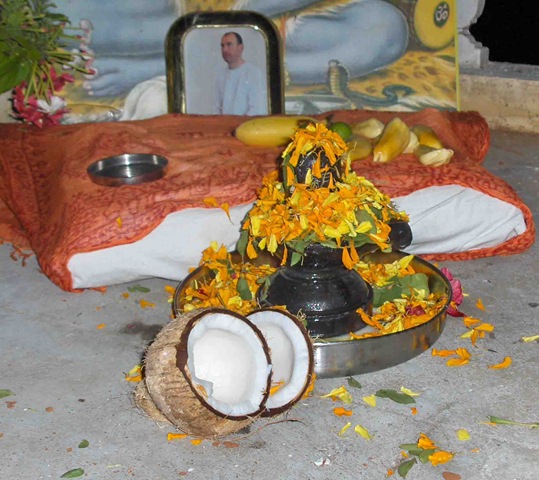
The altar has a picture of Siva, a lingam, a photo of Nome, and various puja materials.

Arunachala is is the background.

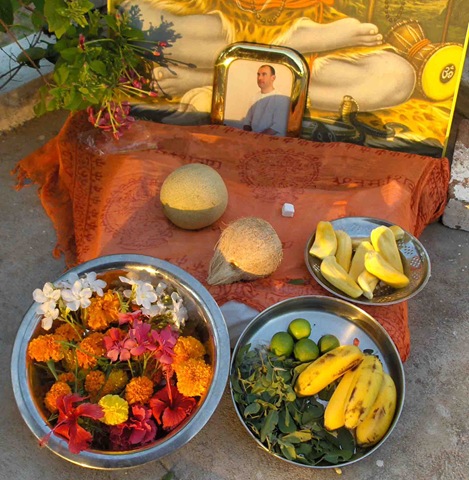
Puja Materials

Puja materials

Fruit and a coconut are common offering.

For Sivaratri it is important to have Bilva leaves as an offering.

Camphor is there for later use.

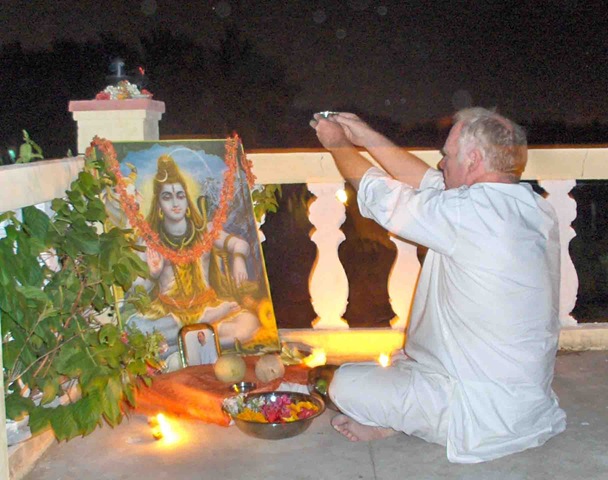
Puja at midnight

Richard at Mahasivaratri Puja

Richard is offering Puja to the Sivalingam.

Coconut milk, cows milk, ghee, bilva leaves and flower petal are offered in turn.

Richard at Puja

Lingam after Puja

lingam after Puja

After the Puja here is the broken coconut.

The lingam is covered with bliva leaves and flowers.

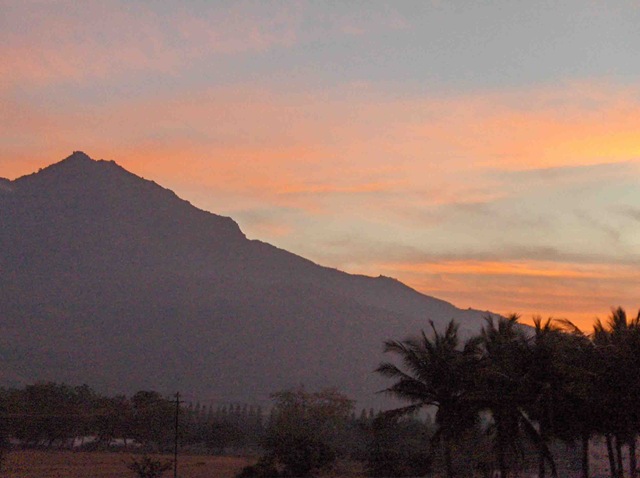
Dawn over Arunachala after Mahasivaratri night

Arunachala Sunrise after Mahasivaratri night

Richard and Carol were up most of the night, listening to recordings of chants, and spiritual discourses from their teacher, Nome.

In quiet times we meditated. For us this is a most holy night.

Altar at dawn

Mahasivaratri altar after Pjua at dawn

Here is the altar at dawn. The lingam has been put back in its usual place, and wrapped with a flower mala.

Now we will go downstairs and go to sleep. This is along night, but spiritually fulfilling.

Harsha's avatar

Meditation, Self-Inquiry, and Self-Realization: By Dr. Harsh K. Luthar

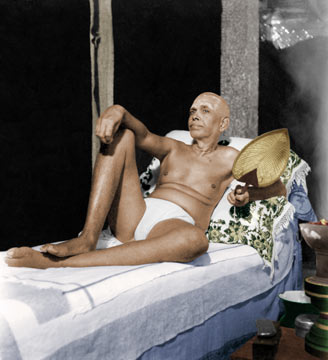
Bhagavan Ramana Reclining

Bhagavan Ramana Reclining

The distinction between Meditation and Self-Inquiry is subtle. However, in one way, understanding this difference is central to grasping the full import of teachings of the Sage of Arunachala, Sri Ramana Maharshi.

Sri Ramana used to say that meditations, affirmations, and other similar techniques presuppose the retention of the mind. To practice a mantra, visualization, pranayama, etc., requires the use and activity of the mind as an independent agent separate from the higher power. One of Sri Ramana’s favorite analogy was that asking the mind to subdue itself is like asking a thief to go ahead and capture itself. The mind will make a game of it, pretend to control itself, but will remain engaged in playing hide and seek.

Certain meditation practices no doubt have a calming and a relaxing effect. However, Sri Ramana states that in all such approaches, the mind remains dormant only temporarily. It rushes forth after sleep or meditation in its individual form when the proper stimulation presents itself. With all practices conducted with the mind, that have an object as their focus (mantra, breath, image, etc.), the seed of duality is already built in.

Someone once asked Sri Ramana whether Self-Inquiry that he advocated was also not a mental activity. If so, it must be presumed as having the same difficulty and limitation as other meditative techniques.

Sri Ramana acknowledged that Self-Inquiry also made use of the mind in initial stages. However, he held that in asking oneself the question “Who am I?” in a serious, alert, and an intense way, the mind was being concentrated and driven inwards towards its Source. This Source is not a form or a sound but the very origin from which the mind arises.

Therefore, in Self-Inquiry, the full power of attention is brought to bear upon this question, “Who am I”? This question does not have an intellectual answer. Asking it is meant for becoming aware of consciousness as existence that permeates us as our root identity. It is this feeling and sense that everyone has of themselves as “I Am”. From childhood to old age, we are aware of this sense of existence without having to give it a name.

This subtle awareness has no form. It is this self-awareness, independent of thoughts, that one has to abide in and follow to the Source. If grace allows for that, the Supreme Heart that the ancients called Sat-Chit-Ananda, reveals It Self. It is really a Self-Revelation. The Heart is recognized as one’s own identity independent of thoughts, personality, mind, etc.

Sri Ramana maintained that although Self-Inquiry required initial use of the mind, after a certain point a spontaneous power took over. The response to serious Self-Inquiry comes from within. Sri Ramana referred to this Source within as the Heart. Self-Inquiry stirred the inner power of the Heart which then became like a magnet pulling the mind within so that Self-Recognition and Self-Realization of Supreme Bliss as our nature could take place.

Namaste

Harsha's avatar

Self-Inquiry_The Science of Self-Realization: By Dr. Harsh K. Luthar

According to Advaita Vedanta, the science of Self-Realization (which we call Self-Inquiry), requires a different approach than the sciences involved in discovering the complexities of the Universe. Both approaches are similar in one way in that our consciousness with focused attention and awareness is used as an instrument of perception to gain knowledge.

Sciences involving the exploration of the universe and its laws focus the attention outside to perceived objects (time, space, matter, laws of motion, gravity, mass, etc.) to determine their nature. When attention and awareness are focused on such analysis, the relationships between various objects according to universal laws becomes clear. This is due to the inherent power of consciousness to discover and make known to itself anything that it focuses attention on. That is how sciences (Mathematics, Physics, Medicine, etc.) move forward.

However, the theoretical limit to understanding objective phenomena is always there to the extent that the observed phenomena is based on the very nature of the observer. It is not clear how precisely the relationship between the subject and the object can be determined scientifically. Philosophically, this is due to the logical difficulty of separating the subject from the object and demonstrating their independence.

Science of the Self, however, is a radical departure from the physical sciences and has a different aim. Here attention is directed inwards towards the subject and not outwards towards objects of perception. The classic methodology given by Sri Ramana for Self-Inquiry is to ask oneself with attention and inquire, “Who am I?” This is done in order to introvert the mind and drive it deeper into its source. In Self-Inquiry, the quality of consciousness itself becomes the center of attention. In this method, consciousness is not focused anywhere or on anything other than itself.

Language is not perfect but there are many ways to say this. Attention focused on attention itself is Self-Inquiry. Consciousness becoming self-focused is Self-Inquiry. Mind turning inwards to its source is Self-Inquiry. Awareness aware of itself is Self-Inquiry. All of these are variations of the same process and basically refer to the same thing. These statements indicate that one should quietly abide in one’s own sense of identity and being with full awareness.

This is not an easy notion to grasp. The Self-Inquiry methodology does not present the aspirant with an image or a sound to concentrate on. Because we are so dependent on our sense of hearing and sight even for meditation and prayer, Self-Inquiry presents a challenge. People often find it difficult to know what to focus in doing the Self-Inquiry because they associate their identity and thus consciousness strongly with the body.

This is why Sri Ramana used to say that Self-Inquiry is not for everyone to take on immediately. I have observed this phenomena carefully for a long time. People find meditation, yoga, tantra, chakras, and kundalini methods much more interesting and exciting to talk about and practice than Self-Inquiry. It is because all of these Yoga systems are directly or indirectly based on producing changes in the physical or the subtle bodies which one can experience.

Consumption of experience in some form or another is natural to all living beings. Self-Inquiry points, however, to the subject; the one who experiences. What is the nature of the one who experiences? Self-Inquiry shifts our attention from perception to the perceiver. Who is the one who perceives and experiences reality?

The practice of meditation and yoga leads the mind to temporarily withdraw the senses from objects of perception. However, internal perceptions in meditative states or Samadhi will most likely still exist. These internal perceptions may manifest in a number of ways including that of visions of angels, holy sages, the Goddess. Various spiritual and religious symbols often appear spontaneously in the mental eye of the aspirant during meditation or contemplative prayer and there may also be experiences of lucid dreaming states. So even in higher meditation states, the distinction between the subject and the objects of perception continues as we engage in and consume one experience after another.

Self-Inquiry, on the other hand, is found to be boring and irrelevant by many people because it promises them no special experience to enjoy other than being their own self. People should always do what feels natural. Nothing can be forced.

Eventually with the practice of meditation and other types of yogas, the mind becomes more subtle. The understanding of the nature of consciousness as free from outer perception (of physical objects) as well as internal perceptions (dreams, visions, other mental experiences) can then start to emerge. Once the independent nature of consciousness (free from all perceptions) is understood, one can recognize the essential quality of existence and pure being in the midst of various experiences.

When attention/awareness become self-focused, that is called Self-Inquiry. When attention lights up attention, awareness lights up awareness, consciousness lights up consciousness, Self is Realized as Sat-Chit-Ananda, the ultimate subject, the very core of being. Sri Ramana called it simply the Heart, whose nature is that of silence which is beyond all understanding.

Harsha's avatar

Lovers Love Completely: The Goddess Mystery. By Dr. Harsh K. Luthar

image

Picture of Arunachala by Gabriele Ebert

Song to the Goddess

Either let me be intoxicated
in your love completely
or put on my robes of joy
and rob me absolutely.
Judge me guilty
in the court of love
or absolve me absolutely;
find me flawed if you like
but never hold me weakly.
No middle ground is possible
for lovers who love completely! 

Love, Consciousness, and Bliss

The great sage of Arunachala, Sri Ramana Maharshi, used to say that all deep thinking people are fascinated by the nature of consciousness. The outer world of time and space is known only through ones’ own mind. Therefore, the mystery of mind and consciousness has been a magnet of attraction for philosopher, yogis, sages, and scientists. Upanishads say that one should know “That” by which all else is known.

What is “That”, which makes all else visible and known? The ancient philosophy outlined in the Upanishads, the sacred Hindu scriptures, refers to “That” as Sat-Chit-Ananda, the core of one’s being which is Absolute Bliss, Absolute Existence, Absolute Consciousness, and we can also say that it is the same as Absolute Love which makes all human love possible. Sri Ramana used to say that “Love is the actual form of God.”

For one irresistibly pulled by the hunger of Self-Knowledge that manifests in one’s own heart, the turning within to “That” Absolute Love and Bliss happens at some point. When consciousness spontaneously starts the process of scanning its own formless form, this churning results in the beauty and self-delight of awareness which underlies all manifestations of energy (Shakti).

Appearance of the Supreme Goddess

In many of the mystical traditions of Hinduism, the manifestations of this energy, resulting from consciousness becoming focused on its own nature, take the forms of Devi. Devi is the Supreme Goddess, who appears in visions and dreams of devotees according to their mental and spiritual condition to nurture, protect, bless, and guide them.

The Goddess is depicted in Hindu art in hundreds if not thousands of ways. This art is part of the Indian history, culture, and Hindu traditions. It comes from the inspired imagination of the artists and is based on the ancient stories about the Goddess and Her powers.

However, no artwork can really capture the form of the Goddess who appears in the mystic eye of the aspirant. She appears to each devotee in a unique way according to what best suits the nature and personality of the person at that time. As the yogi evolves in the spiritual path, the visionary forms of the Goddess can change along with that.

So a relationship develops between the devotee and the Goddess or the Divine Beloved. Like human relationships between lovers, it is not always easy.

Sometimes, the devotee cannot bear the separation and wants immediate union and consummation. He may even blame and question the Goddess as to why She has left him in the middle of the path after taking his hand.

Song of Despair to the Goddess

Play hide and seek
not too much longer
and risk this longing
get even stronger;
when people ask unashamedly
why your love flees from me
what honest answer can I make
and can you also say for sure
that in choosing me as your lover
you have made some grave mistake.

But the Goddess realizes that it is not time and waits for the moment to be ripe for the final liberation. Many of the love poems of mystics to the Goddess have come from this intermediate level of spiritual experiences where the Supreme Beloved appears to plays hide and seek with them.

Sri Ramana and Marital Garland of Letters

In the classic Tamil poem, “The Marital Garland of Letters” the Sage of Arunachala, Sri Ramana Maharshi, chides the Divine Beloved in some of the verses and apologizes for having done so in other verses. He begs Arunachala to fully embrace him (as the devotee) and utterly consume him in love; Because only then he will have peace.

Ramana writes:

Verse 23. “Sweet fruit within my hands, let me be mad with ecstasy, drunk with the bliss of Thy essence, Oh Arunachala!”

Verse 34. “Unless Thou embrace me, I shall melt away in tears of anguish, Oh Arunachala!”

Verse 60. “In my unloving self Thou didst create a passion for Thee; therefore forsake me not, Oh Arunachala!”

Hindu Mystical Bhakti Poetry

The love pattern of alternating between despair and ecstasy (Does She/He love me or love me not), joy and sadness (When will the Goddess/Divine Beloved visit again) is common in the poetry of many Hindu saints and mystics. Even the seeming confusion about the relationship itself, which makes the devotee beg sometimes for love and other times actually blame, chide, and command the Goddess/Divine Beloved, can be seen in some of the poems including the Marital Garland of Letters.

Although the Marital Garland of Letters by Sri Ramana is embedded in the Indian spiritual, historical, and cultural context, the symbolism of a lover who is in complete despair because of an incomplete consummation with her/his beloved is universally understood.

Summary

People who are in love with and fascinated by the mystery of consciousness have felt that mysterious pull of the Heart from within themselves. Who can really explain ways of the Divine and the different forms She/He manifests in.

What is the first step on this path of love? No one can say for sure. Was it the smile and look of a Sage, the grace of the Divine Mother, the kiss of the Goddess, or the kindness of a teacher or a friend? There must be many possibilities that make us aware of the Heart within, whose nature is Sat-Chit-Ananda, that which is the source of the ultimate bliss.

This memory once awakened brings upon the experience of pure being, and attracts the devotee to the truth of her/his own nature. This gentle pull within makes itself felt. It does not let go until the Truth of one’s own Heart is recognized, and there is nothing left to let go.

Some say that it is the Goddess Herself, who takes the devotee into the Heart and then reveals Herself as the Universal Heart. The complete identity between the devotee, the Goddess, and the Heart thus established, everything disappears. There is only that Heart of Love and Fullness, eternal consciousness completely at rest in its own nature.

Knowing That is Self-Knowledge. That is the final consummation.

I came to feed on Thee, but Thou hast fed on me; now there is peace, Oh Arunachala!” Verse 28. Marital Garland of Letters.

NOTE: Some of the verses on the Goddess in this article are from a longer poem on the Goddess by Dr. Harsh K. Luthar.

kurta


Harsha's avatar

Personal Enlightenment? By Dr. Harsh K. Luthar

By Dr. Harsh K. Luthar

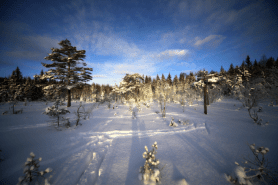
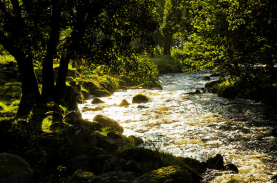
Pictures in this article are by long term HarshaSatsangh member Alan Larus from his website at http://www.ferryfee.com/.

The Self as Satyam-Shivam-Sundram (Truth, Consciousness, Beauty)

The spiritual path is difficult from one perspective because the Self, the ultimate Reality that we are, is not clear to us as individuals. Some people say that Enlightenment is not personal. That is just a fashion statement.

Enlightenment is as personal as it gets. The Self is both personal and impersonal. It is personal because it is you. How can it be any more personal? It is impersonal because its existence (your ultimate nature) is not dependent on time and space bound relationships.

As a mind/body, we are subject to the whims of nature and circumstances (karma). This clouds the understanding of our essential nature. So the teacher or a friend whom we trust is needed to tell us that our nature is not that of the body.

Suffering is natural to the body because it is subject to physical forces. When the sages use the word body, they include the mind. The mental body is also a body but more subtle, made up of more subtle matter, but still matter. If we believe our Self to be the body, the inevitable changes in the body will be a source of fear and anxiety.

So the Body is one thing and the Atman (Soul or Self) is another. The mind/body complex is always subject to change, old age, illness, and suffering at some level. The Atman, who we are, though appearing to be related to the body, is untouched by these.

Bhagavan Krishna, in fact, points this out to Arjuna in the classic Hindu scripture, The Bhagavad-Gita.

Sri Krishna states:

“The Atma is neither born nor does it die at any time, nor having been it will cease to exist again. It is unborn, eternal, permanent, and primeval. The Atma is not destroyed when the body is destroyed.” (2.20)

“Just as a person puts on new garments after discarding the old ones, similarly Atma acquires new bodies after casting away the old bodies.” (2.22)

“Weapons do not cut this Atma, fire does not burn it, water does not make it wet, and the wind does not make it dry.” (2.23).

If we fully understand this dualism, we will not have to struggle to understand nondualism.

Nondualism or Advaita (in Sanskrit) is not an understanding but our essential nature.

The nature of Atman is nondual because Atman is “Being-Awareness” resting in its own nature without any external support. Atman is not free, there being nothing to free itself from. Its very nature is that of absolute freedom.

We cannot conclude this logically but only by Being That. In Self-Realization, Knowing the Self is Being the Self. This Knowing transcends logic, because all distinctions cease. Logic needs duality in order to function. Duality ceases through Self-Knowledge alone.

If you know the Self, what does it mean? You cannot know the Self as an object. You are the Self. Therefore, it is always the Self knowing It Self. The mind cannot fully grasp this unless it has become transparent and fully saturated in the Self, where it knows that it is only the Self knowing itself through It Self.

Maharishi Patanjali says the same thing about the nature of the Self in his yogic classic “Patanjali Sutras”. Ultimately, the Seer rests in His Own Nature. That is the highest Samadhi. Self is Samadhi. Self is Nirvikalpa, beyond imagination and thought. Self is Sahaj or natural and always visible to itself as pure being despite imagination and thought. In Self, Seeing and Being are the same.

In Hinduism, the Reality is often referred to as Satyam-Shivam-Sundram. Truth-Consciousness-Beauty. That which is of the nature of the ultimate truth, pure consciousness, and the essence of beauty is the Self. One’s own Self.

It is of such overwhelming beauty because the devotee who worships the God or the Self with all love and might and with desperation suddenly realizes that the devotee and God are in essence identical. The seeker had been looking for something that constituted the core of his/her very own Being and Existence. God being infinite leaves no room for the devotee as a separate person to exist. That is Grace. That is Advaita. Imagine the shock!

First the shock, and then the smile. Of course, how could it be anything else? The Lord always sits in our Heart as our own Heart. Where else can we find the mystery of existence and our own reality except in our own Heart.

This Realization is one of supreme beauty. The one that you had been longing for has been here all along as your own Self.

That is why I say that Self is Absolutely Personal! Self is empty of all concepts. Its nature is that of completion that is devoid of all longing. Its nature is that of utter fullness that has no where to flow out to, nothing to see, nothing to be. That is why Self is also Impersonal!

Because the Self is One without a second, upon Realization, we see that both Personal and Impersonal are identical in the Self. There is no difference. That is nonduality. That is Advaita.

How can we describe the Self with mind as our tool? We can do so by our experience of this state and through the abidance of the mind in the Heart. The ancients called the Self “Sat-Chit-Ananda”. Existence, Consciousness, Bliss, as one complete Whole with no parts.

It has no basis for comparison and no reference point. By inference, we can say that it is the essence of beauty and bliss. To Know It Is To Be It. In this very moment, you are the That!

Harsha's avatar

Meeting Nisargadatta Maharaj: By Dr. Lakshyan Schanzer

My name is Lakshyan Schanzer. I have been practicing and teaching yoga and meditation since 1971. I am also a psychologist and practice a meditative approach to psychotherapy. This is my first writing about my experiences with Nisargadatta Maharaj.

Image (10) Lakshyan.jpg for post 104

By 1978 I had been practicing and teaching for about 7 years (primarily Integral Yoga) and had reached a ‘wall’ in my practice. I was having wonderful experiences/results on a daily basis. Yet, for me, these experiences were just that; only experiences. Yes, they were important and healing ones, bringing revelations and insights into my history, release of deep feelings, or guidance about the coming day or accurate premonitions about the future.

Continue reading

Harsha's avatar

Icon Painting As A Spiritual Path: By Gabriele Ebert

Gabriele Ebert is a well known German librarian, scholar, and a painter. For information on her books and German translations, please go to the bottom of the article. Gabriele is a long term member of HarshaSatsangh and has been active in Sri Ramana groups for many years. She has served as an inspiration and a role model for all of us with her dedication to the interfaith approach to spirituality. Because Gabriele’s native tongue is German, I did some minor editing on this article and accept responsibility for any mistakes which may have occurred because of that. Fortunately, in this medium, mistakes can easily be corrected once we become aware of them. Enjoy the article. The Icons are stunning and beautiful! Thank you Gabriele for your generous sharing.

The Personal Story

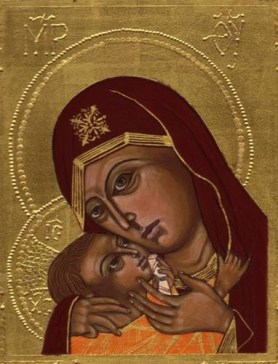
Eleousa (Mother of Mercy)

It was 16 years ago that I discovered icon painting as a spiritual path. This door opened when at one Christmas eve my mother presented me with an icon of the Theothokos (Mother of God). Looking at it I was sure that I would start to paint as well. I felt drawn to painting and through it discovered a creative spiritual path.

Over the years I found different teachers for learning the technique – and later the Jesus prayer (see below).

Icons are enjoyed by many. Most of all it is wonderful if an icon can find its home in a meditation-room or prayer-edge, where it is dedicated to its original meaning.

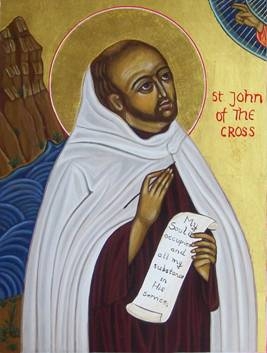
This icon of St. John of the Cross has found its home in the prayer room of the Carmelite Monastery in Dolgellau, Wales.

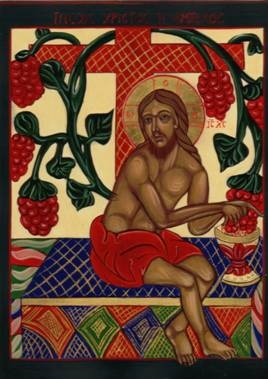
Christ the Vine” is in the meditation-room the Christian Zen-center in Eintürnen, Germany.

Icons – What Are They?

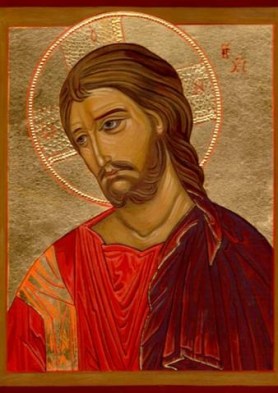
“Sad Christ”

The home of the icons is the Christian Orthodox Church. The earliest icons were painted in the 6th century in Byzantium. From there they later came to Russia and to all other Orthodox countries. Most of the earliest icons have been lost. The oldest collection of icons is found at St. Catherine’s Monastery on Sinai.

Icons play an important role in the liturgical service, and also in the public life and of course for the individual. An icon is a steady companion from the cradle to the grave.

The icons are not individual paintings but rather in the individual. These painting come through the individual by spiritual grace and in a sense the painter does not count. So icons are normally not signed to claim ownership. Outwardly, icons follow fixed patterns and change of the pattern is only possible in a rather limited way as they are real “copies” of the one reality, which represents itself in various pictures and stories.

Icons are of great help for concentration, for prayer, for awareness of the ever-presence of Christ or Mary or the Saints. They are called “Gates to Heaven” or “Windows to Eternity”. If you look at an icon in candle-light, the gold and painting shines in an unearthly magic. The faces are serene, the gestures and colors are full of meaning. The more one dives into this world, the more one becomes drawn into it and the mind becomes silent.

The Path of the Painter

“To paint and to pray are the same thing” (Balthus)

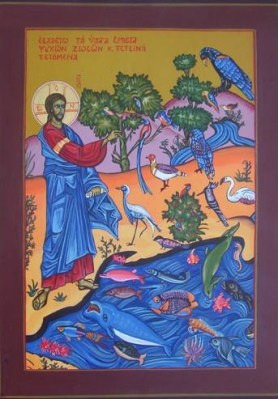
Jesus with animals

I have always felt that this kind of painting is by special grace and has something in it which can’t be compared with other types of paintings. This kind of painting is devotion and prayer – prayer with the brush, so to say. So this “doing” needs not only much outer care, but also inner care. One should not do it with a distracted or unclean mind. According to tradition it is good to have a prayer before starting. The inner attitude should be giving up the sense of doership – which reminds one of Sri Ramana’s instruction as well. It can also be seen as an exercise for just being an instrument of God, which should become a reality in all our actions.

The Jesus-prayer (also known as the Prayer of the Heart) is a short prayer, which should be continuously repeated. The words are: “Jesus Christ, Son of God, have mercy on me!”

Like the icons, it comes from the Orthodox church. The prayer also can be shortened to just the call: “Jesus Christ!” or whatever one prefers. One repeats it as often as one can. In some way it can be compared with nama-japa. It helps to silence the mind and lead it to one thought. With practice it starts to become automatic (self-doing) and sinks into the heart. Yet at each stage it always stays as a prayer in you. The Philokalia – a collection of texts on the Jesus-prayer – can be a wonderful companion on this path. It is recommended in “The Way of a Pilgrim”, which most know who practice the Prayer of the Heart.

It is not so long ago that I discovered – or better re-discovered – the Jesus-prayer when reading this book (“The Way of a Pilgrim”). I felt immediately that this is a wonderful complement to the icon-painting as well. From the tradition of the icon-painters I have found out that my main-model, the famous Russian icon painter Andrej Rubljow must have practiced it. I am sure that his icons reflect it and speak through it.

Icons Interfaith

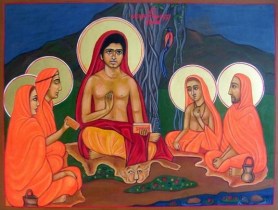
“Dakshinamurti-Ramana” – an icon dedicated to Sri Ramana Maharshi

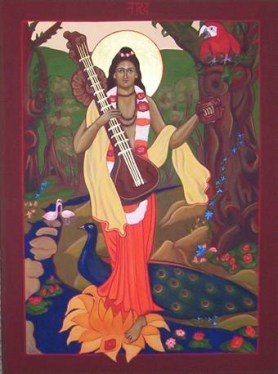
Icon of Narada

Mostly I am painting icons in the Christian tradition. Yet it happened that this Ramana-icon was painted and also some icons of Narada (the bhakti-musician). When being in Tiruvannamalai in 2003 and seeing the paintings in one of the shines of the Arunachaleswara-temple I was reminded of the icon-painting. Also there seems to be a connection to the Buddhist paintings as well. I am sure that the same thing has found its expressions in many religions.

If you would like to see more and get information about the technical side of this kind of painting you can visit:

http://icons.interfaith.googlepages.com/

Gabriele

***********

Gabriele Ebert lives in Germany and works as a librarian.

Recent Books by Gabriele Ebert are:

Ramana Maharshi: Sein Leben, Stuttgart, 2003

Sadhu Arunachala: Erinnerungen eines Sadhus, Berlin, 2004 (German transl.)

Both books are available at amazon.de and can be ordered from each German book-shop.