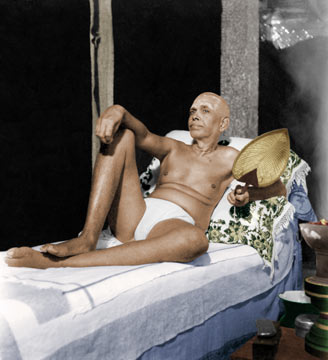
Bhagavan Ramana Reclining

Bhagavan Ramana Reclining

(Pictures in this article come from www.toontracker.com/totaltv/underdog.htm)
Underdog and Sweet Polly Purebred
Do you remember that cartoon show “Underdog”? You might have watched it as a kid in the 1960s and early 1970s. Underdog was a “humble and lovable Shoeshine Boy” who had a secret identity.

Whenever there was a serious world crisis or threat to the city, Underdog would turn into a superhero after taking a special vitamin pill from the secret compartment in his watch.
Underdog had a girlfriend named Sweet Polly Purebred. Sweet Polly was sweet on Underdog. Sweet Polly was a reporter, who seemed to get into trouble with the bad guys in every show. When in crisis mode, she would yell, help, help, help, Underdog, help. Sometimes Sweet Polly would actually sing despondently when Underdog was late in arriving. “Oh where, oh where has my Underdog gone?”
Underdog was probably the best boyfriend Sweet Polly Purebred ever had. No matter how far away and how deeply engrossed in shining shoes of his customers, Underdog could always hear Sweet Polly calling out his name. The “humble and lovable Shoeshine Boy” would slip into a phone booth and emerge as the champion of justice and protector of Sweet Polly. Underdog had super sensitive hearing, at least when it came to Sweet Polly. No doubt this would have resulted in a happy marriage if they had ever tied the knot. Underdog would often say, “When Polly’s in trouble I am not slow, it’s Hip, Hip, Hip and away I go !”

Underdog always came to Sweet Polly’s rescue, yelling, “Never fear, Underdog is here!” Sometimes Underdog took his time and Sweet Polly had to yell help for a long time. This was not easy on our ears as kids. But we hung on. We strongly suspected that Underdog would indeed arrive at some point.
When Underdog finally came, it was a great consolation. We did not really want Sweet Polly to get roughed up by the bad guys. Unfortunately, Underdog was no muscle dog. He had a small chest and a big belly. He was a heart attack waiting to happen according to modern medical standards on waist to chest ratio (which were probably not well known when the show started in the 1960s). In fact, Underdog often became exhausted within a few minutes in his fight with the bad guys and looked for his vitamin pill to get his vitality back. Not being able to locate the magical nutrition pill in time posed a serious problem to Underdog’s health.
It was awful to watch and we were full of tears as Sweet Polly looked for Underdog’s backup energy pill in her purse while Underdog was beaten to a pulp by the bad guys. Sweet Polly always found the needed vitality tablet for Underdog at the last minute, but not before giving everyone the distinct impression that she was very disorganized.
The magic pill, once found, was a life giving elixir. As soon as Underdog put it in his mouth, the effect was immediate. The vitality pill always seemed to bypass Underdog’s digestive system and go straight into his muscles. Typically Underdog swallowed the pill in one gulp and regained his energy the next instant. Then he would beat the surprised bad guys quickly before the show ended. Underdog always saved the day including, of course, Sweet Polly.

I was recently thinking that in real life, some people are like Underdog (who don’t have a Sweet Polly), and some are like Sweet Polly (but without their own personal Underdog).
Sometimes we want to act as saviors to people who do not wish to be saved. Other times, we need desperately to be saved but no one except mom seems interested in the job. That perfect match of being the savior and being saved that Underdog and Sweet Polly had is seldom achieved for most people. Underdog and Sweet Polly were made for each other.
We certainly lack that magic vitamin pill that Underdog had in the secret compartment of his watch. But even for Underdog, the effect of the magic vitamin pill was only temporary. He had to keep taking those pills to maintain superhero status.
One wonders where Underdog got his supply and the money to pay for those pills. After all, he could not have made much as a shoeshine boy. Perhaps he got big tips from his customers. Maybe Underdog had really good health insurance and there was low co-pay for those very strong vitality pills.
I wish that there had been some closure to the Underdog show. Underdog could have proposed to Sweet Polly Purebred in the final season of the show. If Underdog was too shy to do it, maybe Sweet Polly could have proposed to Underdog. Given the number of times Underdog saved her, that’s the least Sweet Polly could do.
It would have been nice to have a big wedding for Underdog and Sweet Polly Purebred at the end of the final season. I can just see Sweet Polly saying to Underdog before they went off on their honeymoon, “Underdog darling, make sure to pack some extra energy pills for the next two weeks.”
Maybe there will be an Underdog movie which will show that Underdog and Sweet Polly Purebred got married and lived happily ever after. If they did it right, the Underdog movie would be blockbuster!
Underdog and related characters are © 1997 GBPC, a subsidiary of Golden Books Family Entertainment.

Picture of Arunachala by Gabriele Ebert
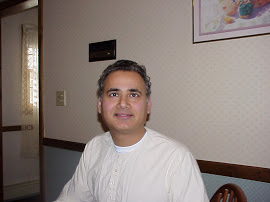
Deep Body Relaxation
I used to teach Yoga, relaxation, and meditation classes in the late 1970s in NYC to make a living. After the Hatha Yoga sequence was done, students were led through a guided deep body relaxation in Shava Asana (the corpse pose where everyone lies down and relaxes each part of the body). After teaching Yoga for many years, it seemed to me that for most students, the guided meditation while lying down was absolutely the most favorite part of the class. Many students would continue in the Shava Asana for half an hour or more after the class was over. Some became so relaxed that they would fall asleep.
Over the years, I have come to feel that the best posture for meditation is not always the Lotus posture as many Yoga traditions claim, but simply lying down in Shava Asana. The sleeping posture is universal and sets no high bar for anyone to have to overcome. Therefore, it is the perfect posture for attaining Self-Realization. In fact, we know that the Sage of Arunachala, Sri Ramana Maharshi, became Self-Realized in that posture.
Deep body relaxation can be mastered by anyone slowly and many people experience physical, mental, and spiritual benefits from it. I have personally found it to be immensely useful in a variety of ways. My own experience of the Heart, Oneness of Being, came when I was very young. I had been meditating for many hours, sitting straight in a cross-legged position, and my back was aching and so tired that I lay down to rest for a few minutes. I was not trying to relax but it was in that resting posture that this deep conscious relaxation came over me and the truth of being revealed itself with complete clarity.
The Relaxation Method
The relaxation method I use is easy. I simply bring attention to every part of the body and consciously experience it and relax it. I start with each individual toe on both feet and relax these. I also focus on the bottom of the feet and relax these. Then I focus on the upper feet and relax these. Then I come to the ankles and relax these and keep moving up to the legs and other parts of the body and so on.
Sometimes, in my teaching, I have combined this method with visualization of white light filling the different parts of the body from the head to the toes. This is a beautiful way to use the intelligence and imaginative and visual faculty of the mind to fill the body with deep relaxation and to create a sanctuary of peace for one self.
Of course, Hatha Yoga is important for many people and sitting in meditation with a straight spine has its own health and energy oriented benefits. Meditation on energy centers along the spine is facilitated by sitting straight in a cross-legged posture. It also helps in doing certain pranayama and deep breathing exercises.
For many people who cannot sit cross- legged, sitting straight on a chair with support for the elbows is helpful. There are many ways to meditate. The main thing is that one should be comfortable in one’s posture.
Sincere Practice Leads to Self-Discovery
One, who is serious about meditation and relaxation and practices it with sincerity, slowly discovers what postures and exercises are the most helpful for her/his body and mind. Each person is unique in terms of what they find useful.
Finding a good yoga teacher is much easier today than it was when I was teaching. Back in the 1970s, in the U.S. and other Western countries, Yoga was popular only in big cities like Manhattan and Los Angles among the actors and actresses and the elite. But now it has become more mainstream and one can find Yoga classes in virtually any city.
Deep body relaxation seems to be universally attractive to people, because it allows for letting go of accumulated tension. It is easy to learn and do and with practice and experience becomes natural.
In the 1960s, my Gurudev, Sri Chitrabhanu- Ji, wrote a poem called “Matiri Bhavanu” on friendship and universal love in his native tongue (Gujrati) that became famous in India. It was eventually recorded as a song by a well known Indian singer named Mukesh and was set to music by an eminent Indian composer. The poem was translated into English by Gurudev Chitrabhanu- Ji and that is the version of the poem that I was most familiar with. However, at the meditation center where Gurudev taught and lectured in the 1970s, we sometimes sang the poem Maitri Bhavanu in Gujrati with great feeling.
The scene shifts now to almost 30 years later to 1994. In 1994, the thought came to me that I should read the original Gujrati version of the poem by my teacher. Gujrati is not my native tongue and, in fact, I do not understand it at all. I cannot speak in Gujrati and cannot read it. However, the Gujrati alphabets are similar to Hindi which I do know. So somehow the feeling came over me and I started to try to read and understand my teacher’s poem. It was hard but I was staring at the Gujrati words as if through will power alone I could decipher them. After some difficulty, I switched to the English description of the Gujrati sounds that you can see on the Jain Meditation Center website.
http://www.jainmeditation.org/pages/song.html
After many attempts, I actually started to understand the first stanza, and then the second, and then the third, and then the fourth. It was so beautiful and full of the universal feeling that I went into ecstasy. The result was the following poem, “Let this feeling never part!” In a very real sense this poem is the spiritual offspring of that original poem written by my teacher in his youth as a Jain monk. Recently, I came across the poem again on my old computer files and had to smile. I was just a “kid” when I wrote it. Of course, it cannot reach the same level of poetic artistry as my teacher’s poem in original Gujrati which is a true masterpiece. But I tried because something came over me. Perhaps what I lacked in talent, I was trying to make up in enthusiasm and feeling. I dedicate this poem to my Gurudev, Sri Chitrabhanu-Ji, who taught me the meaning of Ahimsa, the philosophy of nonviolence.
Let This Feeling Never Part!
The sacred stream of love divine
sweeter than the sweetest wine
flowing into this vast sunshine
springs eternal from my heart.
I pray no one should be left out
from life’s blessings in their glory
and give way to tortured doubt
with unhappy endings to their story.
Never should they be turned away
suffering from the blows of life
the poor, the wretched of this world
caught helplessly in endless strife.
If ever anyone should be in need
of comfort or help in getting up
let me not run away from them
but plant kindness as my living seed.
Let me give hope where there is despair
and mend hearts considered beyond repair
like the gentle ocean breeze that
heals all wounds and gives a fresh start
Let this feeling never part!
I should always find delight
in the warmth of universal light
but if my heart must bleed at all
let it be so in the dark of night.
No one should see the tears that come
when the wicked and cruel come in my sight
let this hand forever be raised in peace
and the violence around us come to cease.
Always this thought should be kept alive
every sinner is a future saint
there should be a place for everyone
to swim in the pouring love divine
that flows eternal from my heart
Let this feeling never part!
Unaware, if someone is unkind
let forgiveness be on my mind
until no trace is left behind
of ill will, anger, or hostility.
If I should ever slip and fall
and no one to catch me is around
let me come down gently like a leaf
so other life is unhurt on the ground.
If I have to lay for some time
contented should be my smile
composing songs of love and friendship
and resting all the while.
I will be picked up by love divine
which springs eternal in my heart
for all the beings everywhere
Let this feeling never part!
Sages have sung the song of friendship
walking with them and in their shoes
the same melody plays on my lips
the feeling of reverence for life continues.
Involuntary poets, there have been many
who felt the thrill and saw the sign
whose hearts sang out in ecstasy
as their fountain bubbled with love divine.
The blessings of nature are bestowed
on those who are firm in their belief
who are harmless to others and easily bow
before anyone, seeing only divinity.
If I should be granted just one thing
let it be the vision of love
always rising from the spring
sacred and eternal in my heart
Let this feeling never part!
**********************
NAMASTE
I bow to the light in you
which is the same light in me.
—
In my view, stress and career management are central to the lives of most people. Given below are some tips that make sense to me. Take them with good humor and make up some of your own.
1. Make friends with your Boss. Research shows that bosses can be a major source of workplace stress. According to Professor Hochwater and his doctoral students, who conducted a study on bad bosses, “Employees stuck in an abusive relationship experienced more exhaustion, job tension, nervousness, depressed mood and mistrust.”
2. Laughing can break up an otherwise negative mental state. Humor plays a big role in our seeing things in perspective. Keep a book of good jokes handy at the workplace and flip through it now and then. Make friends with funny co-workers. They are all around you. When things get difficult, go talk to them and ask them to make you laugh. You will be surprised at the comedic talent available in the workplace. From personal experience, after my most uncontrollable laughs, I have felt much better and rejuvenated afterwards.
3. Assess your skills and abilities in terms of long term goals. Enhance these further through education and training, particularly if your company is willing to pay for it. Many organizations these days pay for their employees getting an advanced degree like an MBA. Higher level of training and education will allow you take charge of your career and make you more marketable. People experience more anxiety and stress when they feel things are not in their control and that they have limited options.
4. Be alert to opportunities around you both within and outside the workplace and take advantage of them. Bite only as much as you can chew and do not say yes to too many workplace projects. It will scatter your energy and leave you exhausted. However, success in fewer and even smaller projects will give you confidence as well as an enhanced professional reputation among your co-workers.
5. Take one or two 10 minutes walks during the workday. I find short walks, or even climbing up and down the stairs several times during the day to be very useful for me. Lunch is a good time for walking. You can walk outside in the fresh air and then come back and eat a light, balanced, and nutritious lunch. I wish I could take my own advice more often! When I can though, I find that walking and deep yogic breathing can do wonders for creativity, energy level, and the general elevation of mood.
6. I find that drinking enough plain water during the workday is very helpful to me. If I drink too much tea or coffee as substitutes for water, it creates physiological symptoms of stress such as sweaty palms, increased heart rate, and just more nervous energy than I need. Students who drink too much tea and coffee before their classes risk the increased possibility of having to take a bathroom break when critical topics are being discussed.
7. Calm and center yourself through meditation and/or prayer several times a day. This is particularly helpful before important presentations and meetings. People listen better, speak more clearly, and in general communicate much more effectively when they are relaxed. If you do not have your own office and feel strange about closing your eyes publicly and just sitting quietly, then go to the bathroom, close the door, and sit there for a few minutes.
What Should Organizations Do?
Organizations should consider incorporating meditation training in their employee wellness programs. Employees who meditate regularly experience greater job satisfaction, improved job performance, are more alert and active, self confident, less irritable, more cooperative with others, and enjoy a greater level of accomplishment.
Organizations also need to be sensitive to the fact that personal problems (divorce, illness in the family, death of a loved one, or other trauma) can temporarily influence the workplace behavior of otherwise good employees. Giving leaves of absence or personals days off with pay to manage such situations can help to reduce the employee stress level.
My Personal Belief
In my view, relaxation and meditation training can be particularly helpful in coping with difficult life or workplace issues. It has been documented in a variety of research settings that meditation and prayer can lead to significant decreases in psychological distress, health complaints, insomnia, and smoking. There is a lot of good information available on stress management in the research literature as well as in popular magazines, and of course on the Internet. Like everything else, one has to be an intelligent consumer of knowledge and use common sense.
Strive and thrive! Do well, and be the best that you can be and leave the rest to the higher power.
Good luck!
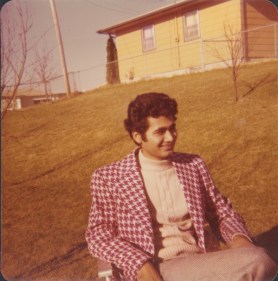
My father was my protector and best friend. I wrote the following in 1996 when my Father turned 70 as a dedication to him. The picture is of him at 72 holding my daughter. It was taken in the summer of 1998.
The last wonderful summer my father and I spent together was in 2003. Several months later in November of 2003 he fell ill. After that I was only able to see him at the hospital. My father passed away in early 2004 at the age of 78. I think of him everyday.
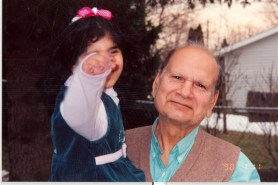
Summer time with my Father – 1998
A Dedication to My Father on His 70th Birthday in 1996
My father was a mathematics professor. He is now retired. I saw him spend countless hours writing papers and constructing new math problems. He involved the whole family in helping him with an undergraduate math journal, Delta, that he had founded, and of which he was both the editor and the publisher. It was too much work for one man, but my father persisted in doing the impossible for years. Delta later merged with the Mathematics Magazine issued by the Mathematics Association of America. We were all happy when that happened!
My father spent a lot of his evenings grading math exams. This used to irritate my mother. “Must you spend so much time reading student exams? Give them a grade and get it over with,” she would say. He usually replied, “What do you think I teach, sociology or philosophy? Can I just read the first and the last line and give a grade!” Then he would laugh heartily feeling he had uttered a profound truth.
My father actually loves the humanities but is of the opinion that everyone should have concrete skills to earn a living. He never hesitated to express his views to me and others about education. Once, in order to demonstrate the superiority of learning math over other disciplines he said to his colleague who taught astronomy the following: “If our students know math and statistics they can get a job at the plant (he was referring to the local GM Plant). If they take astronomy and don’t get a job what will they do? How will they eat? Maybe they can go to your house and you can all watch the stars together on an empty stomach!” My father thought what he had said was quite funny, although the astronomy professor did not. The following poem is dedicated to my father.
PROFESSORS DON’T GROW OLD
Professors don’t grow old
they just grade away
like a master jeweler
who has to differentiate
between precious rubies and stones
who with a heavy heart sings
and then has to part
with diamond rings
that must end up on
someone else’s finger.
Professors don’t grow old
they just grade away
like a gardener who
asks the birds to stay
in the nest he has made
so they can rest in the shade
of the tree of wisdom
carefully pruned
standing in the luscious grass
only to see them fly away.
Cool breezes and the
fresh waters of knowledge
is what we received
in the college
that was my father’s heart.
Yes, professors don’t grow old
they just grade away
and then slowly fade away
to pictures on the walls
leaving nothing behind
but the touch of ideas
given with humor and kindness
and their smiling eyes
bubbling forever in our mind.
By Dr. Harsh K. Luthar
Pictures in this article are by long term HarshaSatsangh member Alan Larus from his website at http://www.ferryfee.com/.
The Self as Satyam-Shivam-Sundram (Truth, Consciousness, Beauty)
The spiritual path is difficult from one perspective because the Self, the ultimate Reality that we are, is not clear to us as individuals. Some people say that Enlightenment is not personal. That is just a fashion statement.
Enlightenment is as personal as it gets. The Self is both personal and impersonal. It is personal because it is you. How can it be any more personal? It is impersonal because its existence (your ultimate nature) is not dependent on time and space bound relationships.
As a mind/body, we are subject to the whims of nature and circumstances (karma). This clouds the understanding of our essential nature. So the teacher or a friend whom we trust is needed to tell us that our nature is not that of the body.
Suffering is natural to the body because it is subject to physical forces. When the sages use the word body, they include the mind. The mental body is also a body but more subtle, made up of more subtle matter, but still matter. If we believe our Self to be the body, the inevitable changes in the body will be a source of fear and anxiety.

So the Body is one thing and the Atman (Soul or Self) is another. The mind/body complex is always subject to change, old age, illness, and suffering at some level. The Atman, who we are, though appearing to be related to the body, is untouched by these.
Bhagavan Krishna, in fact, points this out to Arjuna in the classic Hindu scripture, The Bhagavad-Gita.
Sri Krishna states:
“The Atma is neither born nor does it die at any time, nor having been it will cease to exist again. It is unborn, eternal, permanent, and primeval. The Atma is not destroyed when the body is destroyed.” (2.20)
“Just as a person puts on new garments after discarding the old ones, similarly Atma acquires new bodies after casting away the old bodies.” (2.22)
“Weapons do not cut this Atma, fire does not burn it, water does not make it wet, and the wind does not make it dry.” (2.23).
If we fully understand this dualism, we will not have to struggle to understand nondualism.
Nondualism or Advaita (in Sanskrit) is not an understanding but our essential nature.
The nature of Atman is nondual because Atman is “Being-Awareness” resting in its own nature without any external support. Atman is not free, there being nothing to free itself from. Its very nature is that of absolute freedom.
We cannot conclude this logically but only by Being That. In Self-Realization, Knowing the Self is Being the Self. This Knowing transcends logic, because all distinctions cease. Logic needs duality in order to function. Duality ceases through Self-Knowledge alone.

If you know the Self, what does it mean? You cannot know the Self as an object. You are the Self. Therefore, it is always the Self knowing It Self. The mind cannot fully grasp this unless it has become transparent and fully saturated in the Self, where it knows that it is only the Self knowing itself through It Self.
Maharishi Patanjali says the same thing about the nature of the Self in his yogic classic “Patanjali Sutras”. Ultimately, the Seer rests in His Own Nature. That is the highest Samadhi. Self is Samadhi. Self is Nirvikalpa, beyond imagination and thought. Self is Sahaj or natural and always visible to itself as pure being despite imagination and thought. In Self, Seeing and Being are the same.
In Hinduism, the Reality is often referred to as Satyam-Shivam-Sundram. Truth-Consciousness-Beauty. That which is of the nature of the ultimate truth, pure consciousness, and the essence of beauty is the Self. One’s own Self.
It is of such overwhelming beauty because the devotee who worships the God or the Self with all love and might and with desperation suddenly realizes that the devotee and God are in essence identical. The seeker had been looking for something that constituted the core of his/her very own Being and Existence. God being infinite leaves no room for the devotee as a separate person to exist. That is Grace. That is Advaita. Imagine the shock!

First the shock, and then the smile. Of course, how could it be anything else? The Lord always sits in our Heart as our own Heart. Where else can we find the mystery of existence and our own reality except in our own Heart.
This Realization is one of supreme beauty. The one that you had been longing for has been here all along as your own Self.
That is why I say that Self is Absolutely Personal! Self is empty of all concepts. Its nature is that of completion that is devoid of all longing. Its nature is that of utter fullness that has no where to flow out to, nothing to see, nothing to be. That is why Self is also Impersonal!
Because the Self is One without a second, upon Realization, we see that both Personal and Impersonal are identical in the Self. There is no difference. That is nonduality. That is Advaita.
How can we describe the Self with mind as our tool? We can do so by our experience of this state and through the abidance of the mind in the Heart. The ancients called the Self “Sat-Chit-Ananda”. Existence, Consciousness, Bliss, as one complete Whole with no parts.
It has no basis for comparison and no reference point. By inference, we can say that it is the essence of beauty and bliss. To Know It Is To Be It. In this very moment, you are the That!







 Luthar.com
You must be logged in to post a comment.