Harsha's avatar

Njanappaana by Poonthanam Nambudiri-3

translation and commentary by Smt. Savitri Puram
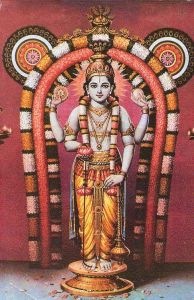
 duzvdh4anypjffvi_D0_guruvayurappa
If we have a lighted lamp, we can use it to read and enjoy a book
or use it to burn and destroy the book. We have the choice
to draw the life circle with Bhagavaan and His naamam as the center
and kindness and love as radius of the circle…
Poonthaanam advises us to use the lighted lamp inside us,
lit by the Light of Lights, to walk through the path of Bhakthi and Naamasankeerthanam. 

boarder

Introduction

Njanappaana can be considered as the Bhagavad Gita of Malayalees. This is a Darshanika kaavyam or philosophical poem expressed in the most simple Malayalam language for ordinary people. Poonthanam Nambudiri, an ardent devotee of Shri Guruvayurappan, transformed his unbearable sorrow from his infant son’s death into a “yogavishesham”. He used this sad experience to build his Bhakthi soudham or house of devotion and opened it for all devotees for all time. Even though the language is very simple, this njaanappana, or song of wisdom deals with the essence of all vedas and upanishads. May Bhagavan Guruvayurappan, Bhagavathy Sarswathi Devi and Sri Poonthaanam Nambudiri bless us to become wiser by going through this great Song of Wisdom!!

This is continued from Part One… https://luthar.com/njanappaana-1 
                                          Part Two  https://luthar.com/njanappaana-2

   boarder

Alpakarmikalaakiya naamellaam
alpakaalam kondororo janthukkal
Garbha paathrathil pukkum purappettum
Karmam kondu kalikkunnathingane

We are all (naamellaam) alpakamikal or our duration of one life to do karmaas are short (when compared to the celestial beings). Hence with the karmaas accumulated in this short period we take birth in different animal’s’ womb (kondororo janthukaal garbhapaathratthil pukkum), come out (purappettum), live for a short period (alpakaalam) and continue playing this karma-bound game (karmam kondu kalikkunnathingane)“Alpakarmikal” include all animals and human beings We are all “alpakarmikal” when compared to celestial beings because one celestial year is 365 human years. What about Brahmadevan? One day time of Brahma is one chaturyugam which is equal to 4,320,000,000 human years. Then night also is as long as the day. So one full day is 8,640, 000,000 human years. So if we multiply with 365 and then by 100 years of Brahma’s life it becomes beyond comprehension for us. So let us not go further to Paramapurusha’s time scale because Bhagavan’s one moment is Brahma’s whole life duration which is 311,040,000,000,000 human years!

We perform karmaas continuously during our short life and then take birth in different animal wombs or human wombs based on our sukrutham or  dushkrutham or mixture of both.. For example, some say one cat year is equivalent to seven human years. So when born as a cat, results of the accumulated karmaas get exhausted in a short time. We believe that before getting a human birth or narajanmam, we go through millions of lives in the lower species with short durations of life. If we are born as a fire-fly (in Malayaalam, Iyyaampaatta) duration of life to exhaust karmaas is only about 21/2 hours or so. As a crocodile, it may be more than 100 years and as an elephant it may be 60 years. Also we see early deaths in all species and the only explanation for all these untimely deaths and diseases is the results of poorvajanma or previous janmaa’s karmaas. Poonthaanam expresses this numerous cycles of birth and death as a karma-bound game. Only Jeevathmaas in the form of different species of animals and humans are involved in this karma-bound game. Paramaathma is only a witness.

When we are finally blessed with a human birth, Poonthaanam advises us to use the power of discrimination bestowed on us by Lord. Only humans have the “vishesha buddhi” to change the course of our life by surrendering to God and offering all our karmaas at His Lotus feet. Continuous chanting of Bhagavaan’s auspicious names will help us not only to understand the real meaning of the famous sloka, but also to practice it in our daily life: 

Kaayena vaacha manasendriyairvaa
budhyaathmanaa vaa prakruthe swabhaavaath
karomi yadyath sakalam parasmai
naaraayanaayethi samarppayaami.

Whatever I do with my body, speech, mind or with other senses of my body, or with my intellect and soul or with my innate natural tendencies I offer (dedicate) everything to Lord Narayana.

With the complete surrender or Sharanagathi, we can escape the terrible cycle of birth,death and sufferings and attain His Lotus feet. Naamasankeerthanam destorys desires and tendencies and helps us to do all karmaas with out expecting anything in return.

 Narakatthil kitakkunna jeevan poy
Durithangal otungi manassinte
Paripaakavum vannu kramatthaale
Narajaathiyil vannu pirannittu
Sukrutham cheythu maelppottu poyavar
Sukhicheetunnu sathyalokattholam
Salkarmam kondu maelpottu poyavar
Swargatthinkal irunnu sukhikkunnu

 Until the consequences of the the multitude of sins gets exhausted (durithangal otungi) Jeevan stays in Naraka or hell ( narkatthil kitakkunna jeevan) and when slowly mind attains maturity (kramatthaale manassinte paripaakavaum vannu) jeevan moves (poy) to take birth as human being (narajaathiyil vannu). After taking birth as humans (pirannittu), those who do sukrutham or good deeds in abundance goes all the way up ( sukrutham cheythu melpottu poyavar) to the sathyalokam (sathylokattholam) and remains there happy and peaceful (sukhiccheetunnu)( never to return and take birth again). Those who do satkarmaas go up to heaven and remain there (for sometime) enjoying the heavenly comforts.

Can we differentiate sukrutham and satkarmam? Sukrutham is the result of dhaarmic punya karmaas. In other words sukrutham is Nishkaama satkarmam or good deeds with out expecting anything in return. All actions performed with purity of mind is Sukrutham. Sukrutham is satkarmaas done for the Kalyaanam or mangalam of all. Bhagavaan assures in Gita “the doer of good (kalyaanakruth), never comes to grief” or “sukruthis never come to grief”. According to another definition Sukrutham is the results of the satkarmaas accumulated from one’s own past karmaas or sukrutham can even be passed on from ancestors.

What is satkarmam? Satkarmaas are definitely good deeds, but the purpose of action may or may not be pure and also good actions can be performed with selfish motives These satkarmaas with out purity of mind do not become Sukrutham. But the results of these satkarmaas are experienced in Swargam or heaven and when they are exhausted soul is subjected to rebirth.

Another word for sathyalokam is “yathaarthalokam” or real world and once we have realisation, no more suffering, sorrows or rebirth.

Life after death is not to punish the souls by sending them to hell or reward them by sending them to heaven. These experiences are given to remind the soul of it’s true purpose of life. Of course the soul’s journey to mukthi or salvation, or heaven or hell depends on the sukrutham or good deeds done. Experiences in heaven and hell are supposed to impart knowledge and wisdom so that when they take rebirth, they can strive to do more good deeds and attain salvation. That is why poonthaanam says about maturity of mind (manassinte paripaakam). But often Maaya masks this realisation and again jeevan goes after transient pleasures and ahdarmic deeds. But because of the Vishesha Buddhi and power of discrimination, humans have the choice to acquire good and bad karmaas. It is only in human birth jeeva gets this opportunity to go beyond the bondage of karma as a whole and attain salvation. Poonthaanam recommends Naamasankeerthanam as the most easy and enjoyable path to salvation.

In this context Njaanaaanada Saraswathi’s description about the fate of souls after death may help us to understand this better. In this book called Vedantha Vinjaanam, he compares the soul’s journey to a bouncing ball. When  we throw a ball to the ground with lot of force, it bounces very high. But when it is thrown with less force it bounces only to a lower height. When it is thrown with hardly any force it hardly bounces and leaves the ground. Here the force with which we throw the ball is compared to sukrutham of the soul. After the death of the body, depending on how much sukrutham one has accumulated, soul goes to Sathylaokam, or Swargam (heaven) or chandralokam or Parjanya lokam , pithrulokam or in the vicinity of earth called prethalokam. Souls that go to Sathyalokam never returns to take janma because they have either attained saalokyam, sarropyam, saameepyam or saayujyam with Paramaathma. (In sathylokam soul can unite with paramaathma and this is Saayujyam. Souls can reside for ever in God’s abode and this is called saalokyam. Next is soul’s assumption of God’s form called Saaroopyam. Staying near to God is Saamipyam.) Poonthannam here mentions about only sathyalokam, heaven and hell. In all other worlds except Sathyalokam, soul stays until the consequences of satkarmaas or dusshkarmaas or a mixture of both are exhausted, and then with the remaining inherent vaasnaas or tendencies takes birth in an appropriate womb determined to improve oneself.

Several different explanations are given for the journey of the soul after death. Dvaitha and Advaitha school of thoughts view these differently. One group believes in attributeless or impersonal God and other group sees God as a personality endowed with glorious qualities. But Mukthi or liberation is unanimously defined as the release from the repeated cycle of birth and death. With the abundance of good deeds or sukrutham, mind becomes pure and “sama-darshanam” or Jeevathma-Parmaathma unity happens. This realization is called enlightenment and enlightened souls eventually get liberated.

Sukruthangalumokke otungumbol
Paripaakavumellolamillavar
Parichodangirunnittu bhoomiyil (jaatharrayi)
duritham cheythu chatthavar pinneppoyi
narkangalil vevvaere veezhunnu

When the results of the good karmaas are exhausted (sukruthangalokke otungumbol), souls remaining in heaven (parichotangirunnittu) are reborn on earth (bhhomiyil jaatharrayi). When their previous good and bad experiences do not impart any maturity and knowledge (paripaakavum ellolam illa-not even as much as little sesame seed), they end up doing more and more bad karmaas (duritham cheythu). Again after death (chatthavar) they suffer the consequences of their various negative karmaas in different ways or in different types of hells. (In one old version the word “jaatharaayi” is not there and with out that meaning can be interpreted in a different way. In that case, the word “parichotangirunnittu” can be for the life on earth or bhoomi itself. When the  the good results of the past sukrutham experiencing in this life on Bhoomi is exhausted, with out any realisation of how transient the pleasures are, some commit more sins to end up in different hells)

In this stanza Poonthaanam explains how important is “pascchaatthaapam” or atonement. Even when we enjoy a good life here on earth, we tend to forget how blessed we are and keep hurting others in several ways. When subjected to miseries also, some people often do not realize the sins or mistakes they have committed and refuse to learn and correct themselves. Poonthaanam is talking about such people and he says that they commit more and more sins with out atonement and go through more suffering. If we realize our mistake and do “praayasccchttham” sincerely, we will not be tempted to do more sins. Famous story of the prostitute Pingala is an example for purifying one’s mind with “pascchaatthaapam”. She realized how wrong it was to sell her body for a living and later with deep atonement surrendered herself at Bhagavaa’s feet and attained Mukthi.

“Aviveka: paramaapadaam padam” is illustrated in this stanza. This means “avivekam” or lack of wise discrimination is the root cause of all miseries. When there is no maturity of mind, the power of discrimination will not be there. So instead of going after “sreyas” or what is good, we go after “preyas” or what gives pleasure. Swami Desikan describes nine steps for a spiritual aspirant and vivekam is the first step. Poonthaanam used the word “paripaakam” of the mind to indicate this vivekam or wise discrimination. Lack of Vivekam or paripaakam of mind leads us to hell by performing adhaarmic and bad deeds .

Purity of mind is very important in spiritual advancement. Only from a pure mind knowledge is emerged. With all temptations around us, it is harder to purify our mind in Kaliyuga.

Kalau kalmasha chitthaanaam
Paapadravyopajeevanam
vidhikriyaavihinaanaam
Gathir Govindakeerthanam

In Kaluyuga, mind of ordinary human beings are tainted by Kaamam, krodham, madam, moham etc (kalamsha chittham) and often end up doing adharmam (paapam) to make money (dravyam) for living (for upajeevanam). Ordinary people do not have the time or inclination to do good karmaas as prescribed in vedaas (vidhikriyaheenam). The only thing that can give relief from the sufferings of Kaliyuga is Govinda naama sankeerthanam. Bhagavaan and Bhagavaan’s naama are never separated. Naamam is called Kalpa vruksham of the earth.

Suralokathil ninnoru jeevan poi
Naraloke maheesuranaakunnu
Chandakarmangal cheythavan chaakumbol
Chandaala kulathinkal pirakkunnu
Asuranmaar suranmarayeetunnu
Amaranmaar marangal aayeetunnu
Ajam chathu gajamai pirakkunnu
Gajam chathangajavum aayeedunnu
Nari chathu naranai pirakkunnu
Naari chathutan oriyai pokunnu
Kripa koodaathe peedippicheetunna
Nripan chathu krimiyaai pirakkunnu
Eacha chathoru poocha yayeetunnu
Easwarante vilaasangalingane

A jeevan or soul from heaven or land of Devaas (suralokatthil ninnoru jeevan) is born as a Brahmin on earth (naralokatthil maheesuranaakunnu). People who do extremely cruel actions becomes “chandaala” or a member of a despised caste. Demons or Asuraas become Suraas or Devaas. People who are eternal or immortal or deathless (amaranmaar) are born as trees (marangal aayeetunnu) . A goat (ajam) is born as an elephant (gajam) and vice versa. A tiger (nari) after death is born as a human being (naran) and a  woman (naari) is born as a fox (oriyaai). A king who mercilessly tortures (kripa kootaathe peedippicchitunna) his citizens takes birth as a worm (krimi). A fly is reborn as a cat and all these are Bhagavaan’s leelavilasam or playful divine drama.

After death, to experience the results of the residual karmaas, jeevan takes birth in appropriate womb. The passage of a soul from body to body is determined by the force of one’s actions, or karma. If an individual performs good deeds, the next birth will be rewarding, and if not, the person may degenerate into a lower life form. In the above lines, Poonthaanam shows several examples of the effect of karmaas on the soul when it is separated from the body after death. A jeevan from heaven comes to earth to experience the results of his residual negative karmaas. Likewise after experiencing negative results by taking birth as beings in several thousands of species, finally a tiger, for example,  gets the life of a human being. Humans bestowed with the power of “wise discrimination” along with the grace of God,  can perform good karmaas and advance spiritually. But when a human being resorts to unkind, hurtful, and negative actions, he will again be pushed back to be born in lower life form like a worm. Poonthaanam says:  A king who mercilessly tortures (kripa kootaathe peedippicchitunna) his citizens takes birth as a worm (krimi).

There are several examples in our puraanaas to illustrate this law of karma. A good example of how an “amara” or immortal being becomes a “maram” or tree is the story of Nalakoobara and Manigriva who were the sons of Kubera, the lord of Yakshaas or the Lord of wealth. Once Nalakoobara and Manigriva were enjoying themselves playing in a lake with women. They were intoxicated and oblivious of everything around them. Sage Narada passed by the lake during this time and the ashamed ladies immediately covered their body with clothes and showed their respect to Narada with folded hands. But both Nalakoobara and Manigriva, intoxicated with pride and drinks ignored Narada Muni. Narda Muni cursed them to become “maruthu trees”. They had to remain as trees for a very long time until Krishna as Damodara came out of Gokulam and touched them with the wooden mortar.

Another example is the story of Gajendramoksham. King Indradyumana was born as a “divine elephant”. I am quoting below the words of our own respected S.N Sastriji (from the Naaraayneeyam commentary) : “The njana and devotion which he (King Indradyumnan who became an elephant by sage Agasthya’s curse) had acquired in his previous life came back to him under the stress of the suffering caused by the attack of the crocodile. He then worshipped Thee with lotus flowers plucked by his trunk, while singing continuously a great hymn addressed to the Nirguna brahmam which he had learnt in his previous life.” Even though King Indradyumna had to be born as an elephant, his residual good karmaas led him to salvation. (Also the crocodile was Huhu, a gandharvan in the previous janma.)
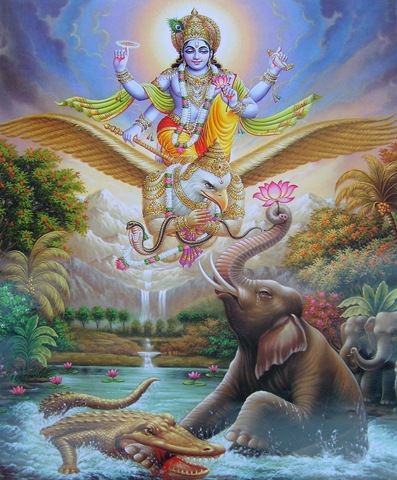
Vishnu_Gajendra_Moksham

As a “Bhoktha”, the experiencer, one does not have the freedom of choice in experiencing the results of accumulated bad karmaas. (Bhagavaan and His naamam are the only solution to lessen or erase our suffering due to accumulated bad karmaas). But as a “Kartha” or doer, one has freedom of choice to some extent. If we have a lighted lamp, we can use it to read and enjoy a book or use it to burn and destroy the book. We have the choice to draw the life circle with Bhagavaan and His naamam as the center and kindness and love as radius of the circle. Also we can draw the life circle with “I” and “mine” as center and a combination of  kaama,krodha,,lobha moha,mada,maasthryaadi  negative qualities as radius of the circle

Poonthaanam advises us to use the lighted lamp inside us, lit by the Light of Lights, to walk through the path of Bhakthi and Naamasankeerthanam. 

Keezhmelingane mandunna jeevanmaar
Bhoomiyeennathre naetunnu karmangal
Seemayillatholam pala karmangal
Bhoomiyeennathre naetunnu jeevanmaar
Angane cheythu nedi marichudan
Anya lokangal oronnil oronnil
Chennirunnu bhujikkunnu jeevanmaar
Thangal cheythoru karmangal than phalam
Odungitum athottunaal chellumbol
Udane vannu naetunnu pinneyum
Thante thante grihathinkal ninnutan
Kondu ponna dhanam kondu naamellam
Mattengaanumoredathirunnittu
Vittoonennu parayum kanakkine

These jeevaas run (mandunnu) between the lower worlds and upper worlds (keezmelingane) of the universe. But it is said (athre) that they get to do karmaas (karmangal naetunnu) only in Bhoomi. It is said that only in Bhoomi these jeevaas get to do various (pala) and limitless (seemayilaatholam) karmaas. Thus (angane) they accumulate karmaas(naeti) and after death (maricchutan) spend time (chennirunnu)in different worlds one by one (lokangal oronnil oronnil) and experience or enjoy (bhujikkunnu) the results of (good) karmaas (karmangal than phalam) done by themselves(thangal cheythoru). These experiences end (odungitum-with the exhaustion of accumulated good karmaas that can be experienced in worlds other than earth) in a little while (athottunaal chellumbol) and again (pinneyum) jeevaas come (vannu) to earth and collect (netunnu) karmaas. When a person goes to some unknown place and spends prodigiously all the money he collected and brought from his own house, can be called “vittunnunnavan”. Exactly in the same way, jevaas accumulate all the karmaas from earth and experience the results in another world.

It appears that a literal translation of some of the verses my not make much sense. Therefore, it seems appropriate to explore the metaphysical meaning that the lines convey.

In Vedanta, earth is often referred to by another name “karma-kshethra”. This name came because souls can experience the results of karmaas performed ONLY on earth and not in any of the other 13 worlds. What ever experiences any jeeva go through in any other world is the result of karmaas done on earth. If good karmaas outweigh the bad karmaas, we go to heaven, experience the results of good karmaas that can be experienced in heaven until those results are exhausted. Then it goes to hell to experience the results of bad karmaas that can be experienced in hell until those results are exhausted and comes back to earth with some residual good or bad (or both good and bad) karmaas that can be experienced only on earth. But no new accumulation of karmaas can happen in any other world. “otungeetum ottunaal chellumbol” (line 5, first part) means that the karmaas that took the soul to heaven (or hell) will be exhausted in heaven (or hell) by enjoyment (or suffering). Every action we perform is like sowing a seed. It remains vibrant and at a later time we reap the results. It is not possible for ordinary people like us to link the past karmaas and what we experience now by any reasonable method. The same karma performed with different attitude can lead us to heaven, hell, or salvation. Bhaavam is very important.

Poonthaanam has used the word “bujikkunnu” for experiencing the results. The word “bhojanam” is defined as “sukhena anubhuyathe iti bhojanam” or “what is experienced happily”. So “bhujikkunnu” may apply only for the experiences of our good karmaas. When the good karmaas that can be enjoyed in heaven are over, we come back to earth. To experience the results of different types of karmaas, our subtle body goes to different worlds and then with a gross, physical body comes to earth and experience what ever residual karmaas are left as well as to perform new karmaas and the cycle continues. The word “Vitttoonu” is a characteristic of a spendthrift. Origin of the word spendthrift is some one who has spent his accumulated wealth from predecessors or ancestors. Poonthannam compares jeevan’s enjoying the results of the accumulated karmaas from the past (from earth) to a person’s enjoying life by spending all the wealth acquired over a period of time. Just like wealth gets exhausted by spending, results of karmaas gets exhausted by experiencing. Life in heaven is not eternal, it is transient. It is interesting to note that jeevans in subtle body and gross body welcome the end of suffering, but definitely want the enjoyment of the results of good karmaas to last for ever when both are transient Only Nishkaama karmam (with out expecting anything in return) leads to eternal peace and happiness or salvation.

Since every action we perform, and every thought that comes to our mind has a result or consequence, Poonthaanam used the word “Seemayillatholam” or limitless or endless karmaas. Wheel of karma continues on and on. Nobody can remain Karma-free. There is one and only one solution to get out of the wheel of Karma and all scriptures and our great seers suggest to surrender to God and do karmaas with renunciation of the fruits of actions.. Poonthaanam gives an easy solution to develop this attitude of complete surrender -Naamasankeertthanam.

Let us chant the naamam to purify our mind with Shri Poonthaanam and other millions of devotees:

Krishna! Krishna! Mukunda! Janaardana!
Krishna! Govinda! Naaraayana! Hare!
Achyuthaananda! Govnda! Maadhavaa!
Sachindaananda! Naaraayana! Hare!


 http://www.youtube.com/watch?v=vbI4Uk8fSYk&feature=player_embedded

 boarder

Samasthaaparadham kshamaswa  Sreekrishnaarpanamasthu
Harsha's avatar

Call of the Conch-Introduction: By Joyce Sweinberg

5732_216453855374_215886190374_7808618_1259315_n
“We need to challenge our age old habits and tradition
if they are in direct contrast to the principles of
non-violence and dharma laid down by Sri Krishna in Gita.”

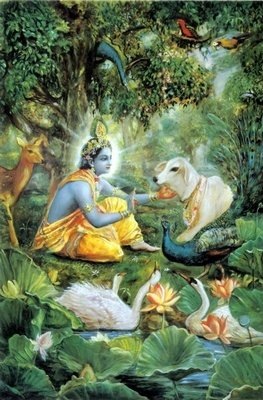
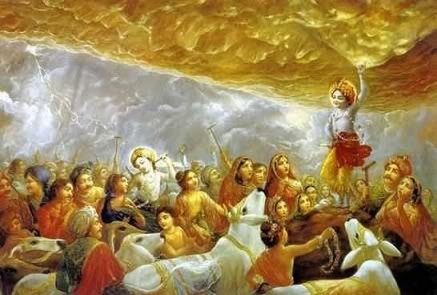
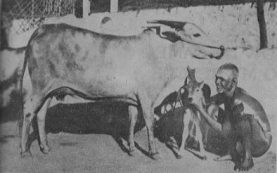
Lord Krishna is also known as Gopala, or protector of the cows. His love for and relationship with the cows of Vrindavan forms a major part of His transcendental past times.  Among the artwork depicting His holy image, there are just as many showing Him with His beloved cows as there are images depicting Him with His beloved Radha and the gopis.  As Giridhara, He lifted the mountain of Govardhana to protect the citizens and the cows from destruction.  When He played His flute, the cows were there, His most ardent audience.  When He wanted to eat, the cows were there, His most willing suppliers of milk and butter.  When He wanted affection, the cows were there, His most unselfish companions, wanting nothing from Him but His caress and His embrace, which they freely returned.  And so, it is not surprising that from these stories and for other reasons, the practice of offering Him prasadam made with dairy, and bathing His image in milk developed and took hold as the cornerstone of devotional rituals.

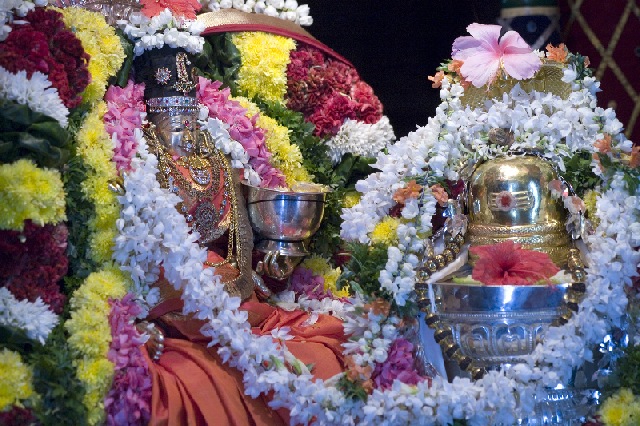
At abishekam, a devotional service, the offering of milk is one of the most common items donated by devotees.  Sometimes mixed with honey and other items, the milk is poured onto the deity and flows freely and amply throughout the ritual, allowed to drain into metal bowls, collected and then poured back into the bottles for the devotees to take home, now blessed by the Lord.  A small vessel is also passed around the room, with each of us given a small spoonful to drink the blessings of Divinity. Food is also offered to the Lord for prasadam and usually contains milk and ghee, a form of clarified butter.  After the puja is complete, the food is shared by devotees partaking of the Lord’s blessings, gathering together in the sangha of God’s worship.

What appears as a charming expression of devotion now has lurking behind it a vile abuse of this most sacred creature of the Lord, both in India and here in America, knowingly perpetrated by the suppliers of the dairy products and unwittingly financed by the Lord’s devotees.  While I converted to a vegetarian diet years ago, I continued to include some dairy in my diet, although very limited due to my developing concern with ahimsa and allergic skin reactions.  But I continued to accept the prasad, I continued to pour the milk when the occasion arose and I relished the sweets and the wonderful Indian cuisine so freely shared where I worship. I told myself that any hesitations I had should be quashed within myself because these were offerings to God and had been blessed and cleansed of any sins committed in their procurement. Lately, though, I was becoming uneasy about it, but not voicing my thoughts and not knowing quite how to voice my developing uncertainty over the source of these offerings.

6129_121115465189_753070189_3399602_3278962_n

Until recently, when Kamleshji, another devotee on a bhakta forum posted a message directly confronting this subject, and ripping open my cloak of uncertainty to the naked truth that cannot be denied if one looks with one’s eyes open, if one hears with one’s heart and if one thinks with one’s conscience. From his post and subsequent communications from him, I quote a few lines below…

“….as devotees of Lord Sri Krishna we must definitely pay attention to the plight of His most beloved animal, the Cow (Go-mata).

Just recently on Sri Krishna Jayanthi, we bathed Lord Sri Krishna in milk, curd, ghee and offered Him His favourite naivedhyams such as paal payasam,  ghee and butter.

However we must be aware how this milk is obtained in this Kali yugam, especially where milk is obtained in commerical farming techniques (as in big cities in India and especially here in the US).  Before this exploitative factory farming age, our saints used to procure Milk products in harmony and without cruelty, the milk was taken from the cow only after the calf has had it’s fill and the cow was worshipped as Go-matha.  Such offerings are certainly pleasing to the Lord.

However in the present age,  factory produced milk is a very cruel exploitative product of torturing cattle. The poor cows are  enclosed in a tiny space, chained in its own waste in darkness, cold and filth for the rest of its life. It is pumped with insane amounts of hormones, and other toxic medications to artifically increase milk production.

These large amounts of hormones, antibiotics and other unnatural feed, cause the cow to grow large and make it prone to bone fractures and other very painful diseases. To add to this torture the cows are artifically inseminated to produce calves to ensure regular supply of milk.

The most unfortunate of the calves are male calves  (called Bobby calves) who are considered to be useless and are sold off to be butchered for meat when they are just five days old. The mother cows separated from their calves cry in agony, yet they are not spared and are administered more hormones to continue milking them.

After milking the cow till it has been exhausted and after ensuring that the cow cannot yield anymore milk, it is sold off to be slaughtered in the most brutal manner for meat and leather.  I request all bhaktas to please think about this, will our Lord ever accept our abhiseghams and Naivedhyams if it means that His favourite innocent animals are killed slowly and extremely painfully all their lives?  Let us not act in an adharmic manner and perform unthinkable atrocities and sins by offering factory produced milk and milk based products especially in our sacred rituals and also in our diets. I can only be certain that we shall never suceed in our sadhana if it causes so much needless pain for innocent animals.

Lord Sri Krishna, vividly describes the three types of foods, Sattvic, Rajasic and Tamasic. Milk in the olden days was definitely Sattvic however now it is 100% Tamasic due to the abundant violence and abuse it entails. Drinking such milk is equal to eating beef.  In fact the animals raised for meat do not have to suffer so much as these unfortunate dairy cows are made to suffer.

We cannot afford to fool ourselves into believing that just because we are vegetarians and do not eat beef, we are protecting the cows. We need to challenge our age old habits and tradition if they are in direct contrast to the principles of non-violence and dharma laid down by Sri Krishna in Gita.”

govardhanagiridhari

His post prompted me to respond to him and to also go online to view some of the websites which I knew would show me the truth, as painful as it might be to watch and to listen. I am now convinced that I must be even more vigilant in my avoidance of all dairy products where I do not know the source.  I will also post several more blog entries examining this subject in more detail, in the hope that each of us can look more honestly into our hearts about what we put into our mouths and onto our bodies, and onto the Lord.

The Luthar.com blog already has several articles on the subject of vegetarian diet…this short series is specifically examining the vegan diet.  We will look at ahimsa as the foundation for a vegan diet, the economic incentives fueling the abuse, the ways in which the dairy cows are abused, including their offspring, and how they are slaughtered in the end. We will examine the human health consequences of ingestion of dairy products and the environmental effects of the mass procreation of cows for human consumption.  We will explore the organic industry as well. We will post photos and links to videos so you can see for yourself what is happening to the dairy cows.  We will also post links to organizations geared to helping the abused cows and offering alternatives to the current system.  We will offer suggestions and ideas on how to substitute other products in our diet and in our worship. We ask that you the reader examine the facts with an open heart. Together with Kamleshji, who has studied the subject extensively and speaks with eloquence and fortitude in His devotion to the Lord on this subject, I will continue to post, seeking His blessings and inspiration.

Today is Ganesh Chaturthi and I take this opportunity to post the first in this series on this day with this prayer…that I serve the Lord without reservation acting as best I can on His wishes, and that I open my mind and my heart enough to let Him speak through me as He guides me.  Ganesha Saranam!

n702126689_1382369_7333

Patram pushpam phalam toyam yo me bhaktyaa prayacchati;
Tadaham bhaktyupahritamashnaami prayataatmanah.

If one offers Me with love and devotion of a leaf,
a flower, fruit or water, I will accept it with joy. BG 9.26

 b36

Harsha's avatar

AUGUST SUMMER by Alan Jacobs

4451_82082183499_623773499_1895176_3431332_n

 August summer from awesome meadow sings,
I never tire from commune with my Soul,
In silent wood’s enchanted shades, where broad
Shafts of sunlight fall in full accord
Gilding leaves of green. The dusty lane’s my goal,
Which ends where the higher path begins.
The air, the fair horizon, crystal springs,
Rosy lips of dawn, which one yearns to kiss
This hem of heaven’s robe in joyful bliss.
Come! let’s gaze at gleaming stars so chaste
They shine on Mother Earth through veils with haste.
Let pine trees imparting scented breath
Waft you along to life away from death,
To sapphire streams and fields of emerald green.
Let Nature’s radiance reveal her sheen
On the solemn beauty of your furrowed brow.
True love latent in your heart, here and now,
Will ever grace this sacred, monumental hour.


6020_96980203499_623773499_2115239_393586_n
       Photos courtesy of Trina Kavanagh

Harsha's avatar

Mangal Aaratee

Unsaved_Production 1


  Mangal Aaratee Priyaa Preetam kee, Mangal Preeti Reeti Doun kee
Blessed prayer of lover and Beloved,  Blessed  is the ritual of their union

Mangal Kaanti Hansani Dasanan kee, Mangal murlee Beena Dhun kee
Blessed is the light of His swanlike splendour,  Blessed is the sweet rhythm of His flute

Mangal Banik Tribhangee Hari kee, Mangal Sevaa Sab Sahachar kee
Blessed Hari, omnipresent knower of three worlds,  Blessed friend of all devotees

 Mangal Sir Chandrikaa Mukut kee, Mangal Chabi Nainan mein At kee
Blessed is His crown made of Peacock’s feather,  Blessed is His glance enslaving my eyes

Mangal Chataa Phabee ang ang kee, Mangal Gaur Syaam Ras Rang kee
Blessed beauty of ornaments on Shyam’s body, Blessed are  Krishna’s activities

 Mangal Ali kati peyare pat kee, Mangal Chitvan Naagar nat kee
Blessed love of Sweetheart Govinda , Blessed allure of that magical Krishna

Mangal Shobhaa kamal Nain kee, Mangal Maadhuri Mridul Bain kee

Blessed is the beauty of His lotus eyes,  Blessed the soft and sweet voice of His Flute

 Mangal Vrinidaavan Mag At kee, Mangal Kreedan Jamunaa Tat kee
Blessed husband of Vrindavan’s gopis,  Blessed is His play on the river  banks of Jamuna

Mangal Charan Arun Taruvan kee, Mangal Karani Bhagati hari Jan kee
Blessed are His Feet under the Arun tree of the forest ,  Blessed Lord, remover of obstacles

 Mangal Jugal Priyaa Bhavaan kee, Mangal Shree Raadha Jeevan kee
Blessed pair of beautiful charming lovers,  Blessed Hari, who is the life of Radha


To listen to this Aaratee, click on the link…
http://www.youtube.com/watch?v=oeOEW5bJUHE

Mangala Aaratee1

Arati (also called  Aarti, ãrti, arathi) is performed in many Hindu temples first thing in the morning, and several times throughout the day, with a final arati in the evening.  Arati is also performed after services such as puja.  The word is derived from the syllables “Aa” which means towards, and “rati” which means the highest love for God.  As the devotee waves the lamp before the deity, the frame of mind should be one of surrender and devotion, a prayer to Divinity to annihilate the ego in the flames of the sacred fire such that complete surrender is achieved.

At the Chinmaya Mission temple where I worship, following the monthly group chanting of the Vishnu Sahasranama, we sing a beautiful Mangal Aaratee to Lord Krishna, which glorifies the love of the Lord for Radha and for the gopis, thus symbolically glorifying the Oneness of the Paramatma and the atma as embodied in the living jiva.  Something about this Aaratee drew me the first time I heard it even though I could not really make out the melody as a small group of devotees sang it one night.  I later found out the language was Hindi, and one afternoon I drove over to the Temple to request Swamiji to sing it for me so I could record it and learn the melody for the monthly chanting.  Like some other bhajans have done, this one took me over and I needed to take it a step further, learning it on my harmonium and memorizing the words.  Still, something was missing…I knew the general gist of the words had to do with auspiciousness and Lord Krishna and Shrimata Radarani, but I wanted more. I wanted to know what all the words meant.

So, I posted photos of my lyric sheet in the Roman transliteration as well as the Hindi devanagari script on my Facebook page, asking my FB friends if anyone there knew Hindi and might be able to help.  One of them did, Shravanji Manyan, and he was kind enough to make an effort which was a great help.  But, there were some lines which he felt he could not quite make out and so there will still some missing lines.  I knew that if the Lord wanted it to happen, He would make it happen.  In the meantime, believing that God helps those who help themselves, I resolved to bring it to a few people at the Mission who I thought might be able to help. 

Before I had to do that, I met a woman who joined into a small yoga group which meets at the Mission.  When our practice was finished for the morning, I pulled it out for my friend, Lakshmi, to ask for her help.  Then a new member of our yoga group, Pushpa, spoke up to say that she had a Masters in Hindi and would be glad to take a look. We started to go over some words, when she offered to take it home.  As a result, she sent me an in depth translation, word for word in a prose like fashion, which gave me a thorough outline of the lyrics. But this was not in the flow of the poetic beauty which graced the Hindi lines. I rewrote the translation to at least try to give it more of a poetic feel and do poetic justice to the author, unknown, who penned these beautiful lines.  Both the lyrics and the melody are hauntingly beautiful, taking you to the banks of the Jamuna River where Radha, the human soul and Krishna, Divinity gracing us in human form,  eternally re-enact the holy union of  His Divinity within the human soul.  There is a certain mystery and wonder to the dance of the lover and the Beloved.  May we all know the glories of this sacred Oneness.

ln004

 Samo’ham sarvabhooteshu na me dweshyo’sti na priyah;
Ye bhajanti tu maam bhaktyaa mayi te teshu chaapyaham
Unsaved_Production 1 

 I look upon all creatures equally,
none are less dear to Me and none more dear.
But those who worship Me with love and affection live in Me,
I come to life in them.” 

BG 9.29

 ln004

Offered with gratitude to the Lotus Feet of my Guru, Shri Krishna, and my Lord, Shri Krishna,
for His Grace in allowing me to love Him, to serve Him and to be His devotee,
and for gifting me with Swami Siddhanandaji in my life, in so many ways,
and in particular, for singing this beautiful work of art for me to learn,
for Shravanji Manyan and for Pushpaji Gairola,
both of whom generously offered their time and talent in
reviewing the lyrics and translating them for me,
and for the unknown poet who wrote this Aaratee through His Grace.
It is said that the Vedas have no author since
they derive from Divinity itself…so too with this Aaratee.


Harsha's avatar

Are You Letting God In? by Swami Sadasivananda

As posted by Swami Sadasivananda on his blog   http://www.ramanateaching.org/

0310_Linga_Pooja_0190

There is one mystical understanding of life that runs through the very core of all major religions. This is the belief, and to many the cherished experience, that our sojourn on earth is not true life. These most ancient scriptures and Masters teach that everything appearing to us here is a mere appearance, behind which we should penetrate, or that it is only a forecourt of the true world, a forecourt which we should cross without paying much attention to.

    Hidden within these very scriptures, though obscured through individual bias or misinterpretation, is a profound truth that utterly refutes this belief. The Vedas, and their essential distillation given in the Bhagavad Gita, the Holy Bible, the Torah, and the Koran definitively proclaim that what a man does here and now with holy intent is no less important, no less true – being a terrestrial indeed, but non the less a factual, link with Divine Being – than the life in the world to come.

    Unfortunately, there is a universal acceptance that the highest gift of grace bestowed upon mankind is a “One way ticket to heaven”. Some call it “salvation”, some say “realization”, some “awakening”. In our modern era this ticket is on sale – being reduced to just a fleeting thought of “oneness” while ferociously consuming whatever is in reach with the righteous indignation permitted within “the present moment”.

    One hallmark of a real spiritual aspirant is an acute awareness of active evolution. Yes, “religion” does mean moving into purity and union through change and improvement.  Although a higher world is perceived, it is erroneous to conclude that we are separated and severed from it. When the day of even partial attainment dawns, we begin to experience that the two worlds are essentially one and shall in fact become one.

    In their true essence, the two worlds are one. They only have, as it were, moved apart. But they shall again become one, as they are in their true essence. Man was created for the purpose of unifying the two worlds. He contributes towards this unity by holy living, in relationship to the world in which he has been set, at the place on which he stands.

    How is it then true that when we suffer in our attempts to live a holy life we are told that such is a gift of grace? Sri Ramana Maharshi declared, with seeming sternness, to Paramahansa Yogananda (in Talks #107), that: “Suffering is the way to Self-Realization.” The Masters of all religions, upon seeing the great misery among the needy, raise their heads and cry out to us and say: “Let us draw God into the world, and all need will be quenched!”

    But is this possible, to draw God into this world? Is this not an arrogant, presumptuous idea?

    The advent of God, His actual gracious Presence, abides within the law that He Himself created and abides by. This law consists precisely in this, that God wants to let Himself be “won” by man, that He places Himself, so to speak, into man’s hands. God wants to come into this world factually, never being satisfied to remain a theory or at best an illusive and flighty “friend in need”. God wants to come to this world, but he wants to come to it through man. This is the mystery of our existence, the superhuman chance of mankind!

    The Masters and their scriptures entice us with the perplexing question: “ Where then is the dwelling of God?” The human mind really does not waiver with the passing of centuries. Therefore the answer to this question from ancient to modern man is: “What a thing to ask! Is not the whole world full of the glory of God? We are then perplexed when the these very saints reply:
                             “God dwells wherever man lets Him in!”

    This is the ultimate purpose; to let God in. But we can let Him in only where we really stand, where we live, where we live a true life. If we maintain holy intercourse with the little world entrusted to us, if we help the holy spiritual substance to accomplish itself in that section of Creation in which we are living, then we are establishing, in this our place, a dwelling for the Divine Presence.
____________________________
Some of the ideas expressed in this article are paraphrased excerpts from the writings of Martin Buber.

rr19

Harsha's avatar

The Path to Enlightenment: By Dr. Harsh K. Luthar

docimage138

A Popular Dichotomy

A popular dichotomy has emerged about Enlightenment in the West since the 1970s between the schools of “gradual enlightenment” and “instant enlightenment”. Some of this can probably be traced back to Poonja ji’s and Nisargadatta Maharaj’s disciples returning to the west in the 1970s and 1980s from India and bringing their understanding of Advaita Vedanta with them as given to them by their teachers. However, because many of these students deviate from traditional Advaita as taught in the classic lineage of Adi Shankracharya, they are referred to as neo-advaitins.

Given this thesis and antithesis between the gradual path and the direct path, I address the following question:

It is said that there are two approaches to the Truth of Being or Reality which some call Enlightenment or Self-Realization. A gradual path and a direct path. What is the truth of it? Are their really two paths? If not, which approach is the correct one? What road should a seeker of truth take?

First we look at the two paths and what these are about.

The Gradual Path

In the gradual path, one engages in meditation and other spiritual practices and disciplines, refines and purifies the mind over time, and is able to rise above the body limitations in ecstatic and trance states.

At some point, the mind beholds the divine directly or is able to surrender itself and be absorbed in the divine. Most yoga paths in various Eastern traditions fall into this category. One can check the ancient Patanjali’s Yoga Sutras for reference.

Such schools of thought are also common to Hinduism, Buddhism, Jainism, and other religions as well. In these traditions, personal prayers, effort, and practice to reach the supreme divine is emphasized and considered vital to success on the spiritual path.

Criticism of the Gradual Path

The yogic paths and meditative approaches based on effort are criticized by the proponents of the direct path (the neo-advaitins) as being misguided.

The advocates of the direct path point out that since Advaita Vedanta states that the Self is always realized, expending effort to find it, is itself counterproductive. Their essential position is that since any effort towards enlightenment is based on ignorance, it cannot lead to true understanding or Enlightenment.

If I were to frame the objection of the neo-advaitin to the gradual path in the form of a question, it would be this: ” How can spiritual effort based on the false assumption of ignorance lead to the Truth of Reality?”.

Logically, It is a quite a beautiful and a powerful assertion.


Criticism of the Direct Path

On the other hand, the “direct path students and teachers” are viewed by many traditional yogis and practitioners of meditation as deluded individuals who at best have convinced themselves due to the power of sheer ignorance that they are enlightened. Such self-deception in the long run is bound to prove frustrating and disappointing to themselves as well as those unfortunate enough to fall for their hype of “Instant Enlightenment”.

Many traditional practitioners also claim that the “direct path teachers” tend to be on power trips and underneath the facade of their “Enlightenment” lies the basic human nature of greed and the hunger for power and the usual sexual and financial exploitation of those who follow them. They point to numerous examples of this happening in various spiritual communities and satsangh circles.

Unfortunately, the traditional practitioners and gurus are also not free from such issues. So neither can win the argument on the ground of excessive purity in behavior and conduct.

Support for Both Schools of Thought Exists

Such criticisms and counter-criticisms that the practitioners of two schools hurl toward each other all appear to have some degree of validity. Both schools also have their own particular strengths. An integrative understanding can lead one to relax one’s position on such matters.

In the direct path, the insight or the revelation is sudden like thunder. Truth of the Self appears as lightning and illuminates one’s being in a flash. The ignorance drops away as if it never was and one is at ease with one’s nature. Buddhists call it the Original Face, the Buddha mind, or the Buddha nature. Hindus and Jains call it Atma Jnana, Kevala Jnana, or Moksha.

There are various examples of this particular mode of thought in Hinduism and other religions as well. In this approach, for many, the Grace of God or Guru becomes the focal point on the spiritual path and the role of personal effort is downplayed. Support for this is found in the Upanishads (sacred scriptures of Hindus) where we see statements like, “Self reveals Itself to whom It chooses.” For reference, see the Katha Upanishad, where Yama, the Lord of Death, explains to Nachiketa,” The Self cannot be known through the study of scriptures, nor through intellect nor through hearing learned discourses. It can be attained only by those whom the Self chooses.”

On the other hand, in many schools of Hinduism, the emphasis is on works and on spiritual practices such as meditation, pranayama, fasting, etc. Similarly, in Jainism, the spiritual aspirant must bravely work out his/her karma (destiny) in this world following the path of forgiveness, compassion, and nonviolence. This was demonstrated over 2600 years ago by the Tirthankara Bhagavan Mahavira who bore physical and mental hardships with a feeling of amity and nonviolence towards all living beings. Eventually, as his karma dropped, the heavy burden of his soul becomes lighter and led to Self-Realization and Kevala Jnana (Which Jains view as Omniscience).

We see that in Jainism, the actual working out of karma through indifference to suffering, doing good deeds and by cultivating universal love for all beings is emphasized. The same is true in most schools of Hinduism. Even in Buddhism, originally Buddha taught the doctrine of effort and walking the spiritual path with care and compassion. Buddha’s last words to his students are said to be, “Work out your salvation with diligence.” Essentially, Buddha was saying to his students that after receiving his teachings, it was up to them to walk the path and attain their Buddha nature.

Where is the Truth in this Forest?

So then where lies the Truth of Enlightenment? Is the Truth of Realization achieved through walking the path gradually and carefully while engaging in spiritual practices? Or is Realization attained suddenly through a Zen like Satori or when the Zen master does something strange and shocking as depicted in many Zen stories. Can Realization really come unannounced knocking at the door as was the case with Sri Ramana Maharshi?

Sri Ramana, the great sage of Arunachala, has simultaneously endorsed both perspectives and said that the Truth of the Self is indeed simple and within everyone’s grasp. We simply mix the underlying feeling of “I AM” which is there in all of us (and always the same from childhood to old age) with the circumstances of our life, and the ever changing currents and patterns of our mood and personality.

The self-feeling of existence, the “I AM” which animates our life and consciousness and gives light to identity becomes invisible and goes in the background as we become captivated with our perceptions and invest in our daily relationships. That is only according to nature, and one is meant to engage in these things.

All relationships inevitably end. Even when we love someone dearly and they love us, eventually we are separated through circumstances, old age, or illness. If someone is married for 50 years, there is no guarantee that they will make it another year or another 10 years. In due time, one person will pass away due to old age or illness or another cause.

Coming together and separating are the nature of life. Underlying all these events and relationships is the silent presence of “I AM”. If we are paying attention we can feel it. In our quiet moments it comes upon us and we can stay with it. The truth is so simple and ordinary and that is why we take it for granted. If we remain with this self-feeling of existence, the stainless “I AM” free from the contents of the mind, we can come to see the value and beauty of it. It is only pure being. Our own being.

The Role of Spiritual Effort

The spiritual effort needed in terms of meditation and inquiry, to make the mind subtle and to refine the intellect so that this simplicity of being can be grasped with immediacy and certainty, should not be dismissed.

If some people do not need such efforts and can recognize the truth of their being immediately by hearing someone restate or paraphrase what the ancient sages have said, that is wonderful indeed. It shows that their mind already had requisite subtlety, depth, and maturity.

The Sense of Being I AM: The Open Secret

If there is a deep sense of quiet within, it can be like a mirror and we can see the image of “I AM” reflected in the mind. I am reminded of that passage where God said to Moses, “I AM That I AM”. I am not a scholar or religious expert but sometimes it seems to me that this is a symbolic message telling us to pay attention to the “I AM” within because it is God sitting in our own being and Heart saying, “Here I AM, I AM, Come to Me”.

It is said that man (woman) was made in the image of God. If the nature or identity of God can be described best as “I AM THAT I AM” it stands to reason that the nature of Man (Woman) is also similar. Our essential nature can be captured by this feeling we all have; the simple feeling of being-existing, free from conflicts, “I AM”. According to Advaita, this “I AM” within us is the link to God. Prayer, meditation, contemplation all make us reflect on this sense of being within us.

The Sahaj State

The state of the Self is natural. Easy and natural because the Self remains as It Self. It is devoid of sorrow and has nothing to attain being whole and complete and what the Advaita scriptures refer to as One without a second. Sages called this Realization the Sahaj state.

Sahaj in Sanskrit means easy and natural. That which requires no effort is Sahaj. To understand the Sahaj state of the Self, we can start and reflect on our body and see what is natural to it. What is easy and natural differs among people. Some people are able to sit in the lotus posture in an easy and natural way (see the picture of this young woman at www.harshasatsangh.com sitting in the lotus posture).

However, the lotus posture is not easy and natural for everyone. For most people, to sit like that would hurt their knees and ankles and is very uncomfortable. God did not say to Moses, “Here I Am, sitting in the Lotus Posture.” God only said, “I AM THAT I AM”. The feeling of “I AM” within us is independent of posture. Physical postures pertain only to the body and not to the spirit.

What is Natural Differs Among People

In life and on the spiritual path we have to see what is easy and natural for us. For some, walking is easy and natural and such people practice their prayers, mantras, and pranayama taking a morning stroll. Others are not satisfied unless they lift very heavy weights and scream “Oh God”, “Oh God”, and breathe rapidly and heavily. This is their form of being natural. For such people becoming very muscular becomes natural. If you were to tell weight lifters to take it easy and just take a nice walk every morning, they would not agree to it. They like to have big muscles and low body fat. That is natural for them but not for everyone.

In Bhagavad Gita, Sri Krishna tells Arjuna that actions and paths of people differ according to their natural inclinations and therefore one should follow one’s own Dharma not someone else’s. In other words, we need not seek or follow someone’s path because it may not be natural for us. We should be natural, authentic, and true to our self. Without it, there would be inner conflict which is not conducive to being quiet and meditative.

 What Path Should One Follow?
Gradual or Direct or Just Stay Home

In this essay, I have suggested that the philosophies and perspectives of the gradual or the direct path are not inherently meaningful. Their truth lies only in being teaching tools. Words and concepts such as the “direct path” and the “gradual path” are meant to point at the truth but they are not themselves the truth. The Truth must reveal itself to us in our own Heart.

Therefore, one should not be rigid about which notion is correct or more important or higher than the other. Asking whether the direct path is better than the gradual, one misses the point. The real question is, “What feels natural to you and makes sense?”

Being rigid in one’s view, one misses the obvious. Both the notion of “direct” and “gradual” depend on each other for meaning and have no basis in the Reality of the Self.

According to Advaita Vedanta, the Self Always Is. It cannot be seen by “another” directly. Neither is it approached by “another” gradually. Self Reveals It Self Alone to ItSelf. To understand it in plain English, you can say to yourself, “I am always going to Me. And Here I Am.” Just stay with that.

You Are the Self.

Harsha's avatar

Self, Shakti, Heart, and Enlightenment in Advaita: By Dr. Harsh K. Luthar

Often on the spiritual path, the topics of best postures, best techniques of meditation, best behaviors conducive to spiritual growth, best gurus, etc., come up. All of these questions are appropriate to their time and circumstances.  Such questions were frequently put to Bhagavan Ramana.

Underlying all such questions is the fundamental theme or inquiry as to what constitutes superior spiritual practice that will lead to improvement in one’s mental and physical conditions and finally to Self-Realization or Enlightenment. From this perspective, Self-Realization is viewed as an attainment. It is something that is achieved by an individual by making the right effort. This approach in its methodology is not too different than that of a talented world class athlete, who after having trained rigorously, wins a gold medal at the Olympics.

This point of view emphasizes the need to focus the mind in order for it to expand and evolve to higher levels. Spiritual practices based on this foundation, involve meditating in a particular posture, concentrating on chakras, raising the kundalini shakti, practicing mantras, deep breathing, and doing pranayama exercises.

The Yoga paths explicitly incorporate the idea of controlling and developing the mind to gain entry into Samadhi and Super-conscious states. Most religions have this philosophy at their core; that without hard work one does not succeed either in life or in knowing God.

The General Spiritual Path Model

Buddha is supposed to have said to his disciples as he was dying, “Work out your salvation with diligence.” He meant that you have to personally work it out and attain Nirvana by right conduct, right practice, right meditation, etc.

The same principle is present in Jainism and most of the schools of thought in Hinduism. In Jainism, one attains to Moksha through one’s own individual efforts. In Hinduism, one achieves Moksha by God’s Grace. However, in most schools of Hinduism, one only benefits fully from God’s Grace, when one has made the right effort on the spiritual path by following one’s Dharma and by meditating on the nature of the Self.

Although it is a complex topic, the general spiritual model that we have before us is this: There is a spiritual path, there is the goal of Enlightenment or Self-Realization, and you have to expend much effort, and walk on the path for a long time in order to reach the destination. While you are walking, you may even have to go through the “dark night of the soul” a few times, because there are so many temptations along the way and things can sometimes appear hopeless and quite depressing.

So not only is there the possibility of tripping and falling due to worldly obstacles, but one also may give up on the whole idea of Liberation, Salvation, Enlightenment, Nirvana, Moksha, and/or getting to Heaven. Indeed many on the spiritual path do end up concluding that there is no meaning in life or the spiritual aspiration at all and kick themselves for missing out on the pleasures of their youth by having rejected the philosophy of “Eat, Drink, and be Merry” prematurely.

However, experienced sages know that what practices or behaviors will be helpful to the seeker on the spiritual path seems to depend on one’s conditioning, physiology, culture, background, etc. Although there is a general framework on how to pursue one’s aspiration for Enlightenment or Self-Realization, the truth is that one has to make the path as one walks on it because each individual is unique. Therefore, the view of “Eat, Drink, and be Merry”, within reason and in moderation, may be fully compatible with the spiritual life. It is the overall context that has to be understood.

The Self-Knowledge of a Sage

For the one abiding spontaneously and inherently in the Self-Truth of Reality, questions of methods, techniques, and practices, and the path become moot. When clarity of Self arises, any technique may be practiced and any path may be walked or one may give up all techniques and paths. For such a person, the Self-Attention itself absorbs attention regardless of where it is focused outwardly. The essential element in this understanding is the Recognition by Awareness of its Innate Wakefulness. Awareness is always self-aware by its very nature.

When awareness remains pure and spontaneously self-focused (perpetually in communion with itself), the subtle duality between awareness/attention (as Pure I AM) and its Source is seen to be illusory.

Then even the witness disappears, there being nothing to witness. The “I AM” disappears having nothing to point to. Spontaneously with the I AM Awareness/Shakti merging in its Source, the Self is Recognized. The Self Recognizes It Self by It Self and Through It Self as its own Source. It Sees and Recognizes that It has Always Been the Source. That It Is the Eternal Source, the causeless cause.

This is the Supreme Beauty of the Heart. It absorbs the Shakti, and along with it the Mind, thus swallowing time and space.

How can one speak of this Silence? The Silence that transcends all understanding and knowledge can only be indicated indirectly.

Great sages like Sri Ramana Maharshi never tire of pointing out that, —That Which is Real and Absolute Always Exists and is not absent even now—. How can Reality, whether one calls it God, Consciousness, Absolute, Nirvana, Moksha, Kingdom of Heaven, or by some other name be present at one time and absent at another? Perfection, by its nature, cannot be more perfect sometimes but not others. The approach and method of Advaita is based on this implicit axiom.

The Method of Advaita

The ever-present and eternal existence of our fundamental reality, whatever label we give it (Self-Nature, Buddha-Nature, Original Face, God, Goddess, God Consciousness, Pure Consciousness, Supreme Consciousness) must be here and now in this very moment. Otherwise, it is not Perfect!

This is the fundamental insight and conviction of the path of Advaita and the Advaitic sages. Therefore, we have to grasp the present by simply being present to it. This is the method of Advaita.

How is this done? In this way:

This present ordinary awareness, that you experience, you should notice it and then hold on to it. It is subtle and yet so ordinary. That is why we miss it. No matter how ordinary a baby looks to others, to the mother it is special. She adores her baby and to her it is the most lovely and wonderful child in the world. That is the attitude one must have towards one’s ordinary present awareness.

Like a mother holds on firmly to her child in all conditions, one should keep this ordinary self-awareness in the center of one’s consciousness knowing it to be special. The Supreme Reality It Self is hidden in it. It cannot be anywhere outside of it. If the Supreme Reality is somewhere outside of our ordinary consciousness, it is not perfect. Therefore, we can confidently look for perfection in our ordinariness, our ordinary consciousness.

Finding God in the Heart

There is a Christian saying that “Man is made in the image of God”. There is deep meaning in that. In the Bhagavad Gita, Sri Krishna says to Arjuna, “I am in the Heart of all.” We find such expressions in many of the religions of the world and in major works of different spiritual traditions.

On the path of Advaita, through our present ordinary awareness, we become, or more accurately, recognize our True and Ever-Present Image in the Heart. Advaita goes one step further and states that indeed the illusion of separation between the Individual soul and God lasts only as long as God is not recognized as the Center of our Being, sitting in the Heart as the Heart.

This is the Heart, that the ancients called Sat-Chit-Ananda. Existence, Consciousness, Bliss. The Supreme Self. It is beyond thoughts and concepts. Time and Space do not touch it.

As Sri Ramana has said, — that which is real is ever present—. We have to see what is present right now in this very moment. If we become quiet, we are able to feel our ordinary awareness, the sense of “I Am” as being present in this moment. That is the seed. If we water it and give it food, it grows and the Reality reveals it Self from within.

Editor’s Note:  The Feature Picture depicts photo art of brother Eden Kailash on his fb page.

Harsha's avatar

Ahimsa – The Antidote to Fear

By Dr. Harsh K. Luthar

Bhagavan Sri Ramana used to say, “Ahimsa Param Dharma”. It means that Ahimsa (Nonviolence) is the Supreme Dharma (Duty or Principle). Sri Ramana pointed out to the devotees and yogis that in Patanjali’s Yoga Sutras, Ahimsa is named as the highest virtue above all other virtues. If we are able to understand what Ahimsa means at the deepest level, that clarity itself guides us in discovering the nature of the Self as our own Being.

Continue reading

Harsha's avatar

Love Is Not Something You Get: By Dr. Harsh K. Luthar

Grandfather and Granddaughter

Once I was sitting and talking with my father when he received a call from one of his close friends in India. They talked for a long time. I went into the kitchen and ate some vegetables my father had prepared from his garden along with some garbanzo beans made in the classic Indian style.

During the meal, I could hear some of the conversation. After I was done with the meal, I prepared some Chai and slowly sipped on it. Half hour later they were still talking. When the conversation ended, my father appeared very silent and thoughtful. I asked him what happened.

My father told me that his friend’s wife passed away six months ago and that his friend was very lonely.

“Old age can be very difficult. I was mostly listening to him,” said my father.

“Well, you both talked for a while and I hope it helped,” I said.

My father explained the situation and said, “I don’t know if it helped. We are old friends and he seemed sad and he was reflecting on his life as we talked. He kept saying throughout the conversation that although he had had many friends in his life and had been married and had children and a family, he never really received genuine love from anyone.”

Hearing about my father’s friend, I also became silent. This is the human condition, is it not? We all know the truth of it. We want attention and love but often do not receive it. Many people, as they get older, embittered by their life experiences become sad and cynical.

My father went into the kitchen and started eating lunch. I prepared another cup of Chai and sat down with him. “What did you say to your friend,” I asked my father.

“I did not say much. We just talked,” said my father.

“No, I mean when your friend said that he had never really gotten love from anyone, what did you say? How did you console him?” I asked my father.

My father said, “I told him I loved him.”

“What did he say in response.” I was very curious.

“He said, he knew that. That’s why he called. We are childhood friends. But he still insisted that he really had not gotten the kind of love he wanted from anyone during his whole life,” said my father.

“What did you say then?” I asked being fully engrossed in the scenario.

My father said, “Well, as we were saying goodbye, I told him that love is not something we get, it’s something we give.”

“Love is not something we get. Its something we give.” I remember my father saying that many years ago.

adedicationtomyfatheronhis70thbirthday-b9e8the-last-summer2-150x150

Harsha's avatar

Shiva and Shakti-Jnaneshwar

Here are some selected verses from Jnaneshwar, a 13th century Indian mystic.

Amritanubhav (The Nectar of Mystical Experience)

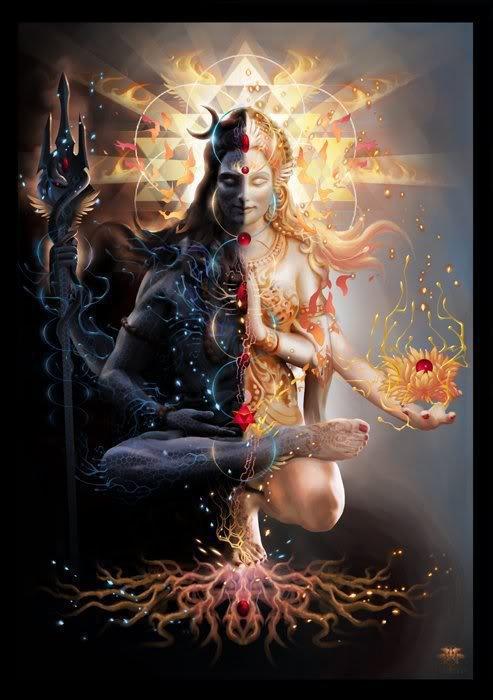
Siva Shakti

Chapter One: The Union of Shiva and Shakti

I offer obeisance to the God and Goddess,
The limitless primal parents of the universe.

They are not entirely the same,
Nor are they not the same.
We cannot say exactly what they are.

How sweet is their union!
The whole world is too small to contain them,
Yet they live happily in the smallest particle.

When He awakes, the whole house disappears,
And nothing at all is left.

Two lutes: one note.
Two flowers: one fragrance.
Two lamps: one light.

Two lips: one word.
Two eyes: one sight.
These two: one universe.

In unity there is little to behold;
So She, the mother of abundance,
Brought forth the world as play.

He takes the role of Witness
Out of love of watching Her.
But when Her appearance is withdrawn,
The role of Witness is abandoned as well.

Through Her,
He assumes the form of the universe;
Without Her,
He is left naked.

If night and day were to approach the Sun,
Both would disappear.
In the same way, their duality would vanish
If their essential Unity were seen.

The book from which these excerpts are taken, is entitled
“Jnaneshvar: The Life and Works of the Celebrated Thirteenth Century Indian Mystic-Poet.”

The translation is by Swami Abhyayananda.