Harsha's avatar

Tips for Career and Stress Management in the Workplace: By Dr. Harsh K. Luthar

In my view, stress and career management are central to the lives of most people. Given below are some tips that make sense to me. Take them with good humor and make up some of your own.

1. Make friends with your Boss. Research shows that bosses can be a major source of workplace stress. According to Professor Hochwater and his doctoral students, who conducted a study on bad bosses, “Employees stuck in an abusive relationship experienced more exhaustion, job tension, nervousness, depressed mood and mistrust.”

2. Laughing can break up an otherwise negative mental state. Humor plays a big role in our seeing things in perspective. Keep a book of good jokes handy at the workplace and flip through it now and then. Make friends with funny co-workers. They are all around you. When things get difficult, go talk to them and ask them to make you laugh. You will be surprised at the comedic talent available in the workplace. From personal experience, after my most uncontrollable laughs, I have felt much better and rejuvenated afterwards.

3. Assess your skills and abilities in terms of long term goals. Enhance these further through education and training, particularly if your company is willing to pay for it. Many organizations these days pay for their employees getting an advanced degree like an MBA. Higher level of training and education will allow you take charge of your career and make you more marketable. People experience more anxiety and stress when they feel things are not in their control and that they have limited options.

4. Be alert to opportunities around you both within and outside the workplace and take advantage of them. Bite only as much as you can chew and do not say yes to too many workplace projects. It will scatter your energy and leave you exhausted. However, success in fewer and even smaller projects will give you confidence as well as an enhanced professional reputation among your co-workers.

5. Take one or two 10 minutes walks during the workday. I find short walks, or even climbing up and down the stairs several times during the day to be very useful for me. Lunch is a good time for walking. You can walk outside in the fresh air and then come back and eat a light, balanced, and nutritious lunch. I wish I could take my own advice more often! When I can though, I find that walking and deep yogic breathing can do wonders for creativity, energy level, and the general elevation of mood.

6. I find that drinking enough plain water during the workday is very helpful to me. If I drink too much tea or coffee as substitutes for water, it creates physiological symptoms of stress such as sweaty palms, increased heart rate, and just more nervous energy than I need. Students who drink too much tea and coffee before their classes risk the increased possibility of having to take a bathroom break when critical topics are being discussed.

7. Calm and center yourself through meditation and/or prayer several times a day. This is particularly helpful before important presentations and meetings. People listen better, speak more clearly, and in general communicate much more effectively when they are relaxed. If you do not have your own office and feel strange about closing your eyes publicly and just sitting quietly, then go to the bathroom, close the door, and sit there for a few minutes.

What Should Organizations Do?

Organizations should consider incorporating meditation training in their employee wellness programs. Employees who meditate regularly experience greater job satisfaction, improved job performance, are more alert and active, self confident, less irritable, more cooperative with others, and enjoy a greater level of accomplishment.

Organizations also need to be sensitive to the fact that personal problems (divorce, illness in the family, death of a loved one, or other trauma) can temporarily influence the workplace behavior of otherwise good employees. Giving leaves of absence or personals days off with pay to manage such situations can help to reduce the employee stress level.

My Personal Belief

In my view, relaxation and meditation training can be particularly helpful in coping with difficult life or workplace issues. It has been documented in a variety of research settings that meditation and prayer can lead to significant decreases in psychological distress, health complaints, insomnia, and smoking. There is a lot of good information available on stress management in the research literature as well as in popular magazines, and of course on the Internet. Like everything else, one has to be an intelligent consumer of knowledge and use common sense.

Strive and thrive! Do well, and be the best that you can be and leave the rest to the higher power.

Good luck!
Harsha's avatar

A Dedication to My Father on His 70th Birthday: By Harsh K. Luthar

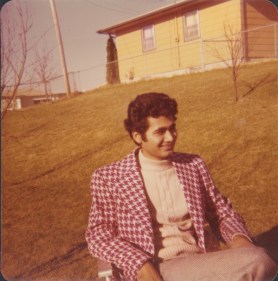
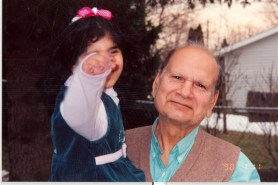
My father was my protector and best friend. I wrote the following in 1996 when my Father turned 70 as a dedication to him. The picture is of him at 72 holding my daughter. It was taken in the summer of 1998.

The last wonderful summer my father and I spent together was in 2003. Several months later in November of 2003 he fell ill. After that I was only able to see him at the hospital. My father passed away in early 2004 at the age of 78. I think of him everyday.

Summer time with my Father – 1998

A Dedication to My Father on His 70th Birthday in 1996

My father was a mathematics professor. He is now retired. I saw him spend countless hours writing papers and constructing new math problems. He involved the whole family in helping him with an undergraduate math journal, Delta, that he had founded, and of which he was both the editor and the publisher. It was too much work for one man, but my father persisted in doing the impossible for years. Delta later merged with the Mathematics Magazine issued by the Mathematics Association of America. We were all happy when that happened!

My father spent a lot of his evenings grading math exams. This used to irritate my mother. “Must you spend so much time reading student exams? Give them a grade and get it over with,” she would say. He usually replied, “What do you think I teach, sociology or philosophy? Can I just read the first and the last line and give a grade!” Then he would laugh heartily feeling he had uttered a profound truth.

My father actually loves the humanities but is of the opinion that everyone should have concrete skills to earn a living. He never hesitated to express his views to me and others about education. Once, in order to demonstrate the superiority of learning math over other disciplines he said to his colleague who taught astronomy the following: “If our students know math and statistics they can get a job at the plant (he was referring to the local GM Plant). If they take astronomy and don’t get a job what will they do? How will they eat? Maybe they can go to your house and you can all watch the stars together on an empty stomach!” My father thought what he had said was quite funny, although the astronomy professor did not. The following poem is dedicated to my father.

PROFESSORS DON’T GROW OLD

Professors don’t grow old

they just grade away

like a master jeweler

who has to differentiate

between precious rubies and stones

who with a heavy heart sings

and then has to part

with diamond rings

that must end up on

someone else’s finger.

Professors don’t grow old

they just grade away

like a gardener who

asks the birds to stay

in the nest he has made

so they can rest in the shade

of the tree of wisdom

carefully pruned

standing in the luscious grass

only to see them fly away.

Cool breezes and the

fresh waters of knowledge

is what we received

in the college

that was my father’s heart.

Yes, professors don’t grow old

they just grade away

and then slowly fade away

to pictures on the walls

leaving nothing behind

but the touch of ideas

given with humor and kindness

and their smiling eyes

bubbling forever in our mind.

Harsha's avatar

Comparison of Kundalini Yoga with Jnana Yoga: By Berit Ellingsen, M.Sc.

Berit Ellingsen is a long term member of the HS community and was the Editor-In-Chief for Volume III of the HS E-Zine. She worked with great patience and creativity to bring the best out of every article that she edited and often added beautiful graphics to enhance each author’s contribution. Berit lives in Norway. She has a degree in biology from the University of Bergen, Norway. This particular article by Berit Ellingsen appeared in Volume I of the HS E-Zine in the Winter of 2001.

Self-Realization in Jnana, Kundalini, and Tantra Yogas

Kundalini Yoga

Kundalini-Shakti, in traditional Indian spiritual sources, is described as the energy that propels man to liberation. Thus, awakening this energy in the body(mind) of the practitioner is central in some liberation teachings, most notably, the Kundalini Yoga systems and the Tantra Yoga systems. As the energy moves in the central channel in the body from its resting place and source in the Muladhara Chakra to the Sahasrara Chakra, and enlivens the passive element of the mind, liberation is said to ensue.

Jnana Yoga

Jnana Yoga, the “yoga of knowledge”, the type of yoga most commonly associated with Advaita Vedanta and the non-dual perspective, does not have the body and its energies as the main focal point for spiritual development, but the mind itself. Jnana Yoga uses the individual consciousness as a tool to learn about the true self and thus attain liberation.

One method of Jnana Yoga is Sri Ramana Maharshi’s method of self inquiry, atma-vichara. In asking oneself “who am I ?” one centers the individual consciousness onto its source. Thus, by focusing the conscious mind on the still point, the witness, to witness the very act of witnessing, the barrier between the perceiver and the perceived vanishes.

Awakening the power of Kundalini-Shakti alone and manipulating this energy is not seen as a prerequisite for attaining liberation, and Kundalini-Shakti does not have a central place in the texts of Jnana Yoga. The method of atma vichara alone is enough to bring about liberation (“Be As You Are, The Teachings of Sri Ramana Maharshi”, edited by D. Godman, p. 142 and p. 146).

Is there nevertheless common ground between Jnana Yoga and Kundalini Yoga ?

From a non-dual perspective, Kundalini-Shakti is but one form of the Self. Kundalini-Shakti is the Self, pure energy and pure Being (Be As You Are, The Teachings of Sri Ramana Maharshi, edited by D. Godman, p. 145). The human mind with its consciousness is also a form of energy, of consciousness and Self.

Kundalini and Tantra Yoga

In Kundalini Yoga and Tantra Yoga, Kundalini-Shakti can be influenced by other energies such as sound (mantra), light and darkness combined into symbols (yantra and mandala) and movements of the physical body (asanas). In Kundalini Yoga, concentration on these energies and on various psychoenergetic centers, the chakras, is said to bring the Kundalini energy to these centers to break through the seven veils (chakras) that stand between union of the individual soul, Atman, with Shiva (or the non-dual consciousness, the Self).

To become strong enough to break through the seven veils of consciousness and reach the Sahasrara Chakra, the Kundalini energy must purify the body and mind in a process which may take many years. In this process, the energy will not always stay in the central channel, but spread out from the Muladhara Chakra in a broad fan that may include the entire lower body or torso in a process that can be complex.

The common denominators in manipulating the Kundalini-Shakti to attain liberation are concentration and focus. Where the mind and individual consciousness, the individual thought energy, is moved and focused on, there Kundalini-Shakti in the individual mind-body also moves. Thus, it makes sense to move consciousness not only onto energy centers, chakras, in the individual body, but instead directly onto and into its own source.

During the practice of atma-vichara, where the consciousness turns inward onto its own source, not to repress any thoughts or concentrate on any subject apart from the act of witnessing itself, the Kundalini-Shakti will automatically become concentrated into a fine beam. It will easily be led back to its source by rising upwards in the central channel with a force strong enough to break through the one true veil between man and liberation, the very idea that the individual consciousness is separate from the Self. The energy of consciousness, the Kundalini-Shakti, in this way is used as a laser beam to melt a single window instead of as a ram to bring down seven gates. No conscious piercing of the Sahasrara or any other Chakra on behalf of the individual mind is needed.

Full Liberation

To bring about full liberation, Sri Ramana Maharshi recommended to continue to clean out the vasanas (the contents of the body-mind which keeps the Atman identified with the body-mind) which may be present even after the identification with sat-chit-ananda has been experienced in the first Nirvikalpa Samadhi (“Be As You Are, The Teachings of Sri Ramana Maharshi”, edited by D. Godman, p. 66-67). After the first Nirvikalpa Samadhi, Kundalini-Shakti may manifest spontaneously, or where already present, the energy may increase the strength and efficiency of its manifestation. The Kundalini energy will then bring more of the vasanas (latent tendencies) to the attention of the conscious mind.

As a result of the knowledge experienced in Nirvikalpa Samadhi, the mind will ask itself “to whom did these events happen ?” and the true nature of this mind content is seen and disidentified with. In this process, the Kundalini energy brings the vasanas to the conscious mind where they eventually evaporate like water in sunlight.

Thus, Jnana Yoga and Kundalini Yoga may share common ground in the effect of the Kundalini-Shakti in the body-mind, both prior to the first Nirvikalpa Samadhi as well as afterwards. The difference between the two yoga systems lies primarily in the view of how this energy should be employed, either directly, as in Kundalini and Tantra Yoga, or indirectly, as in Jnana Yoga.

Harsha's avatar

Psychotherapy, Awakening, and Healing: By Dr. Holly Barrett

This article first appeared in the Winter 2001 Edition of the HS E-zine. The author, Holly Barrett, is a retired psychotherapist and a long time member of the HS community. The image is a courtesy of Alan Larus.

The Magic of Deep Listening As A Spiritual Path
by Holly Barrett, Ph.D.

Listening Instructions

In graduate school, we would-be psychotherapists were instructed in the various ways to listen to another person. This is a little like teaching love, but several suggestions were offered, including “hold evenly-suspended attention” (Freud), “practice the art of unknowing” (Kurtz), and, my personal favorite, “suspend memory and desire” (Bion). Readers will recognize the similarity of these instructions to teachings on meditation. As it turns out, I suspect that a few decades of this kind of listening had a lot to do with the arousal of kundalini in my body, and the subsequent upheaval that, ironically, led me to get out of the therapy business.

Listening to another person over an extended period of time is an awesome, sometimes tedious, joyful, frightening, and ultimately mysterious act – just like meditation or contemplation. Healing, when it occurs, is always reciprocal. Therapists talk among themselves about the weird things that start to happen: how your “client” puts feelings into your body for safekeeping (and for you to feel) till s/he is ready to reclaim them; how you sometimes know what s/he is going to say or do even while you are trying to be reassuring that you cannot read minds; how s/he comes in with the exact same dilemma that you have been struggling with since last week, or this morning. Modern psychoanalysts have a name for this: intersubjectivity. But over time, I found it impossible not to notice that some kind of divine wave motion was moving the therapy along. I decided my most important task, maybe my only one, was to draw a bead on what was alive and shimmering and holy in the person sitting across from me, and hold that jewel in my sight until s/he, too, could see it.

Diagnoses and Boundaries

I was going to title this article “Dual Diagnosis” as a little joke for my enjoyment. In psychology, dual diagnosis refers to a person’s having two presenting difficulties, like addiction plus a character disorder. But to my gradually awakening sensibility all diagnosis, all labels, even I suppose all descriptive language that implies professional “expertise,” pins people down to the dualistic manual. I looked with increasing wonder for the supposed line between the psychological and the spiritual and I could no longer find it. In fact, boundaries were disappearing everywhere. Who was the healer and who the healed? When did a “session” end, or a relationship? What did it mean that I was receiving money for this, especially if I was being paid by an insurance company based on a diagnosis I no longer believed in?

It seemed to me an enormous folly that human beings were trying to control and take credit for an ever-present and divine process. The medicalization of psychotherapy under HMOs leaves no room for the unknown, the empty spaces in life, the eternal presence of mystery. Even the transpersonal psychologists set up structure and hierarchy that can overlook the significance of the tiniest, most miraculous, everyday changes of consciousness that are a consequence of what we call healing.

My Awakening

None of the bells and whistles of my kundalini experiences surpasses witnessing a moment when a woman, for the first time, decides to let THIS anger, THIS wounding, melt away into grace and finds that her heart is cracking open – especially when the woman is myself. Multiply this moment by millions of therapy sessions, millions of people trying to reach for just a little bit more, in offices, in kitchens, wherever people try to dig deeper into life, and the universe starts to look like a big cauldron cooking love. My awakening occurred unexpectedly when I was sitting around morose after my OWN therapy session. The little bits started adding up and bubbling until I was suddenly ablaze.

The epiphanies that burst into life seem to lead to paradoxical statements of: Oh, I never would have guessed! AND: Of course, it is so simple and obvious! They require a hiatus of “knowing” in order to be born. These little pauses in conceptual thinking can be dramatic or scarcely noticeable. I had the privilege of witnessing one that happened to us as a group.

Who is Who?

In the ’70s, the days of Radical Therapy, I worked in a Day Treatment Center in Vermont with “severely disturbed” people. Few had spent much time out of an institution, let alone the state, but we decided to take a field trip to the ocean. The gigantic pleasure of introducing people for the first time to the expanse of beach, and to the horizon of water and sky, can hardly be described. One of my precious memories of that sacred time-out was a lobster and clam feast where we all sat around a table of towels, eating with our fingers, shouting with laughter as butter dribbled down our chins. However briefly, everyone was lucid, involved, awake and living. An observer would not have been able to tell who was a patient and who was a staff member. We had nothing to define us but salty breezes on our skin and our appetite for life.

It seems to me, as I think of this moment of spontaneous healing, that life is shot through with these little quantum jumps in consciousness. But if we don’t listen and watch deeply enough, we will miss them. I imagine that divinity is always trying to push through the ordinary, as part of the wave motion of God, but our fear and need to know everything lets us ignore the obvious. Healing is nothing more, and nothing less, than listening to what is truly here. And now.

Harsha's avatar

Personal Enlightenment? By Dr. Harsh K. Luthar

By Dr. Harsh K. Luthar

Pictures in this article are by long term HarshaSatsangh member Alan Larus from his website at http://www.ferryfee.com/.

The Self as Satyam-Shivam-Sundram (Truth, Consciousness, Beauty)

The spiritual path is difficult from one perspective because the Self, the ultimate Reality that we are, is not clear to us as individuals. Some people say that Enlightenment is not personal. That is just a fashion statement.

Enlightenment is as personal as it gets. The Self is both personal and impersonal. It is personal because it is you. How can it be any more personal? It is impersonal because its existence (your ultimate nature) is not dependent on time and space bound relationships.

As a mind/body, we are subject to the whims of nature and circumstances (karma). This clouds the understanding of our essential nature. So the teacher or a friend whom we trust is needed to tell us that our nature is not that of the body.

Suffering is natural to the body because it is subject to physical forces. When the sages use the word body, they include the mind. The mental body is also a body but more subtle, made up of more subtle matter, but still matter. If we believe our Self to be the body, the inevitable changes in the body will be a source of fear and anxiety.

So the Body is one thing and the Atman (Soul or Self) is another. The mind/body complex is always subject to change, old age, illness, and suffering at some level. The Atman, who we are, though appearing to be related to the body, is untouched by these.

Bhagavan Krishna, in fact, points this out to Arjuna in the classic Hindu scripture, The Bhagavad-Gita.

Sri Krishna states:

“The Atma is neither born nor does it die at any time, nor having been it will cease to exist again. It is unborn, eternal, permanent, and primeval. The Atma is not destroyed when the body is destroyed.” (2.20)

“Just as a person puts on new garments after discarding the old ones, similarly Atma acquires new bodies after casting away the old bodies.” (2.22)

“Weapons do not cut this Atma, fire does not burn it, water does not make it wet, and the wind does not make it dry.” (2.23).

If we fully understand this dualism, we will not have to struggle to understand nondualism.

Nondualism or Advaita (in Sanskrit) is not an understanding but our essential nature.

The nature of Atman is nondual because Atman is “Being-Awareness” resting in its own nature without any external support. Atman is not free, there being nothing to free itself from. Its very nature is that of absolute freedom.

We cannot conclude this logically but only by Being That. In Self-Realization, Knowing the Self is Being the Self. This Knowing transcends logic, because all distinctions cease. Logic needs duality in order to function. Duality ceases through Self-Knowledge alone.

If you know the Self, what does it mean? You cannot know the Self as an object. You are the Self. Therefore, it is always the Self knowing It Self. The mind cannot fully grasp this unless it has become transparent and fully saturated in the Self, where it knows that it is only the Self knowing itself through It Self.

Maharishi Patanjali says the same thing about the nature of the Self in his yogic classic “Patanjali Sutras”. Ultimately, the Seer rests in His Own Nature. That is the highest Samadhi. Self is Samadhi. Self is Nirvikalpa, beyond imagination and thought. Self is Sahaj or natural and always visible to itself as pure being despite imagination and thought. In Self, Seeing and Being are the same.

In Hinduism, the Reality is often referred to as Satyam-Shivam-Sundram. Truth-Consciousness-Beauty. That which is of the nature of the ultimate truth, pure consciousness, and the essence of beauty is the Self. One’s own Self.

It is of such overwhelming beauty because the devotee who worships the God or the Self with all love and might and with desperation suddenly realizes that the devotee and God are in essence identical. The seeker had been looking for something that constituted the core of his/her very own Being and Existence. God being infinite leaves no room for the devotee as a separate person to exist. That is Grace. That is Advaita. Imagine the shock!

First the shock, and then the smile. Of course, how could it be anything else? The Lord always sits in our Heart as our own Heart. Where else can we find the mystery of existence and our own reality except in our own Heart.

This Realization is one of supreme beauty. The one that you had been longing for has been here all along as your own Self.

That is why I say that Self is Absolutely Personal! Self is empty of all concepts. Its nature is that of completion that is devoid of all longing. Its nature is that of utter fullness that has no where to flow out to, nothing to see, nothing to be. That is why Self is also Impersonal!

Because the Self is One without a second, upon Realization, we see that both Personal and Impersonal are identical in the Self. There is no difference. That is nonduality. That is Advaita.

How can we describe the Self with mind as our tool? We can do so by our experience of this state and through the abidance of the mind in the Heart. The ancients called the Self “Sat-Chit-Ananda”. Existence, Consciousness, Bliss, as one complete Whole with no parts.

It has no basis for comparison and no reference point. By inference, we can say that it is the essence of beauty and bliss. To Know It Is To Be It. In this very moment, you are the That!

Harsha's avatar

Meeting Nisargadatta Maharaj: By Dr. Lakshyan Schanzer

My name is Lakshyan Schanzer. I have been practicing and teaching yoga and meditation since 1971. I am also a psychologist and practice a meditative approach to psychotherapy. This is my first writing about my experiences with Nisargadatta Maharaj.

Image (10) Lakshyan.jpg for post 104

By 1978 I had been practicing and teaching for about 7 years (primarily Integral Yoga) and had reached a ‘wall’ in my practice. I was having wonderful experiences/results on a daily basis. Yet, for me, these experiences were just that; only experiences. Yes, they were important and healing ones, bringing revelations and insights into my history, release of deep feelings, or guidance about the coming day or accurate premonitions about the future.

Continue reading

Harsha's avatar

Icon Painting As A Spiritual Path: By Gabriele Ebert

Gabriele Ebert is a well known German librarian, scholar, and a painter. For information on her books and German translations, please go to the bottom of the article. Gabriele is a long term member of HarshaSatsangh and has been active in Sri Ramana groups for many years. She has served as an inspiration and a role model for all of us with her dedication to the interfaith approach to spirituality. Because Gabriele’s native tongue is German, I did some minor editing on this article and accept responsibility for any mistakes which may have occurred because of that. Fortunately, in this medium, mistakes can easily be corrected once we become aware of them. Enjoy the article. The Icons are stunning and beautiful! Thank you Gabriele for your generous sharing.

The Personal Story

Eleousa (Mother of Mercy)

It was 16 years ago that I discovered icon painting as a spiritual path. This door opened when at one Christmas eve my mother presented me with an icon of the Theothokos (Mother of God). Looking at it I was sure that I would start to paint as well. I felt drawn to painting and through it discovered a creative spiritual path.

Over the years I found different teachers for learning the technique – and later the Jesus prayer (see below).

Icons are enjoyed by many. Most of all it is wonderful if an icon can find its home in a meditation-room or prayer-edge, where it is dedicated to its original meaning.

This icon of St. John of the Cross has found its home in the prayer room of the Carmelite Monastery in Dolgellau, Wales.

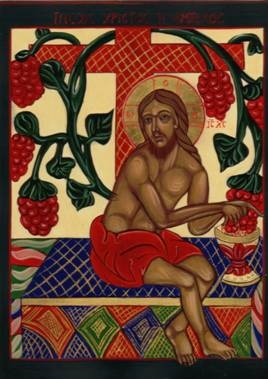
Christ the Vine” is in the meditation-room the Christian Zen-center in Eintürnen, Germany.

Icons – What Are They?

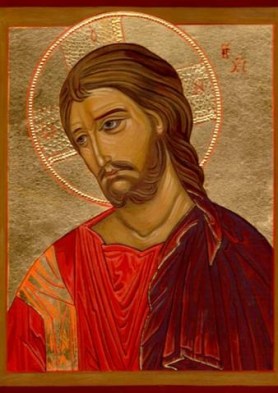
“Sad Christ”

The home of the icons is the Christian Orthodox Church. The earliest icons were painted in the 6th century in Byzantium. From there they later came to Russia and to all other Orthodox countries. Most of the earliest icons have been lost. The oldest collection of icons is found at St. Catherine’s Monastery on Sinai.

Icons play an important role in the liturgical service, and also in the public life and of course for the individual. An icon is a steady companion from the cradle to the grave.

The icons are not individual paintings but rather in the individual. These painting come through the individual by spiritual grace and in a sense the painter does not count. So icons are normally not signed to claim ownership. Outwardly, icons follow fixed patterns and change of the pattern is only possible in a rather limited way as they are real “copies” of the one reality, which represents itself in various pictures and stories.

Icons are of great help for concentration, for prayer, for awareness of the ever-presence of Christ or Mary or the Saints. They are called “Gates to Heaven” or “Windows to Eternity”. If you look at an icon in candle-light, the gold and painting shines in an unearthly magic. The faces are serene, the gestures and colors are full of meaning. The more one dives into this world, the more one becomes drawn into it and the mind becomes silent.

The Path of the Painter

“To paint and to pray are the same thing” (Balthus)

Jesus with animals

I have always felt that this kind of painting is by special grace and has something in it which can’t be compared with other types of paintings. This kind of painting is devotion and prayer – prayer with the brush, so to say. So this “doing” needs not only much outer care, but also inner care. One should not do it with a distracted or unclean mind. According to tradition it is good to have a prayer before starting. The inner attitude should be giving up the sense of doership – which reminds one of Sri Ramana’s instruction as well. It can also be seen as an exercise for just being an instrument of God, which should become a reality in all our actions.

The Jesus-prayer (also known as the Prayer of the Heart) is a short prayer, which should be continuously repeated. The words are: “Jesus Christ, Son of God, have mercy on me!”

Like the icons, it comes from the Orthodox church. The prayer also can be shortened to just the call: “Jesus Christ!” or whatever one prefers. One repeats it as often as one can. In some way it can be compared with nama-japa. It helps to silence the mind and lead it to one thought. With practice it starts to become automatic (self-doing) and sinks into the heart. Yet at each stage it always stays as a prayer in you. The Philokalia – a collection of texts on the Jesus-prayer – can be a wonderful companion on this path. It is recommended in “The Way of a Pilgrim”, which most know who practice the Prayer of the Heart.

It is not so long ago that I discovered – or better re-discovered – the Jesus-prayer when reading this book (“The Way of a Pilgrim”). I felt immediately that this is a wonderful complement to the icon-painting as well. From the tradition of the icon-painters I have found out that my main-model, the famous Russian icon painter Andrej Rubljow must have practiced it. I am sure that his icons reflect it and speak through it.

Icons Interfaith

“Dakshinamurti-Ramana” – an icon dedicated to Sri Ramana Maharshi

Icon of Narada

Mostly I am painting icons in the Christian tradition. Yet it happened that this Ramana-icon was painted and also some icons of Narada (the bhakti-musician). When being in Tiruvannamalai in 2003 and seeing the paintings in one of the shines of the Arunachaleswara-temple I was reminded of the icon-painting. Also there seems to be a connection to the Buddhist paintings as well. I am sure that the same thing has found its expressions in many religions.

If you would like to see more and get information about the technical side of this kind of painting you can visit:

http://icons.interfaith.googlepages.com/

Gabriele

***********

Gabriele Ebert lives in Germany and works as a librarian.

Recent Books by Gabriele Ebert are:

Ramana Maharshi: Sein Leben, Stuttgart, 2003

Sadhu Arunachala: Erinnerungen eines Sadhus, Berlin, 2004 (German transl.)

Both books are available at amazon.de and can be ordered from each German book-shop.

Harsha's avatar

Bliss – The Source and Meaning of Life: By Michael Bowes

This article was originally written on May 9, 2006 and posted by Michael Bowes on the old HS blog.

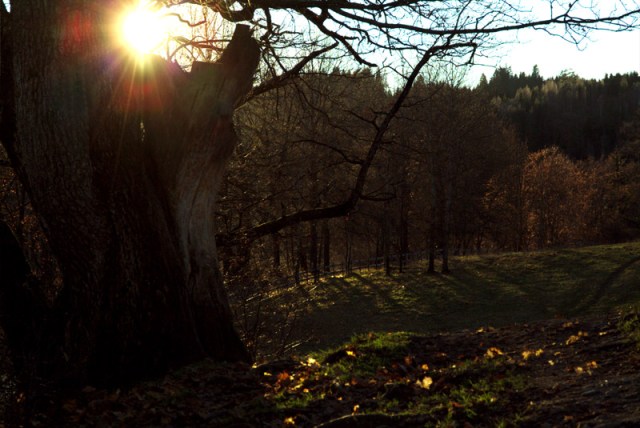
Picture below is by long term HarshaSatsangh member Alan Larus at http://www.ferryfee.com/tree.htm

One weekend in the early 1990s, my friend Narayan and I went to Saint Louis, Missouri to visit with Swami Chetanananda. Narayan and I have known Swami since the late 1980s. On Sunday morning of that weekend we were eating breakfast with Swami and the other residents of the temple, and according to the custom there, we were all reading a portion of the newspaper.

When reading the paper, Narayan nearly always goes straight to the “funnies”.

We were all reading and eating. Swami was at the head of the table, I was to his left, and Narayan was to my left. At some point Narayan nudges me and hands me the funnies. He pointed to the “Donald Duck” comic strip.

Donald Duck was in the Himalayas searching for his guru. And there were signs posted in the mountains that said “Guru”, and then an arrow would be pointing to a certain direction. And Donald followed the signs and arrows until finally, at the top of a mountain peak sat the guru with a personal computer in front of him.

Donald Duck asked the guru, “What is the meaning of life?”

The guru didn’t answer; but the computer started printing out something that couldn’t be read on the comic strip.

The gag was that personal computers were becoming the rage, and now even the guru was using one to divine the mystic truths.

But another peculiar thing was that Narayan and I were searching for a guru and a spiritual home; and now, thanks to Donald Duck, the stage was set for that possibility.

I nudged Swami and handed him the funnies while pointing to the Donald Duck comic strip. He read it and handed it back without saying a word, and continued to eat breakfast. After breakfast Swami went to prepare for his weekly public talk. The rest of us cleaned up after the meal and relaxed until the beginning of the service.

Swami began his Sunday morning talk and I really don’t remember the topic; but near the end he announced that he was going to reveal the “Meaning of Life”. He was going to reply to the question in the funnies.

Swami started by saying, “The meaning of life is bliss.”; and the following is a very loose paraphrase of what he said to explain that statement:

There is an “ocean of bliss” that is the source, the cause and support of all that we see; And in its manifest forms that bliss is experienced as amrita, rasa, love, joy, happiness, fun, hope, peace and even as pain and suffering. Pain and suffering serve as motivation for us to find a way to return to our original state of bliss.

We were all born from bliss. We arrive in this world because one day or one night our parents engaged in a blissful activity, and as a result we were born. From that day on, all of our conscious and even subconscious activities are meant to help us either directly or indirectly to achieve bliss and happiness.

As children all we really wanted to do was play. Our true unconditioned nature is playful. But, as we start to get a little older, we are forced to go to school and we are conditioned by society to perform certain useful functions.

But bliss, happiness, satisfaction, etc. are still the primary objective of all of our behaviors. Our parents and our society force us to go to school so that we can get a job, so that we can earn money, so that we can be happy.

We marry because we believe that another person will fulfill us and make us happy. We have children because we think that will make us happy. Everything that we do is ultimately for happiness and bliss. Even so called, “selfless love” only serves to satisfy ourselves. We believe that by performing our self-ordained duties that we will be satisfied.

A short time after I heard these words from Swami, I directly experienced that “ocean of bliss”. Our own true nature is something that cannot be imagined, and it is truly inexpressible. Since then, even though I have gone through some dark times, it isn’t possible for me to worry or lose my connection to that blissful being, the “ocean of bliss” that is our own true nature. And I have a lot of fun. I can’t seem to avoid it.

I began to experience this truth because of an encounter with the “funny paper”.

Love and peace to all,
Michael Bowes

Harsha's avatar

The Path to Enlightenment: By Dr. Harsh K. Luthar

docimage138

A Popular Dichotomy

A popular dichotomy has emerged about Enlightenment in the West since the 1970s between the schools of “gradual enlightenment” and “instant enlightenment”. Some of this can probably be traced back to Poonja ji’s and Nisargadatta Maharaj’s disciples returning to the west in the 1970s and 1980s from India and bringing their understanding of Advaita Vedanta with them as given to them by their teachers. However, because many of these students deviate from traditional Advaita as taught in the classic lineage of Adi Shankracharya, they are referred to as neo-advaitins.

Given this thesis and antithesis between the gradual path and the direct path, I address the following question:

It is said that there are two approaches to the Truth of Being or Reality which some call Enlightenment or Self-Realization. A gradual path and a direct path. What is the truth of it? Are their really two paths? If not, which approach is the correct one? What road should a seeker of truth take?

First we look at the two paths and what these are about.

The Gradual Path

In the gradual path, one engages in meditation and other spiritual practices and disciplines, refines and purifies the mind over time, and is able to rise above the body limitations in ecstatic and trance states.

At some point, the mind beholds the divine directly or is able to surrender itself and be absorbed in the divine. Most yoga paths in various Eastern traditions fall into this category. One can check the ancient Patanjali’s Yoga Sutras for reference.

Such schools of thought are also common to Hinduism, Buddhism, Jainism, and other religions as well. In these traditions, personal prayers, effort, and practice to reach the supreme divine is emphasized and considered vital to success on the spiritual path.

Criticism of the Gradual Path

The yogic paths and meditative approaches based on effort are criticized by the proponents of the direct path (the neo-advaitins) as being misguided.

The advocates of the direct path point out that since Advaita Vedanta states that the Self is always realized, expending effort to find it, is itself counterproductive. Their essential position is that since any effort towards enlightenment is based on ignorance, it cannot lead to true understanding or Enlightenment.

If I were to frame the objection of the neo-advaitin to the gradual path in the form of a question, it would be this: ” How can spiritual effort based on the false assumption of ignorance lead to the Truth of Reality?”.

Logically, It is a quite a beautiful and a powerful assertion.


Criticism of the Direct Path

On the other hand, the “direct path students and teachers” are viewed by many traditional yogis and practitioners of meditation as deluded individuals who at best have convinced themselves due to the power of sheer ignorance that they are enlightened. Such self-deception in the long run is bound to prove frustrating and disappointing to themselves as well as those unfortunate enough to fall for their hype of “Instant Enlightenment”.

Many traditional practitioners also claim that the “direct path teachers” tend to be on power trips and underneath the facade of their “Enlightenment” lies the basic human nature of greed and the hunger for power and the usual sexual and financial exploitation of those who follow them. They point to numerous examples of this happening in various spiritual communities and satsangh circles.

Unfortunately, the traditional practitioners and gurus are also not free from such issues. So neither can win the argument on the ground of excessive purity in behavior and conduct.

Support for Both Schools of Thought Exists

Such criticisms and counter-criticisms that the practitioners of two schools hurl toward each other all appear to have some degree of validity. Both schools also have their own particular strengths. An integrative understanding can lead one to relax one’s position on such matters.

In the direct path, the insight or the revelation is sudden like thunder. Truth of the Self appears as lightning and illuminates one’s being in a flash. The ignorance drops away as if it never was and one is at ease with one’s nature. Buddhists call it the Original Face, the Buddha mind, or the Buddha nature. Hindus and Jains call it Atma Jnana, Kevala Jnana, or Moksha.

There are various examples of this particular mode of thought in Hinduism and other religions as well. In this approach, for many, the Grace of God or Guru becomes the focal point on the spiritual path and the role of personal effort is downplayed. Support for this is found in the Upanishads (sacred scriptures of Hindus) where we see statements like, “Self reveals Itself to whom It chooses.” For reference, see the Katha Upanishad, where Yama, the Lord of Death, explains to Nachiketa,” The Self cannot be known through the study of scriptures, nor through intellect nor through hearing learned discourses. It can be attained only by those whom the Self chooses.”

On the other hand, in many schools of Hinduism, the emphasis is on works and on spiritual practices such as meditation, pranayama, fasting, etc. Similarly, in Jainism, the spiritual aspirant must bravely work out his/her karma (destiny) in this world following the path of forgiveness, compassion, and nonviolence. This was demonstrated over 2600 years ago by the Tirthankara Bhagavan Mahavira who bore physical and mental hardships with a feeling of amity and nonviolence towards all living beings. Eventually, as his karma dropped, the heavy burden of his soul becomes lighter and led to Self-Realization and Kevala Jnana (Which Jains view as Omniscience).

We see that in Jainism, the actual working out of karma through indifference to suffering, doing good deeds and by cultivating universal love for all beings is emphasized. The same is true in most schools of Hinduism. Even in Buddhism, originally Buddha taught the doctrine of effort and walking the spiritual path with care and compassion. Buddha’s last words to his students are said to be, “Work out your salvation with diligence.” Essentially, Buddha was saying to his students that after receiving his teachings, it was up to them to walk the path and attain their Buddha nature.

Where is the Truth in this Forest?

So then where lies the Truth of Enlightenment? Is the Truth of Realization achieved through walking the path gradually and carefully while engaging in spiritual practices? Or is Realization attained suddenly through a Zen like Satori or when the Zen master does something strange and shocking as depicted in many Zen stories. Can Realization really come unannounced knocking at the door as was the case with Sri Ramana Maharshi?

Sri Ramana, the great sage of Arunachala, has simultaneously endorsed both perspectives and said that the Truth of the Self is indeed simple and within everyone’s grasp. We simply mix the underlying feeling of “I AM” which is there in all of us (and always the same from childhood to old age) with the circumstances of our life, and the ever changing currents and patterns of our mood and personality.

The self-feeling of existence, the “I AM” which animates our life and consciousness and gives light to identity becomes invisible and goes in the background as we become captivated with our perceptions and invest in our daily relationships. That is only according to nature, and one is meant to engage in these things.

All relationships inevitably end. Even when we love someone dearly and they love us, eventually we are separated through circumstances, old age, or illness. If someone is married for 50 years, there is no guarantee that they will make it another year or another 10 years. In due time, one person will pass away due to old age or illness or another cause.

Coming together and separating are the nature of life. Underlying all these events and relationships is the silent presence of “I AM”. If we are paying attention we can feel it. In our quiet moments it comes upon us and we can stay with it. The truth is so simple and ordinary and that is why we take it for granted. If we remain with this self-feeling of existence, the stainless “I AM” free from the contents of the mind, we can come to see the value and beauty of it. It is only pure being. Our own being.

The Role of Spiritual Effort

The spiritual effort needed in terms of meditation and inquiry, to make the mind subtle and to refine the intellect so that this simplicity of being can be grasped with immediacy and certainty, should not be dismissed.

If some people do not need such efforts and can recognize the truth of their being immediately by hearing someone restate or paraphrase what the ancient sages have said, that is wonderful indeed. It shows that their mind already had requisite subtlety, depth, and maturity.

The Sense of Being I AM: The Open Secret

If there is a deep sense of quiet within, it can be like a mirror and we can see the image of “I AM” reflected in the mind. I am reminded of that passage where God said to Moses, “I AM That I AM”. I am not a scholar or religious expert but sometimes it seems to me that this is a symbolic message telling us to pay attention to the “I AM” within because it is God sitting in our own being and Heart saying, “Here I AM, I AM, Come to Me”.

It is said that man (woman) was made in the image of God. If the nature or identity of God can be described best as “I AM THAT I AM” it stands to reason that the nature of Man (Woman) is also similar. Our essential nature can be captured by this feeling we all have; the simple feeling of being-existing, free from conflicts, “I AM”. According to Advaita, this “I AM” within us is the link to God. Prayer, meditation, contemplation all make us reflect on this sense of being within us.

The Sahaj State

The state of the Self is natural. Easy and natural because the Self remains as It Self. It is devoid of sorrow and has nothing to attain being whole and complete and what the Advaita scriptures refer to as One without a second. Sages called this Realization the Sahaj state.

Sahaj in Sanskrit means easy and natural. That which requires no effort is Sahaj. To understand the Sahaj state of the Self, we can start and reflect on our body and see what is natural to it. What is easy and natural differs among people. Some people are able to sit in the lotus posture in an easy and natural way (see the picture of this young woman at www.harshasatsangh.com sitting in the lotus posture).

However, the lotus posture is not easy and natural for everyone. For most people, to sit like that would hurt their knees and ankles and is very uncomfortable. God did not say to Moses, “Here I Am, sitting in the Lotus Posture.” God only said, “I AM THAT I AM”. The feeling of “I AM” within us is independent of posture. Physical postures pertain only to the body and not to the spirit.

What is Natural Differs Among People

In life and on the spiritual path we have to see what is easy and natural for us. For some, walking is easy and natural and such people practice their prayers, mantras, and pranayama taking a morning stroll. Others are not satisfied unless they lift very heavy weights and scream “Oh God”, “Oh God”, and breathe rapidly and heavily. This is their form of being natural. For such people becoming very muscular becomes natural. If you were to tell weight lifters to take it easy and just take a nice walk every morning, they would not agree to it. They like to have big muscles and low body fat. That is natural for them but not for everyone.

In Bhagavad Gita, Sri Krishna tells Arjuna that actions and paths of people differ according to their natural inclinations and therefore one should follow one’s own Dharma not someone else’s. In other words, we need not seek or follow someone’s path because it may not be natural for us. We should be natural, authentic, and true to our self. Without it, there would be inner conflict which is not conducive to being quiet and meditative.

 What Path Should One Follow?
Gradual or Direct or Just Stay Home

In this essay, I have suggested that the philosophies and perspectives of the gradual or the direct path are not inherently meaningful. Their truth lies only in being teaching tools. Words and concepts such as the “direct path” and the “gradual path” are meant to point at the truth but they are not themselves the truth. The Truth must reveal itself to us in our own Heart.

Therefore, one should not be rigid about which notion is correct or more important or higher than the other. Asking whether the direct path is better than the gradual, one misses the point. The real question is, “What feels natural to you and makes sense?”

Being rigid in one’s view, one misses the obvious. Both the notion of “direct” and “gradual” depend on each other for meaning and have no basis in the Reality of the Self.

According to Advaita Vedanta, the Self Always Is. It cannot be seen by “another” directly. Neither is it approached by “another” gradually. Self Reveals It Self Alone to ItSelf. To understand it in plain English, you can say to yourself, “I am always going to Me. And Here I Am.” Just stay with that.

You Are the Self.

Harsha's avatar

Sri Ramana and My Teacher Gurudev Sri Chitrabhanu-Ji: By Dr. Harsh K. Luthar

All of us come from different backgrounds, and we walk the path in our own unique way. Yet, we all have the same innermost longing to know the deepest mystery of our own nature and being. Reflecting on the purest teachings of the Self and on the nature of Ahimsa as nonmovement of the mind, we are bound to have experiences and openings in our consciousness.

When my teacher, Gurudev Sri Chitrabhanu-ji visited Sri Ramana, he was just a teenager. Chitrabhanu-Ji became a Jain monk in 1942 at the age of 20. Prior to that, he was searching and visiting different saints in the various traditions of India and asking them questions about the spiritual path and how to become Self-Realized.

Gurudev Sri Chitrabhanu

Chitrabhanu-Ji told me that of all the saints and sages he visited in India in his teen years, a few were unforgettable and stood out to him. Sri Ramana was one of them.

When I was 22 and studying with Chitrabhanu-Ji, he saw me carrying books of different spiritual teachers for my reading pleasure. He asked to see these books and thumbed through them. He knew most of the authors personally. Swami Rama of Himalayan Institute had come to our meditation center. One time I saw Swami Chidananda, the disciple of Swami Sivananda of Rishikesh, when he came to visit my teacher. Swami Chidananda was very thin even then and was leading a very pure and ascetic life.

After looking through my books, Chitrabhanu-Ji told me that I should read the dialogues with Ramana Maharshi and study his teaching. That is how I was led to Sri Ramana. Of course, after I read the classic, “Talks with Sri Ramana Maharshi”, it was indeed like magic and I knew deep in my heart that this was my way.

The Author at 21-22 studying With Sri Chitrabhanu-Ji

Going back to Chitrabhanu-Ji, he wanted to know the meaning of life at a very young age. He had lost his mother, his sister, and then his girl friend and so the world did not seem so attractive to him even at a young age. He wanted to know the mystery of life and death and what is beyond. In that quest, he started visiting many saints and sadhus and also visited Sri Ramana.

Continue reading