
Category Archives: TEACHERS
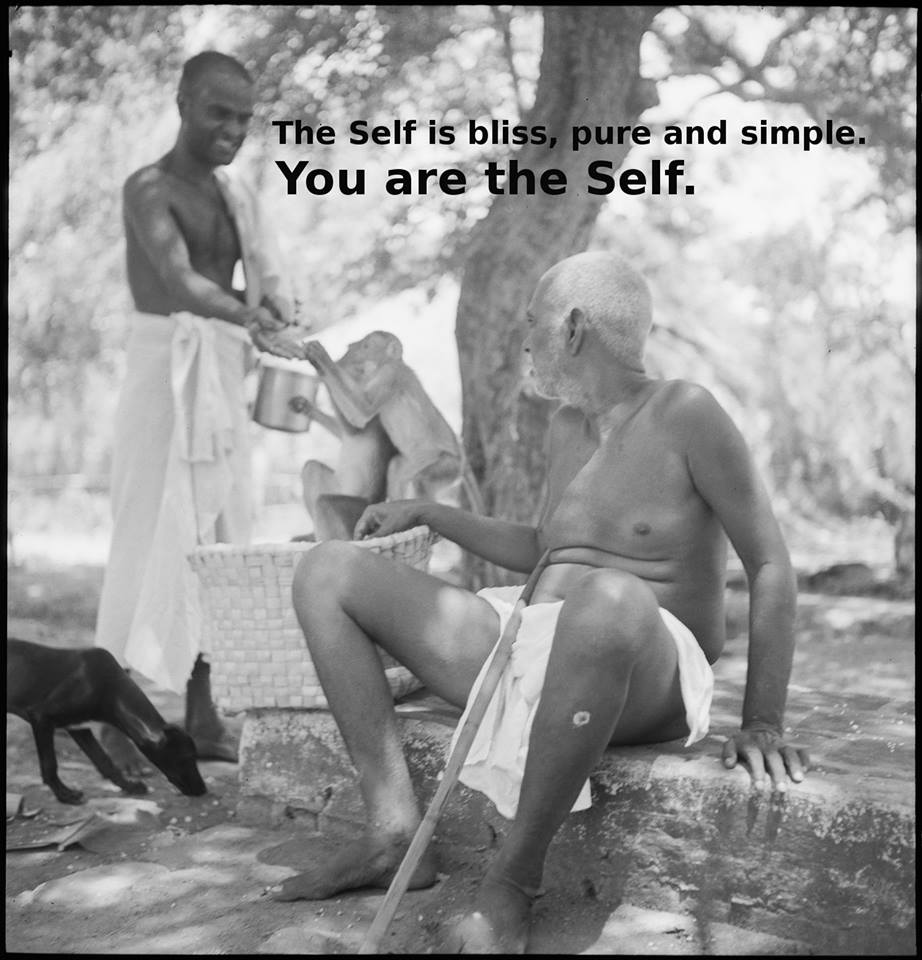
Easy And Natural Is The Way: By Dr. Harsh K. Luthar
Dear Friends,
Sahaj in Sanskrit means easy and natural.
There is saying in Hindi, “Sahaj pake so meetha hoy.”
It means that easy and natural cooking of food leads it to taste sweet.
It is something like the English saying that soup that simmers slowly or the cake that is baked slowly tastes best in the end.
These are metaphors for life. When we do something with care and love, the results are better. Sometimes we even say that, “this is a labor of love.” When we love what we do, it does not feel like work.
Everything has its nature. When we are true to our own nature, an easy authenticity takes over. Then we are not concerned about impressing others nor worried about how others are judging us.
Nature is showing us the way. Seasons are coming and going. Flowers bloom and then wither. We are breathing in and breathing out.
Easy and natural is the way. Anything else makes it appear that somewhere other than where you already are, is more attractive.
All of these teachings of self-improvement, yoga, meditation methods, breathing techniques might have some meaning to someone at some point in time. Truly these are concepts only for the mind to struggle with. The whole premise of these teachings is that you are not OK just the way you are. Ultimately, it is the most splendid nonsense.
To be easy and natural is the way.
How does one become easy and natural? How does one follow the natural path?
To be easy and natural is, well, it is to be easy and natural; and it is best because it is easy and natural.
It is so simple is it not?
What is not easy and natural will produce inner and outer conflicts. We already have enough of those. Of course, for some people making more conflicts may be easy and natural. In that case, go for it (and you can’t help it anyway).
Being easy and natural in awareness allows for the recognition of the Self, which by its very nature is easy being, natural, and wholeness of awareness aware of itself as its own bliss. There is no good way to express it.
My teacher Chitrabhanu-ji (who was a monk for 29 years) once told me that as a young monk he was very very strict with himself. “Sometimes, too much judgment and discipline can be a form of violence with oneself”, he told me.
Another time when we were talking about gurus, I mentioned many names to him and asked his views of them.
Chitrabhanu-ji knew most of the gurus personally. These included J. Krishnamurti, Swami Muktananda, Sri Chinmoy, Rajneesh (Osho), Swami Chidananda, Swami Rama, Swami Satchitananda, etc.
Those gurus whom he liked, Chitrabhanu-ji would only say, “He is a good man.”
One day Chitrabhanu-ji said to me, “You should never follow a guru.” I looked at him puzzled (because he was my guru, you see).
He smiled and said in his thick Bombay accent, “What if the guru goes crazy and tells you to do strange and crazy and weird things…” I had a good hearty laugh! He added, “that does happen you know….”. I laughed even harder.
Well, it does happen you know.
As Sri Ramana never tired of saying,… the only true guru is your Heart, your own Self.
So wise sages tell the advanced aspirants to be perfectly natural. Make the effort, if natural. Follow a teaching if it is easy and makes sense.
If something makes no sense, there is no point in following it. So what if it is considered the supreme teaching and so on by someone well known. For all you know, what the supreme and well known people say could all be manure.
Think about it. What do they really know? How can they really know? What can anyone really and truly know?
So rest, if it feels natural to rest. Watch the spiritual parade pass by and not be moved by any teaching. Or join the parade and sing your song.
Your nature will make you act in a certain way. That is why you can be at perfect ease.
Self-remembrance, Awareness aware of itself, Self-abidance, all of these mean the same.
Easy and natural is simply being aware of one’s innate wakefulness through the winds of emotions, colors of life, and changes in scenery.
To the extent one can grasp it, simply remain aware and if you become conscious of some intangible cloud of unknowing which you cannot go through, become comfortable with it, stay with it, and breathe it in and out.
If you meditate on this and become aware, it will dawn on you with clarity. You will see.
Easy and natural is the way.
Namaste
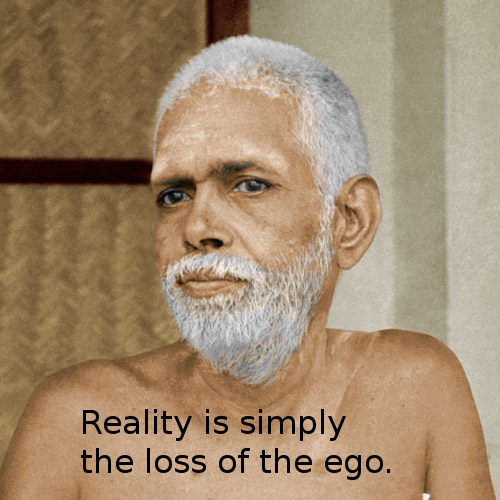
Satsang with Robert Adams: By Kheyala

One of the first stops after leaving Colorado that my best friend and I took in our new home-on-wheels (“Lakshmi”) was in Sedona, AZ to go to satsang with Robert Adams. Many of you may know that Robert Adams (whose body died a few years ago) sat before Ramana for years in Tiruvannamalai.
We knew that Robert Adams was aging and that a special opportunity awaited us. Now, keep in mind that my conscious spiritual journey was rather new and I had previously immersed myself in the Satsang Mecca called Boulder.
I had really gotten a feeling for what satsang was “supposed to” look like and went to Robert Adams’ place fully armed with my finest “spiritual” clothing, “spiritual” face, “spiritual” voice, and “spiritual” sitting posture.
When we arrived, spiritually carrying our zaphus behind our hips in silence, heads held humbly down, we were quite surprised to find a room full of relaxed people hanging around, just acting normal. In fact, they were so talkative with each other and easy-going and animated that it made me wonder if we were really at the right house.
I came prepared for silence and holiness and the scene was unsettling being so ordinary. There was nothing spiritual about the place, like decorations or altars or anything that I recall. There may have been a small photo of Ramana. So I sat down and prepared to “meditate.”
Needless to say, I simply couldn’t keep my eyes closed. There was too much fun going on in the room. I struggled with it for a while, but that became so darned uncomfortable. Eventually, I just sat there figuring it would get holy, maybe, after Robert came in.
You can imagine my surprise when he did come in. While I was expecting a spiritual-looking man dressed in Indian garb, what he was actually wearing was a pair of baggy, silky jogging pants and a tee-shirt and he had on a hot pink rumpled-up baseball cap that was on crooked!
Because Robert had Parkinson’s Disease, he kind of made his way across the living room in a slow-motion shuffle and sat himself in the chair reserved for him. Everyone made room for him as he passed by and with great affection touched their palms together in reverence.
Robert sat on the chair for some time. It was real quiet in the room, but not an “it’s-time-to-be-quiet” kind of quiet. It was just naturally quiet. And no one said anything. So, trained as I was to recognize a jnani, well…. no way. This guy was plainly sitting there with his mouth open and his eyes half closed. He was hunched over with his skin just hanging on his face. There was nothing that I could “read.” And boy, did I try. I looked for some kind of radiant glow, some kind of visible wisdom, some hint of Ramana, and nothing! I looked into his eyes and it was as if no one was home. My mind was just struck dumb.
Eventually, Robert jerked his arm up, sort of pointing a finger. That was the cue for the person holding the boombox to hit “play.” I thought, “Oh. THIS must be the holy part.” I closed my eyes in full expectation of sacred words or ethereal music or at least some Sanskrit bhajans. To my utter shock, the thin and twangy voice of Willie Nelson’s “Always on my mind” came singing out!
The whole room went into an uproar. Everyone was laughing and swaying from side to side in enjoyment, singing dramatic crescendos at each chorus: “Telll meeeee. Tell me that your sweet love hasn’t died…etc.”
Robert? He just sat there, expressionless, his body unmoving, hunched in his chair. No sparkling eyes, no nothing. By then, my mouth was dangling open as well. My mind had completely come to a halt. It could not make sense of this at all. It didn’t know and could not begin to interpret what it was seeing.
The next musical selection was Kenny Rogers singing really sentimental love songs. These were no Sanskrit Bhajans about Enlightenment or God or anything. These were love songs riddled with illusion and duality. Rather than condemning them or spiritually correcting them, Robert Adams was just sitting there. Everyone was laughing so hard that tears were coming out. It was so infectious that before I knew it, I was singing along and laughing too. My sides were aching when we were through.
Afterwards, with everyone returning to normal breathing and with some sighs and residual giggles here and there, I had the thought, “Well, maybe now it will get serious.” There was a moment of silence. Then suddenly, someone said, “Hey! How about Mexican?!” This was met by an outburst of cheering! Soon everyone got up and grouped together in cars to go to a local Mexican restaurant.
Bewildered but happy to go along I arrived at a scene that I was dismayed to find rather loud and crowded and chaotic. Shortly after we were seated, I looked over at Robert. He had a bright green margarita in front of him.
Before leaving, I didn’t want to miss the opportunity to speak with Robert even though at the time I sure didn’t know what to make of him….but all that came out was something like, “I like your hat.” And he said something like, “Thanks.”
The sweet, natural happiness that I experienced in his presence was so very thick and blatant. All the ideas I had picked up about what it is to be in the presence of Truth were permanently cracked. The mind just couldn’t get around the chasm between what it thought holiness was supposed to be like and what it had actually met that day with Robert Adams. In its attempt to cross that chasm, it had fallen into it, giving rise to an absolutely undeniable experience of joyfulness and peace.
Editor’s note: Kheyala is a long term member of the HarshaSatsangh list. Her account of the Satsang with Robert Adams first appeared in Spring 2002 of the original HS-Ezine.
Meditation, Self-Inquiry, and Self-Realization: By Dr. Harsh K. Luthar
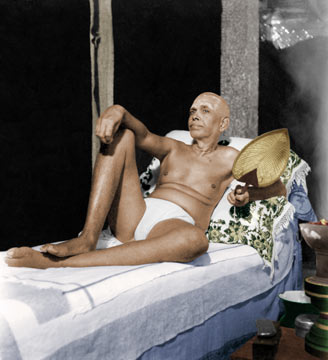
Bhagavan Ramana Reclining
The distinction between Meditation and Self-Inquiry is subtle. However, in one way, understanding this difference is central to grasping the full import of teachings of the Sage of Arunachala, Sri Ramana Maharshi.
Sri Ramana used to say that meditations, affirmations, and other similar techniques presuppose the retention of the mind. To practice a mantra, visualization, pranayama, etc., requires the use and activity of the mind as an independent agent separate from the higher power. One of Sri Ramana’s favorite analogy was that asking the mind to subdue itself is like asking a thief to go ahead and capture itself. The mind will make a game of it, pretend to control itself, but will remain engaged in playing hide and seek.
Certain meditation practices no doubt have a calming and a relaxing effect. However, Sri Ramana states that in all such approaches, the mind remains dormant only temporarily. It rushes forth after sleep or meditation in its individual form when the proper stimulation presents itself. With all practices conducted with the mind, that have an object as their focus (mantra, breath, image, etc.), the seed of duality is already built in.
Someone once asked Sri Ramana whether Self-Inquiry that he advocated was also not a mental activity. If so, it must be presumed as having the same difficulty and limitation as other meditative techniques.
Sri Ramana acknowledged that Self-Inquiry also made use of the mind in initial stages. However, he held that in asking oneself the question “Who am I?” in a serious, alert, and an intense way, the mind was being concentrated and driven inwards towards its Source. This Source is not a form or a sound but the very origin from which the mind arises.
Therefore, in Self-Inquiry, the full power of attention is brought to bear upon this question, “Who am I”? This question does not have an intellectual answer. Asking it is meant for becoming aware of consciousness as existence that permeates us as our root identity. It is this feeling and sense that everyone has of themselves as “I Am”. From childhood to old age, we are aware of this sense of existence without having to give it a name.
This subtle awareness has no form. It is this self-awareness, independent of thoughts, that one has to abide in and follow to the Source. If grace allows for that, the Supreme Heart that the ancients called Sat-Chit-Ananda, reveals It Self. It is really a Self-Revelation. The Heart is recognized as one’s own identity independent of thoughts, personality, mind, etc.
Sri Ramana maintained that although Self-Inquiry required initial use of the mind, after a certain point a spontaneous power took over. The response to serious Self-Inquiry comes from within. Sri Ramana referred to this Source within as the Heart. Self-Inquiry stirred the inner power of the Heart which then became like a magnet pulling the mind within so that Self-Recognition and Self-Realization of Supreme Bliss as our nature could take place.
Namaste
Self-Inquiry_The Science of Self-Realization: By Dr. Harsh K. Luthar

According to Advaita Vedanta, the science of Self-Realization (which we call Self-Inquiry), requires a different approach than the sciences involved in discovering the complexities of the Universe. Both approaches are similar in one way in that our consciousness with focused attention and awareness is used as an instrument of perception to gain knowledge.
Sciences involving the exploration of the universe and its laws focus the attention outside to perceived objects (time, space, matter, laws of motion, gravity, mass, etc.) to determine their nature. When attention and awareness are focused on such analysis, the relationships between various objects according to universal laws becomes clear. This is due to the inherent power of consciousness to discover and make known to itself anything that it focuses attention on. That is how sciences (Mathematics, Physics, Medicine, etc.) move forward.
However, the theoretical limit to understanding objective phenomena is always there to the extent that the observed phenomena is based on the very nature of the observer. It is not clear how precisely the relationship between the subject and the object can be determined scientifically. Philosophically, this is due to the logical difficulty of separating the subject from the object and demonstrating their independence.
Science of the Self, however, is a radical departure from the physical sciences and has a different aim. Here attention is directed inwards towards the subject and not outwards towards objects of perception. The classic methodology given by Sri Ramana for Self-Inquiry is to ask oneself with attention and inquire, “Who am I?” This is done in order to introvert the mind and drive it deeper into its source. In Self-Inquiry, the quality of consciousness itself becomes the center of attention. In this method, consciousness is not focused anywhere or on anything other than itself.
Language is not perfect but there are many ways to say this. Attention focused on attention itself is Self-Inquiry. Consciousness becoming self-focused is Self-Inquiry. Mind turning inwards to its source is Self-Inquiry. Awareness aware of itself is Self-Inquiry. All of these are variations of the same process and basically refer to the same thing. These statements indicate that one should quietly abide in one’s own sense of identity and being with full awareness.
This is not an easy notion to grasp. The Self-Inquiry methodology does not present the aspirant with an image or a sound to concentrate on. Because we are so dependent on our sense of hearing and sight even for meditation and prayer, Self-Inquiry presents a challenge. People often find it difficult to know what to focus in doing the Self-Inquiry because they associate their identity and thus consciousness strongly with the body.
This is why Sri Ramana used to say that Self-Inquiry is not for everyone to take on immediately. I have observed this phenomena carefully for a long time. People find meditation, yoga, tantra, chakras, and kundalini methods much more interesting and exciting to talk about and practice than Self-Inquiry. It is because all of these Yoga systems are directly or indirectly based on producing changes in the physical or the subtle bodies which one can experience.
Consumption of experience in some form or another is natural to all living beings. Self-Inquiry points, however, to the subject; the one who experiences. What is the nature of the one who experiences? Self-Inquiry shifts our attention from perception to the perceiver. Who is the one who perceives and experiences reality?
The practice of meditation and yoga leads the mind to temporarily withdraw the senses from objects of perception. However, internal perceptions in meditative states or Samadhi will most likely still exist. These internal perceptions may manifest in a number of ways including that of visions of angels, holy sages, the Goddess. Various spiritual and religious symbols often appear spontaneously in the mental eye of the aspirant during meditation or contemplative prayer and there may also be experiences of lucid dreaming states. So even in higher meditation states, the distinction between the subject and the objects of perception continues as we engage in and consume one experience after another.
Self-Inquiry, on the other hand, is found to be boring and irrelevant by many people because it promises them no special experience to enjoy other than being their own self. People should always do what feels natural. Nothing can be forced.
Eventually with the practice of meditation and other types of yogas, the mind becomes more subtle. The understanding of the nature of consciousness as free from outer perception (of physical objects) as well as internal perceptions (dreams, visions, other mental experiences) can then start to emerge. Once the independent nature of consciousness (free from all perceptions) is understood, one can recognize the essential quality of existence and pure being in the midst of various experiences.
When attention/awareness become self-focused, that is called Self-Inquiry. When attention lights up attention, awareness lights up awareness, consciousness lights up consciousness, Self is Realized as Sat-Chit-Ananda, the ultimate subject, the very core of being. Sri Ramana called it simply the Heart, whose nature is that of silence which is beyond all understanding.
Hinduism and Vegetarianism: By Dr. K. Sadananda

Editor’s note: Sada-Ji (Dr. K. Sadananda) is well known to the Hindu community in both the U.S. and in India. He is one of the most brilliant and thoughtful exponents of the Bhagavad Gita as well as the ancient philosophy of Advaita-Vedanta.
In this article, Sada-Ji discusses a practical question that frequently comes up among many students of Hinduism as well as many Westernized Hindus. The question is, “Should I become a vegetarian?”
I took the liberty to edit and restructure Sada-Ji’s original e-mail answer to this question for the purpose of this article to give it an easier reading flow. I hope that justice has been done to Sada-Ji’s explanations and that I have stayed within the limits of editorial license. Of course, any errors are mine and as soon as these are pointed out will be promptly corrected. Thank you for your understanding and patience.
***************************************************
Should I Become a Vegetarian?
Recently two questions were asked – Does Hinduism require one to believe in God? Does Hinduism require one to be a vegetarian?
In a recent article, I have addressed the first question. Here I will provide some thoughts for the second question. In relation to the first question, I have discussed what Hinduism stands for and who is truly a Hindu. In essence, Hinduism is Sanatana Dharma, and that Dharma is from time immemorial; it involves pursuit of Moksha through self-reflection, inquiry, and Self-Knowledge. Self-Knowledge in Hinduism is synonymous with Moksha (Liberation from the cycle of birth and death).
Therefore, the one who is seeking to understand the ultimate mystery of existence and thereby gaining salvation or release is a true Hindu, irrespective of the nationality, caste, creed or gender. With that catholic understanding, one can see that Hinduism becomes a way of life because the pursuit of the essential purpose of life is the goal of the ideal Hindu life. If you ask most Hindus whether they believe in God, you will get a firm “Yes”, in response.
With this perspective, it is easier to analyze all other questions including whether Hinduism requires one to be a vegetarian. Since the purpose of life is securing liberation or Moksha, until we reach that we need to maintain our body. Keeping the body healthy through proper nourishment is the Hindu Dharma. The human body is considered a temple of God. Therefore, it is sacred and should be treated with respect.
You asked whether a Hindu has to be a vegetarian. Well, it is a fact that not all Hindus are vegetarians. Hindu kings and princes and the warriors have eaten meat for thousands of years. So your question is not whether a Hindu should eat but whether you should eat meat. Since such a question has already arisen in your mind, perhaps you have developed a degree of sensitivity about harming other living forms to satisfy your physical hunger. If that is true, you may be better off not eating meat. That way you will be at peace with yourself. Since you are sensitive to this issue, your intellect may be directing you towards being a vegetarian. It is a possibility. However, your mind wants the pleasure of eating meat and your body may crave it due to past habits. So you have to reflect on this. Why has this question come up for you? What is the right thing for you to do?
Follow Your Self-Nature
When you go against your own intellect and good understanding of life you commit a sin. An act that is contrary to your SWADHARMA (your own nature) creates a conflict within you. So you have to reflect on whether being a vegetarian is natural to you or not. Now, of course, even the traditional non-vegetarians are choosing vegetarianism not because of any compassion to other animals but they are recognizing that meat is not good for their health.
I have already mentioned that Hinduism does not say to you “don’t do this and don’t do that”. You must determine your own actions based on your intellectual values, culture, education and primary goal in life. You will find that following your Swadharma (your own nature) will make you comfortable with yourself. It is not for others to judge what food is right for you! It is for you to decide.
While you are trying to decide whether to be a vegetarian do this experiment. Imagine your self to be a chicken or cow who is about to be slaughtered for food. Would you not advise the guy who wants to make a dinner out of you to be a vegetarian instead? The golden rule of “Do unto others as you would have them do unto you” can sometimes help shape our analysis.
Life Lives on Life
Life lives on life. That is the law of nature. Whether I eat an animal or plant, I am destroying a life in some form. Among all life forms, Man is different from the rest. He has the capability to discriminate right from wrong. That gives him the freedom of choice which animals and plants lack.
According to ancient teachings and our observations, plants have just a body and perhaps a rudimentary mind. Animals have both body and mind to express their feelings and suffering, but rudimentary intellect. Man has not only body and mind but also a well developed intellect to discriminate between good and bad, and to choose.
Man always has three choices: He can choose to do something, not to do it, or find another alternative way to do it that is more satisfactory. For animals and plants there is no freedom of choice. They are instinctively driven. The cow does not sit down before meals and inquires whether it should be a vegetarian or non-vegetarian. Same with the tiger or the eagle. They don’t say prayers before eating like we do. They just act according to their nature. No one can hold that against them.
Man and Sin
For a Man the discriminative intellect is much evolved. Plants and animals do not commit sin in their actions because there is no will involved in their actions. For a human, the story is different.
You may wonder why I brought sin in the argument. Let me explain. Sin is nothing but agitations in the mind. It is these agitations that prevent me in my journey to Moksha. Mind has to be pure (meaning un-agitated) for me to see the truth as the truth. (Bible also says blessed are those whose minds are pure).
To define sin more scientifically: It is the divergence between the mind and intellect. Intellect knows right from wrong. But we feel like doing things even though we know they are wrong . That is, the intellect says something but mind which should be subservient to the intellect rebels and does whatever it feels like. This divergence is sin.
After a wrong action is performed there is a guilt feeling. Intellect, although it was overruled, does not keep quiet. It keeps prodding “I told you it is wrong. Why did you do it?” With peace of mind gone, Man goes through a “Hell”. Man is not punished for the sin; he is punished by the sin! Think about it. All the Yoga schools, if you analyze clearly, are bringing this integration between the body, mind, and intellect so that there can be harmony. With harmony, there is peace.
For a true Yogi, what he thinks, what he speaks, and what he does are in perfect alignment. In our case, we think something but have no guts to say what we think. Our lips say something different from what we are thinking. Sometimes people say, “Watch My Lips or Read My Lips “. They mean to emphasize that what they say can be counted on. However, if you watch their lips as requested and follow their actions these are again different! There is no integration anywhere. Our lips and our hips have divergent paths. We live a chaotic life of freestyle dancing! Besides deceiving others, we deceive ourselves, and the worst thing is sometimes we don’t even realize that.
Animals and Sin
Now, when a tiger kills and eats, it does not commit a sin. Because its intellect is rudimentary, it does not go through any analysis before it kills and asks “should I kill or not kill this cute deer”? A tiger does not ask itself, “Should I be a non-vegetarian or a vegetarian?”. When it is hungry, to fill the natures demand, it kills its prey and eats what it needs and leaves the rest when it is full. A tiger does not overeat. There are no fat tigers in nature.
A tiger is not greedy either. It does not seek luxury beyond satisfying its needs. Animals and plants and birds and bees and insects and all living things follow a beautiful ecological system. It is only man who destroys the ecology by being greedy. But Man also has the beautiful instrument of the intellect and the ability to develop it and to meditate on the reality of the universe.
Should I be a vegetarian or non-vegetarian?
So yes, “Should I be a vegetarian or non-vegetarian?” is asked only by a man. Why does that question come? It comes due to reflection. Because man has a discriminative intellect, he can reflect on the nature of pain and suffering. Perhaps a man may think at some point in his life whether it is justifiable to harm and kill an animal to fill his belly. A person may reflect whether eating animals is consistent with the golden rule of “Do unto others as you would have them do unto you”. A man may consider whether this maxim applies to all forms of life or just other human beings.
Plants are life forms too. “Should one hurt them?” you may ask. If one can live without hurting any life forms that is the best, but that is not possible. Life lives on life – that is the law of nature. My role as a human being with discriminative intellect is to do the least damage to the nature for keeping myself alive and well.
At least, I am not consciously aware of suffering of the plants. That is why eating to live and not living to eat is the determining factor. In Bhagawad Geeta, Sri Krishna emphatically says that a Sadhaka (one who is in pursuit of Moksha) should have a compassion for all forms of life. There may come a point when it is advisable to be a vegetarian – only taking from nature what you need to keep the body in optimal health.
In one’s spiritual growth, one develops subtler and subtler intellect. That is, the mind becomes more sensitive, calmer, and self-contented. Your sensitivity to suffering of others also grows. Hence, the thought about becoming a vegetarian may come. Only you can decide what is right for you and not someone else. Any decision that is imposed on you from the outside does violence to your nature.
Many young people are now becoming vegetarians. They all have their own reasons. Fortunately vegetarianism is mainstream now and accepted. Most schools and universities offer vegetarian and even vegan meals and so the option to become a vegetarian is easier today than ever before.
Flowers grow in their own time. Whether you are vegetarian or not does not matter ultimately.
You are all flowers blooming in the light of the divine.
Hari Om and Tat Sat. – Sadananda
A Dedication to My Father on His 70th Birthday: By Harsh K. Luthar
My father was my protector and best friend. I wrote the following in 1996 when my Father turned 70 as a dedication to him. The picture is of him at 72 holding my daughter. It was taken in the summer of 1998.
The last wonderful summer my father and I spent together was in 2003. Several months later in November of 2003 he fell ill. After that I was only able to see him at the hospital. My father passed away in early 2004 at the age of 78. I think of him everyday.
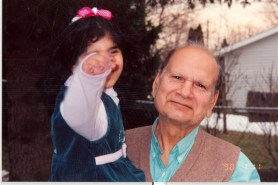
Summer time with my Father – 1998
A Dedication to My Father on His 70th Birthday in 1996
My father was a mathematics professor. He is now retired. I saw him spend countless hours writing papers and constructing new math problems. He involved the whole family in helping him with an undergraduate math journal, Delta, that he had founded, and of which he was both the editor and the publisher. It was too much work for one man, but my father persisted in doing the impossible for years. Delta later merged with the Mathematics Magazine issued by the Mathematics Association of America. We were all happy when that happened!
My father spent a lot of his evenings grading math exams. This used to irritate my mother. “Must you spend so much time reading student exams? Give them a grade and get it over with,” she would say. He usually replied, “What do you think I teach, sociology or philosophy? Can I just read the first and the last line and give a grade!” Then he would laugh heartily feeling he had uttered a profound truth.
My father actually loves the humanities but is of the opinion that everyone should have concrete skills to earn a living. He never hesitated to express his views to me and others about education. Once, in order to demonstrate the superiority of learning math over other disciplines he said to his colleague who taught astronomy the following: “If our students know math and statistics they can get a job at the plant (he was referring to the local GM Plant). If they take astronomy and don’t get a job what will they do? How will they eat? Maybe they can go to your house and you can all watch the stars together on an empty stomach!” My father thought what he had said was quite funny, although the astronomy professor did not. The following poem is dedicated to my father.
PROFESSORS DON’T GROW OLD
Professors don’t grow old
they just grade away
like a master jeweler
who has to differentiate
between precious rubies and stones
who with a heavy heart sings
and then has to part
with diamond rings
that must end up on
someone else’s finger.
Professors don’t grow old
they just grade away
like a gardener who
asks the birds to stay
in the nest he has made
so they can rest in the shade
of the tree of wisdom
carefully pruned
standing in the luscious grass
only to see them fly away.
Cool breezes and the
fresh waters of knowledge
is what we received
in the college
that was my father’s heart.
Yes, professors don’t grow old
they just grade away
and then slowly fade away
to pictures on the walls
leaving nothing behind
but the touch of ideas
given with humor and kindness
and their smiling eyes
bubbling forever in our mind.
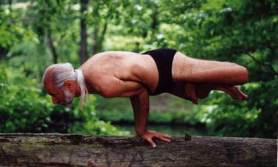
Meeting Nisargadatta Maharaj: By Dr. Lakshyan Schanzer
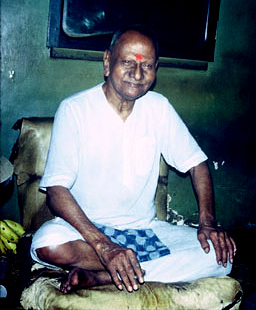
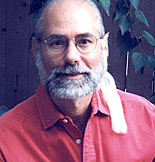
My name is Lakshyan Schanzer. I have been practicing and teaching yoga and meditation since 1971. I am also a psychologist and practice a meditative approach to psychotherapy. This is my first writing about my experiences with Nisargadatta Maharaj.
By 1978 I had been practicing and teaching for about 7 years (primarily Integral Yoga) and had reached a ‘wall’ in my practice. I was having wonderful experiences/results on a daily basis. Yet, for me, these experiences were just that; only experiences. Yes, they were important and healing ones, bringing revelations and insights into my history, release of deep feelings, or guidance about the coming day or accurate premonitions about the future.
Bliss – The Source and Meaning of Life: By Michael Bowes
This article was originally written on May 9, 2006 and posted by Michael Bowes on the old HS blog.
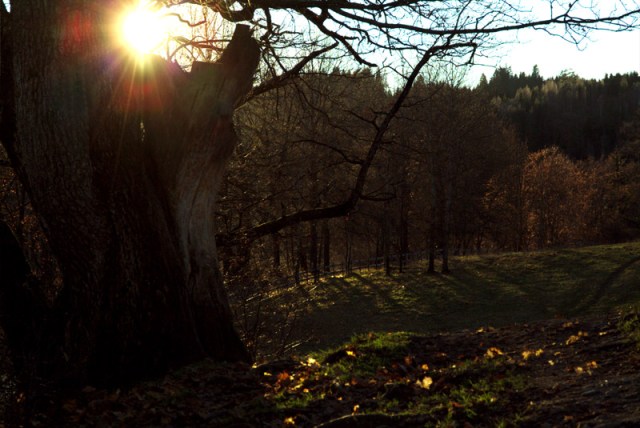
Picture below is by long term HarshaSatsangh member Alan Larus at http://www.ferryfee.com/tree.htm
One weekend in the early 1990s, my friend Narayan and I went to Saint Louis, Missouri to visit with Swami Chetanananda. Narayan and I have known Swami since the late 1980s. On Sunday morning of that weekend we were eating breakfast with Swami and the other residents of the temple, and according to the custom there, we were all reading a portion of the newspaper.
When reading the paper, Narayan nearly always goes straight to the “funnies”.
We were all reading and eating. Swami was at the head of the table, I was to his left, and Narayan was to my left. At some point Narayan nudges me and hands me the funnies. He pointed to the “Donald Duck” comic strip.
Donald Duck was in the Himalayas searching for his guru. And there were signs posted in the mountains that said “Guru”, and then an arrow would be pointing to a certain direction. And Donald followed the signs and arrows until finally, at the top of a mountain peak sat the guru with a personal computer in front of him.
Donald Duck asked the guru, “What is the meaning of life?”
The guru didn’t answer; but the computer started printing out something that couldn’t be read on the comic strip.
The gag was that personal computers were becoming the rage, and now even the guru was using one to divine the mystic truths.
But another peculiar thing was that Narayan and I were searching for a guru and a spiritual home; and now, thanks to Donald Duck, the stage was set for that possibility.
I nudged Swami and handed him the funnies while pointing to the Donald Duck comic strip. He read it and handed it back without saying a word, and continued to eat breakfast. After breakfast Swami went to prepare for his weekly public talk. The rest of us cleaned up after the meal and relaxed until the beginning of the service.
Swami began his Sunday morning talk and I really don’t remember the topic; but near the end he announced that he was going to reveal the “Meaning of Life”. He was going to reply to the question in the funnies.
Swami started by saying, “The meaning of life is bliss.”; and the following is a very loose paraphrase of what he said to explain that statement:
There is an “ocean of bliss” that is the source, the cause and support of all that we see; And in its manifest forms that bliss is experienced as amrita, rasa, love, joy, happiness, fun, hope, peace and even as pain and suffering. Pain and suffering serve as motivation for us to find a way to return to our original state of bliss.
We were all born from bliss. We arrive in this world because one day or one night our parents engaged in a blissful activity, and as a result we were born. From that day on, all of our conscious and even subconscious activities are meant to help us either directly or indirectly to achieve bliss and happiness.
As children all we really wanted to do was play. Our true unconditioned nature is playful. But, as we start to get a little older, we are forced to go to school and we are conditioned by society to perform certain useful functions.
But bliss, happiness, satisfaction, etc. are still the primary objective of all of our behaviors. Our parents and our society force us to go to school so that we can get a job, so that we can earn money, so that we can be happy.
We marry because we believe that another person will fulfill us and make us happy. We have children because we think that will make us happy. Everything that we do is ultimately for happiness and bliss. Even so called, “selfless love” only serves to satisfy ourselves. We believe that by performing our self-ordained duties that we will be satisfied.
A short time after I heard these words from Swami, I directly experienced that “ocean of bliss”. Our own true nature is something that cannot be imagined, and it is truly inexpressible. Since then, even though I have gone through some dark times, it isn’t possible for me to worry or lose my connection to that blissful being, the “ocean of bliss” that is our own true nature. And I have a lot of fun. I can’t seem to avoid it.
I began to experience this truth because of an encounter with the “funny paper”.
Love and peace to all,
Michael Bowes
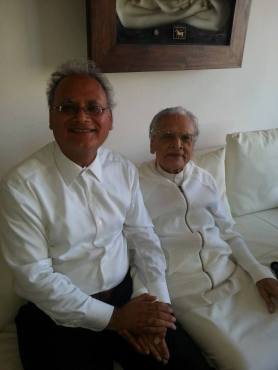
Sri Ramana and My Teacher Gurudev Sri Chitrabhanu-Ji: By Dr. Harsh K. Luthar
All of us come from different backgrounds, and we walk the path in our own unique way. Yet, we all have the same innermost longing to know the deepest mystery of our own nature and being. Reflecting on the purest teachings of the Self and on the nature of Ahimsa as nonmovement of the mind, we are bound to have experiences and openings in our consciousness.
When my teacher, Gurudev Sri Chitrabhanu-ji visited Sri Ramana, he was just a teenager. Chitrabhanu-Ji became a Jain monk in 1942 at the age of 20. Prior to that, he was searching and visiting different saints in the various traditions of India and asking them questions about the spiritual path and how to become Self-Realized.
Gurudev Sri Chitrabhanu
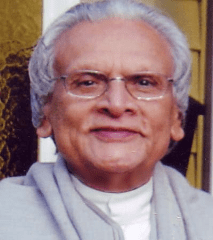
Chitrabhanu-Ji told me that of all the saints and sages he visited in India in his teen years, a few were unforgettable and stood out to him. Sri Ramana was one of them.
When I was 22 and studying with Chitrabhanu-Ji, he saw me carrying books of different spiritual teachers for my reading pleasure. He asked to see these books and thumbed through them. He knew most of the authors personally. Swami Rama of Himalayan Institute had come to our meditation center. One time I saw Swami Chidananda, the disciple of Swami Sivananda of Rishikesh, when he came to visit my teacher. Swami Chidananda was very thin even then and was leading a very pure and ascetic life.
After looking through my books, Chitrabhanu-Ji told me that I should read the dialogues with Ramana Maharshi and study his teaching. That is how I was led to Sri Ramana. Of course, after I read the classic, “Talks with Sri Ramana Maharshi”, it was indeed like magic and I knew deep in my heart that this was my way.
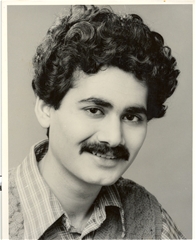
The Author at 21-22 studying With Sri Chitrabhanu-Ji
 Luthar.com
You must be logged in to post a comment.