
Category Archives: PERSONAL
How to Help Haiti Relief Efforts
Many people are asking how they can help in Haiti relief efforts without being victim of Scams. Here is a listing of major groups that have experience in disaster relief efforts.
http://abcnews.go.com/GMA/haiti-earthquake-relief-effort-avoid-scams/story?id=9555419
The American Red Cross site is given below.
The Haiti Earthquake
As many of you know there has been a devastating earthquake in Haiti and it has led to a high death toll and horrific suffering among the people there. Continue reading
Face of Fullness: By Dr. Harsh K. Luthar
There are no free thoughts;
the gate to freedom exists
within the eye of the I.
It may be known
when you are alone
and completely empty.
Or when lovers meet
to spend their passions
and rest in the heart. Continue reading
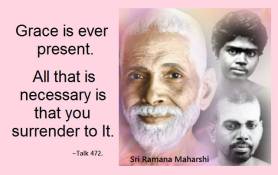
Essential Teachings of Bhagavan Sri Ramana Maharshi
In the following extract from Gems from Bhagavan, we are reminded of the essence of Bhagavan Ramana’s teaching and inspired to realize the True Self. Continue reading
Climate Change – Would You Save Your Only Home? by Dr Damiana Corca
 A major condition of healthy living on Earth is keeping a positive balance between our environment and us. While growing up in the Carpathians I took being self-sustainable for granted, from growing all necessary vegetables on our own land to raising animals that would help us through the winter. Nowadays, I could not do much without relying on fossil energy sources. Unfortunately that comes at a high price. The nature has changed drasticaly and brought fear among us, for the future of our lives and for our children. The media is full of information, very controversial at times, so I was as confused as many of us are when I decided to look closer into the issue of climate change. Are we doomed, can we do something about it, is anything going to change the damage that has already been done – all these questions were racing through my mind. I wanted facts and wanted to know what is in my power to change. Continue reading
 The Quest_To Love Or To Be Loved: By Alx Uttermann
Giving Love To Get Love, Oh Dear!
In my early years, in life and in spiritual searching, my primary motivation in life was to be loved; there seemed to be such a lack of love, cumulatively, in my own experience, everywhere I turned. (Extreme heartbreak, depression, loss, family trauma and other factors had all contributed to this perception.) Continue reading
We Did Not Go To Him For Profit: By T.K. Sundaresa Iyer

Note: T.K. Sundaresa Iyer (T.K.S) met Sri Ramana in 1908 when T.K.S was only a twelve year old boy. Bhagavan, although a full blown Self-Realized sage, was also quite young and in his late 20’s. Many early devotees have described how Bhagavan by his sheer look would give them experience of the Self. However, this was not true in every case.
T.K.S’s cousin Krishnamurthy had been visiting Bhagavan Ramana regularly and would sing songs of devotion to him. One day T.K.S asked his cousin where he went every day. Krishnamurthy told him about Ramana and said, “The Lord of the Hill Himself is sitting in human form, why don’t you come with me.” Both of them then climbed the Hill and went to Virupksha cave to visit the Sage.
Now the story in T.K.S.’s own words:
I too climbed the Hill and found Bhagavan sitting on a stone slab, with about 10 devotees around him. Each would sing a song. Bhagavan turned to me and asked, “Well, won’t you sing a song also.” One of Sundramurthy’s songs came to my mind and I sang it. It’s meaning was, “No other support have I, except thy holy feet. By holding on to them, I shall win your grace. Great men sing your praise Oh, Lord. Grant that my tongue may repeat Thy name even when my mind strays.”
“Yes. That is what must be done,” said Bhagavan, and I took it to be his teaching for me. From that time on, I went to see him regularly for several years without missing a day.
One day I wondered why I was visiting him at all. What was the use? There seemed to be no inner advancement. Going up the hill was meaningless toil. I decided to end my visits on the hill.
For one hundred days exactly I did not see Bhagavan. On the hundred and first day I could suffer no longer and I ran to Skandasramam, above Virupaksha Cave. Bhagavan saw me climbing, got up and came forward to meet me. When I fell at his feet, I could not restrain myself and burst into tears. I clung to them and would not get up.
Bhagavan pulled me up and asked: “It is over three months since I saw you. Where were you?” I told him how I thought that seeing him was of no use. “All right,” he said, “maybe it is of no use, so what? You felt the loss, did you not?”
Then I understood that we did not go to him for profit, but because away from him there was no life for us.
From “At the Feet of Bhagwan” by T.K. Sundaresa Iyer.
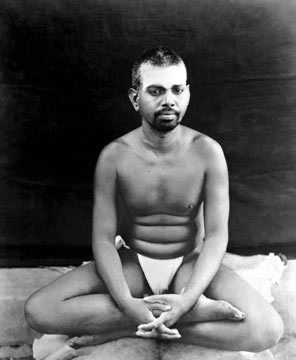
Surrender and Salvation: By Voruganti Krishnayya
Voruganti Krishnayya was a great devotee of Bhagavan Sri Ramana. He has narrated many incidents that he observed while in Bhagavan’s company. The following story is one of my favorite.
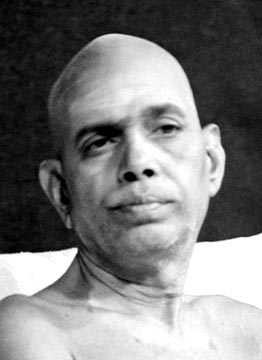
Bhagavan Ramana
Bhagavan was most tender with people who thought themselves for some reason or other to be miserable sinners and who went to him torn by repentance.
During summer evenings we used to sit in the open space near the well. We would collect in the dining hall for dinner and come back to the well. Suddenly, one day, a visitor started weeping bitterly, “I am a horrible sinner. For a long time I have been coming to your feet, but there is no change in me. Can I become pure at last? How long am I to wait? When I am here near you I am good for a time, but when I leave this place I become a beast again. You cannot imagine how bad I can be – hardly a human being. Am I to remain a sinner forever?”
Bhagavan answered: “Why do you come to me? What have I to do with you? What is there between us that you should come here and weep and cry in front of me?”
The man started moaning and crying even more, as if his heart were breaking. “All my hopes of salvation are gone. You were my last refuge and you say you have nothing to do with me! To whom shall I turn now? What am I to do? To whom am I to go?”
Bhagavan watched him for some time and said, “Am I your guru that I should be responsible for your salvation? Have I ever said that I am your master?”
“If you are not my master, then who is? And who are you, if not my master? You are my guru, you are my guardian angel, you will pity me and release me from my sins!” He started sobbing and crying again.
We all sat silent, overcome with pity. Only Bhagavan looked alert and matter-of-fact.
Bh: “If I am your guru, what are my fees? Surely you should pay me for my services.”
D: “But you won’t take anything,” cried the visitor. “What can I give you?”
Bh: “Did I ever say that I don’t take anything? And did you ever ask me what you can give me?”
D: “If you would take, then ask me. There is nothing I would not give you.”
Bh: “All right. Now I am asking. Give me. What will you give me ?”
D: “Take anything, all is yours.”
Bh: “Then give me all the good you have done in this world.”
D: “What good could I have done? I have not a single virtue to my credit.”
Bh: “You have promised to give. Now give. Don’t talk of your credit. Just give away all the good you have done in your past.”
D: “Yes, I shall give. But how does one give? Tell me how the giving is done and I shall give.”
Bh: “Say like this: ‘All the good I have done in the past I am giving away entirely to my guru. Henceforth I have no merit from it nor have I any concern with it.’ Say it with your whole heart.”
D: “All right, Swami, I am giving away to you all the good I have done so far, if I have done any, and all its good effects. I am giving it to you gladly, for you are my master and you are asking me to give it all away to you.”
Bh: “But this is not enough,” said Bhagavan sternly.
D: “I gave you all I have and all you asked me to give. I have nothing more to give.”
Bh: “No, you have. Give me all your sins.”
D: The man looked wildly at Bhagavan, terror stricken. “You do not know, Swami, what you are asking for. If you knew, you would not ask me. If you take over my sins, your body will rot and burn. You do not know me, you do not know my sins. Please do not ask me for my sins.” And he wept bitterly.
Bh: “I shall look after myself, don’t you worry about me,” said Bhagavan. “All I want from you is your sins.”
For a long time the bargain would not go through. The man refused to part with his sins. But Bhagavan was adamant.
Bh: “Either give me your sins along with your merits, or keep both and don’t think of me as your master.”
In the end the visitor’s scruples broke down and he declared: “Whatever sins I have done, they are no longer mine. All of them and their results, too, belong to Ramana.”
Bhagavan seemed to be satisfied. “From now on there is no good nor bad in you. You are just pure. Go and do nothing, neither good nor bad. Remain yourself, remain what you are.”
A great peace fell over the man and over us all. No one knows what happened to the fortunate visitor; he was never seen in the Ashrama again. He might have been in no further need of coming.

Bhagavan Ramana
Gratitude and Divine Grace

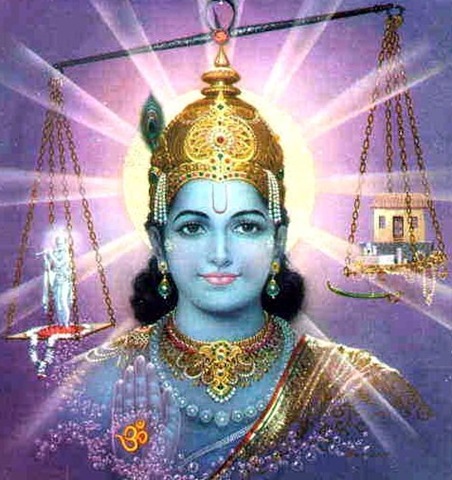

To those who worship Me alone, thinking of no other,
of those ever united, I secure what is not already possessed
and preserve what they already possess. (BG 9.22)
The story below appeared months ago prompting some discussion in the Guruvayur yahoo group in which I am a member. Today is Thanksgiving here in America, and this week we also celebrate Gita Jayanti, or the observance of the gifting of the Bhagavad Gita to the world by Shri Krishna more than five thousand years ago. As my thoughts turn to gratitude, I am reminded of this story below and the responses it produced in the Guruvayur group, and how important it is to always be grateful to the Lord for everything, knowing that He is our eternal well wisher and that everything happens for our highest good, even the things which which appear to be bad or are difficult to endure…everything means everything.
The focus of the discussion was on what should we ask of God. To what end do we pray, asking for this and pleading for that? Success in this venture, a new job, a happy marriage, a grandchild, a son or a daughter, a husband, a wife, a handsome husband, a beautiful wife, a nice house, a beautiful house, a mansion, good grades in school, a child who is a doctor or the president of the US? For what is it that we really seek, when all illusions are cast aside and maya’s veil is lifted? None of the above!!!
What should I seek from the Lord but the Lord Himself? That by His grace, I should know Him as the very Self in my heart, casting aside the shackles of the body and the solitary confinement imposed by the mind. He promises us, in the Gita, that if we are utterly devoted to Him, thinking of Him only, asking only for Him rather than of Him, He will be ours, and as such, will take care of us as needed. To understand this, to believe this, in full faith, can only be followed by complete surrender to His will, trusting that whatever happens is indeed His divine will operating to bring us out of bondage to birth and into reunion with Him.

From http://idharudharkee.blogspot.com/2009/07/what-we-should-ask-god.html
What should we ask of God?
This story from Mahabharata answers this question beautifully and categorically:
The Great War between the Pandavas and Kauravas was to begin. Arjuna, having pondered, decided to
go to Lord Krishna and ask him for help.
He went to the Lord’s abode and found him asleep.He stood respectfully at his lotus feet, with folded hands and head bowed in reverence. Duryodana, of the Kauravas, had the same idea of asking Sri Krishna’s help. He too came and, finding the Lord asleep, sat arrogantly in a chair placed at the head of Lord’s bed.
In due course, the Lord woke up. Arjuna, being at his feet, was the first person he naturally saw. As he turned to get up, the Lord’s eyes fell upon Duryodana.
The purpose of their visit was known to Him. However, he asked them what he could do for them.
Both answered that they had come to request his assistance in the ensuing war. The lord said that they had placed him in a difficult predicament by asking for the same thing. He said he could not deny either of them. He said he would offer himself, alone, without armies to one of them and to the other he would offer all his armed forces completely. He said that since his eyes had fallen on Arjuna first, he should have the first choice in the matter.
Arjuna promptly prayed to Sri Krishna that he alone should side the Pandavas.. Duryodana heaved a sigh of relief and requested Sri Krishna for all his forces. The Lord agreed to their requests.
We know who emerged victorious. The moral is “We should ask for HIM, not ask for things He can give us”
If the Lord gives us everything in the Universe but withholds Himself from us, we gain nothing. But if we seek HIM for Himself alone, we get not merely Him but all that is His, too!
abhyaasa yOga yuktEna cEtasaa naanyagaaminaa,
paramam pursham divyam yaati paarthaanucintayanMeaning:
He who with his mind disciplined through Yoga in the form of practice of meditation and thinking of nothing else, is constantly engaged in contemplation of God attains the supremely effulgent Divine Purusha (God) (sloka 8 in chapter 8 of Gita)
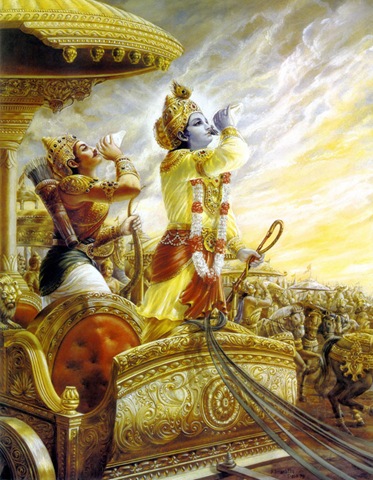

And what did Arjuna request? The Lord Himself. In his earnest bhakti, he intuited that this was the right choice and it was. When you ask for the Lord Himself, with utter devotion and humility, how can He deny you? In the Gita, He makes this promise to His devotees…
ananyaaScintayamtO maam yE janaah paryupaasatE
tEshaam nityaabhiyuktaanaam yOgakshEmam vahaamyaham. (BG 9.22)
To those who worship Me alone, thinking of no other, of those ever united, I secure what is not already possessed and preserve what they already possess.
https://luthar.com/wp-content/uploads/2009/06/bgita.pdf
But those who always worship Me with exclusive devotion, meditating on My transcendental form—to them I carry what they lack, and I preserve what they have.
http://www.bhagavad-gita.us/categories/The-Gita%3A-Chapter-9/?Page=2
Those who desire My eternal association precluding all else meditate on me with exclusive devotion; those persons I insure the uniting of their individual consciousness with Ultimate Consciousness perpetually. http://www.bhagavad-gita.org/Gita/verse-09-22.html
Yoga-kesamam, means to provide what they lack and safeguard or preserve what they have. In this context, yoga is said to mean making available what one does not have, and ksema means the preservation of what one already has. For some, the sloka is interpreted to mean those who recognize the nonduality of the Self, abiding in the Self at all times; for others, this is considered to be a promise from the Lord to take care of His devotees. If we go online, we can find countless articles claiming that the interpretation therein is the right one and that all others are missing the point, thus missing salvation itself!
For me, neither one has the right to claim the other is wrong…it can mean both, one at the level at which we exist as entities in this world of maya, or saguna, another at the level of the formless nirguna. The Lord, in His infinite mercy, prescribed numerous paths in the Gita. I am a bhakta. He is my Lord and while I know that philosophically speaking we are indeed nonseparate as it says so in the Gita and in the Vedas, as far as I am concerned, that can only be truly perceived through His Grace. So, while I am nothing but Him, on another level of worldly perception, this is known and experienced only through the operation of Divine Grace.
It is so stated in the Mukanda Upanishad 3.2.3:
nāyam ātmā pravacanena labhyo
na medhayā, na bahunā śrutena,
yam evaiṣa vṛṇute tena labhyas
tasyaiṣa ātmā vivṛṇute tanūṁ svām.
(Mukanda Upanishad 3.2.3)
This Self cannot be realized by studying the scriptures, nor through the use of reason, nor from the words of others–no matter what they say. By the grace of the Self the Self is known; the Self reveals itself. http://www.peterrussell.com/Upi/Mund.php
The Supreme Lord is not attained by reasonings or by vast intelligence, nor even by much hearing. He is attained only by one whom he Himself chooses. To such a person He manifests His own form. http://bvml.org/SBVPGM/sgt.html
And the Katha Upanishad 2.2.23:
The Self cannot be known through study of the scriptures, nor through the intellect, nor through hearing learned discourses. The Self can be attained only by those Whom the Self chooses. Verily unto them Does the Self reveal himself. http://booksandphotos.blogspot.com/2009/05/upanishads-kena-and-katha.html
This Supreme Self cannot be reached by argumentation, or by applying one’s independent brain power, or by studying many scriptures. Rather, he alone can achieve the Self whom the Self chooses to favor. To that person the Self reveals His own true, personal form. http://vedabase.net/sb/10/87/27/en1
The reason I have reproduced more than one translation of the Gita and Upanishad slokas above is that I wanted to read them in several formats for my own benefit and I also wanted to offer the reader the option of seeing it as such. So many ways of saying the same thing. And so many schools of thought want to say that their interpretation is the correct one and all others false and faulty. In the end, Divine Grace is the operational catalyst, whatever you deem its source.
So, what should we ask of God? Truly, there is no thing to be asked. There is no thing to be given. How can we give Him what is already His? All we can do is realize, through His grace alone, that we are already His, in every sense that we as mortals can conceptualize in our limited minds! Not only will He take care of everything and look after the welfare of the devotee, He will guide us if we listen. Thus, I do have a prayer…to fully surrender, to listen without fear of the consequences, no matter what He asks me to do. Where it will lead, I have no real idea and no plan of action! He is guiding the chariot now. May I sit quietly and not be a backseat driver. Chitta chora!!!





You must be logged in to post a comment.