Harsha's avatar

Wisdom and Action – No. 3 – by V. Ganesan

This is  from a series of ‘sharings’ from V. Ganesan in Tiruvannamalai in the winder of 2008/2009.

Today, we are going to share on the third and fourth principles of what we have been sharing for the past few sessions. They are :

3. Sri Bhagavan said :“If one identifies oneself with the body, ‘Karma ’ [destiny] is inevitable and unavoidable (which means, that one is bound, one is in ‘bondage’ ). If one’s attention is turned inwards, one is always ‘free’ . One is ever a ‘Free Man’ .”

4. When asked whether His Direct Teaching could be put in a single word, Sri Bhagavan answered : “ ATTENTION ” [ “Ulladunar ” in Tamil, meaning, “Attention paying attention to ATTENTION.” ]

______________________________________________________________

( 1. In 1936, Paul Brunton asked the Maharshi : “Can a man of the world, viz.,one who is involved in worldly activities, practice this Jnana Marga or this Wisdom Path ?”

Sri Bhagavan’s cryptic answer was : “There is no contradiction between work and Wisdom.”

2. On another occasion, Sri Bhagavan said : “The only purpose of life is to realize the SELF. All other activities are a waste of time.” )

__________________________________________________________________________________

There are two stories – like the two sides of the same coin – to elaborate on the “third principle”. We are all children in one way – each one’s heart is that of a child – and hence, throughout our living span of existence we are always absorbingly interested in listening to stories !

The First story to affirm that “if one identified with a body, destiny is inevitable” :

Major A.W. Chadwick was the first Westerner to settle permanently as a resident at the Ashram from 1938, till he dropped the body in the 1960s. He had adopted himself in such a harmonious traditional Ashram-way that viewers wondered over his way of life ! Once a devotee who was amazed looking at Chadwick, asked Sri Bhagavan as how it was possible for Chadwick to adopt himself to such a pious Hindu way of living.

Bhagavan gave the following reply : “Chadwick was with us. He had a great fascination for the Westerner way of life that he is born in the West. Now, he has come back to us !”

Paying attention outward of oneself and getting involved with activities outside of oneself traps one into the octopus grip of the ‘Law of Karma’ , giving effect to the series of birth and deaths !

The Second story confirms : If one’s attention is turned inwards, one is always ‘free’ . One is ever a ‘Free Man’.

Once a stranger from North India came to Sri Bhagavan and was firmly seated in the Hall. When almost all had left the Hall, he approached Bhagavan and pleaded, thus : “Bhagavan ! I had committed four murders in my life. I had escaped uncaught; not even my wife knows about it. Yet, my conscience now pricks me, very deeply too. Is there a redemption for me, my Lord ?”

Bhagavan gave him a Glance of Grace. After a few moments, slowly yet most assuredly he replied : “ Yes, there is redemption. Yes, there is redemption !

Give up the thought that you had murdered !” There ruled absolute silence.

The stranger shed profuse tears of joy and gratitude. He prostrated to

Sri Bhagavan and left. Many years after that, an old devotee, H.C. Khanna of Kanpur, happened to travel in the Himalayas. Bhagavan had already dropped the body. Khanna met a Swami with impressive countenance seated in a cave.

He introduced himself as a devotee of Bhagavan Ramana. The Swami got up and touched the feet of Khanna, saying : “You have come from Arunachala ! My God and Guru is Bhagavan Ramana. How fortunate and how blessed I feel in the proximity of a fellow-devotee of the Supreme Master ! “ He, then, narrated the whole story of “his Four Murders” and how there was no trace of affectation left in him; and, how following the commandment of Bhagavan, instantly released him from the grips of ‘Karma’ . After narrating this wonderful story to me, Khanna added : “Once, Bhagavan told me in the Hall : ‘ If one accepted the ‘Prarabdha Karma’ , it will start operating. And, if one refused to identify oneself with ‘Prarabdha Karma’ , operation of ‘Prarabdha Karma’ is totally nullified.’

Is it not clear that a true seeker should ever be a “dheera” [ bold & courageous ] ? How to deny the ‘Karma’ ? This will be the obvious next question ! Only by turning within and surrendering oneself to the Inner Guru.

Silence is the Inner Guru.

The fourth principle is of supreme importance : “Attention paying attention to ATTENTION.” Sri Bhagavan repeatedly guided us : “ Go within, Plunge within, Dive inwards.” To take one’s attention inwardly, one has to have a correct grasp of Bhagavan’s ‘Direct Teaching’ of “Wisdom Realistion”.

Read the following verses from Bhagavan’s Forty Verses on Reality ” :

Though the world and mind rise and fade together, the world shines by the light of the mind. The ground whence the world and mind arise, and wherein they set, that State of Perfection does not either rise or set, but ever shines supreme.

That is Reality.

Under whatever name or form we worship IT, IT leads us on to Wisdom of the Nameless, Formless Absolute. Yet, to see one’s true SELF as the Absolute, to subside into IT and be one with IT – this is the True Wisdom of Absolute Reality.

‘Twos’ and ‘Threes’ ** depend upon one thing — the ego. If one asks in one’s Heart, ‘What is this ego ?’ and finds it, they slip away. Only those who have found this, know the Absolute Reality. And, they will never be perplexed.”

[** ‘Twos’ = names & forms; ‘Threes’ = God,World,Jivas (beings) ]

There is no Wisdom without ignorance and without Wisdom. ignorance cannot be. To ask, ‘Whose is this Wisdom ? ‘Whose is this ignorance ?’ and thus to realize the Primal SELF – this alone is True Wisdom.

FORTY VERSES ON REALITY “ , v. 7,8,9,10

Sri Bhagavan has sung : “Easy is Self-Wisdom; the easiest thing there is.”

Let us adhere to his guidance and boldly take a plunge ‘within’ NOW and be the SELF !

***********************************************

Related posts:

Satsang with Ganesan
Self nature, Faith and Attention
Wisdom and Action (No. 1)
Wisdom and Action (No. 2)

V. Ganesan Bio
HPIM9540

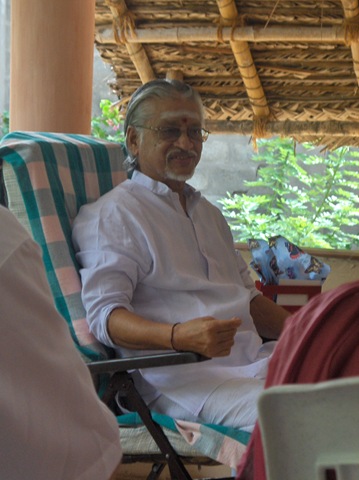
Born in 1936, up to the age of 14 years old, Ganesan grew up in the presence and proximity of Bhagavan Sri Ramana Maharshi. His sacred memory of the Great Master is rich in its content; and, even at that tender age he could see Sri Ramana as the greatest compassionate human being.

On April 14, 1950 – the day the Great Master chose to leave the body – the adolescent Ganesan stood near the entrance to the room where Sri Ramana was lying and was fortunate to witness the brilliant flash of Light that later moved towards the top of the Holy Hill – Arunachala.

Ganesan obtained a Master’s Degree in Philosophy; and, then came to stay permanently at “Sri Ramanasramam, Tiruvannamalai” – the sacred abode of Sri Ramana Maharshi – taking care of the Old Devotees of Sri Ramana. He did it as his sole sadhana (spiritual practice). In that way, he collected the reminiscences of Sri Maharshi from those Old Devotees which have never before been recorded.

His close contacts with sages and saints, including Swami Ramdas, Mother Krishnabai, J. Krishnamurti, Nisargadatta Maharaj and Yogi Ramsuratkumar, he says, have deepened and widened his understanding of the ‘Direct Teaching’ of the Maharshi. However, he feels himself to be an insignificant ‘dust’ at the Holy Feet of Bhagavan Ramana.

He has traveled widely and spread the ‘Direct Teaching’ of Sri Ramana Maharshi, in its pristine purity, wherever he was invited to give talks.

He has authored a few books on the life and teaching of Bhagavan Ramana. Among others, “Purushothama Ramana”, “Be the Self”, “Moments Remembered”, “Direct Teaching of Bhagavan Ramana” and “Practising Self-Enquiry” , are very popular.

At the veranda of his cottage – “Ananda Ramana” – he meets earnest seekers, every Monday and Thursday, between 9.30 and 11 a.m., sharing with them the spiritual treasure entrusted with him by all these holy and sacred souls.

Harsha's avatar

Comments on Deep Body Relaxation: By Dr. K. Sadananda

I received some excellent and thoughtful comments from Sada-Ji (Dr. K. Sadananda) on the article, “The Method of Deep Body Relaxation.” These comments with minor editing are given below. Thank you Sada-Ji.

Editor
**************************************

Comments on “Deep Body Relaxation” By Dr. K. Sadananda

Harshaiji – PraNAms

Here are some comments on your article about “Deep Body Relaxation.”

Shava Asana is always done at the end of yoga exercises as a relaxation technique.

However, I would like to add a word of caution for going from Shava to Shiva – that is lying down and doing regular meditation. There is a good reason why the Lotus Posture (Padmaasan) is universally recommended for meditation. Shava or the corpse is considered as inauspicious while Shiva means auspiciousness itself

Also, it should be kept in mind that when one is in meditation, the normal breathing process will slow down and mind becomes quiet and calm. These conditions are conducive for the mind to go to sleep easily. Hence for most meditators, sleep becomes a big hurdle to overcome. Therefore, the Shava Asana (Corpse pose lying on the floor or bed) may not be useful for meditation.

Sleep is the opposite of meditation. In meditation one attempts to stay conscious and awake. That is one of the reasons why meditation is not recommended in the night when the mind is tired, but in the early mornings when the mind is fresh and vibrant. The period around 4am in the morning is considered best for meditation (it is called brahma muhurtham in Sanskrit).

The Lotus posture insures that the person who is meditating does not fall forward. Sitting in the lotus pose is recommended so that the student is stable and firm on the ground.

Yogic texts all advise that the vertebral column and the neck be in straight line (without going into the details of kundalini aspects).

This way one can stay in meditation for any length of time – awake-vigilant and meditative. Indeed that is the state of mind in meditation to be aimed at.

As Harshaji states, one can easily go to sleep in the Shava Asana. In fact one should go to sleep in that pose thinking of the Lord.

Then one can have Yoga Nidra and blissful heavenly relaxation.

But for Vedantic inquiry, the mind has to be sharp. Our own experience is that we can read stories or popular magazines lying down. But for any serious work, we have to sit up and study. Knowledge can take place only when the mind is sharp. Then, what to talk about the subtlest knowledge about one’s own self. So the recommendation is to do meditation in the sitting pose – if you can.

If you cannot, then alternate poses are recommended.

Now the question is whether one should do meditation in a lying down pose such as Shava Asana! Of course you can do! It is like a drunkard who went to ask a priest, “Sir, can I drink while praying to God?” Priest of course said, “No. you should not drink while praying.”

The drunkard thought about this and re-framed his question and asked again, “Sir, can I pray while drinking?” “Yes of course”, said the priest. So, can one meditate while lying down? The answer is, “of course you can meditate any time and anywhere.” No problem!

Should one lie down to meditate? No, that is not advisable. Sri Krishna himself recommends sitting down and meditating in the 6th Chapter of Bhagavad Gita.

Of course for relaxation – what Harshaji says is correct.

But For a meditator, relaxation is not the goal, but it is only a by-product. Vedantic meditation requires a calm, quiet, and vigilant mind. It is a subtle inquiry within of the very essence of life itself. If relaxation becomes a goal, the meditative mind will only long for that. If the mind settles in that groove, it will not be ready to take a higher flight.

Harsha's avatar

Sayings of Sri RaJ Mata-Ji: By Dr. Harsh K. Luthar

Sri Raj Mata-Ji

Philosophy of Sri Raj Mata-Ji

Sri Raj Mata-Ji is one of my earliest spiritual advisors and counselors. Here are some of her sayings in Hindi and Punjabi that I have translated into English.

*******************************************************

Life is fleeting. Do something for yourself as well as others.

Grab some happiness when you can.

Happiness is having a caring family and cooking for them.

Happiness is having good friends and good neighbors to talk with.

Happiness is a state of mind.

Some people have everything but they are not happy. It’s a pity.

The secret to happiness is in giving.

If you serve others sincerely, you will be happy.

Nobody cares for the weak. Be strong.

You can only help and serve others if you are mentally strong.

Pray and ask God to make you strong.

If you eat too much, don’t complain afterwards.

Go take a walk after a big meal.

Take care of yourself. Nobody else can in the same way.

Make an appointment with the doctor and get a complete check-up.

Help others who need it. It will be good for you.

Give to charity whatever you can afford.

Make friends with your neighbors. Go shopping with them.

Stay active getting older and be part of a community.

Look for friends. They are looking for you.

Don’t look for perfection in others.

Life is a compromise.

You are better off than a lot of people.

Do the best you can and trust in God.

Harsha's avatar

Hinduism and Vegetarianism: By Dr. K. Sadananda

image

Editor’s note: Sada-Ji (Dr. K. Sadananda) is well known to the Hindu community in both the U.S. and in India. He is one of the most brilliant and thoughtful exponents of the Bhagavad Gita as well as the ancient philosophy of Advaita-Vedanta.

In this article, Sada-Ji discusses a practical question that frequently comes up among many students of Hinduism as well as many Westernized Hindus. The question is, “Should I become a vegetarian?”

I took the liberty to edit and restructure Sada-Ji’s original e-mail answer to this question for the purpose of this article to give it an easier reading flow. I hope that justice has been done to Sada-Ji’s explanations and that I have stayed within the limits of editorial license. Of course, any errors are mine and as soon as these are pointed out will be promptly corrected. Thank you for your understanding and patience.

***************************************************

Should I Become a Vegetarian?

Recently two questions were asked – Does Hinduism require one to believe in God? Does Hinduism require one to be a vegetarian?

In a recent article, I have addressed the first question. Here I will provide some thoughts for the second question. In relation to the first question, I have discussed what Hinduism stands for and who is truly a Hindu. In essence, Hinduism is Sanatana Dharma, and that Dharma is from time immemorial; it involves pursuit of Moksha through self-reflection, inquiry, and Self-Knowledge. Self-Knowledge in Hinduism is synonymous with Moksha (Liberation from the cycle of birth and death).

Therefore, the one who is seeking to understand the ultimate mystery of existence and thereby gaining salvation or release is a true Hindu, irrespective of the nationality, caste, creed or gender. With that catholic understanding, one can see that Hinduism becomes a way of life because the pursuit of the essential purpose of life is the goal of the ideal Hindu life. If you ask most Hindus whether they believe in God, you will get a firm “Yes”, in response.

With this perspective, it is easier to analyze all other questions including whether Hinduism requires one to be a vegetarian. Since the purpose of life is securing liberation or Moksha, until we reach that we need to maintain our body. Keeping the body healthy through proper nourishment is the Hindu Dharma. The human body is considered a temple of God. Therefore, it is sacred and should be treated with respect.

You asked whether a Hindu has to be a vegetarian. Well, it is a fact that not all Hindus are vegetarians. Hindu kings and princes and the warriors have eaten meat for thousands of years. So your question is not whether a Hindu should eat but whether you should eat meat. Since such a question has already arisen in your mind, perhaps you have developed a degree of sensitivity about harming other living forms to satisfy your physical hunger. If that is true, you may be better off not eating meat. That way you will be at peace with yourself. Since you are sensitive to this issue, your intellect may be directing you towards being a vegetarian. It is a possibility. However, your mind wants the pleasure of eating meat and your body may crave it due to past habits. So you have to reflect on this. Why has this question come up for you? What is the right thing for you to do?

Follow Your Self-Nature

When you go against your own intellect and good understanding of life you commit a sin. An act that is contrary to your SWADHARMA (your own nature) creates a conflict within you. So you have to reflect on whether being a vegetarian is natural to you or not. Now, of course, even the traditional non-vegetarians are choosing vegetarianism not because of any compassion to other animals but they are recognizing that meat is not good for their health.

I have already mentioned that Hinduism does not say to you “don’t do this and don’t do that”. You must determine your own actions based on your intellectual values, culture, education and primary goal in life. You will find that following your Swadharma (your own nature) will make you comfortable with yourself. It is not for others to judge what food is right for you! It is for you to decide.

While you are trying to decide whether to be a vegetarian do this experiment. Imagine your self to be a chicken or cow who is about to be slaughtered for food. Would you not advise the guy who wants to make a dinner out of you to be a vegetarian instead? The golden rule of “Do unto others as you would have them do unto you” can sometimes help shape our analysis.

Life Lives on Life

Life lives on life. That is the law of nature. Whether I eat an animal or plant, I am destroying a life in some form. Among all life forms, Man is different from the rest. He has the capability to discriminate right from wrong. That gives him the freedom of choice which animals and plants lack.

According to ancient teachings and our observations, plants have just a body and perhaps a rudimentary mind. Animals have both body and mind to express their feelings and suffering, but rudimentary intellect. Man has not only body and mind but also a well developed intellect to discriminate between good and bad, and to choose.

Man always has three choices: He can choose to do something, not to do it, or find another alternative way to do it that is more satisfactory. For animals and plants there is no freedom of choice. They are instinctively driven. The cow does not sit down before meals and inquires whether it should be a vegetarian or non-vegetarian. Same with the tiger or the eagle. They don’t say prayers before eating like we do. They just act according to their nature. No one can hold that against them.

Man and Sin

For a Man the discriminative intellect is much evolved. Plants and animals do not commit sin in their actions because there is no will involved in their actions. For a human, the story is different.

You may wonder why I brought sin in the argument. Let me explain. Sin is nothing but agitations in the mind. It is these agitations that prevent me in my journey to Moksha. Mind has to be pure (meaning un-agitated) for me to see the truth as the truth. (Bible also says blessed are those whose minds are pure).

To define sin more scientifically: It is the divergence between the mind and intellect. Intellect knows right from wrong. But we feel like doing things even though we know they are wrong . That is, the intellect says something but mind which should be subservient to the intellect rebels and does whatever it feels like. This divergence is sin.

After a wrong action is performed there is a guilt feeling. Intellect, although it was overruled, does not keep quiet. It keeps prodding “I told you it is wrong. Why did you do it?” With peace of mind gone, Man goes through a “Hell”. Man is not punished for the sin; he is punished by the sin! Think about it. All the Yoga schools, if you analyze clearly, are bringing this integration between the body, mind, and intellect so that there can be harmony. With harmony, there is peace.

For a true Yogi, what he thinks, what he speaks, and what he does are in perfect alignment. In our case, we think something but have no guts to say what we think. Our lips say something different from what we are thinking. Sometimes people say, “Watch My Lips or Read My Lips “. They mean to emphasize that what they say can be counted on. However, if you watch their lips as requested and follow their actions these are again different! There is no integration anywhere. Our lips and our hips have divergent paths. We live a chaotic life of freestyle dancing! Besides deceiving others, we deceive ourselves, and the worst thing is sometimes we don’t even realize that.

Animals and Sin

Now, when a tiger kills and eats, it does not commit a sin. Because its intellect is rudimentary, it does not go through any analysis before it kills and asks “should I kill or not kill this cute deer”? A tiger does not ask itself, “Should I be a non-vegetarian or a vegetarian?”. When it is hungry, to fill the natures demand, it kills its prey and eats what it needs and leaves the rest when it is full. A tiger does not overeat. There are no fat tigers in nature.

A tiger is not greedy either. It does not seek luxury beyond satisfying its needs. Animals and plants and birds and bees and insects and all living things follow a beautiful ecological system. It is only man who destroys the ecology by being greedy. But Man also has the beautiful instrument of the intellect and the ability to develop it and to meditate on the reality of the universe.

Should I be a vegetarian or non-vegetarian?

So yes, “Should I be a vegetarian or non-vegetarian?” is asked only by a man. Why does that question come? It comes due to reflection. Because man has a discriminative intellect, he can reflect on the nature of pain and suffering. Perhaps a man may think at some point in his life whether it is justifiable to harm and kill an animal to fill his belly. A person may reflect whether eating animals is consistent with the golden rule of “Do unto others as you would have them do unto you”. A man may consider whether this maxim applies to all forms of life or just other human beings.

Plants are life forms too. “Should one hurt them?” you may ask. If one can live without hurting any life forms that is the best, but that is not possible. Life lives on life – that is the law of nature. My role as a human being with discriminative intellect is to do the least damage to the nature for keeping myself alive and well.

At least, I am not consciously aware of suffering of the plants. That is why eating to live and not living to eat is the determining factor. In Bhagawad Geeta, Sri Krishna emphatically says that a Sadhaka (one who is in pursuit of Moksha) should have a compassion for all forms of life. There may come a point when it is advisable to be a vegetarian – only taking from nature what you need to keep the body in optimal health.

In one’s spiritual growth, one develops subtler and subtler intellect. That is, the mind becomes more sensitive, calmer, and self-contented. Your sensitivity to suffering of others also grows. Hence, the thought about becoming a vegetarian may come. Only you can decide what is right for you and not someone else. Any decision that is imposed on you from the outside does violence to your nature.

Many young people are now becoming vegetarians. They all have their own reasons. Fortunately vegetarianism is mainstream now and accepted. Most schools and universities offer vegetarian and even vegan meals and so the option to become a vegetarian is easier today than ever before.

Flowers grow in their own time. Whether you are vegetarian or not does not matter ultimately.

You are all flowers blooming in the light of the divine.

Hari Om and Tat Sat. – Sadananda

Harsha's avatar

Bliss – The Source and Meaning of Life: By Michael Bowes

This article was originally written on May 9, 2006 and posted by Michael Bowes on the old HS blog.

Picture below is by long term HarshaSatsangh member Alan Larus at http://www.ferryfee.com/tree.htm

One weekend in the early 1990s, my friend Narayan and I went to Saint Louis, Missouri to visit with Swami Chetanananda. Narayan and I have known Swami since the late 1980s. On Sunday morning of that weekend we were eating breakfast with Swami and the other residents of the temple, and according to the custom there, we were all reading a portion of the newspaper.

When reading the paper, Narayan nearly always goes straight to the “funnies”.

We were all reading and eating. Swami was at the head of the table, I was to his left, and Narayan was to my left. At some point Narayan nudges me and hands me the funnies. He pointed to the “Donald Duck” comic strip.

Donald Duck was in the Himalayas searching for his guru. And there were signs posted in the mountains that said “Guru”, and then an arrow would be pointing to a certain direction. And Donald followed the signs and arrows until finally, at the top of a mountain peak sat the guru with a personal computer in front of him.

Donald Duck asked the guru, “What is the meaning of life?”

The guru didn’t answer; but the computer started printing out something that couldn’t be read on the comic strip.

The gag was that personal computers were becoming the rage, and now even the guru was using one to divine the mystic truths.

But another peculiar thing was that Narayan and I were searching for a guru and a spiritual home; and now, thanks to Donald Duck, the stage was set for that possibility.

I nudged Swami and handed him the funnies while pointing to the Donald Duck comic strip. He read it and handed it back without saying a word, and continued to eat breakfast. After breakfast Swami went to prepare for his weekly public talk. The rest of us cleaned up after the meal and relaxed until the beginning of the service.

Swami began his Sunday morning talk and I really don’t remember the topic; but near the end he announced that he was going to reveal the “Meaning of Life”. He was going to reply to the question in the funnies.

Swami started by saying, “The meaning of life is bliss.”; and the following is a very loose paraphrase of what he said to explain that statement:

There is an “ocean of bliss” that is the source, the cause and support of all that we see; And in its manifest forms that bliss is experienced as amrita, rasa, love, joy, happiness, fun, hope, peace and even as pain and suffering. Pain and suffering serve as motivation for us to find a way to return to our original state of bliss.

We were all born from bliss. We arrive in this world because one day or one night our parents engaged in a blissful activity, and as a result we were born. From that day on, all of our conscious and even subconscious activities are meant to help us either directly or indirectly to achieve bliss and happiness.

As children all we really wanted to do was play. Our true unconditioned nature is playful. But, as we start to get a little older, we are forced to go to school and we are conditioned by society to perform certain useful functions.

But bliss, happiness, satisfaction, etc. are still the primary objective of all of our behaviors. Our parents and our society force us to go to school so that we can get a job, so that we can earn money, so that we can be happy.

We marry because we believe that another person will fulfill us and make us happy. We have children because we think that will make us happy. Everything that we do is ultimately for happiness and bliss. Even so called, “selfless love” only serves to satisfy ourselves. We believe that by performing our self-ordained duties that we will be satisfied.

A short time after I heard these words from Swami, I directly experienced that “ocean of bliss”. Our own true nature is something that cannot be imagined, and it is truly inexpressible. Since then, even though I have gone through some dark times, it isn’t possible for me to worry or lose my connection to that blissful being, the “ocean of bliss” that is our own true nature. And I have a lot of fun. I can’t seem to avoid it.

I began to experience this truth because of an encounter with the “funny paper”.

Love and peace to all,
Michael Bowes

Harsha's avatar

Love Is Not Something You Get: By Dr. Harsh K. Luthar

Grandfather and Granddaughter

Once I was sitting and talking with my father when he received a call from one of his close friends in India. They talked for a long time. I went into the kitchen and ate some vegetables my father had prepared from his garden along with some garbanzo beans made in the classic Indian style.

During the meal, I could hear some of the conversation. After I was done with the meal, I prepared some Chai and slowly sipped on it. Half hour later they were still talking. When the conversation ended, my father appeared very silent and thoughtful. I asked him what happened.

My father told me that his friend’s wife passed away six months ago and that his friend was very lonely.

“Old age can be very difficult. I was mostly listening to him,” said my father.

“Well, you both talked for a while and I hope it helped,” I said.

My father explained the situation and said, “I don’t know if it helped. We are old friends and he seemed sad and he was reflecting on his life as we talked. He kept saying throughout the conversation that although he had had many friends in his life and had been married and had children and a family, he never really received genuine love from anyone.”

Hearing about my father’s friend, I also became silent. This is the human condition, is it not? We all know the truth of it. We want attention and love but often do not receive it. Many people, as they get older, embittered by their life experiences become sad and cynical.

My father went into the kitchen and started eating lunch. I prepared another cup of Chai and sat down with him. “What did you say to your friend,” I asked my father.

“I did not say much. We just talked,” said my father.

“No, I mean when your friend said that he had never really gotten love from anyone, what did you say? How did you console him?” I asked my father.

My father said, “I told him I loved him.”

“What did he say in response.” I was very curious.

“He said, he knew that. That’s why he called. We are childhood friends. But he still insisted that he really had not gotten the kind of love he wanted from anyone during his whole life,” said my father.

“What did you say then?” I asked being fully engrossed in the scenario.

My father said, “Well, as we were saying goodbye, I told him that love is not something we get, it’s something we give.”

“Love is not something we get. Its something we give.” I remember my father saying that many years ago.

adedicationtomyfatheronhis70thbirthday-b9e8the-last-summer2-150x150

Harsha's avatar

The Guru Came As Ramu – Conclusion: By Michael Bowes

Michael Bowes is well known to us as an authentic and genuine and a very experienced yogi and a devotee of Sri Bhagavan Ramana. Internationally, he is well travelled and has been to India. He has visited various Ashrams and Gurus and Swamis in both the U.S. and abroad.Michael has an uncanny ability to see to the heart of the matter and his spiritual insights pierce through the veils of sentimentality and conceptual baggage. Michael is a long term member of the HarshaSatsangh community and his presence has been a gift.

Given below is the conclusion of a three part story from Michael about his visit to a Swami in India.

You can see Part I at the following link. https://luthar.com/2006/01/page/2/
Part II is at https://luthar.com/2006/01/

************************************************************************

By Sri Michael Bowes

In the first two parts of this story, I related some events that occurred during my association with a certain Swami. In part one, I told about the coming of a starving dog named Ramu, and how his presence began to unravel the Swami’s fragile facade. I wrote of the Swami’s callous statements that he made after Govindan’s wife, Mother, offered her heartfelt thanks for a small gift that I had given her.

I had planned to reveal more of the shameful actions of this Swami who initially had seemed to be a blazing spiritual light. But I realized that I cannot.

There are many blind guides in all religions and sects, persons who misuse their followers either intentionally or unintentionally. And there are many persons of faith who should carefully consider where they place their trust. And that is the question – In whom or in what may we trust?

We can trust in the ONE who sent Ramu to help me. Before I met this particular Swami, I already knew that the true Guru is always radiating grace through a myriad of ways, always guiding us through all beings and events. There is one immortal Being, unborn and undying, always providing the necessary grace to help us to recognize our own true nature. That is the message that I want to convey.

The surest spiritual path for one and all is to awaken to the love and grace of the sadguru. The Sanskrit word “sadguru” means different things to different people. Sadguru is a combination of two Sanskrit words, “sat” and “guru”. The basic meaning of “sat” is existence. It is also translated as “truth” because there is no truth apart from what exists. Of course the word “guru” is usually not translated; but refers to a spiritual guide or teacher. Some persons interpret the word “sadguru” to mean the “true guru”. But I interpret the word to convey the fact that all existence (sat) is the guru.

That is my experience.

The longer I live this life, the more I see that nothing whatsoever exists except for love, and bliss, and unimaginable communion with the sadguru as it manifests as all that we encounter. The wise spiritual aspirant will trust in the ever present sadguru and will not blindly follow any other guide.

Once I had been associating with a certain spiritual group for quite some time. I had benefited immensely from my exposure to their guru. I had developed close friendships with some of the members of the group, including the president of the organization. Occasionally, some of the members of the group would try to convince me to take initiation from their guru.

One day, my friend, the president, also tried to convince me to take initiation. He was trying to impress me with the necessity of accepting a spiritual authority. He was implying that his guru was such an authority.

He asked me, “Who is the final authority?” Suddenly, without consideration, I answered, “Me”. “I am my own final authority.”

It goes without saying. I am responsible for my own life and my own decisions. If I want to consider making a choice between different spiritual paths or spiritual teachers, I then become the ultimate authority. So do you. It’s easy to see. The buck stops with our own self, which is the same as the self of all.

But we don’t ever really need to decide between one teacher or another. The surest, most effective means to truth and happiness is to invoke the true guru, the ever present guru, which is the same as one’s own self.

When one makes that connection then there’s no doubt about the path or the method. After receiving initiation from the sadguru no spiritual or philosophical questions about life arise because life is revealed as a mysterious, blissful and wonderful existence for which there is no explanation.

Then there is nothing to accept and nothing to reject. After the touch of the sadguru one becomes free by always residing in the presence of the sacred ONE and its fantastic and mysterious manifestation.