Tag Archives: Ramana Maharshi
The Search For True Love
Worries Do Not Belong To You!
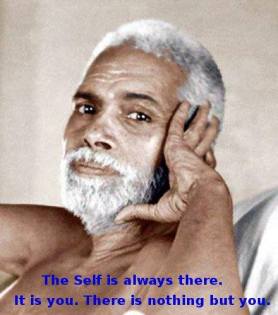
The basic tenet of Advaita-Vedanta is that our original nature, the nature of the Self, is Sat-Chit-Ananda-Nityam-Purnum. Sat means Existence. Chit refers to Consciousness. Ananda means Bliss. Nityam mean Eternal. Purnum means whole or complete.
These are not qualities of the Self but its very nature as One monolithic whole. The Self is One without a second, A Mass of Conscious Bliss that is Eternal and Whole. When we experience the Self, we see that the ancient sages were very precise in describing our nature. It is unmistakable and leaves no room for any thought or doubt. Sages teach us that what comes and goes is not our true nature. What is transient has no permanent power or hold on us.
Although we view our personality as made up of mental traits and thoughts, Advaita teaches us that even our mind and thoughts are transient as they are constantly undergoing change. If our identity is based on mental fluctuations, suffering is the natural result.
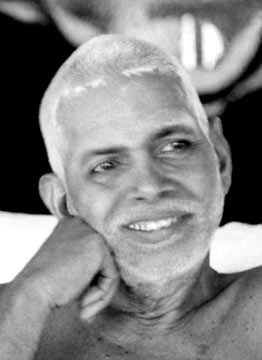
Sri Ramana, the Sage of Arunachala, taught that through reflection, introspection, and self- inquiry, we can see through our mental conditioning, be free of it, and go beyond it.
Then we see that what comes and goes is not our nature.
Here is a conversation with Sri Ramana and a visitor to illustrate this point.
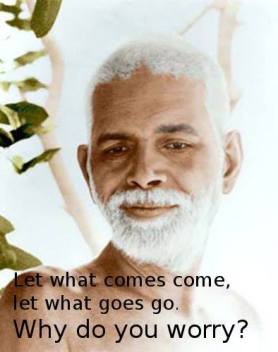
A visitor said: “I suffer from worries without end; there is no peace for me…” Sri Ramana asked: “Do these worries affect you in sleep?” The visitor admitted that they did not.
Sri Ramana asked him again: “Are you the very same man now, or are you different from him that slept without any worry?”
The visitor said, “Yes, I am the same person.”
Sri Ramana then said: “Then surely those worries do not belong to you. It is your own fault if you assume that they are yours.” (From Maha Yoga by K. Lakshmana Sarma).
Solitude is in the Mind
Ramana Maharshi often spoke about the true nature of solitude. He has explained a number of times that silence, peace, and solitude are not a function of our environment but our mental state. Indeed solitude is in the mind and not to be found somewhere outside.
The Self Cannot Be Found In Books
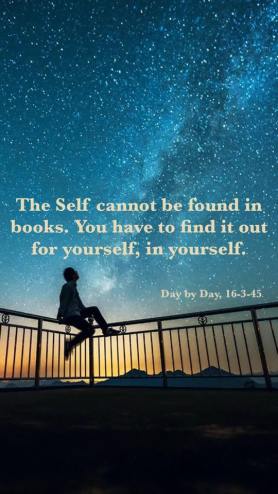
“You may go on reading any number of books on Vedanta. They can only tell you ‘Realize the Self’. The Self cannot be found in books. You have to find it for yourself in yourself.” Bhagavan Ramana in Gems ~ Chapter 8.
Sri Ramana here states the truth directly and unmistakably. No matter how many books one reads, one cannot gain Self-Realization.
Reading, thinking, and conceptualizing involve mental activity. Yet, it is this mental activity that distracts us and covers up the pure essence of being.
It is the mind itself that has to subside into the Heart and dissolve in it. Upon the merging of the mind in the Heart, the Self, recognition of our true nature is instantaneous. With the mind absent as the intermediary, the wordless Realization is immediate. One recognizes and says that “It has been Me all along. I am the Self.”
This recognition is beyond thoughts, words, and concepts. We use the words only to indicate that our real Self stands always Self-revealed.
Bhagavan Ramana teaches that once we become conscious of our power of attention to scan its own nature, we should focus on that.
in the classic quote given at the beginning of the article, Bhagavan Ramana emphasizes the role of deliberate and conscious introversion of the mind by shifting our attention from perceptions to the perceiver via self-inquiry.
OM Shanti!
Namaste
Note: The featured picture is from Mirela Skerbic on Facebook
Nature of the Ego
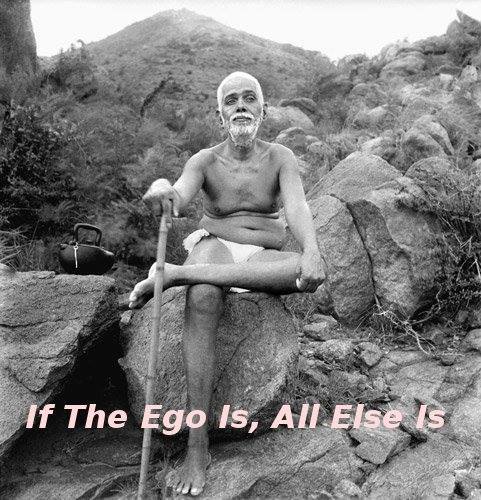
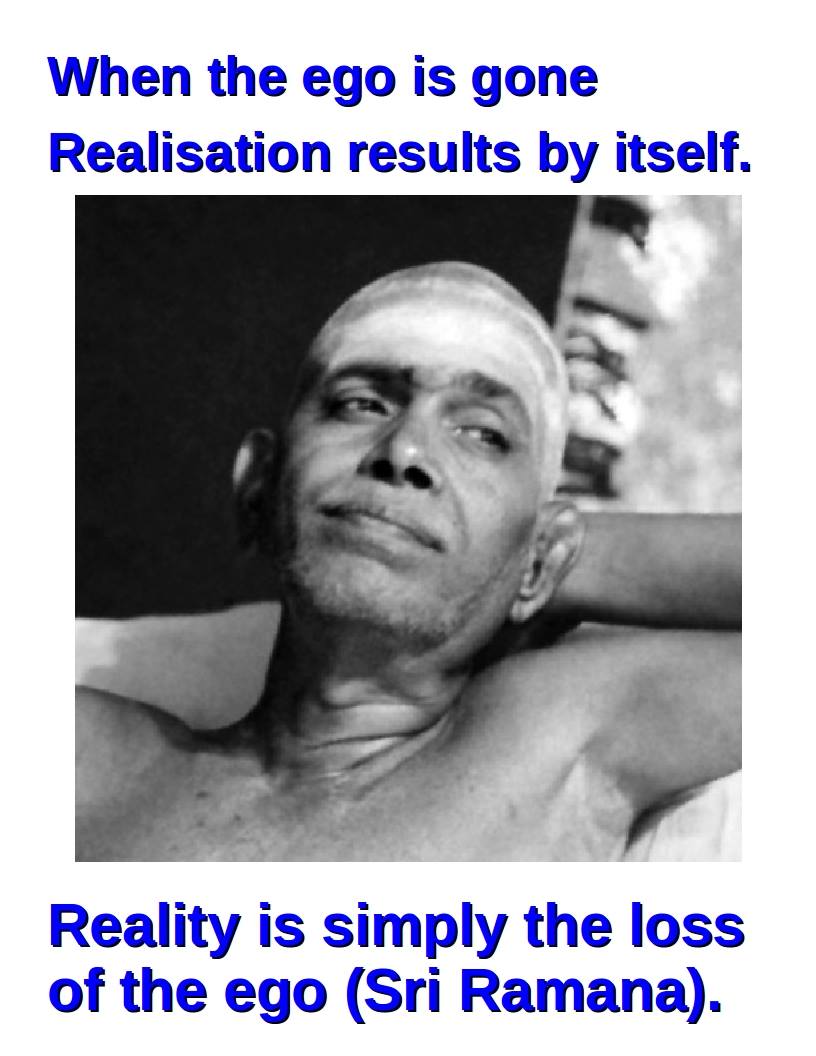
“When the ego rises, all things rise with it. When the ego is not, there is nothing else. Since the ego thus is everything, to question ‘What is this thing?’ is the extinction of all things”.
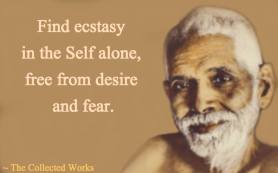
The quote above from Bhagavan Ramana is from ‘Reality in Forty Verses’ (‘Ulladu Narpadu’), v. 26. It can be found in Bhagavad’s “Collected Works”.
Here Bhagavan eloquently points out that one cannot force oneself to give up the ego. The very attempt to discard the ego, is itself based on the assumption of separation from the whole. In other words, the effort to conquer the ego is based on egotism!
Such forced efforts to overcome the ego end up only reinforcing the notion that we are “separate” from the Universal Existence. With such attempts, the nonexistent phantom of the ego appears real in our imagination.
Hence Bhagavan Ramana says, “Question, what is this thing, this ego which manifests as a sense of separateness from the whole”? Where does it come from?”
This inquiry requires us to simply bring our attention to the sense of identity, the sense of “I AM”. It is only by bringing quiet, nonjudgmental attention on the ego, that the ego can be see through as unreal. The method is simple and yet the mind has to be made pure and subtle to grasp it.
Love to all
Namaste
Your Karma Ate My Dogma…Part 3
Mira Prabhu, residing at Arunachala in South India, explains the nature of karma in her characteristic straightforward way that everyone can understand.
Sometime during the mid-90s, at a workshop at Omega, situated in Rhinebeck, upstate New York, I asked Bob Thurman, ex-Buddhist monk and father of the lovely Hollywood star, Uma Thurman, to explain the laws of karma. Bob shrugged and said he didn’t know of any. Much later, when I moved to Dharamsala from Manhattan, I realized how many versions of karmic theory there are—and not just in the Hindu world, but reflected in the four different schools of Tibetan Buddhism.Just for the record, the laws of karma according to my Gelupa Buddhist guru are as follows:
- that karma is definite–meaning that acts that cause pleasure result in pleasure, that acts causing pain bring pain back, while neutral acts have no apparent effect;
- that karmic energy increases exponentially–which means that if you steal one measly rupee, at least four rupees will be stolen from you;
- that one cannot become…
View original post 723 more words


You must be logged in to post a comment.