Harsha's avatar

Viswanatha Swami_ A Hidden Gem: By Murray Feldman

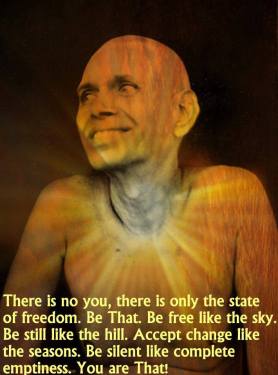
Viswanatha Swami

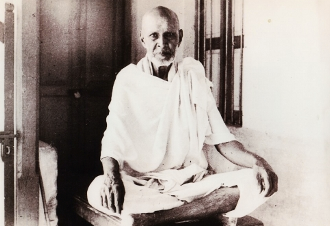
Viswanatha Swami first came to stay with Bhagavan Sri Ramana Maharshi when he was about 19 years old. His father, Ramaswamy Iyer, was a first cousin of Bhagavan.

I had the good fortune to spend considerable time with this great devotee of Ramana Maharishi from April 1976, until he became ill and passed away at 75 years of age on the 22nd November, 1979. How he came to Bhagavan has been written about elsewhere. Here I attempt to show how he exemplified, so wonderfully and devotedly the teachings of Bhagavan. Continue reading

Harsha's avatar

Favorite Ramana Maharshi Quotes – 2

“You are not helping anybody else, but only yourself.” Sri Ramana

Sri Ramana says, “Till you reach the state of jnana and thus wake out of this maya, you must do social service by relieving suffering whenever you see it. But even then you must do it, as we are told, without ahamkara, i.e., without the sense “I am the doer,” but feeling, “I am the Lord’s tool.” Continue reading

Harsha's avatar

Was Bhagavan Ramana An Avatar?

In Hinduism, the term “Avatar” refers to an “Incarnation” of some aspect of God in a form. For example, Rama (from Ramayana), and Krishna (from Mahabharata) are both considered Avatars of the Hindu God Vishnu. In Hinduism, many saints are also considered Avatars by their devotees. In this context,  Sri Ramana was sometimes asked by devotees if he was an Avatar; and if so, of which Hindu God was he an Avatar of? Continue reading

Harsha's avatar

Ramana and the Untouchable Family: By K.S.S. (Ramanadasa)

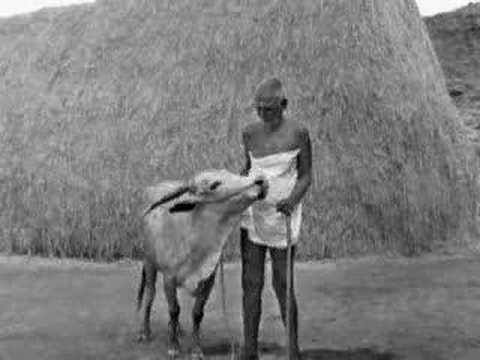
Bhagavan with Lakshmi

When Bhagavan Ramana was living at Skandasramam, I was once alone with him, sitting on the steps leading up to the Asramam. A man came to the gate with his family and stopped there and called out to me.

I went to see what this man wanted. The man asked me to go and ask the Swami (Bhagavan Ramana) whether he and his family could approach Bhagavan and receive his Darshan (Darshan means to be in presence of the Divine or a great saint).

I was surprised at the request and asked the man, “Why do you ask permission?”

He replied, “We are Untouchables.” Continue reading

Harsha's avatar

Is Heart the Seat of the Self? By Dr. Harsh K. Luthar

Dear Harsha,

What is the authority on which Ramana Maharshi says that the Heart is the seat of the Self or that is where the Self is realized. Sri Ramana also says at times that the Self is not physical and beyond the body. It seems like a contradiction. If the Self is the Universal Self and is everywhere, how can it be found in a physical location in the human body. This point is not clear to me. Why do we even need to talk about the Heart? Is it just not another concept that causes confusion.

Seeker Continue reading

Bhagavan Ramana
Harsha's avatar

How To Overcome The Ego? By Dr. Harsh K. Luthar

Bhagavan Sri Ramana used to say that all techniques of meditation and concentration presuppose the retention of the ego/mind. Bhagavan used to joke that employing the ego/mind to overcome the ego/mind is like hiring a thief, who is all dressed up as a policeman, to catch the thief. The policeman will pretend to make herculean efforts to catch the thief, give periodic reports of progress, but will fail each time (since the policeman is the thief!). Continue reading

Harsha's avatar

Gratitude and Divine Grace

Border_25972_217422605374_215886190374_7838220_4877663_n Border_2

   To those who worship Me alone, thinking of no other,
of those ever united, I secure what is not already possessed
and preserve what they already possess. (BG 9.22)

The story below appeared months ago prompting some discussion in the Guruvayur yahoo group in which I am a member. Today is Thanksgiving here in America, and this week we also celebrate Gita Jayanti, or the observance of the gifting of the Bhagavad Gita to the world by Shri Krishna more than five thousand years ago.  As my thoughts turn to gratitude, I am reminded of this story below and the responses it produced in the Guruvayur group, and how important it is to always be grateful to the Lord for everything, knowing that He is our eternal well wisher and that everything happens for our highest good, even the things which which appear to be bad or are difficult to endure…everything means everything.

The focus of the discussion was on what should we ask of God. To what end do we pray, asking for this and pleading for that?  Success in this venture, a new job, a happy marriage, a grandchild, a son or a daughter, a husband, a wife, a handsome husband, a beautiful wife, a nice house, a beautiful house, a mansion, good grades in school, a child who is a doctor or the president of the US?  For what is it that we really seek, when all illusions are cast aside and maya’s veil is lifted?  None of the above!!!

What should I seek from the Lord but the Lord Himself? That by His grace, I should know Him as the very Self in my heart, casting aside the shackles of the body and the solitary confinement imposed by the mind. He promises us, in the Gita, that if we are utterly devoted to Him, thinking of Him only, asking only for Him rather than of Him, He will be ours, and as such, will take care of us as needed.  To understand this, to believe this, in full faith, can only be followed by complete surrender to His will, trusting that whatever happens is indeed His divine will operating to bring us out of bondage to birth and into reunion with Him.

 Border_2
From http://idharudharkee.blogspot.com/2009/07/what-we-should-ask-god.html 

What should we ask of God?

This story from Mahabharata answers this question beautifully and categorically:

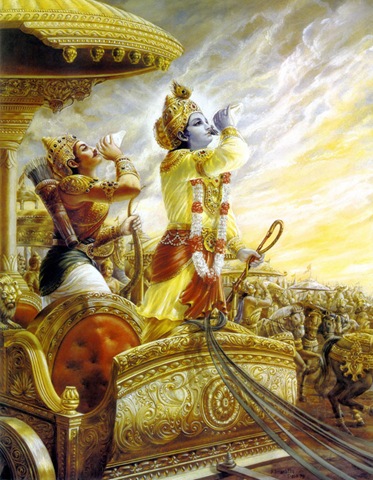
The Great War between the Pandavas and Kauravas was to begin. Arjuna, having pondered, decided to gita-101go to Lord Krishna and ask him for help.
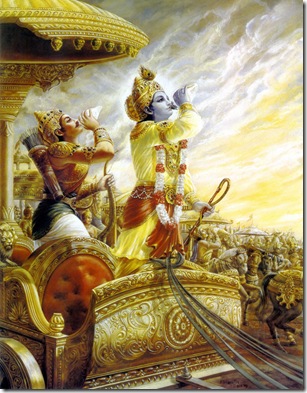
He went to the Lord’s abode and found him asleep.

He stood respectfully at his lotus feet, with folded hands and head bowed in reverence. Duryodana, of the Kauravas, had the same idea of asking Sri Krishna’s help. He too came and, finding the Lord asleep, sat arrogantly in a chair placed at the head of Lord’s bed.

In due course, the Lord woke up. Arjuna, being at his feet, was the first person he naturally saw. As he turned to get up, the Lord’s eyes fell upon Duryodana.

The purpose of their visit was known to Him. However, he asked them what he could do for them.

Both answered that they had come to request his assistance in the ensuing war. The lord said that they had placed him in a difficult predicament by asking for the same thing. He said he could not deny either of them. He said he would offer himself, alone, without armies to one of them and to the other he would offer all his armed forces completely. He said that since his eyes had fallen on Arjuna first, he should have the first choice in the matter.

Arjuna promptly prayed to Sri Krishna that he alone should side the Pandavas.. Duryodana heaved a sigh of relief and requested Sri Krishna for all his forces. The Lord agreed to their requests.

We know who emerged victorious. The moral is “We should ask for HIM, not ask for things He can give us”

If the Lord gives us everything in the Universe but withholds Himself from us, we gain nothing. But if we seek HIM for Himself alone, we get not merely Him but all that is His, too!

abhyaasa yOga yuktEna cEtasaa naanyagaaminaa,
paramam pursham divyam yaati paarthaanucintayan

Meaning: 
He who with his mind disciplined through Yoga in the form of practice of meditation and thinking of nothing else, is constantly engaged in contemplation of God attains the supremely effulgent Divine Purusha (God)  (sloka 8 in chapter 8 of Gita)                                                                       Border_2

And what did Arjuna request?  The Lord Himself.  In his earnest bhakti, he intuited that this was the right choice and it was.  When you ask for the Lord Himself, with utter devotion and humility, how can He deny you?  In the Gita, He makes this promise to His devotees…

ananyaaScintayamtO maam yE janaah paryupaasatE
tEshaam nityaabhiyuktaanaam yOgakshEmam vahaamyaham. (BG 9.22)

To those who worship Me alone, thinking of no other, of those ever united, I secure what is not already possessed and preserve what they already possess.
https://luthar.com/wp-content/uploads/2009/06/bgita.pdf

But those who always worship Me with exclusive devotion, meditating on My transcendental form—to them I carry what they lack, and I preserve what they have. 
http://www.bhagavad-gita.us/categories/The-Gita%3A-Chapter-9/?Page=2

Those who desire My eternal association precluding all else meditate on me with exclusive devotion; those persons I insure the uniting of their individual consciousness with Ultimate Consciousness perpetually.  http://www.bhagavad-gita.org/Gita/verse-09-22.html

Yoga-kesamam, means to provide what they lack and safeguard or preserve what they have. In this context, yoga is said to mean making available what one does not have, and ksema means the preservation of what one already has.  For some, the sloka is interpreted to mean those who recognize the nonduality of the Self, abiding in the Self at all times; for others, this is considered to be a promise from the Lord to take care of His devotees. If we go online, we can find countless articles claiming that the interpretation therein is the right one and that all others are missing the point, thus missing salvation itself!

For me, neither one has the right to claim the other is wrong…it can mean both, one at the level at which we exist as entities in this world of maya, or saguna,  another at the level of the formless nirguna.  The Lord, in His infinite mercy, prescribed numerous paths in the Gita. I am a bhakta. He is my Lord and while I know that philosophically speaking we are indeed nonseparate as it says so in the Gita and in the Vedas, as far as I am concerned, that can only be truly perceived through His Grace.  So, while I am nothing but Him, on another level of worldly perception, this is known and experienced only through the operation of Divine Grace. 

It is so stated in the Mukanda Upanishad 3.2.3:

nāyam ātmā pravacanena labhyo
na medhayā, na bahunā śrutena,
yam evaiṣa vṛṇute tena labhyas
tasyaiṣa ātmā vivṛṇute tanūṁ svām.
(Mukanda Upanishad 3.2.3)

This Self cannot be realized by studying the scriptures, nor through the use of reason, nor from the words of others–no matter what they say. By the grace of the Self the Self is known; the Self reveals itself.   http://www.peterrussell.com/Upi/Mund.php

The Supreme Lord is not attained by reasonings or by vast intelligence, nor even by much hearing. He is attained only by one whom he Himself chooses. To such a person He manifests His own form.  http://bvml.org/SBVPGM/sgt.html

And the Katha Upanishad 2.2.23:

The Self cannot be known through study of the scriptures, nor through the intellect, nor through hearing learned discourses. The Self can be attained only by those Whom the Self chooses. Verily unto them Does the Self reveal himself.  http://booksandphotos.blogspot.com/2009/05/upanishads-kena-and-katha.html

This Supreme Self cannot be reached by argumentation, or by applying one’s independent brain power, or by studying many scriptures. Rather, he alone can achieve the Self whom the Self chooses to favor. To that person the Self reveals His own true, personal form.  http://vedabase.net/sb/10/87/27/en1

The reason I have reproduced more than one translation of the Gita and Upanishad slokas above is that I wanted to read them in several formats for my own benefit and I also wanted to offer the reader the option of seeing it as such. So many ways of saying the same thing.  And so many schools of thought want to say that their interpretation is the correct one and all others false and faulty.  In the end, Divine Grace is the operational catalyst, whatever you deem its source.

So, what should we ask of God? Truly, there is no thing to be asked. There is no thing to be given. How can we give Him what is already His? All we can do is realize, through His grace alone, that we are already His, in every sense that we as mortals can conceptualize in our limited minds! Not only will He take care of everything and look after the welfare of the devotee, He will guide us if we listen. Thus, I do have a prayer…to fully surrender, to listen without fear of the consequences, no matter what He asks me to do. Where it will lead, I have no real idea and no plan of action! He is guiding the chariot now. May I sit quietly and not be a backseat driver. Chitta chora!!!

 Border_2n702126689_1382369_7333 Border_2

Harsha's avatar

Call of the Conch-3-Not for Human Consumption: By Joyce Sweinberg

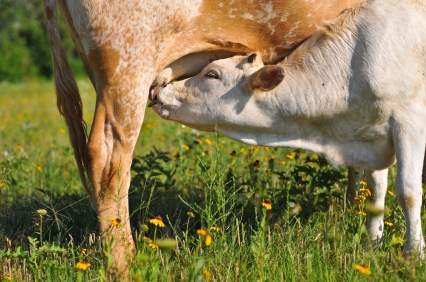
7516calf_nursing

Dairy products in our current industry, worldwide,
foster the very same adverse effects as meat production and consumption, and even worse,
torture the dairy cow and her offspring repeatedly over time prior to the final slaughter.
 

For years, I drank milk and consumed milk products, never realizing that I had milk allergies which were causing my facial rashes and breakouts.  Finally, someone suggested this to me and when I looked it up online, I was shocked to see how many allergies one can have to dairy products.  This was my first step in removing dairy from my diet, for my own benefit.  I was not always true to my vows and would often give in to pizza and on Halloween, would raid my sons’ candy for Snickers Bars, and on other holidays, eat the chocolate which was everywhere.  In the summer months, I sometimes gave into the soft ice cream cones at the corner ice cream stand. And, usually, I broke out but thought it was worth it.

Until I saw some of the videos posted in the earlier parts of this series. When I saw how the dairy cow and her offspring are abused, I could no longer seek out dairy products in any way.   But for some of us, we need to have other reasons than that, so I am including this part to highlight the unknown facts that dairy products really are not that healthy for us or our world, and can cause a multitude of environmental and physical problems.  Many of us operate under the false assumption that dairy products make for healthy bones and this is being proven to be untrue in studies.  The fact is that it is hard for people to give up their false belief systems if it would require them to remove dairy products from their diets.  I have reproduced some excerpts below from online websites along with the link to the actual site for further reading.

Many sites will address the adverse environmental and other effects of the meat industry while including dairy products as a viable alternative to meat.  An honest and  intelligent assessment of the available facts cannot support such a conclusion.  Dairy products in our current industry, worldwide, foster the very same adverse effects as meat production and consumption, and even worse, torture the dairy cow and her offspring repeatedly over time prior to the final slaughter.  The simple indisputable fact is that by consuming dairy products or using them in worship, one is promulgating torture of these defenseless animals, and in the process, violating the foremost principle of dharmic behavior, ahimsa.

Let me add this about myself.  While I now check the ingredients on everything I buy and I will not knowingly purchase anything which contains meat products or animal products or dairy products, I find it is still a challenge to determine whether there is dairy or animal product in what I eat when I am out, either in a restaurant or at a social event. If I am in doubt, and if the product is one which normally has dairy or eggs in it, I will politely decline.

When I am at temple, it is a more difficult position…I can refuse offers of yogurt or payasam or curd rice, or anything which is obviously milk based. But so many of the prasad offerings are laced with dairy or cooked in ghee that it is impossible to tell. I do still partake, asking His mercy and guidance in what I do. And I write this acknowledging that in co-writing this series, I am educating myself as I go along, making some decisions and deferring others as I ponder the solution that will work for me. I offer these writings to you, the reader, in the same spirit.

FROM  PETA…
“Environmental DestructionLarge dairy farms have an enormously detrimental effect on the environment. In California, America’s top milk-producing state, manure from dairy farms has poisoned hundreds of square miles of groundwater, rivers, and streams. Each of the more than 1 million cows on the state’s dairy farms excretes 120 pounds of waste daily.(22) Overall, animals in animal factories, including dairy farms, produce 1.65 billion tons of manure each year, much of which ends up in our waterways and drinking water.(23) The Environmental Protection Agency reports that agricultural runoff is the primary cause of polluted lakes, streams, and rivers. The dairy-products industry is the primary source of smog-forming pollutants in California; a single cow emits more of these harmful gases than a car does.(24)

Eighty percent of all agricultural land in the U.S. is used to raise animals for food or to grow grain to feed them—that’s almost half the total land mass of the contiguous 48 states.(25) Each cow raised by the dairy-products industry consumes as much as 50 gallons of water per day.(26)

Human Bodies Fight Cow’s Milk  Besides humans (and companion animals who are fed by humans), no species drinks milk beyond infancy or drinks the milk of another species. Cow’s milk is suited to the nutritional needs of calves, who have four stomachs and gain hundreds of pounds in a matter of months, sometimes weighing more than 1,000 pounds before they are 2 years old.(27)

Cow’s milk is the number one cause of food allergies among infants and children, according to the American Gastroenterological Association.(28) Most people begin to produce less lactase, the enzyme that helps with the digestion of milk, when they are as young as 2 years old. This reduction can lead to lactose intolerance.(29) Millions of Americans are lactose intolerant, and an estimated 90 percent of Asian-Americans and 75 percent of Native- and African-Americans suffer from the condition, which can cause bloating, gas, cramps, vomiting, headaches, rashes, and asthma.(30) Studies have also found that autism and schizophrenia in children may be linked to the body’s inability to digest casein, a milk protein; symptoms of these diseases diminished or disappeared in 80 percent of the children who switched to milk-free diets.(31)

A U.K. study showed that people who suffered from irregular heartbeats, asthma, headaches, fatigue, and digestive problems “showed marked and often complete improvements in their health after cutting milk from their diets.”(32)

Calcium and Protein Myths

Although American women consume tremendous amounts of calcium, their rates of osteoporosis are among the highest in the world. Conversely, Chinese people consume half as much calcium (most of it from plant sources) and have very low incidence of the bone disease.(33) Medical studies indicate that rather than preventing the disease, milk may actually increase women’s risk of getting osteoporosis. A Harvard Nurses’ Study of more than 77,000 women ages 34 to 59 found that those who consumed two or more glasses of milk per day had higher risks of broken hips and arms than those who drank one glass or less per day.(34) T. Colin Campbell, professor of nutritional biochemistry at Cornell University, said, “The association between the intake of animal protein and fracture rates appears to be as strong as that between cigarette smoking and lung cancer.”(35)

Humans can get all the protein that they need from nuts, seeds, yeast, grains, beans, and other legumes. It’s very difficult not to get enough calories from protein when you eat a healthy diet; protein deficiency (also known as kwashiorkor) is very rare in the United States and is usually only a problem for people who live in famine-stricken countries.(36) Consumption of excessive protein from dairy products, eggs, and meat has been linked to the formation of kidney stones and has been associated with colon cancer and liver cancer.(37,38) It’s also suspected that consuming too much protein puts a strain on the kidneys, which compensate by leeching calcium from the bones.(39)”

http://www.peta.org/mc/factsheet_display.asp?ID=98

FROM A PETA SPONSORED WEBPAGEHarvard School of Public Health, on the Consumption of Dairy Products (2005):

“The recommendation to drink three glasses of low-fat milk or eat three servings of other dairy products per day to prevent osteoporosis is another step in the wrong direction. … Three glasses of low-fat milk add more than 300 calories a day. This is a real issue for the millions of Americans who are trying to control their weight. What’s more, millions of Americans are lactose intolerant, and even small amounts of milk or dairy products give them stomachaches, gas, or other problems. This recommendation ignores the lack of evidence for a link between consumption of dairy products and prevention of osteoporosis. It also ignores the possible increases in risk of ovarian cancer and prostate cancer associated with dairy products.”

Cow’s milk is an inefficient food source. Cows, like humans, expend the majority of their food intake simply leading their lives. It takes a great deal of grain and other foodstuffs cycled through cows to produce a small amount of milk. And not only is milk a waste of energy and water, the production of milk is also a disastrous source of water pollution. A dairy cow produces 120 pounds of waste every day — equal to that of two dozen people, but with no toilets, sewers, or treatment plants.

In Lancaster County, Pa., manure from dairy cows is destroying the Chesapeake Bay, and in California, which produces one-fifth of the country’s total supply of milk, the manure from dairy farms has poisoned vast expanses of underground water, rivers, and streams. In the Central Valley of California, the cows produce as much excrement as a city of 21 million people, and even a smallish farm of 200 cows will produce as much nitrogen as in the sewage from a community of 5,000 to 10,000 people, according to a U.S. Senate report on animal waste.

FOR YOUR HEALTH:  Dairy products are a health hazard. They contain no fiber or complex carbohydrates and are laden with saturated fat and cholesterol. They are contaminated with cow’s blood and pus and are frequently contaminated with pesticides, hormones, and antibiotics. Dairy products are linked to allergies, constipation, obesity, heart disease, cancer, and other diseases.

The late Dr. Benjamin Spock, America’s leading authority on child care, spoke out against feeding cow’s milk to children, saying it can cause anemia, allergies, and insulin-dependent diabetes and in the long term, will set kids up for obesity and heart disease, America’s number one cause of death.

And dairy products may actually cause osteoporosis, not prevent it, since their high-protein content leaches calcium from the body. Population studies, backed up by a groundbreaking Harvard study of more than 75,000 nurses, suggest that drinking milk can actually cause osteoporosis. Find out more by visiting our links page.”

http://www.milksucks.com/index2.asp    

Other resources:

https://luthar.com/wp-content/uploads/2009/11/bookofcompassion2ed.doc

http://www.youtube.com/watch?v=tYpafipJyDE&feature=player_embedded

Nursing calf photo can be found at   http://www.faqs.org/photo-dict/phrase/5743/calf-nursing.html

 n702126689_1382369_7333

Patram pushpam phalam toyam yo me bhaktyaa prayacchati;
Tadaham bhaktyupahritamashnaami prayataatmanah.

If one offers Me with love and devotion of a leaf,
a flower, fruit or water, I will accept it with joy. BG 9.26

b36

  https://luthar.com/call-of-the-conch-introduction/
https://luthar.com/call-of-the-conch-1/
https://luthar.com/call-of-the-conch-part-2/

Harsha's avatar

Njanappaana by Poonthaanam Numidiri-1

 
translation and commentary by Smt. Savitri Puram 

      duzvdh4anypjffvi_D0_guruvayurappa

Krishna! Krishna! Mukunda! Janaardana!
Krishna! Govinda! Naarayana! Hare!
Achyuthaananda! Govinda! Maadhava! 
Sachidaananda! Naarayana! Hare!

Introduction

Njanappaana can be considered as the Bhagavad Gita of Malayalees. This is a Darshanika kaavyam or philosophical poem expressed in the most simple Malayalam language for ordinary people. Poonthanam Nambudiri, an ardent devotee of Shri Guruvayurappan, transformed his unbearable sorrow from his infant son’s death into a “yogavishesham”. He used this sad experience to build his Bhakthi soudham or house of devotion and opened it for all devotees for all time. Even though the language is very simple, this njaanappana, or song of wisdom deals with the essence of all vedas and upanishads. May Bhagavan Guruvayurappan, Bhagavathy Sarswathi Devi and Sri Poonthaanam Nambudiri bless us to become wiser by going through this great Song of Wisdom!!boarder

Gurunaadhan thuNa chaika santhatham thirunaamangal naavinmel eppozhum
Piriyaatheyirikkanam nammude nara janmam saphalamaakkiduvaan

May my Gurunathan help me (thuna chaika) to keep the auspicious names of Lord continuously on my tongue (naavinmel eppozhum) and to make this human life (narajanmam) meaningful and fruitful!(saphalamaakkituvaan).

The only way to to make the human life fruitful and meaningful is to constantly chant the auspicious names of Lord. So, the poet is seeking the blessings of his Gurunaathan to help him retain the naamam on his tongue for ever. Who is Poonthanam’s Guru?  He is considering Guruvayurappan as his Guru because Lord is both the remover of the darkness of Anjaanam or avidya (Guru) and the protector and saviour of all (Naathan). After innumerable births in lower species,we finally got narajanmam in Kaliyuga. Kalisantharanopanishad and many other scriptures reinforce the importance of naamasankeerthanam in Kaliyuga. Naamasankeerthanam can be done any time anywhere.

Innaleyolam enthennarinjeela Ini naaleyum enthennarinjeela
Innikkanda thadikku vinaashavum Inna neramennaethumarinjeela

We really do not know what happened until yesterday or what would happen tomorrow. Neither we know when this body we see today will perish.

When we look at the literal meaning, we may feel like responding: “I know what happened until yesterday and I can roughly guess what will happen in the coming days. I am hail and healthy and unless I get into an accident or so I should be able to live many more years”.

Poonthaanam is putting his forefinger on his nose with an expression of “what a pity?” because he meant much more than the literal meaning of yesterday, tomorrow and our present body. He persuades us to think deep about the uncertainty of life. Yesterday and today also means previous janmaas and future janmaas. We do not know about our previous janmaas or good and bad karmaas we have accumulated. A great part of our good and bad experiences in this janma is the direct result of our past karmaas. We cannot undo the sins or suffering by anything other than sincere prayers. Bhagavaan is the only one who can change the results of our praarabdha karmaas and in Kaliyuga, naamasankeerthanam pleases Bhagavan more than anything. We do not know what is in store for us tomorrow. How can we make sure that our future is in safe hands? Only by offering ourselves in His strong and kind hands. Then what about today? At present we live in this body and the moment jeevathma leaves the body, it becomes lifeless like a log of wood. We have absolutely no idea when that will happen. Here Poonthaanam used the word “thati” for body to specifically tell us that body is like a log of wood or worse than a log of wood when it is lifeless. A dead body that is not preserved starts deteriorating in a few hours where as a log of wood may remain intact for several months or even years. Poonthaanam advises us to think deep about these truths and use every moment available to worship Lord with naamams. Chaitanya Mahaprabhu also said that there are no hard and fast rules for chanting naamaas. Anytime one can chant and under any circumstances one is allowed to chant. “Shuchir va ashuchir va sarva avasthaasu sarvada” meaning in any condition clean (purified) or dirty (impure) one can chant the auspicious names of Lord.

Kandukandangirikkum janangale  Kandillennu varuthunnathum bhavaan
Randu naalu dinam kondorutthane Thandiletti nadathunnathum bhavaan
Maalika mukaleriya mannante Tholil maaraappu kettunnathum bhavaan

If Bhagavan wishes, those people whom we see today may disappear (may be dead) by tomorrow. Again if Bhagavan decides, with in a few days (two or four days) a healthy man’s dead body may be carried to the funeral pyre. In the same way, by God’s wish, a king sitting in a palace (maalika) can become a beggar with a dirty bag (maaraappu) hanging from his shoulders (tholil).

Poonthaanam explains how transient is our life, wealth, poverty, sorrows and everything that we see in this world. A man walking and having fun this moment can embrace death the next moment. Everything is Lord’s wish! In Kerala, usually a dead body is tied to a wooden ladder or a piece of long wood and carried by relatives (normally by sons) to the funeral pyre. However hail and healthy one may be, when the time decided by Lord approaches, chaitanyam or jeevan disappears leaving the dead body to be carried to the funeral pyre. It can happen any time, in one day, two days or four days (randu naalu dinam kondoruthane). Here Poonthanam used the word “mannan” for king (mannante) because “mannan” also means “drushtan” or “aviveki”. He advises that those people who have money and power should have the vivekam to use both dharmically remembering that they came to this world with nothing and would go from this world with nothing. Bhagavan can take it any moment from anybody.

By Lord Krishna’s blessings, Kuchela or Sudama became wealthy overnight. What about Ravana? He lost everything that he held dear and finally he lost his life too at the hands of Lord Rama. Even if we are destined to go through sufferings due to our past karmaas, surrendering to Lord will lessen the negative effects and lead us to Satgathi. “Bagavan says in Gita: “na hi kalyaanakruth kashchid durgathim thaatha gacchathi” meaning “If you do good, it will definitely lead you to satgathi or protect you from any harm”. Poonthaanam tells this truth from his own experience of the tragic and sudden death  of his infant son.

I have heard several versions of the story. But the following is the one I heard from my parents. Poonthaanam’s son was 5 months old and anna praasham (giving rice for the first time is called “choroonu” in Malayalam and usually it is done either the 5th month or 7th month ) ceremony was fixed. He invited several relatives and that morning after feeding the baby his wife made a bed in the room next to the hall where the ceremony was to be conducted. Usually there will be an entrance to that room from the kitchen also. Baby was sleeping and his wife was busy with all the preparations. It was morning and one namboothiri lady finished her bath and put the wet clothes in the same room where the baby was sleeping. That room was dark even during day time and she did not see the baby and unfortunately wet clothes were put on the baby’s face. ( I can very well believe this because in my house, there is a room on the north side called Vatakkini which is very dark even in day time. So when our parents told us this story, we listened with tears in our eyes and we felt it could happen in any Nambudiri house.) Then the next lady came after bath and seeing the wet clothes in a corner she also put hers on the top of it. One after another a few ladies unknowingly put wet clothes on  and around the baby. Nobody noticed and it was about muhurttham time and Poonthaanam asked his wife to bring the baby. She was shocked to see what happened to her helpless baby and we can imagine the rest.

This sorrow gave birth to Njanappana and Poonthaanam advises us to realize the uncertainty of everything in this world and persuades us to think of God by continuous chanting of His auspicious names.

Kandaal ottariyunnu chilarithu Kandaalum thiriyaa chilarkkethumae
Kandathonnumae sathyam allennathu Mumbe kandangariyunnithu chilar

Some people see this truth, understand it or internalize the truth. But some people cannot comprehend the truth even when they see it everyday. But there are some others who know that all that they see are not real and it is all Maaya.

Here Poonthaanam divides humans into three categories. Utthama purushaas (or wise people or perfect human beings) are able to understand the transient nature of this world. People like Shankaraacharyar, Sreeraamakrishna Paramahasar are examples who belong to this category. Then there are Madhyama purushaas (or reasonably wise people) who understand it when they themselves or people near, dear and around them experience the ups and downs of life. Then the third category of people known as Adhama Purushaas (people with low level of wisdom) do not understand or even do not have the attitude to think more about it even if they or their beloved ones go through the negative as well as the positive experiences including successes, death, suffering and disease. Yudhishtira Maharaj says to the Yaksha who asks ” what is the biggest wonder in the world?”

Even though everybody who is born embraces death eventually, the living people refuse to believe that death will eventually embrace them also. What is more surprising than this? Even though we see it everyday we live as if death is only for somebody else.

Again Poonthanam indirectly tells us that only with Bhagavan’s blessings we can have this vivekam or power of discrimination. So we should pray Bhagavan to include us in that category of few people (the word “chilar” indicates that these kind of people are rare) who are capable of seeing the truth. In this Kaliyuga, the most doable form of worship is naamasnakeerthanam and he encourages everybody to chant auspicious names to purify our mind and elevate ourselves from the state of Adhama Purushas to the state of Uttama Purushas.

Palarkkum ariyenam ennittallo
Pala jaathi parayunnu saasthrangal

Many people (palarkkum) want to know (ariyenam)about all these (including the power of discrimination of human beings, about the mystery of God, how to go beyond Maya and attain salvation etc) and hence so many saasthraas (saathrangal) tells (parayunnu) about or explain these subjects in so many different ways (pala jaathi).

Which saasthra or which philosophy appeals to each one depends on each individual’s nature, attitude and circumstances. Some people like certain approach whereas others like a totally different approach. Saathraas contain so many different philosophies to satisfy the varied interests of ordinary people. Just like we all choose different professions or jobs for the sole purpose of survival, different people accept different saasthraas to advance spiritually and increase the awareness of parmaathma chaithanyam or God. There are Vaishnavaas, Shaivaas, Shaaktheyaas or another group who worship all 33 million gods alike etc. Goal is the same and only paths are different. There is a saying that “vitthamaeva param nrunaam janmaachaarakalodaya:” meaning people choose different ways and methods for the sole purpose of acquiring wealth.

Outwardly each and every philosophy may appear different, but once the essence is understood, the differences slowly disappear and all the paths unite to become one path. The word Saasthraas (saathrangal) is used because they advise to follow certain restrictions and rules to advance smoothly in the spiritual path. How is it possible to choose the right path and who will guide us through? Poonthanam has only one solution: chant the auspicious names of God and He will guide us through the right path.

Karmathiladhikaari janangalkku
Karma saasthrangalundu palavidham
Saankhya saasthrangal yogangal enniva
Sankhyayillyathu nilkkatte sarvavum

For those people (janangalkku) who are authorized to do karmaas like yaaga or yanja, homam, poojaas etc (karmaathil adikaari- it can even mean those who desire to do karmaas or those who are entrusted with the duty of performing karmaas) several different (palavidham) karma saashtraas are available (karma saasthrangalundu). Saankhya saasthra, yoga saasthra etc are among the innumerable or countless(sankhyayillya) saasthraas available. But for the time being, let us keep aside ( nilkkatte) all of them (athu sarvavum)

Just like the diversity of the world and its inhabitants, saasthraas also are diverse. Different types of yanjaas, poojaas, and homams are described very clearly in many scriptures. Initially even though devotees perform them with some specific desire, as the Bhakthi bhaavam matures, Bhagavan’s blessings help them to do Nishkaama karma or do karma with out expecting anything in return. There is a small conversation between Jabali Muni and a vartthaka or business man called Thulaadhaara. Even though Jabaali Muni was an embodiment of kindness, he was proud of his achievements and considered himself as the greatest Dharmishttan. Then he heard an ‘ashareeri” or wise words from God to visit Thulaadhaara. He visited him and Thulaadhaara explains to him how we all should do our swadharmam with out expecting anything in return. Thulaadhaara told him that Yanjaas and poojaas are done to show our gratitude to God, Forefathers, Rishis and other Maahaathmaas for what blessings they  have already bestowed on us. Renunciation of the results of the karma is nishkaama karma  and Nishkaama karma purifies our mind. God’s chaithanyam gets reflected only in pure minds.

Maharshi Kapila’s Saankhya philosophy regards Universe as consisting of two eternal realities Purusha and Prakriti. Pathanjali Maharshi’s yoga saasthra describes different types of yogas like Hatha yoga, Raja Yoga etc. They all lead one to the knowledge of Brahmam, but those paths are very difficult and with out an able Guru (in every sense of the word) it is impossible to follow those paths. But in this Kaliyuga, Bhaktha Kavi Poonthaanam advises us to set aside those difficult paths (which are as sharp and dangerous as the edge of a razor) and follow the most simple and enjoyable path of Bhakthi or devotion. What is the first and final step in the path of devotion? Naamasankeerthanam. Bhakthi starts with Naamam and ends with Naamam. It is for ordinary people as well as for self realized souls. No question of whether you are authorized, whether you have enough knowledge to pursue or whether you have the right comes into question in this way of worshipping Lord. Anybody can do naamajapam, anytime, anywhere. 


Krishna! Krishna! Mukunda! Janaardana!
Krishna! Govinda! Naarayana! Hare!
Achyuthaananda! Govinda! Maadhava! 
Sachidaananda! Naarayana! Hare!

Part One…To be continued…

boarder

Harsha's avatar

Goddess As The Guru In Tripura Rahasya

Sri Sri Anandmayi Ma

The classic Goddess scripture Tripura Rahasaya is well known to Sanskrit scholars and now a number of translations exist in English.

Bhagavan Sri Ramana Maharshi often quoted from Tripura Rahasya and considered it one of the greatest works that expounded Advaita philosophy. Bhagavan’s close devotee Munagala Venkataramaiah (later known as Swami Ramanananda Saraswathi)  translated Tripura Rahasya into English in 1936. That was the first translation of this classic, I believe. A number of Sanskrt scholars since then have made their own translations into English.

In many Hindu scriptures like Tripura Rahasaya, the ultimate Guru is Devi, the Supreme Goddess.  She gives instructions to the sages so they can know the highest truth of Reality and attain Self-Realization.

In the path of Tantra, the sciences explaining the mystery of mantra, mind, and breath are explored and explained. Tantric texts focus on the nature of the divine energy within the body, also known as Kundalini Shakti, that moves through the chakras (centers of power) giving rise to various super-conscious experiences and leads to Samadhi.

When the aspirant is spiritually mature,  the Shakti, the Supreme Goddess Herself, takes and merges the mind of the devotee in the Heart and then reveals HerSelf to be the Heart. Then there is no more Goddess or devotee and the universe disappears.

Eternal Bliss as Self-Revelation, the very essence of Beauty, remains as ItSelf. That is what the ancients called Sat-Chit-Ananda. The One without a second. That is the Self. That is Brahman.