Harsha's avatar

Call of the Conch-Introduction: By Joyce Sweinberg

5732_216453855374_215886190374_7808618_1259315_n
“We need to challenge our age old habits and tradition
if they are in direct contrast to the principles of
non-violence and dharma laid down by Sri Krishna in Gita.”

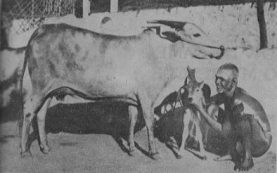
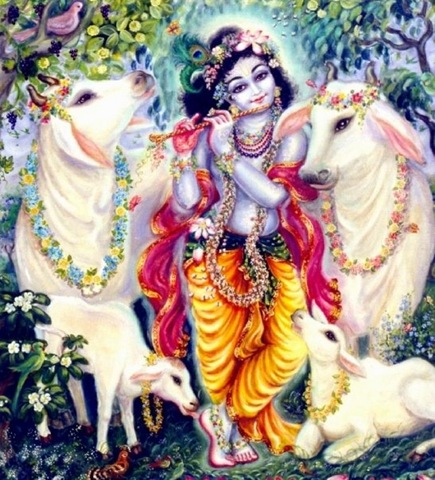
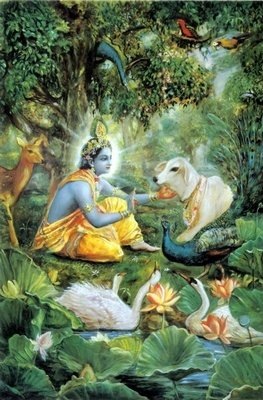
Lord Krishna is also known as Gopala, or protector of the cows. His love for and relationship with the cows of Vrindavan forms a major part of His transcendental past times.  Among the artwork depicting His holy image, there are just as many showing Him with His beloved cows as there are images depicting Him with His beloved Radha and the gopis.  As Giridhara, He lifted the mountain of Govardhana to protect the citizens and the cows from destruction.  When He played His flute, the cows were there, His most ardent audience.  When He wanted to eat, the cows were there, His most willing suppliers of milk and butter.  When He wanted affection, the cows were there, His most unselfish companions, wanting nothing from Him but His caress and His embrace, which they freely returned.  And so, it is not surprising that from these stories and for other reasons, the practice of offering Him prasadam made with dairy, and bathing His image in milk developed and took hold as the cornerstone of devotional rituals.

At abishekam, a devotional service, the offering of milk is one of the most common items donated by devotees.  Sometimes mixed with honey and other items, the milk is poured onto the deity and flows freely and amply throughout the ritual, allowed to drain into metal bowls, collected and then poured back into the bottles for the devotees to take home, now blessed by the Lord.  A small vessel is also passed around the room, with each of us given a small spoonful to drink the blessings of Divinity. Food is also offered to the Lord for prasadam and usually contains milk and ghee, a form of clarified butter.  After the puja is complete, the food is shared by devotees partaking of the Lord’s blessings, gathering together in the sangha of God’s worship.

What appears as a charming expression of devotion now has lurking behind it a vile abuse of this most sacred creature of the Lord, both in India and here in America, knowingly perpetrated by the suppliers of the dairy products and unwittingly financed by the Lord’s devotees.  While I converted to a vegetarian diet years ago, I continued to include some dairy in my diet, although very limited due to my developing concern with ahimsa and allergic skin reactions.  But I continued to accept the prasad, I continued to pour the milk when the occasion arose and I relished the sweets and the wonderful Indian cuisine so freely shared where I worship. I told myself that any hesitations I had should be quashed within myself because these were offerings to God and had been blessed and cleansed of any sins committed in their procurement. Lately, though, I was becoming uneasy about it, but not voicing my thoughts and not knowing quite how to voice my developing uncertainty over the source of these offerings.
6129_121115465189_753070189_3399602_3278962_n

Until recently, when Kamleshji, another devotee on a bhakta forum posted a message directly confronting this subject, and ripping open my cloak of uncertainty to the naked truth that cannot be denied if one looks with one’s eyes open, if one hears with one’s heart and if one thinks with one’s conscience. From his post and subsequent communications from him, I quote a few lines below…

“….as devotees of Lord Sri Krishna we must definitely pay attention to the plight of His most beloved animal, the Cow (Go-mata).

Just recently on Sri Krishna Jayanthi, we bathed Lord Sri Krishna in milk, curd, ghee and offered Him His favourite naivedhyams such as paal payasam,  ghee and butter.

However we must be aware how this milk is obtained in this Kali yugam, especially where milk is obtained in commerical farming techniques (as in big cities in India and especially here in the US).  Before this exploitative factory farming age, our saints used to procure Milk products in harmony and without cruelty, the milk was taken from the cow only after the calf has had it’s fill and the cow was worshipped as Go-matha.  Such offerings are certainly pleasing to the Lord.

However in the present age,  factory produced milk is a very cruel exploitative product of torturing cattle. The poor cows are  enclosed in a tiny space, chained in its own waste in darkness, cold and filth for the rest of its life. It is pumped with insane amounts of hormones, and other toxic medications to artifically increase milk production.

These large amounts of hormones, antibiotics and other unnatural feed, cause the cow to grow large and make it prone to bone fractures and other very painful diseases. To add to this torture the cows are artifically inseminated to produce calves to ensure regular supply of milk.

The most unfortunate of the calves are male calves  (called Bobby calves) who are considered to be useless and are sold off to be butchered for meat when they are just five days old. The mother cows separated from their calves cry in agony, yet they are not spared and are administered more hormones to continue milking them.

After milking the cow till it has been exhausted and after ensuring that the cow cannot yield anymore milk, it is sold off to be slaughtered in the most brutal manner for meat and leather.  I request all bhaktas to please think about this, will our Lord ever accept our abhiseghams and Naivedhyams if it means that His favourite innocent animals are killed slowly and extremely painfully all their lives?  Let us not act in an adharmic manner and perform unthinkable atrocities and sins by offering factory produced milk and milk based products especially in our sacred rituals and also in our diets. I can only be certain that we shall never suceed in our sadhana if it causes so much needless pain for innocent animals.

Lord Sri Krishna, vividly describes the three types of foods, Sattvic, Rajasic and Tamasic. Milk in the olden days was definitely Sattvic however now it is 100% Tamasic due to the abundant violence and abuse it entails. Drinking such milk is equal to eating beef.  In fact the animals raised for meat do not have to suffer so much as these unfortunate dairy cows are made to suffer.

We cannot afford to fool ourselves into believing that just because we are vegetarians and do not eat beef, we are protecting the cows. We need to challenge our age old habits and tradition if they are in direct contrast to the principles of non-violence and dharma laid down by Sri Krishna in Gita.”
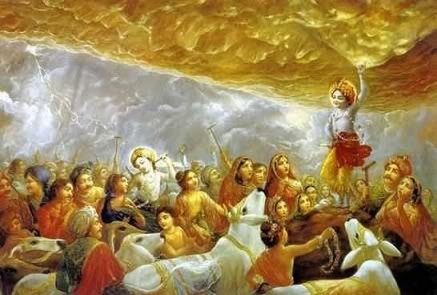
govardhanagiridhari

His post prompted me to respond to him and to also go online to view some of the websites which I knew would show me the truth, as painful as it might be to watch and to listen. I am now convinced that I must be even more vigilant in my avoidance of all dairy products where I do not know the source.  I will also post several more blog entries examining this subject in more detail, in the hope that each of us can look more honestly into our hearts about what we put into our mouths and onto our bodies, and onto the Lord.

The Luthar.com blog already has several articles on the subject of vegetarian diet…this short series is specifically examining the vegan diet.  We will look at ahimsa as the foundation for a vegan diet, the economic incentives fueling the abuse, the ways in which the dairy cows are abused, including their offspring, and how they are slaughtered in the end. We will examine the human health consequences of ingestion of dairy products and the environmental effects of the mass procreation of cows for human consumption.  We will explore the organic industry as well. We will post photos and links to videos so you can see for yourself what is happening to the dairy cows.  We will also post links to organizations geared to helping the abused cows and offering alternatives to the current system.  We will offer suggestions and ideas on how to substitute other products in our diet and in our worship. We ask that you the reader examine the facts with an open heart. Together with Kamleshji, who has studied the subject extensively and speaks with eloquence and fortitude in His devotion to the Lord on this subject, I will continue to post, seeking His blessings and inspiration.

Today is Ganesh Chaturthi and I take this opportunity to post the first in this series on this day with this prayer…that I serve the Lord without reservation acting as best I can on His wishes, and that I open my mind and my heart enough to let Him speak through me as He guides me.  Ganesha Saranam!

n702126689_1382369_7333

Patram pushpam phalam toyam yo me bhaktyaa prayacchati;
Tadaham bhaktyupahritamashnaami prayataatmanah.

If one offers Me with love and devotion of a leaf,
a flower, fruit or water, I will accept it with joy. BG 9.26

 b36

Harsha's avatar

Lobsters and Crabs Feel Pain

Research to be published in two journals focusing on animal behavior suggests that virtually all animals, including lobsters, crabs, fish, shellfish, and insects, can suffer.

Chris Sherwin, a senior research fellow in the Clinical Veterinary Science division at the University of Bristol, commenting on the study told Discovery News, “The question of whether invertebrates experience pain is fundamental to our legislation that protects animals and our behavior, attitude and use of these highly complex organisms.”

Lobsters and crabs feel pain, study shows – Discovery.com- msnbc.com

Harsha's avatar

Ecology and Vegetarianism in Jain Dharma: By Pramoda Chitrabhanu

http://www.jainmeditation.org/pages/pramoda.html

Pramoda Chitrabhanu

Jain Meditation International Center

New York City

Ecology and Vegetarianism in Jainism

Taiwan Nov. 3-7 2007

Today, the global ecological crisis that is threatening the entire human race is becoming a matter of grave concern for all of us and especially for those who are conscientiously aware.  For those who are not aware they forget one thing and that is when one life is threatened, all life is at risk.  It is important to know that each of us is a vital thread in another’s life tapestry and our lives are woven together for a reason – survival and to be happy.

Jain Dharma sees the whole universe as a great cosmic mechanism with its own self-propelling force, and we being a part of that mechanism, the religion teach us to conduct ourselves in harmony and in rhythm with the rest of the life force.

In the manifestation of nature we see there is harmony and rhythm. Everything works according to its nature. But when we look at ourselves we do not see our lives in agreement with the cosmic mechanism. We are out of sync with nature and tend to go against our qualities of love, compassion and friendship for all living beings.

We do not realize that we are interrelated and bound together by mutual support and interdependence with all life force. Each living thing depends on another for insuring its survival. We cannot live a single day without the help of others. Therefore, it is important to know that all life is a gift of togetherness, accommodation and assistance which lead to mutual peace and harmony. This fundamental natural phenomenon of symbiosis or mutual dependence forms the basis of modern day science of ecology.

It is relevant to know that the term ‘ecology’ was coined from the Greek word ‘oikos’ meaning home, a place to which one returns. In 1866 Ernst Haeckel, a German biologist and a philosopher, defined it as a comprehensive science of relationship of organism to environment. This term covers the conditions, circumstances and influences surrounding and affecting the development of an organism or groups of organism, exclusive of their hereditary traits.

Today, the problem of global ecological crisis is due to the ecological balance that has been wildly disturbed by our present day lifestyle, particularly by the wanton destruction of the animal and plant life in the civilized societies.

Have we ever wondered how so many invisible lives have made our single day livable and comfortable? How the microcosm is connected to the macrocosm and the macrocosm to the microcosm? How we are indebted to everything that assists us?

In the words of Nathaniel Altman, who depicts a better picture of interdependence, “Grass, for example, provides nourishment for millions of tiny invertebrates, which in turn are food for insects. The insects are eaten by frogs and small snakes, which provide nourishment for birds. When the larger animals die, they provide food for other living things, and as they decompose, they fertilize the soil on which grass is grown. When this “food chain” is disrupted, the very fiber of life on this planet is affected. As with a house of cards, the removal of one card can bring about the collapse of the entire structure.”

Being on the top of the ladder of evolution, we have learned to take things for granted and in the process have lost the sensibility and sense of appreciation and gratitude.

Many of us like to believe that our life is experienced in isolated, watertight compartments and that the way we conduct our daily affairs does not have a significant impact on the society and the world we live in. But we must not forget that just as a stone thrown into a pool will affect every molecule of water in the pool, in the same way our every thought, word and action will affect our inner and outer world. Therefore, it is important to know that what we do — to the life around us and the environment — becomes our fate.

Lord Mahavir the 24th Tirthankar (path finder) of this era for the Jains lived in 599 – 527 B.C. experienced that the thoughts which govern our words or actions are the products of the food we eat. The food that feeds the system has a definite influence on the person physically as well as emotionally, psychologically and also spiritually. Healthy, whole and harmless foods give rise to healthy, whole and harmless thoughts. Once the thoughts are harmless and healthy, the actions also reflect the same qualities. Weakness in character develops in those who are in poor health, mentally or physically. So, it is rightly said that we are what we eat.

If we take this into consideration and adopt a plant based diet we can save approximately 2400 animals in our life time and stop them from going to the slaughter house.

Believe it or not, if you take just the Americans, they consume 9 billion animals every year. If one wants to, one can change this every time one sits to eat.

The practitioner of Jain Dharma practices Upayoge Dharma (religion of awareness) through its code of conduct. There are five basic vows in this code of conduct that strengthen our practice of environmental concern and protection of all life forms.

The five vows are:

* non violence in thought, word and deed,

* seek and speak the truth,

* behave honestly and never to take anything by force or theft,

* practice restraint and chastity in thought, word and deed,

* practice non- possessiveness.

As in the words of Christopher Key Chapple, “The Jains vows can easily be reinterpreted in an ecological fashion. The practice of nonviolence in the Jain context fosters an attitude of respect for all life -forms. The observance of truthfulness prompts an investigation of the interrelatedness of things; a truthful person cannot easily dismiss the suffering caused by uncontrolled waste. The vow of not stealing can be used to reflect on the world’s limited resources and prompt one to think of the needs of the future generations. Sexual restraint might help minimize population growth. The discipline of non-possession gives one pause to think twice before indulging in the acquisition of material goods, one of the root causes of current ecological concerns.”

With this awareness we can live a non-violent life so that we may incur minimum of negative karmas by our actions that are the cause of our suffering. But often we live an unaware and unknowable life during which we become callous and insensitive to the surroundings, causing much destruction to the animal world and nature by our need to satiate our palate and purse.

The depletion of the natural resources, environmental crisis, global warming, ecological imbalance, and annihilation of innumerable life forms are our responsibility. They help us to live and we destroy them for our food, clothing, entertainment, medicine, and luxury and material possession. This way by abusing and exploiting the living lives and the environment, we abuse and destroy the gentleness of our soul.

Do You Know?

* To produce 1 lb of meat, an average of 40lbs of vegetation is used.

* 12 lbs of wheat produce 12 loaves of bread and only 1 hamburger.

* It takes 3.25 acres of land to produce food for a meat eater on a continuing basis, while it takes 1/3 of an acre for someone eating a diet of plants, eggs and dairy and 1/6 of an acre for a person eating totally plant based diet (vegan).

* A University of California Study shows that to produce 1 lb of meat it takes an average of 2,500 gallons of water, it takes 966 gallons of water to produce one gallon of cow’s milk and on the other hand plant foods such as wheat, apples etc. takes 20 to 50 gallons of water to produce one pound of food.

* Eating food crops first hand produces a tremendous energy savings. To produce one pound of protein derived from beef requires 20 times as much fossil fuel energy as the same one pound of protein derived from corn or wheat. Protein from beef requires 40 times more fossil fuel energy as the same amount of protein derived from soybeans.

* The waste released in the atmosphere by the U.S. Meat and Dairy Industry is 230,000 pounds per second, thus polluting earth, air and water systems.

* It is estimated that it takes 75,000 trees to print a Sunday edition of The New York Times for the readers.

These staggering numbers is a wake up-call for us to make a difference.

Human Welfare

* Twenty vegetarians can be fed on the amount of land needed to feed one person consuming a meat-based diet.

* If America reduced their intake of meat by 10 percent, 60 million people can be adequately fed by grain saved.

* A cow has to eat 7 lbs of grain and soy bean protein to produce 1 lb of meat protein. If the same land were to produce food for humans directly, 7 times more people could eat.

* More than half of all the water used in the United States is used in live stock production that can be used where there is water shortage.

When we become aware of these facts and change our lifestyle and go vegetarian we can increase the amount of grain available to feed people elsewhere, reduce pollution, save water and energy, cease contributing to the clearing of forests and the most important we can save thousands of living creatures from torture and pain.

The core teaching of Jain Dharma is Ahinsa and so all of its 10 million followers are vegetarians, consuming neither meat, fish, fowl, poultry nor eggs. Jains would not take any life for food or sport.

But today many have gone one step forward and have also given up all dairy products and call themselves Vegan – who live on plant based diet, so exclude flesh, fish, fowl, dairy products such as animal milk, butter, cheese, yogurt etc. eggs, honey, animal gelatin and all other items of animal origin.

The dairy cows have become milking machines for human beings. The cows are kept pregnant every year for a consecutive 9-10 year period by artificial insemination. As soon as the cow stops yielding milk, she is dragged to the slaughter house for beef meat. Poor calves are forcefully dragged away from their mother, depriving them of their mother’s milk that is rightfully theirs. They are fattened by hormone injections and kept in dark sheds away from sunlight in oppressed conditions, preparing them for veal meat. Ultimately this becomes the fate of the cows and calves!

How can we be at peace if we are causing pain and suffering to innocent living beings? The quality of our relationship with each other and the world is primarily based on our level of self- understanding. As we want to be happy, all life wants to be happy. So, by making the right choices, life will result in right consequences.

In this way a non-violent approach to life through ecology and vegetarianism enables us to express our reverence for all life forms including ourselves – from the minutest micro-being to the macro- being, from the lowest developed consciousness to the highest developed consciousness.

To sum up this, let me quote Lord Mahavir who expressed it succinctly:

“One who neglects or disregards the existence

Of earth, water, fire, air, vegetation and all other lives

Disregards his own existence

Which is entwined with them?”

Harsha's avatar

Bhagavad Gita and the Sattvic Diet: By Dr. Harsh K. Luthar

img_2719

Sri Ramana used to say that of all the yogic rules and regulations, the best one is taking of Sattvic foods in moderate quantities. This view is consistent with that expressed in the Bhagavad Gita, and indeed most of the Yoga Shastras.

The logic is that since food consumed has a major effect on the body and the mind, a Sattvic diet should be adhered to in order to enhance both the health of the body as well as purity, strength, and calmness of the mind. An agitated person will find it difficult to sit quietly and meditate.

A disciplined and one pointed mind is an aid to ones’ learning and education as well as having success in business and other worldly affairs. A clear, pure, and a reflective mind is, of course, essential to self-enquiry which leads to Self-Realization.

The question then becomes, “What is a Sattvic diet? What is the authority for saying that certain foods are Sattvic and lead to good health, mental clarity, poise, and spiritual advancement, while other foods do not?”

There is much yogic literature on this topic and also some disagreement among experts depending on their school of thought and background. Since most Hindus generally accept the Bhagavad Gita as the final word, I will refer to that as my primary source on the Sattvic diet.

We should keep in mind that Sri Krishna, who speaks in the Bhagavad Gita with complete spiritual authority, is also considered the model of exceptional and abundant physical health and perfect mental poise. He is depicted in the ancient writings as slim, active, energetic, graceful, and attractive.

In the Bhagavad Gita, Sri Krishna demonstrates profound insight into not just the spiritual nature, but also human nature and physical nature. By inference, Sri Krishna’s words on food and the Sattvic diet carry much weight for those who study the Bhagavad Gita.

What foods should one minimize according to the Bhagavad Gita?

In Chapter 17 (verses 8, 9, 10), Sri Krishna makes clear the type of foods to be avoided by those who seek good physical and mental health, worldly success, and progress on the spiritual path.

According to the Bhagavad Gita, foods which are too bitter, sour, salty, pungent, dry, and hot can lead to pain, distress, and disease of the body. Further, Sri Krishna says that foods cooked more than three hours before being eaten, foods which are tasteless, stale, putrid, decomposed and unclean should be avoided by spiritual aspirants and those who seek excellent physical and mental health.

What foods should be eaten according to the Bhagavad Gita?

In Bhagavad Gita, Sri Krishna states, “If one offers Me with love and devotion a leaf, a flower, fruit, or water, I will accept it:” (Bg.9.26). To me this seems to suggest that Sri Krishna is sanctioning a diet based on leaves and fruits and water as the best one for spiritual growth. I am no scholar on the Bhagavad Gita, but my liberal interpretation of this verse would be that the Sattvic diet is generally plant based and includes all or most vegetables, fruits, legumes, grains, nuts, seeds, etc.

Because Sri Krishna gave cows sacred status similar to that of a human mother and favored raw butter for personal consumption as a child, one could reasonably argue that dairy products (such as yogurt, milk, kefir, lassi, sour cream, etc.) belong to the Sattvic food category.

Many yogis hold the view, however, that dairy products can only be considered Sattvic if these are obtained respecting the cows and goats who are shown kindness, love, and humane treatment. According to the principle of Ahimsa (nonviolence), any food procured through violence to living beings cannot be considered Sattvic.

Yogic Sattvic Diets

Some yogis that I have met favor a completely raw vegetarian diet with a primary focus on sprouted grains and beans (such as Garbanzo, Blackeyed peas, etc.) along with raw fruits and vegetables. Their diet is essentially vegan and contains no animal products. However, modern science teaches us that since vitamin B12 is missing from a purely vegan diet, supplementation is necessary.

A number of medical and scholarly references can be found on this issue on the web.

Other yogis have felt that a raw vegetarian diet is too limiting and include cooked foods as well as dairy products (milk, yogurt, lassi, etc.) in their diet. This diet, known as the lacto-vegetarian diet, is probably the most wide spread among Indian Hindus and Jains.

A few well known yogis have also traditionally included not only dairy but also eggs and egg products in their otherwise vegetarian diet. This is known as the lacto-ovo vegetarian diet.

Although very few Indian yogis include any kind of fish, fowl, or meat in their food, there are exceptions. Buddhist yogis, for example Dalai Lama, do eat meat. A few Hindu yogis also eat meat pointing out that some ancient scriptures sanction meat eating for certain religious rituals.

For most Hindu and Jain yogis, however, there is no convincing argument for eating meat if one wishes to uphold the supreme principle of Ahimsa and follow the philosophy of nonviolence.

What is the best Sattvic Diet?

The general answer from my study is that foods which cause the body to gain health and for the mind to be calm and peaceful constitute the Sattvic diet. To some extent, this requires knowing the needs of one’s own body and being sensitive to the effects of various foods on our system. Foods which are very suitable and nutritious for one person may not be right for another. Common sense and wisdom are the essential ingredients to find the best Sattvic diet for yourself.

In terms of particular foods to be eaten, the yogis and sages have answered this question, but the answers have different variations. One common element of a yogic Sattvic diet is that it is primarily vegetarian. This is true at least for Hindu and Jain yogis.

Within the broad framework of vegetarianism, a number of dietary systems are possible where certain foods are included and some are excluded. In the most liberal vegetarian diets, eggs and dairy products are included. Some people include dairy in their vegetarian diet but not eggs. Some include eggs but not dairy. In the most strict vegetarian diet, eggs and milk are excluded. Supplementation through certain vitamins is needed in such diets, according to modern medical opinion.

My personal experiences

Having experimented with a variety of diets for decades, I feel that a vegetarian diet can be healthy or unhealthy depending on many factors. For example, if I am a lacto-vegetarian and eat too many pizza pieces, the feeling of discomfort is likely to follow. In fact, after experimenting with eating pizzas thousands of times in my younger days, I am fairly certain that this is indeed true. I believe this also holds if one eats bucket loads of ice cream on a frequent basis. So, is lacto-vegetarian diet healthy? It depends on how lacto you are and how often you go lacto with heavy fat and fried lacto foods!

The point is that a vegetarian diet can be either healthy or unhealthy depending on the nature of food eaten as well as the quantity of food consumed.

In Chapter 6, verse 16, Sri Krishna specifically emphasizes moderation in eating and sleeping. He states, “There is no possibility of ones’ becoming a yogi, O Arjuna, if one eats too much, or eats too little, sleeps too much or does not sleep enough.”

Clearly, overconsumption of food leads to problems and one can logically conclude that the quantity of food consumed is probably an important element in a diet being considered Sattvic.

Sattvic diet is also a matter of degree. Some diets may be very Sattvic, while others may be moderately Sattvic.

Finally, the thoughts and the emotional balance while eating the food have an effect on our system. This is why in many religions, prayers and showing of gratitude for the food being consumed is offered. This mental state while eating helps the diet become more Sattvic.

What does it all mean?

So what does it all mean and what are the lessons from Bhagavad Gita and our discussion of the Sattvic diet? Here is what I think some of the lessons are. See if you agree.

1. Whatsoever you eat, eat in moderation.

2. Educate yourself on proper nutrition, be sensitive to your body, and see what foods work for you.

3. Emphasize fresh vegetables and fruits and eat a diet which is mostly plant-based.

4. Do not eat foods which are too salty, bitter, or have gone stale and putrid.

5. Regardless of the food being eaten, eat with gratitude, prayerful attitude, and with mental poise.

6. Chew the food carefully and taste it deeply without rushing.

There are literally thousands of great sources on the web and hundreds of books in stores to help you educate yourself on the Bhagavad Gita, vegetarianism, and nutrition. Go do some research and find out for yourself!

That’s my homespun wisdom for today. Like Captain Planet used to say, “The Power is yours!”

Given below are some pictures of plant based dishes that I made keeping the principles of Sattvic food in mind. Wishing you all abundant physical, mental, and spiritual health. Namaste.

Harsha's avatar

Vegetarian Lifestyle: By Dr. Shyam Subramanian

Question from a student: As a Hindu living in the U.S., should I remain a vegetarian? If I include meat in my diet there are so many more choices in restaurant menus. Also, when I go to parties I feel awkward telling the host that I can’t eat many of their meat dishes. It is really uncomfortable. I see many of my Indian friends eating meat and fish and caviar and whatever is available and I feel they are more accepted socially in the western culture and that will help them get ahead professionally as well and make more money. As an American born in India, I feel very conflicted about this whole vegetarianism issue. There is pressure from my family to remain a vegetarian but my friends who are not vegetarians are having a better time at my college it seems.

shyam

Answer By Dr. Shyam Subramanian

Continue reading

Harsha's avatar

Let This Feeling Never Part! By Dr. Harsh K. Luthar

In the 1960s, my Gurudev, Sri Chitrabhanu- Ji, wrote a poem called “Matiri Bhavanu” on friendship and universal love in his native tongue (Gujrati) that became famous in India. It was eventually recorded as a song by a well known Indian singer named Mukesh and was set to music by an eminent Indian composer. The poem was translated into English by Gurudev Chitrabhanu- Ji and that is the version of the poem that I was most familiar with. However, at the meditation center where Gurudev taught and lectured in the 1970s, we sometimes sang the poem Maitri Bhavanu in Gujrati with great feeling.

The scene shifts now to almost 30 years later to 1994. In 1994, the thought came to me that I should read the original Gujrati version of the poem by my teacher. Gujrati is not my native tongue and, in fact, I do not understand it at all. I cannot speak in Gujrati and cannot read it. However, the Gujrati alphabets are similar to Hindi which I do know. So somehow the feeling came over me and I started to try to read and understand my teacher’s poem. It was hard but I was staring at the Gujrati words as if through will power alone I could decipher them. After some difficulty, I switched to the English description of the Gujrati sounds that you can see on the Jain Meditation Center website.

http://www.jainmeditation.org/pages/song.html

After many attempts, I actually started to understand the first stanza, and then the second, and then the third, and then the fourth. It was so beautiful and full of the universal feeling that I went into ecstasy. The result was the following poem, “Let this feeling never part!” In a very real sense this poem is the spiritual offspring of that original poem written by my teacher in his youth as a Jain monk. Recently, I came across the poem again on my old computer files and had to smile. I was just a “kid” when I wrote it. Of course, it cannot reach the same level of poetic artistry as my teacher’s poem in original Gujrati which is a true masterpiece. But I tried because something came over me. Perhaps what I lacked in talent, I was trying to make up in enthusiasm and feeling. I dedicate this poem to my Gurudev, Sri Chitrabhanu-Ji, who taught me the meaning of Ahimsa, the philosophy of nonviolence.

Let This Feeling Never Part!

The sacred stream of love divine
sweeter than the sweetest wine
flowing into this vast sunshine
springs eternal from my heart.

I pray no one should be left out
from life’s blessings in their glory
and give way to tortured doubt
with unhappy endings to their story.

Never should they be turned away
suffering from the blows of life
the poor, the wretched of this world
caught helplessly in endless strife.

If ever anyone should be in need
of comfort or help in getting up
let me not run away from them
but plant kindness as my living seed.

Let me give hope where there is despair
and mend hearts considered beyond repair
like the gentle ocean breeze that
heals all wounds and gives a fresh start
Let this feeling never part!

I should always find delight
in the warmth of universal light
but if my heart must bleed at all
let it be so in the dark of night.

No one should see the tears that come
when the wicked and cruel come in my sight
let this hand forever be raised in peace
and the violence around us come to cease.

Always this thought should be kept alive
every sinner is a future saint
there should be a place for everyone
to swim in the pouring love divine
that flows eternal from my heart
Let this feeling never part!

Unaware, if someone is unkind
let forgiveness be on my mind
until no trace is left behind
of ill will, anger, or hostility.

If I should ever slip and fall
and no one to catch me is around
let me come down gently like a leaf
so other life is unhurt on the ground.

If I have to lay for some time
contented should be my smile
composing songs of love and friendship
and resting all the while.

I will be picked up by love divine
which springs eternal in my heart
for all the beings everywhere
Let this feeling never part!

Sages have sung the song of friendship
walking with them and in their shoes
the same melody plays on my lips
the feeling of reverence for life continues.

Involuntary poets, there have been many
who felt the thrill and saw the sign
whose hearts sang out in ecstasy
as their fountain bubbled with love divine.

The blessings of nature are bestowed
on those who are firm in their belief
who are harmless to others and easily bow
before anyone, seeing only divinity.

If I should be granted just one thing
let it be the vision of love
always rising from the spring
sacred and eternal in my heart
Let this feeling never part!

**********************
NAMASTE

I bow to the light in you
which is the same light in me.

Harsha's avatar

Wisdom Eye: The True Guru: By Dr. Harsh K. Luthar

“Who is a master? He is the Self after all.” Ramana Maharshi

The company of peaceful Sages (Satsangha) and living in Ahimsa (harmlessness) is considered the primary influence that leads to Self-Realization. The forced attempts to discard various habits and conditioning and practicing different techniques to calm the mind have built in limitations. However, such methods can be pursued with benefit if one is already inclined towards these practices.

When strong inner motivation is present, one is automatically propelled towards Self-Awareness and Meditation. The fog of confusion then quickly evaporates and leads to Self-Seeing, Self-Being, Self-Realization, and Silence of the Heart.

Meditation and mind calming methods, can be effective at many different levels if practiced in the context of a clear understanding. Such practices, however, cannot by themselves end the fundamental agitation of the mind which continues at more and more subtle levels and causes suffering.

The nature of the mind is to hanker after that which is not real and is constantly subject to change. Not knowing who we are, where we come from, and where we are going, we still continue chasing after dreams built on the sand castles of desires.

If we become aware of this, we can see the primary nature of suffering, and direct our attention to the mystery of life and the nature of our perceptions.

In Indian spiritual traditions, a guru serves as a conduit to help us along the path. However, many things we hear about gurus these days are not appetizing. Still, if we realize the truth of the pure teachings, that the Supreme Reality is indeed our own Heart which guides us, then we can walk the path lightly without being misled.

The Self Always Reveals It Self from Within. Listen. Remain aware.

Be utterly indifferent to the clever words, miracles, and magical techniques that promise salvation. If you have the courage, open your wisdom eye and see clearly what attracts you to such things and people.

What is it that these gurus have to give you that you do not have? Question seriously and honestly and investigate the root of your hopes and fears.

There are many active marketers of “spiritual wisdom.” It has now become a public relations game with the many modern gurus as they compete in the free market of spirituality. Many spiritual teachers today attempt to distinguish themselves on the basis of their “enlightenment”, their spiritual experience, and how “awake” they are. Some claim that by their magical touch, shaktipat, or willpower, they can create miracles and remove obstacles from someone’s path. We cannot say that all such teachers and gurus are good or bad. But we have witnessed enough scandals among spiritual teachers to conclude that there is a need to be alert to the human tendency of those in power to exploit others financially and even sexually. Some teachers, giving satsang, and teaching yoga and advaita, are no doubt good and genuine people, but others may be quite ignorant and have generally bad tendencies.

I will share with you briefly a story. One time, I was walking my teacher, Chitrabhanu-ji, back to his apartment and we were speaking about the guru-disciple relationship. During the conversation, he said to me, “You should never follow any guru.” I was quite surprised to hear him say that because you see Chitrabhanu-ji was my spiritual teacher and mentor and I referred to him as Gurudeva. All Indian spiritual traditions in Hinduism, Jainism, Buddhism, in fact, have the guru-disciple relationship at their core. So I asked Chitrabhanu-ji, “Gurudev, why do you say this? Why do you say that I should never follow any guru?” My teacher smiled and said, “Well, what if the guru goes crazy and starts acting nutty?” So I had a good hearty laugh.

My teacher, Gurudev Chitrabhanu-ji, was also my friend. I was only 21 when I met him. He was then 56 and now he is in his mid 80s (written in 2006). During the time spent with him, I had the sense that he wanted to make sure that I understood the realities of life and was fully independent and able to think on my own. His success as a teacher was that he made me independent of himself as well. Chitrabhanu-ji used to say that…” a real guru is like an ice cube. He cools your consciousness and then disappears without a trace.” From my teacher I learned the sacred philosophy of Ahimsa (harmlessness), which is the cardinal principle of Jainism. Mahatma Gandhi of India was an exemplar of the practice of Ahimsa in the last century.

After some years, when I left my teacher to go back to graduate school, he said that I should always remember the principle of Ahimsa and keep that as my ideal. From Ahimsa follows being able to understand many different points of view and to approach situations with awareness and compassion. During the years that I studied with my teacher, he never asked me for anything. No money, nothing. Actually, I had nothing to give. At that time I used to teach yoga to earn a livelihood and it was barely enough to pay the rent and eat.

Sometimes I see gurus who treat their students badly and even exploit them financially and in other ways. I see the huge contrast between that and how my teacher treated me, despite my youth and immaturity, with the utmost respect and courtesy as a human being and his equal. So I tell students on the spiritual path that it is never a good idea to hang around a so called guru or a spiritual teacher who demeans you or insults you or disrespects you in any way. It does not matter if such a person is charismatic or if your friends adore him or her. In Patanjali’s ancient yoga sutras, Ahimsa (harmlessness or nonviolence) is mentioned as the first principle of yoga. A guru or a teacher whose words and attitude carry and convey violence cannot be good for you.

Understand that, like you, most gurus and spiritual teachers today have their own personal challenges and suffering. You need not judge others too harshly. Yet at the same time one must be free to follow one’s own vision. With compassion for others and one’s own self, one should keep one’s focus utterly, totally, and completely pure. This means that you should not give in to the attraction of confusion, and compromise in seeking the Truth by creating a permanent dependence on another person. If a guru creates circumstances and subtly encourages you to do become dependent or submit to his/her will, know that such a person is controlled by his or her own power needs and greed. What can such a person give you?

When I first met my teacher he told me frankly, “I cannot give you enlightenment. Gurus who claim such a thing deceive their students. To become Self-Realized, one must carefully investigate the mind and perceptions and meditate on the nature of the Self.”

I pass this on to you. No one can give you the Truth. Truth is always revealed from the inside. And when it comes, you see that your own essence is that of Truth. That is our mystery that the perfect and complete love that we long for is ultimately seen in our nature and our own heart. The ancients called it the Heart, Sat-Chit-Ananda, Existence-Knowledge-Bliss, which is our very being.

Do not settle for anything less than the Heart, your own Heart. Do not settle for anything – keep going until there is nothing left to settle for.

Let your effort be absorbed in peaceful Self-awareness. There is absolutely nothing else to be done.

Nothing given,

nothing taken.

See the sights,

be not mistaken.

You have everything you need.

Think not that you must awaken,

now or at some later date.

Know this for certain,

That You Are Already Wide Awake!

Abide in that Heart of Being.

Harsha's avatar

Ahimsa – The Antidote to Fear

By Dr. Harsh K. Luthar

Bhagavan Sri Ramana used to say, “Ahimsa Param Dharma”. It means that Ahimsa (Nonviolence) is the Supreme Dharma (Duty or Principle). Sri Ramana pointed out to the devotees and yogis that in Patanjali’s Yoga Sutras, Ahimsa is named as the highest virtue above all other virtues. If we are able to understand what Ahimsa means at the deepest level, that clarity itself guides us in discovering the nature of the Self as our own Being.

Continue reading

Harsha's avatar

Heart of the Light: By Dr. Harsh K. Luthar

Anchor yourself in the Heart
Human life is a precious gift that is best utilized for the search of the sublime, the good, the beautiful, and the eternal reality which is joy itself. Such words may appear trite to some, true to some, and irrelevant to still others. Certainly, in the middle of the ups and downs of daily living it is easy to become cynical and bitter about the world around us. We have all endured loss in one form or another and there is no one who has not experienced some shock or tragedy at some point in his or her life.

If you listen to the T.V. news even a few times a week, it seems like the whole world is caught in a whirlpool of suffering. There are endless disputes and wars going on. Human beings are fighting, torturing, or killing each other in the name of religion, God, race, territory, politics, or just because of their inflated egos which have driven them crazy.

Continue reading

Harsha's avatar

Transformation Through Ahimsa: By Dr. Harsh K. Luthar

kurta
In this commercial age, everyone has to periodically run out and buy gifts and cards for their lovers, friends, and family on various occasions. However, true love from the heart remains the most practical gift which is suitable for giving on any holiday, be it Mother’s Day, Father’s Day, Thanksgiving, Christmas, Diwali, Easter, Eid, Hanukkah, Holi, or some other special occasion. It is the only gift which multiplies in value as it is sent out.

Continue reading