Harsha's avatar

Mahasivaratri with Arunachala: By Richard Clarke

The night of March 6 – when there was no moon – was Mahasivaratri this year. This night honors Siva, seen in nonduality as Being-Consciousness absolute. It is the association with Siva that makes Arunachala such a holy mountain.

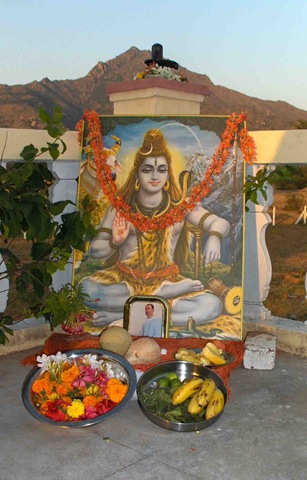
Instead of going into town to a temple, or doing pradakshina – walking around Arunachala – we decided to hold a Siva Puja at our house. Here are some photos.

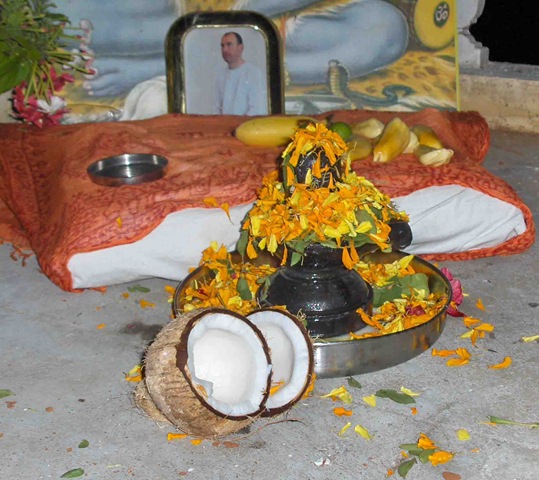
The Altar set up near sun down

Mahasivaratri altar

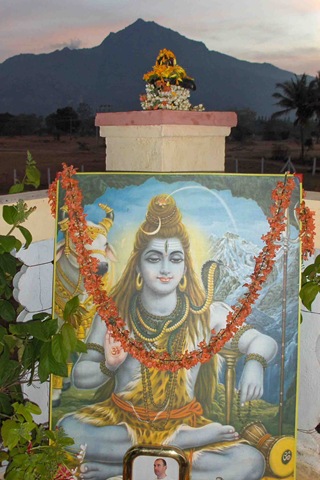
The altar has a picture of Siva, a lingam, a photo of Nome, and various puja materials.

Arunachala is is the background.

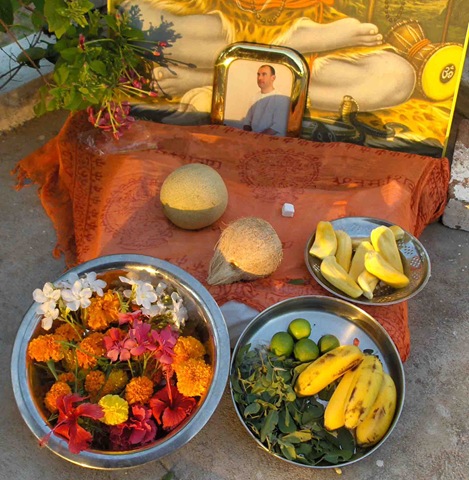
Puja Materials

Puja materials

Fruit and a coconut are common offering.

For Sivaratri it is important to have Bilva leaves as an offering.

Camphor is there for later use.

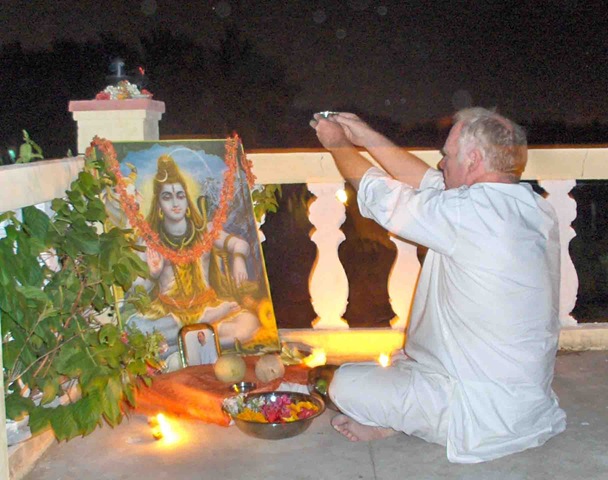
Puja at midnight

Richard at Mahasivaratri Puja

Richard is offering Puja to the Sivalingam.

Coconut milk, cows milk, ghee, bilva leaves and flower petal are offered in turn.

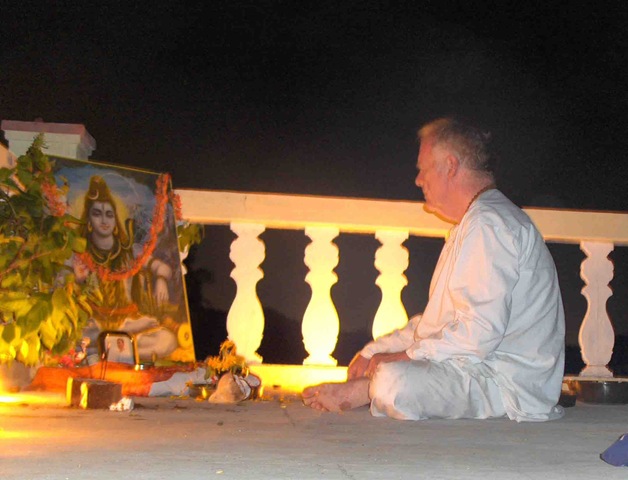
Richard at Puja

Lingam after Puja

lingam after Puja

After the Puja here is the broken coconut.

The lingam is covered with bliva leaves and flowers.

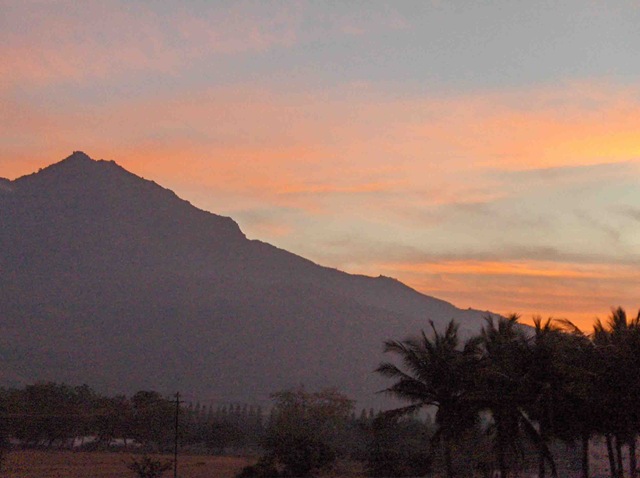
Dawn over Arunachala after Mahasivaratri night

Arunachala Sunrise after Mahasivaratri night

Richard and Carol were up most of the night, listening to recordings of chants, and spiritual discourses from their teacher, Nome.

In quiet times we meditated. For us this is a most holy night.

Altar at dawn

Mahasivaratri altar after Pjua at dawn

Here is the altar at dawn. The lingam has been put back in its usual place, and wrapped with a flower mala.

Now we will go downstairs and go to sleep. This is along night, but spiritually fulfilling.

Harsha's avatar

Living in the embrace of Arunachala: By Richard Clarke

Most posts have been about the new life in India that my wife and I experience. There is so much that is new to us that this is easy to write about.

I have written less about the main reason that we are here, Arunachala, the holy mountain of South India. We live so much in its presence each day. It is like the ever present ‘background’ of life here. It is so present that one could forget about it, like the young fish that asked the queen fish, “What is water? I have heard about it all my life, but I have never seen it.”

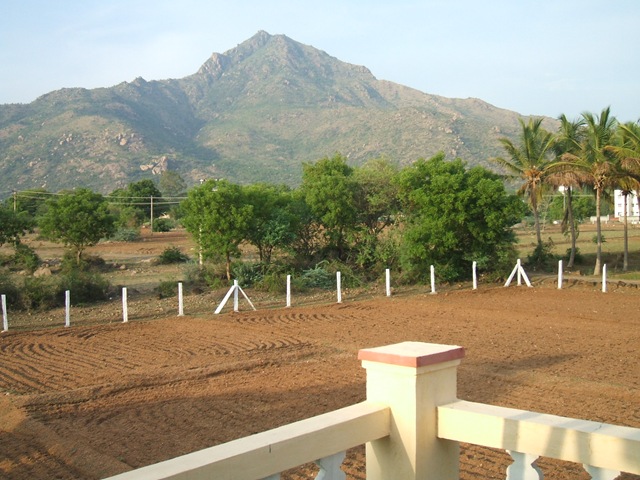
Here is Arunachala from the rooftop of our house (Yenga Veedu in Tamil):

Arunachala from Brindavanam, Tiruvannamalai

Arunachala has been an holy mountain since the dawn of India life. It is written about in the Rig Vedas, purported to be the oldest of the Vedas, which would make it the oldest religious book there is.

That is the holy place! Of all Arunachala is most sacred. It is the heart of the world! Know it to be the secret Heart-center of Siva! In that place He always abides as the glorious Aruna Hill!

Skanda Purana

For many centuries there have been many Indian sadhus and sages associated with the “Red Mountain.” The most well known of these today is Sri Ramana Maharshi, who arrived here in 1896 and never left until the death of his body in 1950. Ramana, who had remarkably few claims of personal actions wrote:

Oh Arunachala, I have exposed your secret doings. Do not be angry. Let your grace be on me.

Necklet of Nine Gems

When we first came to Tiruvannamalai, a small city that has grown around a major Siva temple, Arunachaleswara Temple, over the last 2000 years, I would rise before dawn and go up to the rooftop and just sit and meditate with Arunachala until dawn. I would then watch for a while as the city awoke. After just a few days of this I said to Carol, “We could live here.” She did not treat me like was crazy, though she probably thought I was. Now, several years later I have retired and we have uprooted our nice life the the USA, gotten rid of almost everything we owned, and moved to South India to be with Arunachala.

In the last ten years spiritual practice has become the most important thing in our lives, and we want to use this part of our life where practice is the main focus. Now we are here, ‘living in the embrace of Arunachala.” I still rise before sunrise and go up to the roof, now of our home, named “Brindavanam” by the previous resident who put in the wonderful orchard and garden that surrounds this house. Carol and I are up on the roof with Arunachala several times each day. Even when not on the roof, Arunachala is the dominant presence for miles around. It is always present.

Here is a short poem I recently wrote:

Arunachala,

Silent, still, unmoving.

Arunachala,

Ancient One,

In the form of Dakshinamoorthy

Arunachala,

Quiet this mind.

Arunachala,

Fiery one,

Thy fire burns away ignorance.

Arunachala,

I stand in your Silence.

Arunachala,

Infinite light,

Knowledge of Thee is All.

Arunachala, would that I be as Thee,

Silent, still, unmoving.

Harsha's avatar

Quality of Life Trust – India: By Richard Clarke

My wife and I have started working with Quality of Life Trust – India – http://www.qualityoflife.in/.

They are located right next to Tiruvannamalai and working on village issues. India is going through many changes, and the villages are seeing the most change, so we thing this is a good place for our efforts.

There are two projects they are working on. The first is with the elderly in the village. Some have no place to live and are sleeping on the doorsteps of houses, etc. In some cases it is the doorstep of the house they owned. Then their children got them to give the house to them. Then there was a problem like drinking, and the child lost the house, and the parent had no place to live. The Trust is providing meals to these elders, and helping them with medical treatments. They hope to build some kind of housing in the future. My wife has experience working with the elderly and will help this project.

The other project is for composting toilets. In villages many many people do not have toilets. People will go in nearby fields. Sometimes they are bitten by snakes. Always there is the concern for personal privacy, expecially for the women. There are also problems of disease, etc. This project is building a kind of toilet developed else where in India that does not need water or a sewer connection/septic tank. To add to the appeal, and based on what these local vilages said they are also adding a shower room. This trust has gotten funding from another trust, Bless, and has just started a project to build 50 toilets in the village. I am helping them with project management. These toilets seem to meet a real need, and in addition they produce high quality fertilizer that can be used in the fields.

Working with them this week I got a chance to see the excitement that this was creating in the village. As we were at on house, planning for the foundation (and taking down some banana trees) the neighbor got so excited that he had the crew go to his house and see what kind of site that he had to build on.

These are small things that have a real impact on the lives of the villagers. You should see how proud the man was to be involved in this project, and making life better for his family.

Harsha's avatar

Easy And Natural Is The Way: By Dr. Harsh K. Luthar

Dear Friends,

Sahaj in Sanskrit means easy and natural.

There is saying in Hindi, “Sahaj pake so meetha hoy.”

It means that easy and natural cooking of food leads it to taste sweet.

It is something like the English saying that soup that simmers slowly or the cake that is baked slowly tastes best in the end.

These are metaphors for life. When we do something with care and love, the results are better. Sometimes we even say that, “this is a labor of love.” When we love what we do, it does not feel like work.

Everything has its nature. When we are true to our own nature, an easy authenticity takes over. Then we are not concerned about impressing others nor worried about how others are judging us.

Nature is showing us the way. Seasons are coming and going. Flowers bloom and then wither. We are breathing in and breathing out.

Easy and natural is the way. Anything else makes it appear that somewhere other than where you already are, is more attractive.

All of these teachings of self-improvement, yoga, meditation methods, breathing techniques might have some meaning to someone at some point in time. Truly these are concepts only for the mind to struggle with. The whole premise of these teachings is that you are not OK just the way you are. Ultimately, it is the most splendid nonsense.

To be easy and natural is the way.

How does one become easy and natural? How does one follow the natural path?

To be easy and natural is, well, it is to be easy and natural; and it is best because it is easy and natural.

It is so simple is it not?

What is not easy and natural will produce inner and outer conflicts. We already have enough of those. Of course, for some people making more conflicts may be easy and natural. In that case, go for it (and you can’t help it anyway).

Being easy and natural in awareness allows for the recognition of the Self, which by its very nature is easy being, natural, and wholeness of awareness aware of itself as its own bliss. There is no good way to express it.

My teacher Chitrabhanu-ji (who was a monk for 29 years) once told me that as a young monk he was very very strict with himself. “Sometimes, too much judgment and discipline can be a form of violence with oneself”, he told me.

Another time when we were talking about gurus, I mentioned many names to him and asked his views of them.

Chitrabhanu-ji knew most of the gurus personally. These included J. Krishnamurti, Swami Muktananda, Sri Chinmoy, Rajneesh (Osho), Swami Chidananda, Swami Rama, Swami Satchitananda, etc.

Those gurus whom he liked, Chitrabhanu-ji would only say, “He is a good man.”

One day Chitrabhanu-ji said to me, “You should never follow a guru.” I looked at him puzzled (because he was my guru, you see).

He smiled and said in his thick Bombay accent, “What if the guru goes crazy and tells you to do strange and crazy and weird things…” I had a good hearty laugh! He added, “that does happen you know….”.  I laughed even harder.

Well, it does happen you know.

As Sri Ramana never tired of saying,… the only true guru is your Heart, your own Self.

So wise sages tell the advanced aspirants to be perfectly natural. Make the effort, if natural. Follow a teaching if it is easy and makes sense.

If something makes no sense, there is no point in following it. So what if it is considered the supreme teaching and so on by someone well known. For all you know, what the supreme and well known people say could all be manure.

Think about it. What do they really know? How can they really know? What can anyone really and truly know?

So rest, if it feels natural to rest. Watch the spiritual parade pass by and not be moved by any teaching. Or join the parade and sing your song.

Your nature will make you act in a certain way. That is why you can be at perfect ease.

Self-remembrance, Awareness aware of itself, Self-abidance, all of these mean the same.

Easy and natural is simply being aware of one’s innate wakefulness through the winds of emotions, colors of life, and changes in scenery.

To the extent one can grasp it, simply remain aware and if you become conscious of some intangible cloud of unknowing which you cannot go through, become comfortable with it, stay with it, and breathe it in and out.

If you meditate on this and become aware, it will dawn on you with clarity. You will see.

Easy and natural is the way.

Namaste

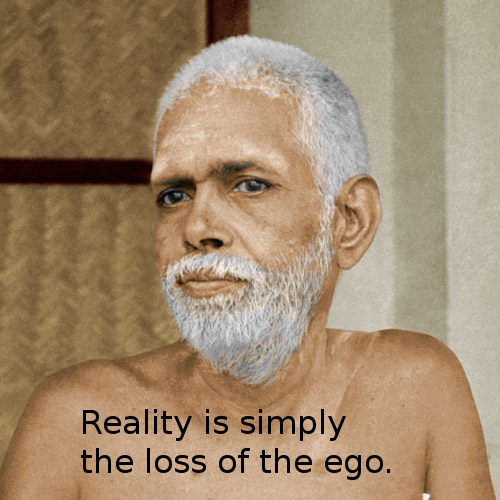
Reality is simply loss of ego - Ramana

Harsha's avatar

Life in India – trip to Pondichery: By Richard Clarke

My wife and I traveled to for a three-day trip to Pondichery. The main reason for the trip was to purchase items not available (or much lower priced due to taxes) in Tiruvannamalai – An Air Conditioner to install before the summer heat, better bikes, some more clothes and personal care items, especially more English books.

Pondy is a nice Indian city on the Indian Ocean with a French flavor (in the few blocks near the ocean) and a beautiful Ocean view. Also, the Auribindo Ashram is here, with many visitors. Many Westerners travel here. What we really noticed is that is the Westerners that were there seemed to be there more to ‘see the sights’, to buy things, and to enjoy the tropical Indian Ocean atmosphere and French flavor. In Tiruvannamalai, Westerners are there mainly for spiritual reasons, drawn in one way or another by Arunachala. We feel more connected to the Westerners we meet in Tiru.

After about two days in Pondy my wife and I both missed Arunachala. I also noticed that two days spent purchasing things was moving my attention away from the spiritual activities that are really the center of this life now.

We are back in Tiru now, and have spent some time with Arunachala. It is good to be home.

In Arunachala,

Richard

Harsha's avatar

Life in India – The Hair Cut: By Richard Clarke

Today I got a haircut.

Here, even simple things like this are an experience.

First the elderly man who had a cut before me had his shirt off. He got his face and head shaved. When this was done, he had his armpits shaved as well.

Also, kids were going to school Several high school boys stopped by to carefully comb their hair, so they would look just right (for the girls at school). Their primping before the mirror reminds me of what I have heard of the girls bathroom in a US high school.

Life in Tiruvannamalai remains sweet. It is starting to get hotter though.

Harsha's avatar

Arunachala Full Moon Day January 2008: By Richard Clarke

My wife and I moved to Tiruvannamalai in November 2007. I had recently retired and felt called to Arunachala for spiritual practice “in the embrace of Arunachala.”

I will be writing from time to time on the experiences of a Westerner in South India, and on my spiritual experiences at Ramanasramam and Tiruvannamalai.

Life in South India is filled with God. Business people perform pujas when they open business for the day. Most people have altars at home and perform daily rites there. Also God is a much more a part of daily life. In the West, God is mainly ‘kept in’ churches. temples and synagogues. In India, God is found on the streets. As one example, during religious festivals, they will put the ‘temple Gods’ on ‘chariots’ and pull or carry these around the town or village.

In this area one of the biggest events every month is the full moon night. During this night usually several hundred thousand people from around the world gather for Giri Pradakahina, where they will walk about 15 km around Arunachala. This is in a town of 100,000, so perhaps three times as many people who live in the town make pradakshina. Most do it in the moonlight, barefoot on the road. Traffic is halted for this night or redirected.

Here is a photo from our house of moonrise the January full moon night.

In Arunachala,

Richard Clarke

Arunachala Moonrise

Harsha's avatar

Bhagavad Gita and the Sattvic Diet: By Dr. Harsh K. Luthar

img_2719

Sri Ramana used to say that of all the yogic rules and regulations, the best one is taking of Sattvic foods in moderate quantities. This view is consistent with that expressed in the Bhagavad Gita, and indeed most of the Yoga Shastras.

The logic is that since food consumed has a major effect on the body and the mind, a Sattvic diet should be adhered to in order to enhance both the health of the body as well as purity, strength, and calmness of the mind. An agitated person will find it difficult to sit quietly and meditate.

A disciplined and one pointed mind is an aid to ones’ learning and education as well as having success in business and other worldly affairs. A clear, pure, and a reflective mind is, of course, essential to self-enquiry which leads to Self-Realization.

The question then becomes, “What is a Sattvic diet? What is the authority for saying that certain foods are Sattvic and lead to good health, mental clarity, poise, and spiritual advancement, while other foods do not?”

There is much yogic literature on this topic and also some disagreement among experts depending on their school of thought and background. Since most Hindus generally accept the Bhagavad Gita as the final word, I will refer to that as my primary source on the Sattvic diet.

We should keep in mind that Sri Krishna, who speaks in the Bhagavad Gita with complete spiritual authority, is also considered the model of exceptional and abundant physical health and perfect mental poise. He is depicted in the ancient writings as slim, active, energetic, graceful, and attractive.

In the Bhagavad Gita, Sri Krishna demonstrates profound insight into not just the spiritual nature, but also human nature and physical nature. By inference, Sri Krishna’s words on food and the Sattvic diet carry much weight for those who study the Bhagavad Gita.

What foods should one minimize according to the Bhagavad Gita?

In Chapter 17 (verses 8, 9, 10), Sri Krishna makes clear the type of foods to be avoided by those who seek good physical and mental health, worldly success, and progress on the spiritual path.

According to the Bhagavad Gita, foods which are too bitter, sour, salty, pungent, dry, and hot can lead to pain, distress, and disease of the body. Further, Sri Krishna says that foods cooked more than three hours before being eaten, foods which are tasteless, stale, putrid, decomposed and unclean should be avoided by spiritual aspirants and those who seek excellent physical and mental health.

What foods should be eaten according to the Bhagavad Gita?

In Bhagavad Gita, Sri Krishna states, “If one offers Me with love and devotion a leaf, a flower, fruit, or water, I will accept it:” (Bg.9.26). To me this seems to suggest that Sri Krishna is sanctioning a diet based on leaves and fruits and water as the best one for spiritual growth. I am no scholar on the Bhagavad Gita, but my liberal interpretation of this verse would be that the Sattvic diet is generally plant based and includes all or most vegetables, fruits, legumes, grains, nuts, seeds, etc.

Because Sri Krishna gave cows sacred status similar to that of a human mother and favored raw butter for personal consumption as a child, one could reasonably argue that dairy products (such as yogurt, milk, kefir, lassi, sour cream, etc.) belong to the Sattvic food category.

Many yogis hold the view, however, that dairy products can only be considered Sattvic if these are obtained respecting the cows and goats who are shown kindness, love, and humane treatment. According to the principle of Ahimsa (nonviolence), any food procured through violence to living beings cannot be considered Sattvic.

Yogic Sattvic Diets

Some yogis that I have met favor a completely raw vegetarian diet with a primary focus on sprouted grains and beans (such as Garbanzo, Blackeyed peas, etc.) along with raw fruits and vegetables. Their diet is essentially vegan and contains no animal products. However, modern science teaches us that since vitamin B12 is missing from a purely vegan diet, supplementation is necessary.

A number of medical and scholarly references can be found on this issue on the web.

Other yogis have felt that a raw vegetarian diet is too limiting and include cooked foods as well as dairy products (milk, yogurt, lassi, etc.) in their diet. This diet, known as the lacto-vegetarian diet, is probably the most wide spread among Indian Hindus and Jains.

A few well known yogis have also traditionally included not only dairy but also eggs and egg products in their otherwise vegetarian diet. This is known as the lacto-ovo vegetarian diet.

Although very few Indian yogis include any kind of fish, fowl, or meat in their food, there are exceptions. Buddhist yogis, for example Dalai Lama, do eat meat. A few Hindu yogis also eat meat pointing out that some ancient scriptures sanction meat eating for certain religious rituals.

For most Hindu and Jain yogis, however, there is no convincing argument for eating meat if one wishes to uphold the supreme principle of Ahimsa and follow the philosophy of nonviolence.

What is the best Sattvic Diet?

The general answer from my study is that foods which cause the body to gain health and for the mind to be calm and peaceful constitute the Sattvic diet. To some extent, this requires knowing the needs of one’s own body and being sensitive to the effects of various foods on our system. Foods which are very suitable and nutritious for one person may not be right for another. Common sense and wisdom are the essential ingredients to find the best Sattvic diet for yourself.

In terms of particular foods to be eaten, the yogis and sages have answered this question, but the answers have different variations. One common element of a yogic Sattvic diet is that it is primarily vegetarian. This is true at least for Hindu and Jain yogis.

Within the broad framework of vegetarianism, a number of dietary systems are possible where certain foods are included and some are excluded. In the most liberal vegetarian diets, eggs and dairy products are included. Some people include dairy in their vegetarian diet but not eggs. Some include eggs but not dairy. In the most strict vegetarian diet, eggs and milk are excluded. Supplementation through certain vitamins is needed in such diets, according to modern medical opinion.

My personal experiences

Having experimented with a variety of diets for decades, I feel that a vegetarian diet can be healthy or unhealthy depending on many factors. For example, if I am a lacto-vegetarian and eat too many pizza pieces, the feeling of discomfort is likely to follow. In fact, after experimenting with eating pizzas thousands of times in my younger days, I am fairly certain that this is indeed true. I believe this also holds if one eats bucket loads of ice cream on a frequent basis. So, is lacto-vegetarian diet healthy? It depends on how lacto you are and how often you go lacto with heavy fat and fried lacto foods!

The point is that a vegetarian diet can be either healthy or unhealthy depending on the nature of food eaten as well as the quantity of food consumed.

In Chapter 6, verse 16, Sri Krishna specifically emphasizes moderation in eating and sleeping. He states, “There is no possibility of ones’ becoming a yogi, O Arjuna, if one eats too much, or eats too little, sleeps too much or does not sleep enough.”

Clearly, overconsumption of food leads to problems and one can logically conclude that the quantity of food consumed is probably an important element in a diet being considered Sattvic.

Sattvic diet is also a matter of degree. Some diets may be very Sattvic, while others may be moderately Sattvic.

Finally, the thoughts and the emotional balance while eating the food have an effect on our system. This is why in many religions, prayers and showing of gratitude for the food being consumed is offered. This mental state while eating helps the diet become more Sattvic.

What does it all mean?

So what does it all mean and what are the lessons from Bhagavad Gita and our discussion of the Sattvic diet? Here is what I think some of the lessons are. See if you agree.

1. Whatsoever you eat, eat in moderation.

2. Educate yourself on proper nutrition, be sensitive to your body, and see what foods work for you.

3. Emphasize fresh vegetables and fruits and eat a diet which is mostly plant-based.

4. Do not eat foods which are too salty, bitter, or have gone stale and putrid.

5. Regardless of the food being eaten, eat with gratitude, prayerful attitude, and with mental poise.

6. Chew the food carefully and taste it deeply without rushing.

There are literally thousands of great sources on the web and hundreds of books in stores to help you educate yourself on the Bhagavad Gita, vegetarianism, and nutrition. Go do some research and find out for yourself!

That’s my homespun wisdom for today. Like Captain Planet used to say, “The Power is yours!”

Given below are some pictures of plant based dishes that I made keeping the principles of Sattvic food in mind. Wishing you all abundant physical, mental, and spiritual health. Namaste.

Harsha's avatar

Vegetarian Lifestyle: By Dr. Shyam Subramanian

Question from a student: As a Hindu living in the U.S., should I remain a vegetarian? If I include meat in my diet there are so many more choices in restaurant menus. Also, when I go to parties I feel awkward telling the host that I can’t eat many of their meat dishes. It is really uncomfortable. I see many of my Indian friends eating meat and fish and caviar and whatever is available and I feel they are more accepted socially in the western culture and that will help them get ahead professionally as well and make more money. As an American born in India, I feel very conflicted about this whole vegetarianism issue. There is pressure from my family to remain a vegetarian but my friends who are not vegetarians are having a better time at my college it seems.

shyam

Answer By Dr. Shyam Subramanian

Continue reading

Harsha's avatar

Underdog and Sweet Polly Purebred: By Dr. Harsh K. Luthar

(Pictures in this article come from www.toontracker.com/totaltv/underdog.htm)

Underdog and Sweet Polly Purebred

Do you remember that cartoon show “Underdog”? You might have watched it as a kid in the 1960s and early 1970s. Underdog was a “humble and lovable Shoeshine Boy” who had a secret identity.

image

Whenever there was a serious world crisis or threat to the city, Underdog would turn into a superhero after taking a special vitamin pill from the secret compartment in his watch.

Underdog had a girlfriend named Sweet Polly Purebred. Sweet Polly was sweet on Underdog. Sweet Polly was a reporter, who seemed to get into trouble with the bad guys in every show. When in crisis mode, she would yell, help, help, help, Underdog, help. Sometimes Sweet Polly would actually sing despondently when Underdog was late in arriving. “Oh where, oh where has my Underdog gone?”

Underdog was probably the best boyfriend Sweet Polly Purebred ever had. No matter how far away and how deeply engrossed in shining shoes of his customers, Underdog could always hear Sweet Polly calling out his name. The “humble and lovable Shoeshine Boy” would slip into a phone booth and emerge as the champion of justice and protector of Sweet Polly. Underdog had super sensitive hearing, at least when it came to Sweet Polly. No doubt this would have resulted in a happy marriage if they had ever tied the knot. Underdog would often say, “When Polly’s in trouble I am not slow, it’s Hip, Hip, Hip and away I go !”

image

Underdog always came to Sweet Polly’s rescue, yelling, “Never fear, Underdog is here!” Sometimes Underdog took his time and Sweet Polly had to yell help for a long time. This was not easy on our ears as kids. But we hung on. We strongly suspected that Underdog would indeed arrive at some point.

When Underdog finally came, it was a great consolation. We did not really want Sweet Polly to get roughed up by the bad guys. Unfortunately, Underdog was no muscle dog. He had a small chest and a big belly. He was a heart attack waiting to happen according to modern medical standards on waist to chest ratio (which were probably not well known when the show started in the 1960s). In fact, Underdog often became exhausted within a few minutes in his fight with the bad guys and looked for his vitamin pill to get his vitality back. Not being able to locate the magical nutrition pill in time posed a serious problem to Underdog’s health.

It was awful to watch and we were full of tears as Sweet Polly looked for Underdog’s backup energy pill in her purse while Underdog was beaten to a pulp by the bad guys. Sweet Polly always found the needed vitality tablet for Underdog at the last minute, but not before giving everyone the distinct impression that she was very disorganized.

The magic pill, once found, was a life giving elixir. As soon as Underdog put it in his mouth, the effect was immediate. The vitality pill always seemed to bypass Underdog’s digestive system and go straight into his muscles. Typically Underdog swallowed the pill in one gulp and regained his energy the next instant. Then he would beat the surprised bad guys quickly before the show ended. Underdog always saved the day including, of course, Sweet Polly.

image

I was recently thinking that in real life, some people are like Underdog (who don’t have a Sweet Polly), and some are like Sweet Polly (but without their own personal Underdog).

Sometimes we want to act as saviors to people who do not wish to be saved. Other times, we need desperately to be saved but no one except mom seems interested in the job. That perfect match of being the savior and being saved that Underdog and Sweet Polly had is seldom achieved for most people. Underdog and Sweet Polly were made for each other.

We certainly lack that magic vitamin pill that Underdog had in the secret compartment of his watch. But even for Underdog, the effect of the magic vitamin pill was only temporary. He had to keep taking those pills to maintain superhero status.

One wonders where Underdog got his supply and the money to pay for those pills. After all, he could not have made much as a shoeshine boy. Perhaps he got big tips from his customers. Maybe Underdog had really good health insurance and there was low co-pay for those very strong vitality pills.

I wish that there had been some closure to the Underdog show. Underdog could have proposed to Sweet Polly Purebred in the final season of the show. If Underdog was too shy to do it, maybe Sweet Polly could have proposed to Underdog. Given the number of times Underdog saved her, that’s the least Sweet Polly could do.

It would have been nice to have a big wedding for Underdog and Sweet Polly Purebred at the end of the final season. I can just see Sweet Polly saying to Underdog before they went off on their honeymoon, “Underdog darling, make sure to pack some extra energy pills for the next two weeks.”

Maybe there will be an Underdog movie which will show that Underdog and Sweet Polly Purebred got married and lived happily ever after. If they did it right, the Underdog movie would be blockbuster!

Underdog and related characters are © 1997 GBPC, a subsidiary of Golden Books Family Entertainment.