Harsha's avatar

Lovers Love Completely: The Goddess Mystery. By Dr. Harsh K. Luthar

image

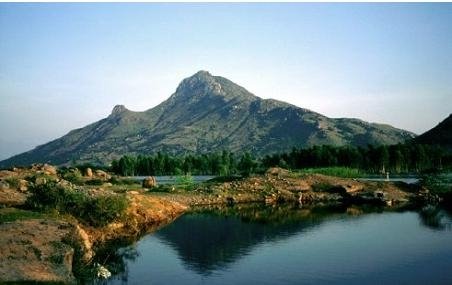
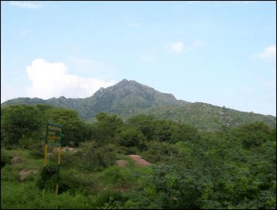
Picture of Arunachala by Gabriele Ebert

Song to the Goddess

Either let me be intoxicated
in your love completely
or put on my robes of joy
and rob me absolutely.
Judge me guilty
in the court of love
or absolve me absolutely;
find me flawed if you like
but never hold me weakly.
No middle ground is possible
for lovers who love completely! 

Love, Consciousness, and Bliss

The great sage of Arunachala, Sri Ramana Maharshi, used to say that all deep thinking people are fascinated by the nature of consciousness. The outer world of time and space is known only through ones’ own mind. Therefore, the mystery of mind and consciousness has been a magnet of attraction for philosopher, yogis, sages, and scientists. Upanishads say that one should know “That” by which all else is known.

What is “That”, which makes all else visible and known? The ancient philosophy outlined in the Upanishads, the sacred Hindu scriptures, refers to “That” as Sat-Chit-Ananda, the core of one’s being which is Absolute Bliss, Absolute Existence, Absolute Consciousness, and we can also say that it is the same as Absolute Love which makes all human love possible. Sri Ramana used to say that “Love is the actual form of God.”

For one irresistibly pulled by the hunger of Self-Knowledge that manifests in one’s own heart, the turning within to “That” Absolute Love and Bliss happens at some point. When consciousness spontaneously starts the process of scanning its own formless form, this churning results in the beauty and self-delight of awareness which underlies all manifestations of energy (Shakti).

Appearance of the Supreme Goddess

In many of the mystical traditions of Hinduism, the manifestations of this energy, resulting from consciousness becoming focused on its own nature, take the forms of Devi. Devi is the Supreme Goddess, who appears in visions and dreams of devotees according to their mental and spiritual condition to nurture, protect, bless, and guide them.

The Goddess is depicted in Hindu art in hundreds if not thousands of ways. This art is part of the Indian history, culture, and Hindu traditions. It comes from the inspired imagination of the artists and is based on the ancient stories about the Goddess and Her powers.

However, no artwork can really capture the form of the Goddess who appears in the mystic eye of the aspirant. She appears to each devotee in a unique way according to what best suits the nature and personality of the person at that time. As the yogi evolves in the spiritual path, the visionary forms of the Goddess can change along with that.

So a relationship develops between the devotee and the Goddess or the Divine Beloved. Like human relationships between lovers, it is not always easy.

Sometimes, the devotee cannot bear the separation and wants immediate union and consummation. He may even blame and question the Goddess as to why She has left him in the middle of the path after taking his hand.

Song of Despair to the Goddess

Play hide and seek
not too much longer
and risk this longing
get even stronger;
when people ask unashamedly
why your love flees from me
what honest answer can I make
and can you also say for sure
that in choosing me as your lover
you have made some grave mistake.

But the Goddess realizes that it is not time and waits for the moment to be ripe for the final liberation. Many of the love poems of mystics to the Goddess have come from this intermediate level of spiritual experiences where the Supreme Beloved appears to plays hide and seek with them.

Sri Ramana and Marital Garland of Letters

In the classic Tamil poem, “The Marital Garland of Letters” the Sage of Arunachala, Sri Ramana Maharshi, chides the Divine Beloved in some of the verses and apologizes for having done so in other verses. He begs Arunachala to fully embrace him (as the devotee) and utterly consume him in love; Because only then he will have peace.

Ramana writes:

Verse 23. “Sweet fruit within my hands, let me be mad with ecstasy, drunk with the bliss of Thy essence, Oh Arunachala!”

Verse 34. “Unless Thou embrace me, I shall melt away in tears of anguish, Oh Arunachala!”

Verse 60. “In my unloving self Thou didst create a passion for Thee; therefore forsake me not, Oh Arunachala!”

Hindu Mystical Bhakti Poetry

The love pattern of alternating between despair and ecstasy (Does She/He love me or love me not), joy and sadness (When will the Goddess/Divine Beloved visit again) is common in the poetry of many Hindu saints and mystics. Even the seeming confusion about the relationship itself, which makes the devotee beg sometimes for love and other times actually blame, chide, and command the Goddess/Divine Beloved, can be seen in some of the poems including the Marital Garland of Letters.

Although the Marital Garland of Letters by Sri Ramana is embedded in the Indian spiritual, historical, and cultural context, the symbolism of a lover who is in complete despair because of an incomplete consummation with her/his beloved is universally understood.

Summary

People who are in love with and fascinated by the mystery of consciousness have felt that mysterious pull of the Heart from within themselves. Who can really explain ways of the Divine and the different forms She/He manifests in.

What is the first step on this path of love? No one can say for sure. Was it the smile and look of a Sage, the grace of the Divine Mother, the kiss of the Goddess, or the kindness of a teacher or a friend? There must be many possibilities that make us aware of the Heart within, whose nature is Sat-Chit-Ananda, that which is the source of the ultimate bliss.

This memory once awakened brings upon the experience of pure being, and attracts the devotee to the truth of her/his own nature. This gentle pull within makes itself felt. It does not let go until the Truth of one’s own Heart is recognized, and there is nothing left to let go.

Some say that it is the Goddess Herself, who takes the devotee into the Heart and then reveals Herself as the Universal Heart. The complete identity between the devotee, the Goddess, and the Heart thus established, everything disappears. There is only that Heart of Love and Fullness, eternal consciousness completely at rest in its own nature.

Knowing That is Self-Knowledge. That is the final consummation.

I came to feed on Thee, but Thou hast fed on me; now there is peace, Oh Arunachala!” Verse 28. Marital Garland of Letters.

NOTE: Some of the verses on the Goddess in this article are from a longer poem on the Goddess by Dr. Harsh K. Luthar.
kurta


Harsha's avatar

What Is Meditation? By Dr. Harsh K. Luthar

The Art Of Doing Nothing

IMG_0141


My Dear Friends,

You have heard many things about meditation and perhaps there are questions in your mind about it. Today, there is no shortage of information on any topic having to do with meditation and yoga. There are literally thousands of books on meditation and yoga and self-help techniques. If you go on the Internet and put in a few key words, you will come across many views on meditation.

Some people equate repeating a mantra with meditation. Others say that if you focus on the in-going and out-going breath, that is meditation. There are people who believe that you must be able to sit cross-legged in the lotus position with a straight spine in order to meditate effectively.

Having meditated since early childhood, I can assure you that this is not true. Inviting aches and pains by sitting in a lotus position will not lead to a peaceful mind. Meditation, after all, is about relaxation and peace. Having peace, or recognizing the peace within, is meditation. What takes us away from being peaceful cannot be meditation. Whatever brings us peace is meditation.

Avoidance Of Stillness

It is my experience that people like to keep busy. In today’s world, being busy is considered a very high virtue. We want to keep busy and be productive in some way. Otherwise, we feel we are wasting time and feel guilty. Certainly, being active is a good thing and allows us to make a living and maintain relationships in the world.

Even Sri Krishna says to Arjuna in the Bhagavad Gita that one cannot avoid action. One is compelled to act according to one’s nature under the force of circumstances. That is the universal law of Karma.

But we have to understand the nature of action and our relationship to it. This is why Sri Krishna advises Arjuna to act according to his duty and dharma but without any expectation for any fruits of action. Our expectations undermine our peace when they do not come to fruition. Right conduct, according to one’s best understanding and judgement, brings peace. Therefore, it brings us to meditation.

Mental Experiments

Ancient Yogic and Advaitic sages gave methods and taught us to conduct mental experiments to find the nature of truth. These mental experiments can indirectly help us recognize the Pure Being within our center as our own Heart.

The techniques of meditation, such as mantra, chanting, yoga, pranayama, breath-awareness, etc., are simply mental and physical experiments. These practices start us on a journey with the potential for personal and spiritual growth.

However, real meditation is beyond visionary experiences and is the discovery of peace within. To reach there, we have to be quiet and learn the art of stillness. Once we know how to be still while doing nothing, we can carry this stillness into our actions as well. But first, we must discover the nature of this inner peace; and to do that we have to learn the art of doing nothing.

Are You Able To Do Nothing?

Are you able to do nothing? Absolutely nothing! The art of meditation is learned by seeing the value of doing nothing. If you can sit very still and quiet without mental disturbance, you have already come a long way towards the experience of meditation.

It is only a rare person that enjoys doing nothing. Doing nothing is not as easy as it may sound. Try it sometimes. Just sit on the sofa. Don’t go to sleep. Stay awake and think about nothing in particular.

You will soon find your mind racing here and there, thinking about your girl friend, your boy friend, your boss, your co-workers, your business, your friends, your family, tofu, pizza, chocolate… the sky is the limit!

The Mind Is A Monkey And A Donkey!

Yogic sages have compared the human mind to a monkey. Just like the monkey cannot be quiet and must be restlessly hopping here and there, so it is with the mind. It is the nature of the mind to be either brooding about the past (regrets, mistakes, guilt, lost opportunities, the roads not taken) or fantasizing about what the future will bring.

The burden of carrying the past and the future in this present moment is heavy. But the mind, like a donkey, gets used to carrying this load and plods along.

However, the mind that is always lost in memories (past) or hopes (the future) misses the most delicious feast of all that is taking place in the present.

The eternal reality, we can call it Self, Sat-Chit-Anand, God, the Supreme Being, the Supreme Goddess, Paramatman, Brahman, the Great Void, or the Kingdom of Heaven, always exists and is shining in the present right before our very eyes.

The Divine mystery is recognized when the mind is calm and awake and free from anger, hatred, and greed and thus not subjected to the pulls of the past and the future. This is why all major religions encourage human beings to be good and kind and compassionate. These virtues serve as the building blocks for the spiritual life because they remove the agitation of the mind.

Why Meditation Techniques Do Not Always Work

IMG_8889


Meditation techniques are fully effective only in a mind that already has some understanding and maturity. So really, laying the foundation or the groundwork for meditation is more important than the practice of meditation. Just like a seed grows naturally on fertile ground, meditation happens spontaneously in a reflective and a quiet mind.

When the mind is ready and ripe, meditation works and self-inquiry is fruitful in a short time.

When the mind is restless, anxious, and troubled, meditation becomes a forced activity and is not always helpful. At such times, one should take a walk, practice deep breathing, or go for running or do push-ups and other exercises. Those are more useful than meditation when the mind is not ready to be calm.

Pranayama, involving deep rhythmic breathing, is an ancient yogic method that can serve to calm and sedate the mind in a natural way. According to Hatha Yoga Pradipika and other classic yogic texts, one first has to master proper breathing in order to progress to meditation. This is the commonly held belief in the school of Hatha Yoga. However, the path of Jnana Yoga does not emphasize breathing exercises or Hatha Yoga Mudras and Kriyas and considers these to be irrelevant to Self-Knowledge.

Advanced Pranayama practices involving breath retention or awakening of Kundalini Shakti can be found in many yogic texts and modern books. However, these should be learned very cautiously from an experienced practitioner of pranayama.

Laying The Foundation For Meditation

In order to advance in meditation and learn it in depth, we have to understand the nature of the mind and learn to be alert and watchful of its activities. It is this constant watching, that is the key method behind all the techniques of meditation. A form of this is what Buddhist calls, “Mindfulness”. Jains call it Upa Yoga (Yoga of Awareness), Hindus refer to it as the “Inquiry into the Self” or Self-Remembrance.

A spiritual seeker is watchful.

The essence of this watchfulness is that with the mind one watches the mind.

If meditation is going to take place, if this recognition of Pure Being with clarity is to be gained, an inner silence must ensue. One cannot see one’s image clearly in the water, when the water is full of waves. In a still pool, our image is reflected and can easily be recognized. Similarly, in a still mind, we can see the nature of our being.

This inner watchfulness, the observer being aware of the observer, this self-inquiry can occur in a ripe mind that is calm, content, and ready.

We Are Dancing For Others!

The difficulty is that our minds are noisy. This is the nature of the mind that goes outward only. It is overcome by sensory experiences and is unable to see its origin. The worldly chatter overshadows and muffles the subtle divine music that is playing.

Friends, sometimes I think, we are dancing to the drum of other people’s expectations, which we have internalized.

There is no end to this dance. This dance has a stronger hold on us than rock and roll or disco or rap music. It keeps us hopping all our life doing this and doing that or achieving this and achieving that. Ultimately, it is exhausting.

Whole world guru


The whole life slips away in the blink of an eye as we keep busy in “doing” this dance making sure that the movement of our steps have the approval of others. We forget to “Be” who we are.

To Be Still is the true meditation. Meditation is simply Pure Being.

The art of recognizing yourself as Pure Being is meditation. Pure Being is Self-Awareness or Awareness.

A Powerful Intervention: Conduct This Experiment

The state of meditation is simple. The methods and techniques and the philosophy behind it are very complicated. That is why thousands of books are written on such things. But the aim of meditation is simply peace. Peaceful Awareness. Meditation is easy to understand. It is being peaceful without expectations.

Conduct the following experiment with being peaceful without expectations. Tell yourself this: “For the next one minute, I am not going to worry about anything and be bothered.”

Try to be free of all inner and outer conflicts for one minute. Give yourself this one minute as a holiday gift!

This is a powerful intervention. Can you be free from inner conflict for one minute? See what hinders your attitude to be worry free for one minute. If you can be peaceful and free from anxiety for one minute then you can do it for two minutes and then more.

To Be With Yourself

So dear friends, find some time to simply “Be” with yourself. To just “Be” is an amazing experience of the present moment. See what thoughts come to your mind. When you sit quietly, many visual images and thought patterns start emerging from the subconscious. This is referred to as “Surfacing” and it happens when your relax and your mind is at ease and free of tension.

If you remain awake and pay attention, you can gain insight into your own mind. These insights will teach you to not attach yourself to things that do not bring you peace. You will come to see that your nature is that of Pure Being which is associated with the many thoughts in your mind and yet is independent of these.

Sri Ramana Maharshi, the great Indian Sage of Arunachala, gave forth this method of reflective Self-Inquiry, that focuses on the question, “Who Am I?”

This investigation, when done with understanding and sincerity, brings us to the state of Being that is free from thoughts. This inquiry is really at the heart of the philosophy of Advaita Vedanta.

Always Be Gentle With Yourself

If you are not able to sit quietly right away and be completely still for even one minute, do not worry about it at all. The reason it is difficult for us to sit quietly and do nothing is because often there are wounds inside which we would rather not become aware of or deal with.

The process of living life can be very very painful and stressful. Over the years, we put temporary bandages on our hurtful experiences, which for a short time dull the pain.

My teacher Chitrabhanu-Ji taught me that when we try to relax and meditate, our anxieties and fears and past suffering sometimes bubble up from the unconscious. So we have to be alert and to accept and let these things go so we can renew ourselves and be fresh.

The ancient Yogic Sages of thousands of years ago left us with great works on the nature of human suffering and how to alleviate it. Sometimes when I read the Bhagavad Gita or Patanjali’s yoga sutras, Tao Te Ching, Buddha’s path or Mahavir’s philosophy of reverence for life and Ahimsa, I marvel at the depth of the insights contained in these.

The great Yogis of the past 5000 years have been really great psychologists who knew the nature of the human condition. They deeply understood what happens when spiritual seekers try to get insights into their mind and provided a path and guidance on how to walk it with the help of teachers and fellow students.

The Notion Of The Sangha

In India, some people meditate in Ashrams or in communities. The notion of a Sangha (community of spiritual seekers) is important. In such a community, meditation is easier, because people are able to encourage each other and share each other’s pain and burdens. When our mental or physical suffering is intense, we are not able to meditate. People turn to alcohol or drugs to numb themselves so that they do not feel their own suffering. This, however, cannot lead to any permanent solution and satisfaction. Indeed, it can weaken the body and the mind and makes matters worse.

Being part of a vibrant spiritual community, or to just be in the company of good people who care about one another, can exercise a protective influence on you.

As a general rule, in order to advance in meditation, you should keep the company of good people who allow you to be who you are.

I studied with Chitrabhanu-Ji who is one of the key figures in 20th and 21st century Jainism. Chitrabhanu-Ji, before he became a Jain monk, was part of Mahatma Gandhi’s movement to free India from the British through the peaceful means of Ahimsa (Nonviolence).

Ahimsa is the cardinal principle in Jainism. Chitrabhanu-Ji taught me that a mind becomes fully fit for meditation and Self-Realization through the practice of reverence for all life and amity towards all beings.

A genuine spiritual community has to be completely dedicated to the principle of Ahimsa in thought and action and be committed to alleviating suffering among all living beings. A teacher or a guru who does not understand or practice the principle of Ahimsa and is abusive to his or her students should be avoided. Such people are on power trips only and have their own problems to deal with.


Having A Personal Philosophy

20150724_174004

It is good to become aware of and think about fundamental life issues at any age, but particularly so if you are young. It allows one to develop a personal philosophy that helps to structure and interpret different experiences and put things into their proper perspective.

It is important to sit quietly and spend time with yourself in order to have an understanding of your own nature. Whatever philosophy one adopts, the following general rules are helpful in remaining calm and healthy.

Ten Tips From Yogic Texts And Sages

1. Eat nutritious foods that suit your constitution in moderate quantities (My New Year’s Resolution!)

2. Walk every day if possible (My Second New Year’s Resolution!).

3. Avoid people who are manipulative, loud, obnoxious, and destructive if at all possible.

4. Keep company of people who are pleasant, easy going, cheerful, and supportive.

5. Remain silent when you have the urge to be sarcastic or make fun of someone.

6. Help people who are in need within your capacity.

7. Take the time to be alone everyday and be with yourself.

8. Never give into peer pressure to drink or do drugs or go to wild parties (Tame and sober get together with good friends and Satsang with fun singing and chanting is OK!).

9. Develop confidence in your own ability to do what you need to do.

10. Engage in introspection at the end of the day. Mentally wishing everyone well, always go to bed with a clean slate.

20151016_141056


Even A Little Effort Helps!

Friends, even a little right effort is never wasted. Every journey must start with the first step. The journey that takes you inside your own Self is the most wondrous journey you can ever take as it reveals the mystery of existence itself. Start from this very moment and enjoy the wonders of your own nature and the sparkling reality that has been smiling and shining on you for the whole of eternity.

Chin Mudra - Jnana Mudra

Harsha's avatar

Kundalini Shakti in the West: By Dr. Harsh K. Luthar

The notion of Kundalini Shakti is at the heart of yoga and is embedded in virtually all Eastern traditions regardless of the name or label that is given. If we carefully examine any school of yoga, tantra, or various traditions (Shakti, Shaivite, Kashmiri Shaivism), there will usually be some descriptions of Hatha Yoga, Pranayama, Kriyas, Mudras, Mantras, and different types of meditations on the Chakras (energy centers).

In the Shakti traditions, detailed descriptions are given of the various aspects of the visions of the Goddess that arise in meditation. Even in the school of Advaita Vedanta, which does not depend on the practices associated with Shakti Yoga, we see that the great scholar/saint Adi Shankracharya has written hymns to the Goddess who represents Shakti, the divine power.

Continue reading

Harsha's avatar

Ahimsa – The Antidote to Fear

By Dr. Harsh K. Luthar

Bhagavan Sri Ramana used to say, “Ahimsa Param Dharma”. It means that Ahimsa (Nonviolence) is the Supreme Dharma (Duty or Principle). Sri Ramana pointed out to the devotees and yogis that in Patanjali’s Yoga Sutras, Ahimsa is named as the highest virtue above all other virtues. If we are able to understand what Ahimsa means at the deepest level, that clarity itself guides us in discovering the nature of the Self as our own Being.

Continue reading

Harsha's avatar

Rest in Beauty: By Dr. Harsh K. Luthar

IMG_0867

Rest in beauty
awaken in love.

Myself, yourself
we rise like waves.

Splash and play
on the banks of life.

Sign our names
on this lovely sand
and then back again.

Ocean calls.

This embrace has no beginning or end.

Harsha's avatar

Self-Inquiry or Atma Vichara: By Dr. Harsh K. Luthar

Self-Inquiry, also known as Atma Vichara in Sanskrit, is based on a philosophy that has its origins in the ancient teachings of Advaita Vedanta. Advaita is based on the Upanishads, the Bhagavad Gita, and is found in a number of other scriptures that are considered sacred by the Hindus. Advaita means nonduality, the ultimate Oneness that pervades or underlies everything.

Essentially Advaita implies that even though there is a diversity of phenomena, it has its origins in God and that ultimately everything not only exists in God but also resolves itself into God. According to Advaitic sages, the nature of God is Sat-Chit-Ananda. Sat means Existence. It is the nature of God to Exist. Chit means Knowledge. It is the nature of God to Know. Ananda means spontaneous Joy. The nature of God is Bliss or Joy. Continue reading

Harsha's avatar

A Visit To The Robert Frost Museum: By Dr. Harsh K. Luthar

On July 3, 2006, I was in Franconia, New Hampshire. Someone mentioned that the famous American poet Robert Frost loved the White Mountains of New Hampshire. Frost, in fact, lived in Franconia from 1915 to 1920 and spent nineteen summers there as well with his family.

I discovered that the Robert Frost Museum was only three to four miles from my motel and was open from 1pm to 5pm. Immediately, I decided to make the sacred pilgrimage to the house where Frost lived. You can find out more about the Frost Place in Franconia, New Hampshire, on the website, http://www.frostplace.org.

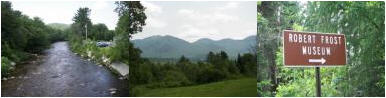
Walking along the road, I was struck by the beauty of the flowing creeks and the mountains in the area. Here are just some of the pictures I took on the path which had clear signs to the Robert Frost Museum.

1

It had been a long hike in the sun but the goal was now in view. Sweating profusely and thirsty I arrived at the Frost House.

2

I looked for a water fountain in the yard but there was none in sight. The first person I met was Sara Brickman, a student at Smith College. Sara was busy arranging Robert Frost books and T-Shirts and other memorabilia that visitors buy. Sara welcomed me warmly, told me that she was a Frost Place Intern for the summer, and would be happy to answer any questions and show me around.

3

Upon my request, Sara kindly supplied me with a tall glass of cold water from the house. Water never tasted so good! Sara introduced me to Professor Robert Farnsworth of Bates College who was reclining and reading a book on the porch of the Frost House.

4

Professor Farnsworth is a highly distinguished and well published poet. He is the 2006 summer’s poet-in-residence at the Frost Place and will be doing a number of readings there. I told Sara and Professor Farnsworth that I taught at Bryant University and was a Frost enthusiast. Soon we were all on first name basis, smiling and laughing, having wonderful conversations. I requested Professor Robert Farnsworth for some pictures and he kindly obliged. We took turns taking pictures.

5

I probably spent an hour and a half to two hours at the Robert Frost Museum. Part of it consisted of watching a 20 minute video on Robert Frost’s life and poetry. I saw only four or five other visitors to the Frost House during that time. Sara and Professor Farnsworth told me that the day before, July 2, had seen a much larger inflow of people who had come for the poetry reading and the music concert. July 2 is Frost Day, which is an annual celebration of Robert Frost, and was established by an official act of New Hampshire Governor Hugh Gallen. The following pictures show Robert Frost’s portrait, the chair that he sat on while living in the farmhouse, and his handwritten poem.

6

As I was getting ready to part, Professor Farnsworth generously offered me a ride back to the motel in his car. Since the memory of my long and hot walk earlier to the Frost House was still fresh in my mind, I gratefully accepted. Professor Farnsworth and I continued our conversation during the car ride and he told me that he had grown up in Rhode Island and received his initial academic training at Brown University. Later, he had gone to Columbia University.

7

My afternoon adventure at the Frost house reached its conclusion when Professor Farnsworth dropped me off at the motel. Back in my room, I turned on the air conditioner and took out some ice tea from the refrigerator. As I slowly sipped the drink, I marveled at how perfect the afternoon had been. I had gone to the Frost House with nothing other than my enthusiasm for the poet and his poetry. What I had found was an afternoon of good conversations with two people I had never met before. At the end of the day, what remained with me was the warmth of friendship and good will from Sara Brickman, the student intern at the Frost Museum, and Professor Robert Farnsworth of Bates College, the 2006 summer’s poet-in-residence at the Frost Place. Thank you Sara and Rob!

8

Harsha's avatar

The Guru Came As Ramu – Conclusion: By Michael Bowes

Michael Bowes is well known to us as an authentic and genuine and a very experienced yogi and a devotee of Sri Bhagavan Ramana. Internationally, he is well travelled and has been to India. He has visited various Ashrams and Gurus and Swamis in both the U.S. and abroad.Michael has an uncanny ability to see to the heart of the matter and his spiritual insights pierce through the veils of sentimentality and conceptual baggage. Michael is a long term member of the HarshaSatsangh community and his presence has been a gift.

Given below is the conclusion of a three part story from Michael about his visit to a Swami in India.

You can see Part I at the following link. https://luthar.com/2006/01/page/2/
Part II is at https://luthar.com/2006/01/

************************************************************************

By Sri Michael Bowes

In the first two parts of this story, I related some events that occurred during my association with a certain Swami. In part one, I told about the coming of a starving dog named Ramu, and how his presence began to unravel the Swami’s fragile facade. I wrote of the Swami’s callous statements that he made after Govindan’s wife, Mother, offered her heartfelt thanks for a small gift that I had given her.

I had planned to reveal more of the shameful actions of this Swami who initially had seemed to be a blazing spiritual light. But I realized that I cannot.

There are many blind guides in all religions and sects, persons who misuse their followers either intentionally or unintentionally. And there are many persons of faith who should carefully consider where they place their trust. And that is the question – In whom or in what may we trust?

We can trust in the ONE who sent Ramu to help me. Before I met this particular Swami, I already knew that the true Guru is always radiating grace through a myriad of ways, always guiding us through all beings and events. There is one immortal Being, unborn and undying, always providing the necessary grace to help us to recognize our own true nature. That is the message that I want to convey.

The surest spiritual path for one and all is to awaken to the love and grace of the sadguru. The Sanskrit word “sadguru” means different things to different people. Sadguru is a combination of two Sanskrit words, “sat” and “guru”. The basic meaning of “sat” is existence. It is also translated as “truth” because there is no truth apart from what exists. Of course the word “guru” is usually not translated; but refers to a spiritual guide or teacher. Some persons interpret the word “sadguru” to mean the “true guru”. But I interpret the word to convey the fact that all existence (sat) is the guru.

That is my experience.

The longer I live this life, the more I see that nothing whatsoever exists except for love, and bliss, and unimaginable communion with the sadguru as it manifests as all that we encounter. The wise spiritual aspirant will trust in the ever present sadguru and will not blindly follow any other guide.

Once I had been associating with a certain spiritual group for quite some time. I had benefited immensely from my exposure to their guru. I had developed close friendships with some of the members of the group, including the president of the organization. Occasionally, some of the members of the group would try to convince me to take initiation from their guru.

One day, my friend, the president, also tried to convince me to take initiation. He was trying to impress me with the necessity of accepting a spiritual authority. He was implying that his guru was such an authority.

He asked me, “Who is the final authority?” Suddenly, without consideration, I answered, “Me”. “I am my own final authority.”

It goes without saying. I am responsible for my own life and my own decisions. If I want to consider making a choice between different spiritual paths or spiritual teachers, I then become the ultimate authority. So do you. It’s easy to see. The buck stops with our own self, which is the same as the self of all.

But we don’t ever really need to decide between one teacher or another. The surest, most effective means to truth and happiness is to invoke the true guru, the ever present guru, which is the same as one’s own self.

When one makes that connection then there’s no doubt about the path or the method. After receiving initiation from the sadguru no spiritual or philosophical questions about life arise because life is revealed as a mysterious, blissful and wonderful existence for which there is no explanation.

Then there is nothing to accept and nothing to reject. After the touch of the sadguru one becomes free by always residing in the presence of the sacred ONE and its fantastic and mysterious manifestation.

Harsha's avatar

The Guru Came As Ramu- Part II: By Michael Bowes

Michael Bowes is well known to us as an authentic and genuine and a very experienced yogi and a devotee of Sri Bhagavan Ramana. Internationally, he is well travelled and has been to India. He has visited various Ashrams and Gurus and Swamis in both the U.S. and abroad.

Michael has an uncanny ability to see to the heart of the matter and his spiritual insights pierce through the veils of sentimentality and conceptual baggage. Michael is a long term member of the HarshaSatsangh community and his presence has been a gift.

Given below is the second part of a three part story from Michael about his visit to a Swami in India. This is Part II.

You can see Part I at the following link.

https://luthar.com/2006/01/page/2/

************************************************************************

By Sri Michael Bowes

Many persons would love to meet their guru. Imagine meeting a Swami of the Shankara Order who was exuding peace, love, and siddhis. Imagine an unknown Swami who, on his first trip to the West attracted a very large following in a very short time. Many persons were convinced that the Swami was an exceptional spiritual beacon. A letter came inviting me to India.

Thinking that I had met a true guru, a person who seemed to be surrounded by mystical events, I traveled to the other side of the earth to be with him in India. But after being there for a short time, and through the grace of the guru, I had already become wary.

The Ashram was situated on a quiet, peaceful farm in South India. The farm was owned by Govindan and his family. There was Mother, his wife, and there were daughter and son. I never got their names – they were Mother and daughter and son.

Govindan had a nice room with a bed and a desk and some chairs. There was a ceiling fan and he had a water purifier there. I would often go there and visit. Mother lived in the kitchen. She slept on a mat on the bare concrete floor. I never did find out where daughter and son slept; but I think that it might have been in the cowshed.

Mother and daughter cooked for us on a wood fire. Sometimes there were many persons there. The food was great. In part one, I mentioned that Govindan, and Shyam and I went to Ramana Ashrama and some other locations; but before we did, I wanted to give Mother a small gift. I also wanted to give something to daughter. I had already given a significant sum to Govindan because they were feeding me and giving me a nice place to stay.

Mother didn’t want to take the money, so I had to leave it on the floor in the kitchen. I also left some money for daughter and then Govindan, Shyam and I left for Tamil Nadu. A couple days after our return, and after the grace of Ramu, the Swami’s attendant called me to his room. Swami was just finishing the morning puja when I walked in. Mother and daughter were there along with some others.

The Swami welcomed me and I paid my respects to all. Mother and daughter were standing and the Swami was seated near the shrine. Swami said, “Mother has something to tell you.” I looked at Mother and her eyes revealed the depth of her emotion. The Swami spoke and said, “Mother wants you to know that she used the money that you gave her and bought these earrings. I have blessed these earrings, and Mother wants me to give these earrings to you and then she wants you to hand the earrings to her.”

I was overjoyed. The Swami placed these teeney, tiny, gold and diamond earrings on a flower, and handed them to me. Then I handed the flower with the earrings to Mother. Mother put them in her ears immediately and she was nearly shining. Daughter had bought a gold nose-pin with her money and so the same process was repeated for daughter. She also seemed quite happy. It was fun for me.

Then Swami said, “Mother has something else to tell you.” I looked at Mother and it seemed that she was about to cry. Swami said, “Mother wants you to know that no one has ever done such a wonderful thing for her. Mother says that men have always cursed her and abused her. Mother says that this is the best thing that has ever happened to her.”

I was stunned. I looked at Mother and I’ll never forget the look on her face. Suddenly I realized – they don’t say her name. She lives on the concrete floor in this primitive kitchen. She and daughter don’t even eat with us. She got this little bit of money and she wants me to know that this is the most wonderful thing that has ever happened to her. I was shocked. I could barely believe this. I can’t begin to explain how I felt.

As everyone was leaving, the Swami asked me to stay. I was really, really sad. I sat down next to him and he said: “Michael, don’t give these people anymore money.” If you want to give someone money, give it to me.”

My very limited patience began to wear thin. I tried to explain that I had given Mother and daughter just a little bit of money and that I gave money to Govindan because he had built a room and was feeding me and everything. Swami said, “Govindan is a retired railway station master. He gets Rupees 1800 every month. Don’t give them any money. If you want to give money, give it to me.” He went on to say that he had some kind of trust set up and that he already had $700 and that everything was all worked out. I told him that I understood, bowed and left the room. I knew that I needed to get away from this Swami; but I couldn’t go home just yet…

Harsha's avatar

The Guru Came As Ramu – Part I: By Michael Bowes

sri-yantra-23.gif

Michael Bowes is well known to us as an authentic and genuine and a very experienced yogi and a devotee of Sri Bhagavan Ramana. Internationally, he is well travelled and has been to India. He has visited various Ashrams and Gurus and Swamis in both the U.S. and abroad.

Michael has an uncanny ability to see to the heart of the matter and his spiritual insights pierce through the veils of sentimentality and conceptual baggage. Michael is a long term member of the HarshaSatsangh community and his presence has been a gift.

Given below is a three part story from Michael about his visit to a Swami in India. This is Part I.

************************************************************************

By Sri Michael Bowes

In the spring of 1992 I met a Swami who was making his first trip to the United States. By the time I met him he had been in the States for about two months and had already developed quite a following. It was easy to understand why so many people were following him because wherever he was many unusual things would occur. I myself witnessed several mystical events.

In late June he returned to India and several of us wanted to go there to see him. About a year later, I received a letter from the Swami. I knew that he had been living an itinerant life, often moving from one place to another; but the letter stated that he had established an ashram in the countryside of South India and he invited me to come and spend some time. I began making arrangements and in early October of 1994 I was on my way.

I landed in Madras where I was going to spend about a week before going to the Swami’s ashram in the interior. And even though I had many Indian friends who had given me a lot of advice about negotiating my way through this foreign culture, I soon realized that nothing could have prepared me for what I encountered. I was truly shocked by the situation.

Anytime I left my hotel room I was besieged by beggars, scam artists, rickshaw wallas, lepers, guides and touts. No matter what I did, I couldn’t seem to make any of them happy. If I paid an outrageous amount to a rickshaw walla to try to help, they responded by begging for more. The hassles and troubles went on and on and on.

I decided that I needed to get out of Madras earlier than planned and I called my contact in the interior. I explained what was happening and he told me to take the train to the town that was closest to the ashram. The hassles continued; but in a couple of days I was on the train to the interior.

I was greeted at the train station by my contact. His name was Shyam. He had a car and driver and we went to the ashram that was on a farm owned by a wonderful old man named Govindan and his family. It was a beautiful, peaceful place and they had just built a new room for me. They showed me my room and then we ate.

It was a tremendous relief to be there with these kind and gentle people. I had arrived earlier than planned and the Swami wasn’t there; but he was coming in a few days. While we were waiting for the Swami, we decided to take a trip and we went to Ramana Ashram, Aurobindo Ashram, and Auroville. It was a great trip and I wasn’t nearly as hassled because I was always surrounded by three or four Indians.

When we returned to the farm, the Swami was there and it was really great to see him. We talked and he gave me some instructions and I just settled into the daily routine. Govindan had built a small temple, complete with a tank and flower gardens. Every day we would arise and Govindan would go around the farm picking flowers for his morning puja (worship). The Swami also performed a very elaborate morning puja in his room. I didn’t talk to the Swami much. He was a man of few words. He didn’t even eat with us. But I would visit with him a little every day.

After a few days the word spread that an American was staying at the ashram and people started coming from all around to see me. On some days there were people lined up outside of my door to talk to me. They were curious about a lot of things. Primarily they wanted to know how to make money. But they also wanted to know how they could move to America, or they wanted to know how to sell goods in America. Some of them just wanted to talk to an American. And occasionally someone would ask about how to reach God-realization.

I couldn’t help them with any of that; but I listened and talked and generally found everyone to be quite pleasant. One day a whole group of children came and they couldn’t speak any English; but they had brought me a gift of some peanuts and they just hung out with me staring and laughing and giggling. They were very sweet.

About the time that the crowds of people thinned out, a new visitor, a starving dog arrived. A medium sized, starving black dog parked himself outside my door and didn’t leave for a couple of days. Govindan had three dogs and the Swami had a dog; but this dog didn’t hang out with the other dogs. Somehow this dog must have known that I was a Westerner and he must have thought that I could help him. But actually, he was there to help me.

When I would leave the room he would just lay there and look at me, and when I would come back – there he was. He would never leave and he was in very bad shape. His condition was very distressing. But he never bothered me. He never tried to come into the room. He just hung out at my door like a statue. His condition was so bad that I had to do something. So I told Govindan that a starving dog was hanging out at my door and that it was disturbing to me. Govindan laughed and said, “That’s not a starving dog. That is Ramu. He’s a dog from the village.”

I said that Ramu looked like he was starving to me and I told Govindan that I was going to talk to the Swami about using his car to go to a nearby large town to buy dog food for him.

I found the Swami and I asked him to come to see Ramu. I showed the dog to him and asked if he would allow his driver to take me to town to buy food for the dog.

The Swami said, “This dog is not starving”.

I said, “How can you say the dog isn’t starving? Just look at him you can see every bone in his body”.

The Swami said, “If the dog is starving then it is his karma to starve.”

“If the dog’s karma caused him to starve, then it is my karma to feed him”, I said.

The Swami relented and allowed his driver to take me to town. Shyam and Govindan went with me. I scoured the town for dog food. I found out that they didn’t really sell dog food; but I managed to find three big boxes of dog biscuits that were made of very nutritious ingredients. By the time we got back to the ashram, dinner was being served. I grabbed a few dog biscuits out of the box, left the rest in the car, ran to my room and gave them to Ramu. Then I ate supper.

After I ate, I went to get the dog biscuits out of the car; but they weren’t there anymore. I asked Govindan what happened to the dog biscuits and he said that the Swami had taken them and put them in his own room. I was dumb struck. The Swami had taken the dog biscuits – what kind of deal was that? His dog was nice and fat. They fed his dog every day like a king and yet he had appropriated the dog biscuits that I had bought for Ramu.

I was not happy. But it was too late that night to do anything about the situation, so I went to my room to meditate and sleep.

When I got to my room Ramu was gone. In fact, I never saw Ramu again. I guess it was a good thing because I didn’t have to confront the Swami about the dog biscuits. I didn’t need them anymore because Ramu was gone. This whole incident began to show me what the Swami was really like. I thought that it was very strange that Ramu should have come and gone in such a mysterious way. Why did he come and hang out at my door? And why did he just suddenly leave? I came to believe that the guru had come in the form of Ramu to begin to unmask the Swami. But I can assure you that it was only the beginning of the unmasking…..

To be continued……….
Love to all,
Michael