
Editor’s note: The doctrines of Karma and Reincarnation play an important role in laying the ethical foundations of conduct in Hinduism, Buddhism, and Jainism. In Bhagavad Gita, the sacred scripture of Hinduism, the path of Karma Yoga (The Yoga of Action) leading to liberation (Moksha) is laid out and explained by Sri Krishna.
In popular understanding, the term Karma can have connotations of both cause and effect. Karma can mean action and activity. It can also mean the fruit or the results of such action and activity that we have to bear. For example, ethical, noble, and selfless actions (karmas) are said to lead to good fortune in the future or in a future life. The opposite of that is true as well.
According to Hinduism, how one leads one’s life determines the mental state in the last moments. The mental atmosphere, ideas, and images occurring in the last moments of life lead to a particular type of rebirth (Bhagavad Gita, Ch. 8, verse 6).
In the article given below, Sri Sunder Hattangadi, a retired psychiatrist and a serious student of Sanskrit, discusses the concept of Karma with references to the classical scriptures of Hinduism. This piece is written at a very high level and a short bibliography is provided at the end for those interested in more information. Even though many Sanskrit terms are used in the text, Sunder-Ji provides excellent English translations to the Sanskrit verses which makes the article very readable by people of all backgrounds.
The original writing was posted by Sunder-Ji to the Advaitin list. The Advaitin list is one of the largest lists in the world to discuss the doctrine of Advaita Vedanta as taught by Adi Shankracharya. Sunder-Ji is a member and a moderator of the Advaitin list. His exceptional mastery of both English and Sanskrit make his works of great value.
I did restructure Sunder-Ji’s article a bit but not with much confidence in my judgment. If any errors have occurred, these will be corrected as soon as pointed out by Sunder-Ji and other learned members of the Advaitin list.
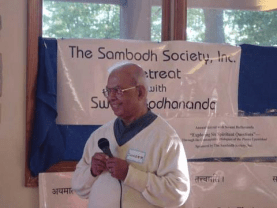
Sri Sunder Hattangadi
The Hindu Doctrine of Karma
Perhaps no word captures the mystery of human existence as suggestively as the word Karma. It is a word that evokes such a host of associated ideas – ethical-moral, psychological, metaphysical, and mystical – that one can easily lose one’s bearings in trying to understand it.
Krishna himself declares in Gita (4:17) – gahanA karmaNo gatiH – “hard to understand is the true nature of action”[`viShamA durj~neyA…yAthAtmyaM tattvam’]. It may be compared to exploring the Himalayan ranges to reach the peak of Kailasa, Shiva’s abode.
Simply defined, karma means action. The stem word, karman, is derived etymologically from the root verb (dhAtu) kRRi, to do, which also generates a multitude of other cognate words that are inextricably related to Karma – e.g. kartA (doer), kartavya/kArya (duty), kAraNa (cause), karaNa (instrument), and so on.
The definitions of Karma are modified by the prefixes, or adjectives, or compound words that are added to it, for example: Karmas may be described as sAtvika, rAjasika or tAmasika; nitya, naimittika; sa~nchita, kriyamANa (Agami), and prArabdha; kAmya, niShkAma; nyAyya, viparIta; shAstra-vidhanokta or avidhipUrvaka; akarma, vikarma, naiShkarmya; svabhAvaja/sahaja.
The Bhagavad-Gita, which Shankara has called `samasta-vedArtha-sAra-sa~Ngraha’ or the `epitome of the essentials of the whole Vedic teaching’ (or Spiritual Knowledge), is the incomparable vade mecum in explaining all the implications of the word Karma. It is a triune synthesis of dharma-shAstra, karma yoga-shAstra, and mokSha-shAstra. Any reader has a wide choice of verses to select in understanding this unique word. The present article is only one such selection, by no means exhaustive, and is only meant to serve as a pointer to other treasures.
Karma and Moksha: Action and Liberation
The word `karma’ yields over 300 words when associated with other prefixes and words to form compound words. The frequency of the word is relatively small in the Vedas & Upanishads, though the major portions of the Vedas (saMhita-s, brAhmaNa-s) are known as Karma-Kanda, i.e. dealing with rituals of worship. They, and the `dharma-shAstra’-s (scriptures on conduct), deal with the do’s and don’ts for the effective functioning of individuals, families, and society. The word has been repeated over a hundred times in the Gita.
The whole pursuit of Reality, the abode of Immortality (13:13) and Imperishable Bliss (5:21), is the effort to transcend the bondage or limitations caused by action. Every ego-centric action leaves an impression (vAsanA) on the mind (or chitta – the memory store-house) serving as a seed to germinate into further action, and results in consequences (karma-phala), that have to be experienced (enjoyed or suffered) in the present or subsequent life. These tendencies (vAsanA-s) can be countered by proper discipline of unselfish actions which leave impressions (saMskara-s). This wiping out of vAsanA-s (vAsanA-kShaya) itself is known as liberation (mukti).
The goal of action is to attain `actionlessness’, (naiShkarmya – Gita 3:4, 18:49). Immortality, freedom from delusion and sorrow and sin, peace, bliss, freedom from desire and anger, are the fruits of this pursuit, as attested in the following verses.
Gita 18:5, yaj~na-dAna-tapaH-karma pAvanAni manIShiNAm – purifiers of the wise.
5:11: “yogins perform action, without attachment for the purification of self.”
4:24 – “Brahman verily shall be reached by one who always sees Brahman in action.”
4:33 – “All action is comprehended in wisdom”.
4:37 – ” Wisdom-fire reduces all actions to ashes.”
Shankra Bhashya on Gita 3:16 states: ` ….till one attains the qualifications for Devotion to the knowledge of the Self, one who knows not the Self and is therefore qualified (for action only) should resort to Devotion to action as a means of attaining Devotion to knowledge.”
In Gita 4:25-32, Krishna defines the manifold yajna-s which are born of action (Bhashya: “in deed, speech and thought”, the not-Self, for the Self is actionless. If you realize that these are not my actions, I am actionless, I am unconcerned, you will be released by this right knowledge, from evil, from the bond of samsara”).
In Gita, 5:8-9, are described other actions (“seeing, hearing, touching, smelling, eating, going, sleeping, breathing, speaking, letting go, seizing, opening and closing the eyes”,) which are expressed by a truth-knower as “I do nothing at all, the senses move among the sense-objects.”
Actions, or the flux of events or changes in phenomena, happen in Prakriti (Gita 7:4) or in Kshetra (13:5-6) when applied to an individual. 3:27 – “Actions are wrought in all cases by the energies of Nature (Prakriti). One whose mind is deluded by egoism thinks `I am the doer’. ”
How does Vedanta view Karma?
Gita 18:13 – (also 2:46, 4:33) Bhashya – “all action ceases when the knowledge of the Self arises, so that Vedanta, which imparts Self-knowledge, is the `end of action’; (sA~Nkhye kRRitAnte)”.
Other References From Upanishads and Bhagavad Gita on Karma
The classical definition of karma is given in Gita 8:3: bhUtabhAvodbhavakaro visargaH karmasaj~nitaH – “The offering which causes the origin of physical beings is called action (Karma)”.
Shankara Bhashya on this is: “The sacrificial act which consists in offering cooked rice, cakes and the like to the Gods (Devatas) and which causes the origin of all creatures, is known by the term Karma; for it forms the seed as it were of all beings; it is in virtue of this act that all beings, animate and inanimate, come into existence, after passing through rain and other regions of life.”
Brihadaranyaka Upanishad, 1:6:1, states: “This Universe is formed of three entities: name, form, and action.”
Taittiriya Upanishad, 1:11:2-4, gives the guidelines – “……should you have any doubt with regard to duties or customs, you should behave in those matters just as the Brahmana-s (learned ones) do, who may happen to be there and who are able and noble thinkers, who are adept in those duties and customs, who are not directed by others, who are not cruel, and who are desirous of merit…..”
[Jaimini’s Karma Mimamsa codifies in aphorisms (3,454 in 16 chapters) the Karma Kanda (`dharma-jij~nAsA’) of the Veda-s, just as Badarayana’s Brahma Sutra-s (555 in 4 chapters) formulate the Upanishadic `brahma-jij~nAsA’ (Jnana Kanda).
Gita 3:14-15 – “From food creatures come forth; the production of food is from rain; rain comes forth from sacrifice; sacrifice is born of action; know thou that action comes from Brahman; and Brahman comes from the Imperishable. Therefore the all-pervading Brahman ever rests in sacrifice.”
Shankara Bhashya : “…Yajna or sacrifice spoken of refers to what is called `apUrva’; and this is the result of the activities of the sacrificer and his priests (ritviks) engaged in a sacrifice. These activities are enjoined in the Veda (Brahman), and the Veda comes from the Imperishable, the Paramatman, the Highest Self. Because the Veda has arisen from the Highest Self, the Akshara, the Imperishable, as the breath comes out of a man, therefore, the Veda, though all comprehending as revealing all things, ever rests in sacrifice, i.e., it treats mainly of sacrifices and the mode of their performance.”
As the reader can see, the word Karma has a rich history and heritage. A discussion of it is intimately tied to other topics such as reincarnation (rebirth) and moksha (liberation). Please review the following references for more information.
References:
http://www.sankara.iitk.ac.in/gitaindex.htm [Complete Works of
Shankara]
http://www.gitasupersite.iitk.ac.in/ [various commentaries on
Gita]
https://luthar.com/wp-content/uploads/2007/07/karma_mimansa.pdf [Jaimini
Sutra-s on Karma Mimamsa]
http://www.archive.org/details/thekarmamaimaacm00keituoft
http://www.mimamsa.org/articles/brief_introduction.html
http://www.geocities.com/profvk/gohitvip/contentsbeach11.html (waves
9&11) [by Prof.V.Krishnamurty]
http://www.hinduismtoday.com/archives/1994/2/1994-2-09.shtml
https://luthar.com/wp-content/uploads/2007/07/waystotruth.pdf [by Ananda Wood]
Back To The Truth – Dennis Waite ; 2007 Ch 2; O Books, UK
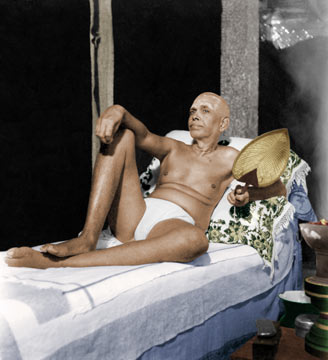
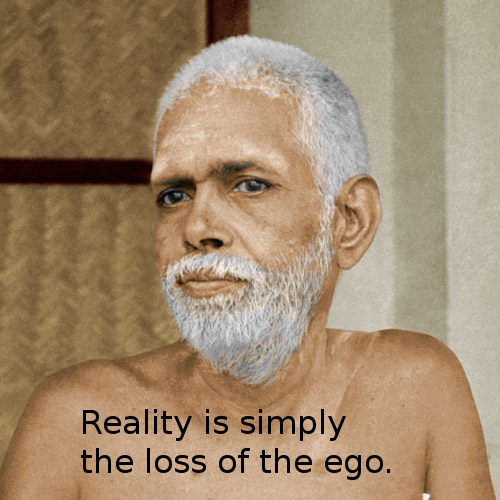
Bhagavan Ramana Reclining

I received some excellent and thoughtful comments from Sada-Ji (Dr. K. Sadananda) on the article, “The Method of Deep Body Relaxation.” These comments with minor editing are given below. Thank you Sada-Ji.
Editor
**************************************
Comments on “Deep Body Relaxation” By Dr. K. Sadananda
Harshaiji – PraNAms
Here are some comments on your article about “Deep Body Relaxation.”
Shava Asana is always done at the end of yoga exercises as a relaxation technique.
However, I would like to add a word of caution for going from Shava to Shiva – that is lying down and doing regular meditation. There is a good reason why the Lotus Posture (Padmaasan) is universally recommended for meditation. Shava or the corpse is considered as inauspicious while Shiva means auspiciousness itself
Also, it should be kept in mind that when one is in meditation, the normal breathing process will slow down and mind becomes quiet and calm. These conditions are conducive for the mind to go to sleep easily. Hence for most meditators, sleep becomes a big hurdle to overcome. Therefore, the Shava Asana (Corpse pose lying on the floor or bed) may not be useful for meditation.
Sleep is the opposite of meditation. In meditation one attempts to stay conscious and awake. That is one of the reasons why meditation is not recommended in the night when the mind is tired, but in the early mornings when the mind is fresh and vibrant. The period around 4am in the morning is considered best for meditation (it is called brahma muhurtham in Sanskrit).
The Lotus posture insures that the person who is meditating does not fall forward. Sitting in the lotus pose is recommended so that the student is stable and firm on the ground.
Yogic texts all advise that the vertebral column and the neck be in straight line (without going into the details of kundalini aspects).
This way one can stay in meditation for any length of time – awake-vigilant and meditative. Indeed that is the state of mind in meditation to be aimed at.
As Harshaji states, one can easily go to sleep in the Shava Asana. In fact one should go to sleep in that pose thinking of the Lord.
Then one can have Yoga Nidra and blissful heavenly relaxation.
But for Vedantic inquiry, the mind has to be sharp. Our own experience is that we can read stories or popular magazines lying down. But for any serious work, we have to sit up and study. Knowledge can take place only when the mind is sharp. Then, what to talk about the subtlest knowledge about one’s own self. So the recommendation is to do meditation in the sitting pose – if you can.
If you cannot, then alternate poses are recommended.
Now the question is whether one should do meditation in a lying down pose such as Shava Asana! Of course you can do! It is like a drunkard who went to ask a priest, “Sir, can I drink while praying to God?” Priest of course said, “No. you should not drink while praying.”
The drunkard thought about this and re-framed his question and asked again, “Sir, can I pray while drinking?” “Yes of course”, said the priest. So, can one meditate while lying down? The answer is, “of course you can meditate any time and anywhere.” No problem!
Should one lie down to meditate? No, that is not advisable. Sri Krishna himself recommends sitting down and meditating in the 6th Chapter of Bhagavad Gita.
Of course for relaxation – what Harshaji says is correct.
But For a meditator, relaxation is not the goal, but it is only a by-product. Vedantic meditation requires a calm, quiet, and vigilant mind. It is a subtle inquiry within of the very essence of life itself. If relaxation becomes a goal, the meditative mind will only long for that. If the mind settles in that groove, it will not be ready to take a higher flight.
Deep Body Relaxation
I used to teach Yoga, relaxation, and meditation classes in the late 1970s in NYC to make a living. After the Hatha Yoga sequence was done, students were led through a guided deep body relaxation in Shava Asana (the corpse pose where everyone lies down and relaxes each part of the body). After teaching Yoga for many years, it seemed to me that for most students, the guided meditation while lying down was absolutely the most favorite part of the class. Many students would continue in the Shava Asana for half an hour or more after the class was over. Some became so relaxed that they would fall asleep.
Over the years, I have come to feel that the best posture for meditation is not always the Lotus posture as many Yoga traditions claim, but simply lying down in Shava Asana. The sleeping posture is universal and sets no high bar for anyone to have to overcome. Therefore, it is the perfect posture for attaining Self-Realization. In fact, we know that the Sage of Arunachala, Sri Ramana Maharshi, became Self-Realized in that posture.
Deep body relaxation can be mastered by anyone slowly and many people experience physical, mental, and spiritual benefits from it. I have personally found it to be immensely useful in a variety of ways. My own experience of the Heart, Oneness of Being, came when I was very young. I had been meditating for many hours, sitting straight in a cross-legged position, and my back was aching and so tired that I lay down to rest for a few minutes. I was not trying to relax but it was in that resting posture that this deep conscious relaxation came over me and the truth of being revealed itself with complete clarity.
The Relaxation Method
The relaxation method I use is easy. I simply bring attention to every part of the body and consciously experience it and relax it. I start with each individual toe on both feet and relax these. I also focus on the bottom of the feet and relax these. Then I focus on the upper feet and relax these. Then I come to the ankles and relax these and keep moving up to the legs and other parts of the body and so on.
Sometimes, in my teaching, I have combined this method with visualization of white light filling the different parts of the body from the head to the toes. This is a beautiful way to use the intelligence and imaginative and visual faculty of the mind to fill the body with deep relaxation and to create a sanctuary of peace for one self.
Of course, Hatha Yoga is important for many people and sitting in meditation with a straight spine has its own health and energy oriented benefits. Meditation on energy centers along the spine is facilitated by sitting straight in a cross-legged posture. It also helps in doing certain pranayama and deep breathing exercises.
For many people who cannot sit cross- legged, sitting straight on a chair with support for the elbows is helpful. There are many ways to meditate. The main thing is that one should be comfortable in one’s posture.
Sincere Practice Leads to Self-Discovery
One, who is serious about meditation and relaxation and practices it with sincerity, slowly discovers what postures and exercises are the most helpful for her/his body and mind. Each person is unique in terms of what they find useful.
Finding a good yoga teacher is much easier today than it was when I was teaching. Back in the 1970s, in the U.S. and other Western countries, Yoga was popular only in big cities like Manhattan and Los Angles among the actors and actresses and the elite. But now it has become more mainstream and one can find Yoga classes in virtually any city.
Deep body relaxation seems to be universally attractive to people, because it allows for letting go of accumulated tension. It is easy to learn and do and with practice and experience becomes natural.
(This article was originally published in HarshaSatsangh E- Magazine Volume I)
Twenty years ago, the kundalini-shakti erupted within myself. Since I didn’t have a clue about what had happened to me and I experienced some quite unpleasant side-effects of this awakening, I had to start looking for remedies in order to ease some of the discomfort. This has been a more or less ongoing process ever since and although I can’t say that all problems have disappeared, some interesting insights and experiences have been gained and that alone has made the journey very worthwhile.
The effects on the psyche, and on one’s ideas about oneself and life in general, that come about by an active kundalini are far reaching indeed, but this transformation seems to have a price attached to it. In my case I’ve been plagued by a variety of symptoms ranging from physical health problems to bouts of anxiety and depression. As a result, I’ve been led to closely observe and attempt to harmonize the innermost workings and mechanics of my mind and body using a variety of techniques and methods such as tai-chi, hatha-yoga and various types of meditation.
To Do Something, or Nothing?
As much as I agree with the advaitin conclusion about reality being One and the concept of separate personalities acting within reality being illusion, I think that the often heard claim that nothing actually needs to be done in order to realise this, will probably only be true for a small number of persons. I find that, in the case of myself at least, ( and I do believe this would apply to most people) some work on oneself using “techniques” is necessary in order to be able to experience this fundamental unity of life. The main reason appears to me to be the deeply ingrained innate patterns of body and mind that prevent a true perception of life.The experience of duality seems to be hardwired into our being by nature, so that definite changes have to take place within the perceiving mechanism of ourselves before reality becomes non-dualistic.
Doing Mantras
One spiritual discipline that seems to work on many different levels to me has been the practice of silent mantra-repetition. One of the first deeper insights or realisations came to me after I had practiced mantra-meditation for some time as taught by Transcendental Meditation or TM.
I was sitting in meditation one day, quietly repeating the mantra in thought, growing progressively calmer and relaxed as a result as the normal rush and clutter of the mind began to recede. Suddenly it hit hit me like bolt of lightning – I was inside “myself”, calmly watching the mantra repeating itself, calmly observing whatever thought-processes still passed through the mind – BUT I WASN’T THE MIND – I WAS THE OBSERVER OBSERVING THE MIND! An enormous sense of relief and gratitude welled up inside as I in one instant understood that everything that really created problems in my life was either mind or body, but that the real “I” was the silent and totally unaffected observer, calmly watching everything come and go.
This was a very profound experience since it in one instant blew the identification with the mind to bits. I had always somehow thought that I actually WAS the constant inner monologue and imagery playing themselves out and now this was shown to be not true at all in a perfectly clear way. I was actually the screen on which the mind with its movies was projected – but I wasn’t the images themselves.
I soon realised however that this was just a glimpse into the deeper reality, but not at all a permanent state of enlightened being – a lot of practice or sadhana seems to be necessary in order to shift the focus of consciousness for good, even though the awakened kundalini is a kind of automatic process in this direction.
After this, mantra practice began to intrigue me more and more, especially since I also became very sensitive to sound and music in particular. I would experience rushes of kundalini moving up the spine, followed by ecstatically blissful sensations listening to certain types of music or certain combinations of notes and harmonies.
I then began to experiment with other mantras and other methods of repetition. Whereas the TM-meditation in essence uses the mantra to really allow oneself to let go and relax completely, I found that mantra-repetition could also be used to direct and control the mind in a more active and deliberately focused manner. This is more in line with yoga as taught in the tradition of Patanjali. The aim here is the sharp one-pointedness of mind which prevents the scattering of thoughts in all directions and keeps the mind from going outwards through the senses. It seems to me that it really is this rapid movement of the mind, constantly going back and forth between the falsely perceived separateness of oneself and the equally false “outer world,” that is one of the main obstacles to just calmly resting in the unity of world and self.
Technically, what seems to happen is that the focusing of thought focuses energy and this usually leads to an increased flow of kundalini along the spine. When this burst of energy reaches the highest region of the brain, shifts in consciousness occur, spiritual insights come drifting into awareness automatically and there can be general feelings of being in tune with the All and Everything.
For this slightly different way of repeating, I try to focus with as much attention as I can on the sound and the shape of the mantra until it gradually fills out the whole space of the mind . I’ve often also done this walking outside with eyes open until sometimes the boundaries between inner world of thought and feeling and outer world of objects have more or less vanished and everything is just felt to be one big continuum with different degrees of density. If the focus is strong enough, it’s as if the whole outer universe becomes filled with the sound of the mantra as well and it can then seem as if the cosmos begins to chant back, which is quite nice.
Mantras and Side-Effects
Other interesting and spiritually useful side-effects of doing mantras over time, is that one develops an increased awareness of the shape and direction thoughts take and it becomes much easier to voluntarily direct the mind and consciously choose which thoughts to follow and which are best left to fade away by themselves. Since I firmly believe that thought determines action and ultimately the realities and life circumstances we find ourselves in, this aspect of mantra-practice is probably quite powerful, in terms of shaping the future and destiny.
A third approach to mantra-recitation that I’ve used with some results is more in line with tantric teachings which focus on the harmonising and control of the different chakras or areas of consciousness. This is also done in order to understand and streamline the physical and mental aspects of life, which manifest through the lower chakras. Mind and body in essence seem to be permutations and combinations of the 5 basic elements – ether or the space in which manifestation takes place, air, fire, water and then earth as the solid end-result. In tantra-speak all this is the Shakti side of the great universal polarity and is ruled by the kundalini. In order to experience Shiva, the silently witnessing consciousness, or the real, permanent “I” of non-duality, kundalini needs to be moved out from the lower chakras and made to unite with top area of the brain. Before that can happen in a steady and permanent manner, the chakras or in essence the elements they represent, need to be purified and strengthened. In practice, I find this to be quite demanding to say the least, but this is probably mainly due to my own shortcomings!
Mantra and Tantra
In the tantric traditions mantras have been used for this purification and as far as my humble experimentation has allowed me to see, the ancient yogis very much knew what they were doing. Reciting the mantra “Lam” at the end of the spine for instance, strengthens, energizes, opens and expands the root-chakra. Now, why is this so, why “Lam” and not any other sound ? I don’t know, but for me, taking the pragmatic approach of “if it works, use it” is the best one. Traditionally, the explanation given is that the ancient seers and rishis were given the various mantras in direct communion with the Infinite and I can go along with that. One day the science of physics will probably find out that the universe really is sound in motion and that different densities of matter correspond to different frequencies of sound. Humans, being part of the universe, will then correspondingly be found to also consist of various frequencies of sound and I believe great advances in the healing sciences will be made because of these discoveries.So, essentially, mantras can be seen to be a method of tuning the mind, body and awareness, harmonising frequencies, directing consciousness towards the light, instead of letting it scatter.
May all beings find peace and happiness.
About the Author:
Michael Hortling is currently residing in Germany. He combines mantra yoga practice with playing the guitar and creating music. As a youngster, he had a mystical experience while watching the Aurora Borealis drape itself across the Northern sky and this may have caused his energies to be like the Aurora, flowing, generously gentle and glowing brightly.
Seed Mantras
The following seed mantras are taken from the classic texts and schools of Kundalini Yoga based in Hinduism. The mantras used in Jainism and Buddhism are somewhat different. Traditionally, Kundalini Yoga in India was only practiced under the guidance of a Kundalini adept. The same advice holds today. Having a good teacher is essential in avoiding mental and physical challenges that may come with the practice of Kundalini Yoga.
LAM – the root (lessons related to the material world)
VAM – the belly (lessons related to sexuality, work and physical desire)
RAM – the solar plexus (lessons related to ego, personality, self-esteem)
YAM – the heart (lessons related to love, forgiveness and compassion)
HAM – the throat (lessons related to will and self expression)
OM – the brow (lessons related to mind, intuition, insight and wisdom)
All Sound – the crown (lessons related to spirituality) this is your quiet and all sounds around you. The sound of your being….

Berit Ellingsen is a long term member of the HS community and was the Editor-In-Chief for Volume III of the HS E-Zine. She worked with great patience and creativity to bring the best out of every article that she edited and often added beautiful graphics to enhance each author’s contribution. Berit lives in Norway. She has a degree in biology from the University of Bergen, Norway. This particular article by Berit Ellingsen appeared in Volume I of the HS E-Zine in the Winter of 2001.
Self-Realization in Jnana, Kundalini, and Tantra Yogas
Kundalini-Shakti, in traditional Indian spiritual sources, is described as the energy that propels man to liberation. Thus, awakening this energy in the body(mind) of the practitioner is central in some liberation teachings, most notably, the Kundalini Yoga systems and the Tantra Yoga systems. As the energy moves in the central channel in the body from its resting place and source in the Muladhara Chakra to the Sahasrara Chakra, and enlivens the passive element of the mind, liberation is said to ensue.
Jnana Yoga, the “yoga of knowledge”, the type of yoga most commonly associated with Advaita Vedanta and the non-dual perspective, does not have the body and its energies as the main focal point for spiritual development, but the mind itself. Jnana Yoga uses the individual consciousness as a tool to learn about the true self and thus attain liberation.
One method of Jnana Yoga is Sri Ramana Maharshi’s method of self inquiry, atma-vichara. In asking oneself “who am I ?” one centers the individual consciousness onto its source. Thus, by focusing the conscious mind on the still point, the witness, to witness the very act of witnessing, the barrier between the perceiver and the perceived vanishes.
Awakening the power of Kundalini-Shakti alone and manipulating this energy is not seen as a prerequisite for attaining liberation, and Kundalini-Shakti does not have a central place in the texts of Jnana Yoga. The method of atma vichara alone is enough to bring about liberation (“Be As You Are, The Teachings of Sri Ramana Maharshi”, edited by D. Godman, p. 142 and p. 146).
Is there nevertheless common ground between Jnana Yoga and Kundalini Yoga ?
From a non-dual perspective, Kundalini-Shakti is but one form of the Self. Kundalini-Shakti is the Self, pure energy and pure Being (Be As You Are, The Teachings of Sri Ramana Maharshi, edited by D. Godman, p. 145). The human mind with its consciousness is also a form of energy, of consciousness and Self.
In Kundalini Yoga and Tantra Yoga, Kundalini-Shakti can be influenced by other energies such as sound (mantra), light and darkness combined into symbols (yantra and mandala) and movements of the physical body (asanas). In Kundalini Yoga, concentration on these energies and on various psychoenergetic centers, the chakras, is said to bring the Kundalini energy to these centers to break through the seven veils (chakras) that stand between union of the individual soul, Atman, with Shiva (or the non-dual consciousness, the Self).
To become strong enough to break through the seven veils of consciousness and reach the Sahasrara Chakra, the Kundalini energy must purify the body and mind in a process which may take many years. In this process, the energy will not always stay in the central channel, but spread out from the Muladhara Chakra in a broad fan that may include the entire lower body or torso in a process that can be complex.
The common denominators in manipulating the Kundalini-Shakti to attain liberation are concentration and focus. Where the mind and individual consciousness, the individual thought energy, is moved and focused on, there Kundalini-Shakti in the individual mind-body also moves. Thus, it makes sense to move consciousness not only onto energy centers, chakras, in the individual body, but instead directly onto and into its own source.
During the practice of atma-vichara, where the consciousness turns inward onto its own source, not to repress any thoughts or concentrate on any subject apart from the act of witnessing itself, the Kundalini-Shakti will automatically become concentrated into a fine beam. It will easily be led back to its source by rising upwards in the central channel with a force strong enough to break through the one true veil between man and liberation, the very idea that the individual consciousness is separate from the Self. The energy of consciousness, the Kundalini-Shakti, in this way is used as a laser beam to melt a single window instead of as a ram to bring down seven gates. No conscious piercing of the Sahasrara or any other Chakra on behalf of the individual mind is needed.
To bring about full liberation, Sri Ramana Maharshi recommended to continue to clean out the vasanas (the contents of the body-mind which keeps the Atman identified with the body-mind) which may be present even after the identification with sat-chit-ananda has been experienced in the first Nirvikalpa Samadhi (“Be As You Are, The Teachings of Sri Ramana Maharshi”, edited by D. Godman, p. 66-67). After the first Nirvikalpa Samadhi, Kundalini-Shakti may manifest spontaneously, or where already present, the energy may increase the strength and efficiency of its manifestation. The Kundalini energy will then bring more of the vasanas (latent tendencies) to the attention of the conscious mind.
As a result of the knowledge experienced in Nirvikalpa Samadhi, the mind will ask itself “to whom did these events happen ?” and the true nature of this mind content is seen and disidentified with. In this process, the Kundalini energy brings the vasanas to the conscious mind where they eventually evaporate like water in sunlight.
Thus, Jnana Yoga and Kundalini Yoga may share common ground in the effect of the Kundalini-Shakti in the body-mind, both prior to the first Nirvikalpa Samadhi as well as afterwards. The difference between the two yoga systems lies primarily in the view of how this energy should be employed, either directly, as in Kundalini and Tantra Yoga, or indirectly, as in Jnana Yoga.



 Luthar.com
You must be logged in to post a comment.