Harsha's avatar

The Journey of the Soul – II

This is in continuation of a Journey of the Soul – I

That is how it comes about that in scientific terms, one cannot prove that energy. What can be proven is only that which has motion. Yet motion is such that at the moment you view it, it changes, and you do not have a true picture of that motion at its most subtle level. That is why we know so little, from laboratory experiments, of the mind. Yet a whole vast range of the mind, over 90 percent, exists which is unexplored. As technology develops, there will be instruments or certain inventions which will probe a bit deeper into the mind. The 10 percent, explored, can become 15, 20 or 30 percent. But we want to know here and know the entirety of the mind, and the mind, being so involved in itself, cannot know itself.Gururaj disciples at Raman's home

When you are involved in a problem, an emotional problem, you cannot think straight because you are involved. But if you separate yourself from the machinations of the mind, you can view the mind from a different perspective altogether. That is why we have counselors, so that when you are in a  rut (someone told me the other day, a rut is nothing else but a coffin with both ends open), you can go to a counselor who can view the subject or the problem objectively, because he is not emotionally involved. Many times people involved in a business deal will say, “let me sleep on this” That means that at this moment I am so involved in this problem that I need to let my mind rest. Tomorrow I shall look at the proposition with a rested mind, more objectively. In this process what travels from point to point is nothing else but the mind.

Now, where can the mind travel to? That is the other question. We have said that the spirit within a human being, or the spirit which pervades the universe, is omnipresent. If the manifestor is omnipresent, then its manifestation must be omnipresent too. Where is there a place for the mind to go? What happens is this: There is just a shifting of energies in the mind. Because there is contraction and expansion going on all the time in the universe, polarities are created. You lift the weight from this side of the scale, and you add some weight on the other side of the scale. The pendulum is forever swinging from one end to the other, and that is happening in the universe. That is what is known as contraction and expension. So the mind goes from nowhere to nowhere, while the energies are just shifting.

Through spiritual practices, we are also working with energies. We are also activating energies, but activating grosser energies and very systematically leading those grosser energies toward the more and more subtle energies which are in the mind. The mind has the conscious level, various strata of the subconscious level, and the superconscious level. All this falls under manifestation, and all manifestation is relative. It is relative to the Absolute.

Gururaj Ramon and Vidya in CyprusWithin the confines of this whole scheme of things, relativity has its gradations: The conscious mind, which is gross; the subconscious mind, including the various subtler levels of the subconscious mind (psychiatrists and psychologists only delve 10-15 percent into the subconscious layers) and beyond that vast subconscious field, the superconscious mind. So we start with the subconscious mind and lead it gently through the layers of the subconscious to the superconscious until we experience the finest, subtlest relative. When we experience that, we can safely say that we have the universe in the palm of our hand.

So there lies the movement from grossness to its subtler levels; yet it is standing still. All the movement in the ocean you see is surface movement. Really speaking, the ocean is not moving. It is there. So, if we think of movement and that which lies between the area of Silence to Silence, nothing has moved. Silence reamains the same and the superimposition remains the same. So, traveler, where do you come from and where are you going to? Nowhere.

It is all here and now. Of course, there are the theories of reincarnation and karma and “reap what you sow.” They also are true at certain levels. But in reality, a person  moves nowhere, and the apparent movement is only the mind experiencing itself at its subtler and subtler levels. That is the greatest illusion: By thinking that I move, I sit still.

For the mind to experience the subtler states, various forms of evolution are necessary, and this evolution from very gross matter to the present stage of humanity has taken millions of years, proceeding through various forms. Yet the substance of all those forms is not different. The substance that makes up the vegetable kingdom is the same substance that makes up the animal kingdom, which is the same substance that makes up the human kingdom. In essence, the substance remains the same. What is this body? It is nothing but food.

These very same substances, assuming different shapes and forms are given names. This table and I are not at all different from each other; we are of the same substance. This table is at a grosser level, and I, having developed the power of thought, am at a more subtle level. That’s the only difference. This table cannot think, the animal cannot think, but I can think; it is just a matter of degree, not of difference in substance. The molecular and atomic structural framework of this table is the same that structures me. The great illusion is accentuated in human beings, because people have reached that certain evolutionary stage where they are thinking.

The great illusion comes about because a person thinks that he thinks, while he is not really thinking. The less a person thinks, the more he experiences. The very process of thought, if wrongly used, can be the wall between the changing unreality and the unchanging reality. That does not mean that we need to destroy the mind – the mind is a great instrument and is to be used.

A sharp knife given to a delinquent boy can be dangerous. But the same sharp instrument in the hands of a surgeon can help perform an operation. So the mind has to be consciously directed. The power and force of the entire universe is contained in the mind, but it has to be directed.Gururaj Ananda and Cansita

If the mind tries to direct itself, then many things can happen, including misdirection, because the instrument is trying to work upon  itself. So we use meditation and spiritual practices to go deep to the superconscious level, which is the closest to the manifestor. We let those subtler energies remodify the thought patterns of the conscious mind, for the conscious mind is a conditioned mind, and we’ve got to use a subtler force to be able to repattern and overcome the conditionings of the conscious mind.

Most of our troubles are of the conscious level. These are in turn pushed forth from the subconscious level. The left hemisphere of the brain, which is said to control thinking, analysis, verbalizing, and symbolizing, is connected to, not apart from, the right hemisphere of the brain, the part that is said to be a link to the intutive ability and the universal mind. Through meditation and spiritual practices we enliven this connection, first in the organ of the brain, and then in its subtler layer, which we call the mind, it’s subtler self. The entirety of the mind has been grossified into the organ called the brain to give us the individuality that we have. Of this brain, three pounds in weight, containing twelve billion cells, we use only one millionth part.

So, by activating the right hemisphere, we are energizing the left hemisphere, and therefore there is greater clarity of thought, greater concentration, and greater one-pointedness: and all  these qualities  plus others make one’s life successful. Not only we are using the energies of the left hemisphere, but, as a result of spiritual practices, we are also drawing upon the intuitive level. If we combine the analytical with the intuitional, how much more forceful our actions become, how much more truthful our thinking becomes. In this way we are led to right thought and right action.

So after practice, over a period of time, the mind gradually starts functioning in a spontaneous manner, to do that which is right. Then thinking is not necessary; you just do. You would, for example, come to a fork in the road, and you would just ver spontaneously take the right road. Your analytical mind will not tell you why or how you did it.

What is working is that intuitional level, which fulfills your every need, not your every want. With “want” the left hemisphere comes into play: “I want a million pounds, I want a 50-room mansion, I want this, and I want that.” That kind of analysis leads only to ego-boosting.

Now, all this exists within the framework of the traveling from Silence to Silence. This is the motion that is created. When that which we are calling the left hemisphere dominates us, we are enmeshed in our ego-selves, which know only this: me and mine.

If the mind is empowered by what we are calling the right hemisphere, the intuitional level which has its roots in the core’s of one personality, which we also call the heart, then “me” and “mine” disappears and it is “thee” and “thine.” For the core of the human personality, though outwardly seeming individualized, also exists in its universilezed form. So what happens to a person is this: He can exist as an individual and yet at the same time be universal, for he has now realized, through his spiritual sadhana , how vast he is. When this happens, a person, being divine, recognizes and experiences this Divinity.

to be continued in Journey of the Soul – III

Soon coming.

MEDITACIÓN BARCELONA

Harsha's avatar

We Did Not Go To Him For Profit: By T.K. Sundaresa Iyer

Note: T.K. Sundaresa Iyer (T.K.S) met Sri Ramana in 1908 when T.K.S was only a twelve year old boy. Bhagavan, although a full blown Self-Realized sage, was also quite young and in his late 20’s. Many early devotees have described how Bhagavan by his sheer look would give them experience of the Self. However, this was not true in every case.

T.K.S’s cousin Krishnamurthy had been visiting Bhagavan Ramana  regularly and would sing songs of devotion to him. One day T.K.S asked his cousin where he went every day. Krishnamurthy told him about Ramana and said, “The Lord of the Hill Himself is sitting in human form, why don’t you come with me.” Both of them then climbed the Hill and went to Virupksha cave to visit the Sage.

Now the story in T.K.S.’s own words:

I too climbed the Hill and found Bhagavan sitting on a stone slab, with about 10 devotees around him. Each would sing a song. Bhagavan turned to me and asked, “Well, won’t you sing a song also.” One of Sundramurthy’s songs came to my mind and I sang it. It’s meaning was, “No other support have I, except thy holy feet. By holding on to them, I shall win your grace. Great men sing your praise Oh, Lord. Grant that my tongue may repeat Thy name even when my mind strays.”

“Yes. That is what must be done,” said Bhagavan, and I took it to be his teaching for me. From that time on, I went to see him regularly for several years without missing a day.

One day I wondered why I was visiting him at all. What was the use? There seemed to be no inner advancement. Going up the hill was meaningless toil. I decided to end my visits on the hill.

For one hundred days exactly I did not see Bhagavan. On the hundred and first day I could suffer no longer and I ran to Skandasramam, above Virupaksha Cave. Bhagavan saw me climbing, got up and came forward to meet me. When I fell at his feet, I could not restrain myself and burst into tears. I clung to them and would not get up.

Bhagavan pulled me up and asked: “It is over three months since I saw you. Where were you?” I told him how I thought that seeing him was of no use. “All right,” he said, “maybe it is of no use, so what? You felt the loss, did you not?”

Then I understood that we did not go to him for profit, but because away from him there was no life for us.

From “At the Feet of Bhagwan” by T.K. Sundaresa Iyer.

Harsha's avatar

Surrender and Salvation: By Voruganti Krishnayya

Voruganti Krishnayya was a great devotee of Bhagavan Sri Ramana. He has narrated many incidents that he observed while in Bhagavan’s company. The following story is one of my favorite.

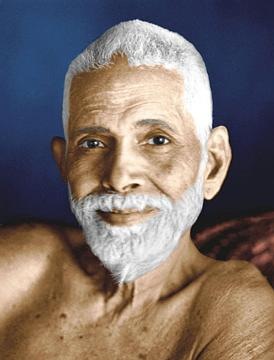
Bhagavan Ramana

Bhagavan Ramana

Bhagavan was most tender with people who thought themselves for some reason or other to be miserable sinners and who went to him torn by repentance.

During summer evenings we used to sit in the open space near the well. We would collect in the dining hall for dinner and come back to the well. Suddenly, one day, a visitor started weeping bitterly, “I am a horrible sinner. For a long time I have been coming to your feet, but there is no change in me. Can I become pure at last? How long am I to wait? When I am here near you I am good for a time, but when I leave this place I become a beast again. You cannot imagine how bad I can be – hardly a human being. Am I to remain a sinner forever?”

Bhagavan answered: “Why do you come to me? What have I to do with you? What is there between us that you should come here and weep and cry in front of me?”

The man started moaning and crying even more, as if his heart were breaking. “All my hopes of salvation are gone. You were my last refuge and you say you have nothing to do with me! To whom shall I turn now? What am I to do? To whom am I to go?”

Bhagavan watched him for some time and said, “Am I your guru that I should be responsible for your salvation? Have I ever said that I am your master?”

“If you are not my master, then who is? And who are you, if not my master? You are my guru, you are my guardian angel, you will pity me and release me from my sins!” He started sobbing and crying again.

We all sat silent, overcome with pity. Only Bhagavan looked alert and matter-of-fact.

Bh: “If I am your guru, what are my fees? Surely you should pay me for my services.”

D: “But you won’t take anything,” cried the visitor. “What can I give you?”

Bh: “Did I ever say that I don’t take anything? And did you ever ask me what you can give me?”

D: “If you would take, then ask me. There is nothing I would not give you.”

Bh: “All right. Now I am asking. Give me. What will you give me ?”

D: “Take anything, all is yours.”

Bh: “Then give me all the good you have done in this world.”

D: “What good could I have done? I have not a single virtue to my credit.”

Bh: “You have promised to give. Now give. Don’t talk of your credit. Just give away all the good you have done in your past.”

D: “Yes, I shall give. But how does one give? Tell me how the giving is done and I shall give.”

Bh: “Say like this: ‘All the good I have done in the past I am giving away entirely to my guru. Henceforth I have no merit from it nor have I any concern with it.’ Say it with your whole heart.”

D: “All right, Swami, I am giving away to you all the good I have done so far, if I have done any, and all its good effects. I am giving it to you gladly, for you are my master and you are asking me to give it all away to you.”

Bh: “But this is not enough,” said Bhagavan sternly.

D: “I gave you all I have and all you asked me to give. I have nothing more to give.”

Bh: “No, you have. Give me all your sins.”

D: The man looked wildly at Bhagavan, terror stricken. “You do not know, Swami, what you are asking for. If you knew, you would not ask me. If you take over my sins, your body will rot and burn. You do not know me, you do not know my sins. Please do not ask me for my sins.” And he wept bitterly.

Bh: “I shall look after myself, don’t you worry about me,” said Bhagavan. “All I want from you is your sins.”

For a long time the bargain would not go through. The man refused to part with his sins. But Bhagavan was adamant.

Bh: “Either give me your sins along with your merits, or keep both and don’t think of me as your master.”

In the end the visitor’s scruples broke down and he declared: “Whatever sins I have done, they are no longer mine. All of them and their results, too, belong to Ramana.”

Bhagavan seemed to be satisfied. “From now on there is no good nor bad in you. You are just pure. Go and do nothing, neither good nor bad. Remain yourself, remain what you are.”

A great peace fell over the man and over us all. No one knows what happened to the fortunate visitor; he was never seen in the Ashrama again. He might have been in no further need of coming.

Bhagavan Ramana

Bhagavan Ramana

Harsha's avatar

The Journey of the Soul – I

Gururaj Ananda Yogi used to speak in his satsangs about the path of unfoldment, to emphasize the fact that there is no development, the soul is completely developed, there is just an unfolding. But in this path, that  goes from Silence to Silence: What is traveling? Have we traveled a path or have we not traveled at all. And if it has been a journey: Who experiences this journey?

We “know” that the spirit of the human being, or the universal spirit, is omnipresent. It has nowhere to go and nowhere to come from. It just is. So what journeys? Is it really and experience, or is it an illusion? Even if it is an illusion, then how is illusion experienced? All illusion or delusion is just a counterpart of reality, as it’s own “non-existence” exists within that It that we call reality.

We come from nowhere and we are going nowhere, but just give a little space between the “w” and the “h”. You are now here and that is the important factor to recognize in practical life. Nevertheless, the mind has a habit of inquiring.

IFSU Flag

IFSU Flag

The  mind is conditioned through the process of evolution into going through various stages whereby it gains these experiences. Who gains the experiences? The mind gains the experiences.

A HUMAN BEING HAS THE CAPACITY TO EXPERIENCE THE ENTIRETY OF THE UNIVERSE; THE SPIRIT CANNOT

So, the experiences having been gained by the mind, of the mind, and from the mind bring us to a simple idea: There is nothing outside the mind. The human mind is as vast as the entire universe, and if you individualize it, it only means that you are viewing one bubble in a vast pond. And that bubble has no separate existence from the pond. A human being has the capacity within himself to experience, with the mind, the entirety of the universe; while the spirit remains aloof, for the spirit cannot experience this journey. Therefore we say, “From Silence we proceed, and we return to Silence.” It means that the mind that has been manifested, as fragrance is from a flower, goes through this journey, be it illusion or not, and then finds itself at total “at-one-ment” with the spirit. That is the journey, so in reality there has been no journey.

But the mind assumes that this is a  journey, that there is a journey. What are the reasons for this? The spirit just is, while the mind travels thinks it is traveling from here to there. From the beginning of the present cycle of this universe there is a manifestation, wrongly called creation, because creation requires a will behind, while manifestation is just an emanation. It is the nature of the manifestor to manifest, like it is the nature of a flower to give off fragrance, but there is no will involved. The powers in the manifestation are known in sanskrit as the three gunas, tamas rajas and satvas. It is this interaction between darkness and light that operates in the manifestation of this universe, which is the Universal Mind also.

THE MIND CREATES EXPERIENCE

The entire mind, or the universe, is nothing else but a propulsion which seemingly goes forth in our concept of linear time and space. In the third dimension that we exist in, we find this movement proceeding from A to B, while beyond the mind there is no space and no time. Like Blake said, “Eternity in an hour”, we would rather say, in a moment.

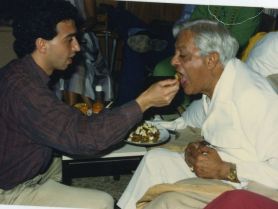
Gururaj Ananda Yogi fed by Raman Leonato in Cyprus

Gururaj Ananda Yogi and Raman in Cyprus

In this process put forth through manifestation in which the three gunas operate, the mind feels itself traveling. Why does it feel itself traveling; why does itself feel mixed up in the process of evolution? In this process of contraction and expansion generated by the three gunas, matter and it’s various atomic structures is always in motion. The mind enmeshed in this process of contraction and expansion thinks it is moving.

If you watch a wave in the ocean, you think the wave is coming from a distance and going to the shore. This is not so. There is a rhythm in the ocean created by currents where each wave is bobbing up and down where it is, and the next then bobs up and down, and so on so forth giving us the illusion that the wave is moving from that end to the shore. Likewise there is the flux of the universe, the perpetual motion that perpetuates itself, within itself, by itself, because its nature is motion. What we are trying to find is that which is silent behind all the motion: for that which is motion cannot be silent, and that which is silent can have no motion. Very simple.

The mind because it has the ability to act and interact within its own components, becomes more and more complex, and it is this very complexity that adds onto the motion of the mind. The  mind creates the experience, and the mind itself is the experiencer, for the eternal spirit within humanity is beyond all experience of motion or anything else. It just is. Here it is a question of a superimposition.

Heat rises from the sun. The sun does not intentionally create the heat: it is the nature of the sun to give off heat. Similarly, that eternal energy, in its very silent form, first manifests itself as mind.

When mind assumes this motion, it also finds a direction, and this direction is what we term as will- Divine Will. Because there was Divine Will, all this you observe, including our individual wills, has come about.

This is very true from from the theological point of view and the philosophical point of view. But from the mystical point of view, this truth assumes a totally different approach: In the manifestation which one could call Divine Will , the Will itself becomes the individual mind. Here there is no differentiation between mind and will. Ordinarily it is the directed activity of an individual mind, which is self-created, that is called will.

When manifestation occurs, this divine force, in the process of manifestation, has to grossify itself in the form of matter, or grosser energies. From the subtlest level of that silent energy, ever inaccessible like in limits in mathematics, this divine force assumes the form of activated energy, and the more that energy is activated, the grosser and grosser it becomes. This is why science today can neither reach nor explain the entire structure of atoms. Scientists talk of sub atomic matter and sub-sub atomic matter, but when coming to experimental experience it will be impossible to capture the nature of that energy, as the very test-tube they are using is made of the same energy in which they are trying to trap it in.

What can be proven is only that which has motion. Yet motion  is such that at the moment you view it, it changes, and viewer in it’s own changing cannot have a true picture of that motion at its most subtlest level. That is why we know so little, from laboratory experiments, of the mind.  (to be continued…)

Gururaj Ananda Yogi

International Foundation for Spiritual Unfoldment

Meditacion Barcelona

Harsha's avatar

In Praise of Shri Bhagavan: By Alan Adams Jacobs

aruna_43

In Praise of Shri Bhagavan
by Alan Adams Jacobs

Let’s give thanks to great Lord Ramana,
For his boundless Grace and Jnana teaching;
He grants silent diksha without vain preaching,
And the precious gift of atma vichara,
His directly liberating, true sadhana.
His eternal presence is close; ever reaching
The hearts of all devotees, so breaching
Mad ego’s fortress of dark avidya.
We feel devotion through our gratitude,
For leading us out of dread samsara;
He bestows full faith, strength and fortitude,
He transmits the power of Arunachala.

Bhagavan27

Ever our loving guardian and guide,
Deep in our hearts his lotus feet abide.

Photos courtesy of Shri Ramanaashram

Harsha's avatar

Gratitude and Divine Grace

Border_25972_217422605374_215886190374_7838220_4877663_n Border_2

   To those who worship Me alone, thinking of no other,
of those ever united, I secure what is not already possessed
and preserve what they already possess. (BG 9.22)

The story below appeared months ago prompting some discussion in the Guruvayur yahoo group in which I am a member. Today is Thanksgiving here in America, and this week we also celebrate Gita Jayanti, or the observance of the gifting of the Bhagavad Gita to the world by Shri Krishna more than five thousand years ago.  As my thoughts turn to gratitude, I am reminded of this story below and the responses it produced in the Guruvayur group, and how important it is to always be grateful to the Lord for everything, knowing that He is our eternal well wisher and that everything happens for our highest good, even the things which which appear to be bad or are difficult to endure…everything means everything.

The focus of the discussion was on what should we ask of God. To what end do we pray, asking for this and pleading for that?  Success in this venture, a new job, a happy marriage, a grandchild, a son or a daughter, a husband, a wife, a handsome husband, a beautiful wife, a nice house, a beautiful house, a mansion, good grades in school, a child who is a doctor or the president of the US?  For what is it that we really seek, when all illusions are cast aside and maya’s veil is lifted?  None of the above!!!

What should I seek from the Lord but the Lord Himself? That by His grace, I should know Him as the very Self in my heart, casting aside the shackles of the body and the solitary confinement imposed by the mind. He promises us, in the Gita, that if we are utterly devoted to Him, thinking of Him only, asking only for Him rather than of Him, He will be ours, and as such, will take care of us as needed.  To understand this, to believe this, in full faith, can only be followed by complete surrender to His will, trusting that whatever happens is indeed His divine will operating to bring us out of bondage to birth and into reunion with Him.

 Border_2
From http://idharudharkee.blogspot.com/2009/07/what-we-should-ask-god.html 

What should we ask of God?

This story from Mahabharata answers this question beautifully and categorically:

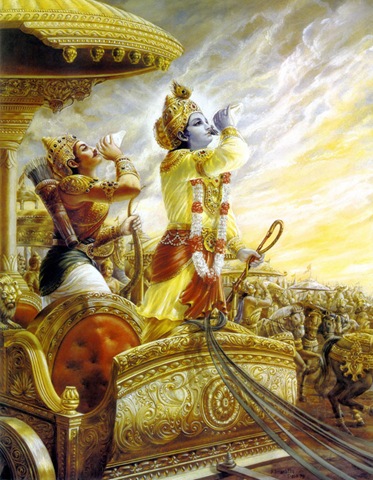
The Great War between the Pandavas and Kauravas was to begin. Arjuna, having pondered, decided to gita-101go to Lord Krishna and ask him for help.
He went to the Lord’s abode and found him asleep.

He stood respectfully at his lotus feet, with folded hands and head bowed in reverence. Duryodana, of the Kauravas, had the same idea of asking Sri Krishna’s help. He too came and, finding the Lord asleep, sat arrogantly in a chair placed at the head of Lord’s bed.

In due course, the Lord woke up. Arjuna, being at his feet, was the first person he naturally saw. As he turned to get up, the Lord’s eyes fell upon Duryodana.

The purpose of their visit was known to Him. However, he asked them what he could do for them.

Both answered that they had come to request his assistance in the ensuing war. The lord said that they had placed him in a difficult predicament by asking for the same thing. He said he could not deny either of them. He said he would offer himself, alone, without armies to one of them and to the other he would offer all his armed forces completely. He said that since his eyes had fallen on Arjuna first, he should have the first choice in the matter.

Arjuna promptly prayed to Sri Krishna that he alone should side the Pandavas.. Duryodana heaved a sigh of relief and requested Sri Krishna for all his forces. The Lord agreed to their requests.

We know who emerged victorious. The moral is “We should ask for HIM, not ask for things He can give us”

If the Lord gives us everything in the Universe but withholds Himself from us, we gain nothing. But if we seek HIM for Himself alone, we get not merely Him but all that is His, too!

abhyaasa yOga yuktEna cEtasaa naanyagaaminaa,
paramam pursham divyam yaati paarthaanucintayan

Meaning: 
He who with his mind disciplined through Yoga in the form of practice of meditation and thinking of nothing else, is constantly engaged in contemplation of God attains the supremely effulgent Divine Purusha (God)  (sloka 8 in chapter 8 of Gita)                                                                       Border_2

And what did Arjuna request?  The Lord Himself.  In his earnest bhakti, he intuited that this was the right choice and it was.  When you ask for the Lord Himself, with utter devotion and humility, how can He deny you?  In the Gita, He makes this promise to His devotees…

ananyaaScintayamtO maam yE janaah paryupaasatE
tEshaam nityaabhiyuktaanaam yOgakshEmam vahaamyaham. (BG 9.22)

To those who worship Me alone, thinking of no other, of those ever united, I secure what is not already possessed and preserve what they already possess.
https://luthar.com/wp-content/uploads/2009/06/bgita.pdf

But those who always worship Me with exclusive devotion, meditating on My transcendental form—to them I carry what they lack, and I preserve what they have. 
http://www.bhagavad-gita.us/categories/The-Gita%3A-Chapter-9/?Page=2

Those who desire My eternal association precluding all else meditate on me with exclusive devotion; those persons I insure the uniting of their individual consciousness with Ultimate Consciousness perpetually.  http://www.bhagavad-gita.org/Gita/verse-09-22.html

Yoga-kesamam, means to provide what they lack and safeguard or preserve what they have. In this context, yoga is said to mean making available what one does not have, and ksema means the preservation of what one already has.  For some, the sloka is interpreted to mean those who recognize the nonduality of the Self, abiding in the Self at all times; for others, this is considered to be a promise from the Lord to take care of His devotees. If we go online, we can find countless articles claiming that the interpretation therein is the right one and that all others are missing the point, thus missing salvation itself!

For me, neither one has the right to claim the other is wrong…it can mean both, one at the level at which we exist as entities in this world of maya, or saguna,  another at the level of the formless nirguna.  The Lord, in His infinite mercy, prescribed numerous paths in the Gita. I am a bhakta. He is my Lord and while I know that philosophically speaking we are indeed nonseparate as it says so in the Gita and in the Vedas, as far as I am concerned, that can only be truly perceived through His Grace.  So, while I am nothing but Him, on another level of worldly perception, this is known and experienced only through the operation of Divine Grace. 

It is so stated in the Mukanda Upanishad 3.2.3:

nāyam ātmā pravacanena labhyo
na medhayā, na bahunā śrutena,
yam evaiṣa vṛṇute tena labhyas
tasyaiṣa ātmā vivṛṇute tanūṁ svām.
(Mukanda Upanishad 3.2.3)

This Self cannot be realized by studying the scriptures, nor through the use of reason, nor from the words of others–no matter what they say. By the grace of the Self the Self is known; the Self reveals itself.   http://www.peterrussell.com/Upi/Mund.php

The Supreme Lord is not attained by reasonings or by vast intelligence, nor even by much hearing. He is attained only by one whom he Himself chooses. To such a person He manifests His own form.  http://bvml.org/SBVPGM/sgt.html

And the Katha Upanishad 2.2.23:

The Self cannot be known through study of the scriptures, nor through the intellect, nor through hearing learned discourses. The Self can be attained only by those Whom the Self chooses. Verily unto them Does the Self reveal himself.  http://booksandphotos.blogspot.com/2009/05/upanishads-kena-and-katha.html

This Supreme Self cannot be reached by argumentation, or by applying one’s independent brain power, or by studying many scriptures. Rather, he alone can achieve the Self whom the Self chooses to favor. To that person the Self reveals His own true, personal form.  http://vedabase.net/sb/10/87/27/en1

The reason I have reproduced more than one translation of the Gita and Upanishad slokas above is that I wanted to read them in several formats for my own benefit and I also wanted to offer the reader the option of seeing it as such. So many ways of saying the same thing.  And so many schools of thought want to say that their interpretation is the correct one and all others false and faulty.  In the end, Divine Grace is the operational catalyst, whatever you deem its source.

So, what should we ask of God? Truly, there is no thing to be asked. There is no thing to be given. How can we give Him what is already His? All we can do is realize, through His grace alone, that we are already His, in every sense that we as mortals can conceptualize in our limited minds! Not only will He take care of everything and look after the welfare of the devotee, He will guide us if we listen. Thus, I do have a prayer…to fully surrender, to listen without fear of the consequences, no matter what He asks me to do. Where it will lead, I have no real idea and no plan of action! He is guiding the chariot now. May I sit quietly and not be a backseat driver. Chitta chora!!!

 Border_2n702126689_1382369_7333 Border_2

Harsha's avatar

Bliss yoga: By Christine Wushke

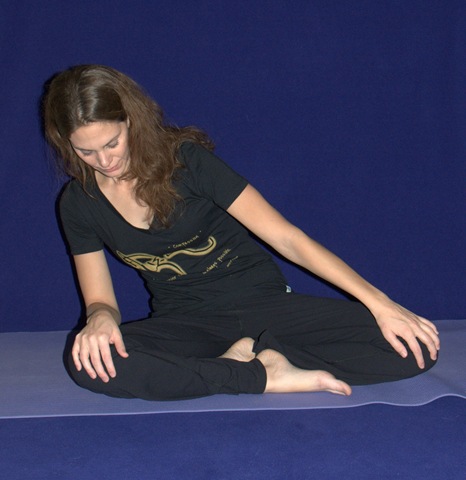
This style of yoga was inspired by a tantric dance called the Tan Da Va. When I was first introduced to this dance I was told that part of the dance training was to sit and watch a stick of incense burn. After a few hours of watching the smoke rise and spiral, one begins to get in touch with the intuitive flow or a natural instinctive movement. Bliss yoga is movement that comes from an inner naturalness. There is an ancient wisdom within your body waiting to unfold and flow like the rising smoke of lit incense. When it is given space to flow it becomes a beautiful expression of your unique wisdom inherent within. Bliss yoga can be described as the poetry of yoga: rules are not important and expression is everything.


bliss yoga 2

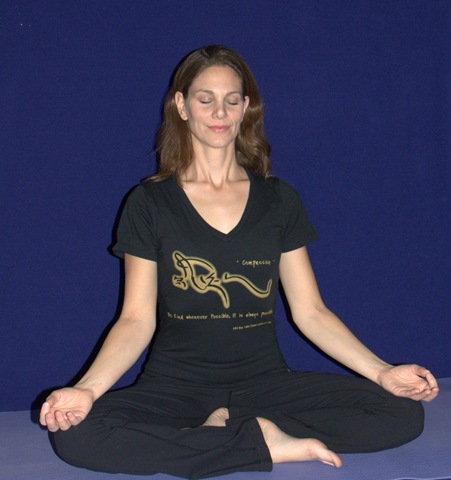
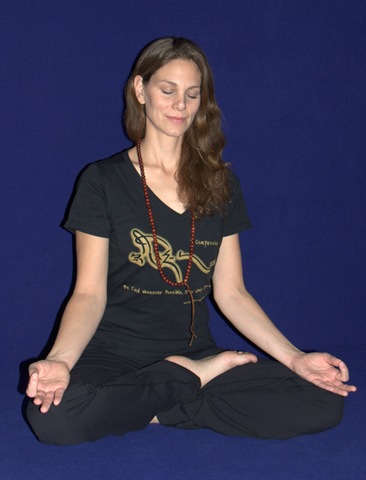
1. Sit on the floor with the legs crossed; if you find this position to be uncomfortable, sit in an alternative position or in a chair.

2. Close your eyes and let your awareness move inward. Be aware of your sit bones in contact with the floor or chair.

3. Take a moment to inwardly honor the deep wisdom and intelligence inherent within the body.


bliss yoga 3

4. Imagine that just below your tailbone a stick of incense is burning and the smoke is rising up the spine. Set your imagination free: see the smoke spiralling, or moving straight up. There is no wrong way to do the practice; it is about allowing what is and making room for your intuition to take the lead.

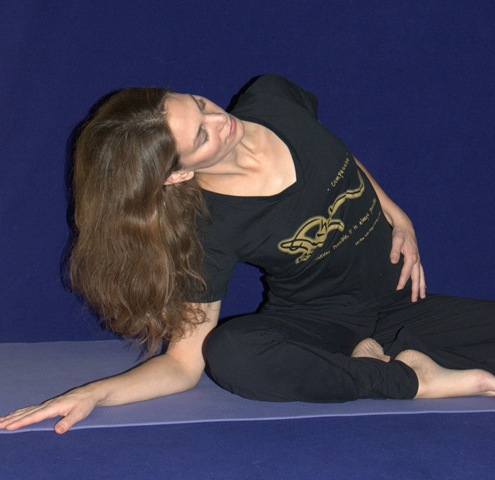
5. Slowly allow your torso to move side-to-side, forward and back. Allow the movement to come from the inside out–allow the inner wisdom to be the mover, not the mind. Get creative, stretch forward and back, side to side. Allow your movement to be intuitive.


bliss yoga 4

6. Hold each stretch for as long as desired.

7. When you feel intuitively ready to finish moving, let the body slowly unwind and return to sitting quietly.


bliss yoga finish

8. As the body comes into stillness become aware of the movement or aliveness of prana (life force energy) inside the body.

9. Enjoy the effects of heightened awareness for a few minutes or longer.


  Benefits: Loosens and releases the sacrum. Relaxes the muscles of the pelvis, and lower back. Massages and oxygenates the back of the pelvis. Increases flexibility in the abductor, and adductor muscles in the thighs. Increases body awareness aiding in a healthier and more loving relationship with your body. Increases prana (energy) in the body. Deepens your spiritual practice.


If you enjoyed this article and would like to find out more about the writings of Christine click here. 

© written and modeled by Christine Wushke, Photo’s by Dianne Wushke.


Christine Wushke is a certified yoga and meditation teacher with over 15 years of experience. Her aim is to create a sacred space for students to effortlessly find the presence of stillness and an inner silence. Christine’s mission is to raise consciousness on the planet by empowering people to realize their own Divinity and to uncover a deep peace within. Christine is committed to assisting you in your journey, and helping you to realize directly for yourself the truth of what you are, and the stillness of truth within. In addition to her yoga and meditation training, Christine is also a registered massage therapist. In the past two years she has studied extensively in the spiritual tradition of Advaita Vedanta. Her teaching style is largely influenced by Iyengar yoga, and the nondual tradition of Advaita.

www.journeytolight.net
www.innerlightyoga.blogspot.com


Harsha's avatar

The Non-Doer: By Pieter Schoonheim Samara

The seer is really the substratum of both the subject and the object. The individual consciousness, when purified is discovered to be the same as the Universal All-Pervasive Consciousness, like lifting a top off a jar that shows that the air inside and outside are the same. This isolation of the seer is Yoga.

These seem to be 2 (subject and object) because attention is focused through the lens of the mind into images appearing in the mind (whether from inward takes or the impressions of the moment to moment takes on the senses).

But when the mind is purified, there arises easily an inward pulling, like a graviton into the Heart, and attention to objects dissipitates with the brightening of the inward consciousness that fills and transcends the mind and the body. (The wise man’s heart inclines him to the right. – Ecclesiastics 10:3)

Gradually, a transition occurs, where the mind is no longer used to see, rather one awakens to the Singularity of the “I as I.” There is still a world, but it just appears, not separate, without a separate self to see or know. It’s like the analogy of a color coming into the proximity of a pure and clear the diamond, which seems to reflect the color variously, yet remains within its own nature always resolute, unchanging, pure and clear.

When the Sun of the Heart rises, the Moon of the Mind is no longer necessary to see.

From the moment that This awakening emerges into the consciousness, the “I as I” pulsates and withdraws as the subject of attention.

“All is empty, clear, self illuminating with no exertion of the mind’s power.” (Faith Mind – Third Zen Patriarch)

There is no experiencer or experience, no subject nor object, no seer nor seen. For the time being, these may seem like empty words. But when inward hearing arises, these words are recognized and trigger an inward pulling.

This is the Truth the Founders of all the Religions have been saying in whatever way that those that have ears to hear might hear when the heart is pure. A pure heart means that the mind has become clear enough through any means that the pulsation of the “I as I” is heard. Then we abide simply as That, and the subject-object notion in the mind simply dissolves, having no relevance at all to the emerging Truth. The idea of an identity to images is suddenly and simply relinquished.

Theories, concepts, strategies, methods, philosophies … all just drop off, having no relevance to the continuing pulsation of the All-Pervasive Self.

The Truth resonates as soundless sound: “Infinitely large and infinitely small, no difference, for definitions have vanished and no boundaries are seen.” (Faith Mind – Third Zen Patriarch)

There needs to be some practice that purifies the mind, where the body field comes into a still luminous balance, beyond thought, wherein hearing can become possible. At the same time there needs to be an effort to hear the Truth recorded in the Scriptures of the various Religions. As the mind becomes pure and still True hearing begins to manifest in the consciousness.

The Truth of one’s being recognizes Itself and draws the mind inward to dwell in and abide as Truth.

Harsha's avatar

Call of the Conch-3-Not for Human Consumption: By Joyce Sweinberg

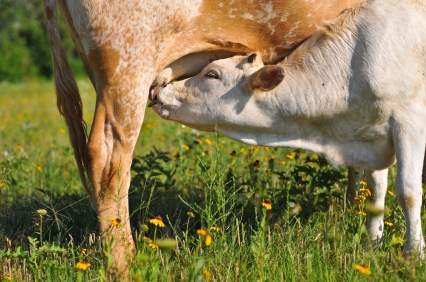
7516calf_nursing

Dairy products in our current industry, worldwide,
foster the very same adverse effects as meat production and consumption, and even worse,
torture the dairy cow and her offspring repeatedly over time prior to the final slaughter.
 

For years, I drank milk and consumed milk products, never realizing that I had milk allergies which were causing my facial rashes and breakouts.  Finally, someone suggested this to me and when I looked it up online, I was shocked to see how many allergies one can have to dairy products.  This was my first step in removing dairy from my diet, for my own benefit.  I was not always true to my vows and would often give in to pizza and on Halloween, would raid my sons’ candy for Snickers Bars, and on other holidays, eat the chocolate which was everywhere.  In the summer months, I sometimes gave into the soft ice cream cones at the corner ice cream stand. And, usually, I broke out but thought it was worth it.

Until I saw some of the videos posted in the earlier parts of this series. When I saw how the dairy cow and her offspring are abused, I could no longer seek out dairy products in any way.   But for some of us, we need to have other reasons than that, so I am including this part to highlight the unknown facts that dairy products really are not that healthy for us or our world, and can cause a multitude of environmental and physical problems.  Many of us operate under the false assumption that dairy products make for healthy bones and this is being proven to be untrue in studies.  The fact is that it is hard for people to give up their false belief systems if it would require them to remove dairy products from their diets.  I have reproduced some excerpts below from online websites along with the link to the actual site for further reading.

Many sites will address the adverse environmental and other effects of the meat industry while including dairy products as a viable alternative to meat.  An honest and  intelligent assessment of the available facts cannot support such a conclusion.  Dairy products in our current industry, worldwide, foster the very same adverse effects as meat production and consumption, and even worse, torture the dairy cow and her offspring repeatedly over time prior to the final slaughter.  The simple indisputable fact is that by consuming dairy products or using them in worship, one is promulgating torture of these defenseless animals, and in the process, violating the foremost principle of dharmic behavior, ahimsa.

Let me add this about myself.  While I now check the ingredients on everything I buy and I will not knowingly purchase anything which contains meat products or animal products or dairy products, I find it is still a challenge to determine whether there is dairy or animal product in what I eat when I am out, either in a restaurant or at a social event. If I am in doubt, and if the product is one which normally has dairy or eggs in it, I will politely decline.

When I am at temple, it is a more difficult position…I can refuse offers of yogurt or payasam or curd rice, or anything which is obviously milk based. But so many of the prasad offerings are laced with dairy or cooked in ghee that it is impossible to tell. I do still partake, asking His mercy and guidance in what I do. And I write this acknowledging that in co-writing this series, I am educating myself as I go along, making some decisions and deferring others as I ponder the solution that will work for me. I offer these writings to you, the reader, in the same spirit.

FROM  PETA…
“Environmental DestructionLarge dairy farms have an enormously detrimental effect on the environment. In California, America’s top milk-producing state, manure from dairy farms has poisoned hundreds of square miles of groundwater, rivers, and streams. Each of the more than 1 million cows on the state’s dairy farms excretes 120 pounds of waste daily.(22) Overall, animals in animal factories, including dairy farms, produce 1.65 billion tons of manure each year, much of which ends up in our waterways and drinking water.(23) The Environmental Protection Agency reports that agricultural runoff is the primary cause of polluted lakes, streams, and rivers. The dairy-products industry is the primary source of smog-forming pollutants in California; a single cow emits more of these harmful gases than a car does.(24)

Eighty percent of all agricultural land in the U.S. is used to raise animals for food or to grow grain to feed them—that’s almost half the total land mass of the contiguous 48 states.(25) Each cow raised by the dairy-products industry consumes as much as 50 gallons of water per day.(26)

Human Bodies Fight Cow’s Milk  Besides humans (and companion animals who are fed by humans), no species drinks milk beyond infancy or drinks the milk of another species. Cow’s milk is suited to the nutritional needs of calves, who have four stomachs and gain hundreds of pounds in a matter of months, sometimes weighing more than 1,000 pounds before they are 2 years old.(27)

Cow’s milk is the number one cause of food allergies among infants and children, according to the American Gastroenterological Association.(28) Most people begin to produce less lactase, the enzyme that helps with the digestion of milk, when they are as young as 2 years old. This reduction can lead to lactose intolerance.(29) Millions of Americans are lactose intolerant, and an estimated 90 percent of Asian-Americans and 75 percent of Native- and African-Americans suffer from the condition, which can cause bloating, gas, cramps, vomiting, headaches, rashes, and asthma.(30) Studies have also found that autism and schizophrenia in children may be linked to the body’s inability to digest casein, a milk protein; symptoms of these diseases diminished or disappeared in 80 percent of the children who switched to milk-free diets.(31)

A U.K. study showed that people who suffered from irregular heartbeats, asthma, headaches, fatigue, and digestive problems “showed marked and often complete improvements in their health after cutting milk from their diets.”(32)

Calcium and Protein Myths

Although American women consume tremendous amounts of calcium, their rates of osteoporosis are among the highest in the world. Conversely, Chinese people consume half as much calcium (most of it from plant sources) and have very low incidence of the bone disease.(33) Medical studies indicate that rather than preventing the disease, milk may actually increase women’s risk of getting osteoporosis. A Harvard Nurses’ Study of more than 77,000 women ages 34 to 59 found that those who consumed two or more glasses of milk per day had higher risks of broken hips and arms than those who drank one glass or less per day.(34) T. Colin Campbell, professor of nutritional biochemistry at Cornell University, said, “The association between the intake of animal protein and fracture rates appears to be as strong as that between cigarette smoking and lung cancer.”(35)

Humans can get all the protein that they need from nuts, seeds, yeast, grains, beans, and other legumes. It’s very difficult not to get enough calories from protein when you eat a healthy diet; protein deficiency (also known as kwashiorkor) is very rare in the United States and is usually only a problem for people who live in famine-stricken countries.(36) Consumption of excessive protein from dairy products, eggs, and meat has been linked to the formation of kidney stones and has been associated with colon cancer and liver cancer.(37,38) It’s also suspected that consuming too much protein puts a strain on the kidneys, which compensate by leeching calcium from the bones.(39)”

http://www.peta.org/mc/factsheet_display.asp?ID=98

FROM A PETA SPONSORED WEBPAGEHarvard School of Public Health, on the Consumption of Dairy Products (2005):

“The recommendation to drink three glasses of low-fat milk or eat three servings of other dairy products per day to prevent osteoporosis is another step in the wrong direction. … Three glasses of low-fat milk add more than 300 calories a day. This is a real issue for the millions of Americans who are trying to control their weight. What’s more, millions of Americans are lactose intolerant, and even small amounts of milk or dairy products give them stomachaches, gas, or other problems. This recommendation ignores the lack of evidence for a link between consumption of dairy products and prevention of osteoporosis. It also ignores the possible increases in risk of ovarian cancer and prostate cancer associated with dairy products.”

Cow’s milk is an inefficient food source. Cows, like humans, expend the majority of their food intake simply leading their lives. It takes a great deal of grain and other foodstuffs cycled through cows to produce a small amount of milk. And not only is milk a waste of energy and water, the production of milk is also a disastrous source of water pollution. A dairy cow produces 120 pounds of waste every day — equal to that of two dozen people, but with no toilets, sewers, or treatment plants.

In Lancaster County, Pa., manure from dairy cows is destroying the Chesapeake Bay, and in California, which produces one-fifth of the country’s total supply of milk, the manure from dairy farms has poisoned vast expanses of underground water, rivers, and streams. In the Central Valley of California, the cows produce as much excrement as a city of 21 million people, and even a smallish farm of 200 cows will produce as much nitrogen as in the sewage from a community of 5,000 to 10,000 people, according to a U.S. Senate report on animal waste.

FOR YOUR HEALTH:  Dairy products are a health hazard. They contain no fiber or complex carbohydrates and are laden with saturated fat and cholesterol. They are contaminated with cow’s blood and pus and are frequently contaminated with pesticides, hormones, and antibiotics. Dairy products are linked to allergies, constipation, obesity, heart disease, cancer, and other diseases.

The late Dr. Benjamin Spock, America’s leading authority on child care, spoke out against feeding cow’s milk to children, saying it can cause anemia, allergies, and insulin-dependent diabetes and in the long term, will set kids up for obesity and heart disease, America’s number one cause of death.

And dairy products may actually cause osteoporosis, not prevent it, since their high-protein content leaches calcium from the body. Population studies, backed up by a groundbreaking Harvard study of more than 75,000 nurses, suggest that drinking milk can actually cause osteoporosis. Find out more by visiting our links page.”

http://www.milksucks.com/index2.asp    

Other resources:

https://luthar.com/wp-content/uploads/2009/11/bookofcompassion2ed.doc

http://www.youtube.com/watch?v=tYpafipJyDE&feature=player_embedded

Nursing calf photo can be found at   http://www.faqs.org/photo-dict/phrase/5743/calf-nursing.html

 n702126689_1382369_7333

Patram pushpam phalam toyam yo me bhaktyaa prayacchati;
Tadaham bhaktyupahritamashnaami prayataatmanah.

If one offers Me with love and devotion of a leaf,
a flower, fruit or water, I will accept it with joy. BG 9.26

b36

  https://luthar.com/call-of-the-conch-introduction/
https://luthar.com/call-of-the-conch-1/
https://luthar.com/call-of-the-conch-part-2/

Harsha's avatar

Avadhut – The Avadhut Gita

INTRODUCTION

The word Gita means a song. The Indian holy Scriptures were written in songs, and each was attributed to a great sage, or to an Incarnation of God, called an Avatar. The best known of the Gitas is the Bhagavad Gita. Among the Gitas the least known are the Shiva Gita, Rama Gita, Vyadha Gita, and Devi Gita. The theme of all the Gitas is the non-dualist philosophy of the Upanishads. The Bhagavad Gita came into prominence when the greatest of the Indian teachers, Schankaracharya1, wrote a commentary on it, acknowledging its great metaphysical and devotional value. Another reason for its popularity is that its teachings are universal. The beginner in metaphysics, the layman, the highest initiate, and the greatest philosophical genius can find food there for his spiritual nature.

The Avadhut Gita is a special classic which is meant for the use of those advanced students of Indian metaphysics who have learned self-control to an appreciable extent, risen above the prejudice of this or that religion, and made the ultimate Reality – Truth – their sole God; it is for those who practice detachment in daily life, and are eager to realize God at any cost. The narrow worshiper, the fanatical adherent of an exclusive creed, the one who loves anything but the highest knowledge, the megalomaniac and the egotist will find the study of this Gita brings him little satisfaction.

It is a well known classic among the high Yogis, Sannyasins2 and sincere aspirants. In the calm of the Himalayan valleys, on the banks of the holy Ganges, one often hears this Gita sung by the Yogis, Sannyasins and Brahmacharis3. The great teachers who have thrown away all books, having found everything worth knowing in their hearts, still keep this little Gita in their caves and huts.

The lower form of prayer consists of singing hymns and repeating mantrams4 in which the ultimate Reality, the secondless, all-transcending Brahman5 is conceived in terms of duality.

The higher form of prayer consists of feelingly singing of Brahman in terms of non-duality, and in the first person, “Shivoham,” I am Shiva6 (Bliss), “Aham Bramhasmi,” I am Brahman, and so forth. Our inner life is covered by those attributes of God which we repeat or of which we sing. The Avadhut Gita speaks of the ultimate reality in terms of absolute freedom.

The aim of life is to realize the Truth and to be eternally free. Purification of the heart is essential to this realization. Practice of virtue, devotion to God, pilgrimages and other religious practices, are useful only so far as they purify the heart from the taint of meum and tuum, and bring before us the great vision of Truth, which makes worldly achievements mediocre and ultimately valueless.


1 Schankaracharya was the greatest of the Indian philosophers. He lived probably in the seventh century A.D. He was perhaps the first exponent of Vedic idealism in philosophic form. He silenced all opposition to the Vedic theory of idealistic non-dualism by traveling through the length and breadth of India, and holding controversies with the learned. His commentaries on the Vedanta Sutras, the Upanishads and the Gita are an immortal monument to his genius. (Schankaracharya is said to have begun to read the Vedas at the age of three, become a sannyasin at the age of nine and realize the ultimate Reality at age sixteen, remaining, thereafter, ever abiding as the Self. He founded 10 monastic orders in a short life span of 686-718. He also wrote several books, including “Viveka Chudamani”, Crest-Jewel of Discrimination.
2 Holy Renunciate
3 Neophytes
4 A mantram is a Vedic formula, the repetition of which, according to approved rules, induces spiritual consciousness, and also psychic powers.
5 Brahman comes from the root meaning majestic, and in philosophy is applied to the Absolute, transcending all thought and feeling and all attributes, it can be spoken of rather provincially as Sat, Chit and Ananda, i.e., Existence Absolute, Intelligence Absolute Bliss Absolute.)
6 “I am Shiva” (the Destroyer aspect of the Hindu trinity, notably the destroyer of ignorance).


They create in us an undying desire to realize truth, but the direct cause of realization of God is within, is knowledge of Truth. Knowledge is the magic wand which frees the spirit of peace and Ananda from the rock of personality, covering the fearing ego into a conflagration, burning up all duality and its cause, ignorance.

The Avadhut Gita contains this knowledge in its purest form. The word Avadhut means a high Renunciate, a Mahatma7, one who has found unity with God, and lives a life of perfect freedom, uninfluenced by ignorance and its effects.

Who was this Mahatma Dattatreya, who gave this priceless gift of the Gita? There is no other writing attributed to him. When and where he lived cannot be said with certainty. To some Yogis and devotees he is an immortal, and they still see him and talk to him. In a temple, among the calm and beautiful peaks of the mountain called Girnar, a bed is made for the Mahatma daily.

It is clear that he was an historical person, and not a mythical Mahatma, and that he lived after Shri Krishna8, that is, a little over three thousand years ago. From the fact that most of his devotees live in the Bombay presidency we can infer that he lived in Western India. There are many legends about his miraculous birth and life, but they do not take us far.

There is a mention of the Avadhut in the Eleventh Book of the Shrimad Bhagavata, a great Indian classic of devotion and metaphysics, attributed to Vyasa, written in a highly poetic style in pure modern Sanskrit. The following is an extract from this book:

“Salutations to you, O Sage, Kindly tell us what Guru has given you the great knowledge which has made you perfect in wisdom, full of peace, and devoted to the good of all living beings.”

This was the reply of the Avadhut:

“One’s own Self is one’s chief Guru. By knowledge of Self alone through perception, inference and mystic communion one obtains the great bliss.”

He further said that he did not learn from one particular source, but from many teachers, each source of knowledge being his Guru. He then mentioned twenty-four special teachers. Of them, the following are worthy of note:

Water, the earth, the wind, space, the moon, the sun, the sea, and the arrow-maker.

From water he learned purity and the taste of tastelessness. “As water is sweet and pure, so is Atman9. Man should manifest sweetness and purity in his conduct. I have therefore taken water as one of my Gurus,” he said.

“Patience, forgiveness, supporting others without expectation of gratitude I have learned from my Guru, the earth.”

“The wind blows everywhere, over the flower-beds, deserts, marshes, palaces and prisons, without being attached to any of them, without preference or dislike. So, I, an Avadhut, go everywhere, scattering my blessings of peace, without being attached to anyone. My Guru, the wind, has taught me this lesson.”


7 “I am Brahman.”Mahatma, lit, great soul, a perfected man.

8 Shri Krishna – the teacher of the Bhagavat Gita, the recognized Supreme master of Indian Yoga and philosophy.

9 Atman – The Divine Self


In the all-pervading space there exist clouds, stars, planets, dust-storms, and so on, but it is not touched by any of them. So is Atman, which, pervading all bodies of men and animals, of saints, sages, kings, madmen, sinners, and paupers, is untainted by any of them. So do I feel, having learned this lesson from space, my Guru.”

“As the moon is perfect, in spite of its waning and waxing, which do not exist in it, so is Atman ever perfect, in spite of its seeming imperfections. This is what the moon, my Guru, has taught me.”

“As the sun through its rays absorbs water from the earth, only to give it back in a cool and pure form, so ought a Mahatma to take the things of the world, not for his own sake, but in order to give them back in a richer and better form. This is what my Guru, the sun, has taught me.”

“Though thousands of rivers empty themselves into the sea, yet it remains within its limits; so remains undisturbed the mind of the knower of God, though objects of all kinds pour themselves into it. Thus, the sea, my Guru, has instructed me.”

“From the arrow-maker I have learned the value of concentration. In a certain town there lived an arrow-maker, who devoted his full attention to his occupation. Once he was beating the point of an arrow, when the king and his procession went by the street. He was so attentive to his work that he knew nothing of the king’s passing, and when they asked him how he liked the music of the procession he said, ‘What procession? When did it pass?’ So ought we to concentrate on the Truth that no external object or event should disturb us.”

The teachings of Rishi Dattatreya are similar to those of Vasishtha, Loatzu, Abu Ben Adhem, and Jajaluddin Rumi. There are still many Paramahansas10, Bramacharis and Yogis who follow the path of spiritual solitude. Many such Mahatmas have been seen in the Himalayan woods, in the forests of Szechwan province of China, and near the Koyasan in Japan. They are free from the pairs of opposites11, established in Atman, and radiate peace and spiritual upliftment.

They do not shun human society, and yet they do not relish it. Of them it is said:

“Heed then no more how the body lives or goes;

Its task is done; let karma float it down;

Let one put garlands on, another kick

This frame; say naught. No praise or blame can be

Where praiser praised and blamer blamed are one.

Thus be thou calm, Sannyasin bold, and say,

OM TAT SAT OM.”

The Avadhut Gita breathes the purest spirit of Shri Schankaracharya and the sages of the Upanishads.


10 Paramahansas – Those who have realized the highest Self [and whose Sahasrara – Thousand Pedaled Lotus (the brain) is completely filled with Light

11 Pairs of opposites – such as heat and cold, love and hate, grief and joy, etc..


Chapter I

  1. By the grace of God the Brahmins above all men are inspired with the disposition to non-duality (unity of the Self with God), which relieves them of the great fear.
  2. How can I salute the Self, which is indestructible, which is all Bliss, which in Itself and by Itself pervades everything, and which is inseparable from Itself?
  3. I alone am, ever free from all taint. The world exists like a mirage within me. To whom shall I bow?
  4. Verily the one Self is all, free from differentiation and non-differentiation. Neither can it be said, “It is” nor “It is not.” What a great mystery.
  5. This is the whole substance of Vedanta; this is the essence of all knowledge, theoretical and intuitional. I am the Atman, by nature impersonal and all-pervasive.
  6. That God who is the Self in all, impersonal and changeless, like unto space, by nature purity itself, verily, verily, that I am.
  7. I am pure knowledge, imperishable, infinite. I know neither joy nor pain; whom can they touch?
  8. The actions of the mind, good and evil, the actions of the body, good and evil, the actions of the voice, good and evil, exist not in me (Atman). I am the nectar which is knowledge absolute; beyond the range of the senses I am.
  9. The mind is as space, embracing all. I am beyond mind. In Reality the mind has no independent existence.
  10. How can it be said that the Self is manifest? How can it be said that the self is limited? I alone am existence; all this objective world am I. More subtle than space itself am I.
  11. Know the Self to be infinite consciousness, self-evident, beyond destruction, enlightening all bodies equally, ever shining. In It is neither day nor night.
  12. Know Atman to be one, ever the same, changeless. How canst though say: “I am the meditator, and this is the object of meditation?” How can perfection be divided?
  13. Thou, O Atman, wast never born, nor didst thou ever die. The body was never thine. The Shruti (revealed Scriptures) has often said: “This is all Brahman.”
  14. Thou art all Brahman, free from all change, the same within and without, absolute bliss. Run not to and fro like a ghost.
  15. Neither unity nor separation exist in thee nor in me. All is Atman alone. “I” and “thou” and the world have no real being.
  16. The subtle faculties of touch, taste, smell, form and sound which constitute the world without are not thyself, nor are they within thee. Thou art the great all-transcending Reality.
  17. Birth and death exist not in the mind, not in thee, as do also bondage and liberation. Good and evil are in the mind, and not in thee. O Beloved, why dost thou cry? Name and form are neither in thee nor in me.
  18. Oh my mind, why dost thou range in delusion like a ghost? Know Atman to be above duality and be happy.
  19. Thou art the essence of knowledge, indomitable, eternal, ever free from modifications. Neither is there in thee attachment nor indifference. Let not thyself suffer from desires.
  20. All the Shrutis speak of Atman as without attributes, ever pure, imperishable, without a body, the eternal Truth. That know to be thyself.
  21. Know all forms, physical and subtle, as illusion. The Reality underlying them is eternal. By living this Truth one passes beyond birth and death.
  22. The sages call Atman the “ever-same.” By giving up attachment the mind sees neither duality nor unity.
  23. Concentration is not possible either on perishable objects, on account of their mutability, nor on Atman. “Is” and “is not” do not apply to Atman either. In Atman, freedom absolute, how is Samadhi12 possible?
  24. Birthless, pure, bodiless, equable, imperishable Atman thou knowest thyself to be. How then canst thou say: “I know Atman,” or “I know not Atman.”
  25. Thus has the Shruti spoken of Atman; “That Thou art.” Of the illusory world, born of the five physical elements, the Shruti says: “Neti, neti” (not this, not this).
  26. All this is ever pervaded by thee as Atman. In thee is neither the meditator nor the object of meditation. Why, O mind, dost thou shamelessly meditate”
  27. I know not Shiva13,
    How can I speak of Him?
    Who Shiva is I know not,
    How can I worship Him?
  28. I am Shiva, the only reality,
    Like unto space absolute is my nature.
    In me is neither unity nor variety,
    The cause of imagination also is absent in me.
  29. Free from subject and object am I,
    How can I be self-realizable?
    Endless is my nature, naught else exists.
    Truth absolute is my nature, naught else exists.
  30. Atman by nature, the supreme Reality am I,
    Neither am I slayer nor the slain
  31. On the destruction of a jar, the space therein unites with all space. In myself and Shiva I see no difference when the mind is purified.
  32. Brahman alone is, as pure consciousness. In truth there is no jar, and no jar-space, no embodied soul, nor its nature.
  33. There are no worlds, no Vedas, no Devas, no sacrifices, no castes, no family tribes, no nationalities, no smoke-path, no shining-path.
  34. Some there are that prize non-dualism, others hold to dualism. They know not the Truth, which is above both.
  35. How can the supreme Reality be described, since It is neither white nor any other colour, has no qualities such as sound, and is beyond voice and mind?
  36. “I eat,” “I give,” “I act”; such statements do not apply to Atman, which is purity, birthless and imperishable.
  37. Where the one Brahman alone is, how can it be said “this is Maya14”, or “this is not Maya”, “this is shadow” or “this is not shadow”?
  38. I am without beginning and without end. Never was I bound. By nature pure, taintless is my Self. This know I of a surety.
  39. From subtle substance (mahat) down to formed creation, there is nothing but Brahman; most clearly do I see this. Where then is the division of caste?
  40. The absolute void and its opposite, all am I everlastingly.
  41. Atman is not male or female, nor is It neuter; neither is It happiness or suffering. How dare ye pervert It?
  42. Atman is not purified by the six methods of Yoga. Absence of the mind makes It no clearer. The teachings of a Guru reveal It not. It is all purity, in Itself, by Itself.
  43. I am neither bound nor free. I am not separate from Brahman.
  44. Neither the doer nor the enjoyer of the fruits of karma am I. The pervader or the pervaded I am not.
  45. As a volume of water poured into water is inseparably united with water, so, I perceive, matter and spirit are one.
  46. Why callest thou Atman personal and impersonal. Since thou art neither bound nor free?
  47. Pure, pure thou art, without a body, unrelated to the mind, beyond maya; why art thou ashamed to declare: “I am Atman, the supreme Reality”?
  48. O my mind, why dost thou cry? Realize thy Atman, o Beloved; drink the timeless great nectar of non-duality.
  49. Knowledge born of the intellect am I not. By nature Truth eternal am I. I am perpetual immutability.
  50. Neither formless nor with form, described by the Vedas as “Not this, not this,” free from separation and unity, the true Self reigns supreme.
  51. There is no father, no mother, no kinsman, no son, no wife, no friend, no prejudice, no doctrine. Why art thou disquiet, o my mind?
  52. Why do the wise imagine the bodiless Brahman to be a body? In It there is neither day nor night, neither rising nor setting.
  53. Since the imperfections of attachment and the like are not in me, I am above the suffering of the body. Know me to be infinite, like unto space, one Atman.
  54. O my mind, my friend, many words are not needful, and the world comprehends not reason. In a word, I have told thee the essence of truth: “thou art Truth, thou art as space.”
  55. In whatever place and in whatever state the Yogi dies, his spirit is absorbed into That, as, on the destruction of the jar, the space in the jar is united with absolute space.
  56. Whether he dies conscious or in coma, in a holy temple or in the house of an untouchable, he obtains liberation, becoming the all-pervading Brahman.
  57. The Yogis regard righteousness, prosperity, desire for Paradise and liberation, and also the moving and fixed objects, as mere will-o’-the-wisps.
  58. The Avadhut in unshakable equanimity, living in the holy temple of nothingness, walks naked, knowing all to be Brahman.
  59. Where there is no “Third” or “Fourth15”, where all is known as Atman, where there is neither righteousness nor unrighteousness, how can there be either bondage or liberation?

12 Samadhi – A high state of consciousness.

13 Shiva – a name for Brahman

14 Maya is the creative power of the Lord, the means by which the phenomenal world has been brought into existence.

15 These are states of consciousness. There are waking, dreaming and dreamless sleep. The “Fourth” is the substratum of these three, also called Turya, beyond this is the absolute, beyond words and experience, Turyatita.


CHAPTER II

The Avadhut said:

  1. Hold not the immature, the credulous, the foolish, the slow, the layman and the fallen to have nothing good in them. They all teach something. Learn from them. Surely we do not give up a game although we have mastered it?
  2. Think not lightly of thy Guru should he lack letters and learning. Take the Truth he teaches and ignore the rest. Know well that a boat, painted and adorned, will carry you across the river; so also will one that is plain and simple.
  3. The higher intelligence which without effort pervades the movable and the immovable, and which by nature is all peace and consciousness, that am I.
  4. How can the one supreme consciousness which without effort rules the living and the inert and is all-pervasive, be other than I?
  5. I am more subtle than primordial substance, beyond elements and compounds, free from birth and death, above duality and unity.
  6. The modifications of the inner organ (antahkarana) have no part in me. Like bubbles rising and falling in a river, thoughts and volitions rise and disappear in the inner organ.
  7. As softness is not perceived apart from soft objects, as sweetness is not known apart from honey, as bitterness is not known apart from the Nim tree16, as fluidity and coolness are the nature of water, so the primordial form of matter called mahat17 is no other than the Self (Atman). As the rays of the sun differ not from the sun, so matter does not differ from God.
  8. How can “I” or “thou” be said of Brahman which is more subtle than mahat, free from all attributes, greater than all, above the range of mind and emotion, without medium or limitation, lord of the universe? It can neither be called static or dynamic.
  9. As space cannot be compared with another space, so Brahman being above duality, cannot be compared with any object. Brahman alone is perfection, taintless, all knowledge.
  10. It walks not on the earth, the wind cannot move It, the water cannot cover It, It stands in the midst of Light.
  11. It pervades space-time. Nothing pervades It. From limitations ever free, eternally the same, with nothing outside It and nothing within, It abides.
  12. Atman, of which the high Yogis speak, most subtle, beyond perception, without attributes, must be realized step by step, and not by sudden violence.
  13. Ever practicing Yoga18, not depending on any object, the Yogi merges his consciousness in Brahman, and becomes Brahman.
  14. There is but one antidote to the poison of passions, which beget infatuation and are highly dangerous, and that is to return to the state of Atman. Atman is unapproachable by the emotions, is ever formless and independent.
  15. Hidden in the realm of eternal consciousness lies the world’s cause, which is prakriti. Within this cause is Brahman. The husk of a coconut is the world, the pulp is prakriti, and the sweet cool water encased in the pulp is Brahman.
  16. Like the full moon is Atman. See It in all. Duality is the product of defective vision. As there is only one moon so there is only one Atman in all.
  17. No duality can touch the conception of Brahman, because It is all-pervasive. The wise who teach this acquire boundless patience, and their disciples can never be too thankful to them.
  18. The talented as well as the witless attain the state of desirelessness by knowing the mystery of Atman, through the grace of their spiritual teacher.
  19. This transcendent state of consciousness (Nirvana) is reached by those who are free from attachment and aversion, ever engaged in doing good to all living beings, whose knowledge is firmly rooted, and who are patient.
  20. The Yogi is merged in the divine after leaving the body, as the jar-space is merged in cosmic space on the destruction of the jar.
  21. The statement that the future condition is determined by the state of the thoughts at death is made of the uninitiated, not the initiated.
  22. The knower of Brahman may leave his body in a holy place, or in the house of an untouchable, he is absorbed into Brahman.
  23. When a Yogi has realized Atman, which is his true Self, birthless and beyond the range of the mind and emotions, then the karmas19 no longer touch him. He may perform the rituals or leave them. To him it is all one.
  24. Atman realized is the master of creation, eternal, indestructible, formless, without dimensions, absolutely independent, without pleasure or pain, full of all powers.
  25. The wise discover that Atman is not seen either by the study of the Vedas, by initiations, by shaving the head, or by being a Guru or chela (an approved disciple). Nor is it seen through postures.
  26. That God, Atman, by whose power the whole universe is born, in which it abides and to which it finally returns like bubbles and waves in the sea, is realized by the wise.
  27. Atman, which the wise realize, is not the aim of control of breath (pranayama) nor of the postures of Hatha Yoga20. In It there is neither knowledge nor ignorance.
  28. There is neither unity nor duality in Atman, nor unity-duality, neither smallness nor greatness, neither emptiness nor fullness. All these exist in the mind, and the mind is not Atman.
  29. The teacher cannot teach Atman; the disciple cannot learn it.

16 Nim tree – a tropical Indian tree whose leaves have an extremely bitter taste.

17 Mahat – Cosmic Mind.

18 Yoga – Practice of mind control, detachment and meditation.

19 Karma – Actions and their consequences.

20 The methods of Hatha Yoga, the Yoga of physical austerities and exercises.


CHAPTER III

  1. How shall I worship that Atman great
    Which is neither personal nor impersonal.
    Taintless, above love and aversion, uncreated,
    All pervasive, of the form of the universe,
    Having no attributes, yet not attributeless
    That all-bliss Shiva, my Self.
  2. How shall I bow down to mine own Self
    In my own Self and by my Self?
    I have no colours, white or yellow;
    Eternal Shiva am I.
  3. I am rootless, and without root,
    Free from smoke, and smokeless am I,
    Without a lamp, and lightless am I,
    Equanimity am I, like a sun ever risen.
  4. How can I name the passionless, desireless One
    As having desires? The Absolute cannot
    Be described in terms of conditions;
    How can I speak of myself?
    I am neither with an essence,
    Nor am I without an essence.
    Space-like all equanimity am I.
  5. How shall I say that non-duality
    Is all this creation, or that, or that?
    Even if it be duality, then too I cannot
    Attribute creation or dissolution to It.
    How can the Eternal, the All
    Be expressed in any way?
    Space-like, all-bliss am I.
  6. Neither gross nor subtle is my Atman;
    It comes not, and It goes not;
    Without a beginning and without an end;
    Neither higher nor lower is It;
    That Truth absolute, space-like,
    Immortality-giving knowledge am I.
  7. Know well that all the senses
    Are as space, and so also their objects.
    Know that the One is taintless,
    The One is neither bound nor free.
    That all-pervasive ever-blissful Shiva,
    Immortality-giving knowledge am I.
  8. The knowledge of the Self, hard to obtain,
    Which is experienced, is not Atman;
    The object of meditation,
    Hard to concentrate upon, is not Atman;
    That which is near, and that which is far, far away,
    Is not Atman. Space-like, all-bliss
    Shiva am I, Shiva am I.
  9. Without karma am I, I burn up karmas;
    Without pain am I, I burn up sufferings;
    Bodiless, homeless am I, and yet I burn up these,
    All equanimity, space-like am I.
  10. The seed of the plant of the world exists not in me,
    Contentment and pleasures exist not in me;
    Bondage and ignorance are not in me;
    Space-like, absolute Shiva am I.
  11. Atman is not the Knower
    Nor is It the known.
    It is not accessible to inference.
    Words cannot describe
    This Consciousness Absolute.
    The mind is lost in Its majesty.
    How can It be explained to thee?
    Space-like immortality-giving knowledge am I.
  12. There is no separation and no unity in It.
    Neither is It inner nor outer.
    It is Truth transcendental.
    It cannot be said “It was all before.”
    Verily nothing exists but Atman.
    And that space-like immortality-giving
    Knowledge am I.
  13. I am the eternal principle.
    Free from attachment and aversion,
    Free from imperfections am I,
    Fate and providence exist not in me.
    Eternally free from the sufferings of the world,
    Verily, space-like immortality-giving
    Knowledge am I.
  14. As the three states of consciousness
    Exist not in Atman,
    How can It be the Fourth?
    Free from past, present and future
    How can the cardinal points exist in IT?
    Eternal peace, space-like transcendental
    Truth am I.
  15. Neither father nor mother have I,
    Neither wife nor child.
    Birth and death I do not know.
    The mind is not my own.
    Eternal peace, space-like transcendental
    Peace am I.
  16. Devas and Gods, like Indra and Brahma,
    Have no place in Atman.
    Neither Paradise nor Heaven exist in Atman.
    The one taintless transcendental Truth am I.
  17. The saying of the Shruti “not this, not this”
    Does not apply to Atman.
    How can it be said “When all is subtracted
    Atman alone remains”?
    It is symbolical but not a symbol;
    Yet even this cannot be said of Atman.
    Space-like, the water of immortality am I.
  18. Maya is not my modification.
    Nor is its glamour mine.
    Deceit and hypocrisy, truth and untruth
    Have no place in me.
    Space-like, immortality-giving knowledge am I.

CHAPTER IV

  1. Nothing can be added or taken away from the Universal Consciousness. It cannot be invoked or worshipped with flowers and leaves. Meditations and Mantrams cannot reach It. How could It be worshipped as Shiva for in It there are neither distinctions nor unity?
  2. In the One there is neither bondage nor salvation, neither purity nor impurity. From union and separation the One is free. That space-like Truth am I.
  3. As in reality I am Nirvana, thoughts as to the reality and unreality of the world trouble me not at all.
  4. Eternally free from the taint of ignorance as I am, knowledge or illusion never had birth in me. How can I say whether I am bound or free?
  5. Neither sin nor virtue ever existed in me; by nature I am Nirvana. Neither the worshiper nor the worshipped am I. No instructions and no rituals are there for me. Knowledge also am I not. By nature I am Nirvana.
  6. Taintless Nirvana am I; I am neither the comprehender nor the comprehended. Neither the cause nor the effect exist in me.
  7. Neither am I a body, nor am I bodiless. The buddhi21, the mind and the senses are not mine. How can I talk of attachment and detachment, since I am taintless Nirvana?
  8. In me exist not birth, death, purity, impurity, poison or the water of immortality. Verily I am free even from the taint of Nirvana. I cannot speak of the “Third” or the “Fourth”.
  9. Neither a fool nor a pundit am I, neither silent nor of many words; how can I speak of reasoning or argument since I am free even from the taint of Nirvana?
  10. Giving up all meditations, all good and evil karma, drinking the water of immortality, the heros know that I from the taint of Nirvana am free.
  11. No ritualist injunction is binding on me; mind, the seat of anxieties, does not exist in me. Far, far from me also is egotism. Space-like, immortality-giving knowledge absolute am I.
  12. I cannot say whether the world is nothingness or if it is partly real and partly unreal, or, if like a flowing river though ever changing, it is in fact real as a whole. Space-like immortality-giving knowledge absolute am I.
  13. There is not the least shadow of name or form in the Infinite, nor is there unity or diversity in me. O my shameless mind, why createst thou a confusion? Space-like immortality-giving knowledge absolute am I.
  14. O my friend, there is no cause for disquietude since thou art not the body. Thou art imperishable and eternal, then why criest thou? Rest in peace. Space-like, immortality-giving knowledge absolute am I.
  15. Why art thou troubled, O friend, since avarice, lust, attachment, are not in thee? Space-like, immortality-giving knowledge absolute am I.
  16. Why this craving for power, O companion, when in truth wealth is not thine. “Mine” and “thine” are not in thee.
  17. In thy heart there is no meditator, there is no Samadhi, nor is there any possibility of meditation in Atman. Time and causation never existed in thee.
  18. I have told the, o disciple, the essence of Truth. There is no “thou” nor “I”, no world, no Guru, or disciple. Know that by nature I am freedom absolute. I am transcendental Truth.
  19. When Atman, the absolute existence, alone is, and It is I, then where is transcendental Truth, where is bliss, where is knowledge, secular or spiritual?
  20. Unknown to fire, water and earth, motionless, all-pervasive as space, knowledge absolute know thy Atman to be.
  21. Renounce, renounce the world, and also renounce renunciation, and even give up the absence of renunciation. By nature all-pervasive as space, knowledge absolute art thou.

CHAPTER V

  1. The syllable OM spoken is the essence of the lower and the higher knowledge. It is Brahman, space-like. There is neither existence nor non-existence in this world. Brahman is ever free from duality.
  2. Thou art that Atman of which the Shruti says, “Tat Twam Asi22.” Know that thou art free from maya. Cry not, o mind, verily thou art all.
  3. There is neither higher nor lower in thee. Thou pervadest all equally, and there is neither inner nor outer. Then why mournest thou, O mind? All, all is Brahman.
  4. Neither that which is imagined, nor the imagination exist in thee; know that cause and effect touch thee not. Free from words and all expressions art thou, eternally the same. O mind, cry not.
  5. To know that there is neither higher nor lower in Atman is Samadhi; to know that Atman is ever free from time and space is Samadhi. Cry not, O mind, all is Brahman.
  6. As there is no jar, there is no jar space. As there is no jiva body, no conditioning medium23, there is no jiva. The cause and effect which produce conditions do not exist in Atman. Why then dost thou cry, O my mind?
  7. It is all one whether we live in a hut in retirement, or in a house with many kinfolk, for Atman is free from the multitude as from solitude. Free also is It from knowledge, theoretical and practical, Atman being All, O my mind, cry not.

22 Tat Twam Asi – That thou Art.

23 The conditioning of consciousness to form the individual soul (jiva) encased in the human body is compared to the apparent enclosure of space in a jar. As jars do not really limit space, so the conditioning medium of body and mind cannot limit Atman.


CHAPTER VI

  1. The whole universe is a projection of the mind; therefore it is a mode of the mind. The true nature of the mind is bliss, and when the mind is stilled, bliss absolute is revealed.
  2. Consciousness absolute, being unknowable by the mind, how can speech explain it?
  3. The Self is free from day and night, and therefore the conception of its pilgrimage in time and space is no true one.
  4. No sun illumines Atman; the fire and the moon cannot shine therein. It is not equanimity or even desirelessness; how then can action exist in it?
  5. Neither can it be said that It is to be known by the absence of action. It is neither within or without. It is naught but bliss absolute.
  6. How can it be said that It is the first or that It is the last, since It is neither element or compound, nor emptiness nor fullness? Eternal, ever the same, the essence of all is Shiva.
  7. The statement that Atman is describable or indescribable cannot stand. Neither is It the knower nor the known. It cannot be imagined or defined. How can we say that It has a mind or any of the senses?
  8. Space, time, water, fire, earth, constituting the world, are a mere mirage. In truth the One, imperishable, ever blissful, alone exists. There is neither cloud nor water in It.
  9. As there is no possibility of birth and death in It, so no conception of duty nor dereliction of duty can be applied to It. That undifferentiated, eternal, all-pervasive Shiva alone is.
  10. The modifications of primordial matter and of individualized consciousness are in the realm of cause and effect. When there is eternal all-pervasive Shiva alone, how can there be matter or spirit therein?
  11. There is in It no suffering, and no possibility of suffering, because It is free from all attributes.
  12. There is no duality in It. How can there be age, or youth, or childhood in that One eternal principle?
  13. Atman is dependent on nothing and is unlimited. The law of cause and effect touches It not. How can the buddhi, which operates only in duality, and which is perishable, discern It?
  14. It grasps not, nor is It grasped. It is not born nor does It bring forth. We can only say that in It there is no destruction.
  15. In Atman there is neither manhood nor womanhood, because such conceptions cannot exist in eternity.
  16. There is no pleasure in It, and no faculty of enjoying pleasure, since It is free from such defects as attachment. Equally free from doubts and suffering, one and eternal is Shiva; thus the conception of “I” and “mine” do not apply to It.
  17. Neither is there Brahman in It, nor the absence of Brahman. Since It alone exists and is eternity, it must follow that It is free from pain, and also from freedom from pain.
  18. There is no gain and there is no loss. Infatuation and worldly wisdom have no place therein. When the eternal consciousness alone exists, how can discrimination or wisdom, or any such thing be contained in It?
  19. In It there is no “thou” and no “I”, therefore family and caste exist not therein. It is neither true nor untrue. Neither is It of this world nor of the next. How then can one pray to It?
  20. Illusory is the connection of the learner and the teacher. Teaching and contemplation, when thus beheld, are not admissible. “Verily, I am Shiva.” This alone is the whole Truth. How then can I pray to It, or worship It?
  21. The body itself is imagined in Atman, as is the whole universe. Atman is free from all differentiations. Then since I am Shiva, there can be no idea of prayer or worship.
  22. Consciousness absolute has no body. It cannot be said that It is without a body or attributes. All that can be said is that It is bliss absolute, and that bliss am I. This is the height of worship, and this is the culmination of all prayer.
  23. The Avadhut who has realized this mystery of all mysteries, and has risen to the state of unceasing and perfect bliss, moves about in the crowds unconcerned, radiating bliss and higher knowledge.
  24. He is clothed in a habit of old and worn. He walks in a path that is free from religious merit or sin. He lives in the temple of absolute emptiness. His soul is naked, and free from all taints and modifications of maya.
  25. The Avadhut has no ideal, neither strives he after the attainment of an ideal. Having lost his identity in Atman, free from the limitations of maya, free also from the perfections of Yoga, thus walks the Avadhut. He argues with no one, he is not concerned with any object or person.
  26. Free from the snares of expectations and hopes, he has cast off the worn-out garments of purity, righteousness, and all ideals. His path is free from any such consideration. It can only be said about him that he is purity absolute, and is far, far above the clouds of maya and ignorance.
  27. He has no such thoughts as “I am not in the body,” or “I am not the body.” He has no aversion, attachment or infatuation towards any object or person. Pure as space he walks, immersed in the immaculate bliss of his natural state.
  28. The Avadhut may be compared to immeasurable space. He is eternity. In him is neither purity nor impurity. There is no variety nor unity in him; no bondage nor absence of bondage.
  29. Free from separation and union, free from enjoyment or absence of enjoyment, he moves calm and unhurried through the world. Having given up all activity of the mind, he is in his normal state of indescribable bliss.
  30. Atman, with which the Avadhut has found natural unity, is limitless and inconceivable. It is unknowable by the mind. It is neither a part nor is It divided. It cannot be said, “So far is its province and no farther.” Verily, it is hard to describe and hard to obtain.
  31. The Avadhut is not concerned with the things of the world, because the natural state of Self-realization renders all else insignificant. Death and birth have no meaning; he meditates not, neither does he worship.
  32. All this world is a magic show, like a mirage in the desert. Concentrated bliss, alone and secondless, is Shiva and that is the Avadhut.
  33. The wise man strives not for anything, not even for Dharma24 or liberation. He is free from all actions and movements, and also from desire and renunciation.
  34. What do they, the pundits, know of him? Even the Vedas cannot speak of him perfectly. That bliss absolute, ever indestructible, but a source of bliss to all, is the Avadhut.

24 The law of unity and righteousness.


CHAPTER VII

  1. When as a pilgrim, I began to journey towards Thee, then my little notions of all-pervasiveness of Atman died.
  2. When my mind began to meditate on Thee, it lost all interest in objects. When my tongue began to praise Thee it lost the power of praising others. I forgot my three great sins.
  3. He whose buddhi is no longer attracted towards desires and pleasures, whose nature has become joyful and compassionate, he who, even in his heart, has no idea of possessions, who is ever peaceful and most temperate in all things and is not moved by any happenings and events – that Muni25 takes refuge in Atman. Ever watchful, solemn as the ocean and full of patience.
  4. He who has conquered the feelings of pleasure, wrath, avarice, attachment, vanity and aversion, this one is peace itself, and free from all pride.
  5. Efficient in his undertakings, full of compassion is the sadhu26; he gives pity to all, has enmity towards no one.
  6. He bears patiently heat and cold, seeing the one Self enlightening all bodies. He walks solitary as a rhinoceros27. He has become an ocean of Truth and is ever engaged in the work of mercy. Such is the Avadhut, free from birth and death.
  7. The knowers of God will know the meaning of the word AVADHUT by the four letters which form it, A, V, Dh, T.
  8. A stands for freedom from the snares of hopes and expectations, pure in the beginning, in the middle and the end, merged in Self-bliss.
  9. V stands for the rooting out of all desires after pleasure, subtle or material, and for life in the present as all-sufficient, the present being eternity.
  10. Dh is the physical body, covered with dirt and dust, but with the mind ever pure, and the heart ever still, above contemplation and meditation.
  11. T is the unceasing contemplation of the eternal Truth, and indifference to the activities of the mind and senses. It also bespeaks freedom from egoism and pride.
  12. Woe to them that give up this knowledge of the wisdom of Atman, which in itself constitutes eternal freedom and joy throughout all worlds, and turn to the realms of limited pleasure and of ignorance.
  13. Those who are desirous of acquiring this eternal bliss and of communicating it to others through their teaching, must give up all sensuous pleasures, more especially those which arise from sex union.
  14. The body is made up of impure elements, of blood, flesh, bones and the like. Woe to those who are attached to it, and indifferent to the ever blissful Atman.
  15. There are three kinds of wine, produced from syrup, grain and honey. But there is a fourth, the darkest of all, the wine of sex, which has intoxicated the whole world.
  16. When the mind is uncontrolled, then the body, which is the object of affection to the ignorant, also suffers, and when the mind is controlled, then the body also remains in good estate.
  17. Wherefore, all ye lovers of wisdom, protect your minds from feelings of pleasure, and engage them in spiritual wisdom.
  18. This is the song of the great Dattatreya Avadhut. Those who read it and hear it with respectful attention, they are not reborn on this earth.

25 Muni – A sage.

26 Sadhu – A holy man.

27 In the East the rhinoceros is a symbol of detachment, solemnity and peace.


“Blessed am I; in freedom am I.

I am the infinite in my soul;

I can find no beginning, no end.

All is my Self……………..”