Tag Archives: Harsh Luthar
Surrender and Salvation: By Voruganti Krishnayya
Voruganti Krishnayya was a great devotee of Bhagavan Sri Ramana. He has narrated many incidents that he observed while in Bhagavan’s company. The following story is one of my favorite.
Bhagavan was most tender with people who thought themselves for some reason or other to be miserable sinners and who went to him torn by repentance.
During summer evenings we used to sit in the open space near the well. We would collect in the dining hall for dinner and come back to the well. Suddenly, one day, a visitor started weeping bitterly, “I am a horrible sinner. For a long time I have been coming to your feet, but there is no change in me. Can I become pure at last? How long am I to wait? When I am here near you I am good for a time, but when I leave this place I become a beast again. You cannot imagine how bad I can be – hardly a human being. Am I to remain a sinner forever?”
Bhagavan answered: “Why do you come to me? What have I to do with you? What is there between us that you should come here and weep and cry in front of me?”
The man started moaning and crying even more, as if his heart were breaking. “All my hopes of salvation are gone. You were my last refuge and you say you have nothing to do with me! To whom shall I turn now? What am I to do? To whom am I to go?”
Bhagavan watched him for some time and said, “Am I your guru that I should be responsible for your salvation? Have I ever said that I am your master?”
“If you are not my master, then who is? And who are you, if not my master? You are my guru, you are my guardian angel, you will pity me and release me from my sins!” He started sobbing and crying again.
We all sat silent, overcome with pity. Only Bhagavan looked alert and matter-of-fact.
Bh: “If I am your guru, what are my fees? Surely you should pay me for my services.”
D: “But you won’t take anything,” cried the visitor. “What can I give you?”
Bh: “Did I ever say that I don’t take anything? And did you ever ask me what you can give me?”
D: “If you would take, then ask me. There is nothing I would not give you.”
Bh: “All right. Now I am asking. Give me. What will you give me ?”
D: “Take anything, all is yours.”
Bh: “Then give me all the good you have done in this world.”
D: “What good could I have done? I have not a single virtue to my credit.”
Bh: “You have promised to give. Now give. Don’t talk of your credit. Just give away all the good you have done in your past.”
D: “Yes, I shall give. But how does one give? Tell me how the giving is done and I shall give.”
Bh: “Say like this: ‘All the good I have done in the past I am giving away entirely to my guru. Henceforth I have no merit from it nor have I any concern with it.’ Say it with your whole heart.”
D: “All right, Swami, I am giving away to you all the good I have done so far, if I have done any, and all its good effects. I am giving it to you gladly, for you are my master and you are asking me to give it all away to you.”
Bh: “But this is not enough,” said Bhagavan sternly.
D: “I gave you all I have and all you asked me to give. I have nothing more to give.”
Bh: “No, you have. Give me all your sins.”
D: The man looked wildly at Bhagavan, terror stricken. “You do not know, Swami, what you are asking for. If you knew, you would not ask me. If you take over my sins, your body will rot and burn. You do not know me, you do not know my sins. Please do not ask me for my sins.” And he wept bitterly.
Bh: “I shall look after myself, don’t you worry about me,” said Bhagavan. “All I want from you is your sins.”
For a long time the bargain would not go through. The man refused to part with his sins. But Bhagavan was adamant.
Bh: “Either give me your sins along with your merits, or keep both and don’t think of me as your master.”
In the end the visitor’s scruples broke down and he declared: “Whatever sins I have done, they are no longer mine. All of them and their results, too, belong to Ramana.”
Bhagavan seemed to be satisfied. “From now on there is no good nor bad in you. You are just pure. Go and do nothing, neither good nor bad. Remain yourself, remain what you are.”
A great peace fell over the man and over us all. No one knows what happened to the fortunate visitor; he was never seen in the Ashrama again. He might have been in no further need of coming.
The True Meditation: By Dr. Harsh K. Luthar
What is spiritual wisdom other than being gentle and easy with oneself and others in awareness? Gain and loss, pain and pleasure, joy and sorrow, are threads of life. Life lived in awareness is the only meditation.
Our talents and strengths do not raise us above anyone. Our shortcomings do not diminish our original nature. That is just how it is. Sages see action and inaction, speech and silence to be the same. So there is no need to struggle. To simply be aware of oneself as pure and clear being is the true meditation.
The steadiness of awareness and balance is a gift of grace. It is the blessing of love that springs forth from the heart of sages. In the company of good and wise people who know the nature of reality, the ego gradually loses its hold and pure awareness reveals itself as the eternal presence. That is the real meditation.
Namaste
What Is Enlightenment? By Dr. Harsh K. Luthar
What Is Enlightenment?
“The state we call realization is simply being oneself, not knowing anything or becoming anything. If one has realized, he is that which alone is, and which alone has always been. He cannot describe that state. He can only be That.” Bhagavan Sri Ramana Maharshi
What is Enlightenment? Did you know that it is simply the state of being yourself. Does this sound too simple to you?
There is so much talk about Enlightenment these days. Gurus, teachers, self-help experts, and personal development specialists go on talking about the wonders of Enlightenment. Well why not? They are selling something, a vague but an attractive idea of bliss and happiness; and there are plenty of buyers.
My friends, where is the glamor in being one’s own Self?
That is all what Enlightenment is. But we run from this simplicity.
There are many extraordinary Samadhis, visions, and powerful mental experiences on the spiritual path.
These can be captivating. Ultimately, all these things are transient. That is why there is no point in being attached to such phenomena and pursuing it. These cannot add an iota of substance to our natural reality.
Beyond all the imagination, there is only who you truly are. In face of your own Self, all the glamor of visionary experiences and mental states becomes zero. You are the ground of being on which all the experiences play out.
Ultimately, you are going to have to introduce yourself to yourself. The reality at the core of your Being turns out to be simply you. Bhagavan Ramana once said, “There is only you. There is nothing but you.”
Indeed, Self-Realization is the ordinary state. That is why it is called the Sahaj or the easy and natural state. What could be more natural than simply being yourself?
Yoga And Advaita: By Dr. Harsh K. Luthar
These questions came up some years ago. My responses are included. (Photo art above is from Andreas Farsatis).
Question: Is the way and goal of Patanjali’s Yoga and Sri Sankara’s Advaita Vedanta the same?
Advaita-Vedanta and Sri Ramana: By Dr. Harsh K. Luthar

Advaita is a Sanskrit term and means “not two”. It refers to the philosophy of nondualism. There is a lot of literature on Advaita Vedanta that can be found in any good library and, of course, the Internet.
Excellent and reliable information on classical Advaita-Vedanta and the saints associated with that tradition can be found at the following links.
The Secret Of Enlightenment: By Dr. Harsh K. Luthar
Dear Friends:
After you have practiced meditation for many years, at some point the questions may arise:
1. What is Enlightenment?
2. How does one get Enlightened?
3. What is the secret of Enlightenment?
Although the word Enlightenment has much glamor associated with it, it is a very simple thing. Enlightenment means to simply rest in one’s own authentic and original nature which is one’s own Self. This is the state of quiet peace whose very nature is Awareness and Ahimsa.
One becomes Enlightened by hearing that there is such a state of peace and beauty, and then by engaging in meditation and inquiring into one’s own nature by going within.
For ripe seekers, the secret of Enlightenment is told and it is this.
Be easy and natural in life.
Do your work and play your role in the world as best as you can.
Do not be much attached to success or failure.
Do not mind the mind but instead focus on the quality of awareness that permeates it.
Finally, as the awareness of awareness becomes strong, let the mind glide into the Heart and be free.
The True Heart: By Dr. Harsh K. Luthar
Dear Friends,
In any language, the term “Heart” is unique. In Sanskrit, the “Heart” is referred to as Hridayam. Hridayam means, “Here is the Center”.
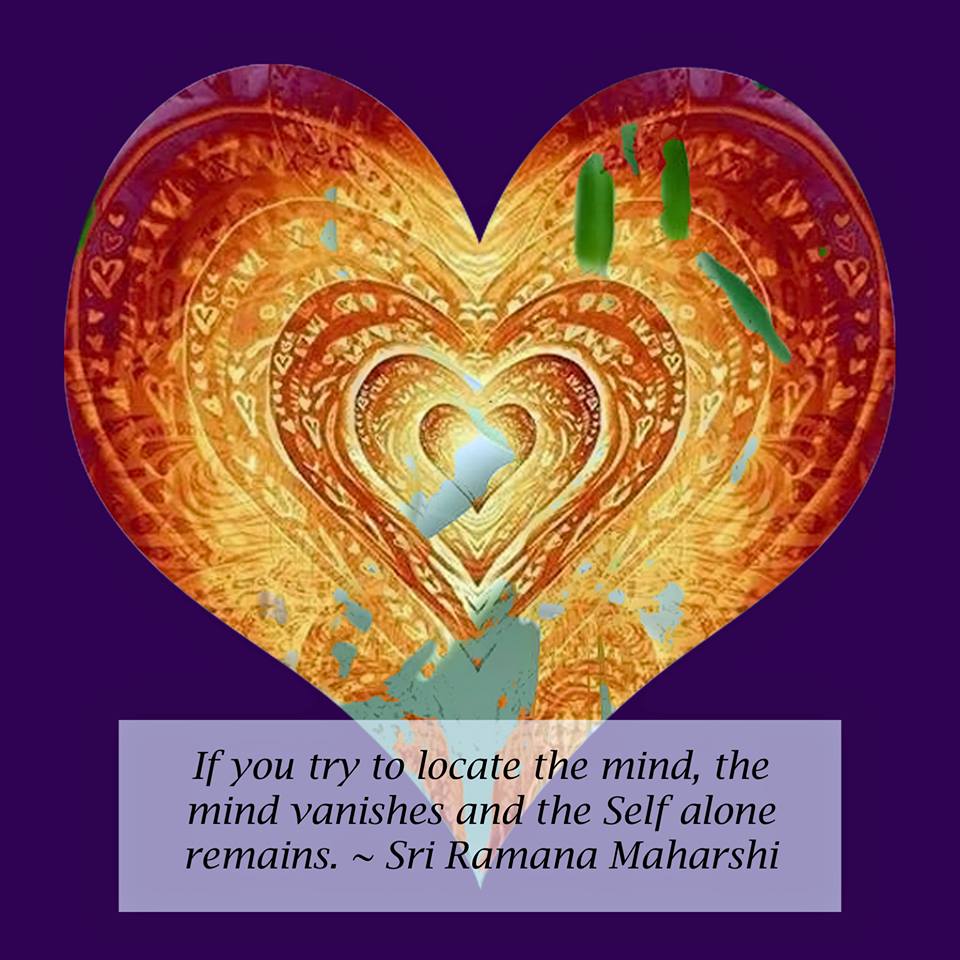
Bhagavan Sri Ramana gave a unique emphasis to the term “Heart” or “Hriydayam” in Sanskrit. He spoke about it frequently as the center of centers in which the mind must find final rest.
In ancient Eastern texts and scriptures, the Heart is talked about in the context of physical health, mental health, and also spiritual health and vitality. Even in English, we intuitively know that the word “Heart” really has multiple meanings.
If someone says to you, “You have a beautiful heart”, it does not mean that the person feels you have a very attractive physical organ beating in your chest. No, not at all! The statement about the beauty of your heart implies that you, your personality, your essential character have a warmth and glow which others find pleasant and joyful.
When we try to deeply understand a situation, a person, or resolve a dilemma, we inquire, “What is at the heart of this situation”? We say “let us go to the heart of the matter”. We might even look in someone’s eyes and ask, “What is truly in your heart.”
If we are trying to get to the truth, we never ask anyone in a conversation, “What is truly in your stomach or what is truly in your liver?”. That would make no sense. We do not even ask, “What is in your brain?”, unless we are being sarcastic. Sometimes, we might say, “What is on your mind?” But such a statement does not have the same warmth or mean the same thing as “What is in your heart”?
When We ask, “What is in your heart?”, it is an offer of direct and sympathetic communication. “Let us have a heart to heart talk”, signifies openness for a mutually respectful and even a loving exchange.
The term “Heart” literally means Truth. When we want to know the Truth, we want to go to the heart of the matter. When I say to someone, “I want to speak my heart”, it means I want to speak my truth. I want to give my true feelings.
Heart means center, or core, which provides the foundation for the structure of our perceptions. The light of the Heart as consciousness reflecting off our latent tendencies (karmas) appears to give color to our thoughts, feelings, and emotions which constitute our personality.
We know and understand and give meaning to this whole universe through our Heart. Truly, to know others is cleverness, but to know your own Heart is wisdom.
The old saying, “Know thyself” means “Know your Heart”.
Through what power do we know the world? Ancient sages have said, Know “That” by which all else is known.
How do we know anything?
When we get up in the morning and open our eyes, we see the world. By what power do we see? By what power do we hear?
By what power do we know of our own existence? No one comes and tell us every morning, “Hey, you exist. This is your lucky day”. We know we exist. This knowledge does not require external validation.
The French Philosopher Descartes said, “I think, therefore, I am”. However, the sages of Advaita stated thousand of years ago that “I Am” is prior to “thoughts”. Thinking is apriori predicated on our already being.
We know we exist and we know it with certainty. This certainty arises from the nature of the Heart.
If you have known everything but not your own Heart, you will not be fully satisfied. Something will be missing. Underlying our personality, thoughts, mental makeup, physical makeup, there is that power that allows us to be conscious of our being. Conscious of our existence. Conscious of the world of perceptions.
This power has many names in various religions. Ancients called this power simply the Heart. It is one’s own Heart, that is at the core of existence. It is one’s own Self, which shines and radiates through the medium of the mind as pure consciousness.
Knowing the Heart, one knows all hearts and minds. Everything arises from the same One Heart.
Namaste
OM! What Shall I Meditate On? By Dr. Harsh K. Luthar
Dear Friends,
When consciousness focuses its attention on a perceived or imagined object (such as an energy center, point of light, sound, music, mantra, etc.), that is known as concentration and can lead to deeper meditation and samadhi or trance states.
Truly all such techniques, although useful, are inherently and fundamentally flawed in seeing our own nature.
Such methods presuppose that there is something to concentrate or meditate on outside of consciousness. But how could that be?
All point of concentration, all techniques and methods of meditation only exist in consciousness. A person who understands this deeply loses interest in methods of meditation. The consciousness of a Self-Realized sage has settled into its own nature. It is in perpetual communion with itself. Always new and alive and pure being whose very nature is meditation does not concentrate or meditate.
On What Shall I Meditate? And How!
Namaste


You must be logged in to post a comment.