Harsha's avatar

Jai Guru Omkara

ln054

In honor of the Guru, which can only be Him
manifesting in His infinite mercy to remove the illusion of duality.

It may be external, or it may be from within,
opening the chambers of the heart and
unlocking the shackles of the mind such that nothing remains but Him,
everywhere manifesting in everything.  Chitta chora!  Chitta chora!

Steal it all and give me only one thing in return…your holy Presence. 
May I prostrate before you eternally
in gratitude for the Grace you have brought into my life.


PRIMROSEw - Copy


Puja Prayer

Like a flower
In complete surrender
I come unto You

Petal by petal
In complete surrender
I come unto You

Like the primrose heralds the spring
In complete surrender
I come unto You

May my actions be right
In complete surrender
I come unto You

May I walk in thy Light
In complete surrender
I come unto You

Earth, my altar… I, my offering
In complete surrender
I come unto You

May my only reward
Be complete surrender
Unto You


 ln054


The Self manifests externally as Guru when occasion arises;
otherwise He is always within, doing the needful.
From Talks with Ramana Maharshi, 12th June, 1937 Talk 426.

To view Adi Shankaracharya’s Guru Ashtakam… 

Harsha's avatar

Light From Eternal Lamps: By Swami Sadasivananda

image

“One must make the mind to bear on God”

ENTERING THE PALACE OF LIBERATION…

The One Thing Needful

“The eternal, unbroken, natural state of abiding in the Self is jnana. To abide in the Self you must love the Self. Since God is verily the Self, love of the Self is love of God; and that is bhakti. Jnana and bhakti are thus one and the same…. their purpose is to lead you to dhyana, to meditation, which ends in Self-realization.”  Maharshi’s Gospel I, The Teachings of Sri Ramana Maharshi. p. 17-18.

Sri Ramana Maharshi maintained this ancient form of instruction. The answers he gave to questions represent what has evolved in our modern times as a uniquely universal spiritual teaching that can be taken up by anyone the world over without adopting the limiting constraints of any one religious tradition. It has been said that these teachings were indeed God-given, for they began with the words of grace flowing from Sri Ramakrishna and continued with the blessing of perfection that was embodied as Bhagavan.

As did his predecessor, Bhagavan Sri Ramana Maharshi stressed practice that produces purification (removal of that fog of ignorance, the obstacles and habits of the mercurial mind which diminish our pure vision) as well as the grace of the knowledge of the Self as the eternal companions of those who would be led:

From the unreal to the Real,
From darkness to Light,
From death to Immortality!

NOTES FROM ARUNACHALA…

Devotees present with Bhagavan on this day said that a most important spiritual lesson was transmitted through the actions of Bhagavan as he held Lakshmi’s head during her final moments.

As Bhagavan was stroking Lakshmi’s head, she was gasping for breath in the final moments prior to her passing. Bhagavan, who all knew was capable of removing her pain and causing her spirit to easily exit the body, rather whispered in Lakshmi’s ear to “Tolerate the pain!”.

At a later day, Bhagavan said that, “Suffering is the way to Self-realization.” Our training within meditation prepares us to remain “steady in wisdom” even during the final trial of separation from the body.

image

“Practice is necessary, Grace is there.”
Reprinted from Swami Sadsivananda’s July newsletter.
To subscribe to his newsletter, go to http://www.ramanateaching.org/contact.html
For more information on Swamiji, click here:   About Swami Sadasivananda
Teachings of Bhagavan Sri Ramana Maharshi web site: http://www.ramanateaching.org
Ask your question in relation to Bhagavan’s teachings, meditation and spirituality at:
http://www.ramanateaching.org/faq

Harsha's avatar

Are You Letting God In? by Swami Sadasivananda

As posted by Swami Sadasivananda on his blog   http://www.ramanateaching.org/

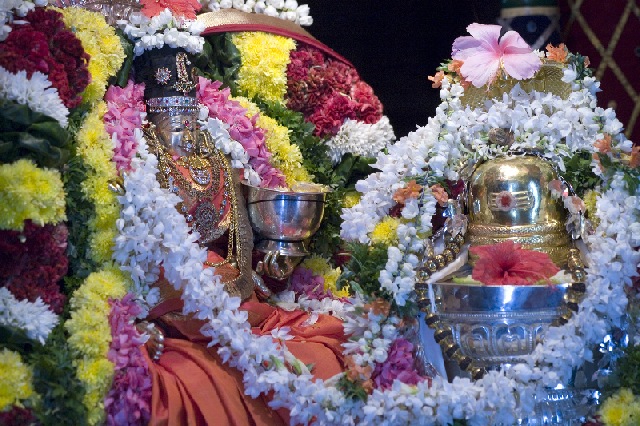
0310_Linga_Pooja_0190

There is one mystical understanding of life that runs through the very core of all major religions. This is the belief, and to many the cherished experience, that our sojourn on earth is not true life. These most ancient scriptures and Masters teach that everything appearing to us here is a mere appearance, behind which we should penetrate, or that it is only a forecourt of the true world, a forecourt which we should cross without paying much attention to.

    Hidden within these very scriptures, though obscured through individual bias or misinterpretation, is a profound truth that utterly refutes this belief. The Vedas, and their essential distillation given in the Bhagavad Gita, the Holy Bible, the Torah, and the Koran definitively proclaim that what a man does here and now with holy intent is no less important, no less true – being a terrestrial indeed, but non the less a factual, link with Divine Being – than the life in the world to come.

    Unfortunately, there is a universal acceptance that the highest gift of grace bestowed upon mankind is a “One way ticket to heaven”. Some call it “salvation”, some say “realization”, some “awakening”. In our modern era this ticket is on sale – being reduced to just a fleeting thought of “oneness” while ferociously consuming whatever is in reach with the righteous indignation permitted within “the present moment”.

    One hallmark of a real spiritual aspirant is an acute awareness of active evolution. Yes, “religion” does mean moving into purity and union through change and improvement.  Although a higher world is perceived, it is erroneous to conclude that we are separated and severed from it. When the day of even partial attainment dawns, we begin to experience that the two worlds are essentially one and shall in fact become one.

    In their true essence, the two worlds are one. They only have, as it were, moved apart. But they shall again become one, as they are in their true essence. Man was created for the purpose of unifying the two worlds. He contributes towards this unity by holy living, in relationship to the world in which he has been set, at the place on which he stands.

    How is it then true that when we suffer in our attempts to live a holy life we are told that such is a gift of grace? Sri Ramana Maharshi declared, with seeming sternness, to Paramahansa Yogananda (in Talks #107), that: “Suffering is the way to Self-Realization.” The Masters of all religions, upon seeing the great misery among the needy, raise their heads and cry out to us and say: “Let us draw God into the world, and all need will be quenched!”

    But is this possible, to draw God into this world? Is this not an arrogant, presumptuous idea?

    The advent of God, His actual gracious Presence, abides within the law that He Himself created and abides by. This law consists precisely in this, that God wants to let Himself be “won” by man, that He places Himself, so to speak, into man’s hands. God wants to come into this world factually, never being satisfied to remain a theory or at best an illusive and flighty “friend in need”. God wants to come to this world, but he wants to come to it through man. This is the mystery of our existence, the superhuman chance of mankind!

    The Masters and their scriptures entice us with the perplexing question: “ Where then is the dwelling of God?” The human mind really does not waiver with the passing of centuries. Therefore the answer to this question from ancient to modern man is: “What a thing to ask! Is not the whole world full of the glory of God? We are then perplexed when the these very saints reply:
                             “God dwells wherever man lets Him in!”

    This is the ultimate purpose; to let God in. But we can let Him in only where we really stand, where we live, where we live a true life. If we maintain holy intercourse with the little world entrusted to us, if we help the holy spiritual substance to accomplish itself in that section of Creation in which we are living, then we are establishing, in this our place, a dwelling for the Divine Presence.
____________________________
Some of the ideas expressed in this article are paraphrased excerpts from the writings of Martin Buber.

rr19

Harsha's avatar

A Sufi Saying about Virtue and Sin: By Dr. Mourad Rashad

There is only one virtue and one sin for a soul on the path:  virtue when he is conscious of God and sin when he is not.

Abu Hashim Madani (Sufi Master)

God is lost to Man when he becomes conscious of himself. Conscious of my own actions, of my own achievements, of my own position in the society, of my own physical body and so forth.

Consciousness of these entire things is only an interpretation, a particular interpretation to what is actually taking place in his experience of  living. Strictly speaking, the objects of Man’s consciousness are his thoughts, concepts and views. Man’s being is linked, colored and affected by these interpretations. So Man is always conscious of the thoughts, concepts and views that establish his separate position, making his being subject to all these interpretations. When this Man realizes that all these are interpretations just to establish his identity among others, he assumes the responsibility of his own happiness and misery. If this Man is keen and sincere to take his search a few steps further, Divine intervention will provide him with the means to continue. Divine intervention will send him a fellow, a companion, or a Master.

Divine intervention -in whatever form it takes- will guide this Man to the true significance  and the actual meaning to the experience of his life. When this Man glimpses what is the actual significance of what is occuring in his life’s experience, he will formulate another set of interpretations, concepts and views that are entirely based on the true significance of what is actually taking place. For example, this Man will discover and then say “No one does anything, but God does everything”. This is another interpretation, but based on a true seeing of what is actually taking place. Now, this Man will replace the old interpretation that used to say “I do“, with new interpretation saying “God Does“.

As a result of this change in interpretation, Man’s consciousness now witnesses the interpretation -concepts, thoughts, view- that establish God as a central reality in his own life, instead of establishing himself as this central reality.

A further step in the path of this Man will come up.

When this Man becomes fully and totally convinced that God does it all. Then this Man comes to see that it is a burden to continue on keeping this new interpretation that has replaced the old one. The new interpretation also will drop away, leaving a pure witnessing of this Consciousness to what is actually taking place, without any interpretation from his part. This Consciousness will become extremely silent but highly cognizant of its actual content. The actual content is the phenomenal appearances and what they truly signify. The true significance of the content of this virgin Consciousness is the Kingdom of God or Paradise or the Reality of Being or the Garden of Eden or Nirvana or Sat Chit Ananda….etc.

This transformed Man’s consciousness only witnesses the Presence of God.

This is the virtue  Abu Hashim Madani is talking about, and it goes without saying that to be conscious of yourself -as described above- is a sin.

Harsha's avatar

God’s Guidance, Meditation and the Master. By Mourad Rashad

What guides Man to God, is God Himself, provided that this Man has a genuine and sincere wish to leave his present worldly residence and travel to God’s Kingdom. How does God guide Man? Man’s heart or insight is the instrument that God has given to Man, so that God can communicate with Man and guide him. Man’s mind is always clouded by his own desires, hopes, achievements, attachments and so forth. When Man develops a sincere longing to leave this world -due to his sensitivity towards the pains of his fellow Man- he looks for a way out from this world that is full of pain, misery and fears. Then this Man turns to become meditative.

What is meditation? Meditation is not a practice or a posture or a technique; meditation is to develop a meditative attitude towards your everyday life.

Meditation is not a discipline that you impose on yourself. That is why the great Zen Master Rinzai said “There are bald-headed and blind monks who, after satisfying their hunger, immediately sit in meditation to look into their mental activities and arrest their thoughts so that the latter cannot arise again. These people hate disturbance and seek quiet; this is the way of the heretics.”  Unfortunately, Man today looks at meditation as a technique to calm the torrent of his thoughts, a tranquilizer pill or a tablet of valium, at the most to take him to another dimension of consciousness where everything disappears and a state of ecstasy or unsurpassed bliss is experienced. What Advaita describes as a type of Samadhi. Then the one who meditate  thinks that he has reached the final goal.  That is why Sri Ramana Maharishi says in Talk 465:  “Meditation should remain unbroken as a current. If unbroken it is called samadhi or Kundalini sakti. ……… Otherwise how can nirvikalpa samadhi be of any use in which a man remains as a log of wood? He must necessarily rise up from it sometime or other and face the world.”  It is this continous meditation, this unbroken current; that is the true meditation. 

Meditation has to happen to you; meditation becomes an indispensible growth in your being. Meditation has to occur due to a deep transformation in your own being. Meditation cannot be added to your being while you are still as you are. A metamorphosis in your inner configuration has to happen by which you are transformed into a meditative human, the highest type of human beings.

What is this metamorphosis, what is this transformation that has to happen before Man becomes meditative? It is a deeper transformation in Man’s heart. Man has to know what he is. Man is a practitioner of worldly life, a follower of the worldly conventional ways of dealing with his everyday life, an automaton, a robot that simply follows the convention, a robot that works through buttons; the button is called conditioning.

Do we remember the Great Russian scientist Pavlov and his discovery of the conditioned reactions of dogs and other animals? Pavlov designed an experiment which he calls “sham feeding of dogs”. Every time he rings a bell, he gives the dog something to eat. After repeating this method many times, Pavlov rings the bell and does not give the dog food; the dog starts salivating. This is the conditioned reflex in animals. This is Man’s conditioning. This conditioning of Man’s mind, made the mind run in fixed grooves; just like the grooves of a plastic musical record and the stylus. Man does not stop and question his conditioning; is it right or is it wrong. Man simply follows. This is what Man is.

Why does meditation become an indispensible growth? Why can’t Man learn how to meditate? No one can learn how to meditate; it has to spring from your deep most core, and it has to erupt like a volcano upon your discovery of your own ignorance. You discover your own utter ignorance from your contact with your everyday living. A discovery that we are always avoiding, a discovery that we all evade in order not to appear in our own eyes as ignorant, as stupid and dull witted.  I do not want to change my own idea about myself; I wish to remain as people think about what I am. I want always to be the clever one. Upon the discovery of my own ignorance, the volcano erupts. I am not clever, maybe I am also not the good guy that I think myself to be, maybe I am not the good father, the good husband and so forth. Only then, meditation becomes an indispensible growth, a must, because without it you are lost, you cannot live your life. You need meditation to continue living.

Now, the need to have a meditative attitude has been created in your heart. But what is this inner metamorphosis, inner change of your configuration? This inner mutation, inner transformation, I wish to name it inner metamorphosis from being the Mr. know it all to Mr. Dumb. This maturity, this revelation that I am Mr. Dumb cannot be added to Mr. know it all. Mr. know it all has to go, to be replaced by Mr. Dumb. This new Mr. Dumb will be my intimate friend for ever. This is the transformation and the mutation. I cannot be at times Mr. know it all and at other times Mr. Dumb.

This meditative attitude, this inward metamorphosis in the configuration of Man, will flower into the spiritual insight, an insight that will guide him to God’s kingdom. This insight has always been with Man. It is an essential component of his original nature, but Man neglected it and used his mind instead.

When meditation starts, God’s guidance occurs in the form of revelations and inspirations. This happens to the mature Man. Moreover, to the less mature Man, God will speak to him in symbols, in signs and in his dreams. In either case God guides this Man. Whatever this Man understands from the inspirations, revelation, signs and so forth, he follows immediately and put this new understanding in effect in his daily life in place of his old conventional understanding. These new revelations might be expressed in words, either to himself or his friends. Once these revelations are expressed to others, they could be viewed by people of the world as views, points of view, ideas, illusory concepts and they give themselves the liberty to put these revelations that were expressed on equal footing and equal grounds as their own dusty views and ideas they live by. That is because these mortals -people of the world- had never developed a meditative attitude, nor has their insight been revived.

That is why an earnest seeker needs a guide, a Master in order to tell him – at least in the beginning of the blossoming of his insight- that what he had recently understood is a revelation, not another concept or idea or a view from his rotten mind. This guidance by the guide -Murshid in Sufism- or Master will continue until the seeker is able to differentiate between a revelation and a silly mental concept, view or idea. This relationship between the Master and the disciple -later on- will not remain as such, but they will be as two seekers holding each other’s hand flying to God’s kingdom, with the former disciple always grateful and appreciating his previous Master.

Harsha's avatar

The Heart of God:The Nature of Self-Realization. By Dr. Harsh K. Luthar

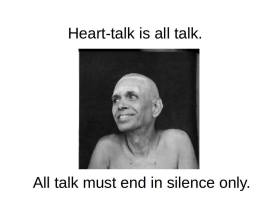
Heart Talk is All Talk

The difficulty in many of our conversations about spiritual insight is that the true understanding is not intellectual or conceptual, but absolutely direct. It is clear and direct without the medium of the mind.

Truth has never been a monopoly of a particular religion or spiritual tradition. How can it be? Some may disagree, but in my view, God does not play favorites.

We cannot make Truth our personal property but only allow the quality of Truth to overtake us and shine in us. We cannot possess God but only surrender to the Divine Will and let God take over our life.

Continue reading

Harsha's avatar

What is God’s Name? By Dr. Harsh K. Luthar

Ramana Maharshi: “I am” is the name of God. Of all the definitions of God, none is indeed so well put as the Biblical statement “I am that I am” in Exodus (Chapter 3).

Words are used in various spiritual traditions to describe God or give God a name. Many people are convinced that their religion, their scriptures, and their way of worshipping God is the best way. Sometimes people argue and and fight over God as well. 

Our conception of God is to large extent a function of where we are born and in what religion. Our mental conditioning is often so strong that we are not able to see the diversity of perspectives in various spiritual traditions. Only the mystics in different religions, who have through self-reflections and meditation, gone beyond their mental conditioning offer a unified vision of God. 

Continue reading

Harsha's avatar

Blessings of Simplicity: By Dr. Mourad Rashad

Have you ever asked yourself, “do I understand life”? Is life what I think it to be?

To start asking yourself about what you take for granted is the beginning of true understanding. This is the first step taken by any prophet, wise man, or a sage.

What triggered these questions in the hearts and minds of these great men? Life itself forced these questions. Worldly living and suffering brought these questions about. The simplicity and humility of these men in response to life allowed these questions to emerge.

Simplicity means that you are not sophisticated. Being sophisticated shows that one is worldly wise; one is well versed in the ways and methods of the world. Sophisticated shares the same root with the word sophistry, signifying something very plausible, but fallacious and misleading.

No one is born sophisticated. Sophistication is something that we learn. Children are born light and natural.

The prophets remain like children. They do not wish to become clever. Instead, they want to widen and deepen their understanding of life.

For the prophets and sages of old, the ways of the world, did not appeal to them and did not satisfy their hunger for a truer meaning to life. These great men were of this type, they were simple, they were direct in their understanding, and they did not allow sophistication and clever ways of the world to mislead them.

I finish with a quote from the Bible where Jesus makes the same point.

“Truly I say to you, Unless you turn around and become as young children, you will by no means enter into the kingdom of the heavens. Therefore, whoever will humble himself like this young child is the one that is the greatest in the kingdom of the heavens.”
____________________________________________________________________

From the Author: My name is Mourad Rashad. I am 57 years old and live in Cairo, Egypt where I was born. I hold a PhD in Pathology from the Faculty of Medicine, Ain Shams University, Cairo, Egypt, where I am a Professor. I have a private practice as an internist specializing in geriatric medicine.

I am a Muslim, and have read all of the Quran as well as the Bible. I became exposed to Mysticism early in life, through my father who was an avid reader of the mystic masters, and who took me with him to attend spiritual gatherings in Cairo. I have read extensively in Zen, Sufism, Advita, Gnosticism, Taoism. I was a disciple of the late Padamanabhamenon (Gurudev), who is the son and successor of the late Atmananda (Gurunathn), who was a contemporary sage to Sri Ramana Maharishi.

I have written a book in collaboration with a fellow Egyptian mystic entitled “The Mysticism of Jesus Christ”, where we discussed and interpreted the sayings of Jesus Christ in the four canonical Gospels, and as well as in the Gospel of Thomas.

Harsha's avatar

Love, Heart, and Enlightenment: By Dr. Harsh K. Luthar

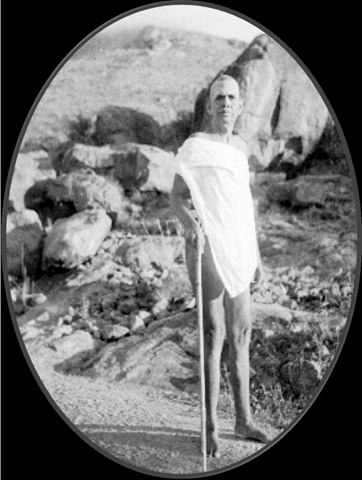
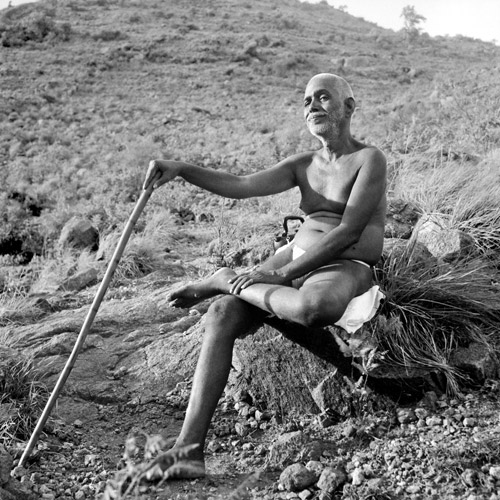
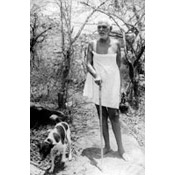
Sri Ramana Walking

Sri Ramana Walking

There is only One Heart

Sri Ramana once said that many advanced souls get liberation after reaching higher planes and that a few rare ones attain mukti (liberation) right here and now. In such cases their Prana along with mind (Kundalini Shakti) gets fully absorbed in the Spiritual Heart and the individual identity is dissolved into Brahman, the Self, the universal Heart and consciousness.

Continue reading

Harsha's avatar

Personal Enlightenment? By Dr. Harsh K. Luthar

By Dr. Harsh K. Luthar

Pictures in this article are by long term HarshaSatsangh member Alan Larus from his website at http://www.ferryfee.com/.
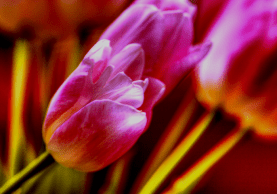
The Self as Satyam-Shivam-Sundram (Truth, Consciousness, Beauty)

The spiritual path is difficult from one perspective because the Self, the ultimate Reality that we are, is not clear to us as individuals. Some people say that Enlightenment is not personal. That is just a fashion statement.

Enlightenment is as personal as it gets. The Self is both personal and impersonal. It is personal because it is you. How can it be any more personal? It is impersonal because its existence (your ultimate nature) is not dependent on time and space bound relationships.

As a mind/body, we are subject to the whims of nature and circumstances (karma). This clouds the understanding of our essential nature. So the teacher or a friend whom we trust is needed to tell us that our nature is not that of the body.

Suffering is natural to the body because it is subject to physical forces. When the sages use the word body, they include the mind. The mental body is also a body but more subtle, made up of more subtle matter, but still matter. If we believe our Self to be the body, the inevitable changes in the body will be a source of fear and anxiety.

So the Body is one thing and the Atman (Soul or Self) is another. The mind/body complex is always subject to change, old age, illness, and suffering at some level. The Atman, who we are, though appearing to be related to the body, is untouched by these.

Bhagavan Krishna, in fact, points this out to Arjuna in the classic Hindu scripture, The Bhagavad-Gita.

Sri Krishna states:

“The Atma is neither born nor does it die at any time, nor having been it will cease to exist again. It is unborn, eternal, permanent, and primeval. The Atma is not destroyed when the body is destroyed.” (2.20)

“Just as a person puts on new garments after discarding the old ones, similarly Atma acquires new bodies after casting away the old bodies.” (2.22)

“Weapons do not cut this Atma, fire does not burn it, water does not make it wet, and the wind does not make it dry.” (2.23).

If we fully understand this dualism, we will not have to struggle to understand nondualism.

Nondualism or Advaita (in Sanskrit) is not an understanding but our essential nature.

The nature of Atman is nondual because Atman is “Being-Awareness” resting in its own nature without any external support. Atman is not free, there being nothing to free itself from. Its very nature is that of absolute freedom.

We cannot conclude this logically but only by Being That. In Self-Realization, Knowing the Self is Being the Self. This Knowing transcends logic, because all distinctions cease. Logic needs duality in order to function. Duality ceases through Self-Knowledge alone.

If you know the Self, what does it mean? You cannot know the Self as an object. You are the Self. Therefore, it is always the Self knowing It Self. The mind cannot fully grasp this unless it has become transparent and fully saturated in the Self, where it knows that it is only the Self knowing itself through It Self.

Maharishi Patanjali says the same thing about the nature of the Self in his yogic classic “Patanjali Sutras”. Ultimately, the Seer rests in His Own Nature. That is the highest Samadhi. Self is Samadhi. Self is Nirvikalpa, beyond imagination and thought. Self is Sahaj or natural and always visible to itself as pure being despite imagination and thought. In Self, Seeing and Being are the same.

In Hinduism, the Reality is often referred to as Satyam-Shivam-Sundram. Truth-Consciousness-Beauty. That which is of the nature of the ultimate truth, pure consciousness, and the essence of beauty is the Self. One’s own Self.

It is of such overwhelming beauty because the devotee who worships the God or the Self with all love and might and with desperation suddenly realizes that the devotee and God are in essence identical. The seeker had been looking for something that constituted the core of his/her very own Being and Existence. God being infinite leaves no room for the devotee as a separate person to exist. That is Grace. That is Advaita. Imagine the shock!

First the shock, and then the smile. Of course, how could it be anything else? The Lord always sits in our Heart as our own Heart. Where else can we find the mystery of existence and our own reality except in our own Heart.

This Realization is one of supreme beauty. The one that you had been longing for has been here all along as your own Self.

That is why I say that Self is Absolutely Personal! Self is empty of all concepts. Its nature is that of completion that is devoid of all longing. Its nature is that of utter fullness that has no where to flow out to, nothing to see, nothing to be. That is why Self is also Impersonal!

Because the Self is One without a second, upon Realization, we see that both Personal and Impersonal are identical in the Self. There is no difference. That is nonduality. That is Advaita.

How can we describe the Self with mind as our tool? We can do so by our experience of this state and through the abidance of the mind in the Heart. The ancients called the Self “Sat-Chit-Ananda”. Existence, Consciousness, Bliss, as one complete Whole with no parts.

It has no basis for comparison and no reference point. By inference, we can say that it is the essence of beauty and bliss. To Know It Is To Be It. In this very moment, you are the That!