The Place of Wisdom,
Where Men may Meet their God

Now, in the early morning, Jesus came again to teach and heal. A light not comprehended shown about, as though some mighty spirit overshadowed Him. Continue reading

The Place of Wisdom,
Where Men may Meet their God
Now, in the early morning, Jesus came again to teach and heal. A light not comprehended shown about, as though some mighty spirit overshadowed Him. Continue reading
translation and commentary by Smt. Savitri Puram

“Neither I live in vaikunTha nor in the hearts of yOgi.
I am indeed there where my bhaktas are singing (my praises).”

Introduction
Njanappaana can be considered as the Bhagavad Gita of Malayalees. This is a Darshanika kaavyam or philosophical poem expressed in the most simple Malayalam language for ordinary people. Poonthanam Nambudiri, an ardent devotee of Shri Guruvayurappan, transformed his unbearable sorrow from his infant son’s death into a “yogavishesham”. He used this sad experience to build his Bhakthi soudham or house of devotion and opened it for all devotees for all time. Even though the language is very simple, this njaanappana, or song of wisdom deals with the essence of all vedas and upanishads. May Bhagavan Guruvayurappan, Bhagavathy Sarswathi Devi and Sri Poonthaanam Nambudiri bless us to become wiser by going through this great Song of Wisdom!!
This is continued from
Part One: https://luthar.com/njanappaana-1
Part Two: https://luthar.com/njanappaana-2
Part Three: https://luthar.com/njanappaana-3
Part Four: https://luthar.com/njanappaana-4th/
Part Five: https://luthar.com/njanappaana-5/
Athu chinthichu mattulla lokangal
Pathimoonnilumulla janangalum
Mattu dweepukalaarilumullorum
Mattu khandangalettilumullorum
Mattu moonnu yugangalilullorum
Mukti thangalkku saadhyamallaykayaal
Kalikaalthe, bhaaratha khandathe
Kalithaadaram kaivananageedunnu
Thinking about that (athu chinthicchu) (truth about Bhaaratham)) all the living souls in the other thirteen worlds (lokangal pathimmunnilulla janangalum), those who are living in the other 6 islands (mattu dweepukalil aarilumullorum), those who are living in the other eight continents (mattu khandangalettilumullorum) and all who lived in the other three yugaas (mattu moonu yugangalilullorum), realizing that salvation is not possible for them (mukthi thangalkku saadhyamallaaykayaal), pay respect both to Bhaaratha and the Kalikaala or Kaliyuga with folded hands (kalikaalatthe, bharathakhanadathe kalithaadaram kaivanangunnu).
What does “athu chinthicchu” or “thinking about that” mean? In the 27th Stanza poet reminds us: “Everybody should remember that this place known as Bhaaratham is such an important place. Out of the four yugaas, Kaliyugam is the best to attain salvation.” So thinking about these two factors, all the souls lived outside Bhaaratha varsha and all who lived in the other three yugaas paid respect to this auspicious time and this auspicious land.
Other thirteen lokaas or worlds are :1. Sathya lokam 2. Thapolokam 3. Janalokam 4. Maharlokam 5. swarlokam 6. Bhuvarlokam 7. Athalam 8. Vithalam 9. Suthalam 10. Thalaathalam 11. Mahathalam 12. Rasathalam 13. Paathaalam. The first six worlds are above Earth and the last seven are below earth.
Other six islands or dweepams are Plaksha dweepam, Shaalmala dweepam, Kusa ,Krouncha, Shaaka and Pushkara dweepams.
Other six continents or regions are 1. Ilavrita Region 2. Bhadrasva Region 3.Harivarsha Region 4.Kethumaala Region 5. Ramyaka Region 6. Hiranmaya Region 7. Kuru Region 8. Kimpurusha Region.
Other three yugas are 1. Krutha yuga 2. Thretha yuga 3. Dwapara yuga.
Why all of them think that salvation is not possible or “mukthi saadhyamallaykayaal” in their time and place? Scriptures depict Dharmam as a bull or “vrusham”, and it has four legs in Krutha yuga (chathushpaadam). They are : Tapa, Soucha, Daya, Sathya or Religious austerity, Purity, Compassion and Truth respectively. In Krutha yuga people had all these qualities and Dharma was completely stable. All people were saathwic or pious and only through severe penance one could realize god.
In Thretha, people have only three qualities except Tapa. Dharma was somewhat stable on three legs. One has to strive less than Krutha Yuga, but had to observe strict purity of mind and body along with compassion and truthfulness. They had to perform difficult yanjnaas and distribute their possessions with kindness. In Dwapara yuga people have only Daya and Sathya and Dharma had to balance with effort to survive on two legs. In this yuga also it was much harder to attain salvation than in Kaliyuga. They had to do Yaagaas like Raajasooyam, poojaas using different manthras and thanthras etc.
In Kaliyuga, only one leg is there for Dharma which is Sathya, and it is trembling insecurely on one leg. Kali encouraged by falsehood tries to destabilize the bull called Dharma.
So why do they think that they cannot attain salvation ? They can actually attain salvation in any yuga. But the effort is many many times the effort or yathnam that one has to make in Kaliyuga. When compared to how effortless it is in Kaliyuga, they feel that it is impossible to get salvation in other yugaas. “Not possible” really do not mean that it is not possible but means that practically it is much harder to attain salvation. So they all desire to be born in Kaliyuga in Bhaaratha so that they can get salvation just by chanting Bhagava’s naamam. In other yugaas so much penance has to be done, so many Yanjnaas have to be performed along with daana (giving away ) and purity of mind and body has to be strictly observed. But in Kaliyuga, naamasankeerhtanam can be done anytime, anywhere, clean or unclean, knowingly or unknowingly and one can attain salvation by the power of Naamam.
If we are truthful, Kali cannot do anything to us and Naamasankeerthanam helps us to be truthful and strong. Leading a dharmic life we can easily progress in our spiritual path by chanting namam and eventually attain salvation. But negative temptations are all around us and it is hard to resist those. But once we step on the ladder of Naamasankeerthanam, our upward journey to merge with Bhagavaan becomes safe and trouble free with the blessings of Naami (one who bears the naamam).
Athil vannoru pullaayittenkilum
Ithukaalam janichukonteeduvaan
Yogyatha varutheetuvaan thakkoru
Bhaagyam poraathe poyallo daivame!
Bhaaratha khandathinkal pirannoru
Maanusharkkum kalikkum namaskaaram
They (people who are in other worlds) think: Oh God! (Daivame!) (we) are not lucky enough (thakkoru bhaagyam poraathe poyallo) to be qualified (yogyatha varuttheetuvaan) to be born even as a blade of grass (pullaayittenkilum) in that land (athil or in Bhaaratham), in this time (ithukaalam or Kaliyugam), (we) do namaskaaram to both the people who are born in Bhaaratha varsha (bhaaratha khandathinkal pirannoru manushyarkkum) and to Kali himslef(kalikkum).
Here word “athil” indicates Bhaaratham and “ithukaalam” indicates Kaliyugam. Calling God “Daivame” indirectly shows their sorrow and they wish that at least in their next birth, they will be fortunate to be born in Bhaaratha. Brahma Vaiavarttha Purana says: “satajanma tapa: puto janmedam Bhaarate labhet” means “after performing austerities for hundreds of births, one is born in Bhaarahta Varsha”. So poet is indirectly telling us that even after getting a human birth in Bhaaratha, it is really unfortunate for some one to forget God and waste his life going after material pleasures. In Kaliyuga Bhaaratha, attaining salvation is as easy as chanting divine naamaas.
What is the use of being born as a blade of grass? Sometimes even a blade of grass that is growing near sajjanaas may get a chance to hear divine names of Bhagavaan and may be born as a pious human being and eventually attain salvation. There is a story about Poonthanam himself. There were two jack fruit trees in the poet’s back yard and those trees were very fortunate to hear Namasankeerthanam and Bhagavatha paaraynam (reading) by Poonthanam for several years.
Once Poonthanam wanted to write about Vaikundham (Vishnu Bhagavan’s eternal abode) and he was worried how he could realistically describe Vaikundham when he had not actually seen it. That night Bhagavan gave him a real vision of Vaikundham and in that vision or dream two resident devotees of Vaikundham showed special hospitality with lot of affection. They told him that they were the jack fruit trees in his back yard which broke and fell a few days ago due to severe wind and rain. Since they were lucky to have satsangam with Poonthaanam for several years, they attained salvation. Poonthaanam was very surprised to see that even trees can get salvation by listening to Naama sankeerthanam and stories of Bhagavaan. This story justifies the desire of the people in other worlds to be at least born as a blade of grass in Kaliyuga Bhaaratha.
People in the other worlds not only wish to be born here but they actually bow with respect and folded hands to all who are born here. Poet is telling this to us to remind how lucky we are and we should start naamsankeerthanam with utmost devotion with out a moment’s delay. God has blessed us to be born in Kaliyuga Bhaaratha and (even if we are not born in Bhaaratha,) Namasankeerthanam will purify our mind and satsangam will elevate us to higher states of spirituality.
Ennellam pukazhtheedunnu mattullor
Ennathathenthinu naam paranjeedunnu?
Kaalaminnu kaliyugamallayo
Bhaarathamipradeshavumallayo
Nammalellam naranmaarumallayo
Chemme nannai niroopippenellarum
Hari naamangalillathe pokayo
Narakangalil pedi kurakayo
Naavu koodaathe janmamathaakayo
Namukkinni vinaasamillaykayo
Kashtam kashtam! Niroopanam koodaathe
Chuttu thinnunnu janmam pazhuthe naam!
Why should we tell that others are praising us like this? (first two lines ) Don’t we know that this kaalam is Kaliyugam, this land is Bhaaratham and we are all human beings? (lines three, four and five) Are we short of Hari’s or Bhagavan’s names? Are we not afraid of different types of hells? Are we born with out tongue in this janma? Do we believe that we will never be perished? (line seven, eight, nine and ten) We all should think about this in detail (chemme nannai niroopippinellaarum- line six). Alas! alas! (kashtam! Kashtam!) with out proper contemplation (niroopanam kootaathe) we are wasting our lives in vain (last line).
In this stanza poet blames us for wasting our precious lives by going after transient pleasures. He asks: what is the use of saying over and over again about how people in the other worlds praise us? We do not deserve any respect from anybody unless we live up to the expectations of those people and our own mother land. They pay respect to us thinking that we are fortunate to be born in this punya karmakshethra and we will make use of the great opportunity God bestowed on us.
Poet is wondering what is wrong with all of us! We are intelligent enough to know from the scriptures that this is Kaliyuga and it is easy to attain salvation in Kaliiyuga Bhaaratha just by doing Naamasankeerthanam. Kali Santharanopanishad tells us explicitly that in Kaliyuga only Naamasankeerthanam is the solution to all problems. (“Kalau naasthyeva naasthyeva naasthyeva gathiranyadha”) Why are we hesitating to chant Naamas? Is there any shortage of divine names? Vishnu shasranaamam has thousand names and we can choose any one that appeals to our mind. We can choose the simple “Rama” namam or a complicated one like “Vishvaksena”. Are we not afraid of the sufferings in the hell? If we are not afraid of hell, we should not desire heaven also. We should have “samabhaavana” or we should see both sukham (happiness) and dukham (sorrow) alike. Are we not afraid of the fruits of bad karmaas? Bad Karmaas will only give rise to suffering. Why are we going deep into the samsaara (materialism) by sowing wrong seeds and still expect to reap good fruits?
Why is the tongue that is used for non-stop talking become hesitant to chant divine names of Bhagavan? We act as if we do not have tongue when it comes to Naamasankeerthanam. We are shy to chant loudly because of the powerful ego. But don’t we have the power of discrimination (bestowed on us by Lord) to know that once namasankeerthanam is started, power of naamam will easily take over the power of ego and our mind will get purified. Do we think that our body is eternal? If we realize how uncertain our life is and if we contemplate how helpless we are when death comes and knocks on our door, we should not waste not even one moment of our life. He sympathizes with those people who completely forget about this truth and wastes their life going after transient material pleasures with out ever turning their mind towards God.
In this context, let us remember what Sage Narada asked Bhagavan and Bhagavaan’s reply. Sage Narada asked Lord where His permanent abode was. Is it Vaikundham? Is it Golokam? Is it Bhoomi? Bhagavan said: “Naham vasami Vaikundhe, Na yogi hrudaye ravau, Math bhaktha: yathra gaayanthi thathra thishtaami Narada” – he would not reside in Vaikunta, the celestial abode, nor in the hearts of great tapasvis [sages], nor permeate in the Solar system, but would stand in attention wherever His devotees do sing His name [sankeertanam].

Bhaktha Mirabai says:”This treasure of Bhagavaan’s naamam, none can rob, this treasure does not reduce if you draw from it, and in fact, it grows at a compound rate”
Ethra janmam prayaasappettikkaalam
Athra vannu pirannu sukruthathaal
Ethra janmam malathil kazhinjathum
Ethra janmam jalathil kazhinjathum
Ethra janmangal mannil kazhinjathum
Ethra janmam marangalai ninnathum
Ethra janmam marichu nadannathum
Ethra janmam parannu natannathum
Ethra janmam mrugangal pashukkalai
Marthya janmathin mumbe kazhichu naam
How many previous lives (Ethra janmam) we struggled (prayaasappettittu) to be born in this time(ikkaalam) and because of the good deeds done in the past ((sukruthangal) we are born here (athravannu pirannu). How many lives we would have spent in human and animal excretions, how many lives we would have spent in water (line three and four), how many lives we would have spent in mud, how many lives we would have spent as trees (lines five and six), how many times we died, how many lives we would have spent flying in the sky as a bird (lines seven and eight), how many lives we would have spent as cows and other animals before we took birth as a human being (lines nine and ten)?
The word “ikkaalam” or “this time” refers to Kaliyuga and word “athra” indicates Bhaaratham. First line says that only after several lives of suffering and struggle one gets the opportunity to be born in this Kaliyuga. Birth in Kaliyuga is considered to be very near “Moksha praapthi” or getting salvation because even the mere chanting of naamam leads us to moksham. Poet also says that only good deeds performed in the past make one eligible to be born in Bhaaratham. Even the inhabitants of heaven want to be born in Kaliyuga Bhaaratha so that they can free themselves from the repeated cycle of birth and death by performing “Nishkaama Karma” or karmaas with renunciation of results. Results of the accumulated good karmaas and bad karmaas that can be experienced by the subtle body are experienced in heavens and hells respectively. So, to take birth in Bhaaratha, one should have accumulated some good deeds in the previous janmaas, results of which can only be experienced by a human body born in Bhaaratha. So poet says that it is a very unique opportunity to get a life in Kaliyuga in Bhaaratha.
Before getting here, we do not know how many lives we lived as amoebas, worms and small insects in animal and human excretions. After that we may have promoted to the state of inhabitants of water. Even there, as a small fish we would have lived with fear of larger fishes. Then we might have spent miserable lives in mud in constant fear of being consumed by birds and other larger and cruel animals. Afterwards, we might have spent lives as trees suffering rain and shine and heat and cold. How many times our subtle body would have experienced the time lapse between one death and next birth? That time might have been filled with horrifying experiences in the hell owing to the sins committed. Who knows how many lives we would have spent as animals knowing nothing better than “animal instinct’?
It is interesting to note the effect of fall from human life when compared to the effect of fall or going backward from lives of lower species. Let us take the example of a high rise building with, say, 40 storeys. Imagine fortieth storey is where Jeevathma merges with Parmaathma.
Imagine that we climbed the first two stories and we happen to fall. The impact and momentum of the fall will be less than the fall from any higher stories of the building or in other words, the impact will be directly proportional to the height of the building. Scriptures say that in the spiritual world also the effect of the fall from highest species, human beings are much more serious than falling from other species. The reason is that human beings are blessed with the power of discrimination or vivekam and animal species are guided only by instincts. Other living beings like trees also have no choice other than following the commands of Prakruthi or Nature. When we choose wrong direction deliberately ignoring our ever guiding conscience, repercussions are disastrous. Animals are just experiencing the results of the past karmaas and after exhausting those through several janmaas in different species and kinds, finally gets the chance to be born as a human being. Poet says that human life is so precious and sought after by souls in all other worlds that we should cherish every moment of our life and devote it for knowing God by any prescribed method. In Kaliyuga the prescribed method is Naamasankeerthanam.
In this context, it is appropriate to remember the one sloka from Mukundamala to reinforce the importance of Shri Poonthaanam’s advice.
Aashcahryam etaddhi manushyaloke
Sudhaam parithyajya visham pibanthi
Naamani Naaraayna gocharaani
Thyaktvanya vaacha: kuhaka: pathanthi
“The greatest wonder in human society is this: People reject the life-giving nectar of Bhagavaan’s names and instead drink poison by speaking about everything else”.
Ethrayum panippettingu maathaavin
Garbha paathrahil veenatharinjaalum
Pathu maasam vayattil kazhinju poy
Pathu pantheeraandunniyaayittum poy
Thannethaanabhimaanichu pinnedam
Thannethaanariyaathe kazhiyunnu
Please understand or know (arinjaalum) that after a lot of struggle and effort (ethrayum panippettingu), finally we come or end up in a human mother’s womb (garbhapaathratthil veenathu). Ten months we survive in her womb (patthu maasam vyattil kazhinju poy) and about ten to twelve years we spend in childhood (patthu pantheerantuunniyaayyittum poy) . Rest of the life (pinnedam) we live identifying the body as “I” (thannetthaanabhimaanichu) (separate from Paramaathma) and with out really knowing who we are (thannethaanariyaathe kazhiyunnu).
As explained in the previous stanza, after spending several janmaas in different animal forms, a soul gets a unique chance to be born as a human and takes birth in a mother’s womb. It is said that the baby in the womb remembers all the previous janmas. During the ten months of pregnancy, the baby is trapped inside the womb with no space to move around and during that time it contemplates about his existence and promises God to lead a life completely surrendering to Him when he gets out of the womb. But during of the trauma of birth, memory of the previous janmaas are completely wiped out and the baby becomes a slave of Maya. Here the poet says “patthumaasam vayattil kazhinju poy” and this indicates that even though the child remembered and took decision to lead a detached life with attachment only to God, all the good intentions were lost during his arrival on earth.So poet describes that as a waste of time or loss of time.
Then the next ten to twelve years are spent as a playful child. Here also the word “poy” at the end of line four indicates the loss of his childhood years doing nothing to move towards God. When the baby is born he forgets about all the sufferings of the past janmaas and then starts building attachment to material things and relations influenced by the parents. Each day baby gets attached more and more to the people and things around him. If the parents do not teach him to think of God and surrender to God in the form of prayers, then the unfortunate child will never get a chance to remember or follow what he had promised God when he was in the womb. Swami Vivekananda stresses the importance of parent’s role in reminding the children, their hidden love and attachment for God through daily prayers. So parents can lessen the loss of precious time as a child by giving them the faith in God which they will carry all through their life. This faith in God and love of God given during the childhood years will help them to use their precious time as adults in youth and old age more effectively to advance spiritually amidst their other material commitments.
Fifth line says that the rest of the life we live with terrible ego with out the real knowledge of who we are. So in our youth, we forget ourselves and take credit for all the success we meet with and blame others for every failures we encounter. So youth also is lost with out any contemplation about our own existence and we go after transient material pleasures. When one spends almost all of one’s life with out ever thinking of a higher power who controls everything in the universe, at the fag end of life one gets depressed and confused by the material world. Because of the lack of training of the mind to think and surrender to God, we get lost in the material world. Thus the most precious human life we obtained after a lot of struggle is wasted, ready to repeat the never ending cycle of birth and death. Poet says that God gives us a chance to escape from this and it is unfortunate that we are not making use of the golden opportunity given to us.
I happened to read an explanation by an unknown author about the word “soham” and ego and I would like to share that in this context. What does “soham” mean?
It is split as sa: + aham He or That + I
Sa: means He, That or God and Ham means “I”.
“It is the identification or dissolution of the ego with “that” or God. “I” merges with God or Easwara of the Vedas, Brahman of the Upanishads or Bhagavaan of the puraanaas. The meaning of the phrase might be expressed as follows: “I” am obviously not this body because the physical constituents of the body are changing every moment. Ultimately, the body dies. Atman the soul or self never dies – it is “That”. “That” is Absolute Reality. It is the witness of all, it is what the mind does through the body. This self is always on the path of progression, which is the consciousness. This is called spiritual awareness. ”
Poet says that we live all our life and die with out this spiritual awareness “soham”. That is the meaning of the last line. What is the method to know ourselves or to identify ourselves with Parmaathma for materialistic people like us in Kaliyuga? Poonthaanam has one and only one solution: Naamasankeerthanam. This solution is easily accessible to all sadhakaas or yearning devotees and can be practised anywhere at anytime . One does not need any initiation or training.
(During praanaayaamam some people say “so” while inhaling and “ham” while exhaling. While inhaling we take God or God’s power as prraanavayu and leave out ahamkaaram or I while exhaling. This happens 21,600 times a day and that means we are welcoming God and driving out ego that many times- Saibaba
http://www.youtube.com/watch?v=vbI4Uk8fSYk&feature=player_embedded

This is in continuation of a Journey of the Soul – I
That is how it comes about that in scientific terms, one cannot prove that energy. What can be proven is only that which has motion. Yet motion is such that at the moment you view it, it changes, and you do not have a true picture of that motion at its most subtle level. That is why we know so little, from laboratory experiments, of the mind. Yet a whole vast range of the mind, over 90 percent, exists which is unexplored. As technology develops, there will be instruments or certain inventions which will probe a bit deeper into the mind. The 10 percent, explored, can become 15, 20 or 30 percent. But we want to know here and know the entirety of the mind, and the mind, being so involved in itself, cannot know itself.
When you are involved in a problem, an emotional problem, you cannot think straight because you are involved. But if you separate yourself from the machinations of the mind, you can view the mind from a different perspective altogether. That is why we have counselors, so that when you are in a rut (someone told me the other day, a rut is nothing else but a coffin with both ends open), you can go to a counselor who can view the subject or the problem objectively, because he is not emotionally involved. Many times people involved in a business deal will say, “let me sleep on this” That means that at this moment I am so involved in this problem that I need to let my mind rest. Tomorrow I shall look at the proposition with a rested mind, more objectively. In this process what travels from point to point is nothing else but the mind.
Now, where can the mind travel to? That is the other question. We have said that the spirit within a human being, or the spirit which pervades the universe, is omnipresent. If the manifestor is omnipresent, then its manifestation must be omnipresent too. Where is there a place for the mind to go? What happens is this: There is just a shifting of energies in the mind. Because there is contraction and expansion going on all the time in the universe, polarities are created. You lift the weight from this side of the scale, and you add some weight on the other side of the scale. The pendulum is forever swinging from one end to the other, and that is happening in the universe. That is what is known as contraction and expension. So the mind goes from nowhere to nowhere, while the energies are just shifting.
Through spiritual practices, we are also working with energies. We are also activating energies, but activating grosser energies and very systematically leading those grosser energies toward the more and more subtle energies which are in the mind. The mind has the conscious level, various strata of the subconscious level, and the superconscious level. All this falls under manifestation, and all manifestation is relative. It is relative to the Absolute.
 Within the confines of this whole scheme of things, relativity has its gradations: The conscious mind, which is gross; the subconscious mind, including the various subtler levels of the subconscious mind (psychiatrists and psychologists only delve 10-15 percent into the subconscious layers) and beyond that vast subconscious field, the superconscious mind. So we start with the subconscious mind and lead it gently through the layers of the subconscious to the superconscious until we experience the finest, subtlest relative. When we experience that, we can safely say that we have the universe in the palm of our hand.
So there lies the movement from grossness to its subtler levels; yet it is standing still. All the movement in the ocean you see is surface movement. Really speaking, the ocean is not moving. It is there. So, if we think of movement and that which lies between the area of Silence to Silence, nothing has moved. Silence reamains the same and the superimposition remains the same. So, traveler, where do you come from and where are you going to? Nowhere.
It is all here and now. Of course, there are the theories of reincarnation and karma and “reap what you sow.” They also are true at certain levels. But in reality, a person moves nowhere, and the apparent movement is only the mind experiencing itself at its subtler and subtler levels. That is the greatest illusion: By thinking that I move, I sit still.
For the mind to experience the subtler states, various forms of evolution are necessary, and this evolution from very gross matter to the present stage of humanity has taken millions of years, proceeding through various forms. Yet the substance of all those forms is not different. The substance that makes up the vegetable kingdom is the same substance that makes up the animal kingdom, which is the same substance that makes up the human kingdom. In essence, the substance remains the same. What is this body? It is nothing but food.
These very same substances, assuming different shapes and forms are given names. This table and I are not at all different from each other; we are of the same substance. This table is at a grosser level, and I, having developed the power of thought, am at a more subtle level. That’s the only difference. This table cannot think, the animal cannot think, but I can think; it is just a matter of degree, not of difference in substance. The molecular and atomic structural framework of this table is the same that structures me. The great illusion is accentuated in human beings, because people have reached that certain evolutionary stage where they are thinking.
The great illusion comes about because a person thinks that he thinks, while he is not really thinking. The less a person thinks, the more he experiences. The very process of thought, if wrongly used, can be the wall between the changing unreality and the unchanging reality. That does not mean that we need to destroy the mind – the mind is a great instrument and is to be used.
A sharp knife given to a delinquent boy can be dangerous. But the same sharp instrument in the hands of a surgeon can help perform an operation. So the mind has to be consciously directed. The power and force of the entire universe is contained in the mind, but it has to be directed.
If the mind tries to direct itself, then many things can happen, including misdirection, because the instrument is trying to work upon itself. So we use meditation and spiritual practices to go deep to the superconscious level, which is the closest to the manifestor. We let those subtler energies remodify the thought patterns of the conscious mind, for the conscious mind is a conditioned mind, and we’ve got to use a subtler force to be able to repattern and overcome the conditionings of the conscious mind.
Most of our troubles are of the conscious level. These are in turn pushed forth from the subconscious level. The left hemisphere of the brain, which is said to control thinking, analysis, verbalizing, and symbolizing, is connected to, not apart from, the right hemisphere of the brain, the part that is said to be a link to the intutive ability and the universal mind. Through meditation and spiritual practices we enliven this connection, first in the organ of the brain, and then in its subtler layer, which we call the mind, it’s subtler self. The entirety of the mind has been grossified into the organ called the brain to give us the individuality that we have. Of this brain, three pounds in weight, containing twelve billion cells, we use only one millionth part.
So, by activating the right hemisphere, we are energizing the left hemisphere, and therefore there is greater clarity of thought, greater concentration, and greater one-pointedness: and all these qualities plus others make one’s life successful. Not only we are using the energies of the left hemisphere, but, as a result of spiritual practices, we are also drawing upon the intuitive level. If we combine the analytical with the intuitional, how much more forceful our actions become, how much more truthful our thinking becomes. In this way we are led to right thought and right action.
So after practice, over a period of time, the mind gradually starts functioning in a spontaneous manner, to do that which is right. Then thinking is not necessary; you just do. You would, for example, come to a fork in the road, and you would just ver spontaneously take the right road. Your analytical mind will not tell you why or how you did it.
What is working is that intuitional level, which fulfills your every need, not your every want. With “want” the left hemisphere comes into play: “I want a million pounds, I want a 50-room mansion, I want this, and I want that.” That kind of analysis leads only to ego-boosting.
Now, all this exists within the framework of the traveling from Silence to Silence. This is the motion that is created. When that which we are calling the left hemisphere dominates us, we are enmeshed in our ego-selves, which know only this: me and mine.
If the mind is empowered by what we are calling the right hemisphere, the intuitional level which has its roots in the core’s of one personality, which we also call the heart, then “me” and “mine” disappears and it is “thee” and “thine.” For the core of the human personality, though outwardly seeming individualized, also exists in its universilezed form. So what happens to a person is this: He can exist as an individual and yet at the same time be universal, for he has now realized, through his spiritual sadhana , how vast he is. When this happens, a person, being divine, recognizes and experiences this Divinity.
to be continued in Journey of the Soul – III
Soon coming.
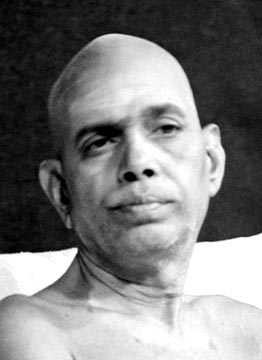
Bhagavan Ramana

Bhagavan Ramana

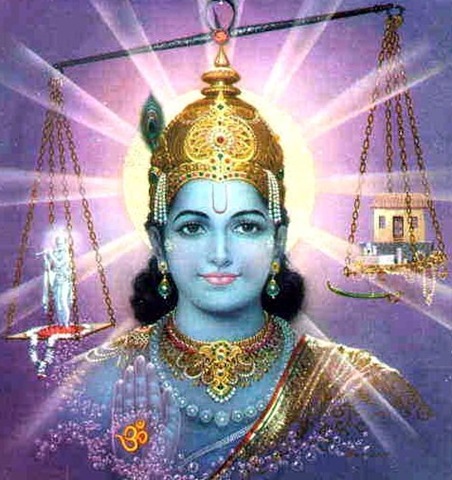

To those who worship Me alone, thinking of no other,
of those ever united, I secure what is not already possessed
and preserve what they already possess. (BG 9.22)
The story below appeared months ago prompting some discussion in the Guruvayur yahoo group in which I am a member. Today is Thanksgiving here in America, and this week we also celebrate Gita Jayanti, or the observance of the gifting of the Bhagavad Gita to the world by Shri Krishna more than five thousand years ago. As my thoughts turn to gratitude, I am reminded of this story below and the responses it produced in the Guruvayur group, and how important it is to always be grateful to the Lord for everything, knowing that He is our eternal well wisher and that everything happens for our highest good, even the things which which appear to be bad or are difficult to endure…everything means everything.
The focus of the discussion was on what should we ask of God. To what end do we pray, asking for this and pleading for that? Success in this venture, a new job, a happy marriage, a grandchild, a son or a daughter, a husband, a wife, a handsome husband, a beautiful wife, a nice house, a beautiful house, a mansion, good grades in school, a child who is a doctor or the president of the US? For what is it that we really seek, when all illusions are cast aside and maya’s veil is lifted? None of the above!!!
What should I seek from the Lord but the Lord Himself? That by His grace, I should know Him as the very Self in my heart, casting aside the shackles of the body and the solitary confinement imposed by the mind. He promises us, in the Gita, that if we are utterly devoted to Him, thinking of Him only, asking only for Him rather than of Him, He will be ours, and as such, will take care of us as needed. To understand this, to believe this, in full faith, can only be followed by complete surrender to His will, trusting that whatever happens is indeed His divine will operating to bring us out of bondage to birth and into reunion with Him.

From http://idharudharkee.blogspot.com/2009/07/what-we-should-ask-god.html
What should we ask of God?
This story from Mahabharata answers this question beautifully and categorically:
The Great War between the Pandavas and Kauravas was to begin. Arjuna, having pondered, decided to
go to Lord Krishna and ask him for help.
He went to the Lord’s abode and found him asleep.He stood respectfully at his lotus feet, with folded hands and head bowed in reverence. Duryodana, of the Kauravas, had the same idea of asking Sri Krishna’s help. He too came and, finding the Lord asleep, sat arrogantly in a chair placed at the head of Lord’s bed.
In due course, the Lord woke up. Arjuna, being at his feet, was the first person he naturally saw. As he turned to get up, the Lord’s eyes fell upon Duryodana.
The purpose of their visit was known to Him. However, he asked them what he could do for them.
Both answered that they had come to request his assistance in the ensuing war. The lord said that they had placed him in a difficult predicament by asking for the same thing. He said he could not deny either of them. He said he would offer himself, alone, without armies to one of them and to the other he would offer all his armed forces completely. He said that since his eyes had fallen on Arjuna first, he should have the first choice in the matter.
Arjuna promptly prayed to Sri Krishna that he alone should side the Pandavas.. Duryodana heaved a sigh of relief and requested Sri Krishna for all his forces. The Lord agreed to their requests.
We know who emerged victorious. The moral is “We should ask for HIM, not ask for things He can give us”
If the Lord gives us everything in the Universe but withholds Himself from us, we gain nothing. But if we seek HIM for Himself alone, we get not merely Him but all that is His, too!
abhyaasa yOga yuktEna cEtasaa naanyagaaminaa,
paramam pursham divyam yaati paarthaanucintayanMeaning:
He who with his mind disciplined through Yoga in the form of practice of meditation and thinking of nothing else, is constantly engaged in contemplation of God attains the supremely effulgent Divine Purusha (God) (sloka 8 in chapter 8 of Gita)
And what did Arjuna request? The Lord Himself. In his earnest bhakti, he intuited that this was the right choice and it was. When you ask for the Lord Himself, with utter devotion and humility, how can He deny you? In the Gita, He makes this promise to His devotees…
ananyaaScintayamtO maam yE janaah paryupaasatE
tEshaam nityaabhiyuktaanaam yOgakshEmam vahaamyaham. (BG 9.22)
To those who worship Me alone, thinking of no other, of those ever united, I secure what is not already possessed and preserve what they already possess.
https://luthar.com/wp-content/uploads/2009/06/bgita.pdf
But those who always worship Me with exclusive devotion, meditating on My transcendental form—to them I carry what they lack, and I preserve what they have.
http://www.bhagavad-gita.us/categories/The-Gita%3A-Chapter-9/?Page=2
Those who desire My eternal association precluding all else meditate on me with exclusive devotion; those persons I insure the uniting of their individual consciousness with Ultimate Consciousness perpetually. http://www.bhagavad-gita.org/Gita/verse-09-22.html
Yoga-kesamam, means to provide what they lack and safeguard or preserve what they have. In this context, yoga is said to mean making available what one does not have, and ksema means the preservation of what one already has. For some, the sloka is interpreted to mean those who recognize the nonduality of the Self, abiding in the Self at all times; for others, this is considered to be a promise from the Lord to take care of His devotees. If we go online, we can find countless articles claiming that the interpretation therein is the right one and that all others are missing the point, thus missing salvation itself!
For me, neither one has the right to claim the other is wrong…it can mean both, one at the level at which we exist as entities in this world of maya, or saguna, another at the level of the formless nirguna. The Lord, in His infinite mercy, prescribed numerous paths in the Gita. I am a bhakta. He is my Lord and while I know that philosophically speaking we are indeed nonseparate as it says so in the Gita and in the Vedas, as far as I am concerned, that can only be truly perceived through His Grace. So, while I am nothing but Him, on another level of worldly perception, this is known and experienced only through the operation of Divine Grace.
It is so stated in the Mukanda Upanishad 3.2.3:
nāyam ātmā pravacanena labhyo
na medhayā, na bahunā śrutena,
yam evaiṣa vṛṇute tena labhyas
tasyaiṣa ātmā vivṛṇute tanūṁ svām.
(Mukanda Upanishad 3.2.3)
This Self cannot be realized by studying the scriptures, nor through the use of reason, nor from the words of others–no matter what they say. By the grace of the Self the Self is known; the Self reveals itself. http://www.peterrussell.com/Upi/Mund.php
The Supreme Lord is not attained by reasonings or by vast intelligence, nor even by much hearing. He is attained only by one whom he Himself chooses. To such a person He manifests His own form. http://bvml.org/SBVPGM/sgt.html
And the Katha Upanishad 2.2.23:
The Self cannot be known through study of the scriptures, nor through the intellect, nor through hearing learned discourses. The Self can be attained only by those Whom the Self chooses. Verily unto them Does the Self reveal himself. http://booksandphotos.blogspot.com/2009/05/upanishads-kena-and-katha.html
This Supreme Self cannot be reached by argumentation, or by applying one’s independent brain power, or by studying many scriptures. Rather, he alone can achieve the Self whom the Self chooses to favor. To that person the Self reveals His own true, personal form. http://vedabase.net/sb/10/87/27/en1
The reason I have reproduced more than one translation of the Gita and Upanishad slokas above is that I wanted to read them in several formats for my own benefit and I also wanted to offer the reader the option of seeing it as such. So many ways of saying the same thing. And so many schools of thought want to say that their interpretation is the correct one and all others false and faulty. In the end, Divine Grace is the operational catalyst, whatever you deem its source.
So, what should we ask of God? Truly, there is no thing to be asked. There is no thing to be given. How can we give Him what is already His? All we can do is realize, through His grace alone, that we are already His, in every sense that we as mortals can conceptualize in our limited minds! Not only will He take care of everything and look after the welfare of the devotee, He will guide us if we listen. Thus, I do have a prayer…to fully surrender, to listen without fear of the consequences, no matter what He asks me to do. Where it will lead, I have no real idea and no plan of action! He is guiding the chariot now. May I sit quietly and not be a backseat driver. Chitta chora!!!



translation and commentary by Smt. Savitri Puram
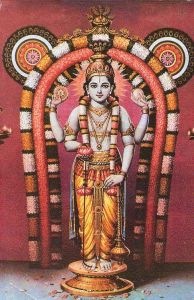
If we have a lighted lamp, we can use it to read and enjoy a book
or use it to burn and destroy the book. We have the choice
to draw the life circle with Bhagavaan and His naamam as the center
and kindness and love as radius of the circle…
Poonthaanam advises us to use the lighted lamp inside us,
lit by the Light of Lights, to walk through the path of Bhakthi and Naamasankeerthanam.

Introduction
Njanappaana can be considered as the Bhagavad Gita of Malayalees. This is a Darshanika kaavyam or philosophical poem expressed in the most simple Malayalam language for ordinary people. Poonthanam Nambudiri, an ardent devotee of Shri Guruvayurappan, transformed his unbearable sorrow from his infant son’s death into a “yogavishesham”. He used this sad experience to build his Bhakthi soudham or house of devotion and opened it for all devotees for all time. Even though the language is very simple, this njaanappana, or song of wisdom deals with the essence of all vedas and upanishads. May Bhagavan Guruvayurappan, Bhagavathy Sarswathi Devi and Sri Poonthaanam Nambudiri bless us to become wiser by going through this great Song of Wisdom!!
This is continued from Part One… https://luthar.com/njanappaana-1
Part Two https://luthar.com/njanappaana-2
Alpakarmikalaakiya naamellaam
alpakaalam kondororo janthukkal
Garbha paathrathil pukkum purappettum
Karmam kondu kalikkunnathingane
We are all (naamellaam) alpakamikal or our duration of one life to do karmaas are short (when compared to the celestial beings). Hence with the karmaas accumulated in this short period we take birth in different animal’s’ womb (kondororo janthukaal garbhapaathratthil pukkum), come out (purappettum), live for a short period (alpakaalam) and continue playing this karma-bound game (karmam kondu kalikkunnathingane)“Alpakarmikal” include all animals and human beings We are all “alpakarmikal” when compared to celestial beings because one celestial year is 365 human years. What about Brahmadevan? One day time of Brahma is one chaturyugam which is equal to 4,320,000,000 human years. Then night also is as long as the day. So one full day is 8,640, 000,000 human years. So if we multiply with 365 and then by 100 years of Brahma’s life it becomes beyond comprehension for us. So let us not go further to Paramapurusha’s time scale because Bhagavan’s one moment is Brahma’s whole life duration which is 311,040,000,000,000 human years!
We perform karmaas continuously during our short life and then take birth in different animal wombs or human wombs based on our sukrutham or dushkrutham or mixture of both.. For example, some say one cat year is equivalent to seven human years. So when born as a cat, results of the accumulated karmaas get exhausted in a short time. We believe that before getting a human birth or narajanmam, we go through millions of lives in the lower species with short durations of life. If we are born as a fire-fly (in Malayaalam, Iyyaampaatta) duration of life to exhaust karmaas is only about 21/2 hours or so. As a crocodile, it may be more than 100 years and as an elephant it may be 60 years. Also we see early deaths in all species and the only explanation for all these untimely deaths and diseases is the results of poorvajanma or previous janmaa’s karmaas. Poonthaanam expresses this numerous cycles of birth and death as a karma-bound game. Only Jeevathmaas in the form of different species of animals and humans are involved in this karma-bound game. Paramaathma is only a witness.
When we are finally blessed with a human birth, Poonthaanam advises us to use the power of discrimination bestowed on us by Lord. Only humans have the “vishesha buddhi” to change the course of our life by surrendering to God and offering all our karmaas at His Lotus feet. Continuous chanting of Bhagavaan’s auspicious names will help us not only to understand the real meaning of the famous sloka, but also to practice it in our daily life:
Kaayena vaacha manasendriyairvaa
budhyaathmanaa vaa prakruthe swabhaavaath
karomi yadyath sakalam parasmai
naaraayanaayethi samarppayaami.
Whatever I do with my body, speech, mind or with other senses of my body, or with my intellect and soul or with my innate natural tendencies I offer (dedicate) everything to Lord Narayana.
With the complete surrender or Sharanagathi, we can escape the terrible cycle of birth,death and sufferings and attain His Lotus feet. Naamasankeerthanam destorys desires and tendencies and helps us to do all karmaas with out expecting anything in return.
Narakatthil kitakkunna jeevan poy
Durithangal otungi manassinte
Paripaakavum vannu kramatthaale
Narajaathiyil vannu pirannittu
Sukrutham cheythu maelppottu poyavar
Sukhicheetunnu sathyalokattholam
Salkarmam kondu maelpottu poyavar
Swargatthinkal irunnu sukhikkunnu
Until the consequences of the the multitude of sins gets exhausted (durithangal otungi) Jeevan stays in Naraka or hell ( narkatthil kitakkunna jeevan) and when slowly mind attains maturity (kramatthaale manassinte paripaakavaum vannu) jeevan moves (poy) to take birth as human being (narajaathiyil vannu). After taking birth as humans (pirannittu), those who do sukrutham or good deeds in abundance goes all the way up ( sukrutham cheythu melpottu poyavar) to the sathyalokam (sathylokattholam) and remains there happy and peaceful (sukhiccheetunnu)( never to return and take birth again). Those who do satkarmaas go up to heaven and remain there (for sometime) enjoying the heavenly comforts.
Can we differentiate sukrutham and satkarmam? Sukrutham is the result of dhaarmic punya karmaas. In other words sukrutham is Nishkaama satkarmam or good deeds with out expecting anything in return. All actions performed with purity of mind is Sukrutham. Sukrutham is satkarmaas done for the Kalyaanam or mangalam of all. Bhagavaan assures in Gita “the doer of good (kalyaanakruth), never comes to grief” or “sukruthis never come to grief”. According to another definition Sukrutham is the results of the satkarmaas accumulated from one’s own past karmaas or sukrutham can even be passed on from ancestors.
What is satkarmam? Satkarmaas are definitely good deeds, but the purpose of action may or may not be pure and also good actions can be performed with selfish motives These satkarmaas with out purity of mind do not become Sukrutham. But the results of these satkarmaas are experienced in Swargam or heaven and when they are exhausted soul is subjected to rebirth.
Another word for sathyalokam is “yathaarthalokam” or real world and once we have realisation, no more suffering, sorrows or rebirth.
Life after death is not to punish the souls by sending them to hell or reward them by sending them to heaven. These experiences are given to remind the soul of it’s true purpose of life. Of course the soul’s journey to mukthi or salvation, or heaven or hell depends on the sukrutham or good deeds done. Experiences in heaven and hell are supposed to impart knowledge and wisdom so that when they take rebirth, they can strive to do more good deeds and attain salvation. That is why poonthaanam says about maturity of mind (manassinte paripaakam). But often Maaya masks this realisation and again jeevan goes after transient pleasures and ahdarmic deeds. But because of the Vishesha Buddhi and power of discrimination, humans have the choice to acquire good and bad karmaas. It is only in human birth jeeva gets this opportunity to go beyond the bondage of karma as a whole and attain salvation. Poonthaanam recommends Naamasankeerthanam as the most easy and enjoyable path to salvation.
In this context Njaanaaanada Saraswathi’s description about the fate of souls after death may help us to understand this better. In this book called Vedantha Vinjaanam, he compares the soul’s journey to a bouncing ball. When we throw a ball to the ground with lot of force, it bounces very high. But when it is thrown with less force it bounces only to a lower height. When it is thrown with hardly any force it hardly bounces and leaves the ground. Here the force with which we throw the ball is compared to sukrutham of the soul. After the death of the body, depending on how much sukrutham one has accumulated, soul goes to Sathylaokam, or Swargam (heaven) or chandralokam or Parjanya lokam , pithrulokam or in the vicinity of earth called prethalokam. Souls that go to Sathyalokam never returns to take janma because they have either attained saalokyam, sarropyam, saameepyam or saayujyam with Paramaathma. (In sathylokam soul can unite with paramaathma and this is Saayujyam. Souls can reside for ever in God’s abode and this is called saalokyam. Next is soul’s assumption of God’s form called Saaroopyam. Staying near to God is Saamipyam.) Poonthannam here mentions about only sathyalokam, heaven and hell. In all other worlds except Sathyalokam, soul stays until the consequences of satkarmaas or dusshkarmaas or a mixture of both are exhausted, and then with the remaining inherent vaasnaas or tendencies takes birth in an appropriate womb determined to improve oneself.
Several different explanations are given for the journey of the soul after death. Dvaitha and Advaitha school of thoughts view these differently. One group believes in attributeless or impersonal God and other group sees God as a personality endowed with glorious qualities. But Mukthi or liberation is unanimously defined as the release from the repeated cycle of birth and death. With the abundance of good deeds or sukrutham, mind becomes pure and “sama-darshanam” or Jeevathma-Parmaathma unity happens. This realization is called enlightenment and enlightened souls eventually get liberated.
Sukruthangalumokke otungumbol
Paripaakavumellolamillavar
Parichodangirunnittu bhoomiyil (jaatharrayi)
duritham cheythu chatthavar pinneppoyi
narkangalil vevvaere veezhunnu
When the results of the good karmaas are exhausted (sukruthangalokke otungumbol), souls remaining in heaven (parichotangirunnittu) are reborn on earth (bhhomiyil jaatharrayi). When their previous good and bad experiences do not impart any maturity and knowledge (paripaakavum ellolam illa-not even as much as little sesame seed), they end up doing more and more bad karmaas (duritham cheythu). Again after death (chatthavar) they suffer the consequences of their various negative karmaas in different ways or in different types of hells. (In one old version the word “jaatharaayi” is not there and with out that meaning can be interpreted in a different way. In that case, the word “parichotangirunnittu” can be for the life on earth or bhoomi itself. When the the good results of the past sukrutham experiencing in this life on Bhoomi is exhausted, with out any realisation of how transient the pleasures are, some commit more sins to end up in different hells)
In this stanza Poonthaanam explains how important is “pascchaatthaapam” or atonement. Even when we enjoy a good life here on earth, we tend to forget how blessed we are and keep hurting others in several ways. When subjected to miseries also, some people often do not realize the sins or mistakes they have committed and refuse to learn and correct themselves. Poonthaanam is talking about such people and he says that they commit more and more sins with out atonement and go through more suffering. If we realize our mistake and do “praayasccchttham” sincerely, we will not be tempted to do more sins. Famous story of the prostitute Pingala is an example for purifying one’s mind with “pascchaatthaapam”. She realized how wrong it was to sell her body for a living and later with deep atonement surrendered herself at Bhagavaa’s feet and attained Mukthi.
“Aviveka: paramaapadaam padam” is illustrated in this stanza. This means “avivekam” or lack of wise discrimination is the root cause of all miseries. When there is no maturity of mind, the power of discrimination will not be there. So instead of going after “sreyas” or what is good, we go after “preyas” or what gives pleasure. Swami Desikan describes nine steps for a spiritual aspirant and vivekam is the first step. Poonthaanam used the word “paripaakam” of the mind to indicate this vivekam or wise discrimination. Lack of Vivekam or paripaakam of mind leads us to hell by performing adhaarmic and bad deeds .
Purity of mind is very important in spiritual advancement. Only from a pure mind knowledge is emerged. With all temptations around us, it is harder to purify our mind in Kaliyuga.
Kalau kalmasha chitthaanaam
Paapadravyopajeevanam
vidhikriyaavihinaanaam
Gathir Govindakeerthanam
In Kaluyuga, mind of ordinary human beings are tainted by Kaamam, krodham, madam, moham etc (kalamsha chittham) and often end up doing adharmam (paapam) to make money (dravyam) for living (for upajeevanam). Ordinary people do not have the time or inclination to do good karmaas as prescribed in vedaas (vidhikriyaheenam). The only thing that can give relief from the sufferings of Kaliyuga is Govinda naama sankeerthanam. Bhagavaan and Bhagavaan’s naama are never separated. Naamam is called Kalpa vruksham of the earth.
Suralokathil ninnoru jeevan poi
Naraloke maheesuranaakunnu
Chandakarmangal cheythavan chaakumbol
Chandaala kulathinkal pirakkunnu
Asuranmaar suranmarayeetunnu
Amaranmaar marangal aayeetunnu
Ajam chathu gajamai pirakkunnu
Gajam chathangajavum aayeedunnu
Nari chathu naranai pirakkunnu
Naari chathutan oriyai pokunnu
Kripa koodaathe peedippicheetunna
Nripan chathu krimiyaai pirakkunnu
Eacha chathoru poocha yayeetunnu
Easwarante vilaasangalingane
A jeevan or soul from heaven or land of Devaas (suralokatthil ninnoru jeevan) is born as a Brahmin on earth (naralokatthil maheesuranaakunnu). People who do extremely cruel actions becomes “chandaala” or a member of a despised caste. Demons or Asuraas become Suraas or Devaas. People who are eternal or immortal or deathless (amaranmaar) are born as trees (marangal aayeetunnu) . A goat (ajam) is born as an elephant (gajam) and vice versa. A tiger (nari) after death is born as a human being (naran) and a woman (naari) is born as a fox (oriyaai). A king who mercilessly tortures (kripa kootaathe peedippicchitunna) his citizens takes birth as a worm (krimi). A fly is reborn as a cat and all these are Bhagavaan’s leelavilasam or playful divine drama.
After death, to experience the results of the residual karmaas, jeevan takes birth in appropriate womb. The passage of a soul from body to body is determined by the force of one’s actions, or karma. If an individual performs good deeds, the next birth will be rewarding, and if not, the person may degenerate into a lower life form. In the above lines, Poonthaanam shows several examples of the effect of karmaas on the soul when it is separated from the body after death. A jeevan from heaven comes to earth to experience the results of his residual negative karmaas. Likewise after experiencing negative results by taking birth as beings in several thousands of species, finally a tiger, for example, gets the life of a human being. Humans bestowed with the power of “wise discrimination” along with the grace of God, can perform good karmaas and advance spiritually. But when a human being resorts to unkind, hurtful, and negative actions, he will again be pushed back to be born in lower life form like a worm. Poonthaanam says: A king who mercilessly tortures (kripa kootaathe peedippicchitunna) his citizens takes birth as a worm (krimi).
There are several examples in our puraanaas to illustrate this law of karma. A good example of how an “amara” or immortal being becomes a “maram” or tree is the story of Nalakoobara and Manigriva who were the sons of Kubera, the lord of Yakshaas or the Lord of wealth. Once Nalakoobara and Manigriva were enjoying themselves playing in a lake with women. They were intoxicated and oblivious of everything around them. Sage Narada passed by the lake during this time and the ashamed ladies immediately covered their body with clothes and showed their respect to Narada with folded hands. But both Nalakoobara and Manigriva, intoxicated with pride and drinks ignored Narada Muni. Narda Muni cursed them to become “maruthu trees”. They had to remain as trees for a very long time until Krishna as Damodara came out of Gokulam and touched them with the wooden mortar.
Another example is the story of Gajendramoksham. King Indradyumana was born as a “divine elephant”. I am quoting below the words of our own respected S.N Sastriji (from the Naaraayneeyam commentary) : “The njana and devotion which he (King Indradyumnan who became an elephant by sage Agasthya’s curse) had acquired in his previous life came back to him under the stress of the suffering caused by the attack of the crocodile. He then worshipped Thee with lotus flowers plucked by his trunk, while singing continuously a great hymn addressed to the Nirguna brahmam which he had learnt in his previous life.” Even though King Indradyumna had to be born as an elephant, his residual good karmaas led him to salvation. (Also the crocodile was Huhu, a gandharvan in the previous janma.)
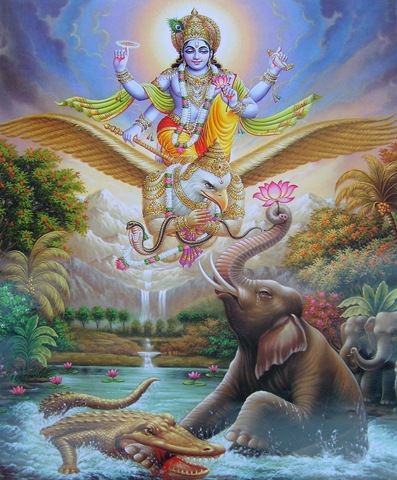
As a “Bhoktha”, the experiencer, one does not have the freedom of choice in experiencing the results of accumulated bad karmaas. (Bhagavaan and His naamam are the only solution to lessen or erase our suffering due to accumulated bad karmaas). But as a “Kartha” or doer, one has freedom of choice to some extent. If we have a lighted lamp, we can use it to read and enjoy a book or use it to burn and destroy the book. We have the choice to draw the life circle with Bhagavaan and His naamam as the center and kindness and love as radius of the circle. Also we can draw the life circle with “I” and “mine” as center and a combination of kaama,krodha,,lobha moha,mada,maasthryaadi negative qualities as radius of the circle
Poonthaanam advises us to use the lighted lamp inside us, lit by the Light of Lights, to walk through the path of Bhakthi and Naamasankeerthanam.
Keezhmelingane mandunna jeevanmaar
Bhoomiyeennathre naetunnu karmangal
Seemayillatholam pala karmangal
Bhoomiyeennathre naetunnu jeevanmaar
Angane cheythu nedi marichudan
Anya lokangal oronnil oronnil
Chennirunnu bhujikkunnu jeevanmaar
Thangal cheythoru karmangal than phalam
Odungitum athottunaal chellumbol
Udane vannu naetunnu pinneyum
Thante thante grihathinkal ninnutan
Kondu ponna dhanam kondu naamellam
Mattengaanumoredathirunnittu
Vittoonennu parayum kanakkine
These jeevaas run (mandunnu) between the lower worlds and upper worlds (keezmelingane) of the universe. But it is said (athre) that they get to do karmaas (karmangal naetunnu) only in Bhoomi. It is said that only in Bhoomi these jeevaas get to do various (pala) and limitless (seemayilaatholam) karmaas. Thus (angane) they accumulate karmaas(naeti) and after death (maricchutan) spend time (chennirunnu)in different worlds one by one (lokangal oronnil oronnil) and experience or enjoy (bhujikkunnu) the results of (good) karmaas (karmangal than phalam) done by themselves(thangal cheythoru). These experiences end (odungitum-with the exhaustion of accumulated good karmaas that can be experienced in worlds other than earth) in a little while (athottunaal chellumbol) and again (pinneyum) jeevaas come (vannu) to earth and collect (netunnu) karmaas. When a person goes to some unknown place and spends prodigiously all the money he collected and brought from his own house, can be called “vittunnunnavan”. Exactly in the same way, jevaas accumulate all the karmaas from earth and experience the results in another world.
It appears that a literal translation of some of the verses my not make much sense. Therefore, it seems appropriate to explore the metaphysical meaning that the lines convey.
In Vedanta, earth is often referred to by another name “karma-kshethra”. This name came because souls can experience the results of karmaas performed ONLY on earth and not in any of the other 13 worlds. What ever experiences any jeeva go through in any other world is the result of karmaas done on earth. If good karmaas outweigh the bad karmaas, we go to heaven, experience the results of good karmaas that can be experienced in heaven until those results are exhausted. Then it goes to hell to experience the results of bad karmaas that can be experienced in hell until those results are exhausted and comes back to earth with some residual good or bad (or both good and bad) karmaas that can be experienced only on earth. But no new accumulation of karmaas can happen in any other world. “otungeetum ottunaal chellumbol” (line 5, first part) means that the karmaas that took the soul to heaven (or hell) will be exhausted in heaven (or hell) by enjoyment (or suffering). Every action we perform is like sowing a seed. It remains vibrant and at a later time we reap the results. It is not possible for ordinary people like us to link the past karmaas and what we experience now by any reasonable method. The same karma performed with different attitude can lead us to heaven, hell, or salvation. Bhaavam is very important.
Poonthaanam has used the word “bujikkunnu” for experiencing the results. The word “bhojanam” is defined as “sukhena anubhuyathe iti bhojanam” or “what is experienced happily”. So “bhujikkunnu” may apply only for the experiences of our good karmaas. When the good karmaas that can be enjoyed in heaven are over, we come back to earth. To experience the results of different types of karmaas, our subtle body goes to different worlds and then with a gross, physical body comes to earth and experience what ever residual karmaas are left as well as to perform new karmaas and the cycle continues. The word “Vitttoonu” is a characteristic of a spendthrift. Origin of the word spendthrift is some one who has spent his accumulated wealth from predecessors or ancestors. Poonthannam compares jeevan’s enjoying the results of the accumulated karmaas from the past (from earth) to a person’s enjoying life by spending all the wealth acquired over a period of time. Just like wealth gets exhausted by spending, results of karmaas gets exhausted by experiencing. Life in heaven is not eternal, it is transient. It is interesting to note that jeevans in subtle body and gross body welcome the end of suffering, but definitely want the enjoyment of the results of good karmaas to last for ever when both are transient Only Nishkaama karmam (with out expecting anything in return) leads to eternal peace and happiness or salvation.
Since every action we perform, and every thought that comes to our mind has a result or consequence, Poonthaanam used the word “Seemayillatholam” or limitless or endless karmaas. Wheel of karma continues on and on. Nobody can remain Karma-free. There is one and only one solution to get out of the wheel of Karma and all scriptures and our great seers suggest to surrender to God and do karmaas with renunciation of the fruits of actions.. Poonthaanam gives an easy solution to develop this attitude of complete surrender -Naamasankeertthanam.
Let us chant the naamam to purify our mind with Shri Poonthaanam and other millions of devotees:
Krishna! Krishna! Mukunda! Janaardana!
Krishna! Govinda! Naaraayana! Hare!
Achyuthaananda! Govnda! Maadhavaa!
Sachindaananda! Naaraayana! Hare!
http://www.youtube.com/watch?v=vbI4Uk8fSYk&feature=player_embedded
Samasthaaparadham kshamaswa Sreekrishnaarpanamasthu
WARNING: THE STILL AND VIDEO IMAGES IN THIS ARTICLE
ARE GRAPHIC DEPICTIONS OF VIOLENCE TO DAIRY COWS AND THEIR OFFSPRING.
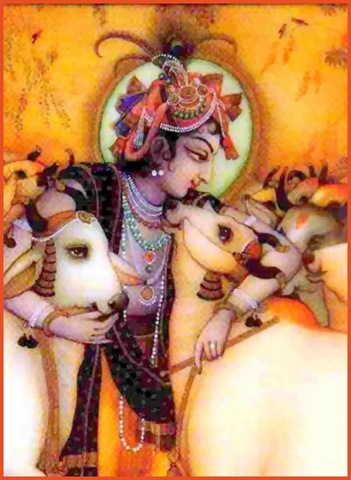
We need to realize that milk is not an “Innocent”
animal product as it is thought to be, but is a
highly violent, cruel, and immensely exploitative food.
The most important factor in cow abuse is the economic factor;
we need to realize that as long as we, the consumers
of milk and leather, continue to buy these violent products,
the exploitation of the cow and the killing of her calves
will continue to occur. ~Shri Kamlesh
“The female dairy cow spends her life confined in close quarters with other cows, being pumped with hormones calculated to produce pregnancy after pregnancy as long as she is capable of bearing calves, both to increase the population of the cows for milk and meat production and to spur the female to produce more milk. When her calves are born, they are taken from her within a few days of birth, giving rise to the grief of separation for both the mother and the child.” https://luthar.com/call-of-the-conch-1. The videos below depict the artificial insemination of the dairy cow, the birth of the calves, and the removal of the calf shortly after birth…on it’s way to either the slaughterhouse if it is male, or to its own pathetic future as a female dairy cow, soon to face the same fate as the grieving mother who gave birth to her, bearing in her heart the infant grief of separation from her mother and facing the maternal grief in the heart of a mother forced to face the loss of her child.
The motherless child…
http://www.youtube.com/watch?v=wiRxkU_opyQ&feature=player_embedded
http://www.youtube.com/watch?v=_ZrX1rTddho
http://www.youtube.com/watch?v=_kM387cI4rk&feature=player_embedded
http://www.youtube.com/watch?v=hAiIIZMKPC0&feature=player_embedded
Contrasts a dairy calf searching for his mother on a farm with undercover footage of calves at a slaughterhouse.
“Roughly 50% of the calves are male calves which are considered to be the by-products of the milk industry and do not have any value. These male calves are the most unfortunate souls of the milk industry; they are the silent sufferers in the background that no one bothers to notice. They sacrifice their lives so that we can drink the milk which was meant for them.These calves meet their deaths wherever factory farming occurs both in India and in the western world.
India.
Before mechanized farming, the male calves were highly sought after as draught animals that would till the land and become the farmer’s best friend. But with tractors taking over the role of draught animals, the male calves are useless and the farming/milk industry no longer feels it necessary to sustain them.
Due to the cultural heritage of India, where beef eating is not popular and cow killing is illegal, these calves are not slaughtered for calf-meat or “veal” as in the western countries. But since they pose no value to the farmer these calves are killed in the most horrific manner.
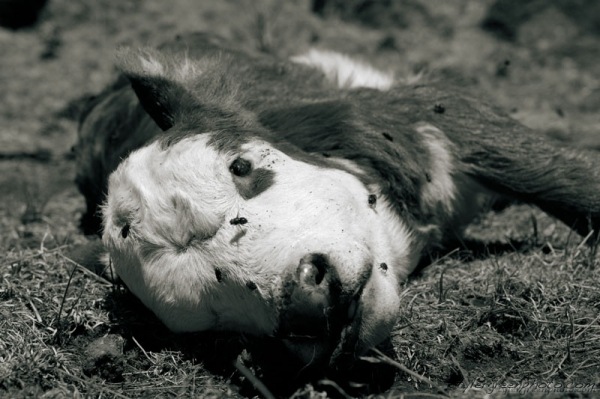
Most male calves in India are separated soon after their birth… they are strangulated to death, starved and then even buried alive in compost mounds to dispose their bodies. In some cases a stuffed animal like structure is covered with the hide of the dead calf and placed near the cow, so that she continues to give milk thinking that the stuffed doll is her living calf! Many are slaughtered in illegal slaughter houses to make fancy “calf leather” belts, purses, wrist bands etc.
Western Countries.
In the west the male calves are seen as sources of “calf-meat” or veal, which is the most perverted food any human can eat. The specialty of veal meat is that it is very tender, fatty and succulent and to achieve this, the calves are taken from their mothers immediately after birth and raised so as to deliberately induce borderline anemia.
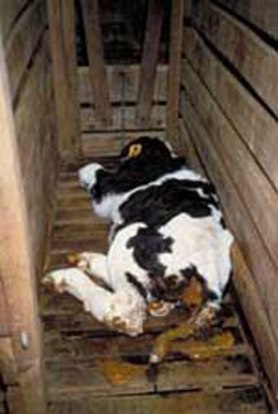
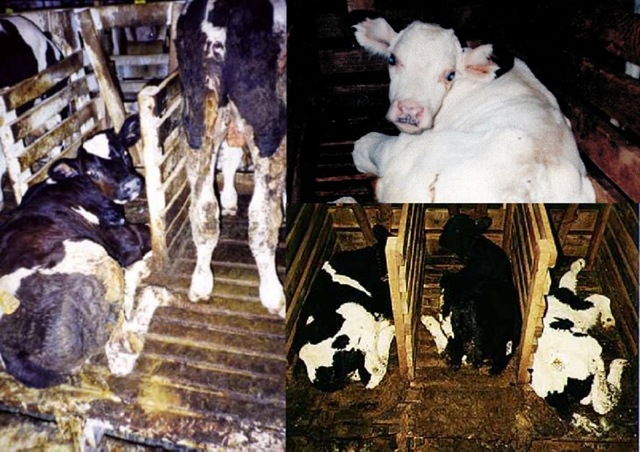
They are then confined in small cages called as veal-crates, usually measuring 2-feet-wide, in which they cannot turn around or stretch their limbs all their lives. This is done so that their flesh does not build muscle which is considered to be tough to eat. After about 3-5 months of living confined to their cages, these innocent calves are then slaughtered to satisfy humans’ perverted thirst for flesh.
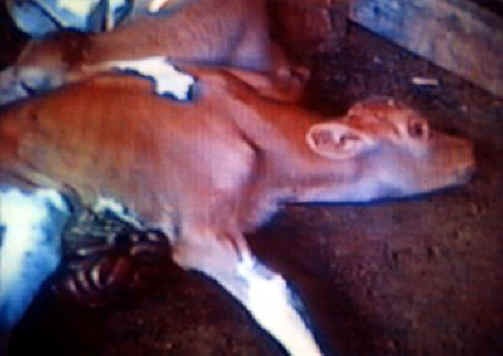
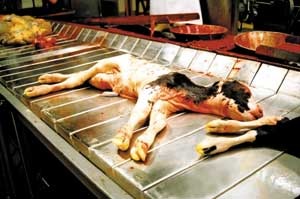
The plight of the female calves is worse, they are raised so that they can be perpetually inseminated to give us their milk for the rest of the lives. If they are so unfortunate so that they become sick or break their legs which they often do, due to being continuously pregnant they are then mercilessly slaughtered, ending as meat and leather.
It is a well known fact the cows raised for milk (Dairy cows) have to undergo much more abuse and sufferings than the cows which are raised for meat (Beef cows)”
These are NOT isolated incidents, but are in fact routine procedure to dispose the male calves as profitably as possible depending upon the location, either in India or in the west. This suffering and killings are a direct result of the milk industry, which satisfies our thirst for milk, our cravings for ice-creams, payasams and chocolates at the cost of these innocent animals.
While we enjoy our milk, the silent killings go on! ~Shri Kamlesh*
Having one’s actions grounded in ahimsa for the Lord’s creatures, all of them, calls to our spiritual conscience with the power of the sounding of the conch. The conch, held by Vishnu, the preserver, represents life. When it is sounded, it is the sound of victory, as by Krishna and Arjuna heralding the defeat of the adharmic influences in the battlefield of the mind symbolized in the Holy Gita. May the adharmic influences inherent in the dairy industry fall to the ground in defeat at the call of the conch.
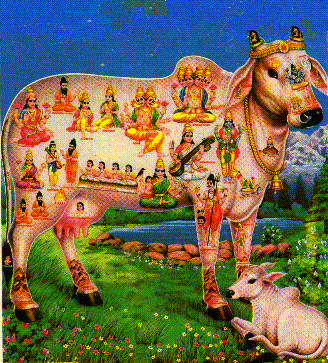 … dhenoonaamasmi kaamadhuk…
Among the cows, I am Surabhi, the wish-fulfilling cow. B.G. 10.28

https://luthar.com/call-of-the-conch-introduction
https://luthar.com/call-of-the-conch-1
*The italicized text of Part 2 in this series was written by Shri Kamlesh, who also provided many of the images used. Any edits were to context, not to content. I offer my namaskarams to him.
translation and commentary by Smt. Savitri Puram
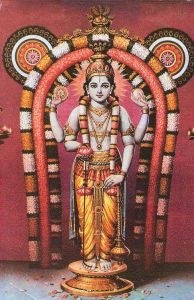
Krishna! Krishna! Mukunda! Janaardana!
Krishna! Govinda! Naarayana! Hare!
Achyuthaananda! Govinda! Maadhava!
Sachidaananda! Naarayana! Hare!
Introduction
Njanappaana can be considered as the Bhagavad Gita of Malayalees. This is a Darshanika kaavyam or philosophical poem expressed in the most simple Malayalam language for ordinary people. Poonthanam Nambudiri, an ardent devotee of Shri Guruvayurappan, transformed his unbearable sorrow from his infant son’s death into a “yogavishesham”. He used this sad experience to build his Bhakthi soudham or house of devotion and opened it for all devotees for all time. Even though the language is very simple, this njaanappana, or song of wisdom deals with the essence of all vedas and upanishads. May Bhagavan Guruvayurappan, Bhagavathy Sarswathi Devi and Sri Poonthaanam Nambudiri bless us to become wiser by going through this great Song of Wisdom!!
This is continued from Part One… https://luthar.com/njanappaana-1
Chuzhannitunna samsaara chakratthil
Uzhannitum namukkarinjeetuvaan
Arivulla mahatthukkal undoru
Paramaartham arul cheythirikkunnu
Eluthaayittu mukthi labhippaanaay
Chevi thannithu kelppin ellaavarum
We are restlessly moving (uzhannitum) up and down in this rotating (chuzhannitunna) wheel of material world (samsaara chkratthil). For us to know (namukkarinjituvaan), great njaanis( arivulla mahatthukkal) have preached (arul chythirikkunnu) the paramaartham (Supreme truth). All of you listen to this (kelppin ellaavarum) because to attain salvation (mukthi labhipaanaay) easily (eluthaayittu) God has given you the sravanaedriyam or ears (chevi thannithu). The meaning of “chevi thannithu” can also be taken as “give your ears” or listen to what Mhaathmaas told us.
Getting human life is rare and even after getting human life, very few people are blessed to pursue the spiritual path. But great sages of the past realized this pitiable condition of ordinary souls and have prescribed easy ways to know the Supreme Truth. One of the easiest method for Kaliyuga suggested by them is Naamasankeerthanam. Since this is the opinion of self-realized bhakthaas, Bhagavan Himself approves this method and tells in Bhagavad Gita: “yajnaanaam japayajnosmi” or Among all the sacrifices, sadhanas, austerities or forms of tapas, I am represented by japa” and thus supporting the words of Mahaathmaas.
(Bhagavan always supports Bhakthaas. When Poothaanam once read Amaraprabhu as Maraprabhu while chanting Vishnusahasra naamam, a few Sanskrit scholars made fun of him. Bhagavan could not take his dear devotee’s grief and told from the sanctum sanctorum : “I am Amara prabhu as well as Maraprabhu, meaning I am also the lord of trees or in Malayalam maram”.)
We are all going up and down on the wheel of material world rotating with extreme speed and it is very difficult to escape from that. But once we know the Supreme Truth, we will be relieved from the samsaarachakra. This Brahma jnanam is possible by sincerely chanting the auspicious names of God because Naamam or names of Lord are even greater than Naami or Lord Himself. Hanumanji had to just chant Raama naamam to cross the ocean where as Lord Raama had to construct the bridge to cross the ocean to Lanka!
Also as explained in the previous lines [https://luthar.com/njanappana-1 ], anybody can chant naamam anytime and anywhere. So Poonthaanam is asking us to listen carefully to what Mahaathmaas have told us about Supreme Truth. Like sravanedriyam or ears can be used for hearing the greatness of Lord, all other indriyaas should be used for the purpose of serving God. Sankarrachaaryar also gives this idea in a very beautiful sloka in Soundarya Lahari:
JapO jalpa: shilpam sakalam api mudraa-virachanaa
Gathi: praadakshiNya-kramanam ashanady aahuthi-vidhi:
PraNaama: samvesha: sukham akhilam aathmaarpaNa -drushaa
Saparyaa paryaya: thava bhavathu yan mae vilasitham
Let my spoken words become manthras, let all my hand gestures become mudraas, let all my steps become circumambulation or pradakhinam to you, let my lying down to sleep become prostration to you, let the food I consume be an offering to the sacred fire lit for you, let what ever I do become a worship to you.
Nammeyokkeyum bandhicha saadahanam
Karmam ennariyendathu mumbinaal
First and foremost (mumbinaal), we should know (ariyendathu) that karmam is the thing (saadhanam) that binds (bandhiccha) all of us (naameyokkeyum) to this world.
Even before telling us more about the easiest path for salvation, poet starts with the big word : “Karma” and how we are all bound in the cycle of birth and death by karma. Both good and bad karmaas are binding and hence we have to know what is the root cause for making us do karmaas and eradicate the root cause. In this context, an example of a burning stick is appropriate. If we move a burning stick in a circle, a burning circle will seem to appear. In reality (understanding the reality is njaanam) the circular movement of the stick causes the illusion. Likewise the wheel of time is moving with very high speed dragging us along with it and forcing us to do good as well as bad karmaas with ego (or feeling of “I am the doer). This causes the illusion of bondage. So we have to have the njaanam or knowledge to go beyond this illusion or Maya to escape from the bondage. Also the famous example of seeing a rope and misunderstanding it as a snake is appropriate. Until we know that it is only a rope, we will be scared and stressed. What will lead us to this knowledge of Brahmam? Continuous remembrance of Lord through Naamasankeerthanam will help us to detach us from the karma-bound cycle and lead us to Njaanam and moksham.
Law of Karma is a law of justice and it is straight forward, impartial and inescapable. The only thing that can nullify the effects of Karma is Bhagavan’s grace. Bhagavan’s blessings loosen the tightly bound law of Karma and makes the otherwise impossible escape possible for us. In Kaliyuga the easiest way to obtain Bhagavan’s blessings and grace is naamasnakeerthanam.
In Mahabharatha, Sahadeva advises his elder elder brother Yudhishtira on the subject of Karma. He says that when ever we do Karmaas with the feeling of “I am the doer” or “mine (two letter sanskrit word “mama”) those karmaas lead us to the cycle of birth and death. But when we do karmaas thinking that we are not the doer, the results of the karmaas also will not be ours. This feeling is called “I am not the doer” or not mine (in Sanskrit, it is expressed in three letters “na mama”). Karmaas performed with this attitude are not binding and and free us from the eternal cycle of birth and death. Again, how can we develop this attitude in Kaliyuga? Poonthanam assures us along with Bhagavan that Nammasankeerthanam will eventually give us this “na mama” attitude and lead us to njaanam and moksham.
How can we forget to mention Shankaraachaaryar’s lines
punarapi jananam punarapi maranam
punarapi jananii jathare shayanam
iha samsaare bahudustaare
kripayaa apaare paahi muraare
Born again, death again, birth again to stay in the mother’s womb! It is indeed hard to cross this boundless ocean of samsara. Oh Murari! Save me through Thy mercy.
Munnam ikkanda viswam aseshavum
Onnaayulloru jyothi swaroopamaay
Onnum chennangu thannodu pattaathe
Onnilum chennu thaanum valayaathe
Onnonnaayi ninakkum janangalkku
Onnukondariyaavunna vasthuvaay
Onnilum urakkaattha janagalku
Onnu kondum thiriyaatha vasthuvaay
Onnu pole onnillaathe ullathil
Onnaayulloru jeeva swaroopamaay
Ninnavan thanne viswam chamachu pol,
Moonnum onnil adangunnu pinneyum
During pralaya or dissolution (word “munnam” refers to pralayam) this whole world (viswam asheshavaum) becomes the one and only one (onnayulloru) jyothi swaroopam or parama thejopunjam. This jyothiswaroopam is only a witness, this is neither attached to anything in this world (line four) nor let anything in the world get attached to this (line 3). Those Jnaanis and Bhakthaas (predominantly of saatwic and raajasic nature) who try to figure out one by one (onnonnaayi ninakkum janangalkku) using “nethi, nethi” process or “not this, not this” process, perceive “It” as one thing through which everything is known (onukondariyaavunna vasthuvaay). For those people whose minds are restless, fickle and out of control (onnilum urakkaattha janangalkku -predominantly of Thaamasic nature) “It” cannot be comprehended or understood by any means (onnukondum thiriyaattha vasthuvaay). Outwardly each and every being is different (oonu pole onnillaathe), but the spirit or jeeva swaroopam in all beings are the same (ullatthil onnaayulloru jeevaswaroopamaay). The same jeeva swaroopam that exists in everything (ninnavan thanne) created the whole universe (viswam chamacchupol) and “It” again (pinneyum) contains all the three . (moonnum onnil adangunnu)
During pralaya or dissolution, everything is merged in Lord and nothing remains except the parama jyothi swaroopam or light of lights (or paramaathma chaithanyam). This is compared to the disappearance of stars and moon at sunrise. Likewise, the whole universe including the sun, moon, stars and all planets dissolve and become part of that great Jyothi swaroopam. One of the prayers we chant during aarathi or deepaaraadhana expresses the same idea:
Na thathra suryo bhathi, na chandratharakam
nema viddhutho bhanthi kuthoyamagni
Thameva bhantham anubhaathi sarvam,
thasya bhasa sarvamidham vibhathi.
“There the sun does not shine, nor the moon nor the stars; these lightnings also do not shine – how then (can) this earthly fire? Verily, everything shines after Him reflecting His glory. This whole world is illuminated with His light.”
But this light of lights is “Anaadimadhyaantham” or beginningless,middleless and endless. At the end of the dissolution phase, each individual soul again takes birth depending on the accumulated karmaas. These individual souls with accumulated karmaas do not get salvation during dissolution, but just remain hidden in Easwara Chaithanyam and then take birth again to experience the results of their good and bad karmaas.
These lines specifically explains how Bhagavan is not tainted by our karmaas. Even when we disappear into the jyothi swaroopam, that jyothi swaroopam remains unaffected. So our sorrows and happiness do not affect Bhagavan and Bhagavan is not responsible for our sorrows and happiness. Our experiences are the direct results of our own karmaas. Then how does Bhagavan help us? When we realize that the jyothi swaroopam with in all of us is the same as the paramaathmachaithanyam, all our actions become an offering to the Light of Lights, “mama or mine” attitude disappears, and “na mama or not mine” attitude arises. But only in a pure mind this realization happens and in Kaliyuga, Nammasnakeerthanam is the most practical method to attain purity of mind.
“Onnukondariyaavunna vasthu” indicates that for ordinary people like us, Brahmam can be known only through the path of Bhakthi. Bhakthi leads to Njaanam. Little Prahlaada believed that everything existing was Naarayana swaroopam and when he told his father that God is omnipresent, Lord did come out from the lifeless pillar to protect Him. Gopikaas were ordinary housewives and just because of their intense and blind devotion to the Lord of Vrindavan they attained Jnaanam and moksham. Fickle minded ordinary people who are distracted every moment with the the various temptations of life cannot comprehend the greatness of Bhagavan. First the aasuric or thaamasic or demonic characteristics of our mind has to be reduced by the constant remembrance of Lord and the power of Naamam will elevate ourselves to purer and purer levels.
Last line talks about the number three. This three can refer to several things: Prakrutthi, mahatthathvam, Ahamkaaram or Satva Gunam, Rajo Gunam, Thamo Gunam or Brahma, Vishnu, Maheswaran or three worlds. At the time of dissolution, everything merges into the paramachaithanyam and this explains the transient nature of everything we see or feel in this world. Poonthanam explains this to develop an attitude of detachment in our mind and hence perform Nishnkaama karmam and attain the Lotus Feet of Lord by chanting His names.
Onnu kondu chamachoru viswatthil
Moonnayittulla karmangalokkeyum
Punya karmangal paapa karmangalum
Punya paapangal misramaam karmavum
Moonu jaathi niroopichu kaanumbol
Moonnu kondum thalakkunna jeevane
In this universe (virtually) created (chamachoru viswatthil) by our own Avidya or ignorance (here “onnu kondu” means “due to avidya or ignorance”), all karmaas (karmangalokkeyum) can be divided into three categories ( moonnaayittulla). They are namely Punya karmaas, Paapa karmaas and Punya-Paapa-misra karmaas. (lines 2 and 3) When we think (niroopicchu kaanumbol) about the above three types of karmaas (moonnu jaathi), we can see that jeevaathma (jeevane) is bound (thalakkunnu) by all three types of karmaas (moonnu kondum)..
Just like the moon is lit by the reflected light of the Sun, we are alive by the chaithanyam or light lit by the Light of Lights, Paramachaithanyam. A person who is ignorant of the fact that sun’ light causes the moon-light, thinks that it is moon’s own light. Similarly, this whole universe is not different from the paramaathma chaithanyam itself and with our inability to comprehend this and internalize the truth, we do three types of karmaas with “ahambhaavam” or feeling of “I and mine” and these sakaama karmaas (result oriented actions) bind us to the eternal cycle of birth and death. It is difficult to exactly differentiate punya karmaas and paapa karmaas. Some of them can be labelled with out any doubt. But, some of the karmaas can be classified only according to the context.That is why Poonthaanam mentions about the third type called mixed karmaas.
There is a small story to illustrate this point. Once a very pious sage was resting in his hermitage in the forest. A just and righteous King followed by a group of robbers entered the forest. King was running about one mile ahead of the robbers and turned east near the sage’s hermitage. (Hermitage was in junction near a river and one can go in any direction from there). While running, he specifically told the sage not to disclose which way he ran to the robbers following him. As expected robbers came and asked the sage about the direction in which the King ran. This sage who had never spoken untruth in his life did not want to say a lie to the robbers. He could have either said “I do not know” or to save the King’s life he could have even said “west or south or north”. Instead he told them “east” to save his sathyavratham or vow of truth. Later he had to experience the negative results of his paapa karma because in that particular context, saying the truth was not a punya karma or dharmam. By saying an untruth he would have saved the life of a righteous king and his country. But he cared more for his own vow of truth than saving the life of a just and righteous King. Because of his selfishness, even though he told the truth, it became a paapa karmam.
Since all the three types of karmaas binds us, only destruction of all karmaas can free us from bondage. But it is impossible for ordinary people to live with out doing any karmaas. There is not even a moment when we are not doing karma either by body, by words or by thoughts. So the only solution is to do karmaas with renunciation of the fruits action which is called Nishkaamakarmam. Bhagavan says in Bhagavad Gita;
yasya sarve samarambha:
kama-sankalpa varjitha:
jnanagni dagdha karmanam
tam ahu: panditham budha:
He, all whose undertakings in this world are free from the bondage of expectation, who has sacrificed all the results of his actions in the fire of knowledge is a pandithan or scholar -so says intelligent people or (great seers)
Even though all these philosophical concepts are mind boggling to ordinary people like us, Poonthanam assures that Naamasnakeerthanam will clear our mind and help us to develop an attitude of surrender and intense devotion. Then Bhagavan takes over and assures us : Na mae bhaktha pranashyathi- my devotees will never perish. Bhagavan’s grace will lead us from Rakthi —> Bhakthi—-> Mukthi.
Ponnin changala onnipparanjathil
onnirumbu kondennathre bhedangal
Randinaalumeduthu panichaiytha
Changalayallo misramaam karmavum
Bondage comes from three types of karmaas and one string (changala) formed as a result of satkarmaas or punyakarmaas or good deeds is made of Gold (ponnin), another one (onnu) formed as a result of paapa karmaas or negative karmaas or dushkarmaas is made of Iron (irumbu) and the third string ( formed as a result of the mixture of the above two types of karmaas-misrakarmam) is made of a mixture of both Gold and Iron (randinaalumeduthu pani cheytha).
Even though Gold and Iron are different metals with entirely different properties, when they are used for tying or binding some one it hardly makes any difference for the bound victim. The word “changala” and “thalakkuka” are usually used for chaining elephants. By using these words, Poonthanam brings out the fact that breaking the strings of bondage is as difficult for us as it is for an elephant to break it’s thick Iron chain. But with lot of effort, sometimes elephants do break and run to freedom. So with continuous and sincere effort human beings blessed with the power of discrimination, can break all three binding chains. Even people with predominantly satva gunaas find it hard to break the bondage effortlessly. As long as their satkarmmas are result oriented, they will not be freed from the cycle of birth and death. They live to enjoy the results of satkarmaas, again do satkarmaas to be born again and again. Only renunciation of the fruits of action can break the bondage for Punyaatmaas (great souls), Paapis (sinned souls) and those punyaathma-paapaathma combination souls . The only difference is that when we do Paapa karmaas we are subjected to negative experiences and punya karmaas yield positive experiences and mixture of both will give both positive and negative experiences. But eternal freedom from this cycle calls for Nishkaama karmam.
Even if a cage is made of Gold, a bird sees it only as a cage in which it is trapped. It does not enjoy the beauty of Gold. It only wants freedom. Likewise our souls crave for eternal freedom to join the Parmaathma. Because of the avidya or ignorance, jeevathma goes after transient pleasures and with egoistic actions accumulates all three types of karmaas. Poonthaanam advises us to do naamasnkeerthanam which removes ignorance and makes us realize that we are trapped in this eternal cycle of birth and death. Naamam persuades us to strive with the determination and force of a “matthagajam” or mad elephant to break this chain of bondage. Poet assures that this force to break the chain can be derived from chanting Lord’s name. By the power of Naamajapam even an athiest (who does not believe in God or in prayers) goes through different stages of Bhakthi or devotion and reach the highest state of Uttama Bhaktha or perfect devotee. A Bhaagavatotthama ( the highest type of devotee ) is one who sees the glory of Bahgavan in all animate and inanimate beings, and also perceives all beings as dwelling in Him. So all his karmaas become an offering to God and practically becomes a Jeevanmuktha. Then he discards the body when the results of the accumulated karmaas are exhausted and merges with the Paramaathma.
Where does God live? Bhagavan says to Narada:
Naham vasami vaikunte na yogi hrudaye ravau
Mad bhaktha: yatra gayanti tatra thishtami narada.
“I dwell not in Vaikundha, not in the hearts of yogis, nor in the Sun, I live where my devotees sing my glory and divine names.”
Brahmaavaadiyaay eecchayirumbolam
karmabaddhanmaar ennatharinjaalum
Bhuvanangale srishtikkayennathu
Bhuvanaantha pralayam kazhivolam
Karmapaasatthe lamkhikkayennathu
Brahmaavinnumeluthalla nirnayam
Dikpaalakanmaarum avvannam ororo
Dikku thorum thalachu kitakkunnu
Know the fact that (ennatharinjaalum) starting from Brahamadevan and other devaas (Brahmaavaadiyaay) to flies and ants (eeccha irumbolum), all of God’s creation are bound by Karma (karmabaddhanmaarr). Creation of universe (bhuvanangale srushtikkayennathu) continues until the dissolution or pralayam of the universe (bhuvanaantha pralayam) is completed (kazhivolam). That means it is definitely (nirnayam) not easy (eluthalla) even for Brahmadevan (Brahmaavinu) to break (lamkhikkayennathu) the binding thread of karma (karmapaashatthe). In the same way (avvannam) eight devaas ruling the eight zones or quarters of the universe also (dikpaalakanmaarum) are lying bound (thalacchu kitakkunnu) in their own directions (dikku thorum).
In these lines, poet says that there is no body (it literally means any jeevaathma dwelling in any type of body) in this world who is not bound by Karmaas. Even Brahmadevan dwelling in a body continuously does srushti or creation and then of course Vishnu Bhagavan has to maintain the universe and Mahadevan has to take care of annihilation. When Dharma declines, Vishnu Bhagavan incarnates in different forms, perform necessary karmaas with out attachment and goes back to Swadhaamam or home discarding the body used temporarily. Only the Nirguna Brahmam or Paramajyothi swaroopam, who is only a witness of all these, is free of this bondage of Karma. But thrimurthis (Brahma-Vishnu-Maheswara) know that they are none other than the Brahmam and they are neither attached to the karmaas or the fruits of their karmaas. Because of their knowledge of the essence of srushti-sthithi-samhaaram (creation, maintenance and annihilation) they do not experience the uncertainties of life like other demigods or mortal human beings. They just perform karmaas with out attachment. (Vaikundhavaasi, ananthashaayi Vishnu Bhagavan and Bhagavaan’s all incarnations are not Jeevathmaa occupying a body, but Paramaathma Himself. With apaara kaarunyam or ocean of mercy, that Paramachaithanyam is letting us worship in any form (sagunam) we prefer. Even though in incarnations, Bhagavaan discards the body after the purpose of incarnation, He would appear before us in any form we worship because He is eternal with form and with out form. In one of the stories, He even takes the form of a “male buffalo” to please his devotee. Bhagavaan appeared as the minister Mangaattacchan to save Poonthaanam from robbers!)
Even Thrimurhis (Brahma, Vishnu and Shiva) do not break the chain of Karmam. So where do we stand? By their actions, Thrimurthis are demonstrating this truth to the world. The word “Nirnayam” indicates that to destroy the karmaas each and every individual should strive. In the spiritual world there is no proxy and each person should take responsibility for their own advancement. A Guru or satsangam can help to initiate one’s effort and the rest is in each inividual’s sincere effort. Above all of these, we need Bhagavaan’s blessings every moment and Poonthaanam’s only solution in this Kaliyuga is chanting of naamam. It is interesting to note that Poonthaanam used the words “thalacchu kitakkunnu” for the eight devaas who rule the eight directions. Dikpaalakaas are not as detached to the karmaas as Brahmadevan or in other words they are not Brahmajnaanis and hence they are helplessly lying bound in the eight directions. Ordinary human beings are far inferior to this dikpaalakaas. To elevate ourselves from the Maanava state to Maadhava stage, Poonthanam recommends Naamasankeerthanam. In Bhagavatam, Sri Shuka Maharshi tells King Parikshit:
Kalair dosha nidhe rajan astihyeko mahaan gunaan
Kirtanaad eva krishnasya mukta sanga: param vrajet
My dear King, although Kali-yuga is an ocean of faults, there is still one good quality about this age: Simply by chanting Hari keerthana, one can become free from material bondage and attain salvation.
Shankarrachaaryar’s explanation on the importance of Naamajapam is very interesting. He says Naama japam gives us mukthi or salvation faster than any other form of worship or prayer because of two main reasons:
1. It is very simple and can be done by anybody, anywhere and anytime. No restrictions have to be followed.
2. Second one is the most important reason. We are not asking God for any favours or special blessings or anything in particular when we worship with naamasankeerthanam. We only glorify God with His auspicious names and try to continuously remember His divine form. Naamasankeerthanam promotes Nishkaama Bhakthi which leads us to salvation or mukthi.
So let us chant along with Suka Muni, Shri Shankarrachaaryar, Poonthaanam Nambudiri and millions of devotees:
Krishna! Krishna! Mukunda! Janaardana!
Krishna! Govinda! Naarayana! Hare!
Achyuthaananda! Govinda! Maadhava!
Sachidaananda! Naarayana! Hare!
Samasthaaparaadham kshamaswa.
Sreekrishnaarpanamasthu.
translation and commentary by Smt. Savitri Puram
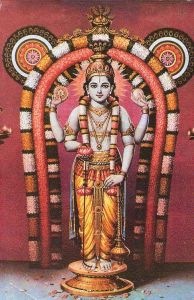
Krishna! Krishna! Mukunda! Janaardana!
Krishna! Govinda! Naarayana! Hare!
Achyuthaananda! Govinda! Maadhava!
Sachidaananda! Naarayana! Hare!
Introduction
Njanappaana can be considered as the Bhagavad Gita of Malayalees. This is a Darshanika kaavyam or philosophical poem expressed in the most simple Malayalam language for ordinary people. Poonthanam Nambudiri, an ardent devotee of Shri Guruvayurappan, transformed his unbearable sorrow from his infant son’s death into a “yogavishesham”. He used this sad experience to build his Bhakthi soudham or house of devotion and opened it for all devotees for all time. Even though the language is very simple, this njaanappana, or song of wisdom deals with the essence of all vedas and upanishads. May Bhagavan Guruvayurappan, Bhagavathy Sarswathi Devi and Sri Poonthaanam Nambudiri bless us to become wiser by going through this great Song of Wisdom!!
Gurunaadhan thuNa chaika santhatham thirunaamangal naavinmel eppozhum
Piriyaatheyirikkanam nammude nara janmam saphalamaakkiduvaan
May my Gurunathan help me (thuna chaika) to keep the auspicious names of Lord continuously on my tongue (naavinmel eppozhum) and to make this human life (narajanmam) meaningful and fruitful!(saphalamaakkituvaan).
The only way to to make the human life fruitful and meaningful is to constantly chant the auspicious names of Lord. So, the poet is seeking the blessings of his Gurunaathan to help him retain the naamam on his tongue for ever. Who is Poonthanam’s Guru? He is considering Guruvayurappan as his Guru because Lord is both the remover of the darkness of Anjaanam or avidya (Guru) and the protector and saviour of all (Naathan). After innumerable births in lower species,we finally got narajanmam in Kaliyuga. Kalisantharanopanishad and many other scriptures reinforce the importance of naamasankeerthanam in Kaliyuga. Naamasankeerthanam can be done any time anywhere.
Innaleyolam enthennarinjeela Ini naaleyum enthennarinjeela
Innikkanda thadikku vinaashavum Inna neramennaethumarinjeela
We really do not know what happened until yesterday or what would happen tomorrow. Neither we know when this body we see today will perish.
When we look at the literal meaning, we may feel like responding: “I know what happened until yesterday and I can roughly guess what will happen in the coming days. I am hail and healthy and unless I get into an accident or so I should be able to live many more years”.
Poonthaanam is putting his forefinger on his nose with an expression of “what a pity?” because he meant much more than the literal meaning of yesterday, tomorrow and our present body. He persuades us to think deep about the uncertainty of life. Yesterday and today also means previous janmaas and future janmaas. We do not know about our previous janmaas or good and bad karmaas we have accumulated. A great part of our good and bad experiences in this janma is the direct result of our past karmaas. We cannot undo the sins or suffering by anything other than sincere prayers. Bhagavaan is the only one who can change the results of our praarabdha karmaas and in Kaliyuga, naamasankeerthanam pleases Bhagavan more than anything. We do not know what is in store for us tomorrow. How can we make sure that our future is in safe hands? Only by offering ourselves in His strong and kind hands. Then what about today? At present we live in this body and the moment jeevathma leaves the body, it becomes lifeless like a log of wood. We have absolutely no idea when that will happen. Here Poonthaanam used the word “thati” for body to specifically tell us that body is like a log of wood or worse than a log of wood when it is lifeless. A dead body that is not preserved starts deteriorating in a few hours where as a log of wood may remain intact for several months or even years. Poonthaanam advises us to think deep about these truths and use every moment available to worship Lord with naamams. Chaitanya Mahaprabhu also said that there are no hard and fast rules for chanting naamaas. Anytime one can chant and under any circumstances one is allowed to chant. “Shuchir va ashuchir va sarva avasthaasu sarvada” meaning in any condition clean (purified) or dirty (impure) one can chant the auspicious names of Lord.
Kandukandangirikkum janangale Kandillennu varuthunnathum bhavaan
Randu naalu dinam kondorutthane Thandiletti nadathunnathum bhavaan
Maalika mukaleriya mannante Tholil maaraappu kettunnathum bhavaan
If Bhagavan wishes, those people whom we see today may disappear (may be dead) by tomorrow. Again if Bhagavan decides, with in a few days (two or four days) a healthy man’s dead body may be carried to the funeral pyre. In the same way, by God’s wish, a king sitting in a palace (maalika) can become a beggar with a dirty bag (maaraappu) hanging from his shoulders (tholil).
Poonthaanam explains how transient is our life, wealth, poverty, sorrows and everything that we see in this world. A man walking and having fun this moment can embrace death the next moment. Everything is Lord’s wish! In Kerala, usually a dead body is tied to a wooden ladder or a piece of long wood and carried by relatives (normally by sons) to the funeral pyre. However hail and healthy one may be, when the time decided by Lord approaches, chaitanyam or jeevan disappears leaving the dead body to be carried to the funeral pyre. It can happen any time, in one day, two days or four days (randu naalu dinam kondoruthane). Here Poonthanam used the word “mannan” for king (mannante) because “mannan” also means “drushtan” or “aviveki”. He advises that those people who have money and power should have the vivekam to use both dharmically remembering that they came to this world with nothing and would go from this world with nothing. Bhagavan can take it any moment from anybody.
By Lord Krishna’s blessings, Kuchela or Sudama became wealthy overnight. What about Ravana? He lost everything that he held dear and finally he lost his life too at the hands of Lord Rama. Even if we are destined to go through sufferings due to our past karmaas, surrendering to Lord will lessen the negative effects and lead us to Satgathi. “Bagavan says in Gita: “na hi kalyaanakruth kashchid durgathim thaatha gacchathi” meaning “If you do good, it will definitely lead you to satgathi or protect you from any harm”. Poonthaanam tells this truth from his own experience of the tragic and sudden death of his infant son.
I have heard several versions of the story. But the following is the one I heard from my parents. Poonthaanam’s son was 5 months old and anna praasham (giving rice for the first time is called “choroonu” in Malayalam and usually it is done either the 5th month or 7th month ) ceremony was fixed. He invited several relatives and that morning after feeding the baby his wife made a bed in the room next to the hall where the ceremony was to be conducted. Usually there will be an entrance to that room from the kitchen also. Baby was sleeping and his wife was busy with all the preparations. It was morning and one namboothiri lady finished her bath and put the wet clothes in the same room where the baby was sleeping. That room was dark even during day time and she did not see the baby and unfortunately wet clothes were put on the baby’s face. ( I can very well believe this because in my house, there is a room on the north side called Vatakkini which is very dark even in day time. So when our parents told us this story, we listened with tears in our eyes and we felt it could happen in any Nambudiri house.) Then the next lady came after bath and seeing the wet clothes in a corner she also put hers on the top of it. One after another a few ladies unknowingly put wet clothes on and around the baby. Nobody noticed and it was about muhurttham time and Poonthaanam asked his wife to bring the baby. She was shocked to see what happened to her helpless baby and we can imagine the rest.
This sorrow gave birth to Njanappana and Poonthaanam advises us to realize the uncertainty of everything in this world and persuades us to think of God by continuous chanting of His auspicious names.
Kandaal ottariyunnu chilarithu Kandaalum thiriyaa chilarkkethumae
Kandathonnumae sathyam allennathu Mumbe kandangariyunnithu chilar
Some people see this truth, understand it or internalize the truth. But some people cannot comprehend the truth even when they see it everyday. But there are some others who know that all that they see are not real and it is all Maaya.
Here Poonthaanam divides humans into three categories. Utthama purushaas (or wise people or perfect human beings) are able to understand the transient nature of this world. People like Shankaraacharyar, Sreeraamakrishna Paramahasar are examples who belong to this category. Then there are Madhyama purushaas (or reasonably wise people) who understand it when they themselves or people near, dear and around them experience the ups and downs of life. Then the third category of people known as Adhama Purushaas (people with low level of wisdom) do not understand or even do not have the attitude to think more about it even if they or their beloved ones go through the negative as well as the positive experiences including successes, death, suffering and disease. Yudhishtira Maharaj says to the Yaksha who asks ” what is the biggest wonder in the world?”
Even though everybody who is born embraces death eventually, the living people refuse to believe that death will eventually embrace them also. What is more surprising than this? Even though we see it everyday we live as if death is only for somebody else.
Again Poonthanam indirectly tells us that only with Bhagavan’s blessings we can have this vivekam or power of discrimination. So we should pray Bhagavan to include us in that category of few people (the word “chilar” indicates that these kind of people are rare) who are capable of seeing the truth. In this Kaliyuga, the most doable form of worship is naamasnakeerthanam and he encourages everybody to chant auspicious names to purify our mind and elevate ourselves from the state of Adhama Purushas to the state of Uttama Purushas.
Palarkkum ariyenam ennittallo
Pala jaathi parayunnu saasthrangal
Many people (palarkkum) want to know (ariyenam)about all these (including the power of discrimination of human beings, about the mystery of God, how to go beyond Maya and attain salvation etc) and hence so many saasthraas (saathrangal) tells (parayunnu) about or explain these subjects in so many different ways (pala jaathi).
Which saasthra or which philosophy appeals to each one depends on each individual’s nature, attitude and circumstances. Some people like certain approach whereas others like a totally different approach. Saathraas contain so many different philosophies to satisfy the varied interests of ordinary people. Just like we all choose different professions or jobs for the sole purpose of survival, different people accept different saasthraas to advance spiritually and increase the awareness of parmaathma chaithanyam or God. There are Vaishnavaas, Shaivaas, Shaaktheyaas or another group who worship all 33 million gods alike etc. Goal is the same and only paths are different. There is a saying that “vitthamaeva param nrunaam janmaachaarakalodaya:” meaning people choose different ways and methods for the sole purpose of acquiring wealth.
Outwardly each and every philosophy may appear different, but once the essence is understood, the differences slowly disappear and all the paths unite to become one path. The word Saasthraas (saathrangal) is used because they advise to follow certain restrictions and rules to advance smoothly in the spiritual path. How is it possible to choose the right path and who will guide us through? Poonthanam has only one solution: chant the auspicious names of God and He will guide us through the right path.
Karmathiladhikaari janangalkku
Karma saasthrangalundu palavidham
Saankhya saasthrangal yogangal enniva
Sankhyayillyathu nilkkatte sarvavum
For those people (janangalkku) who are authorized to do karmaas like yaaga or yanja, homam, poojaas etc (karmaathil adikaari- it can even mean those who desire to do karmaas or those who are entrusted with the duty of performing karmaas) several different (palavidham) karma saashtraas are available (karma saasthrangalundu). Saankhya saasthra, yoga saasthra etc are among the innumerable or countless(sankhyayillya) saasthraas available. But for the time being, let us keep aside ( nilkkatte) all of them (athu sarvavum)
Just like the diversity of the world and its inhabitants, saasthraas also are diverse. Different types of yanjaas, poojaas, and homams are described very clearly in many scriptures. Initially even though devotees perform them with some specific desire, as the Bhakthi bhaavam matures, Bhagavan’s blessings help them to do Nishkaama karma or do karma with out expecting anything in return. There is a small conversation between Jabali Muni and a vartthaka or business man called Thulaadhaara. Even though Jabaali Muni was an embodiment of kindness, he was proud of his achievements and considered himself as the greatest Dharmishttan. Then he heard an ‘ashareeri” or wise words from God to visit Thulaadhaara. He visited him and Thulaadhaara explains to him how we all should do our swadharmam with out expecting anything in return. Thulaadhaara told him that Yanjaas and poojaas are done to show our gratitude to God, Forefathers, Rishis and other Maahaathmaas for what blessings they have already bestowed on us. Renunciation of the results of the karma is nishkaama karma and Nishkaama karma purifies our mind. God’s chaithanyam gets reflected only in pure minds.
Maharshi Kapila’s Saankhya philosophy regards Universe as consisting of two eternal realities Purusha and Prakriti. Pathanjali Maharshi’s yoga saasthra describes different types of yogas like Hatha yoga, Raja Yoga etc. They all lead one to the knowledge of Brahmam, but those paths are very difficult and with out an able Guru (in every sense of the word) it is impossible to follow those paths. But in this Kaliyuga, Bhaktha Kavi Poonthaanam advises us to set aside those difficult paths (which are as sharp and dangerous as the edge of a razor) and follow the most simple and enjoyable path of Bhakthi or devotion. What is the first and final step in the path of devotion? Naamasankeerthanam. Bhakthi starts with Naamam and ends with Naamam. It is for ordinary people as well as for self realized souls. No question of whether you are authorized, whether you have enough knowledge to pursue or whether you have the right comes into question in this way of worshipping Lord. Anybody can do naamajapam, anytime, anywhere.
Krishna! Krishna! Mukunda! Janaardana!
Krishna! Govinda! Naarayana! Hare!
Achyuthaananda! Govinda! Maadhava!
Sachidaananda! Naarayana! Hare!
Part One…To be continued…
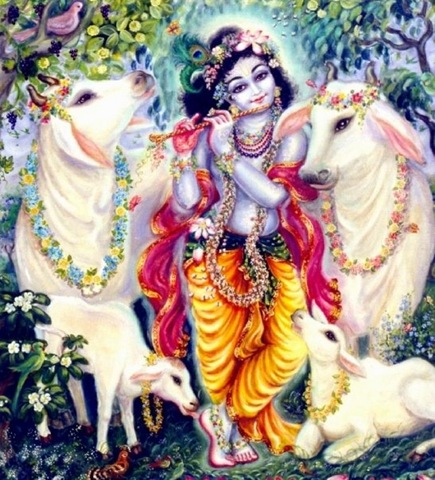
“We need to challenge our age old habits and tradition
if they are in direct contrast to the principles of
non-violence and dharma laid down by Sri Krishna in Gita.”
Lord Krishna is also known as Gopala, or protector of the cows. His love for and relationship with the cows of Vrindavan forms a major part of His transcendental past times. Among the artwork depicting His holy image, there are just as many showing Him with His beloved cows as there are images depicting Him with His beloved Radha and the gopis. As Giridhara, He lifted the mountain of Govardhana to protect the citizens and the cows from destruction. When He played His flute, the cows were there, His most ardent audience. When He wanted to eat, the cows were there, His most willing suppliers of milk and butter. When He wanted affection, the cows were there, His most unselfish companions, wanting nothing from Him but His caress and His embrace, which they freely returned. And so, it is not surprising that from these stories and for other reasons, the practice of offering Him prasadam made with dairy, and bathing His image in milk developed and took hold as the cornerstone of devotional rituals.
At abishekam, a devotional service, the offering of milk is one of the most common items donated by devotees. Sometimes mixed with honey and other items, the milk is poured onto the deity and flows freely and amply throughout the ritual, allowed to drain into metal bowls, collected and then poured back into the bottles for the devotees to take home, now blessed by the Lord. A small vessel is also passed around the room, with each of us given a small spoonful to drink the blessings of Divinity. Food is also offered to the Lord for prasadam and usually contains milk and ghee, a form of clarified butter. After the puja is complete, the food is shared by devotees partaking of the Lord’s blessings, gathering together in the sangha of God’s worship.
What appears as a charming expression of devotion now has lurking behind it a vile abuse of this most sacred creature of the Lord, both in India and here in America, knowingly perpetrated by the suppliers of the dairy products and unwittingly financed by the Lord’s devotees. While I converted to a vegetarian diet years ago, I continued to include some dairy in my diet, although very limited due to my developing concern with ahimsa and allergic skin reactions. But I continued to accept the prasad, I continued to pour the milk when the occasion arose and I relished the sweets and the wonderful Indian cuisine so freely shared where I worship. I told myself that any hesitations I had should be quashed within myself because these were offerings to God and had been blessed and cleansed of any sins committed in their procurement. Lately, though, I was becoming uneasy about it, but not voicing my thoughts and not knowing quite how to voice my developing uncertainty over the source of these offerings.
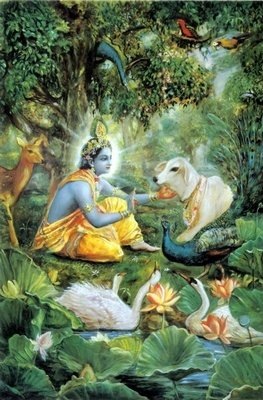
Until recently, when Kamleshji, another devotee on a bhakta forum posted a message directly confronting this subject, and ripping open my cloak of uncertainty to the naked truth that cannot be denied if one looks with one’s eyes open, if one hears with one’s heart and if one thinks with one’s conscience. From his post and subsequent communications from him, I quote a few lines below…
“….as devotees of Lord Sri Krishna we must definitely pay attention to the plight of His most beloved animal, the Cow (Go-mata).
Just recently on Sri Krishna Jayanthi, we bathed Lord Sri Krishna in milk, curd, ghee and offered Him His favourite naivedhyams such as paal payasam, ghee and butter.
However we must be aware how this milk is obtained in this Kali yugam, especially where milk is obtained in commerical farming techniques (as in big cities in India and especially here in the US). Before this exploitative factory farming age, our saints used to procure Milk products in harmony and without cruelty, the milk was taken from the cow only after the calf has had it’s fill and the cow was worshipped as Go-matha. Such offerings are certainly pleasing to the Lord.
However in the present age, factory produced milk is a very cruel exploitative product of torturing cattle. The poor cows are enclosed in a tiny space, chained in its own waste in darkness, cold and filth for the rest of its life. It is pumped with insane amounts of hormones, and other toxic medications to artifically increase milk production.
These large amounts of hormones, antibiotics and other unnatural feed, cause the cow to grow large and make it prone to bone fractures and other very painful diseases. To add to this torture the cows are artifically inseminated to produce calves to ensure regular supply of milk.
The most unfortunate of the calves are male calves (called Bobby calves) who are considered to be useless and are sold off to be butchered for meat when they are just five days old. The mother cows separated from their calves cry in agony, yet they are not spared and are administered more hormones to continue milking them.
After milking the cow till it has been exhausted and after ensuring that the cow cannot yield anymore milk, it is sold off to be slaughtered in the most brutal manner for meat and leather. I request all bhaktas to please think about this, will our Lord ever accept our abhiseghams and Naivedhyams if it means that His favourite innocent animals are killed slowly and extremely painfully all their lives? Let us not act in an adharmic manner and perform unthinkable atrocities and sins by offering factory produced milk and milk based products especially in our sacred rituals and also in our diets. I can only be certain that we shall never suceed in our sadhana if it causes so much needless pain for innocent animals.
Lord Sri Krishna, vividly describes the three types of foods, Sattvic, Rajasic and Tamasic. Milk in the olden days was definitely Sattvic however now it is 100% Tamasic due to the abundant violence and abuse it entails. Drinking such milk is equal to eating beef. In fact the animals raised for meat do not have to suffer so much as these unfortunate dairy cows are made to suffer.
We cannot afford to fool ourselves into believing that just because we are vegetarians and do not eat beef, we are protecting the cows. We need to challenge our age old habits and tradition if they are in direct contrast to the principles of non-violence and dharma laid down by Sri Krishna in Gita.”
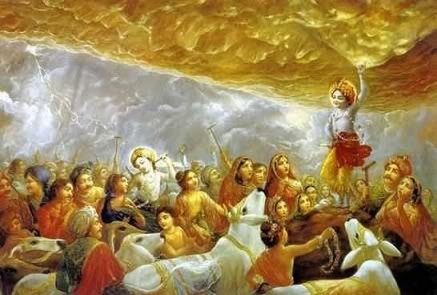
His post prompted me to respond to him and to also go online to view some of the websites which I knew would show me the truth, as painful as it might be to watch and to listen. I am now convinced that I must be even more vigilant in my avoidance of all dairy products where I do not know the source. I will also post several more blog entries examining this subject in more detail, in the hope that each of us can look more honestly into our hearts about what we put into our mouths and onto our bodies, and onto the Lord.
The Luthar.com blog already has several articles on the subject of vegetarian diet…this short series is specifically examining the vegan diet. We will look at ahimsa as the foundation for a vegan diet, the economic incentives fueling the abuse, the ways in which the dairy cows are abused, including their offspring, and how they are slaughtered in the end. We will examine the human health consequences of ingestion of dairy products and the environmental effects of the mass procreation of cows for human consumption. We will explore the organic industry as well. We will post photos and links to videos so you can see for yourself what is happening to the dairy cows. We will also post links to organizations geared to helping the abused cows and offering alternatives to the current system. We will offer suggestions and ideas on how to substitute other products in our diet and in our worship. We ask that you the reader examine the facts with an open heart. Together with Kamleshji, who has studied the subject extensively and speaks with eloquence and fortitude in His devotion to the Lord on this subject, I will continue to post, seeking His blessings and inspiration.
Today is Ganesh Chaturthi and I take this opportunity to post the first in this series on this day with this prayer…that I serve the Lord without reservation acting as best I can on His wishes, and that I open my mind and my heart enough to let Him speak through me as He guides me. Ganesha Saranam!

Patram pushpam phalam toyam yo me bhaktyaa prayacchati;
Tadaham bhaktyupahritamashnaami prayataatmanah.
If one offers Me with love and devotion of a leaf,
a flower, fruit or water, I will accept it with joy. BG 9.26

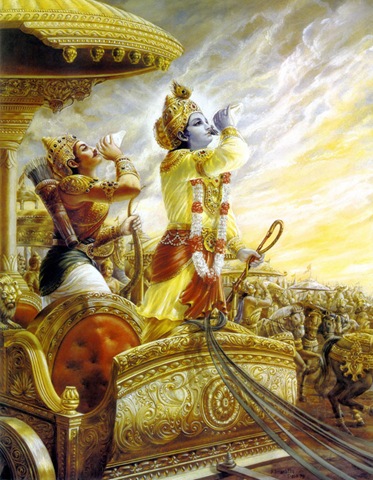

 Luthar.com


You must be logged in to post a comment.