Harsha's avatar

Satsang with Robert Adams: By Kheyala

image

One of the first stops after leaving Colorado that my best friend and I took in our new home-on-wheels (“Lakshmi”) was in Sedona, AZ to go to satsang with Robert Adams. Many of you may know that Robert Adams (whose body died a few years ago) sat before Ramana for years in Tiruvannamalai.

We knew that Robert Adams was aging and that a special opportunity awaited us. Now, keep in mind that my conscious spiritual journey was rather new and I had previously immersed myself in the Satsang Mecca called Boulder.

I had really gotten a feeling for what satsang was “supposed to” look like and went to Robert Adams’ place fully armed with my finest “spiritual” clothing, “spiritual” face, “spiritual” voice, and “spiritual” sitting posture.

When we arrived, spiritually carrying our zaphus behind our hips in silence, heads held humbly down, we were quite surprised to find a room full of relaxed people hanging around, just acting normal. In fact, they were so talkative with each other and easy-going and animated that it made me wonder if we were really at the right house.

I came prepared for silence and holiness and the scene was unsettling being so ordinary. There was nothing spiritual about the place, like decorations or altars or anything that I recall. There may have been a small photo of Ramana. So I sat down and prepared to “meditate.”

Needless to say, I simply couldn’t keep my eyes closed. There was too much fun going on in the room. I struggled with it for a while, but that became so darned uncomfortable. Eventually, I just sat there figuring it would get holy, maybe, after Robert came in.

You can imagine my surprise when he did come in. While I was expecting a spiritual-looking man dressed in Indian garb, what he was actually wearing was a pair of baggy, silky jogging pants and a tee-shirt and he had on a hot pink rumpled-up baseball cap that was on crooked!

Because Robert had Parkinson’s Disease, he kind of made his way across the living room in a slow-motion shuffle and sat himself in the chair reserved for him. Everyone made room for him as he passed by and with great affection touched their palms together in reverence.

Robert sat on the chair for some time. It was real quiet in the room, but not an “it’s-time-to-be-quiet” kind of quiet. It was just naturally quiet. And no one said anything. So, trained as I was to recognize a jnani, well…. no way. This guy was plainly sitting there with his mouth open and his eyes half closed. He was hunched over with his skin just hanging on his face. There was nothing that I could “read.” And boy, did I try. I looked for some kind of radiant glow, some kind of visible wisdom, some hint of Ramana, and nothing! I looked into his eyes and it was as if no one was home. My mind was just struck dumb.

Eventually, Robert jerked his arm up, sort of pointing a finger. That was the cue for the person holding the boombox to hit “play.” I thought, “Oh. THIS must be the holy part.” I closed my eyes in full expectation of sacred words or ethereal music or at least some Sanskrit bhajans. To my utter shock, the thin and twangy voice of Willie Nelson’s “Always on my mind” came singing out!

The whole room went into an uproar. Everyone was laughing and swaying from side to side in enjoyment, singing dramatic crescendos at each chorus: “Telll meeeee. Tell me that your sweet love hasn’t died…etc.”

Robert? He just sat there, expressionless, his body unmoving, hunched in his chair. No sparkling eyes, no nothing. By then, my mouth was dangling open as well. My mind had completely come to a halt. It could not make sense of this at all. It didn’t know and could not begin to interpret what it was seeing.

The next musical selection was Kenny Rogers singing really sentimental love songs. These were no Sanskrit Bhajans about Enlightenment or God or anything. These were love songs riddled with illusion and duality. Rather than condemning them or spiritually correcting them, Robert Adams was just sitting there. Everyone was laughing so hard that tears were coming out. It was so infectious that before I knew it, I was singing along and laughing too. My sides were aching when we were through.

Afterwards, with everyone returning to normal breathing and with some sighs and residual giggles here and there, I had the thought, “Well, maybe now it will get serious.” There was a moment of silence. Then suddenly, someone said, “Hey! How about Mexican?!” This was met by an outburst of cheering! Soon everyone got up and grouped together in cars to go to a local Mexican restaurant.

Bewildered but happy to go along I arrived at a scene that I was dismayed to find rather loud and crowded and chaotic. Shortly after we were seated, I looked over at Robert. He had a bright green margarita in front of him.

Before leaving, I didn’t want to miss the opportunity to speak with Robert even though at the time I sure didn’t know what to make of him….but all that came out was something like, “I like your hat.” And he said something like, “Thanks.”

The sweet, natural happiness that I experienced in his presence was so very thick and blatant. All the ideas I had picked up about what it is to be in the presence of Truth were permanently cracked. The mind just couldn’t get around the chasm between what it thought holiness was supposed to be like and what it had actually met that day with Robert Adams. In its attempt to cross that chasm, it had fallen into it, giving rise to an absolutely undeniable experience of joyfulness and peace.

Editor’s note: Kheyala is a long term member of the HarshaSatsangh list. Her account of the Satsang with Robert Adams first appeared in Spring 2002 of the original HS-Ezine.

Harsha's avatar

MOTORAZR(2) V9m

image

Verizon Wireless formally announced that MOTORAZR2 V9m will become available to Verizon Wireless customers in September 2007. Clearly in competition with Apple’s iPhone, MOTORAZR2 V9m comes with external touch-sensitive keys for access to Verizon’s catalog of over two million songs. It also comes equipped with Bluetooth® stereo support for listening to music.

The MOTORAZR2 V9m has a 2.0 megapixel camera with 4x zoom and picture, video, text, and instant messaging (IM) capabilities.

MOTORAZR2 V9m has been strategically priced by Verizon to be about half of that of the iPhone.

Sprint and AT&T are releasing their own versions of the MOTORAZR2 V9m. Sprint, in fact, promises to release its version of the phone in August before Verizon. Interestingly, Sprint also beat Verizon in releasing their version of the HTC 6800 as well.

Strategically, AT&T releasing a MOTORAZR2 V9m makes sense. They will not lose customers to Sprint and Verizon who do not want to pay for the much higher priced iPhone.

For information on the Verizon’s MOTORAZR2 V9m, go to Verizon news URL listed below.

http://news.vzw.com/news/2007/08/pr2007-08-10.html

Engadget has good coverage of the release by all three carriers (Verizon, Sprint, and AT&T).

http://www.engadget.com/2007/08/10/sprint-verizon-both-announce-motorola-razr-2-v9m/

Harsha's avatar

Bhagavad Gita and the Sattvic Diet: By Dr. Harsh K. Luthar

img_2719

Sri Ramana used to say that of all the yogic rules and regulations, the best one is taking of Sattvic foods in moderate quantities. This view is consistent with that expressed in the Bhagavad Gita, and indeed most of the Yoga Shastras.

The logic is that since food consumed has a major effect on the body and the mind, a Sattvic diet should be adhered to in order to enhance both the health of the body as well as purity, strength, and calmness of the mind. An agitated person will find it difficult to sit quietly and meditate.

A disciplined and one pointed mind is an aid to ones’ learning and education as well as having success in business and other worldly affairs. A clear, pure, and a reflective mind is, of course, essential to self-enquiry which leads to Self-Realization.

The question then becomes, “What is a Sattvic diet? What is the authority for saying that certain foods are Sattvic and lead to good health, mental clarity, poise, and spiritual advancement, while other foods do not?”

There is much yogic literature on this topic and also some disagreement among experts depending on their school of thought and background. Since most Hindus generally accept the Bhagavad Gita as the final word, I will refer to that as my primary source on the Sattvic diet.

We should keep in mind that Sri Krishna, who speaks in the Bhagavad Gita with complete spiritual authority, is also considered the model of exceptional and abundant physical health and perfect mental poise. He is depicted in the ancient writings as slim, active, energetic, graceful, and attractive.

In the Bhagavad Gita, Sri Krishna demonstrates profound insight into not just the spiritual nature, but also human nature and physical nature. By inference, Sri Krishna’s words on food and the Sattvic diet carry much weight for those who study the Bhagavad Gita.

What foods should one minimize according to the Bhagavad Gita?

In Chapter 17 (verses 8, 9, 10), Sri Krishna makes clear the type of foods to be avoided by those who seek good physical and mental health, worldly success, and progress on the spiritual path.

According to the Bhagavad Gita, foods which are too bitter, sour, salty, pungent, dry, and hot can lead to pain, distress, and disease of the body. Further, Sri Krishna says that foods cooked more than three hours before being eaten, foods which are tasteless, stale, putrid, decomposed and unclean should be avoided by spiritual aspirants and those who seek excellent physical and mental health.

What foods should be eaten according to the Bhagavad Gita?

In Bhagavad Gita, Sri Krishna states, “If one offers Me with love and devotion a leaf, a flower, fruit, or water, I will accept it:” (Bg.9.26). To me this seems to suggest that Sri Krishna is sanctioning a diet based on leaves and fruits and water as the best one for spiritual growth. I am no scholar on the Bhagavad Gita, but my liberal interpretation of this verse would be that the Sattvic diet is generally plant based and includes all or most vegetables, fruits, legumes, grains, nuts, seeds, etc.

Because Sri Krishna gave cows sacred status similar to that of a human mother and favored raw butter for personal consumption as a child, one could reasonably argue that dairy products (such as yogurt, milk, kefir, lassi, sour cream, etc.) belong to the Sattvic food category.

Many yogis hold the view, however, that dairy products can only be considered Sattvic if these are obtained respecting the cows and goats who are shown kindness, love, and humane treatment. According to the principle of Ahimsa (nonviolence), any food procured through violence to living beings cannot be considered Sattvic.

Yogic Sattvic Diets

Some yogis that I have met favor a completely raw vegetarian diet with a primary focus on sprouted grains and beans (such as Garbanzo, Blackeyed peas, etc.) along with raw fruits and vegetables. Their diet is essentially vegan and contains no animal products. However, modern science teaches us that since vitamin B12 is missing from a purely vegan diet, supplementation is necessary.

A number of medical and scholarly references can be found on this issue on the web.

Other yogis have felt that a raw vegetarian diet is too limiting and include cooked foods as well as dairy products (milk, yogurt, lassi, etc.) in their diet. This diet, known as the lacto-vegetarian diet, is probably the most wide spread among Indian Hindus and Jains.

A few well known yogis have also traditionally included not only dairy but also eggs and egg products in their otherwise vegetarian diet. This is known as the lacto-ovo vegetarian diet.

Although very few Indian yogis include any kind of fish, fowl, or meat in their food, there are exceptions. Buddhist yogis, for example Dalai Lama, do eat meat. A few Hindu yogis also eat meat pointing out that some ancient scriptures sanction meat eating for certain religious rituals.

For most Hindu and Jain yogis, however, there is no convincing argument for eating meat if one wishes to uphold the supreme principle of Ahimsa and follow the philosophy of nonviolence.

What is the best Sattvic Diet?

The general answer from my study is that foods which cause the body to gain health and for the mind to be calm and peaceful constitute the Sattvic diet. To some extent, this requires knowing the needs of one’s own body and being sensitive to the effects of various foods on our system. Foods which are very suitable and nutritious for one person may not be right for another. Common sense and wisdom are the essential ingredients to find the best Sattvic diet for yourself.

In terms of particular foods to be eaten, the yogis and sages have answered this question, but the answers have different variations. One common element of a yogic Sattvic diet is that it is primarily vegetarian. This is true at least for Hindu and Jain yogis.

Within the broad framework of vegetarianism, a number of dietary systems are possible where certain foods are included and some are excluded. In the most liberal vegetarian diets, eggs and dairy products are included. Some people include dairy in their vegetarian diet but not eggs. Some include eggs but not dairy. In the most strict vegetarian diet, eggs and milk are excluded. Supplementation through certain vitamins is needed in such diets, according to modern medical opinion.

My personal experiences

Having experimented with a variety of diets for decades, I feel that a vegetarian diet can be healthy or unhealthy depending on many factors. For example, if I am a lacto-vegetarian and eat too many pizza pieces, the feeling of discomfort is likely to follow. In fact, after experimenting with eating pizzas thousands of times in my younger days, I am fairly certain that this is indeed true. I believe this also holds if one eats bucket loads of ice cream on a frequent basis. So, is lacto-vegetarian diet healthy? It depends on how lacto you are and how often you go lacto with heavy fat and fried lacto foods!

The point is that a vegetarian diet can be either healthy or unhealthy depending on the nature of food eaten as well as the quantity of food consumed.

In Chapter 6, verse 16, Sri Krishna specifically emphasizes moderation in eating and sleeping. He states, “There is no possibility of ones’ becoming a yogi, O Arjuna, if one eats too much, or eats too little, sleeps too much or does not sleep enough.”

Clearly, overconsumption of food leads to problems and one can logically conclude that the quantity of food consumed is probably an important element in a diet being considered Sattvic.

Sattvic diet is also a matter of degree. Some diets may be very Sattvic, while others may be moderately Sattvic.

Finally, the thoughts and the emotional balance while eating the food have an effect on our system. This is why in many religions, prayers and showing of gratitude for the food being consumed is offered. This mental state while eating helps the diet become more Sattvic.

What does it all mean?

So what does it all mean and what are the lessons from Bhagavad Gita and our discussion of the Sattvic diet? Here is what I think some of the lessons are. See if you agree.

1. Whatsoever you eat, eat in moderation.

2. Educate yourself on proper nutrition, be sensitive to your body, and see what foods work for you.

3. Emphasize fresh vegetables and fruits and eat a diet which is mostly plant-based.

4. Do not eat foods which are too salty, bitter, or have gone stale and putrid.

5. Regardless of the food being eaten, eat with gratitude, prayerful attitude, and with mental poise.

6. Chew the food carefully and taste it deeply without rushing.

There are literally thousands of great sources on the web and hundreds of books in stores to help you educate yourself on the Bhagavad Gita, vegetarianism, and nutrition. Go do some research and find out for yourself!

That’s my homespun wisdom for today. Like Captain Planet used to say, “The Power is yours!”

Given below are some pictures of plant based dishes that I made keeping the principles of Sattvic food in mind. Wishing you all abundant physical, mental, and spiritual health. Namaste.

Harsha's avatar

Verizon’s XV6800: Still In The Testing Phase? By Dr. Harsh K. Luthar

By Dr. Harsh K. Luthar

On July 22, 2007 I asked the question “Where is Verizon’s XV6800”?

Given the rumors of its imminent release since December 2006, http://www.engadgetmobile.com/2006/12/22/verizon-utstarcom-xv6800-the-cdma-tytn-lives/, it is a question many Verizon subscribers who want to upgrade from their XV6700 have been asking.

Here is an early picture claiming to be that of Verizon’s XV6800. It came out on engadgetmobile website in February of 2007 along with a second review of the XV6800 features.

image

http://www.engadgetmobile.com/2007/02/09/verizon-xv6800-in-the-flesh/

I followed up my original post on XV6700 and XV6800 by doing an analysis of the legal battle between Qualcomm and Broadcom and its potential impact on Verizon’s introduction of XV6800.

My second post ended on an optimistic note for the early release date of XV6800 based on the recent agreement between Verizon and Broadcom. The Verizon-Broadcom agreement apparently frees Verizon to offer PDA/Cell phones like the XV6800 which have a Qualcomm chip that allegedly infringes on Broadcom patents.

However, there is still no word on the XV6800 release date even after the Verizon-Broadcom agreement which should have ended the mystery.

I talked again to a Verizon’s customer service rep on July 27 on the phone and asked for information on the upcoming XV6800 which is meant to be a successor to their XV6700 model. The Verizon customer rep said that he knew nothing about any XV6800 and they usually get only one week notice before a new product comes out.

I pointed out to the rep that there had already been many discussions on the web of the XV6800 since the Christmas season of 2006 and so it was surprising that no official information is available from Verizon.

The Verizon rep was sympathetic and suggested that I go to phonescoop.com.

When I went to phonescoop.com and looked around I found this. The site has good information about the XV6800 but most of it is common knowledge by now to the XV6800 fans. The phonescoop site does not seem to mention that the XV6800 has 256 megabytes of RAM which is a substantial increase from XV6700.

The next day, on July 28, I visited a large Verizon store hoping for a face to face conversation with an experienced Verizon employee.

After about 10 minutes of waiting, a well dressed gentleman came up to me and said that he could help me. Not losing any time, I asked him whether he could tell me the release date for the XV6800 as I was waiting to buy it.

Here is the Whole Conversation about XV6800.

Luthar: I am very interested in buying the XV6800 when it comes out. Can you tell me anything about its release date.

Verizon Rep (VR): No, I can’t do that. I don’t have that information.

Luthar: Do you think it would be out in two or three weeks? Would that be a good estimate?

VR: I don’t know. I just don’t know.

Seeing that he was not denying the very existence of the XV6800, I asked, “What could be taking so long for Verizon to bring it out..”

VR: Testing. Verizon has to thoroughly test a phone before they release it. If a phone does not pass the tests, it does not get released.

Luthar: What tests, what kind of tests are done on these phones. Is this not just an upgrade from the XV6700? What new testing are they doing?

VR: Tests, tests, tests have to be done to make sure everything works…..

Luthar: OK. Does Verizon have another phone like the XV6800 with a sliding keyboard? I guess what I am asking is that whether there is another phone that I can buy that has some of the XV6800 features. Would one of the Blackberry phones be a similar phone or a close competitor for it for Verizon customers who are waiting for an upgrade to XV6800?

VR: Not really. We don’t have any other phones at this time with the sliding keyboard except the XV6700. Would you like to look at that?

Luthar: I have already looked at that and tried it out. I don’t want to get the XV6700 if the XV6800 is going to be released in a few weeks.

VR: I don’t know when that phone will be released. It could be a few months. It all depends on the testing. If a phone fails the test, it does not get released.

Luthar: A few months? There have been pictures of it all over the web since December of 2006.

VR: I can’t really tell you anything more than I have.

***********************************************

The conversation left me wondering again what the Verizon strategy is.

When Apple was getting ready to release the iPhone, a big media sensation was created that ultimately had people waiting in lines for the iPhone.

Verizon’s strategy seems to be just the opposite and there has not been any official word on the XV6800 release date at all.

For many business people and professors who use windows applications including Microsoft Outlook to synchronize to their Exchange servers at work, the XV6800 is a far superior choice to the iPhone.

Could Verizon be missing an opportunity to market the XV6800 to its customers who could potentially be switching to Sprint to get its twin the Sprint Mogul (PPC-6800)?

Time will tell what is going on behind the scenes with the Verizon XV6800 and how this fits in with the Verizon’s strategy for marketing this device which many consider to have much more utility for their work than the Apple’s iPhone.

Harsha's avatar

Vegetarian Lifestyle: By Dr. Shyam Subramanian

Question from a student: As a Hindu living in the U.S., should I remain a vegetarian? If I include meat in my diet there are so many more choices in restaurant menus. Also, when I go to parties I feel awkward telling the host that I can’t eat many of their meat dishes. It is really uncomfortable. I see many of my Indian friends eating meat and fish and caviar and whatever is available and I feel they are more accepted socially in the western culture and that will help them get ahead professionally as well and make more money. As an American born in India, I feel very conflicted about this whole vegetarianism issue. There is pressure from my family to remain a vegetarian but my friends who are not vegetarians are having a better time at my college it seems.

shyam

Answer By Dr. Shyam Subramanian

Continue reading

Harsha's avatar

Verizon’s XV 6800 Mystery Solved? By Dr. Harsh K. Luthar

After thinking some more about why Verizon’s XV 6800 model has not yet made it to the stores, I did some research and realized that there is a logical reason for it. Evidently the problem seems to have now been solved by Verizon and so the XV 6800 should be available in the near future.

Here is the story, I think.

It seems that Verizon’s XV 6800 had been delayed due to the ongoing legal dispute between Qualcomm and Broadcom.

How?

The Facts Follow:

The International Trade Commission (ITC) ruled last month (June 2007) that Qualcomm’s 3G chips infringe on certain Broadcom patents.

Therefore, the ITC banned future imports of products to the US containing Qualcomm chips.

Guess what? High Tech Computer Corporation (HTC) which is the manufacturer of Verizon’s cutting edge XV 6800 and its twin the Sprint Mogul PPC-6800 powers the 6800 models with a Qualcomm chip (MSM7500)!

So, although the legal dispute over patents started with Qualcomm and Broadcom, a number of chip users of Qualcomm in the U.S. are affected including Verizon and Sprint! This explains the delay in the XV 6800. Some of the information on this can be found at the following url.

http://www.newsfactor.com/story.xhtml?story_id=020001YSTWYW

After the ITC issued its ruling to ban the import of Qualcomm chip based products that infringe on Broadcom’s patents, the reaction by Verizon was predictable and an unhappy one. Verizon and its customers would definitely be hurt severely by such a ban.

The ITC ruling was appealed to President Bush who has the right to affirm, modify, or veto the ruling within 60 days.

Verizon, however, apparently had second thoughts about waiting for President Bush to make a decision on the Qualcomm case. In a brilliant tactical move, Verizon, bypassing its partner Qualcomm, reached an agreement directly with Broadcom that would allow Verizon to sell products containing Qualcomm chips even though these chips may infringe on Broadcom patents.

The Verizon-Broadcom agreement stipulates that Verizon Wireless will pay Broadcom $6 per phone (up to $200 million) for rights to the patent in question.

http://techpolicysummit.blogs.com/tech_policy_summit/intellectual_property/index.html

This will allow Verizon to start selling their latest phones containing Qualcomm chips in the U.S. market without fear of Broadcom as Broadcom has now been paid off. In order to make Broadcom even happier, Verizon also agreed to stop helping Qualcomm to overturn the ITC ban on Qualcomm’s chips. Verizon wireless broke the story on its website last week.

http://news.vzw.com/news/2007/07/pr2007-07-19j.html

Broadcom is clearly the victor here. However, Verizon also won. For Verizon, 200 million dollars to Broadcom is a small price to continue having the dominant role in the wireless market.

Qualcomm, of course, is probably not too happy right now, although publicly they are saying that they like the Broadcom and Verizon agreement. Perhaps Qualcomm likes it because at least the products containing their chips can now be sold in the U.S. by Verizon. According to Qualcomm, serious issues of public policy and public interest still remain regarding this case and need to be addressed. At least, that’s what they say on their website.

http://www.qualcomm.com/press/releases/2007/070719_views_verizon_wireless.html

OK. That’s it and hope it makes sense. I am not sure I got everything right or covered. If there are mistakes in my connecting the dots, please let me know.

Good luck to Verizon, Qualcomm, and Broadcom. Let’s get the XV 6800 out now to the Verizon customers!

Harsha's avatar

Where is Verizon’s XV 6800? By Dr. Harsh K. Luthar

image

By Dr. Harsh K. Luthar

Reports have been coming since the 2006 Christmas/New year shopping season that Verizon was getting ready to release the successor to their popular PDA/Cellphone XV 6700.

Verizon’s XV 6700 generally got good reviews when it came out. It’s sliding keyboard and being able to connect to the web made it an early favorite for business people, professors, students, and those who want to stay at the cutting edge of technology.

image

The built in windows mobile 5.0 operating system along with Windows applications and the ability to synchronize Outlook with Microsoft Exchange are some of the attractive features of Verizon’s XV 6700.

Where is Verizon’s XV 6800?

It is now almost the end of July 2007 and I have not seen XV 6800 at any Verizon store. Verizon salespeople and those working in the customer service department have been unable to say anything about the XV 6800 since December of 2006 when the news/rumors started surfacing that its release as the successor of XV 6700 was imminent.

Sprint Mogul (PPC-6800)

Sprint, on the other hand, has released the successor to their PPC 6700. The Sprint PPC 6800 is called the Mogul.

image

See the review of the Spring Mogul at the following url.

http://gizmodo.com/gadgets/htc-brings-the-goods/the-sprint-mogul-is-here-269646.php

Verizon customers whose one or two year contract with the company has expired are left scratching their head. What should they do? Stay with Verizon’s network or jump ship. The release date for Verizon’s XV 6800 has been shrouded in mystery.

Verizon XV 6800 Release Date

About a week ago, in a casual conversation, a Verizon employee mentioned to me that the Verizon technicians or salespeople were getting some training materials on the XV 6800. If I heard correctly, perhaps Verizon is getting ready to make the big announcement.

Regardless of when the release date is for Verizon’s XV 6800, I would love to know Verizon’s strategic reasons for giving little information to customers prior to this much awaited product coming out.

Harsha's avatar

Moksha in Hinduism: By Dr. Shyam Subramanian

A seeker asks: In Hinduism, there is a belief in reincarnation. The idea of reincarnation is that when the body dies, I will be born again. However, we are taught to pursue Moksha (salvation) which puts an end to the cycle of birth and death. As a Hindu, why should I pursue Moksha? Is that not a permanent death forever? At least with reincarnation, I have a chance to be reborn. Perhaps I will get to meet old girl friends in my next birth and go to Las Vegas and Bombay again. But if I get Moksha, according to Hindu teachings, I will never be reborn. That is scary, is it not? Why should I then seek Moksha as stated in our scriptures? How does this idea of Moksha as salvation or liberation make any sense?

Editor’s note: Moksha in Hinduism is not viewed as permanent death but an awakening into eternal life. Moksha is essentially the recognition that one’s very nature is that of freedom and wholeness. The questioner’s presumption that his next life would be according to present desires or expectations (going to Las Vegas or Bombay with his old girlfriends) is not consistent with the doctrine of Karma. According to the doctrine of karma, the next birth is determined by a combination of actions taken in previous lives and the present life. The merits and demerits generated thus will determine future experiences of pleasures and pains. Therefore, there is no guarantee that the expectations to be with specific individuals and repeat pleasurable experiences would come to fruition in the next life. Although the seeker premises the question on a faulty understanding of the ancient teachings on karma and reincarnation, Dr. Subramanian clarifies logically the nature of Moksha and why it is considered the most worthy goal in Hinduism.

shyam

As a way of introduction, Dr. Shyam Subramanian is a professor of medicine and also well trained in the classical traditions of Vedanta. Shyam-Ji’s knowledge of Sanskrit and understanding of subtle truths of the Upanishads makes him a brilliant exponent of various Eastern philosophies and religions from a Vedantic perspective. His writing is clear and easy to follow and very helpful for the novice and the advanced students of Hindu philosophy. If any errors have crept in Shyam-Ji’s presentation due to my minor editing, these will be corrected as soon as pointed out.

Continue reading

Harsha's avatar

The Hindu Doctrine of Karma: By Dr. Sunder Hattangadi

Editor’s note: The doctrines of Karma and Reincarnation play an important role in laying the ethical foundations of conduct in Hinduism, Buddhism, and Jainism. In Bhagavad Gita, the sacred scripture of Hinduism, the path of Karma Yoga (The Yoga of Action) leading to liberation (Moksha) is laid out and explained by Sri Krishna.

In popular understanding, the term Karma can have connotations of both cause and effect. Karma can mean action and activity. It can also mean the fruit or the results of such action and activity that we have to bear. For example, ethical, noble, and selfless actions (karmas) are said to lead to good fortune in the future or in a future life. The opposite of that is true as well.

According to Hinduism, how one leads one’s life determines the mental state in the last moments. The mental atmosphere, ideas, and images occurring in the last moments of life lead to a particular type of rebirth (Bhagavad Gita, Ch. 8, verse 6).

In the article given below, Sri Sunder Hattangadi, a retired psychiatrist and a serious student of Sanskrit, discusses the concept of Karma with references to the classical scriptures of Hinduism. This piece is written at a very high level and a short bibliography is provided at the end for those interested in more information. Even though many Sanskrit terms are used in the text, Sunder-Ji provides excellent English translations to the Sanskrit verses which makes the article very readable by people of all backgrounds.

The original writing was posted by Sunder-Ji to the Advaitin list. The Advaitin list is one of the largest lists in the world to discuss the doctrine of Advaita Vedanta as taught by Adi Shankracharya. Sunder-Ji is a member and a moderator of the Advaitin list. His exceptional mastery of both English and Sanskrit make his works of great value.

I did restructure Sunder-Ji’s article a bit but not with much confidence in my judgment. If any errors have occurred, these will be corrected as soon as pointed out by Sunder-Ji and other learned members of the Advaitin list.

image

Sri Sunder Hattangadi

The Hindu Doctrine of Karma

Perhaps no word captures the mystery of human existence as suggestively as the word Karma. It is a word that evokes such a host of associated ideas – ethical-moral, psychological, metaphysical, and mystical – that one can easily lose one’s bearings in trying to understand it.

Krishna himself declares in Gita (4:17) – gahanA karmaNo gatiH – “hard to understand is the true nature of action”[`viShamA durj~neyA…yAthAtmyaM tattvam’]. It may be compared to exploring the Himalayan ranges to reach the peak of Kailasa, Shiva’s abode.

Simply defined, karma means action. The stem word, karman, is derived etymologically from the root verb (dhAtu) kRRi, to do, which also generates a multitude of other cognate words that are inextricably related to Karma – e.g. kartA (doer), kartavya/kArya (duty), kAraNa (cause), karaNa (instrument), and so on.

The definitions of Karma are modified by the prefixes, or adjectives, or compound words that are added to it, for example: Karmas may be described as sAtvika, rAjasika or tAmasika; nitya, naimittika; sa~nchita, kriyamANa (Agami), and prArabdha; kAmya, niShkAma; nyAyya, viparIta; shAstra-vidhanokta or avidhipUrvaka; akarma, vikarma, naiShkarmya; svabhAvaja/sahaja.

The Bhagavad-Gita, which Shankara has called `samasta-vedArtha-sAra-sa~Ngraha’ or the `epitome of the essentials of the whole Vedic teaching’ (or Spiritual Knowledge), is the incomparable vade mecum in explaining all the implications of the word Karma. It is a triune synthesis of dharma-shAstra, karma yoga-shAstra, and mokSha-shAstra. Any reader has a wide choice of verses to select in understanding this unique word. The present article is only one such selection, by no means exhaustive, and is only meant to serve as a pointer to other treasures.

Karma and Moksha: Action and Liberation

The word `karma’ yields over 300 words when associated with other prefixes and words to form compound words. The frequency of the word is relatively small in the Vedas & Upanishads, though the major portions of the Vedas (saMhita-s, brAhmaNa-s) are known as Karma-Kanda, i.e. dealing with rituals of worship. They, and the `dharma-shAstra’-s (scriptures on conduct), deal with the do’s and don’ts for the effective functioning of individuals, families, and society. The word has been repeated over a hundred times in the Gita.

The whole pursuit of Reality, the abode of Immortality (13:13) and Imperishable Bliss (5:21), is the effort to transcend the bondage or limitations caused by action. Every ego-centric action leaves an impression (vAsanA) on the mind (or chitta – the memory store-house) serving as a seed to germinate into further action, and results in consequences (karma-phala), that have to be experienced (enjoyed or suffered) in the present or subsequent life. These tendencies (vAsanA-s) can be countered by proper discipline of unselfish actions which leave impressions (saMskara-s). This wiping out of vAsanA-s (vAsanA-kShaya) itself is known as liberation (mukti).

The goal of action is to attain `actionlessness’, (naiShkarmya – Gita 3:4, 18:49). Immortality, freedom from delusion and sorrow and sin, peace, bliss, freedom from desire and anger, are the fruits of this pursuit, as attested in the following verses.

Gita 18:5, yaj~na-dAna-tapaH-karma pAvanAni manIShiNAm – purifiers of the wise.
5:11: “yogins perform action, without attachment for the purification of self.”
4:24 – “Brahman verily shall be reached by one who always sees Brahman in action.”
4:33 – “All action is comprehended in wisdom”.
4:37 – ” Wisdom-fire reduces all actions to ashes.”

Shankra Bhashya on Gita 3:16 states: ` ….till one attains the qualifications for Devotion to the knowledge of the Self, one who knows not the Self and is therefore qualified (for action only) should resort to Devotion to action as a means of attaining Devotion to knowledge.”

In Gita 4:25-32, Krishna defines the manifold yajna-s which are born of action (Bhashya: “in deed, speech and thought”, the not-Self, for the Self is actionless. If you realize that these are not my actions, I am actionless, I am unconcerned, you will be released by this right knowledge, from evil, from the bond of samsara”).

In Gita, 5:8-9, are described other actions (“seeing, hearing, touching, smelling, eating, going, sleeping, breathing, speaking, letting go, seizing, opening and closing the eyes”,) which are expressed by a truth-knower as “I do nothing at all, the senses move among the sense-objects.”

Actions, or the flux of events or changes in phenomena, happen in Prakriti (Gita 7:4) or in Kshetra (13:5-6) when applied to an individual. 3:27 – “Actions are wrought in all cases by the energies of Nature (Prakriti). One whose mind is deluded by egoism thinks `I am the doer’. ”

How does Vedanta view Karma?

Gita 18:13 – (also 2:46, 4:33) Bhashya – “all action ceases when the knowledge of the Self arises, so that Vedanta, which imparts Self-knowledge, is the `end of action’; (sA~Nkhye kRRitAnte)”.

Other References From Upanishads and Bhagavad Gita on Karma

The classical definition of karma is given in Gita 8:3: bhUtabhAvodbhavakaro visargaH karmasaj~nitaH – “The offering which causes the origin of physical beings is called action (Karma)”.

Shankara Bhashya on this is: “The sacrificial act which consists in offering cooked rice, cakes and the like to the Gods (Devatas) and which causes the origin of all creatures, is known by the term Karma; for it forms the seed as it were of all beings; it is in virtue of this act that all beings, animate and inanimate, come into existence, after passing through rain and other regions of life.”

Brihadaranyaka Upanishad, 1:6:1, states: “This Universe is formed of three entities: name, form, and action.”

Taittiriya Upanishad, 1:11:2-4, gives the guidelines – “……should you have any doubt with regard to duties or customs, you should behave in those matters just as the Brahmana-s (learned ones) do, who may happen to be there and who are able and noble thinkers, who are adept in those duties and customs, who are not directed by others, who are not cruel, and who are desirous of merit…..”

[Jaimini’s Karma Mimamsa codifies in aphorisms (3,454 in 16 chapters) the Karma Kanda (`dharma-jij~nAsA’) of the Veda-s, just as Badarayana’s Brahma Sutra-s (555 in 4 chapters) formulate the Upanishadic `brahma-jij~nAsA’ (Jnana Kanda).

Gita 3:14-15 – “From food creatures come forth; the production of food is from rain; rain comes forth from sacrifice; sacrifice is born of action; know thou that action comes from Brahman; and Brahman comes from the Imperishable. Therefore the all-pervading Brahman ever rests in sacrifice.”

Shankara Bhashya : “…Yajna or sacrifice spoken of refers to what is called `apUrva’; and this is the result of the activities of the sacrificer and his priests (ritviks) engaged in a sacrifice. These activities are enjoined in the Veda (Brahman), and the Veda comes from the Imperishable, the Paramatman, the Highest Self. Because the Veda has arisen from the Highest Self, the Akshara, the Imperishable, as the breath comes out of a man, therefore, the Veda, though all comprehending as revealing all things, ever rests in sacrifice, i.e., it treats mainly of sacrifices and the mode of their performance.”

As the reader can see, the word Karma has a rich history and heritage. A discussion of it is intimately tied to other topics such as reincarnation (rebirth) and moksha (liberation). Please review the following references for more information.

References:

http://www.sankara.iitk.ac.in/gitaindex.htm [Complete Works of
Shankara]

http://www.gitasupersite.iitk.ac.in/ [various commentaries on
Gita]

https://luthar.com/wp-content/uploads/2007/07/karma_mimansa.pdf [Jaimini
Sutra-s on Karma Mimamsa]

http://www.archive.org/details/thekarmamaimaacm00keituoft

http://www.mimamsa.org/articles/brief_introduction.html

http://www.geocities.com/profvk/gohitvip/contentsbeach11.html (waves
9&11) [by Prof.V.Krishnamurty]

http://www.hinduismtoday.com/archives/1994/2/1994-2-09.shtml

https://luthar.com/wp-content/uploads/2007/07/waystotruth.pdf [by Ananda Wood]

Back To The Truth – Dennis Waite ; 2007 Ch 2; O Books, UK

Harsha's avatar

Meditation, Self-Inquiry, and Self-Realization: By Dr. Harsh K. Luthar

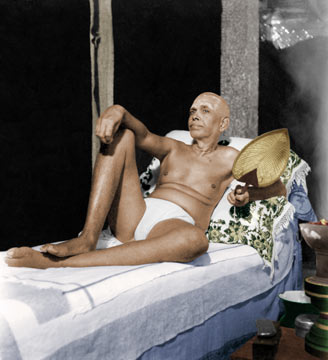
Bhagavan Ramana Reclining

Bhagavan Ramana Reclining

The distinction between Meditation and Self-Inquiry is subtle. However, in one way, understanding this difference is central to grasping the full import of teachings of the Sage of Arunachala, Sri Ramana Maharshi.

Sri Ramana used to say that meditations, affirmations, and other similar techniques presuppose the retention of the mind. To practice a mantra, visualization, pranayama, etc., requires the use and activity of the mind as an independent agent separate from the higher power. One of Sri Ramana’s favorite analogy was that asking the mind to subdue itself is like asking a thief to go ahead and capture itself. The mind will make a game of it, pretend to control itself, but will remain engaged in playing hide and seek.

Certain meditation practices no doubt have a calming and a relaxing effect. However, Sri Ramana states that in all such approaches, the mind remains dormant only temporarily. It rushes forth after sleep or meditation in its individual form when the proper stimulation presents itself. With all practices conducted with the mind, that have an object as their focus (mantra, breath, image, etc.), the seed of duality is already built in.

Someone once asked Sri Ramana whether Self-Inquiry that he advocated was also not a mental activity. If so, it must be presumed as having the same difficulty and limitation as other meditative techniques.

Sri Ramana acknowledged that Self-Inquiry also made use of the mind in initial stages. However, he held that in asking oneself the question “Who am I?” in a serious, alert, and an intense way, the mind was being concentrated and driven inwards towards its Source. This Source is not a form or a sound but the very origin from which the mind arises.

Therefore, in Self-Inquiry, the full power of attention is brought to bear upon this question, “Who am I”? This question does not have an intellectual answer. Asking it is meant for becoming aware of consciousness as existence that permeates us as our root identity. It is this feeling and sense that everyone has of themselves as “I Am”. From childhood to old age, we are aware of this sense of existence without having to give it a name.

This subtle awareness has no form. It is this self-awareness, independent of thoughts, that one has to abide in and follow to the Source. If grace allows for that, the Supreme Heart that the ancients called Sat-Chit-Ananda, reveals It Self. It is really a Self-Revelation. The Heart is recognized as one’s own identity independent of thoughts, personality, mind, etc.

Sri Ramana maintained that although Self-Inquiry required initial use of the mind, after a certain point a spontaneous power took over. The response to serious Self-Inquiry comes from within. Sri Ramana referred to this Source within as the Heart. Self-Inquiry stirred the inner power of the Heart which then became like a magnet pulling the mind within so that Self-Recognition and Self-Realization of Supreme Bliss as our nature could take place.

Namaste