When it comes to food, today’s market offers products that are probably tastier than they have ever been. How can it be different? The food industry of today is a business above all, even when it comes to whole food stores industry. Continue reading

When it comes to food, today’s market offers products that are probably tastier than they have ever been. How can it be different? The food industry of today is a business above all, even when it comes to whole food stores industry. Continue reading
If you know a few things about Chinese herbs, then the title might give you a giggle as you well know that not even the tip of the iceberg can be touched in a few hundred words article. Well, I’m fully aware of that! So, let’s think of this as an intro to the magic kingdom of Chinese herbs. They have changed my life with their wisdom and healing powers, and I think I owe it to them, myself and you to share some facts that might surprise you more than you’ve ever thought.
 First of all, did you know that the phrase Chinese herbs does not necessarily imply that those herbs originate from China, but rather that they are applied through Chinese Medicine concepts? So, here we have our old friend Dandelion – if we call it Pu Gong Ying, it becomes a Chinese herb. True, many of the herbs used in Chinese Medicine today are coming from China and other Oriental countries, but in reality, over the past thousands of years, plants have migrated from a continent to another by different means. Take, for instance, licorice – Gan Cao in Chinese – which is one of the most commonly used herbs for over 2000 years. Does that make it Chinese? Not really, since the Greeks and the Romans have also used licorice since ancient times.
Chinese Herbal Medicine has about 2500 years of written history. However, increased herbal usage dates back at least 5000 years. You might say so what? What has this got to do with me? Maybe people have used herbs since the beginning of humankind. What if I tell you that Chinese Medicine has between 30.000 and 40.000 books written before the turn of the century with thousands additional articles and books written only in the past few years. Of course, Chinese Medicine is more than Chinese Herbs; it also incorporates Acupuncture, tuina (Chinese massage), qi gong, tai chi and nutrition. Continue reading
 A major condition of healthy living on Earth is keeping a positive balance between our environment and us. While growing up in the Carpathians I took being self-sustainable for granted, from growing all necessary vegetables on our own land to raising animals that would help us through the winter. Nowadays, I could not do much without relying on fossil energy sources. Unfortunately that comes at a high price. The nature has changed drasticaly and brought fear among us, for the future of our lives and for our children. The media is full of information, very controversial at times, so I was as confused as many of us are when I decided to look closer into the issue of climate change. Are we doomed, can we do something about it, is anything going to change the damage that has already been done – all these questions were racing through my mind. I wanted facts and wanted to know what is in my power to change. Continue reading
 I think I couldn’t find a better topic to begin with in 2010 than something as vital as the air we breathe – WATER. When your habit changes from drinking only 1 or 2 cups of water every day, I guarantee you will feel as though you have been reborn or washed on the inside – both spiritually and physically. And if you don’t quite get the spiritual part, then the increased bowel movements might let you know for sure that something is being cleansed
 Everybody is talking of how good water is for you and how you should have at least 8 cups of water per day. In the rush of the day, between working, taking care of the kids, cooking and coping with life, you find yourself at 10 PM having ingested nothing more than the rushed cup of water that replaced your breakfast. Should you go ahead and pour down your throat the remaining 7 cups until you feel like fish could live into your belly? I’d say that is not the way to go about it. I have heard this so many times that it has become my second nature to talk about the simple Rule of Four.
You only need to remember 4 times a day to drink water and thankfully there are no strict hours. Two times you have to remember is morning and evening; right upon wakening drink 2 cups of water and as early as you can remember before sleeping but after dinner, have another 2 cups of water. Here we go, 4 cups down! The rest of the cups are simply split by half, 2 cups anytime between breakfast and lunch and another 2 between lunch and dinner. See how simple it is? You can also carry a bottle of water and sip throughout the day if that feels easier, but if you have a hard time remembering to keep drinking, the Rule of Four should always do the trick. Oh, let me give you a tip! Do no drink more than a few sips of water anytime during eating and 20 minutes before or after eating. This would only make the digestion process longer and even induce bloating. Continue reading
This simple twist can be done by Yogi’s of any level. Twisting poses are very beneficial for cleansing and toning the organs of elimination, as well as increasing mobility in the spinal muscles. This is another excellent preparation pose for seated meditation.
*If you find sitting on the floor difficult you can practice this twist sitting in a chair. It is not recommended to perform twisting poses during early pregnancy or menstruation. Also use caution if you have herniated disks in the spine. Continue reading
This is another great pose to nourish the spinal column, as well as relieve stiffness in your back or shoulders. It is also an excellent preparation pose for seated meditation. Continue reading
This pose is great for bringing extra circulation into the brain. I find it refreshing and yet relaxing at the same time. If you have high blood pressure use caution in this pose. Come out of the position slowly if you feel any pressure in the head or behind the eyes.
 *You will need a chair and some yoga blocks for this pose.
1. Begin with a chair in front of you, and some yoga blocks near by.
2. Bend forward until you feel a stretch in the backs of your legs. Check to see what height your hands naturally reach to without forcing them farther. Bring your hands down to your chair checking that you are not pushing the stretch to far. It should feel like a very easy and gentle stretch at this point. (If it is not, then place a folded blanket or yoga block on top of the chair.) The idea is to use the props so that the pose can meet your body where it is right now without any strain whatsoever. Continue reading

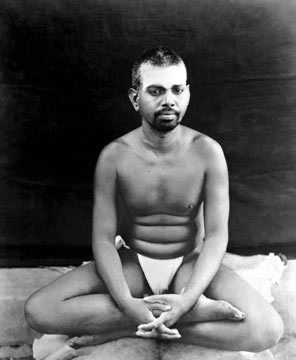
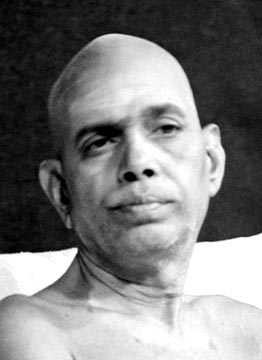
Bhagavan Ramana

Bhagavan Ramana
 Luthar.com
You must be logged in to post a comment.