Bhagavan Ramana explained the three approaches or methods to strengthen Self-Inquiry and gain Self-Realization. Continue reading

Bhagavan Ramana explained the three approaches or methods to strengthen Self-Inquiry and gain Self-Realization. Continue reading

Bhagavan Ramana as a youth
Bhagavan Ramana Maharshi
by Alan Adams Jacobs
Boundless Bliss flooded the Heart of Beauteous Mother Earth,
A Sage came as Ramana to save us, he took a human birth. Continue reading

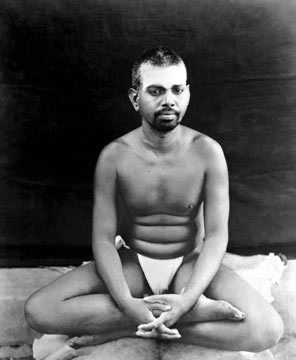

In Praise of Shri Bhagavan
by Alan Adams Jacobs
Let’s give thanks to great Lord Ramana,
For his boundless Grace and Jnana teaching;
He grants silent diksha without vain preaching,
And the precious gift of atma vichara,
His directly liberating, true sadhana.
His eternal presence is close; ever reaching
The hearts of all devotees, so breaching
Mad ego’s fortress of dark avidya.
We feel devotion through our gratitude,
For leading us out of dread samsara;
He bestows full faith, strength and fortitude,
He transmits the power of Arunachala.
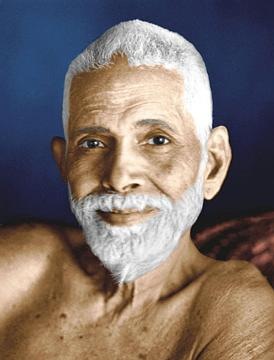
Ever our loving guardian and guide,
Deep in our hearts his lotus feet abide.
Photos courtesy of Shri Ramanaashram

As I ramble on with Ramana
on sitting silent, and passing.
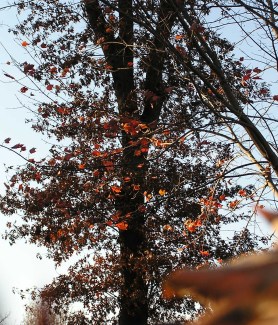
Action of auspicious shades of orange autumn leaves
attach their coloured crusty shades
to reflective rockports of realization.
On occasion, a lofty leaf within leela, stuck without sticking
releases bondage from rambling rocking walking rock.
Heart time space are collaborated and concentrated.
An unconditional comfortable compassion now remains here
and an all airy fiery appearance resides rupa.
Om. All love.

by Swami Sadasivananda
Are we Really what we Eat?
The Need for a Vegetarian Diet!
Every one has heard the saying: “You are what you eat.” But according to the scriptures and saints of the major Eastern religions, as well as of early Christianity, a more precise reckoning of this euphemism is, in fact, a twofold statement: “You are what you think, and you think like what you eat!”
Science tells us that the food we eat is transformed into energy that fuels the physical body. Only in our recent times has science acknowledged that there is also another energy imbued within our food, of a far more subtle nature, that influences not only the physical sphere of our being, but more importantly, the mental realm of our existence. Although modern science holds the trophy for “The slowest learners on earth”, they are now admitting that the most profound and powerful effect food has on man occurs at the psychological plane of existence.
This fact is, of course, based on the Maxim of physics that all elements in existence are essentially energy, and that energy is constant. The constancy of energy is defined by its nature of being impervious to essential altercation. The energy in the beginning of a process is the same at the end of the said process. What goes in, stays in!
In terms of ingestion of digestible matter, the quality of the energy, scientifically and specifically the vibratory rate, that dominated the nature of the plant or animal that is being eaten, is directly transferred through the digestive process and into the mind of the consumer. Thus our mind, our perception, and finally our spirit become what we eat!
If the energy is heavy or inert, little can be done with it to produce the state of silence and clarity needed to reflect the truth of spirit. Certain actions darken the mind and make it thick or heavy, vibrating very slowly–sometimes seemingly not at all. On the other hand, some actions lighten the mind, making it fluid and subtle, vibrating at a very high level. It is this latter condition that is needed for attaining the state of liberation–or rather, the state that liberates the spirit from the illusion of bondage and suffering. It is really the mind that becomes liberated, but that liberation also affects the essentially ever-free spirit and sets it free from involvement with the mind. And to attain such liberation the mind must be purified and refined. Thus, vegetarian diet becomes one of the best and strongest means for its purification.
“When we realize that any physical object has all the levels which we do, namely, the physical, biomagnetic, sensory, intellectual and will bodies, we can understand the importance of the kind and quality of food we eat. For not only does the physical substance of the food become assimilated into our physical body, so also do the subtler energies become united to our inner levels. This is the teaching of the Chandogya Upanishad:
“Mind consists of food. That which is the subtle part of milk moves
upward when the milk is churned and becomes butter. In the same
manner, the subtle part of the food that is eaten moves upward and
becomes mind. Thus, mind consists of food.” 1
“It is obvious, then, that the food we eat is going to determine the quality and condition of all the levels of our being. Our food has the same levels we do, and the different energies of the food are absorbed into our corresponding levels. Therefore when we eat something, it not only affects us on all levels of our existence, it becomes those levels. In this very real sense we indeed are what we eat. In esoteric philosophy our various levels are looked upon as separate bodies through which our consciousness operates. Since those bodies are formed essentially from the food we eat, they will be conditioned by and function according to the kind of energy extracted from the food. We are very much like the child’s toy that is a series of colored rings stacked on a rod. That is, we are successive layers of subtler and subtler energy that are connected to the physical body. From these energy levels the different life processes are empowered and administered. When the energies within us are positive, they produce harmonious states of mind and behavior. But when the energies are negative, they move in a random and chaotic manner and produce negative states of mind and, consequently, negative behavior. Moreover, these toxic energies can also manifest as physical illnesses or defects. Substances that are toxic to the body–such as meat, alcohol, nicotine, and drugs–are toxic on the inner levels as well, and their ingestion poisons all our bodies by putting into them negative energies which are going to manifest in the disrupting manner just described. On the other hand, fruits, vegetables, and grains are reservoirs of pure, basic life energies that are very light and malleable. These energies are easily assimilated into all our bodies and made to take on our specific, unique life vibrations and karmic patterns.” 2
Thus, we must accept, and can on no legitimate grounds refute the facts of the twofold statement: “You are what you think, and you think like what you eat!” Therefore, it can be gleaned, from both the material as well as the spiritual viewpoint, why Sri Ramana Maharshi stressed a vegetarian diet.
Question: I have heard it said that the Maharshi set no rules of conduct or lifestyle within the Ashram that came up around him. Therefore, how can what is being said regarding a vegetarian diet be essential for spiritual attainment?
It is in fact openly stated, and recorded within several of the published core teachings at the Ashram that Bhagavan Ramana set forth only one regulation for the devotees living within the Ashram, as well as for those living outside that followed his teaching. This one rule of life regarded the maintaining of a sattvic (pure) diet.
Question: Did Bhagavan ever explain why maintaining purity of diet was important, and what constituted a sattvic or pure diet?
He did explain the reason why a vegetarian diet was, and is even to this day, maintained at all times. This discipline was central to his guidance of effective means of sublimating (uplifting) the mind and its direction towards reflection upon its True Nature. His guidance stressed an ever purer awareness or quality of mind, which paved the way towards awareness within the heart, the essential home of our Eternal Self.
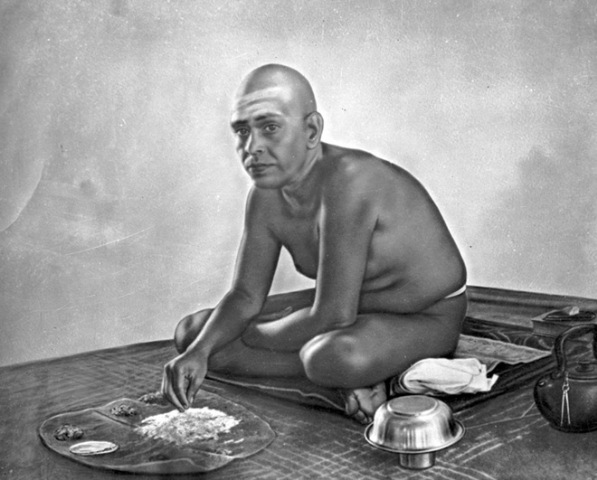
In Bhagavan’s own words we find recorded:
Devotee: What diet is prescribed for a sadhak (one engaged in spiritual practices)?
Maharshi: Sattvic food in limited quantities.
D.: What is sattvic food?
M.: Bread, fruits, vegetables, milk, etc.
D.: Some people take fish in North India. May it be done?
(The Maharshi made no answer.)
D.: We Europeans are accustomed to a particular diet; change of diet affects health and weakens the mind. Is it not necessary to keep up physical health?
M.: Quite necessary. The weaker the body the stronger the mind grows.
D.: In the absence of our usual diet our health suffers and the mind loses strength.
M.: What do you mean by strength of mind?
D.: The power to eliminate worldly attachment.
M.: The quality of food influences the mind. The mind feeds on the food consumed.
D.: Really! How can the Europeans adjust themselves to sattvic food only?
M.: (Pointing to Mr. Evans-Wentz) You have been taking our food.
Do you feel uncomfortable on that account?
Mr. Evans-Wentz: No. Because I am accustomed to it.
D.: What about those not so accustomed?
M.: Habit is only adjustment to the environment. It is the mind that matters. The fact is that the mind has been trained to think certain foods tasty and good. The food material is to be had both in vegetarian and nonvegetarian diet equally well. But the mind desires such food as it is accustomed to and considers tasty.
D.: Are there restrictions for the realised man in a similar manner?
M.: No. He is steady and not influenced by the food he takes.
D.: Is it not killing life to prepare meat diet?
M.: Ahimsa stands foremost in the code of discipline for the yogis.
D.: Even plants have life.
M.: So too the slabs you sit on!
D.: May we gradually get ourselves accustomed to vegetarian food?
M.: Yes. That is the way. 3
In this example, and as is seen throughout the teachings of Sri Ramana Maharshi, Bhagavan is stressing: “It is the mind that matters.” Furthermore, “The mind feeds on the food consumed”, and “The weaker the body the stronger the mind grows.”
In the following story, we are being shown that a pure diet will not only elevate the quality of the mind, but will also keep the body free from illness: “One afternoon at 3 o’clock, a devotee who was going to Madras gave a small tin containing some ointment and said that if that medicine was applied to Bhagavan’s legs, the pain would decrease, and that if Bhagavan would continuously use it, he would bring a dozen tins of it from Madras. Bhagavan replied, saying: “Enough. The Karpura Thailam I am using now is adequate. Why do I require such costly medicines? If diet is properly regulated, no medicine will be required. When these medicines are used, the ailment apparently disappears, but it starts again. That is because of some irregularity in diet.” 4
One of the close disciples who lived with Bhagavan, Arthur Osborne, related what the Maharshi taught him: “It should be explained for non-Hindu readers, that the practice of vegetarianism is not only out of disinclination to take life or eat flesh, though that is one reason for it; it is also because unsattvic food tends to increase animal passions and impede spiritual effort.” 5
Although the Ashram food was strictly vegetarian, Alagammal, Bhagavan’s mother, like some very devout Brahmins, went still further and considered some vegetables (i.e. onions) also unsattvic (impure). When Bhagavan would sit with the devotees in the kitchen and peel onions, Alagammal would weep bitterly. In response, Bhagavan would retort while holding up an onion: “Behold the powers of this small bulb.” She would then weep all the more loudly. Bhagavan had the final word, and would say mockingly: “Mind that onion! It is a great obstacle to Moksha (Deliverance)! It should be said here that Sri Bhagavan did not disapprove of orthodoxy in general. In this case there was excessive attachment to the forms of orthodoxy and that was what he attacked. In general he laid stress on the importance of sattvic (pure) food. He did not often give any injunctions at all concerning outer activity; his usual method was to sow the spiritual seed in the heart and leave it to shape the outer life as it grew. The injunctions came from within.” 6
1 Chandogya Upanishad, 6.5.4, 6.6.1,2,5.
2 Spiritual Benefits of a Vegetarian Diet, Swami Nirmalananda, Atmajyoti Press.
3 Talks with Sri Ramana Maharshi, recorded by Sri Munagala Venkataramiah, Sri Ramanashramam 2006, Talk 22, p. 20.
4 Letters from Sri Ramanashramam, Suri Nagamma, Sri Ramanashramam 2006, Letter #266 December1949, p. 640.
5 Ramana Maharshi and the Path of Self-Knowledge, Arthur Osborne, Sri Ramanashramam 2006, p. 82.
6 Ibid. p. 81.
Reprinted with permission of Swami Sadasivananda
To subscribe to his newsletter, go to http://www.ramanateaching.org/contact.html
For more information on Swamiji, click here: About Swami Sadasivananda
Teachings of Bhagavan Sri Ramana Maharshi web site: http://www.ramanateaching.org
Ask your question in relation to Bhagavan’s teachings, meditation and spirituality at:
http://www.ramanateaching.org/faq

Ramana
Self-Realized sages are like parrots. You see them in their youth, in middle age, and then in their old age.
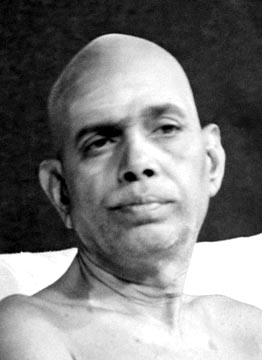
Bhagavan Ramana
They do not change their message and keep saying the same thing over and over again.
On the outside, such sages appear the same as anyone else.Yet, within, the perpetual fountain of love for all beings becomes an ongoing stream that can barely be contained. So they do not mind repeating themselves again and again.
Self-Realized sages are like parrots. But unlike parrots, their utterances come from the depth of their experience, the direct knowledge of the Heart. Such words, although always the same, are energized by the power that can transform a human being.
The devotees of Sri Ramana, even those who did not have much learning, used to say, “He made us like Himself”. The simple silence of a Self-Realized sage exerts a powerful influence that follows a devotee until the Self is realized as one’s own Heart.
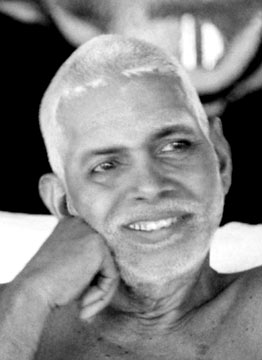
Bhagavan Ramana
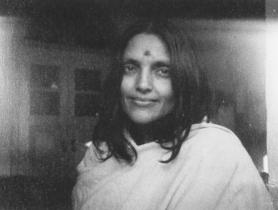

What a special privilege it was for me when i attended the Talk on Sri Ramana Bhagwan’s ‘Saddarsanam’ as presented by Dr. K. Sadananda at the Chinmaya Mission Washington DC center on the Memorial day weekend.
Sadaji is one of the moderators of the a Yahoo group ‘advaitin’ where he has contributed many valuable posts on the finer nuances of Adi Shankara Bhagvadapada’s Advaita philosophy. My only regret was I could not attend the First day of the Talks wherin Sadaji gave a commentary on almost 26 verses of this wonderful scriptural text on forty verses of ‘Reality’ ( aka as Ulladu Narpadu) . But the last 24 verses are equally important as they direct us to the ‘Ultimate Reality‘ by a process of Atma Vichara – a unique contribution of Sri Ramana Bhagwan to Sanatana Dharma.
Sadaji kept the 90 member strong audience ( consisting of all age groups from teens to adults) spellbound with his commentary on the Sanskrit verses with his English commentary. Sadaji never once referred to any notes while reciting the verses . His presentation was flawless and spontaneous and he made it all very interesting by narrating humorous anecdotes, parables and real life experiences. Sadaji adopted a simple and direct approach in unique Ramana style in an easy to understand layman terminology while stating the profound Truth of Non Dual reality (Advaita).
The verses that appealed to me most were the verses on ‘Ego’ – of all the heads the demon Ravana had , his ‘ego head was the last to fall! When that ego head collapsed on the ground , Realization dawned and Ravana was liberated! The sanskrit word for head is ‘masta’ and anything associated with the head is ‘masthisk’ ( the synonym for intellect /mind).
Here is verse 32 :
gavesanat prapaya hrdantaram tat
pated-ahanta paribhugna-sirsa
athaham-anyat sphurati prakrstam
nahamkrtis-tat parameva purnam
Having reached within the heart , by the search , the ‘I’ Notion whose head is broken falls . Then another ‘I’ which is the main one shines forth. It is not the ego but the supreme ‘Fullness’ alone.
The ‘ego’ is the cloud that is covering the ever shining Self , the Sun!
And when one hears this next verse , then you find the ‘key’ that is unlocking your heart ! in Tamil , Heart is refereed to as ‘ullam’ ! The word ‘ul’ has profound meanings in Tamil . Depending on the context ‘ul’ could mean being , thinking , heart and inner space , all associated with indivisible Oneness. Here , it is important to recall the very first verse of Saddarsanam aka as Ulladu Narpadu –
sat-pratyayah kim nu vihaya santam?
hrdy-esa cinta -rahito hrdakhyah
katham smarmas-tam ameyam ekam ?
tasya smrtis-tatra drdhaiva nishta . ( verse 1 )
Can there be thoughts of the existence of objects without the existence principle ? (No) . The existence named as hrt is in the heart itself , free from thought . How can we remember that one immeasurable existence ? Its remembrance is in the form of firm abidance in it .
This is the first verse and that is the True vision of Truth ( Saddarsanam)
” Seeing the Truth is being the Truth”
The Washingtonians are indeed indebted to Sadaji for bringing the best ‘stimulus’ package in these troubled times.We would like to thank Sadaji for bringing the eternal message of ‘Vedanta’ into the hearts of everyone,young and old , rich or poor . That is Sadaji’s gift to our community via the Platform of Chinmaya Mission.
It is rare to see Selfless Teachers like Sadaji spending two full days explaining and commenting on these Forty – all in the interest of ‘loka Sangraham’ ! ( the greater good for the community)!
A verse from Srimad Bhagwat gita comes to mind!
saktah karmany avidvamso
yatha kurvanti bharata
kuryad vidvams tathasaktas
cikirsur loka-sangraham ( 3:25)
As the ignorant perform their duties with attachment to results, similarly the learned may also act, but without attachment, for the sake of leading people on the right path
I am glad I did attend this camp and i wish all of you were there too ! What a wonderful ‘treat’ this retreat was ! Can you imagine learning the entire Vedanta within 40 verses ? Each verse is a gem and we thank Sadaji for placing this ‘treasure’ within our reach.
For those of you , who would like to read ‘Saddarsanam ‘ , you can order your own copy from Chinmaya mission . The commentary by Swami Tejomayananda is Divine.
May I now end this small tribute to the eternal Truth called ‘sanatana dharma ‘ with this immortal verse from upanishads ?
“OM Poornamadah Poornamidam Poornaad Poornamudachyate; Poornasya Poornamaadaaya Poornamevaavashisyate”.
Om Shanti ! Shanti ! Shantihi!
 Luthar.com
You must be logged in to post a comment.