
Tag Archives: Ramana Maharshi
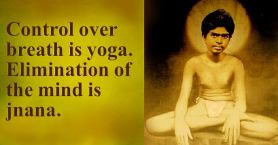
Poonja-ji’s Instructions for Self-Realization
This was posted many years ago in 1999 on the HarshaSatsangh yahoo group by a disciple of Poonja-ji (also known as Papa-ji). Poonja-ji received instructions from Sri Ramana in the 1930s and considered himself a disciple of Ramana.
_________________________________________________________________
Poonja-Ji, spoke the following words in the beginning of Satsang 26/11/1992.
OM. Let there be peace among all beings of the universe. Let there be peace. Let there be peace. Om shanti, shanti, shanti. Namaskar, namaskar.
Welcome.
Behold the inner flame, eternally ablaze within the cave of your own heart and in the hearts of all beings.
There are three prescribed methods for it:
Number 1: Absolute dedication to it.
Number 2: Complete abandonment of all the desires which you have hitherto opted for and which have not given you satisfaction.
Number 3: Enquiry into the nature of Self.
These are the three ways to know who you really are.
What is this shining in your own heart?
Call it Atman, call it enlightenment, call it freedom. Any one of these ways is quite enough. Without this you would not be attracted to it.
This is your own beauty, your own love, your own light.
Aids To Self Enquiry: By Alan Jacobs
“Those who leave the path of Self Enquiry, the way of liberation, and wander off along the myriad forest tracks, will encounter only confusion”. Bhagavan Ramana.
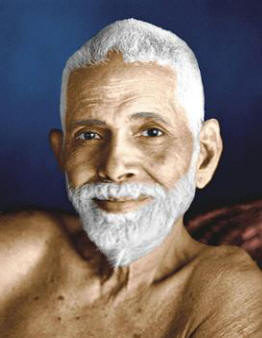
Self Enquiry is the Direct Path and Bhagavan’s great contribution for the modern age for all.
Self Enquiry is the backbone of the main weapon in Bhagavan’s teaching for eliminating the vasanas, tendencies and vrittis, the thought forms which act as a veil and occlude your Real Self. Continue reading
The Unreality of the World: By Alan Jacobs
The Guru Vachaka Kovai, the Garland of Guru’s sayings, is a comprehensive collection of the Maharshi’s Sayings , composed and strung together by the great Tamil Poet Muruganar.This translation is by Professor K. Swaminathan.
In Part 1 , after the invocation there is a long section called ‘The Quest’, and part 2 is entitled the Unreality Of The World, and continues from verse 63 to 70.. Verse 69 states
“The world perceived by the poor jiva
Lapsed from its own Being true,
Buried in darkness, and believing
That it is but the body, alas,
The world thus seen is non-existent;
Yes, it is indeed unreal.
The thrust of this verse, and those like it is underlined by the often quoted passage in Letters from Sri Ramanasramam, 24th August, 1946, quoted in the marvelous book Muruganar’s Padamalai, edited by David Godman. On page 283 of the Chapter entitled The Reality Of The World Appearance we read.
Bhagavan:” In the sadhak stage [the stage of being a spiritual seeker] you have got to say that the world is an illusion. There is no other way. When a man forgets he is Brahman, who is Real, permanent and omnipresent, and deludes himself into thinking that he is a body in the universe which is filled with bodies that are transitory, and labours under that delusion, you have got to remind him that the world is unreal and a delusion. Why? Because his vision which has forgotten its own Self is dwelling in the external material universe. It will not turn inwards into introspection unless you impress on him that all this external universe is unreal. When once he realizes his own Self, and also that there is nothing other than his own Self, he will come to look upon the whole universe as Brahman.”
Like very many sadhak’s I found it difficult to be convinced that the world we perceive is ‘unreal’. I realized that the concepts of space, time, and causality are inherent in the organ of cognition and create the screen of consciousness on which the world stage, actions and pictures are projected. Also that quantum physics has confirmed that what we see, feel, smell , touch and taste is not what it appears to be, but subtle energies in constant movement. But, It was not until I read the Advaita Bhoda Deepika, The Lamp of Non-Dual Knowledge, a short work, highly spoken of by Bhagavan that I followed the complete logic of this point of view.
I summarize my findings as follows, largely based and inspired by Chapter 1 of this marvelous treatise, entitled On Superimposition.
1.All is Absolute, pure, infinite Consciousness, non-dual, Supreme Intelligence, the Self-Existent Self or Brahman.
2. Maya or Illusion, the powers of veiling and projection are inherent powers in Brahman.
3.These powers manifest an apparent, but unreal Universe. Unreal because it was NOT before manifestation and will NOT BE after dissolution. Therefore it is likened to a dream in the Supreme Intelligence or Mind of Brahman. Thus the apparent Universe is but an appearance based on Brahman. It does not exist apart from Brahman. It could be termed, therefore, a confusion between the Real and the Unreal, or neither Real nor Unreal, or both Real and Unreal. In the Vedanta, the term Real is applied to the Immutable or Unchanging. The apparent world is constantly changing, in a state of flux, becoming and decaying, so it cannot be termed Real in this sense, whereas Brahman is immutable, unchanging and eternal.
4.The ignorant ‘jiva’ (the ajnani) or individual soul is reborn and dies continuously through many lifetimes, until Self Realization. It carries forward from each life the seeds of many latent tendencies from previous lives, although its True Nature is also the Absolute Pure Consciousness of Atman-Brahman. But because of the implicit Maya, projection and veiling, inherent in the Self of Pure Consciousness or Brahman, it identifies with its insentient body and creates a Universe from its latent tendencies (vasanas) through the mind, (organ of cognition, the brain and sensorial adjuncts). The mind is a wondrous power in the Self. The world it sees, composed of latent tendencies, and thoughts is therefore of the nature of a dream, even an hallucination, and may be termed ‘unreal’.
5. The latent tendencies inherent in each jiva at the time of each life, are selected by Isvara, an adjunct of Brahman, for its spiritual development. So all is benign, based on Love, essentially. This is stated By Bhagavan in answer to a question by Paul Brunton quoted in the book Conscious Immortality on Page 130 , Chapter 10.
6. The mind-body complex, personal individuality, other sentient beings, and the Universe of multiplicity, are therefore a superimposition on the Self which is now living from reflected Consciousness, mirrored by egotism and the latent vasanas.
7. Through Grace, the jiva receives the teachings of Advaita from a Jnani, and when fit, through assimilation of this Knowledge and mental purification through right intellectual discrimination, spiritual practice and devotion, he or she is shown the way to awaken from the dream of suffering and transient joy (samsara). The means are through Self Enquiry into the source of the ego, the Self and the illusory nature of the Universe.
8. At the same time one lives one life as if it was real, knowing it to be unreal, and accepting all that happens as ultimately for the best.
9. When there is an awakening from the dream of life, the transmigration of the jiva is over. The immortal Self of infinite Consciousness is Realized directly and one lives from that state of ‘sahaja’ until the mind-body falls off in death, and one is absorbed into Brahman or Infinite Consciousness, no longer a separate individual identified with its body-mind. All is the Self, and the world is seen to be Real because its substratum is now known to be Brahman.
I hope this essay, into a difficult metaphysical question may be helpful to seekers baffled by the world illusion.
Re-reading Bhagavan's Eight Stanzas to Arunachala, a marvelous poem, I came across this verse which sums up my Essay. I add it as an addition, as it seems to sum the whole question up, very succinctly.
6. Thou art Thyself, the One Being, ever aware as the Self-luminous Heart! In Thee there is a mysterious power (Shakti) which without Thee is nothing. From it proceeds the phantom of the mind emitting its latent subtle dark mists, which illumined by Thy light (of consciousness) reflected on them, appear within as thoughts whirling in the vortices of parabdha, later developing into the psychic worlds and projected outwardly as the material world transformed into concrete objects which are magnified by the outgoing senses and move about like pictures in a cinema show. Visible or invisible, oh hill of grace, without Thee they are nothing!
Alan Jacobs
Arunachala – New Access to Ramana Sites Below Virupaksha Cave: By Richard Clarke
A group of local Tiruvannamalai people have organized themselves and are doing wonderful work to clean up, repair and open up an area on Arunachala that is near to the popular Sri Ramana Maharshi sites of Virupaksha Cave and Skandanasram.
They have organized as a part of “Global Watch Trust.” You can see more about this organization at http://www.globalwatchtrust.com. This site is not yet updated to include this project.
In this area, this project is cleaning trash, clearing brush, repairing and improving paths, planting, and building benches and meditation areas. It improves access to Guhai Namashivaya Shrine and an ancient Ganesh shrine, and provides a way to reach three hillside caves that are said by local villagers to have been frequented by Sri Ramana. The Trust has been given permission to do this work by The Forest Authority, Arunachaleshwar Temple and Sri Ramanasramam.
The Approach
To get to this area, start like you are going to Virupaksha Cave. Below shows where this ‘road’ meets the street, at the northeast corner of Arunachaleshwar Temple.

Walk up the road until you see, to the left, this street. Notice the blue Global Watch Trust sign on the wall.

Continue walking up the hill.

Here they have made a small shrine at the base of a tree.

Entering the area of the Project
Part of the work done is to clean up trash and clear brush away from the paths. This path is marked with stone borders and shows the effects of trash and brush removal. Keep walking up this path.

When you get the this banyan tree, this is the ‘hub’ for the improved paths that access the various caves and shrines on this part of the hill.
IF you look closely you will see a man reclining on a branch of the Banyan tree. This is one of the key people behind all the activity, a young man who grew up around this part of the hill, Saravan. I think this project is largely Saravan’s vision. Saravan guided us through this area and showed us the work that had been done.

To Guhai Namashivaya Shrine
Turn left at the Banyan tree, and take this new path just a few meters to go to Guhai Namashivaya Shrine. I am told this shrine is about 500 years old.

Here are Saravan and my wife, Carol, outside Guhai Namashiva Shrine. This shrine is an important locale in the history of Sri Ramana Maharshi. This is where he provided answers to questions on slips of paper that became the second of his small books, “Who am I?” This is probably the best known of Ramana’s works.
More information can be found about Guhai Namashivaya at http://www.arunachalasamudra.org/guhainamasivaya.html

Up to the Caves
Returning to the Banyan tree, looking up the hill, to the right, outside this photo, is the stone path to Virupaksha cave. Directly up the hill is the path to the caves.
When finished, this area will have a nice stone path in the middle, surrounded by flowers and planting on both sides. There will be benches to sit and meditate and to enjoy this place.

Take the path to caves and a part of the hill that is mainly unseen by visitors.

Looking from the path, Arunachaleshwar Temple can be seen, with gopurams rising above the trees.

One of the Caves
On the path, we pass by a small cave, big enough for perhaps two or three people to sit in.

Old Ganesh Shrine
The next feature is an old Ganesh shrine, with this water tank. This shrine has been vandalized and the Ganesh idol taken. The Global Watch Trust plans to replace this idol.

Here you can see the back of the shrine and the tank.

Another small cave near the Ganesh Shrine. This cave is big enough for a person to lie down and sleep, but not big enough to stand up.

Up the hill to the best of the caves
Climbing further up the path we will get to the crown jewel (I think) of this area.
I would recommend good shoes or sandals and strong legs for the next part of the journey. The path is a bit steep in a couple of places.
Below Carol and Sarsvan are crossing a rock face. Note that they each have clippers in their hands, to work on a bit more brush cutting on the path.

As the path gets higher, the view of Arunachaleshwar Temple is breathtaking. I think the big rock in the midground is a part of Guhai Namashivaya Shrine.

The path continues up the hill. Here it is dirt and pretty easy walking. After this there is a section up through more rocks. This is the only section that I think is tricky. The biggest trick right now is that there is a place where the path goes up the hill and to the left. Take the left. This is not presently marked. Hopefully, this will be done.
Some of this path is a ‘fire road’ up the hill.

Now the cave entrance is visible.
I think this cave is a special place. The people who live on the hill below here say that Ramana stayed in this cave, I guess during what are generally known as the ‘Virupaksha days.’
We have been here just two times and already it is one of our favorite places on Arunachala.

Here is the cave entrance. Saravan and a helper, over the last few months, have put in the concrete walls, floors and benches, and painted them. Flowing water has left stains that make the walls look older than they are.

Behind me on the path, Saravan and Carol have pruning clippers and are cutting back brush from the path.

View from the Cave
Here we are looking east from the Cave across Tiruvannamalai.

Arunachaleshwar Temple view.

Looking up from the cave, we see Arunachala. If you look closely maybe you can see about 3/4 up the photo, on the right, a coconut palm. This is Skandanasram.
If you look closely in the foreground, you will see red oleander flowers. Saravan planted these bushes three years ago. These flowers are used as puja flowers, and he wanted them to be available for those who use this cave for worship.

In the Cave
In the cave, an oil lamp has been lighted.

Carol sits in the cave, meditating.
We think this is one of the special places on this hill. Peaceful and serene, it is a great place to open your heart to Arunachala.

Working on the Mountain – Global Watch Trust
Community Development
The first part of this project was a vision from Saravan as to what could be done in this area, with encouragement from the founder of Global Watch Trust, Sathya. Together they put together a plan and a team to clean up and enhance this part of the Arunachala hill to properly respect the sacred heritage that is here.
An important part of the process has been involving the villagers who live on this part of the hill. This started with a ceremony and a ‘gifting.’ School notebooks were gifted to the children in an evening ceremony that included the local villagers. The purpose of this was to educate the villagers on the importance of this area so they might not use it as a trash dump, and to enlist their help in the work to clean up the hill.
Below is a photo of the books that were to be gifted, and the team from Global Watch Trust.

Here the gifting is being done. Many locals are gathered together here.

As work started, local officials came to the group. Each interaction was similar, starting with “What are you doing?” and “No, you cannot do this.” After some discussion, permission was granted. First were officials from Arunachaleshwar Temple, then the Forest Authority, the Sri Ramanasramam.
The Crew
One big part of the effort was done with a crew consisting of local volunteers and the Global Watch Trust team, shown below. Together they worked to do the major cleanup of the hillside.

So much cleaning and clearing to do
For many years this area has been used for trash. The first thing needed was to clean up the trash.


Brush has overgrown the paths and area around the Banyan tree. All this needs to be cut away, and cuttings disposed of.

While the brush cutting is going on, a part of the team gathers to discuss the details of path repair for this area.

More trash to be cleaned.


The path cleaned and cleared, ready for repair
Here is the approach path with trash cleaned and brush cleared. Now work must be done to repair the path.

Clearing around the Banyan Tree
The ancient Banyan tree is to the left, with rocks built up at its base. In the surrounding area, brush and small trees have grown up, crowding each other for space and sun. They need to be cut back so the area can be opened up and a new path built.

Here they are clearing brush from the base of the Banyan tree.

Results of the Team’s work
The path is repaired
Here is a part of the path shown above that needed repair. Now it is easy and pleasant walking.

Standing proudly by Old Tree
Saravan stands by the Banyan tree. Now it is cleaned up, brush cut back, trash picked up, etc.

What has been shown here is just a part of the job. to continue the job, Global Watch Trust has been sponsoring a small team to work with Saravan to continue with the path building, planting, and improving these areas by adding cement benches to sit and meditate, etc.
There is a need for financial support
Work has stopped for now. Global Watch Trust needs to find people who are able to provide some support for this work.
Global Watch Trust has funded the effort that you see in these pages out of their own funds. Those funds have run out, and for work to continue donations are needed. Evan small donations are a big help. Rs 1000 ($25 or 15 Euros) pays for one day’s work on the project. 40 days work have been done so far, and so much has been accomplished.
If you are able to help, donations can be made through the Global Watch Trust web site. Go to http://www.globalwatchtrust.com/ and click the ‘donate’ button. Credit Cards and PayPal are accepted. Also they ask, until their site is updated, that you also send an email to ceo@levicent.com and let them know that this donation is to be used for the Arunachala Hill project.
Sri Ramana and Modern Day Gurus: By Dr. Harsh K. Luthar
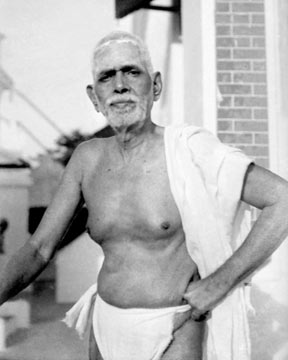
I am very often asked by Sri Bhagavan’s devotees what I feel about modern day teachers and gurus.
I don’t know how to answer that question well. I do not personally know most of these teachers.
For sincere devotees of Bhagavan, I recommend that they seek company of other devotees. Sri Ramana exemplified all that is best in a living Self-Realized sage in his actions. The Sage of Arunachala was liberal, tolerant, compassionate, and for him all faiths and religions had a place and were welcomed with an open heart.
Sri Ramana lived as a recluse first but when a community formed around him, his life became public. He was in the spotlight 24 hours a day, seven days a week for over 50 years. During all this time, he lived as an ascetic and served all those who came to him and answered their questions.
The devotees know that Sri Bhagavan was so alert to everyone’s welfare and that included not just people but also animals and plants and trees in his vicinity. He refused to eat unless enough was available for everyone. I recall that when the plague came to that area of India, one of the devotees came down with it. Others wanted to leave that devotee and for Bhagavan to come with them. They assured Bhagavan that food would be periodically sent to the afflicted individual. Sri Ramana told them that they could go but he would stay with the devotee who had come down with the dreaded disease and continue to serve him.
How many modern day teachers and gurus can do that?
Like many saints, Bhagavan led a pure and spotless life.
Sometimes, people write me very moving letters detailing how they have had experiences with certain gurus thought to be enlightened who actually were very abusive. Given below is an answer I recently gave to someone after hearing their heart breaking account.
Thank you for your sharing. I am so glad to know that you came through OK what must have been some very difficult experiences and trying times in your spiritual journey. Surely Bhagavan was with you all the way.
I have known of many gurus not treating their students well and have written about it in the following article.
I know that many teachers use Sri Ramana to bolster themselves but are not able to live up to the teaching. Once someone asked Sri Ramana the fate of a false guru and those who followed that guru. Sri Ramana said, “each according to their merit.”
People should be very alert to gurus who are on power trips and abusive of others. If someone asked me for advice about any guru, I would counsel them to be patient and cautious before deciding to follow someone. Those of us who have Bhagavan as our Sat Guru have nothing to gain by following anyone else.
My teacher Chitrabhanu-ji used to visit Sri Ramana in his teenage years. Chitrabhanu-ji told me, when I was very young, to follow Sri Ramana and study the teachings of the Sage of Arunachala.
It was like magic for me. That was back in 1978 when I rediscovered my connection with Bhagavan. I have never felt the need to follow any other guru.
But each to their own. This is the way of the life and we can only wish the best for others. If someone asks me about gurus, Sri Ramana is the only one I can point to.
Yours in Bhagavan
The Ribhu Gita: By Richard Clarke
Your true nature is always the undivided, nondual Brahman,
Which is a mass of Being-Consciousness-Bliss,
Motionless, ancient, still,
Eternal, without attributes,
Without confusions, without sheaths,
Without parts, without impurity,
Completely free from any illusion of duality,
Full, peerless, and the One.
From Song of Ribhu, Chapter two.
The Ribhu Gita is a spiritual text that was extensively used by Bhagavan Sri Ramana Maharshi. It was one of the first books he read after Self-Realization, one whose message clearly accorded with what he had realized within himself. For many years during his life it was read to those at Ramanasramam. It is still read at Ramanasramam today. Ramana’s use and recommendation of this text has brought it into much wider visibility among those interested in his teachings and Advaita Vedanta.

A number of teachers in the tradition of Sri Ramana have been using these translations of the Ribhu Gita in their teaching. Above is a picture of Papaji reading from the English Translation of the Sanskrit version.
The Ribhu Gita is a book that is best read aloud, a few verses at one time. It is in an ancient form designed to be chanted, and they way it is written is most conducive to reading aloud, even if one is reading it to oneself.
The Ribhu Gita presents the timeless teaching of Self Knowledge, emphasized by Advaita Vedanta. Its fundamental tenet is the identity of the Self with Brahman, a term signifying the vast Absolute. This scripture presents the teaching given by the sage, Ribhu, to Nidaga to become enlightened into his true nature.
According to Annamalai Swami, “Bhagavan often said that we should read and study the Ribhu Gita regularly. In the Ribhu Gita it is said, ‘That bhavana “I am not the body, I am not the mind, I am Brahman, I am everything” is to be repeated again and again until this becomes the natural state.”
In describing the Self or Brahman, negation is primarily used because the Self can never be an object, can never be what is perceived or conceived. By negation in the process of Self-inquiry, the ignorance of identifying ones own existence with an individual body and mind is destroyed. This “destruction” of ignorance is really not the destruction of anything real, as the false identification as an individual just consists of assumptions, ideas. What remains after this so-called destruction is not anything new. It is not something achieved. It is not a transformation. It is what has been your innermost identity all the time.
As all differences are an illusory appearance
On Brahman, which is not different from the Self,
Due to conditionings of the Self like the defect of nescience (ignorance)
And conditionings of Brahman like maya (Illusion, delusion),
One should realize, by a practice of negation,
That all appearances are not a whit different from the substratum
And one should cognize the originless, endless,
Undivided identity of the Self and Brahman.
From Song of Ribhu, Chapter One
“The text is a relentless reiteration of uncompromising Advaita―that the Supreme Brahman, ‘That,’ is all that exists and exists not, that nothing else exists, the Self is Brahman and Brahman is the Self, I am that, I am all, and That is myself. This Awareness is moksha (liberation) which is attained by the way of knowledge and the certitude I-am-Brahman,” says Dr. H Ramamoorthy, one of the co-translators, in his Translator’s Introduction to the English translation of the Sanskrit version published by The Society of Abidance in Truth in 1995.
The origins of the Ribhu Gita are uncertain. It is contained within the Sivarahasya, an ancient Sanskrit epic devoted to Siva. It has been compared to the better-known Bhagavad Gita, contained within the epic, Mahabharata. Similar dialogs between Ribhu and Nidagha on the Self and Brahman are also found within the traditional 108 Upanisads, so it appears that the origin of the Ribhu Gita dates from the Upanisadic period, generally thought to be about 600 BCE.
The Ribhu Gita exists in two forms, the traditional Sanskrit version, and a Tamil version rendered in the late 1800s by Bhikshu Sastrigal, also known as Ulagantha Swamigal. Both versions have been translated into English by Dr. H. Ramamoorthy, a Sanskrit and Tamil scholar, and Nome, a Self-Realized sage in the United States of America, who realized the Truth revealed by Sri Ramana Maharshi and the Ribhu Gita in 1974. Both books, The Ribhu Gita and The Song of Ribhu (the Sanskrit and Tamil versions of the text) have been printed by the society of Abidance in Truth (SAT) and are available from their website (www.satramana.org).
These English translations have become the basis for a widening appreciation of this ancient nondual work. Translations have been made from these English translations into a number of other languages, including Italian, and Hindi. The Song of Ribhu has also been reprinted by Sri Ramanasramam and is available from their bookstore.
In addition to these two complete translations, there have been a number of partial translations published. One is a small pamphlet, Essence of Ribhu, available by download from Sri Ramanasramam – www.sriramanamaharshi.org . The other is The Heart of the Ribhu Gita, by F Jones, Los Angeles: Dawn Horse, 1973.

Nome has been teaching Self-inquiry, as taught by Sri Ramana, for about 30 years. He gives satsangs and holds retreats at the temple of The Society of Abidance in Truth (SAT), in Santa Cruz, CA, USA. For more information go to http://www.satramana.org. He has translated and published a number of books of Advaita Vedanta that otherwise would not be available in English. Many of these translations were done in collaboration with Dr. Ramamoorthy.
Easy And Natural Is The Way: By Dr. Harsh K. Luthar
Dear Friends,
Sahaj in Sanskrit means easy and natural.
There is saying in Hindi, “Sahaj pake so meetha hoy.”
It means that easy and natural cooking of food leads it to taste sweet.
It is something like the English saying that soup that simmers slowly or the cake that is baked slowly tastes best in the end.
These are metaphors for life. When we do something with care and love, the results are better. Sometimes we even say that, “this is a labor of love.” When we love what we do, it does not feel like work.
Everything has its nature. When we are true to our own nature, an easy authenticity takes over. Then we are not concerned about impressing others nor worried about how others are judging us.
Nature is showing us the way. Seasons are coming and going. Flowers bloom and then wither. We are breathing in and breathing out.
Easy and natural is the way. Anything else makes it appear that somewhere other than where you already are, is more attractive.
All of these teachings of self-improvement, yoga, meditation methods, breathing techniques might have some meaning to someone at some point in time. Truly these are concepts only for the mind to struggle with. The whole premise of these teachings is that you are not OK just the way you are. Ultimately, it is the most splendid nonsense.
To be easy and natural is the way.
How does one become easy and natural? How does one follow the natural path?
To be easy and natural is, well, it is to be easy and natural; and it is best because it is easy and natural.
It is so simple is it not?
What is not easy and natural will produce inner and outer conflicts. We already have enough of those. Of course, for some people making more conflicts may be easy and natural. In that case, go for it (and you can’t help it anyway).
Being easy and natural in awareness allows for the recognition of the Self, which by its very nature is easy being, natural, and wholeness of awareness aware of itself as its own bliss. There is no good way to express it.
My teacher Chitrabhanu-ji (who was a monk for 29 years) once told me that as a young monk he was very very strict with himself. “Sometimes, too much judgment and discipline can be a form of violence with oneself”, he told me.
Another time when we were talking about gurus, I mentioned many names to him and asked his views of them.
Chitrabhanu-ji knew most of the gurus personally. These included J. Krishnamurti, Swami Muktananda, Sri Chinmoy, Rajneesh (Osho), Swami Chidananda, Swami Rama, Swami Satchitananda, etc.
Those gurus whom he liked, Chitrabhanu-ji would only say, “He is a good man.”
One day Chitrabhanu-ji said to me, “You should never follow a guru.” I looked at him puzzled (because he was my guru, you see).
He smiled and said in his thick Bombay accent, “What if the guru goes crazy and tells you to do strange and crazy and weird things…” I had a good hearty laugh! He added, “that does happen you know….”. I laughed even harder.
Well, it does happen you know.
As Sri Ramana never tired of saying,… the only true guru is your Heart, your own Self.
So wise sages tell the advanced aspirants to be perfectly natural. Make the effort, if natural. Follow a teaching if it is easy and makes sense.
If something makes no sense, there is no point in following it. So what if it is considered the supreme teaching and so on by someone well known. For all you know, what the supreme and well known people say could all be manure.
Think about it. What do they really know? How can they really know? What can anyone really and truly know?
So rest, if it feels natural to rest. Watch the spiritual parade pass by and not be moved by any teaching. Or join the parade and sing your song.
Your nature will make you act in a certain way. That is why you can be at perfect ease.
Self-remembrance, Awareness aware of itself, Self-abidance, all of these mean the same.
Easy and natural is simply being aware of one’s innate wakefulness through the winds of emotions, colors of life, and changes in scenery.
To the extent one can grasp it, simply remain aware and if you become conscious of some intangible cloud of unknowing which you cannot go through, become comfortable with it, stay with it, and breathe it in and out.
If you meditate on this and become aware, it will dawn on you with clarity. You will see.
Easy and natural is the way.
Namaste
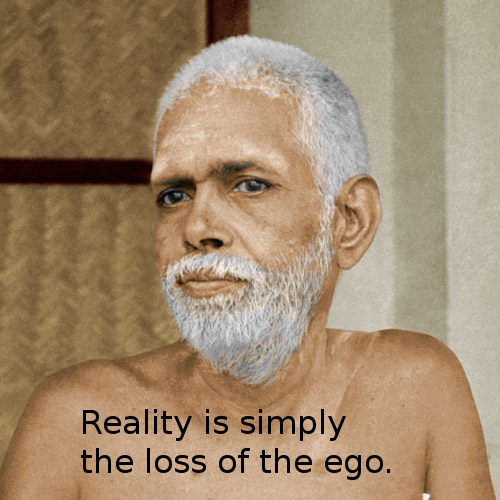
Ahimsa – The Antidote to Fear
By Dr. Harsh K. Luthar
Bhagavan Sri Ramana used to say, “Ahimsa Param Dharma”. It means that Ahimsa (Nonviolence) is the Supreme Dharma (Duty or Principle). Sri Ramana pointed out to the devotees and yogis that in Patanjali’s Yoga Sutras, Ahimsa is named as the highest virtue above all other virtues. If we are able to understand what Ahimsa means at the deepest level, that clarity itself guides us in discovering the nature of the Self as our own Being.
Advaita and Western Neo-Advaita-A Study: By Alan Adam Jacobs

‘If the blind lead the blind
both shall fall into the ditch.’
(Matt. 15:14,15)
We must be grateful to Dennis Waite and his excellent book, with its appendix, for sharply bringing this whole question to our attention. There can be no doubt that Dennis Waite’s ‘The Book Of One’ is a worthy introduction to the Ancient Teaching of Advaita. In a clear and erudite manner he summarizes the main points of this Great Philosophy and Spiritual Teaching. The book is in Sections with subsidiary chapters elucidating the chief principles. The Main Section Titles are as follows: The Unreal, The Spiritual Path, and the Real. The subsidiary 18 chapters within these Sections cover, amongst others, such topics as What I Am Not, the Nature of Man, What We Think We Can Know, Meditation, Appearance and Reality, Consciousness, the Nature of Self, Realisation, and the Direct Path.
Dennis Waite is a respected member of the Ramana Foundation UK, and there are many useful references to the Maharshi’s Teachings in the text. He has studied the subject for over fifteen years and has a working knowledge of Sanskrit. The book is definitely to be recommended for those who need a succinct overview to the whole Teaching in one medium size volume. It is easy to read and surveys the philosophy competently in an even handed way. This part of the book can well be regarded as a sound and valuable introduction to the whole field.
There is, however, a long Appendix of 24 pages packed with information on current Western Advaita Organisations, International Internet Sites, and a Reading List. This part of the book and the names contained in it raises an interesting and perplexing question of what exactly is happening to the hallowed and revered Teaching of Advaita in the Western World?
Many firm devotees of Sri Ramana Maharshi now rightly term this Western phenomenon as ‘Neo-Advaita’. The term is carefully selected because ‘neo’ means ‘a new or revived form’. And this new form is not the Classical Advaita which we understand to have been taught by both of the Great Self Realised Sages, Adi Shankara and Ramana Maharshi. It can even be termed ‘pseudo’ because, by presenting the teaching in a highly attenuated form, it might be described as purporting to be Advaita, but not in effect actually being so, in the fullest sense of the word. In this watering down of the essential truths in a palatable style made acceptable and attractive to the contemporary western mind, their teaching is misleading .
Let us examine this thesis in more detail. There are a great many so-called Advaita or Non-Dual Teachers both in Europe, America and Australasia. Dennis Waite lists numerous organisations, Internet sites, and modern books, many of which fall under this category. New teachers calling themselves ‘Awakened’ appear frequently. They are often long standing ex-students of the late Raj Neesh, or people who visited Lucknow with H.L.Poonja.
Obviously, styles, personalities, emphases, delineations, and content vary considerably. But there are enough common threads to identify this tendency as ‘Neo-Advaita’. First of all, the teaching are mainly presented by question and answer at meetings called ‘Satsangs’. The teacher invites questions, and then answers them in his or her own particular way. There is no overview of the basic Advaita principles. So those who attend are left with no full understanding of the complete bases on which the Teaching stands. One is dependent on what is said there and then; after many visits, which have to be paid for, one may appreciate what the self-appointed teacher is attempting to ‘put over’. The books they have published are in the main just edited transcripts of these ‘satsangs’, and are also often incomplete.
There is no doubt that many of these men and women in most cases are attractive, talented, gifted communicators. They often have a certain charisma and an intelligent quick wit. They handle concepts from an intellectual standpoint with dexterity and are often entertaining in an idiosyncratic way. Many seekers develop a psychological dependency on one favourite teacher; others move from one to another hoping to pick up some truth which will help them in their quest. But these satsangs tend to be fragmented, so many teachers and meetings need to be visited and this can lead to confusion. There is generally a lack of experiential understanding of the Real Self and its Power as deep, silent, unconditional love. When the vasanas are strong and rajistic even such rare glimpses may not happen at all.
Stated briefly, what has happened is that an advanced teaching pointer, normally give to the Sadhak by a fully Self Realised Guru, Jivan Mukta or Jnani, has been taken over as the preliminary step and is now given ‘piecemeal’ to any new adept. The suggestion that no further effort is necessary is only stated when the Sadhak has reached the point where effort is no longer possible .The mark of the true Guru is that peace, Love and Silence are palpably felt in his presence. What Neo-Advaita gives in fact boils down to the seductive formula that ”there is nothing you can do or need to do, all you have to know is that there is no one there.”
That the mind is a bundle of thoughts ,and that there is no entity called ‘me’ is ancient Upanishadic teaching, and not a new revelation as some purport. Paradoxically, and for a reason difficult to explain, all of the leading International Neo-Advaita teachers have themselves engaged in spiritual practices of one kind or another, sometimes over a long period, then they deny this necessity to their pupils.
The suggestion by the Neo-Advaitins that effort builds up the Ego giving it a sense of pride in its ability to meditate is only true in a small number of eccentric cases. In fact, the effort of developing one pointedness leading to Self Enquiry in order to discover the source of the ‘phantom me’, the root of all thoughts and feelings, actually undermines this recalcitrant ‘egotistical ghost’. Effort can give some modicum of necessary mind control, and one pointed attention. By sidelining Self Enquiry and treating it as an idea rather than a practice along with Devotion and the support practices for Self Enquiry, the student is left in a comfortable conceptual mental zone where it is stated cosily that ‘there is nothing to do and nowhere to go’. One can park in this space forever, coming once a month and paying for another satsang, hoping Grace will descend. It is like trying to win a major lottery prize, without ever having bought the ticket of turning deeply and persistently inward and enquiring into the source of the ‘phantom me’. Friendships are often made and a lifestyle developed which is psychologically rewarding. Retreats and intensives are held.
The charge is made that effort is trying to ‘get something’ and therefore suspect as coming from the ‘me’. In fact, the ‘ghost of the me’ doesn’t really exist as an entity. The notion of ‘the false me’ is very powerfully fuelled subconsciously by the selfish-will and compounded by the vital force. It has to be diligently enquired into to be destroyed. The Maharshi says emphatically that our only freedom as an ajnani is to turn inwards. It is not trying ‘to get something.’ It is rather trying to ‘get rid of something’, the sense of separation, i.e. identification with the thoughts, mind, and feelings. Otherwise, there is a permanent occlusion, the Granthi Knot, permanently screening off the tremendous power of the Real Self, which is the Absolute Unborn Deathless Consciousness, God, Unconditional Love, Dynamic Silence, and Oneness. Instead, the Neo-Advaitin pupil merely basks in his or her Reflected Consciousness, designated as follows: ‘All there is, is perfect, whatever manifests.’ The clear distinction between Absolute and Relative consciousness is not made, and possibly may not even be known about.
To summarise, the main Neo-Advaitin fallacy ignores the fact that there is an occlusion or veiling formed by the vasanas, samskaras, bodily sheaths and vrittis, and there is a Granthi Knot forming an identification between Self and mind which has to be severed . If this were not the case then the whole of humanity would be living from Absolute Consciousness. As it is, humanity still lives from Reflected Consciousness, including the Neo-Advaitin Teacher with his or her active vasanas, still identified with the mind. In effect Neo-Advaita gives the ego licence, without attenuation, to live on under the justification of a seductive, hedonistic argument.
The Maharshi’s remedy to this whole trap is persistent effective Self Enquiry, and/or Complete Unconditional Surrender of the ‘phantom ego’ to Self or God, until the Granthi Knot is severed, the Vasanas, Samskaras and Vrittis come out, and are rendered harmless like a burned out rope. Support practices and directions are given for those who find Self Enquiry too difficult to commence. Partial surrender is possible for all, leading to total surrender through Grace consequent on efforts made through earnest one pointedness. In his foundation Essay, Self Enquiry {Collected Works}, Bhagavan clearly draws a diagram which shows how the Ego, composed of thoughts, bodily sheaths, and tendencies, forms a mirrorisation which reflects Pure Absolute Consciousness through the door of the senses onto the world as Reflected Consciousness.
The Neo-Advaitin often says somewhat wryly that Awakening is actually very ordinary and nothing special. Obviously it will appear ‘grey’ if vasanas are still active. How can living in Sahaja Samahdi and from Absolute Consciousness with unconditional love, great peace and dynamic silence abounding, be called ‘ordinary’ ? For the Neo-Advaitin teacher, there is a process of cleverly intellectually deconstructing the ‘sense of doership’ or the ‘false sense of me’ or ‘phantom ego’ which can, if performed intensively, lead to an experience, usually temporary, that there is ‘nobody there’ and even making the sense of doership temporarily disfunctional. This is then termed as ‘ an awakening has happened’ or some such hyperbole and the aspirant rests content and may even develop a desire to teach the same technique to others. The subtle part of the ego believes itself to be ‘enlightened’ but the vasanas are still active, so the awakening is conceptual, and possibly imagined, rather like the ‘born again’ experience in evangelical Christianity. No Jnani ever claims to be Enlightened. It remains for others to recognise his qualities. To say ‘I am enlightened’ is a contradiction as the I which would make such an assertion is the ‘I’ which has to be destroyed before Enlightenment can happen.
The Neo-Advaita teacher is still talking from the mind in reflected Consciousness not from the ‘no mind’. To claim to have awakened others prematurely in this tentative way then becomes further proof of a teacher’s ability. This builds up a false sense of expectation in the mind of the naive and gullible adherents that they may become awakened too, if they are lucky. This then becomes a vocation, and in many cases a very successful means of earning a livelihood. Pupils gravitate to the teacher with this kind of agenda which confirms what he or she wants to believe, that no effort is needed. The result is that the Teacher, still living from the ordinary mind, with vasanas active, can never go back on the promise that he is ‘awakened’ and therefore forfeit the right to teach. That the vasanas have been accumulated and consolidated in previous ‘life dreams’ is not examined, and if raised, the teachings about ‘samsara’ , ‘maya’ , jiva, karma and re-birth, are often considered too metaphysical to explain or grasp. They are invariably dismissed as old superstitions. Teaching from the ‘no mindstate’ or ‘silence of the Sage’ can never happen while the powerful vasanas are active. They have to die down and become harmless, and this means self-enquiry and surrender, until the mind, through Grace, when the Real Self recognises the Jiva with a one pointed mind, has fully turned inwards. The nervous system has been prepared and The Self then draws the mind into the fully opened Heart. This is Self Realisation.
Many of the teachers claim Ramana Maharshi as their lineage, often displaying his photo prestigiously, but are not at all erudite in his Teaching. Often the Teaching is stripped of its devotional content. Some merely pass over him and are content to be the sole authority. To give ‘satsang’ in Arunachala gives some Teachers added credence. How has this fundamental fallacy come about? Why is it so attractive to mostly young contemporary Westerners, that they are content to by-pass Self Enquiry, Devotion and the Surrender of the ‘false self’ or ‘ego’ to the Real Self or God, and so hand over all the cares and responsibilities of their lives, with great faith, before entering the spiritual life?
This advanced teaching of ‘no effort needed’ drawn from advanced Advaita and Cha’an Buddhism [the Sudden Awakening School] has slipped in as the fundamental Neo-Advaita pointer. It is then easy for the radically skeptical Western mind to accept this lazy way in our micro wave culture of wanting instant gratification now, instead of having to work at studying the Teachings of the great Sources of the contemporary Advaita Renaissance, Sri Bhagavan Ramana Maharshi, Adi Shankara and other great Sages. Nor do they need to develop some power of attention and concentration. Nor does Hindu terminology have to be understood, and the traditional language assimilated even in translation. This demands study and effort. The making of an effort can arise without a sense of personal doership just as one makes efforts in life spontaneously when needed, from the vital energy. It is said that we are utterly helpless and there is nothing we can do, but this ignores the All powerful Self and the Grace which starts to flow as a response to the initial and persistent effort of Self Enquiry and Surrender. The idea that this ‘awakening’ may not be immediate does not appeal to the current desire for materialistic instant satisfaction. Hedonism, without pain, dominates Western culture, religious values are at a low ebb, and a humanistic teaching is much more appealing.
Besides it lets the Teacher off the hook. He can dispense with advising on Sadhana altogether. Peace and quiet is preferable to Sadhana as the prerequisite for Enlightenment. This has a therapeutic value. In addition the idea of a ‘living Teacher ‘is appealing. It is not understood that the Supreme Guru, the Jivan Mukti who has left the body, is still available both in the Heart as the Sat-Guru within or as Absolute Consciousness, the Deathless Unborn Self, beyond the mind. But to reach the Sat-Guru inwardly needs the effort of turning inwards and this is not a popular word to use, although effort is applicable in every other walk of life. The Neo-Advaitins claim there is no one there to make any effort. This is absurd. The energy for the wish for liberation arises and the intelligent part of the ‘phantom ego’ begins Self Enquiry and its support practices leading to one pointedness. If there was no one there to make effort, how does any work get achieved on this planet at all? Self Enquiry needs preparation, as David Frawley has pointed out in his excellent books on Advaita and articles in the Mountain Path. Self Enquiry may not yield an immediate perceivable result. It commences a graceful process of removing the obstacle of obscuration to the Realisation of the Real Self. To borrow metaphors from the Gospels, the Kingdom of Heaven within is the pearl of great price. It has to be earned by earnest enquiry and surrender. The real purpose of Life in this birth is not merely to enjoy oneself in sensual pleasure but to summon the necessary effort to remove the phantom ego’s sense of separation and identification with the mind, thoughts feelings and body. “If the blind lead the blind both shall fall into the ditch.” It is truly a marvel of Maya that some Neo-Advaita teachers can state personal views which suggest that their knowledge is more profound than that of the Maharshi.
It must be said that this Essay is a generalisation based on visiting the many Neo-Advaita teachers who come to or are resident in London, and seeing videos of others in the USA and elsewhere. My criticisms do not apply equally to all. Each one has his or her own emphases, angularities, and delineations, but the basic thrust of my reservations are generally applicable.
However, Neo-Advaita, no matter how faulty and incomplete, has a distinct advantage. It can serve as an introduction to the true Advaita Teaching. Flawed as Neo-Advaita may be, it undermines ‘the phantom ego’ intellectually at least, after several satsangs. At its best it is a partial surrender , but without full devotional content, and therefore cannot lead to total surrender when the mental occlusion is absorbed in the Heart . One can only accept that the Neo-Advaitin movement with its proliferating teachers and burgeoning web sites is here to stay, although some have prophesised that the tide is beginning to turn and that many are now beginning to earnestly enquire into Ramana’s Teaching. Nevertheless, Neo-Advaita is a necessary part of ‘what is’ and as an aspect of the divine plan has its place as a preliminary introduction. It is therefore a valid, if imperfect stepping stone, for those who are ready and mature enough to walk on to true Advaita, instead of just reclining half way up the Mount Arunachala.
Allow Sri Bhagavan to have the last word on this question….”There must be human effort to discard them [vasanas]….how could God be expected to be favourable towards you without your striving for it'” [Letters pg 151].
Life is a pure flame, and we live
by an invisible Sun within us.
Alan Jacobs is Chairman of the Ramana Maharshi Foundation UK , A Moderator of Ramana Maharshi and Atma Vichara at Yahoo Groups, author of The Bhagavad Gita a Poetic Transcreation and The Principal Upanishads A Poetic Transcreation . He is also a professional Life Coach. You can find his website at www.creativelifecoaching.org
This article published with permission from The Mountain Path.
Image of entrance to Virupaksha Cave courtesy of Gabriele Ebert.
 Luthar.com
You must be logged in to post a comment.