Harsha's avatar

Kundalini Shakti and Spirituality: By Dr. Harsh K. Luthar

The awakening of Kundalini Shakti is one aspect of spiritual life on many of the yogic paths. It allows for the exploration of  manifesting consciousness at different levels of existence.

What yogis refer to as Kundalini Shakti in the East has different names in various religious traditions. I believe that in Christianity, this power is referred to as the Holy Spirit.

All these practices such as centering prayer, meditation, concentration, devotion, praying to the Lord with heart felt intensity over a period of time can evoke a powerful response from the fundamental primordial divine intelligence that sits at the base of all life and in our heart.

In Yoga (see Patanjali’s Yoga Sutras), the first principle is Ahimsa or nonviolence. That should be the proper foundation on which to build one’s life and to experience the manifestations of the divine intelligence which we refer to as the Kundalini Shakti.

Normal awakening of Kundalini Shakti allows one to balance the spiritual and the worldly aspects of life. Through Kundalini Shakti, one can come to understand the role of conditioned consciousness  in desiring, creating, and consuming various types of experiences, both of the spirit and of the world.

The spiritual life may integrate visions of angels, saints, the divine feminine as the Goddess, and other forms of  super conscious experiences.

However, the ultimate aim of a life that is lived well is to attain the “peace that passeth all understanding”. That perfect peace comes from knowing our original and pure nature and abiding effortlessly in that.

On the path of Kundalini Yoga, there are many gimmicks and also charlatans who pretend to be Kundalini masters and so forth. If your spiritual search is sincere and free from the greed to obtain various psychic and mental experiences, you can easily avoid such things.

Some people are attracted to telepathy, mind reading, fortune telling, astrology, and such phenomena. There is nothing wrong with such desires but where can these really lead us in the long run?

By remaining pure to the ideal of knowing deeply the truth of your being and existence, gradually you will lose your attraction to small and superficial things which dance in the mind and cause ripples.

Whatever religion or spiritual path you follow with Ahimsa (nonviolence) as the foundation of your life and gentle and kind awareness as your support, it will bring you to the destination which is here and now. The kingdom of heaven  exists in this very moment.

Harsha's avatar

Spring Renewal: Ready For Detox? by Rita Minassian


Cleansing our body inside out has become essential nowadays. The high level of pollution and the increased electro-magnetic activity in the atmosphere, hectic professional agendas and endless lists of preservatives in our food, contribute to increase the level of stress in our system. By stress, I don’t only mean high nervosity or anxiety but an imbalanced state that creates blocks and ultimately disease. Additional to a healthy lifestyle routine, anyone who has ever experienced a detox program agrees that helps to clear not only the body, getting rid of any excess weight, to restore and optimize our energy level, but clears the mind as well, bringing more focus and an overall sense of ultimate sense of well-being. Then our outlook on life changes drastically, a more positive approach of life is possible which is rule number 1 to prevent depression and an optimum healthy life.

But is this just a modern, trendy “must do” during intermediate seasons?… Certainly not. From ancient traditions spring detox has always been a universal concept.

Years ago, when I first experienced Ayurveda at Soukya Holistic Center in Karnataka-India, I ‘ve been told by my physician, world-renowned Ayurvedic Doctor Isaac Mathai, that the monsoon season usually starting  in May, is actually the best period for a Panchakarma: a complete 5 step mind-body detox program which ideally lasts for 7, 14, 21 or 28 days (the duration of a Moon cycle and a cell renewal cycle by the ways…). He explained that the rainfalls actually support the cleansing/detox provided to a patient according to their Dosha type (biological “moods”). I also believe that people feel more positive and refreshed inside out because of the negative ions generated by rainfalls.

Ghulum (bath attendant) providing a customer with 2 Ayurvedic procedures.

In Panchakarma, a combination of different techniques are used to remove stored toxins in the body which contribute to sap our immune system. Purgation is usually processed with clarified butter (ghee) to remove impurities from the colon or water for a nasya (instillation through nostrils). Blood letting is also used to renew the red blood cells in the body.

Specific massages, like daily Abhayangas (4 hand massage) bring back balance and harmony to the body and to the Chakra system. The Shirhodara (3rd eye cleansing and my favorite…) do wonder on quieting the mind, increases awareness and heal migraine and Parkinson. Goodbye anger, sadness, grudges or lingering guilt, they will all be swept out… It’s important to remember that while a imbalanced diet can obviously affect the body directly, negative thoughts are actually number 1 enemies to harmony and good health.

Meditation and yoga programs can be added to these medical techniques: a combination of postures (Asanas) with Mudras, breathing techniques (Pranayama) and Mantras, are powerful tools to unburden the body and mind.

It is interesting to mention that this period of spring cleaning corresponds as well to some religious and non religious practices found in different traditions. For example, according to the bible, spring is time for the Jewish community to get rid of all the “hametz” during the pre-Passover time: every single dust or crumb has to disappear from the house before the celebration of “Pessah”, liberation.

In Feng shui, spring is also an important time for a making up; what to keep, what to give, what to get rid of… In this ancient Chinese concept, old, useless items represent blockages for a fluent energy flow in the house, but also for the inner world (body system), and for the mind: any type of clutter, within the body and/ or in the environment has to be cleared to avoid disease.

Mother Earth, in her infinite abundance and generosity offers us everything to achieve this detox: plants, vegetables, essential oils, specific spices like curcuma and cinnamon among many others are on the top list of the “natural cleaning team” in Ayurvedic medicine. Aditionnal to the digestive system, a Panchakarma detox program will also support several other channels of elimination in our body: lungs, kidneys, skin, and lymphatic system, all your body will be thankful for this renewal. It goes without saying that a Panchakarma  has to be done by a physician specialized in Ayurveda.

Wether using ancient wisdom tools, planning a retreat in a traditional medicine clinic, or indulge yourself in a modern SPA resort, it’s time to find your ultimate place for detox and enjoy your rebirth!

Rita Minassian

www.ritaminassian.com

Harsha's avatar

Chakras: The Pathway to Enlightenment by Rita Minassian

Rita Minassian holistic therapist chakra-balancing 

The chakras energy centers, a Sanskrit word for « wheel » or « disk », are the keys to reach Enlightenment. Through their meaning, colors, symbols, we can embrace the whole history of humanity starting from its root toward its supreme realization we’re all walking toward.


The Mulhadara chakra (or root chakra) located at the base of the spine is the chakra of our fundation: it refers to our survival instincts, self preservation and security. During prehistoric ages, people’s first occupation was struggling to survive. All their activities were about eating, finding a grotto to protect themselves from dangerous animal’s attack or bad weather, and when the moment came, to protect their precious source of fire.


Middle ages and Renaissance period were the theater of conquerors around the world. Crusaders or  conquistadors were fighting to conquer territories like Holly land and south America in tremendous violence, while other one were competing for the power of a royal throne and wealth, killing or raping people without guilt.


Through centuries, humanity progressed to Svadhistana, our second orange chakra just below the navel. It connects us to others through feeling, desire, sensation, and movement. It represents our capability to exchange and interconnect with the others. This need lead people to the sexual freedom in the 70’s: Woodstock and the use of the orange color during this period of time was the tangible representation of that desire to free the energy of Svadhistana chakra.


During the 80’s, we entered the Manipura chakra Era. This yellow solar plexus chakra represents, ego, identity and is oriented to self-definition. Time came for women who wanted some more recognition in society to adopt a “male look” through ties and shoulder pads on fashion at that time, businesswomen were becoming more and more numerous in companies, where self progression was motivating each step of corporate associates, male and female.  Ambition, self realization in a materialistic way: people just worked to achieve some personal goals through one rule, “Me first” …


Have you noticed how purple color overflowed fashion this year? For who knows the chakra color system it is surprising to talk about purple color instead of Anahata’s beautiful emerald green color… But shifting from  Manipura to Anahata, from ego to heart and Love, to generosity, non judgment, non violence, we need a lot of transformation and spirituality which is actually the symbol of purple color. Purple was also present during the 70’s when desire to enter the “New age” through a new spirituality was emerging. Anahata is a crossroads chakra, it’s very exigent and very simple at the same time: with loving ourselves and being in Peace, we allow ourselves to Love Unconditionally.


Anahata is also the “filter” for the Kundalini energy that climbs up from one chakra to another one and to transform it into a subtle compassionate energy and reach Vishudha chakra through the narrow space of our neck. Thanks to the  filter of Anahata, this blue communication chakra, we will express our thoughts in a compassionate way.   


This energy full of kindness will continue its path until arriving to Ajna chakra, or the 3rd eye chakra in the middle of the eyebrows (pituitary gland). It’s the place where our Yin and Yang energies meet: we then become more aware of our being and of our Universe. Ajna is the seat of our 6th sense that sees intuitively. Through it, we can use our insight and psychic skills. Nowadays, we can see more and more children around us with very strong intuitive skills and large consciousness:  some schools are aware of this phenomenon and accompany them with adapted programs. Some of them are known as “indigo children” because of the indigo color of their Aura, similar to Ajna chakra.


Finally, the run of the Kundalini energy will finally end to our crown chakra: Sahasrara and its “1000 petals” tinted in marvelous colors like purple (spirituality) white (purity) gold and silver (usually related to Guides and Angels)…

These numerous “receptors” connect us to our Higher Self, to our Guides and to Upper Forces. When everybody will reach the level of Sahasrara through a rich Spiritual life (which is not necessarily a religious life) people will access to wisdom, all-knowing, and bliss. That moment of pure Enlightenment will give us the opportunity to live in Harmony, at least…


The good news is that our evolution is rapidly increasing in the last decades than it used to be at the beginning of humanity, and hopefully our complete awakening will arrive quickly.


Each progress we make in our personal path toward Enlightenment is a help for our kinds: the more numerous we will be to raise our vibratory frequency, the better it is for the collective unconscious and our planet. From 1952 to 1958, in the island of Koshima in Japan, scientists established a theory which is called “The 100th Monkey”: the scientists trained monkeys to wash their sweet potatoes before eating them. After a certain number of monkeys trained, the scientists noticed that the monkeys on Takasakiyama island, a neighbor island of Koshima, started to wash their food also without being trained for it or having any connections with the trained monkeys … This experience shows us how the energy of a group can have effect on other ones attitude…


Everything that happens in this world finds its Source into upper world and upper force, using them for humanity’s Enlightenment is the choice we have through our free will. Like the lotus flower and its root in ooze becomes a beautiful flower with the help of the sunrays, such is human being and humanity in a holistic state: grounded into earth but push by a thirst for Light and Upper Forces to be able to grow…


OM MANI PADME HUM, this post is dedicated to the 7 billions of Lotus jewels around our beautiful planet walking toward Light.


Rita Minassian

www.ritaminassian.com

Harsha's avatar

A Zen Garden: By Jerry C. Weinstein

Jerry Weinstein, known lovingly to his friends and admirers as Jerrysan Rinpoche, is a retired lawyer. Jerrysan gave up a very lucrative and highly successful law practice many years ago to live the quiet life of a sage and meditate on the mysteries of life. The force of an active kundalini has been with Jerrysan for many years, showing him both the beauty and the agony of being human and aspiring to the divine union.

When Jerrysan speaks to us about his suffering and lays bare his heart, he teaches us about the human condition and our collective suffering and lays bare our own hearts. In revealing himself, he reveals us.

Jerrysan once said something like, “My heart is an ocean, like a love that has no shoreline. Yet this heart must be shattered over and over again as I progress on the path of the unknown. I have been deprived of all comforts of not only outer life but inner life as well — all reliance upon scriptures, teachers and their teachings is gone. All forms of meditation and mystical experience have been given up — in order to fully realize who I am.”

A ZEN GARDEN
By Jerry C. Weinstein

image

I used to go to Asia every year, especially to India, but had never been to Bali. So in August 1992, l scheduled a trip there. It’s such a long flight l decided at the last minute to do a stop-over in Japan for 5 days to break up the trip. Before l left l told my caretaker to get rid of all the weeds in my back yard, which was quite a mess.

Upon arriving in Japan l immediately went to Kyoto, which l knew to be a spiritual center with a lot of zen temples. It was then that l found myself in another world, sensing at once that destiny had guided me there. I’d been doing vipassana meditation pretty intensely for several months and was starting to feel the increased concentration and depth from this practice. In addition, I’ve always had a passionately aesthetic nature. So, l think it was a combination of these things that led to not only the temples, but particularly the zen gardens being probably the most wonderful moment of discovery I’ve ever known. There were many moments of melting in tears of joy, and many others of profound meditative stillness, induced by the sense conveyed of almost perfect harmony with nature.

It was with great reluctance that l left Kyoto for Bali, which, although it has its charms, proved to be an afterthought. Then, after flying home and pulling up in my driveway, l had the sense of being someplace else. My caretaker, instead of being content to get rid of weeds, had also cut down every tree in my backyard, making it unrecognizable.

My upstairs tenant, a staunch environmentalist, was angry at me and ready to move out. The neighbors were furious. l called my caretaker and asked how he’d managed to so misunderstand me do something so unthinkable as this? He had always been a thoughtful and responsible person, and curiously, appeared to have no idea himself.

My first reaction, since l now had a bare yard, was to arrange to have a bunch of trees planted. But somewhere within me the Kyoto experience resonated enough to lead me to postpone doing anything for awhile. The idea of having my own zen garden had an allure — the problem was l was bogged down full time in my law practice and had never even planted a tree or done any gardening in my life. So the notion of my doing anything was totally impractical. My hope was that, hey, maybe something will just evolve or manifest itself out of my meditation practice.

Less than 2 weeks after my return home my kundalini process began, with energy shooting out of my brow chakra and remaining there on a permanent basis (as well as elsewhere). There were 6 months of powerful but mostly pleasant energy sensations — interestingly, every time l looked at a tree my brow chakra would go crazy. Then certain breathing practices led to a long period of continuous headaches and other problems, making any meditation impossible. So much for the idea of a zen garden — that was the least of my concerns. So my yard just deteriorated more and more as first months, then years went by.

My yard became the junkyard of the neighborhood as weeds, beverage cans and dog crap became its main constituents. My neighbors were beyond being upset — l told one of them that someday it was going to be a zen garden, which drew a mixture of disbelief and ridicule.

My kundalini hit bottom in late 95, a time when physically l felt like l was going to die. I separated from my meditation teacher (my guru at the time) and also began winding down my law practice.

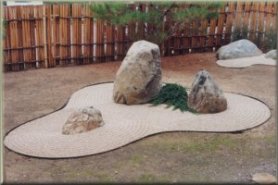
lt was then that l turned all my attention to my yard. l just stood out there, day after day, getting the feel of it and recycling ideas through my system. And so began a process that lasted for over 4 years. First, l did a formal zen sitting garden in the back, with a large area of raked, fine gravel and a meditation platform — enclosed by a fence and bordered by trees, a groove of bamboo, and a small Buddha statue in the rear corner. l often asked myself, why am l doing this? l can’t even meditate and may never be able to again. l just seemed to be driven to do it. What surprised me was that it worked — the effect was magical — friends started coming over to meditate there.

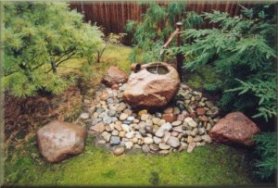
Once the back was finished l figured that was it. But 2 years later l decided to expand the garden from the back to include the side area. Once again l was completely stumped at first, but I eventually came up with a moss garden with a water feature, boulders, Japanese maples and conifers, enclosed by a bamboo fence.

l was amazed at the end result. Then last year l decided to go all the way and do the front yard also. l was just as clueless as before, and again spent day after day in front of my house, as my neighbors nervously looked on. l completely redid my front yard, enclosing it with a bamboo fence on top of a low dry stone wall. l brought in several huge boulders (which required months to select) which l arranged in various combinations surrounded by raked gravel and trees. l also tore up the straight cement walkway from the street and created a curving stone path that leads to the front door and also winds completely throughout the entire garden.

So, if anyone’s still with me here (ha ha), l now have a completely enclosed zen garden which covers my entire property and consists of 3 distinct areas. At the risk of sounding egotistical, l am pretty amazed by the physical transformation that’s occurred. Several landscape architects have wandered in and have been stunned by it. Local garden associations have pestered me to take tours through here, but I’ve resisted that so far — just doesn’t feel right. And my dear neighbors have become humble admirers.

image

Of course, there’s a downside too — l could write a book about all the problems I’ve encountered. Maintaining the zen garden is no small thing. But l think being able to do the garden has been wonderful for my energy process, both in terms of strengthening my connectedness to the earth and in providing an opportunity to be creative in such a fulfilling way.

For all this, l can be thankful that for some mysterious reason my caretaker decided to cut down all my trees. In recent weeks I’ve found that after nearly 7 yrs, my headaches are finally getting better, and the energy is flowing more freely again. Maybe this summer I’ll get to meditate in my garden.

Editor’s note: Jerrysan Rinpoche is a long term member of the HarshaSatsangh community. His article first appeared in the first volume of the old HS Ezine in 2001.

Harsha's avatar

Comments on Deep Body Relaxation: By Dr. K. Sadananda

I received some excellent and thoughtful comments from Sada-Ji (Dr. K. Sadananda) on the article, “The Method of Deep Body Relaxation.” These comments with minor editing are given below. Thank you Sada-Ji.

Editor
**************************************

Comments on “Deep Body Relaxation” By Dr. K. Sadananda

Harshaiji – PraNAms

Here are some comments on your article about “Deep Body Relaxation.”

Shava Asana is always done at the end of yoga exercises as a relaxation technique.

However, I would like to add a word of caution for going from Shava to Shiva – that is lying down and doing regular meditation. There is a good reason why the Lotus Posture (Padmaasan) is universally recommended for meditation. Shava or the corpse is considered as inauspicious while Shiva means auspiciousness itself

Also, it should be kept in mind that when one is in meditation, the normal breathing process will slow down and mind becomes quiet and calm. These conditions are conducive for the mind to go to sleep easily. Hence for most meditators, sleep becomes a big hurdle to overcome. Therefore, the Shava Asana (Corpse pose lying on the floor or bed) may not be useful for meditation.

Sleep is the opposite of meditation. In meditation one attempts to stay conscious and awake. That is one of the reasons why meditation is not recommended in the night when the mind is tired, but in the early mornings when the mind is fresh and vibrant. The period around 4am in the morning is considered best for meditation (it is called brahma muhurtham in Sanskrit).

The Lotus posture insures that the person who is meditating does not fall forward. Sitting in the lotus pose is recommended so that the student is stable and firm on the ground.

Yogic texts all advise that the vertebral column and the neck be in straight line (without going into the details of kundalini aspects).

This way one can stay in meditation for any length of time – awake-vigilant and meditative. Indeed that is the state of mind in meditation to be aimed at.

As Harshaji states, one can easily go to sleep in the Shava Asana. In fact one should go to sleep in that pose thinking of the Lord.

Then one can have Yoga Nidra and blissful heavenly relaxation.

But for Vedantic inquiry, the mind has to be sharp. Our own experience is that we can read stories or popular magazines lying down. But for any serious work, we have to sit up and study. Knowledge can take place only when the mind is sharp. Then, what to talk about the subtlest knowledge about one’s own self. So the recommendation is to do meditation in the sitting pose – if you can.

If you cannot, then alternate poses are recommended.

Now the question is whether one should do meditation in a lying down pose such as Shava Asana! Of course you can do! It is like a drunkard who went to ask a priest, “Sir, can I drink while praying to God?” Priest of course said, “No. you should not drink while praying.”

The drunkard thought about this and re-framed his question and asked again, “Sir, can I pray while drinking?” “Yes of course”, said the priest. So, can one meditate while lying down? The answer is, “of course you can meditate any time and anywhere.” No problem!

Should one lie down to meditate? No, that is not advisable. Sri Krishna himself recommends sitting down and meditating in the 6th Chapter of Bhagavad Gita.

Of course for relaxation – what Harshaji says is correct.

But For a meditator, relaxation is not the goal, but it is only a by-product. Vedantic meditation requires a calm, quiet, and vigilant mind. It is a subtle inquiry within of the very essence of life itself. If relaxation becomes a goal, the meditative mind will only long for that. If the mind settles in that groove, it will not be ready to take a higher flight.

Harsha's avatar

The Eruption of Kundalini-Shakti: By Michael Hortling

(This article was originally published in HarshaSatsangh E- Magazine Volume I)

Twenty years ago, the kundalini-shakti erupted within myself. Since I didn’t have a clue about what had happened to me and I experienced some quite unpleasant side-effects of this awakening, I had to start looking for remedies in order to ease some of the discomfort. This has been a more or less ongoing process ever since and although I can’t say that all problems have disappeared, some interesting insights and experiences have been gained and that alone has made the journey very worthwhile.

The effects on the psyche, and on one’s ideas about oneself and life in general, that come about by an active kundalini are far reaching indeed, but this transformation seems to have a price attached to it. In my case I’ve been plagued by a variety of symptoms ranging from physical health problems to bouts of anxiety and depression. As a result, I’ve been led to closely observe and attempt to harmonize the innermost workings and mechanics of my mind and body using a variety of techniques and methods such as tai-chi, hatha-yoga and various types of meditation.

To Do Something, or Nothing?

As much as I agree with the advaitin conclusion about reality being One and the concept of separate personalities acting within reality being illusion, I think that the often heard claim that nothing actually needs to be done in order to realise this, will probably only be true for a small number of persons. I find that, in the case of myself at least, ( and I do believe this would apply to most people) some work on oneself using “techniques” is necessary in order to be able to experience this fundamental unity of life. The main reason appears to me to be the deeply ingrained innate patterns of body and mind that prevent a true perception of life.The experience of duality seems to be hardwired into our being by nature, so that definite changes have to take place within the perceiving mechanism of ourselves before reality becomes non-dualistic.

Doing Mantras

One spiritual discipline that seems to work on many different levels to me has been the practice of silent mantra-repetition. One of the first deeper insights or realisations came to me after I had practiced mantra-meditation for some time as taught by Transcendental Meditation or TM.

I was sitting in meditation one day, quietly repeating the mantra in thought, growing progressively calmer and relaxed as a result as the normal rush and clutter of the mind began to recede. Suddenly it hit hit me like bolt of lightning – I was inside “myself”, calmly watching the mantra repeating itself, calmly observing whatever thought-processes still passed through the mind – BUT I WASN’T THE MIND – I WAS THE OBSERVER OBSERVING THE MIND! An enormous sense of relief and gratitude welled up inside as I in one instant understood that everything that really created problems in my life was either mind or body, but that the real “I” was the silent and totally unaffected observer, calmly watching everything come and go.

This was a very profound experience since it in one instant blew the identification with the mind to bits. I had always somehow thought that I actually WAS the constant inner monologue and imagery playing themselves out and now this was shown to be not true at all in a perfectly clear way. I was actually the screen on which the mind with its movies was projected – but I wasn’t the images themselves.

I soon realised however that this was just a glimpse into the deeper reality, but not at all a permanent state of enlightened being – a lot of practice or sadhana seems to be necessary in order to shift the focus of consciousness for good, even though the awakened kundalini is a kind of automatic process in this direction.

After this, mantra practice began to intrigue me more and more, especially since I also became very sensitive to sound and music in particular. I would experience rushes of kundalini moving up the spine, followed by ecstatically blissful sensations listening to certain types of music or certain combinations of notes and harmonies.

I then began to experiment with other mantras and other methods of repetition. Whereas the TM-meditation in essence uses the mantra to really allow oneself to let go and relax completely, I found that mantra-repetition could also be used to direct and control the mind in a more active and deliberately focused manner. This is more in line with yoga as taught in the tradition of Patanjali. The aim here is the sharp one-pointedness of mind which prevents the scattering of thoughts in all directions and keeps the mind from going outwards through the senses. It seems to me that it really is this rapid movement of the mind, constantly going back and forth between the falsely perceived separateness of oneself and the equally false “outer world,” that is one of the main obstacles to just calmly resting in the unity of world and self.

Technically, what seems to happen is that the focusing of thought focuses energy and this usually leads to an increased flow of kundalini along the spine. When this burst of energy reaches the highest region of the brain, shifts in consciousness occur, spiritual insights come drifting into awareness automatically and there can be general feelings of being in tune with the All and Everything.

For this slightly different way of repeating, I try to focus with as much attention as I can on the sound and the shape of the mantra until it gradually fills out the whole space of the mind . I’ve often also done this walking outside with eyes open until sometimes the boundaries between inner world of thought and feeling and outer world of objects have more or less vanished and everything is just felt to be one big continuum with different degrees of density. If the focus is strong enough, it’s as if the whole outer universe becomes filled with the sound of the mantra as well and it can then seem as if the cosmos begins to chant back, which is quite nice.

Mantras and Side-Effects

Other interesting and spiritually useful side-effects of doing mantras over time, is that one develops an increased awareness of the shape and direction thoughts take and it becomes much easier to voluntarily direct the mind and consciously choose which thoughts to follow and which are best left to fade away by themselves. Since I firmly believe that thought determines action and ultimately the realities and life circumstances we find ourselves in, this aspect of mantra-practice is probably quite powerful, in terms of shaping the future and destiny.

A third approach to mantra-recitation that I’ve used with some results is more in line with tantric teachings which focus on the harmonising and control of the different chakras or areas of consciousness. This is also done in order to understand and streamline the physical and mental aspects of life, which manifest through the lower chakras. Mind and body in essence seem to be permutations and combinations of the 5 basic elements – ether or the space in which manifestation takes place, air, fire, water and then earth as the solid end-result. In tantra-speak all this is the Shakti side of the great universal polarity and is ruled by the kundalini. In order to experience Shiva, the silently witnessing consciousness, or the real, permanent “I” of non-duality, kundalini needs to be moved out from the lower chakras and made to unite with top area of the brain. Before that can happen in a steady and permanent manner, the chakras or in essence the elements they represent, need to be purified and strengthened. In practice, I find this to be quite demanding to say the least, but this is probably mainly due to my own shortcomings!

Mantra and Tantra

In the tantric traditions mantras have been used for this purification and as far as my humble experimentation has allowed me to see, the ancient yogis very much knew what they were doing. Reciting the mantra “Lam” at the end of the spine for instance, strengthens, energizes, opens and expands the root-chakra. Now, why is this so, why “Lam” and not any other sound ? I don’t know, but for me, taking the pragmatic approach of “if it works, use it” is the best one. Traditionally, the explanation given is that the ancient seers and rishis were given the various mantras in direct communion with the Infinite and I can go along with that. One day the science of physics will probably find out that the universe really is sound in motion and that different densities of matter correspond to different frequencies of sound. Humans, being part of the universe, will then correspondingly be found to also consist of various frequencies of sound and I believe great advances in the healing sciences will be made because of these discoveries.So, essentially, mantras can be seen to be a method of tuning the mind, body and awareness, harmonising frequencies, directing consciousness towards the light, instead of letting it scatter.

May all beings find peace and happiness.

About the Author:

Michael Hortling is currently residing in Germany. He combines mantra yoga practice with playing the guitar and creating music. As a youngster, he had a mystical experience while watching the Aurora Borealis drape itself across the Northern sky and this may have caused his energies to be like the Aurora, flowing, generously gentle and glowing brightly.

Seed Mantras

The following seed mantras are taken from the classic texts and schools of Kundalini Yoga based in Hinduism. The mantras used in Jainism and Buddhism are somewhat different. Traditionally, Kundalini Yoga in India was only practiced under the guidance of a Kundalini adept. The same advice holds today. Having a good teacher is essential in avoiding mental and physical challenges that may come with the practice of Kundalini Yoga.

LAM – the root (lessons related to the material world)

VAM – the belly (lessons related to sexuality, work and physical desire)

RAM – the solar plexus (lessons related to ego, personality, self-esteem)

YAM – the heart (lessons related to love, forgiveness and compassion)

HAM – the throat (lessons related to will and self expression)

OM – the brow (lessons related to mind, intuition, insight and wisdom)

All Sound – the crown (lessons related to spirituality) this is your quiet and all sounds around you. The sound of your being….

Harsha's avatar

Comparison of Kundalini Yoga with Jnana Yoga: By Berit Ellingsen, M.Sc.

Berit Ellingsen is a long term member of the HS community and was the Editor-In-Chief for Volume III of the HS E-Zine. She worked with great patience and creativity to bring the best out of every article that she edited and often added beautiful graphics to enhance each author’s contribution. Berit lives in Norway. She has a degree in biology from the University of Bergen, Norway. This particular article by Berit Ellingsen appeared in Volume I of the HS E-Zine in the Winter of 2001.

Self-Realization in Jnana, Kundalini, and Tantra Yogas

Kundalini Yoga

Kundalini-Shakti, in traditional Indian spiritual sources, is described as the energy that propels man to liberation. Thus, awakening this energy in the body(mind) of the practitioner is central in some liberation teachings, most notably, the Kundalini Yoga systems and the Tantra Yoga systems. As the energy moves in the central channel in the body from its resting place and source in the Muladhara Chakra to the Sahasrara Chakra, and enlivens the passive element of the mind, liberation is said to ensue.

Jnana Yoga

Jnana Yoga, the “yoga of knowledge”, the type of yoga most commonly associated with Advaita Vedanta and the non-dual perspective, does not have the body and its energies as the main focal point for spiritual development, but the mind itself. Jnana Yoga uses the individual consciousness as a tool to learn about the true self and thus attain liberation.

One method of Jnana Yoga is Sri Ramana Maharshi’s method of self inquiry, atma-vichara. In asking oneself “who am I ?” one centers the individual consciousness onto its source. Thus, by focusing the conscious mind on the still point, the witness, to witness the very act of witnessing, the barrier between the perceiver and the perceived vanishes.

Awakening the power of Kundalini-Shakti alone and manipulating this energy is not seen as a prerequisite for attaining liberation, and Kundalini-Shakti does not have a central place in the texts of Jnana Yoga. The method of atma vichara alone is enough to bring about liberation (“Be As You Are, The Teachings of Sri Ramana Maharshi”, edited by D. Godman, p. 142 and p. 146).

Is there nevertheless common ground between Jnana Yoga and Kundalini Yoga ?

From a non-dual perspective, Kundalini-Shakti is but one form of the Self. Kundalini-Shakti is the Self, pure energy and pure Being (Be As You Are, The Teachings of Sri Ramana Maharshi, edited by D. Godman, p. 145). The human mind with its consciousness is also a form of energy, of consciousness and Self.

Kundalini and Tantra Yoga

In Kundalini Yoga and Tantra Yoga, Kundalini-Shakti can be influenced by other energies such as sound (mantra), light and darkness combined into symbols (yantra and mandala) and movements of the physical body (asanas). In Kundalini Yoga, concentration on these energies and on various psychoenergetic centers, the chakras, is said to bring the Kundalini energy to these centers to break through the seven veils (chakras) that stand between union of the individual soul, Atman, with Shiva (or the non-dual consciousness, the Self).

To become strong enough to break through the seven veils of consciousness and reach the Sahasrara Chakra, the Kundalini energy must purify the body and mind in a process which may take many years. In this process, the energy will not always stay in the central channel, but spread out from the Muladhara Chakra in a broad fan that may include the entire lower body or torso in a process that can be complex.

The common denominators in manipulating the Kundalini-Shakti to attain liberation are concentration and focus. Where the mind and individual consciousness, the individual thought energy, is moved and focused on, there Kundalini-Shakti in the individual mind-body also moves. Thus, it makes sense to move consciousness not only onto energy centers, chakras, in the individual body, but instead directly onto and into its own source.

During the practice of atma-vichara, where the consciousness turns inward onto its own source, not to repress any thoughts or concentrate on any subject apart from the act of witnessing itself, the Kundalini-Shakti will automatically become concentrated into a fine beam. It will easily be led back to its source by rising upwards in the central channel with a force strong enough to break through the one true veil between man and liberation, the very idea that the individual consciousness is separate from the Self. The energy of consciousness, the Kundalini-Shakti, in this way is used as a laser beam to melt a single window instead of as a ram to bring down seven gates. No conscious piercing of the Sahasrara or any other Chakra on behalf of the individual mind is needed.

Full Liberation

To bring about full liberation, Sri Ramana Maharshi recommended to continue to clean out the vasanas (the contents of the body-mind which keeps the Atman identified with the body-mind) which may be present even after the identification with sat-chit-ananda has been experienced in the first Nirvikalpa Samadhi (“Be As You Are, The Teachings of Sri Ramana Maharshi”, edited by D. Godman, p. 66-67). After the first Nirvikalpa Samadhi, Kundalini-Shakti may manifest spontaneously, or where already present, the energy may increase the strength and efficiency of its manifestation. The Kundalini energy will then bring more of the vasanas (latent tendencies) to the attention of the conscious mind.

As a result of the knowledge experienced in Nirvikalpa Samadhi, the mind will ask itself “to whom did these events happen ?” and the true nature of this mind content is seen and disidentified with. In this process, the Kundalini energy brings the vasanas to the conscious mind where they eventually evaporate like water in sunlight.

Thus, Jnana Yoga and Kundalini Yoga may share common ground in the effect of the Kundalini-Shakti in the body-mind, both prior to the first Nirvikalpa Samadhi as well as afterwards. The difference between the two yoga systems lies primarily in the view of how this energy should be employed, either directly, as in Kundalini and Tantra Yoga, or indirectly, as in Jnana Yoga.

Harsha's avatar

Psychotherapy, Awakening, and Healing: By Dr. Holly Barrett

This article first appeared in the Winter 2001 Edition of the HS E-zine. The author, Holly Barrett, is a retired psychotherapist and a long time member of the HS community. The image is a courtesy of Alan Larus.

The Magic of Deep Listening As A Spiritual Path
by Holly Barrett, Ph.D.

Listening Instructions

In graduate school, we would-be psychotherapists were instructed in the various ways to listen to another person. This is a little like teaching love, but several suggestions were offered, including “hold evenly-suspended attention” (Freud), “practice the art of unknowing” (Kurtz), and, my personal favorite, “suspend memory and desire” (Bion). Readers will recognize the similarity of these instructions to teachings on meditation. As it turns out, I suspect that a few decades of this kind of listening had a lot to do with the arousal of kundalini in my body, and the subsequent upheaval that, ironically, led me to get out of the therapy business.

Listening to another person over an extended period of time is an awesome, sometimes tedious, joyful, frightening, and ultimately mysterious act – just like meditation or contemplation. Healing, when it occurs, is always reciprocal. Therapists talk among themselves about the weird things that start to happen: how your “client” puts feelings into your body for safekeeping (and for you to feel) till s/he is ready to reclaim them; how you sometimes know what s/he is going to say or do even while you are trying to be reassuring that you cannot read minds; how s/he comes in with the exact same dilemma that you have been struggling with since last week, or this morning. Modern psychoanalysts have a name for this: intersubjectivity. But over time, I found it impossible not to notice that some kind of divine wave motion was moving the therapy along. I decided my most important task, maybe my only one, was to draw a bead on what was alive and shimmering and holy in the person sitting across from me, and hold that jewel in my sight until s/he, too, could see it.

Diagnoses and Boundaries

I was going to title this article “Dual Diagnosis” as a little joke for my enjoyment. In psychology, dual diagnosis refers to a person’s having two presenting difficulties, like addiction plus a character disorder. But to my gradually awakening sensibility all diagnosis, all labels, even I suppose all descriptive language that implies professional “expertise,” pins people down to the dualistic manual. I looked with increasing wonder for the supposed line between the psychological and the spiritual and I could no longer find it. In fact, boundaries were disappearing everywhere. Who was the healer and who the healed? When did a “session” end, or a relationship? What did it mean that I was receiving money for this, especially if I was being paid by an insurance company based on a diagnosis I no longer believed in?

It seemed to me an enormous folly that human beings were trying to control and take credit for an ever-present and divine process. The medicalization of psychotherapy under HMOs leaves no room for the unknown, the empty spaces in life, the eternal presence of mystery. Even the transpersonal psychologists set up structure and hierarchy that can overlook the significance of the tiniest, most miraculous, everyday changes of consciousness that are a consequence of what we call healing.

My Awakening

None of the bells and whistles of my kundalini experiences surpasses witnessing a moment when a woman, for the first time, decides to let THIS anger, THIS wounding, melt away into grace and finds that her heart is cracking open – especially when the woman is myself. Multiply this moment by millions of therapy sessions, millions of people trying to reach for just a little bit more, in offices, in kitchens, wherever people try to dig deeper into life, and the universe starts to look like a big cauldron cooking love. My awakening occurred unexpectedly when I was sitting around morose after my OWN therapy session. The little bits started adding up and bubbling until I was suddenly ablaze.

The epiphanies that burst into life seem to lead to paradoxical statements of: Oh, I never would have guessed! AND: Of course, it is so simple and obvious! They require a hiatus of “knowing” in order to be born. These little pauses in conceptual thinking can be dramatic or scarcely noticeable. I had the privilege of witnessing one that happened to us as a group.

Who is Who?

In the ’70s, the days of Radical Therapy, I worked in a Day Treatment Center in Vermont with “severely disturbed” people. Few had spent much time out of an institution, let alone the state, but we decided to take a field trip to the ocean. The gigantic pleasure of introducing people for the first time to the expanse of beach, and to the horizon of water and sky, can hardly be described. One of my precious memories of that sacred time-out was a lobster and clam feast where we all sat around a table of towels, eating with our fingers, shouting with laughter as butter dribbled down our chins. However briefly, everyone was lucid, involved, awake and living. An observer would not have been able to tell who was a patient and who was a staff member. We had nothing to define us but salty breezes on our skin and our appetite for life.

It seems to me, as I think of this moment of spontaneous healing, that life is shot through with these little quantum jumps in consciousness. But if we don’t listen and watch deeply enough, we will miss them. I imagine that divinity is always trying to push through the ordinary, as part of the wave motion of God, but our fear and need to know everything lets us ignore the obvious. Healing is nothing more, and nothing less, than listening to what is truly here. And now.

Harsha's avatar

Self, Shakti, Heart, and Enlightenment in Advaita: By Dr. Harsh K. Luthar

Often on the spiritual path, the topics of best postures, best techniques of meditation, best behaviors conducive to spiritual growth, best gurus, etc., come up. All of these questions are appropriate to their time and circumstances.  Such questions were frequently put to Bhagavan Ramana.

Underlying all such questions is the fundamental theme or inquiry as to what constitutes superior spiritual practice that will lead to improvement in one’s mental and physical conditions and finally to Self-Realization or Enlightenment. From this perspective, Self-Realization is viewed as an attainment. It is something that is achieved by an individual by making the right effort. This approach in its methodology is not too different than that of a talented world class athlete, who after having trained rigorously, wins a gold medal at the Olympics.

This point of view emphasizes the need to focus the mind in order for it to expand and evolve to higher levels. Spiritual practices based on this foundation, involve meditating in a particular posture, concentrating on chakras, raising the kundalini shakti, practicing mantras, deep breathing, and doing pranayama exercises.

The Yoga paths explicitly incorporate the idea of controlling and developing the mind to gain entry into Samadhi and Super-conscious states. Most religions have this philosophy at their core; that without hard work one does not succeed either in life or in knowing God.

The General Spiritual Path Model

Buddha is supposed to have said to his disciples as he was dying, “Work out your salvation with diligence.” He meant that you have to personally work it out and attain Nirvana by right conduct, right practice, right meditation, etc.

The same principle is present in Jainism and most of the schools of thought in Hinduism. In Jainism, one attains to Moksha through one’s own individual efforts. In Hinduism, one achieves Moksha by God’s Grace. However, in most schools of Hinduism, one only benefits fully from God’s Grace, when one has made the right effort on the spiritual path by following one’s Dharma and by meditating on the nature of the Self.

Although it is a complex topic, the general spiritual model that we have before us is this: There is a spiritual path, there is the goal of Enlightenment or Self-Realization, and you have to expend much effort, and walk on the path for a long time in order to reach the destination. While you are walking, you may even have to go through the “dark night of the soul” a few times, because there are so many temptations along the way and things can sometimes appear hopeless and quite depressing.

So not only is there the possibility of tripping and falling due to worldly obstacles, but one also may give up on the whole idea of Liberation, Salvation, Enlightenment, Nirvana, Moksha, and/or getting to Heaven. Indeed many on the spiritual path do end up concluding that there is no meaning in life or the spiritual aspiration at all and kick themselves for missing out on the pleasures of their youth by having rejected the philosophy of “Eat, Drink, and be Merry” prematurely.

However, experienced sages know that what practices or behaviors will be helpful to the seeker on the spiritual path seems to depend on one’s conditioning, physiology, culture, background, etc. Although there is a general framework on how to pursue one’s aspiration for Enlightenment or Self-Realization, the truth is that one has to make the path as one walks on it because each individual is unique. Therefore, the view of “Eat, Drink, and be Merry”, within reason and in moderation, may be fully compatible with the spiritual life. It is the overall context that has to be understood.

The Self-Knowledge of a Sage

For the one abiding spontaneously and inherently in the Self-Truth of Reality, questions of methods, techniques, and practices, and the path become moot. When clarity of Self arises, any technique may be practiced and any path may be walked or one may give up all techniques and paths. For such a person, the Self-Attention itself absorbs attention regardless of where it is focused outwardly. The essential element in this understanding is the Recognition by Awareness of its Innate Wakefulness. Awareness is always self-aware by its very nature.

When awareness remains pure and spontaneously self-focused (perpetually in communion with itself), the subtle duality between awareness/attention (as Pure I AM) and its Source is seen to be illusory.

Then even the witness disappears, there being nothing to witness. The “I AM” disappears having nothing to point to. Spontaneously with the I AM Awareness/Shakti merging in its Source, the Self is Recognized. The Self Recognizes It Self by It Self and Through It Self as its own Source. It Sees and Recognizes that It has Always Been the Source. That It Is the Eternal Source, the causeless cause.

This is the Supreme Beauty of the Heart. It absorbs the Shakti, and along with it the Mind, thus swallowing time and space.

How can one speak of this Silence? The Silence that transcends all understanding and knowledge can only be indicated indirectly.

Great sages like Sri Ramana Maharshi never tire of pointing out that, —That Which is Real and Absolute Always Exists and is not absent even now—. How can Reality, whether one calls it God, Consciousness, Absolute, Nirvana, Moksha, Kingdom of Heaven, or by some other name be present at one time and absent at another? Perfection, by its nature, cannot be more perfect sometimes but not others. The approach and method of Advaita is based on this implicit axiom.

The Method of Advaita

The ever-present and eternal existence of our fundamental reality, whatever label we give it (Self-Nature, Buddha-Nature, Original Face, God, Goddess, God Consciousness, Pure Consciousness, Supreme Consciousness) must be here and now in this very moment. Otherwise, it is not Perfect!

This is the fundamental insight and conviction of the path of Advaita and the Advaitic sages. Therefore, we have to grasp the present by simply being present to it. This is the method of Advaita.

How is this done? In this way:

This present ordinary awareness, that you experience, you should notice it and then hold on to it. It is subtle and yet so ordinary. That is why we miss it. No matter how ordinary a baby looks to others, to the mother it is special. She adores her baby and to her it is the most lovely and wonderful child in the world. That is the attitude one must have towards one’s ordinary present awareness.

Like a mother holds on firmly to her child in all conditions, one should keep this ordinary self-awareness in the center of one’s consciousness knowing it to be special. The Supreme Reality It Self is hidden in it. It cannot be anywhere outside of it. If the Supreme Reality is somewhere outside of our ordinary consciousness, it is not perfect. Therefore, we can confidently look for perfection in our ordinariness, our ordinary consciousness.

Finding God in the Heart

There is a Christian saying that “Man is made in the image of God”. There is deep meaning in that. In the Bhagavad Gita, Sri Krishna says to Arjuna, “I am in the Heart of all.” We find such expressions in many of the religions of the world and in major works of different spiritual traditions.

On the path of Advaita, through our present ordinary awareness, we become, or more accurately, recognize our True and Ever-Present Image in the Heart. Advaita goes one step further and states that indeed the illusion of separation between the Individual soul and God lasts only as long as God is not recognized as the Center of our Being, sitting in the Heart as the Heart.

This is the Heart, that the ancients called Sat-Chit-Ananda. Existence, Consciousness, Bliss. The Supreme Self. It is beyond thoughts and concepts. Time and Space do not touch it.

As Sri Ramana has said, — that which is real is ever present—. We have to see what is present right now in this very moment. If we become quiet, we are able to feel our ordinary awareness, the sense of “I Am” as being present in this moment. That is the seed. If we water it and give it food, it grows and the Reality reveals it Self from within.

Editor’s Note:  The Feature Picture depicts photo art of brother Eden Kailash on his fb page.

Harsha's avatar

Kundalini Shakti in the West: By Dr. Harsh K. Luthar

The notion of Kundalini Shakti is at the heart of yoga and is embedded in virtually all Eastern traditions regardless of the name or label that is given. If we carefully examine any school of yoga, tantra, or various traditions (Shakti, Shaivite, Kashmiri Shaivism), there will usually be some descriptions of Hatha Yoga, Pranayama, Kriyas, Mudras, Mantras, and different types of meditations on the Chakras (energy centers).

In the Shakti traditions, detailed descriptions are given of the various aspects of the visions of the Goddess that arise in meditation. Even in the school of Advaita Vedanta, which does not depend on the practices associated with Shakti Yoga, we see that the great scholar/saint Adi Shankracharya has written hymns to the Goddess who represents Shakti, the divine power.

Continue reading