Harsha's avatar

Good News for Vegetarians and Vegans? By Dr. Harsh K. Luthar

A newly released study has found that a diet rich in omega-3 fatty acids may help lower a person’s blood pressure. Omega-3 fatty acids are typically found in larger quantities in certain types of fish, nuts such as walnuts, and flax seeds.

http://www.cnn.com/2007/HEALTH/conditions/06/05/heart.pressure.reut/index.html?eref=rss_health

The study examined the diets of 4,680 men and women, ranging from ages of 40 to 59 from four different countries (Japan, China, Britain and the United States). Research on the benefits of omega-3 fatty acids has been ongoing for a number of years and the Internet is full of references to such literature.

This particular study interestingly concluded that people who got their omega-3s from vegetarian sources (such as Walnuts, flaxseed, and canola oil) had just as much benefit as those who get them by eating fish. This is probably reassuring news for vegetarians who do not eat fish.

Vegetarianism has become more mainstream in the West since the 1970s. People are vegetarian or become vegetarian due to a variety of reasons including their religion, cultural upbringing, and the desire to not eat meat.

Most vegetarians in India include dairy products as part of their diet. Some include eggs as well.

Veganism is a more strict form of vegetarianism in which no animal products are included in the diet at all.

For a list of famous vegans, see the following link.

Source: http://en.wikipedia.org/wiki/List_of_vegans

Harsha's avatar

Personal Enlightenment? By Dr. Harsh K. Luthar

By Dr. Harsh K. Luthar

Pictures in this article are by long term HarshaSatsangh member Alan Larus from his website at http://www.ferryfee.com/.
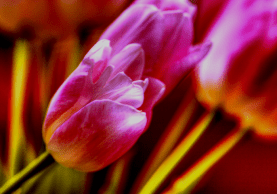
The Self as Satyam-Shivam-Sundram (Truth, Consciousness, Beauty)

The spiritual path is difficult from one perspective because the Self, the ultimate Reality that we are, is not clear to us as individuals. Some people say that Enlightenment is not personal. That is just a fashion statement.

Enlightenment is as personal as it gets. The Self is both personal and impersonal. It is personal because it is you. How can it be any more personal? It is impersonal because its existence (your ultimate nature) is not dependent on time and space bound relationships.

As a mind/body, we are subject to the whims of nature and circumstances (karma). This clouds the understanding of our essential nature. So the teacher or a friend whom we trust is needed to tell us that our nature is not that of the body.

Suffering is natural to the body because it is subject to physical forces. When the sages use the word body, they include the mind. The mental body is also a body but more subtle, made up of more subtle matter, but still matter. If we believe our Self to be the body, the inevitable changes in the body will be a source of fear and anxiety.

So the Body is one thing and the Atman (Soul or Self) is another. The mind/body complex is always subject to change, old age, illness, and suffering at some level. The Atman, who we are, though appearing to be related to the body, is untouched by these.

Bhagavan Krishna, in fact, points this out to Arjuna in the classic Hindu scripture, The Bhagavad-Gita.

Sri Krishna states:

“The Atma is neither born nor does it die at any time, nor having been it will cease to exist again. It is unborn, eternal, permanent, and primeval. The Atma is not destroyed when the body is destroyed.” (2.20)

“Just as a person puts on new garments after discarding the old ones, similarly Atma acquires new bodies after casting away the old bodies.” (2.22)

“Weapons do not cut this Atma, fire does not burn it, water does not make it wet, and the wind does not make it dry.” (2.23).

If we fully understand this dualism, we will not have to struggle to understand nondualism.

Nondualism or Advaita (in Sanskrit) is not an understanding but our essential nature.

The nature of Atman is nondual because Atman is “Being-Awareness” resting in its own nature without any external support. Atman is not free, there being nothing to free itself from. Its very nature is that of absolute freedom.

We cannot conclude this logically but only by Being That. In Self-Realization, Knowing the Self is Being the Self. This Knowing transcends logic, because all distinctions cease. Logic needs duality in order to function. Duality ceases through Self-Knowledge alone.

If you know the Self, what does it mean? You cannot know the Self as an object. You are the Self. Therefore, it is always the Self knowing It Self. The mind cannot fully grasp this unless it has become transparent and fully saturated in the Self, where it knows that it is only the Self knowing itself through It Self.

Maharishi Patanjali says the same thing about the nature of the Self in his yogic classic “Patanjali Sutras”. Ultimately, the Seer rests in His Own Nature. That is the highest Samadhi. Self is Samadhi. Self is Nirvikalpa, beyond imagination and thought. Self is Sahaj or natural and always visible to itself as pure being despite imagination and thought. In Self, Seeing and Being are the same.

In Hinduism, the Reality is often referred to as Satyam-Shivam-Sundram. Truth-Consciousness-Beauty. That which is of the nature of the ultimate truth, pure consciousness, and the essence of beauty is the Self. One’s own Self.

It is of such overwhelming beauty because the devotee who worships the God or the Self with all love and might and with desperation suddenly realizes that the devotee and God are in essence identical. The seeker had been looking for something that constituted the core of his/her very own Being and Existence. God being infinite leaves no room for the devotee as a separate person to exist. That is Grace. That is Advaita. Imagine the shock!

First the shock, and then the smile. Of course, how could it be anything else? The Lord always sits in our Heart as our own Heart. Where else can we find the mystery of existence and our own reality except in our own Heart.

This Realization is one of supreme beauty. The one that you had been longing for has been here all along as your own Self.

That is why I say that Self is Absolutely Personal! Self is empty of all concepts. Its nature is that of completion that is devoid of all longing. Its nature is that of utter fullness that has no where to flow out to, nothing to see, nothing to be. That is why Self is also Impersonal!

Because the Self is One without a second, upon Realization, we see that both Personal and Impersonal are identical in the Self. There is no difference. That is nonduality. That is Advaita.

How can we describe the Self with mind as our tool? We can do so by our experience of this state and through the abidance of the mind in the Heart. The ancients called the Self “Sat-Chit-Ananda”. Existence, Consciousness, Bliss, as one complete Whole with no parts.

It has no basis for comparison and no reference point. By inference, we can say that it is the essence of beauty and bliss. To Know It Is To Be It. In this very moment, you are the That!

Harsha's avatar

Icon Painting As A Spiritual Path: By Gabriele Ebert

Gabriele Ebert is a well known German librarian, scholar, and a painter. For information on her books and German translations, please go to the bottom of the article. Gabriele is a long term member of HarshaSatsangh and has been active in Sri Ramana groups for many years. She has served as an inspiration and a role model for all of us with her dedication to the interfaith approach to spirituality. Because Gabriele’s native tongue is German, I did some minor editing on this article and accept responsibility for any mistakes which may have occurred because of that. Fortunately, in this medium, mistakes can easily be corrected once we become aware of them. Enjoy the article. The Icons are stunning and beautiful! Thank you Gabriele for your generous sharing.

The Personal Story

Eleousa (Mother of Mercy)

It was 16 years ago that I discovered icon painting as a spiritual path. This door opened when at one Christmas eve my mother presented me with an icon of the Theothokos (Mother of God). Looking at it I was sure that I would start to paint as well. I felt drawn to painting and through it discovered a creative spiritual path.

Over the years I found different teachers for learning the technique – and later the Jesus prayer (see below).

Icons are enjoyed by many. Most of all it is wonderful if an icon can find its home in a meditation-room or prayer-edge, where it is dedicated to its original meaning.

This icon of St. John of the Cross has found its home in the prayer room of the Carmelite Monastery in Dolgellau, Wales.

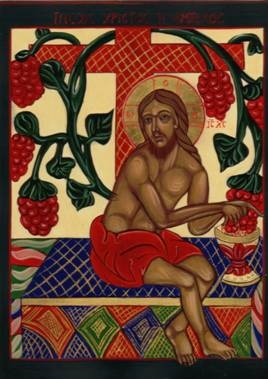
Christ the Vine” is in the meditation-room the Christian Zen-center in Eintürnen, Germany.

Icons – What Are They?

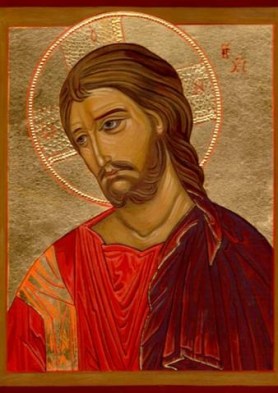
“Sad Christ”

The home of the icons is the Christian Orthodox Church. The earliest icons were painted in the 6th century in Byzantium. From there they later came to Russia and to all other Orthodox countries. Most of the earliest icons have been lost. The oldest collection of icons is found at St. Catherine’s Monastery on Sinai.

Icons play an important role in the liturgical service, and also in the public life and of course for the individual. An icon is a steady companion from the cradle to the grave.

The icons are not individual paintings but rather in the individual. These painting come through the individual by spiritual grace and in a sense the painter does not count. So icons are normally not signed to claim ownership. Outwardly, icons follow fixed patterns and change of the pattern is only possible in a rather limited way as they are real “copies” of the one reality, which represents itself in various pictures and stories.

Icons are of great help for concentration, for prayer, for awareness of the ever-presence of Christ or Mary or the Saints. They are called “Gates to Heaven” or “Windows to Eternity”. If you look at an icon in candle-light, the gold and painting shines in an unearthly magic. The faces are serene, the gestures and colors are full of meaning. The more one dives into this world, the more one becomes drawn into it and the mind becomes silent.

The Path of the Painter

“To paint and to pray are the same thing” (Balthus)

Jesus with animals

I have always felt that this kind of painting is by special grace and has something in it which can’t be compared with other types of paintings. This kind of painting is devotion and prayer – prayer with the brush, so to say. So this “doing” needs not only much outer care, but also inner care. One should not do it with a distracted or unclean mind. According to tradition it is good to have a prayer before starting. The inner attitude should be giving up the sense of doership – which reminds one of Sri Ramana’s instruction as well. It can also be seen as an exercise for just being an instrument of God, which should become a reality in all our actions.

The Jesus-prayer (also known as the Prayer of the Heart) is a short prayer, which should be continuously repeated. The words are: “Jesus Christ, Son of God, have mercy on me!”

Like the icons, it comes from the Orthodox church. The prayer also can be shortened to just the call: “Jesus Christ!” or whatever one prefers. One repeats it as often as one can. In some way it can be compared with nama-japa. It helps to silence the mind and lead it to one thought. With practice it starts to become automatic (self-doing) and sinks into the heart. Yet at each stage it always stays as a prayer in you. The Philokalia – a collection of texts on the Jesus-prayer – can be a wonderful companion on this path. It is recommended in “The Way of a Pilgrim”, which most know who practice the Prayer of the Heart.

It is not so long ago that I discovered – or better re-discovered – the Jesus-prayer when reading this book (“The Way of a Pilgrim”). I felt immediately that this is a wonderful complement to the icon-painting as well. From the tradition of the icon-painters I have found out that my main-model, the famous Russian icon painter Andrej Rubljow must have practiced it. I am sure that his icons reflect it and speak through it.

Icons Interfaith

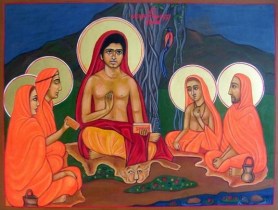
“Dakshinamurti-Ramana” – an icon dedicated to Sri Ramana Maharshi

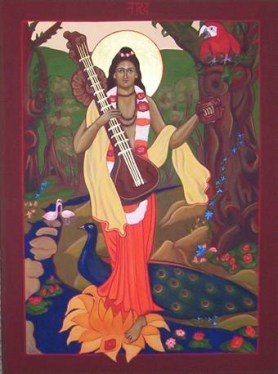
Icon of Narada

Mostly I am painting icons in the Christian tradition. Yet it happened that this Ramana-icon was painted and also some icons of Narada (the bhakti-musician). When being in Tiruvannamalai in 2003 and seeing the paintings in one of the shines of the Arunachaleswara-temple I was reminded of the icon-painting. Also there seems to be a connection to the Buddhist paintings as well. I am sure that the same thing has found its expressions in many religions.

If you would like to see more and get information about the technical side of this kind of painting you can visit:

http://icons.interfaith.googlepages.com/

Gabriele

***********

Gabriele Ebert lives in Germany and works as a librarian.

Recent Books by Gabriele Ebert are:

Ramana Maharshi: Sein Leben, Stuttgart, 2003

Sadhu Arunachala: Erinnerungen eines Sadhus, Berlin, 2004 (German transl.)

Both books are available at amazon.de and can be ordered from each German book-shop.

Harsha's avatar

Bliss – The Source and Meaning of Life: By Michael Bowes

This article was originally written on May 9, 2006 and posted by Michael Bowes on the old HS blog.

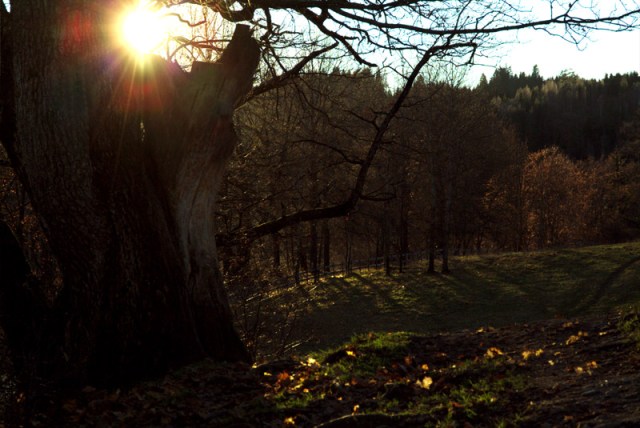
Picture below is by long term HarshaSatsangh member Alan Larus at http://www.ferryfee.com/tree.htm

One weekend in the early 1990s, my friend Narayan and I went to Saint Louis, Missouri to visit with Swami Chetanananda. Narayan and I have known Swami since the late 1980s. On Sunday morning of that weekend we were eating breakfast with Swami and the other residents of the temple, and according to the custom there, we were all reading a portion of the newspaper.

When reading the paper, Narayan nearly always goes straight to the “funnies”.

We were all reading and eating. Swami was at the head of the table, I was to his left, and Narayan was to my left. At some point Narayan nudges me and hands me the funnies. He pointed to the “Donald Duck” comic strip.

Donald Duck was in the Himalayas searching for his guru. And there were signs posted in the mountains that said “Guru”, and then an arrow would be pointing to a certain direction. And Donald followed the signs and arrows until finally, at the top of a mountain peak sat the guru with a personal computer in front of him.

Donald Duck asked the guru, “What is the meaning of life?”

The guru didn’t answer; but the computer started printing out something that couldn’t be read on the comic strip.

The gag was that personal computers were becoming the rage, and now even the guru was using one to divine the mystic truths.

But another peculiar thing was that Narayan and I were searching for a guru and a spiritual home; and now, thanks to Donald Duck, the stage was set for that possibility.

I nudged Swami and handed him the funnies while pointing to the Donald Duck comic strip. He read it and handed it back without saying a word, and continued to eat breakfast. After breakfast Swami went to prepare for his weekly public talk. The rest of us cleaned up after the meal and relaxed until the beginning of the service.

Swami began his Sunday morning talk and I really don’t remember the topic; but near the end he announced that he was going to reveal the “Meaning of Life”. He was going to reply to the question in the funnies.

Swami started by saying, “The meaning of life is bliss.”; and the following is a very loose paraphrase of what he said to explain that statement:

There is an “ocean of bliss” that is the source, the cause and support of all that we see; And in its manifest forms that bliss is experienced as amrita, rasa, love, joy, happiness, fun, hope, peace and even as pain and suffering. Pain and suffering serve as motivation for us to find a way to return to our original state of bliss.

We were all born from bliss. We arrive in this world because one day or one night our parents engaged in a blissful activity, and as a result we were born. From that day on, all of our conscious and even subconscious activities are meant to help us either directly or indirectly to achieve bliss and happiness.

As children all we really wanted to do was play. Our true unconditioned nature is playful. But, as we start to get a little older, we are forced to go to school and we are conditioned by society to perform certain useful functions.

But bliss, happiness, satisfaction, etc. are still the primary objective of all of our behaviors. Our parents and our society force us to go to school so that we can get a job, so that we can earn money, so that we can be happy.

We marry because we believe that another person will fulfill us and make us happy. We have children because we think that will make us happy. Everything that we do is ultimately for happiness and bliss. Even so called, “selfless love” only serves to satisfy ourselves. We believe that by performing our self-ordained duties that we will be satisfied.

A short time after I heard these words from Swami, I directly experienced that “ocean of bliss”. Our own true nature is something that cannot be imagined, and it is truly inexpressible. Since then, even though I have gone through some dark times, it isn’t possible for me to worry or lose my connection to that blissful being, the “ocean of bliss” that is our own true nature. And I have a lot of fun. I can’t seem to avoid it.

I began to experience this truth because of an encounter with the “funny paper”.

Love and peace to all,
Michael Bowes

Harsha's avatar

The Path to Enlightenment: By Dr. Harsh K. Luthar

docimage138

A Popular Dichotomy

A popular dichotomy has emerged about Enlightenment in the West since the 1970s between the schools of “gradual enlightenment” and “instant enlightenment”. Some of this can probably be traced back to Poonja ji’s and Nisargadatta Maharaj’s disciples returning to the west in the 1970s and 1980s from India and bringing their understanding of Advaita Vedanta with them as given to them by their teachers. However, because many of these students deviate from traditional Advaita as taught in the classic lineage of Adi Shankracharya, they are referred to as neo-advaitins.

Given this thesis and antithesis between the gradual path and the direct path, I address the following question:

It is said that there are two approaches to the Truth of Being or Reality which some call Enlightenment or Self-Realization. A gradual path and a direct path. What is the truth of it? Are their really two paths? If not, which approach is the correct one? What road should a seeker of truth take?

First we look at the two paths and what these are about.

The Gradual Path

In the gradual path, one engages in meditation and other spiritual practices and disciplines, refines and purifies the mind over time, and is able to rise above the body limitations in ecstatic and trance states.

At some point, the mind beholds the divine directly or is able to surrender itself and be absorbed in the divine. Most yoga paths in various Eastern traditions fall into this category. One can check the ancient Patanjali’s Yoga Sutras for reference.

Such schools of thought are also common to Hinduism, Buddhism, Jainism, and other religions as well. In these traditions, personal prayers, effort, and practice to reach the supreme divine is emphasized and considered vital to success on the spiritual path.

Criticism of the Gradual Path

The yogic paths and meditative approaches based on effort are criticized by the proponents of the direct path (the neo-advaitins) as being misguided.

The advocates of the direct path point out that since Advaita Vedanta states that the Self is always realized, expending effort to find it, is itself counterproductive. Their essential position is that since any effort towards enlightenment is based on ignorance, it cannot lead to true understanding or Enlightenment.

If I were to frame the objection of the neo-advaitin to the gradual path in the form of a question, it would be this: ” How can spiritual effort based on the false assumption of ignorance lead to the Truth of Reality?”.

Logically, It is a quite a beautiful and a powerful assertion.


Criticism of the Direct Path

On the other hand, the “direct path students and teachers” are viewed by many traditional yogis and practitioners of meditation as deluded individuals who at best have convinced themselves due to the power of sheer ignorance that they are enlightened. Such self-deception in the long run is bound to prove frustrating and disappointing to themselves as well as those unfortunate enough to fall for their hype of “Instant Enlightenment”.

Many traditional practitioners also claim that the “direct path teachers” tend to be on power trips and underneath the facade of their “Enlightenment” lies the basic human nature of greed and the hunger for power and the usual sexual and financial exploitation of those who follow them. They point to numerous examples of this happening in various spiritual communities and satsangh circles.

Unfortunately, the traditional practitioners and gurus are also not free from such issues. So neither can win the argument on the ground of excessive purity in behavior and conduct.

Support for Both Schools of Thought Exists

Such criticisms and counter-criticisms that the practitioners of two schools hurl toward each other all appear to have some degree of validity. Both schools also have their own particular strengths. An integrative understanding can lead one to relax one’s position on such matters.

In the direct path, the insight or the revelation is sudden like thunder. Truth of the Self appears as lightning and illuminates one’s being in a flash. The ignorance drops away as if it never was and one is at ease with one’s nature. Buddhists call it the Original Face, the Buddha mind, or the Buddha nature. Hindus and Jains call it Atma Jnana, Kevala Jnana, or Moksha.

There are various examples of this particular mode of thought in Hinduism and other religions as well. In this approach, for many, the Grace of God or Guru becomes the focal point on the spiritual path and the role of personal effort is downplayed. Support for this is found in the Upanishads (sacred scriptures of Hindus) where we see statements like, “Self reveals Itself to whom It chooses.” For reference, see the Katha Upanishad, where Yama, the Lord of Death, explains to Nachiketa,” The Self cannot be known through the study of scriptures, nor through intellect nor through hearing learned discourses. It can be attained only by those whom the Self chooses.”

On the other hand, in many schools of Hinduism, the emphasis is on works and on spiritual practices such as meditation, pranayama, fasting, etc. Similarly, in Jainism, the spiritual aspirant must bravely work out his/her karma (destiny) in this world following the path of forgiveness, compassion, and nonviolence. This was demonstrated over 2600 years ago by the Tirthankara Bhagavan Mahavira who bore physical and mental hardships with a feeling of amity and nonviolence towards all living beings. Eventually, as his karma dropped, the heavy burden of his soul becomes lighter and led to Self-Realization and Kevala Jnana (Which Jains view as Omniscience).

We see that in Jainism, the actual working out of karma through indifference to suffering, doing good deeds and by cultivating universal love for all beings is emphasized. The same is true in most schools of Hinduism. Even in Buddhism, originally Buddha taught the doctrine of effort and walking the spiritual path with care and compassion. Buddha’s last words to his students are said to be, “Work out your salvation with diligence.” Essentially, Buddha was saying to his students that after receiving his teachings, it was up to them to walk the path and attain their Buddha nature.

Where is the Truth in this Forest?

So then where lies the Truth of Enlightenment? Is the Truth of Realization achieved through walking the path gradually and carefully while engaging in spiritual practices? Or is Realization attained suddenly through a Zen like Satori or when the Zen master does something strange and shocking as depicted in many Zen stories. Can Realization really come unannounced knocking at the door as was the case with Sri Ramana Maharshi?

Sri Ramana, the great sage of Arunachala, has simultaneously endorsed both perspectives and said that the Truth of the Self is indeed simple and within everyone’s grasp. We simply mix the underlying feeling of “I AM” which is there in all of us (and always the same from childhood to old age) with the circumstances of our life, and the ever changing currents and patterns of our mood and personality.

The self-feeling of existence, the “I AM” which animates our life and consciousness and gives light to identity becomes invisible and goes in the background as we become captivated with our perceptions and invest in our daily relationships. That is only according to nature, and one is meant to engage in these things.

All relationships inevitably end. Even when we love someone dearly and they love us, eventually we are separated through circumstances, old age, or illness. If someone is married for 50 years, there is no guarantee that they will make it another year or another 10 years. In due time, one person will pass away due to old age or illness or another cause.

Coming together and separating are the nature of life. Underlying all these events and relationships is the silent presence of “I AM”. If we are paying attention we can feel it. In our quiet moments it comes upon us and we can stay with it. The truth is so simple and ordinary and that is why we take it for granted. If we remain with this self-feeling of existence, the stainless “I AM” free from the contents of the mind, we can come to see the value and beauty of it. It is only pure being. Our own being.

The Role of Spiritual Effort

The spiritual effort needed in terms of meditation and inquiry, to make the mind subtle and to refine the intellect so that this simplicity of being can be grasped with immediacy and certainty, should not be dismissed.

If some people do not need such efforts and can recognize the truth of their being immediately by hearing someone restate or paraphrase what the ancient sages have said, that is wonderful indeed. It shows that their mind already had requisite subtlety, depth, and maturity.

The Sense of Being I AM: The Open Secret

If there is a deep sense of quiet within, it can be like a mirror and we can see the image of “I AM” reflected in the mind. I am reminded of that passage where God said to Moses, “I AM That I AM”. I am not a scholar or religious expert but sometimes it seems to me that this is a symbolic message telling us to pay attention to the “I AM” within because it is God sitting in our own being and Heart saying, “Here I AM, I AM, Come to Me”.

It is said that man (woman) was made in the image of God. If the nature or identity of God can be described best as “I AM THAT I AM” it stands to reason that the nature of Man (Woman) is also similar. Our essential nature can be captured by this feeling we all have; the simple feeling of being-existing, free from conflicts, “I AM”. According to Advaita, this “I AM” within us is the link to God. Prayer, meditation, contemplation all make us reflect on this sense of being within us.

The Sahaj State

The state of the Self is natural. Easy and natural because the Self remains as It Self. It is devoid of sorrow and has nothing to attain being whole and complete and what the Advaita scriptures refer to as One without a second. Sages called this Realization the Sahaj state.

Sahaj in Sanskrit means easy and natural. That which requires no effort is Sahaj. To understand the Sahaj state of the Self, we can start and reflect on our body and see what is natural to it. What is easy and natural differs among people. Some people are able to sit in the lotus posture in an easy and natural way (see the picture of this young woman at www.harshasatsangh.com sitting in the lotus posture).

However, the lotus posture is not easy and natural for everyone. For most people, to sit like that would hurt their knees and ankles and is very uncomfortable. God did not say to Moses, “Here I Am, sitting in the Lotus Posture.” God only said, “I AM THAT I AM”. The feeling of “I AM” within us is independent of posture. Physical postures pertain only to the body and not to the spirit.

What is Natural Differs Among People

In life and on the spiritual path we have to see what is easy and natural for us. For some, walking is easy and natural and such people practice their prayers, mantras, and pranayama taking a morning stroll. Others are not satisfied unless they lift very heavy weights and scream “Oh God”, “Oh God”, and breathe rapidly and heavily. This is their form of being natural. For such people becoming very muscular becomes natural. If you were to tell weight lifters to take it easy and just take a nice walk every morning, they would not agree to it. They like to have big muscles and low body fat. That is natural for them but not for everyone.

In Bhagavad Gita, Sri Krishna tells Arjuna that actions and paths of people differ according to their natural inclinations and therefore one should follow one’s own Dharma not someone else’s. In other words, we need not seek or follow someone’s path because it may not be natural for us. We should be natural, authentic, and true to our self. Without it, there would be inner conflict which is not conducive to being quiet and meditative.

 What Path Should One Follow?
Gradual or Direct or Just Stay Home

In this essay, I have suggested that the philosophies and perspectives of the gradual or the direct path are not inherently meaningful. Their truth lies only in being teaching tools. Words and concepts such as the “direct path” and the “gradual path” are meant to point at the truth but they are not themselves the truth. The Truth must reveal itself to us in our own Heart.

Therefore, one should not be rigid about which notion is correct or more important or higher than the other. Asking whether the direct path is better than the gradual, one misses the point. The real question is, “What feels natural to you and makes sense?”

Being rigid in one’s view, one misses the obvious. Both the notion of “direct” and “gradual” depend on each other for meaning and have no basis in the Reality of the Self.

According to Advaita Vedanta, the Self Always Is. It cannot be seen by “another” directly. Neither is it approached by “another” gradually. Self Reveals It Self Alone to ItSelf. To understand it in plain English, you can say to yourself, “I am always going to Me. And Here I Am.” Just stay with that.

You Are the Self.

Harsha's avatar

Sri Ramana and My Teacher Gurudev Sri Chitrabhanu-Ji: By Dr. Harsh K. Luthar

All of us come from different backgrounds, and we walk the path in our own unique way. Yet, we all have the same innermost longing to know the deepest mystery of our own nature and being. Reflecting on the purest teachings of the Self and on the nature of Ahimsa as nonmovement of the mind, we are bound to have experiences and openings in our consciousness.

When my teacher, Gurudev Sri Chitrabhanu-ji visited Sri Ramana, he was just a teenager. Chitrabhanu-Ji became a Jain monk in 1942 at the age of 20. Prior to that, he was searching and visiting different saints in the various traditions of India and asking them questions about the spiritual path and how to become Self-Realized.

Gurudev Sri Chitrabhanu

Chitrabhanu-Ji told me that of all the saints and sages he visited in India in his teen years, a few were unforgettable and stood out to him. Sri Ramana was one of them.

When I was 22 and studying with Chitrabhanu-Ji, he saw me carrying books of different spiritual teachers for my reading pleasure. He asked to see these books and thumbed through them. He knew most of the authors personally. Swami Rama of Himalayan Institute had come to our meditation center. One time I saw Swami Chidananda, the disciple of Swami Sivananda of Rishikesh, when he came to visit my teacher. Swami Chidananda was very thin even then and was leading a very pure and ascetic life.

After looking through my books, Chitrabhanu-Ji told me that I should read the dialogues with Ramana Maharshi and study his teaching. That is how I was led to Sri Ramana. Of course, after I read the classic, “Talks with Sri Ramana Maharshi”, it was indeed like magic and I knew deep in my heart that this was my way.

The Author at 21-22 studying With Sri Chitrabhanu-Ji

Going back to Chitrabhanu-Ji, he wanted to know the meaning of life at a very young age. He had lost his mother, his sister, and then his girl friend and so the world did not seem so attractive to him even at a young age. He wanted to know the mystery of life and death and what is beyond. In that quest, he started visiting many saints and sadhus and also visited Sri Ramana.

Continue reading

Harsha's avatar

Bill Gates On The Way We Give: By Dr. Harsh K. Luthar

bill_gates.gi.jpg

This essay, adapted from a speech of Bill Gates, is one of the most beautiful, eloquent, and inspirational pieces I have read.

I was reminded of the the passage quoted by Sri subrahmanian of the Advaitin list to me recently which states:

“As life is dear to oneself, it is also just so to other beings. Men show compassion to other beings by putting themselves in their place”. [MBh 13.116.21cd–22ab; YDhS p. 31]

Surely people like Bill Gates are touched by some divine energy that not only opens their hearts but through them delivers the healing balms to soothe the suffering of millions of others.

We bow to such people.

May all beings be free from sorrow.

Bill Gates: Technology and Philanthropy – Jan. 9, 2007

Harsha's avatar

Self, Shakti, Heart, and Enlightenment in Advaita: By Dr. Harsh K. Luthar

Often on the spiritual path, the topics of best postures, best techniques of meditation, best behaviors conducive to spiritual growth, best gurus, etc., come up. All of these questions are appropriate to their time and circumstances.  Such questions were frequently put to Bhagavan Ramana.

Underlying all such questions is the fundamental theme or inquiry as to what constitutes superior spiritual practice that will lead to improvement in one’s mental and physical conditions and finally to Self-Realization or Enlightenment. From this perspective, Self-Realization is viewed as an attainment. It is something that is achieved by an individual by making the right effort. This approach in its methodology is not too different than that of a talented world class athlete, who after having trained rigorously, wins a gold medal at the Olympics.

This point of view emphasizes the need to focus the mind in order for it to expand and evolve to higher levels. Spiritual practices based on this foundation, involve meditating in a particular posture, concentrating on chakras, raising the kundalini shakti, practicing mantras, deep breathing, and doing pranayama exercises.

The Yoga paths explicitly incorporate the idea of controlling and developing the mind to gain entry into Samadhi and Super-conscious states. Most religions have this philosophy at their core; that without hard work one does not succeed either in life or in knowing God.

The General Spiritual Path Model

Buddha is supposed to have said to his disciples as he was dying, “Work out your salvation with diligence.” He meant that you have to personally work it out and attain Nirvana by right conduct, right practice, right meditation, etc.

The same principle is present in Jainism and most of the schools of thought in Hinduism. In Jainism, one attains to Moksha through one’s own individual efforts. In Hinduism, one achieves Moksha by God’s Grace. However, in most schools of Hinduism, one only benefits fully from God’s Grace, when one has made the right effort on the spiritual path by following one’s Dharma and by meditating on the nature of the Self.

Although it is a complex topic, the general spiritual model that we have before us is this: There is a spiritual path, there is the goal of Enlightenment or Self-Realization, and you have to expend much effort, and walk on the path for a long time in order to reach the destination. While you are walking, you may even have to go through the “dark night of the soul” a few times, because there are so many temptations along the way and things can sometimes appear hopeless and quite depressing.

So not only is there the possibility of tripping and falling due to worldly obstacles, but one also may give up on the whole idea of Liberation, Salvation, Enlightenment, Nirvana, Moksha, and/or getting to Heaven. Indeed many on the spiritual path do end up concluding that there is no meaning in life or the spiritual aspiration at all and kick themselves for missing out on the pleasures of their youth by having rejected the philosophy of “Eat, Drink, and be Merry” prematurely.

However, experienced sages know that what practices or behaviors will be helpful to the seeker on the spiritual path seems to depend on one’s conditioning, physiology, culture, background, etc. Although there is a general framework on how to pursue one’s aspiration for Enlightenment or Self-Realization, the truth is that one has to make the path as one walks on it because each individual is unique. Therefore, the view of “Eat, Drink, and be Merry”, within reason and in moderation, may be fully compatible with the spiritual life. It is the overall context that has to be understood.

The Self-Knowledge of a Sage

For the one abiding spontaneously and inherently in the Self-Truth of Reality, questions of methods, techniques, and practices, and the path become moot. When clarity of Self arises, any technique may be practiced and any path may be walked or one may give up all techniques and paths. For such a person, the Self-Attention itself absorbs attention regardless of where it is focused outwardly. The essential element in this understanding is the Recognition by Awareness of its Innate Wakefulness. Awareness is always self-aware by its very nature.

When awareness remains pure and spontaneously self-focused (perpetually in communion with itself), the subtle duality between awareness/attention (as Pure I AM) and its Source is seen to be illusory.

Then even the witness disappears, there being nothing to witness. The “I AM” disappears having nothing to point to. Spontaneously with the I AM Awareness/Shakti merging in its Source, the Self is Recognized. The Self Recognizes It Self by It Self and Through It Self as its own Source. It Sees and Recognizes that It has Always Been the Source. That It Is the Eternal Source, the causeless cause.

This is the Supreme Beauty of the Heart. It absorbs the Shakti, and along with it the Mind, thus swallowing time and space.

How can one speak of this Silence? The Silence that transcends all understanding and knowledge can only be indicated indirectly.

Great sages like Sri Ramana Maharshi never tire of pointing out that, —That Which is Real and Absolute Always Exists and is not absent even now—. How can Reality, whether one calls it God, Consciousness, Absolute, Nirvana, Moksha, Kingdom of Heaven, or by some other name be present at one time and absent at another? Perfection, by its nature, cannot be more perfect sometimes but not others. The approach and method of Advaita is based on this implicit axiom.

The Method of Advaita

The ever-present and eternal existence of our fundamental reality, whatever label we give it (Self-Nature, Buddha-Nature, Original Face, God, Goddess, God Consciousness, Pure Consciousness, Supreme Consciousness) must be here and now in this very moment. Otherwise, it is not Perfect!

This is the fundamental insight and conviction of the path of Advaita and the Advaitic sages. Therefore, we have to grasp the present by simply being present to it. This is the method of Advaita.

How is this done? In this way:

This present ordinary awareness, that you experience, you should notice it and then hold on to it. It is subtle and yet so ordinary. That is why we miss it. No matter how ordinary a baby looks to others, to the mother it is special. She adores her baby and to her it is the most lovely and wonderful child in the world. That is the attitude one must have towards one’s ordinary present awareness.

Like a mother holds on firmly to her child in all conditions, one should keep this ordinary self-awareness in the center of one’s consciousness knowing it to be special. The Supreme Reality It Self is hidden in it. It cannot be anywhere outside of it. If the Supreme Reality is somewhere outside of our ordinary consciousness, it is not perfect. Therefore, we can confidently look for perfection in our ordinariness, our ordinary consciousness.

Finding God in the Heart

There is a Christian saying that “Man is made in the image of God”. There is deep meaning in that. In the Bhagavad Gita, Sri Krishna says to Arjuna, “I am in the Heart of all.” We find such expressions in many of the religions of the world and in major works of different spiritual traditions.

On the path of Advaita, through our present ordinary awareness, we become, or more accurately, recognize our True and Ever-Present Image in the Heart. Advaita goes one step further and states that indeed the illusion of separation between the Individual soul and God lasts only as long as God is not recognized as the Center of our Being, sitting in the Heart as the Heart.

This is the Heart, that the ancients called Sat-Chit-Ananda. Existence, Consciousness, Bliss. The Supreme Self. It is beyond thoughts and concepts. Time and Space do not touch it.

As Sri Ramana has said, — that which is real is ever present—. We have to see what is present right now in this very moment. If we become quiet, we are able to feel our ordinary awareness, the sense of “I Am” as being present in this moment. That is the seed. If we water it and give it food, it grows and the Reality reveals it Self from within.

Editor’s Note:  The Feature Picture depicts photo art of brother Eden Kailash on his fb page.

Harsha's avatar

Enlightenment Haiku: By Dr. Harsh K. Luthar

Breath stolen
Heart, stopping to hear
Again, the same intimacy.

Harsha's avatar

Wisdom Eye: The True Guru: By Dr. Harsh K. Luthar

“Who is a master? He is the Self after all.” Ramana Maharshi

The company of peaceful Sages (Satsangha) and living in Ahimsa (harmlessness) is considered the primary influence that leads to Self-Realization. The forced attempts to discard various habits and conditioning and practicing different techniques to calm the mind have built in limitations. However, such methods can be pursued with benefit if one is already inclined towards these practices.

When strong inner motivation is present, one is automatically propelled towards Self-Awareness and Meditation. The fog of confusion then quickly evaporates and leads to Self-Seeing, Self-Being, Self-Realization, and Silence of the Heart.

Meditation and mind calming methods, can be effective at many different levels if practiced in the context of a clear understanding. Such practices, however, cannot by themselves end the fundamental agitation of the mind which continues at more and more subtle levels and causes suffering.

The nature of the mind is to hanker after that which is not real and is constantly subject to change. Not knowing who we are, where we come from, and where we are going, we still continue chasing after dreams built on the sand castles of desires.

If we become aware of this, we can see the primary nature of suffering, and direct our attention to the mystery of life and the nature of our perceptions.

In Indian spiritual traditions, a guru serves as a conduit to help us along the path. However, many things we hear about gurus these days are not appetizing. Still, if we realize the truth of the pure teachings, that the Supreme Reality is indeed our own Heart which guides us, then we can walk the path lightly without being misled.

The Self Always Reveals It Self from Within. Listen. Remain aware.

Be utterly indifferent to the clever words, miracles, and magical techniques that promise salvation. If you have the courage, open your wisdom eye and see clearly what attracts you to such things and people.

What is it that these gurus have to give you that you do not have? Question seriously and honestly and investigate the root of your hopes and fears.

There are many active marketers of “spiritual wisdom.” It has now become a public relations game with the many modern gurus as they compete in the free market of spirituality. Many spiritual teachers today attempt to distinguish themselves on the basis of their “enlightenment”, their spiritual experience, and how “awake” they are. Some claim that by their magical touch, shaktipat, or willpower, they can create miracles and remove obstacles from someone’s path. We cannot say that all such teachers and gurus are good or bad. But we have witnessed enough scandals among spiritual teachers to conclude that there is a need to be alert to the human tendency of those in power to exploit others financially and even sexually. Some teachers, giving satsang, and teaching yoga and advaita, are no doubt good and genuine people, but others may be quite ignorant and have generally bad tendencies.

I will share with you briefly a story. One time, I was walking my teacher, Chitrabhanu-ji, back to his apartment and we were speaking about the guru-disciple relationship. During the conversation, he said to me, “You should never follow any guru.” I was quite surprised to hear him say that because you see Chitrabhanu-ji was my spiritual teacher and mentor and I referred to him as Gurudeva. All Indian spiritual traditions in Hinduism, Jainism, Buddhism, in fact, have the guru-disciple relationship at their core. So I asked Chitrabhanu-ji, “Gurudev, why do you say this? Why do you say that I should never follow any guru?” My teacher smiled and said, “Well, what if the guru goes crazy and starts acting nutty?” So I had a good hearty laugh.

My teacher, Gurudev Chitrabhanu-ji, was also my friend. I was only 21 when I met him. He was then 56 and now he is in his mid 80s (written in 2006). During the time spent with him, I had the sense that he wanted to make sure that I understood the realities of life and was fully independent and able to think on my own. His success as a teacher was that he made me independent of himself as well. Chitrabhanu-ji used to say that…” a real guru is like an ice cube. He cools your consciousness and then disappears without a trace.” From my teacher I learned the sacred philosophy of Ahimsa (harmlessness), which is the cardinal principle of Jainism. Mahatma Gandhi of India was an exemplar of the practice of Ahimsa in the last century.

After some years, when I left my teacher to go back to graduate school, he said that I should always remember the principle of Ahimsa and keep that as my ideal. From Ahimsa follows being able to understand many different points of view and to approach situations with awareness and compassion. During the years that I studied with my teacher, he never asked me for anything. No money, nothing. Actually, I had nothing to give. At that time I used to teach yoga to earn a livelihood and it was barely enough to pay the rent and eat.

Sometimes I see gurus who treat their students badly and even exploit them financially and in other ways. I see the huge contrast between that and how my teacher treated me, despite my youth and immaturity, with the utmost respect and courtesy as a human being and his equal. So I tell students on the spiritual path that it is never a good idea to hang around a so called guru or a spiritual teacher who demeans you or insults you or disrespects you in any way. It does not matter if such a person is charismatic or if your friends adore him or her. In Patanjali’s ancient yoga sutras, Ahimsa (harmlessness or nonviolence) is mentioned as the first principle of yoga. A guru or a teacher whose words and attitude carry and convey violence cannot be good for you.

Understand that, like you, most gurus and spiritual teachers today have their own personal challenges and suffering. You need not judge others too harshly. Yet at the same time one must be free to follow one’s own vision. With compassion for others and one’s own self, one should keep one’s focus utterly, totally, and completely pure. This means that you should not give in to the attraction of confusion, and compromise in seeking the Truth by creating a permanent dependence on another person. If a guru creates circumstances and subtly encourages you to do become dependent or submit to his/her will, know that such a person is controlled by his or her own power needs and greed. What can such a person give you?

When I first met my teacher he told me frankly, “I cannot give you enlightenment. Gurus who claim such a thing deceive their students. To become Self-Realized, one must carefully investigate the mind and perceptions and meditate on the nature of the Self.”

I pass this on to you. No one can give you the Truth. Truth is always revealed from the inside. And when it comes, you see that your own essence is that of Truth. That is our mystery that the perfect and complete love that we long for is ultimately seen in our nature and our own heart. The ancients called it the Heart, Sat-Chit-Ananda, Existence-Knowledge-Bliss, which is our very being.

Do not settle for anything less than the Heart, your own Heart. Do not settle for anything – keep going until there is nothing left to settle for.

Let your effort be absorbed in peaceful Self-awareness. There is absolutely nothing else to be done.

Nothing given,

nothing taken.

See the sights,

be not mistaken.

You have everything you need.

Think not that you must awaken,

now or at some later date.

Know this for certain,

That You Are Already Wide Awake!

Abide in that Heart of Being.