Harsha's avatar

Brain Nourishing Pose: By Christine Wushke

This pose is great for bringing extra circulation into the brain. I find it refreshing and yet relaxing at the same time. If you have high blood pressure use caution in this pose. Come out of the position slowly if you feel any pressure in the head or behind the eyes.

Copy of chair forward bend 1*You will need a chair and some yoga blocks for this pose.

1. Begin with a chair in front of you, and some yoga blocks near by.

2. Bend forward until you feel a stretch in the backs of your legs. Check to see what height your hands naturally reach to without forcing them farther. Bring your hands down to your chair checking that you are not pushing the stretch to far. It should feel like a very easy and gentle stretch at this point. (If it is not, then place a folded blanket or yoga block on top of the chair.) The idea is to use the props so that the pose can meet your body where it is right now without any strain whatsoever.  Continue reading

Harsha's avatar

The Journey of the Soul – II

This is in continuation of a Journey of the Soul – I

That is how it comes about that in scientific terms, one cannot prove that energy. What can be proven is only that which has motion. Yet motion is such that at the moment you view it, it changes, and you do not have a true picture of that motion at its most subtle level. That is why we know so little, from laboratory experiments, of the mind. Yet a whole vast range of the mind, over 90 percent, exists which is unexplored. As technology develops, there will be instruments or certain inventions which will probe a bit deeper into the mind. The 10 percent, explored, can become 15, 20 or 30 percent. But we want to know here and know the entirety of the mind, and the mind, being so involved in itself, cannot know itself.Gururaj disciples at Raman's home

When you are involved in a problem, an emotional problem, you cannot think straight because you are involved. But if you separate yourself from the machinations of the mind, you can view the mind from a different perspective altogether. That is why we have counselors, so that when you are in a  rut (someone told me the other day, a rut is nothing else but a coffin with both ends open), you can go to a counselor who can view the subject or the problem objectively, because he is not emotionally involved. Many times people involved in a business deal will say, “let me sleep on this” That means that at this moment I am so involved in this problem that I need to let my mind rest. Tomorrow I shall look at the proposition with a rested mind, more objectively. In this process what travels from point to point is nothing else but the mind.

Now, where can the mind travel to? That is the other question. We have said that the spirit within a human being, or the spirit which pervades the universe, is omnipresent. If the manifestor is omnipresent, then its manifestation must be omnipresent too. Where is there a place for the mind to go? What happens is this: There is just a shifting of energies in the mind. Because there is contraction and expansion going on all the time in the universe, polarities are created. You lift the weight from this side of the scale, and you add some weight on the other side of the scale. The pendulum is forever swinging from one end to the other, and that is happening in the universe. That is what is known as contraction and expension. So the mind goes from nowhere to nowhere, while the energies are just shifting.

Through spiritual practices, we are also working with energies. We are also activating energies, but activating grosser energies and very systematically leading those grosser energies toward the more and more subtle energies which are in the mind. The mind has the conscious level, various strata of the subconscious level, and the superconscious level. All this falls under manifestation, and all manifestation is relative. It is relative to the Absolute.

Gururaj Ramon and Vidya in CyprusWithin the confines of this whole scheme of things, relativity has its gradations: The conscious mind, which is gross; the subconscious mind, including the various subtler levels of the subconscious mind (psychiatrists and psychologists only delve 10-15 percent into the subconscious layers) and beyond that vast subconscious field, the superconscious mind. So we start with the subconscious mind and lead it gently through the layers of the subconscious to the superconscious until we experience the finest, subtlest relative. When we experience that, we can safely say that we have the universe in the palm of our hand.

So there lies the movement from grossness to its subtler levels; yet it is standing still. All the movement in the ocean you see is surface movement. Really speaking, the ocean is not moving. It is there. So, if we think of movement and that which lies between the area of Silence to Silence, nothing has moved. Silence reamains the same and the superimposition remains the same. So, traveler, where do you come from and where are you going to? Nowhere.

It is all here and now. Of course, there are the theories of reincarnation and karma and “reap what you sow.” They also are true at certain levels. But in reality, a person  moves nowhere, and the apparent movement is only the mind experiencing itself at its subtler and subtler levels. That is the greatest illusion: By thinking that I move, I sit still.

For the mind to experience the subtler states, various forms of evolution are necessary, and this evolution from very gross matter to the present stage of humanity has taken millions of years, proceeding through various forms. Yet the substance of all those forms is not different. The substance that makes up the vegetable kingdom is the same substance that makes up the animal kingdom, which is the same substance that makes up the human kingdom. In essence, the substance remains the same. What is this body? It is nothing but food.

These very same substances, assuming different shapes and forms are given names. This table and I are not at all different from each other; we are of the same substance. This table is at a grosser level, and I, having developed the power of thought, am at a more subtle level. That’s the only difference. This table cannot think, the animal cannot think, but I can think; it is just a matter of degree, not of difference in substance. The molecular and atomic structural framework of this table is the same that structures me. The great illusion is accentuated in human beings, because people have reached that certain evolutionary stage where they are thinking.

The great illusion comes about because a person thinks that he thinks, while he is not really thinking. The less a person thinks, the more he experiences. The very process of thought, if wrongly used, can be the wall between the changing unreality and the unchanging reality. That does not mean that we need to destroy the mind – the mind is a great instrument and is to be used.

A sharp knife given to a delinquent boy can be dangerous. But the same sharp instrument in the hands of a surgeon can help perform an operation. So the mind has to be consciously directed. The power and force of the entire universe is contained in the mind, but it has to be directed.Gururaj Ananda and Cansita

If the mind tries to direct itself, then many things can happen, including misdirection, because the instrument is trying to work upon  itself. So we use meditation and spiritual practices to go deep to the superconscious level, which is the closest to the manifestor. We let those subtler energies remodify the thought patterns of the conscious mind, for the conscious mind is a conditioned mind, and we’ve got to use a subtler force to be able to repattern and overcome the conditionings of the conscious mind.

Most of our troubles are of the conscious level. These are in turn pushed forth from the subconscious level. The left hemisphere of the brain, which is said to control thinking, analysis, verbalizing, and symbolizing, is connected to, not apart from, the right hemisphere of the brain, the part that is said to be a link to the intutive ability and the universal mind. Through meditation and spiritual practices we enliven this connection, first in the organ of the brain, and then in its subtler layer, which we call the mind, it’s subtler self. The entirety of the mind has been grossified into the organ called the brain to give us the individuality that we have. Of this brain, three pounds in weight, containing twelve billion cells, we use only one millionth part.

So, by activating the right hemisphere, we are energizing the left hemisphere, and therefore there is greater clarity of thought, greater concentration, and greater one-pointedness: and all  these qualities  plus others make one’s life successful. Not only we are using the energies of the left hemisphere, but, as a result of spiritual practices, we are also drawing upon the intuitive level. If we combine the analytical with the intuitional, how much more forceful our actions become, how much more truthful our thinking becomes. In this way we are led to right thought and right action.

So after practice, over a period of time, the mind gradually starts functioning in a spontaneous manner, to do that which is right. Then thinking is not necessary; you just do. You would, for example, come to a fork in the road, and you would just ver spontaneously take the right road. Your analytical mind will not tell you why or how you did it.

What is working is that intuitional level, which fulfills your every need, not your every want. With “want” the left hemisphere comes into play: “I want a million pounds, I want a 50-room mansion, I want this, and I want that.” That kind of analysis leads only to ego-boosting.

Now, all this exists within the framework of the traveling from Silence to Silence. This is the motion that is created. When that which we are calling the left hemisphere dominates us, we are enmeshed in our ego-selves, which know only this: me and mine.

If the mind is empowered by what we are calling the right hemisphere, the intuitional level which has its roots in the core’s of one personality, which we also call the heart, then “me” and “mine” disappears and it is “thee” and “thine.” For the core of the human personality, though outwardly seeming individualized, also exists in its universilezed form. So what happens to a person is this: He can exist as an individual and yet at the same time be universal, for he has now realized, through his spiritual sadhana , how vast he is. When this happens, a person, being divine, recognizes and experiences this Divinity.

to be continued in Journey of the Soul – III

Soon coming.

MEDITACIÓN BARCELONA

Harsha's avatar

Bliss yoga: By Christine Wushke

This style of yoga was inspired by a tantric dance called the Tan Da Va. When I was first introduced to this dance I was told that part of the dance training was to sit and watch a stick of incense burn. After a few hours of watching the smoke rise and spiral, one begins to get in touch with the intuitive flow or a natural instinctive movement. Bliss yoga is movement that comes from an inner naturalness. There is an ancient wisdom within your body waiting to unfold and flow like the rising smoke of lit incense. When it is given space to flow it becomes a beautiful expression of your unique wisdom inherent within. Bliss yoga can be described as the poetry of yoga: rules are not important and expression is everything.


bliss yoga 2

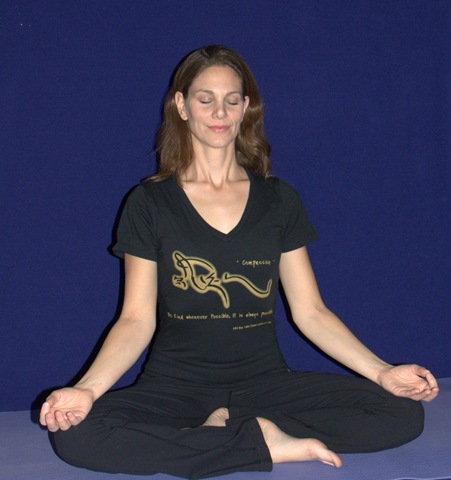
1. Sit on the floor with the legs crossed; if you find this position to be uncomfortable, sit in an alternative position or in a chair.

2. Close your eyes and let your awareness move inward. Be aware of your sit bones in contact with the floor or chair.

3. Take a moment to inwardly honor the deep wisdom and intelligence inherent within the body.


bliss yoga 3

4. Imagine that just below your tailbone a stick of incense is burning and the smoke is rising up the spine. Set your imagination free: see the smoke spiralling, or moving straight up. There is no wrong way to do the practice; it is about allowing what is and making room for your intuition to take the lead.

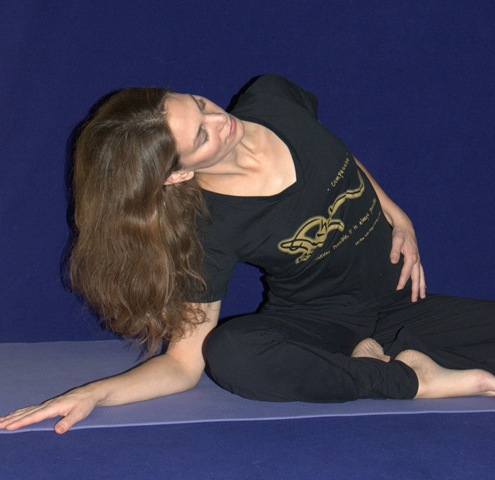
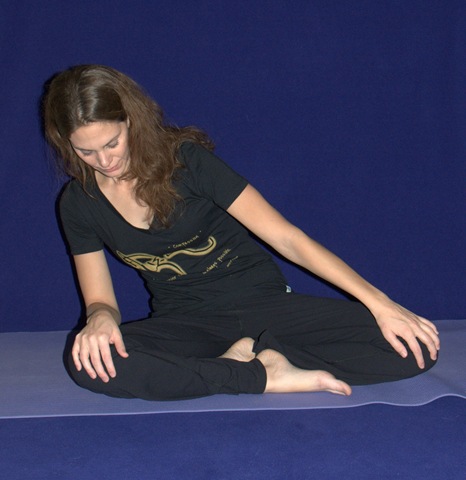
5. Slowly allow your torso to move side-to-side, forward and back. Allow the movement to come from the inside out–allow the inner wisdom to be the mover, not the mind. Get creative, stretch forward and back, side to side. Allow your movement to be intuitive.


bliss yoga 4

6. Hold each stretch for as long as desired.

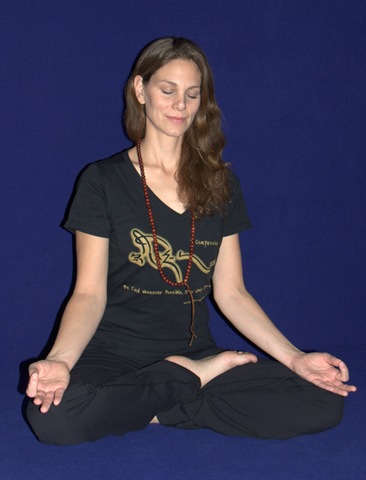
7. When you feel intuitively ready to finish moving, let the body slowly unwind and return to sitting quietly.


bliss yoga finish

8. As the body comes into stillness become aware of the movement or aliveness of prana (life force energy) inside the body.

9. Enjoy the effects of heightened awareness for a few minutes or longer.


  Benefits: Loosens and releases the sacrum. Relaxes the muscles of the pelvis, and lower back. Massages and oxygenates the back of the pelvis. Increases flexibility in the abductor, and adductor muscles in the thighs. Increases body awareness aiding in a healthier and more loving relationship with your body. Increases prana (energy) in the body. Deepens your spiritual practice.


If you enjoyed this article and would like to find out more about the writings of Christine click here. 

© written and modeled by Christine Wushke, Photo’s by Dianne Wushke.


Christine Wushke is a certified yoga and meditation teacher with over 15 years of experience. Her aim is to create a sacred space for students to effortlessly find the presence of stillness and an inner silence. Christine’s mission is to raise consciousness on the planet by empowering people to realize their own Divinity and to uncover a deep peace within. Christine is committed to assisting you in your journey, and helping you to realize directly for yourself the truth of what you are, and the stillness of truth within. In addition to her yoga and meditation training, Christine is also a registered massage therapist. In the past two years she has studied extensively in the spiritual tradition of Advaita Vedanta. Her teaching style is largely influenced by Iyengar yoga, and the nondual tradition of Advaita.

www.journeytolight.net
www.innerlightyoga.blogspot.com


Harsha's avatar

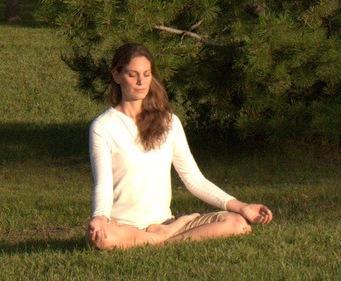
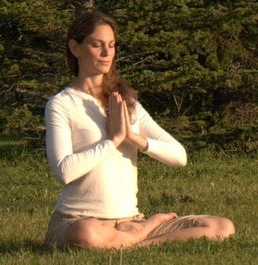
Alternate Nostril Breath Meditation

Alternate nostril breath meditation

This practice of pranayama is wonderful for bringing about a feeling of balance and well being. Because the nostrils are said to connect to our male and female energy channels, when we focus on the nostril, we balance and purify that corresponding channel of energy. The regular practice of alternate nostril breathing is said to help us experience the feeling of being beyond the polarity of male and female and into the non dual Reality of oneness.  Practice this when you are feeling scattered or unfocused, and you will be amazed at the results.

meditating 41. Find a position where you can be comfortable, relaxed, and free of any distractions, then settle into your posture

2. Allow the body to relax completely, especially your abdomen.

3. Notice how a relaxed abdomen naturally brings about a deepening and softening of the breath.

4.  Allow the abdomen to relax more and more with each breath. As you let the abdomen soften, and the breath to deepen; start to become evermore aware of the feeling of nourishment in the breath. Be aware of the sensation of the body being nourished by the breath.

5. Allow your breath to flow as naturally and as freely possible; as if the breath is taking on a life of its own, moving from a deep inner intelligence and knowing.

6. As you are enjoying the feeling of a deep intuitive breathing and the feeling of nourishment within the breath, start to become aware of the sensation of air moving in the nostrils.

alternate nostril breathing 27. Become aware of the feeling inside the nostrils as well as the quality and movement of air. Notice how the air is cooler and drier as you breathe in. Notice the warmth of the air on your exhales.

8. Take about 10 breaths to concentrate on the feeling of the air moving in the nostrils, and the feeling of the body being nourished by the breath. As you are doing so, see if you can detect which nostril feels more open or expanded. (this is your active nostril)

9. Start to focus on your active nostril only. Breathe as if you are breathing through just that one nostril. Focus on the feeling of the air moving on that one side. Focus on this for about 30 seconds, or 10 breaths.

10. When it feels natural to switch sides, start to focus on the movement of air on the other side (the passive nostril). Focus on the feeling of the air moving inside the passive nostril. Focus on this for about 30 seconds, or 10 breaths. You may find this side more challenging to concentrate on, yet eventually it will begin to feel as if it is opening and expanding to be the same as the other side.

11. The final phase of this exercise is to imagine that you are breathing into a third nostril that runs from the tip of the nose to the center of the forehead. Inhale and move your awareness from the tip of the nose to center of the forehead and exhale from the center of the forehead to the tip of the nose. Stay with this for about 10 breaths.

12. Go back to breathing into the belly and focusing once again on the feeling of being nourished by the breath.

13.    Stay with the belly breathing as long as you are comfortable and enjoy the feeling of balance and wellbeing.

If you enjoyed this meditation you can purchase Christine’s meditation CD in stores, by download, or by clicking here. Listen to sample.

© written and modeled by Christine Wushke, Photo’s by Dianne Wushke.

Christine Wushke is a certified yoga and meditation teacher with over 15 years of experience. Her aim is to create a sacred space for students to effortlessly find the presence of stillness and an inner silence. Christine’s mission is to raise consciousness on the planet by empowering people to realize their own Divinity and to uncover a deep peace within. Christine is committed to assisting you in your journey, and helping you to realize directly for yourself the truth of what you are, and the stillness of truth within. In addition to her yoga and meditation training, Christine is also a registered massage therapist. In the past two years she has studied extensively in the spiritual tradition of Advaita Vedanta. Her teaching style is largely influenced by Iyengar yoga, and the nondual tradition of Advaita.
www.journeytolight.net
www.innerlightyoga.blogspot.com
Harsha's avatar

Belly Breathing

The yogic word for breathing practice is “Pranayama”. The word “prana” means life force energy, and the word “yama” means to expand. Pranayama is a practice for increasing energy, and aliveness in the body.

One of the favorite practices of pranayama at Journey to light yoga studio, is called “Belly breathing”. Belly breathing is a great way to slow down the breathing and deepen your connection to the prana in the breath. It is very relaxing, deeply nourishing, and often therapeutic for stress and anxiety. Set aside 10 – 15 min for this practice, in a place where you can be free from all distractions.  I hope you return to your day relaxed, refreshed, and nourished.

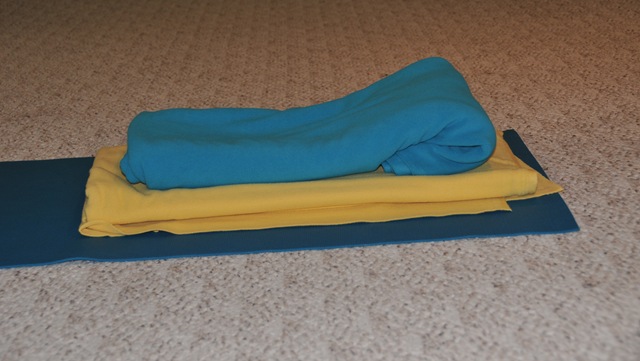
belly breath props

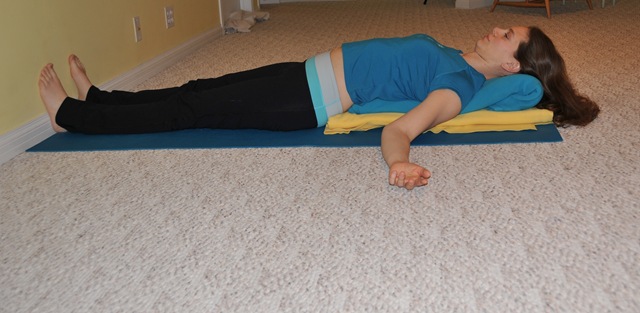
1. Take 2 folded blankets, and stagger them, so one is on top of the other, and the top blanket is pulled about 2 inches back. Fold the top blanket under at the other end, to make a pillow.

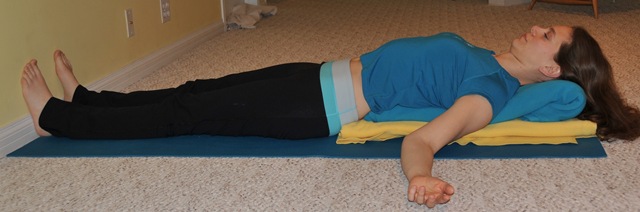
2. Lay on your back with the base of the spine touching the bottom blanket. Let your shoulders roll under and open the front of the chest.

pranayama 3. Start by relaxing into the pose, and allowing the body to completely sink into the blankets.

Notice your breath. Imagine that your breath is like a drop of Prana (energy) and all around you there is an infinite ocean of Prana, and nourishment. Allow your inhalations to be a drinking in of this nourishment.

Allow your exhalations to be dissolving breaths, as if drops of water are diffusing into the infinite ocean of Prana, and nourishment all around you. Inhale nourishing, exhale dissolving. Imagine that the supply of nourishment all around you is limitless.

belly breathing 4. Begin to focus your attention on your lower abdomen. Breathe in and allow the lower abdomen to lightly inflate, as if you were blowing up a balloon of energy just below the belly button. Stay with the belly breathing for at least 10 min, focusing on breathing deep into the lower belly.

Benefits ~ Strengthens the parasympathetic nervous system.  increases relaxation, increases oxygenation of  blood, improved mental clarity, and emotionally uplifting. Therapeutic for anxiety and stress.

Christine Wushke is a yoga and meditation teacher with over 15 years of experience. Her aim is to create a sacred space for students to effortlessly find the presence of stillness and an inner silence. Christine’s mission is to raise consciousness on the planet by empowering people to realize their own Divinity and to uncover a deep peace within. Christine is committed to assisting you in your journey, and helping you to realize directly for yourself the truth of what you are, and the stillness of truth within.

Christine’s meditations, and yoga articles will guide you to deepen your understanding of the wisdom within this ancient practice and experience the spiritual elements of yoga.

www.innerlightyoga.blogspot.com
www.journeytolight.net

If you enjoyed this meditation you can purchase Christine’s meditation CD in stores, by download, or by clicking here. Listen to sample.

Harsha's avatar

Sacral releasing Pose

Sacral releasing Pose

This pose is amazing for releasing and opening the sacrum. In spiritual tradition of yoga, it is said that the kundalini Shakti energy lies dormant like a coiled snake sitting at the base of the spine. When we do certain meditations or yoga poses, it is said that we can awaken this dormant energy and activate a spiritual energy to begin its journey up the spinal column and up into the brain.  Please use caution and mindfulness in this pose if you have herniated disks, or arthritis in the spine.

sacrum 1

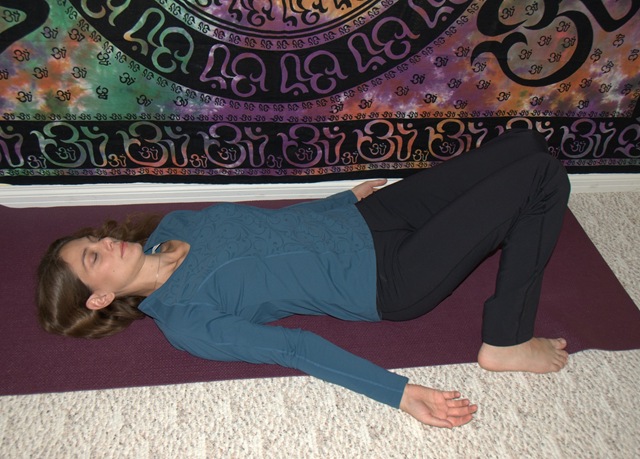
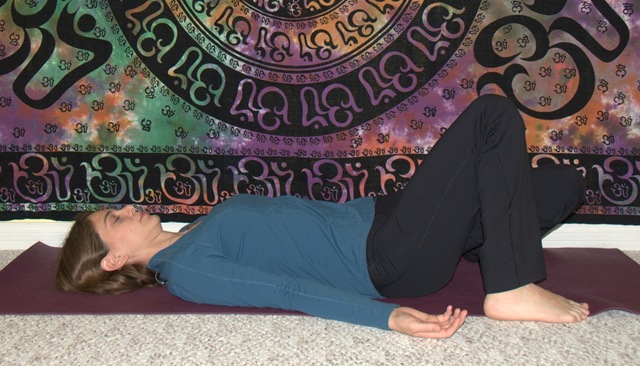
1. Lay on your back with your knees bent. Bring your knees together and your feet about shoulder width apart.

2. Lift your pelvis slightly and move your tailbone toward your heels. Flatten the small of your back to the floor. (Or as flat as it will go)

3. Let your knees lean into each other, letting them also pull forward. (let this movement be natural, and not forced). Let the lower back relax as much as you can.

4. Hold this position for at least 30 seconds, allowing the muscles in your legs, and pelvis to relax.

sacrum opener

5. Bring your awareness into your sacrum. Imagine that you are breathing light, energy and nourishment into your sacrum. Imagine that you are drawing that nourishment all the way up your spine and into your brain.

6. Start to bring your knees down toward the floor, one at a time. Stretching the inner thigh.

7. As you bring your knee toward the floor, let the pelvis rock from side to side massaging the back of your pelvis. Continue to imagine that you are drawing nourishment and light into your sacrum, and allowing it to flow all the way up your spine. Use the rocking action of the pelvis to increase the amount of energy flowing into the sacrum and up the spine.

8. Return to position #1, and rest for another 30 seconds or longer.

Benefits ~ Loosens and releases the sacrum. Relaxes the muscles of the pelvis, and lower back. Massages and Oxygenates the back of the pelvis. Increases flexibility in the abductor, and adductor muscles in the thighs.

© written and modeled by Christine Wushke, Photo’s by Dianne Wushke.

Christine Wushke is a certified yoga and meditation teacher with over 15 years of experience. Her aim is to create a sacred space for students to effortlessly find the presence of stillness and an inner silence. Christine’s mission is to raise consciousness on the planet by empowering people to realize their own Divinity and to uncover a deep peace within. Christine is committed to assisting you in your journey, and helping you to realize directly for yourself the truth of what you are, and the stillness of truth within. In addition to her yoga and meditation training, Christine is also a registered massage therapist. In the past two years she has studied extensively in the spiritual tradition of Advaita Vedanta. Her teaching style is largely influenced by Iyengar yoga, and the nondual tradition of Advaita.

www.journeytolight.net

www.innerlightyoga.blogspot.com

Harsha's avatar

Spinal Nourishing Pose

Spinal Nourishing Pose

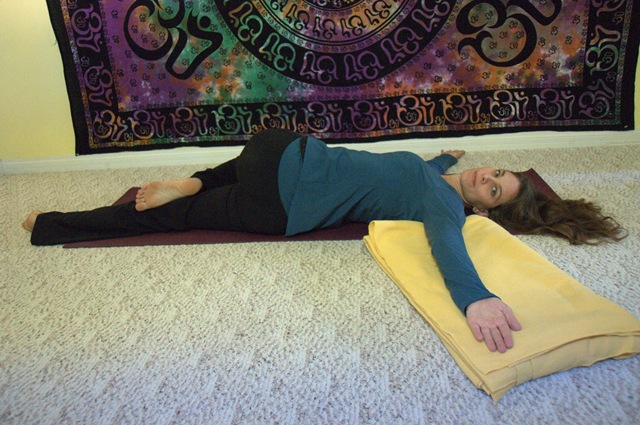
This is one of my favourite twisting poses. It is very relaxing and can be done by most people at any fitness level or age. Let yourself relax into the pose and bring attention into your spine. Let your whole spinal column be enlivened by the effects of the pose as well as your attention. It is not recommended to do this pose if you have just finished a meal, or are pregnant. Use caution if you have degenerated disks or arthritis in the spine or hips.

reclining twist part 1

You will need some blankets, pillows, or yoga blocks for this pose.

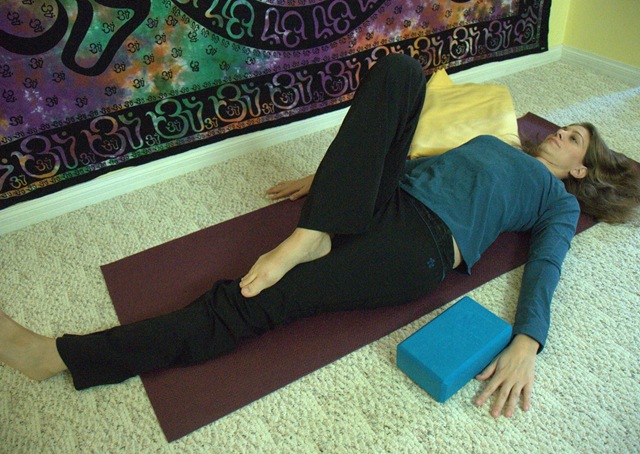
1. Lay on your back with your block or pillow on you left side near your hip and your blanket near your right shoulder.

2. Bend your right knee and bring the sole of your foot onto your left knee. Roll onto your left side bringing your knee down onto your block. (you may need to adjust the height of the block or pillow so it feels comfortable.)

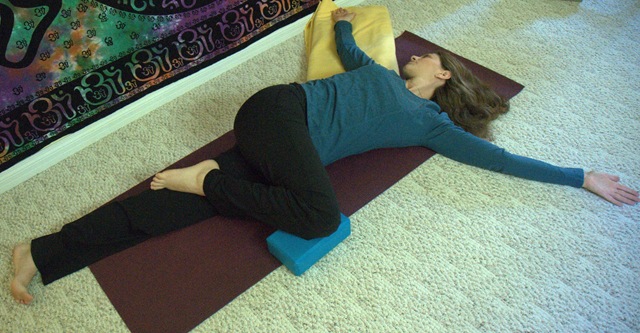
3. Bring your right arm over to the right until your arm is resting on your blanket. You may have to adjust the angle of your hip in order to place the arm in a comfortable position. Use as many blankets under the arm as you need so the position is very comfortable. Turn your head and look over your right shoulder.

reclining twist part 2

4. Check that there is equal weight on both the right knee as well as the right shoulder. You may need to fine tune your pose a bit and experiment with your props in order to find that balance.

5. You should be feeling the stretch in your hips, back, and shoulders. Take care to keep the movement of your neck soft and relaxed.

reclining twist part 3

6. Once you feel comfortable in the pose allow yourself to
relax, let your arm sink into the blanket and your knee sink into the block. Breathe into your back and spine as if you are drawing nourishment into your back muscles from the energy in your breath. Also breathe into your spine and feel the prana from your breath enliven the spinal column.

7. Hold the pose for about 1 min to each side, or until you feel the stretch diminish.

Benefits~ increases flexibility to the spine, and back muscles. Opens the shoulders, chest, and hips, mobilizes the pelvis and sacrum, strengthens the parasympathetic nervous system, releases stress and emotional tension. Detoxifies internal organs. Improves bowl function.

© written and modeled by Christine Wushke, Photo’s by Dianne Wushke.

www.journeytolight.net

www.innerlightyoga.blogspot.com

Harsha's avatar

Where is the Mind?

Perceptions and experiences occur in the mind. In what does the mind occur?

Harsha's avatar

I am not this, I am not that; who am I? – Gururaj Ananda Yogi Satsang

-This is an edited and unpublished satsang of Gururaj Ananda Yogi. If you want to watch the video of the whole satsang you can get it in Gururaj’s channel at Vimeo

Question: I am that which causes awareness to flow from the grossness of the lower mind to the un‑differentiated bliss of the superconscious.  I am not mind, but upon me the mind rests.  I do not move, yet through me all things move.  I am neither this nor that.  What am I?

Gururaj Ananda: That you are.

Who am I if I am not the mind?  Who am I if I am not the body?  What makes you presume that you are not the body and not the mind. What point of reference have you to tell you that I am not the mind and neither the body?  Show me that point of reference.

When I say to myself, “I am that I am,” who is this that I am that I am?  Who is this Brahmas mi‑‑I am Brahma?  Who is this that could say, “I and my Father are one?”  Who is this that could say that I, as the mind and body, is non‑existent?

Then what part of you is existent to make you cognize your non‑existence?  You don’t know, that is for sure.

Your mind is a reality, your body is a reality, and the spiritual self within you is a reality, but it is only the mind that could cognize its own realness which is also, at the same time, erroneous.
Gururaj Ananda and Cansita

You say I am this body.  Now this body has been changing so much.  I was an infant, then l grew up into adolescence, became an old man…

So this body is the same body, but over a period of time ‑‑ which you regard to be time ‑‑ has gone through various changes.  Who is that which perceives this particular form of reality?

The spirit that is within you, the Divinity that is within you, is non‑cognizable and neither would it cognize anything besides itself in its own cognition.

The mind says this is a handkerchief.  Why does the mind say this is a handkerchief?  Because my mind, or a certain recollection or experiences that has gone through me in this lifetime or even in past lifetimes, perhaps, make me cognize this to be a cloth, a piece of cloth to be used on my nose.

Now, where does this come from?  What tells you that this is a nose and that’s a handkerchief?  So you go further back to realize that my mind is saying that, then you will ask yourself what perpetuates this mind in this mold of having this particular kind of cognition?

And like that you go on and on and on until you reach a point which is zero.  Then only can you say, “I’m not the body.”  Then only can you say, “I’m not the mind.”

Look, I can touch, feel, smell, taste, go to bed and make love, go to the toilet.  Is the body then not functional?  Of course  it is functional.  Then why do I deny the body?

I deny the body because I feel within myself‑‑or rather some force is feeling within myself‑‑that I am far beyond the body and the mind.  Now, the greatest mistake that has been made‑‑or is being made by various theologies‑‑is the denial of the body and mind.  Let’s look at it from a different angle.  Do not deny this body.  Do not deny this mind.  And do not deny that which cognizes the body and the mind.

So how are you dealing with yourself, then?  We’re still going to come to the cognitive factor.  But at this moment how do you stand?  You stand in the position of saying, my body exists, my mind exists, and the cognitive factor also exists, so therefore I am existence and being existing I can deny nothing.  For I am that I am.

There is no differentation between your body and your mind and your cognitive self.  The I that cognizes the very existence of this body and this mind is thought forms which we can call the ego self that is forever trying to preserve itself in the cognitive factors of saying I am this handsome guru [comments and laughs from audience].   Who’s saying that?  That stupid ego self.

Now, what is the ego worth?  The ego is worth nothing, because it is just a formation of patterns which you have superimposed upon yourself through the various experiences that you have gone through, and that has left impressions.  And those impressions is that which we call the ego.

Now, I put my hand on this table and I remove this hand.  But an imprint is there.  The hand is not there anymore, but an impression or an imprint of the hand is existing on this table.  Get out your magnifying glass and you will see it.  What reality is there in this imprint?  Nil!

This very imprint that cognizes me as a body, this very imprint that cognizes me as a mind.  So my body and mind is totally dependent upon that imprint.  And yet, what is the reality of this imprint? Nil.  It’s an impression created through patternings of experiences.

So now if I deny this imprint, or if I do not attach value to this imprint in bringing about the recognitions of the existence of this body and this mind, then I am basing the existence of this body and this mind with something that has no substance but which has just created an impression there, presuming that this mind and this body is real.

So now, what have we done so far?  We are accepting the reality of the mind and the body, and, at the same time, we are denying the mind and the body.  Because both are true. You are not the body, yet the body; you are not the mind, yet the mind.  Then what is your reality?  And how are you going to prove this reality?

You can only prove it by inference.  Or by the very factor that reality requires no proof.  It exists because of its own existence.  The only time you can prove reality is when you have a reference point.  And where can there be any reference point as as far as Divinity is concerned.

There is consciousness and non‑consciousness.  Non‑ consciousness means you are not aware.  And conscious means that you are aware.  Now, what proof is there of awareness.  Does awareness require any proof?  Does the light burning there require any proof that it is burning?  Its very act of giving light is its own proof.

You do not need to prove anything.  Because when it comes to the highest level, you need a point of reference, and the highest level being the one, without a second, cannot have a reference point.

I exist, I exist, because I exist.  That’s all.  And because I, the real me to which I have no reference point exists, I can only refer it back to a grosser level of the mind and the body, which finds its existence in that which I cannot prove is existing.Gururaj Ananda
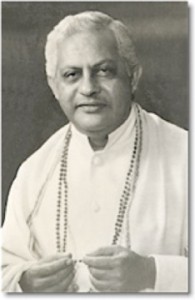
I’m taking the highest factor in life and bringing it down to the grossest factor and that is what I could compare things with.  But when we reach the point beyond comparison ‑‑ Beautiful word.  You’re pairing up things in comparison.  There have to be two to compare.  But what if I want to exist as I am in my full totality, then will I not lose the idea of comparing myself to anything else?  And the very moment I lose the idea of comparing myself to any subject or object, that is the very moment when I will lose the ego self, that imprint that is existing in my experience.  Or the impression of the experience.  Then where will I be?  I shall be incomparable.

I shall be the source of existence itself, which I am.  Not in reality, but in actuality.  For reality changes from day to day.  What is real to you today might be unreal to you tomorrow. You see.  But when I become actual, when I become the source and recognize that source within me, or the source recognizes itself, then I will say, let me enjoy this body.  Let me enjoy this mind, for it is a product of a collection of impressions.  And if they are there, let me make the best use of it.

Here we are fusing two factors.  The fusion lies in the fact that that which is created by impressions‑‑or maya or illusion‑‑, is brought into reality, and reality is converted into illusion.  So I make the best of both worlds.

For example, let’s see what example we can use.  Say I loved a woman very much, I was deeply involved with that woman.  Fine. And she has left me.  She has jilted me or died or whatever or jumped in the lake.  Now, is she there or is she not there?  She’s dead, we know.  But is she there or is she not there?  She is there because you think she is there.  What makes you think she is there is because those impressions, those experiences, and you are reliving something so far in the past which has no reality today, which has become an illusion.  Because she is not there.  I have developed a dependency upon her when she was there.  So what am I living on now?  On dependencies.

I am existing with a reality, which is my body and my mind.  Though in essence it is unreal, but for the moment of three score years and ten, let me do the best with it I can.  Why not. Who would deny me that right?  And why should it be denied to me? You think all these organs we have are there just for the fun of it or for the show of it?  You think I have ears and I must not hear?  Or I have eyes and I must not see?  Or a nose and not smell?  Or any other organ of my body that has been there created through an evolutionary process and not to be used.  Why should I not use every organ in this body of mine to its fullest value? Honestly and sincerely.

So these monks  say become celibate, become this and that, become this and I don’t know what all.  I say, “become yourself!”  Be yourself!

Be yourself.  How can I make myself be myself?  Ahh!  How can I make myself be myself?  And the answer to that riddle is so simple.  Do you know that beautiful hymn which I like very much, lead thou me on, kindly light, one step at a time is enough for me.  Don’t you know that beautiful hymn?

Firstly, I must admit to myself that  I’m living a fragmented life.  Part of my mind is pulling that way, part of my mind is pulling that way, part of my mind is floating up there in Chicago and another part somewhere in some heaven or some hell which has no existence in reality.

Admit to oneself that I’m fragmented.  Lead thou me on, kindly light to integration away from fragmentation.  Let me be whole.  Let me function in this life holistically.  Let me not find any more the discriminatory factors between body, mind, and spirit.  Let me regard it to be one continuum.  And this continuum, after finding through spiritual practices and meditation, when you find this continuum of yourself, mind, body, and spirit, this continuum will extend and extend and develop so much that the entire universe becomes you and you become the universe.

Existence and non‑existence, what am I going to do about it?  I’m both.  I am existing, and at the same time, the impressions which I’m existing upon is non‑existent.

So let me tell you this, that 99.999% of your problems in your mind are self‑created without any damn substance.  So that which you have created without substance… very easy way out of it‑‑pull the chain!

That is the secret of life.  Forget the past.  It is gone. Do not project yourself into the future, it might not be there. But live for this moment.  Live for this moment.  And then you’ll preserve your physical health, you’ll preserve your mental health, you’ll become integrated in mind, body and spirit, and you’ll enjoy life.  For life is joy.  So, as I always say, enjoy the joy.  Why deny yourself of that beautiful joy of this so‑ called existence when you can have fun.

What’s wrong with fun. Enjoy it.  But be honest and sincere, that’s important.

MEDITACION BARCELONA

Harsha's avatar

Chakras: The Pathway to Enlightenment by Rita Minassian

Rita Minassian holistic therapist chakra-balancing 

The chakras energy centers, a Sanskrit word for « wheel » or « disk », are the keys to reach Enlightenment. Through their meaning, colors, symbols, we can embrace the whole history of humanity starting from its root toward its supreme realization we’re all walking toward.


The Mulhadara chakra (or root chakra) located at the base of the spine is the chakra of our fundation: it refers to our survival instincts, self preservation and security. During prehistoric ages, people’s first occupation was struggling to survive. All their activities were about eating, finding a grotto to protect themselves from dangerous animal’s attack or bad weather, and when the moment came, to protect their precious source of fire.


Middle ages and Renaissance period were the theater of conquerors around the world. Crusaders or  conquistadors were fighting to conquer territories like Holly land and south America in tremendous violence, while other one were competing for the power of a royal throne and wealth, killing or raping people without guilt.


Through centuries, humanity progressed to Svadhistana, our second orange chakra just below the navel. It connects us to others through feeling, desire, sensation, and movement. It represents our capability to exchange and interconnect with the others. This need lead people to the sexual freedom in the 70’s: Woodstock and the use of the orange color during this period of time was the tangible representation of that desire to free the energy of Svadhistana chakra.


During the 80’s, we entered the Manipura chakra Era. This yellow solar plexus chakra represents, ego, identity and is oriented to self-definition. Time came for women who wanted some more recognition in society to adopt a “male look” through ties and shoulder pads on fashion at that time, businesswomen were becoming more and more numerous in companies, where self progression was motivating each step of corporate associates, male and female.  Ambition, self realization in a materialistic way: people just worked to achieve some personal goals through one rule, “Me first” …


Have you noticed how purple color overflowed fashion this year? For who knows the chakra color system it is surprising to talk about purple color instead of Anahata’s beautiful emerald green color… But shifting from  Manipura to Anahata, from ego to heart and Love, to generosity, non judgment, non violence, we need a lot of transformation and spirituality which is actually the symbol of purple color. Purple was also present during the 70’s when desire to enter the “New age” through a new spirituality was emerging. Anahata is a crossroads chakra, it’s very exigent and very simple at the same time: with loving ourselves and being in Peace, we allow ourselves to Love Unconditionally.


Anahata is also the “filter” for the Kundalini energy that climbs up from one chakra to another one and to transform it into a subtle compassionate energy and reach Vishudha chakra through the narrow space of our neck. Thanks to the  filter of Anahata, this blue communication chakra, we will express our thoughts in a compassionate way.   


This energy full of kindness will continue its path until arriving to Ajna chakra, or the 3rd eye chakra in the middle of the eyebrows (pituitary gland). It’s the place where our Yin and Yang energies meet: we then become more aware of our being and of our Universe. Ajna is the seat of our 6th sense that sees intuitively. Through it, we can use our insight and psychic skills. Nowadays, we can see more and more children around us with very strong intuitive skills and large consciousness:  some schools are aware of this phenomenon and accompany them with adapted programs. Some of them are known as “indigo children” because of the indigo color of their Aura, similar to Ajna chakra.


Finally, the run of the Kundalini energy will finally end to our crown chakra: Sahasrara and its “1000 petals” tinted in marvelous colors like purple (spirituality) white (purity) gold and silver (usually related to Guides and Angels)…

These numerous “receptors” connect us to our Higher Self, to our Guides and to Upper Forces. When everybody will reach the level of Sahasrara through a rich Spiritual life (which is not necessarily a religious life) people will access to wisdom, all-knowing, and bliss. That moment of pure Enlightenment will give us the opportunity to live in Harmony, at least…


The good news is that our evolution is rapidly increasing in the last decades than it used to be at the beginning of humanity, and hopefully our complete awakening will arrive quickly.


Each progress we make in our personal path toward Enlightenment is a help for our kinds: the more numerous we will be to raise our vibratory frequency, the better it is for the collective unconscious and our planet. From 1952 to 1958, in the island of Koshima in Japan, scientists established a theory which is called “The 100th Monkey”: the scientists trained monkeys to wash their sweet potatoes before eating them. After a certain number of monkeys trained, the scientists noticed that the monkeys on Takasakiyama island, a neighbor island of Koshima, started to wash their food also without being trained for it or having any connections with the trained monkeys … This experience shows us how the energy of a group can have effect on other ones attitude…


Everything that happens in this world finds its Source into upper world and upper force, using them for humanity’s Enlightenment is the choice we have through our free will. Like the lotus flower and its root in ooze becomes a beautiful flower with the help of the sunrays, such is human being and humanity in a holistic state: grounded into earth but push by a thirst for Light and Upper Forces to be able to grow…


OM MANI PADME HUM, this post is dedicated to the 7 billions of Lotus jewels around our beautiful planet walking toward Light.


Rita Minassian

www.ritaminassian.com