Harsha's avatar

The Divine and The Ego: By Dr. Mourad Rashad

To understand that the ego is the disease, the mind is the disease, this is true understanding. What is the difference between ego or mind and insight or Consciousness?

Insight is a gift from the Divine, is a link with the Divine, and is the unbreakable bond with the Divine. Insight appears when your consciousness is temporarily freed from the influence of the ego or mind and regains its original condition.

One has to know, that we are born with only an Insightful Consciousness, later on, due to the child’s conditioning by the society, this Insightful Consciousness is transformed to our everyday mind or our ego, which in turn transforms the Original Divine Existence into our everyday world we experience. This is the problem. Our everyday mind or ego is our transformed Original Nature due to conditioning by the society and is the root cause of experiencing our world with all its pains and miseries together with a trivial scent of pleasure and fun, instead of experiencing the Divine Existence. The mind or ego is not our true nature.

This original Insightful Consciousness is what is meant by the word “Heart” in mystical and spiritual literature.

Originally, this Insightful Consciousness is integrated with the Divine Existence. It never departed from this Divine Existence. This Insightful Consciousness is the breath of God in Adam’s nostril -according to Genesis. This is the Spark, the Flame, and the Spirit of God with humans.

When you know that the ego is the disease, the mind is the disease, conditioning by the society is the disease, then you start the process of de-conditioning, you start unlearning what you have learnt, in order to regain the Insightful Consciousness, which will guide you back to be in perpetual integration with the Divine Existence. A Divine Existence that is Wise, Cognizant, Deathless, Eternal and Blissful.

Then Insight starts to clear, you see the world in a different light, you start glimpsing the Divine Existence, and you start learning from your life. You look at life more appreciatively, you become no longer interested in seeing your old world, because now you come to know that there is a Divine Existence underlying what you used to call and experience by your mind or ego as my world. Moreover, your ticket back to this Divine Existence is de-conditioning to regain your original Insightful Consciousness.

Harsha's avatar

ULLADU NAARPADU (also spelt as Ulladu Narpadu): Comments By Professor V. Krishnamurthy

ULLADU NAARPADU

The famous Vedantic poem in Tamil by Bhagavan Ramana Maharishi

(consisting of two preliminary verses called Mangalam, 40 verses which form the main text , and another 40 verses called the Appendix)

Translation into English by Lakshmana Sharma

Detailed Commentary in Tamil by Lakshmana Sharma,

adapted into English by Profvk


Mangalam – 1

Text in Tamil:

uLLadu aladu uLLa uNarvu uLado?

uLLa poruL uLLal aRa uLLatte uLLadAl

uLLal enum uLLa poruL uLLal evan?

uLLatte uLLapaDi uLLade uLLal uNar.


Translation (Lakshmana Sharma)


Can there be a sense of existence without something that is? Is Real Consciousness  a thing other than That? Since that (Reality) dwells, thought free, in the Heart, how can It – Itself named the Heart – be meditated on?

And who is there, distinct from It, to meditate on It, the Self whose nature is Reality Consciousness?

Know that to meditate on It is just to be at one with It within the Heart.


Incidentally the Mangalam-1 Verse has been translated by Prof. K. Swaminathan as follows:

“Unless Reality exists, can thought of it arise? Since, devoid of thought, Reality exists within as Heart, how to know the Reality we term the Heart? To know That is merely to be That in the Heart.

The first sentence may also be rendered thus: Can there be Knowledge of Reality other than existing as Reality?”


I am giving the original Tamil for us all to see the majesty of Ramana’s classical Tamil (even if one does not understand Tamil!).


Commentary on the first line


There are two meanings for this line. Both are valid. These are the first two sentences of the translation.


On the first meaning of first line


Can there be a sense of Existence without something that is? Here the conclusion is there exists something that always is. The jIva-Ishvara-jagat (soul-God-universe) which appears as real is not real, but there is a substratum (*adhishTAnam* of Reality underneath. This is the truth declared by the Upanishads, which call this Reality ‘Brahman’. Bhagavan himself explains this as follows:


“Every one sees himself and the universe around him. He thinks both are real. If they are real they should always appear, not off and on. But they appear and also disappear. They appear in the waking and dream state but not in the deep sleep state. In other words they appear only when the mind is there. They do not appear when the mind is not there. Therefore the seer JIva and the seen universe are only thought-forms of the mind and not real. Where these thoughts arise from, where they merge, that is the only shining Reality”. This same content is going to be given by Verse beginning with ‘ulagaRivum onRAy’ (Verse #7) later.


So what appears only off and on is unreal and what appears always uninterruptedly is Real. Recall B.G. *nAsato vidyate bhAvo …*. Which gives the distinction between sat and asat. ‘What does not exist before and after, is only non-existent even in the present but only appears to exist’ says Gaudapada in his Karika. Those who accept this maxim of Reality are advaitins. Others are dvaitins.


The standard example for this unreal appearance of the universe and the Reality of the AdhishTAnam is the snake-rope example. Brahman is the adhishhTAnam (sub-stratum, base) ; jIva-Ishvara-jagat is Aropitam (Superposed entities).


The snake which is imagined hides the rope which exists. So also the imagined jIvaIshvara-jagat hides the existent Brahman. So long as Brahman is seen only as the universe (By the way ‘Universe’ here will include jIva and Ishvara also because if the universe is not there, the JIva and Ishvara also are not there), Brahman will not be seen or known as brahman. When by Atman-Realisation, Wisdom arises, the universe will not be seen as universe but as Brahman, the only Reality. This appearance and disappearance form the characteristic of mAyA. Really mAyA is not real. But that will be known only on Self-Realisation. Before that, that is, so long as the universe is taken to be real, one has to say mAyA exists. This mAyA is also called avidyA or ajnAna.


When the rope appears as snake, the appearance is due to the confusion in the mind of the seer. Now the jIva-Ishvara-jagat appearance is due to what? Is there a consciousness other than Brahman and is it that which shows the universe to us? Is Brahman inert or conscious? Is consciousness Brahman or is consciousness a quality of Brahman? The replies to these are given by the second meaning of the first line of the verse. It is actually the second sentence that appears in the translation.


On the second meaning of first line.


Is Real Consciousness a thing other than That?


What exists – false or real – what sense makes it explicit? This consciousness is not different from what absolutely exists. That itself is a bundle of consciousness – of the form of Knowledge (jnAna-svarUpa). In order for this to express itself there is no cognizing source other than itself. That which exists expresses itself by its own luminiscence of consciousness. It is self-effulgent. This is the substance of the 2nd meaning.


At the time of Ignorance Brahman appears as the universe. At the state 

of jnAna that itself expresses as the sat-cid-Atman (and nothing else). For both expressions it is the knowledge-factor of brahman that is the shining Light.


 [ Footnote: For the universe to appear it is again the Light of Brahman that shines. The Light of Brahman is not totally hidden by the universe. The akhaNDa-brahma-chaitanyam itself sparks as the speck of ego and that shows up the universe] .


There is one more implication in this sentence. Since we said there is no other consciousness distinct from Brahman, the universe that appears to be different must be only a false sensation. And he who sees this universe as a real show, is also having only a false sensation. Bhagavan says the seer or jIva who sees this universe is also part and parcel of this show of universe. This same idea comes again in the verse beginning with ‘nAmulagam’ (Verse #1).


In the Appendix (anubandham) to this text Bhagavan calls this ‘false soul’ or ‘false jIva’. Vedanta books call this ‘cidAbhAsa’ (also false consciousness). Ignorant people think of this jIva as AtmA; they call this jIvAtmA and call God as paramAtmA, as if there are two AtmAs. This text-line tells us that other than this ever-existent Brahman there is no one to be called jIva. Therefore we, that is, the AtmA is Brahman and not something else. This is the brahmAtmaikya conclusion of all Upanishads. This is also the considered conclusion of Adi Shankara. This is the Absolute pAramArthika truth that will be clear by the experience of jnAna. We think in our Ignorance, that the false jIva is AtmA and other things are different from it.


All this means: Brahman is what exists. It is the only Reality. It is also the Consciousness that expresses itself. Therefore Brahman is AtmA. There is nothing different from it either sentient or not. It has no differences like the seer and the seen. This is the conclusion of advaita.


Note that this text-line does not tell you that brahman HAS consciousness. Brahman IS consciousness – that is the teaching. If something has consciousness it means it has consciousness as a quality or qualification. In that case it will be callled buddhi. Actually this is not different from the mind. For mind, to be conscious is not its nature. It is its quality or qualification. Therefore consciousness of the mind is not permanent or stable. In sleep the mind’s consciousness vanishes. The consciousness that is the nature of brahman is not of this kind. It is eternal and unchanging. It is unaffected by time and space. Even when all the universe disappears, even in that primordial state, it exists.


That Brahman is jnAna-svarUpa is to be known by the teaching that we receive. But it can also be inferred by logic. Such a logic appears in the first meaning of this text line. We saw therein that it is Brahman that is the origin as well as destination of all thoughts of the mind. So Brahman is the source of this sentient mind; so this brahman has either sentience or is itself sentience. If it HAS sentience it is like the mind and so not a reality. Thus it is neither insentient nor an entity which has sentience. Then what is it? It IS sentience, consciousness (chit or chaitanyam). This is the conclusion of all Vedanta. Therefore it is called sat-chit.


Alternatively we can also argue as follows:


It is not correct to say that Brahman HAS sentience. Therefore it has to be either insentient or Caitanyam (Sentience, Consciousness) itself. If you accept it is insentient then it means it is not self-effulgent; for all insentient things show up only by an external intelligence. Then the question arises: how is brahman effulgent, by what intelligence? The opponent would say it is effulgent by an intelligence outside of it. Now the question is: That caitanyam – is it *sat* (existent) or *asat* (non-existent)? Certainly not non-existent; for a non-existent thing never lights up anything. If you say it is *sat* then it becomes *sat* and *cit* . Thus we have accepted that the same entity can be both *sat* and *cit*. In that case, the earlier mentioned brahman which exists, can as well be also *cit*. This is the easy way out. Thus it turns out that the existent Brahman which is the adhishhTAnam for the universe is self-effulgent, in other words, in order to show it there is no other intelligence necessary. On the other hand, if we say that this existent thing is not self-effulgent, then in order to show it there must be another cit (intelligence). That also cannot be said to be self-effulgent, by the above logic. Thus another intelligence has to be postulated. So we have to go on postulating non-self-effulgent intelligences, — a series of them. This is then an infinite regress (anavasthA-doshha). Thus the conclusion is the Brahman which is the Reality is self-effulgent.


Thus it is clear that Brahman is by nature Existence as well as Intelligence. That is why it is called *sat-cit*. But this does not exhaust the svarUpa of Brahman. Its svarUpa can be understood only by experience not by any other means.


So the mind which appears to have sentience is really not so. It is also insentient (jaDa) like the universe.


In fact this Brahman is our AtmA. But then why does it not show up like that for us? Why are we thinking that we are finite beings who suffer all the unhappiness and revolve in this samsAra? The answer comes in the next portion of the Mangalam first verse.

The next sentence in the Mangalam – 1 Verse


uLLa-poruL uLLal-aRa uLLatte uLLadAl

uLLamenum uLLa-poruL uLLal evan?


Translation

Since that (Reality) dwells, thought- free, in the Heart, how can It – Itself named the Heart – be meditated on? And who is there, distinct from It, to meditate on It, the Self whose nature is Reality Consciousness?


[Note by VK: Bhagavan Ramana’s masterly handling of classical poetic Tamil can be appreciated even by non-Tamil people, when I tell you that he uses the words

uLLam = mind;

uLLadu = that which exists; (uL = interior, content);

uLLal = thinking, thought, meditation (comes from the verb form)

uLLam = heart (Bhagavan Ramana’s usage, when the context permits),

in all possible combinations so that the verse manifests as a lilting poetry!]


Commentary


Here the Tamil word ‘evan’ must be taken in two meanings, namely, ‘who?’ and ‘how?’, according to Bhagavan’s own words. [That is why, in Lakshmana Sharma’s translation above, there are two sentences in English for this one sentence of Tamil].


In sum, this sentence says: The svarUpa of brahman is without mind [Note: thought-free = uLLal-aRa] and full of peace; it is in the heart (uLLam). This Reality (the existing thing = *uLLa-poruL*) will show up only in the heart, that is devoid of the mind (uLLal-aRa = mind-without). When the mind is active and poised outside It will not show up ‘as is’ (=*uLLapaDi*). What does it mean to say it will not show up as is. It means it will show up as jIva-Ishvara-jagat. By this very reason Brahman cannot be thought of (=*uLLal*) by the mind.


Why cannot Brahman be thought of by the mind? There are several reasons for this. One of them will be understood when we come to the verse *madikkoLi tandu* (Verse #22). But here there are two reasons given. 1. Mind by nature imagines differences in Brahman of pure non-duality, and treats them as real; 2. There is no intelligence, sentience (*cit*) other than Brahman to meditate on it or think of it.


We shall consider the first reason. First mind imagines a duality of inside and outside (the mind) and thinks that there are universes, other jIvas, God – all of these are outside. This is mind’s nature. We have already seen that all this imagined world etc. have an adhishhTAna (substratum) reality of Brahman and they are all Aropitam (superposed) on that Brahman. By the logic that the superposed thing hides the show-up of the existence of the substratum, the superposed universe hides the existence of the substratum of Brahman. So long as mind is focussed outside (=*bahir-mukham*) brahman, instead of showing up as is, shows up as jIva-Ishvara-jagat. Once the mind is focussed inside (*antar-mukham*) it joins up with its original location, the heart, and there mind loses its ‘mind’-nature and ‘vanishes’. So the three kinds of shows, namely jIva, Ishvara and jagat also do not show up and Brahman shows up as the AtmA, without any obstacle. Of course mind does not see it, nor does it know!


Here we have talked as if there is something called heart or *uLLam* which is the ‘location’ for Brahman but in reality it is not different from brahman; so neither it is the location nor does brahman is ‘located’ in a place. The seeker who is after Self-Realisation needs to change from his look-outside to a look-inside and for this purpose the heart was spoken of as a sAdhana (means) and there is nothing more meant. The heart (spiritual interior) itself is Brahman. Look at the 2nd line in the above text: *uLLamenum uLLa poruL*:

uLLam = heart,

*enum* = named

*uLLa poruL* = that which exists.

This means: Brahman itself is what is called the heart, because uLLa-poruL is brahman only.


Since brahman is in this (inner) heart, it shows up as is when the mind has vanished. When the mind is otherwise engaged outside, It will not show up. We already observed that that is when all the imaginations about the three things happen and they hide brahman. Thus it is clear that those whose minds are turned outside will not realise brahman.


Now we shall go to the second reason: namely, to think of Brahman, there is no other sentient entity (cetana). The jIva that thinks of itself as knowing another entity is a false jIva. When the mind is turned outside, such a false jIva appears to be real. When mind turns inside, that is, merges in the uLLam (heart) , that false jIva vanishes. The false jIva is only an imagination; so there is no one to meditate on Brahman. The conclusion is: brahman is not amenable to the mind’s thinking.


Then how do we ever ‘think’ of or meditate on, the Brahman which is the Atman? This question is answered by the fourth line of Mangalam-1 verse.


Fourth Line of the Verse


uLLatte uLLapaDi uLLade uLLal uNar.


“Know that to meditate on It is just to be at one with It within the Heart.”


*uNar* = know(that)

*uLLal* = meditation

*uLLade* =(is) just only being, abiding in, (Tamil: *iruttal*)

*uLLatte* = in the heart

*uLLapaDi* = as (It) is.


Commentary


This line describes Atma-jnAna-anubhavam (Self-Realisation-Experience). Mind to be seated in the heart, and abiding in brahman that is nothing but that heart, and to lose its mind-status, so that brahman, unmoving and peaceful, is ‘seen/known’ as Atman: this is known as dhyAnam.


But mark it. Though we have said this is dhyAnam it is not the meditation by the mind. Meditation caused by the mind has three facets in it, namely, the meditator, the meditated object and the meditation. But this dhyAnam above is devoid of these three components. Since other than this everything else is not considered to be dhyAnam, this is said to be dhyAnam in the text. Bhagavan Ramana says this is pUjA, this is bhakti, this is darshan, this is Knowledge. All benefits supposed to be accrued by these are only accrued by this; not otherwise. What is called mukti or mokshha is this. This is also known as the Fourth (turIya) state. To get to this state the sAdhanA is described later in the verse beginning with ‘ezhumbum-aganthai’ (Verse #28).


 Continued in ULLADU NAARPADU – Mangalam 2

********************************************************************


Harsha's avatar

Self-Nature, Faith, and Attention: By V. Ganesan

This posting is from a series of ‘sharings’ done by V. Ganesan in Tiruvannamalai in 2009.

Bhagavan Ramana emphasized that nothing is more productive of the highest spiritual results than concentration of the mind on one’s True Nature, which is the Absolute Reality, God and Inner Guru.

To adhere to this injunction of Sri Bhagavan, even the physical form of the Guru should not be an obstacle for a true seeker. Listen to the story of Uddhava in “Srimad Bhagavatham” :–

When Lord Krishna ended His mission on earth and was prepared to return to his eternal abode in Heaven, Uddhava, who was greatly attached to His person, appealed to Him with tears in his eyes to take him along with Him, saying :   “I have strong forebodings, O Supreme Lord, that after destroying the Yadu race you will leave the earth altogether.  I cannot bear to be away from your holy feet even for a moment.  Grant that I may be taken with You to Your Divine Abode in Heaven.  How can I now be separated from you ?”

Lord Krishna answered that it would be in Uddhava’s own interest not to cling to His body but to stay on after Him and practice the Inner Yoga in the Himalayas, after shaking off all attachments to his family and kinsfolk, keeping his mind fixed wholly on Him, within his Heart.

Sri Krishna added : “You must always remember, dear friend Uddhava, that whatever is thought by the mind, perceived by the eyes and ears and spoken by the tongue is the creation of the mind and therefore illusory. By controlling your mind and senses, you will see the world as only the projection of your own Self and that your Self is in ME, the Supreme Lord.  Possessed of this Wisdom, be immersed in the Supreme Peace of Self-Realisation. Then, you will experience no obstruction in regaining ME, in your Heart.”

There was a pious lady, who once prayed to Sri Bhagavan to bless her by selecting a few important verses from his written works, so as to help her progress in her spiritual emancipation.  Sri Bhagavan gave her a glance of compassion.  It seemed to endorse Jesus Christ’s statement : “Ask, it shall be given”.  Instantly, he quoted two verses from “Sri Bhagavad Gita ”. He had already selected 42 verses from out of the 700 and odd total verses of the ‘Gita ’ and had translated them into Tamil verses.  They are :

“The faith of everyone is according to his nature.  Man is
essentially endowed with faith.  What his faith is, that
indeed is he.”  —  [xvii (3) ]

“One who has faith and one-pointed attention and has
subdued his senses, attains Wisdom.  Having gained
Wisdom, he speedily attains Supreme Peace.” – [ iv (39) ]

These two are Verses 17 and 18  of  “The Song Celestial ”- the 42 verses that Sri Bhagavan had selected from the ancient classical, spiritual treatise : ‘The Bhagavad Gita’ .

The first verse [ No.17 ]  affirms the traditionally upheld ‘Law of Karma’, which dictates that one’s present life is due to the past actions and that one’s nature is thus ever controlled. The second verse [ No.18 ], however, postulates the certain possibility of one’s turning one’s attention within and thus getting rooted in Wisdom, resulting in the attainment of Supreme Peace.

Whatever is one’s sadhana-mode – as referred to in verse 17 – one is always free to make a concerted effort to turn one’s attention inwards and thus supersede the law of karma and be established in the SELF . The choice is all the time available to each seeker in the solid form of  “ NOW”.

Ignore one should the ‘prarabdha’  and pay full attention [ within ] to ATTENTION !   The very effort of one to plunge within is due to Grace, affirms Bhagavan Ramana !

Attention is “NOW”, which swallows one’s ‘faith’ and one’s  ‘nature’, thus establishing one in the Supreme Truth of Existence, the  “ I AM ” .

All ‘karmas’ project a ‘past’ and  then a ‘future’ – the two non-existents. Bhagavan Ramana’s commandment is :

“ Shift your attention from non-truth to Truth.”

Let us remove our attention from the ‘past’ and ‘future’ and one-pointedly plunge our full attention within – on NOW – and be supremely happy !

************************************************

Related post: Satsang with Ganesan

V. Ganesan Bio

ganesan-1

Born in 1936, up to the age of 14 years old, Ganesan grew up in the presence and proximity of Bhagavan Sri Ramana Maharshi. His sacred memory of the Great Master is rich in its content; and, even at that tender age he could see Sri Ramana as the greatest compassionate human being.

On April 14, 1950 – the day the Great Master chose to leave the body – the adolescent Ganesan stood near the entrance to the room where Sri Ramana was lying and was fortunate to witness the brilliant flash of Light that later moved towards the top of the Holy Hill – Arunachala.

Ganesan obtained a Master’s Degree in Philosophy; and, then came to stay permanently at “Sri Ramanasramam, Tiruvannamalai” – the sacred abode of Sri Ramana Maharshi – taking care of the Old Devotees of Sri Ramana. He did it as his sole sadhana (spiritual practice). In that way, he collected the reminiscences of Sri Maharshi from those Old Devotees which have never before been recorded.

His close contacts with sages and saints, including Swami Ramdas, Mother Krishnabai, J. Krishnamurti, Nisargadatta Maharaj and Yogi Ramsuratkumar, he says, have deepened and widened his understanding of the ‘Direct Teaching’ of the Maharshi. However, he feels himself to be an insignificant ‘dust’ at the Holy Feet of Bhagavan Ramana.

He has traveled widely and spread the ‘Direct Teaching’ of Sri Ramana Maharshi, in its pristine purity, wherever he was invited to give talks.

He has authored a few books on the life and teaching of Bhagavan Ramana. Among others, “Purushothama Ramana”, “Be the Self”, “Moments Remembered”, “Direct Teaching of Bhagavan Ramana” and “Practising Self-Enquiry” , are very popular.

At the veranda of his cottage – “Ananda Ramana” – he meets earnest seekers, every Monday and Thursday, between 9.30 and 11 a.m., sharing with them the spiritual treasure entrusted with him by all these holy and sacred souls.

Harsha's avatar

Surrender in Advaita: By Dr. K. Sadananda

The following question was put to Sada-ji (Dr. Sadananda), an eminent scholar on Hindu metaphysics of Advaita-Vedanta (Feb. 12, 1999) on the Advaitin Sangha:

Please explain what is the place of surrender in an advaitin’s search for Self-knowledge?. What should he surrender to? What shall prompt him to surrender?

with pranams
vijayakumar

Editor’s Note: Dr. Sadananda’s answer is given below with minor edits by me. I am not a Sanskrit scholar and so if there are mistakes in my edits, please let me know and I will correct these quickly. Thanks.

Dr. Sadananda answers:

Bhagavan Ramana describes this beautifully in Updesh Sara:

ahami naashabaagyahamaham taayaa|
spurati hRit swayam param puurNa sat||

When the false I falls (ego is surrendered), then in that place aham, aham – I am – I am – swayam spurati – spontaneously rises.

This “I am” that rises is different from the previous “I am” (ego) with notions that I am this and that etc.

This pure and unconditional rising  is paramam – supreme (there is nothing beyond it); It is puurnam – Infinite without limitations since limitations belong to “this” and “that”.  It is Sat swaruupam – nature of pure existence with no qualifications attached to “I am”.

Where does it rise?  Where else but in ones own inner core of personality where “I am” (ego) is currently rising along with notions that  I am body, mind, or intellect etc. With the surrendering of ego, the false notions about my self are replaced by the true knowledge of my self. It becomes clear that as the self is in all, all are in myself.

sarva bhuutasta maatmaanam sarva bhuutanica aatmani –

What should I surrender to?

In pure Advaita Vedanta, the surrendering is not someone surrendering to another person.

Advaita teaches through negation of what I am not.  In scriptures, this process is given as – neti – neti, etc. I am not this and not this and not this, etc.. Whatsoever can be objectified by me, I am not.

Through negation one ascertains who one is.

Realization of what I am searching for, I am searching with! Do you see the beauty of it?

Tat twam asi – neti neti is a part of the inquiry of who I am not, by negating what I am not. What is left after all negations is the subject who is negating. The subject cannot negate oneself. That I am!

This very inquiry is the surrendering of the ego.  As J. Krishnamurthi puts it;

The very observation of ones conditioning releases one from his conditioning. Knowledge of who I am then rises.

In vishishhTaadvaita the knowledge of the Lord rises. There the Lord is different from me yet I am part of Him not independent of Him. The total is one – Creation is the gross manifestation of the subtle existence.

What prompts one to surrender?

There is a famous sloka in the Mundaka Upanishad –

pariiksha locaan karma chitaan brahmano
nirvedamaayaa naasch kRitah kRitena
tat viJNaanaartham sa guru mevaabhigachhet
samit paaNiH strotriyam brahman nishTaam||

At some stage in life – a question arises – what does all this means? One is looking for happiness in all pursuits and one is unable to get an everlasting happiness from the external  world and relationships.

By examining ones’ owns action- prompted results, one realizes that by doing action one cannot gain any everlasting happiness. That is the time, the scripture advises the student to approach a proper teacher to guide one self. One should approach a teacher with full humility with an attitude of service to that teacher who is fully established in the truth and who can come down and communicate this knowledge to the student.

So what prompts one to surrender? The clear realization that all other means are not useful to secure what one is looking for – an eternal happiness.

Hari Om!
Sadananda

Harsha's avatar

Blessings of Simplicity: By Dr. Mourad Rashad

Have you ever asked yourself, “do I understand life”? Is life what I think it to be?

To start asking yourself about what you take for granted is the beginning of true understanding. This is the first step taken by any prophet, wise man, or a sage.

What triggered these questions in the hearts and minds of these great men? Life itself forced these questions. Worldly living and suffering brought these questions about. The simplicity and humility of these men in response to life allowed these questions to emerge.

Simplicity means that you are not sophisticated. Being sophisticated shows that one is worldly wise; one is well versed in the ways and methods of the world. Sophisticated shares the same root with the word sophistry, signifying something very plausible, but fallacious and misleading.

No one is born sophisticated. Sophistication is something that we learn. Children are born light and natural.

The prophets remain like children. They do not wish to become clever. Instead, they want to widen and deepen their understanding of life.

For the prophets and sages of old, the ways of the world, did not appeal to them and did not satisfy their hunger for a truer meaning to life. These great men were of this type, they were simple, they were direct in their understanding, and they did not allow sophistication and clever ways of the world to mislead them.

I finish with a quote from the Bible where Jesus makes the same point.

“Truly I say to you, Unless you turn around and become as young children, you will by no means enter into the kingdom of the heavens. Therefore, whoever will humble himself like this young child is the one that is the greatest in the kingdom of the heavens.”
____________________________________________________________________

From the Author: My name is Mourad Rashad. I am 57 years old and live in Cairo, Egypt where I was born. I hold a PhD in Pathology from the Faculty of Medicine, Ain Shams University, Cairo, Egypt, where I am a Professor. I have a private practice as an internist specializing in geriatric medicine.

I am a Muslim, and have read all of the Quran as well as the Bible. I became exposed to Mysticism early in life, through my father who was an avid reader of the mystic masters, and who took me with him to attend spiritual gatherings in Cairo. I have read extensively in Zen, Sufism, Advita, Gnosticism, Taoism. I was a disciple of the late Padamanabhamenon (Gurudev), who is the son and successor of the late Atmananda (Gurunathn), who was a contemporary sage to Sri Ramana Maharishi.

I have written a book in collaboration with a fellow Egyptian mystic entitled “The Mysticism of Jesus Christ”, where we discussed and interpreted the sayings of Jesus Christ in the four canonical Gospels, and as well as in the Gospel of Thomas.

Harsha's avatar

Crisis, Fear, And Transformation: By Rita Minassian

Rita Minassian post crisis-fear-and-tranformation

Traders in panic in Wall Street – Photo credit Bloomberg

No doubt that in the current economical context, many people are in panic around the world because of huge losses on the stock exchanges of the planet. Except a pinch of conscious business leaders, how many of them are considering this crisis with a spiritual approach, realising how predictable was the transformation we’re going through and, beyond economical issues, how global it is? Yet, for centuries, esoteric systems referred to some huge opening of consciousness after the millenium, lets’ see how incontrovertible is this profound change and how to participate to it individually and consciously.

 According to the belief of the Mayan civilization, the world is organized upon a cyclic system: many centuries BC, the Maya calendar predicted the end of a cycle of 26 000 years in 2012 and the starting over a new one.

 The book of the Apocalypse, refers to a chaos that St John calls “The Judgement day “ that will occur during “the End of the times”. This doesn’t mean the end of our planet because of our “sins” like Church wanted people to believe for centuries but, the original meaning of the word, a time for  “Revelation”: time for people to transform the way they think, they behave and reveal their inner truth to live in a conscious way.

It’s been 5000 years that Sciences like Chinese medicine and Ayurveda are promoting a hollistic  approach of human beings: we’re not just flesh and blood that can be opened, cut and sewed like rag dolls…but energetic systems to be considered globally: physical, emotional, mental and spiritual beings. Recently, the research in Quantic physics and the string theory are tending to proof the global nature of our “system”,  including an energetic approach of what we call reality.

In  the 19th century,  Carl Gustav Jung and his concept of collective unconscious was a revolution in our approach as individual beings, showing how bounded we all are.

Compassionate thoughts are prayers toward the others and would, by a “boomerang effect” come back to us the way we threw them. Such as embezzlements… isn’t it M. Madoff ?…

Like is like, the law of attraction was already known through the famous “Do onto others as you would wish them do onto you”, our economy is paying the price of feckless decisions based only on a compulsive need for profit margin…

To bring back balance in our life, it’s becoming urgent to live in harmony: within ourselves, with the others and with the Universe, by adding some more common sense and ethic in our economics, politics, environmental issues …Integrity and respect have to be applied in our everyday life, both personal and professional and not just be abstract, political correct concepts.

 According to esoteric systems, we’ve now almost entered the Era of the Aquarius that is not, like some people may think, the confabulation of a group of hippies of the 70’s, but a challenging period of time for humanity that gives us the opportunity to live this famous New Age predicted since centuries in many civilizations, beyond one religion or belief, through inner transformation…

 Transformation within ourselves, to go to a higher level of consciousness, transforming old patterns, lead unto gold,  sounds like an alchemical process to reach a certain Holly quest isn’t it?…

There are many tools to help us to operate this transformation. Some traditional ones like yoga, meditation and mantras help us to connect our higher self giving us a conscious awareness of what we’re living “here and now”. Other ones more contemporary, like psychology, give us the opportunity to face the shadow within us. Our ego builds a balance, a public character that plays a role in society, but in the back of this pseudo identity, it’s important to find out how much our reactions are conditioned by our fears and old patterns in order to operate changes and stop to live the same experiences over again, very often in pain and suffering…

 As we’re all bounded, we attract what we are through the law of attraction. We can represent this unity by similarity with a diamond, a unique gem with many different facets: each one of them representing one person…If we apply that metaphor to our interpersonal experiences, in a very honest way, we can see how each person around us represents a part of our personality with both positives points and flaws. Very often, the characteristic of the person is shown to us in a exaggerate way in other to wake us up and oblige us to see what’s wrong within us!

This perspective really give us an interesting stand back that helps to “in-vestigate”: “what part of my personality is attracting that person/attribute/lack/experience…?”

Mirror, mirror on the wall… the other then becomes the reflection of our real “me”, free from the mask of the ego…

When we start to be aware of the transformation we have to proceed within ourselves, it becomes an everyday challenge, but Oh so rewarding!

“A lot of chaos is needed to create a butterfly”, thus spoke Zarathustra, we’re in the middle of the chaos, creating the butterfly depends on all of us…

This period of profound change, pushes us to reorganize our entire system in the doldrums, to clean it deeply, previous to a positive period of time unprecedented: no GDP can measure what’s really worth living in life. Today, I heard the speech of a politician asking for some more “moral capitalism”, It is definitely time for a more heart-based leadership…

“Be the change that you want to see around you” said the Mahatma Gandhi, let’s face the mirror and go for this challenging Armageddon.

Rita Minassian Empathic-civilization-jeremy-rifkin-crisis fear transformation

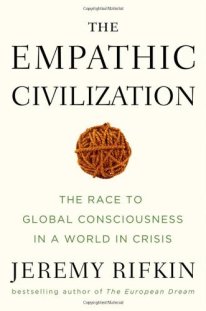
NOTA: Two years after writing this article, an excellent book called “The Empathic Civilization” was published by economist Jeremy Rifkin, a real visionary. I highly recommend this book if you wish to go further with the topic of this post.

Rita Minassian – www.ritaminasian.com

Editor’s Note: Rita Minassian resides in France and her native tongue is French.  She is the founder and spiritual trainer at the Akasha Institute. Please visit her website for more information.
Harsha's avatar

The Only True Love: By Dr. Mourad Rashad

If you love a person, you start seeing things which are not there. No woman is as beautiful as you think when you love her, because you project. You have a dream girl in the mind and that dream girl is projected. Some how the real girl functions only as a screen on which you project your dream girl.

That is why every love comes to a frustrating point sooner or later, because how can the girl go on playing the screen? She is a real person; she will assert, she will say, “I am not a screen!” How long can she go on fitting in with your projection? Eventually, you feel things do not fit. In the beginning, she yielded, in the beginning you yielded. You were a projection screen for her; she was a projection screen for you.

Nobody can play a screen for you forever and nothing can remain a screen for you forever, because it is uncomfortable and not natural. How can somebody adjust to your dream? How can anything adjust to your dream? Everything has his own reality, and the reality asserts and shows itself.

If you love a person, you project things, which are not there. If you hate a person, again you project things, which are not there. In love, the person becomes a god. In hate, the person becomes a devil — and the person is neither god nor devil. The person is simply himself or herself. These devils and gods are projections.

Similarly, you love your world; the real world is a screen for you, a screen for the beautiful world in your own mind, which you project. You see things in your loved world, which are not there; you imagine that they are there. That is why your loved world frustrates you, betrays you, annoys you and finally you die, your loved world kills you.

The real world cannot remain a screen for you. It has to show you what it is made of, and it has to show you its truth. You cannot see its truth unless you stop projecting your dream world, you stop loving the world in your mind, and you stop loving your ego, which is the world, stored up as mind.

If you love, you cannot see clearly. If you hate, you cannot see clearly.  When there is no liking, no disliking, your eyes are clear, you have clarity. Then you see the other as he is or as she is, you see the world stored up in your mind, which is projected, or you see your ego as it is.

Moreover, when you have clarity of consciousness, I say clarity of consciousness not clarity of mind. The mind or ego can never be clear. The mind or ego are only consciousness transformed through our preferences, desires and conditioning. I say when you have clarity of consciousness, which means you are no longer an ego, you are no longer a mind, but you are the clarity, the light, and the purity of consciousness. Then, the whole existence reveals its reality to you. The whole world unravels its identity to you.

That reality and that identity is God, that identity is the Divine, that reality is the Sublime Truth. You come to discover that your ego, your mind, your projected world was hiding and transforming the Original Divine Existence.

One can say, when man’s consciousness regains its liberty from the influence of the ego or mind, it returns to the original unity. Unity of man’s consciousness and this Divine Existence. Where man’s consciousness mirrors faithfully the immediate experience and functions as an integral part of this Divine Existence, and follows it without any separation, any division or any cleavage.

This is the state of Love, this is The Divinity, this is the Ultimate and this is the Sahaja-Samadhi. This is seeing, experiencing and living without your mind, without your projections, without your ego, this is the state of Egolessness, this is Sahaja-Samadhi.

Editor’s note: Dr. Mourad Rashad is an insightful and brilliant writer on love, life, and the nature of reality. Mourad is a long time member of HarshaSatsangh.

Harsha's avatar

The True Meditation: By Dr. Harsh K. Luthar

What is spiritual wisdom other than being gentle and easy with oneself and others in awareness? Gain and loss, pain and pleasure, joy and sorrow, are threads of life. Life lived in awareness is the only meditation.

Our talents and strengths do not raise us above anyone. Our shortcomings do not diminish our original nature. That is just how it is. Sages see action and inaction, speech and silence to be the same. So there is no need to struggle. To simply be aware of oneself as pure and clear being is the true meditation.

The steadiness of awareness and balance is a gift of grace. It is the blessing of love that springs forth from the heart of sages. In the company of good and wise people who know the nature of reality, the ego gradually loses its hold and pure awareness reveals itself as the eternal presence. That is the real meditation.

Namaste

Harsha's avatar

What Is Enlightenment? By Dr. Harsh K. Luthar

What Is Enlightenment?

“The state we call realization is simply being oneself, not knowing anything or becoming anything. If one has realized, he is that which alone is, and which alone has always been. He cannot describe that state. He can only be That.”  Bhagavan Sri Ramana Maharshi

What is Enlightenment? Did you know that it is simply the state of being yourself. Does this sound too simple to you?

There is so much talk about Enlightenment these days. Gurus, teachers, self-help experts, and personal development specialists go on talking about the wonders of Enlightenment. Well why not? They are selling something, a vague but an attractive idea of bliss and happiness; and there are plenty of buyers.

My friends, where is the glamor in being one’s own Self?

That is all what Enlightenment is. But we run from this simplicity.

There are many extraordinary Samadhis, visions, and powerful mental experiences on the spiritual path.

These can be captivating. Ultimately, all these things are transient. That is why there is no point in being attached to such phenomena and pursuing it. These cannot add an iota of substance to our natural reality.

Beyond all the imagination, there is only who you truly are. In face of your own Self, all the glamor of visionary experiences and mental states becomes zero. You are the ground of being on which all the experiences play out.

Ultimately, you are going to have to introduce yourself to yourself. The reality at the core of your Being turns out to be simply you. Bhagavan Ramana once said, “There is only you. There is nothing but you.” 

Indeed, Self-Realization is the ordinary state. That is why it is called the Sahaj or the easy and natural state. What could be more natural than simply being yourself?

Harsha's avatar

Karma, Reincarnation, and Suffering: By Alan Jacobs

There is a great deal of misery and anxiety occupying peoples’ minds these days about the suffering currently undergone on the Planet through terrorism, local armed conflicts, starvation, disease and economic depression. Many atheists and agnostics base their skepticism about the existence of God on the observation that a benign and benevolent God of Love could not possibly exist, or else he would not permit so much world suffering.

According to sages, the highest teachings of the world religions are contained in the idea that we are all “One” and that we come from the same divine source to which many names can be given. Sri Ramana used to say that, “God is the actual form of love”. So why then so much suffering in the world?  From the standpoint of our own teaching, that of the great Sage, Sri Bhagavan Ramana Maharshi, we must first understand that this plane of existence must be seen as a field of Karma in which the plan for human evolution is embedded.

As the Bhagavad Gita, and Ramana Maharshi point out, men and women are born into this planet with Karma or Destiny preordained by Iswara or Almighty God, for their own spiritual development. This was stated to Paul Brunton in his dialogue with Ramana and is fully recorded in the Book ‘Conscious Immortality’.

Nobody actually dies in Reality. Lord Krishna told Arjuna “Do not grieve!” After an interval of rest, the soul or jiva is reborn into a new life, again chosen from its latent tendencies, accumulated in previous lives, for his or her spiritual growth. This cycle continues until as a result of meritorious deeds they are, then through Grace, eventually brought to this teaching which in due course will lead them to Self Realisation. Then the whole Karmic scheme collapses and nature of God as Love is realized.

Sri Ramana’s point of view is well and fully expressed in a long answer given in Talks No. 272 on October 23rd. 1936. Also David Godman’s excellent anthology ‘Be As You Are’ has a long Chapter , N0.20., entitled Suffering and Mortality, and a further Chapter called Karma, Destiny and Free Will, with all the appropriate answers to this unnecessarily vexatious question. For those who are troubled by the problem of world suffering they would do well to read this material. Briefly Bhagavan states that from a higher perspective the question concerning the triad of world, God and individual should be seen as inventions of the mind. From a lower perspective, instead of worrying about the world, we should allow ‘He who created it to look after it’.

If this is accepted then the sufferings which people endure are benign in the sense that this is their preordained karma for the soul’s spiritual development. Bhagavan once said that all suffering leads to God Realisation. Nobility of soul and very many virtues are only born out of suffering. This samsara which is a time of purgation and purification uses suffering to bring its children back to true values rather than linger in  the hedonism of a decadent and corrupt culture. As Hafiz wrote

“Never the greatest man that yet was born

Has plucked a rose so soft it has no thorn.”

We live in a world based on the law of polar opposites, which we have to surmount.

There has always been suffering on the planet. The suffering endured in the two great world wars makes contemporary suffering almost infinitesimal in comparison. At the same time we must never be hard hearted and indifferent to any suffering, and always act with compassion. As Bhagavan taught, if suffering comes our way, and in our path, we must do our utmost to relieve it. The Jnani is all compassionate, not only to human beings but to animals and plants as well. The greatest help we can bring to Humanity is our own Self Realisation which mitigates world suffering both amongst believers and the faithless.

The question is often asked “how do I deal with suffering when it happens?” Primarily one must ‘accept’ that whatever it is , ultimately it is all for the best. The human mind cannot understand the Higher Wisdom. With this form of surrender, one gradually perceives the lesson that we were meant to learn from our suffering. Every day living is full of stress, anxiety, loss and disappointment. After the acceptance to which I have referred we must hand over the whole burden of our life to God or the Sat Guru in our Heart as an act of surrender. Then he carries our burden, and all our cares are his.

Ultimately we must accept that everything which happens from galaxy to atom does not move without the permission of the Divine Will. Who are we with our petty egotistic humanoid perception, based on personal pleasurable satisfaction, to question the actions of the Master of the Universe, which are beyond our intelligence to  even remotely fathom?

Alan Jacobs

Note from the Editor: Alan Jacobs is prominent devotee of Sri Bhagavan Ramana Maharshi and has written a number of articles on this site. Alan’s article on self enquiry is given below. It also contains more information about  Alan. Alan is also the moderator for the largest Sri Ramana group on yahoo groups called HarshaSatsangh.

https://luthar.com/aids-to-self-enquiry