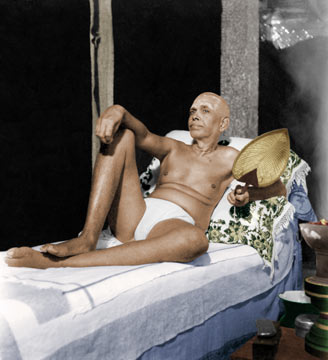
Bhagavan Ramana Reclining

Bhagavan Ramana Reclining

(Pictures in this article come from www.toontracker.com/totaltv/underdog.htm)
Underdog and Sweet Polly Purebred
Do you remember that cartoon show “Underdog”? You might have watched it as a kid in the 1960s and early 1970s. Underdog was a “humble and lovable Shoeshine Boy” who had a secret identity.

Whenever there was a serious world crisis or threat to the city, Underdog would turn into a superhero after taking a special vitamin pill from the secret compartment in his watch.
Underdog had a girlfriend named Sweet Polly Purebred. Sweet Polly was sweet on Underdog. Sweet Polly was a reporter, who seemed to get into trouble with the bad guys in every show. When in crisis mode, she would yell, help, help, help, Underdog, help. Sometimes Sweet Polly would actually sing despondently when Underdog was late in arriving. “Oh where, oh where has my Underdog gone?”
Underdog was probably the best boyfriend Sweet Polly Purebred ever had. No matter how far away and how deeply engrossed in shining shoes of his customers, Underdog could always hear Sweet Polly calling out his name. The “humble and lovable Shoeshine Boy” would slip into a phone booth and emerge as the champion of justice and protector of Sweet Polly. Underdog had super sensitive hearing, at least when it came to Sweet Polly. No doubt this would have resulted in a happy marriage if they had ever tied the knot. Underdog would often say, “When Polly’s in trouble I am not slow, it’s Hip, Hip, Hip and away I go !”

Underdog always came to Sweet Polly’s rescue, yelling, “Never fear, Underdog is here!” Sometimes Underdog took his time and Sweet Polly had to yell help for a long time. This was not easy on our ears as kids. But we hung on. We strongly suspected that Underdog would indeed arrive at some point.
When Underdog finally came, it was a great consolation. We did not really want Sweet Polly to get roughed up by the bad guys. Unfortunately, Underdog was no muscle dog. He had a small chest and a big belly. He was a heart attack waiting to happen according to modern medical standards on waist to chest ratio (which were probably not well known when the show started in the 1960s). In fact, Underdog often became exhausted within a few minutes in his fight with the bad guys and looked for his vitamin pill to get his vitality back. Not being able to locate the magical nutrition pill in time posed a serious problem to Underdog’s health.
It was awful to watch and we were full of tears as Sweet Polly looked for Underdog’s backup energy pill in her purse while Underdog was beaten to a pulp by the bad guys. Sweet Polly always found the needed vitality tablet for Underdog at the last minute, but not before giving everyone the distinct impression that she was very disorganized.
The magic pill, once found, was a life giving elixir. As soon as Underdog put it in his mouth, the effect was immediate. The vitality pill always seemed to bypass Underdog’s digestive system and go straight into his muscles. Typically Underdog swallowed the pill in one gulp and regained his energy the next instant. Then he would beat the surprised bad guys quickly before the show ended. Underdog always saved the day including, of course, Sweet Polly.

I was recently thinking that in real life, some people are like Underdog (who don’t have a Sweet Polly), and some are like Sweet Polly (but without their own personal Underdog).
Sometimes we want to act as saviors to people who do not wish to be saved. Other times, we need desperately to be saved but no one except mom seems interested in the job. That perfect match of being the savior and being saved that Underdog and Sweet Polly had is seldom achieved for most people. Underdog and Sweet Polly were made for each other.
We certainly lack that magic vitamin pill that Underdog had in the secret compartment of his watch. But even for Underdog, the effect of the magic vitamin pill was only temporary. He had to keep taking those pills to maintain superhero status.
One wonders where Underdog got his supply and the money to pay for those pills. After all, he could not have made much as a shoeshine boy. Perhaps he got big tips from his customers. Maybe Underdog had really good health insurance and there was low co-pay for those very strong vitality pills.
I wish that there had been some closure to the Underdog show. Underdog could have proposed to Sweet Polly Purebred in the final season of the show. If Underdog was too shy to do it, maybe Sweet Polly could have proposed to Underdog. Given the number of times Underdog saved her, that’s the least Sweet Polly could do.
It would have been nice to have a big wedding for Underdog and Sweet Polly Purebred at the end of the final season. I can just see Sweet Polly saying to Underdog before they went off on their honeymoon, “Underdog darling, make sure to pack some extra energy pills for the next two weeks.”
Maybe there will be an Underdog movie which will show that Underdog and Sweet Polly Purebred got married and lived happily ever after. If they did it right, the Underdog movie would be blockbuster!
Underdog and related characters are © 1997 GBPC, a subsidiary of Golden Books Family Entertainment.

Picture of Arunachala by Gabriele Ebert
Philosophy of Sri Raj Mata-Ji
Sri Raj Mata-Ji is one of my earliest spiritual advisors and counselors. Here are some of her sayings in Hindi and Punjabi that I have translated into English.
*******************************************************
Life is fleeting. Do something for yourself as well as others.
Grab some happiness when you can.
Happiness is having a caring family and cooking for them.
Happiness is having good friends and good neighbors to talk with.
Happiness is a state of mind.
Some people have everything but they are not happy. It’s a pity.
The secret to happiness is in giving.
If you serve others sincerely, you will be happy.
Nobody cares for the weak. Be strong.
You can only help and serve others if you are mentally strong.
Pray and ask God to make you strong.
If you eat too much, don’t complain afterwards.
Go take a walk after a big meal.
Take care of yourself. Nobody else can in the same way.
Make an appointment with the doctor and get a complete check-up.
Help others who need it. It will be good for you.
Give to charity whatever you can afford.
Make friends with your neighbors. Go shopping with them.
Stay active getting older and be part of a community.
Look for friends. They are looking for you.
Don’t look for perfection in others.
Life is a compromise.
You are better off than a lot of people.
Do the best you can and trust in God.
In the 1960s, my Gurudev, Sri Chitrabhanu- Ji, wrote a poem called “Matiri Bhavanu” on friendship and universal love in his native tongue (Gujrati) that became famous in India. It was eventually recorded as a song by a well known Indian singer named Mukesh and was set to music by an eminent Indian composer. The poem was translated into English by Gurudev Chitrabhanu- Ji and that is the version of the poem that I was most familiar with. However, at the meditation center where Gurudev taught and lectured in the 1970s, we sometimes sang the poem Maitri Bhavanu in Gujrati with great feeling.
The scene shifts now to almost 30 years later to 1994. In 1994, the thought came to me that I should read the original Gujrati version of the poem by my teacher. Gujrati is not my native tongue and, in fact, I do not understand it at all. I cannot speak in Gujrati and cannot read it. However, the Gujrati alphabets are similar to Hindi which I do know. So somehow the feeling came over me and I started to try to read and understand my teacher’s poem. It was hard but I was staring at the Gujrati words as if through will power alone I could decipher them. After some difficulty, I switched to the English description of the Gujrati sounds that you can see on the Jain Meditation Center website.
http://www.jainmeditation.org/pages/song.html
After many attempts, I actually started to understand the first stanza, and then the second, and then the third, and then the fourth. It was so beautiful and full of the universal feeling that I went into ecstasy. The result was the following poem, “Let this feeling never part!” In a very real sense this poem is the spiritual offspring of that original poem written by my teacher in his youth as a Jain monk. Recently, I came across the poem again on my old computer files and had to smile. I was just a “kid” when I wrote it. Of course, it cannot reach the same level of poetic artistry as my teacher’s poem in original Gujrati which is a true masterpiece. But I tried because something came over me. Perhaps what I lacked in talent, I was trying to make up in enthusiasm and feeling. I dedicate this poem to my Gurudev, Sri Chitrabhanu-Ji, who taught me the meaning of Ahimsa, the philosophy of nonviolence.
Let This Feeling Never Part!
The sacred stream of love divine
sweeter than the sweetest wine
flowing into this vast sunshine
springs eternal from my heart.
I pray no one should be left out
from life’s blessings in their glory
and give way to tortured doubt
with unhappy endings to their story.
Never should they be turned away
suffering from the blows of life
the poor, the wretched of this world
caught helplessly in endless strife.
If ever anyone should be in need
of comfort or help in getting up
let me not run away from them
but plant kindness as my living seed.
Let me give hope where there is despair
and mend hearts considered beyond repair
like the gentle ocean breeze that
heals all wounds and gives a fresh start
Let this feeling never part!
I should always find delight
in the warmth of universal light
but if my heart must bleed at all
let it be so in the dark of night.
No one should see the tears that come
when the wicked and cruel come in my sight
let this hand forever be raised in peace
and the violence around us come to cease.
Always this thought should be kept alive
every sinner is a future saint
there should be a place for everyone
to swim in the pouring love divine
that flows eternal from my heart
Let this feeling never part!
Unaware, if someone is unkind
let forgiveness be on my mind
until no trace is left behind
of ill will, anger, or hostility.
If I should ever slip and fall
and no one to catch me is around
let me come down gently like a leaf
so other life is unhurt on the ground.
If I have to lay for some time
contented should be my smile
composing songs of love and friendship
and resting all the while.
I will be picked up by love divine
which springs eternal in my heart
for all the beings everywhere
Let this feeling never part!
Sages have sung the song of friendship
walking with them and in their shoes
the same melody plays on my lips
the feeling of reverence for life continues.
Involuntary poets, there have been many
who felt the thrill and saw the sign
whose hearts sang out in ecstasy
as their fountain bubbled with love divine.
The blessings of nature are bestowed
on those who are firm in their belief
who are harmless to others and easily bow
before anyone, seeing only divinity.
If I should be granted just one thing
let it be the vision of love
always rising from the spring
sacred and eternal in my heart
Let this feeling never part!
**********************
NAMASTE
I bow to the light in you
which is the same light in me.
—
This article first appeared in the Winter 2001 Edition of the HS E-zine. The author, Holly Barrett, is a retired psychotherapist and a long time member of the HS community. The image is a courtesy of Alan Larus.
The Magic of Deep Listening As A Spiritual Path
by Holly Barrett, Ph.D.
Listening Instructions
In graduate school, we would-be psychotherapists were instructed in the various ways to listen to another person. This is a little like teaching love, but several suggestions were offered, including “hold evenly-suspended attention” (Freud), “practice the art of unknowing” (Kurtz), and, my personal favorite, “suspend memory and desire” (Bion). Readers will recognize the similarity of these instructions to teachings on meditation. As it turns out, I suspect that a few decades of this kind of listening had a lot to do with the arousal of kundalini in my body, and the subsequent upheaval that, ironically, led me to get out of the therapy business.
Listening to another person over an extended period of time is an awesome, sometimes tedious, joyful, frightening, and ultimately mysterious act – just like meditation or contemplation. Healing, when it occurs, is always reciprocal. Therapists talk among themselves about the weird things that start to happen: how your “client” puts feelings into your body for safekeeping (and for you to feel) till s/he is ready to reclaim them; how you sometimes know what s/he is going to say or do even while you are trying to be reassuring that you cannot read minds; how s/he comes in with the exact same dilemma that you have been struggling with since last week, or this morning. Modern psychoanalysts have a name for this: intersubjectivity. But over time, I found it impossible not to notice that some kind of divine wave motion was moving the therapy along. I decided my most important task, maybe my only one, was to draw a bead on what was alive and shimmering and holy in the person sitting across from me, and hold that jewel in my sight until s/he, too, could see it.
I was going to title this article “Dual Diagnosis” as a little joke for my enjoyment. In psychology, dual diagnosis refers to a person’s having two presenting difficulties, like addiction plus a character disorder. But to my gradually awakening sensibility all diagnosis, all labels, even I suppose all descriptive language that implies professional “expertise,” pins people down to the dualistic manual. I looked with increasing wonder for the supposed line between the psychological and the spiritual and I could no longer find it. In fact, boundaries were disappearing everywhere. Who was the healer and who the healed? When did a “session” end, or a relationship? What did it mean that I was receiving money for this, especially if I was being paid by an insurance company based on a diagnosis I no longer believed in?
It seemed to me an enormous folly that human beings were trying to control and take credit for an ever-present and divine process. The medicalization of psychotherapy under HMOs leaves no room for the unknown, the empty spaces in life, the eternal presence of mystery. Even the transpersonal psychologists set up structure and hierarchy that can overlook the significance of the tiniest, most miraculous, everyday changes of consciousness that are a consequence of what we call healing.
None of the bells and whistles of my kundalini experiences surpasses witnessing a moment when a woman, for the first time, decides to let THIS anger, THIS wounding, melt away into grace and finds that her heart is cracking open – especially when the woman is myself. Multiply this moment by millions of therapy sessions, millions of people trying to reach for just a little bit more, in offices, in kitchens, wherever people try to dig deeper into life, and the universe starts to look like a big cauldron cooking love. My awakening occurred unexpectedly when I was sitting around morose after my OWN therapy session. The little bits started adding up and bubbling until I was suddenly ablaze.
The epiphanies that burst into life seem to lead to paradoxical statements of: Oh, I never would have guessed! AND: Of course, it is so simple and obvious! They require a hiatus of “knowing” in order to be born. These little pauses in conceptual thinking can be dramatic or scarcely noticeable. I had the privilege of witnessing one that happened to us as a group.
In the ’70s, the days of Radical Therapy, I worked in a Day Treatment Center in Vermont with “severely disturbed” people. Few had spent much time out of an institution, let alone the state, but we decided to take a field trip to the ocean. The gigantic pleasure of introducing people for the first time to the expanse of beach, and to the horizon of water and sky, can hardly be described. One of my precious memories of that sacred time-out was a lobster and clam feast where we all sat around a table of towels, eating with our fingers, shouting with laughter as butter dribbled down our chins. However briefly, everyone was lucid, involved, awake and living. An observer would not have been able to tell who was a patient and who was a staff member. We had nothing to define us but salty breezes on our skin and our appetite for life.
It seems to me, as I think of this moment of spontaneous healing, that life is shot through with these little quantum jumps in consciousness. But if we don’t listen and watch deeply enough, we will miss them. I imagine that divinity is always trying to push through the ordinary, as part of the wave motion of God, but our fear and need to know everything lets us ignore the obvious. Healing is nothing more, and nothing less, than listening to what is truly here. And now.
By Dr. Harsh K. Luthar
Pictures in this article are by long term HarshaSatsangh member Alan Larus from his website at http://www.ferryfee.com/.
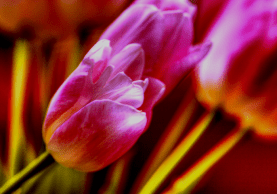
The Self as Satyam-Shivam-Sundram (Truth, Consciousness, Beauty)
The spiritual path is difficult from one perspective because the Self, the ultimate Reality that we are, is not clear to us as individuals. Some people say that Enlightenment is not personal. That is just a fashion statement.
Enlightenment is as personal as it gets. The Self is both personal and impersonal. It is personal because it is you. How can it be any more personal? It is impersonal because its existence (your ultimate nature) is not dependent on time and space bound relationships.
As a mind/body, we are subject to the whims of nature and circumstances (karma). This clouds the understanding of our essential nature. So the teacher or a friend whom we trust is needed to tell us that our nature is not that of the body.
Suffering is natural to the body because it is subject to physical forces. When the sages use the word body, they include the mind. The mental body is also a body but more subtle, made up of more subtle matter, but still matter. If we believe our Self to be the body, the inevitable changes in the body will be a source of fear and anxiety.

So the Body is one thing and the Atman (Soul or Self) is another. The mind/body complex is always subject to change, old age, illness, and suffering at some level. The Atman, who we are, though appearing to be related to the body, is untouched by these.
Bhagavan Krishna, in fact, points this out to Arjuna in the classic Hindu scripture, The Bhagavad-Gita.
Sri Krishna states:
“The Atma is neither born nor does it die at any time, nor having been it will cease to exist again. It is unborn, eternal, permanent, and primeval. The Atma is not destroyed when the body is destroyed.” (2.20)
“Just as a person puts on new garments after discarding the old ones, similarly Atma acquires new bodies after casting away the old bodies.” (2.22)
“Weapons do not cut this Atma, fire does not burn it, water does not make it wet, and the wind does not make it dry.” (2.23).
If we fully understand this dualism, we will not have to struggle to understand nondualism.
Nondualism or Advaita (in Sanskrit) is not an understanding but our essential nature.
The nature of Atman is nondual because Atman is “Being-Awareness” resting in its own nature without any external support. Atman is not free, there being nothing to free itself from. Its very nature is that of absolute freedom.
We cannot conclude this logically but only by Being That. In Self-Realization, Knowing the Self is Being the Self. This Knowing transcends logic, because all distinctions cease. Logic needs duality in order to function. Duality ceases through Self-Knowledge alone.

If you know the Self, what does it mean? You cannot know the Self as an object. You are the Self. Therefore, it is always the Self knowing It Self. The mind cannot fully grasp this unless it has become transparent and fully saturated in the Self, where it knows that it is only the Self knowing itself through It Self.
Maharishi Patanjali says the same thing about the nature of the Self in his yogic classic “Patanjali Sutras”. Ultimately, the Seer rests in His Own Nature. That is the highest Samadhi. Self is Samadhi. Self is Nirvikalpa, beyond imagination and thought. Self is Sahaj or natural and always visible to itself as pure being despite imagination and thought. In Self, Seeing and Being are the same.
In Hinduism, the Reality is often referred to as Satyam-Shivam-Sundram. Truth-Consciousness-Beauty. That which is of the nature of the ultimate truth, pure consciousness, and the essence of beauty is the Self. One’s own Self.
It is of such overwhelming beauty because the devotee who worships the God or the Self with all love and might and with desperation suddenly realizes that the devotee and God are in essence identical. The seeker had been looking for something that constituted the core of his/her very own Being and Existence. God being infinite leaves no room for the devotee as a separate person to exist. That is Grace. That is Advaita. Imagine the shock!

First the shock, and then the smile. Of course, how could it be anything else? The Lord always sits in our Heart as our own Heart. Where else can we find the mystery of existence and our own reality except in our own Heart.
This Realization is one of supreme beauty. The one that you had been longing for has been here all along as your own Self.
That is why I say that Self is Absolutely Personal! Self is empty of all concepts. Its nature is that of completion that is devoid of all longing. Its nature is that of utter fullness that has no where to flow out to, nothing to see, nothing to be. That is why Self is also Impersonal!
Because the Self is One without a second, upon Realization, we see that both Personal and Impersonal are identical in the Self. There is no difference. That is nonduality. That is Advaita.
How can we describe the Self with mind as our tool? We can do so by our experience of this state and through the abidance of the mind in the Heart. The ancients called the Self “Sat-Chit-Ananda”. Existence, Consciousness, Bliss, as one complete Whole with no parts.
It has no basis for comparison and no reference point. By inference, we can say that it is the essence of beauty and bliss. To Know It Is To Be It. In this very moment, you are the That!

This article was originally written on May 9, 2006 and posted by Michael Bowes on the old HS blog.
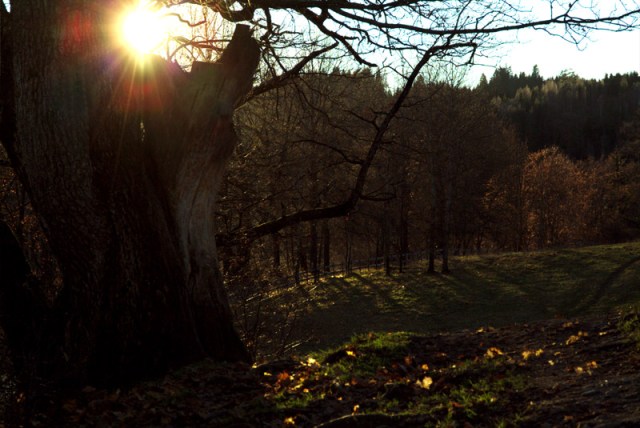
Picture below is by long term HarshaSatsangh member Alan Larus at http://www.ferryfee.com/tree.htm
One weekend in the early 1990s, my friend Narayan and I went to Saint Louis, Missouri to visit with Swami Chetanananda. Narayan and I have known Swami since the late 1980s. On Sunday morning of that weekend we were eating breakfast with Swami and the other residents of the temple, and according to the custom there, we were all reading a portion of the newspaper.
When reading the paper, Narayan nearly always goes straight to the “funnies”.
We were all reading and eating. Swami was at the head of the table, I was to his left, and Narayan was to my left. At some point Narayan nudges me and hands me the funnies. He pointed to the “Donald Duck” comic strip.
Donald Duck was in the Himalayas searching for his guru. And there were signs posted in the mountains that said “Guru”, and then an arrow would be pointing to a certain direction. And Donald followed the signs and arrows until finally, at the top of a mountain peak sat the guru with a personal computer in front of him.
Donald Duck asked the guru, “What is the meaning of life?”
The guru didn’t answer; but the computer started printing out something that couldn’t be read on the comic strip.
The gag was that personal computers were becoming the rage, and now even the guru was using one to divine the mystic truths.
But another peculiar thing was that Narayan and I were searching for a guru and a spiritual home; and now, thanks to Donald Duck, the stage was set for that possibility.
I nudged Swami and handed him the funnies while pointing to the Donald Duck comic strip. He read it and handed it back without saying a word, and continued to eat breakfast. After breakfast Swami went to prepare for his weekly public talk. The rest of us cleaned up after the meal and relaxed until the beginning of the service.
Swami began his Sunday morning talk and I really don’t remember the topic; but near the end he announced that he was going to reveal the “Meaning of Life”. He was going to reply to the question in the funnies.
Swami started by saying, “The meaning of life is bliss.”; and the following is a very loose paraphrase of what he said to explain that statement:
There is an “ocean of bliss” that is the source, the cause and support of all that we see; And in its manifest forms that bliss is experienced as amrita, rasa, love, joy, happiness, fun, hope, peace and even as pain and suffering. Pain and suffering serve as motivation for us to find a way to return to our original state of bliss.
We were all born from bliss. We arrive in this world because one day or one night our parents engaged in a blissful activity, and as a result we were born. From that day on, all of our conscious and even subconscious activities are meant to help us either directly or indirectly to achieve bliss and happiness.
As children all we really wanted to do was play. Our true unconditioned nature is playful. But, as we start to get a little older, we are forced to go to school and we are conditioned by society to perform certain useful functions.
But bliss, happiness, satisfaction, etc. are still the primary objective of all of our behaviors. Our parents and our society force us to go to school so that we can get a job, so that we can earn money, so that we can be happy.
We marry because we believe that another person will fulfill us and make us happy. We have children because we think that will make us happy. Everything that we do is ultimately for happiness and bliss. Even so called, “selfless love” only serves to satisfy ourselves. We believe that by performing our self-ordained duties that we will be satisfied.
A short time after I heard these words from Swami, I directly experienced that “ocean of bliss”. Our own true nature is something that cannot be imagined, and it is truly inexpressible. Since then, even though I have gone through some dark times, it isn’t possible for me to worry or lose my connection to that blissful being, the “ocean of bliss” that is our own true nature. And I have a lot of fun. I can’t seem to avoid it.
I began to experience this truth because of an encounter with the “funny paper”.
Love and peace to all,
Michael Bowes

This essay, adapted from a speech of Bill Gates, is one of the most beautiful, eloquent, and inspirational pieces I have read.
I was reminded of the the passage quoted by Sri subrahmanian of the Advaitin list to me recently which states:
“As life is dear to oneself, it is also just so to other beings. Men show compassion to other beings by putting themselves in their place”. [MBh 13.116.21cd–22ab; YDhS p. 31]
Surely people like Bill Gates are touched by some divine energy that not only opens their hearts but through them delivers the healing balms to soothe the suffering of millions of others.
We bow to such people.
May all beings be free from sorrow.
 Luthar.com
You must be logged in to post a comment.