The Dog Warrior Pose. Except notice the dog in the middle. Seems to be just going along to make the owner happy.
Category Archives: HEALTH & NUTRITION
Dog Yoga With Unenthusiastic Dog
In Dog Yoga, the dog does not have to be as enthusiastic as the owner.
Doga Yoga
Dog Yoga is the latest trend. People doing yoga with their dogs.
Lobsters and Crabs Feel Pain
Research to be published in two journals focusing on animal behavior suggests that virtually all animals, including lobsters, crabs, fish, shellfish, and insects, can suffer.
Chris Sherwin, a senior research fellow in the Clinical Veterinary Science division at the University of Bristol, commenting on the study told Discovery News, “The question of whether invertebrates experience pain is fundamental to our legislation that protects animals and our behavior, attitude and use of these highly complex organisms.”
Lobsters and crabs feel pain, study shows – Discovery.com- msnbc.com
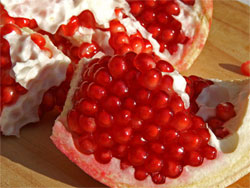
Pomegranate For Your Skin: By Dr. Jeanette Jacknin
Each year cosmeceutical companies and consumers alike search for the next big thing in anti-aging discoveries. This year, with everyone going “green” and searching for natural ingredients, pomegranate definitely is “in” in the anti-aging cosmeceutical industry. Dr. Carl Thornfeldt, MD in his March 2008 article in the Journal of Cosmetic Dermatology states “Mucocutaneous inflammation as the final common pathway of many systemic and mucocutaneous diseases including extrinsic aging has been established at the molecular and cellular levels.”[1] Pomegranate has known antioxidant and anti-inflammatory activity and has been documented in double-blind clinical trials to significantly improve signs of skin aging. Of the over 8000 known antioxidant ingredients, pomegranate is 1 in less than 20 have been incorporated into topical formulations which have been documented in human clinical trials to reverse signs of aging of the skin.
The status of the Pomegranate goes back as far as the history of agriculture itself, 10,000 years. Allusions to the pomegranate are readily found in the oldest cultures of the Indus Valley, ancient China, and classical Greece, as well as in the Old Testament. It has a long history of medicinal use, with the peel well regarded for its astringent use.
Anthocyanins account for the red-purple color of the pomegranate’s skin, flesh, and seed. More importantly, pomegranate juice made from squeezing the whole fruit is a rich source of punicalagin, a large polyphenol antioxidant. Pomegranate seeds are a good source of punicic acid, similar to conjugated linoleic acid.
Research has shown that the physiological effects of pomegranate juice constituents are remarkable in their preventive potential against two of the major chronic diseases of aging – heart disease and cancer. There is evidence of the pomegranate’s impact on heart disease, including its ability to enhance nitric oxide production in endothelial cells.[2]
There is also significant antiproliferative effects attributed to the pomegranate [3] in battling several breast cancer[4] and prostate cancer[5], and it has been shown to retard tumor growth in animals. One can also hypothesize that pomegranate juice may work the same way on skin cells.
In a study carried out at the University of Michigan Medical School, aqueous fractions prepared from pomegranate peel, fermented juice and lipophilic fractions of the pomegranate were examined for effects on human epidermal and dermal cell function.
Pomegranate seed oil was shown to stimulate epidermal call proliferation, and a mild thickening of the epidermis was observed! In contrast, pomegranate peel extract stimulated type I procollagen synthesis by dermal fibroblasts, These results indicate the potential of pomegranate fractions for facilitating skin repair by promoting regeneration of the dermis and epidermis.[6]
Three oral supplements containing a pomegranate mix have been documented in double-blind clinical trials to effectively improve signs of aging. Additionally, pomegranate demonstrated efficacy in improving signs of extrinsic skin aging in open label trials when topical and oral administration were combined. [7]
In Jan 2008 Dr. Seeram reported his study which applied 4 tests of antioxidant potency of polyphenol-rich beverages available in the marketplace. Pomegranate juice had the greatest antioxidant potency composite index among the 12 beverages tested and was at least 20% greater than any of the other 11 beverages tested.
In Navindra Seeram’s comparative study published in the Journal of Agricultural Food Chemisty, he demonstrated that the antioxidant potency and total polyphenol content were consistently greatest in pomegranate juice as compared to apple juice, acai juice, black cherry juice, red wine, blueberry juice, cranberry juice, Concord grape juice, orange juice, black tea, green tea, and white tea capacity. Although in vitro antioxidant potency does not prove in vivo biological activity, there is also consistent clinical evidence of antioxidant potency for the most potent beverages including pomegranate juice. [8]
Thus, it would be surprising if many cosmeceutical companies don’t add pomegranate to their mix of anti-aging ingredients, with its clinically proven anti-inflammatory, anti-oxidant, and anti-aging properties.
1. Carl R Thornfeldt, MDFAAD, “Chronic inflammation is etiology of
extrinsic aging,” Journal of Cosmetic Dermatology 7(1), 78-82, March
2008
2. De Nigris F et al. “Beneficial effects of pomegranate juice on
oxidation-sensitive genes and endothelial nitric oxide synthase
activity at sites of perturbed shear stress.” Proc Natl Acad Sci USA.
102, 13:4896-901, 2005, http://www.pnas.org
3. Seeram NP et al. ” In vitro antiproliferative, apoptotoic and
antioxidant activities of punicalagin, ellagic acid, and a total
pomegranate tannin extract are enhanced in combination with other
polyphenols as found in pomegranate juice.” J Nutr Biochem. 16,
6:360-7, 2005. http://www.elsevier.com/locate/nutbio
4. Mehta Re, Lansky EP. “Breast cancer chemopreventive properties of
pomegranate ( Punica granatum) fruit extracts in a mouse mammary organ
culture.” Eur J Cancer Prev.13, 4:345-8, 2004.
5. Lansky EP el al. “Pomegranate ( Pumica granatum) pure chemicals show
possible synergistic inhibition of human PC-3 prostate cancer cell
invasion across Matrigel.” Invest New Drugs.23, 2:121-2, 2005.
6. Aslam, MN, Lansky EP, et al. “Pomegranate as a cosmeceutical source:
pomegranate fractions promote proliferation and procollagen synethsis
and inhibit matrix metalloproteinase-1 production in human skin cells,
J Ethnopharmacol , 20,103(3): 311-318, 2006.
7. Carl R. Thornberg, “Cosmeceuticals containing herbs: fact, fiction
and future,” Dermatol Surg.31(72):873-80, Jul 2005
8. Navindra Seeram, [My paper] “Comparison of antioxidant potency of
commonly consumed polyphenol-rich beverages in the United States.” J
Agric Food Chem.56(4):1415-22, Feb 2008

Board-certified Dermatologist Dr. Jeanette Jacknin has distinguished herself as a well-respected physician and author whose passion is nutricosmeceuticals and holistic dermatology.
Dr. Jacknin’s credentials are many and start with the medical degree she earned from Medical College of Virginia in 1983. There she completed her Dermatology Residency and served as Chief Resident. Dr. Jacknin’s education and vast experience have led her to become a published author of the classic book, Smart Medicine for Your Skin, published by Penguin Putnam in 2001. For easy access, the book is now published in e-Book format, at http://www.drjacknin.com for instant download on the internet.
In addition, Dr. Jacknin has contributed to an abundance of articles published in numerous high profile magazines, such as Alternative Medicine, Body and Soul, Better Homes and Gardens, Reader’s Digest, Men’s Health, Natural Health, Shape, and Women’s World Magazine. She is a regular contributor to In Cosmeceuticals, Natural Solutions, Carefair.com and AZSpaGirls.com. She has been featured on radio programs like: Health Talk, The Deborah Ray Show and the Wealth of Health Nutrition Hour.
To find out more about Dr. Jacknin and her skin care philosophy and products, please visit her website.
The Business of Shaking Hands: By Dr. Harsh K. Luthar
Hand shaking is common to conducting business. Many people take pride in their grip which is meant to convey warmth, strength, and mutual respect. However, from a health perspective, this practice must now be viewed with caution. Almost 25% of the people do not wash their hands after using the toilet.
The October 8, 2007 issue of American Medical news (page 33) cites research, which reveals a large discrepancy between what people say they do and what they actually do after using a public bathroom.
According to a study commissioned jointly by the American Society for Microbiology, and the Soap and Detergent Association, 92% of the people claimed that they always wash hands after using a public restroom. However, observations in public places such as train stations and sports stadiums showed that, in fact, only 77% of the people washed their hands after using the restroom.
The study further reports that significantly more women (88%) than men (66%) wash their hands after using a public restroom. “Very clearly, guys need to step up to the sink,” said Brian Sansoni, Vice President of Communication for the Soap Association (October 8, 2007 American Medical News, p.33).
When you extend your hand to shake someone else’s, you will never hear the other person retreat and say, “Sorry, but I did not wash my hands after going to the toilet today.” Instead you are likely to get a strong, firm, and an enthusiastic handshake with a big smile possibly covering up an unpleasant truth.
It would appear that the good old handshake, which is meant to create trust between people, is potentially unhealthy unless both parties follow common sense and good personal hygiene. Perhaps the Chinese had it right all along in their custom of simply bowing their heads politely to other people instead of shaking their hands.
My brother and some Indian friends have suggested to me that a similar analysis is possible of the Indian greeting of “Namaste”. However, I am not sure about that. The Indian culture is different than the Chinese culture in some fundamental ways. Indians love to hold hands. I know that Indians love to hug. We even have a hugging saint named Ammachi. She spends a lot of time actively hugging people. See the link below.
Anyway, back to the original topic.
Washing hands with soap and use of alcohol based rubs to sanitize hands have proven to be effective techniques in health care settings in reducing infection rates. Similarly, it is clear that carrying a hand sanitizer is a must for every business professional whose job involves shaking many hands everyday.
Of course, it may be politically incorrect for you to take out the sanitizer immediately after shaking someone’s hands. However, a relatively discrete application of the sanitizer a few minutes later would seem to be be acceptable. If someone notices it and asks, one can always say, “my hands are very dry. I always carry this lotion with me. Would you like try it?”
Another option would be to simply stop shaking hands. When someone offers their hand, you could say with warmth and sincerity, “I would much rather hug you.” Obviously, this is not the norm among business professionals today. But every custom must start somewhere with a brave person.
If hugging replaced handshaking, It could lead to a better world and possibly more harmony and global peace. Imagine, if all the world leaders, when they met, had to hug each other tightly for at least two minutes. Would things be better with long hugs? It’s hard to say but certainly worth a try.
Bhagavad Gita and the Sattvic Diet: By Dr. Harsh K. Luthar
Sri Ramana used to say that of all the yogic rules and regulations, the best one is taking of Sattvic foods in moderate quantities. This view is consistent with that expressed in the Bhagavad Gita, and indeed most of the Yoga Shastras.
The logic is that since food consumed has a major effect on the body and the mind, a Sattvic diet should be adhered to in order to enhance both the health of the body as well as purity, strength, and calmness of the mind. An agitated person will find it difficult to sit quietly and meditate.
A disciplined and one pointed mind is an aid to ones’ learning and education as well as having success in business and other worldly affairs. A clear, pure, and a reflective mind is, of course, essential to self-enquiry which leads to Self-Realization.
The question then becomes, “What is a Sattvic diet? What is the authority for saying that certain foods are Sattvic and lead to good health, mental clarity, poise, and spiritual advancement, while other foods do not?”
There is much yogic literature on this topic and also some disagreement among experts depending on their school of thought and background. Since most Hindus generally accept the Bhagavad Gita as the final word, I will refer to that as my primary source on the Sattvic diet.
We should keep in mind that Sri Krishna, who speaks in the Bhagavad Gita with complete spiritual authority, is also considered the model of exceptional and abundant physical health and perfect mental poise. He is depicted in the ancient writings as slim, active, energetic, graceful, and attractive.
In the Bhagavad Gita, Sri Krishna demonstrates profound insight into not just the spiritual nature, but also human nature and physical nature. By inference, Sri Krishna’s words on food and the Sattvic diet carry much weight for those who study the Bhagavad Gita.
What foods should one minimize according to the Bhagavad Gita?
In Chapter 17 (verses 8, 9, 10), Sri Krishna makes clear the type of foods to be avoided by those who seek good physical and mental health, worldly success, and progress on the spiritual path.
According to the Bhagavad Gita, foods which are too bitter, sour, salty, pungent, dry, and hot can lead to pain, distress, and disease of the body. Further, Sri Krishna says that foods cooked more than three hours before being eaten, foods which are tasteless, stale, putrid, decomposed and unclean should be avoided by spiritual aspirants and those who seek excellent physical and mental health.
What foods should be eaten according to the Bhagavad Gita?
In Bhagavad Gita, Sri Krishna states, “If one offers Me with love and devotion a leaf, a flower, fruit, or water, I will accept it:” (Bg.9.26). To me this seems to suggest that Sri Krishna is sanctioning a diet based on leaves and fruits and water as the best one for spiritual growth. I am no scholar on the Bhagavad Gita, but my liberal interpretation of this verse would be that the Sattvic diet is generally plant based and includes all or most vegetables, fruits, legumes, grains, nuts, seeds, etc.
Because Sri Krishna gave cows sacred status similar to that of a human mother and favored raw butter for personal consumption as a child, one could reasonably argue that dairy products (such as yogurt, milk, kefir, lassi, sour cream, etc.) belong to the Sattvic food category.
Many yogis hold the view, however, that dairy products can only be considered Sattvic if these are obtained respecting the cows and goats who are shown kindness, love, and humane treatment. According to the principle of Ahimsa (nonviolence), any food procured through violence to living beings cannot be considered Sattvic.
Yogic Sattvic Diets
Some yogis that I have met favor a completely raw vegetarian diet with a primary focus on sprouted grains and beans (such as Garbanzo, Blackeyed peas, etc.) along with raw fruits and vegetables. Their diet is essentially vegan and contains no animal products. However, modern science teaches us that since vitamin B12 is missing from a purely vegan diet, supplementation is necessary.
A number of medical and scholarly references can be found on this issue on the web.
Other yogis have felt that a raw vegetarian diet is too limiting and include cooked foods as well as dairy products (milk, yogurt, lassi, etc.) in their diet. This diet, known as the lacto-vegetarian diet, is probably the most wide spread among Indian Hindus and Jains.
A few well known yogis have also traditionally included not only dairy but also eggs and egg products in their otherwise vegetarian diet. This is known as the lacto-ovo vegetarian diet.
Although very few Indian yogis include any kind of fish, fowl, or meat in their food, there are exceptions. Buddhist yogis, for example Dalai Lama, do eat meat. A few Hindu yogis also eat meat pointing out that some ancient scriptures sanction meat eating for certain religious rituals.
For most Hindu and Jain yogis, however, there is no convincing argument for eating meat if one wishes to uphold the supreme principle of Ahimsa and follow the philosophy of nonviolence.
What is the best Sattvic Diet?
The general answer from my study is that foods which cause the body to gain health and for the mind to be calm and peaceful constitute the Sattvic diet. To some extent, this requires knowing the needs of one’s own body and being sensitive to the effects of various foods on our system. Foods which are very suitable and nutritious for one person may not be right for another. Common sense and wisdom are the essential ingredients to find the best Sattvic diet for yourself.
In terms of particular foods to be eaten, the yogis and sages have answered this question, but the answers have different variations. One common element of a yogic Sattvic diet is that it is primarily vegetarian. This is true at least for Hindu and Jain yogis.
Within the broad framework of vegetarianism, a number of dietary systems are possible where certain foods are included and some are excluded. In the most liberal vegetarian diets, eggs and dairy products are included. Some people include dairy in their vegetarian diet but not eggs. Some include eggs but not dairy. In the most strict vegetarian diet, eggs and milk are excluded. Supplementation through certain vitamins is needed in such diets, according to modern medical opinion.
My personal experiences
Having experimented with a variety of diets for decades, I feel that a vegetarian diet can be healthy or unhealthy depending on many factors. For example, if I am a lacto-vegetarian and eat too many pizza pieces, the feeling of discomfort is likely to follow. In fact, after experimenting with eating pizzas thousands of times in my younger days, I am fairly certain that this is indeed true. I believe this also holds if one eats bucket loads of ice cream on a frequent basis. So, is lacto-vegetarian diet healthy? It depends on how lacto you are and how often you go lacto with heavy fat and fried lacto foods!
The point is that a vegetarian diet can be either healthy or unhealthy depending on the nature of food eaten as well as the quantity of food consumed.
In Chapter 6, verse 16, Sri Krishna specifically emphasizes moderation in eating and sleeping. He states, “There is no possibility of ones’ becoming a yogi, O Arjuna, if one eats too much, or eats too little, sleeps too much or does not sleep enough.”
Clearly, overconsumption of food leads to problems and one can logically conclude that the quantity of food consumed is probably an important element in a diet being considered Sattvic.
Sattvic diet is also a matter of degree. Some diets may be very Sattvic, while others may be moderately Sattvic.
Finally, the thoughts and the emotional balance while eating the food have an effect on our system. This is why in many religions, prayers and showing of gratitude for the food being consumed is offered. This mental state while eating helps the diet become more Sattvic.
What does it all mean?
So what does it all mean and what are the lessons from Bhagavad Gita and our discussion of the Sattvic diet? Here is what I think some of the lessons are. See if you agree.
1. Whatsoever you eat, eat in moderation.
2. Educate yourself on proper nutrition, be sensitive to your body, and see what foods work for you.
3. Emphasize fresh vegetables and fruits and eat a diet which is mostly plant-based.
4. Do not eat foods which are too salty, bitter, or have gone stale and putrid.
5. Regardless of the food being eaten, eat with gratitude, prayerful attitude, and with mental poise.
6. Chew the food carefully and taste it deeply without rushing.
There are literally thousands of great sources on the web and hundreds of books in stores to help you educate yourself on the Bhagavad Gita, vegetarianism, and nutrition. Go do some research and find out for yourself!
That’s my homespun wisdom for today. Like Captain Planet used to say, “The Power is yours!”
Given below are some pictures of plant based dishes that I made keeping the principles of Sattvic food in mind. Wishing you all abundant physical, mental, and spiritual health. Namaste.
Good News for Vegetarians and Vegans? By Dr. Harsh K. Luthar
A newly released study has found that a diet rich in omega-3 fatty acids may help lower a person’s blood pressure. Omega-3 fatty acids are typically found in larger quantities in certain types of fish, nuts such as walnuts, and flax seeds.
http://www.cnn.com/2007/HEALTH/conditions/06/05/heart.pressure.reut/index.html?eref=rss_health
The study examined the diets of 4,680 men and women, ranging from ages of 40 to 59 from four different countries (Japan, China, Britain and the United States). Research on the benefits of omega-3 fatty acids has been ongoing for a number of years and the Internet is full of references to such literature.
This particular study interestingly concluded that people who got their omega-3s from vegetarian sources (such as Walnuts, flaxseed, and canola oil) had just as much benefit as those who get them by eating fish. This is probably reassuring news for vegetarians who do not eat fish.
Vegetarianism has become more mainstream in the West since the 1970s. People are vegetarian or become vegetarian due to a variety of reasons including their religion, cultural upbringing, and the desire to not eat meat.
Most vegetarians in India include dairy products as part of their diet. Some include eggs as well.
Veganism is a more strict form of vegetarianism in which no animal products are included in the diet at all.
For a list of famous vegans, see the following link.
What Is Meditation? By Dr. Harsh K. Luthar
The Art Of Doing Nothing

My Dear Friends,
You have heard many things about meditation and perhaps there are questions in your mind about it. Today, there is no shortage of information on any topic having to do with meditation and yoga. There are literally thousands of books on meditation and yoga and self-help techniques. If you go on the Internet and put in a few key words, you will come across many views on meditation.
Some people equate repeating a mantra with meditation. Others say that if you focus on the in-going and out-going breath, that is meditation. There are people who believe that you must be able to sit cross-legged in the lotus position with a straight spine in order to meditate effectively.
Having meditated since early childhood, I can assure you that this is not true. Inviting aches and pains by sitting in a lotus position will not lead to a peaceful mind. Meditation, after all, is about relaxation and peace. Having peace, or recognizing the peace within, is meditation. What takes us away from being peaceful cannot be meditation. Whatever brings us peace is meditation.
Avoidance Of Stillness
It is my experience that people like to keep busy. In today’s world, being busy is considered a very high virtue. We want to keep busy and be productive in some way. Otherwise, we feel we are wasting time and feel guilty. Certainly, being active is a good thing and allows us to make a living and maintain relationships in the world.
Even Sri Krishna says to Arjuna in the Bhagavad Gita that one cannot avoid action. One is compelled to act according to one’s nature under the force of circumstances. That is the universal law of Karma.
But we have to understand the nature of action and our relationship to it. This is why Sri Krishna advises Arjuna to act according to his duty and dharma but without any expectation for any fruits of action. Our expectations undermine our peace when they do not come to fruition. Right conduct, according to one’s best understanding and judgement, brings peace. Therefore, it brings us to meditation.
Mental Experiments
Ancient Yogic and Advaitic sages gave methods and taught us to conduct mental experiments to find the nature of truth. These mental experiments can indirectly help us recognize the Pure Being within our center as our own Heart.
The techniques of meditation, such as mantra, chanting, yoga, pranayama, breath-awareness, etc., are simply mental and physical experiments. These practices start us on a journey with the potential for personal and spiritual growth.
However, real meditation is beyond visionary experiences and is the discovery of peace within. To reach there, we have to be quiet and learn the art of stillness. Once we know how to be still while doing nothing, we can carry this stillness into our actions as well. But first, we must discover the nature of this inner peace; and to do that we have to learn the art of doing nothing.
Are You Able To Do Nothing?
Are you able to do nothing? Absolutely nothing! The art of meditation is learned by seeing the value of doing nothing. If you can sit very still and quiet without mental disturbance, you have already come a long way towards the experience of meditation.
It is only a rare person that enjoys doing nothing. Doing nothing is not as easy as it may sound. Try it sometimes. Just sit on the sofa. Don’t go to sleep. Stay awake and think about nothing in particular.
You will soon find your mind racing here and there, thinking about your girl friend, your boy friend, your boss, your co-workers, your business, your friends, your family, tofu, pizza, chocolate… the sky is the limit!
The Mind Is A Monkey And A Donkey!
Yogic sages have compared the human mind to a monkey. Just like the monkey cannot be quiet and must be restlessly hopping here and there, so it is with the mind. It is the nature of the mind to be either brooding about the past (regrets, mistakes, guilt, lost opportunities, the roads not taken) or fantasizing about what the future will bring.
The burden of carrying the past and the future in this present moment is heavy. But the mind, like a donkey, gets used to carrying this load and plods along.
However, the mind that is always lost in memories (past) or hopes (the future) misses the most delicious feast of all that is taking place in the present.
The eternal reality, we can call it Self, Sat-Chit-Anand, God, the Supreme Being, the Supreme Goddess, Paramatman, Brahman, the Great Void, or the Kingdom of Heaven, always exists and is shining in the present right before our very eyes.
The Divine mystery is recognized when the mind is calm and awake and free from anger, hatred, and greed and thus not subjected to the pulls of the past and the future. This is why all major religions encourage human beings to be good and kind and compassionate. These virtues serve as the building blocks for the spiritual life because they remove the agitation of the mind.
Why Meditation Techniques Do Not Always Work

Meditation techniques are fully effective only in a mind that already has some understanding and maturity. So really, laying the foundation or the groundwork for meditation is more important than the practice of meditation. Just like a seed grows naturally on fertile ground, meditation happens spontaneously in a reflective and a quiet mind.
When the mind is ready and ripe, meditation works and self-inquiry is fruitful in a short time.
When the mind is restless, anxious, and troubled, meditation becomes a forced activity and is not always helpful. At such times, one should take a walk, practice deep breathing, or go for running or do push-ups and other exercises. Those are more useful than meditation when the mind is not ready to be calm.
Pranayama, involving deep rhythmic breathing, is an ancient yogic method that can serve to calm and sedate the mind in a natural way. According to Hatha Yoga Pradipika and other classic yogic texts, one first has to master proper breathing in order to progress to meditation. This is the commonly held belief in the school of Hatha Yoga. However, the path of Jnana Yoga does not emphasize breathing exercises or Hatha Yoga Mudras and Kriyas and considers these to be irrelevant to Self-Knowledge.
Advanced Pranayama practices involving breath retention or awakening of Kundalini Shakti can be found in many yogic texts and modern books. However, these should be learned very cautiously from an experienced practitioner of pranayama.
Laying The Foundation For Meditation
In order to advance in meditation and learn it in depth, we have to understand the nature of the mind and learn to be alert and watchful of its activities. It is this constant watching, that is the key method behind all the techniques of meditation. A form of this is what Buddhist calls, “Mindfulness”. Jains call it Upa Yoga (Yoga of Awareness), Hindus refer to it as the “Inquiry into the Self” or Self-Remembrance.
A spiritual seeker is watchful.
The essence of this watchfulness is that with the mind one watches the mind.
If meditation is going to take place, if this recognition of Pure Being with clarity is to be gained, an inner silence must ensue. One cannot see one’s image clearly in the water, when the water is full of waves. In a still pool, our image is reflected and can easily be recognized. Similarly, in a still mind, we can see the nature of our being.
This inner watchfulness, the observer being aware of the observer, this self-inquiry can occur in a ripe mind that is calm, content, and ready.
We Are Dancing For Others!
The difficulty is that our minds are noisy. This is the nature of the mind that goes outward only. It is overcome by sensory experiences and is unable to see its origin. The worldly chatter overshadows and muffles the subtle divine music that is playing.
Friends, sometimes I think, we are dancing to the drum of other people’s expectations, which we have internalized.
There is no end to this dance. This dance has a stronger hold on us than rock and roll or disco or rap music. It keeps us hopping all our life doing this and doing that or achieving this and achieving that. Ultimately, it is exhausting.

The whole life slips away in the blink of an eye as we keep busy in “doing” this dance making sure that the movement of our steps have the approval of others. We forget to “Be” who we are.
To Be Still is the true meditation. Meditation is simply Pure Being.
The art of recognizing yourself as Pure Being is meditation. Pure Being is Self-Awareness or Awareness.
A Powerful Intervention: Conduct This Experiment
The state of meditation is simple. The methods and techniques and the philosophy behind it are very complicated. That is why thousands of books are written on such things. But the aim of meditation is simply peace. Peaceful Awareness. Meditation is easy to understand. It is being peaceful without expectations.
Conduct the following experiment with being peaceful without expectations. Tell yourself this: “For the next one minute, I am not going to worry about anything and be bothered.”
Try to be free of all inner and outer conflicts for one minute. Give yourself this one minute as a holiday gift!
This is a powerful intervention. Can you be free from inner conflict for one minute? See what hinders your attitude to be worry free for one minute. If you can be peaceful and free from anxiety for one minute then you can do it for two minutes and then more.
To Be With Yourself
So dear friends, find some time to simply “Be” with yourself. To just “Be” is an amazing experience of the present moment. See what thoughts come to your mind. When you sit quietly, many visual images and thought patterns start emerging from the subconscious. This is referred to as “Surfacing” and it happens when your relax and your mind is at ease and free of tension.
If you remain awake and pay attention, you can gain insight into your own mind. These insights will teach you to not attach yourself to things that do not bring you peace. You will come to see that your nature is that of Pure Being which is associated with the many thoughts in your mind and yet is independent of these.
Sri Ramana Maharshi, the great Indian Sage of Arunachala, gave forth this method of reflective Self-Inquiry, that focuses on the question, “Who Am I?”
This investigation, when done with understanding and sincerity, brings us to the state of Being that is free from thoughts. This inquiry is really at the heart of the philosophy of Advaita Vedanta.
Always Be Gentle With Yourself
If you are not able to sit quietly right away and be completely still for even one minute, do not worry about it at all. The reason it is difficult for us to sit quietly and do nothing is because often there are wounds inside which we would rather not become aware of or deal with.
The process of living life can be very very painful and stressful. Over the years, we put temporary bandages on our hurtful experiences, which for a short time dull the pain.
My teacher Chitrabhanu-Ji taught me that when we try to relax and meditate, our anxieties and fears and past suffering sometimes bubble up from the unconscious. So we have to be alert and to accept and let these things go so we can renew ourselves and be fresh.
The ancient Yogic Sages of thousands of years ago left us with great works on the nature of human suffering and how to alleviate it. Sometimes when I read the Bhagavad Gita or Patanjali’s yoga sutras, Tao Te Ching, Buddha’s path or Mahavir’s philosophy of reverence for life and Ahimsa, I marvel at the depth of the insights contained in these.
The great Yogis of the past 5000 years have been really great psychologists who knew the nature of the human condition. They deeply understood what happens when spiritual seekers try to get insights into their mind and provided a path and guidance on how to walk it with the help of teachers and fellow students.
The Notion Of The Sangha
In India, some people meditate in Ashrams or in communities. The notion of a Sangha (community of spiritual seekers) is important. In such a community, meditation is easier, because people are able to encourage each other and share each other’s pain and burdens. When our mental or physical suffering is intense, we are not able to meditate. People turn to alcohol or drugs to numb themselves so that they do not feel their own suffering. This, however, cannot lead to any permanent solution and satisfaction. Indeed, it can weaken the body and the mind and makes matters worse.
Being part of a vibrant spiritual community, or to just be in the company of good people who care about one another, can exercise a protective influence on you.
As a general rule, in order to advance in meditation, you should keep the company of good people who allow you to be who you are.
I studied with Chitrabhanu-Ji who is one of the key figures in 20th and 21st century Jainism. Chitrabhanu-Ji, before he became a Jain monk, was part of Mahatma Gandhi’s movement to free India from the British through the peaceful means of Ahimsa (Nonviolence).
Ahimsa is the cardinal principle in Jainism. Chitrabhanu-Ji taught me that a mind becomes fully fit for meditation and Self-Realization through the practice of reverence for all life and amity towards all beings.
A genuine spiritual community has to be completely dedicated to the principle of Ahimsa in thought and action and be committed to alleviating suffering among all living beings. A teacher or a guru who does not understand or practice the principle of Ahimsa and is abusive to his or her students should be avoided. Such people are on power trips only and have their own problems to deal with.
Having A Personal Philosophy

It is good to become aware of and think about fundamental life issues at any age, but particularly so if you are young. It allows one to develop a personal philosophy that helps to structure and interpret different experiences and put things into their proper perspective.
It is important to sit quietly and spend time with yourself in order to have an understanding of your own nature. Whatever philosophy one adopts, the following general rules are helpful in remaining calm and healthy.
Ten Tips From Yogic Texts And Sages
1. Eat nutritious foods that suit your constitution in moderate quantities (My New Year’s Resolution!)
2. Walk every day if possible (My Second New Year’s Resolution!).
3. Avoid people who are manipulative, loud, obnoxious, and destructive if at all possible.
4. Keep company of people who are pleasant, easy going, cheerful, and supportive.
5. Remain silent when you have the urge to be sarcastic or make fun of someone.
6. Help people who are in need within your capacity.
7. Take the time to be alone everyday and be with yourself.
8. Never give into peer pressure to drink or do drugs or go to wild parties (Tame and sober get together with good friends and Satsang with fun singing and chanting is OK!).
9. Develop confidence in your own ability to do what you need to do.
10. Engage in introspection at the end of the day. Mentally wishing everyone well, always go to bed with a clean slate.

Even A Little Effort Helps!
Friends, even a little right effort is never wasted. Every journey must start with the first step. The journey that takes you inside your own Self is the most wondrous journey you can ever take as it reveals the mystery of existence itself. Start from this very moment and enjoy the wonders of your own nature and the sparkling reality that has been smiling and shining on you for the whole of eternity.


You must be logged in to post a comment.