Harsha's avatar

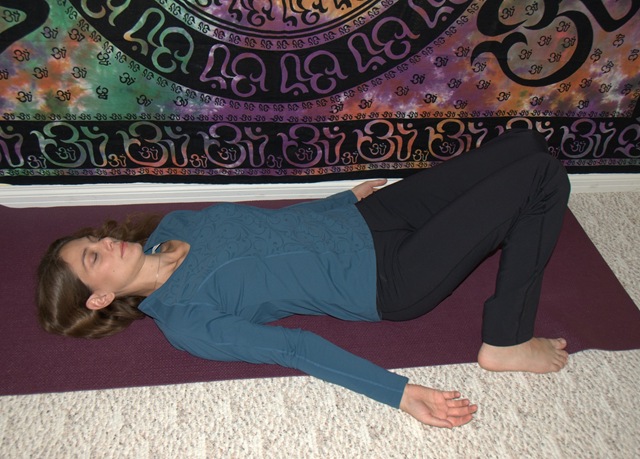
Sacral releasing Pose

Sacral releasing Pose

This pose is amazing for releasing and opening the sacrum. In spiritual tradition of yoga, it is said that the kundalini Shakti energy lies dormant like a coiled snake sitting at the base of the spine. When we do certain meditations or yoga poses, it is said that we can awaken this dormant energy and activate a spiritual energy to begin its journey up the spinal column and up into the brain.  Please use caution and mindfulness in this pose if you have herniated disks, or arthritis in the spine.

sacrum 1

1. Lay on your back with your knees bent. Bring your knees together and your feet about shoulder width apart.

2. Lift your pelvis slightly and move your tailbone toward your heels. Flatten the small of your back to the floor. (Or as flat as it will go)

3. Let your knees lean into each other, letting them also pull forward. (let this movement be natural, and not forced). Let the lower back relax as much as you can.

4. Hold this position for at least 30 seconds, allowing the muscles in your legs, and pelvis to relax.

sacrum opener

5. Bring your awareness into your sacrum. Imagine that you are breathing light, energy and nourishment into your sacrum. Imagine that you are drawing that nourishment all the way up your spine and into your brain.

6. Start to bring your knees down toward the floor, one at a time. Stretching the inner thigh.

7. As you bring your knee toward the floor, let the pelvis rock from side to side massaging the back of your pelvis. Continue to imagine that you are drawing nourishment and light into your sacrum, and allowing it to flow all the way up your spine. Use the rocking action of the pelvis to increase the amount of energy flowing into the sacrum and up the spine.

8. Return to position #1, and rest for another 30 seconds or longer.

Benefits ~ Loosens and releases the sacrum. Relaxes the muscles of the pelvis, and lower back. Massages and Oxygenates the back of the pelvis. Increases flexibility in the abductor, and adductor muscles in the thighs.

© written and modeled by Christine Wushke, Photo’s by Dianne Wushke.

Christine Wushke is a certified yoga and meditation teacher with over 15 years of experience. Her aim is to create a sacred space for students to effortlessly find the presence of stillness and an inner silence. Christine’s mission is to raise consciousness on the planet by empowering people to realize their own Divinity and to uncover a deep peace within. Christine is committed to assisting you in your journey, and helping you to realize directly for yourself the truth of what you are, and the stillness of truth within. In addition to her yoga and meditation training, Christine is also a registered massage therapist. In the past two years she has studied extensively in the spiritual tradition of Advaita Vedanta. Her teaching style is largely influenced by Iyengar yoga, and the nondual tradition of Advaita.

www.journeytolight.net

www.innerlightyoga.blogspot.com

Harsha's avatar

Spinal Nourishing Pose

Spinal Nourishing Pose

This is one of my favourite twisting poses. It is very relaxing and can be done by most people at any fitness level or age. Let yourself relax into the pose and bring attention into your spine. Let your whole spinal column be enlivened by the effects of the pose as well as your attention. It is not recommended to do this pose if you have just finished a meal, or are pregnant. Use caution if you have degenerated disks or arthritis in the spine or hips.

reclining twist part 1

You will need some blankets, pillows, or yoga blocks for this pose.

1. Lay on your back with your block or pillow on you left side near your hip and your blanket near your right shoulder.

2. Bend your right knee and bring the sole of your foot onto your left knee. Roll onto your left side bringing your knee down onto your block. (you may need to adjust the height of the block or pillow so it feels comfortable.)

3. Bring your right arm over to the right until your arm is resting on your blanket. You may have to adjust the angle of your hip in order to place the arm in a comfortable position. Use as many blankets under the arm as you need so the position is very comfortable. Turn your head and look over your right shoulder.

reclining twist part 2

4. Check that there is equal weight on both the right knee as well as the right shoulder. You may need to fine tune your pose a bit and experiment with your props in order to find that balance.

5. You should be feeling the stretch in your hips, back, and shoulders. Take care to keep the movement of your neck soft and relaxed.

reclining twist part 3

6. Once you feel comfortable in the pose allow yourself to
relax, let your arm sink into the blanket and your knee sink into the block. Breathe into your back and spine as if you are drawing nourishment into your back muscles from the energy in your breath. Also breathe into your spine and feel the prana from your breath enliven the spinal column.

7. Hold the pose for about 1 min to each side, or until you feel the stretch diminish.

Benefits~ increases flexibility to the spine, and back muscles. Opens the shoulders, chest, and hips, mobilizes the pelvis and sacrum, strengthens the parasympathetic nervous system, releases stress and emotional tension. Detoxifies internal organs. Improves bowl function.

© written and modeled by Christine Wushke, Photo’s by Dianne Wushke.

www.journeytolight.net

www.innerlightyoga.blogspot.com

Harsha's avatar

You Are What You Eat

cornucopia


by Swami Sadasivananda

Are we Really what we Eat?
The Need for a Vegetarian Diet!

Every one has heard the saying: “You are what you eat.” But according to the scriptures and saints of the major Eastern religions, as well as of early Christianity, a more precise reckoning of this euphemism is, in fact, a twofold statement: “You are what you think, and you think like what you eat!”

Science tells us that the food we eat is transformed into energy that fuels the physical body. Only in our recent times has science acknowledged that there is also another energy imbued within our food, of a far more subtle nature, that influences not only the physical sphere of our being, but more importantly, the mental realm of our existence. Although modern science holds the trophy for “The slowest learners on earth”, they are now admitting that the most profound and powerful effect food has on man occurs at the psychological plane of existence.

This fact is, of course, based on the Maxim of physics that all elements in existence are essentially energy, and that energy is constant. The constancy of energy is defined by its nature of being impervious to essential altercation. The energy in the beginning of a process is the same at the end of the said process. What goes in, stays in!

In terms of ingestion of digestible matter, the quality of the energy, scientifically and specifically the vibratory rate, that dominated the nature of the plant or animal that is being eaten, is directly transferred through the digestive process and into the mind of the consumer. Thus our mind, our perception, and finally our spirit become what we eat!

If the energy is heavy or inert, little can be done with it to produce the state of silence and clarity needed to reflect the truth of spirit. Certain actions darken the mind and make it thick or heavy, vibrating very slowly–sometimes seemingly not at all. On the other hand, some actions lighten the mind, making it fluid and subtle, vibrating at a very high level. It is this latter condition that is needed for attaining the state of liberation–or rather, the state that liberates the spirit from the illusion of bondage and suffering. It is really the mind that becomes liberated, but that liberation also affects the essentially ever-free spirit and sets it free from involvement with the mind. And to attain such liberation the mind must be purified and refined. Thus, vegetarian diet becomes one of the best and strongest means for its purification.

“When we realize that any physical object has all the levels which we do, namely, the physical, biomagnetic, sensory, intellectual and will bodies, we can understand the importance of the kind and quality of food we eat. For not only does the physical substance of the food become assimilated into our physical body, so also do the subtler energies become united to our inner levels. This is the teaching of the Chandogya Upanishad:

“Mind consists of food. That which is the subtle part of milk moves
upward when the milk is churned and becomes butter. In the same
manner, the subtle part of the food that is eaten moves upward and
becomes mind. Thus, mind consists of food.” 1

“It is obvious, then, that the food we eat is going to determine the quality and condition of all the levels of our being. Our food has the same levels we do, and the different energies of the food are absorbed into our corresponding levels. Therefore when we eat something, it not only affects us on all levels of our existence, it becomes those levels. In this very real sense we indeed are what we eat. In esoteric philosophy our various levels are looked upon as separate bodies through which our consciousness operates. Since those bodies are formed essentially from the food we eat, they will be conditioned by and function according to the kind of energy extracted from the food. We are very much like the child’s toy that is a series of colored rings stacked on a rod. That is, we are successive layers of subtler and subtler energy that are connected to the physical body. From these energy levels the different life  processes are empowered and administered. When the energies within us are positive, they produce harmonious states of mind and behavior. But when the energies are negative, they move in a random and chaotic manner and produce negative states of mind and, consequently, negative behavior. Moreover, these toxic energies can also manifest as physical illnesses or defects. Substances that are toxic to the body–such as meat, alcohol, nicotine, and drugs–are toxic on the inner levels as well, and their ingestion poisons all our bodies by putting into them negative energies which are going to manifest in the disrupting manner just described. On the other hand, fruits, vegetables, and grains are reservoirs of pure, basic life energies that are very light and malleable. These energies are easily assimilated into all our bodies and made to take on our specific, unique life vibrations and karmic patterns.” 2

Thus, we must accept, and can on no legitimate grounds refute the facts of the twofold statement: “You are what you think, and you think like what you eat!”  Therefore, it can be gleaned, from both the material as well as the spiritual viewpoint, why Sri Ramana Maharshi stressed a vegetarian diet.

Question: I have heard it said that the Maharshi set no rules of conduct or lifestyle within the Ashram that came up around him. Therefore, how can what is being said regarding a vegetarian diet be essential for spiritual attainment?

It is in fact openly stated, and recorded within several of the published core teachings at the Ashram that Bhagavan Ramana set forth only one regulation for the devotees living within the Ashram, as well as for those living outside that followed his teaching. This one rule of life regarded the maintaining of a sattvic (pure) diet.

Question: Did Bhagavan ever explain why maintaining purity of diet was important, and what constituted a sattvic or pure diet?

He did explain the reason why a vegetarian diet was, and is even to this day, maintained at all times. This discipline was central to his guidance of effective means of sublimating (uplifting) the mind and its direction towards reflection upon its True Nature. His guidance stressed an ever purer awareness or quality of mind, which paved the way towards awareness within the heart, the essential home of our Eternal Self.
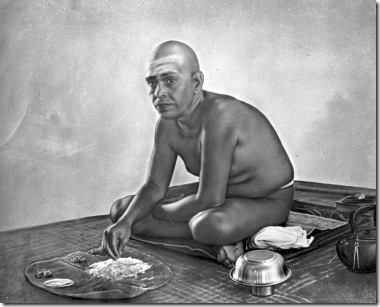
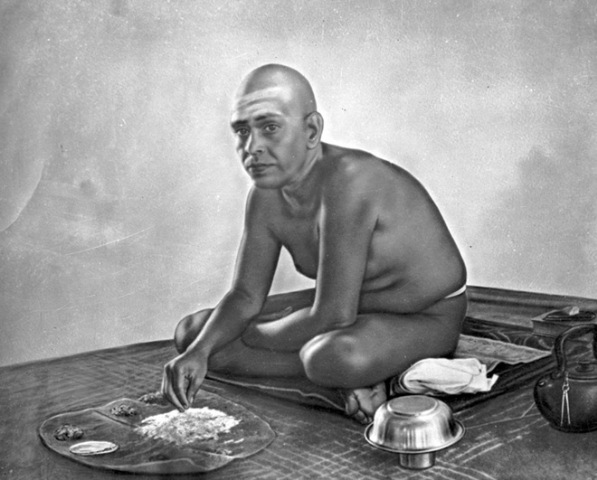
Bhagavaneating

 In Bhagavan’s own words we find recorded:

Devotee: What diet is prescribed for a sadhak (one engaged in spiritual practices)?
Maharshi: Sattvic food in limited quantities.
D.: What is sattvic food?
M.: Bread, fruits, vegetables, milk, etc.
D.: Some people take fish in North India. May it be done?
(The Maharshi made no answer.)
D.: We Europeans are accustomed to a particular diet; change of diet affects health and weakens the mind. Is it not necessary to keep up physical health?
M.: Quite necessary. The weaker the body the stronger the mind grows.
D.: In the absence of our usual diet our health suffers and the mind loses strength.
M.: What do you mean by strength of mind?
D.: The power to eliminate worldly attachment.
M.: The quality of food influences the mind. The mind feeds on the food consumed.
D.: Really! How can the Europeans adjust themselves to sattvic food only?
M.: (Pointing to Mr. Evans-Wentz) You have been taking our food.
Do you feel uncomfortable on that account?
Mr. Evans-Wentz: No. Because I am accustomed to it.
D.: What about those not so accustomed?
M.: Habit is only adjustment to the environment. It is the mind that matters. The fact is that the mind has been trained to think certain foods tasty and good. The food material is to be had both in vegetarian and nonvegetarian diet equally well. But the mind desires such food as it is accustomed to and considers tasty.
D.: Are there restrictions for the realised man in a similar manner?
M.: No. He is steady and not influenced by the food he takes.
D.: Is it not killing life to prepare meat diet?
M.: Ahimsa stands foremost in the code of discipline for the yogis.
D.: Even plants have life.
M.: So too the slabs you sit on!
D.: May we gradually get ourselves accustomed to vegetarian food?
M.: Yes. That is the way. 3

In this example, and as is seen throughout the teachings of Sri Ramana Maharshi, Bhagavan is stressing: “It is the mind that matters.” Furthermore, “The mind feeds on the food consumed”, and “The weaker the body the stronger the mind grows.”

In the following story, we are being shown that a pure diet will not only elevate the quality of the mind, but will also keep the body free from illness: “One afternoon at 3 o’clock, a devotee who was going to Madras gave a small tin containing some ointment and said that if that medicine was applied to Bhagavan’s legs, the pain would decrease, and that if Bhagavan would continuously use it, he would bring a dozen tins of it from Madras. Bhagavan replied, saying: “Enough. The Karpura Thailam I am using now is adequate. Why do I require such costly medicines? If diet is properly regulated, no medicine will be required. When these medicines are used, the ailment apparently disappears, but it starts again. That is because of some irregularity in diet.” 4

One of the close disciples who lived with Bhagavan, Arthur Osborne, related what the Maharshi taught him: “It should be explained for non-Hindu readers, that the practice of vegetarianism is not only out of disinclination to take life or eat flesh, though that is one reason for it; it is also because unsattvic food tends to increase animal passions and impede spiritual effort.” 5

Although the Ashram food was strictly vegetarian, Alagammal, Bhagavan’s mother, like some very devout Brahmins, went still further and considered some vegetables (i.e. onions) also unsattvic (impure). When Bhagavan would sit with the devotees in the kitchen and peel onions, Alagammal would weep bitterly. In response, Bhagavan would retort while holding up an onion: “Behold the powers of this small bulb.” She would then weep all the more loudly. Bhagavan had the final word, and would say mockingly: “Mind that onion! It is a great obstacle to Moksha (Deliverance)! It should be said here that Sri Bhagavan did not disapprove of orthodoxy in general. In this case there was excessive attachment to the forms of orthodoxy and that was what he attacked. In general he laid stress on the importance of sattvic (pure) food. He did not often give any injunctions at all concerning outer activity; his usual method was to sow the spiritual seed in the heart and leave it to shape the outer life as it grew. The injunctions came from within.” 6

1 Chandogya Upanishad, 6.5.4, 6.6.1,2,5.
2 Spiritual Benefits of a Vegetarian Diet, Swami Nirmalananda, Atmajyoti Press.
3 Talks with Sri Ramana Maharshi, recorded by Sri Munagala Venkataramiah, Sri Ramanashramam 2006, Talk 22, p. 20.
4 Letters from Sri Ramanashramam, Suri Nagamma, Sri Ramanashramam 2006, Letter #266 December1949, p. 640.
5 Ramana Maharshi and the Path of Self-Knowledge, Arthur Osborne, Sri Ramanashramam 2006, p. 82.
6 Ibid. p. 81.

cornucopia - Copy

Reprinted  with permission of Swami Sadasivananda
To subscribe to his newsletter, go to http://www.ramanateaching.org/contact.html
For more information on Swamiji, click here:   About Swami Sadasivananda
Teachings of Bhagavan Sri Ramana Maharshi web site: http://www.ramanateaching.org
Ask your question in relation to Bhagavan’s teachings, meditation and spirituality at:
http://www.ramanateaching.org/faq

Harsha's avatar

Call of the Conch-Part 2: By Joyce Sweinberg


WARNING:  THE  STILL AND VIDEO IMAGES IN THIS ARTICLE
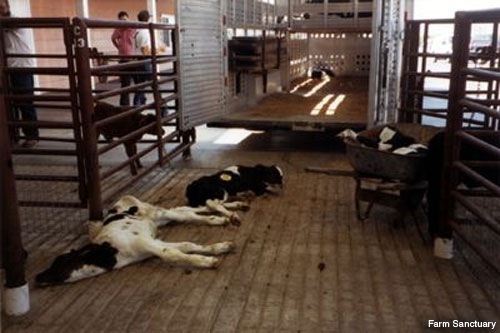
ARE GRAPHIC DEPICTIONS OF VIOLENCE TO DAIRY COWS AND THEIR OFFSPRING.

vishn69

We need to realize that milk is not an “Innocent”
animal product as it is thought to be, but is a
highly violent, cruel, and immensely exploitative food.
The most important factor in cow abuse is the economic factor;
we need to realize that as long as we, the consumers
of milk and leather, continue to buy these violent products,
the exploitation of the cow and the killing of her calves
will continue to occur.
~Shri Kamlesh

 “The female dairy cow spends her life confined in close quarters with other cows, being pumped with hormones calculated to produce pregnancy after pregnancy as long as she is capable of bearing calves, both to increase the population of the cows for milk and meat production and to spur the female to produce more milk. When her calves are born, they are taken from her within a few days of birth, giving rise to the grief of separation for both the mother and the child.”  https://luthar.com/call-of-the-conch-1.  The videos below depict the artificial insemination of the dairy cow, the birth of the calves, and the removal of the calf shortly after birth…on it’s way to either the slaughterhouse if it is male, or to its own pathetic future as a female dairy cow, soon to face the same fate as the grieving mother who gave birth to her,  bearing in her heart the infant grief of separation from her mother and facing the maternal grief in the heart of a mother forced to face the loss of her child.

The motherless child…

http://www.youtube.com/watch?v=wiRxkU_opyQ&feature=player_embedded

http://www.youtube.com/watch?v=_ZrX1rTddho

  http://www.youtube.com/watch?v=_kM387cI4rk&feature=player_embedded

http://www.youtube.com/watch?v=hAiIIZMKPC0&feature=player_embedded

Contrasts a dairy calf searching for his mother on a farm with undercover footage of calves at a slaughterhouse.

“Roughly 50% of the calves are male calves which are considered to be the by-products of the milk industry and do not have any value. These male calves are the most unfortunate souls of the milk industry; they are the silent sufferers in the background that no one bothers to notice. They sacrifice their lives so that we can drink the milk which was meant for them.These calves meet their deaths wherever factory farming occurs both in India and in the western world.

India.

Before mechanized farming, the male calves were highly sought after as draught animals that would till the land and become the farmer’s best friend. But with tractors taking over the role of draught animals, the male calves are useless and the farming/milk industry no longer feels it necessary to sustain them.

Due to the cultural heritage of India, where beef eating is not popular and cow killing is illegal, these calves are not slaughtered for calf-meat or “veal” as in the western countries. But since they pose no value to the farmer these calves are killed in the most horrific manner.

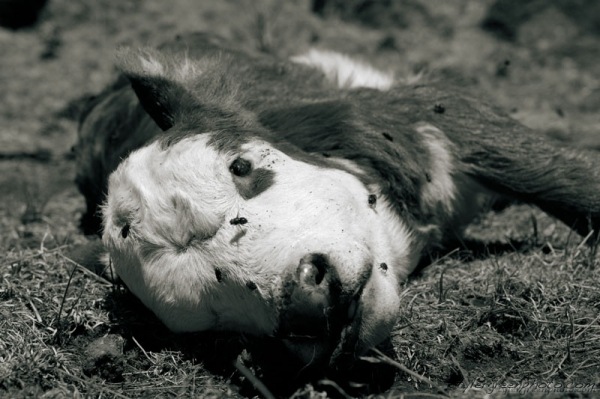
 dead-calf

Most male calves in India are separated soon after their birth… they are strangulated to death, starved and then even buried alive in compost mounds to dispose their bodies. In some cases a stuffed animal like structure is covered with the hide of the dead calf and placed near the cow, so that she continues to give milk thinking that the stuffed doll is her living calf! Many are slaughtered in illegal slaughter houses to make fancy “calf leather” belts, purses, wrist bands etc.

Western Countries.

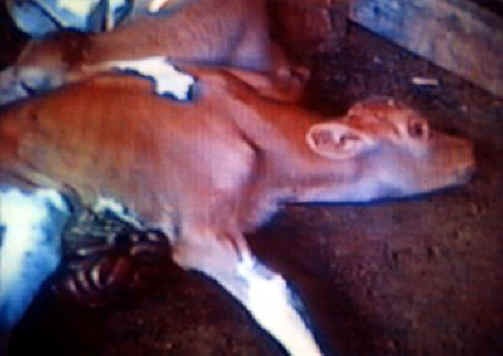
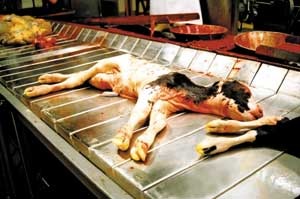
In the west the male calves are seen as sources of “calf-meat” or veal, which is the most perverted food any human can eat. The specialty of veal meat is that it is very tender, fatty and succulent and to achieve this, the calves are taken from their mothers immediately after birth and raised so as to deliberately induce borderline anemia.

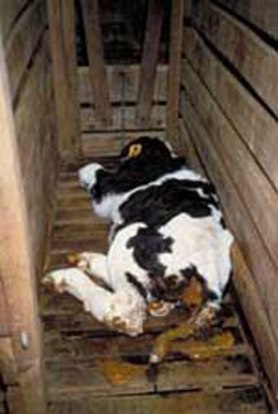
 sick_calf

veal

They are then confined in small cages called as veal-crates, usually measuring 2-feet-wide, in which they cannot turn around or stretch their limbs all their lives. This is done so that their flesh does not build muscle which is considered to be tough to eat. After about 3-5 months of living confined to their cages, these innocent calves are then slaughtered to satisfy humans’ perverted thirst for flesh.


cattle-veal-13 preg-conveyorbeltbig

The plight of the female calves is worse, they are raised so that they can be perpetually inseminated to give us their milk for the rest of the lives. If they are so unfortunate so that they become sick or break their legs which they often do, due to being continuously pregnant they are then mercilessly slaughtered, ending as meat and leather.

It is a well known fact the cows raised for milk (Dairy cows) have to undergo much more abuse and sufferings than the cows which are raised for meat (Beef cows)”

These are NOT isolated incidents, but are in fact routine procedure to dispose the male calves as profitably as possible depending upon the location, either in India or in the west. This suffering and killings are a direct result of the milk industry, which satisfies our thirst for milk, our cravings for ice-creams, payasams and chocolates at the cost of these innocent animals.

While we enjoy our milk, the silent killings go on!   ~Shri Kamlesh*

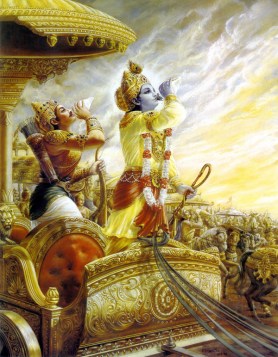
 Having one’s actions grounded in ahimsa for the Lord’s creatures, all of them, calls to our spiritual conscience with the power of the sounding of the conch. The conch, held by Vishnu, the preserver, represents life. When it is sounded, it is the sound of victory, as by Krishna and Arjuna heralding the defeat of the adharmic influences in the battlefield of the mind symbolized in the Holy Gita.  May the adharmic influences inherent in the dairy industry fall to the ground in defeat at the call of the conch.

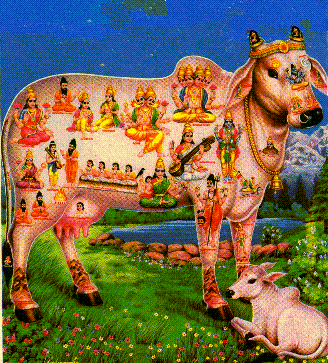
cow-gomatha_vishnu… dhenoonaamasmi kaamadhuk…

Among the cows, I am Surabhi, the wish-fulfilling cow. B.G. 10.28

 b36

 https://luthar.com/call-of-the-conch-introduction
https://luthar.com/call-of-the-conch-1

*The italicized text of Part 2 in this series was written by Shri Kamlesh, who also provided many of the images used. Any edits were to context, not to content. I offer my namaskarams to him.

Harsha's avatar

Call of the Conch-Part 1: By Joyce Sweinberg


WARNING:  THE  STILL AND VIDEO IMAGES IN THIS ARTICLE
ARE GRAPHIC DEPICTIONS OF VIOLENCE TO DAIRY COWS.

  5972_217788405374_215886190374_7850084_1398980_n 5972_217788400374_215886190374_7850083_3230150_n 5972_217804335374_215886190374_7850612_5256181_n

Lord Sri Krishna vividly describes the three types of foods,
Sattvic, Rajasic and Tamasic. Milk in the olden days was definitely Sattvic.
However now it is 100% Tamasic due to the abundant violence and abuse it entails.
Drinking such milk is equal to eating beef. In fact the animals raised for meat
do not have to suffer so much as these unfortunate dairy cows are made to suffer.

~Shri Kamlesh

In Patanjali’s Yoga Sutras, Ahimsa (nonviolence) is considered the first principle of the spiritual life. Ramana Maharshi, the great sage of Arunachala has clearly stated, “Ahimsa Param Dharma”. Translated this means that nonviolence is the supreme religion… My friends, in order to gain peace, one has to give peace to others. This is the universal law as described and explained by the doctrine of karma. What we give to others, we give to ourselves. If we are able to learn this lesson by heart, it will influence our actions in this world. It is not an easy lesson at all.Nonviolence is the most beautiful expression and manifestation of the unconditioned recognition of the Nature of Reality. This is our conviction. This ideal is our aspiration. As many times as we fall, we get up and stand on the foundation of nonviolence as our nature. ~Dr. Harsh K. Luthar

                                      https://luthar.com/ahimsa-and-self-realization-by-dr-harsh-k-luthar

Can you hear her crying?

There was a time, a time when the dairy cow was nurtured and revered for her milk, when the calf came first and the human after, when she was part of the family, not part of their property. When she lived out her life with decency until the end, even after she no longer produced milk. But that time is long gone, replaced by industry production methods aimed at one goal…profit.  And in that goal, all decency was lost, replaced with the torture, plunder and cruelty of the present milk farms, both here in the US and abroad.

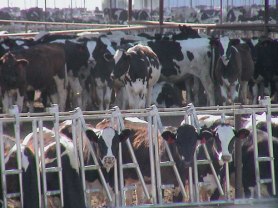
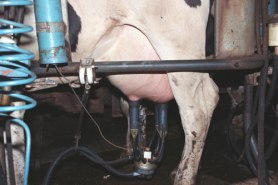
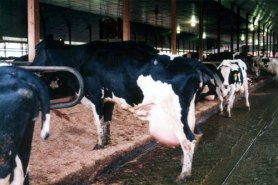
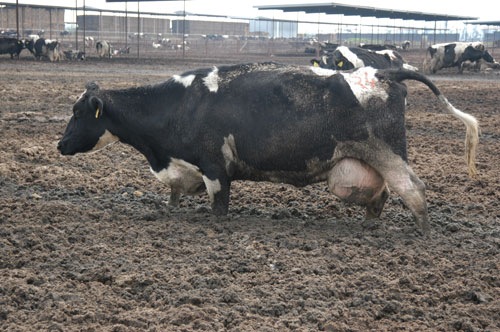
The female dairy cow spends her life confined in close quarters with other cows, being pumped with hormones calculated to produce pregnancy after pregnancy as long as she is capable of bearing calves, both to increase the population of the cows for milk and meat production and to spur the female to produce more milk. when her calves are born, they are taken from her within a few days of birth, giving rise to the grief of separation for both the mother and the child. (This and the fate of her calves will be the subject of its own article)  Her body knows no rest, either from pregnancy, the drugs used to induce pregnancy and milk production,  or the milking machines which relentlessly squeeze the very life out of her, slowly and painfully.  This relentless assault on her body frequently causes her to develop mastitis, an extremely painful condition of the udder, which results in blood and pus accumulating within the infection and often being expelled into the milk.

cow07

 cow10

cow11

cow08

The link below graphically depicts the puncture of  an inflamed udder…
http://www.youtube.com/watch?v=vqqSeO4vqcw&feature=player_embedded

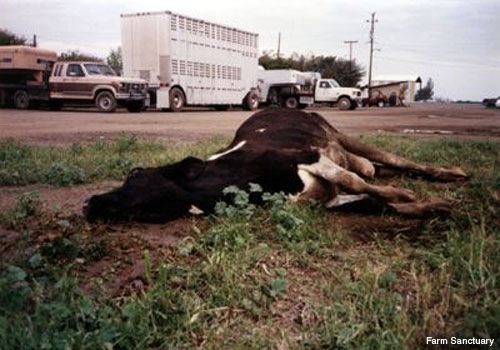
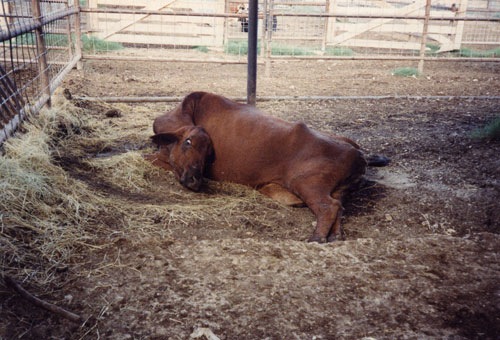
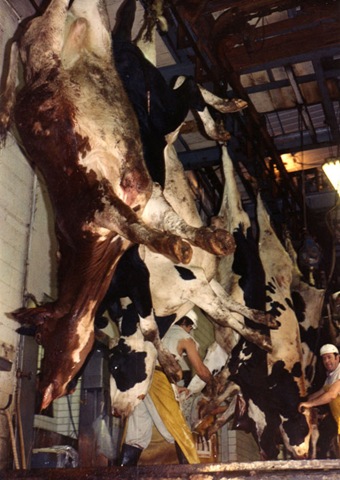
Although the average life span of the cow can be in the neighborhood of  25 years,  the cow in the milk farm is ready for death after approximately 4-5 years.  By this time, the multiple pregnancies, coupled with the hormones and other drugs pumped into her system have taken their toll.  More often than not, by this time, she can barely walk on her own, either due to excess weight gain from the drugs and/or broken bones and the condition is often referred to as a “downed cow.”  This has significance in the market, as a “downed cow”, by law in most states, is not to be introduced into the slaughterhouse and the meat which is being sold to the ever willing population of meat eaters.  For this is her final destination…once she is no longer useful for bearing calves or bearing milk, she is sent to the slaughterhouse to be butchered and sold as meat.

A note about organic farming is in order. Although the cow may not be confined or treated with antibiotics and other drugs, it is quite likely that she will be impregnated, separated from her offspring and slaughtered in the end.

Even as she approaches her last moments, she is prodded and abused to keep her “up” so she can “walk” past the inspectors and into the knife of the butcher.  The videos in the link below show the cows being hit in the face with sticks, prodded with electric prods, chained to forklifts and dragged just to get them “on their feet.”  Once on the feet, the cow is continually pushed, her tail twisted, electric shocks applied to her, anything to keep her moving and get her into the kill box, where all of this will finally come to an end, and she will be slaughtered. The link below to the Humane Society video, taken undercover at a dairy farm in California, illustrates some of this abuse…

http://lawprofessors.typepad.com/foodlaw/2008/02/horrible-dairy.html

  Abuse is not limited to America…

INSIDE THE INDIAN DAIRY INDUSTRY

“The cows are cramped into these trucks, with no food, water for days these poor exhausted animals are then literally thrown from the trucks on to the ground. Many cows break their legs, and bones and cannot walk, to hoist them to the slaughter house acid is poured into their eyes and noses or their tails are broken. These abuses are wide-spread because of lax laws and corrupt officials and the demand for cheap leather products. Some how when these cows are lead to the slaughter house, the cows are literally hammered by a large hammer on their heads and after they are immobile their necks are slit so that they are bled to death. At least their miserable lives have now finally come to an end. The farmer now gets his money from the dead cow’s flesh and leather and buys a younger cow to continue the cycle.”  ~Shri Kamlesh

 http://www.youtube.com/watch?v=ZjYA2K7ke0E&feature=player_embedded

 DOWNED COWS

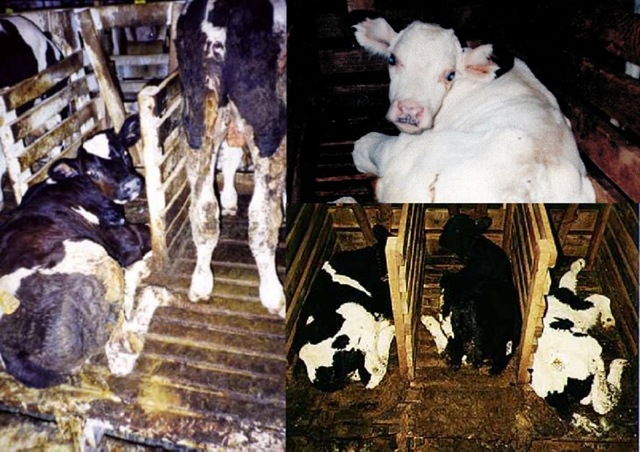
The cows pictured below, either because of broken legs or other diseases affecting them due to the abuse of their bodies in the production of milk, can no longer stand on their own. They are left stranded, unable to move, even to get away from their own excrement, unable to escape the violence which awaits them as they are either “euthanized” or butchered for meat production.

  Many of the images below can be located at http://www.goveg.com/photos_cows.asp
with detailed explanations of the images…

cow18


cow19

cow20

 Once they are forced up, this is where they end up, along with their male counterparts…

 cow23

  http://www.goveg.com/photos_cows.asp

Having one’s actions grounded in ahimsa for the Lord’s creatures, all of them, calls to our spiritual conscience with the power of the sounding of the conch. The conch, held by Vishnu, the preserver, represents life. When it is sounded, it is the sound of victory, as by Krishna and Arjuna heralding the defeat of the adharmic influences in the battlefield of the mind symbolized in the Holy Gita.  May the adharmic influences inherent in the dairy industry fall to the ground in defeat at the call of the conch.

gita-101


 Matkarmakrinmatparamo madbhaktah sangavarjitah;
Nirvairah sarvabhooteshu yah sa maameti paandava.

Whoever works for Me, looking upon Me as the goal;
whoever is My devotee, free from attachments
and from antagonism to any being –
such a one shall enter into Me. (BG 11.55) 

b36

Harsha's avatar

Call of the Conch-Introduction: By Joyce Sweinberg

5732_216453855374_215886190374_7808618_1259315_n
“We need to challenge our age old habits and tradition
if they are in direct contrast to the principles of
non-violence and dharma laid down by Sri Krishna in Gita.”

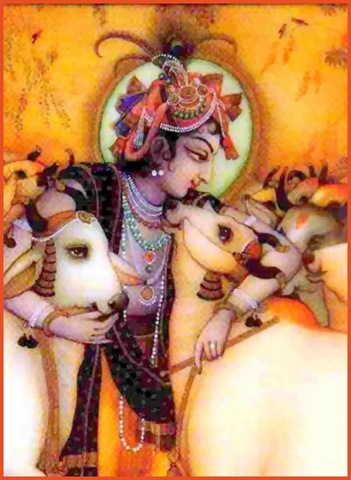
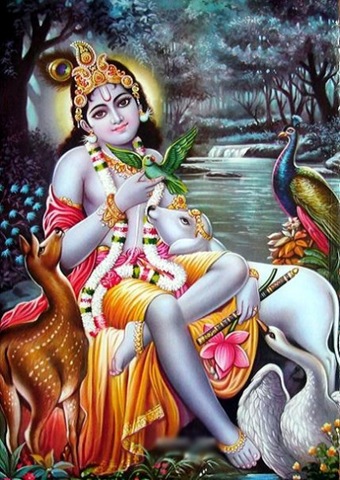
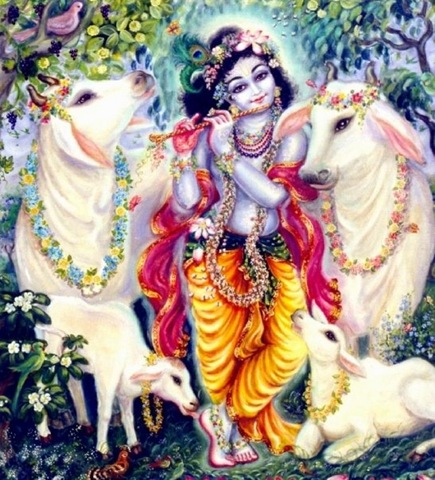
Lord Krishna is also known as Gopala, or protector of the cows. His love for and relationship with the cows of Vrindavan forms a major part of His transcendental past times.  Among the artwork depicting His holy image, there are just as many showing Him with His beloved cows as there are images depicting Him with His beloved Radha and the gopis.  As Giridhara, He lifted the mountain of Govardhana to protect the citizens and the cows from destruction.  When He played His flute, the cows were there, His most ardent audience.  When He wanted to eat, the cows were there, His most willing suppliers of milk and butter.  When He wanted affection, the cows were there, His most unselfish companions, wanting nothing from Him but His caress and His embrace, which they freely returned.  And so, it is not surprising that from these stories and for other reasons, the practice of offering Him prasadam made with dairy, and bathing His image in milk developed and took hold as the cornerstone of devotional rituals.

At abishekam, a devotional service, the offering of milk is one of the most common items donated by devotees.  Sometimes mixed with honey and other items, the milk is poured onto the deity and flows freely and amply throughout the ritual, allowed to drain into metal bowls, collected and then poured back into the bottles for the devotees to take home, now blessed by the Lord.  A small vessel is also passed around the room, with each of us given a small spoonful to drink the blessings of Divinity. Food is also offered to the Lord for prasadam and usually contains milk and ghee, a form of clarified butter.  After the puja is complete, the food is shared by devotees partaking of the Lord’s blessings, gathering together in the sangha of God’s worship.

What appears as a charming expression of devotion now has lurking behind it a vile abuse of this most sacred creature of the Lord, both in India and here in America, knowingly perpetrated by the suppliers of the dairy products and unwittingly financed by the Lord’s devotees.  While I converted to a vegetarian diet years ago, I continued to include some dairy in my diet, although very limited due to my developing concern with ahimsa and allergic skin reactions.  But I continued to accept the prasad, I continued to pour the milk when the occasion arose and I relished the sweets and the wonderful Indian cuisine so freely shared where I worship. I told myself that any hesitations I had should be quashed within myself because these were offerings to God and had been blessed and cleansed of any sins committed in their procurement. Lately, though, I was becoming uneasy about it, but not voicing my thoughts and not knowing quite how to voice my developing uncertainty over the source of these offerings.

6129_121115465189_753070189_3399602_3278962_n

Until recently, when Kamleshji, another devotee on a bhakta forum posted a message directly confronting this subject, and ripping open my cloak of uncertainty to the naked truth that cannot be denied if one looks with one’s eyes open, if one hears with one’s heart and if one thinks with one’s conscience. From his post and subsequent communications from him, I quote a few lines below…

“….as devotees of Lord Sri Krishna we must definitely pay attention to the plight of His most beloved animal, the Cow (Go-mata).

Just recently on Sri Krishna Jayanthi, we bathed Lord Sri Krishna in milk, curd, ghee and offered Him His favourite naivedhyams such as paal payasam,  ghee and butter.

However we must be aware how this milk is obtained in this Kali yugam, especially where milk is obtained in commerical farming techniques (as in big cities in India and especially here in the US).  Before this exploitative factory farming age, our saints used to procure Milk products in harmony and without cruelty, the milk was taken from the cow only after the calf has had it’s fill and the cow was worshipped as Go-matha.  Such offerings are certainly pleasing to the Lord.

However in the present age,  factory produced milk is a very cruel exploitative product of torturing cattle. The poor cows are  enclosed in a tiny space, chained in its own waste in darkness, cold and filth for the rest of its life. It is pumped with insane amounts of hormones, and other toxic medications to artifically increase milk production.

These large amounts of hormones, antibiotics and other unnatural feed, cause the cow to grow large and make it prone to bone fractures and other very painful diseases. To add to this torture the cows are artifically inseminated to produce calves to ensure regular supply of milk.

The most unfortunate of the calves are male calves  (called Bobby calves) who are considered to be useless and are sold off to be butchered for meat when they are just five days old. The mother cows separated from their calves cry in agony, yet they are not spared and are administered more hormones to continue milking them.

After milking the cow till it has been exhausted and after ensuring that the cow cannot yield anymore milk, it is sold off to be slaughtered in the most brutal manner for meat and leather.  I request all bhaktas to please think about this, will our Lord ever accept our abhiseghams and Naivedhyams if it means that His favourite innocent animals are killed slowly and extremely painfully all their lives?  Let us not act in an adharmic manner and perform unthinkable atrocities and sins by offering factory produced milk and milk based products especially in our sacred rituals and also in our diets. I can only be certain that we shall never suceed in our sadhana if it causes so much needless pain for innocent animals.

Lord Sri Krishna, vividly describes the three types of foods, Sattvic, Rajasic and Tamasic. Milk in the olden days was definitely Sattvic however now it is 100% Tamasic due to the abundant violence and abuse it entails. Drinking such milk is equal to eating beef.  In fact the animals raised for meat do not have to suffer so much as these unfortunate dairy cows are made to suffer.

We cannot afford to fool ourselves into believing that just because we are vegetarians and do not eat beef, we are protecting the cows. We need to challenge our age old habits and tradition if they are in direct contrast to the principles of non-violence and dharma laid down by Sri Krishna in Gita.”

govardhanagiridhari

His post prompted me to respond to him and to also go online to view some of the websites which I knew would show me the truth, as painful as it might be to watch and to listen. I am now convinced that I must be even more vigilant in my avoidance of all dairy products where I do not know the source.  I will also post several more blog entries examining this subject in more detail, in the hope that each of us can look more honestly into our hearts about what we put into our mouths and onto our bodies, and onto the Lord.

The Luthar.com blog already has several articles on the subject of vegetarian diet…this short series is specifically examining the vegan diet.  We will look at ahimsa as the foundation for a vegan diet, the economic incentives fueling the abuse, the ways in which the dairy cows are abused, including their offspring, and how they are slaughtered in the end. We will examine the human health consequences of ingestion of dairy products and the environmental effects of the mass procreation of cows for human consumption.  We will explore the organic industry as well. We will post photos and links to videos so you can see for yourself what is happening to the dairy cows.  We will also post links to organizations geared to helping the abused cows and offering alternatives to the current system.  We will offer suggestions and ideas on how to substitute other products in our diet and in our worship. We ask that you the reader examine the facts with an open heart. Together with Kamleshji, who has studied the subject extensively and speaks with eloquence and fortitude in His devotion to the Lord on this subject, I will continue to post, seeking His blessings and inspiration.

Today is Ganesh Chaturthi and I take this opportunity to post the first in this series on this day with this prayer…that I serve the Lord without reservation acting as best I can on His wishes, and that I open my mind and my heart enough to let Him speak through me as He guides me.  Ganesha Saranam!

n702126689_1382369_7333

Patram pushpam phalam toyam yo me bhaktyaa prayacchati;
Tadaham bhaktyupahritamashnaami prayataatmanah.

If one offers Me with love and devotion of a leaf,
a flower, fruit or water, I will accept it with joy. BG 9.26

 b36

Harsha's avatar

Ethical Choices in Eating

Given the rising interest in sustainable living, more people than ever before are giving serious thought to their eating choices. This very interesting article in the Los Angles Times discusses the complexities of ethical eating along with related health issues. A number of authors and books and resources are mentioned.

Tackling the ethics of eating – Los Angeles Times

Harsha's avatar

Spring Renewal: Ready For Detox? by Rita Minassian


Cleansing our body inside out has become essential nowadays. The high level of pollution and the increased electro-magnetic activity in the atmosphere, hectic professional agendas and endless lists of preservatives in our food, contribute to increase the level of stress in our system. By stress, I don’t only mean high nervosity or anxiety but an imbalanced state that creates blocks and ultimately disease. Additional to a healthy lifestyle routine, anyone who has ever experienced a detox program agrees that helps to clear not only the body, getting rid of any excess weight, to restore and optimize our energy level, but clears the mind as well, bringing more focus and an overall sense of ultimate sense of well-being. Then our outlook on life changes drastically, a more positive approach of life is possible which is rule number 1 to prevent depression and an optimum healthy life.

But is this just a modern, trendy “must do” during intermediate seasons?… Certainly not. From ancient traditions spring detox has always been a universal concept.

Years ago, when I first experienced Ayurveda at Soukya Holistic Center in Karnataka-India, I ‘ve been told by my physician, world-renowned Ayurvedic Doctor Isaac Mathai, that the monsoon season usually starting  in May, is actually the best period for a Panchakarma: a complete 5 step mind-body detox program which ideally lasts for 7, 14, 21 or 28 days (the duration of a Moon cycle and a cell renewal cycle by the ways…). He explained that the rainfalls actually support the cleansing/detox provided to a patient according to their Dosha type (biological “moods”). I also believe that people feel more positive and refreshed inside out because of the negative ions generated by rainfalls.

Ghulum (bath attendant) providing a customer with 2 Ayurvedic procedures.

In Panchakarma, a combination of different techniques are used to remove stored toxins in the body which contribute to sap our immune system. Purgation is usually processed with clarified butter (ghee) to remove impurities from the colon or water for a nasya (instillation through nostrils). Blood letting is also used to renew the red blood cells in the body.

Specific massages, like daily Abhayangas (4 hand massage) bring back balance and harmony to the body and to the Chakra system. The Shirhodara (3rd eye cleansing and my favorite…) do wonder on quieting the mind, increases awareness and heal migraine and Parkinson. Goodbye anger, sadness, grudges or lingering guilt, they will all be swept out… It’s important to remember that while a imbalanced diet can obviously affect the body directly, negative thoughts are actually number 1 enemies to harmony and good health.

Meditation and yoga programs can be added to these medical techniques: a combination of postures (Asanas) with Mudras, breathing techniques (Pranayama) and Mantras, are powerful tools to unburden the body and mind.

It is interesting to mention that this period of spring cleaning corresponds as well to some religious and non religious practices found in different traditions. For example, according to the bible, spring is time for the Jewish community to get rid of all the “hametz” during the pre-Passover time: every single dust or crumb has to disappear from the house before the celebration of “Pessah”, liberation.

In Feng shui, spring is also an important time for a making up; what to keep, what to give, what to get rid of… In this ancient Chinese concept, old, useless items represent blockages for a fluent energy flow in the house, but also for the inner world (body system), and for the mind: any type of clutter, within the body and/ or in the environment has to be cleared to avoid disease.

Mother Earth, in her infinite abundance and generosity offers us everything to achieve this detox: plants, vegetables, essential oils, specific spices like curcuma and cinnamon among many others are on the top list of the “natural cleaning team” in Ayurvedic medicine. Aditionnal to the digestive system, a Panchakarma detox program will also support several other channels of elimination in our body: lungs, kidneys, skin, and lymphatic system, all your body will be thankful for this renewal. It goes without saying that a Panchakarma  has to be done by a physician specialized in Ayurveda.

Wether using ancient wisdom tools, planning a retreat in a traditional medicine clinic, or indulge yourself in a modern SPA resort, it’s time to find your ultimate place for detox and enjoy your rebirth!

Rita Minassian

www.ritaminassian.com

Harsha's avatar

Jenny McCarthy: Yoga, Diet, and Vaccines

I saw Jim Carrey and his wife Jenny McCarthy on Larry King Live speaking about vaccines. They were extremely well informed about how the health care business works in the U.S.  As I listened to the interview, I saw why they are so passionate about the topic and the idea that good health should focus on prevention of disease. Their son was diagnosed with autism at an early age.

Both Jenny McCarthy and Jim Carrey  are actively involved in autism-related causes. McCarthy wrote the book called “Louder Than Words: A Mother’s Journey in Healing Autism.”

Their criticism of the modern medical system and the lack of training doctors have in nutrition in prevention of disease was very pointed.

Jenny McCarthy states that her son Evan who is autistic has healed through alternative methods. She discusses these methods in her third book on the subject, “Healing and Preventing Autism.”

Jenny  McCarthy believes that vaccines caused her son Evan’s autism. She feels parents should question doctors more carefully to determine if the various shots are necessary.

“I’m not anti-vaccine,” she said. “I’m not an idiot. I get that we need them, but I do think people need to wake up and take a look at the schedule… and why did we triple the amount?”

As far as their  practice of yoga, Jim Carrey does not practice any but really appreciates the fact that his wife does and is extremely supportive of her practice.

Jenny  McCarthy engages in Bikram Yoga for 90 minutes a day. That is quite a lot of yoga on a daily basis!

For those who don’t know, Bikram Yoga is practiced with heat turned up fairly high and really makes one sweat profusely.

In addition to yoga, Jenny McCarthy focuses on a good diet to stay healthy and slim.

Harsha's avatar

The Dog Shavasana

Finally some rest from the Dog Yoga!