ShrIgurubhyo namaH

ShrIgurubhyo namaH
The path of devotion communicated during the conversation between Sri Arjuna and Lord Krishna is highlighted by providing answer to the following key questions:
(1) Should One Worship a Personal or an Impersonal God?
(2) What are the four Paths to God Realization explained in this chapter?
(3) Why Karma-Yoga is recommended to be the Best Starting Point for God Realization?
(4) What are the Key Attributes of a Devotee that we can gather from this Chapter?
(5) Finally why One Should Sincerely Strive to develop Divine Qualities?
Arjuna asked: Which of these has the best knowledge of yoga; those ever-steadfast devotees who worship personal aspect, or impersonal aspect (the formless Absolute)?
Lord Krishna said – “I consider the best yogis to be those ever steadfast devotees who worship with supreme faith by fixing their mind on Me as their personal God.”
This is a restatement of what He said in chapter 6, verse 47. True devotion is defined as the highest order of love for God. True devotion is motiveless intense love of God to attain Him. It is seeking God’s grace and serving with love and dedication to please Him . Thus, devotion is doing one’s duty as an offering to the Lord with love of God in one’s heart.
It should be also understood that devotion is granted by the grace of God. A loving relationship with God is easily developed through a personal God. The faithful followers of Rama, Krishna, Moses, Buddha, Christ, and Muhammad are considered the steadfast devotees. All spiritual practices in the absence of steadfast devotion will become useless. The pearl of Self-knowledge is born on the nucleus of faith and devotion only.
What Lord Krishna has said with respect to those who worship the impersonal God? He assures that they also attain Me who worship the unchangeable, the inexplicable, the invisible, the omnipresent, the inconceivable, the unchanging, the immovable, and the formless. Their worship of the impersonal God come in the form of change in their attitude to life by restraining all the senses, even-minded behavior under all circumstances by engaging in the welfare of all creatures. A person who is competent to worship the formless aspect of God must have a complete mastery over the senses, be tranquil under all circumstances, and be engaged in the welfare of all creatures.
Lord Krishna implicitly points out that worshiping the personal God is relatively easier than worshiping the impersonal God. One must be free from body-feeling and be established in the feeling of the existence of the Self alone, if one wants to succeed in worship of formless Absolute. One becomes free from the bodily conception of life when one is fully purified and acts solely for the Supreme Lord. Attainment of such a state is not possible for the average human being, but only for advanced souls. Therefore, the natural course for the ordinary seeker is to worship God with a form. Thus the method of worship depends on the individual. One should find out for oneself which method suits one best. It is quite fruitless to ask a child to worship a formless God, whereas a sage sees God in every form and does not need a statue or even a picture of God for worship.
At the starting point there are likely differences between these two approaches to the worship of God. But those practice with steadfast devotion the differences get melted away. Then there will be no real difference between the two paths. – the path of devotion to a personal God and the path of Self-knowledge of the impersonal God – as they attain full spiritual maturity. In the highest stage of realization they merge and become one. The personal and the impersonal, the physical form and the transcendental form, are the two sides of the coin of ultimate Reality. A person must learn to focus the mind with the one and only thought on a personal God with a form. After succeeding therein by fixing their mind, their mind get purified and they are able to transcendent all attachments to names and forms. The highest liberation is possible only by realization of God as the very Self in all beings, and it comes only through maturity of devotion to the personal God and by His grace.
First is the path of meditation (See Chapter 6 for greater details) for the contemplative mind. Thinking of a chosen form of God all the time is different from worshiping that form, but both practices are the same in quality and effect. In other words, contemplation is also a form of worship. If you are unable to focus your mind steadily on Me then long to attain Me by practice of any other spiritual discipline; such as a ritual, or deity worship that suits you. (12.09).
Second is the path of ritual, prayer, and devotional worship recommended for people who are emotional, have more faith but less reasoning and intellect (See also 9.32). Constantly contemplate and concentrate your mind on God, using symbols or mental pictures of a personal God as an aid to develop devotion. If you are unable even to do any spiritual discipline, then dedicate all your work to Me, or do your duty just for Me. You shall attain perfection by doing your prescribed duty for Me – without any selfish motive – just as an instrument to serve and please Me. (12.10)
Third is the path of transcendental knowledge or renunciation, acquired through contemplation and scriptural study for people who have realized the truth that we are only divine instruments. Lord Himself guides every endeavor of the person who works for the good of humanity, and success comes to a person who dedicates his or her life to the service of God. If you are unable to dedicate your work to Me, then just surrender unto My will and renounce the attachment to, and the anxiety for, the fruits of all work by learning to accept all results with equanimity as God’s grace. (12.11).
The fourth is the path of Karma Yoga, the selfless service to humanity, discussed in Chapter 3, for householders who cannot renounce worldly activity and work full-time for God, as discussed in verse 12.10, above. The main thrust of verses 12.08-11 is that one must establish some relationship with the Lord; such as the progenitor, father, mother, beloved, child, savior, guru, master, helper, guest, friend, and even an enemy. Karma Yoga, or the renunciation of the selfish attachment to fruits of work, is not a method of last resort; as it may appear from verse 12.11.
The transcendental knowledge of scriptures is better than mere ritualistic practice; meditation is better than scriptural knowledge; renunciation of selfish attachment to the fruits of work (KarmaYoga) is better than meditation; because peace immediately follows renunciation of selfish motives. (See more on renunciation in 18.02, and 18.09) When one’s knowledge of God increases, all Karma is gradually eliminated because one who is situated in knowledge thinks he or she is not the doer but an instrument working at the pleasure of the creator. Such an action in God-consciousness becomes devotion ¾ free from any Karmic bondage. Thus, there is no sharp demarcation between the paths of selfless service, spiritual knowledge, and devotion.
One is dear to Me who does not hate any creature, who is friendly and compassionate, free from the notion of “I” and “my”, even-minded in pain and pleasure, forgiving; and who is ever content, who has subdued the mind, whose resolve is firm, whose mind and intellect are engaged in dwelling upon Me, and who is devoted to Me. (12.13-14) To attain oneness with God, one has to become perfect like Him by cultivating moral virtues. Virtues and discipline are two sure means of devotion. A list of forty virtues and values are provided through verses 12.13 to 12.19 by describing the qualities of an ideal devotee, or a Self-realized person. The true devotee is fully committed to these forty noble qualities. It should be pointed out the true devotion implies “COMMITMENT” without “ATTACHMENT.”
One is also dear to Me who is free from joy, envy, fear and anxiety and does not agitate others and also not agitated by them. (12.15)
One who is desireless, pure, wise, impartial, and free from anxiety; who has renounced the doership in all undertakings – such a devotee is dear to Me. (12.16)
One who neither rejoices nor grieves, neither likes nor dislikes, who has renounced both the good and the evil, and is full of devotion is also dear to Me. (12.17)
One who remains the same towards friend or foe, in honor or disgrace, in heat or cold, in pleasure or pain; who is free from attachment; who is indifferent to censure or praise; who is quiet, and content with whatever one has, unattached to a place, a country, or a house; who is tranquil, and full of devotion, that person is dear to Me. (12.18-19)
It is said that divine Controllers with their exalted qualities, such as the knowledge of God, wisdom, renunciation, detachment, and equanimity, always reside in the inner psyche of a pure devotee. Thus, perfect devotees who have renounced affinity for the world and its objects and have love for God are rewarded by the Lord with divine qualities. They are dear to the Lord.
What about those who are imperfect, but trying sincerely for perfection? Lord Krishna answers this question in the very the next verse suggesting that One Should Sincerely Strive to Develop Divine Qualities:
But those faithful devotees are very dear to Me who set Me as their supreme goal and follow — or just sincerely strive to develop — the above mentioned nectar of (forty) moral values. (12.20)
One may not have all the virtues, but a sincere effort to develop virtues is most appreciated by the Lord. Thus the one who strives is very dear to the Lord. The higher class of devotees do not desire anything, including salvation from the Lord, except for the boon to permanently be at the lotus feet of a personal God, birth after birth. Lower class devotees use God as a servant to fulfill their material demands and desires. The development of unswerving love and devotion to the lotus feet of the Lord is the ultimate aim of all spiritual discipline and meritorious deeds as well as the goal of human birth. A true devotee considers oneself the servant, the Lord as the master, and the entire creation as His body.
The path of devotion is a better path for most people, but Devotion does not develop without a combination of personal effort, faith, and the grace of God. Nine techniques for cultivating devotion which is an intense love for God as a personal Being – based on Tulasi Ramayana are:
(1) The company of the holy and wise,
(2) Listening and reading the glories and stories of Lord’s incarnations in the religious scriptures,
(3) Seva or serving God through service to the needy, the saints, and society,
(4) Congregational chanting and singing of the glories of God,
(5) Repeating the Lord’s name and mantra with firm faith,
(6) Discipline, control over the six senses, and detachment,
(7) Seeing your personal God everywhere and in everything,
(8) Contentment and lack of greed as well as overlooking others’ faults, and
(9) Simplicity, lack of anger, jealousy, and hatred.
The best thing a person should do is to develop love of God. Lord Rama said that one needs to follow any one of the above methods with faith to develop love of God and become a devotee.
Good company of saints and sages is a very powerful tool for God-realization. It is said that friendship, discussions, dealings, and marriage should be with equals or those who are better than oneself, not with persons of lower level of intellect (MB 5.13.117).
A person is known by the company he or she keeps. According to most saints and sages, the path of devotion is very simple and easy to perform. One can begin by simply chanting a personal mantra or any holy name of God. There is no restriction on the correct time or place for chanting the holy name of God. The process of devotional service consists of one or more of the following practices: Hearing discourses, chanting the holy name of God, remembering and contemplating God, worshipping Him, praying to Him, serving God and humanity, and surrendering to His will.
The four inter-connected paths of yoga discussed in the first twelve chapters of the Gita may be summarized as follows:
The practice of Karma Yoga leads to purification of the mind from the stain of selfishness that paves the way for knowledge of God to be revealed. Knowledge develops into devotional love of God. Constant thinking of God, the object of our love due to devotion, is called meditation and contemplation that eventually lead to enlightenment and salvation.
Lord Krishna has been talking about both manifest and unmanifest aspects of God in the previous chapters (See for example 9.4 and 9.5). Arjuna’s question has been answered in great detail in this chapter, but people still argue that one method of worship or certain religious practices are better than others. Such persons will continue to argue and will be only able to understand half the truth.
From what is presented in Chapter 12, it is clear that the method of worship depends on the nature of the individual. The person or the person’s guru should find out which path will be most suitable for the individual, depending on the person’s temperament. To force his or her own method of worship on other people is the greatest disservice a guru can do to disciples. The most important thing is to develop faith in and love of God. God has the power to manifest before a devotee in any form, regardless of the devotee’s chosen form of worship. What has worked for one may not work for all, so what makes you think your method is universal? There was no need for the Lord to discuss different paths of yoga if there was one path for all. If the chosen path of spiritual discipline does not give one peace or God-realization, then it must be understood that one is not practicing correctly or the path is not right for the individual. It should be kept in mind that a drop of water, no matter what route it takes, will eventually reach the ocean.
Note: It should be pointed out that the recipes presented in this chapter are quite useful for cooks who want to prepare tasty meals for seekers who like the flavors of Dwaita or Visistadwaita or Advaita! That may explain why this chapter is well-liked by the followers of different schools of thought.
Dear Friends:
After you have practiced meditation for many years, at some point the questions may arise:
1. What is Enlightenment?
2. How does one get Enlightened?
3. What is the secret of Enlightenment?
Although the word Enlightenment has much glamor associated with it, it is a very simple thing. Enlightenment means to simply rest in one’s own authentic and original nature which is one’s own Self. This is the state of quiet peace whose very nature is Awareness and Ahimsa.
One becomes Enlightened by hearing that there is such a state of peace and beauty, and then by engaging in meditation and inquiring into one’s own nature by going within.
For ripe seekers, the secret of Enlightenment is told and it is this.
Be easy and natural in life.
Do your work and play your role in the world as best as you can.
Do not be much attached to success or failure.
Do not mind the mind but instead focus on the quality of awareness that permeates it.
Finally, as the awareness of awareness becomes strong, let the mind glide into the Heart and be free.
The term ‘Vedanta’ stands for the Upanishads as a whole, which form part of the Vedas. It would therefore be appropriate to give a general account of the Vedas before going on to deal with Vedanta.
In the Indian tradition, philosophy is termed ‘darsana’, a Sanskrit word meaning ‘seeing’ or ‘experiencing’. This indicates that the aim of philosophy in India is direct experience of the ultimate Reality and not mere intellectual speculation as in Western philosophy.
The Indian philosophical systems are classified into two broad categories known as ‘aastika darsanas’ and ‘naastika darsanas’. There are no exact equivalents to these terms in English, though the terms ‘orthodox’ and ‘unorthodox’ are sometimes used. It would be wholly misleading to use the terms ‘theistic’ and ‘atheistic’ for these categories.
The term ‘aastika’ has been defined as referring to a person who, or a system which, accepts, (1) the authority of the Vedas, (2) the doctrine of rebirth and (3) the existence of other ‘lokas’ or spheres of experience. In the category of aastika darsanas fall those systems which accept the authority of the Vedas. These are the six systems known as Nyaya, Vaiseshika, Sankhya, Yoga, Purvamimamsa and Uttaramimamsa (or Vedanta). Even among these six, it is only the last two that base themselves directly on the Vedas and accept nothing that goes against them. The other four systems are based more on independent grounds of logic and reasoning, but they too are not opposed to the Vedas.
In the category of naastika darsanas fall the four schools of Buddhism, Jainism and the Carvaka (or atheistic) school, which do not accept the authority of the Vedas. These also make up a total of six.
All the six aastika darsanas regard the Vedas as the record of the divine truths revealed to the sages (Rishis or seers) in their supra-normal consciousness. The sages are not the authors of the Vedas. They are known as ‘seers’ of the Vedic mantras.
The traditional view is that the Vedas are eternal. The word ‘Veda’ means primarily ‘knowledge’ and secondarily the books in which that knowledge is recorded. This is not knowledge of the external world, but the knowledge of the supreme Truth which cannot be attained by any effort of the human mind.
It has been categorically declared by our ancient sages that the Vedas have no validity in matters which fall within the domain of other valid means of knowledge such as perception and inference. Sri Sankara says in his Bhashya on the Bhagavadgita, ch.18, verse 66:
The validity of the Vedas holds good only with regard to matters which cannot be known through such other valid means of knowledge as direct perception, etc., because the validity of the Vedas lies in revealing what is beyond direct perception. Even a hundred Vedic statements cannot become valid if they say that fire is cold or non-luminous. If a Vedic text says that fire is cold or non-luminous, one should assume that the intended meaning of the text is different, for otherwise its validity cannot be maintained. One should not interpret it in such a way as to contradict some other valid means of knowledge.
Because of this clear demarcation of the spheres of validity of the Vedas on the one hand and the other means of knowledge relied on by science on the other, no conflict between science and the Vedas can arise, similar to those which arose between the Church and the discoveries of scientists like Copernicus and Galileo in Europe. It is this knowledge contained in the Vedas that is considered to be eternal. Just as the law of gravity existed and operated even before it was discovered by Newton, the knowledge contained in the Vedas existed even before it became known to the sages.
The Vedas are considered to be ‘apaurusheya’, i.e., they are not human compositions. Even God is not the author of the Vedas. The eternal knowledge contained in the Vedas is only revealed by God to the sages in each cycle of creation. The Vedas are ‘seen’ or ‘heard’ by the sages and recorded by them or their disciples for the benefit of posterity. The Vedas are therefore termed sruti, or ‘what is heard’. As distinguished from these are the smritis, which are all human compositions, based on the srutis.
The Itihasas and Puranas come under the category of smriti. According to Manu, the greatest lawgiver of India, the smritis should be considered as an elaboration of the Vedas. However, it is an inviolable rule that, where there is a difference between the sruti and the smriti on any matter, the sruti has to be upheld and the smriti should be interpreted in conformity with it. The truths enshrined in the Vedas have been actually experienced again and again by successive generations of great souls. The experiences of great saints like Sri Ramakrishna Paramahamsa and Bhagavan Ramana in recent times bear testimony to the authenticity of all that is stated in the Upanishads.
The Vedas are four in number– Rigveda, Yajurveda, Samaveda and Atharvaveda. Each Veda consists of three parts– the karma-kanda, the upasana-kanda and the jnana-kanda. The karma-kanda is divided into samhitas and brahmanas. The samhitas are collections of mantras, or hymns in verse, most of which are praises or prayers addressed to various gods such as Indra, Varuna and Agni. They are chanted during the performance of sacrifices. The brahmanas are mostly in prose and contain detailed descriptions of sacrifices and instructions for the performance of sacrificial rites. The upasana-kanda deals with various meditations. The jnana-kanda consists of the Upanishads and this is what is denoted by the term ‘Vedanta’.
These three kandas are, however, not mutually exclusive compartments. The highest philosophical truths, similar to those expounded in the Upanishads, are found also in the samhita and brahmana portions which deal mainly with Vedic rituals. It is further noteworthy that the Isavasyopanishad appears in the samhita portion of the Sukla Yajurveda, the Brihadaranyakopanishad forms the concluding portion of the Satapathabrahmana of the Sukla Yajurveda, the Chandogyopanishad constitutes eight chapters of the Chandogyabrahmana of Samaveda and the Kenopanishad forms the ninth chapter of the Talavakarabrahmana of Samaveda. All these form part of jnanakanda, in spite of their being located right inside the samhitas or brahmanas. The term ‘Vedanta’ should therefore be understood to mean the ultimate conclusion or the highest philosophy of the Vedas and not the end portion of the Vedas.
The source books of Vedanta are the triple texts, Prasthanatraya, namely, the Upanishads, the Bhagavadgita and the Brahmasutras.
The word ‘Upanishad’ is derived by adding the prefixes ‘upa’ (near) and ni’ (with certainty) to the verbal root ‘sad’ meaning ‘ to destroy, to go to and to loosen’. By the word ‘Upanishad’ is meant the knowledge that destroys the seeds of worldly existence such as ignorance in the case of those seekers of liberation who, after cultivating detachment towards all enjoyments, approach (upa, sad) this knowledge and then deliberate on it with steadiness and certainty (ni).
Though this knowledge is the primary meaning of the word, it is used also to denote the book that contains this knowledge, in a secondary sense. This knowledge is known as ‘Brahmavidya’. The theme of all the Upanishads is Brahman, which is identical with the individual self. This subject is dealt with in detail later on.
It is not known with any certainty how many Upanishads existed originally, but 108 are now available to us. There are commentaries, known as ‘bhashya’ by Sri Sankara on eleven of these, namely, Isa, Kena, Katha, Prasna, Mundaka, Mandukya, Aitareya, Taittiriya, Chandogya, Brihadaranyaka and Nrsimhatapani upanishads. There is also a commentary on Svetasvatara upanishad, but there is difference of opinion among modern scholars about its authorship, though tradition attributes it to Sri Sankara.
This is the second of the triple texts. It forms part of the great epic Mahabharata and is given the same authority as the upanishads. As is well known, the Bhagavadgita contains the teachings of Lord Krishna to Arjuna on the battle field of Kurukshetra. Sri Sankara has described it as the essence of the Vedas.
This work is attributed to sage Veda-Vyasa. It consists of short aphorisms, called sutras. There are in all 555 aphorisms. A total of 192 topics, known as adhikaranas are dealt with in these aphorisms. The purpose of these aphorisms is to explain the real import of various terms and statements in the upanishads and to reconcile apparent contradictions. Sri Sankara has explained the meanings of these aphorisms from the Advaitic point of view in his commentaries, known as ‘Bhashya’.
The philosophy of Advaita Vedanta has attracted intellectuals from all parts of the world because of the fact that it adheres to the strict rules of logic and does not demand blind faith or unquestioning acceptance. The student of Vedanta is asked to examine and think for himself before accepting the teachings of the Guru. But he must start with an open mind, a genuine desire to understand and an attitude of respect towards the scriptures.
We find in the upanishads that the student frankly puts his doubts and objections to the Guru and the Guru very patiently clarifies his doubts and answers his objections. The upanishads are not for the intellectually indolent. There is a very important place for reason in Vedanta. The fundamental principle of Vedanta is that the final testimony of truth is actual spiritual experience. This makes it a very scientific system and therefore acceptable to intellectuals of the present day who swear by reason and the scientific method.
Dr. T.M.P.Mahadevan, the great Vedantic scholar, says in his book ‘Ramana Maharshi and His Philosophy of Existence’– “We believe that Advaita is not a sectarian doctrine. It is the culmination of all doctrines, the crown of all views. Though other views may imagine themselves to be opposed to Advaita, Advaita is opposed to none.
As Gaudapada, a pre-Sankara teacher of Advaita, says, Advaita has no quarrel with any system of philosophy. While the pluralistic world-views may be in conflict with one another, Advaita is not opposed to any of them. It recognises the measure of truth that there is in each of them; but only, that truth is not the whole. Hostility arises out of partial vision. When the whole truth is realised, there can be no hostility. (Mandukya Karika, III. 17 & 18; IV. 5)”.
The essence of Advaita has been stated by Sri Sankara in half a verse thus:– Brahman is the only Reality, the universe has only apparent reality, and the individual self is non-different from Brahman.
Brahman is the only Reality. ‘Reality’ is defined as that which does not undergo any change at any time. By this test, Brahman, which is absolutely changeless and eternal, is alone real. The world keeps on changing all the time and so it cannot be considered as real. At the same time, we cannot dismiss it as unreal, because it is actually experienced by us.
The example of a rope being mistaken for a snake in dim light is used to explain this. The snake so seen produces the same reaction, such as fear and trembling of the limbs, as a real snake would. It cannot therefore be said to be totally unreal. At the same time, on examination with the help of a lamp it is found that the snake never existed and that the rope alone was there all the time.
The snake cannot be described as both real and unreal, because these two contradictory qualities cannot exist in the same substance. It must therefore be said that the snake is neither real nor unreal. Such an object is described as ‘mithya’. Just as the snake appears because of ignorance of the fact that there is only a rope, this world appears to exist because of our ignorance of Brahman. Thus the world is also neither real nor unreal; it is also ‘mithya’. Just as the snake is superimposed on the rope, the world is superimposed on Brahman.
Our ignorance of Brahman is what is called avidya or ajnaana or nescience. This ignorance not only makes us ignorant of Brahman, but it projects the world as a reality. The world has no reality apart from Brahman, just as the illusory snake has no reality apart from the rope. When the knowledge of Brahman arises, the world is seen as a mere appearance of Brahman. The illusory snake arose from the rope, was sustained by the rope and ultimately merged into the rope. Similarly, the world arises from Brahman, is sustained by Brahman and merges into Brahman on the attainment of knowledge.
Another example is also given to explain this. Ornaments of different sizes and shapes are made out of one gold bar. Their appearance and the use for which they are meant vary, but the fact that they are all really nothing but gold, in spite of their different appearances and uses, cannot be denied. The appearance may change, a bangle may be converted into rings, but the gold always remains as gold. When we begin to look upon the bangles, rings, etc., as nothing but gold in essence, the differences between bangle and ring, ring and chain, etc., cease to count though they continue to retain their different shapes.
Similarly, on the dawn of the knowledge of Brahman (which is the same as the Self), though the different forms continue to be seen by the Jnaani, the realised soul, he sees them all only as appearances of the one Brahman. Thus the perception of difference between one person and another, or one thing and another, and the consequences of such perception, such as looking upon some as favourable and others as the opposite, and the consequent efforts to retain or get what is favourable and to get rid of or avoid what is not favourable, come to an end. This is the state of liberation even while living, which is known as Jivanmukti.
Every individual identifies himself with the physical body, the sense organs and the mind. When a person describes himself as stout or lean or fair-complexioned or dark, he is looking upon himself as the physical body to which these characteristics belong. When he says ‘I see’, ‘I hear’, ‘I smell’ and so on, he is identifying himself with the organs of sense which perform these functions. When he says ‘I am happy’ or ‘I am unhappy’, he is identifying himself with his mind. The Upanishads declare that all these identifications are wrong and that the human being is in reality not the body or the sense-organs or the mind, but Brahman, which is eternal, changeless and not affected by anything that happens to the body-mind complex.
It is Brahman that appears as the jiva or individual because of identification with the body-mind complex. This body-mind complex, which makes the infinite, all-pervading Brahman appear as an individual limited to a particular body-mind complex, is known as the limiting adjunct or upadhi of Brahman. This wrong identification, which is called bondage, is due to our ignorance of our real nature. This ignorance is what is called avidya or nescience. When this ignorance is eradicated, the person remains established in his essence as the Self or Brahman-Atman. This is liberation.
Thus liberation is not the attainment of some new state in some other world after the end of the present life. It is only the realisation, in this life itself, of what one has always been, namely Brahman, by the removal of the wrong notion that one is the body-mind complex. The illusory snake never existed. What existed even when the snake was seen was only the rope.
Similarly, bondage has no real existence at all. Even when we are ignorant of Brahman and think of ourselves as limited by the body, we are really none other than the infinite Brahman. Liberation is thus only the removal of the wrong identification with the body, mind and senses. The attainment of the state of liberation-in-life or Jivanmukti is the ultimate goal of human life according to the upanishads.
Three paths are laid down in the scriptures as the means to the attainment of this ultimate goal. These are karma yoga, bhakti yoga and jnaana yoga. Here the word ‘yoga’ signifies ‘the means’. That is to say, karma, bhakti and jnaana are the means to the attainment of liberation. These are, however, not independent paths, but are intrinsically bound together. Karma yoga is the performance of all duties enjoined upon one by the scriptures, as well as the duties that are incumbent on one because of one’s station in life. If these duties are performed without craving for the fruit of the actions and as an offering to God, they lead to purification of the mind by the eradication of desires and the evil consequences of desire, namely, greed, anger, jealousy and other negative emotions.
The very fact that all actions must be performed as an offering to God implies that one must have devotion to God. Thus the path of bhakti or devotion to God and the path of action, or karma yoga are intrinsically bound together and one cannot be practised without the other. Thus karma yoga and bhakti yoga form one composite whole.
As stated above, karma yoga is the means by which the mind becomes purified by the removal of all impurities in the form of desire, anger, greed, delusion, pride and jealousy. Bhakti yoga brings about concentration of mind. Only a mind which has become pure and one-pointed is capable of attaining self-knowledge. Jnaana yoga consists in hearing the exposition of the scriptures by the Guru, reflecting on what has been heard in order to remove all doubts, and meditation to realise as an actual experience what has been understood intellectually by hearing and reflection. A person who has, by this process, come to experience the truth that he is really the Atman and not the body, mind or sense-organs and remains firmly rooted in that experience is a liberated one or a Jivanmukta.
Shri S.N.Sastri is a former member of the Indian Revenue Service. He retired as Member, Central Board of Direct Taxes, Government of India.
He has authored the following books:–
1. Commentary in English on Narayaneeyam, a devotional work in Sanskrit by the devotee-poet Melpathur Narayana Bhattatiri who lived in Kerala in the 16th century A.D– Published by Central Chinmaya Mission Trust, Mumbai- 72.
Second Edition- Jan 2005. Pages 761. Price Rs. 160. Contains the slokas in Devanagari script, word-by-word meaning, and detailed explanatory notes. Available at all the centres of Chinmaya Mission all over the world.
2. Commentary in English on Satasloki of Sri Adi Sankaracharya– Published by the author. Price Rs. 80.
3. Commentary in English on Hastamalakiyam of Hastamalaka, one of the four disciples of Sri Adi Sankara– Published by the author. Price Rs. 25.
Books 2 and 3 can be had from Jayalakshmi Indological Book House, 6, Appar Swamy Koil Street, (opp. Sanskrit College), Mylapore, Chennai- 600 004. Tel: 24990539.
He has edited the English translation of a monumental commentary in Malayalam on Narayaneeyam, published by The Bhaktaranjini Trust, Bangalore-94. Price Rs.800.
He has written articles on Vedantic topics which have been published in various journals.
Some of the articles written by him are posted on his website.
http://www.geocities.com/snsastri/
. These articles are written in simple language, avoiding all technical jargon. They can be easily understood even by persons who have not had any exposure to Vedanta.
Shri S.N.Sastri can be contacted at snsastri@yahoo.com and at sn.sastri@gmail.com.
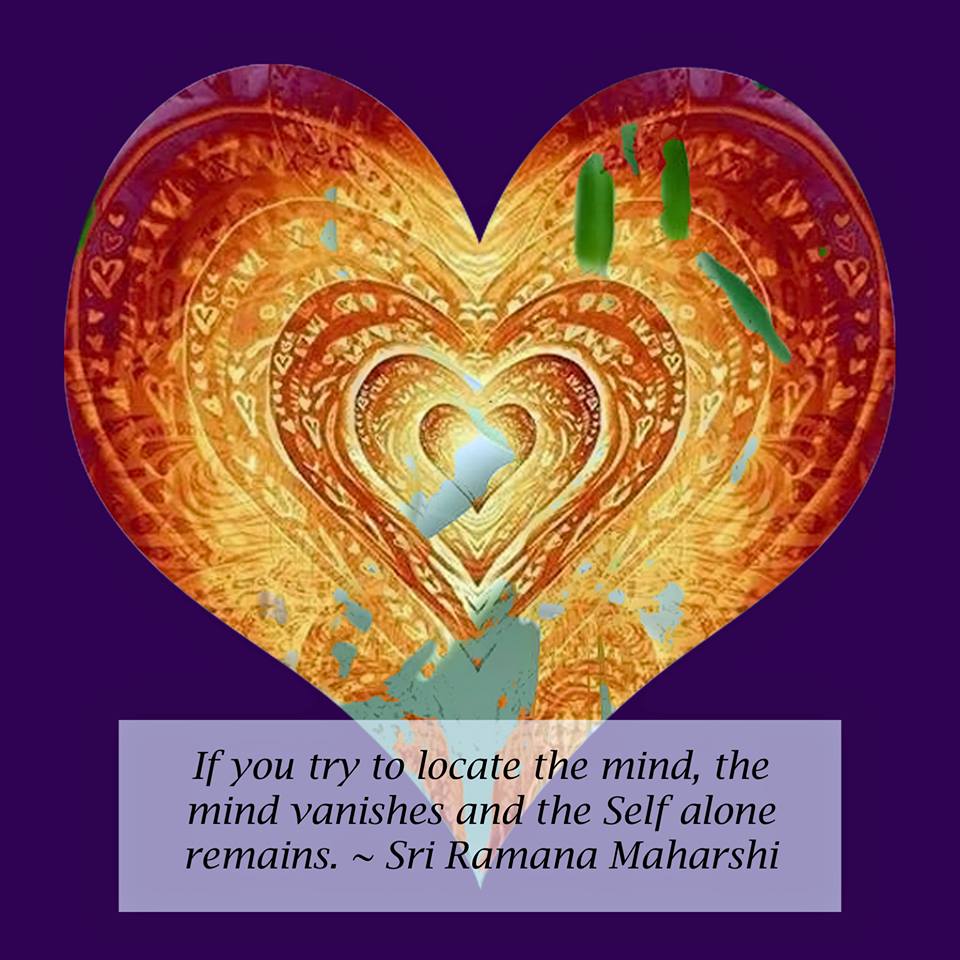
Image originally posted on the Ramana Maharshi FB Page by Cathy Ginter
Dear Friends,
When consciousness focuses its attention on a perceived or imagined object (such as an energy center, point of light, sound, music, mantra, etc.), that is known as concentration and can lead to deeper meditation and samadhi or trance states.
Truly all such techniques, although useful, are inherently and fundamentally flawed in seeing our own nature.
Such methods presuppose that there is something to concentrate or meditate on outside of consciousness. But how could that be?
All point of concentration, all techniques and methods of meditation only exist in consciousness. A person who understands this deeply loses interest in methods of meditation. The consciousness of a Self-Realized sage has settled into its own nature. It is in perpetual communion with itself. Always new and alive and pure being whose very nature is meditation does not concentrate or meditate.
On What Shall I Meditate? And How!
Namaste
For one in whom the complete and radical understanding of the nature of being and Heart has emerged, there is no particular place or time to practice yoga, concentration, meditation, samadhi, etc. The fullness of understanding itself is its own transformation.
Here and now, we are free. This moment itself is the freedom. You, yourself are this very moment.
https://luthar.com/you-yourself-are-this-moment-by-dr-harsh-k-luthar

 Luthar.com
You must be logged in to post a comment.