Harsha's avatar

Moksha in Hinduism: By Dr. Shyam Subramanian

A seeker asks: In Hinduism, there is a belief in reincarnation. The idea of reincarnation is that when the body dies, I will be born again. However, we are taught to pursue Moksha (salvation) which puts an end to the cycle of birth and death. As a Hindu, why should I pursue Moksha? Is that not a permanent death forever? At least with reincarnation, I have a chance to be reborn. Perhaps I will get to meet old girl friends in my next birth and go to Las Vegas and Bombay again. But if I get Moksha, according to Hindu teachings, I will never be reborn. That is scary, is it not? Why should I then seek Moksha as stated in our scriptures? How does this idea of Moksha as salvation or liberation make any sense?

Editor’s note: Moksha in Hinduism is not viewed as permanent death but an awakening into eternal life. Moksha is essentially the recognition that one’s very nature is that of freedom and wholeness. The questioner’s presumption that his next life would be according to present desires or expectations (going to Las Vegas or Bombay with his old girlfriends) is not consistent with the doctrine of Karma. According to the doctrine of karma, the next birth is determined by a combination of actions taken in previous lives and the present life. The merits and demerits generated thus will determine future experiences of pleasures and pains. Therefore, there is no guarantee that the expectations to be with specific individuals and repeat pleasurable experiences would come to fruition in the next life. Although the seeker premises the question on a faulty understanding of the ancient teachings on karma and reincarnation, Dr. Subramanian clarifies logically the nature of Moksha and why it is considered the most worthy goal in Hinduism.

shyam

As a way of introduction, Dr. Shyam Subramanian is a professor of medicine and also well trained in the classical traditions of Vedanta. Shyam-Ji’s knowledge of Sanskrit and understanding of subtle truths of the Upanishads makes him a brilliant exponent of various Eastern philosophies and religions from a Vedantic perspective. His writing is clear and easy to follow and very helpful for the novice and the advanced students of Hindu philosophy. If any errors have crept in Shyam-Ji’s presentation due to my minor editing, these will be corrected as soon as pointed out.

Continue reading

Harsha's avatar

Meditation, Self-Inquiry, and Self-Realization: By Dr. Harsh K. Luthar

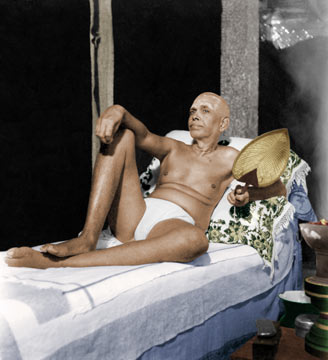
Bhagavan Ramana Reclining

Bhagavan Ramana Reclining

The distinction between Meditation and Self-Inquiry is subtle. However, in one way, understanding this difference is central to grasping the full import of teachings of the Sage of Arunachala, Sri Ramana Maharshi.

Sri Ramana used to say that meditations, affirmations, and other similar techniques presuppose the retention of the mind. To practice a mantra, visualization, pranayama, etc., requires the use and activity of the mind as an independent agent separate from the higher power. One of Sri Ramana’s favorite analogy was that asking the mind to subdue itself is like asking a thief to go ahead and capture itself. The mind will make a game of it, pretend to control itself, but will remain engaged in playing hide and seek.

Certain meditation practices no doubt have a calming and a relaxing effect. However, Sri Ramana states that in all such approaches, the mind remains dormant only temporarily. It rushes forth after sleep or meditation in its individual form when the proper stimulation presents itself. With all practices conducted with the mind, that have an object as their focus (mantra, breath, image, etc.), the seed of duality is already built in.

Someone once asked Sri Ramana whether Self-Inquiry that he advocated was also not a mental activity. If so, it must be presumed as having the same difficulty and limitation as other meditative techniques.

Sri Ramana acknowledged that Self-Inquiry also made use of the mind in initial stages. However, he held that in asking oneself the question “Who am I?” in a serious, alert, and an intense way, the mind was being concentrated and driven inwards towards its Source. This Source is not a form or a sound but the very origin from which the mind arises.

Therefore, in Self-Inquiry, the full power of attention is brought to bear upon this question, “Who am I”? This question does not have an intellectual answer. Asking it is meant for becoming aware of consciousness as existence that permeates us as our root identity. It is this feeling and sense that everyone has of themselves as “I Am”. From childhood to old age, we are aware of this sense of existence without having to give it a name.

This subtle awareness has no form. It is this self-awareness, independent of thoughts, that one has to abide in and follow to the Source. If grace allows for that, the Supreme Heart that the ancients called Sat-Chit-Ananda, reveals It Self. It is really a Self-Revelation. The Heart is recognized as one’s own identity independent of thoughts, personality, mind, etc.

Sri Ramana maintained that although Self-Inquiry required initial use of the mind, after a certain point a spontaneous power took over. The response to serious Self-Inquiry comes from within. Sri Ramana referred to this Source within as the Heart. Self-Inquiry stirred the inner power of the Heart which then became like a magnet pulling the mind within so that Self-Recognition and Self-Realization of Supreme Bliss as our nature could take place.

Namaste

Harsha's avatar

Icon Painting As A Spiritual Path: By Gabriele Ebert

Gabriele Ebert is a well known German librarian, scholar, and a painter. For information on her books and German translations, please go to the bottom of the article. Gabriele is a long term member of HarshaSatsangh and has been active in Sri Ramana groups for many years. She has served as an inspiration and a role model for all of us with her dedication to the interfaith approach to spirituality. Because Gabriele’s native tongue is German, I did some minor editing on this article and accept responsibility for any mistakes which may have occurred because of that. Fortunately, in this medium, mistakes can easily be corrected once we become aware of them. Enjoy the article. The Icons are stunning and beautiful! Thank you Gabriele for your generous sharing.

The Personal Story

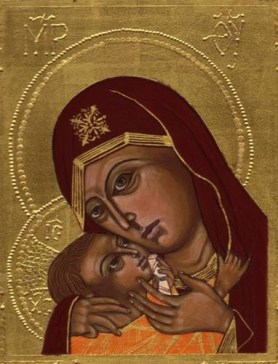
Eleousa (Mother of Mercy)

It was 16 years ago that I discovered icon painting as a spiritual path. This door opened when at one Christmas eve my mother presented me with an icon of the Theothokos (Mother of God). Looking at it I was sure that I would start to paint as well. I felt drawn to painting and through it discovered a creative spiritual path.

Over the years I found different teachers for learning the technique – and later the Jesus prayer (see below).

Icons are enjoyed by many. Most of all it is wonderful if an icon can find its home in a meditation-room or prayer-edge, where it is dedicated to its original meaning.

This icon of St. John of the Cross has found its home in the prayer room of the Carmelite Monastery in Dolgellau, Wales.

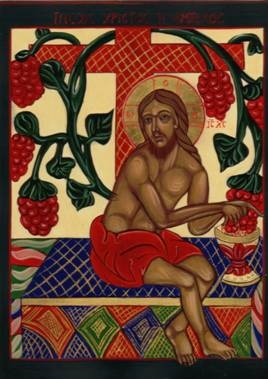
Christ the Vine” is in the meditation-room the Christian Zen-center in Eintürnen, Germany.

Icons – What Are They?

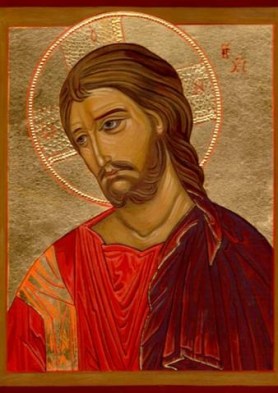
“Sad Christ”

The home of the icons is the Christian Orthodox Church. The earliest icons were painted in the 6th century in Byzantium. From there they later came to Russia and to all other Orthodox countries. Most of the earliest icons have been lost. The oldest collection of icons is found at St. Catherine’s Monastery on Sinai.

Icons play an important role in the liturgical service, and also in the public life and of course for the individual. An icon is a steady companion from the cradle to the grave.

The icons are not individual paintings but rather in the individual. These painting come through the individual by spiritual grace and in a sense the painter does not count. So icons are normally not signed to claim ownership. Outwardly, icons follow fixed patterns and change of the pattern is only possible in a rather limited way as they are real “copies” of the one reality, which represents itself in various pictures and stories.

Icons are of great help for concentration, for prayer, for awareness of the ever-presence of Christ or Mary or the Saints. They are called “Gates to Heaven” or “Windows to Eternity”. If you look at an icon in candle-light, the gold and painting shines in an unearthly magic. The faces are serene, the gestures and colors are full of meaning. The more one dives into this world, the more one becomes drawn into it and the mind becomes silent.

The Path of the Painter

“To paint and to pray are the same thing” (Balthus)

Jesus with animals

I have always felt that this kind of painting is by special grace and has something in it which can’t be compared with other types of paintings. This kind of painting is devotion and prayer – prayer with the brush, so to say. So this “doing” needs not only much outer care, but also inner care. One should not do it with a distracted or unclean mind. According to tradition it is good to have a prayer before starting. The inner attitude should be giving up the sense of doership – which reminds one of Sri Ramana’s instruction as well. It can also be seen as an exercise for just being an instrument of God, which should become a reality in all our actions.

The Jesus-prayer (also known as the Prayer of the Heart) is a short prayer, which should be continuously repeated. The words are: “Jesus Christ, Son of God, have mercy on me!”

Like the icons, it comes from the Orthodox church. The prayer also can be shortened to just the call: “Jesus Christ!” or whatever one prefers. One repeats it as often as one can. In some way it can be compared with nama-japa. It helps to silence the mind and lead it to one thought. With practice it starts to become automatic (self-doing) and sinks into the heart. Yet at each stage it always stays as a prayer in you. The Philokalia – a collection of texts on the Jesus-prayer – can be a wonderful companion on this path. It is recommended in “The Way of a Pilgrim”, which most know who practice the Prayer of the Heart.

It is not so long ago that I discovered – or better re-discovered – the Jesus-prayer when reading this book (“The Way of a Pilgrim”). I felt immediately that this is a wonderful complement to the icon-painting as well. From the tradition of the icon-painters I have found out that my main-model, the famous Russian icon painter Andrej Rubljow must have practiced it. I am sure that his icons reflect it and speak through it.

Icons Interfaith

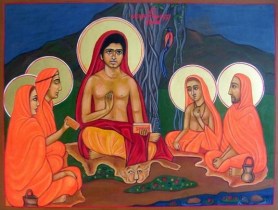
“Dakshinamurti-Ramana” – an icon dedicated to Sri Ramana Maharshi

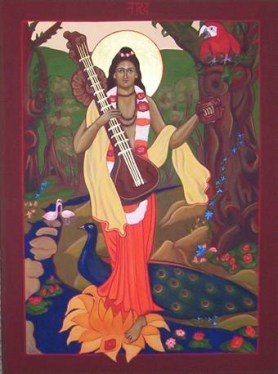
Icon of Narada

Mostly I am painting icons in the Christian tradition. Yet it happened that this Ramana-icon was painted and also some icons of Narada (the bhakti-musician). When being in Tiruvannamalai in 2003 and seeing the paintings in one of the shines of the Arunachaleswara-temple I was reminded of the icon-painting. Also there seems to be a connection to the Buddhist paintings as well. I am sure that the same thing has found its expressions in many religions.

If you would like to see more and get information about the technical side of this kind of painting you can visit:

http://icons.interfaith.googlepages.com/

Gabriele

***********

Gabriele Ebert lives in Germany and works as a librarian.

Recent Books by Gabriele Ebert are:

Ramana Maharshi: Sein Leben, Stuttgart, 2003

Sadhu Arunachala: Erinnerungen eines Sadhus, Berlin, 2004 (German transl.)

Both books are available at amazon.de and can be ordered from each German book-shop.

Harsha's avatar

The Story of JaDa-Bharata By Professor V. Krishnamurthy

Professor V. Krishnamurthy is well known to the Advaitin Hindu community and deeply revered as both a practitioner and a scholar of the Upanishads, Bhagavad Gita, Shrimad Bhagavatam, and other ancient scriptures and texts. He has touched our lives through his healing words, wisdom, and authenticity.

Before his retirement, Professor Krishnamurthy was a professor of mathematics with a distinguished record of service and leadership in the academe. Along with that, he also demonstrated brilliant scholarship of Hinduism. His insight into the ancient texts should come as no surprise. He was trained from childhood by his father Sri R.Viswanatha Sastrigal who was a living example of the ideal Hindu way of life.

A more comprehensive description of Professor Krishnamurthy’s contributions to his profession of mathematics and to Hinduism can be found at the end of the article.

The Story of JaDa-Bharata the Jivan-mukta

By Professor. V. Krishnamurthy

The JaDa-bharata story in Shrimad Bhagavatam is the story of a superlative Brahma-jnAni. There are very few Brahma-jnAnis known to us either through the Puranas or through history. The example of Ramana Maharishi, of the 20th century, known to us in modern times, cannot be missed.

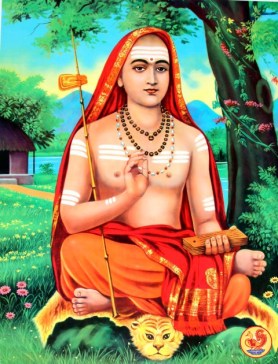
Going back in history, there is Sadashiva Brahmendra (of whom there is very little recorded history), Adi Shankara himself (of whom we know fairly well through his works), and Shuka Brahmam (whose Bhagavatam is very revealing).

The story of JaDa-Bharata is, however, unique among all of them. Lord Krishna describes a Brahma jnAni once each in the 2nd, 12th and 14th chapters of his Gita and also off and on in the fifth chapter.

The Lineage of Bharata

The history of Priyavrata, the first son of Manu Svayambhuva, occurs in the fifth skanda of Shrimad Bhagavatam. Priyavrata’s son was Agnidhra and his son was Nabhi. Nabhi was a great and devout ruler and to him was born another avatar of Mahavishnu, by name Rishabha.

Rishabha, also called Rishabhadeva, had one hundred sons of whom the eldest was Bharata whose story is the content of this article. Incidentally it is this Bharata after whom the country (India) was called BhArata-varsha; before that it was called aja-nAbha varsha.

King Rishaba Retires

King Rishabha on retirement from the duties of the state called his sons before him and gave them all a long sermon on the need to lead a spiritual life. This sermon constitutes the first 27 shlokas of the fifth chapter of the fifth skanda. It is sometimes called Rishabha-Gita. For a sample we take the first shloka here.

“This body is not meant to be used for sensuous enjoyments as done by lowly animals. There are two doors out of this life. One is the door for moksha and the other is the door for the darkness of hell”. (V – 5 – 2 –first half). “The door to moksha is by service to great people.”

Here the words used are *yoshhitAM sangi-sangaM*. To go upward on the spiritual path one needs a direct contact with great people. But to cause a slide downward even a secondary contact with the vile ones will do. The lesson is that one should select one’s friends very carefully.

“By the union of man and woman attachment arises to home, family, sons, wealth and property. Those who want to reach God must see to it that they should advise their children as a father, train their people as a boss or a leader, and teach their disciples as a Guru. A father who does not do so is not a father; a king who does not do so is not a king; a guru who does not do so is not a guru”.

After elaborating such teaching in very forceful words King Rishabhadeva relinquished his kingdom, left his palace and roamed about as one intoxicated with God and the godly, completely nude, with disheveled hair and uncouth appearance. Actually he moved about as if he were senseless, blind, dumb and deaf, a ghost or a drunkard; even though others spoke to him he did not speak, because he was observing total silence:

*jaDAndha-mUka-badhira-pishAchonmAdakavat avadhUta-veshaH abhibhAshhyamANo’pi janAnAM gRRihIta-mauna-vrataH tUshhNIM babhUva* (V – 5 – 29).

This avatara of the Lord is to teach us worldly minded people to change our ways and reach Moksha.

*ayam avatAro rajas-opapluta-kaivalyopa-sikshhaNArthaH*

[Note to Scholars: Incidentally the author Shuka adopts a prose style of narration for most of this fifth skanda. In the other skandas it was all verse; probably he wanted to stick to the way the narration was given by Maitreya to Vidhura in the earlier portions. But now in the fifth skanda he is himself telling the story and this time it is about two great Brahma-jnAnis – Rishabha and Bharata – and as a Brahma-jnAni himself Shuka probably did not want to be bound by meter, prosody etc. which usually are obligatory restrictions in the verse form of narration.]

Bharata As King

Bharata accepted his responsibility as the next king after his father Rishba renounced the world.

Bharata ruled the country for a long time in the most notable manner, without ever swerving from the dharmic path, the path of the holy ones. As a noble king of India, he set a wonderful example for his subjects. Not surprisingly, his people were also following dharma in a remarkable manner.

The yajnas and pUjAs that he performed incessantly purified his mind to such an extent that the Lord was residing in Bharata’s heart almost visibly. Eventually Bharata wished to spend all his time in meditation and solitude. Like his great father Rishaba before him, Bharata ultimately decided to take Sannyasa and retired from the world.

Bharata Leaves the Kingdom

After making his family and subjects aware of his decision, Bharata distributed his kingdom to his sons and and went over to distant pulahAshrama for a period of penance and whole-time spiritual pursuit.

Entirely devoid of any mundane desires or attachments, he was worshipping the Lord with all the flowers, leaves and fruits that he could get in the forest there. His bhakti towards the Lord increased day by day and he was living all the time in a state of total bliss in the company of the Lord in his heart.

The constant contemplation of the lotus feet of the Lord generated a superlative joy of devotional experience. In that joy he forgot himself as well as the very worship he was doing. He just lost himself in divine contemplation in a kind of spiritual trance.

Forming of a New Attachment

One day, after his daily routine bath, Bharata was sitting on the bank of the river for four and a half hours doing the japa of AUM. A solitary doe approached the river for drinking water. Suddenly there was a terrifying roar of a lion. By nature the doe trembled with fear on hearing the roar; frightened and shaken by that roar, the doe jumped across the river. In that frightful jump she gave birth to a young one which fell into the river. The mother doe, due to shock, process of delivery, and the act of springing, fell dead on the other side of the river.

Bharata saw all this and was overpowered with compassion at the poor little deer that had now lost its mother and was about to be itself lost in the current of the river. Instinctively he caught hold of the little one, brought it to his own ashram and started taking care of it. From that day onwards he started feeding it, searched for the proper grass for its food, protected it from wild animals and was doing everything for its care, nourishment and growth.

Gradually Bharata’s time was more and more occupied with caring and tending to the needs of the infant deer. The time that he usually allotted for his spiritual disciplines got reduced steadily to almost nothing.

Compassion and affection are not wrong; in fact they are very noble qualities. But when they become an attachment, the spiritual fall is imminent. Affection ennobles, but attachment enslaves. Love elevates, but desire entraps. This is what happened in the case of this great King Bharata.

Infatuation Clouds Bharata’s Mind

With the attachment to the deer growing in intensity day by day, Bharata started thinking all the time of this deer that was now dearest to him. *Asana-shayana-aTana-sthAna-ashanAdishhu* — whether he was sitting or sleeping, walking or standing, or was eating, he was not wanting to be separated from the young deer. If the deer even for a little time was away from him he worried about its safety and began to wail over the matter. Even when he was trying to do his daily japa the deer would come near him and cuddle around him and he would take pity on it and put it on his lap and appreciate how this pet of his behaves like an own son!

Let us recall that this great king Bharata had renounced his vast kingdom and all the riches which he acquired as well as his family and people, for the sake of pursuing a life of total renunciation and tapas.

How could such a renouncer fall into the trap of worldly affection for a deer-cub and forget even his daily spiritual routine like this? What else could it be but his prArabdha (fate) in the form of this deer? Time passed like this and all his Atma-vichAra had come to a dead stop.

Death Of Bharata

Death comes to everyone and Bharata was no exception. The hour of Death does not wait.

Bharata knew the end was coming. He worried about what would happen to this poor deer-cub when he was gone! He was thinking about it, when he breathed his last. According to Hindu scriptures, a person’s last thoughts and state of mind determine the next birth.

Rebirth of Bharata

Subsequently, in his next life, Bharata was born as a deer!

(Recall Gita: *yaM yaM vApi smaran bhAvam *.. . (VIII – 6).

But because of the intense pUjA and tapas Bharata had been doing in all his previous life, even in the body of the deer, his mind, by the Grace of God, remembered his life as King Bharata and the calamity that had befallen him at the end of that life.

A Meditative Deer

So now Bharata, even as a deer, decided that he would not develop any more attachment or VAsanA. The deer Bharata deserted his surrounding deer-family and somehow went over to the same Pulahashrama where he was doing his tapas in the previous life.

The deer Bharata did not eat tasty green grass or any of the other things that deer are fond of, lest any attachment to food may develop. He only subsisted on a minimum dried grass and lived aloof from any of his own species. He lived in the company of Sadhus who were doing tapas in the Ashrama and was waiting for this life to pass and his prArabdha (destiny) to spend itself. He had decided not to acquire any more vAsanA even if he got a human life.

The end came. When it came, the deer Bharata went to the river and stood up in neck-deep water and for the first time as a deer, raised his voice and ‘spoke’ God’s name, dipped in the water and died!

The Last Birth of Bharata

Bharata’s next birth was in a noble Brahmin family. This was his last birth. His father was a great, scholarly Brahmin with purest intentions who led a religious life, with his nine sons from his first wife and a twin-child from his second wife. Of the twins one was male and the other was female.

The male of the twin was JaDa-bharata, our hero. The name that applied to him in this birth is not mentioned by Shuka. So, to continue our story we shall still call him Bharata. But expositors refer to him as JaDa-bharata. ‘JaDa’ means inert; from his very birth Bharata remained totally silent and was behaving like an idiot, not responding to any provocation. By the Grace of God he had all the memory of his two previous lives, one as King Bharata and the next as the lone deer of Pulahashrama; naturally, he was scared of accumulation of any more vAsanA. So he showed himself as mad, inert, blind, deaf and dumb.

The father, wanting to discharge his responsibilities, and hoping that this jaDa nature of the boy might be cured by a proper samskAra, performed the Upanayanam (thread ceremony) for the boy and prodded him on to do the daily Sandhya worship. But the boy would do no such thing! He was already a Brahma-jnAni and was in that state all the time, though the outside world, including his own family, could not recognize him as such. All their teaching of the Vedas or the Gayatri was a failure as far as they were concerned! The father died in due time and the second wife, the mother of JaDabharata also followed him immediately.

JaDa-Bharata’s Indifference

The nine brothers of JaDa-bharata who were knowledgeable only about the karma-kANDa of the Vedas and had no idea of the Brahmavit among them treated him as a good-for-nothing fool. Consequently they simply extracted work from him and fed him only some rotten food, that deserved to be thrown in the garbage.

JaDa-Bharata came to be known in the entire neighborhood as a robust young man but a confirmed idiot. Whatever menial work anybody gave him he did it, but not intelligently. They put him as a sentry in the fields to ward off birds and he sat there unendingly. Some one gives him instructions to dig and he digs ; someone else comes along and asks him to stop and he stops. Some one gives him a beating for not doing his work properly and he receives it without murmur or protest. Whatever he gets he accepted it, without ever caring whether it is more or less, good or bad. Whatever they gave him, be it rice flour, oil-cake, chaff, spoilt pulses, or charred food – he ate up everything as if it were nectar.

*YadA tu parata AhAraM karma-vetana IhamAnaH sva-bhrAtRRibhirapi kedAra-karmaNi nirUpitaH tadapi karoti kintu na samaM vishhamaM nyUnaM adhikaM iti veda kaNa-piNyAka-palI-karaNa-kulmAsha-sthAlIpurIshhAdIny-api amRRitavad-abhyavaharati //* V- 9 – 11.

It went on like this day by day, year by year. He had decided not to care for this body and so his body was usually filthy, his dhoti dirty, and his face, with a long beard, looked like that of a caveman. He was living as a Brahmavit totally aloof from his body.

The Goddess Saves JaDa-Bharata

It turned out that some rich man wanted to give a nara-bali (sacrifice of a human) to Goddess Kali and had arranged for a captive intended for the nara-bali. But just on the previous night the captive escaped and they needed immediately a substitute for the next morning’s ritual. The rich man sent his assistants to look for a substitute.

They roamed about and found our JaDa-bharata sitting alone in the fields. His robust appearance and youth tempted them to choose him as their victim for the nara-bali and they simply led him on to their boss.

Never had a victim for nara-bali come along with them for his own human sacrifice, as this man did, without the least protest! It appeared to them he was almost willing to die for them.

The next day the ritual started in the presence of the Kali deity. JaDa-bharata was bathed in oil, washed clean, dressed gorgeously, decorated with sandal paste and other cosmetics. Finally the leader of the group got ready to cut off JaDa-Bharata’s head as a sacrifice.

At that time Mother Goddess Kali Herself appeared from the deity and chopped off the heads of the entire gang and saved JaDa-Bharata. We don’t know where JaDa-Bharata went from there.

Upholding Ahimsa (Non-violence) and Jolting the King

The story is picked up by Shuka in another scene. There was one King of Sauvira country, by name Rahugana. He had great intentions to have spirituality lessons from Kapila Muni and so he traveled, carried in a palanquin, to the northwest corner of this country in the hope of meeting Kapila. On the way, one of his eight palanquin-bearers became unable to do his duty and so they needed a substitute. They looked for one and they found our JaDa-Bharata roaming about as if for no purpose. Again his robustness and youth attracted them and he was used as the substitute palanquin bearer.

The strength of the vAsanAs that one inherits from the actions of the past is very great. Noble Sadhus, particularly in the Sannyasa-Ashrama, are so careful even while they walk to see they don’t trample on a living creature. It is an extreme discipline of this kind which is one of the reasons they have cAturmasya-vrata (the vrata during the rainy season of four months), the observance of which requires them, among other things, to stay in the same place and carry on their daily worship or meditation routine.

Our JaDabharata must have gone through such disciplines in his previous lives. That VasanA of ahimsA (non-violence) was so strong in him that as he was walking along carrying the palanquin of King Rahugana in the woods, now and then he jumped forward, still carrying the portion of the palanquin resting on his right shoulder. The jumping was to avoid trampling on some small crawling creature on the ground below. But this jumping of one of the bearers, without the concordant activity or consent of the other bearers, naturally created a sudden jolt and jerk to the occupant of the palanquin. The King opened his window, looked out, and faulted the bearers for jolting him like that. All seven of them said it was not their fault; it was the newcomer who joined them just a little while earlier who was jumping out of step unnecessarily!

JaDa-Bharata Speaks

And that was the starting point of a remarkable dialogue between the King Rahuguna and our hero JaDa-Bharata. The King chastises him in a satirical way, referring to his robust health, fat body and youth. When a second time this chastisement happens, JaDabharata, for the first time in his life, opens his mouth. This portion in the Bhagavatam, going through four chapters, is one of the most treasured pieces in the whole work.

My dear King, says JaDa-bharata, whatever you have spoken sarcastically is certainly true. Actually these are not simply words of chastisement, for the body is the carrier. The load carried by the body does not belong to me. There is no contradiction in your statements because I am different from the body. I am not the carrier of the palanquin; the body is the carrier. Certainly, as you have hinted, I have not labored carrying the palanquin, for I am detached from the body. Your words about my stoutness or otherwise are befitting a person who does not know the distinction between the body and the soul. The body may be fat or thin, but no learned man would say such things of the Atman. As far as the Atman is concerned, I am neither fat nor skinny; therefore you are correct when you say that I am not very stout. Also, if the object of this journey and the path leading there were mine, there would be many troubles for me, but because they relate not to me but to my body, there is no trouble at all.

Fatness, thinness, bodily and mental distress, thirst, hunger, fear, disagreement, desires for material happiness, old age, sleep, attachment for material possessions, anger, lamentation, illusion and identification of the body with the self are all transformations of the material covering of the Atman. Only a person who has identified himself with his body is affected by these things. Consequently I am neither fat nor skinny nor anything else you have mentioned.

My dear King, you have unnecessarily accused me of being dead though alive. In this regard, I can only say that this is the case everywhere because everything material has its beginning and end. As far as your thinking that you are the king and master and are thus trying to order me, this is also incorrect because these positions are temporary. Today you are a king and I am your servant, but tomorrow the position may be changed, and you may be my servant and I your master. These are temporary circumstances. The differentiation is temporary, and it expands only from usage or convention. I do not see any other cause. In that case, who is the master, and who is the servant? Nonetheless, if you think that you are the master and that I am the servant, I shall accept this. Please order me. What can I do for you? You said you are going to punish me severely. What will you gain by punishing me? You will be only punishing my body; but I have actually punished this body by never tending to it. You are only powdering the already powdered chaff. There will be no effect.

King Recognizes JaDa-Bharata As A Self-Realized Soul

The King was stunned and amazed when he heard this. He jumped from the palanquin, fell at the feet of JaDabharata and asked for being taught spiritual wisdom. There ensues then a three-chapter dialogue between the King and JaDabharata containing the essence of advaita. The King asks questions and the Brahma-jnAni JaDabharata answers them meticulously.

Material pains and pleasures are only external. People interested in them are far from spiritual advancement. It is the mind, contaminated by the three modes of Nature, that makes the living entity wander through different species of life. If the mind can become unattached to material enjoyment, it becomes the cause of liberation.

All things on earth, moving or unmoving are nothing but different combinations of substances coming from the earth. We are all but dust and dust shall we end in. This universe itself has no ultimate existence.

Non-duality is the ultimate truth. This material existence is a forest. The Jiva through various births wanders through this forest and suffers untold miseries but does not know how to get out of this. The only way to get out of this is through satsangh. And the Brahma-jnAni concludes his teaching with the following emphasis:

*rahUgaNa-etat tapasA na yAti na cejyayA nirvapaNAd-gRhAd-vA /

nac-chandasA naiva jalAgni-sUryaIH vinA mahat-pAda-rajobhishhekaM *// Bh. V – 12 – 12

Rahugana, Unless one bathes in the dust from the feet of the devotees, this Absolute Truth cannot be learnt. Not by penance, nor by yajna, nor by renouncing the household, nor by Vedas, nor by torturing oneself in water, fire or the Sun (can it be learnt).

Summary

To sum up we shall only recall the following four shlokas from the Gita which describe a Brahma-jnAni. There is perhaps nothing more telling than the story of JaDa-Bharata to illustrate these profound declarations of the Lord Himself:

V-17: Their intellect absorbed in That, their self being That, established in That, with That for their supreme goal, they go whence there is no return, their sins dispelled by knowledge.

V -18: The wise men look, by nature, equally upon a Brahmana, rich in learning and humility, on a cow, on an elephant, and on a mere dog and on a dog-cooker (an out-caste).

V -19: Here [i.e. even while living in the body.] itself is rebirth conquered by them whose minds are established on sameness. Since Brahman is the same (in all) and free from defects, therefore they are established in Brahman.

V- 20: Resting in Brahman, with steady intellect and unclouded, the knower of Brahman neither rejoices on obtaining what is pleasant nor grieves on obtaining what is unpleasant.

Om ShAntiH ShAntiH ShAntiH.

Prof. V. Krishnamurthy
profvk@yahoo.com

Also see, http://www.harshasatsangh.com/ProfVK/Raasa/LeelA.htm

Prof. V. Krishnamurthy M.A. of Madras University and Ph.D, of Annamalai University, is an ex-Director of K.K. Birla Academy, New Delhi. Formerly he was Dy. Director and Prof. of Mathematics at Birla Institute of Technology and Science, Pilani for two decades. While at Pilani he was one of the top-ranking academic administrators who were responsible for the multifarious academic reforms for which BITS is now well known. His wide and varied interests in teaching and research include assignments at the University of Illinois, Urbana, Ill., U.S.A. and University of Delaware, Newark, DE., U.S.A. His mathematical research contributions are in the areas of Functional Analysis, Topology, Combinatorics and Mathematics Education.

Professor Krishnamurthy has been the President of the Indian Mathematical Society, President of the Mathematics Section of the Indian Science Congress Association, Executive Chairman of Association of Mathematics Teachers of India, and National Lecturer and National Fellow of the University Grants Commission. He has been Leader of the Indian team for the International Mathematical Olympiad, held at Bombay in 1996. His books in Mathematics include: Combinatorics: Theory and Applications; Introduction to Linear Algebra (jointly with two others); The Culture, Excitement and Relevance of Mathematics; Challenge & Thrill of Pre-College Mathematics (jointly with three others)and, The Clock of the Night Sky. and What is Mathematics? – An explanation through two Puzzles (In Tamil).
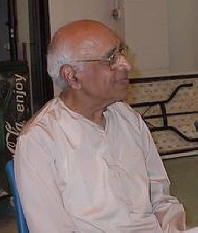

Professor Krishnamurthy was also trained systematically in the traditional Hindu scriptures by his father Sri R.Viswanatha Sastrigal, a scholarly exponent who was himself a living example of the ideal Hindu way of life. Prof. Krishnamurthy has given several successful lectures on Hinduism, the Ramayana, the Gita, the Upanishads, and Srimad Bhagavatam to Indian and American audiences. His expositions are known for their precision, clarity and an irresistible appeal to the modern mind. His books on religion include: Essentials of Hinduism; Hinduism for the next Generation; and, The Ten Commandments of Hinduism. He has also authored a series of 18 poster-size charts on Hinduism, entitled SADHARMA (= Sanatana Dharma Ratna Mala). These are unusual expositions with visual support, on the concepts ideals and traditions of the Hindu way of life, presented by an incisive scientific mind in a totally novel manner never before tried by any exponent of religion formally or informally.

A number of writings of his on Religion and Philosophy are on the web at http://www.geocities.com/profvk/ entitled: Science and Spirituality and Gems from the Ocean of Hindu Thought, Vision and Practice.

His recent books on religion are Kannan sorpadi vaazhvdeppadi (in Tamil) with an appendix on Dhruva-Stuti – An Upanishad Capsule (Published by Alliance Co., Mylapore, Chennai) and Science and Spirituality – A Vedanta Perception (Published by Bharatiya Vidya Bhavan).

Live Happily the Gita Way – An Advaitic approach” is under publication. He was given the Distinguished Service Award by the Mathematics Association of India in 1995, the Seva Ratna award by the Centenarian Trust, Chennai, in 1996, and the Vocational Service Award for Exemplary Contributions Education by the Rotary Clubs of Guindy and Chennai Samudra in September 2001.
Harsha's avatar

Self, Shakti, Heart, and Enlightenment in Advaita: By Dr. Harsh K. Luthar

Often on the spiritual path, the topics of best postures, best techniques of meditation, best behaviors conducive to spiritual growth, best gurus, etc., come up. All of these questions are appropriate to their time and circumstances.  Such questions were frequently put to Bhagavan Ramana.

Underlying all such questions is the fundamental theme or inquiry as to what constitutes superior spiritual practice that will lead to improvement in one’s mental and physical conditions and finally to Self-Realization or Enlightenment. From this perspective, Self-Realization is viewed as an attainment. It is something that is achieved by an individual by making the right effort. This approach in its methodology is not too different than that of a talented world class athlete, who after having trained rigorously, wins a gold medal at the Olympics.

This point of view emphasizes the need to focus the mind in order for it to expand and evolve to higher levels. Spiritual practices based on this foundation, involve meditating in a particular posture, concentrating on chakras, raising the kundalini shakti, practicing mantras, deep breathing, and doing pranayama exercises.

The Yoga paths explicitly incorporate the idea of controlling and developing the mind to gain entry into Samadhi and Super-conscious states. Most religions have this philosophy at their core; that without hard work one does not succeed either in life or in knowing God.

The General Spiritual Path Model

Buddha is supposed to have said to his disciples as he was dying, “Work out your salvation with diligence.” He meant that you have to personally work it out and attain Nirvana by right conduct, right practice, right meditation, etc.

The same principle is present in Jainism and most of the schools of thought in Hinduism. In Jainism, one attains to Moksha through one’s own individual efforts. In Hinduism, one achieves Moksha by God’s Grace. However, in most schools of Hinduism, one only benefits fully from God’s Grace, when one has made the right effort on the spiritual path by following one’s Dharma and by meditating on the nature of the Self.

Although it is a complex topic, the general spiritual model that we have before us is this: There is a spiritual path, there is the goal of Enlightenment or Self-Realization, and you have to expend much effort, and walk on the path for a long time in order to reach the destination. While you are walking, you may even have to go through the “dark night of the soul” a few times, because there are so many temptations along the way and things can sometimes appear hopeless and quite depressing.

So not only is there the possibility of tripping and falling due to worldly obstacles, but one also may give up on the whole idea of Liberation, Salvation, Enlightenment, Nirvana, Moksha, and/or getting to Heaven. Indeed many on the spiritual path do end up concluding that there is no meaning in life or the spiritual aspiration at all and kick themselves for missing out on the pleasures of their youth by having rejected the philosophy of “Eat, Drink, and be Merry” prematurely.

However, experienced sages know that what practices or behaviors will be helpful to the seeker on the spiritual path seems to depend on one’s conditioning, physiology, culture, background, etc. Although there is a general framework on how to pursue one’s aspiration for Enlightenment or Self-Realization, the truth is that one has to make the path as one walks on it because each individual is unique. Therefore, the view of “Eat, Drink, and be Merry”, within reason and in moderation, may be fully compatible with the spiritual life. It is the overall context that has to be understood.

The Self-Knowledge of a Sage

For the one abiding spontaneously and inherently in the Self-Truth of Reality, questions of methods, techniques, and practices, and the path become moot. When clarity of Self arises, any technique may be practiced and any path may be walked or one may give up all techniques and paths. For such a person, the Self-Attention itself absorbs attention regardless of where it is focused outwardly. The essential element in this understanding is the Recognition by Awareness of its Innate Wakefulness. Awareness is always self-aware by its very nature.

When awareness remains pure and spontaneously self-focused (perpetually in communion with itself), the subtle duality between awareness/attention (as Pure I AM) and its Source is seen to be illusory.

Then even the witness disappears, there being nothing to witness. The “I AM” disappears having nothing to point to. Spontaneously with the I AM Awareness/Shakti merging in its Source, the Self is Recognized. The Self Recognizes It Self by It Self and Through It Self as its own Source. It Sees and Recognizes that It has Always Been the Source. That It Is the Eternal Source, the causeless cause.

This is the Supreme Beauty of the Heart. It absorbs the Shakti, and along with it the Mind, thus swallowing time and space.

How can one speak of this Silence? The Silence that transcends all understanding and knowledge can only be indicated indirectly.

Great sages like Sri Ramana Maharshi never tire of pointing out that, —That Which is Real and Absolute Always Exists and is not absent even now—. How can Reality, whether one calls it God, Consciousness, Absolute, Nirvana, Moksha, Kingdom of Heaven, or by some other name be present at one time and absent at another? Perfection, by its nature, cannot be more perfect sometimes but not others. The approach and method of Advaita is based on this implicit axiom.

The Method of Advaita

The ever-present and eternal existence of our fundamental reality, whatever label we give it (Self-Nature, Buddha-Nature, Original Face, God, Goddess, God Consciousness, Pure Consciousness, Supreme Consciousness) must be here and now in this very moment. Otherwise, it is not Perfect!

This is the fundamental insight and conviction of the path of Advaita and the Advaitic sages. Therefore, we have to grasp the present by simply being present to it. This is the method of Advaita.

How is this done? In this way:

This present ordinary awareness, that you experience, you should notice it and then hold on to it. It is subtle and yet so ordinary. That is why we miss it. No matter how ordinary a baby looks to others, to the mother it is special. She adores her baby and to her it is the most lovely and wonderful child in the world. That is the attitude one must have towards one’s ordinary present awareness.

Like a mother holds on firmly to her child in all conditions, one should keep this ordinary self-awareness in the center of one’s consciousness knowing it to be special. The Supreme Reality It Self is hidden in it. It cannot be anywhere outside of it. If the Supreme Reality is somewhere outside of our ordinary consciousness, it is not perfect. Therefore, we can confidently look for perfection in our ordinariness, our ordinary consciousness.

Finding God in the Heart

There is a Christian saying that “Man is made in the image of God”. There is deep meaning in that. In the Bhagavad Gita, Sri Krishna says to Arjuna, “I am in the Heart of all.” We find such expressions in many of the religions of the world and in major works of different spiritual traditions.

On the path of Advaita, through our present ordinary awareness, we become, or more accurately, recognize our True and Ever-Present Image in the Heart. Advaita goes one step further and states that indeed the illusion of separation between the Individual soul and God lasts only as long as God is not recognized as the Center of our Being, sitting in the Heart as the Heart.

This is the Heart, that the ancients called Sat-Chit-Ananda. Existence, Consciousness, Bliss. The Supreme Self. It is beyond thoughts and concepts. Time and Space do not touch it.

As Sri Ramana has said, — that which is real is ever present—. We have to see what is present right now in this very moment. If we become quiet, we are able to feel our ordinary awareness, the sense of “I Am” as being present in this moment. That is the seed. If we water it and give it food, it grows and the Reality reveals it Self from within.

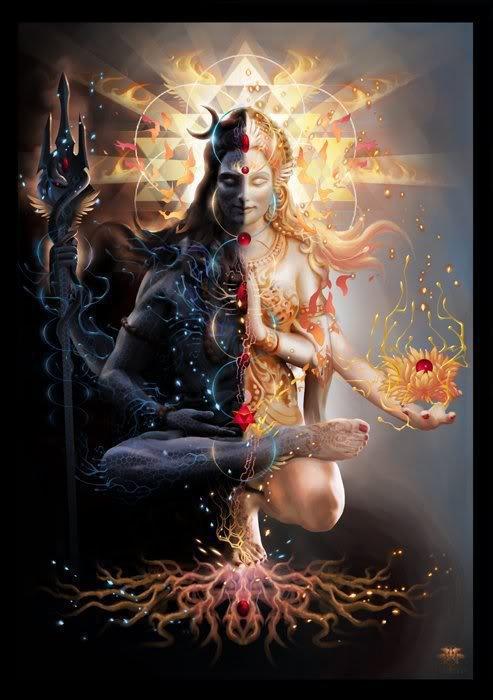
Editor’s Note:  The Feature Picture depicts photo art of brother Eden Kailash on his fb page.

Harsha's avatar

Kundalini Shakti in the West: By Dr. Harsh K. Luthar

The notion of Kundalini Shakti is at the heart of yoga and is embedded in virtually all Eastern traditions regardless of the name or label that is given. If we carefully examine any school of yoga, tantra, or various traditions (Shakti, Shaivite, Kashmiri Shaivism), there will usually be some descriptions of Hatha Yoga, Pranayama, Kriyas, Mudras, Mantras, and different types of meditations on the Chakras (energy centers).

In the Shakti traditions, detailed descriptions are given of the various aspects of the visions of the Goddess that arise in meditation. Even in the school of Advaita Vedanta, which does not depend on the practices associated with Shakti Yoga, we see that the great scholar/saint Adi Shankracharya has written hymns to the Goddess who represents Shakti, the divine power.

Continue reading

Harsha's avatar

Wisdom Eye: The True Guru: By Dr. Harsh K. Luthar

“Who is a master? He is the Self after all.” Ramana Maharshi

The company of peaceful Sages (Satsangha) and living in Ahimsa (harmlessness) is considered the primary influence that leads to Self-Realization. The forced attempts to discard various habits and conditioning and practicing different techniques to calm the mind have built in limitations. However, such methods can be pursued with benefit if one is already inclined towards these practices.

When strong inner motivation is present, one is automatically propelled towards Self-Awareness and Meditation. The fog of confusion then quickly evaporates and leads to Self-Seeing, Self-Being, Self-Realization, and Silence of the Heart.

Meditation and mind calming methods, can be effective at many different levels if practiced in the context of a clear understanding. Such practices, however, cannot by themselves end the fundamental agitation of the mind which continues at more and more subtle levels and causes suffering.

The nature of the mind is to hanker after that which is not real and is constantly subject to change. Not knowing who we are, where we come from, and where we are going, we still continue chasing after dreams built on the sand castles of desires.

If we become aware of this, we can see the primary nature of suffering, and direct our attention to the mystery of life and the nature of our perceptions.

In Indian spiritual traditions, a guru serves as a conduit to help us along the path. However, many things we hear about gurus these days are not appetizing. Still, if we realize the truth of the pure teachings, that the Supreme Reality is indeed our own Heart which guides us, then we can walk the path lightly without being misled.

The Self Always Reveals It Self from Within. Listen. Remain aware.

Be utterly indifferent to the clever words, miracles, and magical techniques that promise salvation. If you have the courage, open your wisdom eye and see clearly what attracts you to such things and people.

What is it that these gurus have to give you that you do not have? Question seriously and honestly and investigate the root of your hopes and fears.

There are many active marketers of “spiritual wisdom.” It has now become a public relations game with the many modern gurus as they compete in the free market of spirituality. Many spiritual teachers today attempt to distinguish themselves on the basis of their “enlightenment”, their spiritual experience, and how “awake” they are. Some claim that by their magical touch, shaktipat, or willpower, they can create miracles and remove obstacles from someone’s path. We cannot say that all such teachers and gurus are good or bad. But we have witnessed enough scandals among spiritual teachers to conclude that there is a need to be alert to the human tendency of those in power to exploit others financially and even sexually. Some teachers, giving satsang, and teaching yoga and advaita, are no doubt good and genuine people, but others may be quite ignorant and have generally bad tendencies.

I will share with you briefly a story. One time, I was walking my teacher, Chitrabhanu-ji, back to his apartment and we were speaking about the guru-disciple relationship. During the conversation, he said to me, “You should never follow any guru.” I was quite surprised to hear him say that because you see Chitrabhanu-ji was my spiritual teacher and mentor and I referred to him as Gurudeva. All Indian spiritual traditions in Hinduism, Jainism, Buddhism, in fact, have the guru-disciple relationship at their core. So I asked Chitrabhanu-ji, “Gurudev, why do you say this? Why do you say that I should never follow any guru?” My teacher smiled and said, “Well, what if the guru goes crazy and starts acting nutty?” So I had a good hearty laugh.

My teacher, Gurudev Chitrabhanu-ji, was also my friend. I was only 21 when I met him. He was then 56 and now he is in his mid 80s (written in 2006). During the time spent with him, I had the sense that he wanted to make sure that I understood the realities of life and was fully independent and able to think on my own. His success as a teacher was that he made me independent of himself as well. Chitrabhanu-ji used to say that…” a real guru is like an ice cube. He cools your consciousness and then disappears without a trace.” From my teacher I learned the sacred philosophy of Ahimsa (harmlessness), which is the cardinal principle of Jainism. Mahatma Gandhi of India was an exemplar of the practice of Ahimsa in the last century.

After some years, when I left my teacher to go back to graduate school, he said that I should always remember the principle of Ahimsa and keep that as my ideal. From Ahimsa follows being able to understand many different points of view and to approach situations with awareness and compassion. During the years that I studied with my teacher, he never asked me for anything. No money, nothing. Actually, I had nothing to give. At that time I used to teach yoga to earn a livelihood and it was barely enough to pay the rent and eat.

Sometimes I see gurus who treat their students badly and even exploit them financially and in other ways. I see the huge contrast between that and how my teacher treated me, despite my youth and immaturity, with the utmost respect and courtesy as a human being and his equal. So I tell students on the spiritual path that it is never a good idea to hang around a so called guru or a spiritual teacher who demeans you or insults you or disrespects you in any way. It does not matter if such a person is charismatic or if your friends adore him or her. In Patanjali’s ancient yoga sutras, Ahimsa (harmlessness or nonviolence) is mentioned as the first principle of yoga. A guru or a teacher whose words and attitude carry and convey violence cannot be good for you.

Understand that, like you, most gurus and spiritual teachers today have their own personal challenges and suffering. You need not judge others too harshly. Yet at the same time one must be free to follow one’s own vision. With compassion for others and one’s own self, one should keep one’s focus utterly, totally, and completely pure. This means that you should not give in to the attraction of confusion, and compromise in seeking the Truth by creating a permanent dependence on another person. If a guru creates circumstances and subtly encourages you to do become dependent or submit to his/her will, know that such a person is controlled by his or her own power needs and greed. What can such a person give you?

When I first met my teacher he told me frankly, “I cannot give you enlightenment. Gurus who claim such a thing deceive their students. To become Self-Realized, one must carefully investigate the mind and perceptions and meditate on the nature of the Self.”

I pass this on to you. No one can give you the Truth. Truth is always revealed from the inside. And when it comes, you see that your own essence is that of Truth. That is our mystery that the perfect and complete love that we long for is ultimately seen in our nature and our own heart. The ancients called it the Heart, Sat-Chit-Ananda, Existence-Knowledge-Bliss, which is our very being.

Do not settle for anything less than the Heart, your own Heart. Do not settle for anything – keep going until there is nothing left to settle for.

Let your effort be absorbed in peaceful Self-awareness. There is absolutely nothing else to be done.

Nothing given,

nothing taken.

See the sights,

be not mistaken.

You have everything you need.

Think not that you must awaken,

now or at some later date.

Know this for certain,

That You Are Already Wide Awake!

Abide in that Heart of Being.

Harsha's avatar

Shiva and Shakti-Jnaneshwar

Here are some selected verses from Jnaneshwar, a 13th century Indian mystic.

Amritanubhav (The Nectar of Mystical Experience)

Siva Shakti

Chapter One: The Union of Shiva and Shakti

I offer obeisance to the God and Goddess,
The limitless primal parents of the universe.

They are not entirely the same,
Nor are they not the same.
We cannot say exactly what they are.

How sweet is their union!
The whole world is too small to contain them,
Yet they live happily in the smallest particle.

When He awakes, the whole house disappears,
And nothing at all is left.

Two lutes: one note.
Two flowers: one fragrance.
Two lamps: one light.

Two lips: one word.
Two eyes: one sight.
These two: one universe.

In unity there is little to behold;
So She, the mother of abundance,
Brought forth the world as play.

He takes the role of Witness
Out of love of watching Her.
But when Her appearance is withdrawn,
The role of Witness is abandoned as well.

Through Her,
He assumes the form of the universe;
Without Her,
He is left naked.

If night and day were to approach the Sun,
Both would disappear.
In the same way, their duality would vanish
If their essential Unity were seen.

The book from which these excerpts are taken, is entitled
“Jnaneshvar: The Life and Works of the Celebrated Thirteenth Century Indian Mystic-Poet.”

The translation is by Swami Abhyayananda.

Harsha's avatar

The Guru Came As Ramu – Part I: By Michael Bowes

sri-yantra-23.gif

Michael Bowes is well known to us as an authentic and genuine and a very experienced yogi and a devotee of Sri Bhagavan Ramana. Internationally, he is well travelled and has been to India. He has visited various Ashrams and Gurus and Swamis in both the U.S. and abroad.

Michael has an uncanny ability to see to the heart of the matter and his spiritual insights pierce through the veils of sentimentality and conceptual baggage. Michael is a long term member of the HarshaSatsangh community and his presence has been a gift.

Given below is a three part story from Michael about his visit to a Swami in India. This is Part I.

************************************************************************

By Sri Michael Bowes

In the spring of 1992 I met a Swami who was making his first trip to the United States. By the time I met him he had been in the States for about two months and had already developed quite a following. It was easy to understand why so many people were following him because wherever he was many unusual things would occur. I myself witnessed several mystical events.

In late June he returned to India and several of us wanted to go there to see him. About a year later, I received a letter from the Swami. I knew that he had been living an itinerant life, often moving from one place to another; but the letter stated that he had established an ashram in the countryside of South India and he invited me to come and spend some time. I began making arrangements and in early October of 1994 I was on my way.

I landed in Madras where I was going to spend about a week before going to the Swami’s ashram in the interior. And even though I had many Indian friends who had given me a lot of advice about negotiating my way through this foreign culture, I soon realized that nothing could have prepared me for what I encountered. I was truly shocked by the situation.

Anytime I left my hotel room I was besieged by beggars, scam artists, rickshaw wallas, lepers, guides and touts. No matter what I did, I couldn’t seem to make any of them happy. If I paid an outrageous amount to a rickshaw walla to try to help, they responded by begging for more. The hassles and troubles went on and on and on.

I decided that I needed to get out of Madras earlier than planned and I called my contact in the interior. I explained what was happening and he told me to take the train to the town that was closest to the ashram. The hassles continued; but in a couple of days I was on the train to the interior.

I was greeted at the train station by my contact. His name was Shyam. He had a car and driver and we went to the ashram that was on a farm owned by a wonderful old man named Govindan and his family. It was a beautiful, peaceful place and they had just built a new room for me. They showed me my room and then we ate.

It was a tremendous relief to be there with these kind and gentle people. I had arrived earlier than planned and the Swami wasn’t there; but he was coming in a few days. While we were waiting for the Swami, we decided to take a trip and we went to Ramana Ashram, Aurobindo Ashram, and Auroville. It was a great trip and I wasn’t nearly as hassled because I was always surrounded by three or four Indians.

When we returned to the farm, the Swami was there and it was really great to see him. We talked and he gave me some instructions and I just settled into the daily routine. Govindan had built a small temple, complete with a tank and flower gardens. Every day we would arise and Govindan would go around the farm picking flowers for his morning puja (worship). The Swami also performed a very elaborate morning puja in his room. I didn’t talk to the Swami much. He was a man of few words. He didn’t even eat with us. But I would visit with him a little every day.

After a few days the word spread that an American was staying at the ashram and people started coming from all around to see me. On some days there were people lined up outside of my door to talk to me. They were curious about a lot of things. Primarily they wanted to know how to make money. But they also wanted to know how they could move to America, or they wanted to know how to sell goods in America. Some of them just wanted to talk to an American. And occasionally someone would ask about how to reach God-realization.

I couldn’t help them with any of that; but I listened and talked and generally found everyone to be quite pleasant. One day a whole group of children came and they couldn’t speak any English; but they had brought me a gift of some peanuts and they just hung out with me staring and laughing and giggling. They were very sweet.

About the time that the crowds of people thinned out, a new visitor, a starving dog arrived. A medium sized, starving black dog parked himself outside my door and didn’t leave for a couple of days. Govindan had three dogs and the Swami had a dog; but this dog didn’t hang out with the other dogs. Somehow this dog must have known that I was a Westerner and he must have thought that I could help him. But actually, he was there to help me.

When I would leave the room he would just lay there and look at me, and when I would come back – there he was. He would never leave and he was in very bad shape. His condition was very distressing. But he never bothered me. He never tried to come into the room. He just hung out at my door like a statue. His condition was so bad that I had to do something. So I told Govindan that a starving dog was hanging out at my door and that it was disturbing to me. Govindan laughed and said, “That’s not a starving dog. That is Ramu. He’s a dog from the village.”

I said that Ramu looked like he was starving to me and I told Govindan that I was going to talk to the Swami about using his car to go to a nearby large town to buy dog food for him.

I found the Swami and I asked him to come to see Ramu. I showed the dog to him and asked if he would allow his driver to take me to town to buy food for the dog.

The Swami said, “This dog is not starving”.

I said, “How can you say the dog isn’t starving? Just look at him you can see every bone in his body”.

The Swami said, “If the dog is starving then it is his karma to starve.”

“If the dog’s karma caused him to starve, then it is my karma to feed him”, I said.

The Swami relented and allowed his driver to take me to town. Shyam and Govindan went with me. I scoured the town for dog food. I found out that they didn’t really sell dog food; but I managed to find three big boxes of dog biscuits that were made of very nutritious ingredients. By the time we got back to the ashram, dinner was being served. I grabbed a few dog biscuits out of the box, left the rest in the car, ran to my room and gave them to Ramu. Then I ate supper.

After I ate, I went to get the dog biscuits out of the car; but they weren’t there anymore. I asked Govindan what happened to the dog biscuits and he said that the Swami had taken them and put them in his own room. I was dumb struck. The Swami had taken the dog biscuits – what kind of deal was that? His dog was nice and fat. They fed his dog every day like a king and yet he had appropriated the dog biscuits that I had bought for Ramu.

I was not happy. But it was too late that night to do anything about the situation, so I went to my room to meditate and sleep.

When I got to my room Ramu was gone. In fact, I never saw Ramu again. I guess it was a good thing because I didn’t have to confront the Swami about the dog biscuits. I didn’t need them anymore because Ramu was gone. This whole incident began to show me what the Swami was really like. I thought that it was very strange that Ramu should have come and gone in such a mysterious way. Why did he come and hang out at my door? And why did he just suddenly leave? I came to believe that the guru had come in the form of Ramu to begin to unmask the Swami. But I can assure you that it was only the beginning of the unmasking…..

To be continued……….
Love to all,
Michael

Harsha's avatar

ALL IS ONE -Yet We Are Not Alone: By Michael Bowes

By Michael Bowes

One can be certain that one is not alone in this world. As long as we consider ourselves to be a separate, limited, mortal individual in this sometimes bewildering existence, one can be certain that the presence and guidance of the true guru, the eternal guide, is always with us. That loving guide draws us to ItSelf just as the flowers attract the bees.

Have you noticed how persons use expressions similar to the following – “I said to myself”, “I thought to myself”, “I told myself”, “I asked myself”?
Who is the “I” that asks one’s self, who is the “I” that thinks to one’s self, who is the “I” that tells one’s self? And who is the “myself” that “I” tells?
These expressions and questions are subtle indications of the fractured nature of our existence; but they are also indications of the one who is guiding the other home, back to eternal peace and bliss – back to the multivaried oneness that is our very nature.

If we haven’t already, at some point we will discover the one who is guiding the other home. And in so doing we find our very own self – our eternal, immortal guide and companion. This loving guide is within and without, and is present in all places and at all times regardless of our personal merit or lack of merit.

In the coming days, weeks and months, I’d like to offer some stories about the journey, the guide and the goal.

Love to all.
Michael