Harsha's avatar

The Highest Operation of Grace: Secret of God’s Smile

Posted by Swami Sadasivananda at http://blog.spiritualpracticeofbhagavan.org
Sri Muruganar, a close disciple of Sri Ramana Maharshi, read from the scriptures before Bhagavan:

“There is a secret language of silence and smiles understood by mutual lovers, but not noticed by onlookers. The operation of grace is secret and not spectacular.”

There is so much that can, and should, be said about the smile of a human. Indeed the exaltation and upliftment of a smile is essential even for saints. Saint Francis de Sales once said: “A saint that is sad, is a sad saint!” Yes, smiling opens the heart and lets your light shine into the world. Scientist say that it makes you healthy. It takes away stress, increases the endorphin flow (the inner happy drugs in the blood) and it is contagious. When people smile others are attracted – for unconsciously they think – “gosh that person is happy” – maybe I can become happy too by association with such happy folk. We learn from those who have unlocked the secret – and have found some "stillness, peace, happiness, and positive energy" and we know that this is God shining through them – because it’s all down to a "heart connection with the Divine.” A friend once conveyed to me that at a lecture at Alexander Palace in London some15 years the Dalai Lama was the keynote speaker.

After the talk he was walking along the park with all his bodyguards to get into his car and she just happened to be there by the car and he turned and gave her this huge smile – at once she received this amazing flow of loving kindness from him – she still remembers that his smile was absolutely full of grace, genuine and a huge gift. It was like he was carrying all the smiles of his linage.

Mother Teresa said: "Every time you smile at someone, it is an action of love, a gift to that person, a beautiful thing." (Mother Teresa’s smile upon mankind was seen through the compassionate labor of her hands!)

Everyone understands, in a totally intuitive way, what a smile means. It transcends language and cultural barriers. It is the clearest, simplest manifestation of the joy that lies within us. It is the quickest and most direct way to connect with another human being by touching that place of joy within them. A smile is shorthand for "I recognize and acknowledge the God within you.”


These truths are undeniable, and beyond the reach of debate. With a clear understanding of the ability of every human to communicate “stillness, peace, happiness, positive energy and uplifting compassion", let us attempt to consider what actually happens to humans when God, or someone whose complete awareness is saturated with the Presence of God, smiles upon them!


There is a beautiful saying from the scriptures of India:

Devi priya prahasant.
Devi prahasant priya.

The love of the Devi manifests as a smile,
therefore She loves to smile!


It is said in the Holy Bible: “God is glorious in His saints”. God is even more glorious in His smile!

The most learned scholars who have sought to plumb the depths of the Bhagavad Gita universally agree that the actual teaching from Lord Krishna begins in the eleventh verse of Chapter Two:  The Blessed Lord spoke:

“You have mourned those that should not be mourned,
and you speak as if with wisdom;
The wise do not mourn for the dead or for the living.

Many of the very wisest of these scholars, those who strive to comprehend the Gita in its highest mystical sense, profoundly declare that the Lord’s teaching to mankind actually begins with the tenth verse of Chapter Two. They boldly go further and declare that the Gita’s entire message is actually conveyed by the very first action Sri Krishna makes before Arjuna – and us!

As if assuming the manifestation of Lord Dakshinamurti, Sri Krishna being named as the “Lord of the Senses” (Hrishikesha), responds to the despondency of Arjuna in silence. From the uncompromisable position between the two opposing armies drawn for battle, the Lord smiles!
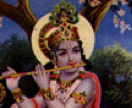
“The advanced devotee – who has found himself in an uncompromisable position between the sense soldiers of the ego and the discriminative warriors of the soul, which is lamenting the necessity for renouncing sense habits, and who has therefore become indecisively inactive,    “The advanced devotee – who has found himself in an uncompromisable position between the sense soldiers of the ego and the discriminative warriors of the soul, which is lamenting the necessity for renouncing sense habits, and who has therefore become indecisively inactive, surrendering himself passively to the infinite – beholds the Spirit, come to dispel the gloom of doubt with the gentle light of His smile and His voice of wisdom heard through intuition.

“Those devotees who, during the invasion of doubt, completely give themselves up to the Spirit in inner silence and submission are able to perceive the indescribable, all-purifying Light of God playing across the firmament of their inner perception.”

“This indescribable “Smile of the Spirit” is fully perceived only by those devotees whose spiritual lives are directed by ‘right action’. For as the Buddha demonstrated, through ‘right action’ alone does one cultivate ‘right perception’. There is little mystery, and even less theory (for the Buddha was not a theorist) behind this proclamation. It is simply a definitive declaration that one must lead a clean spiritual life; proper eating, right moral behavior and deep meditation!”

Arjuna was the epitome of a devotee on the verge of the highest spiritual revelation and attainment, for he had chosen the Lord Himself to direct the horses of his chariot, to be his Guiding Power. The name “Arjuna” mystically symbolizes self-control. The means of achievement of this is demonstrated by Arjuna’s ‘right action‘ of choosing Sri Krishna to hold the reigns that guide the five horses (five senses) of his chariot (his mind). (above quotes and paraphrases are excerpts from The Bhagavad Gita, God Talks with Arjuna, Paramahansa Yogananda, Yogoda Satsanga India Press 2002.)

Thus Arjuna’s mind was under control and still. His surrender was active and provocative, in that he was now fully empowered to arouse and encounter the sense solders of the ego. Furthermore, he was ready to fight under the shadow of the monkey-ensigned banner signifying devotion and discipleship.  In response to his submission and devotion he was transformed through the illuminating smile of the Lord, which attuned him to have “an ear to hear” the still small inner Divine voice of his Soul!
In our modern era, during the sojourn of Sri Ramakrishna, another soul was transfixed and transformed by a slight smile from the Face of a Living God.

Girish Chandra Ghosh was considered to be one of the closest and dearest disciples of Sri Ramakrishna, and unmistakably he was the most flamboyant and rowdy. In addition to having become irrevocably attached to Sri Ramakrishna, he was addicted to alcohol and frequent visits to houses of ill repute. On one occasion he was fully inebriated and reeling his way to visit one of his “ladies of the night” when instead he changed his mind and turned around to make a visit to his Lord and Master. Upon arrival at Sri Ramakrishna’s room he attempted to bow at the Master’s feet, only to collapse in a heap of reeking ‘pickled’ flesh. Sri Ramakrishna began to give him advice in a manner to persuade him to correct his behavior.
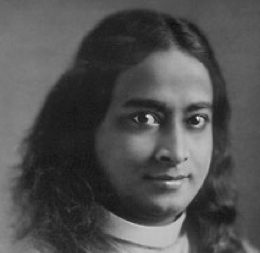
The truth is well known that “the Lord works in mysterious ways”, and what happened next ascended such heights of “mystery” that all present fell to their knees and wept. Girish, too drunk to stand, half-raised himself and tried to focus on the face of Sri Ramakrishna. His mind, his reasoning and his entire personality were numbed into oblivion. But upon beholding the living face of Sri Ramakrishna his heart burst forth with an all-consuming silent prayer for mercy. As the Master’s sweet words rained upon him even as nectar, Girish raised his hand up and said: “Stop! Don’t give me any advice, it will do no good. Please do something to change my life!”

In response to this soulful plea, the Master smiled!

All in the room said they saw only a very slight smile play across the lips of the Master. But the power and sweetness of that slight smile was so indescribable that in a wondrous flash, Girish Chandra Ghosh was completely transformed and purified.

Only at a later date could Girish attempt to speak of the wondrous event. And in doing so he proved that though now a completely changed being, he still retained a vivid sense of humor. All he could say was: “If I had known that there existed in the Master such a big pit that I could cast all of my sins into; I would have committed a lot more!”

In our own times divine embodiments of Grace have come forth to grant the heartfelt prayers of many who yearn to live a higher life.


Sri Anandamayi Ma was given the name “Joy–permeated Mother” mainly due to her lustrous smile that transformed onlookers by a mere glance.

As a young baby, the women in her village would line up early every morning to take turns holding her. They longed for a smile from the baby Goddess, which always came. From that smile, the women could endure the day’s bitterest hunger and direst labor, for their hearts were satiated with bliss and the love of God.


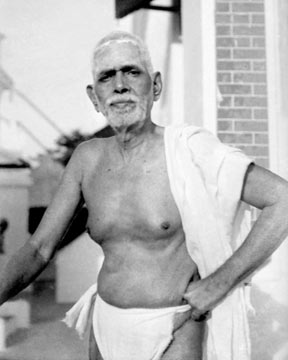
It was said of Sri Ramana Maharshi that he had “A look that pierced.” Such was the case that people had to avert or close their eyes when his look fell upon them. Nevertheless, when his look couched his divine smile, all were transfixed. Many have tried to communicate the wondrous experience of beholding the smile of Bhagavan; they all finally admitted that their words fell far short of the wonder. Here are a few instances of those who attempted to convey the smile that seemed to” burst open the very gates of heaven”.

“You can imagine nothing more beautiful than his smile. There is no way of describing the radiance of his smile.”
A simple woman said: “I don’t understand the philosophy but when he smiles at me I feel safe, just like a child in its mother’s arms. I had never yet seen him when I received a letter from my five- year-old daughter: ‘You will love Bhagavan. When he smiles everyone must be so happy’.”

“And he would explain that it is the Guru not the disciple who sees the progress made; it is for the disciple to carry on perseveringly with his work even though the structure
being raised may be out of sight of the mind. It may sound a hard path, but the disciples’ love for Bhagavan and the graciousness of his smile gave it beauty.”

“The Maharshi with an ineffable smile which lit up His Holy Face and which was all-pervasive, shining upon the coterie around him, replied in tones of certainty and with the ring of truth; “Divine Grace is essential for Realisation. It leads one to God-realisation. But such Grace is vouchsafed only to him who is a true devotee or a yogin, who has striven hard and ceaselessly on the path towards freedom.” Talks with Sri Ramana Maharshi #29

“He sat motionless with a sparkling smile on his face like the foam on the waves of the ocean of ananda.”

“His gentle smile shone like the cool rays of the moon. His words simply rained amrit. We sat there like statues without consciousness of the body.”

“I saw him looking at me with large penetrating eyes, wreathed in smiles rendered divinely soothing by their child-like innocence.”

At the time of Bhagavan’s Mahanirvana (leaving the physical body: “Unexpectedly, a group of devotees sitting on the veranda outside the hall began singing ‘Arunachala-Siva’ (Aksharanamanamalai). On hearing it, Sri Bhagavan’s eyes opened and shone. He gave a brief smile of indescribable tenderness. From the outer edges of his eyes tears of bliss rolled down. One more deep breath, and no more. There was no struggle, no spasm, no other sign of death: only that the next breath did not come.”

Harsha's avatar

The Heart of God:The Nature of Self-Realization. By Dr. Harsh K. Luthar

Heart Talk is All Talk

The difficulty in many of our conversations about spiritual insight is that the true understanding is not intellectual or conceptual, but absolutely direct. It is clear and direct without the medium of the mind.

Truth has never been a monopoly of a particular religion or spiritual tradition. How can it be? Some may disagree, but in my view, God does not play favorites.

We cannot make Truth our personal property but only allow the quality of Truth to overtake us and shine in us. We cannot possess God but only surrender to the Divine Will and let God take over our life.

Continue reading

Harsha's avatar

AHAM (I AM) Is The Essence Of Mantras: By Sri Venkata Sriram

Edtior’s Note: The following post appeared in the Advaitin list on Yahoo Groups and is reprinted with the permission of the author, Sri Venkata Sriram. In this article Venkat-Ji speaks about the idea of AHAM as the essence of Mantras, Vedas, and Upanishads. AHAM translated from Sanskrit means, “ME” or “I AM” and refers to the principle of I-NESS that is inherent in the existence of all beings as it is their core. Sri Bhagavan Ramana’s teaching involving the Inquiry, “Who Am I?” is essentially a meditation on AHAM, which in the Advaitic approach leads to Self-Realization. I have made only minor edits in the original version. Please bring to my attention any errors and these will be corrected right away.

AHAM (I AM) Is The Essence Of Mantras

It is to be noted that *who am I* is not a *intellectual* enquiry to be pursued.  It is the upasana of *Aham* which is the upasana of Vak – the Great Goddess of Speech which is described in Vedas as Vak / Tripurasundari.

According to legend, the 14 Maheshwara Sutras were revealed to Panini, Vyaghrapada, Upamanyu and other sages by Shiva. Panini then composed his grammar called Ashtadhyayi which is based on the 14 Sutras that were revealed during the Cosmic Dance of Shiva. They are also called the Maheshvara Sutras. At the end of the Shiva’s Cosmic Dance, he sounded his Damaruka 14 times. And from these 14 Sounds of Damaruka, evolved 14 Sutras. These 14 sutras encompass the phonetics of the Sanskrit language.

The first 4 sutras cover all the vowels.  They are :

1) a i u n
2) r l k
3) e o n
4) ai au ch.

Omit the last letter of the 4 sutras and they are a, i, u, r, l, e, o, ai, au. The entire 16 vowels from A to AHA have emanated from these letters.

The Last 10 sutras include all the consonants. They are :

5) h y v r t
6) l n
7) n m n n n m
8.) jh bh n
9) gh dh dh s
10) j b g d d s
11) kh ph ch th th ca t t v
12) k p y
13) s s s r;
14. h l.

Omit the last letter of these 10 sutras, they become entire 34 consonants ie., from K to HA. The SRICHAKRA is constructed keeping in view these entire set of 14 sutras.  Ashtadhyayi divides these 14 formulae into 43 letters which become the 43 Angles of Sriyantra.

The entire Matrikas (letters) ie., 16 vowels and 34 consonants have evolved from these 14 Maheshwara Sutras.

The 16 Vowels and 34 Consonants have become 50 Matrikas of Letters.. They are the Saktha Pitas of Sridevi.  Every Matrika has a distinct Power and Seat of Origin in our Body. These Matrikas are presided by a distinct and corresponding Devis that govern that particular seat of origin (Pita) in our Body. These Cosmic Powers that preside over each Matrika is invoked during the Antarmatrika and Bahir Matrika Nyasas.

It is to be noted that the Kamakala Akshara is derived from these 14 sutras. This *AHAM* is the essence of all the Mantras, Vedas, Upanishads as these fall in between A (WHICH IS 1ST VOWEL) AND H (WHICH IS THE LAST CONSONANT). From the first sutra, A is taken and from the last Sutra H is taken. Bindu is added and it becomes AHAM.

This is the AHAM swarupa or the I-NESS of Maheswara which is of the form of CHIT. It is from this AHAM of the Siva, the entire Cosmos in the form of Matrikas have evolved. This AHAM is the KAMAKALA. The entire vowels and consonants fall in between this A and H.

The Tantric script encodes this principle of AHAM and depicts as a INVERTED TRIANGLE which is a representation of Triputi or Triad in the form of External Object perceived, Knowledge or Perception, Observer or Perceiver otherwise called Jnatr-Jnana-Jneya.

Veda & Tantra paves the way for the piercing of this Triad which is called TRIPUTI-BHEDANA. And the methodology employed is *AHAMGRAHOPASANA* through Sagunopasana.

When Vashishta Ganapati Muni pleaded for guidance in sadhana, Bhagavan Ramana asked the Muni to enquire into the Source of the Panchakshari Mantra (NAMA SIVAYA) which is invariably collection of 5 letters in the form of Speech.

The root of all mantras in the form of Speech is *A-HA-Bindu*.  A is the 1st vowel; Ha is the Last Consonant; M-the Bindu; which is AHAM. This is what is the essence of VAK Sukta in Rg Veda which starts with *Aham rudrebhir vasubhischarami……….*.

Bhagavan Ramana Maharishi wants us to catch hold of this AHAM as it is the source of Speech and which shines in the cave of our heart. (vide ref: Ramana Gita).

The speech has 4 stages of evolution whose order of evolution is : 1) Para 2) Pashyanti 3) madhyama 4) Vaikhari.  Vaikhari is the Articular Sound what we hear.  The source of this Articulate Sound is Para which originates from Heart Cave where throbs our consciousness in the form of *AHAM* (hridaya kuhara madhye aham aham iti sphurantam…).  It is this throb or Antah sphurana, Bhagavan urges us to realise.  It is this *Aham throb* or *Antah-sphurana* which is *Brahma*.  Hence, Bhagavan Ramana says in ECSTASY *Aham* *Brahma* *Asmi*.

It is verily this *I* which shines in the heart cave as *Aham* which Bhagavn says is Brahman.

Now, what does Acharya Sankara say about the Upasana of *Aham*, let us see.

Acharya Sankara gives us a wonderful hymn for meditation, contemplation and reflection which is called *Dakshinamurthy Stotram* (DS).  Acharya has divided the entire hymn into 3 principles  : Jiva, Jagat & Ishwara. Later, he gives a clue for the Upasana which is quite *mandatory*  for those who are into the upasana of  the *aham* principle. What exactly is this *aham*, is wonderfully given in the sloka *bAlyAdiShvapi…….AHAM iti antahsphurantam sadA….* of DS.

Now, how should we enquire into the root of this *aham* or *I-ness*? Acharya has hinted in the subsequent sloka and the type of upasana to be undertaken. It is the *ahamgrahopasana* along with Sagunopasana which is suggested here.  When this upasana reaches the state of culmination, it is the realisation in *ECSTASY* that this *aham* or *antah-sphuraNa* is Brahman which is the essence of Mahavakya *aham brahmasmi*.

Mahavakyas are the *GREAT UTTERANCES IN ECSTASY* by our vedic seers.

Even in deep reflection and sadhana, when the upasaka reaches the highest pinnacle of spiritual illumination, both the terms *aham* and *brahma* drops off and what remains is ASMI.  And this state is wonderfully explained in the Rg veda in  the *Hymn of Creation or *Nasadiya Sukta*.

I repeat: Mahavakyas are the *GREAT UTTERENCES IN SPIRITUAL ECSTASY*.

Acharya Sankara also hints in his Sutra Bhashya about the sagunopasana..  He says:

“apratyAkhyAyaina kAryaprapancham, PARINAMAPRAKRRIYAM CHA shrayati SAGUNESHuPASANESHUP AYOKSHYA te iti”.

Also, in the 1st adhyaya for the sutra “tad adhInatvA darthavat”, Acharya Sankara explains the principle of Sakti to be the upAdana kAraNa for paramEshwara in the Creation. Acharya Sankara emphatically says that it is the Parinamavada to be adopted to achieve the Sagunopasana Siddhi and not for kArya-prapancha (jagat) siddhi.

Acharya Sankara in his sutra bhashya says that parinamavada (theory of transformaton) can be adopted for the purpose of saguna upasana which is the upasana of maya-sabala brahman where the substratum is Brahman only. When the upasana is ripe, and upon the dawn of right knowledge, the “reality” which the “ignorant” people perceive WOULD BECOME an “illusion”.

So, what i conclude is that Bhagavan Ramana’s Teaching is not new and is not an *Intellectual Enquiry*. It is verily the *Veda Vidya* handed down to us. Bhagavan embodies in himself the *Spirit of Vedic Seer*.  Bhagavan’s teaching is the upasana of Vak.

Bhagavan was verily the form of Dakshinamurthy who taught the Upasana of Vak in the form of *Silence*. It is this *silence* which is called Para-vak. It is this Para-Vak which sports in the deep chasms of our heart as *I* or *Aham*.

The vedas and Tantra declare this Para-Vak as Tripurasundari – which is the Great Triangle in Sriyantra and the substratum of this Para-Vak is the Absolute Principle in the Form of Shiva which is depicted as Circle or Bindu in Sriyantra.

Sriyantra is the diagrammatic representation of AHAM and Srividya is the Upasana of Vak in the form of *Ahamgrahopasana*.  Hence, to evolve a method for this *ahamgrahopasana*, Srividya Tantra came into being.

It is interesting to note that Bhagavan Ramana himself did the prana pratishta of Sriyantra at the samadhi of His mother.

tamai shri gurumurtaye namah idam shri dakshinamurthaye.

with regards,
sriram

Harsha's avatar

Who Is the I? Knowing Our Nature: By Dr. Harsh K. Luthar

Who Am I?

The practice of advanced yoga methods and pranayama with discipline along with meditation on the Chakras (Energy Centers in the body) leads to various mental and spiritual experiences. Sri Ramana’s teaching, however, views such yogic and meditative practices as preliminary to the real quest into the investigation of the nature of the “I”.

Visions of angels, deities, super conscious states, and various types of psychic abilities do manifest on the spiritual path.  But fascinating as such things are to the human mind, these do not resolve the fundamental question about the nature and mystery of existence.

People say, “I like this”, “I dislike this”, “I am a doctor”, “I am a professor”, “I am a psychic”, “I am a student”, “I am good”,  “I am a husband”, “I am a wife”, “I went here”, “I am strong”, “I am weak”, “I am happy”, “I am sad”, etc. The commonality in all we do and how we view our self  is this, “I”

The method of Self-Inquiry is to ask oneself “KOHUM”.  KOHUM in Sanskrit translated literally means “Who Is Me?” In English, we use the question, “Who Am I?” or Who is this “I” that is a constant reference point for us?

What is this sense of identity that engages in all these activities and has a variety of experiences, perceptions about the world and itself?

Who is the I that sees, dreams or has visions.  According to Sri Ramana, without understanding the nature of the I and resolving the mystery of existence, permanent satisfaction and peace are not gained.

It is for this reason that great sages say that one should aspire for Self-Knowledge above all else.

Everything, absolutely without exception, is transient. One is born, one grows old, one has many experiences in the world, and then one dies.

Things have a beginning and then an inevitable end. All physical and mental abilities and powers eventually fade. Psychic abilities and every kind of experience, supernatural or otherwise meets the same fate. It ends.

What remains always present is simply the sense of existence, this sense of I. The method of self-inquiry involves a focus on this I, an awareness of this awareness, until the quality of self-awareness is known as the inner essence of our existence. The words cannot fully capture this approach. It is understood only with effort and practice.

Therefore, the aspirant should with confidence maintain the inner gaze  focusing the “I” on “I”. Remaining in stillness with awareness aware of itself is the practice. Remaining with the sense of “I AM” is the practice.

It is this practice which is known as the direct path. It leads to the “I” merging into its Source. Immediately, it is seen that the Source is the Self, that the ancients called Sat-Chit-Ananda.  There are no words to describe it fully. It knows nothing else other than It Self, there being nothing else to know.

It is only this that the sages have referred to as the Supreme and the Absolute Beauty, the Core of Being that is Reality itself which sits in the heart of all beings as their support.  It is Knowledge, Existence, Bliss as one whole which animates existence and gives light and life to the mind.

Namaste

Harsha's avatar

What is Saguna and Nirguna Brahman? By Dr. Harsh K. Luthar

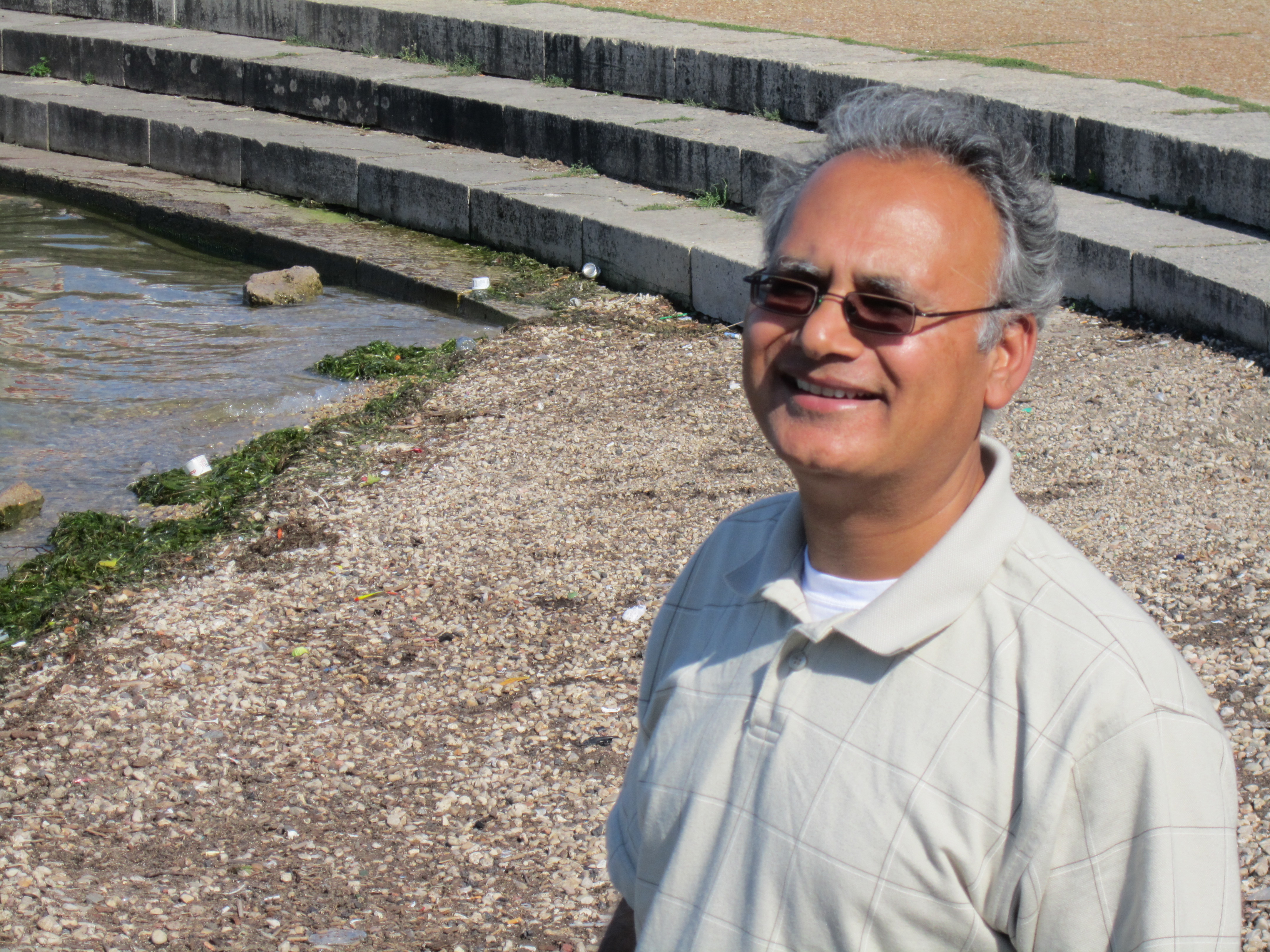
Harsh K. Luthar in Madison, WI

Questioner: What is meant in Hinduism by “Saguna Brahman” and how is that different from “Nirguna Brahman”

Answer: The term Saguna means “with attributes”. The term “Saguna Brahman” implies that God has a name and form and other attributes. Many Savikalpa Samadhis give rise to the (living) form of the Ishta Devata. Ishta Devta is one’s favored way of visualizing the divine. It might be Krishna, Jesus, Rama, the Goddess or some other Deity of choice.

Nirguna means “without attributes”. The term “Nirguna Brahman” implies that God as the Absolute Spirit and Pure Consciousness has no name and form or attributes. Nirvikalpa Samadhi reveals the Nirguna nature of the Self.

There are a number of books on Hinduism that discuss Saguna and Nirguna Brahman. Classic yoga texts like Patanjali’s yoga sutras explain various types of Samadhi states. All of such concepts and topics of discussion can also be found in the conversations Sri Ramana had with various visitors, scholars, and yogis for over 50 years.

The book I recommend for the devotees of Sri Ramana is “Talks with Ramana Maharshi” as it gives the context of the conversations and the flavor of the essential teaching of Sri Ramana. “Day by Day with Bhagavan” capturing the Ashram atmosphere in the 1940s is very good as well. In addition, the recollections of various devotees given in many books are quite good.

One sees that Sri Ramana was very flexible and open to people who came with a sincere desire for self-knowledge. A person’s religion, philosophy, background, race, all of that, made no difference to him. In his acceptance of all, even the monkeys and squirrels and animals who were always around him, Sri Ramana emanated a perpetual aura of kindness.

Those interested in Advaita Vedanta and Self-Realization will find the teachings of Sri Ramana Maharshi to be very helpful.

Namaste and Love to all

Harsha's avatar

HarshaSatsangh: The Sri Bhagavan Ramana Maharshi Group on Yahoo

Ramana Maharshi Devotees, please note that Harshasatsangh@yahoogroups.com is the largest Ramana Maharshi internet forum on yahoo with around 1500 members. It has been in existence since January 1999.  Lively discussions on Sri Ramana’s self-inquiry methodology as well as submissions of poetry, essays, and relevant postings by members keep Devotees in touch with Bhagavan Ramana’s teachings on a daily basis. The current moderator of the group is Sri Alan Jacobs, the President of the Ramana Maharshi Foundation UK. Ramana Maharshi Foundation UK website is given below.

http://www.ramana-maharshi.org.uk/

HarshaSatsangh is supported by luthar.com which is an e-magazine containing numerous important articles on Sri Ramana and his teaching of Self-Inquiry.  Luthar.com is one of the top Advaita-Vedanta sites on the Internet.  Sri Alan Jacobs and other authors have written a number of articles on Bhagavan’s teachings on luthar.com.

Articles are added to luthar.com on a monthly or a weekly basis by Bhagavan devotees and other authors writing on spirituality. The luthar.com site is Interfaith in its outlook, and people from many different religions and backgrounds write there.  Usually the themes of the topics center on God, Self-Realization, Enlightenment, and mysticism. Majority of the articles and essays focus on issues relevant to Yoga, Advaita, Inquiry, but there is flexibility to write on other topics as well such as lifestyles related to healthy living and vegetarianism. Articles on Buddhism, Christianity, Hinduism, Jainism, and Sufism can be found there as well. Scholar and sages from all spiritual traditions are welcome to write there.

The snapshot of luthar.com is given below. Please scroll down to read the history and a detailed description of the HarshaSatsangh group.

History of HarshaSatsangh

In order to build a spiritual online community devoted to the ancient traditions of Advaita-Vedanta and Yoga, centered around the Sage of Arunachala, Sri Bhagavan Ramana Maharshi, I founded HarshaSatsangh in January 1999. The group’s two main pillars have been the philosophy of Ahimsa (nonviolence) and Sri Ramana’s teachings of Self-Inquiry and Self-Realization.

I received my first teachings of Ahimsa from Gurudev Sri Chitrabhanu, with whom I studied after I finished college. Chitrabhanu-ji had been a Jain monk for 29 years.  Ahimsa is the cardinal principle in the Jaina philosophy. Chitrabhanu-ji and his wife Pramoda-ji have dedicated their life to spreading the message of Ahimsa, specifically focusing on the welfare of underprivileged people in India as well to stop the inhumane and cruel treatment of animals.

All Self-Realized sages spontaneously develop the feeling of reverence for life and embrace all living being regardless of age, race, ethnicity, gender, as their own.

Sri Ramana used to say that “Ahimsa Param Dharmo”. It means that Nonviolence is the first principle of the spiritual life. Ahimsa is also the first principle in Yogic Psychology of Self-Realization. In the classic Yoga work, Patanjali’s Yoga Sutras, Maharishi Patanjali puts Ahimsa at the top of the list above all other virtues. All other virtues follow from the principle of nonviolence.

Self-Realization and Ahimsa go hand in hand. It is only when the feeling of Ahimsa, reverence for all life, and amity towards all beings permeates one’s being can the deepest possible relaxation and letting go is possible for the mind to surrender to the Heart.

Sri Ramana was known for his immense kindness to people, animals, birds, and even plants growing in his vicinity. It came naturally to him. No one had to teach Sri Ramana to be compassionate to others. Self-Realization changes a person from the center.  For a Self-Realized Being, the same life runs through all living beings. Same Truth. Same Self.

With that as the background and context, HarshsSatsangh came into existence in January of 1999. The following description is taken from the yahoo groups.

Description of HarshaSatsangh

Harshasatsangh@yahoogroups.com is the largest Sri Bhagavan Ramana Maharshi on yahoo groups. It has been in existence since January 1999. It is supported by https://luthar.com/. The current moderator for the group is Sri Alan Jacobs, the President of the Ramana Maharshi Foundation UK.

Ramana Maharshi Devotees world wide are invited to apply for free membership.

http://groups.yahoo.com/group/HarshaSatsangh

General Information on HarshaSatsangh

Ramana Maharshi devotees should know that this is Sri Ramana’s Sangha. It is dedicated To Teachings of Self-Inquiry as given by Sri Ramana Maharshi. This is the Largest Yahoo Group for Sri Ramana Devotees. It is blessed by Sri Bhagavan Ramana, the Sage of Arunachala. The group was Started in January 1999.

Ramana Maharshi is known as the Sage of Arunachala. Sri Ramana spontaneously realized the Self at 16. After that he moved to the holy mountain of Arunachala and remained there for the rest of his life. Sri Ramana taught the method of self-inquiry which through Grace leads to Realization of our Self.

Blessings of Bhagavan Sri Ramana Maharshi do not require that one be from a particular school of yoga, meditation, or a follower of a certain religion, philosophy, or some esoteric school of thought.

The highest teaching of Sri Ramana is that of Self-Inquiry. Self-inquiry can be performed by anyone who has the maturity of mind to ask the ultimate question, “Who Am I?” and focus attention with patience and vigilance on one’s self-nature. If one can understand it and become aware of the awareness within, it is Grace at work.

Aspirants practicing Raj Yoga, Tantra, Kundalini Yoga, Hatha Yoga, Nada, Mantras, and Japa and belonging to any religion all came to see Sri Ramana. Sri Ramana always pointed them to their own Self, their own Heart, from which the consciousness sprouts up and world becomes visible. Finally, it is in the Heart where the Shakti, the mind, and all the paths merge, and the Absolute shines forth in its own nature.

Sri Ramana often quoted the Bhagavad Gita and said that the Lord sits in our Heart as our own Heart; indeed as our very own Self  (“I am in the Heart of all O’ Gudakesa”). So, it is nice to be in the company of the devotees of the Lord of the Heart.

This list is dedicated to the Sage of Arunachala, Sri Ramana Maharshi, and the pure teachings of the Self as taught in Advaita Vedanta. Sri Ramana taught that all spiritual practices (prayers, meditation, pranayama, japa) ripen the mind and make it suitable for self-inquiry. Ultimately, the Grace of Bhagavan leads the mind into the Heart for Self-Realization.

HarshaSatsangh Group Information – March 2009

  • Members: 1206
  • Category: Yoga
  • Founded: Jan 2, 1999
  • Language: English

HarshaSatsangh Group

  • Membership requires approval
  • Messages from new members require approval
  • All members can post messages
  • Email attachments are distributed, not archived
  • Members cannot hide email address
  • Listed in the Yahoo directory
Harsha's avatar

ULLADU NAARPADU (Reality in Forty Verses): Verse #12.

ULLADU NAARPADU
(Reality in Forty Verses)

The famous Vedantic poem in Tamil by Bhagavan Ramana Maharishi
(consisting of two preliminary verses called Mangalam,
40 verses which form the main text ,
and another 40 verses called the Appendix)
Detailed Commentary in Tamil by Lakshmana Sharma,
adapted into English by Profvk

(Continued from ULLADU NAARPADU – Verse No.10 &11
See Post#48287 Of Harsha Satsangh
For the first post in this series see #47923)

Lakshmana Sharma’s Introduction to Verse No.12

If both Ignorance and Knowledge are gone, then what remains must be a void. Is it so? – is the question that arises. What so remains is not a void. The Consciousness that is the Nature of the Atman is what remains. This is the content of this verse. The Self-Realisation where there is neither knowledge nor ignorance is what is known as the (ultimate) Knowledge Supreme. It is the nature of the Atman; it is not a quality or attribute of Atman – so says this verse.

Verse No.12

aRivu aRiyAmaiyum aRRathu aRivAme;
aRiyum athu uNmai aRivu AhAthu.
aRithaRku aRivittaRku anniyam inRAy avirvathAl,
tAn aRivu Ahum; paazh anRu, aRi.

Translation (Lakshmana Sharma)

Know that that alone is true knowledge, in which there is neither knowledge nor ignorance; the (so-called) knowledge of objects, understand, is not at all true knowledge. The Real Self shines always alone, with neither things for Him to know, nor persons to know Him; therefore He is only Consciousness; do not think He is non-being.

Translation (Prof. K. Swaminathan)

True Knowledge is being devoid of knowledge as well as ignorance of objects. Knowledge of objects is not true knowledge. Since the Self shines self-luminous, with nothing else for It to know, with nothing else to know It, the Self is Knowledge. Nescience It is not.

Translation (Osborne)

That alone is true Knowledge which is neither knowledge nor ignorance. What is known is not true Knowledge. Since the Self shines with nothing else to know or to make known, It alone is Knowledge. It is not a void.

Word by Word

aRivAme: (True) Knowledge
aRRathu : (is) devoid of
aRivu: Knowledge
aRiyAmaiyum : and Ignorance.
aRiyum athu : What knows
AhAthu: will not be
uNmai aRivu: True Knowledge.
avirvathAL : Because it shines
inRAy: without (the necessity of the presence of)
anniyam: a distinct object
aRithaRku: for (either) to know
aRivittaRku: (or) to be known,
tAN : the Real Self
Ahum: is
aRivu: Consciousness (True Knowledge)
pAzh anRu: (It) is not a non-being or void.
aRi: Know (this).

Commentary (in Tamil) by Lakshmana Sharma.

‘Self Realisation is the only True Knowledge; all else is just Ignorance’ –this thought has already been said in Verse No. 10. The same thing is being reconfirmed here for emphasis. Knowledge and Ignorance subsist only when the Ego has its sway on samsAra. In the turIya there is only Pure Knowledge that is unmixed with Ignorance and which has no relationship with Ignorance. Therein there is no duality of knowledge and ignorance, nor there is the triad of knower, knowledge and the known.So there is no concept of ‘difference’ there. But the common knowledge-triad is full of concepts of difference and so is in relationship with Ignorance. Therefore it is nothing but Ignorance, says the second line of this verse.

One might ask: Why do Knowledge and Ignorance both get destroyed in turIya? Why not Ignorance alone meet with destruction and Knowledge survive? The knowledge that is being spoken of in this question is itself nothing but Ignorance – we have mentioned this already. The reason that both Knowledge and Ignorance do get destroyed in turIya is that the latter is the state of mokshha; there is no second thing there. This is what has been said in the third and fourth line of this verse. There is nothing distinct from the Supreme and so there is no question of the Supreme ‘knowing’ anything. So the knowledge that is spoken of in the knowledge-triad is not there in the Atman. Again in order that It, the Atman, may be shown to exist as the ‘known’ (an object of knowledge), there has to be a distinct intelligence other than the Atman. There is no such. Actually this truth was what was already meant through the second meaning of the very first line of Mangalam – 1: ‘What sense distinct from It makes explicit what exists as Real Consciousness? The Atman does not shine by an ‘outside’ something, but shines by its own self-effulgence, which is its natural state of Pure Knowledge. So it is not inert and by that very fact thre is no Ignorance there. It is the Complete totality which has neither ignorance nor the opposite of it.

By this very fact of Self-effulgence, it follows that the Atman’s very nature is the shine of True Knowledge. This is the conclusion of all Vedanta and this is stated here by the words “tAn aRivu Ahum” (The Real Self is Consciousness).

There are those who do not understand that what exists as Absolute reality is the Knowledge-Supreme and that whatever appears in the world is the mithyA that has as its support (adhishhTAnam) this Knowledge-Supreme. These are the ones who complain that the Atman is equivalent to a void. To guard against this pitfall of delusion, Bhagavan says “Understand that this is not a void”. What makes all this world exist, by what shine all this shines, that cannot be a void.

Those who believe that the Atman is a void, would consider the experience of the material bliss of the heavenly world as most desirable. They do not know the true nature of happiness. The heavenly bliss of happiness in the other world has many faults, and further, it has an end. So it cannot be permanent Bliss. On the other hand the Bliss that comes from Self Realisation has none of these faults and it is infinite.

Now we can understand what it means to say ‘Self-Knowledge’. It may mean two things: ‘Knowledge of Self’ and ‘Knowledge that is Self’. The first meaning implies the knowledge that knows the Self. But this will make the Self an object that is known or is to be known. In other words the Self becomes an object of knowledge and the knowledge that knows it as distinct from it. But the Self is non-dual and we already mentioned that it does not afford the triad of knower-knowledge-known. Thus the first meaning is to be discarded. The second meaning which says the Self itself is Knowledge indicates that the Self is of the nature of Knowledge. This is what Bhagavan says by the words ‘tAn aRivu Ahum’. Thus it follows that it is wrong to say either that we do not now know the Self or that we will one day know the Self. ‘Knowing the Self’ can only mean ‘Being the Self’. In fact this meaning will be made explicit in Verse No. 33.

(To be continued in Verse No. 13)

PraNAms to all advaitins.
PraNAms to Bhagavan Ramana Maharishi.
profvk

Harsha's avatar

Ramana Maharshi: The Master of Silent Teaching: By Gabriele Ebert

Editor’s note: Because Gabriele Ebert’s native tongue is German, I had to edit the article. If there are any mistakes in the article, I accept complete responsibility. Please bring any such errors to my attention and these will be corrected right away.

Master and Disciple

The characteristics of a spiritual master is that he leads his disciple toward experience of the eternal truth by way of teaching. In Hinduism this is called upadesa (spiritual teaching, spiritual instruction). But master and disciple have to harmonize with each other, i.e. the master must be able to transmit his teaching whereas the disciple must be ready to grasp it and put it into practice. Otherwise, the relationship of master and disciple will bring no fruit.

In giving instructions to the student, medium of speech normally plays an important role. However, in spiritual instruction and transmission to the prepared student, according to Sri Ramana, speech is not the most potent means. Indeed, the sage of Arunachala is known as the great master of silent teaching.

A visitor said: “Bhagavan says, ‘The influence of the Jnani (Self-Realized one)steals into the devotee in silence.’ Bhagavan also says ‘Contact with great men, exalted souls, is one efficacious means of realising one’s true being.”

Ramana responded: “Contact with them is good. They will work through silence. By speaking, their power is reduced. Silence is most powerful. Speech is always less powerful than silence. So mental contact is the best.”

And on another occasion Ramana pointed out the potency of such teachings outside the verbal medium: “Such mouna [silence] is not inertness but great activity. It is the most powerful speech.”

Silent Teachings – Heart to Heart Instructions

The silence (mouna) Ramana talks about is not just absence of speech. It is when the mind/ego becomes silent, free from thought, and comes to rest in the Self.

If the ego/mind is fully absorbed in the Self, it will not appear anymore and assert itself as a separate identity. Such a one in whom the ego has been fully vanquished is called a Jnani. He will stay in the Self and will no more return to an ego-centered state. The ‘I’ working through him/herself is no more the little ego-I, but the Self of God. In his booklet “Who am I?” Ramana says: “It is this state, where there is not the slightest trace of the ‘I’-thought, that is the true Being of oneself. And that is called Quiescence or Mouna (Silence).”

Only who rests permanently in this silence can also transmit his teaching in silence. The disciple is not yet in this state, but he yearns for it above all. Through the silence of his teacher he is guided into his own heart, the source of the ego, to that ‘place’ from where this impermanent ego-I arises and submerges again.

In the beginning, the disciple will become silent, and enter for a short in the same state in which his master permanently rests. In this state, he finally experiences his own true nature. In this silence he starts to understand the truth. This is the Heart to Heart instruction.

This is a different path than the one of eloquent speeches and lectures of popular swamis and gurus.  This is the direct path of experience. This is the pathless path, and only suitable for mature seekers. Ramana states that for most seekers verbal instruction is needed.

“Silence is the best Upadesa (spiritual teachings), but it is suited only for advanced students. Others are unable to draw full inspiration from it, therefore they need words to explain the Truth. But Truth is beyond words. It does not admit of explanations. Lectures may entertain individuals for a few hours without having an effect upon them, whereas the result of silence is permanent and benefits all. Even though it is not understood, that does not matter. Oral lectures are not so eloquent as silence. It is unceasing eloquence. The primal master Dakshinamurti is the ideal and he taught in silence.”

Ramana and Dakshinamurti

Ramana was often identified with Dakshinamurti, who is the youthful Siva and represents his ascetic aspect. He is considered as the Guru of all Gurus, sitting under a Banyan-tree in silence. The four disciples, who seek his guidance, are “old”, i.e. they are ripe and Dakshinamurti teaches them in silence alone.

Ramana writes in his two verses on Dakshinamurti:

“Who is the youthful guru beneath the banyan tree?

Very old are the pupils who seek him.

The handsome teacher’s speech is silence.

Cleared are all the pupils’ doubts.

Under the wonderful banyan tree shines the youthful

guru. Aged pupils come to him. Silence is this teacher’s

speech. Gone are the doubts in the pupils’ minds.”

The following episode from Sundaresa Iyer’s reminiscences illustrates Ramana’s way of silent teaching:

“It was a Sivaratri Day. The evening worship at the Mother’s shrine was over. The devotees had their dinner with Sri Bhagavan, who was now on His seat, the devotees at His feet sitting around Him.

At 8 p.m. one of the Sadhus stood up, did pranam (offered obeisance), and with folded hands prayed: ‘Today is Sivaratri Day; we should be highly blessed by Sri Bhagavan expounding to us the meaning of the Hymn to Dakshinamurti (stotra).’ Says Bhagavan: ‘Yes, sit down.’

The Sadhu sat, and all eagerly looked at Sri Bhagavan and Sri Bhagavan looked at them. Sri Bhagavan sat and sat in His usual pose, no, poise. No words, no movement, and all was stillness! He sat still, and all sat still, waiting. The clock went on striking, nine, ten, eleven, twelve, one, two and three. Sri Bhagavan sat and they sat. Stillness, calmness, motionlessness – not conscious of the body, of space or time.

Thus eight hours were passed in Peace, in Silence, in Being, as It is. Thus was the Divine Reality taught through the speech of Silence by Bhagavan Sri Ramana-Dakshinamurthi.

At the stroke of 4 a.m. Sri Bhagavan quietly said: ‘And now have you known the essence of Dakshinamurti Hymn?’”

Ramana’s own Spiritual Experience

Ramana’s way of teaching in silence arose from his own spiritual experience. At the age of 16 he suddenly had a kind of death-experience, through which he spontaneously realized the Self.

One day, when he was all alone at home, unexpectedly and without reason an unmistakable fear of death caught hold of Ramana. But instead of seeking help from outside he turned within and asked, who was it, that is going to die and if death of the body means also death of himself. Suddenly the shell of the ego dropped off forever. From then on, he was certain, that in truth he was the Self (Atman, God, the Absolute, or whatever name one might like to give it). His attitude towards the world changed completely. Ramana had become silent in the deepest sense of the word.

Soon after he left his home in Madurai and went to the holy hill Arunachala, which he venerated since childhood. He settled down and stayed there until his death.

In the first few years at Arunachala Ramana was silent and completely absorbed in this truth, which was his inner most and real Being. Withdrawn from the world, Ramana remained in perpetual samadhi while the insects fed on his body. His body was kept alive by a few people who by the grace of God happened to be around and noticed this teenager doing what they believed was intense tapas (spiritual practice).

Ramana did not start teaching of his own accord. If people would not have noticed him and sought his company or advice, he perhaps never would have become known. But the spiritual seekers who came within his orbit felt instintcively that he was a great sage, a rishi, a Maharishi, the One, who was a great seer and who lived the truth and was completely authentic.

Sincere people started to come to Ramana with their questions. The silent Sage answered them, at first only by writing down his answers. But slowly in response to the aspirations of those around, Ramana returned gradually to speech, and using words to teach.

Ramana always emphasized that the highest teaching is transmitted in silence. Ramana never called himself a guru or Maharishi. In His view there were no master and disciples. However, the students who gathered around him were overwhelmed by the brillaint luster and the peaceful radiance of the great sage of Arunachala. Ganapati Muni, one of most powerful intellect and spiritual personalities of the time was the first to call Ramana a Maharishi (Great Seer).

As Ramana adapted to his surroundings, he  gradually became more and more open to talks.  In the Hall, where he could be met days and nights, philosophical topics were vividly discussed. Pundits came with their questions. His followers like Ganapati Muni, were superb adepts of the holy Hindu-scriptures – and the answers which Ramana gave fill many volumes. At times the Hall was also a workshop of artful peotry. Politics and themes of everyday life were discussed as well.

Though Sri Ramana was a master of silent teaching and silence (mouna) is seen as an important means in Hinduism, he dissuaded his devotees from taking a vow of silence. Nevertheless Major Chadwick, one of the Western devotees of Ramana made plans to do so.

This amusing story is found in Major Chadwick’s reminiscences: “During the war I decided that I would like to do so, chiefly to protect myself from the jibes of others. I went and asked Bhagavan’s permission. He was not enthusiastic and told me that it was useless to keep the tongue still but to continue to write messages on bits of paper which so many so-called Maunis (silent ones) continue to do. In this way only the tongue had a rest but the mind continued just as before. I said that I had no intention of doing this but would throw my pencil and paper away. I felt that I had obtained a reluctant consent as Bhagavan agreed that people were worrying me. So I made the necessary arrangements, installed a bell from my room to the kitchen so I should not have to call my servant, and fixed a lucky day to begin.

The night before I was to start, a friend of mine brought up the subject in the Hall after the evening meal when only a few of us were present. Bhagavan immediately showed his disapproval and said it was unnecessary and in fact not a good thing at all. I did not talk much anyhow. It was better to speak only when it was necessary, that it actually did no good to observe silence, that if one did so for twelve years one became dumb and might obtain some thaumaturgic powers, but who wanted them? Speech acted as a safety valve. Naturally after this talk I gave up the idea.”

The Power Of Silent Look (Darshan)

Many people came to be in Ramana’s silent presence, without asking him questions or talk to him. His look was extraordinary intense and penetrating directly into the hearts. The cook Shantamma reports the following example:

“One morning a European came in a horse carriage to the Ashram and went straight to Bhagavan. He wrote something on a piece of paper and showed it to Bhagavan. Bhagavan did not answer; instead he gazed at the stranger with unwinking eyes. The stranger was staring back at him. Then Bhagavan closed his eyes and the stranger also closed his. They stayed without moving. At mealtime the meals were served but Bhagavan would not open his eyes. Madhavaswami, the attendant, got Bhagavan’s water pot and stood ready to lead Bhagavan out of the Hall. Bhagavan would not stir. We felt afraid to go near, such was the intensity around him. His face was glowing with a strange light. The guests in the dining hall were waiting and the food before them was getting cold. Chinnaswami was talking loudly to attract Bhagavan’s attention. Even vessels were banged about, but all in vain. When the clock was striking twelve Bhagavan opened his eyes. They were glowing very brightly. Madhavaswami took up the water jug; the European got into the carriage and went away. It was the last we saw of him. We did not even get his name.”

Silence is the Eternal Stream of Speech

In “Talks” many quotes of the Maharshi can be found, which make clear, that silence is the actual, direct and eternal speech, which flows heart to heart.

“Silence is ever-speaking; it is a perennial flow of language; it is interrupted by speaking. These words obstruct that mute language. There is electricity flowing in a wire. With resistance to its passage, it glows as a lamp or revolves as a fan. In the wire it remains as electric energy. Similarly also, silence is the eternal flow of language, obstructed by words. What one fails to know by conversation extending to several years can be known in a trice in Silence, or in front of Silence – e.g., Dakshinamurti, and his four disciples.

That is the highest and most effective language.”

Elsewhere it is stated: “Silence is never-ending speech. Vocal speech obstructs the other speech of silence. In silence one is in intimate contact with the surroundings. The silence of Dakshinamurti removed the doubts of the four sages. Mouna vyakhya prakatita tatvam (Truth expounded by silence). Silence is said to be exposition. Silence is so potent.

For vocal speech, organs of speech are necessary and they precede speech. But the other speech lies even beyond thought. It is in short transcendent speech or unspoken word, para vak.”

On 20th July 1936 Ramana had the following talk:

A visitor asked: “What is mouna (silence)?”

M.: “Mouna is not closing the mouth. It is eternal speech.”

D.: “I do not understand.”

M.: “That state wich transcends speech and thought is mouna.”

D.: “How to achieve it?”

M.: “Hold some concept firmly and trace it back. By such concentration silence results. When practice becomes natural it will end in silence. Meditation without mental activity is silence. Subjugation of the mind is meditation. Deep meditation is eternal speech.”

D.: “How will worldly transaction go on if one observes silence?”

M.: “When women walk with water pots on their heads and chat with their companions they remain very careful, their thoughts concentrated on the loads of their heads. Similarly when a sage engages in activities, these do not distrub him because his mind abides in Brahman.”

Major Chadwick reports the following episode: “A gentleman from Kashmir came to the Ashram with his servant who could not speak a word of any other language except his native Kashmiri. One night when the Hall was almost dark except for the pale glimmer of a single hurricane lantern, the servant came into the Hall and stood before Bhagavan in a respectful manner jabbering something rapidly in his own language. Bhagavan said nothing, but lay quietly gazing at him. After a while the servant saluted and left the Hall. Next morning his master came to Bhagavan and complained, ‘Bhagavan, you never told me you could speak Kashmiri, was it fair?’

‘Why, what do you mean?’ asked Bhagavan. ‘I know not a single word of your language.’

Bhagavan aksed the gentleman how he had got hold of this absurd idea and the latter explained: ‘Last night my servant came to you and asked you several questions in his language. He tells me that you answered him in the same language and cleared his doubts.’

‘But I never opened my mouth,’ Bhagavan replied.”

Another story: “When Bhagavan Sri Ramana was staying in the Virupaksha Cave, a District Collector and a Deputy Collector went there for his darshan. After prostrations to Sri Bhagavan, the Collector began to speak, narrating at length all that he had read and done by way of sadhana [spiritual practice], and at the end confessed that in spite of all that, peace was as far from him as ever before. No sooner had he finished than the Deputy Collector started to tell his story and stopped only after saying all that he had to say. These two conversations took quite a long time, but Sri Bhagavan did not interrupt them even once, observing strict silence all throughout.

Seeing that neither of them got any reply from Sri Ramana, the Collector once again delivered a long harangue and stopped only when he was at the end of his resources. Yet not a word passed from the mouth of Sri Ramana. The Collector was a little put out at this, and drawled out: ‘We have been speaking to you since long, but you don’t open your lips at all! Will you please tell us something at least?”

Then, Sri Bhagavan spoke: ‘All the while I have been speaking in my own language. What can I do when you won’t listen to it?’

The Collector was intelligent and he caught the meaning of Sri Ramana’s cryptical reply. He was overpowered with devotion and fell down at the feet of Sri Bhagavan, chanting the following (Sanskrit) verse: ‘Strange (sight) under the banyan tree! The disciples are all old and the Guru is youthful; he expounds (the Truth) in Silence and the disciples are freed from doubts!’

Then both of them sat before Sri Bhagavan in silent meditation. They got the peace they were in search of and departed fully satisfied at the outcome of their visit.”

Silence and Inspiration

This silence of the Heart is no dead silence, but also the source of all inspiration. Sri Ramana inspired Ganapati Muni in his writing of the last part of his major poem ‘Uma Sahasram’ just by silently sitting with him. Sundaresa Iyer reports the story in detail:

“Sri Kavyakanta [Ganapati Muni] had composed 700 stanzas of Uma in some thirty different meters, and had announced to his devotees in various parts of the country that this poem would be dedicated on a certain Friday in the Shrine of Sri Uma in the great Temple of Sri Arunachaleswara. Over a hundered persons gathered at the Pachaiamman Temple so as to be present on the occasion. … At about 8 p.m. on the evening before the dedication day, after supper, Sri Maharshi asked Sri Kavyakanta whether the dedication would have to be postponed to some other Friday, as 300 verses were still to be composed to complete the thousand. But Sri Kavyakanta assured Bhagavan that he would complete the poem immediately.

The scene that followed can hardly be believed by one who did not actually witness it. Sri Maharshi sat silent and in deep meditation like the silent Lord Dakshinamurty. The eager disciples watched in tense admiration the sweet flow of divine music in Sanskrit verse as it came from the lips of the great and magnetic personality of Sri Kavyakanta. He stood there delivering the verses in an unbroken stream while disciples eagerly gathered the words and wrote them down. … The ‘Sahasram’ was finished in several meters. … For a while the disciples present enjoyed the deep ecstasy of the silence pervading the atmosphere, as Sri Kavyakanta concluded with the normal type of colophon. Then Sri Bhagavan opened His eyes and asked, ‘Nayana, has all that I said been taken down?’ From Sri Ganapati Muni came the ready and grateful response ‘Bhagavan, all that Bhagavan inspired in me has been taken down!’

Silence and Self-Inquiry (Atma Vichara)

Sri Ramana taught self-inquiry (atma vichara) as the most effective spiritual practice. For the spiritual practitioner both – atma vichara and silence – belong inseparably together. Atma vichara is the active spiritual practice, which leads – together with the influence of the guru, to this silence. Ideally both complement each other (practice and influence of the guru) – as is the case with devotees of Sri Ramana Maharshi.

Ramana has described the method of atma vichara in his booklet “Nan Yar?” (“Who am I?”). The I in the question relates to the original I-feeling of the human being. Ramana says, that this I is the first thought, on which all other thoughts and feelings are based.

But this I-feeling is no continuous entity, as there are also times, when it is absent, so for example in deep-sleep. Ramana explains, that the mind, i.e. this I-feeling arises from the Heart and submerges therein again. With the question “Who am i?” the mind turns to its own origin. But no answer, which the intellect might give can be accepted. Ramana assures us, that with continuous practice the ego will dissolve in the Self – though this is no more in the hands of the practitioner. One day the ego will be rooted out and just drop away. Ramana has repeatedly pointed out this path as the most effective among all.

Teaching in Silence is not bound to Time and Space

One might ask, if with the bodily death of the Maharshi his silent teaching of the Heart to Heart transmission as well came to an end. Does this kind of contact with Him continue or have we to go on search for another master?

Before his death Ramana said: “I am not going away, I am here!” Again and again he assured his devotees, that the body is not the guru and that it does not matter for the jnani, if he is in the body or not. So his bodily death did not end his spiritual guidance.

When in 1950 Sri Ramana died of cancer, his devotees scattered to the four winds. The Ashram was deserted, so that even in daylight thieves could break in and loot. Only slowly the truth of Ramana’s words dawned on the devotees. The power of the Silent Truth and transmission again brought the devotees together to Ramanashram.

This continues today. People are still drawn towards Ramana Maharshi and open themselves to his silent guidance and to self-inquiry as taught by him.

Sources

This article is the translation of: Ebert, Gabriele: Ramana Maharshi: Der Meister der schweigenden Belehrung, in: Wege der Stille, Hamburg 2008)

Iyer, T.K. Sundaresa: At the Feet of Bhagavan. – Tiruvannamalai, 1980

Mudaliar, A Devaraja: Day by Day with Bhagavan. – 3rd repint. – Tiruvannamalai, 1989

Ramana Maharshi: Collected Works. – 9th ed. – Tiruvannamalai, 2004

Ramana Maharshi: Words of Grace (Who am I?, Self-Enquiry, Spiritual Instruction) . – 3rd ed. – Tiruvannamalai, 1996

Ramana Smrti Souvenir: Ramana Maharshi Birth Centenary Offering 1980. – 1.ed. – Tiruvannamalai, 1980

Sadhu Arunachala (A.W. Chadwick): A Sadhus Raminiscences of Ramana Maharshi. – 4th ed. – Tiruvannamalai, 1994

Talks with Sri Ramana Maharshi. – 9th ed. – Tiruvannamalai, 1994


Mudaliar: Day by Day, 9.3.1946

dto., 29.4.1946

Words of Grace, p. 4

Sadhu Arunachala: A Sadhu’s Reminiscences of Ramana Maharshi, pp. 63f

Miracle of Dakshinamurit, in: Collected Works, p. 148

the „night of Siva“, high Siva-feast

Iyer: At the Feet of Bhagavan, pp. 29f

Sadhu Arunachala: A Sadhu’s Reminiscences, pp. 91f

Shantamma: Eternal Bhagavan in: Ramana Smrti, 1.ed., Ramanasram [p. 83]

from Talk 246

from Talk 68

Talk 231

Sadhu Arunachala: A Sadhu’s Reminiscences, p. 65

Silent Speech in: The Mountain path, 1995, p. 37

Recent Books by Gabriele Ebert are:

Ramana Maharshi: Sein Leben, Stuttgart, 2003

Sadhu Arunachala: Erinnerungen eines Sadhus, Berlin, 2004 (German transl.)

Both books are available at amazon.de and can be ordered from each German book-shop.

Gabriele Ebert is a well known  Ramana devotee. Gabriele is a German librarian, scholar, and a painter. Please go to the following link to see her beautiful article on icon paintings full of inspiring pictures.

https://luthar.com/icon-painting-as-a-spiritual-path-by-gabriele-ebert

Gabriele is a long term member of HarshaSatsangh (Harshasatsangh@yahoogroups.com) which is the largest Ramana Maharshi Internet Group on the web. Gabriele has been active in Sri Ramana groups for many years. She has served as an inspiration and a role model for all of us with her dedication to the interfaith approach to spirituality.

Harsha's avatar

ULLADU NAARPADU (Reality in Forty Verses) – Verse #9.

ULLADU NAARPADU
(Reality in Forty Verses)

The famous Vedantic poem in Tamil by Bhagavan Ramana Maharishi
(consisting of two preliminary verses called Mangalam,
40 verses which form the main text ,
and another 40 verses called the Appendix)

Detailed Commentary in Tamil by Lakshmana Sharma,
adapted into English by Profvk

(Continued from ULLADU NAARPADU – Verse No.8
See Post #48178 Of Harsha Satsangh)

Lakshmana Sharma’s Introduction to Verse No.9

The Ishvara and JIva spoken of here constitute a dual pair. They consist of two opposites, like light and darkness. Ishvara is all-knowledgeable while JIva has only a scanty intelligence; they differ in many other respects. So they form a pair. Knowledge and ignorance, good and evil, happiness and misery, inside and outside, are each a pair (Sanskrit: dvandva). Such pairs or dualities are numerous. The world is full of differences because of these dualities. Further, when we visualise an Ishvara, there are three different things, namely, the seer, the seen and the sight. These three constitute a triad (Sanskrit: tripuTi) or trinity. Triads also are innumerable. And they too create differences in the world. We have to enquire whether these differences are real or unreal. If they are unreal, it will confirm that the world is unreal. This is conveyed by Bhagavan in this verse.

Verse #9

iraTTaigaL, muppuDigaL, enRum onRu paRRi iruppavAm;
avvonRu Ethu enRu karuttinuL kaNDAl
kazhalum avai; kaNDavare uNmai kaNDAr,
kalangArE, kAN
.

Translation (Lakshmana Sharma)

The triads all arise depending on the ego-sense; so too arise the pairs. If one enters the heart by the Quest of ‘Who is the I?’ and sees the truth of it (the Real Self) all of them vanish utterly; such a one is the Sage; he is not deluded (by them).

Translation (Prof. K. Swaminathan)

`Twos’ and `Threes’ depend upon one thing, the ego. If one asks in one’s Heart, `What is this ego?’ and finds it, they slip away. Only those who have found this know the Truth, and they will never be perplexed.

Translation (Osborne)

The duality of subject and object and trinity of seer, sight, and seen can exist only if supported by the One. If one turns inward in search of that One Reality they fall away. Those who see this are those who see Wisdom. They are never in doubt.

Word by Word

iraTTaigaL: Pairs (like knowledge & ignorance, pleasure & pain)
muppuDigaL:Triads (like knowledge, knower & the known)
enRum : always
iruppavAm: hold alive, exist
onRu paRRi: supported by (some) one (namely, the ego )
Edu: Whence (is)
avvonRu: that one
enRu: thus
karuttinil : in the bottom of the heart
kaNDAl : if one finds out
avai ; they (the dualities and trinities)
kazhalum: slip away
kaNDavarE: Only those who thus see (the truth)
kaNDAr: have realised
uNmai : the Absolute Truth
kalangArE : they are not deluded (by the dualities and trinities)
kAN : Know this (to be the truth).

Commentary (by Lakshmana Sharma)

Pairs and triads all arise in the mind. In every pair, when one rises, the other (of the pair) also arises simultaneously. In the same manner, in every triad, when one rises, the other two of the triad also rise alongside. And similarly, when they die they die together – the two of the pair together and the three of the triad together. In sleep where the mind is absent, there are no duads or triads. Therefore they are all constructs of the mind. And at the bottom of all thoughts in the mind there is the thought of ‘I’. Always this thought arises only in respect of a form or body (see verse #25). This is what is called the Ego (‘ahamkAram’ or ‘ahamtA’ in Sanskrit and ‘akanthai’ in Tamil). It will be explained in the sequel. Thus, pairs and triads, all have their roots in the Ego. In the words ‘onRu paRRi iruppavAm’ in the first line of the verse the word ‘onRu’ (meaning ‘one’ in general, but here in the context meaning ‘some one thing’) stands for this.

In a later verse (#26), it will be shown that this Ego is the original source for all world-appearances.

All the differences of the world that hide the Atman, the Existent Reality, have their seed in this Ego. If this is destroyed, everything vanishes and the Real Nature of the Atman shines. This is the content of this entire work.

What is the means by which this Ego may be destroyed? The means is the quest for the source of the Ego. This comes up in verse #27 and succeeding verses.

That source is what is mentioned in the second line of this verse by Bhagavan. In order to know the truth of this Ego one delves inside; the mind dives into the heart and merges into it. Then one realises the Self. The ‘finding out’ in the bottom of the heart (‘karuttinil kaNDAl’) is nothing but this experience. ‘The dualities and trinities slip away’ says the verse; this shows that in theturIya of Self Realisation these do not survive. In other words in absolute truth (pAramArthika reality) they are not real. Only so long as the feeling or attitude of ‘I am the body’ is there they appear to be real – just as for the dreamer the dream is a reality while dreaming.

Those who see thus realise the absolute truth. This shows that such a seer is a jnAni. Not only that. Because he sees no differences – he does not see them – he is not perplexed by this mAyA of the world. The delusion caused by these differences is only when Ego is alive.

Thus all the differences have their root-source in our Ego; in Self-Realisation the Ego has vanished; therefore the mental constructs of dualities and trinities all vanish. And the only thing that remains is the Atman. All this go to confirm that the world is unreal.

(To be continued in Verse #10)

Harsha's avatar

Paradox Of The Mind: By Alan Jacobs

“Oh Mind, do not waste your life in roaming outside, pursuing wonders and wallowing in enjoyments. To know the Self through grace and to abide in this way firmly in the Heart is alone worthwhile.” [1]

This relevant quotation leads us to consider that what we term ‘mind’ can be conceived as a great paradox. From one standpoint it is a benevolent friend but from another it is a malicious enemy. Continue reading