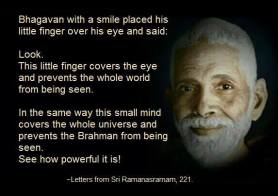
- Photo art from Ramana Maharshi FB page. Contributed by John Wassenberg

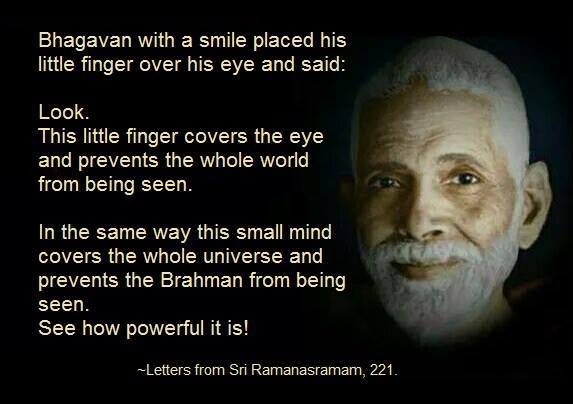
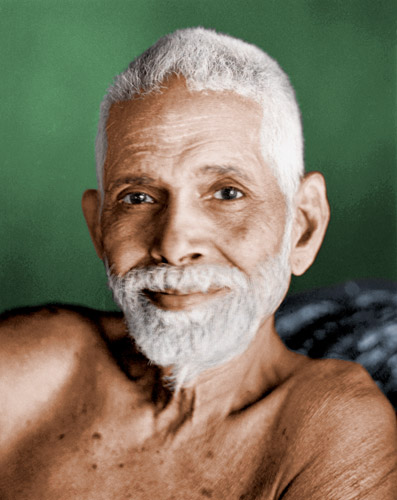
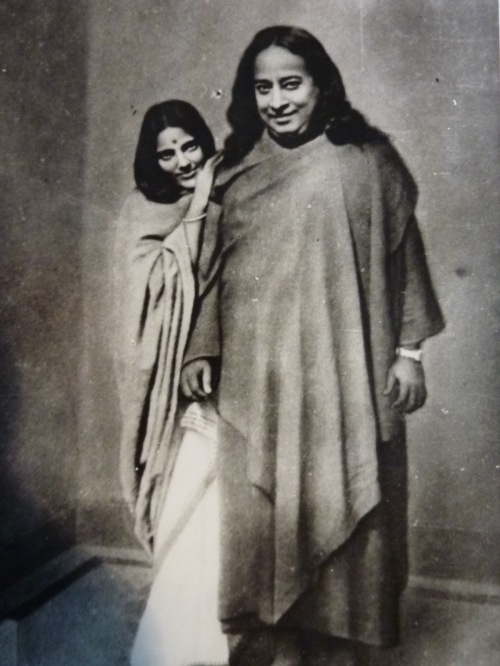
Witness consciousness as a concept and a spiritual practice has become better known now in the West. In the psychology of Advaita and Yoga of thousands of years ago, it has always been a fundamental tool for self development and self understanding on the path to Self-Realization.
View original post 481 more words
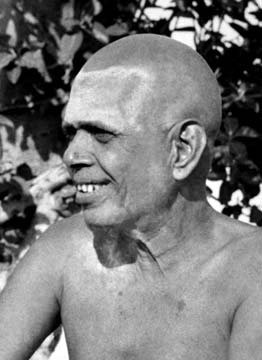
“Who is a master? He is the Self after all.” Ramana Maharshi
The company of peaceful Sages (Satsangha) and living in Ahimsa (harmlessness) is considered the primary influence that leads to Self-Realization. The forced attempts to discard various habits and conditioning and practicing different techniques to calm the mind have built in limitations. However, such methods can be pursued with benefit if one is already inclined towards these practices.
When strong inner motivation is present, one is automatically propelled towards Self-Awareness and Meditation. The fog of confusion then quickly evaporates and leads to Self-Seeing, Self-Being, Self-Realization, and Silence of the Heart.
Meditation and mind calming methods, can be effective at many different levels if practiced in the context of a clear understanding. Such practices, however, cannot by themselves end the fundamental agitation of the mind which continues at more and more subtle levels and causes suffering.
The nature of the…
View original post 1,176 more words
Dear Friends,
Sahaj in Sanksrit means easy and natural.
There is saying in Hindi, “Sahaj pake so meetha hoy.”
It means that easy and natural cooking of food leads it to taste sweet.
It is something like the English saying that soup that simmers slowly or the cake that is baked slowly tastes best in the end.
These are metaphors for life. When we do something with care and love, the results are better. Sometimes we even say that, “this is a labor of love.” When we love what we do, it does not feel like work.
Everything has its nature. When we are true to our own nature, an easy authenticity takes over. Then we are not concerned about impressing others nor worried about how others are judging us.
Nature is showing us the way. Seasons are coming and going. Flowers bloom and then wither. We are breathing in…
View original post 640 more words
This is in continuation of a Journey of the Soul – I
That is how it comes about that in scientific terms, one cannot prove that energy. What can be proven is only that which has motion. Yet motion is such that at the moment you view it, it changes, and you do not have a true picture of that motion at its most subtle level. That is why we know so little, from laboratory experiments, of the mind. Yet a whole vast range of the mind, over 90 percent, exists which is unexplored. As technology develops, there will be instruments or certain inventions which will probe a bit deeper into the mind. The 10 percent, explored, can become 15, 20 or 30 percent. But we want to know here and know the entirety of the mind, and the mind, being so involved in itself, cannot know itself.
When you are involved in a problem, an emotional problem, you cannot think straight because you are involved. But if you separate yourself from the machinations of the mind, you can view the mind from a different perspective altogether. That is why we have counselors, so that when you are in a rut (someone told me the other day, a rut is nothing else but a coffin with both ends open), you can go to a counselor who can view the subject or the problem objectively, because he is not emotionally involved. Many times people involved in a business deal will say, “let me sleep on this” That means that at this moment I am so involved in this problem that I need to let my mind rest. Tomorrow I shall look at the proposition with a rested mind, more objectively. In this process what travels from point to point is nothing else but the mind.
Now, where can the mind travel to? That is the other question. We have said that the spirit within a human being, or the spirit which pervades the universe, is omnipresent. If the manifestor is omnipresent, then its manifestation must be omnipresent too. Where is there a place for the mind to go? What happens is this: There is just a shifting of energies in the mind. Because there is contraction and expansion going on all the time in the universe, polarities are created. You lift the weight from this side of the scale, and you add some weight on the other side of the scale. The pendulum is forever swinging from one end to the other, and that is happening in the universe. That is what is known as contraction and expension. So the mind goes from nowhere to nowhere, while the energies are just shifting.
Through spiritual practices, we are also working with energies. We are also activating energies, but activating grosser energies and very systematically leading those grosser energies toward the more and more subtle energies which are in the mind. The mind has the conscious level, various strata of the subconscious level, and the superconscious level. All this falls under manifestation, and all manifestation is relative. It is relative to the Absolute.
 Within the confines of this whole scheme of things, relativity has its gradations: The conscious mind, which is gross; the subconscious mind, including the various subtler levels of the subconscious mind (psychiatrists and psychologists only delve 10-15 percent into the subconscious layers) and beyond that vast subconscious field, the superconscious mind. So we start with the subconscious mind and lead it gently through the layers of the subconscious to the superconscious until we experience the finest, subtlest relative. When we experience that, we can safely say that we have the universe in the palm of our hand.
So there lies the movement from grossness to its subtler levels; yet it is standing still. All the movement in the ocean you see is surface movement. Really speaking, the ocean is not moving. It is there. So, if we think of movement and that which lies between the area of Silence to Silence, nothing has moved. Silence reamains the same and the superimposition remains the same. So, traveler, where do you come from and where are you going to? Nowhere.
It is all here and now. Of course, there are the theories of reincarnation and karma and “reap what you sow.” They also are true at certain levels. But in reality, a person moves nowhere, and the apparent movement is only the mind experiencing itself at its subtler and subtler levels. That is the greatest illusion: By thinking that I move, I sit still.
For the mind to experience the subtler states, various forms of evolution are necessary, and this evolution from very gross matter to the present stage of humanity has taken millions of years, proceeding through various forms. Yet the substance of all those forms is not different. The substance that makes up the vegetable kingdom is the same substance that makes up the animal kingdom, which is the same substance that makes up the human kingdom. In essence, the substance remains the same. What is this body? It is nothing but food.
These very same substances, assuming different shapes and forms are given names. This table and I are not at all different from each other; we are of the same substance. This table is at a grosser level, and I, having developed the power of thought, am at a more subtle level. That’s the only difference. This table cannot think, the animal cannot think, but I can think; it is just a matter of degree, not of difference in substance. The molecular and atomic structural framework of this table is the same that structures me. The great illusion is accentuated in human beings, because people have reached that certain evolutionary stage where they are thinking.
The great illusion comes about because a person thinks that he thinks, while he is not really thinking. The less a person thinks, the more he experiences. The very process of thought, if wrongly used, can be the wall between the changing unreality and the unchanging reality. That does not mean that we need to destroy the mind – the mind is a great instrument and is to be used.
A sharp knife given to a delinquent boy can be dangerous. But the same sharp instrument in the hands of a surgeon can help perform an operation. So the mind has to be consciously directed. The power and force of the entire universe is contained in the mind, but it has to be directed.
If the mind tries to direct itself, then many things can happen, including misdirection, because the instrument is trying to work upon itself. So we use meditation and spiritual practices to go deep to the superconscious level, which is the closest to the manifestor. We let those subtler energies remodify the thought patterns of the conscious mind, for the conscious mind is a conditioned mind, and we’ve got to use a subtler force to be able to repattern and overcome the conditionings of the conscious mind.
Most of our troubles are of the conscious level. These are in turn pushed forth from the subconscious level. The left hemisphere of the brain, which is said to control thinking, analysis, verbalizing, and symbolizing, is connected to, not apart from, the right hemisphere of the brain, the part that is said to be a link to the intutive ability and the universal mind. Through meditation and spiritual practices we enliven this connection, first in the organ of the brain, and then in its subtler layer, which we call the mind, it’s subtler self. The entirety of the mind has been grossified into the organ called the brain to give us the individuality that we have. Of this brain, three pounds in weight, containing twelve billion cells, we use only one millionth part.
So, by activating the right hemisphere, we are energizing the left hemisphere, and therefore there is greater clarity of thought, greater concentration, and greater one-pointedness: and all these qualities plus others make one’s life successful. Not only we are using the energies of the left hemisphere, but, as a result of spiritual practices, we are also drawing upon the intuitive level. If we combine the analytical with the intuitional, how much more forceful our actions become, how much more truthful our thinking becomes. In this way we are led to right thought and right action.
So after practice, over a period of time, the mind gradually starts functioning in a spontaneous manner, to do that which is right. Then thinking is not necessary; you just do. You would, for example, come to a fork in the road, and you would just ver spontaneously take the right road. Your analytical mind will not tell you why or how you did it.
What is working is that intuitional level, which fulfills your every need, not your every want. With “want” the left hemisphere comes into play: “I want a million pounds, I want a 50-room mansion, I want this, and I want that.” That kind of analysis leads only to ego-boosting.
Now, all this exists within the framework of the traveling from Silence to Silence. This is the motion that is created. When that which we are calling the left hemisphere dominates us, we are enmeshed in our ego-selves, which know only this: me and mine.
If the mind is empowered by what we are calling the right hemisphere, the intuitional level which has its roots in the core’s of one personality, which we also call the heart, then “me” and “mine” disappears and it is “thee” and “thine.” For the core of the human personality, though outwardly seeming individualized, also exists in its universilezed form. So what happens to a person is this: He can exist as an individual and yet at the same time be universal, for he has now realized, through his spiritual sadhana , how vast he is. When this happens, a person, being divine, recognizes and experiences this Divinity.
to be continued in Journey of the Soul – III
Soon coming.

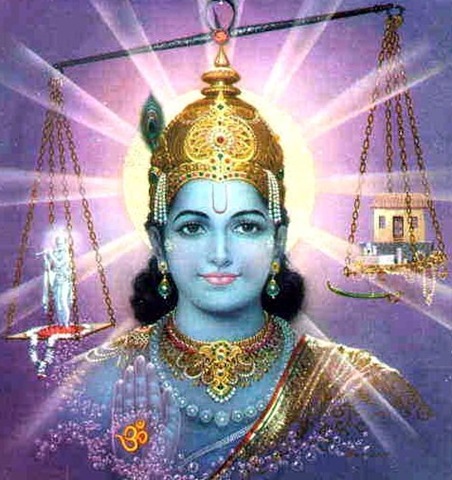

To those who worship Me alone, thinking of no other,
of those ever united, I secure what is not already possessed
and preserve what they already possess. (BG 9.22)
The story below appeared months ago prompting some discussion in the Guruvayur yahoo group in which I am a member. Today is Thanksgiving here in America, and this week we also celebrate Gita Jayanti, or the observance of the gifting of the Bhagavad Gita to the world by Shri Krishna more than five thousand years ago. As my thoughts turn to gratitude, I am reminded of this story below and the responses it produced in the Guruvayur group, and how important it is to always be grateful to the Lord for everything, knowing that He is our eternal well wisher and that everything happens for our highest good, even the things which which appear to be bad or are difficult to endure…everything means everything.
The focus of the discussion was on what should we ask of God. To what end do we pray, asking for this and pleading for that? Success in this venture, a new job, a happy marriage, a grandchild, a son or a daughter, a husband, a wife, a handsome husband, a beautiful wife, a nice house, a beautiful house, a mansion, good grades in school, a child who is a doctor or the president of the US? For what is it that we really seek, when all illusions are cast aside and maya’s veil is lifted? None of the above!!!
What should I seek from the Lord but the Lord Himself? That by His grace, I should know Him as the very Self in my heart, casting aside the shackles of the body and the solitary confinement imposed by the mind. He promises us, in the Gita, that if we are utterly devoted to Him, thinking of Him only, asking only for Him rather than of Him, He will be ours, and as such, will take care of us as needed. To understand this, to believe this, in full faith, can only be followed by complete surrender to His will, trusting that whatever happens is indeed His divine will operating to bring us out of bondage to birth and into reunion with Him.

From http://idharudharkee.blogspot.com/2009/07/what-we-should-ask-god.html
What should we ask of God?
This story from Mahabharata answers this question beautifully and categorically:
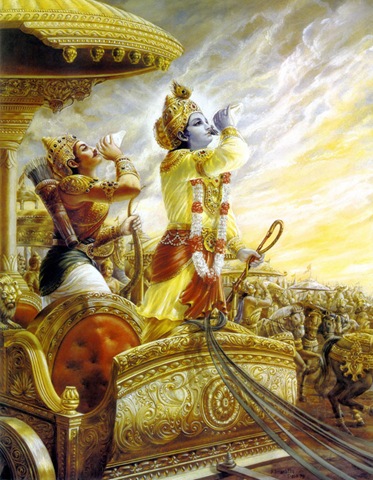
The Great War between the Pandavas and Kauravas was to begin. Arjuna, having pondered, decided to
go to Lord Krishna and ask him for help.
He went to the Lord’s abode and found him asleep.He stood respectfully at his lotus feet, with folded hands and head bowed in reverence. Duryodana, of the Kauravas, had the same idea of asking Sri Krishna’s help. He too came and, finding the Lord asleep, sat arrogantly in a chair placed at the head of Lord’s bed.
In due course, the Lord woke up. Arjuna, being at his feet, was the first person he naturally saw. As he turned to get up, the Lord’s eyes fell upon Duryodana.
The purpose of their visit was known to Him. However, he asked them what he could do for them.
Both answered that they had come to request his assistance in the ensuing war. The lord said that they had placed him in a difficult predicament by asking for the same thing. He said he could not deny either of them. He said he would offer himself, alone, without armies to one of them and to the other he would offer all his armed forces completely. He said that since his eyes had fallen on Arjuna first, he should have the first choice in the matter.
Arjuna promptly prayed to Sri Krishna that he alone should side the Pandavas.. Duryodana heaved a sigh of relief and requested Sri Krishna for all his forces. The Lord agreed to their requests.
We know who emerged victorious. The moral is “We should ask for HIM, not ask for things He can give us”
If the Lord gives us everything in the Universe but withholds Himself from us, we gain nothing. But if we seek HIM for Himself alone, we get not merely Him but all that is His, too!
abhyaasa yOga yuktEna cEtasaa naanyagaaminaa,
paramam pursham divyam yaati paarthaanucintayanMeaning:
He who with his mind disciplined through Yoga in the form of practice of meditation and thinking of nothing else, is constantly engaged in contemplation of God attains the supremely effulgent Divine Purusha (God) (sloka 8 in chapter 8 of Gita)
And what did Arjuna request? The Lord Himself. In his earnest bhakti, he intuited that this was the right choice and it was. When you ask for the Lord Himself, with utter devotion and humility, how can He deny you? In the Gita, He makes this promise to His devotees…
ananyaaScintayamtO maam yE janaah paryupaasatE
tEshaam nityaabhiyuktaanaam yOgakshEmam vahaamyaham. (BG 9.22)
To those who worship Me alone, thinking of no other, of those ever united, I secure what is not already possessed and preserve what they already possess.
https://luthar.com/wp-content/uploads/2009/06/bgita.pdf
But those who always worship Me with exclusive devotion, meditating on My transcendental form—to them I carry what they lack, and I preserve what they have.
http://www.bhagavad-gita.us/categories/The-Gita%3A-Chapter-9/?Page=2
Those who desire My eternal association precluding all else meditate on me with exclusive devotion; those persons I insure the uniting of their individual consciousness with Ultimate Consciousness perpetually. http://www.bhagavad-gita.org/Gita/verse-09-22.html
Yoga-kesamam, means to provide what they lack and safeguard or preserve what they have. In this context, yoga is said to mean making available what one does not have, and ksema means the preservation of what one already has. For some, the sloka is interpreted to mean those who recognize the nonduality of the Self, abiding in the Self at all times; for others, this is considered to be a promise from the Lord to take care of His devotees. If we go online, we can find countless articles claiming that the interpretation therein is the right one and that all others are missing the point, thus missing salvation itself!
For me, neither one has the right to claim the other is wrong…it can mean both, one at the level at which we exist as entities in this world of maya, or saguna, another at the level of the formless nirguna. The Lord, in His infinite mercy, prescribed numerous paths in the Gita. I am a bhakta. He is my Lord and while I know that philosophically speaking we are indeed nonseparate as it says so in the Gita and in the Vedas, as far as I am concerned, that can only be truly perceived through His Grace. So, while I am nothing but Him, on another level of worldly perception, this is known and experienced only through the operation of Divine Grace.
It is so stated in the Mukanda Upanishad 3.2.3:
nāyam ātmā pravacanena labhyo
na medhayā, na bahunā śrutena,
yam evaiṣa vṛṇute tena labhyas
tasyaiṣa ātmā vivṛṇute tanūṁ svām.
(Mukanda Upanishad 3.2.3)
This Self cannot be realized by studying the scriptures, nor through the use of reason, nor from the words of others–no matter what they say. By the grace of the Self the Self is known; the Self reveals itself. http://www.peterrussell.com/Upi/Mund.php
The Supreme Lord is not attained by reasonings or by vast intelligence, nor even by much hearing. He is attained only by one whom he Himself chooses. To such a person He manifests His own form. http://bvml.org/SBVPGM/sgt.html
And the Katha Upanishad 2.2.23:
The Self cannot be known through study of the scriptures, nor through the intellect, nor through hearing learned discourses. The Self can be attained only by those Whom the Self chooses. Verily unto them Does the Self reveal himself. http://booksandphotos.blogspot.com/2009/05/upanishads-kena-and-katha.html
This Supreme Self cannot be reached by argumentation, or by applying one’s independent brain power, or by studying many scriptures. Rather, he alone can achieve the Self whom the Self chooses to favor. To that person the Self reveals His own true, personal form. http://vedabase.net/sb/10/87/27/en1
The reason I have reproduced more than one translation of the Gita and Upanishad slokas above is that I wanted to read them in several formats for my own benefit and I also wanted to offer the reader the option of seeing it as such. So many ways of saying the same thing. And so many schools of thought want to say that their interpretation is the correct one and all others false and faulty. In the end, Divine Grace is the operational catalyst, whatever you deem its source.
So, what should we ask of God? Truly, there is no thing to be asked. There is no thing to be given. How can we give Him what is already His? All we can do is realize, through His grace alone, that we are already His, in every sense that we as mortals can conceptualize in our limited minds! Not only will He take care of everything and look after the welfare of the devotee, He will guide us if we listen. Thus, I do have a prayer…to fully surrender, to listen without fear of the consequences, no matter what He asks me to do. Where it will lead, I have no real idea and no plan of action! He is guiding the chariot now. May I sit quietly and not be a backseat driver. Chitta chora!!!





 Luthar.com
You must be logged in to post a comment.