Harsha's avatar

2014 New Year Message From Dr. Harsh K. Luthar

Dear Friends,

Humanity stands at the crossroads of destiny. Amidst wars and conflict on this planet, along with poverty, disease, and changes in the environment leading to global warming, the way ahead is not clear to me. Is it clear to you? If so, please share your views.

Our heroes in the past have tended to be warriors, kings, conquerors, entrepreneurs, innovators, inventors, who through their power of imagination, genius, organization, cleverness, and ingenuity were able to succeed beyond measure and attain personal empires, fortunes, and glories.  I ask you all to consider that perhaps we need different types of heroes if human evolution is to find its rightful purpose and survive. Our heroes, out of necessity now, have to be those with a long term vision of peace. Our heroes have to be the Peace Makers. Without them, the very survival of humanity is at stake.

I read somewhere that in the 19th century, over 19 million people died in armed conflict. In the 20th century, probably due to more sophisticated weapons and technology, almost 110 million people died in wars. Now we are in the 21st century. One wonders what will happen in this century to us, our loved ones, our children,  grandchildren, sisters, brothers, neighbors,  friends, and the human family in general?

Will our wisdom finally catch up with our knowledge, cunning, technology, ruthlessness, and the ability to destroy each other along with the planet? Or are we helpless in face of the human condition where gross self-interest, violence, and vengeance are the rules for individuals, groups, and nations.  Even the environment and the various species of plants, animals, and sea creatures have not been spared from the tendency of humans to violate.

A careful analysis of human violence no longer involves simply evaluating a moral issue. This reflection is important because the answers we come up with and the way we operationalize and implement these will impact the long term future of humanity it self.

Violence means to violate. To impose one’s will on another is a form of violence. Violence, of course, is part of all nature. Some violence is even essential for survival.  However, excessive and unnecessary violence breeds fear, resentment, anger, and rage. It is not a recipe for any type of realistic peace among human beings.  A strong person, group, organization, and even a nation can always attain a temporary victory.  But such a victory generally comes with lasting consequences of worry, fear, anxiety, and retaliation. Violence and Peace can never stay in the same house together.

Is violence so genetically embedded in humanity that, even knowing better, we are simply unable to overcome it? Is the destruction of humanity inevitable because of our helplessness in face of our root instincts?  I shudder at the thought of this possibility. What comforts me in such moments are the Peace Makers and the way they lived their lives. You know who they are. You have heard of them.  We have read their stories. Possibly, if we are very lucky, we might have run into one at some point in our life. Buddha, Jesus, Mahavir, Gandhi, St. Francis of Assisi, Bishop Tutu, Mother Theresa…there must be thousands of such heroes. It does give me some hope that there have been human beings who somehow were able to rise above the instinct to survive and lived their lives for others.

It seems to me that the path shown by the Peace Makers throughout history contains the seeds for survival of humanity. Embracing Ahimsa as the engine of human evolution has now become essential.  The supreme principle and the cardinal rule of the spiritual life has always had its foundation in the ancient philosophy of Ahimsa or nonviolence. This principle can no longer be limited to the spiritual life and must be broadened to include all aspects of life and creative endeavors such as business, politics, and world affairs. In fact, we have no choice but to do that.

The energy of consciousness, projected through the mind, is responsible for evolution of humanity through breakthroughs in technology and improved understanding of how the physical and subtle laws of the universe function. However, without Ahimsa (nonviolence) as the basic foundation of our thinking, the power of the mind can easily turn into a destructive force with the possibility of undermining human civilization.

Without truly understanding the nature of our interdependence with each other as human beings regardless of country, race, religion; and without realizing that we share with the plants, animals, water, air, and all living beings, this common desire to flourish, Ahimsa as a philosophy is difficult to understand and embrace.

Mahavira, the Jain prophet of nonviolence, said 2500 years ago that all beings have the natural desire to live and survive. Wanting to be safe, happy, and in a nurturing community is not unique to any particular country, culture, religion, or spiritual tradition. In fact, it is not even unique to human beings. Enjoying success at the expense of others including nature and the environment cannot be sustained. This is a simple but an ancient truth. According to the law of karma, if we wish to be happy, we should respect all life as sacred and minimize any type of violence to the extent we can.

Dr. Martin Luther King said in one of his sermons:

“Human progress is neither automatic nor inevitable. We are faced now with the fact that tomorrow is today. We are confronted with the fierce urgency of now. In this unfolding conundrum of life and history there is such a thing as being too late…We may cry out desperately for time to pause in her passage, but time is deaf to every plea and rushes on. Over the bleached bones and jumbled residues of numerous civilizations are written the pathetic words: Too late.” (Martin Luther King Jr. ‘Where do we go from here: chaos or community’).

My friends, prejudice, hatred, and incomprehensible violence are part of humanity. Still many individuals in every age, country, religion, and culture have been able to demonstrate the innate capacity of human beings to love, to nurture, to heal, to be peacemakers, and to forgive without reservation.

Like two lovers who are inseparable, Ahimsa and wisdom go hand in hand. Both point to the precious nature of all life and the sacredness of the present moment. Be that present moment and let compassion guide your way. You are the Peace Maker.

Harsha's avatar

Love, Heart, and Enlightenment: By Dr. Harsh K. Luthar

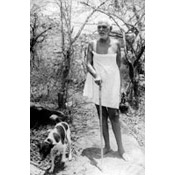
Sri Ramana Walking

Sri Ramana Walking

There is only One Heart

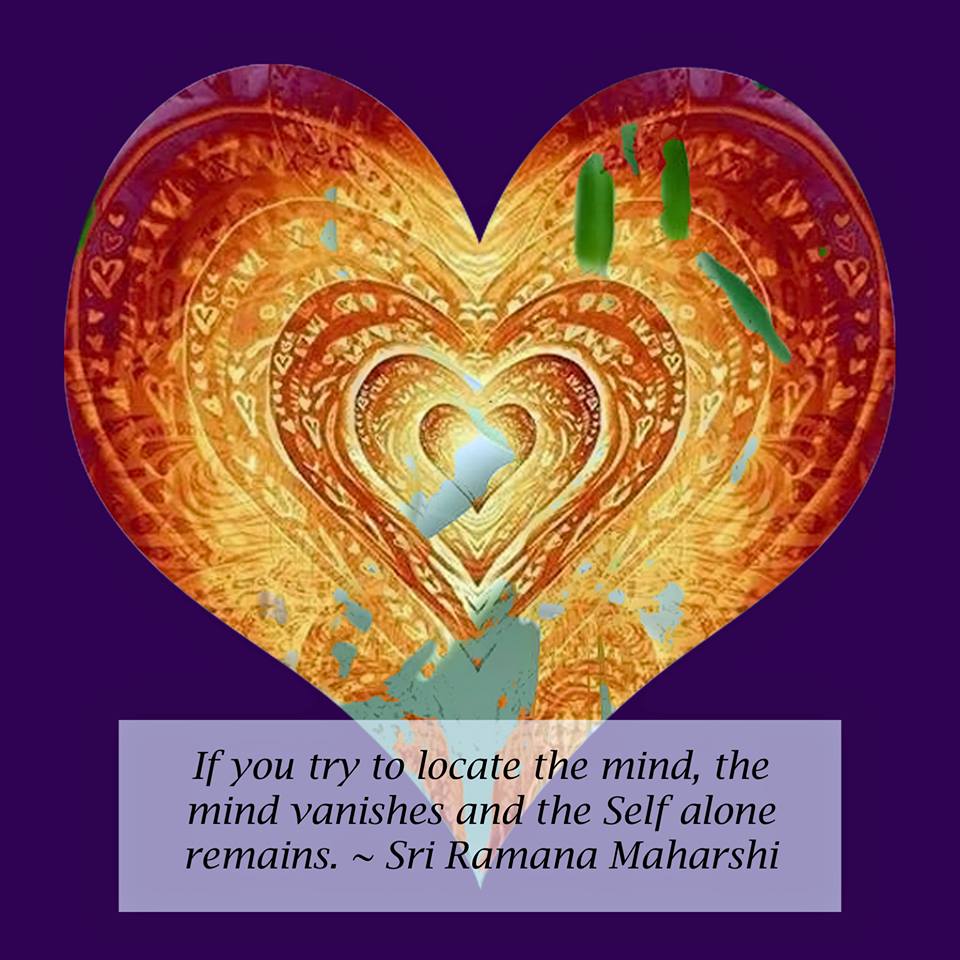
Sri Ramana once said that many advanced souls get liberation after reaching higher planes and that a few rare ones attain mukti (liberation) right here and now. In such cases their Prana along with mind (Kundalini Shakti) gets fully absorbed in the Spiritual Heart and the individual identity is dissolved into Brahman, the Self, the universal Heart and consciousness.

Continue reading

Harsha's avatar

Yoga And Advaita: By Dr. Harsh K. Luthar

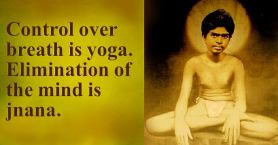
Yoga and breath Jnana and mind

These questions came up some years ago. My responses are included. (Photo art above is from Andreas Farsatis).

Question: Is the way and goal of Patanjali’s Yoga and  Sri Sankara’s Advaita Vedanta the same?

Continue reading

Harsha's avatar

Summary of the Bhagavad Gita, Chapter 12: By Dr. Ram Chandran

Gita Chapter 12: The Path of Devotion to God Realization

The path of devotion communicated during the conversation between Sri Arjuna and Lord Krishna is highlighted by providing answer to the following key questions:

(1) Should One Worship a Personal or an Impersonal God?

(2) What are the four Paths to God Realization explained in this chapter?

(3) Why Karma-Yoga is recommended to be the Best Starting Point for God Realization?

(4) What are the Key Attributes of a Devotee that we can gather from this Chapter?

(5) Finally why One Should Sincerely Strive to develop Divine Qualities?

Arjuna asked: Which of these has the best knowledge of yoga; those ever-steadfast devotees who wor­ship personal aspect, or impersonal aspect (the formless Absolute)?

Lord Krishna said – “I consider the best yogis to be those ever steadfast devotees who worship with supreme faith by fixing their mind on Me as their personal God.”

This is a restatement of what He said in chapter 6, verse 47. True devotion is defined as the highest order of love for God. True devotion is motiveless intense love of God to attain Him. It is seeking God’s grace and serving with love and dedication to please Him . Thus, devotion is doing one’s duty as an offering to the Lord with love of God in one’s heart.

It should be also understood that devotion is granted by the grace of God. A loving relationship with God is easily developed through a personal God. The faithful followers of Rama, Krishna, Moses, Buddha, Christ, and Muhammad are considered the steadfast devotees. All spiritual practices in the absence of steadfast devotion will become useless. The pearl of Self-knowledge is born on the nucleus of faith and devo­tion only.

What Lord Krishna has said with respect to those who worship the impersonal God? He assures that they also attain Me who worship the unchangeable, the inexplicable, the invisible, the omnipresent, the inconceivable, the unchanging, the immov­able, and the formless. Their worship of the impersonal God come in the form of change in their attitude to life by restraining all the senses, even-minded behavior under all circumstances by en­gaging in the welfare of all creatures. A person who is competent to worship the formless aspect of God must have a complete mastery over the senses, be tranquil under all circumstances, and be engaged in the welfare of all creatures.

Lord Krishna implicitly points out that worshiping the personal God is relatively easier than worshiping the impersonal God. One must be free from body-feeling and be established in the feeling of the existence of the Self alone, if one wants to succeed in worship of formless Absolute. One becomes free from the bodily conception of life when one is fully purified and acts solely for the Supreme Lord. Attainment of such a state is not possible for the average human being, but only for advanced souls. Therefore, the natural course for the ordinary seeker is to worship God with a form. Thus the method of worship depends on the individual. One should find out for oneself which method suits one best. It is quite fruitless to ask a child to worship a formless God, whereas a sage sees God in every form and does not need a statue or even a picture of God for worship.

At the starting point there are likely differences between these two approaches to the worship of God. But those practice with steadfast devotion the differences get melted away. Then there will be no real difference between the two paths. – the path of devotion to a personal God and the path of Self-knowledge of the impersonal God – as they attain full spiritual maturity. In the highest stage of realization they merge and become one. The personal and the impersonal, the physical form and the transcendental form, are the two sides of the coin of ultimate Reality. A per­son must learn to focus the mind with the one and only thought on a personal God with a form. After succeeding therein by fixing their mind, their mind get purified and they are able to transcendent all attachments to names and forms. The highest lib­eration is possible only by realization of God as the very Self in all beings, and it comes only through maturity of devo­tion to the personal God and by His grace.

Four Paths to God

First is the path of meditation (See Chapter 6 for greater details) for the contemplative mind. Thinking of a chosen form of God all the time is different from worshiping that form, but both practices are the same in quality and effect. In other words, contemplation is also a form of worship. If you are unable to focus your mind steadily on Me then long to at­tain Me by practice of any other spiritual discipline; such as a ritual, or deity worship that suits you. (12.09).

Second is the path of ritual, prayer, and devotional worship recommended for people who are emotional, have more faith but less reasoning and intellect (See also 9.32). Constantly contemplate and concentrate your mind on God, using symbols or mental pictures of a personal God as an aid to develop devotion. If you are unable even to do any spiritual discipline, then dedicate all your work to Me, or do your duty just for Me. You shall attain perfection by doing your prescribed duty for Me – without any selfish motive – just as an instrument to serve and please Me. (12.10)

Third is the path of transcendental knowledge or renunciation, acquired through contemplation and scriptural study for people who have realized the truth that we are only divine instruments. Lord Himself guides every endeavor of the person who works for the good of humanity, and success comes to a person who dedicates his or her life to the service of God. If you are unable to dedicate your work to Me, then just surrender unto My will and renounce the attachment to, and the anxiety for, the fruits of all work by learning to accept all results with equanimity as God’s grace. (12.11).

The fourth is the path of Karma Yoga, the selfless service to humanity, discussed in Chapter 3, for householders who cannot renounce worldly activity and work full-time for God, as discussed in verse 12.10, above. The main thrust of verses 12.08-11 is that one must establish some relationship with the Lord; such as the progenitor, fa­ther, mother, beloved, child, savior, guru, master, helper, guest, friend, and even an enemy. Karma Yoga, or the renunciation of the selfish attachment to fruits of work, is not a method of last resort; as it may appear from verse 12.11.

Karma Yoga is the Best Way

The transcendental knowledge of scriptures is better than mere ritualistic practice; meditation is better than scriptural knowledge; renunciation of selfish attachment to the fruits of work (KarmaYoga) is better than meditation; because peace immediately follows renunciation of selfish motives. (See more on renunciation in 18.02, and 18.09) When one’s knowledge of God increases, all Karma is gradually eliminated because one who is situated in knowledge thinks he or she is not the doer but an instrument working at the pleasure of the creator. Such an action in God-consciousness becomes devotion ¾ free from any Karmic bondage. Thus, there is no sharp demarcation between the paths of selfless service, spiritual knowledge, and devotion.

What are the Key Attributes of a Devotee?

One is dear to Me who does not hate any creature, who is friendly and compassion­ate, free from the notion of “I” and “my”, even-minded in pain and pleasure, forgiving; and who is ever content, who has subdued the mind, whose re­solve is firm, whose mind and intellect are engaged in dwelling upon Me, and who is devoted to Me. (12.13-14) To attain oneness with God, one has to become per­fect like Him by cultivating moral virtues. Virtues and discipline are two sure means of devotion. A list of forty virtues and values are provided through verses 12.13 to 12.19 by describing the qualities of an ideal devotee, or a Self-realized person. The true devotee is fully committed to these forty noble qualities. It should be pointed out the true devotion implies “COMMITMENT” without “ATTACHMENT.”

One is also dear to Me who is free from joy, envy, fear and anxiety and does not agitate others and also not agitated by them. (12.15)

One who is desireless, pure, wise, impartial, and free from anxiety; who has renounced the doership in all undertakings – such a devotee is dear to Me. (12.16)

One who neither rejoices nor grieves, neither likes nor dislikes, who has renounced both the good and the evil, and is full of devotion is also dear to Me. (12.17)

One who remains the same towards friend or foe, in honor or dis­grace, in heat or cold, in pleasure or pain; who is free from attach­ment; who is indifferent to censure or praise; who is quiet, and content with whatever one has, unattached to a place, a country, or a house; who is tranquil, and full of devotion, that person is dear to Me. (12.18-19)

It is said that divine Controllers with their exalted qualities, such as the knowledge of God, wisdom, renunciation, detachment, and equanimity, always reside in the inner psyche of a pure devotee. Thus, perfect devotees who have renounced affinity for the world and its objects and have love for God are rewarded by the Lord with divine qualities. They are dear to the Lord.

What about those who are imperfect, but trying sincerely for perfection? Lord Krishna answers this question in the very the next verse suggesting that One Should Sincerely Strive to Develop Divine Qualities:

But those faithful devotees are very dear to Me who set Me as their supreme goal and follow — or just sincerely strive to develop — the above mentioned nectar of (forty) moral values. (12.20)

One may not have all the virtues, but a sincere effort to develop virtues is most appreciated by the Lord. Thus the one who strives is very dear to the Lord. The higher class of devotees do not desire anything, including salvation from the Lord, ex­cept for the boon to permanently be at the lotus feet of a personal God, birth after birth. Lower class devotees use God as a ser­vant to fulfill their material demands and desires. The development of unswerving love and devotion to the lotus feet of the Lord is the ultimate aim of all spiritual discipline and meri­torious deeds as well as the goal of human birth. A true devotee con­siders oneself the servant, the Lord as the master, and the entire creation as His body.

The path of devotion is a better path for most people, but Devotion does not develop without a combination of personal effort, faith, and the grace of God. Nine techniques for cultivating devotion which is an intense love for God as a personal Being – based on Tulasi Ramayana are:

(1) The company of the holy and wise,

(2) Listening and reading the glories and stories of Lord’s incarnations in the religious scriptures,

(3) Seva or serving God through service to the needy, the saints, and society,

(4) Congregational chanting and singing of the glories of God,

(5) Repeating the Lord’s name and mantra with firm faith,

(6) Discipline, con­trol over the six senses, and detachment,

(7) Seeing your personal God everywhere and in everything,

(8) Contentment and lack of greed as well as overlooking others’ faults, and

(9) Simplicity, lack of anger, jealousy, and hatred.

The best thing a person should do is to develop love of God. Lord Rama said that one needs to follow any one of the above methods with faith to develop love of God and become a devotee.

Good company of saints and sages is a very powerful tool for God-realization. It is said that friendship, discussions, dealings, and marriage should be with equals or those who are better than oneself, not with persons of lower level of intellect (MB 5.13.117).

A person is known by the company he or she keeps. According to most saints and sages, the path of devotion is very simple and easy to perform. One can begin by simply chanting a personal mantra or any holy name of God. There is no restriction on the correct time or place for chanting the holy name of God. The process of devotional service consists of one or more of the following practices: Hearing discourses, chanting the holy name of God, remembering and contemplating God, worshipping Him, praying to Him, serving God and humanity, and surrendering to His will.

The four inter-connected paths of yoga discussed in the first twelve chapters of the Gita may be summarized as follows:

The practice of Karma Yoga leads to purification of the mind from the stain of selfishness that paves the way for knowledge of God to be revealed. Knowledge develops into devotional love of God. Constant thinking of God, the object of our love due to devotion, is called meditation and contemplation that eventually lead to enlightenment and salvation.

Is there Only One Right Way to God?

Lord Krishna has been talking about both manifest and unmanifest aspects of God in the previous chapters (See for example 9.4 and 9.5). Arjuna’s question has been answered in great detail in this chapter, but people still argue that one method of worship or certain religious practices are better than others. Such persons will continue to argue and will be only able to understand half the truth.

From what is presented in Chapter 12, it is clear that the method of worship depends on the nature of the individual. The person or the person’s guru should find out which path will be most suitable for the individual, depending on the person’s temperament. To force his or her own method of worship on other people is the greatest disservice a guru can do to disciples. The most important thing is to develop faith in and love of God. God has the power to manifest before a devotee in any form, regardless of the devotee’s chosen form of worship. What has worked for one may not work for all, so what makes you think your method is universal? There was no need for the Lord to discuss different paths of yoga if there was one path for all. If the chosen path of spiritual discipline does not give one peace or God-realization, then it must be understood that one is not practicing correctly or the path is not right for the individual. It should be kept in mind that a drop of water, no matter what route it takes, will eventually reach the ocean.

Note: It should be pointed out that the recipes presented in this chapter are quite useful for cooks who want to prepare tasty meals for seekers who like the flavors of Dwaita or Visistadwaita or Advaita! That may explain why this chapter is well-liked by the followers of different schools of thought.

Harsha's avatar

Arunachala – On the Inner Path: Parvati Hill

This post continues the series of posts that show Arunachala’s Inner Path, used by devotees of Sri Bhagavan Ramana Maharshi for the sacred walk around this holy hill. This walking is called pradakshina, or, in Tamil, girivalam.

Part one shows the path from Ramanasramam. Part two shows the walk around the southwest side of the hill. This post is Part three of the series.

Inner Girivalam Path around Arunachala:
Parvati Hill section

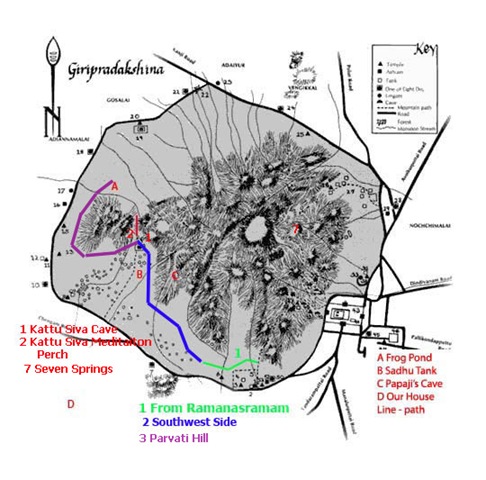
A map is below. The Parvati Hill section of the Inner Path is shown in purple.

Arunachala Inner Path Parvati hill

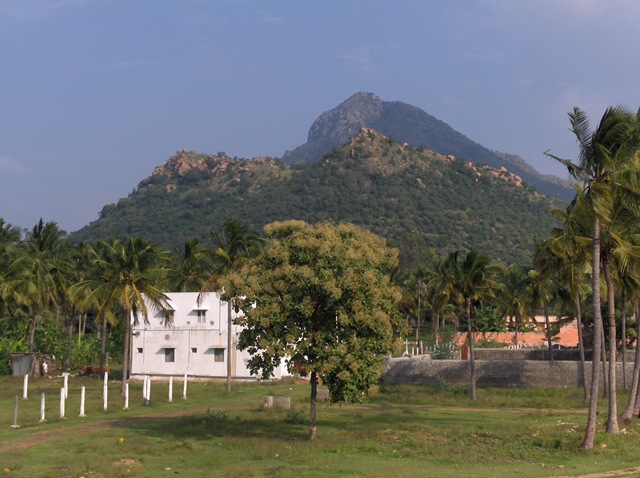
Another way to visualize this is by the look of Arunachala from this location. From the correct place on this side of Arunachala, one can see Arunachala rising behind the twin peaks of Parvati Hill. Parvati Hill is in the foreground, with Arunachala behind.

HPIM9835

Approaching the Inner Path

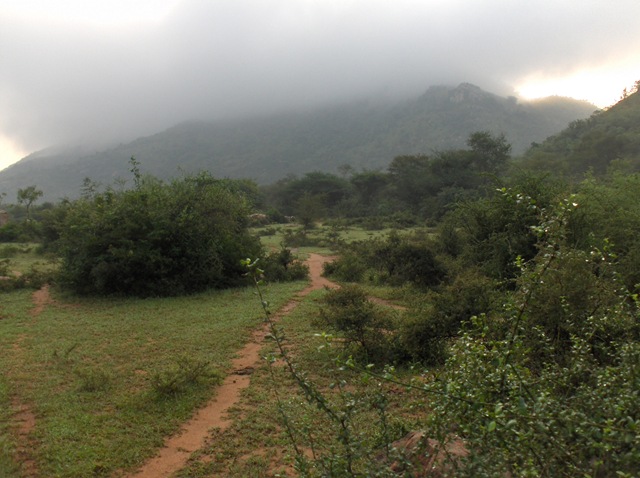
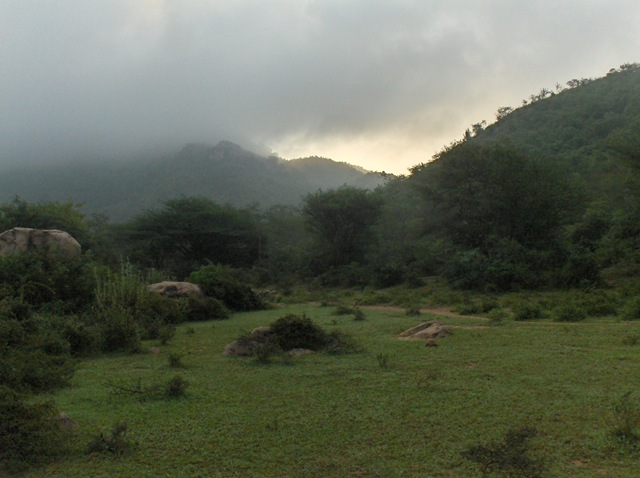
We started from our house on the southwest side of the mountain. The day we walked was after more than one week of rain, after ‘a cyclone’ hit Tamil Nadu. As you will see, much of the path was under water, and the catchment basins and tanks were filled with water.

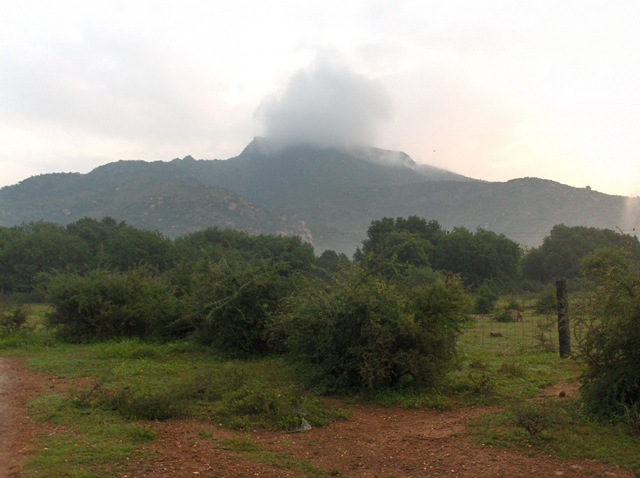
It is a cloudy day, and Arunachala is behind a cloud.

HPIM9574

Parvati Hill is to the left. Arunachala goes off to the right.

HPIM9575

Sadhus are bathing at Kattu Siva tank.

HPIM9579

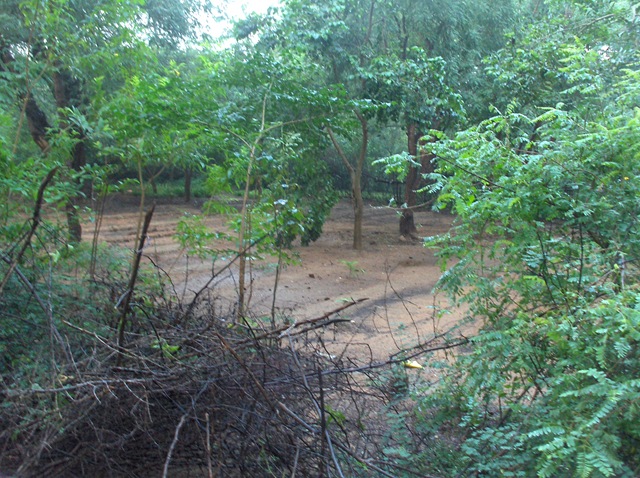
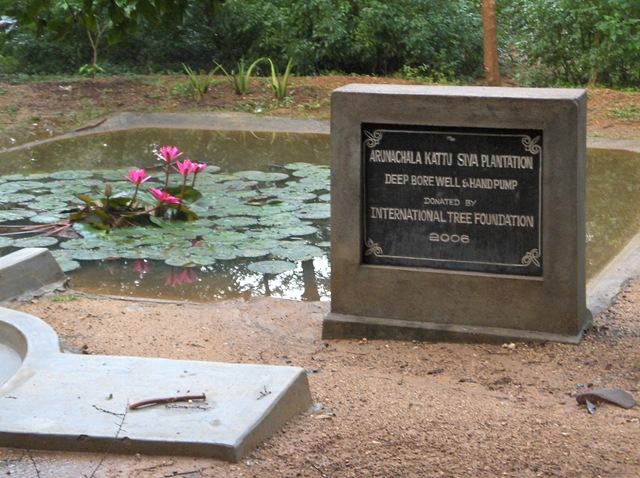
The trees at the Arunachala Kattu Siva Plantation are gone, a sign of the changes this organization is going through as it tries to deal with new people in the local Forestry Department. I hate it that they felt they had to move away from the mountain. See this link for more information about the important work being done by this organization.

HPIM9583

From this area, you can also walk to the Kattu Siva Cave, or take a Path Across Arunachala.

The deep water pump and beautiful water lilies remain.

HPIM9587

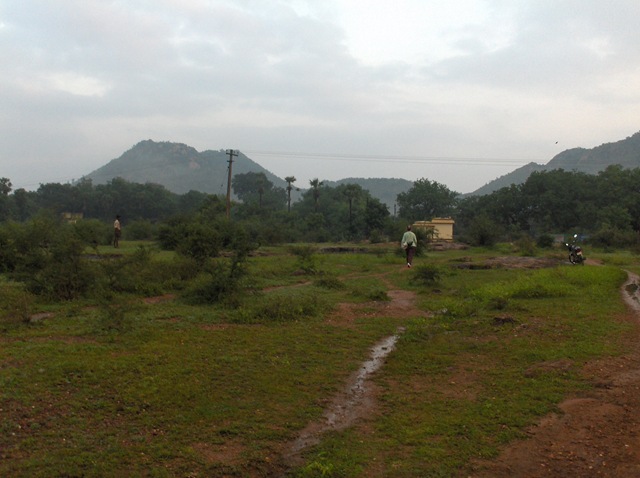
Now we start on this section of the Inner Path. Follow the path, generally north.

HPIM9589

Across a creek, full of water now, the path that goes to the Kattu Siva Meditation Perch branches off to the right.

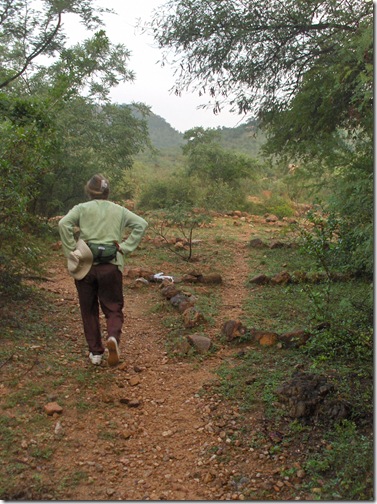
Carol is taking the main path. The east end of the peak of Parvati Hill is in the background.

HPIM9591

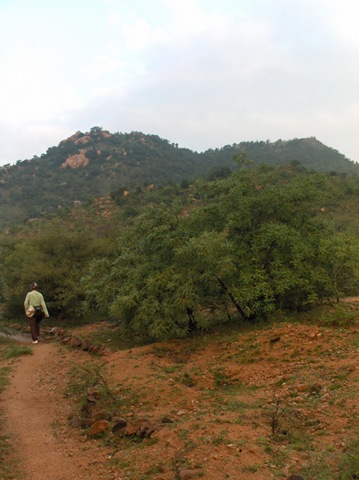
Here are both peaks. These also carry the names of Siva and Parvati. These two peaks are the only part of Arunachala hill that have the same look from both sides of the hill. I will show the other side in a photo later in this article.

HPIM9594

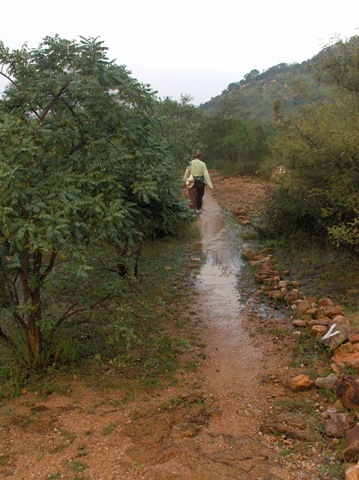
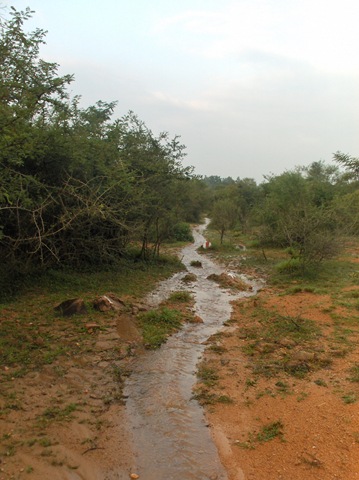
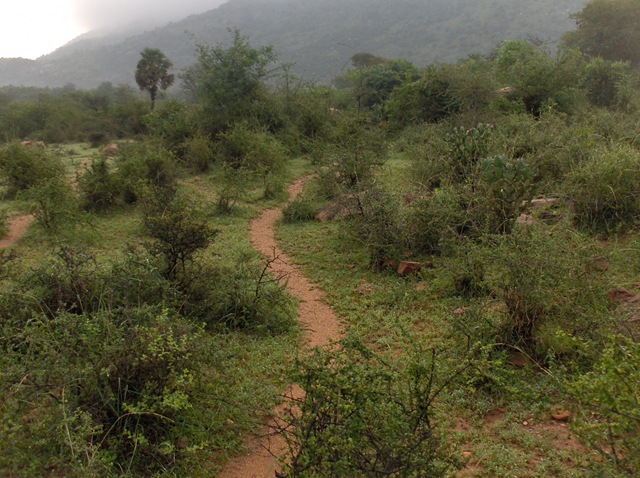
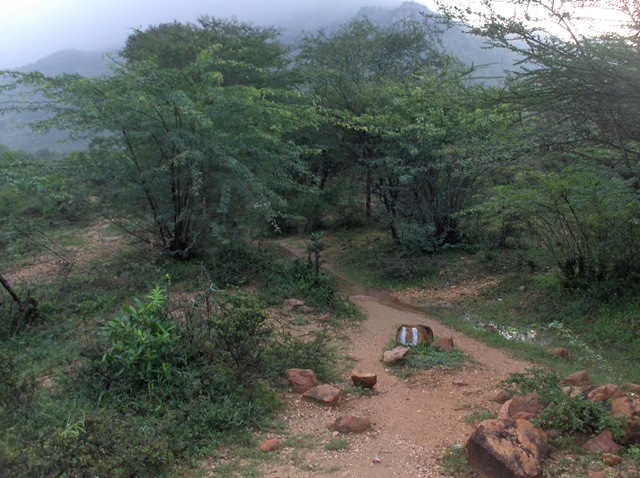
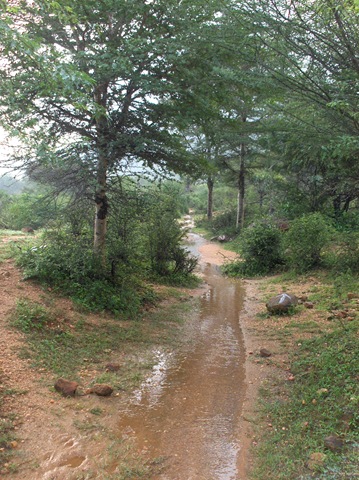
After all the rain, the path, in many places, seemed more like a creek than a path.

HPIM9595

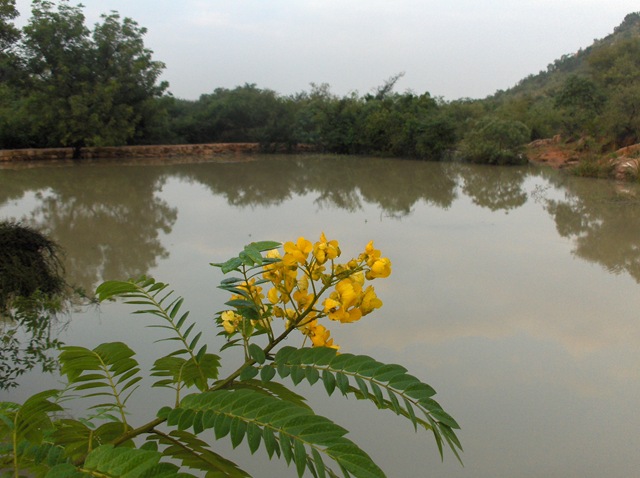
After a bit of walking, you will come to this tank. Today it is very full. There is a path on the other side, too, but now it is under water.

HPIM9603

There is a sadhu’s hut by this tank. The winds during the cyclone have torn his plastic ‘door’ to shreds.

HPIM9604

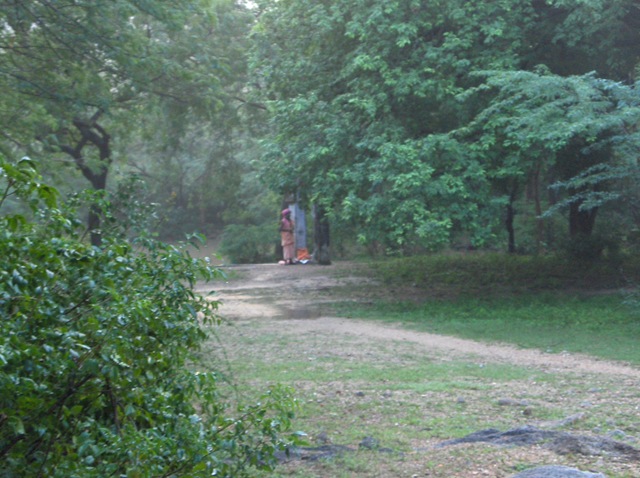
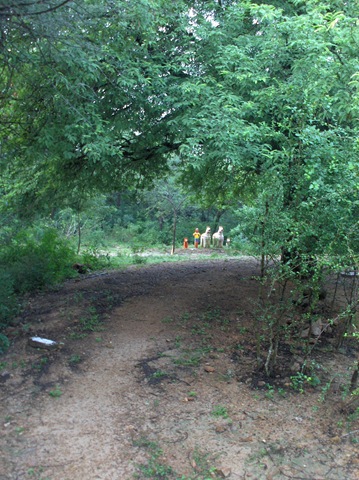
On the other side of this tank, we see some statues.

HPIM9605

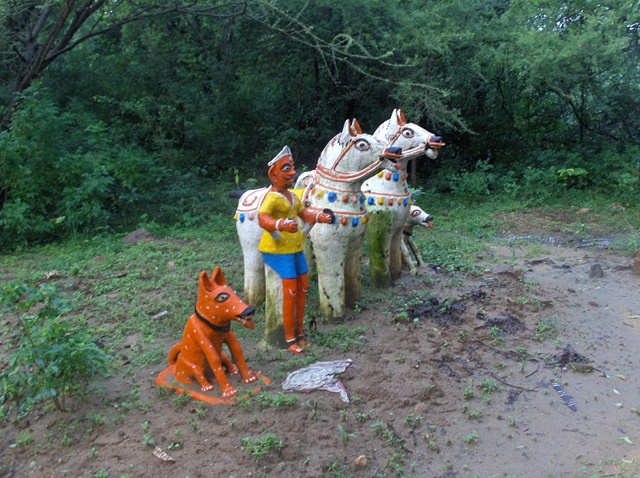
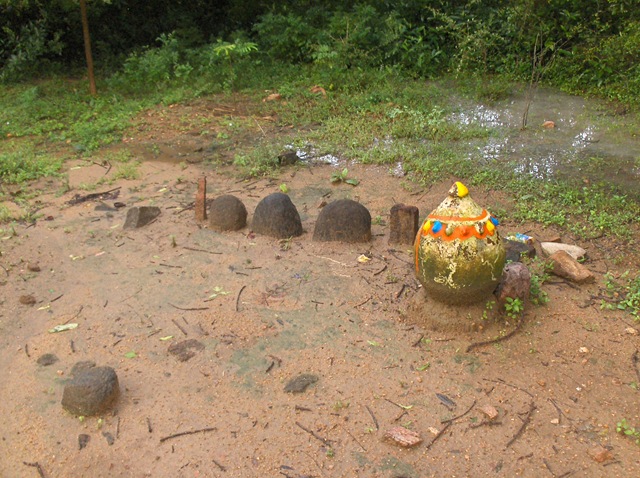
We come closer to these statues. Investigating, we have found that they represent a tribal God, Vediyappan (god of wilderness, or forest). These horses are seen near many temples is this area.

This shrine is located in a spot considered very sacred by the local tribal people. They say that you can hear the gods’ footsteps in this area. That is why the shrine is located here.

I have talked to other local people about these horses, and while they may not know about Vediyappan, they know that these horses stand ready for the god to ride out whenever someone needs protection.

Here is a closer photo of the horses, the god, I guess, and the dogs that are the escorts.

HPIM9608

At the side of the statues is the “primitive” forest temple, with natural rocks worshiped as lingams, etc. These kinds of shrines are in many places in South India. I think one can see the progression from natural shrine, to outside altar, to small holy building, to temple, to temple complex.

HPIM9609

Below, a close-up of the watchman. You can see a shield in one hand. The other hand, though empty now, once held a sword.  These figures are the protectors of the forest from predators, standing ready.

I have researched Vediyappan and not found much. But I did find Ved Ayyappan, said to be the third son of Siva, and to have overcome a forest-thug, Udayanan. Here is a link for Ayyappan. Here is a second link. Maybe this local god is a local version of this legend?  Further research makes me think that this a local name for Ayyanar. Ayyanar is definitely associated with the white horses.

HPIM9615

Arunachala, enshrouded in clouds.

HPIM9620

Now to follow the path onward around Parvati Hill.

HPIM9622

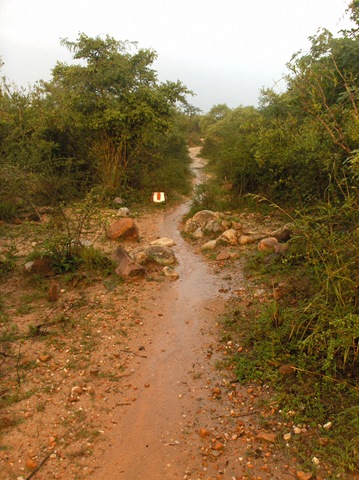
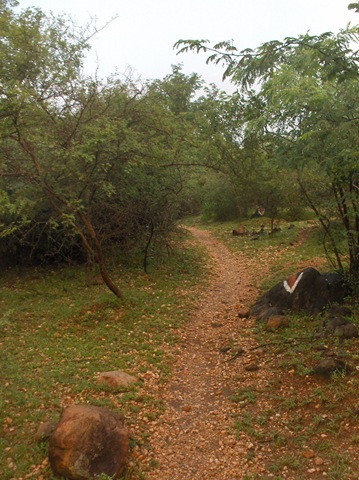
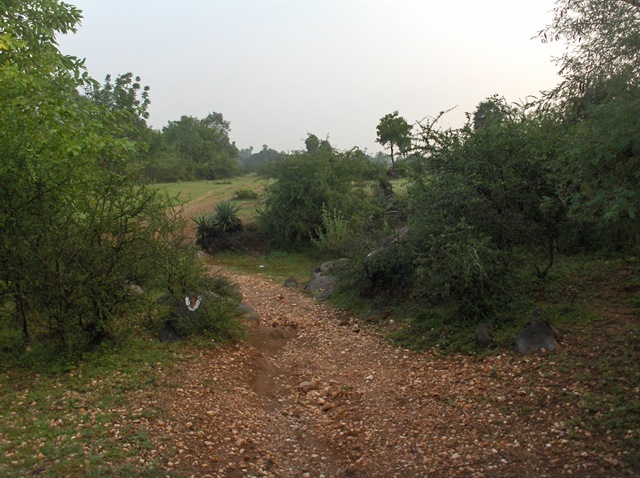
Still wondering if this is the path or a creek? I see a white and red path marker ahead, so it must be the path.

HPIM9624

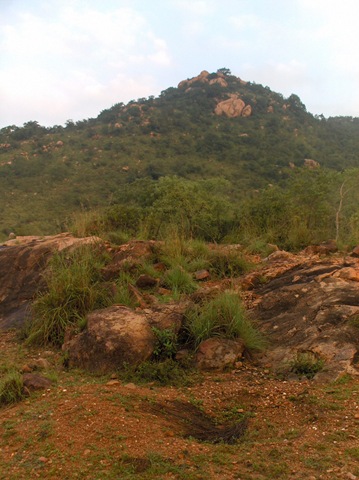
One  of the peaks of Parvati Hill.

HPIM9630

The old Inner Path section that is being restored goes to the right here. Here are two posts about this path. Part one. Part two.

HPIM9632

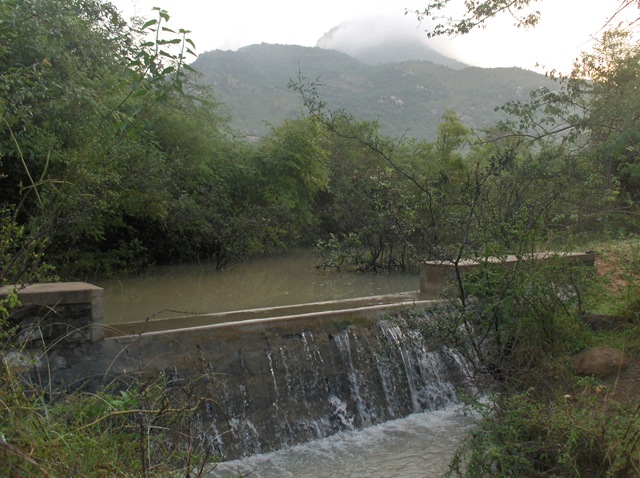
Water pours over this catchment dam, with Arunachala in the background.

HPIM9642

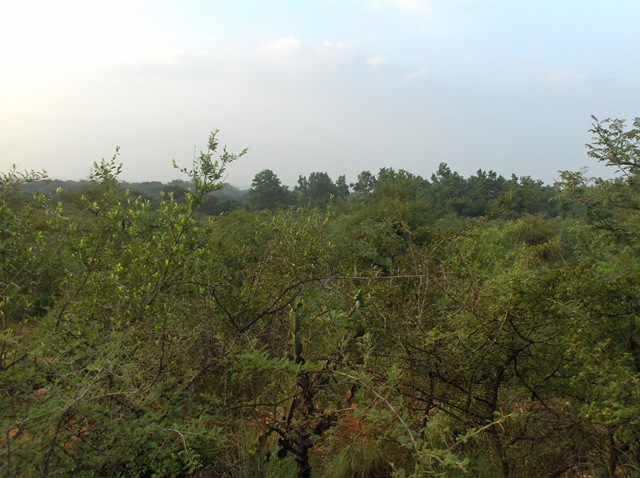
Looking away from the hill, one sees the forest that surrounds the path on this side of the hill.

HPIM9650

The path slogs on through the water.

HPIM9653

One last look at Arunachala before it is occluded by Parvati Hill.

HPIM9655

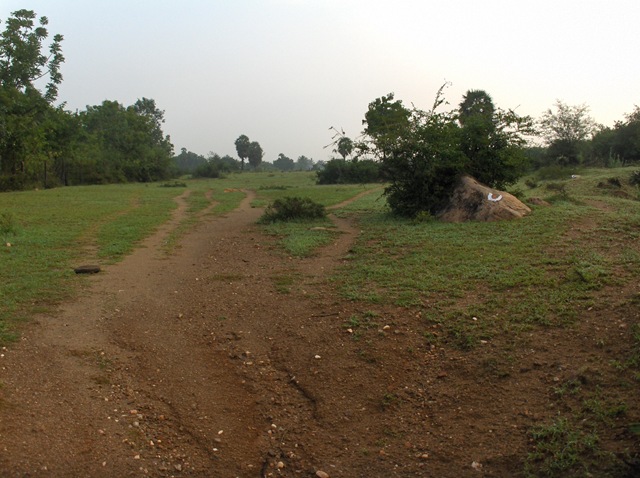
On the other side of Parvati Hill one sees a big tree and rock to the right of the path.

HPIM9657

Coming closer, you can see a path off to the right.

HPIM9658

The side path leads through the bushes.

HPIM9659

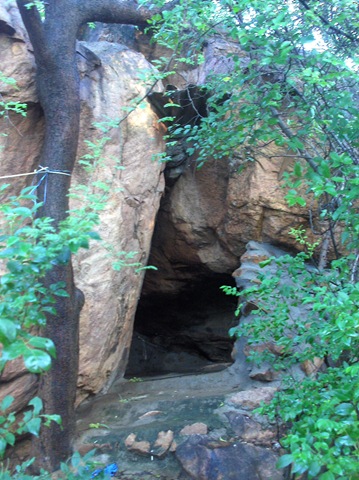
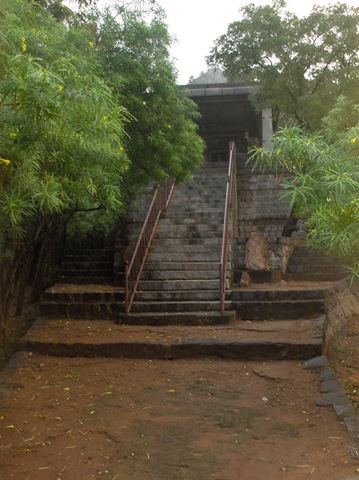
And to a nice cave, just off the Inner Path. We had walked by this spot for several months without noticing this cave.

HPIM9669

Inside the cave is a cement floor, dry even after the last week of rain. Notice the rock and cement work to the right  of the doorway.

HPIM9663

Back on the Inner Path.

HPIM9671

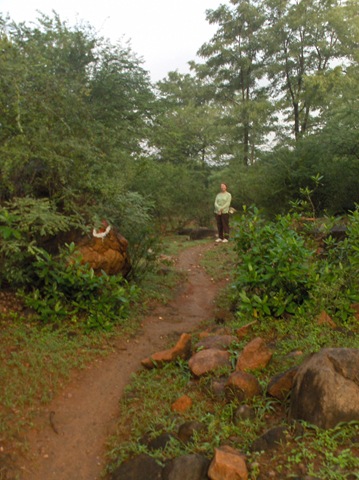
For a bit, the trees change, the general color seems a darker green, and there are the big trees like these behind Carol.

HPIM9679

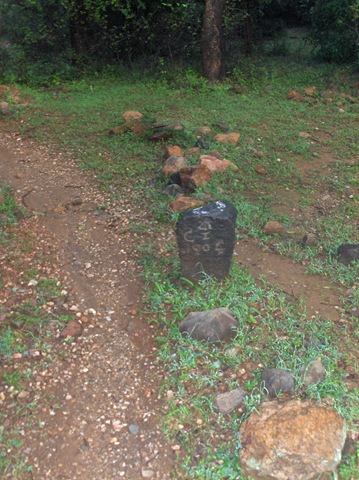
Here is a stone survey marker dated from 1904. There are several of these around the hill, all from the same approximate period.

HPIM9681

To the left is a big intersection with another path.

HPIM9682

Follow the path to the left.

HPIM9683

You come to Kannapar Shrine. There is a path from Girivalam Road that takes you right to this spot.

HPIM9688

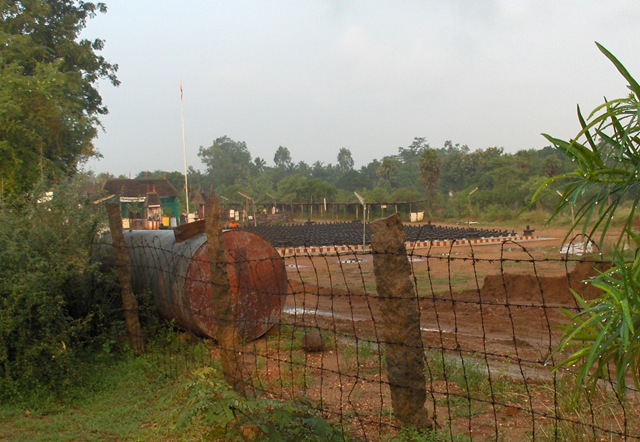
Newly built next to Kannapar Shrine is what I think of as a ‘lingam field.’ This is one of the young Nithyananda‘s facilities. Here I think there are 1008 lingams.

HPIM9689 closeup

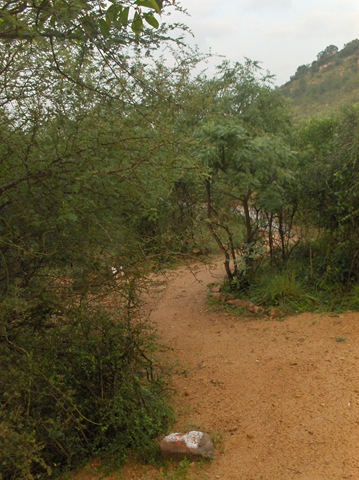
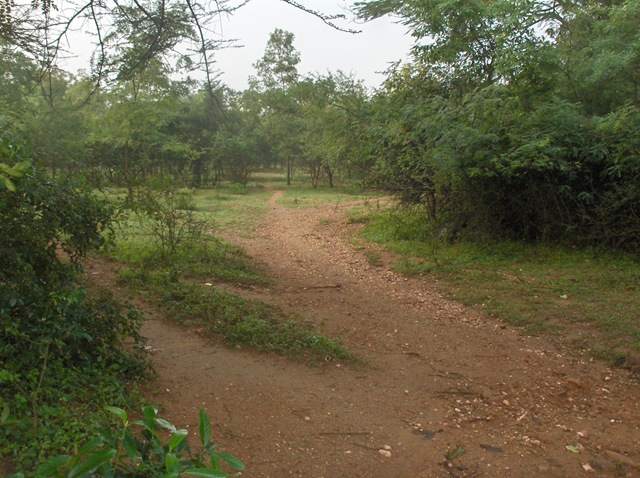
Back on the path, now on the north side of Parvati Hill. The path is pretty wide here.

HPIM9693

After a bit more walking through the trees and brush, the terrain opens up.

HPIM9702

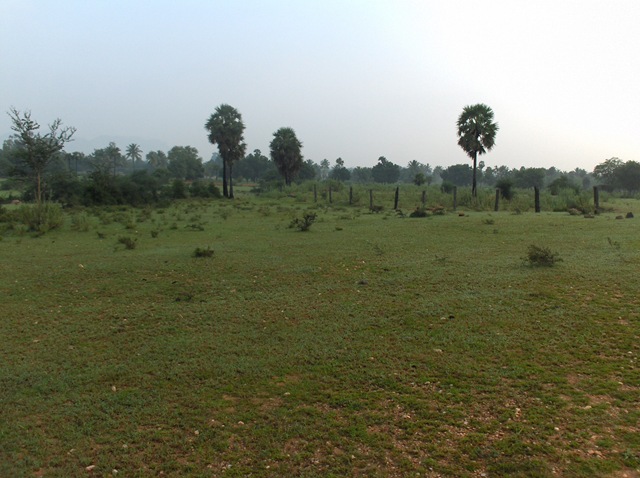
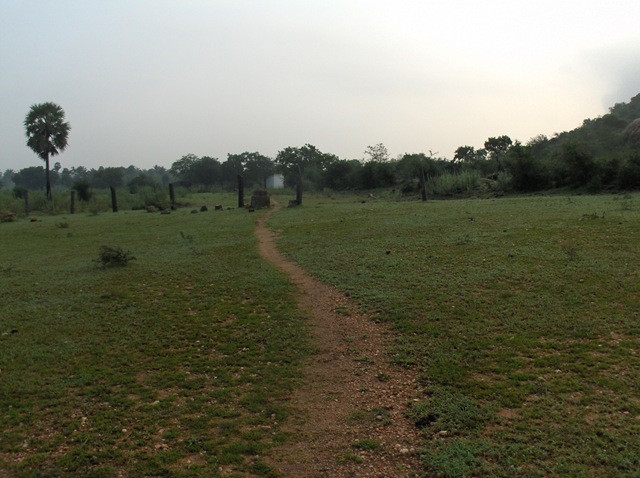
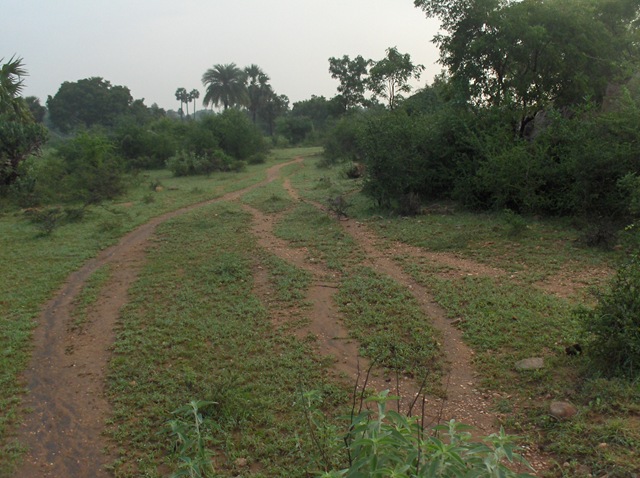
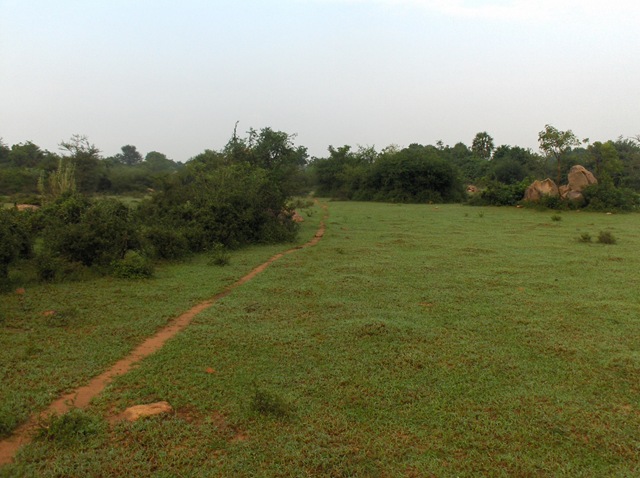
We walk through a wide open grassy area. The Inner Path goes to the right of this photo. We walk through the center path. It seems easier and more direct.

HPIM9703

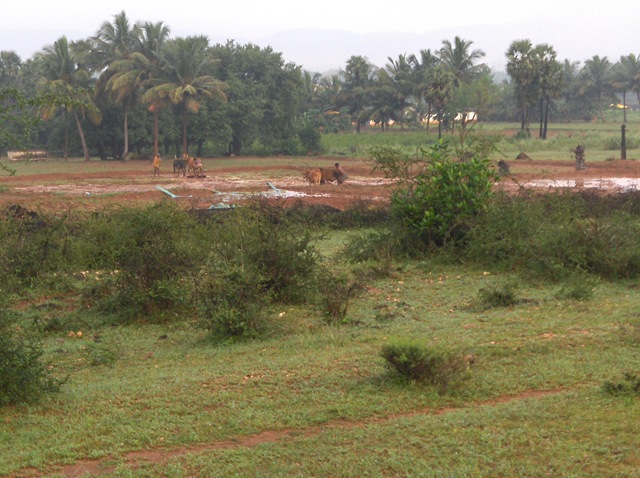
To the left is a field, flooded and being plowed by a man behind two bullocks.

HPIM9710

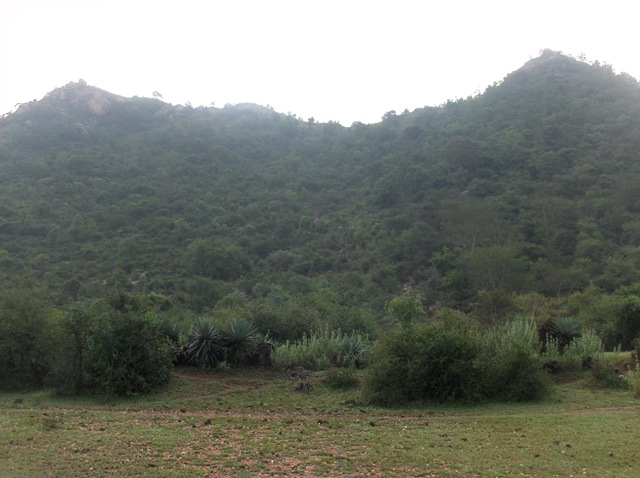
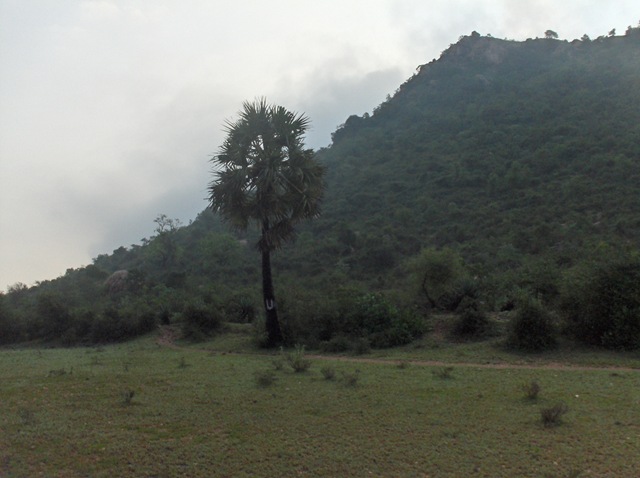
To the right are the twin peaks of Parvati Hill. From the north side this time, though.

HPIM9711

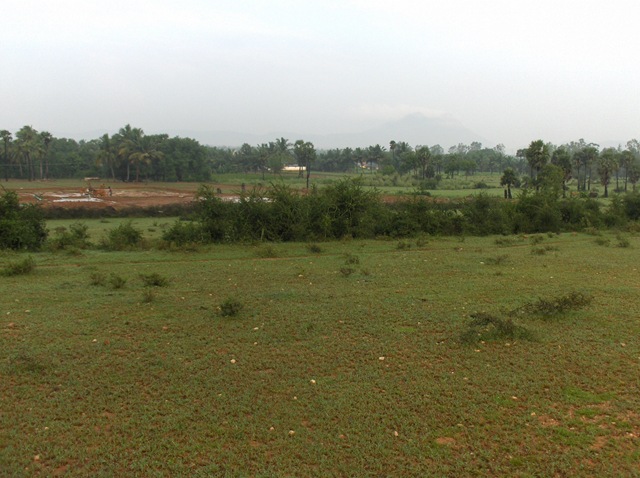
For a panoramic view, I stood in one place and swung the camera from left to right. Panoramic shot 1.

HPIM9713

Panoramic shot 2

HPIM9715

Panoramic shot 3.

HPIM9716

Panoramic shot 4.

HPIM9717

Below, still walking along the trail. This small house is the only one close to the path on this side of the hill. I have seen a sadhu there, accompanied by another man.

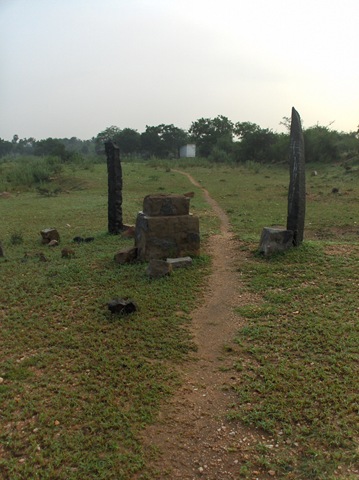
In this picture there is another stone marker of some kind. Obviously meant to mark something. But it is not associated with the property line and line of posts.

HPIM9718

Following the path(s) around the hill.

HPIM9725

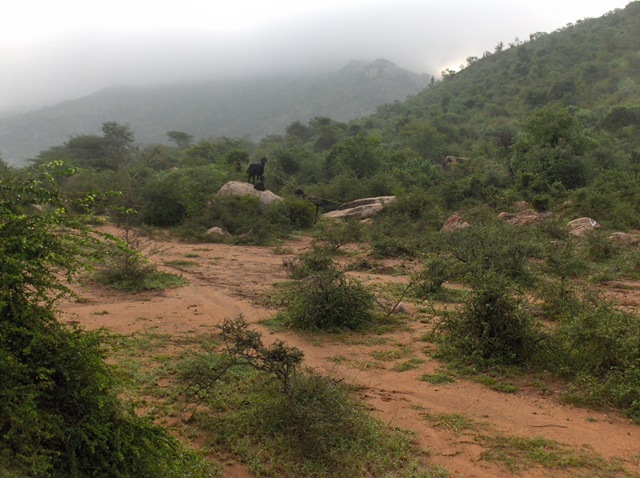
Look, on the rock ahead is a black goat.

HPIM9733

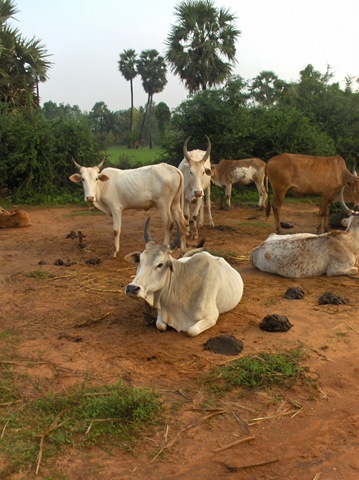
We pass the herd of bulls that seems to live here. They are always in this spot as we pass by in the morning.

HPIM9738

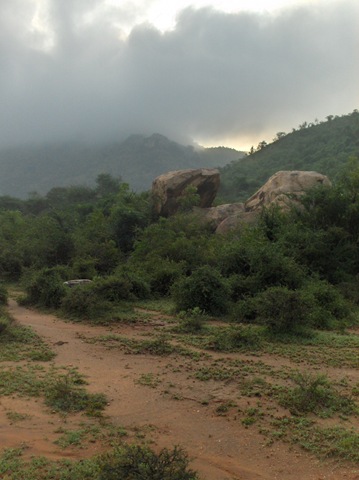
The clouds above the hill, a spot of clearing over one of the passes over the hill.

HPIM9740

The path goes through this open area towards Arunachala hill. From here, you usually see the structure, ‘The Elephant.’ Today the clouds obstruct The Elephant.

HPIM9743

Looking towards the path over the hill.

HPIM9748

A bit more through the grassy fields and clumps of trees.

HPIM9750

I know we are getting close to the end of this section because of the palm tree to the left of this shot. The path winds through these scrubby low bushes.

HPIM9757

We are joining the main path again here.

HPIM9761

Or is it the main creek?

HPIM9762

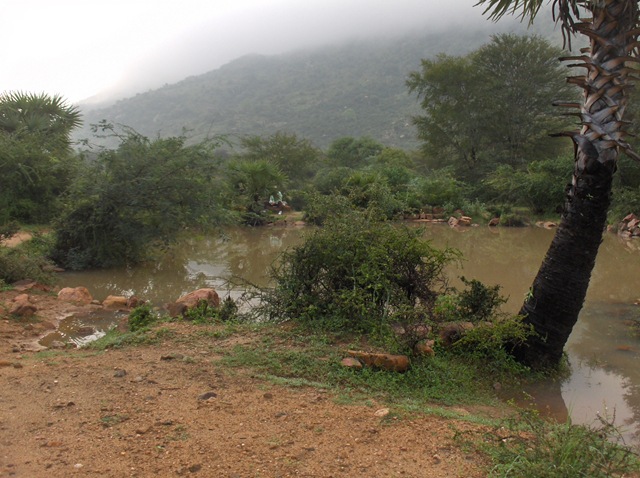
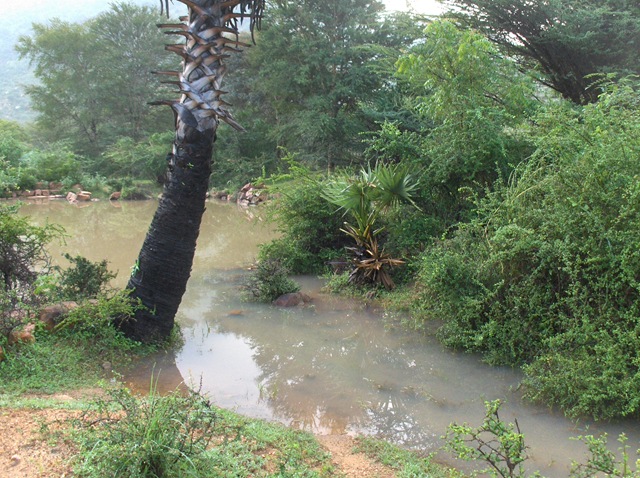
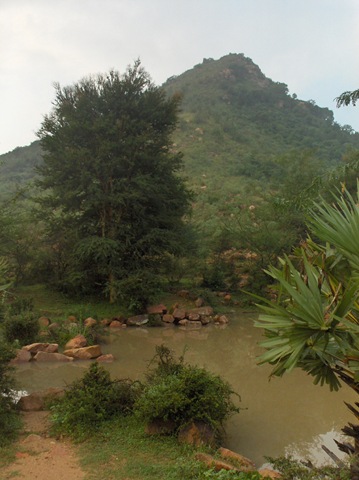
The ‘Frog Pond’ (as we call it) is over its banks. We cannot even get to where we usually sit for a rest without wading through the water. Today we don’t even try.

HPIM9764

We usually walk to the right here. Not today.

HPIM9765

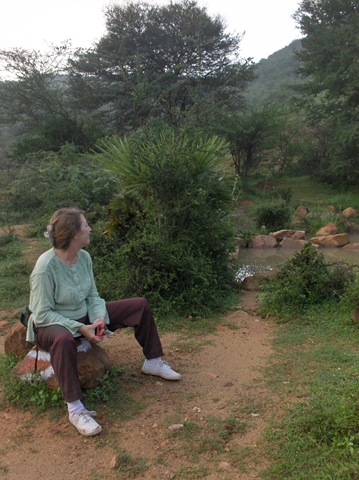
Carol sits for a bit. So do I. This is the end of this section. We rest before we proceed to the next section, which we call, ‘The Elephant.’

HPIM9767

Below, the east end of Parvati Hill from the Frog Pond.

HPIM9768

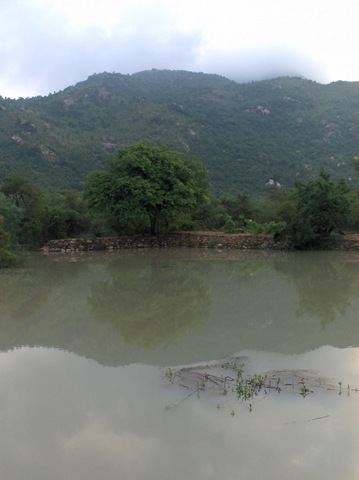
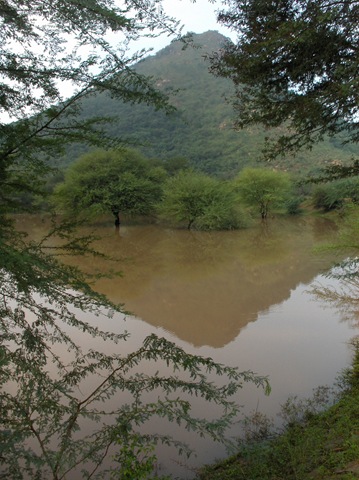
Parvati Hill from a bit further on the path, reflected in the now-full northside basin.

HPIM9782

Related Posts:

Kattu Siva path Renewal – part 1

Kattu Siva path Renewal – part 2

Kattu Siva Cave

Kattu Siva meditation Perch

A Path Across Arunachala

Inner Path – Southwest Side

Inner Path – South Side from Ramanasramam

Holy Feet

Harsha's avatar

The Secret Of Enlightenment: By Dr. Harsh K. Luthar

Dear Friends:

After you have practiced meditation for many years, at some point the questions may arise:

1. What is Enlightenment?

2. How does one get Enlightened?

3. What is the secret of Enlightenment?

Although the word Enlightenment has much glamor associated with it, it is a very simple thing. Enlightenment means to simply rest in one’s own authentic and original nature which is one’s own Self. This is the state of quiet peace whose very nature is Awareness and Ahimsa.

One becomes Enlightened by hearing that there is such a state of peace and beauty, and then by engaging in meditation and inquiring into one’s own nature by going within.

For ripe seekers, the secret of Enlightenment is told and it is this.

Be easy and natural in life.

Do your work and play your role in the world as best as you can.

Do not be much attached to success or failure.

Do not mind the mind but instead focus on the quality of awareness that permeates it.

Finally, as the awareness of awareness becomes strong, let the mind glide into the Heart and be free.

Harsha's avatar

The Art Of Leadership: By Prof. V. Krishnamurthy

The motivation for writing this article arose from my speech while chairing a session on ‘Wisdom Perspectives on Leadership’ at the First International Conference on ‘Igniting the Genius Within’ at the Indian School of Business, Hyderabad in October 2008.

Leaders and teachers have always used stories to capture our interest and attention. So I am going to tell you a few stories and leave you to infer the lessons yourselves. One thing I assure you, all the stories are real.

Inspite of all the books written upon Leadership, it is not something that is learnt from books or by tuition. One recognizes it only by the extent of the change caused by that leadership and by the quality of that change.

Individual contributors like a writer, an artist, painter or designer produce something which bring in appreciation and pave the way for the contributor evolving into a role model for a new pattern or a new style of work. But a leader does not necessarily merit his leadership by any such material productions or contributions. What he or she does is to cause others to think out of the box, to act innovatively and to behave differently. The contribution of leaders is the change they cause among those who are influenced by them.

If this change rollerskates into further changes in future generations, that becomes a unique legacy, the leader’s legacy. From the point of view of such legacy for the longest period of time transmitted to the largest number of people there is none to beat Valmiki and Vyasa of ancient times, or for that matter, Gautama Buddha and Jesus of later times.

Acts of leadership occur surprisingly even from unexpected quarters. When you analyse these they turn out to be the results of internally inspired responses to certain challenges of the context and time. A challenge is not asking whether it is possible or not. It is about whether the mind is capable of freeing itself. To respond to it one must have the quality of intensity and immediacy.

A rare act of such genius, occurs in a narration in the fourth chapter of Chandogya Upanishad. Satyakama was one of the reputed Vedantic teachers mentioned in the Upanishad. But the birth of Satyakama was only of negative repute. His mother Jabali was a serving-girl, a parichArikA, serving for hire at various houses, “resorting to many” and was therefore unable to name her son’s father. Satyakama had therefore no gotra, no caste, no lineage. When he left for the gurukul, wanting to learn all the Shastras, she told him to announce himself as her son and therefore he should call himself Satyakama Jabala. He told his guru that very truth and that declaration earned him the approbation of his guru who concluded that this honest acknowledgement of a truth of such damaging nature could not have come from anyone who did not have the noble qualities usually associated with Brahminhood, and so he initiated the boy and proceeded further with his education. This decision of Jabali to acknowledge this damaging truth, transcending the cultural taboo of the times, must be considered a daring act of leadership.

Leadership turns out to be an art in the hands of the leaders; in fact it is the enabling art of progress. At the same time it is also a scientific process that may not have to be studied as a methodology but should be allowed to evolve over a period of time according to one’s personal traits of leadership. It is one’s nature that gets in the way of the fructification of leadership traits that may be dormant in one’s personality.

Ancient books like the Mahabharata have numerous lessons to teach us these personal traits of leadership. Just to take one example, in the Mahabharata we have the account of the divine sage Sanatsujata teaching the basics of philosophy to King Dhritarashtra, the blind father of the hundred Kauravas, who was blind not only physically but in terms of his stupid and passionate fancy towards his unprincipled sons. Sanatsujata, amidst his technical exposition, also hits the rock bottom of naivety in mentioning six elementary virtues as the most fundamental for any living being, and certainly are the gateways, for leadership. These are truth, straightforwardness, sense of shame in doing wrong, control of senses, purity and education (*satyArjavahrIr-dama-shauca-vidyAH*).

Among these I want to focus on the third, namely, the sense of shame while doing adharma. In Sanskrit, akArya karaNe lajjA. It is also known by the one word ‘hrIh’. The central problem in the morals (both in public and private life) of modern times is the absence of any sense of shame while going against the accepted norms of morality. For the health of the society it may be justified to question certain norms, but in all practice the sense of shame in doing wrong was the one sure insulation the previous generations had against a degeneration of morality. Without the virtue of hrIh, one goes down, by succumbing to temptations to do wrong. In fact in these days of fear of youngsters getting addicted to drugs or extremist fads, the one virtue that should be inculcated in them even as children is hrIh. Even if this means swinging the pendulum back towards a conformist approach our civilisation ought preferably to have this swing.

It was by sensing the all-round moral degradation that in modern times, Sir M. Visveswarayya, a visionary par excellence, before he accepted the prestigious office of Dewan of Mysore, called all his relatives and friends for a grand dinner and announced therein that he would accept the prestigious office only if they assured him that none of them would come to him for any favours! It may appear to be a quick-fix strategy but was indeed a daring act of leadership in the context. Such instances are certainly unique legacies that leaders are remembered for.

In the same Mahabharata, while Sanatsujata listed the six most fundamental virtues that any aspirant to leadership should have, the divine roving sage Narada, while meeting King Yudhishtira who had just been made Crown Prince in Indraprastha, asks the King some rhetorical questions one of which is whether as a king and administrator he has avoided certain six evils. Coming from Narada to Yudhishtira, the paragon of virtue, this list is of great importance. Here is the list of these six evils: sleep, indolence, fear, anger, softness, and procrastination. (*nidrAlasya-bhaya-krodhAH mArdavaM dIrghasUtratA*). No aspirant to greatness can ever afford to fall into any of these habit-forming evils.

Narada’s advice is a warning to all political leaders, scientific workers, project managers and administrators. All these people complain about lack of time to do his or her job. One’s time-organization comes not a little from the proper organization of how much one sleeps and when. Sleep and Procrastination are two of the greatest obstacles to greatness. Particularly the latter one is a too familiar scene in present day politics and beaurocracy.

‘Fear’ is understandably in Narada’s list. Ferlessness is a great virtue for a would-be leader. Gandhiji was able to bring to the Indian masses the quality of fearlessness, more than anything else, which alone led them to that great event of attainment of Swaraj. Before his time they were afraid of almost everything, of the Government, of the Police, of the caste system, of the rules of a tradition-bound society, of the westerner, of beaurocracy, of prison, and, most of all, of violence. That you can resist and fight all these non-violently was his teaching and in order to make the whole thing work he implanted into their minds the virtue of fearlessness by his own acts of self-sacrifice.

True leadership does not reside merely in techniques or in the discovery of new technologies. It exhibits itself in the integration of several experiences that carry authenticity, into one voice for the service of others. It is not the head alone or the heart alone. The head does not hear anything until the heart has listened. What the heart knows today will be understood by the head only later. The heart might say: Don’t get lost in resisting and battling against things; but dedicate your energies to fight for something, instead of against something. Make it the most important habit of your life. Gandhiji fought for honesty and straightforwardness even when he appeared to fight against British Imperialism. That was why he, sitting inside the prison, stopped the ongoing civil disobedience movement which he himself had started, because the Champaran incident of violence failed to broadcast his wavelength of honesty and straightforwardness. He wanted every thought, every word and every deed to cherish and nurture the seeds of integrity and non-violence for that future independent India of his dreams. He not only wanted so, but made it a habit of his.

A transactive model of leadership only builds skills and competences. But great leaders like Gandhiji belonged to the transformative model of leaders which creates a fundamental shift in point of view, values and purpose. But it is not only such great leaders who do the transformations. Even an ordinary incident where one goes beyond one’s authority becomes the seed of a significant transformation. Rosa Parks, an elderly black woman went beyond her authority in 1955 when she refused to move to the back of a bus in Montgomery, Alabama. Her behaviour distinguished itself as an act of leadership, because it was that spontaneous act of hers that was used by her and other civil rights leaders to focus public attention and responsibility on the issue of civil rights. The public response was to raise the necessary outcry of protest that catalysed the civil rights movemement of the 1960’s.

Here is one more example of something that emanated from a great leader, India’s greatest industrial giant of the early twentieth century, that taught his contemporaries a fundamental shift in purpose and perspective, of the ordinary act, known as charitable benefaction. Jamshedji Tata, in the twilight years of the nineteenth century donated his own house in Bombay to the cause of scientific research and development in India. His friends and relatives from the Parsi community pleaded with him to change his mind and donate it to the cause of the development of the poor in his own community. His reply to them deserves to be printed in gold: “What advances a nation or community is not so much to prop up its weakest and most helpless members as to lift up the best and most gifted so as to make them of the greatest service to the country. I prefer this constructive philanthropy which seeks to educate and develop the faculties of the best of our young men”. It is that farsight of this great visionary leader who gave a magnificent shift of perspective to a traditionally respected act of charity, that finally gave this nation the topmost research organization of science and engineering, the present Indian Institute of Science.

Talking of transformative model of leadership I cannot but recall the phenomenal transformation that my own institution, BITS Pilani, went through in the period 1970 to 1988, during which I was one of the two Deputy Directors, in addition to my duties as Professor of Mathematics. In that capacity we were responsible along with a few others for the entire innovative restructuring and developmental process of BITS, from its earlier run-of-the mill type of traditional Indian university to its modern style of a technological university.

We were pioneers in this total change. The epoch-making decision that we took as early as 1970 was to thrust forward all the way across the board instead of tackling one issue after another in isolation. In the growth of an organisation from its primitive state, without violent damage to its men and materials, such a strategy did make the path hard and long but it worked.

The reforms that were thus achieved included: A system of admissions based on an all-India merit index; an integrated four year degree programme in which specialisation follows a common broad spectrum of foundations; Science degrees linked with a professional dual degree so that both attract the top layers of the cream of the country; student involvement in every academic developmental and monitoring activity; intensive teacher training for all teachers through special on-the-job workshops; industry linked internship for every undergraduate for as long as six months which is duly evaluated by professionals; emphasis on mathematical-cum-analytical foundations for every programme; flexible academic regulations which gets continuous work done by students and also continuously evaluated by the concerned teachers; active production of text-books tested by course development and class use; and computerised development of all infrastructure.

All of these were started in the seventies from scratch. Scratch does not mean we started with a clean slate. We actually started with all the failings that all Indian universities shared in the educational milieu of India. It was certainly not an overnight transformation. We worked the hard way 365x24x7 for 18 years before we handed over the first phase of an almost finished product wherein all the educational ideals which had been talked about since 1947 but scarcely implemented in any of the universities, had been introduced, implemented, online corrections made and sustained and finally the legacy of this transformation was handed over to a team consisting of the next generation who were themselves trained by us. Participating in this gigantic process, we ourselves got transformed from ordinary class-room expositors, to leaders of transformation. We happily see already that these transformations are roller-skating into further transformations.

One other major quality of leadership that can be recognised in all leaders is an unwavering conviction and faith in the cause for which one is leading. In the case of Gandhiji this was his faith in Truth and Non-violence; in the case of Nehru it was his faith in the principle of democracy. In the case of Prabhupada, who in the sixties and seventies of the last century revolutionised thousands of the western world into adopting an Asian religion of devotion, totally new to them, it was a never-vacillating faith in divine help. He singlehandedly started, in 1959 or so, to write, print and publish the monumental volumes of his own English translation and commentary of Srimad Bhagavatam, a Purana of 18000 verses in Sanskrit, almost when he was nearing sixty years. This unique decision of his turned out to become, within the next ten years, a fantastic money spinner for the new world-wide organization called Iskcon (International Society for Krishna Consciousness), which he founded. The remarkable challenge that he undertook and successfully accomplished was the transformation of the most materialistic youth of the times, the rebelling anti-conformist westernised youth who were products of the luxury, affluence and license of the West — not just a few, but literally thousands of them — into godly personalities with the loftiest of spiritual and ethical ideals. Till he was seventy he struggled alone to implement his master’s injunction of propagating the glories of Lord Krishna and transmitting the treasures of SrImad bhAgavatam. But even in the land where these had been held, without any doubt, in superlative esteem by one and all, he could not succeed. Till he was seventy, only three books were written by him, only one disciple was initiated and the worldwide society of Krishna devotees was only in his dream. But in the next twelve years, he wrote sixty books, initiated a few thousands and the society of his dreams came to fruition with more than one hundred centres all over the world. All this was a marvel of leadership in just the last twelve years of his 82 years of life, achieved by an unwavering conviction and faith in the presence of divine help.

Appayya Dikshita who lived for 72 years in South India in the 16th century is another monumental example of what a transformative model of leadership could be. He was the guiding spirit of a great movement in which he organised the services of a large band of volunteers trained by him to disseminate among the masses his great life mission of reconciliation of warring religious groups, particularly Shaivism and Vaishnavism. He was born in a very hot age of bigotry and vigorous proselytism. The adherents of the creeds were mostly cantankerous persons who mistook acrimony for devotion. It was in this dark atmosphere that Appayya Dikshita rose to such heights of fame by propagating, through his ambassadors of tolerance, that the religious books of the rival schools of thought did not proclaim mutual exclusiveness or hostility. His massive scholarship and spiritual wisdom provided him the seeds of authenticity – one of the most important requisites of leadership –for this legacy of his.

I shall wind up by mentioning one more name, that of V. Krishnaswamy Iyer, (1863-1911) whose prodigious achievements within a life of 48 years are a bagful. Starting as a lawyer in the Madras Bar, he became a judge of the Madras High Court and later served as a member of the Viceroy’s Executive Council. He played a significant role in supporting the move to send Swami Vivekananda to the Parliament of Religions. He founded the Ayurvedic College of medicine and a free Dispensary in Mylapore. He was pivotal in starting the Madras Law Journal on the lines of critical Law Journals in Europe. In 1906 he started the Madras Sanskrit College and provided for free education to students therein. In the same year when there was the sensational case of the crash due to bankruptcy of Arbuthnot Bank it was he who was responsible as the contending advocate for bringing the culprit to justice. And as a consequential contribution to posterity he played the key role in the founding of the Indian Bank soon after. The 1907 session of the Congress Party was held in Madras mostly due to his efforts and he was instrumental in striking a rapport between the moderates and extremists in the Party, particularly after the Surat split of 1907 in the party. He was responsible for introducing a number of educational reforms in the University of Madras. During the minority of the Shankaracharya of Kanchi he was the foremost to see that the Mutt did not fall into wrong hands. In all these instances the silent unconscious unseen influence of his own spotless character backed up by a spiritual conviction was the one thing that surely contributed to his achievement of leadership.

And, most of all, seizing the opportunity at the right time even if it means taking a risk, is important. I will give you the most ancient example for this. In the Upanishadic times there lived a great towering personality in the field of spirituality, by name Yajnavalkya. That he was not only great, but great as a leader with conviction and confidence, came to light in a much-talked-about seminar in the court of King Janaka. King Janaka himself was a royal householder-philosopher known for his scholarship as well as his adherence to philosophical insights. Janaka arranged this seminar in which he announced an on-the-spot-competition. Having invited all the stalwarts in Vedanta for a yajna, Janaka provokes them into a discussion by announcing that he has earmarked one thousand cows, each with a bag of ten gold coins and all these constitute the prize for the one among them who can declare himself to be the most erudite in vedas and its accessories. The entire assembly is stunned at this announcement, stupefied by the challenge of the occasion and the seriousness it demanded and kept silent. But after a little period of silence, Yajnavalkya rises up and with his assistant makes preparations to take possession of the cows. Then it is that the assembled scholars begin to challenge him one by one. Each one asks him several questions about the subtleties of the Knowledge about the Absolute. Yajnavalkya shoots forth his answers without any hesitation or confusion and with such clarity that every one had to withdraw and sit down. Finally one lady, Vacaknavi Gargi, announces that she is going to ask just two questions of Yajnavalkya and the questions will be of such nature that if he answers them well, there should be no more doubt about who carries the day. And that is how Yajnavalkya carries the day. The technical text of the discussion described elaborately in Brihad-Aranyakopanishad is beyond our subject today. But what is relevant to us in the context of the topic of Leadership is the style of the leader who rose to the occasion irrespective of the august nature of the assembly and the serenity that was demanded.

The last quality that I shall emphasize is a confidence in oneself. It expresses itself in several ways. I shall only give three examples from three different perspective. A filial assurance of perspective came from the mother of the astrophysicist Dr. S. Chandrasekhar when she alone decided, against the recommendations of all the rest of the family, that her son, inspite of her own serious illness, should accept the offer to go abroad for his higher studies, when he was around twenty.

A perspective from a logical reasoning was shown by Prof. G.H. Hardy who took a bold risky decision after several deliberations with Prof. Littlewood, on the matter of what appeared to be a cranky freak technical letter from an unknown unheard-of clerk in distant Madras Port Trust.

A third perspective of confidence in one’s own out-of-the-box thinking was shown around 1920 by the budding music maestro Ariyakkudi Ramanuja Iyengar who adopted and persisted with the then-unusual style of slapping the palm on one’s thigh to keep the Tala. The orthodox brahmin elite of Madras did not particularly like this because according to them this kind of slapping is what is prescribed as a cremation ritual that a son does when he circumambulates his father’s dead body at the cremation ground. So they protested with one voice. And there was also a second kind of protest from another quarter of the public because according to them this slapping is against stage manners and constitutes an insult to the long Tamil tradition of musical genius which should sense the rhythm purely orally. These protests from two complementary quarters did not shake the resolve or the wisdom of the budding maestro but they however posed such a challenge to his closest friends and well-wishers that they finally sought the opinion and verdict of the Kanchi Mutt. The then new head of the Kanchi Mutt, the young Chandra-sekharendra Saraswati, was being given scriptural education by the Pundits of the Mutt and they gave the verdict that the slapping of the thigh while in the sitting posture did not constitute a sacrilege. There ended the matter, Ariyakudy’s star was rising and a new era started in the history of Carnatic music.

Before I wind up I should tell you the story of how in my own life I was once sucked into a certain leadership position that unexpectedly turned out to be not so enviable at the time, though at this distance in time I can talk about it with pride.

Ninety of us Indians travelled to the United States in August 1962 as Fulbright Travel Grantees. Our sponsors for the entire trip was USEFI, Delhi. We had a four-day orientation in Mumbai (then called Bombay), at the end of which we were divided into three batches of 30 each, each batch having a different travel itinerary. However, in the first lap of our journey by boat from Bombay to Naples we were all together. At Naples the batches separated and went their different ways. At Bombay itself at the end of the orientation, leaders of the three batches had been elected. I was elected leader of my batch. There were 25 men and five women in my batch. Most of them were headed for a graduate education in the U.S. Five of them including myself were going to take up faculty positions in different universities in the U.S.

At Bombay they gave our tickets upto Naples and further told us that at Naples a representative of the Council of Student Travel (with HQ in Paris) would give us necessary money as well as tickets for the onward journey. Our itinerary was to alight at Naples, travel by train to Rome, and again travel by train from Rome to Rotterdam from where we would take another boat to New York. A student representative received us at Naples but he and the taxis at his disposal were not prepared for our 90 pieces of luggage for the thirty of us. By the time we could find a bus for us to carry our luggage and reach the trainstation, our train had left. We left by a later train and arrived at Rome in the evening.

One Mr. Marconi, also a student, took care of us for the evening and night, gave us just one fourth of the money we expected to get, and the next morning put us in a train to Rotterdam. Only after he put us on the train we came to know that no reservation had been done for us but actually we had been shoved into a compartment which was completely reserved from Milan onwards. So all of us, thirty Indians along with 90 pieces of baggage had to alight in Milan, around 5 PM, completely stranded. When the train was departing from Rome Mr. Marconi had signalled to us that he would send a telegram to Milan station master and set matters right; but obviously this must have goofed up somewhere. We had no idea of when our boat was to depart from Rotterdam the next day. The Station Master at Milan tried to help us by suggesting that we could go by the next train, leaving around 11 PM but it would reach Rotterdam only late evening the next day and even in that train there might not be accommodation enough for so many of us!

In the meantime our group of 30 had several different opinions (some of them as crazy as you can imagine) as to how to meet this crisis situation. I could get constructive help and advice from four or five in our group of whom I cannot forget Dr. A.M. Vaidya, Dr. Gautam and Joseph Edwards. But it was an eye-opener to me that even in such an adult population of well-educated youths, about half a dozen in our batch were so upset at the turn of events as we left Rome, that we had to treat them almost as children lost in a mela. There were another two or three who were so argumentative that they almost threatened to break from the group and run away in Milan.

We needed all our wits to keep them in the group with the rest of us. There were a few others who cared the least, whatever might happen; and so this was the other extreme, namely, total indifference! Well, in about 24 hours I learnt a lot, by the hard way of course, about the hazards of leadership! The five of us who could keep our cool took an unusual decision to immediately contact the US Consul in Milan (whose office we learnt was within half an hour walking distance from the Station). As our good fortune would have it, he had still not left the office and he promised to stay till we arrived at his office. He made the necessary phone calls to Paris and Rotterdam and made some arrangements the exact nature of which was not then clear to us. But he asked us to go back to the Station and be ready to board the 11 PM train.

What actually happened at 11 PM was very Indian! The train was to start from Milan so as it was backing into the platform from the yard, we noticed that thirty towels had been used to ‘reserve’ thirty seats for us in the very familiar way in which we Indians used to appropriate seats in trains in those days when every seat was free for all!. At Rotterdam the next day our boat, the Waterman, had been made to wait five hours for us, and as soon as all of us got on the boat around 7 PM or so, it whistled off. We found our baggages had already arrived for us on the boat, thanks to the excellent logistics that must have been charted out by the Consul at Milan.

The point of this story is the leadership part that was put to the severest test during the fire-fighting and trouble-shooting and I must say this much in fairness to the story – the majority was always positive and helpful. Even the simple problem of loading and unloading the 90 pieces of luggage presented challenging leadership problems of coordination and discipline. Incidentally, the luggages were really very heavy, because we were all scheduled for travel by boat and we had to tranship them six times in two days ourselves, at Naples, Rome and Milan!

Summing up we may list the qualities all of which, I think, are fundamental characteristics of Leadership. Truth, straightforwardness, sense of shame in doing wrong, control of senses, purity and education – the six fundamental positives of Sanatsujata; Avoidance of six fundamental negatives as advised by Narada, namely of sleep, indolence, fear, anger, softness, and procrastination. To the list of positives should be added: authenticity, a fundamental shift in purpose and perspective where necessary, a spotless character, a mind that can free itself from the shackles of the past and the present, an impeccable confidence in oneself, and most of all, an absolute conviction and faith in the ideal, along with, if I may add, a self-negating humility.

*******************

Harsha's avatar

The True Heart: By Dr. Harsh K. Luthar

Heart

Image originally posted on the Ramana Maharshi FB Page by Cathy Ginter

Dear Friends,

In any language, the term “Heart” is unique. In Sanskrit, the “Heart” is referred to as Hridayam. Hridayam means, “Here is the Center”.

Bhagavan Sri Ramana gave a unique emphasis to the term “Heart” or “Hriydayam” in Sanskrit. He spoke about it frequently as the center of centers in which the mind must find final rest.

In ancient Eastern texts and scriptures, the Heart is talked about in the context of physical health, mental health, and also spiritual health and vitality. Even in English, we intuitively know that the word “Heart” really has multiple meanings.

If someone says to you, “You have a beautiful heart”, it does not mean that the person feels you have a very attractive physical organ beating in your chest.  No, not at all! The statement about the beauty of your heart implies that you, your personality, your essential character have a warmth and glow which others find pleasant and joyful.

When we try to deeply understand a situation, a person, or resolve a dilemma, we inquire, “What is at the heart of this situation”? We say “let us go to the heart of the matter”. We might even look in someone’s eyes and ask, “What is truly in your heart.”

If we are trying to get to the truth, we never ask anyone in a conversation, “What is truly in your stomach or what is truly in your liver?”. That would make no sense. We do not even ask, “What is in your brain?”, unless we are being sarcastic. Sometimes, we might say, “What is on your mind?” But such a statement does not have the same warmth or mean the same thing as “What is in your heart”? 

When We ask, “What is in your heart?”, it is an offer of direct and sympathetic communication. “Let us have a heart to heart talk”, signifies openness for a  mutually respectful and even a loving exchange.

The term “Heart” literally means Truth. When we want to know the Truth, we want to go to the heart of the matter. When I say to someone, “I want to speak my heart”, it means I want to speak my truth. I want to give my true feelings.

Heart means center, or core, which provides the foundation for the structure of our perceptions. The light of the Heart as consciousness reflecting off our latent tendencies (karmas) appears to give color to our thoughts, feelings, and emotions which constitute our personality.

We know and understand and give meaning to this whole universe through our Heart. Truly, to know others is cleverness, but to know your own Heart is wisdom.

The old saying, “Know thyself” means “Know your Heart”.

Through what power do we know the world? Ancient sages have said, Know “That” by which all else is known.

How do we know anything?

When we get up in the morning and open our eyes, we see the world. By what power do we see? By what power do we hear?

By what power do we know of our own existence? No one comes and tell us every morning, “Hey, you exist. This is your lucky day”.  We know we exist. This knowledge does not require external validation.

The French Philosopher Descartes said, “I think, therefore, I am”. However, the sages of Advaita stated thousand of years ago that “I Am” is prior to “thoughts”. Thinking is apriori predicated on our already being.

We know we exist and we know it with certainty. This certainty arises from the nature of the Heart.

If you have known everything but not your own Heart, you will not be fully satisfied. Something will be missing. Underlying our personality, thoughts, mental makeup, physical makeup, there is that power that allows us to be conscious of our being. Conscious of our existence. Conscious of the world of perceptions.

This power has many names in various religions. Ancients called this power simply the Heart. It is one’s own Heart, that is at the core of existence. It is one’s own Self, which shines and radiates through the medium of the mind as pure consciousness.

Knowing the Heart, one knows all hearts and minds. Everything arises from the same One Heart.

Namaste

Harsha's avatar

OM! What Shall I Meditate On? By Dr. Harsh K. Luthar

Dear Friends,

When consciousness focuses its attention on a perceived or imagined object (such as an energy center, point of light, sound, music, mantra, etc.), that is known as concentration and can lead to deeper meditation and samadhi or trance states.

Truly all such techniques, although useful, are inherently and fundamentally flawed in seeing our own nature.

Such methods presuppose that there is something to concentrate or meditate on outside of consciousness. But how could that be?

All point of concentration, all techniques and methods of meditation only exist in consciousness. A person who understands this deeply loses interest in methods of meditation. The consciousness of a Self-Realized sage has settled into its own nature. It is in perpetual communion with itself. Always new and alive and pure being whose very nature is meditation does not concentrate or meditate.

On What Shall I Meditate? And How!

Namaste

Harsha's avatar

Self As Presence. What Is, Is You: By Dr. Harsh K. Luthar

The Truth of Existence is ultimately simple and never absent. It could not be otherwise. Sri Ramana used to say that the Eternal Divine nature cannot be present at one time and absent at another. So we must become aware of our Self in this present moment. It is only in the present that the Self is Realized. That is because the very nature of the Self is Pure Presence. It is Pure Being.

Truth is always Self-Seeing and Self-Being. Self Sees It Self by the power of its own inherent Truth. It needs no external agency for validation.  You do not need anyone to tell you that you exist. You know you exist. Your existence announces itself perpetually and continually. That is the nature of the Self. It is unbroken and the whole mass of Awareness-Existence-Bliss. In Sanskrit, we refer to it as Sat-Chit-Ananada.

Advaita says that Self is the Truth and it is One without a second. There is no second outside of this One to verify its existence.

The Truth is only found by turning within. It cannot be found looking anywhere other than where you are in this present moment. The great Realization is that the Seeker, the one who seeks the Truth, ends up knowing that He/She is the Truth It Self. That is the end of seeking. Where can you look for the Truth when the Realization dawns that you are already rooted in the Truth of Existence.

We are already the Truth. There is nothing to gain which can add something to our original nature. We must See this with our inner Eye. This knowledge is not objective knowledge. This knowledge is purely subjective. That is why we call it Self-Knowledge. It is not the knowledge of objects of perceptions. The best one can say is that It is only what One Is.

Self is Always Self-Awake and complete. The awakened and quiet mind is able to recognize the Self shining through clearly. It is only Self-Recognition through the medium of the mind.

The mind identity that arises out of the Self, and that is of the nature of Self in essence, has the feeling of limitation and weakness due to identification with the body. Many explanations are given for this such as Karma, Maya, etc.

So the practical instructions of the sages emphasize contemplation on the essential nature of identity and existence. This method is known as Self-Inquiry. It involves inquiring into the nature of one’s own being and existence with conviction.

Without faith one can never jump into the arms of the Divine Beloved.

We do not have enough personal strength to go into the unknown. The personal identity cannot step into the unknown without faith. To allow that final surrender to the Divine to take place at all is called Grace.

Faith allows for total and immediate availability to the Divine, which ultimately is nowhere other than in one’s own Self. Without faith, one speaks eloquently of water but does not take the drink and remains thirsty.

Sri Ramana pointed out that any “doing” with the mind presupposes the retention of the mind. It is this very nature of “doing” that preserves the ego identity and does not allow the conscious sinking of the mind into the Self from where it arises.

There is no antidote to this except for faith. The complete acceptance of things as they are (not my will, but Divine will), when it permeates meditation and life, undermines the resistance of the mind.

Faith is important. It evokes Grace. It is the preface to Grace.

What is, is you. Self is Realized in the Present as Pure Presence. It is only your own Eternal Presence. If you pay attention, Self reveals It Self as your own Heart of Awareness.