I felt something come from under the bathroom sink onto my foot.
Like the dance of water it felt.
When I looked down, I saw you. I felt revulsion and disgust.
Is it a crime for one’s form to look so ugly to me? Continue reading

I felt something come from under the bathroom sink onto my foot.
Like the dance of water it felt.
When I looked down, I saw you. I felt revulsion and disgust.
Is it a crime for one’s form to look so ugly to me? Continue reading


You are bursting out of me
In all directions
I wake up
And sing out
Your praises
As soon as I know
I have lips
Again. Continue reading

Recently, on United States’ Day of Thanksgiving, my mind remembered in my childhood when my family’s celebration of this holiday changed significantly for some years. When I was small, my mother would spend hours in the kitchen every Thanksgiving morning to prepare the requisite feast of a big whole cooked turkey along with many side dishes, which together were meant to represent the food that was eaten at the “First Thanksgiving” celebrated by about fifty Pilgrims, along with almost one-hundred Native Americans, after their first harvest in the New World in 1621. Although I did not notice at the time, I think my mom did not like being separated from her husband and three sons while she worked for hours in the kitchen. However, I do remember enjoying the fanciness of the feast at least as much as its delicious flavors. Continue reading
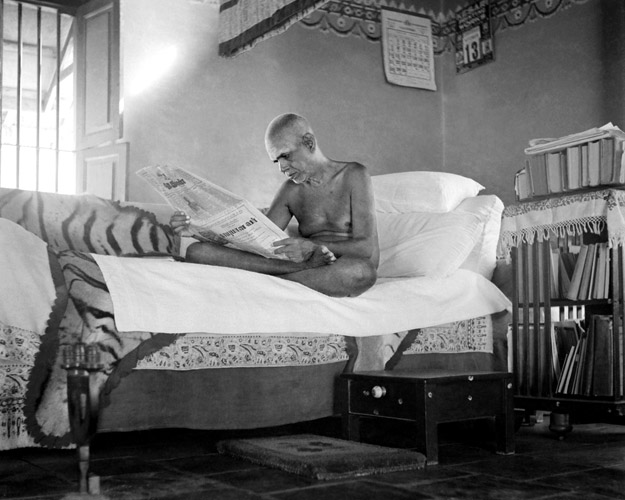
Sri Ramana reading
Sri Bhagavan generally used two fountain pens: one contained blue ink, the other, red. Both of these pens were quite old and looked, to me at least, worn out. One day the top cover of the red-ink pen cracked, so a devotee took it to town to have it repaired. It was gone for several days. During this period Sri Bhagavan reverted to an old-fashioned nib pen which had to be dipped in an ink pot of red ink. Since this seemed to cause him some inconvenience, I decided to get him a new pen. I wrote to a friend in Bombay and asked him to send one immediately. A few days later the pen arrived by post. I went straight to Sri Bhagavan and handed over the unopened parcel containing the pen. Continue reading
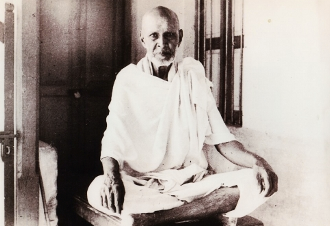
Viswanatha Swami first came to stay with Bhagavan Sri Ramana Maharshi when he was about 19 years old. His father, Ramaswamy Iyer, was a first cousin of Bhagavan.
I had the good fortune to spend considerable time with this great devotee of Ramana Maharishi from April 1976, until he became ill and passed away at 75 years of age on the 22nd November, 1979. How he came to Bhagavan has been written about elsewhere. Here I attempt to show how he exemplified, so wonderfully and devotedly the teachings of Bhagavan. Continue reading


Verse1: kartur agyaya prapyathe phalam. karma kim param? karma tat jadam.
Meaning of the words.
kartur: The ordainer of results. God.
agyaya: as per His orders.
prapyathe phalam: The results are obtained.
karma : the actions
kim param : Are they supreme ? [Meaning is the law of karma the ultimate ? Who is the one who makes it happen then? ]
karma tat jadam: Actions are jadam, dead lifeless entities.
English translation of Verse 1:
“Action is insentient. Action is not the ultimate reality so action per se has no ability to confer the fruit of action. Fruit of action occurs according to the whim of the ultimate reality which is usually called God.”
Comments by Dr. Raju:
In his classic work Upadesa Saram (Spiritual Instructions) Bhagavan is questioning the idea of doership in the first verse itself. Bhagawan explains in the first verse why the individual performing the action is not the doer. Continue reading
 Luthar.com
You must be logged in to post a comment.