Harsha's avatar

The Deepest Knowing

When I was a child, the idea that I could only know “me” and not others was both strange and fascinating. It still makes me smile. What can anyone really and truly know with complete and absolute intimacy?

What is your deepest knowing? How do you know that you know?

Harsha's avatar

Where is the Mind?

Perceptions and experiences occur in the mind. In what does the mind occur?

Harsha's avatar

Who Am I? The legendry question! By Mourad Rashad

Who Am I? The legendry mystical question, the path of many sages such as Ramana, Nisargedata, Krishna Menon, Shancara …etc. All these sages followed the enquiry “who am I” to its end.

“Who am I?” is not really a question because it has no answer to it; it is unanswerable. It is a device, a process, a methodology and a meditation not a question. It is used as a mantra. When man constantly inquires internally: “Who am I? Who am I?” Man is not waiting for an answer. The mind will supply many answers; all those answers have to be rejected. The mind will say: “I” is the essence of life. “I” the eternal soul. “I” is divine,” and so on and so forth. All those answers have to be rejected: neti neti — one has to go on saying: “Neither this nor that.”

When man has denied all the possible answers that the mind can supply and devise, when the question remains absolutely unanswerable, a miracle happens: suddenly the question also disappears. When all the answers have been rejected, the question has no grounds, no supports internally to stand on any more. It simply flops, it collapses, and it disappears.

When the question also has disappeared, then man knows. But that knowing is not an answer: it is an existential experience. Nothing can be said about it, or whatever will be said will be wrong. To say anything about it is to falsify it. It is the ultimate mystery, inexpressible, indefinable. No word is adequate enough to describe it. Even the phrase “essence of life” is not adequate; even “God” is not adequate. Nothing is adequate to express it; its very nature is inexpressible.”

When Hui-k’o went to see Bodhidharma, this interchange took place;

“Peace of mind”, replied Hui-K’o.

“Show me this mind of yours”, said Bodhidharma, “and I will pacify it”.

“But when I seek my mind, I cannot find it”, was the reply.

“THERE!” said Bodhidharma, “I have pacified your mind!”

“YES!” said Hui-K’o, and laughed.

Now, what next after this revelation of knowing who you are?

Harsha's avatar

I am not this, I am not that; who am I? – Gururaj Ananda Yogi Satsang

-This is an edited and unpublished satsang of Gururaj Ananda Yogi. If you want to watch the video of the whole satsang you can get it in Gururaj’s channel at Vimeo

Question: I am that which causes awareness to flow from the grossness of the lower mind to the un‑differentiated bliss of the superconscious.  I am not mind, but upon me the mind rests.  I do not move, yet through me all things move.  I am neither this nor that.  What am I?

Gururaj Ananda: That you are.

Who am I if I am not the mind?  Who am I if I am not the body?  What makes you presume that you are not the body and not the mind. What point of reference have you to tell you that I am not the mind and neither the body?  Show me that point of reference.

When I say to myself, “I am that I am,” who is this that I am that I am?  Who is this Brahmas mi‑‑I am Brahma?  Who is this that could say, “I and my Father are one?”  Who is this that could say that I, as the mind and body, is non‑existent?

Then what part of you is existent to make you cognize your non‑existence?  You don’t know, that is for sure.

Your mind is a reality, your body is a reality, and the spiritual self within you is a reality, but it is only the mind that could cognize its own realness which is also, at the same time, erroneous.

Gururaj Ananda and Cansita

You say I am this body.  Now this body has been changing so much.  I was an infant, then l grew up into adolescence, became an old man…

So this body is the same body, but over a period of time ‑‑ which you regard to be time ‑‑ has gone through various changes.  Who is that which perceives this particular form of reality?

The spirit that is within you, the Divinity that is within you, is non‑cognizable and neither would it cognize anything besides itself in its own cognition.

The mind says this is a handkerchief.  Why does the mind say this is a handkerchief?  Because my mind, or a certain recollection or experiences that has gone through me in this lifetime or even in past lifetimes, perhaps, make me cognize this to be a cloth, a piece of cloth to be used on my nose.

Now, where does this come from?  What tells you that this is a nose and that’s a handkerchief?  So you go further back to realize that my mind is saying that, then you will ask yourself what perpetuates this mind in this mold of having this particular kind of cognition?

And like that you go on and on and on until you reach a point which is zero.  Then only can you say, “I’m not the body.”  Then only can you say, “I’m not the mind.”

Look, I can touch, feel, smell, taste, go to bed and make love, go to the toilet.  Is the body then not functional?  Of course  it is functional.  Then why do I deny the body?

I deny the body because I feel within myself‑‑or rather some force is feeling within myself‑‑that I am far beyond the body and the mind.  Now, the greatest mistake that has been made‑‑or is being made by various theologies‑‑is the denial of the body and mind.  Let’s look at it from a different angle.  Do not deny this body.  Do not deny this mind.  And do not deny that which cognizes the body and the mind.

So how are you dealing with yourself, then?  We’re still going to come to the cognitive factor.  But at this moment how do you stand?  You stand in the position of saying, my body exists, my mind exists, and the cognitive factor also exists, so therefore I am existence and being existing I can deny nothing.  For I am that I am.

There is no differentation between your body and your mind and your cognitive self.  The I that cognizes the very existence of this body and this mind is thought forms which we can call the ego self that is forever trying to preserve itself in the cognitive factors of saying I am this handsome guru [comments and laughs from audience].   Who’s saying that?  That stupid ego self.

Now, what is the ego worth?  The ego is worth nothing, because it is just a formation of patterns which you have superimposed upon yourself through the various experiences that you have gone through, and that has left impressions.  And those impressions is that which we call the ego.

Now, I put my hand on this table and I remove this hand.  But an imprint is there.  The hand is not there anymore, but an impression or an imprint of the hand is existing on this table.  Get out your magnifying glass and you will see it.  What reality is there in this imprint?  Nil!

This very imprint that cognizes me as a body, this very imprint that cognizes me as a mind.  So my body and mind is totally dependent upon that imprint.  And yet, what is the reality of this imprint? Nil.  It’s an impression created through patternings of experiences.

So now if I deny this imprint, or if I do not attach value to this imprint in bringing about the recognitions of the existence of this body and this mind, then I am basing the existence of this body and this mind with something that has no substance but which has just created an impression there, presuming that this mind and this body is real.

So now, what have we done so far?  We are accepting the reality of the mind and the body, and, at the same time, we are denying the mind and the body.  Because both are true. You are not the body, yet the body; you are not the mind, yet the mind.  Then what is your reality?  And how are you going to prove this reality?

You can only prove it by inference.  Or by the very factor that reality requires no proof.  It exists because of its own existence.  The only time you can prove reality is when you have a reference point.  And where can there be any reference point as as far as Divinity is concerned.

There is consciousness and non‑consciousness.  Non‑ consciousness means you are not aware.  And conscious means that you are aware.  Now, what proof is there of awareness.  Does awareness require any proof?  Does the light burning there require any proof that it is burning?  Its very act of giving light is its own proof.

You do not need to prove anything.  Because when it comes to the highest level, you need a point of reference, and the highest level being the one, without a second, cannot have a reference point.

I exist, I exist, because I exist.  That’s all.  And because I, the real me to which I have no reference point exists, I can only refer it back to a grosser level of the mind and the body, which finds its existence in that which I cannot prove is existing.Gururaj Ananda

I’m taking the highest factor in life and bringing it down to the grossest factor and that is what I could compare things with.  But when we reach the point beyond comparison ‑‑ Beautiful word.  You’re pairing up things in comparison.  There have to be two to compare.  But what if I want to exist as I am in my full totality, then will I not lose the idea of comparing myself to anything else?  And the very moment I lose the idea of comparing myself to any subject or object, that is the very moment when I will lose the ego self, that imprint that is existing in my experience.  Or the impression of the experience.  Then where will I be?  I shall be incomparable.

I shall be the source of existence itself, which I am.  Not in reality, but in actuality.  For reality changes from day to day.  What is real to you today might be unreal to you tomorrow. You see.  But when I become actual, when I become the source and recognize that source within me, or the source recognizes itself, then I will say, let me enjoy this body.  Let me enjoy this mind, for it is a product of a collection of impressions.  And if they are there, let me make the best use of it.

Here we are fusing two factors.  The fusion lies in the fact that that which is created by impressions‑‑or maya or illusion‑‑, is brought into reality, and reality is converted into illusion.  So I make the best of both worlds.

For example, let’s see what example we can use.  Say I loved a woman very much, I was deeply involved with that woman.  Fine. And she has left me.  She has jilted me or died or whatever or jumped in the lake.  Now, is she there or is she not there?  She’s dead, we know.  But is she there or is she not there?  She is there because you think she is there.  What makes you think she is there is because those impressions, those experiences, and you are reliving something so far in the past which has no reality today, which has become an illusion.  Because she is not there.  I have developed a dependency upon her when she was there.  So what am I living on now?  On dependencies.

I am existing with a reality, which is my body and my mind.  Though in essence it is unreal, but for the moment of three score years and ten, let me do the best with it I can.  Why not. Who would deny me that right?  And why should it be denied to me? You think all these organs we have are there just for the fun of it or for the show of it?  You think I have ears and I must not hear?  Or I have eyes and I must not see?  Or a nose and not smell?  Or any other organ of my body that has been there created through an evolutionary process and not to be used.  Why should I not use every organ in this body of mine to its fullest value? Honestly and sincerely.

So these monks  say become celibate, become this and that, become this and I don’t know what all.  I say, “become yourself!”  Be yourself!

Be yourself.  How can I make myself be myself?  Ahh!  How can I make myself be myself?  And the answer to that riddle is so simple.  Do you know that beautiful hymn which I like very much, lead thou me on, kindly light, one step at a time is enough for me.  Don’t you know that beautiful hymn?

Firstly, I must admit to myself that  I’m living a fragmented life.  Part of my mind is pulling that way, part of my mind is pulling that way, part of my mind is floating up there in Chicago and another part somewhere in some heaven or some hell which has no existence in reality.

Admit to oneself that I’m fragmented.  Lead thou me on, kindly light to integration away from fragmentation.  Let me be whole.  Let me function in this life holistically.  Let me not find any more the discriminatory factors between body, mind, and spirit.  Let me regard it to be one continuum.  And this continuum, after finding through spiritual practices and meditation, when you find this continuum of yourself, mind, body, and spirit, this continuum will extend and extend and develop so much that the entire universe becomes you and you become the universe.

Existence and non‑existence, what am I going to do about it?  I’m both.  I am existing, and at the same time, the impressions which I’m existing upon is non‑existent.

So let me tell you this, that 99.999% of your problems in your mind are self‑created without any damn substance.  So that which you have created without substance… very easy way out of it‑‑pull the chain!

That is the secret of life.  Forget the past.  It is gone. Do not project yourself into the future, it might not be there. But live for this moment.  Live for this moment.  And then you’ll preserve your physical health, you’ll preserve your mental health, you’ll become integrated in mind, body and spirit, and you’ll enjoy life.  For life is joy.  So, as I always say, enjoy the joy.  Why deny yourself of that beautiful joy of this so‑ called existence when you can have fun.

What’s wrong with fun. Enjoy it.  But be honest and sincere, that’s important.

MEDITACION BARCELONA

Harsha's avatar

AUGUST SUMMER by Alan Jacobs

4451_82082183499_623773499_1895176_3431332_n

 August summer from awesome meadow sings,
I never tire from commune with my Soul,
In silent wood’s enchanted shades, where broad
Shafts of sunlight fall in full accord
Gilding leaves of green. The dusty lane’s my goal,
Which ends where the higher path begins.
The air, the fair horizon, crystal springs,
Rosy lips of dawn, which one yearns to kiss
This hem of heaven’s robe in joyful bliss.
Come! let’s gaze at gleaming stars so chaste
They shine on Mother Earth through veils with haste.
Let pine trees imparting scented breath
Waft you along to life away from death,
To sapphire streams and fields of emerald green.
Let Nature’s radiance reveal her sheen
On the solemn beauty of your furrowed brow.
True love latent in your heart, here and now,
Will ever grace this sacred, monumental hour.


6020_96980203499_623773499_2115239_393586_n
       Photos courtesy of Trina Kavanagh

Harsha's avatar

Gururaj Ananda Yogi

ifsu092I am starting with this post a series of articles dedicated to the teachings that Gururaj Ananda Yogi gave to his chelas during 12 years. Gururaj Ananda Yogi (birth name: Purushottam Narsinhram Valodia, 3 March 1932, Gujarat, India – died 17 May 1988, Cape Town, South Africa) was the founder of International Foundation of Spiritual Unfoldment.  Gururaj Ananda Yogi started giving satsang in his living room at his home in South Africa and during 1974 with the help of some of his disciples in South Africa started The South African Meditation Society and The International Foundation for Spiritual Unfoldment. Since that date to 1988 when he passed away he traveled around the world lecturing and had chelas in several countries, particularly Spain, USA and the UK countries he visited twice a year since he started teaching. His teachings were recorded and more than 3,000 hours of recorded material are now being edited and transcribed to be published in different media. Some of his disciples are today teachng meditation and there are centers in many parts of the world. I actually dedicate myself full time to teach meditation and maintain meditation centers in Barcelona, Asturias, Bilbao and Madrid

Knowledge

From Duality to Non-Duality

Meditacion Barcelona

Emptiness
Just emptiness
Nothing to do
Nowhere to go
Pulsating life that laughs back at
This bunch of impressions
That feel have an existence by its own
But just exist as impressions of this singled drop of water

Moment by moment, this form performs within this universal dance
And carries images to this singled drop of water
Still pictures of a film
Only existing in its own maya of mind
Clouds that hide the sun
Amazing sun that created those very same clouds

At times merging into my soul – a moment of perfection,
Vain seems my learning, and incomplete
The world’s knowledge gathered through its lifetime,
Impressions of what is, moment by moment, gathered in this singled drop of water

At this moment into timelessness, spacelessness, perfection;
Vain is all art, cults, creeds, humanity – all incomplete
Illusions! Mirages! And then that moment lapses:
The limitless becomes limited, the infinite becomes finite
The machinery of mind starts rolling in its own disturbance –
Surveying the din and tumult of the world,
All existence becomes real and time is divided;
The mind gropes in its own darkness
Real becomes the multitude stricken with pain –
All striving for wealth or fame or a dreamed “forever” prince.

A strive for perfection – the aim of all – consciously or unconsciously.
Knowledge and art and cults and creeds are not in vain
In the world of mind; toiling, striving, fathoming –
Seeking completeness from without
Images gathered reflected back in this moment of delight.

I that have tasted of infinity
Fight with my own mind at times, to loosen its bonds,
And try to seek within
For another moment of eternity

Through these series of articles I will be introducing the teachings of Gururaj Ananda Yogi from which many will be able to benefit

Namaste

Harsha's avatar

Mangal Aaratee

Unsaved_Production 1


  Mangal Aaratee Priyaa Preetam kee, Mangal Preeti Reeti Doun kee
Blessed prayer of lover and Beloved,  Blessed  is the ritual of their union

Mangal Kaanti Hansani Dasanan kee, Mangal murlee Beena Dhun kee
Blessed is the light of His swanlike splendour,  Blessed is the sweet rhythm of His flute

Mangal Banik Tribhangee Hari kee, Mangal Sevaa Sab Sahachar kee
Blessed Hari, omnipresent knower of three worlds,  Blessed friend of all devotees

 Mangal Sir Chandrikaa Mukut kee, Mangal Chabi Nainan mein At kee
Blessed is His crown made of Peacock’s feather,  Blessed is His glance enslaving my eyes

Mangal Chataa Phabee ang ang kee, Mangal Gaur Syaam Ras Rang kee
Blessed beauty of ornaments on Shyam’s body, Blessed are  Krishna’s activities

 Mangal Ali kati peyare pat kee, Mangal Chitvan Naagar nat kee
Blessed love of Sweetheart Govinda , Blessed allure of that magical Krishna

Mangal Shobhaa kamal Nain kee, Mangal Maadhuri Mridul Bain kee

Blessed is the beauty of His lotus eyes,  Blessed the soft and sweet voice of His Flute

 Mangal Vrinidaavan Mag At kee, Mangal Kreedan Jamunaa Tat kee
Blessed husband of Vrindavan’s gopis,  Blessed is His play on the river  banks of Jamuna

Mangal Charan Arun Taruvan kee, Mangal Karani Bhagati hari Jan kee
Blessed are His Feet under the Arun tree of the forest ,  Blessed Lord, remover of obstacles

 Mangal Jugal Priyaa Bhavaan kee, Mangal Shree Raadha Jeevan kee
Blessed pair of beautiful charming lovers,  Blessed Hari, who is the life of Radha


To listen to this Aaratee, click on the link…
http://www.youtube.com/watch?v=oeOEW5bJUHE

Mangala Aaratee1

Arati (also called  Aarti, ãrti, arathi) is performed in many Hindu temples first thing in the morning, and several times throughout the day, with a final arati in the evening.  Arati is also performed after services such as puja.  The word is derived from the syllables “Aa” which means towards, and “rati” which means the highest love for God.  As the devotee waves the lamp before the deity, the frame of mind should be one of surrender and devotion, a prayer to Divinity to annihilate the ego in the flames of the sacred fire such that complete surrender is achieved.

At the Chinmaya Mission temple where I worship, following the monthly group chanting of the Vishnu Sahasranama, we sing a beautiful Mangal Aaratee to Lord Krishna, which glorifies the love of the Lord for Radha and for the gopis, thus symbolically glorifying the Oneness of the Paramatma and the atma as embodied in the living jiva.  Something about this Aaratee drew me the first time I heard it even though I could not really make out the melody as a small group of devotees sang it one night.  I later found out the language was Hindi, and one afternoon I drove over to the Temple to request Swamiji to sing it for me so I could record it and learn the melody for the monthly chanting.  Like some other bhajans have done, this one took me over and I needed to take it a step further, learning it on my harmonium and memorizing the words.  Still, something was missing…I knew the general gist of the words had to do with auspiciousness and Lord Krishna and Shrimata Radarani, but I wanted more. I wanted to know what all the words meant.

So, I posted photos of my lyric sheet in the Roman transliteration as well as the Hindi devanagari script on my Facebook page, asking my FB friends if anyone there knew Hindi and might be able to help.  One of them did, Shravanji Manyan, and he was kind enough to make an effort which was a great help.  But, there were some lines which he felt he could not quite make out and so there will still some missing lines.  I knew that if the Lord wanted it to happen, He would make it happen.  In the meantime, believing that God helps those who help themselves, I resolved to bring it to a few people at the Mission who I thought might be able to help. 

Before I had to do that, I met a woman who joined into a small yoga group which meets at the Mission.  When our practice was finished for the morning, I pulled it out for my friend, Lakshmi, to ask for her help.  Then a new member of our yoga group, Pushpa, spoke up to say that she had a Masters in Hindi and would be glad to take a look. We started to go over some words, when she offered to take it home.  As a result, she sent me an in depth translation, word for word in a prose like fashion, which gave me a thorough outline of the lyrics. But this was not in the flow of the poetic beauty which graced the Hindi lines. I rewrote the translation to at least try to give it more of a poetic feel and do poetic justice to the author, unknown, who penned these beautiful lines.  Both the lyrics and the melody are hauntingly beautiful, taking you to the banks of the Jamuna River where Radha, the human soul and Krishna, Divinity gracing us in human form,  eternally re-enact the holy union of  His Divinity within the human soul.  There is a certain mystery and wonder to the dance of the lover and the Beloved.  May we all know the glories of this sacred Oneness.

ln004

 Samo’ham sarvabhooteshu na me dweshyo’sti na priyah;
Ye bhajanti tu maam bhaktyaa mayi te teshu chaapyaham
Unsaved_Production 1 

 I look upon all creatures equally,
none are less dear to Me and none more dear.
But those who worship Me with love and affection live in Me,
I come to life in them.” 

BG 9.29

 ln004

Offered with gratitude to the Lotus Feet of my Guru, Shri Krishna, and my Lord, Shri Krishna,
for His Grace in allowing me to love Him, to serve Him and to be His devotee,
and for gifting me with Swami Siddhanandaji in my life, in so many ways,
and in particular, for singing this beautiful work of art for me to learn,
for Shravanji Manyan and for Pushpaji Gairola,
both of whom generously offered their time and talent in
reviewing the lyrics and translating them for me,
and for the unknown poet who wrote this Aaratee through His Grace.
It is said that the Vedas have no author since
they derive from Divinity itself…so too with this Aaratee.


Harsha's avatar

Jai Guru Omkara

ln054

In honor of the Guru, which can only be Him
manifesting in His infinite mercy to remove the illusion of duality.

It may be external, or it may be from within,
opening the chambers of the heart and
unlocking the shackles of the mind such that nothing remains but Him,
everywhere manifesting in everything.  Chitta chora!  Chitta chora!

Steal it all and give me only one thing in return…your holy Presence. 
May I prostrate before you eternally
in gratitude for the Grace you have brought into my life.


PRIMROSEw - Copy


Puja Prayer

Like a flower
In complete surrender
I come unto You

Petal by petal
In complete surrender
I come unto You

Like the primrose heralds the spring
In complete surrender
I come unto You

May my actions be right
In complete surrender
I come unto You

May I walk in thy Light
In complete surrender
I come unto You

Earth, my altar… I, my offering
In complete surrender
I come unto You

May my only reward
Be complete surrender
Unto You


 ln054


The Self manifests externally as Guru when occasion arises;
otherwise He is always within, doing the needful.
From Talks with Ramana Maharshi, 12th June, 1937 Talk 426.

To view Adi Shankaracharya’s Guru Ashtakam… 

Harsha's avatar

Caves of Arunachala – July 2009 Update

As we have been exploring Arunachala we keep finding ‘caves,’ some already widely known, and some not. A friend suggested that we write about these caves in a blog. This seems a good idea, so here it is. We can find nothing like this available now.

Our exploration of Arunachala is ongoing, and any additional caves we find will be added. In this post 1 refer to other postings where there are more photos and information about each of the caves.

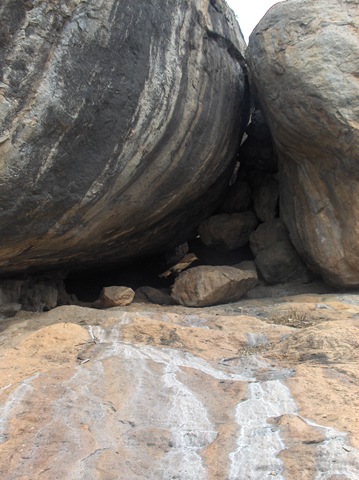
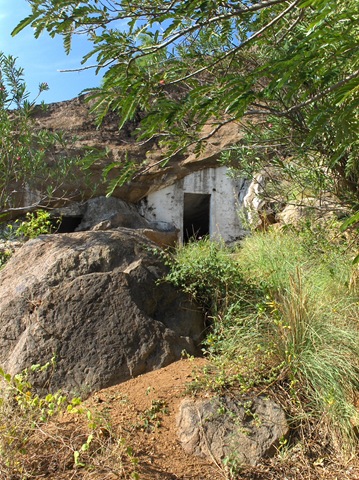
I put quotes around the first instance of ‘caves’ since what are called caves here are often nothing more than a sheltered space under a big rock. Some are natural, some have been improved, usually by building walls and adding a concrete floor. Some have been dug out under rocks.

Is some cases the individual caves already have names in common use. Most do not, and for the purposes of this listing I am calling these by names that I made up. If other caves are known, or names of caves shown are  known, let me know, so I can update this listing.

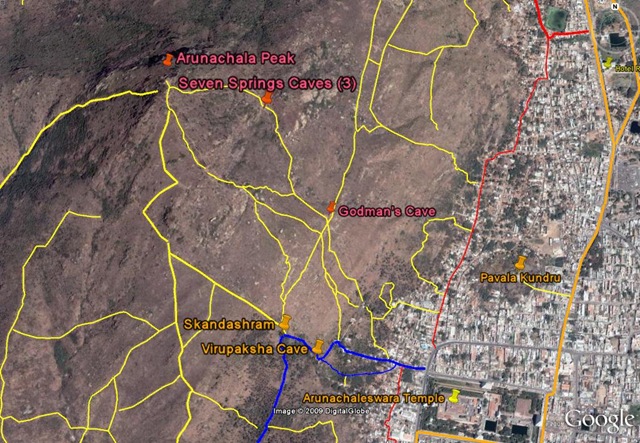
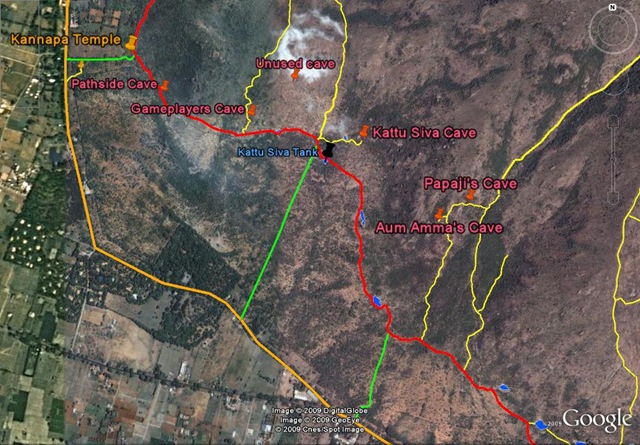
The December 2008 posting showed 18 caves. In July 2009, it now shows 23 caves. Maps, developed from GoogleEarth tm are also added that show the location of each of these caves.

Caves Associated with Sri Ramana Maharshi

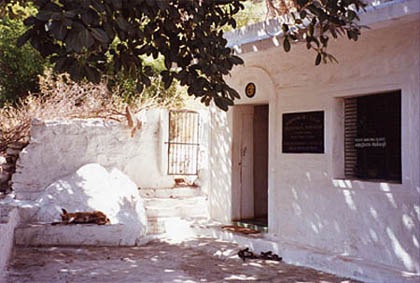
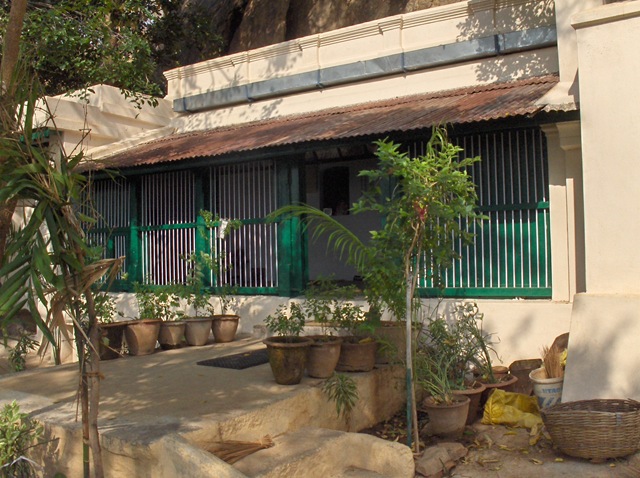
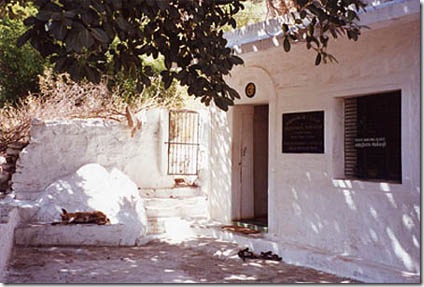
Virupaksha Cave
bhagvans_cave

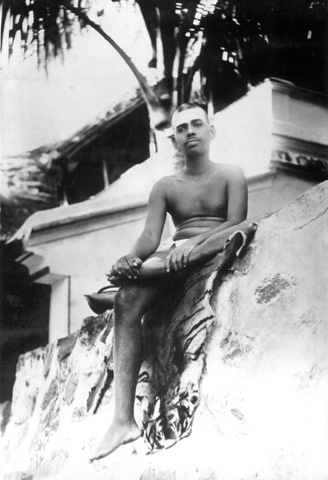
Virupaksha is, for most, deeply associated with Sri Ramana Maharshi. Ramana lived where he lived for 17 years [1899-1916].

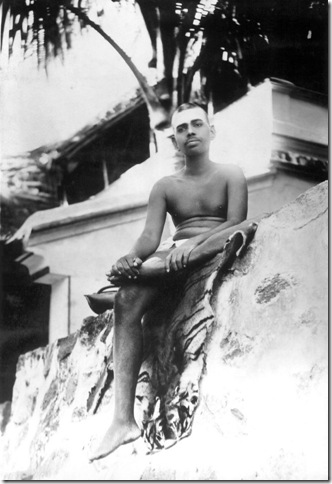
Below is a famous photo of the young Ramana at Virupaksha cave.
rest-9_1

The cave is named for a famous saint, Virupaksha, who lived in this cave in the 1500’s, around the same time as Guhai Nama Shivaya lived nearby (see below). At Virupaksha’s demise, called here ‘maha samadhi,’ it is said that his body was transformed into vibhuti (sacred ash). In the interior of this cave there is a mound in the shape of Arunachala. It is said to be made of this vibhuti.

More on Virupaksha Cave  is in this post.

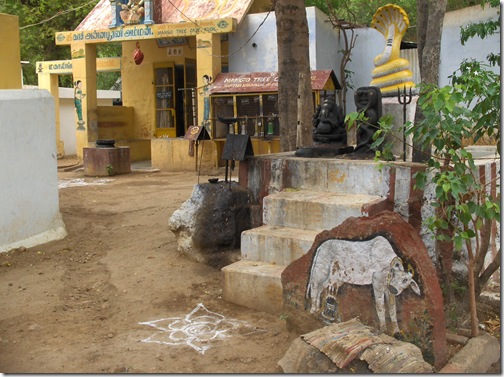
Mango Tree Cave

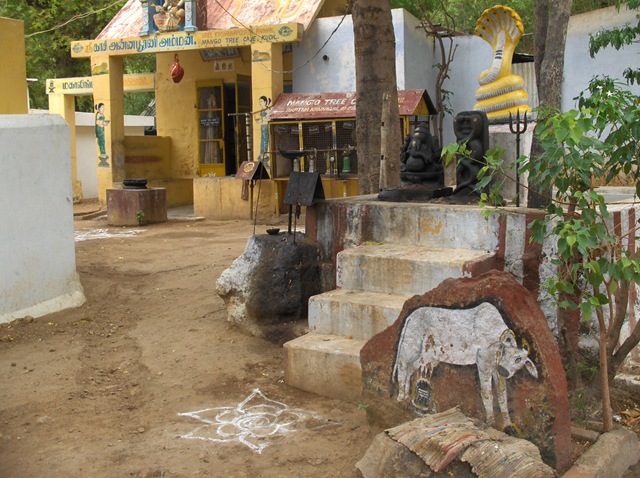
During the Virupaksha days, Sri Ramana would come down to Mango Tree Cave during the summer. It was cooler, and there was water here when there was none at Virupaksha Cave. Mango Tree Cave is on the common way up the hill to Virupaksha  Cave.
HPIM4609

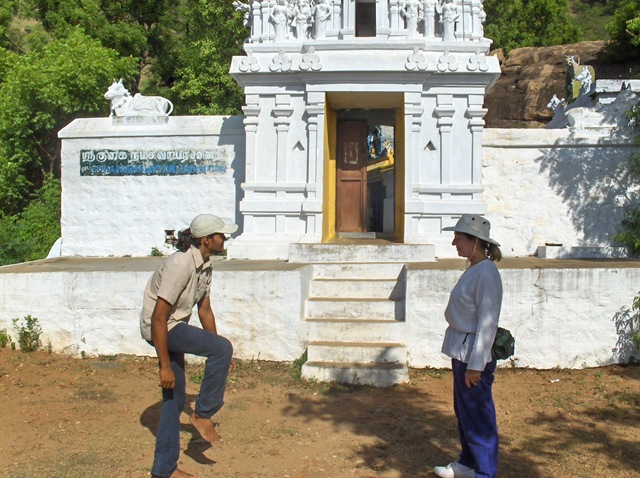
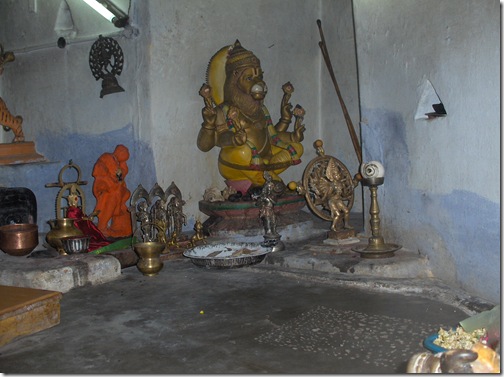
Inside the building, to the back, there is the actual cave. I think the building has been added since Ramana’s time.
HPIM4621

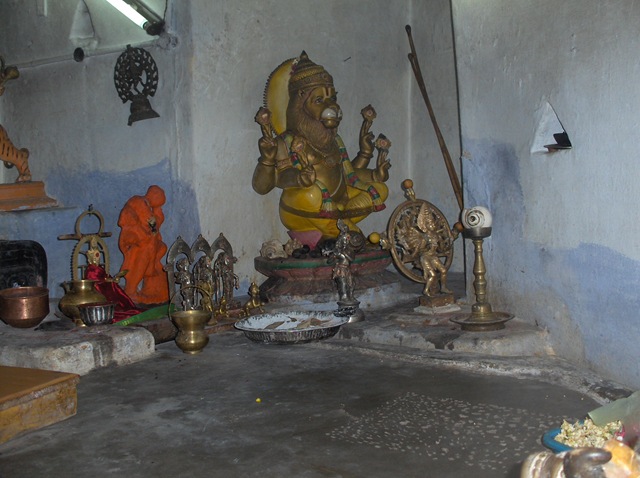
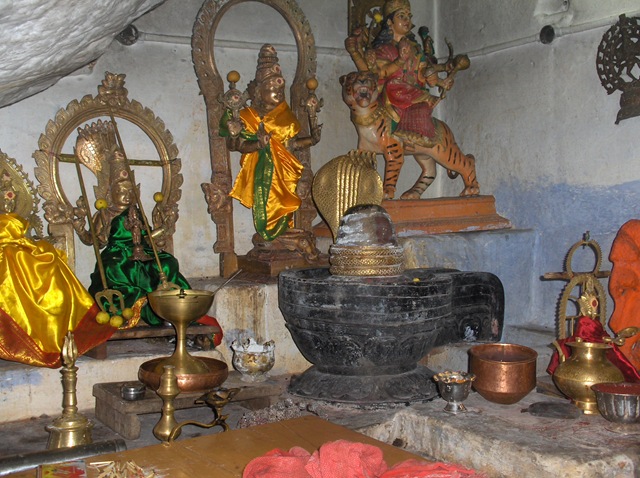
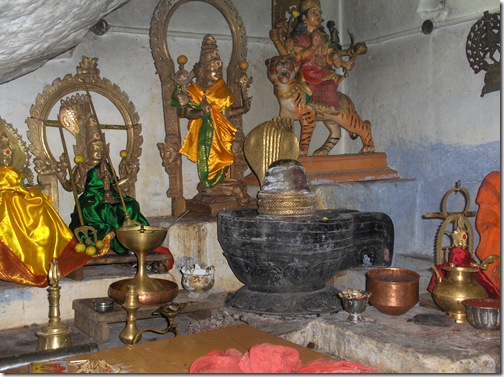
Now this small cave is filled with lingams and murtis of many gods.
HPIM4623

More on Mango Tree Cave can be round in this blog entry.  

Guhai Nama Sivaya

This is another cave in which Ramana lived in 1899. It is here that he wrote the notes which later because the pamphlet, Who am I?

A bit more on this cave is in the post New Access to Ramana Sites below Virupaksha.
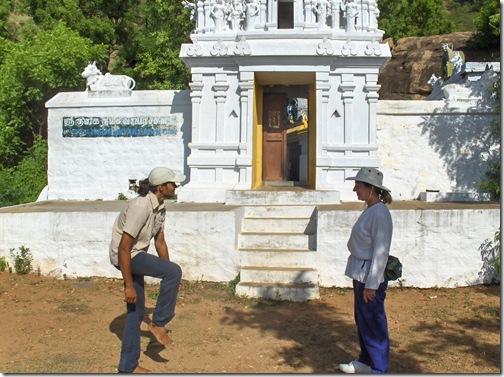
HPIM4986

A short clip from Arunachala Grace Blog:

Guhai Namasivaya is known to have been born around the year AD 1548 in Karnataka to a pious Saiva couple. His spiritual nature became evident at an early age: he was virtuous in his conduct, adept at his studies and evinced no attachment to worldly matters.

He practised his system of yoga for many years and as a result of the dream guidance of Lord Mallikarjuna, the presiding deity of Sri Sailam, Guhai Namasivaya came to Arunachala and remained as a Guru, giving teachings to mature disciples who approached him.

Tortoise Cave / Tortoise Rock

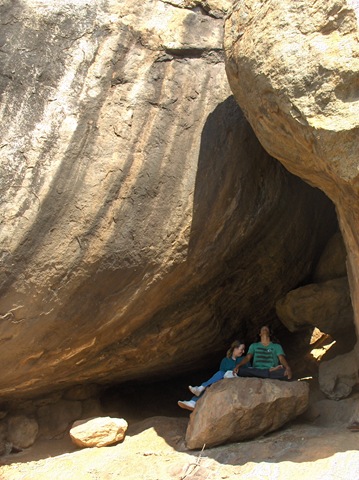
Tortoise Cave (also called Turtle Cave) was frequented by Sri Ramana during the Virupaksha days. In those days, there were few trees on Arunachala, and not many places with shade. Tortoise Cave has a good flat stone at its entrance to sit on. Here you are in the shade, and there is often a breeze.

This is also the place made famous in the story of Sri Ramana’s ‘second death experience’. This happened when Ramana stopped at Tortoise Cave / Tortoise Rock on his way back from Pachiaimman Koil. More of Tortoise Cave and Rock, and Ramana’s second death experience is in this post. More about Tortoise Cave is also  in this post.

From places like Pavala Kundru, Tortoise Cave can be seen as a dark triangle up on the mountain. It is a bit of a climb to get up here. We think it is worth it. You will want to take a Mountain Guide the first time, I think.
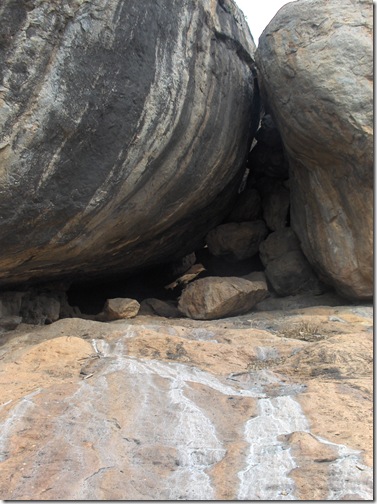
HPIM4022

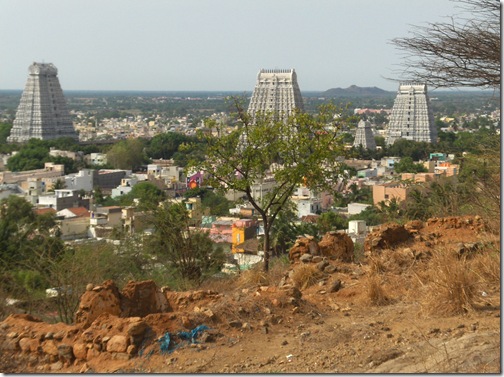
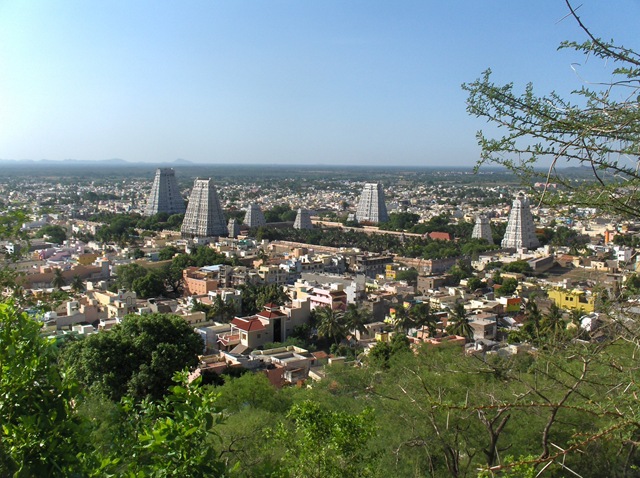
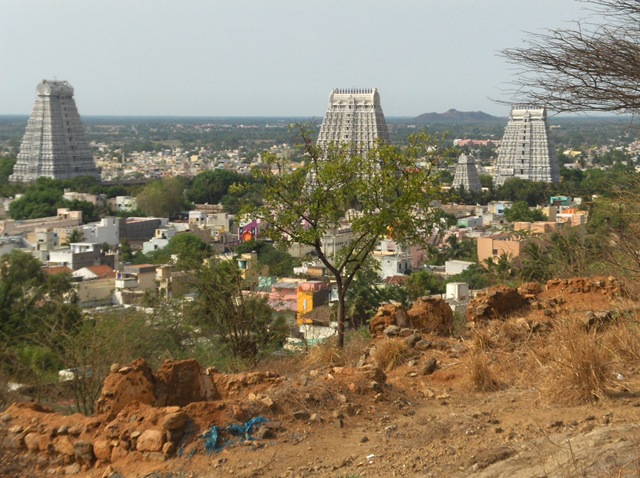
Arunachaleswara Temple for Tortoise Cave. A wonderful view.
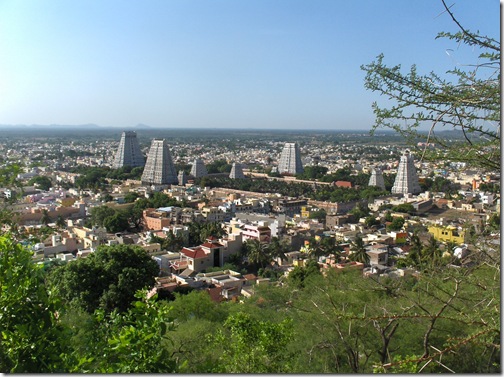
HPIM5402

This rock at the entrance of the cave is where Sri Ramana would have sat and rested. And meditated.
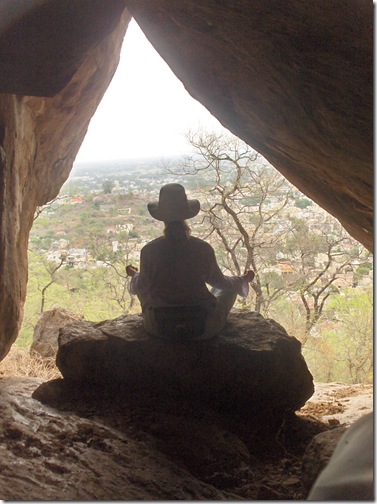
HPIM4032

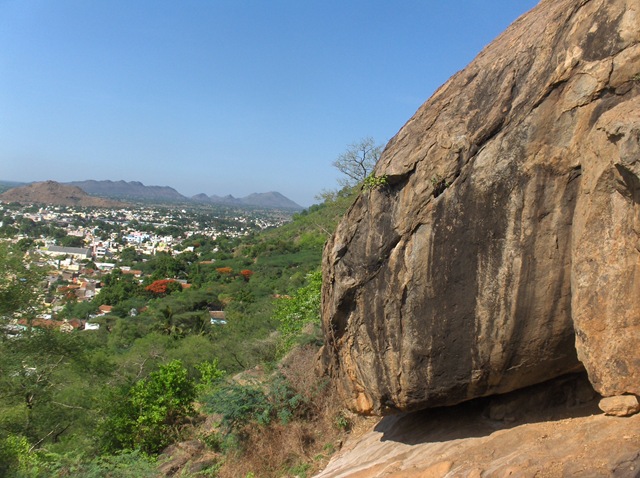
Pavala Kundru can be seen toward the left.
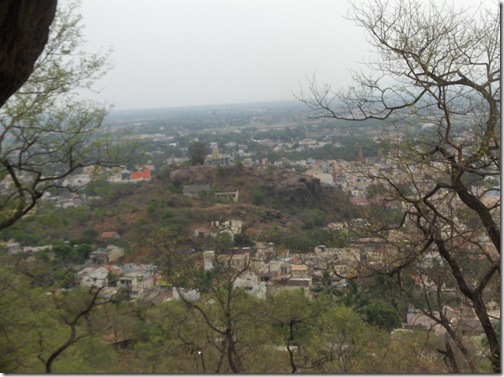
HPIM4045 

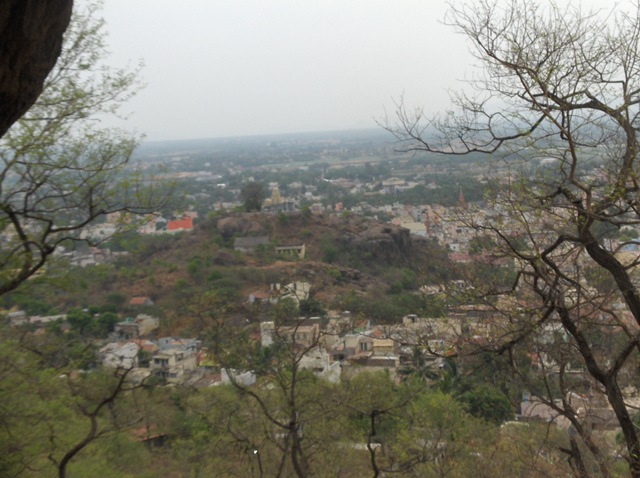
Here is a close up view of the face of the turtle on Tortoise Rock. Tiruvannamalai is in the background.
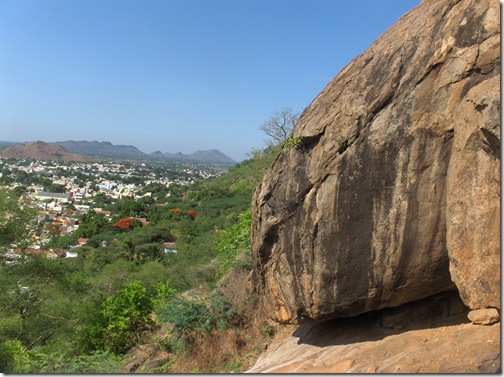
HPIM5427

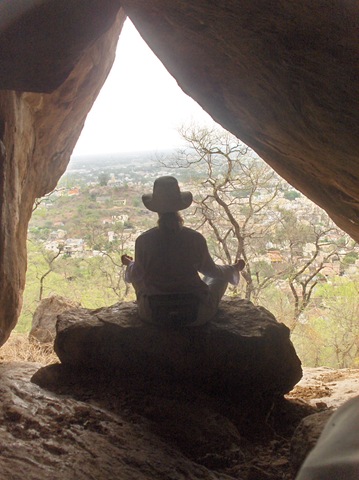
This cave is a great place to sit in the shade and meditate.
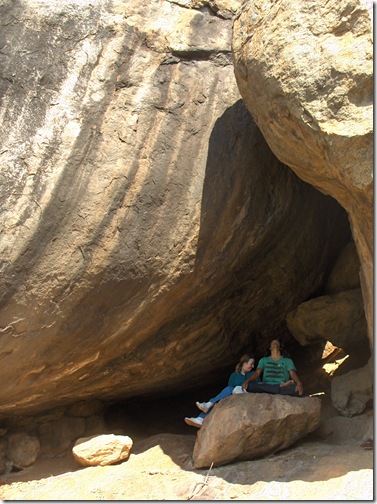
HPIM5441  

Skandashram

More on Skandashram is in the post Walking up to Skandashram.
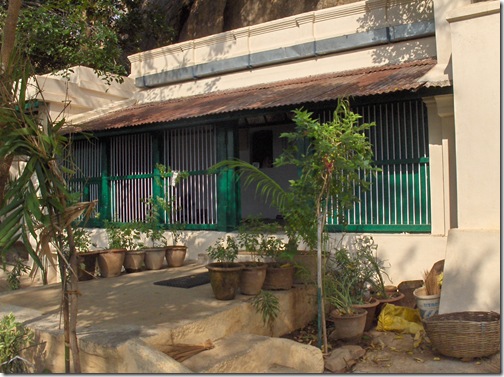
HPIM4373

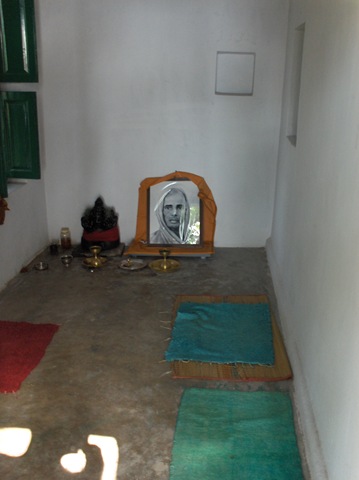
Sri Ramana lived at Skandashram from 1916 to 1922. His mother joined him during this period, and for the first time cooking was done there. This is where the mother had her maha samadhi in 1922. Her room is now a shrine.

HPIM4367

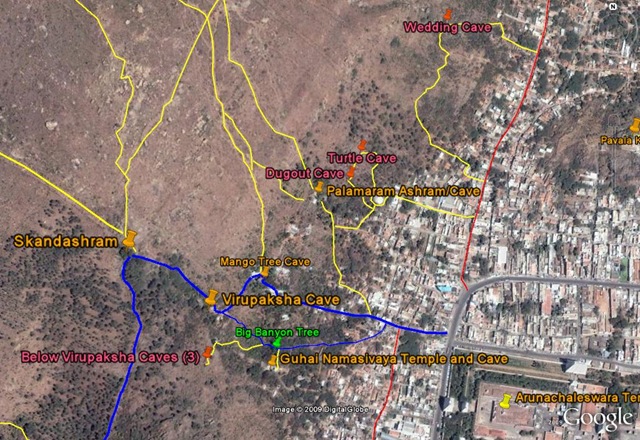
The map below shows all of the caves associated with Ramana, as well as other caves in the Virupaksha Cave area. Double click to expand.
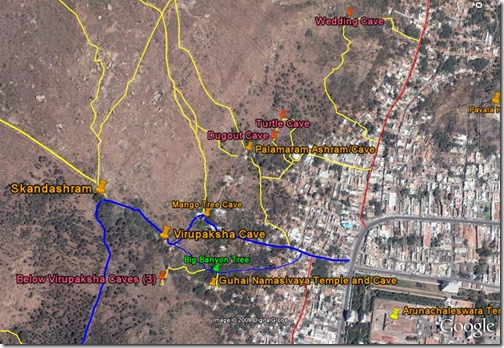
screenhunter82

Seven Springs Caves

The next four caves are shown in the Seven Springs posting. They are all located on the hill above Skandashram, on one of the paths that goes to the top of the hill. Only one is associated with Ramana, the top one at Seven Springs. They are shown on this map:
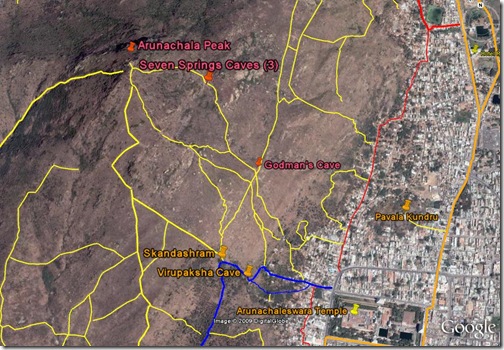
screenhunter83

Godman’s Cave

This is a cave, said to be greatly improved by the work of David Godman in the 1980s. Maybe ten people can fit into this cave.
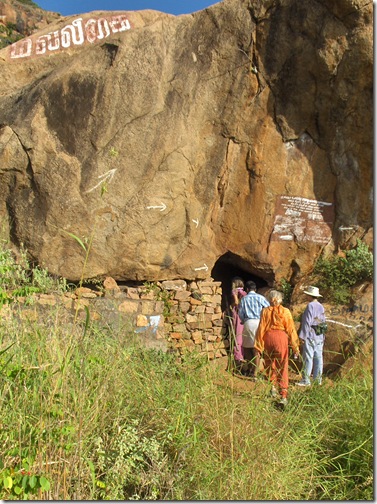
HPIM7886

Altar in the cave.

HPIM7891

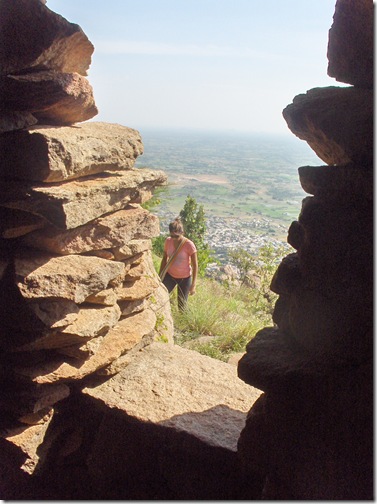
Looking out the entrance. John, the archivist at Ramanasramam, stands outside  the entrance.
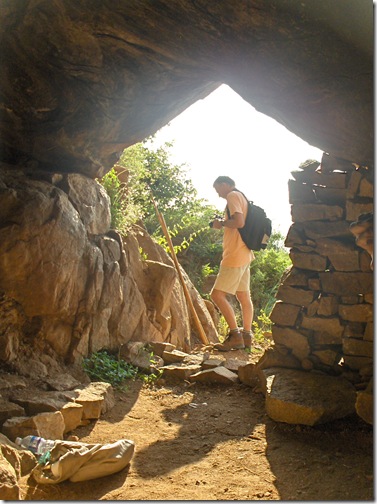
HPIM7897

Seven Springs 1

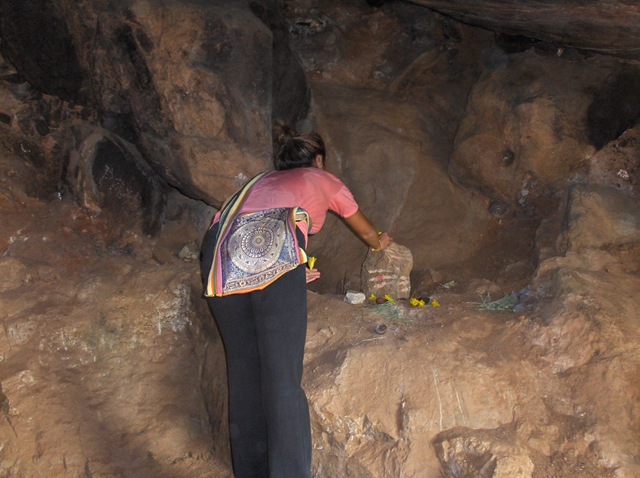
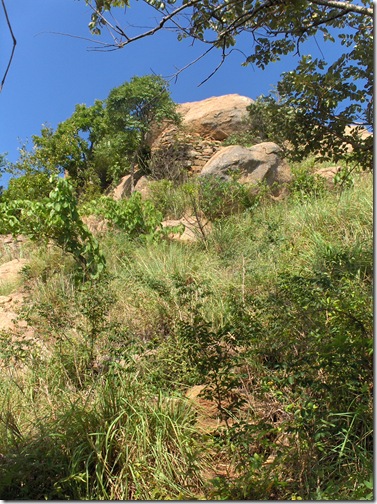
This is first of three caves found at Seven Springs. There is a stone entrance built, and a good altar in the cave. Maybe four people can fit in here.

Up the hill you can see stonework.
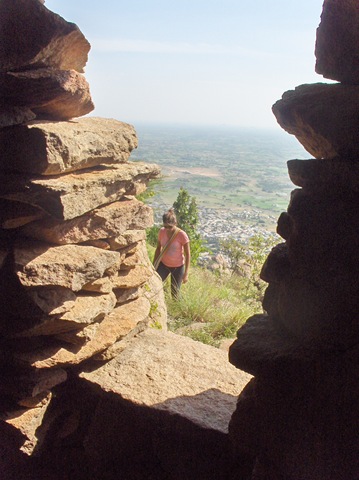
HPIM7933

The entrance, from the inside.

HPIM7953

Richard, offering incense to the altar.

HPIM7939

Carol, exiting the cave.

IMG_1702

Seven Springs 2

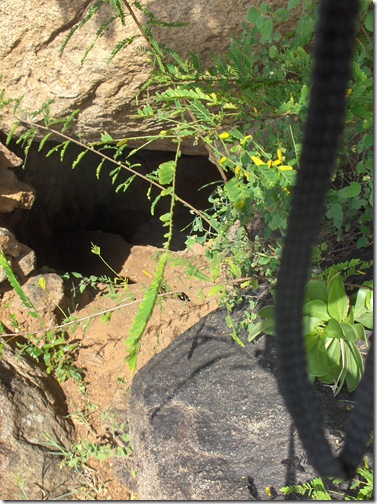
This is a small cave, behind Seven Springs 1. Maybe two people fit inside. Many stone and concrete improvements have been made.
HPIM7958

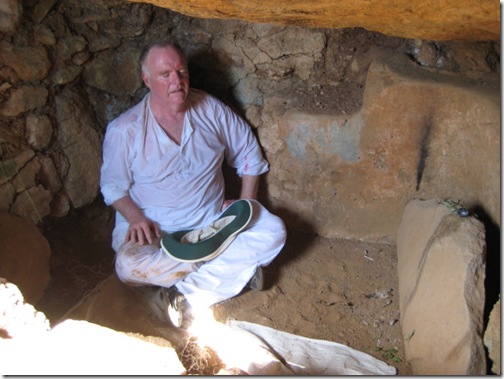
Richard, meditating in the cave.

IMG_1714

Ramana’s resting cave

HPIM7988

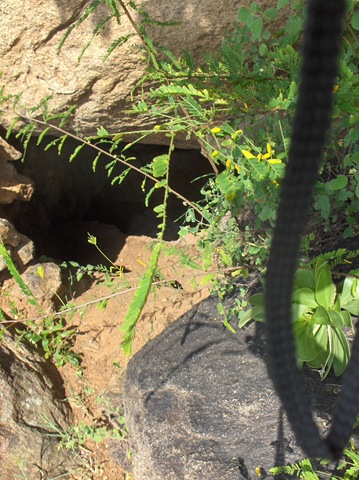
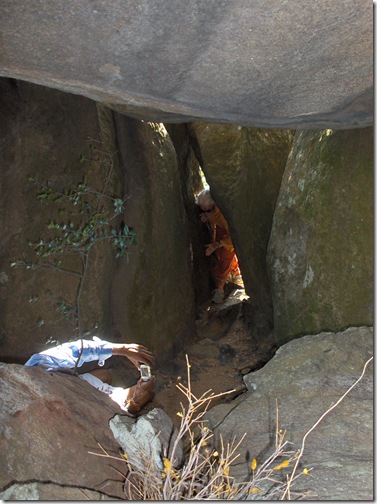
I call it ‘Ramana’s Resting Cave’ since this is the cave that is documented in writing about Ramana where he was known to rest, while others made the climb up to the top of Arunachala.

It is in the shade all day with a nice breeze through it, and a view out through green trees.

The entrance is a bit tight, though.
HPIM7993

Caves in Virupaksha Cave Area

(these are shown on the map at the end of the Ramana Caves section.)

Palamaram Ashram Cave

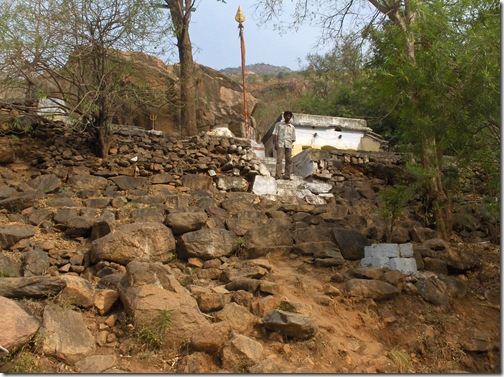
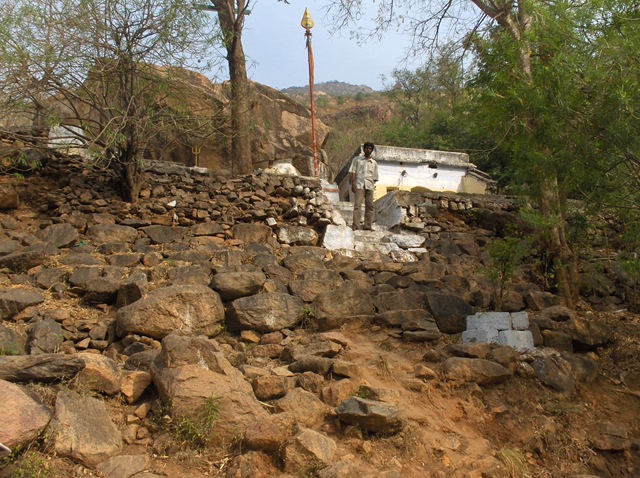
The Palamaram Ashram and is ‘generations’ old and has been run by one family for these generations. Palamaram is the Tamil word for ‘jackfruit’ (but we did not see a jackfruit tree). The guru who was most recently active here, per our mountain guide, was Palamaram Swamy, who was here for 40 years and for the last 15 years has been in the Himalayas.

Steps lead up the the ashram. The flag pole can be seen from down the hill.
HPIM3849

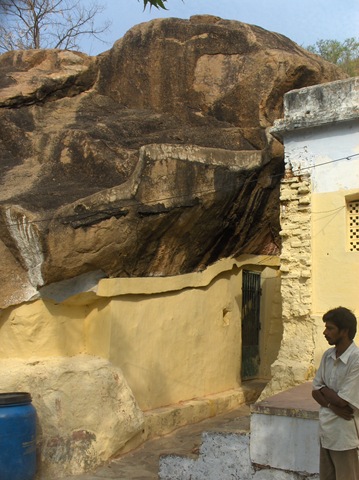
The cave is under this rock. The doors into the cave are locked, and you will have to see if you can find someone who can open them. Often you cannot find the person.
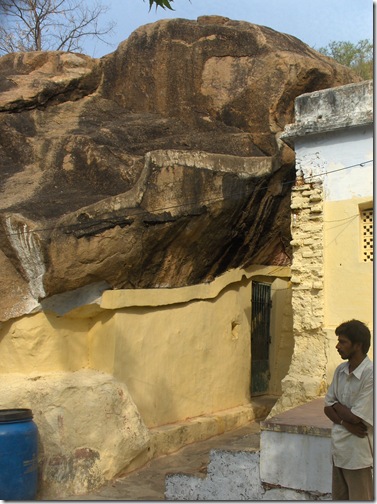
HPIM3833

For more on this place, see the Palamaram Ashram Post.

Wedding Cave

Wedding Cave is a small cave to the north of Virupaksha. It is rarely visited by westerners. We just discovered it by accident, looking for some other place.

It is at the base of the hill. You have to travel through residential areas, then up hillside trails to reach it.

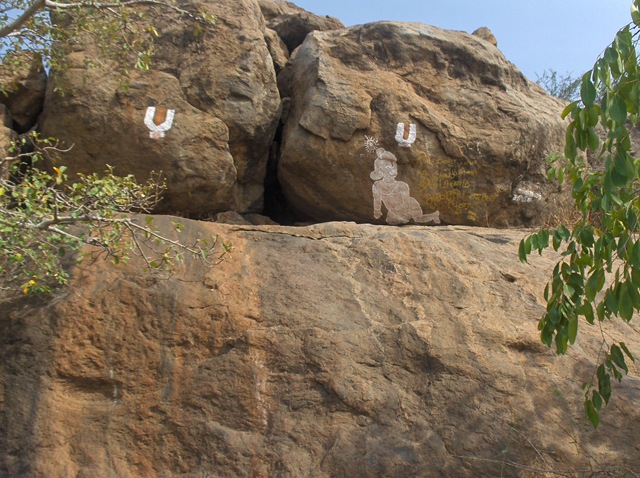
To get to the cave, you have to climb up the rock, to the right of what can be seen in this photo.
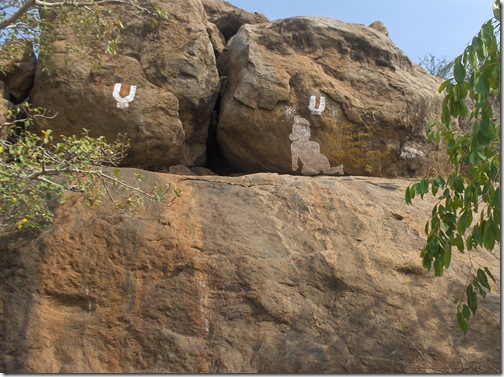
HPIM3931

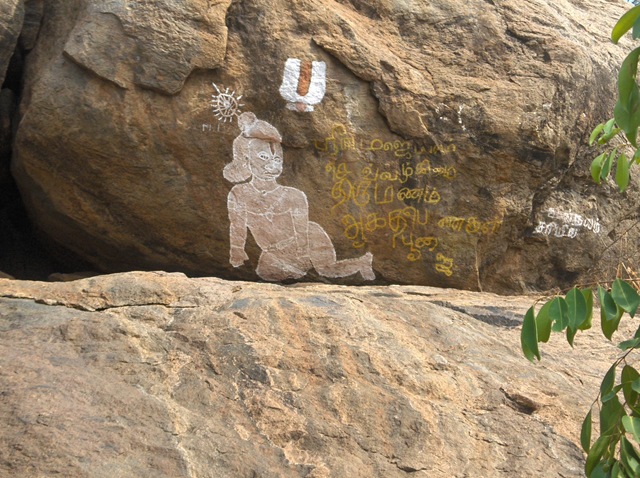
Krishna is painted on the rock, with a peacock feather on his head.
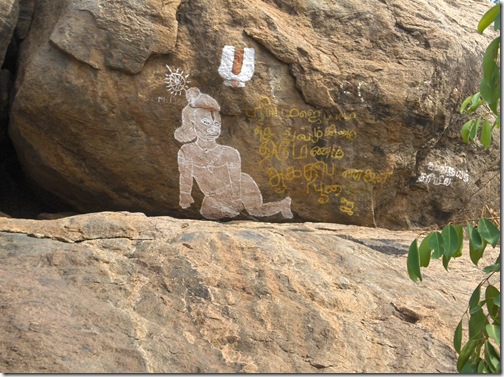
HPIM3932

A great view of Pavala Kundru can be seen from here.
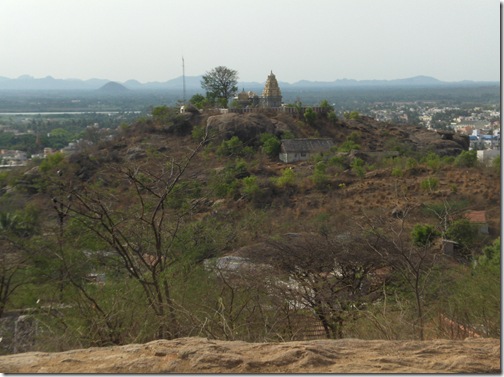
HPIM3935

Arunachaleswara Temple, too.

HPIM3937  

More is found in Wedding Cave Post.

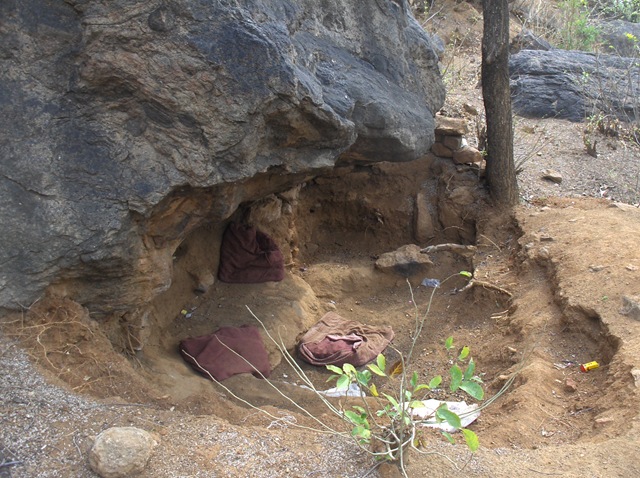
Dugout Cave

Dugout cave is a made made cave under a rock below Tortoise Cave.

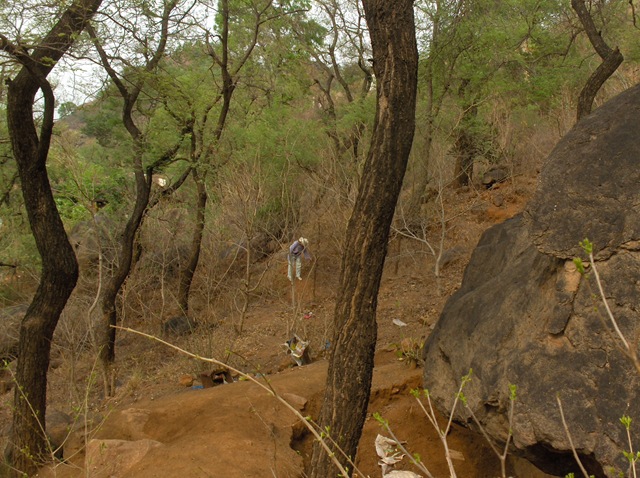
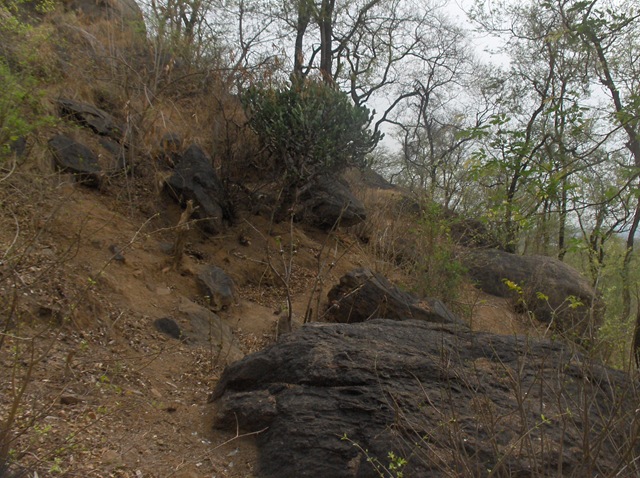
To get to it, you go through the hillside,m like  shown below.
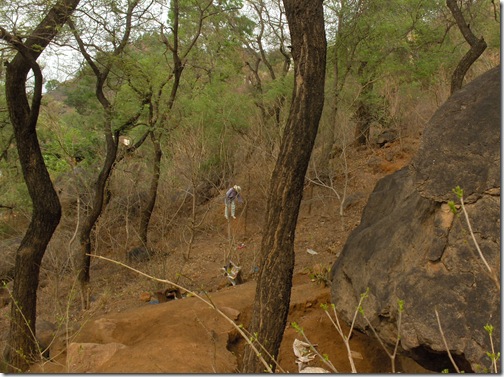
HPIM3996

A nice spot has been bug out under this rock. There are several cushions laying in the cave. Maybe there was a smaller cave, that was ‘improved’ to make a better space. I know nothing of the history of this cave.
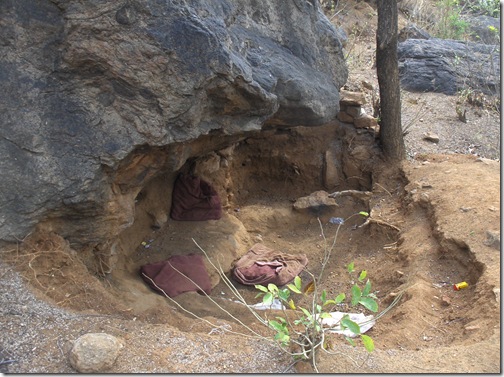
HPIM4000

Another  photo of the terrain around this cave.
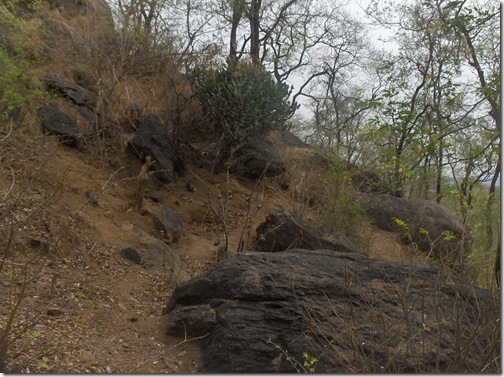
HPIM4001  

This is seen as a part of this post.

Caves below Virupaksha Cave

These caves are described in the post New Access to Ramana Sites below Virupaksha.

Below Virupaksha 1

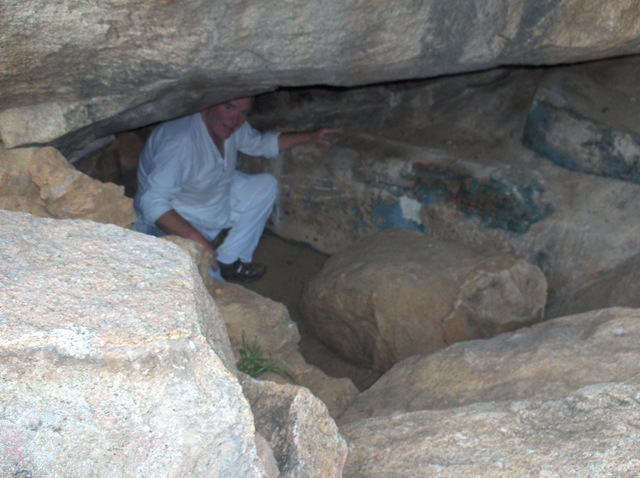
This cave is big enough that one or two people can sit in it.
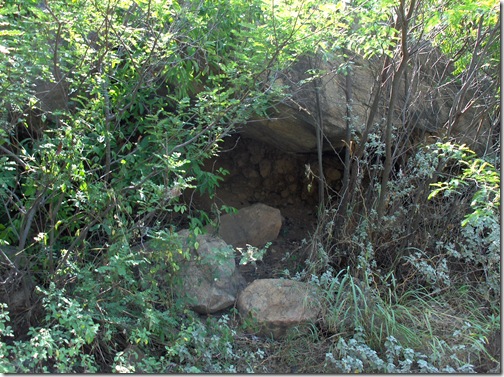
HPIM4991

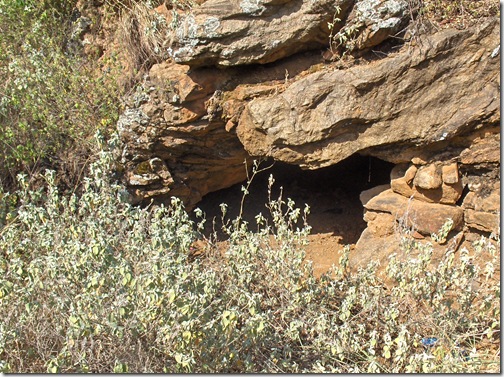
Below Virupaksha 2

This cave is very small. One person can lie down in it.
HPIM4997

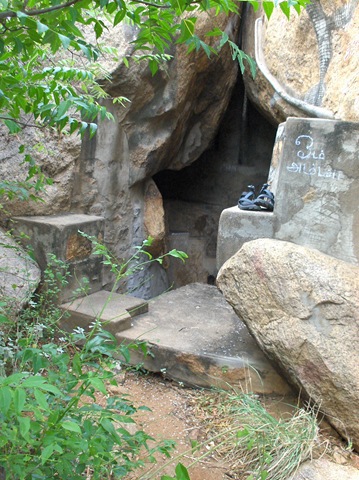
Below Virupaksha 3 – Associated with Ramana?

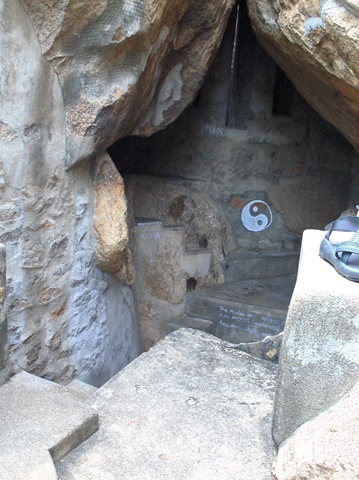
This cave is said by local villagers to be one used by Ramana in the early days. Recently, people have built walls and a door and an altar in it.

HPIM5004

The altar.

HPIM5010

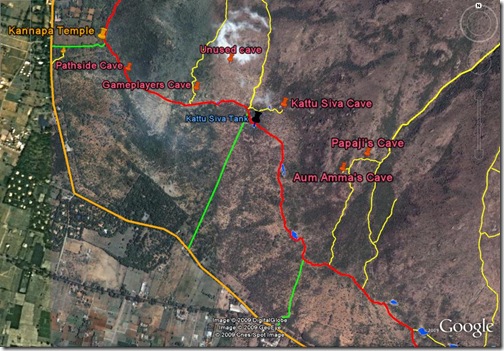
Southwest Side

This map shows (right to left) Papaji’s Cave, Aum Amma’s Cave, Kattu Siva Cave, Unused Cave, Gameplayers Cava (Mankala Cave), and Pathside Cave.
screenhunter85

Caves on Papaji’s Knoll

These caves are shown in the posts Papaji’s Cave and Aum Amma’s Cave.

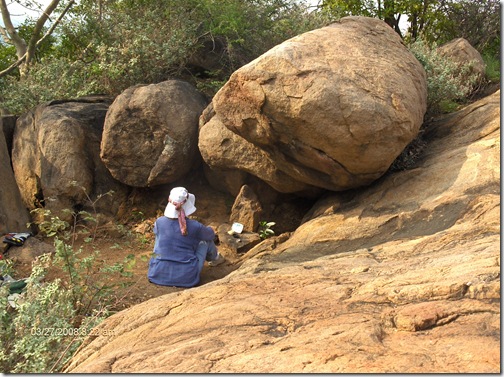
Papaji’s Cave 1

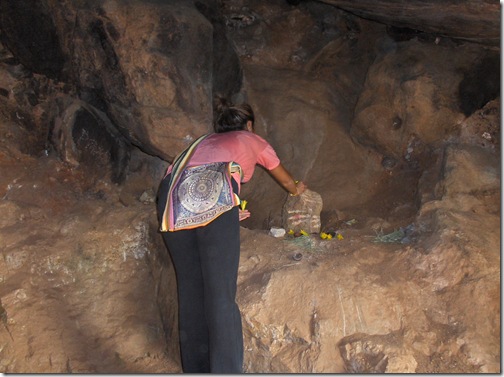
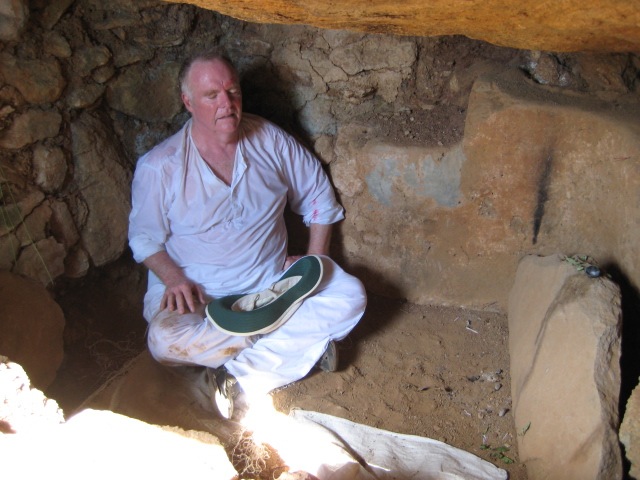
The first ‘cave’ of Papaji’s is in the area where part of his ashes were scattered. This is a nice place to sit and meditate at the altar that has been set up there.

HPIM3940

HPIM3980

Papaji’s Cave 2

The next of the caves named for Papaji, and one that he is said to have lived in, is near the first cave, down the rock and a bit up the path.

Carol enters the cave from the path.

HPIM5936

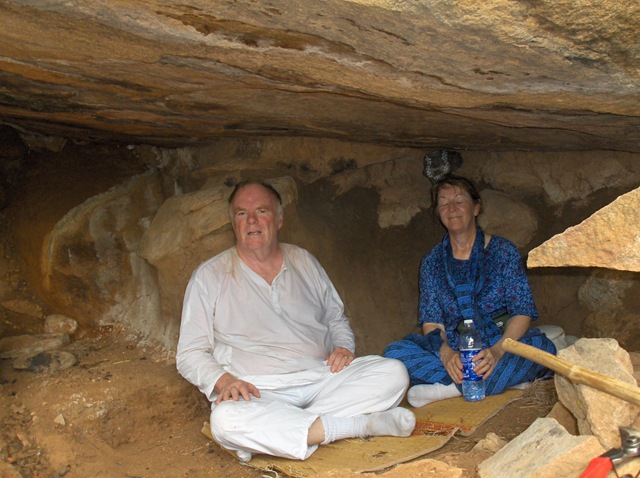
Richard and Carol, meditating in the cave.

HPIM5941

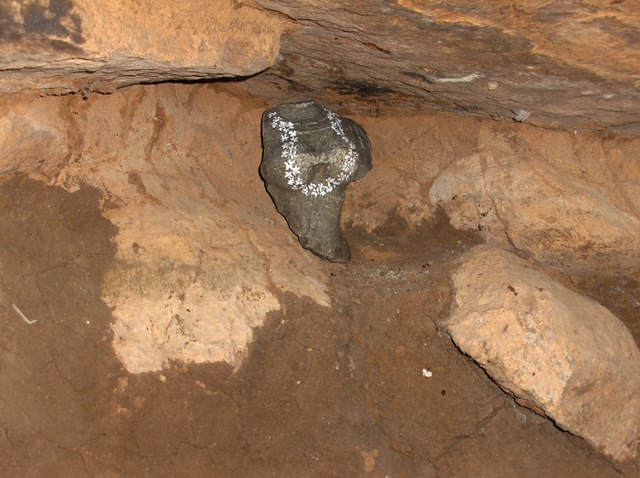
Below is part of a mother goddess statue, placed in this cave.

HPIM5944

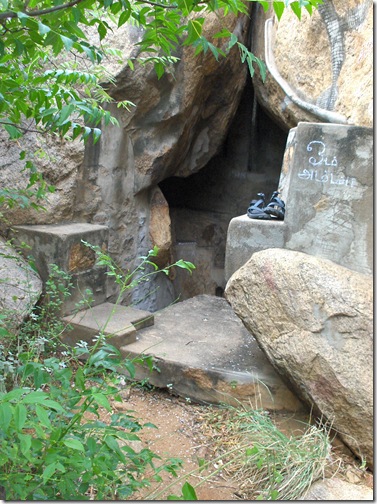
Aum Amma’s Cave

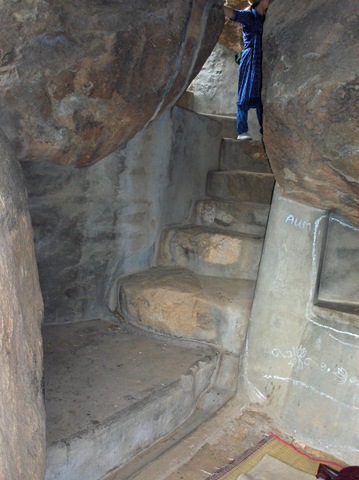
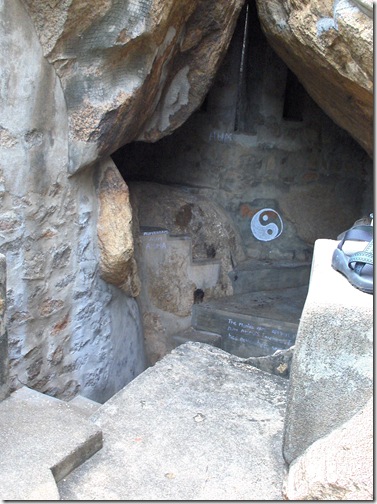
Aum Amma’s cave is the most developed of any cave we have found so far (except for those, like Virupaksha, which have had buildings constructed around them).
HPIM5873

Many bags of cement were carried up the hill to make these cave improvements. Aum Amma lived her for several years until just a few years ago.
HPIM5876

Stairs lead down into a main room.

HPIM5895

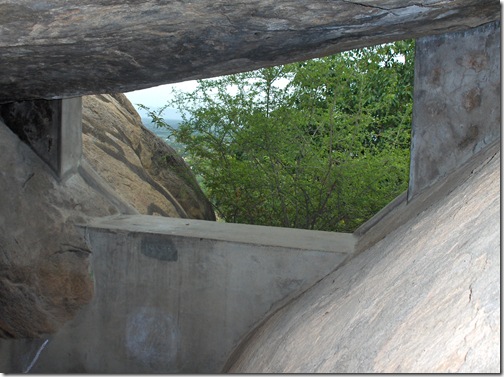
There is a good view out the “window” in the main room. It looks like sometimes that people sleep in this cave, though you are not supposed to, and if you stay too long, the Forestry Department people will chase you out.
HPIM5888

Caves in Kattu Siva area

Kattu Siva Cave

This cave is shown in the post Kattu Siva Cave.

There is a nice cleared area around the cave. this is good place to come during the heat of the day. There is plenty of shade.

HPIM8655

Climbing over the rocks at the end of the clearing, a hole in the rock appears.
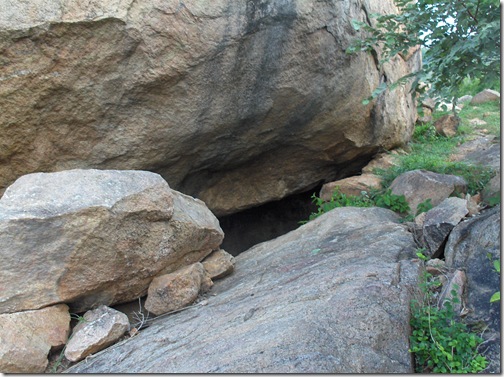
HPIM8659

This is Kattu Siva’s cave. A big rock, in front of Richard, has fallen into the cave. Will someone be able to remove it?

HPIM8665

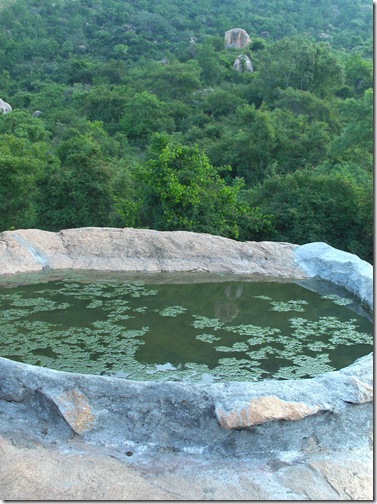
On the top of the rock over the cave, a cement water catching area was made. The photo below looks over this to the Arunachala hillside behind Kattu Siva’s cave.
HPIM8678

Cave Above Kattu Siva Meditation Perch – Unused Cave

Related posts are: Kattu Siva Meditation Perch and Kattu Siva path Renewal – Part 1.

This is a small unused cave. Rocks need to be cleared from the floor to make a good sleeping area.

HPIM8743

Mankala Cave (or Gameplayers Cave)

This cave is shown in the post Kattu Siva path Renewal – Part 1. It is under a rock that looks like a natural lingam as you approach this cave.

HPIM8804

Cave next to Inner Path near Kannappa Temple – Pathside Cave

This cave is shown in the post Inner Path – Around Parvati Hill.

A path leads to it from the Inner Path.

HPIM9659

This cave was improved with a stone and cement wall in front.
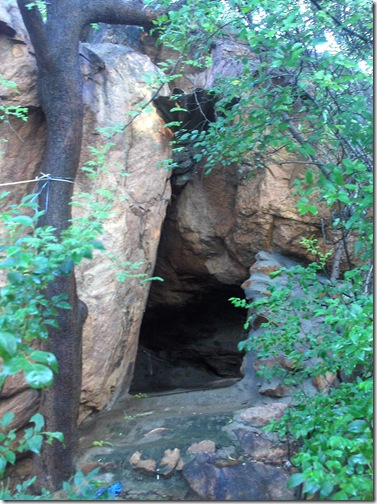
HPIM9669

A nice cement floor has been put in the cave.

HPIM9665

Caves on Northside  of Arunachala

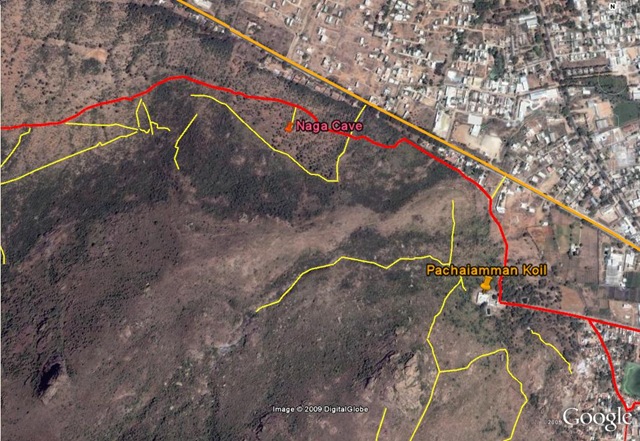
Naga Cave is shown in the map, below.
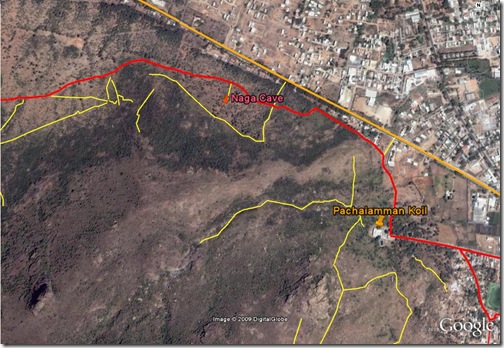
screenhunter84

Naga Cave

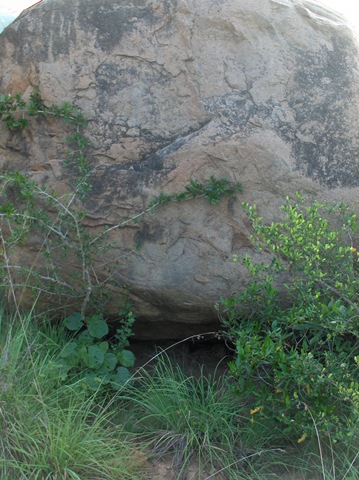
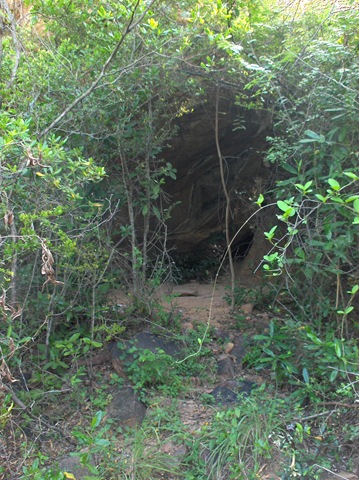
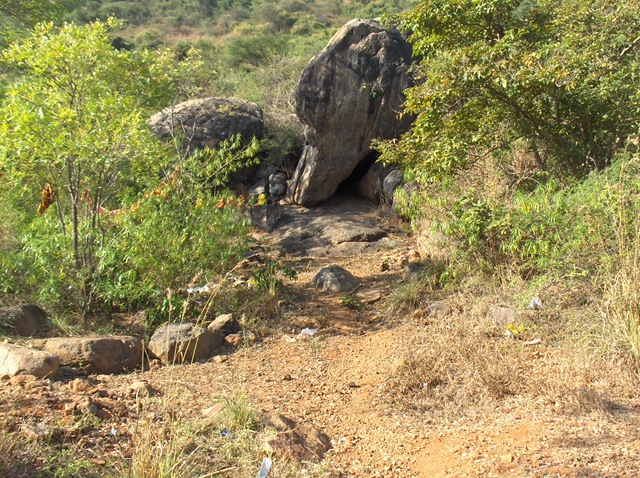
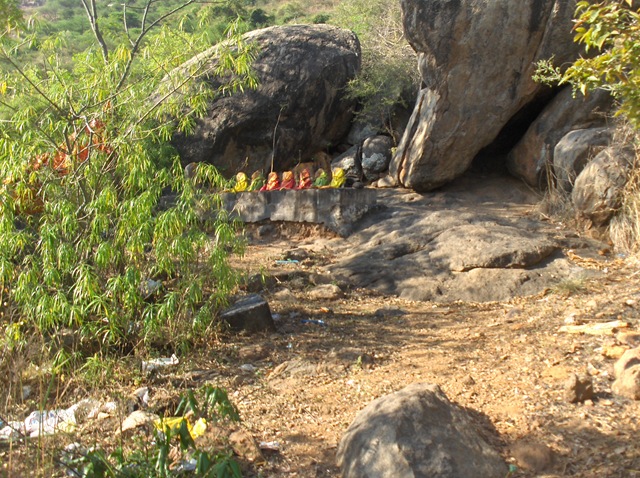
This is not too far from Pachaiamman Koil.  It is between the Inner Path and Arunachala, just barely visible from the path. You may notice a bit of color towards Arunachala.

As you approach you see a small cave.  
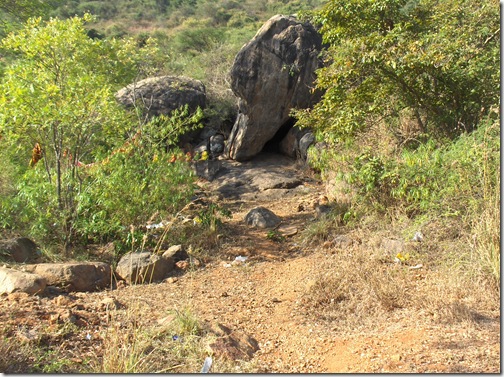
HPIM2689

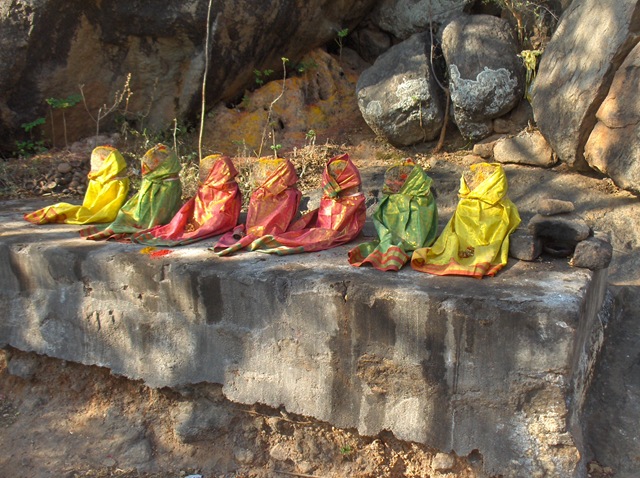
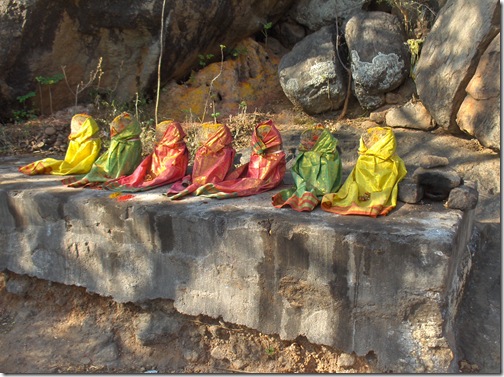
To the left is a primate altar, featuring Nagas, snake gods.
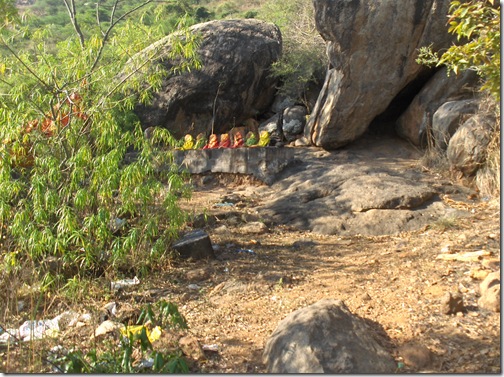
HPIM2690

The colors noticed from the path are the fine clothes that the Nagas are wearing.
HPIM2692

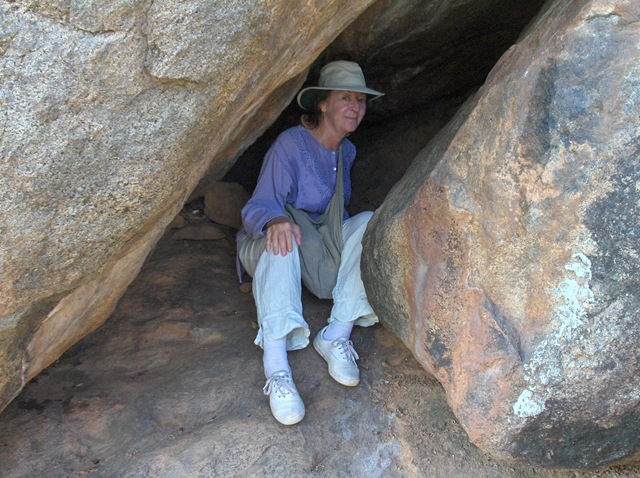
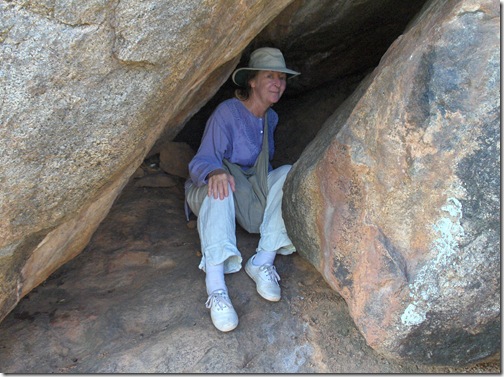
The cave is small. Only one person can sit in it. Not good for sleeping, either.
HPIM2696   

More is to be found in the Naga Cave Post. 

More caves to find, more of Arunachala to explore

I have heard of more caves. I have been told:

  • There are four caves on the hill above the Mountain of Medicine Arunachala reforestation facility.
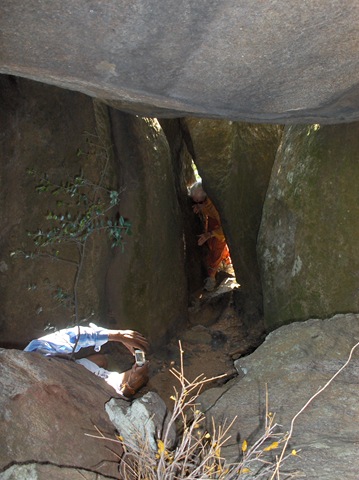
  • There is another cave high above Papaji’s cave.
  • There are three caves on the north side.
  • There is a cave near Virupaksha occupied by a sadhu that does not like to be bothered.

What else is there? We have to explore to know more. If you know of any more caves that haven’t been listed, please let me know.

Harsha's avatar

Light From Eternal Lamps: By Swami Sadasivananda

image

“One must make the mind to bear on God”

ENTERING THE PALACE OF LIBERATION…

The One Thing Needful

“The eternal, unbroken, natural state of abiding in the Self is jnana. To abide in the Self you must love the Self. Since God is verily the Self, love of the Self is love of God; and that is bhakti. Jnana and bhakti are thus one and the same…. their purpose is to lead you to dhyana, to meditation, which ends in Self-realization.”  Maharshi’s Gospel I, The Teachings of Sri Ramana Maharshi. p. 17-18.
Sri Ramana Maharshi maintained this ancient form of instruction. The answers he gave to questions represent what has evolved in our modern times as a uniquely universal spiritual teaching that can be taken up by anyone the world over without adopting the limiting constraints of any one religious tradition. It has been said that these teachings were indeed God-given, for they began with the words of grace flowing from Sri Ramakrishna and continued with the blessing of perfection that was embodied as Bhagavan.
As did his predecessor, Bhagavan Sri Ramana Maharshi stressed practice that produces purification (removal of that fog of ignorance, the obstacles and habits of the mercurial mind which diminish our pure vision) as well as the grace of the knowledge of the Self as the eternal companions of those who would be led:
From the unreal to the Real,
From darkness to Light,
From death to Immortality!

NOTES FROM ARUNACHALA…

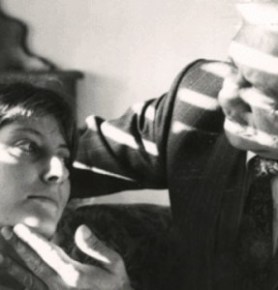
Devotees present with Bhagavan on this day said that a most important spiritual lesson was transmitted through the actions of Bhagavan as he held Lakshmi’s head during her final moments.

As Bhagavan was stroking Lakshmi’s head, she was gasping for breath in the final moments prior to her passing. Bhagavan, who all knew was capable of removing her pain and causing her spirit to easily exit the body, rather whispered in Lakshmi’s ear to “Tolerate the pain!”.

At a later day, Bhagavan said that, “Suffering is the way to Self-realization.” Our training within meditation prepares us to remain “steady in wisdom” even during the final trial of separation from the body.

image

“Practice is necessary, Grace is there.”
Reprinted from Swami Sadsivananda’s July newsletter.
To subscribe to his newsletter, go to http://www.ramanateaching.org/contact.html
For more information on Swamiji, click here:   About Swami Sadasivananda
Teachings of Bhagavan Sri Ramana Maharshi web site: http://www.ramanateaching.org
Ask your question in relation to Bhagavan’s teachings, meditation and spirituality at:
http://www.ramanateaching.org/faq