Harsha's avatar

Alternate Nostril Breath Meditation

Alternate nostril breath meditation

This practice of pranayama is wonderful for bringing about a feeling of balance and well being. Because the nostrils are said to connect to our male and female energy channels, when we focus on the nostril, we balance and purify that corresponding channel of energy. The regular practice of alternate nostril breathing is said to help us experience the feeling of being beyond the polarity of male and female and into the non dual Reality of oneness.  Practice this when you are feeling scattered or unfocused, and you will be amazed at the results.

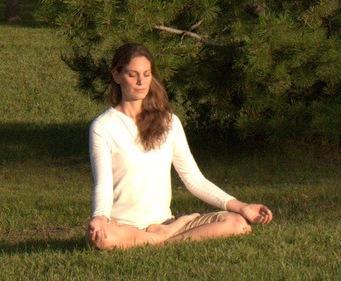
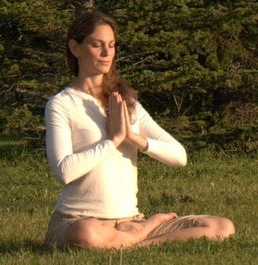
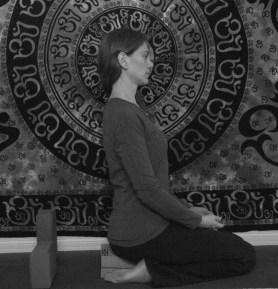
meditating 41. Find a position where you can be comfortable, relaxed, and free of any distractions, then settle into your posture

2. Allow the body to relax completely, especially your abdomen.

3. Notice how a relaxed abdomen naturally brings about a deepening and softening of the breath.

4.  Allow the abdomen to relax more and more with each breath. As you let the abdomen soften, and the breath to deepen; start to become evermore aware of the feeling of nourishment in the breath. Be aware of the sensation of the body being nourished by the breath.

5. Allow your breath to flow as naturally and as freely possible; as if the breath is taking on a life of its own, moving from a deep inner intelligence and knowing.

6. As you are enjoying the feeling of a deep intuitive breathing and the feeling of nourishment within the breath, start to become aware of the sensation of air moving in the nostrils.

alternate nostril breathing 27. Become aware of the feeling inside the nostrils as well as the quality and movement of air. Notice how the air is cooler and drier as you breathe in. Notice the warmth of the air on your exhales.

8. Take about 10 breaths to concentrate on the feeling of the air moving in the nostrils, and the feeling of the body being nourished by the breath. As you are doing so, see if you can detect which nostril feels more open or expanded. (this is your active nostril)

9. Start to focus on your active nostril only. Breathe as if you are breathing through just that one nostril. Focus on the feeling of the air moving on that one side. Focus on this for about 30 seconds, or 10 breaths.

10. When it feels natural to switch sides, start to focus on the movement of air on the other side (the passive nostril). Focus on the feeling of the air moving inside the passive nostril. Focus on this for about 30 seconds, or 10 breaths. You may find this side more challenging to concentrate on, yet eventually it will begin to feel as if it is opening and expanding to be the same as the other side.

11. The final phase of this exercise is to imagine that you are breathing into a third nostril that runs from the tip of the nose to the center of the forehead. Inhale and move your awareness from the tip of the nose to center of the forehead and exhale from the center of the forehead to the tip of the nose. Stay with this for about 10 breaths.

12. Go back to breathing into the belly and focusing once again on the feeling of being nourished by the breath.

13.    Stay with the belly breathing as long as you are comfortable and enjoy the feeling of balance and wellbeing.

If you enjoyed this meditation you can purchase Christine’s meditation CD in stores, by download, or by clicking here. Listen to sample.

© written and modeled by Christine Wushke, Photo’s by Dianne Wushke.

Christine Wushke is a certified yoga and meditation teacher with over 15 years of experience. Her aim is to create a sacred space for students to effortlessly find the presence of stillness and an inner silence. Christine’s mission is to raise consciousness on the planet by empowering people to realize their own Divinity and to uncover a deep peace within. Christine is committed to assisting you in your journey, and helping you to realize directly for yourself the truth of what you are, and the stillness of truth within. In addition to her yoga and meditation training, Christine is also a registered massage therapist. In the past two years she has studied extensively in the spiritual tradition of Advaita Vedanta. Her teaching style is largely influenced by Iyengar yoga, and the nondual tradition of Advaita.
www.journeytolight.net
www.innerlightyoga.blogspot.com
Harsha's avatar

Belly Breathing

The yogic word for breathing practice is “Pranayama”. The word “prana” means life force energy, and the word “yama” means to expand. Pranayama is a practice for increasing energy, and aliveness in the body.

One of the favorite practices of pranayama at Journey to light yoga studio, is called “Belly breathing”. Belly breathing is a great way to slow down the breathing and deepen your connection to the prana in the breath. It is very relaxing, deeply nourishing, and often therapeutic for stress and anxiety. Set aside 10 – 15 min for this practice, in a place where you can be free from all distractions.  I hope you return to your day relaxed, refreshed, and nourished.

belly breath props

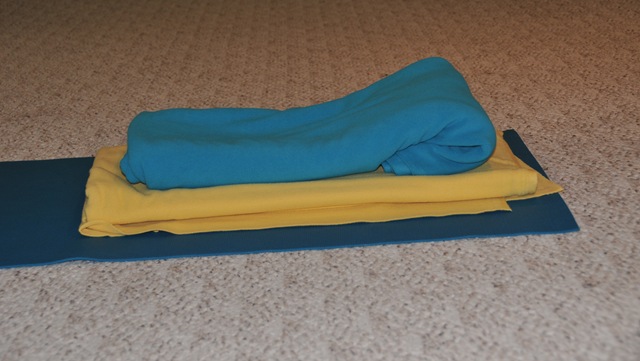
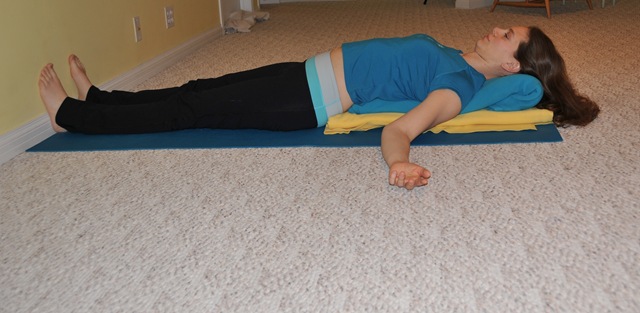
1. Take 2 folded blankets, and stagger them, so one is on top of the other, and the top blanket is pulled about 2 inches back. Fold the top blanket under at the other end, to make a pillow.

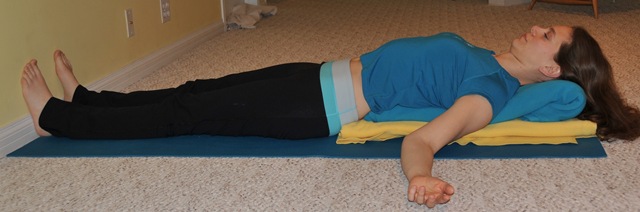
2. Lay on your back with the base of the spine touching the bottom blanket. Let your shoulders roll under and open the front of the chest.

pranayama 3. Start by relaxing into the pose, and allowing the body to completely sink into the blankets.

Notice your breath. Imagine that your breath is like a drop of Prana (energy) and all around you there is an infinite ocean of Prana, and nourishment. Allow your inhalations to be a drinking in of this nourishment.

Allow your exhalations to be dissolving breaths, as if drops of water are diffusing into the infinite ocean of Prana, and nourishment all around you. Inhale nourishing, exhale dissolving. Imagine that the supply of nourishment all around you is limitless.

belly breathing 4. Begin to focus your attention on your lower abdomen. Breathe in and allow the lower abdomen to lightly inflate, as if you were blowing up a balloon of energy just below the belly button. Stay with the belly breathing for at least 10 min, focusing on breathing deep into the lower belly.

Benefits ~ Strengthens the parasympathetic nervous system.  increases relaxation, increases oxygenation of  blood, improved mental clarity, and emotionally uplifting. Therapeutic for anxiety and stress.

Christine Wushke is a yoga and meditation teacher with over 15 years of experience. Her aim is to create a sacred space for students to effortlessly find the presence of stillness and an inner silence. Christine’s mission is to raise consciousness on the planet by empowering people to realize their own Divinity and to uncover a deep peace within. Christine is committed to assisting you in your journey, and helping you to realize directly for yourself the truth of what you are, and the stillness of truth within.

Christine’s meditations, and yoga articles will guide you to deepen your understanding of the wisdom within this ancient practice and experience the spiritual elements of yoga.

www.innerlightyoga.blogspot.com
www.journeytolight.net

If you enjoyed this meditation you can purchase Christine’s meditation CD in stores, by download, or by clicking here. Listen to sample.

Harsha's avatar

Sacral releasing Pose

Sacral releasing Pose

This pose is amazing for releasing and opening the sacrum. In spiritual tradition of yoga, it is said that the kundalini Shakti energy lies dormant like a coiled snake sitting at the base of the spine. When we do certain meditations or yoga poses, it is said that we can awaken this dormant energy and activate a spiritual energy to begin its journey up the spinal column and up into the brain.  Please use caution and mindfulness in this pose if you have herniated disks, or arthritis in the spine.

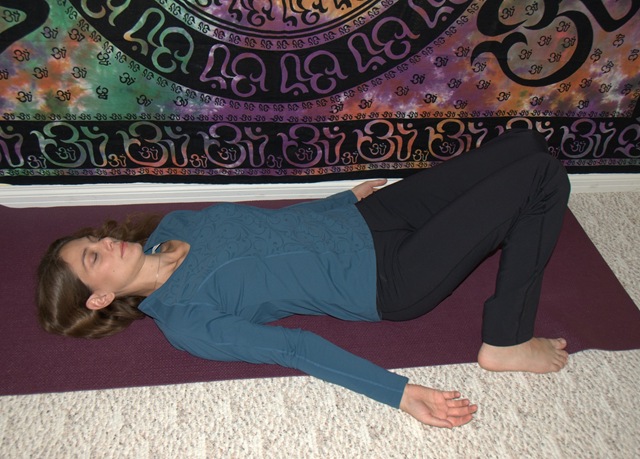
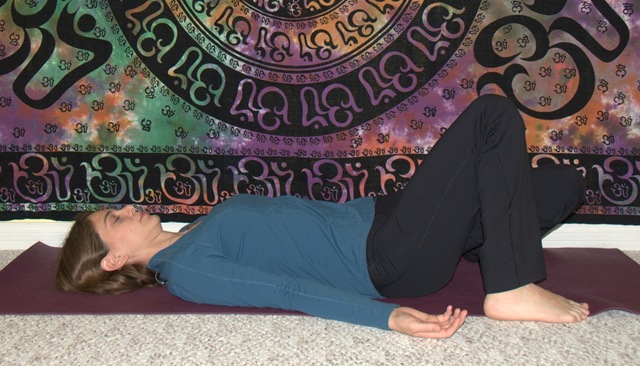
sacrum 1

1. Lay on your back with your knees bent. Bring your knees together and your feet about shoulder width apart.

2. Lift your pelvis slightly and move your tailbone toward your heels. Flatten the small of your back to the floor. (Or as flat as it will go)

3. Let your knees lean into each other, letting them also pull forward. (let this movement be natural, and not forced). Let the lower back relax as much as you can.

4. Hold this position for at least 30 seconds, allowing the muscles in your legs, and pelvis to relax.

sacrum opener

5. Bring your awareness into your sacrum. Imagine that you are breathing light, energy and nourishment into your sacrum. Imagine that you are drawing that nourishment all the way up your spine and into your brain.

6. Start to bring your knees down toward the floor, one at a time. Stretching the inner thigh.

7. As you bring your knee toward the floor, let the pelvis rock from side to side massaging the back of your pelvis. Continue to imagine that you are drawing nourishment and light into your sacrum, and allowing it to flow all the way up your spine. Use the rocking action of the pelvis to increase the amount of energy flowing into the sacrum and up the spine.

8. Return to position #1, and rest for another 30 seconds or longer.

Benefits ~ Loosens and releases the sacrum. Relaxes the muscles of the pelvis, and lower back. Massages and Oxygenates the back of the pelvis. Increases flexibility in the abductor, and adductor muscles in the thighs.

© written and modeled by Christine Wushke, Photo’s by Dianne Wushke.

Christine Wushke is a certified yoga and meditation teacher with over 15 years of experience. Her aim is to create a sacred space for students to effortlessly find the presence of stillness and an inner silence. Christine’s mission is to raise consciousness on the planet by empowering people to realize their own Divinity and to uncover a deep peace within. Christine is committed to assisting you in your journey, and helping you to realize directly for yourself the truth of what you are, and the stillness of truth within. In addition to her yoga and meditation training, Christine is also a registered massage therapist. In the past two years she has studied extensively in the spiritual tradition of Advaita Vedanta. Her teaching style is largely influenced by Iyengar yoga, and the nondual tradition of Advaita.

www.journeytolight.net

www.innerlightyoga.blogspot.com

Harsha's avatar

Spinal Nourishing Pose

Spinal Nourishing Pose

This is one of my favourite twisting poses. It is very relaxing and can be done by most people at any fitness level or age. Let yourself relax into the pose and bring attention into your spine. Let your whole spinal column be enlivened by the effects of the pose as well as your attention. It is not recommended to do this pose if you have just finished a meal, or are pregnant. Use caution if you have degenerated disks or arthritis in the spine or hips.

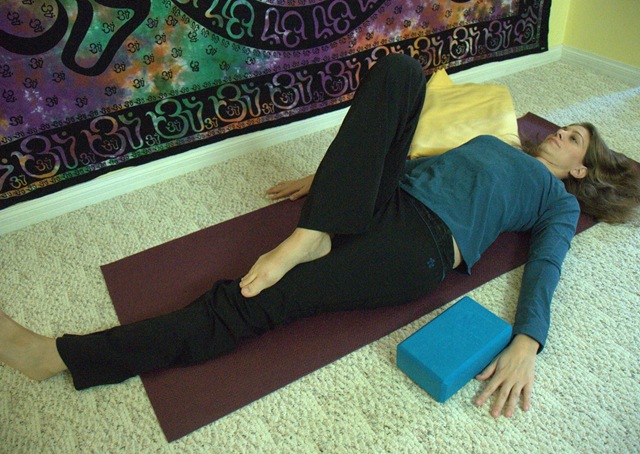
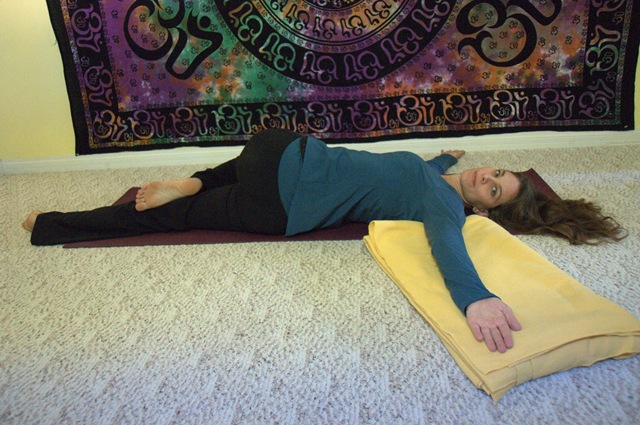
reclining twist part 1

You will need some blankets, pillows, or yoga blocks for this pose.

1. Lay on your back with your block or pillow on you left side near your hip and your blanket near your right shoulder.

2. Bend your right knee and bring the sole of your foot onto your left knee. Roll onto your left side bringing your knee down onto your block. (you may need to adjust the height of the block or pillow so it feels comfortable.)

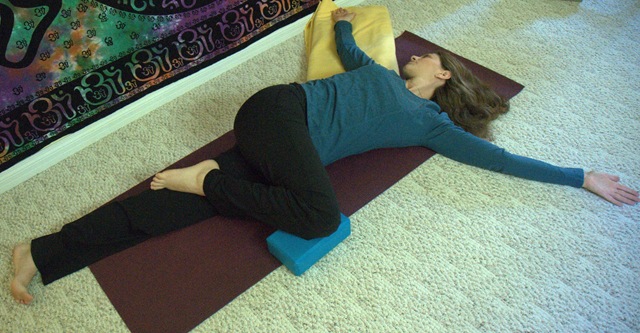
3. Bring your right arm over to the right until your arm is resting on your blanket. You may have to adjust the angle of your hip in order to place the arm in a comfortable position. Use as many blankets under the arm as you need so the position is very comfortable. Turn your head and look over your right shoulder.

reclining twist part 2

4. Check that there is equal weight on both the right knee as well as the right shoulder. You may need to fine tune your pose a bit and experiment with your props in order to find that balance.

5. You should be feeling the stretch in your hips, back, and shoulders. Take care to keep the movement of your neck soft and relaxed.

reclining twist part 3

6. Once you feel comfortable in the pose allow yourself to
relax, let your arm sink into the blanket and your knee sink into the block. Breathe into your back and spine as if you are drawing nourishment into your back muscles from the energy in your breath. Also breathe into your spine and feel the prana from your breath enliven the spinal column.

7. Hold the pose for about 1 min to each side, or until you feel the stretch diminish.

Benefits~ increases flexibility to the spine, and back muscles. Opens the shoulders, chest, and hips, mobilizes the pelvis and sacrum, strengthens the parasympathetic nervous system, releases stress and emotional tension. Detoxifies internal organs. Improves bowl function.

© written and modeled by Christine Wushke, Photo’s by Dianne Wushke.

www.journeytolight.net

www.innerlightyoga.blogspot.com

Harsha's avatar

You Are What You Eat

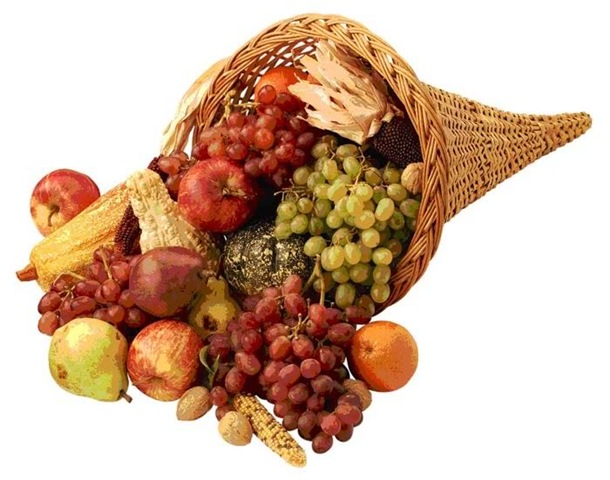
cornucopia


by Swami Sadasivananda

Are we Really what we Eat?
The Need for a Vegetarian Diet!

Every one has heard the saying: “You are what you eat.” But according to the scriptures and saints of the major Eastern religions, as well as of early Christianity, a more precise reckoning of this euphemism is, in fact, a twofold statement: “You are what you think, and you think like what you eat!”

Science tells us that the food we eat is transformed into energy that fuels the physical body. Only in our recent times has science acknowledged that there is also another energy imbued within our food, of a far more subtle nature, that influences not only the physical sphere of our being, but more importantly, the mental realm of our existence. Although modern science holds the trophy for “The slowest learners on earth”, they are now admitting that the most profound and powerful effect food has on man occurs at the psychological plane of existence.

This fact is, of course, based on the Maxim of physics that all elements in existence are essentially energy, and that energy is constant. The constancy of energy is defined by its nature of being impervious to essential altercation. The energy in the beginning of a process is the same at the end of the said process. What goes in, stays in!

In terms of ingestion of digestible matter, the quality of the energy, scientifically and specifically the vibratory rate, that dominated the nature of the plant or animal that is being eaten, is directly transferred through the digestive process and into the mind of the consumer. Thus our mind, our perception, and finally our spirit become what we eat!

If the energy is heavy or inert, little can be done with it to produce the state of silence and clarity needed to reflect the truth of spirit. Certain actions darken the mind and make it thick or heavy, vibrating very slowly–sometimes seemingly not at all. On the other hand, some actions lighten the mind, making it fluid and subtle, vibrating at a very high level. It is this latter condition that is needed for attaining the state of liberation–or rather, the state that liberates the spirit from the illusion of bondage and suffering. It is really the mind that becomes liberated, but that liberation also affects the essentially ever-free spirit and sets it free from involvement with the mind. And to attain such liberation the mind must be purified and refined. Thus, vegetarian diet becomes one of the best and strongest means for its purification.

“When we realize that any physical object has all the levels which we do, namely, the physical, biomagnetic, sensory, intellectual and will bodies, we can understand the importance of the kind and quality of food we eat. For not only does the physical substance of the food become assimilated into our physical body, so also do the subtler energies become united to our inner levels. This is the teaching of the Chandogya Upanishad:

“Mind consists of food. That which is the subtle part of milk moves
upward when the milk is churned and becomes butter. In the same
manner, the subtle part of the food that is eaten moves upward and
becomes mind. Thus, mind consists of food.” 1

“It is obvious, then, that the food we eat is going to determine the quality and condition of all the levels of our being. Our food has the same levels we do, and the different energies of the food are absorbed into our corresponding levels. Therefore when we eat something, it not only affects us on all levels of our existence, it becomes those levels. In this very real sense we indeed are what we eat. In esoteric philosophy our various levels are looked upon as separate bodies through which our consciousness operates. Since those bodies are formed essentially from the food we eat, they will be conditioned by and function according to the kind of energy extracted from the food. We are very much like the child’s toy that is a series of colored rings stacked on a rod. That is, we are successive layers of subtler and subtler energy that are connected to the physical body. From these energy levels the different life  processes are empowered and administered. When the energies within us are positive, they produce harmonious states of mind and behavior. But when the energies are negative, they move in a random and chaotic manner and produce negative states of mind and, consequently, negative behavior. Moreover, these toxic energies can also manifest as physical illnesses or defects. Substances that are toxic to the body–such as meat, alcohol, nicotine, and drugs–are toxic on the inner levels as well, and their ingestion poisons all our bodies by putting into them negative energies which are going to manifest in the disrupting manner just described. On the other hand, fruits, vegetables, and grains are reservoirs of pure, basic life energies that are very light and malleable. These energies are easily assimilated into all our bodies and made to take on our specific, unique life vibrations and karmic patterns.” 2

Thus, we must accept, and can on no legitimate grounds refute the facts of the twofold statement: “You are what you think, and you think like what you eat!”  Therefore, it can be gleaned, from both the material as well as the spiritual viewpoint, why Sri Ramana Maharshi stressed a vegetarian diet.

Question: I have heard it said that the Maharshi set no rules of conduct or lifestyle within the Ashram that came up around him. Therefore, how can what is being said regarding a vegetarian diet be essential for spiritual attainment?

It is in fact openly stated, and recorded within several of the published core teachings at the Ashram that Bhagavan Ramana set forth only one regulation for the devotees living within the Ashram, as well as for those living outside that followed his teaching. This one rule of life regarded the maintaining of a sattvic (pure) diet.

Question: Did Bhagavan ever explain why maintaining purity of diet was important, and what constituted a sattvic or pure diet?

He did explain the reason why a vegetarian diet was, and is even to this day, maintained at all times. This discipline was central to his guidance of effective means of sublimating (uplifting) the mind and its direction towards reflection upon its True Nature. His guidance stressed an ever purer awareness or quality of mind, which paved the way towards awareness within the heart, the essential home of our Eternal Self.

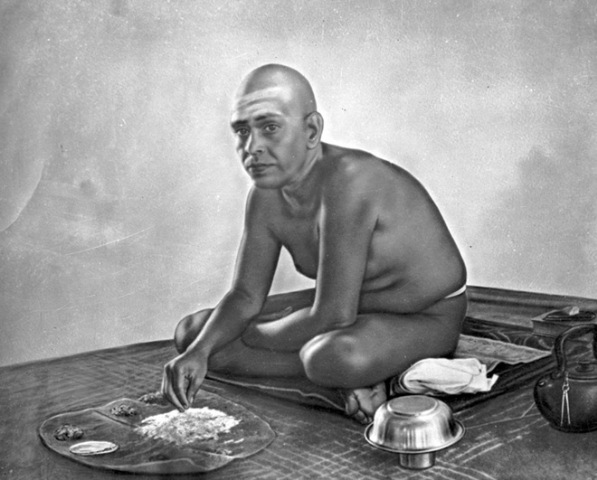
Bhagavaneating

 In Bhagavan’s own words we find recorded:

Devotee: What diet is prescribed for a sadhak (one engaged in spiritual practices)?
Maharshi: Sattvic food in limited quantities.
D.: What is sattvic food?
M.: Bread, fruits, vegetables, milk, etc.
D.: Some people take fish in North India. May it be done?
(The Maharshi made no answer.)
D.: We Europeans are accustomed to a particular diet; change of diet affects health and weakens the mind. Is it not necessary to keep up physical health?
M.: Quite necessary. The weaker the body the stronger the mind grows.
D.: In the absence of our usual diet our health suffers and the mind loses strength.
M.: What do you mean by strength of mind?
D.: The power to eliminate worldly attachment.
M.: The quality of food influences the mind. The mind feeds on the food consumed.
D.: Really! How can the Europeans adjust themselves to sattvic food only?
M.: (Pointing to Mr. Evans-Wentz) You have been taking our food.
Do you feel uncomfortable on that account?
Mr. Evans-Wentz: No. Because I am accustomed to it.
D.: What about those not so accustomed?
M.: Habit is only adjustment to the environment. It is the mind that matters. The fact is that the mind has been trained to think certain foods tasty and good. The food material is to be had both in vegetarian and nonvegetarian diet equally well. But the mind desires such food as it is accustomed to and considers tasty.
D.: Are there restrictions for the realised man in a similar manner?
M.: No. He is steady and not influenced by the food he takes.
D.: Is it not killing life to prepare meat diet?
M.: Ahimsa stands foremost in the code of discipline for the yogis.
D.: Even plants have life.
M.: So too the slabs you sit on!
D.: May we gradually get ourselves accustomed to vegetarian food?
M.: Yes. That is the way. 3

In this example, and as is seen throughout the teachings of Sri Ramana Maharshi, Bhagavan is stressing: “It is the mind that matters.” Furthermore, “The mind feeds on the food consumed”, and “The weaker the body the stronger the mind grows.”

In the following story, we are being shown that a pure diet will not only elevate the quality of the mind, but will also keep the body free from illness: “One afternoon at 3 o’clock, a devotee who was going to Madras gave a small tin containing some ointment and said that if that medicine was applied to Bhagavan’s legs, the pain would decrease, and that if Bhagavan would continuously use it, he would bring a dozen tins of it from Madras. Bhagavan replied, saying: “Enough. The Karpura Thailam I am using now is adequate. Why do I require such costly medicines? If diet is properly regulated, no medicine will be required. When these medicines are used, the ailment apparently disappears, but it starts again. That is because of some irregularity in diet.” 4

One of the close disciples who lived with Bhagavan, Arthur Osborne, related what the Maharshi taught him: “It should be explained for non-Hindu readers, that the practice of vegetarianism is not only out of disinclination to take life or eat flesh, though that is one reason for it; it is also because unsattvic food tends to increase animal passions and impede spiritual effort.” 5

Although the Ashram food was strictly vegetarian, Alagammal, Bhagavan’s mother, like some very devout Brahmins, went still further and considered some vegetables (i.e. onions) also unsattvic (impure). When Bhagavan would sit with the devotees in the kitchen and peel onions, Alagammal would weep bitterly. In response, Bhagavan would retort while holding up an onion: “Behold the powers of this small bulb.” She would then weep all the more loudly. Bhagavan had the final word, and would say mockingly: “Mind that onion! It is a great obstacle to Moksha (Deliverance)! It should be said here that Sri Bhagavan did not disapprove of orthodoxy in general. In this case there was excessive attachment to the forms of orthodoxy and that was what he attacked. In general he laid stress on the importance of sattvic (pure) food. He did not often give any injunctions at all concerning outer activity; his usual method was to sow the spiritual seed in the heart and leave it to shape the outer life as it grew. The injunctions came from within.” 6

1 Chandogya Upanishad, 6.5.4, 6.6.1,2,5.
2 Spiritual Benefits of a Vegetarian Diet, Swami Nirmalananda, Atmajyoti Press.
3 Talks with Sri Ramana Maharshi, recorded by Sri Munagala Venkataramiah, Sri Ramanashramam 2006, Talk 22, p. 20.
4 Letters from Sri Ramanashramam, Suri Nagamma, Sri Ramanashramam 2006, Letter #266 December1949, p. 640.
5 Ramana Maharshi and the Path of Self-Knowledge, Arthur Osborne, Sri Ramanashramam 2006, p. 82.
6 Ibid. p. 81.

cornucopia - Copy

Reprinted  with permission of Swami Sadasivananda
To subscribe to his newsletter, go to http://www.ramanateaching.org/contact.html
For more information on Swamiji, click here:   About Swami Sadasivananda
Teachings of Bhagavan Sri Ramana Maharshi web site: http://www.ramanateaching.org
Ask your question in relation to Bhagavan’s teachings, meditation and spirituality at:
http://www.ramanateaching.org/faq

Harsha's avatar

Call of the Conch-Part 2: By Joyce Sweinberg


WARNING:  THE  STILL AND VIDEO IMAGES IN THIS ARTICLE
ARE GRAPHIC DEPICTIONS OF VIOLENCE TO DAIRY COWS AND THEIR OFFSPRING.

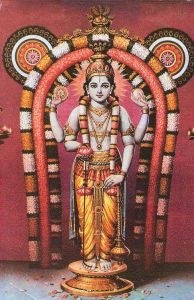
vishn69

We need to realize that milk is not an “Innocent”
animal product as it is thought to be, but is a
highly violent, cruel, and immensely exploitative food.
The most important factor in cow abuse is the economic factor;
we need to realize that as long as we, the consumers
of milk and leather, continue to buy these violent products,
the exploitation of the cow and the killing of her calves
will continue to occur.
~Shri Kamlesh

 “The female dairy cow spends her life confined in close quarters with other cows, being pumped with hormones calculated to produce pregnancy after pregnancy as long as she is capable of bearing calves, both to increase the population of the cows for milk and meat production and to spur the female to produce more milk. When her calves are born, they are taken from her within a few days of birth, giving rise to the grief of separation for both the mother and the child.”  https://luthar.com/call-of-the-conch-1.  The videos below depict the artificial insemination of the dairy cow, the birth of the calves, and the removal of the calf shortly after birth…on it’s way to either the slaughterhouse if it is male, or to its own pathetic future as a female dairy cow, soon to face the same fate as the grieving mother who gave birth to her,  bearing in her heart the infant grief of separation from her mother and facing the maternal grief in the heart of a mother forced to face the loss of her child.

The motherless child…

http://www.youtube.com/watch?v=wiRxkU_opyQ&feature=player_embedded

http://www.youtube.com/watch?v=_ZrX1rTddho

  http://www.youtube.com/watch?v=_kM387cI4rk&feature=player_embedded

http://www.youtube.com/watch?v=hAiIIZMKPC0&feature=player_embedded

Contrasts a dairy calf searching for his mother on a farm with undercover footage of calves at a slaughterhouse.

“Roughly 50% of the calves are male calves which are considered to be the by-products of the milk industry and do not have any value. These male calves are the most unfortunate souls of the milk industry; they are the silent sufferers in the background that no one bothers to notice. They sacrifice their lives so that we can drink the milk which was meant for them.These calves meet their deaths wherever factory farming occurs both in India and in the western world.

India.

Before mechanized farming, the male calves were highly sought after as draught animals that would till the land and become the farmer’s best friend. But with tractors taking over the role of draught animals, the male calves are useless and the farming/milk industry no longer feels it necessary to sustain them.

Due to the cultural heritage of India, where beef eating is not popular and cow killing is illegal, these calves are not slaughtered for calf-meat or “veal” as in the western countries. But since they pose no value to the farmer these calves are killed in the most horrific manner.

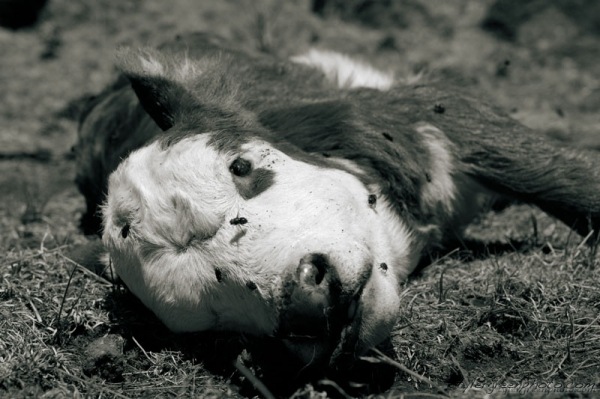
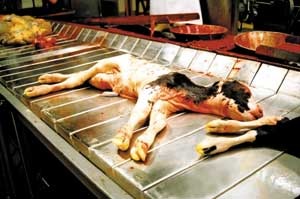
 dead-calf

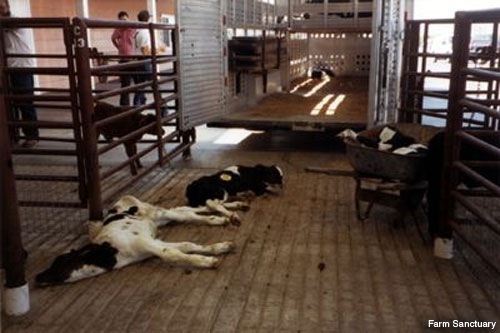
Most male calves in India are separated soon after their birth… they are strangulated to death, starved and then even buried alive in compost mounds to dispose their bodies. In some cases a stuffed animal like structure is covered with the hide of the dead calf and placed near the cow, so that she continues to give milk thinking that the stuffed doll is her living calf! Many are slaughtered in illegal slaughter houses to make fancy “calf leather” belts, purses, wrist bands etc.

Western Countries.

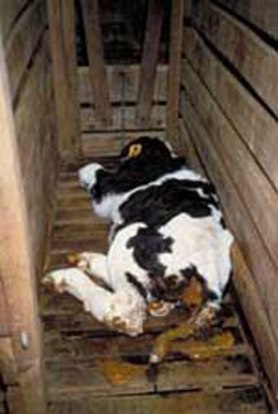
In the west the male calves are seen as sources of “calf-meat” or veal, which is the most perverted food any human can eat. The specialty of veal meat is that it is very tender, fatty and succulent and to achieve this, the calves are taken from their mothers immediately after birth and raised so as to deliberately induce borderline anemia.

 sick_calf

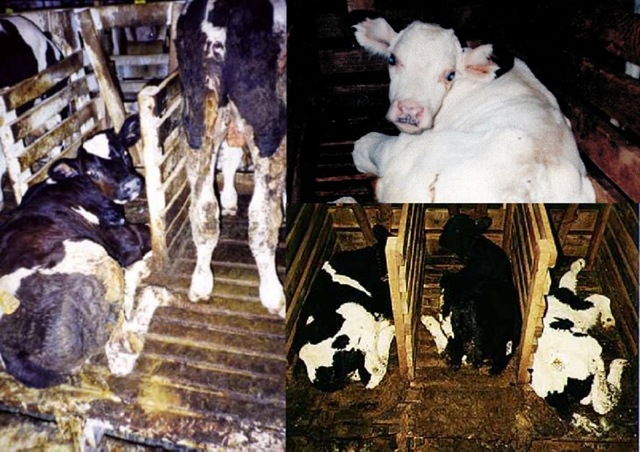
veal

They are then confined in small cages called as veal-crates, usually measuring 2-feet-wide, in which they cannot turn around or stretch their limbs all their lives. This is done so that their flesh does not build muscle which is considered to be tough to eat. After about 3-5 months of living confined to their cages, these innocent calves are then slaughtered to satisfy humans’ perverted thirst for flesh.


cattle-veal-13 preg-conveyorbeltbig

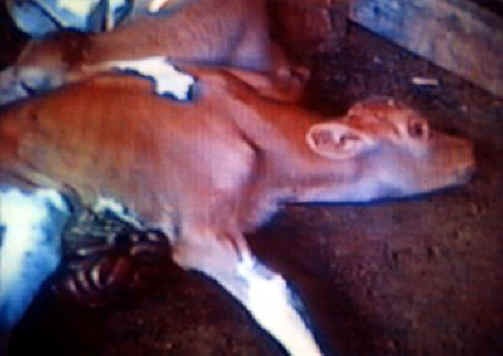
The plight of the female calves is worse, they are raised so that they can be perpetually inseminated to give us their milk for the rest of the lives. If they are so unfortunate so that they become sick or break their legs which they often do, due to being continuously pregnant they are then mercilessly slaughtered, ending as meat and leather.

It is a well known fact the cows raised for milk (Dairy cows) have to undergo much more abuse and sufferings than the cows which are raised for meat (Beef cows)”

These are NOT isolated incidents, but are in fact routine procedure to dispose the male calves as profitably as possible depending upon the location, either in India or in the west. This suffering and killings are a direct result of the milk industry, which satisfies our thirst for milk, our cravings for ice-creams, payasams and chocolates at the cost of these innocent animals.

While we enjoy our milk, the silent killings go on!   ~Shri Kamlesh*

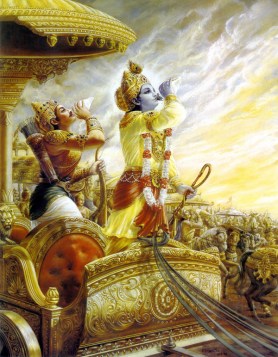
 Having one’s actions grounded in ahimsa for the Lord’s creatures, all of them, calls to our spiritual conscience with the power of the sounding of the conch. The conch, held by Vishnu, the preserver, represents life. When it is sounded, it is the sound of victory, as by Krishna and Arjuna heralding the defeat of the adharmic influences in the battlefield of the mind symbolized in the Holy Gita.  May the adharmic influences inherent in the dairy industry fall to the ground in defeat at the call of the conch.

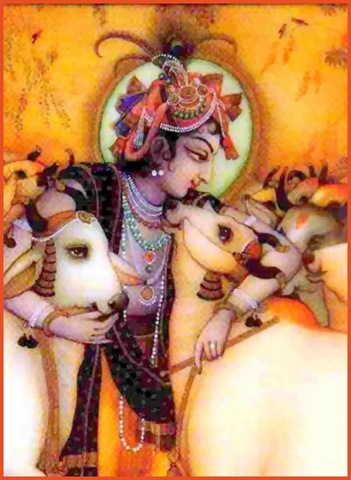
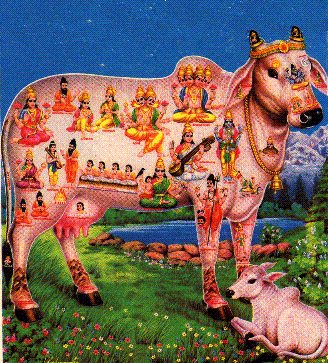
cow-gomatha_vishnu… dhenoonaamasmi kaamadhuk…

Among the cows, I am Surabhi, the wish-fulfilling cow. B.G. 10.28

 b36

 https://luthar.com/call-of-the-conch-introduction
https://luthar.com/call-of-the-conch-1

*The italicized text of Part 2 in this series was written by Shri Kamlesh, who also provided many of the images used. Any edits were to context, not to content. I offer my namaskarams to him.

Harsha's avatar

Njanappaana by Poonthaanam Nambudiri-2

translation and commentary by Smt. Savitri Puram 
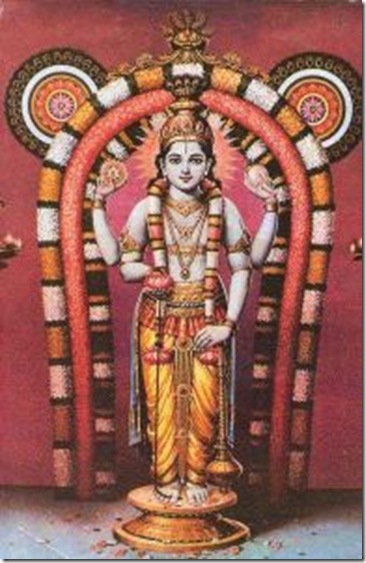
duzvdh4anypjffvi_D0_guruvayurappa

Krishna! Krishna! Mukunda! Janaardana!
Krishna! Govinda! Naarayana! Hare!
Achyuthaananda! Govinda! Maadhava! 
Sachidaananda! Naarayana! Hare!

boarder

Introduction

Njanappaana can be considered as the Bhagavad Gita of Malayalees. This is a Darshanika kaavyam or philosophical poem expressed in the most simple Malayalam language for ordinary people. Poonthanam Nambudiri, an ardent devotee of Shri Guruvayurappan, transformed his unbearable sorrow from his infant son’s death into a “yogavishesham”. He used this sad experience to build his Bhakthi soudham or house of devotion and opened it for all devotees for all time. Even though the language is very simple, this njaanappana, or song of wisdom deals with the essence of all vedas and upanishads. May Bhagavan Guruvayurappan, Bhagavathy Sarswathi Devi and Sri Poonthaanam Nambudiri bless us to become wiser by going through this great Song of Wisdom!!

This is continued from Part One… https://luthar.com/njanappaana-1

boarder

 Chuzhannitunna samsaara chakratthil
Uzhannitum namukkarinjeetuvaan
Arivulla mahatthukkal undoru
Paramaartham arul cheythirikkunnu
Eluthaayittu mukthi labhippaanaay
Chevi thannithu kelppin ellaavarum

We are restlessly moving (uzhannitum) up and down in this rotating (chuzhannitunna) wheel of material world (samsaara chkratthil). For us to know (namukkarinjituvaan), great njaanis( arivulla mahatthukkal) have preached (arul chythirikkunnu) the paramaartham (Supreme truth). All of you listen to this (kelppin ellaavarum) because to attain salvation (mukthi labhipaanaay) easily (eluthaayittu) God has given you the sravanaedriyam or ears (chevi thannithu). The meaning of “chevi thannithu” can also be taken as “give your ears” or listen to what Mhaathmaas told us.

Getting human life is rare and even after getting human life, very few people are blessed to pursue the spiritual path. But great sages of the past realized this pitiable condition of ordinary souls and have prescribed easy ways to know the Supreme Truth. One of the easiest method for Kaliyuga suggested by them is Naamasankeerthanam. Since this is the opinion of self-realized bhakthaas, Bhagavan Himself approves this method and tells in Bhagavad Gita: “yajnaanaam japayajnosmi” or Among all the sacrifices, sadhanas, austerities or forms of tapas, I am represented by japa” and thus supporting the words of Mahaathmaas.

(Bhagavan always supports Bhakthaas. When Poothaanam once read Amaraprabhu as Maraprabhu while chanting Vishnusahasra naamam, a few Sanskrit scholars made fun of him. Bhagavan could not take his dear devotee’s grief and told from the sanctum sanctorum : “I am Amara prabhu as well as Maraprabhu, meaning I am also the lord of trees or in Malayalam maram”.)

We are all going up and down on the wheel of material world rotating with extreme speed and it is very difficult to escape from that. But once we know the Supreme Truth, we will be relieved from the samsaarachakra. This Brahma jnanam is possible by sincerely chanting the auspicious names of God because Naamam or names of Lord are even greater than Naami or Lord Himself.  Hanumanji had to just chant Raama naamam to cross the ocean where as Lord Raama had to construct the bridge to cross the ocean to Lanka!

Also as explained in the previous lines [https://luthar.com/njanappana-1 ], anybody can chant naamam anytime and anywhere. So Poonthaanam is asking us to listen carefully to what Mahaathmaas have told us about Supreme Truth. Like sravanedriyam or ears can be used for hearing the greatness of Lord, all other indriyaas should be used for the purpose of serving God. Sankarrachaaryar also gives this idea in a very beautiful sloka in Soundarya Lahari:

JapO jalpa: shilpam sakalam api mudraa-virachanaa
Gathi: praadakshiNya-kramanam ashanady aahuthi-vidhi:
PraNaama: samvesha: sukham akhilam aathmaarpaNa -drushaa
Saparyaa paryaya: thava bhavathu yan mae vilasitham

Let my spoken words become manthras, let all my hand gestures become mudraas, let all my steps become circumambulation or pradakhinam to you, let my lying down to sleep become prostration to you, let the food I consume be an offering to the sacred fire lit for you, let what ever I do become a worship to you. 

Nammeyokkeyum bandhicha saadahanam
Karmam ennariyendathu mumbinaal

First and foremost (mumbinaal), we should know (ariyendathu) that karmam is the thing (saadhanam) that binds (bandhiccha) all of us (naameyokkeyum) to this world.

Even before telling us more about the easiest path for salvation, poet starts with the big word : “Karma” and how we are all bound in the cycle of birth and death by karma. Both good and bad karmaas are binding and hence we have to know what is the root cause for making us do karmaas and eradicate the root cause. In this context, an example of a burning stick is appropriate. If we move a burning stick in a circle, a burning circle will seem to appear. In reality (understanding the reality is njaanam) the circular movement of the stick causes the illusion. Likewise the wheel of time is moving with very high speed dragging us along with it and forcing us to do good as well as bad karmaas with ego (or feeling of “I am the doer). This causes the illusion of bondage. So we have to have the njaanam or knowledge to go beyond this illusion or Maya to escape from the bondage. Also the famous example of seeing a rope and misunderstanding it as a snake is appropriate. Until we know that it is only a rope, we will be scared and stressed. What will lead us to this knowledge of Brahmam? Continuous remembrance of Lord through Naamasankeerthanam will help us to detach us from the karma-bound cycle and lead us to Njaanam and moksham. 

Law of Karma is a law of justice and it is straight forward, impartial and inescapable. The only thing that can nullify the effects of Karma is Bhagavan’s grace. Bhagavan’s blessings loosen the tightly bound law of Karma and makes the otherwise impossible escape possible for us. In Kaliyuga the easiest way to obtain Bhagavan’s blessings and grace is naamasnakeerthanam. 

In Mahabharatha, Sahadeva advises his elder elder brother Yudhishtira on the subject of Karma. He says that when ever we do Karmaas with the feeling of “I am the doer” or “mine (two letter sanskrit word “mama”) those karmaas lead us to the cycle of birth and death. But when we do karmaas thinking that we are not the doer, the results of the karmaas also will not be ours. This feeling is called “I am not the doer” or not mine (in Sanskrit, it is expressed in three letters “na mama”). Karmaas performed with this attitude are not binding and and free us from the eternal cycle of birth and death. Again, how can we develop this attitude in Kaliyuga? Poonthanam assures us along with Bhagavan that Nammasankeerthanam will eventually give us this “na mama” attitude and lead us to njaanam and moksham.

How can we forget to mention Shankaraachaaryar’s lines

punarapi jananam punarapi maranam
punarapi jananii jathare shayanam
iha samsaare bahudustaare
kripayaa apaare paahi muraare

Born again, death again, birth again to stay in the mother’s womb! It is indeed hard to cross this boundless ocean of samsara. Oh Murari! Save me through Thy mercy.


Munnam ikkanda viswam aseshavum
Onnaayulloru jyothi swaroopamaay
Onnum chennangu thannodu pattaathe
Onnilum chennu thaanum valayaathe
Onnonnaayi ninakkum janangalkku
Onnukondariyaavunna vasthuvaay
Onnilum urakkaattha janagalku
Onnu kondum thiriyaatha vasthuvaay
Onnu pole onnillaathe ullathil
Onnaayulloru jeeva swaroopamaay
Ninnavan thanne viswam chamachu pol,
Moonnum onnil adangunnu pinneyum

During pralaya or dissolution (word “munnam” refers to pralayam) this whole world (viswam asheshavaum) becomes the one and only one (onnayulloru) jyothi swaroopam or parama thejopunjam. This jyothiswaroopam is only a witness, this is neither attached to anything in this world (line four) nor let anything in the world get attached to this (line 3). Those Jnaanis and Bhakthaas (predominantly of saatwic and raajasic nature) who try to figure out one by one (onnonnaayi ninakkum janangalkku) using “nethi, nethi” process or “not this, not this” process, perceive “It” as one thing through which everything is known (onukondariyaavunna vasthuvaay). For those people whose minds are restless, fickle and out of control (onnilum urakkaattha janangalkku -predominantly of Thaamasic nature) “It” cannot be comprehended or understood by any means (onnukondum thiriyaattha vasthuvaay). Outwardly each and every being is different (oonu pole onnillaathe), but the spirit or jeeva swaroopam in all  beings are the same (ullatthil onnaayulloru jeevaswaroopamaay). The same jeeva swaroopam that exists in everything (ninnavan thanne) created the whole universe (viswam chamacchupol) and “It” again (pinneyum) contains all the three . (moonnum onnil adangunnu)

During pralaya or dissolution, everything is merged in Lord and nothing remains except the parama jyothi swaroopam or light of lights (or paramaathma chaithanyam). This is compared to the disappearance of stars and moon at sunrise. Likewise, the whole universe including the sun, moon, stars and all planets dissolve and become part of that great Jyothi swaroopam. One of the prayers we chant during aarathi or deepaaraadhana expresses the same idea:

Na thathra suryo bhathi, na chandratharakam
nema viddhutho bhanthi kuthoyamagni
Thameva bhantham anubhaathi sarvam,
thasya bhasa sarvamidham vibhathi.

“There the sun does not shine, nor the moon nor the stars; these lightnings also do not shine – how then (can) this earthly fire? Verily, everything shines after Him reflecting His glory. This whole world is illuminated with His light.”

But this light of lights is “Anaadimadhyaantham” or beginningless,middleless and endless. At the end of the dissolution phase, each individual soul again takes birth depending on the accumulated karmaas. These individual souls with accumulated karmaas do not get salvation during dissolution, but just remain hidden in Easwara Chaithanyam and then take birth again to experience the results of their good and bad karmaas.

These lines specifically explains how Bhagavan is not tainted by our karmaas. Even when we disappear into the jyothi swaroopam, that jyothi swaroopam remains unaffected. So our sorrows and happiness do not affect Bhagavan and Bhagavan is not responsible for our sorrows and happiness. Our experiences are the direct results of our own karmaas. Then how does Bhagavan help us? When we realize that the jyothi swaroopam with in all of us is the same as the paramaathmachaithanyam, all our actions become an offering to the Light of Lights, “mama or mine” attitude disappears, and “na mama or not mine” attitude arises. But only in a pure mind this realization happens and in Kaliyuga, Nammasnakeerthanam is the most practical method to attain purity of mind.

“Onnukondariyaavunna vasthu” indicates that for ordinary people like us, Brahmam can be known only through the path of Bhakthi. Bhakthi leads to Njaanam. Little Prahlaada believed that everything existing was Naarayana swaroopam and when he told his father that God is omnipresent, Lord did come out from the lifeless pillar to protect Him. Gopikaas were ordinary housewives and just because of their intense and blind devotion to the Lord of Vrindavan they attained Jnaanam and moksham. Fickle minded ordinary people who are distracted every moment with the the various temptations of life cannot comprehend the greatness of Bhagavan. First the aasuric or thaamasic or demonic characteristics of our mind has to be reduced by the constant remembrance of Lord and the power of Naamam will elevate ourselves to purer and purer levels.

Last line talks about the number three. This three can refer to several things: Prakrutthi, mahatthathvam, Ahamkaaram or  Satva Gunam, Rajo Gunam, Thamo Gunam or Brahma, Vishnu, Maheswaran or  three worlds. At the time of dissolution, everything merges into the paramachaithanyam and this explains the transient nature of everything we see or feel in this world. Poonthanam explains this to develop an attitude of detachment in our mind and hence perform Nishnkaama karmam and attain the Lotus Feet of Lord by chanting His names.

Onnu kondu chamachoru viswatthil
Moonnayittulla karmangalokkeyum
Punya karmangal paapa karmangalum
Punya paapangal misramaam karmavum
Moonu jaathi niroopichu kaanumbol
Moonnu kondum thalakkunna jeevane

In this universe (virtually) created (chamachoru viswatthil) by our own Avidya or ignorance (here “onnu kondu” means “due to avidya or ignorance”), all karmaas (karmangalokkeyum) can be divided into three categories ( moonnaayittulla). They are namely Punya karmaas, Paapa karmaas and Punya-Paapa-misra karmaas. (lines 2 and 3) When we think (niroopicchu kaanumbol) about the above three types of karmaas (moonnu jaathi), we can see that jeevaathma (jeevane) is bound (thalakkunnu) by all three types of karmaas (moonnu kondum)..

Just like the moon is lit by the reflected light of the Sun, we are alive by the chaithanyam or light lit by the Light of Lights, Paramachaithanyam. A person who is ignorant of the fact that sun’ light causes the moon-light, thinks that it is moon’s own light. Similarly, this whole universe is not different from the paramaathma chaithanyam itself and with our inability to comprehend this and internalize the truth, we do three types of karmaas with “ahambhaavam” or feeling of “I and mine” and these sakaama karmaas (result oriented actions) bind us to the eternal cycle of birth and death. It is difficult to exactly differentiate punya karmaas and paapa karmaas. Some of them can be labelled with out any doubt. But, some of the karmaas can be classified only according to the context.That is why Poonthaanam mentions about the third type called mixed karmaas.

There is a small story to illustrate this point. Once a very pious sage was resting in his hermitage in the forest. A just and righteous King followed by a group of robbers entered the forest. King was running about one mile ahead of the robbers and turned east near the sage’s hermitage. (Hermitage was in junction near a river and one can go in any direction from there). While running, he specifically told the sage not to disclose which way he ran to the robbers following him. As expected robbers came and asked the sage about the direction in which the King ran. This sage who had never spoken untruth in his life did not want to say a lie to the robbers. He could have either said “I do not know” or to save the King’s life he could have even said  “west or south or north”. Instead he told them “east” to save his sathyavratham or vow of truth. Later he had to experience the negative results of his paapa karma because in that particular context, saying the truth was not a punya karma or dharmam. By saying an untruth he would have saved the life of a righteous king and his country. But he cared more for his own vow of truth than saving the life of a just and righteous King. Because of his selfishness, even though he told the truth, it became a paapa karmam.

Since all the three types of karmaas binds us, only destruction of all karmaas can free us from bondage. But it is impossible for ordinary people to live with out doing any karmaas. There is not even a moment when we are not doing karma either by body, by words or by thoughts. So the only solution is to do karmaas with renunciation of the fruits action which is called Nishkaamakarmam. Bhagavan says in Bhagavad Gita;

yasya sarve samarambha:
kama-sankalpa varjitha:
jnanagni dagdha karmanam
tam ahu: panditham budha:

He, all whose undertakings in this world are free from the bondage of expectation, who has sacrificed all the results of his actions in the fire of knowledge is a pandithan or scholar -so says intelligent people or (great seers)

Even though all these philosophical concepts are mind boggling to ordinary people like us, Poonthanam assures that Naamasnakeerthanam will clear our mind and help us to develop an attitude of surrender and intense devotion. Then Bhagavan takes over and assures us : Na mae bhaktha pranashyathi- my devotees will never perish. Bhagavan’s grace will lead us from Rakthi —> Bhakthi—-> Mukthi.

Ponnin changala onnipparanjathil
onnirumbu kondennathre bhedangal
Randinaalumeduthu panichaiytha
Changalayallo misramaam karmavum

Bondage comes from three types of karmaas and one string (changala) formed as a result of satkarmaas or punyakarmaas or good deeds is made of Gold (ponnin), another one (onnu) formed as a result of paapa karmaas or negative karmaas or dushkarmaas is made of Iron (irumbu) and the third  string ( formed as a result of the mixture of the above two types of karmaas-misrakarmam) is made of a mixture of both Gold and Iron (randinaalumeduthu pani cheytha).

Even though Gold and Iron are different metals with entirely different properties, when they are used for tying or binding some one it hardly makes any difference for the bound victim. The word “changala” and “thalakkuka” are usually used for chaining elephants. By using these words, Poonthanam brings out the fact that breaking the strings of bondage is as difficult for us as it is for an elephant to break it’s thick Iron chain. But with lot of effort, sometimes elephants do break and run to freedom. So with continuous and sincere effort human beings blessed with the power of discrimination, can break all three binding chains. Even people with predominantly satva gunaas find it hard to break the bondage effortlessly. As long as their satkarmmas are result oriented, they will not be freed from the cycle of birth and death.  They live to enjoy the results of satkarmaas, again do satkarmaas to be born again and again. Only renunciation of the fruits of action can break the bondage for Punyaatmaas (great souls), Paapis (sinned souls) and those punyaathma-paapaathma combination souls . The only difference is that when we do Paapa karmaas we are subjected to negative experiences and punya karmaas yield positive experiences and mixture of both will give both positive and negative experiences. But eternal freedom from this cycle calls for Nishkaama karmam.

Even if a cage is made of Gold, a bird sees it only as a cage in which it is trapped. It does not enjoy the beauty of Gold. It only wants freedom. Likewise our souls crave for eternal freedom to join the Parmaathma. Because of the avidya or ignorance, jeevathma goes after transient pleasures and with egoistic actions accumulates all three types of karmaas. Poonthaanam advises us to do naamasnkeerthanam which  removes ignorance and makes us realize that we are trapped in this eternal cycle of birth and death. Naamam persuades us to strive with the determination and force of a “matthagajam” or mad elephant to break this chain of bondage. Poet assures that this force to break the chain can be derived from chanting Lord’s name. By the power of Naamajapam even an athiest (who does not believe in God or in prayers) goes through different stages of Bhakthi or devotion and reach the highest state of Uttama Bhaktha or perfect devotee. A Bhaagavatotthama ( the highest type of devotee ) is one who sees the glory of Bahgavan in all animate and inanimate beings, and also perceives all beings as dwelling in Him. So all his karmaas become an offering to God and practically becomes a Jeevanmuktha. Then he discards the body when the results of the accumulated karmaas are exhausted and merges with the Paramaathma.

Where does God live? Bhagavan says to Narada:

Naham vasami vaikunte na yogi hrudaye ravau
Mad bhaktha: yatra gayanti tatra thishtami narada.

“I dwell not in Vaikundha, not in the hearts of yogis, nor in the Sun, I live where my devotees sing my glory and divine names.” 

Brahmaavaadiyaay eecchayirumbolam
karmabaddhanmaar ennatharinjaalum
Bhuvanangale srishtikkayennathu
Bhuvanaantha pralayam kazhivolam
Karmapaasatthe lamkhikkayennathu
Brahmaavinnumeluthalla nirnayam
Dikpaalakanmaarum avvannam ororo
Dikku thorum thalachu kitakkunnu

Know the fact that (ennatharinjaalum) starting from Brahamadevan and other devaas (Brahmaavaadiyaay) to flies and ants (eeccha irumbolum), all of God’s creation are bound by Karma (karmabaddhanmaarr). Creation of universe (bhuvanangale srushtikkayennathu) continues until the dissolution or pralayam of the universe (bhuvanaantha pralayam) is completed (kazhivolam). That means it is definitely (nirnayam) not easy (eluthalla) even for Brahmadevan (Brahmaavinu) to break (lamkhikkayennathu) the binding thread of karma (karmapaashatthe). In the same way (avvannam) eight devaas ruling the eight zones or quarters of the universe also (dikpaalakanmaarum) are lying bound (thalacchu kitakkunnu) in their own directions (dikku thorum).

In these lines, poet says that there is no body (it literally means any jeevaathma dwelling in any type of body) in this world who is not bound by Karmaas. Even Brahmadevan dwelling in a body continuously does srushti or creation and then of course Vishnu Bhagavan has to maintain the universe and Mahadevan has to take care of annihilation. When Dharma declines, Vishnu Bhagavan incarnates in different forms, perform necessary karmaas with out attachment and goes back to Swadhaamam or home discarding the body used temporarily. Only the Nirguna Brahmam or Paramajyothi swaroopam, who is only a witness of all these, is free of this bondage of Karma. But thrimurthis (Brahma-Vishnu-Maheswara) know that they are none other than the Brahmam and they are neither attached to the karmaas or the fruits of their karmaas. Because of their knowledge of the essence of srushti-sthithi-samhaaram (creation, maintenance and annihilation) they do not experience the uncertainties of life like other demigods or mortal human beings. They just perform karmaas with out attachment. (Vaikundhavaasi, ananthashaayi Vishnu Bhagavan and Bhagavaan’s all incarnations are not Jeevathmaa occupying a body, but Paramaathma Himself. With apaara kaarunyam or ocean of mercy, that Paramachaithanyam is letting us worship in any form (sagunam) we prefer. Even though in incarnations, Bhagavaan discards the body after the purpose of incarnation, He would appear before us in any form we worship because He is eternal with form and with out form. In one of the stories, He even takes the form of a “male buffalo” to please his devotee. Bhagavaan appeared as the minister Mangaattacchan to save Poonthaanam from robbers!)

Even Thrimurhis (Brahma, Vishnu and Shiva) do not break the chain of Karmam. So where do we stand?  By their actions, Thrimurthis are demonstrating this truth to the world. The word “Nirnayam” indicates that to destroy the karmaas each and every individual should strive. In the spiritual world there is no proxy and each person should take responsibility for their own advancement. A Guru or satsangam can help to initiate one’s effort and the rest is in each inividual’s sincere effort.  Above all of these, we need Bhagavaan’s blessings every moment and Poonthaanam’s only solution in this Kaliyuga is chanting of naamam. It is interesting to note that Poonthaanam used the words “thalacchu kitakkunnu” for the eight devaas who rule the eight directions. Dikpaalakaas are not as detached to the karmaas as Brahmadevan or in other words they are not Brahmajnaanis and hence they are helplessly lying bound in the eight directions.  Ordinary human beings are far inferior to this dikpaalakaas. To elevate ourselves from the Maanava state to Maadhava stage, Poonthanam recommends Naamasankeerthanam. In Bhagavatam, Sri Shuka Maharshi tells King Parikshit:

Kalair dosha nidhe rajan astihyeko mahaan gunaan
Kirtanaad eva krishnasya mukta sanga: param vrajet

My dear King, although Kali-yuga is an ocean of faults, there is still one good quality about this age:  Simply by chanting  Hari keerthana, one can become free from material bondage and attain salvation.

Shankarrachaaryar’s explanation on the importance of Naamajapam is very interesting. He says Naama japam gives us mukthi or salvation faster than any other form of worship or prayer because of two main reasons:

1. It is very simple and can be done by anybody, anywhere and anytime. No restrictions have to be followed.

2. Second one is the most important reason. We are not asking God for any favours or special blessings or anything in particular when we worship with naamasankeerthanam. We only glorify God with His auspicious names and try to continuously remember His divine form. Naamasankeerthanam promotes Nishkaama Bhakthi which leads us to salvation or mukthi. 

So let us chant along with Suka Muni, Shri Shankarrachaaryar, Poonthaanam Nambudiri and millions of devotees: 

Krishna! Krishna! Mukunda! Janaardana!
Krishna! Govinda! Naarayana! Hare!
Achyuthaananda! Govinda! Maadhava! 
Sachidaananda! Naarayana! Hare!

boarder

Samasthaaparaadham kshamaswa.

Sreekrishnaarpanamasthu.

Harsha's avatar

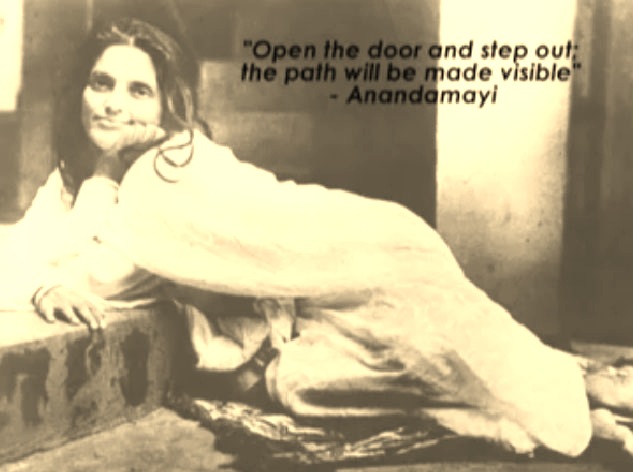
Matri Vani


Matri Vani (Words of Sri Anandamayi Ma) (from Matri Vani, Volume 2)

Om_MaA traveler on the path to the realization of the Supreme Being has to obey his Guru’s instructions so that his journey may be crowned with success. However, in a case where there are no such instructions, one should, according to the dictates of one’s heart, keep oneself engrossed in calling out to God and in prayer and meditation. If someone prays to Him with a sincere and simple heart, God will fulfill his cherished desire. To yearn for Him with his whole being is man’s duty.

To invoke That, to be constantly intent on realizing It is man’s duty. At all time in Her arms, in Her embrace—within the Mother. On finding Mother everything is found.

There are two kinds of restlessness: one due to worldly activity and the other the restlessness to advance on the spiritual path. The latter is the very means to real peace. That which is tranquility, Atma, God—That becomes known. Only when there is intense hankering after it will supreme peace be found. Eternal bliss is also one and the same thing. 

It is impossible to invoke God sincerely without a result—this can never happen! He will surely cleanse and purify His own offspring and then take them to Himself. Pray to Him with heart and soul. To the limit of your power, using all the strength and capacity you possess, endeavor to live constantly in His presence. Surrender yourself at His feet. He Himself gives His Kriya (spiritual practice), training the aspirant to go beyond all Kriya in order to reach the Goal. Therefore, try with all your might to concentrate with your entire being on that form of Him to which you can give yourself whole-heartedly and without reserve. Time is speeding away!

To be born as a human being is a rare boon. If in spite of having obtained this great opportunity one does not give time to the contemplation of the Beloved, one will have to ask oneself: “What have I been doing?” To neglect the contemplation of Reality means to take the road of death.

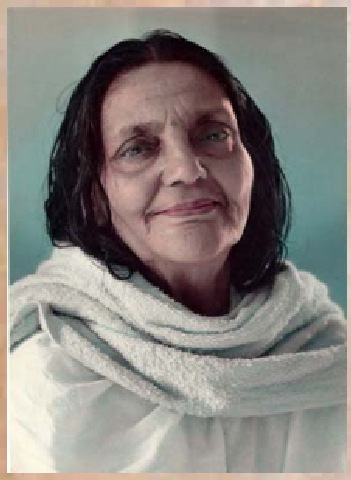
 Anandamayi Ma

Border_2


Reprinted  with permission of Swami Sadasivananda
To subscribe to his newsletter, go to http://www.ramanateaching.org/contact.html
For more information on Swamiji, click here:   About Swami Sadasivananda
Teachings of Bhagavan Sri Ramana Maharshi web site: http://www.ramanateaching.org
Ask your question in relation to Bhagavan’s teachings, meditation and spirituality at:
http://www.ramanateaching.org/faq

Harsha's avatar

Simple Seated Twist: By Christine Wushke

This pose is recommended for intermediate students. While the spinal twist is very gentle, sitting in hero pose can be difficult for beginning students. If you would like to try this pose, and you are a beginning student, follow steps 2 – 6 sitting on a chair, instead of the blocks.

* This pose in not recommended for pregnancy, arthritis in the spine, or degenerated disks in the spine.

simple twist props B&W

Get 4 foam blocks, and 2 yoga bricks, or some folded blankets, and some pillows. You will need to experiment with the right height for you, so have ample props nearby, it is better to have more than enough.

1. Hero pose: Sit with your back straight, and your sit bones on a stack of blocks or folded blankets. Place your feet straight back making sure your knees are pointing straight forward. You may have to adjust your calf muscles so that they are in a comfortable position when sitting.

simple twist 1 B&W Check that there is no discomfort on your knees or hips. If there is, then adjust your height so that you are sitting on more blankets, or blocks. Take time to experiment with the amount of blocks or blankets you are using, so you are completely comfortable. If you are not comfortable in this position, follow along with steps 2 – 5 sitting in a chair.
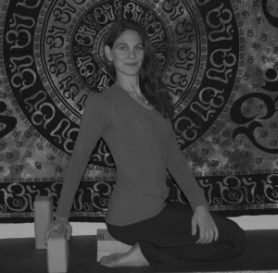
2. Straighten your spine, so that you are sitting as tall as possible. Move your shoulder blades down your back. (As if you are placing your shoulder blades in your back pockets.) Lift your chest up.

3. Very slowly twist your spine until you feel a stretch in your back. As soon as you feel a stretch, stop. Lift your chest, and move the shoulder blades down. Stay here until you feel the stretch diminish. Breathe evenly, and into the belly.

simple twist B&W

4. After you feel the stretch diminish twist a little bit more, until you feel a stretch in your back again. Stop here. Lift your chest, move your shoulder blades down. Look over your shoulder, keeping your neck nice and loose.

5. Hold the pose as long as you are comfortable, doing your belly breathing.

6. Remember to use your intuition, the best yoga teacher you will ever find is your own body.

Benefits ~ Tones and strengthens the muscles in the back, helps diminish muscle tension in the back, keeps the joints in the spine more mobile, tones and detoxifies internal organs, cleanses the colon, detoxifies the liver.


Ab0ut Christine Wushke

Christine Wushke is a yoga and meditation teacher with over 15 years of experience. Her aim is to create a sacred space for students to effortlessly find the presence of stillness and an inner silence. Christine’s mission is to raise consciousness on the planet by empowering people to realize their own Divinity and to uncover a deep peace within. Christine is committed to assisting you in your journey, and helping you to realize directly for yourself the truth of what you are, and the stillness of truth within.

Christine’s meditations, and yoga articles will guide you to deepen your understanding of the wisdom within this ancient practice and experience the spiritual elements of yoga.

http://www.innerlightyoga.blogspot.com
http://www.journeytolight.net

Harsha's avatar

Call of the Conch-Part 1: By Joyce Sweinberg


WARNING:  THE  STILL AND VIDEO IMAGES IN THIS ARTICLE
ARE GRAPHIC DEPICTIONS OF VIOLENCE TO DAIRY COWS.

  5972_217788405374_215886190374_7850084_1398980_n 5972_217788400374_215886190374_7850083_3230150_n 5972_217804335374_215886190374_7850612_5256181_n

Lord Sri Krishna vividly describes the three types of foods,
Sattvic, Rajasic and Tamasic. Milk in the olden days was definitely Sattvic.
However now it is 100% Tamasic due to the abundant violence and abuse it entails.
Drinking such milk is equal to eating beef. In fact the animals raised for meat
do not have to suffer so much as these unfortunate dairy cows are made to suffer.

~Shri Kamlesh

In Patanjali’s Yoga Sutras, Ahimsa (nonviolence) is considered the first principle of the spiritual life. Ramana Maharshi, the great sage of Arunachala has clearly stated, “Ahimsa Param Dharma”. Translated this means that nonviolence is the supreme religion… My friends, in order to gain peace, one has to give peace to others. This is the universal law as described and explained by the doctrine of karma. What we give to others, we give to ourselves. If we are able to learn this lesson by heart, it will influence our actions in this world. It is not an easy lesson at all.Nonviolence is the most beautiful expression and manifestation of the unconditioned recognition of the Nature of Reality. This is our conviction. This ideal is our aspiration. As many times as we fall, we get up and stand on the foundation of nonviolence as our nature. ~Dr. Harsh K. Luthar

                                      https://luthar.com/ahimsa-and-self-realization-by-dr-harsh-k-luthar

Can you hear her crying?

There was a time, a time when the dairy cow was nurtured and revered for her milk, when the calf came first and the human after, when she was part of the family, not part of their property. When she lived out her life with decency until the end, even after she no longer produced milk. But that time is long gone, replaced by industry production methods aimed at one goal…profit.  And in that goal, all decency was lost, replaced with the torture, plunder and cruelty of the present milk farms, both here in the US and abroad.

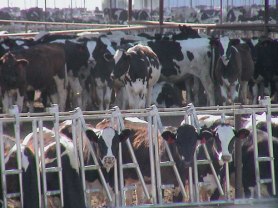
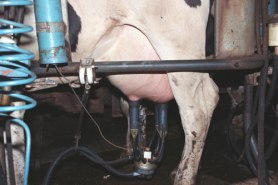
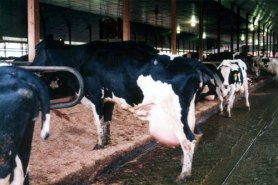
The female dairy cow spends her life confined in close quarters with other cows, being pumped with hormones calculated to produce pregnancy after pregnancy as long as she is capable of bearing calves, both to increase the population of the cows for milk and meat production and to spur the female to produce more milk. when her calves are born, they are taken from her within a few days of birth, giving rise to the grief of separation for both the mother and the child. (This and the fate of her calves will be the subject of its own article)  Her body knows no rest, either from pregnancy, the drugs used to induce pregnancy and milk production,  or the milking machines which relentlessly squeeze the very life out of her, slowly and painfully.  This relentless assault on her body frequently causes her to develop mastitis, an extremely painful condition of the udder, which results in blood and pus accumulating within the infection and often being expelled into the milk.

cow07

 cow10

cow11

cow08

The link below graphically depicts the puncture of  an inflamed udder…
http://www.youtube.com/watch?v=vqqSeO4vqcw&feature=player_embedded

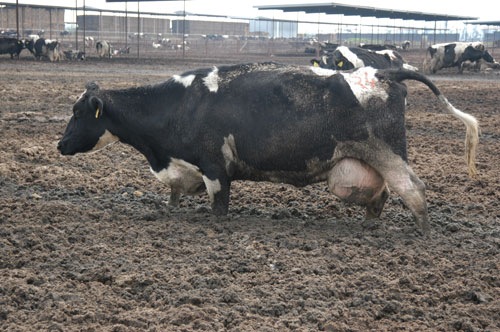
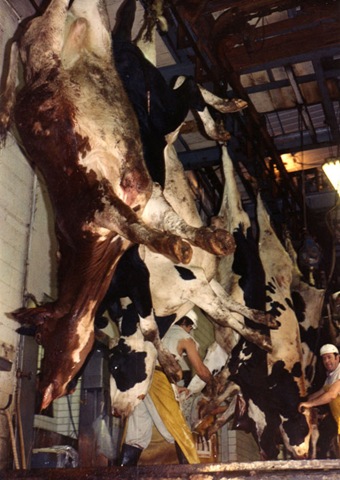
Although the average life span of the cow can be in the neighborhood of  25 years,  the cow in the milk farm is ready for death after approximately 4-5 years.  By this time, the multiple pregnancies, coupled with the hormones and other drugs pumped into her system have taken their toll.  More often than not, by this time, she can barely walk on her own, either due to excess weight gain from the drugs and/or broken bones and the condition is often referred to as a “downed cow.”  This has significance in the market, as a “downed cow”, by law in most states, is not to be introduced into the slaughterhouse and the meat which is being sold to the ever willing population of meat eaters.  For this is her final destination…once she is no longer useful for bearing calves or bearing milk, she is sent to the slaughterhouse to be butchered and sold as meat.

A note about organic farming is in order. Although the cow may not be confined or treated with antibiotics and other drugs, it is quite likely that she will be impregnated, separated from her offspring and slaughtered in the end.

Even as she approaches her last moments, she is prodded and abused to keep her “up” so she can “walk” past the inspectors and into the knife of the butcher.  The videos in the link below show the cows being hit in the face with sticks, prodded with electric prods, chained to forklifts and dragged just to get them “on their feet.”  Once on the feet, the cow is continually pushed, her tail twisted, electric shocks applied to her, anything to keep her moving and get her into the kill box, where all of this will finally come to an end, and she will be slaughtered. The link below to the Humane Society video, taken undercover at a dairy farm in California, illustrates some of this abuse…

http://lawprofessors.typepad.com/foodlaw/2008/02/horrible-dairy.html

  Abuse is not limited to America…

INSIDE THE INDIAN DAIRY INDUSTRY

“The cows are cramped into these trucks, with no food, water for days these poor exhausted animals are then literally thrown from the trucks on to the ground. Many cows break their legs, and bones and cannot walk, to hoist them to the slaughter house acid is poured into their eyes and noses or their tails are broken. These abuses are wide-spread because of lax laws and corrupt officials and the demand for cheap leather products. Some how when these cows are lead to the slaughter house, the cows are literally hammered by a large hammer on their heads and after they are immobile their necks are slit so that they are bled to death. At least their miserable lives have now finally come to an end. The farmer now gets his money from the dead cow’s flesh and leather and buys a younger cow to continue the cycle.”  ~Shri Kamlesh

 http://www.youtube.com/watch?v=ZjYA2K7ke0E&feature=player_embedded

 DOWNED COWS

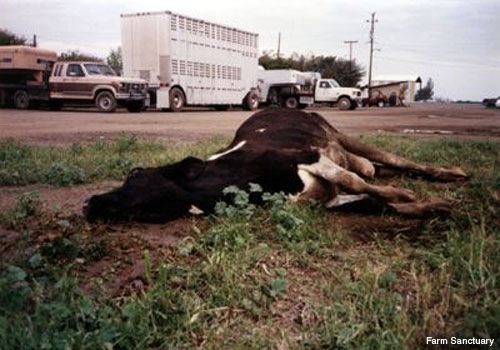
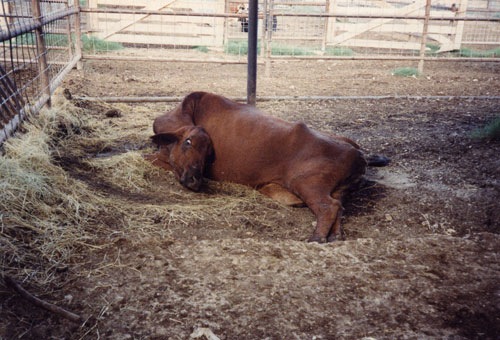
The cows pictured below, either because of broken legs or other diseases affecting them due to the abuse of their bodies in the production of milk, can no longer stand on their own. They are left stranded, unable to move, even to get away from their own excrement, unable to escape the violence which awaits them as they are either “euthanized” or butchered for meat production.

  Many of the images below can be located at http://www.goveg.com/photos_cows.asp
with detailed explanations of the images…

cow18


cow19

cow20

 Once they are forced up, this is where they end up, along with their male counterparts…

 cow23

  http://www.goveg.com/photos_cows.asp

Having one’s actions grounded in ahimsa for the Lord’s creatures, all of them, calls to our spiritual conscience with the power of the sounding of the conch. The conch, held by Vishnu, the preserver, represents life. When it is sounded, it is the sound of victory, as by Krishna and Arjuna heralding the defeat of the adharmic influences in the battlefield of the mind symbolized in the Holy Gita.  May the adharmic influences inherent in the dairy industry fall to the ground in defeat at the call of the conch.

gita-101


 Matkarmakrinmatparamo madbhaktah sangavarjitah;
Nirvairah sarvabhooteshu yah sa maameti paandava.

Whoever works for Me, looking upon Me as the goal;
whoever is My devotee, free from attachments
and from antagonism to any being –
such a one shall enter into Me. (BG 11.55) 

b36