
Tag Archives: Ramana Maharshi
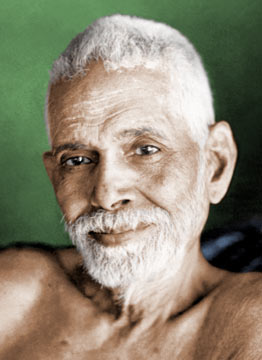
Bhagavan Ramana Maharshi: by Alan Adams Jacobs
Bhagavan Ramana Maharshi
by Alan Adams Jacobs
Boundless Bliss flooded the Heart of Beauteous Mother Earth,
A Sage came as Ramana to save us, he took a human birth. Continue reading
We Did Not Go To Him For Profit: By T.K. Sundaresa Iyer

Note: T.K. Sundaresa Iyer (T.K.S) met Sri Ramana in 1908 when T.K.S was only a twelve year old boy. Bhagavan, although a full blown Self-Realized sage, was also quite young and in his late 20’s. Many early devotees have described how Bhagavan by his sheer look would give them experience of the Self. However, this was not true in every case.
T.K.S’s cousin Krishnamurthy had been visiting Bhagavan Ramana regularly and would sing songs of devotion to him. One day T.K.S asked his cousin where he went every day. Krishnamurthy told him about Ramana and said, “The Lord of the Hill Himself is sitting in human form, why don’t you come with me.” Both of them then climbed the Hill and went to Virupksha cave to visit the Sage.
Now the story in T.K.S.’s own words:
I too climbed the Hill and found Bhagavan sitting on a stone slab, with about 10 devotees around him. Each would sing a song. Bhagavan turned to me and asked, “Well, won’t you sing a song also.” One of Sundramurthy’s songs came to my mind and I sang it. It’s meaning was, “No other support have I, except thy holy feet. By holding on to them, I shall win your grace. Great men sing your praise Oh, Lord. Grant that my tongue may repeat Thy name even when my mind strays.”
“Yes. That is what must be done,” said Bhagavan, and I took it to be his teaching for me. From that time on, I went to see him regularly for several years without missing a day.
One day I wondered why I was visiting him at all. What was the use? There seemed to be no inner advancement. Going up the hill was meaningless toil. I decided to end my visits on the hill.
For one hundred days exactly I did not see Bhagavan. On the hundred and first day I could suffer no longer and I ran to Skandasramam, above Virupaksha Cave. Bhagavan saw me climbing, got up and came forward to meet me. When I fell at his feet, I could not restrain myself and burst into tears. I clung to them and would not get up.
Bhagavan pulled me up and asked: “It is over three months since I saw you. Where were you?” I told him how I thought that seeing him was of no use. “All right,” he said, “maybe it is of no use, so what? You felt the loss, did you not?”
Then I understood that we did not go to him for profit, but because away from him there was no life for us.
From “At the Feet of Bhagwan” by T.K. Sundaresa Iyer.
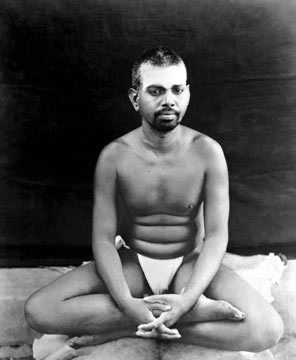
Surrender and Salvation: By Voruganti Krishnayya
Voruganti Krishnayya was a great devotee of Bhagavan Sri Ramana. He has narrated many incidents that he observed while in Bhagavan’s company. The following story is one of my favorite.
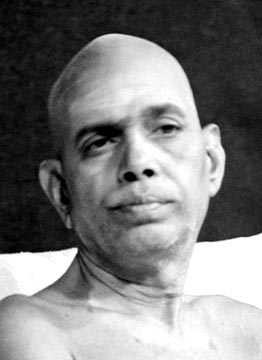
Bhagavan Ramana
Bhagavan was most tender with people who thought themselves for some reason or other to be miserable sinners and who went to him torn by repentance.
During summer evenings we used to sit in the open space near the well. We would collect in the dining hall for dinner and come back to the well. Suddenly, one day, a visitor started weeping bitterly, “I am a horrible sinner. For a long time I have been coming to your feet, but there is no change in me. Can I become pure at last? How long am I to wait? When I am here near you I am good for a time, but when I leave this place I become a beast again. You cannot imagine how bad I can be – hardly a human being. Am I to remain a sinner forever?”
Bhagavan answered: “Why do you come to me? What have I to do with you? What is there between us that you should come here and weep and cry in front of me?”
The man started moaning and crying even more, as if his heart were breaking. “All my hopes of salvation are gone. You were my last refuge and you say you have nothing to do with me! To whom shall I turn now? What am I to do? To whom am I to go?”
Bhagavan watched him for some time and said, “Am I your guru that I should be responsible for your salvation? Have I ever said that I am your master?”
“If you are not my master, then who is? And who are you, if not my master? You are my guru, you are my guardian angel, you will pity me and release me from my sins!” He started sobbing and crying again.
We all sat silent, overcome with pity. Only Bhagavan looked alert and matter-of-fact.
Bh: “If I am your guru, what are my fees? Surely you should pay me for my services.”
D: “But you won’t take anything,” cried the visitor. “What can I give you?”
Bh: “Did I ever say that I don’t take anything? And did you ever ask me what you can give me?”
D: “If you would take, then ask me. There is nothing I would not give you.”
Bh: “All right. Now I am asking. Give me. What will you give me ?”
D: “Take anything, all is yours.”
Bh: “Then give me all the good you have done in this world.”
D: “What good could I have done? I have not a single virtue to my credit.”
Bh: “You have promised to give. Now give. Don’t talk of your credit. Just give away all the good you have done in your past.”
D: “Yes, I shall give. But how does one give? Tell me how the giving is done and I shall give.”
Bh: “Say like this: ‘All the good I have done in the past I am giving away entirely to my guru. Henceforth I have no merit from it nor have I any concern with it.’ Say it with your whole heart.”
D: “All right, Swami, I am giving away to you all the good I have done so far, if I have done any, and all its good effects. I am giving it to you gladly, for you are my master and you are asking me to give it all away to you.”
Bh: “But this is not enough,” said Bhagavan sternly.
D: “I gave you all I have and all you asked me to give. I have nothing more to give.”
Bh: “No, you have. Give me all your sins.”
D: The man looked wildly at Bhagavan, terror stricken. “You do not know, Swami, what you are asking for. If you knew, you would not ask me. If you take over my sins, your body will rot and burn. You do not know me, you do not know my sins. Please do not ask me for my sins.” And he wept bitterly.
Bh: “I shall look after myself, don’t you worry about me,” said Bhagavan. “All I want from you is your sins.”
For a long time the bargain would not go through. The man refused to part with his sins. But Bhagavan was adamant.
Bh: “Either give me your sins along with your merits, or keep both and don’t think of me as your master.”
In the end the visitor’s scruples broke down and he declared: “Whatever sins I have done, they are no longer mine. All of them and their results, too, belong to Ramana.”
Bhagavan seemed to be satisfied. “From now on there is no good nor bad in you. You are just pure. Go and do nothing, neither good nor bad. Remain yourself, remain what you are.”
A great peace fell over the man and over us all. No one knows what happened to the fortunate visitor; he was never seen in the Ashrama again. He might have been in no further need of coming.

Bhagavan Ramana
In Praise of Shri Bhagavan: By Alan Adams Jacobs
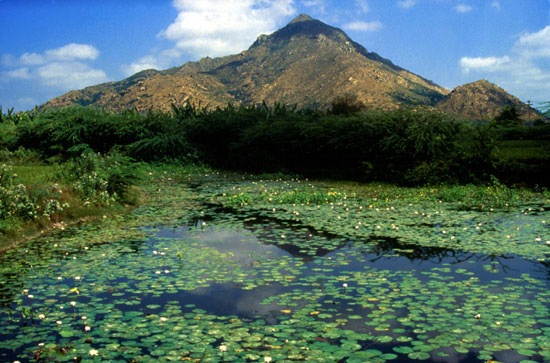
In Praise of Shri Bhagavan
by Alan Adams Jacobs
Let’s give thanks to great Lord Ramana,
For his boundless Grace and Jnana teaching;
He grants silent diksha without vain preaching,
And the precious gift of atma vichara,
His directly liberating, true sadhana.
His eternal presence is close; ever reaching
The hearts of all devotees, so breaching
Mad ego’s fortress of dark avidya.
We feel devotion through our gratitude,
For leading us out of dread samsara;
He bestows full faith, strength and fortitude,
He transmits the power of Arunachala.
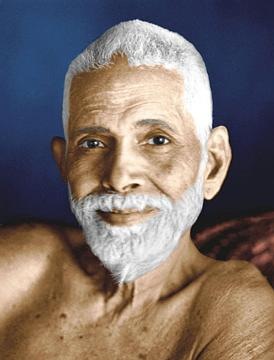
Ever our loving guardian and guide,
Deep in our hearts his lotus feet abide.
Photos courtesy of Shri Ramanaashram
The Heart of the Ribhu Gita
Inhering in the Undifferentiated And Non-Dual Reality
Preface:
“The ego or separate soul is a concept. God, the world, the mind desires, action, sorrow and all other things are all concepts”.
Bhagavan Sri Ramana Maharshi, a famous Sage of modern India, attributed unique value to this lucid exposition of Supreme Truth. He often referred to it in his talks with devotees and seekers, and he is reported to have said that is one repeatedly read Chapter 26 of the Ribhu Gita one could pass spontaneously into samadhi, or the natural state of Self-realization.
The Ribhu Gita, literally “Ribhu’s Song”, is Part Six of the Shiva Rahasya, a legendary mystical text of India. The whole of the Ribhu Gita is said to represent the teaching given to the Sage Ribhu by God himself in the form of Lord Shiva, the formless aspect of the Divine activity, in whom all beings and things are always already absorbed. The Sage in turn gave the teaching to his reluctant disciple Nidagha.
THE HEART OF THE RIBHU GITA
- I shall now expound to you the method of inhering in the All-inclusive and undifferentiated Reality. This teaching is secret and difficult to understand even with the help of the various Scriptures. Even celestial beings and practitioners of spiritual discipline who hold it dear acquire it only with great difficulty. Follow what I say and, inhering in Reality, be happy.
- My son! Realized sages say that absolute inherence in Reality means becoming one with the immutable, tranquil, non-dual Absolute Supreme Being which is Existence-Consciousness-Bliss and the Self of all, and making the wandering mind one with it like the proverbial milk and water, absolutely free from all concepts.
- When one scrutinizes this variety of manifestation one realizes that it does not really exist and that everything is the undifferentiated Absolute Supreme Being which is not different from the Self and oneself. Let this knowledge become firm with you by constant practice. Then, discarding everything, become one with the Supreme Absolute Reality and, remaining as that, be happy.
- Abide as That which does not, when scrutinized, show any duality in the form of these various objects or the least trace of cause and effect, That in which, when the mind is absorbed in It, there is not fear of duality at all – and be always happy, unshakable and free the fear arising from duality.
- Abide as That in which there are neither thoughts nor fancies, neither peace nor self-control, neither the mind nor the intellect, neither confusion nor certainly, neither being nor non-being, and no perception of duality – and be always happy, unshakable and absolutely free from the fear arising from duality.
- Abide as That in which there is neither any defect nor good quality, neither pleasure nor pain, neither thought nor silence, neither misery nor austerities practiced for getting rid of misery, no “I-am-the-body” idea, no objects of perception whatsoever – and be always happy, free from all traces of thought.
- Abide as That in which there is no work, physical, mental, verbal or of any other kind, neither sin nor virtue, neither attachment nor its consequences – and be always happy, free from all traces of thought.
- Abide as That in which there are neither thoughts nor a thinker, neither the arising nor the preservation nor the dissolution of the world, nothing whatsoever at any time – and be always happy, free from all traces of thought.
- Abide as That in which there is neither the Self-limiting Power of Illusion nor its effects, neither knowledge nor ignorance, neither separate soul nor Lord of Creation, neither being nor non-being, neither world nor God – and be always happy, free from all traces of thought.
- Abide as That in which there are no gods and their worship, none of the three Divine aspects of Creator, Preserver and Destroyer or meditation on them no Supreme Formless God nor meditation on Him – and be always happy, without the least trace of thought.
- Abide as That in which there is neither maturing bondage to the way of good works nor searching devotion to the Divine nor self-knowing wisdom, no fruit of action to be enjoyed, no supreme state separate from it, no means of attainment or object to be attained and be always happy, free from all traces of though.
- Abide as That in which there is neither body nor senses nor vital forces, neither mind nor intellect nor fancy, neither ego nor ignorance, nor anyone who identifies himself with them, neither the macrocosm nor the microcosm and be always happy, free from all traces of thought.
- Abide as That in which there is neither desire nor anger, neither greed nor delusion, neither ill-will nor pride, no impurities of mind and no false notions of bondage and liberation – and be always happy, free from all traces of thought.
- Abide as That in which there is no beginning or end, no top or bottom or middle, no holy place or god, no gifts or pious acts, no time or space, no objects of perception – and be always happy, free from all traces of thought.
- Abide as That in which there is no discrimination between the real and the unreal, no absence of desire, no possession of virtues, o yearning for liberation, no competent Master or disciple, no steady knowledge, no realized stage, no liberation while alive or after death, nothing whatsoever at any time – and be always happy free from all traces of thought.
- Abide as That in which there are no Holy Scriptures or sacred books, no one who thinks, no objection or answer to it, no theory to be established, no theory to be rejected, nothing other than one Self – and be always happy, free from the least trace of thought.
- Abide as That in which there is no debate, no success or failure, no word or its meaning, no speech, no difference between the soul and the Supreme Being, none of the manifold causes and consequences – and be always happy, without the least trace of thought.
- Abide as That in which there is no need for listening, reflecting and practicing, no meditation to be practiced, no differences of sameness, otherness or internal contradictions, no words or their meanings – and be always happy, free from the least trace of thought.
- Abide as That in which there are no fears of hell, no joys of heaven, no worlds of the Creator God or the other Gods, nor any object to be gained from them, no other world, no universe of any kind – and be always happy, without the least trace of thought.
- Abide as That in which there is nothing of the elements nor even an iota of their derivatives, no sense of “I” or “mind”, no fantasies of the mind, no blemish of attachment, no concept whatsoever – and be always happy, without the least trace of the thought.
- Abide as That in which there are none of the three kinds of bodies (gross physical, subtle internal, or formless and most subtle), dreaming and sleeping), none of the three kinds of souls (those who are fully prepared to advance spiritually, those who are not fully prepared, and those who are not prepared at all), none of the three kinds afflictions (those of the body, those caused by the elements, and those caused by subtle beings and powers), none of the five functional layers of being (gross physical, vital, emotional-psychic, mental, and that of formless bliss), no one to identify himself with them – and be always happy, without the least trace of thought.
- Abide as That in which there is no sentient object, no power to hide Reality, no difference of any kind, no power of projecting unreal objects, no power of any other kind, no false notion about the world – and be always happy, without the least trace of thought.
- Abide as That in which there are no sense organs or anyone to use the, That in which transcendent bliss is experienced, That which is absolutely immediate, That by realizing and attaining which one becomes immortal, That by becoming which one does not return to this cycle of births and deaths – and be always happy, without the least trace of thought.
- Abide as That, on realizing and experiencing the bliss of which, all joys appear to be the joys of That, That which, when clearly known to be oneself, shows there is nothing apart from oneself, and, knowing which, all kinds of separate souls become liberated – and be always happy, without the least trace of thought.
- Abide as That, on realizing which to be oneself, there is nothing else to be known, everything becomes already known and every purpose accomplished – and be always happy, without the least trace of thought.
- Abide as That which is attained easily when one is convinced that one is not different from the Supreme Absolute, That which results, when that conviction becomes firm, in the experience of the Supreme Bliss of the Real, That which produces a sense of incomparable and complete satisfaction when the mind is absorbed in It – and be always happy, without the least trace of thought.
- Abide as That which leads to the complete cessation of misery when the mind is absorbed in It, and the extinction of all ideas of “I”, “you” and “another,” and the disappearance of al differences – and be always happy, without the least trace of thought.
- Abide as That in which, when the mind is absorbed in It, one remains without a second, nothing other than oneself is seen to exist and incomparable bliss is experienced – and be always happy, without the least trace of thought.
- Abide as That which is undifferentiated Existence, undifferentiated Consciousness, undifferentiated Bliss, absolutely non-dual, the undifferentiated Absolute Reality – and with the firm conviction that you are That, be always happy.
- Abide as That which is “I” as well as “you” as well as everyone else, is the basis of all, is one without anything else whatsoever, is extremely pure, the undifferentiated Whole – and with the firm conviction that you are That, be always happy.
- Abide as That in which there are no concepts or anything else whatsoever, the ego ceases to exist, all desires disappear, the mind becomes extinct and all confusions come to an end – and with the firm conviction that you are That, be always happy.
- Abide as That in which there is no awareness of the body, or the various functions of manifest existence, no perception of objects, That in which the mind is dead, the soul become one with the Reality, thoughts dissolved and even one’s convictions no longer hold – and with the firm conviction that you are That, be always happy.
- Abide as That in which there is no longer any meditative spiritual practice or ignorance or knowledge or activities of any kind, that which is the Supreme Reality – and with the firm conviction that you are That, be always happy.
- Abide as That in which, when one is completely merged with It, one experiences pure bliss, never experiences misery, sees nothing, does not take birth again, never thinks oneself to be a separate individual, becomes the Supreme Being and with the conviction that you are That, be always happy.
- Abide as That which is truly the Supreme Absolute Reality, the Supreme Formless God, the absolutely pure Being, the Supreme State, Absolute Consciousness, the Supreme Truth – and with the conviction that you are That, be always happy.
- Abide as That which is the absolutely pure Supreme Being, absolute Bliss, the supremely subtle Being, the Self-Effulgent, non-dual and undifferentiated One – and with the conviction that you are That, be always happy.
- Abide as That which is absolute Truth, supreme Tranquility, eternal Being, absolutely attributeless, the Self, the absolutely undifferentiated Supreme Being – and with the conviction that you are That, be always happy.
- Abide as That which is everything from the experiential point of view and nothing from the absolute point of view, Existence – Consciousness-Bliss, always tranquil, with nothing separate from It, the self-existent Being –and with the conviction that you are That be always happy.
- I have thus, O Nidagha, clearly explained to you the state of being one with the Supreme Being. By constantly thinking that you are the undifferentiated Supreme Being you can attain that state and enjoy constant bliss. There after, having become the Supreme Absolute Reality, you will never experience the misery that comes from identification with birth and death.
- “Everything is the Supreme Being, which is Existence-Consciousness-Bliss, and I am That” By constantly cultivating this pure thought, get rid of impure thoughts. Then, my son, discarding even that thought and always inhering in the State of Fullness, you will become the non-dual and undifferentiated Supreme Being and attain liberation.
- Pure and impure thoughts are a feature of the mind. There are no wandering thoughts in the Supreme Being. Therefore, abide as That and, free from the pure and impure thoughts of the mind, remain still like a stone or a log of wood. You will then be always happy.
- By constantly thinking of the undifferentiated Supreme Being and forgetting thereby all thoughts, including the thought of the Supreme Being, you will become the all-comprehensive Supreme Being. Even a great sinner who hears and understands this teaching will get rid of all his sins and become the undifferentiated Supreme Being.
- The endless textbooks of spiritual instruction have already prescribed meditation for attaining purity of mind. In order that those who have become pure in mind may easily attain liberation and, realizing that they are absolute and boundless Bliss, remain still like a stone in the undifferentiated and all-comprehensive Supreme Formless God, the nature of this immaculate state has been expounded by me.
- Therefore, attaining purity of mind by constantly thinking that everything that is known is the Supreme Being and that Supreme Being is oneself, and thereafter abiding in the state of complete identity with the Absolute Reality, liberation can be attained here and now. I have spoken the truth. In this manner, Sage Ribhu expounded the true and full state of being to Nidagha.
- When one is convinced that one is always That which is Existence-Consciousness-Bliss and abides as That in a state of complete identity, one casts off the unreal bondage of identification with birth and death and attains liberation. This is the significance of the highly blissful mood and dance of our Supreme and undifferentiated Gold.
You Are What You Eat

by Swami Sadasivananda
Are we Really what we Eat?
The Need for a Vegetarian Diet!
Every one has heard the saying: “You are what you eat.” But according to the scriptures and saints of the major Eastern religions, as well as of early Christianity, a more precise reckoning of this euphemism is, in fact, a twofold statement: “You are what you think, and you think like what you eat!”
Science tells us that the food we eat is transformed into energy that fuels the physical body. Only in our recent times has science acknowledged that there is also another energy imbued within our food, of a far more subtle nature, that influences not only the physical sphere of our being, but more importantly, the mental realm of our existence. Although modern science holds the trophy for “The slowest learners on earth”, they are now admitting that the most profound and powerful effect food has on man occurs at the psychological plane of existence.
This fact is, of course, based on the Maxim of physics that all elements in existence are essentially energy, and that energy is constant. The constancy of energy is defined by its nature of being impervious to essential altercation. The energy in the beginning of a process is the same at the end of the said process. What goes in, stays in!
In terms of ingestion of digestible matter, the quality of the energy, scientifically and specifically the vibratory rate, that dominated the nature of the plant or animal that is being eaten, is directly transferred through the digestive process and into the mind of the consumer. Thus our mind, our perception, and finally our spirit become what we eat!
If the energy is heavy or inert, little can be done with it to produce the state of silence and clarity needed to reflect the truth of spirit. Certain actions darken the mind and make it thick or heavy, vibrating very slowly–sometimes seemingly not at all. On the other hand, some actions lighten the mind, making it fluid and subtle, vibrating at a very high level. It is this latter condition that is needed for attaining the state of liberation–or rather, the state that liberates the spirit from the illusion of bondage and suffering. It is really the mind that becomes liberated, but that liberation also affects the essentially ever-free spirit and sets it free from involvement with the mind. And to attain such liberation the mind must be purified and refined. Thus, vegetarian diet becomes one of the best and strongest means for its purification.
“When we realize that any physical object has all the levels which we do, namely, the physical, biomagnetic, sensory, intellectual and will bodies, we can understand the importance of the kind and quality of food we eat. For not only does the physical substance of the food become assimilated into our physical body, so also do the subtler energies become united to our inner levels. This is the teaching of the Chandogya Upanishad:
“Mind consists of food. That which is the subtle part of milk moves
upward when the milk is churned and becomes butter. In the same
manner, the subtle part of the food that is eaten moves upward and
becomes mind. Thus, mind consists of food.” 1
“It is obvious, then, that the food we eat is going to determine the quality and condition of all the levels of our being. Our food has the same levels we do, and the different energies of the food are absorbed into our corresponding levels. Therefore when we eat something, it not only affects us on all levels of our existence, it becomes those levels. In this very real sense we indeed are what we eat. In esoteric philosophy our various levels are looked upon as separate bodies through which our consciousness operates. Since those bodies are formed essentially from the food we eat, they will be conditioned by and function according to the kind of energy extracted from the food. We are very much like the child’s toy that is a series of colored rings stacked on a rod. That is, we are successive layers of subtler and subtler energy that are connected to the physical body. From these energy levels the different life processes are empowered and administered. When the energies within us are positive, they produce harmonious states of mind and behavior. But when the energies are negative, they move in a random and chaotic manner and produce negative states of mind and, consequently, negative behavior. Moreover, these toxic energies can also manifest as physical illnesses or defects. Substances that are toxic to the body–such as meat, alcohol, nicotine, and drugs–are toxic on the inner levels as well, and their ingestion poisons all our bodies by putting into them negative energies which are going to manifest in the disrupting manner just described. On the other hand, fruits, vegetables, and grains are reservoirs of pure, basic life energies that are very light and malleable. These energies are easily assimilated into all our bodies and made to take on our specific, unique life vibrations and karmic patterns.” 2
Thus, we must accept, and can on no legitimate grounds refute the facts of the twofold statement: “You are what you think, and you think like what you eat!” Therefore, it can be gleaned, from both the material as well as the spiritual viewpoint, why Sri Ramana Maharshi stressed a vegetarian diet.
Question: I have heard it said that the Maharshi set no rules of conduct or lifestyle within the Ashram that came up around him. Therefore, how can what is being said regarding a vegetarian diet be essential for spiritual attainment?
It is in fact openly stated, and recorded within several of the published core teachings at the Ashram that Bhagavan Ramana set forth only one regulation for the devotees living within the Ashram, as well as for those living outside that followed his teaching. This one rule of life regarded the maintaining of a sattvic (pure) diet.
Question: Did Bhagavan ever explain why maintaining purity of diet was important, and what constituted a sattvic or pure diet?
He did explain the reason why a vegetarian diet was, and is even to this day, maintained at all times. This discipline was central to his guidance of effective means of sublimating (uplifting) the mind and its direction towards reflection upon its True Nature. His guidance stressed an ever purer awareness or quality of mind, which paved the way towards awareness within the heart, the essential home of our Eternal Self.
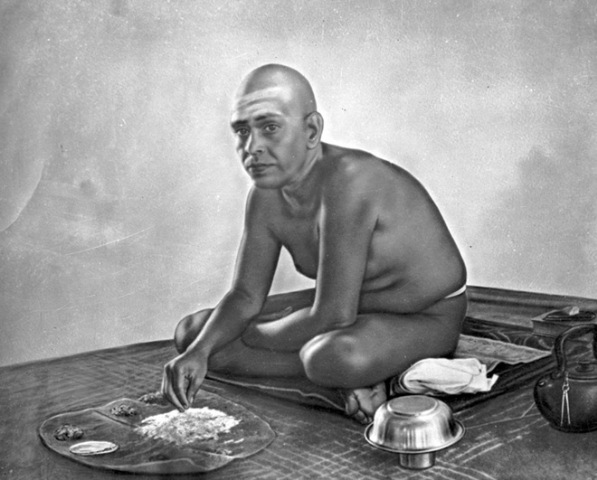
In Bhagavan’s own words we find recorded:
Devotee: What diet is prescribed for a sadhak (one engaged in spiritual practices)?
Maharshi: Sattvic food in limited quantities.
D.: What is sattvic food?
M.: Bread, fruits, vegetables, milk, etc.
D.: Some people take fish in North India. May it be done?
(The Maharshi made no answer.)
D.: We Europeans are accustomed to a particular diet; change of diet affects health and weakens the mind. Is it not necessary to keep up physical health?
M.: Quite necessary. The weaker the body the stronger the mind grows.
D.: In the absence of our usual diet our health suffers and the mind loses strength.
M.: What do you mean by strength of mind?
D.: The power to eliminate worldly attachment.
M.: The quality of food influences the mind. The mind feeds on the food consumed.
D.: Really! How can the Europeans adjust themselves to sattvic food only?
M.: (Pointing to Mr. Evans-Wentz) You have been taking our food.
Do you feel uncomfortable on that account?
Mr. Evans-Wentz: No. Because I am accustomed to it.
D.: What about those not so accustomed?
M.: Habit is only adjustment to the environment. It is the mind that matters. The fact is that the mind has been trained to think certain foods tasty and good. The food material is to be had both in vegetarian and nonvegetarian diet equally well. But the mind desires such food as it is accustomed to and considers tasty.
D.: Are there restrictions for the realised man in a similar manner?
M.: No. He is steady and not influenced by the food he takes.
D.: Is it not killing life to prepare meat diet?
M.: Ahimsa stands foremost in the code of discipline for the yogis.
D.: Even plants have life.
M.: So too the slabs you sit on!
D.: May we gradually get ourselves accustomed to vegetarian food?
M.: Yes. That is the way. 3
In this example, and as is seen throughout the teachings of Sri Ramana Maharshi, Bhagavan is stressing: “It is the mind that matters.” Furthermore, “The mind feeds on the food consumed”, and “The weaker the body the stronger the mind grows.”
In the following story, we are being shown that a pure diet will not only elevate the quality of the mind, but will also keep the body free from illness: “One afternoon at 3 o’clock, a devotee who was going to Madras gave a small tin containing some ointment and said that if that medicine was applied to Bhagavan’s legs, the pain would decrease, and that if Bhagavan would continuously use it, he would bring a dozen tins of it from Madras. Bhagavan replied, saying: “Enough. The Karpura Thailam I am using now is adequate. Why do I require such costly medicines? If diet is properly regulated, no medicine will be required. When these medicines are used, the ailment apparently disappears, but it starts again. That is because of some irregularity in diet.” 4
One of the close disciples who lived with Bhagavan, Arthur Osborne, related what the Maharshi taught him: “It should be explained for non-Hindu readers, that the practice of vegetarianism is not only out of disinclination to take life or eat flesh, though that is one reason for it; it is also because unsattvic food tends to increase animal passions and impede spiritual effort.” 5
Although the Ashram food was strictly vegetarian, Alagammal, Bhagavan’s mother, like some very devout Brahmins, went still further and considered some vegetables (i.e. onions) also unsattvic (impure). When Bhagavan would sit with the devotees in the kitchen and peel onions, Alagammal would weep bitterly. In response, Bhagavan would retort while holding up an onion: “Behold the powers of this small bulb.” She would then weep all the more loudly. Bhagavan had the final word, and would say mockingly: “Mind that onion! It is a great obstacle to Moksha (Deliverance)! It should be said here that Sri Bhagavan did not disapprove of orthodoxy in general. In this case there was excessive attachment to the forms of orthodoxy and that was what he attacked. In general he laid stress on the importance of sattvic (pure) food. He did not often give any injunctions at all concerning outer activity; his usual method was to sow the spiritual seed in the heart and leave it to shape the outer life as it grew. The injunctions came from within.” 6
1 Chandogya Upanishad, 6.5.4, 6.6.1,2,5.
2 Spiritual Benefits of a Vegetarian Diet, Swami Nirmalananda, Atmajyoti Press.
3 Talks with Sri Ramana Maharshi, recorded by Sri Munagala Venkataramiah, Sri Ramanashramam 2006, Talk 22, p. 20.
4 Letters from Sri Ramanashramam, Suri Nagamma, Sri Ramanashramam 2006, Letter #266 December1949, p. 640.
5 Ramana Maharshi and the Path of Self-Knowledge, Arthur Osborne, Sri Ramanashramam 2006, p. 82.
6 Ibid. p. 81.
Reprinted with permission of Swami Sadasivananda
To subscribe to his newsletter, go to http://www.ramanateaching.org/contact.html
For more information on Swamiji, click here: About Swami Sadasivananda
Teachings of Bhagavan Sri Ramana Maharshi web site: http://www.ramanateaching.org
Ask your question in relation to Bhagavan’s teachings, meditation and spirituality at:
http://www.ramanateaching.org/faq
Self-Realization According to Ramana: By Dr. Harsh K. Luthar
The following is a summary of Bhagavan Sri Ramana Maharshi’s teaching on the Self.
Self-Realization cannot be described because Self can never be an object of perception. The Self is always the subject. The Ultimate Subject. When the mind is temporarily absorbed in the Heart, the Self is known with immediacy as the eternal presence. That is called Kevala Nirvikalpa Samadhi.
However, even after having attained Nirvikalpa Samadhi, the mind has the tendency to sprout up again with its conditioned habits due to the force of karma (previous tendencies). Hence the need for awareness and practice of reflective inquiry continues.
When the mind is completely resolved in the Heart, the Self naturally and spontaneously dominates in all states of consciousness (waking, sleeping, super-conscious). That is known as Sahaj Samadhi or the natural state. In this state, the karma that has started to bear fruition will continue until the end of the body. The former conditioning might still manifest in the sage but loses its fundamental hold to create new karmic forces for the future.
Sri Ramana describes Self-Realization below.
“The state we call realisation is simply being oneself, not knowing anything or becoming anything. If one has realised, he is that which alone is, and which alone has always been. He cannot describe that state. He can only be That. Of course we loosely talk of Self-Realisation for want of a better term.”
Bhagavan Sri Ramana Maharshi
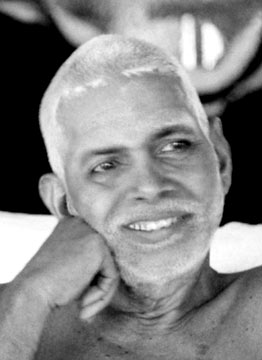
Bhagavan Ramana
Jai Guru Omkara

In honor of the Guru, which can only be Him
manifesting in His infinite mercy to remove the illusion of duality.
It may be external, or it may be from within,
opening the chambers of the heart and
unlocking the shackles of the mind such that nothing remains but Him,
everywhere manifesting in everything. Chitta chora! Chitta chora!
Steal it all and give me only one thing in return…your holy Presence.
May I prostrate before you eternally
in gratitude for the Grace you have brought into my life.
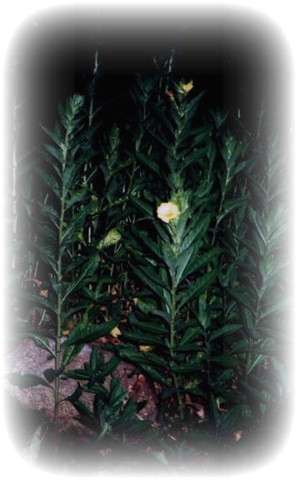
Puja Prayer
Like a flower
In complete surrender
I come unto You
Petal by petal
In complete surrender
I come unto You
Like the primrose heralds the spring
In complete surrender
I come unto You
May my actions be right
In complete surrender
I come unto You
May I walk in thy Light
In complete surrender
I come unto You
Earth, my altar… I, my offering
In complete surrender
I come unto You
May my only reward
Be complete surrender
Unto You

The Self manifests externally as Guru when occasion arises;
otherwise He is always within, doing the needful.
From Talks with Ramana Maharshi, 12th June, 1937 Talk 426.
To view Adi Shankaracharya’s Guru Ashtakam…
Caves of Arunachala – July 2009 Update
As we have been exploring Arunachala we keep finding ‘caves,’ some already widely known, and some not. A friend suggested that we write about these caves in a blog. This seems a good idea, so here it is. We can find nothing like this available now.
Our exploration of Arunachala is ongoing, and any additional caves we find will be added. In this post 1 refer to other postings where there are more photos and information about each of the caves.
I put quotes around the first instance of ‘caves’ since what are called caves here are often nothing more than a sheltered space under a big rock. Some are natural, some have been improved, usually by building walls and adding a concrete floor. Some have been dug out under rocks.
Is some cases the individual caves already have names in common use. Most do not, and for the purposes of this listing I am calling these by names that I made up. If other caves are known, or names of caves shown are known, let me know, so I can update this listing.
The December 2008 posting showed 18 caves. In July 2009, it now shows 23 caves. Maps, developed from GoogleEarth tm are also added that show the location of each of these caves.
Caves Associated with Sri Ramana Maharshi
Virupaksha Cave
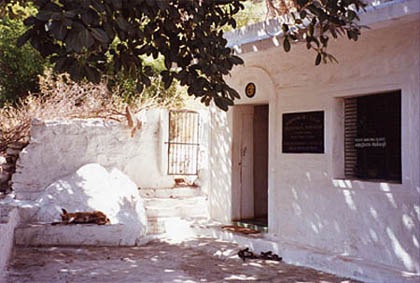
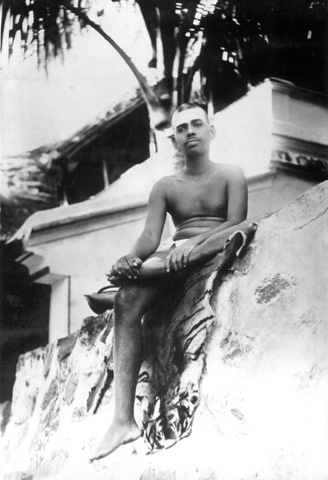
Virupaksha is, for most, deeply associated with Sri Ramana Maharshi. Ramana lived where he lived for 17 years [1899-1916].
Below is a famous photo of the young Ramana at Virupaksha cave.
The cave is named for a famous saint, Virupaksha, who lived in this cave in the 1500’s, around the same time as Guhai Nama Shivaya lived nearby (see below). At Virupaksha’s demise, called here ‘maha samadhi,’ it is said that his body was transformed into vibhuti (sacred ash). In the interior of this cave there is a mound in the shape of Arunachala. It is said to be made of this vibhuti.
More on Virupaksha Cave is in this post.
Mango Tree Cave
During the Virupaksha days, Sri Ramana would come down to Mango Tree Cave during the summer. It was cooler, and there was water here when there was none at Virupaksha Cave. Mango Tree Cave is on the common way up the hill to Virupaksha Cave.
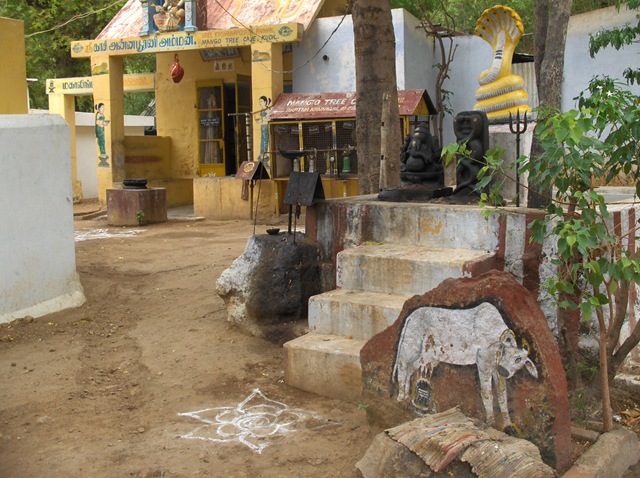
Inside the building, to the back, there is the actual cave. I think the building has been added since Ramana’s time.
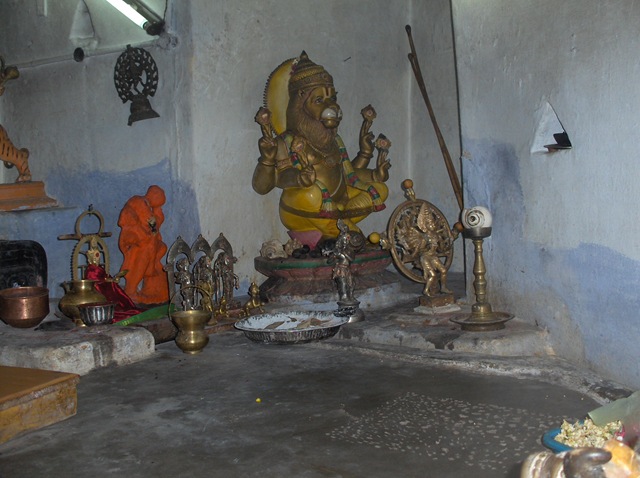
Now this small cave is filled with lingams and murtis of many gods.
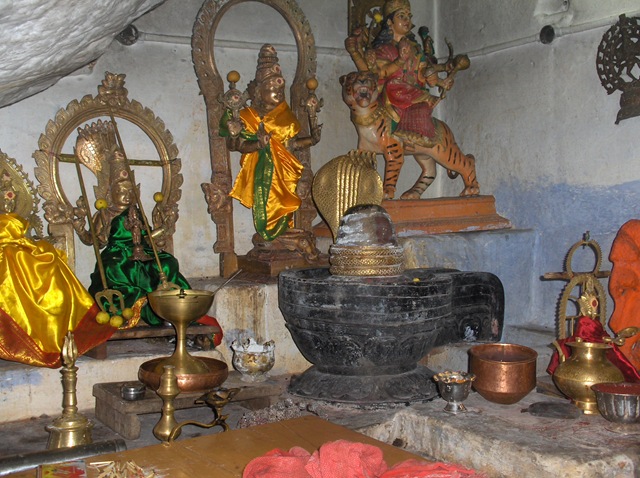
More on Mango Tree Cave can be round in this blog entry.
Guhai Nama Sivaya
This is another cave in which Ramana lived in 1899. It is here that he wrote the notes which later because the pamphlet, Who am I?
A bit more on this cave is in the post New Access to Ramana Sites below Virupaksha.
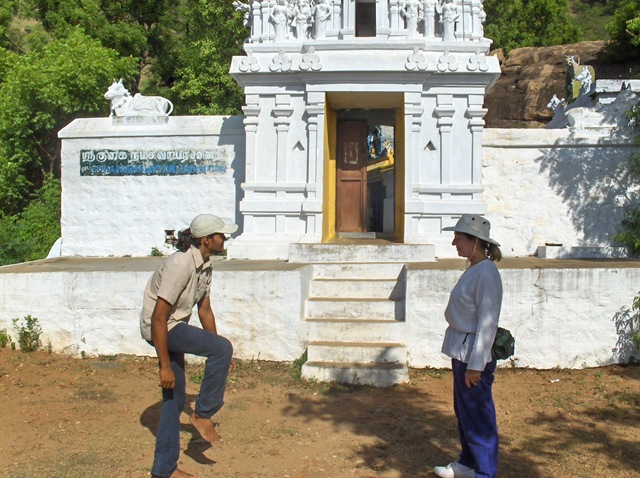
A short clip from Arunachala Grace Blog:
Guhai Namasivaya is known to have been born around the year AD 1548 in Karnataka to a pious Saiva couple. His spiritual nature became evident at an early age: he was virtuous in his conduct, adept at his studies and evinced no attachment to worldly matters.
He practised his system of yoga for many years and as a result of the dream guidance of Lord Mallikarjuna, the presiding deity of Sri Sailam, Guhai Namasivaya came to Arunachala and remained as a Guru, giving teachings to mature disciples who approached him.
Tortoise Cave / Tortoise Rock
Tortoise Cave (also called Turtle Cave) was frequented by Sri Ramana during the Virupaksha days. In those days, there were few trees on Arunachala, and not many places with shade. Tortoise Cave has a good flat stone at its entrance to sit on. Here you are in the shade, and there is often a breeze.
This is also the place made famous in the story of Sri Ramana’s ‘second death experience’. This happened when Ramana stopped at Tortoise Cave / Tortoise Rock on his way back from Pachiaimman Koil. More of Tortoise Cave and Rock, and Ramana’s second death experience is in this post. More about Tortoise Cave is also in this post.
From places like Pavala Kundru, Tortoise Cave can be seen as a dark triangle up on the mountain. It is a bit of a climb to get up here. We think it is worth it. You will want to take a Mountain Guide the first time, I think.
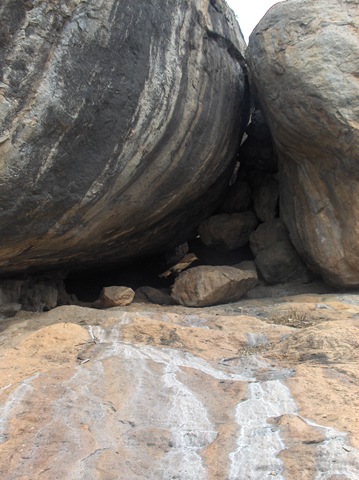
Arunachaleswara Temple for Tortoise Cave. A wonderful view.
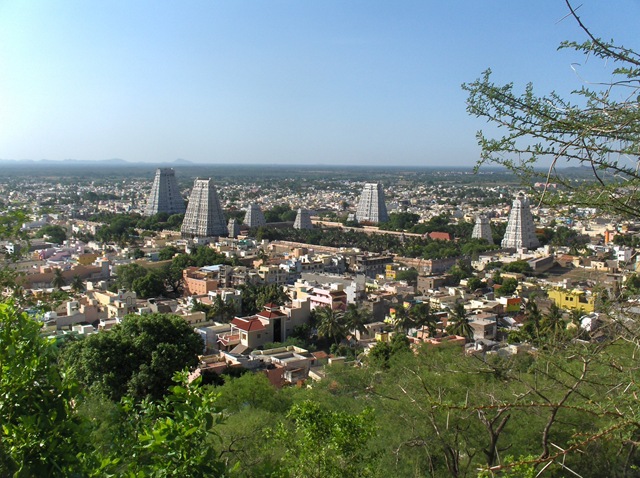
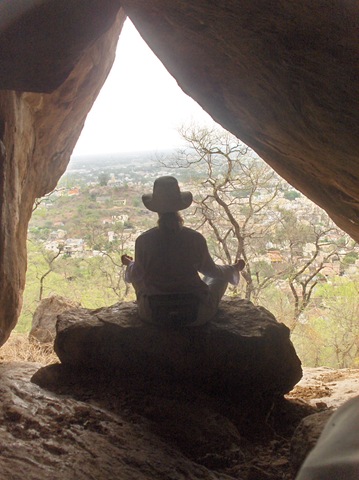
This rock at the entrance of the cave is where Sri Ramana would have sat and rested. And meditated.
Pavala Kundru can be seen toward the left.
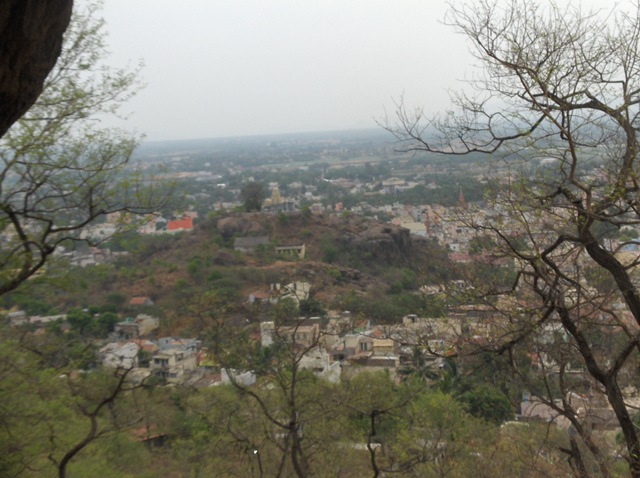
Here is a close up view of the face of the turtle on Tortoise Rock. Tiruvannamalai is in the background.
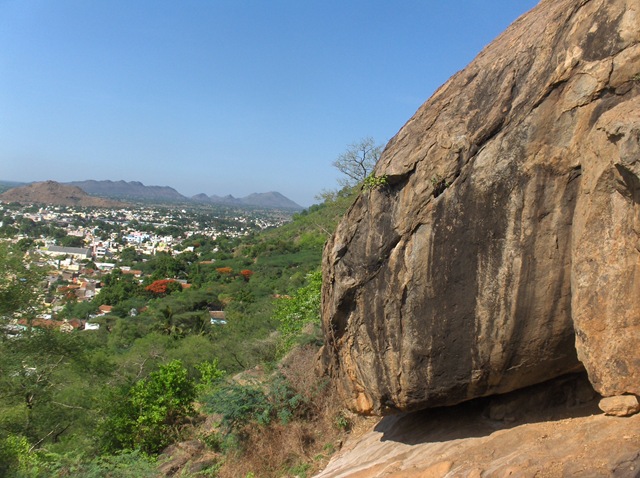
This cave is a great place to sit in the shade and meditate.
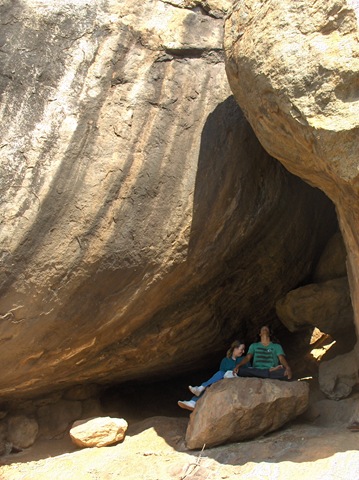
Skandashram
More on Skandashram is in the post Walking up to Skandashram.
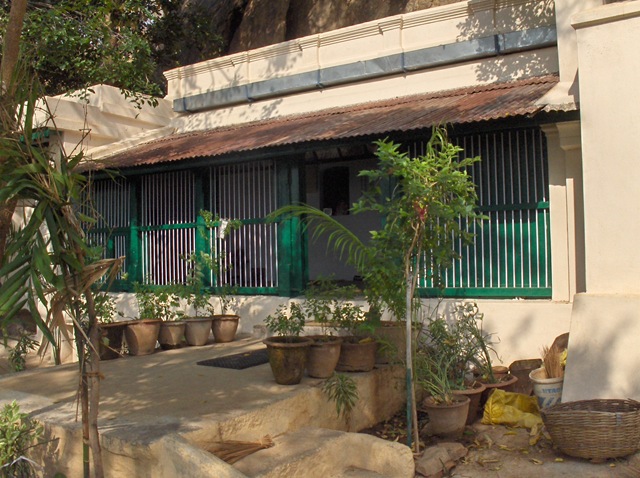
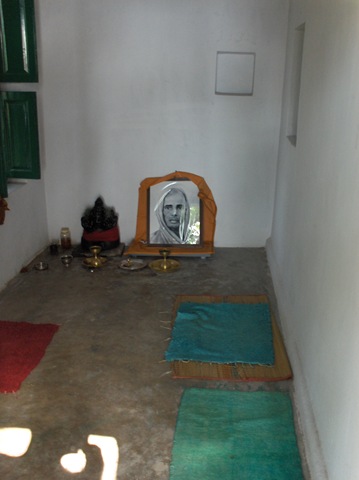
Sri Ramana lived at Skandashram from 1916 to 1922. His mother joined him during this period, and for the first time cooking was done there. This is where the mother had her maha samadhi in 1922. Her room is now a shrine.
The map below shows all of the caves associated with Ramana, as well as other caves in the Virupaksha Cave area. Double click to expand.
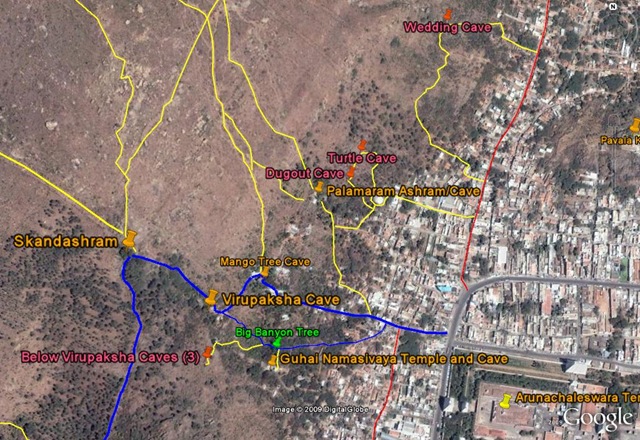
Seven Springs Caves
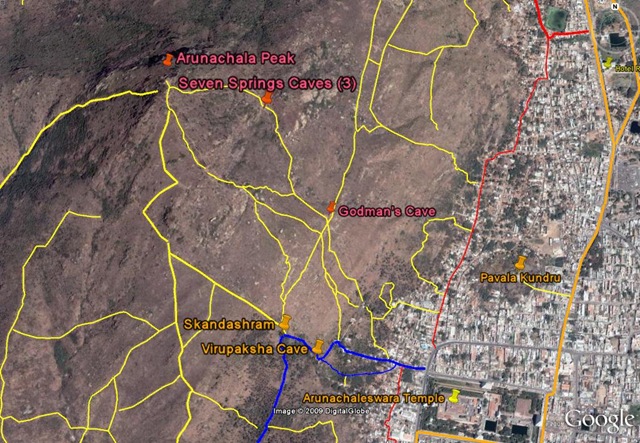
The next four caves are shown in the Seven Springs posting. They are all located on the hill above Skandashram, on one of the paths that goes to the top of the hill. Only one is associated with Ramana, the top one at Seven Springs. They are shown on this map:
Godman’s Cave
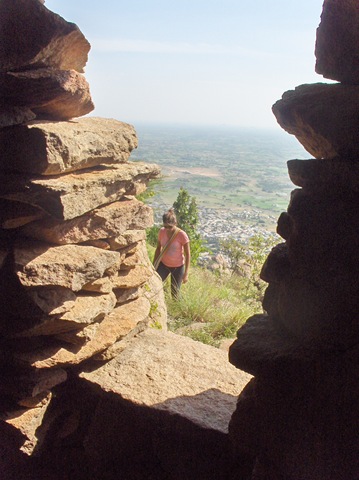
This is a cave, said to be greatly improved by the work of David Godman in the 1980s. Maybe ten people can fit into this cave.

Altar in the cave.
Looking out the entrance. John, the archivist at Ramanasramam, stands outside the entrance.

Seven Springs 1
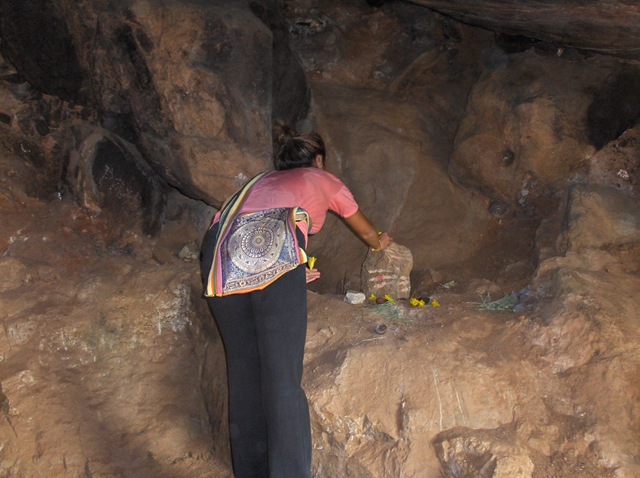
This is first of three caves found at Seven Springs. There is a stone entrance built, and a good altar in the cave. Maybe four people can fit in here.
Up the hill you can see stonework.

The entrance, from the inside.
Richard, offering incense to the altar.

Carol, exiting the cave.

Seven Springs 2
This is a small cave, behind Seven Springs 1. Maybe two people fit inside. Many stone and concrete improvements have been made.
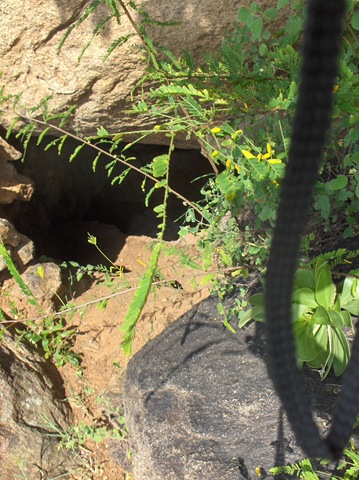
Richard, meditating in the cave.
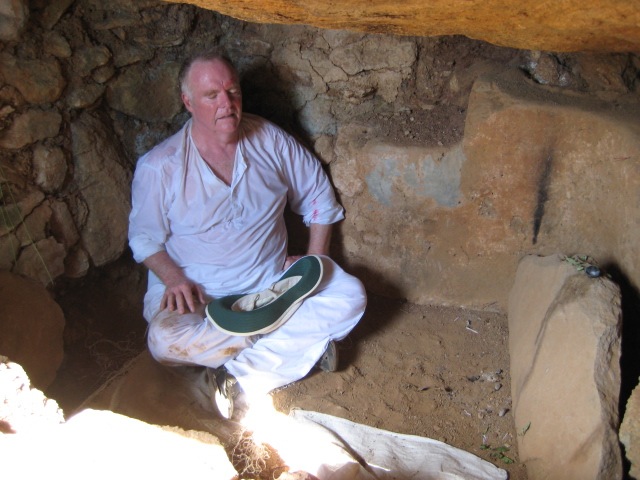
Ramana’s resting cave

I call it ‘Ramana’s Resting Cave’ since this is the cave that is documented in writing about Ramana where he was known to rest, while others made the climb up to the top of Arunachala.
It is in the shade all day with a nice breeze through it, and a view out through green trees.
The entrance is a bit tight, though.
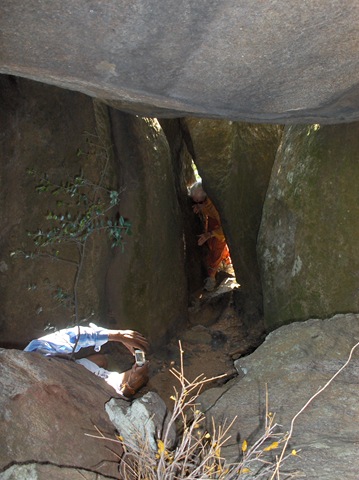
Caves in Virupaksha Cave Area
(these are shown on the map at the end of the Ramana Caves section.)
Palamaram Ashram Cave
The Palamaram Ashram and is ‘generations’ old and has been run by one family for these generations. Palamaram is the Tamil word for ‘jackfruit’ (but we did not see a jackfruit tree). The guru who was most recently active here, per our mountain guide, was Palamaram Swamy, who was here for 40 years and for the last 15 years has been in the Himalayas.
Steps lead up the the ashram. The flag pole can be seen from down the hill.
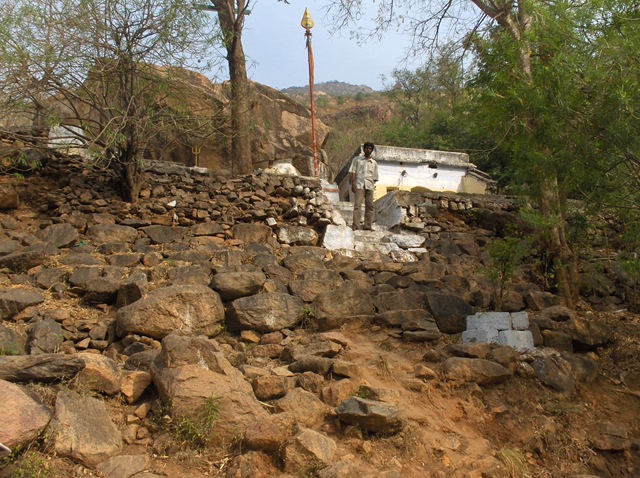
The cave is under this rock. The doors into the cave are locked, and you will have to see if you can find someone who can open them. Often you cannot find the person.
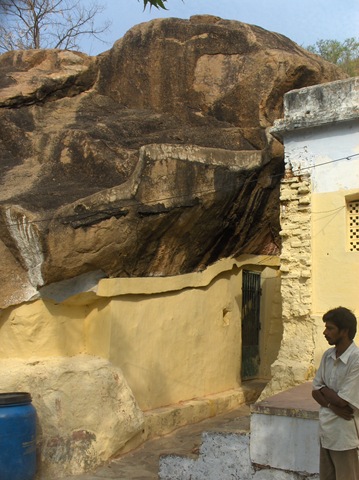
For more on this place, see the Palamaram Ashram Post.
Wedding Cave
Wedding Cave is a small cave to the north of Virupaksha. It is rarely visited by westerners. We just discovered it by accident, looking for some other place.
It is at the base of the hill. You have to travel through residential areas, then up hillside trails to reach it.
To get to the cave, you have to climb up the rock, to the right of what can be seen in this photo.
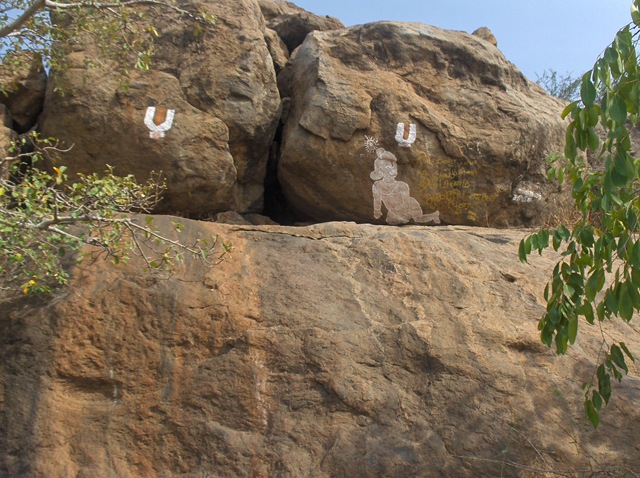
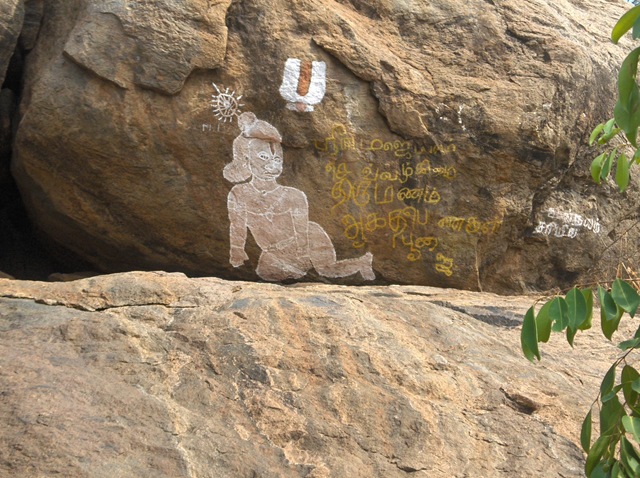
Krishna is painted on the rock, with a peacock feather on his head.
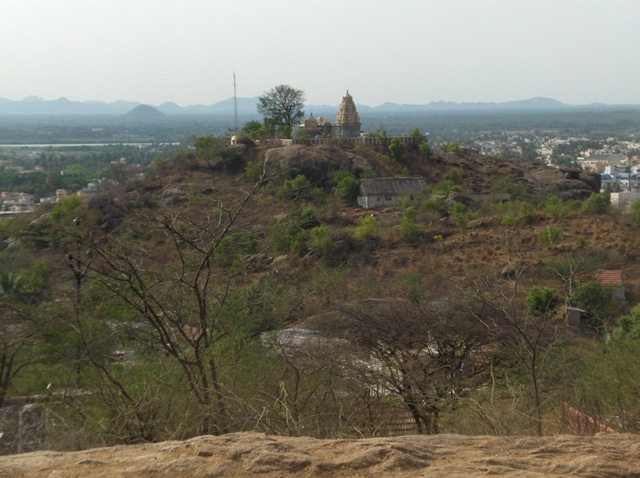
A great view of Pavala Kundru can be seen from here.
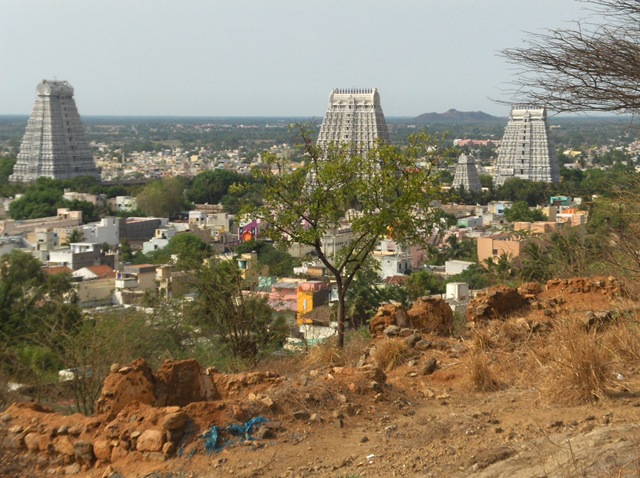
Arunachaleswara Temple, too.
More is found in Wedding Cave Post.
Dugout Cave
Dugout cave is a made made cave under a rock below Tortoise Cave.
To get to it, you go through the hillside,m like shown below.
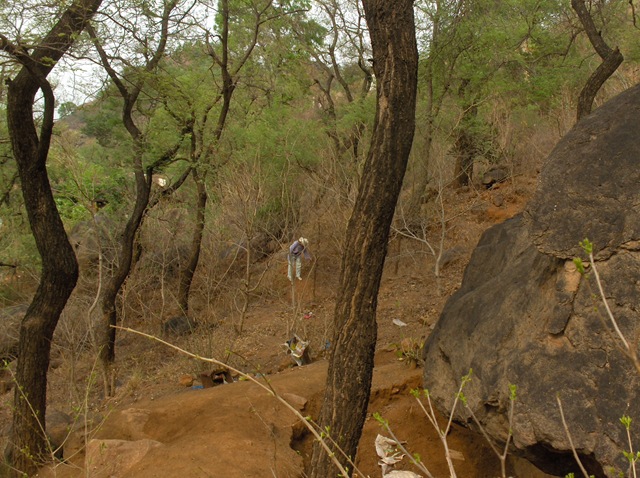
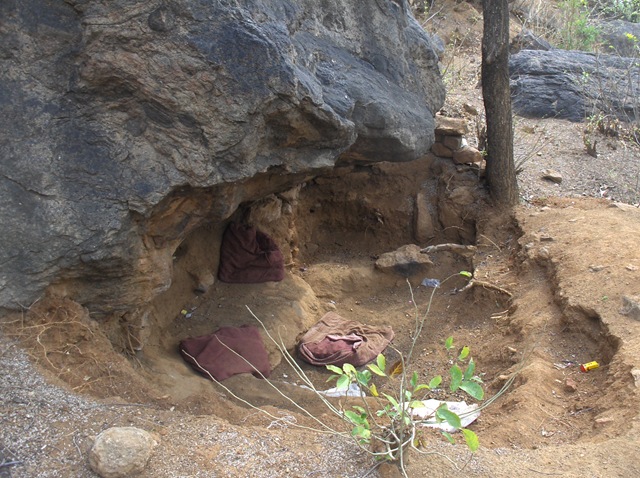
A nice spot has been bug out under this rock. There are several cushions laying in the cave. Maybe there was a smaller cave, that was ‘improved’ to make a better space. I know nothing of the history of this cave.
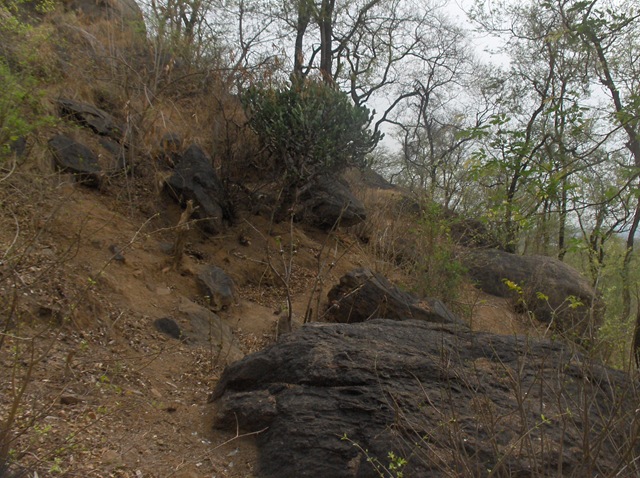
Another photo of the terrain around this cave.
This is seen as a part of this post.
Caves below Virupaksha Cave
These caves are described in the post New Access to Ramana Sites below Virupaksha.
Below Virupaksha 1
This cave is big enough that one or two people can sit in it.
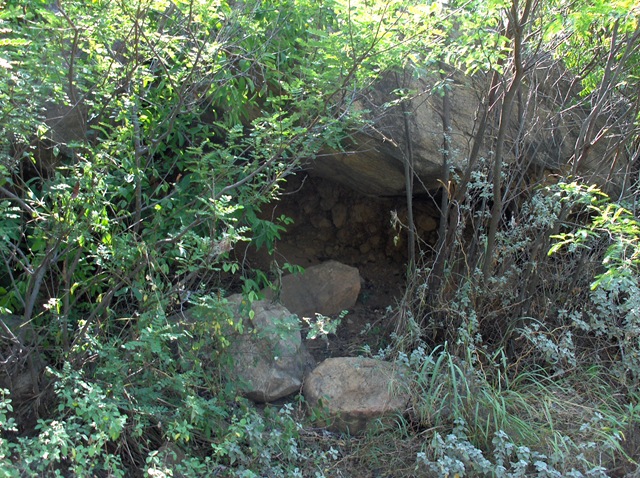
Below Virupaksha 2
This cave is very small. One person can lie down in it.
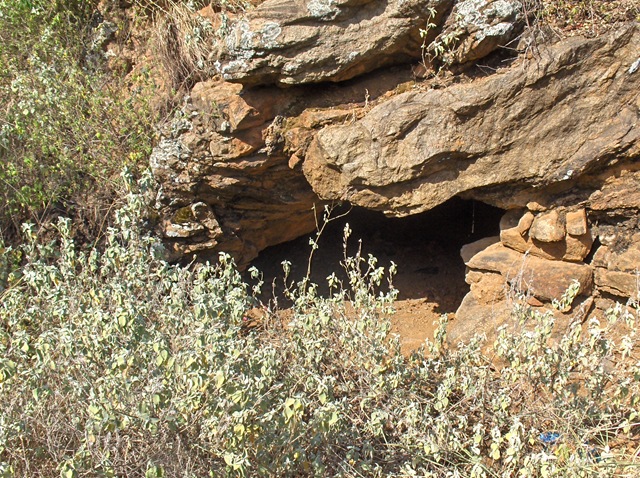
Below Virupaksha 3 – Associated with Ramana?
This cave is said by local villagers to be one used by Ramana in the early days. Recently, people have built walls and a door and an altar in it.
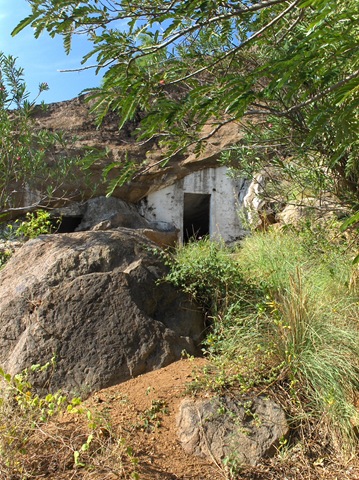
The altar.

Southwest Side
This map shows (right to left) Papaji’s Cave, Aum Amma’s Cave, Kattu Siva Cave, Unused Cave, Gameplayers Cava (Mankala Cave), and Pathside Cave.
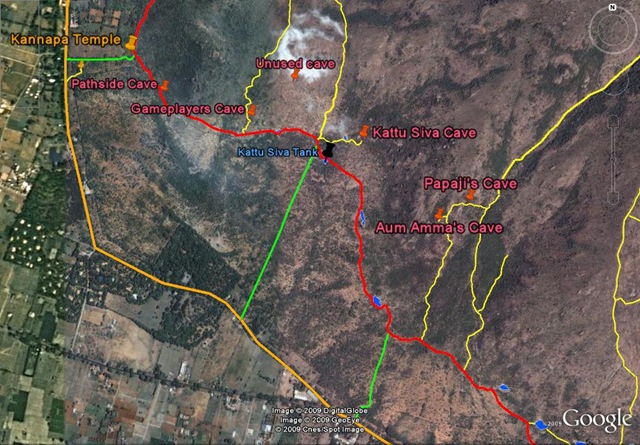
Caves on Papaji’s Knoll
These caves are shown in the posts Papaji’s Cave and Aum Amma’s Cave.
Papaji’s Cave 1
The first ‘cave’ of Papaji’s is in the area where part of his ashes were scattered. This is a nice place to sit and meditate at the altar that has been set up there.


Papaji’s Cave 2
The next of the caves named for Papaji, and one that he is said to have lived in, is near the first cave, down the rock and a bit up the path.
Carol enters the cave from the path.

Richard and Carol, meditating in the cave.
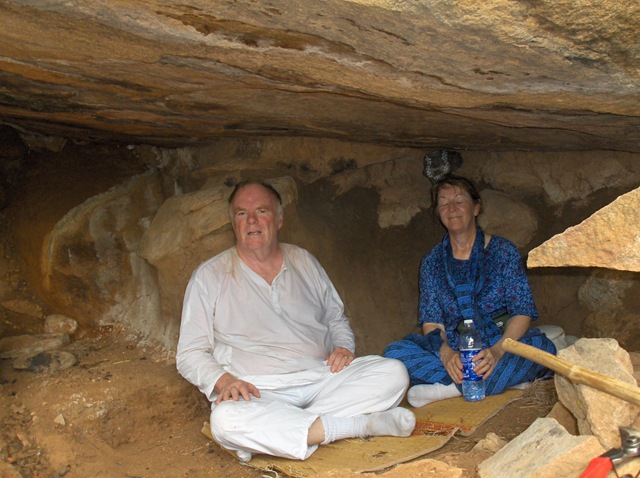
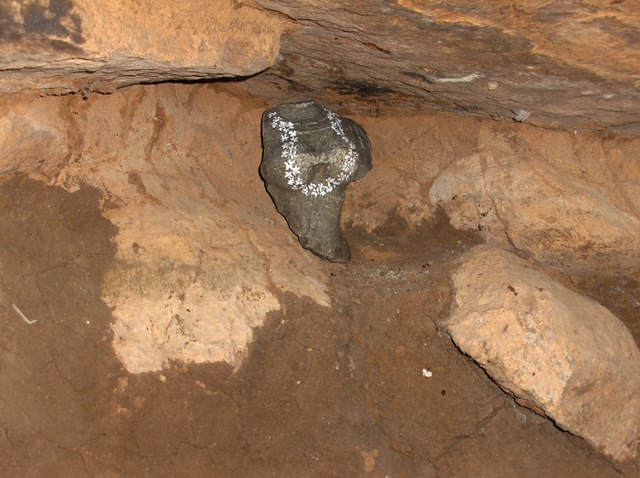
Below is part of a mother goddess statue, placed in this cave.
Aum Amma’s Cave
Aum Amma’s cave is the most developed of any cave we have found so far (except for those, like Virupaksha, which have had buildings constructed around them).
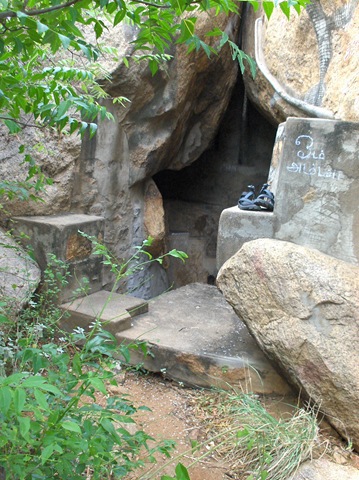
Many bags of cement were carried up the hill to make these cave improvements. Aum Amma lived her for several years until just a few years ago.
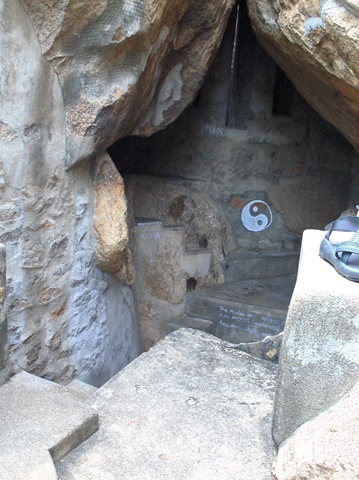
Stairs lead down into a main room.
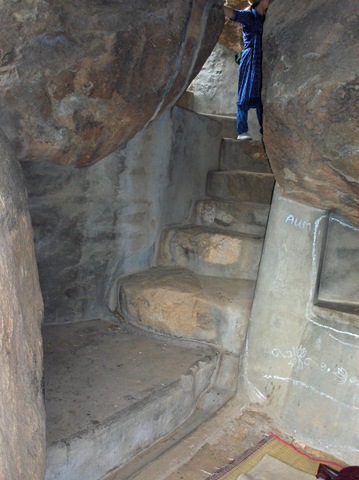
There is a good view out the “window” in the main room. It looks like sometimes that people sleep in this cave, though you are not supposed to, and if you stay too long, the Forestry Department people will chase you out.

Caves in Kattu Siva area
Kattu Siva Cave
This cave is shown in the post Kattu Siva Cave.
There is a nice cleared area around the cave. this is good place to come during the heat of the day. There is plenty of shade.

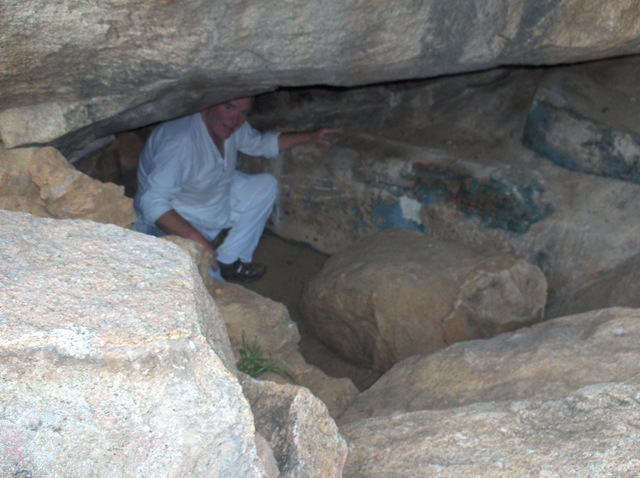
Climbing over the rocks at the end of the clearing, a hole in the rock appears.

This is Kattu Siva’s cave. A big rock, in front of Richard, has fallen into the cave. Will someone be able to remove it?
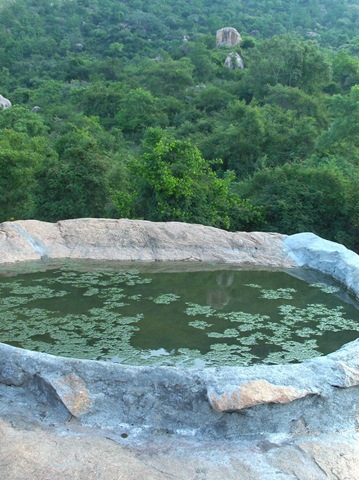
On the top of the rock over the cave, a cement water catching area was made. The photo below looks over this to the Arunachala hillside behind Kattu Siva’s cave.
Cave Above Kattu Siva Meditation Perch – Unused Cave
Related posts are: Kattu Siva Meditation Perch and Kattu Siva path Renewal – Part 1.
This is a small unused cave. Rocks need to be cleared from the floor to make a good sleeping area.
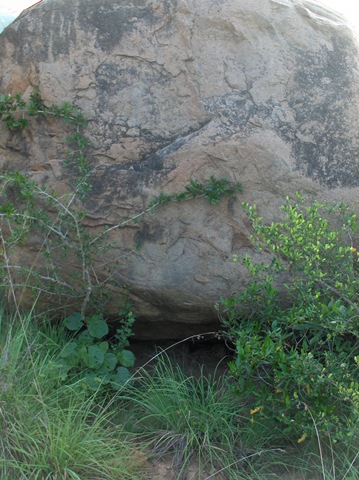
Mankala Cave (or Gameplayers Cave)
This cave is shown in the post Kattu Siva path Renewal – Part 1. It is under a rock that looks like a natural lingam as you approach this cave.
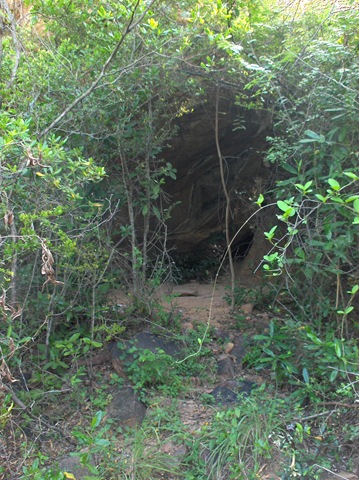
Cave next to Inner Path near Kannappa Temple – Pathside Cave
This cave is shown in the post Inner Path – Around Parvati Hill.
A path leads to it from the Inner Path.

This cave was improved with a stone and cement wall in front.

A nice cement floor has been put in the cave.

Caves on Northside of Arunachala
Naga Cave is shown in the map, below.
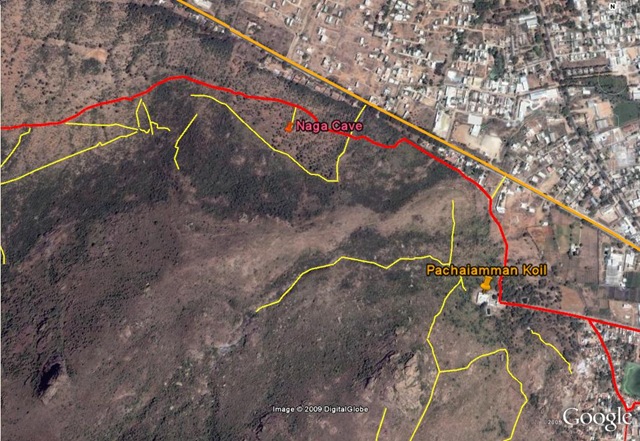
Naga Cave
This is not too far from Pachaiamman Koil. It is between the Inner Path and Arunachala, just barely visible from the path. You may notice a bit of color towards Arunachala.
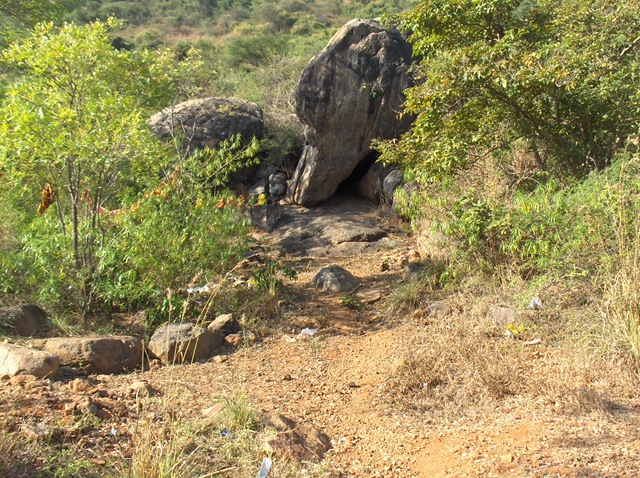
As you approach you see a small cave.
To the left is a primate altar, featuring Nagas, snake gods.
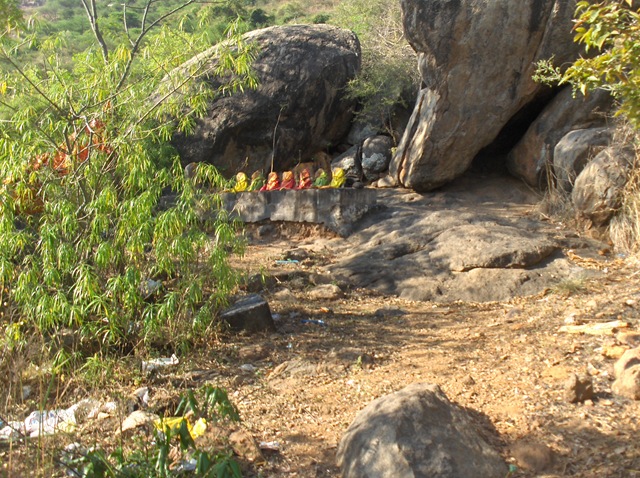
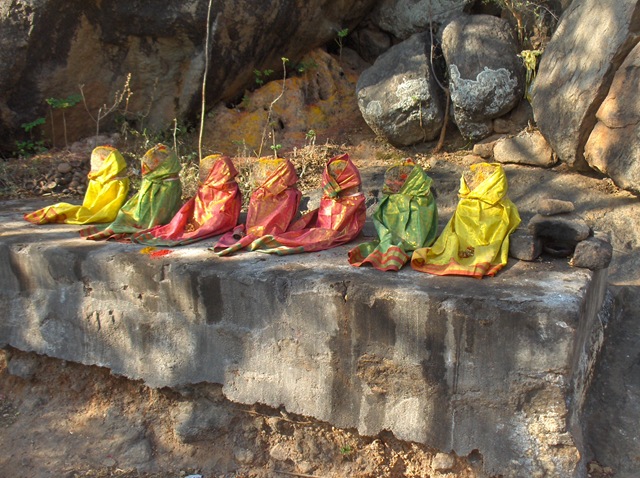
The colors noticed from the path are the fine clothes that the Nagas are wearing.
The cave is small. Only one person can sit in it. Not good for sleeping, either.
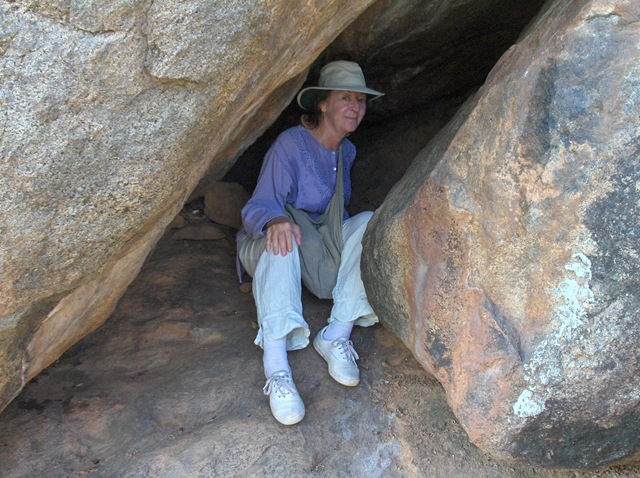
More is to be found in the Naga Cave Post.
More caves to find, more of Arunachala to explore
I have heard of more caves. I have been told:
- There are four caves on the hill above the Mountain of Medicine Arunachala reforestation facility.
- There is another cave high above Papaji’s cave.
- There are three caves on the north side.
- There is a cave near Virupaksha occupied by a sadhu that does not like to be bothered.
What else is there? We have to explore to know more. If you know of any more caves that haven’t been listed, please let me know.
 Luthar.com
You must be logged in to post a comment.