Harsha's avatar

Two Great Truths of Absolute and Relative Reality

By Mira Prabhu who is both an amazing and insightful Yogini as well as a very gifted writer. ❤

Mira Prabhu's avatarmira prabhu

SHIVA AND SHAKTI TANTRA

In my volatile teens, I was struck by the poignant beauty of an ancient metaphor (contained within the Mundaka Upanishad) that speaks of two birds perched on the branch of a tree: one bird eats the fruit of the tree while the other watches.

The first bird represents the individual self/soul; distracted by the fruits (signifying sensual pleasures), she forgets her lord and lover and tries to enjoy the fruit independent of him. (This separating amnesia is known in Sanskrit as maha-maya or enthrallment; it results in the plunge of the individual into the ephemeral realm of birth and death.) As for the second bird, it is an aspect of the Divine/Self that rests in every heart—and which remains forever constant even as the individual soul is bedazzled by the material world.

This teaching implies that it is ignorance of our true nature that creates a vicious cycle: the individual, being blinded by the illusion of existing as a separate…

View original post 613 more words

Harsha's avatar

“Mind Your Own Business”, said Ramana Maharshi

Mind your own business. ~ Sri Ramana

Harsha's avatarLuthar.com

The sun is simply bright


One day, one of the devotees came to Bhagavan Sri Ramana Maharshi and said in an excited whisper, “Look, Bhagavan! Just look at that man! ” Everyone turned to look. We saw a gentleman who was asleep, swaying back and forth. The devotee who had approached Bhagavan complained, “I have been watching him for the past few days. He always sleeps in Bhagavan’s presence.”

View original post 232 more words

Harsha's avatar

Some history of Arunachala and the efforts to protect it

Some history of Arunachala and the efforts to protect it

Richard Clarke's avatarLiving in the Embrace of Arunachala

There have been struggles to preserve and protect Arunachala that date back to the times of Ramana Maharshi. These include a court appearance by Ramana Maharshi, a legal effort in the late 1990s, various efforts to protect encroachment of the inner path, environmental recovery around Arunachala, and then in 2012 a series of fires on Arunachala that resulted in the Inner Path closure, which continues to this day.

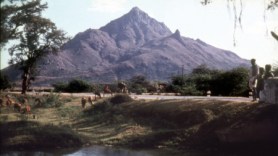
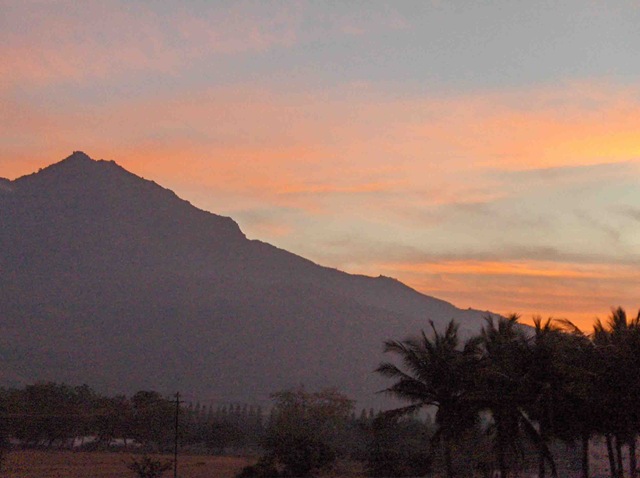
Old photo of Arunachala Old photo of Arunachala

Below are links, first to David Godman’s website, then to an Arunachala Samudra  artecle on the legal battles in the late 1990s, and a series of posts on this blog.

Together they show a long lasting concern about how to protect Arunachala. That effort continues to this day with the recent protests that stopped – for now – destructive tree cutting and digging on the pradakshina route.

Bhagavan’s Deposition on Arunachala

Environmental concerns and the courts – 2001

View original post 116 more words

evankeith's avatar

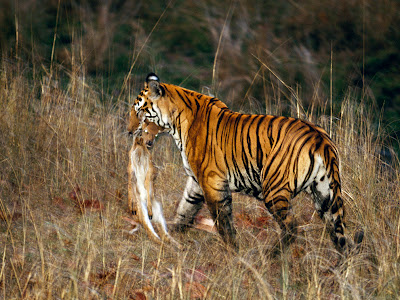
In the Jaws of the Beloved Tiger: By Dr. Evan Keith

Image

I do not know when I first learned of Bhagavan Sri Ramana Maharshi. I know that at most he was little more than a name to me before my eighteenth birthday and only in the last year has he become of central importance to me. In fact, now I think of Bhagavan as my Guru. Bhagavan never did formal initiation of anyone as a devotee and never even referred to anyone as being or not being his devotee. Nevertheless, he sometimes mentioned that most people needed a guru to overcome their ancient tendencies and “realize” the Self. Sometimes Bhagavan would allude to the Self, itself, or in particular the mountain Arunachala as having been his Guru. In this respect, Bhagavan Ramana is my Sadguru and I am His devotee. Continue reading

Harsha's avatar

Nirvikalpa Samadhi – Two Different Perspectives: By Dr. Harsh K. Luthar

Harsh K. Luthar

Harsh K. Luthar

Question On 01/20/2000 From Gausima

I accidentally found this on the internet while searching for something else, and was wondering what type of Nirvikalpa Samadhi it was referring to and if anyone had any knowledge of this.

“once an ordinary person achieves Nirvikalpa Samadhi, he leaves the body in 21 days.”   In the Gospel of Sri Ramakrishna, on page 245, it says, “Trailanga Swami once said that because a man reasons he is conscious of multiplicity, of variety. Attaining samadhi, one gives up the body in twenty-one days. . . ” (Ramakrishna was talking to his devotees.)

Namaste,
Gasusima

Continue reading

Harsha's avatar

The Maharshi’s Advice to Poonja-Ji

Editor’s note:

As you read this personal account by Poonja-ji, keep in mind the background and the context of the times of the year 1947 as India was getting ready to be split into two countries. Continue reading

Harsha's avatar

The Heart of God:The Nature of Self-Realization. By Dr. Harsh K. Luthar

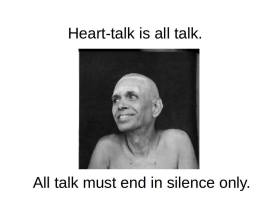
Heart Talk is All Talk

The difficulty in many of our conversations about spiritual insight is that the true understanding is not intellectual or conceptual, but absolutely direct. It is clear and direct without the medium of the mind.

Truth has never been a monopoly of a particular religion or spiritual tradition. How can it be? Some may disagree, but in my view, God does not play favorites.

We cannot make Truth our personal property but only allow the quality of Truth to overtake us and shine in us. We cannot possess God but only surrender to the Divine Will and let God take over our life.

Continue reading

Harsha's avatar

Easy And Natural Is The Way: By Dr. Harsh K. Luthar

Dear Friends,

Sahaj in Sanskrit means easy and natural.

There is saying in Hindi, “Sahaj pake so meetha hoy.”

It means that easy and natural cooking of food leads it to taste sweet.

It is something like the English saying that soup that simmers slowly or the cake that is baked slowly tastes best in the end.

These are metaphors for life. When we do something with care and love, the results are better. Sometimes we even say that, “this is a labor of love.” When we love what we do, it does not feel like work.

Everything has its nature. When we are true to our own nature, an easy authenticity takes over. Then we are not concerned about impressing others nor worried about how others are judging us.

Nature is showing us the way. Seasons are coming and going. Flowers bloom and then wither. We are breathing in and breathing out.

Easy and natural is the way. Anything else makes it appear that somewhere other than where you already are, is more attractive.

All of these teachings of self-improvement, yoga, meditation methods, breathing techniques might have some meaning to someone at some point in time. Truly these are concepts only for the mind to struggle with. The whole premise of these teachings is that you are not OK just the way you are. Ultimately, it is the most splendid nonsense.

To be easy and natural is the way.

How does one become easy and natural? How does one follow the natural path?

To be easy and natural is, well, it is to be easy and natural; and it is best because it is easy and natural.

It is so simple is it not?

What is not easy and natural will produce inner and outer conflicts. We already have enough of those. Of course, for some people making more conflicts may be easy and natural. In that case, go for it (and you can’t help it anyway).

Being easy and natural in awareness allows for the recognition of the Self, which by its very nature is easy being, natural, and wholeness of awareness aware of itself as its own bliss. There is no good way to express it.

My teacher Chitrabhanu-ji (who was a monk for 29 years) once told me that as a young monk he was very very strict with himself. “Sometimes, too much judgment and discipline can be a form of violence with oneself”, he told me.

Another time when we were talking about gurus, I mentioned many names to him and asked his views of them.

Chitrabhanu-ji knew most of the gurus personally. These included J. Krishnamurti, Swami Muktananda, Sri Chinmoy, Rajneesh (Osho), Swami Chidananda, Swami Rama, Swami Satchitananda, etc.

Those gurus whom he liked, Chitrabhanu-ji would only say, “He is a good man.”

One day Chitrabhanu-ji said to me, “You should never follow a guru.” I looked at him puzzled (because he was my guru, you see).

He smiled and said in his thick Bombay accent, “What if the guru goes crazy and tells you to do strange and crazy and weird things…” I had a good hearty laugh! He added, “that does happen you know….”.  I laughed even harder.

Well, it does happen you know.

As Sri Ramana never tired of saying,… the only true guru is your Heart, your own Self.

So wise sages tell the advanced aspirants to be perfectly natural. Make the effort, if natural. Follow a teaching if it is easy and makes sense.

If something makes no sense, there is no point in following it. So what if it is considered the supreme teaching and so on by someone well known. For all you know, what the supreme and well known people say could all be manure.

Think about it. What do they really know? How can they really know? What can anyone really and truly know?

So rest, if it feels natural to rest. Watch the spiritual parade pass by and not be moved by any teaching. Or join the parade and sing your song.

Your nature will make you act in a certain way. That is why you can be at perfect ease.

Self-remembrance, Awareness aware of itself, Self-abidance, all of these mean the same.

Easy and natural is simply being aware of one’s innate wakefulness through the winds of emotions, colors of life, and changes in scenery.

To the extent one can grasp it, simply remain aware and if you become conscious of some intangible cloud of unknowing which you cannot go through, become comfortable with it, stay with it, and breathe it in and out.

If you meditate on this and become aware, it will dawn on you with clarity. You will see.

Easy and natural is the way.

Namaste

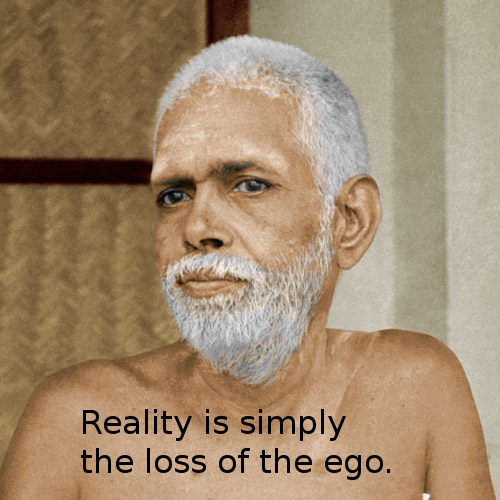
Reality is simply loss of ego - Ramana