Harsha's avatar

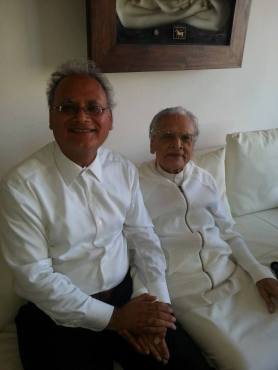
Sri Ramana and My Teacher Gurudev Sri Chitrabhanu-Ji: By Dr. Harsh K. Luthar

All of us come from different backgrounds, and we walk the path in our own unique way. Yet, we all have the same innermost longing to know the deepest mystery of our own nature and being. Reflectin…

Source: Sri Ramana and My Teacher Gurudev Sri Chitrabhanu-Ji: By Dr. Harsh K. Luthar

Harsha's avatar

The Root of Self-Inquiry: By Dr. Harsh K. Luthar

The ultimate Reality cannot be named. It has no name. There is no one outside of Reality to give it a name.

Harsha's avatarLuthar.com

Realized Sages such as Bhagavan Sri Ramana have indicated the experience or the state of the Self.  It is what it is.

It is the Heart of Existence, and Existence It Self.  Sri Ramana used to say that It is only Being.

You can call it what you like. Self, No-Self, Shunya, Reality. What difference can it make? The ultimate Reality cannot be named. It has no name. There is no one outside of Reality to give it a name.

Ancient sages taught that the core of our being is pure Sat-Chit-Ananda which roughly translates from Sanskrit as Existence, Knowledge/Consciousness, Bliss as One.

It is devoid of thought or doubt or conflict, but utterly complete and supreme over its domain, its domain being no other than It Self.

It is the Eternal Reality which is not conscious of anything separate from it, being Pure Consciousness Itself.

It is beyond happiness…

View original post 174 more words

Harsha's avatar

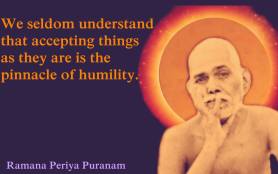
The Nature of Humility

Sri Ramana’s teaching is that the ego/mind merges in the Heart in two ways.

First, we can investigate the nature of the ego and examine the sense of “I” that we naturally feel and see where it arises. To do this, one needs to still the mind and with a purified and subtle intellect trace the “I” back to its source, the Heart. This is the yogic path of Jnana.

The second approach is to simply surrender the ego/mind without reservation to the Lord and accept that it is never our will but the Lord’s will as to what happens. If this attitude of “not my will but thine my Lord” penetrates deeply into our being, then we become accepting of everything. We see that worries and anxieties associated with ego/mind do not belong to us as we have surrendered our individual identity to the Lord. This is the approach of devotion and leads to the ego/mind merging into the Heart where the Lord sits as Eternal Existence.

“If ego rises, all will rise. If the ego merges, all will merge. The more we are humble, the better it is for us”. ~ Sri Ramana in “Gems”, Chapter XIII.

Photo art in this article is from Andreas Farasitis.

Harsha's avatar

Food is Sacred

May all beings be healthy and happy and enjoy fullness without being too full.

Harsha's avatarLuthar.com

Vegan Salad with Mango pieces

Sri Ramana spent many years cooking for others at the Ashram and even gave precise instructions to those in the kitchen on cooking! He was a taskmaster and did not allow any food to be wasted.

The Upanishads remind us that food is sacred. “Food (anna) itself is Brahma” ~  Taittiriya Upanishad.

Bhagavan Ramana taught the devotees that food influences our body and mind, and should be selected with care, prepared well, and eaten in moderation.

View original post 95 more words

Harsha's avatar

Song of Mahamudra:Tilopa

Cut the root of a tree
And the leaves will wither;
Cut the root of your mind
And Samsara falls.

The light of any lamp
Dispels in a moment
The darkness of long kalpas;
The strong light of the mind
In but a flash will burn
The veil of ignorance.

Whoever clings to mind sees not
The truth of what’s
Beyond the mind.
Whoever strives to practice Dharma
Finds not the truth of
Beyond-practice.
To know what is Beyond both mind and practice,
One should cut cleanly through the root of mind
And stare naked.
One should thus break away
From all distinctions and remain at ease.

-From Tilopa’s ‘The Song of Mahamudra’ (translated by Garma C.C. Chang).

Harsha's avatar

The minute I heard my first love story I started looking for you: Rumi

Rumi’s poetry often centers on the search for the Beloved and the union with the Beloved.

It echoes the poetry of Bhagavan Ramana and the verses Bhagavan wrote to Arunachala.

Rumi says, “The minute I heard my first love story I started looking for you”.

It was the same with Bhagavan Ramana. The minute he heard the name Arunachala, he associated it with something majestic, God Himself and started looking for it.

hindu_deity_qd15_l

The minute I heard my first love story

I started looking for you, not knowing
how blind that was.

Lovers don’t finally meet somewhere.
They’re in each other all along.

From Open Secret: Versions of Rumi, Translated by Coleman Barks / Translated by John Moyne


Harsha's avatar

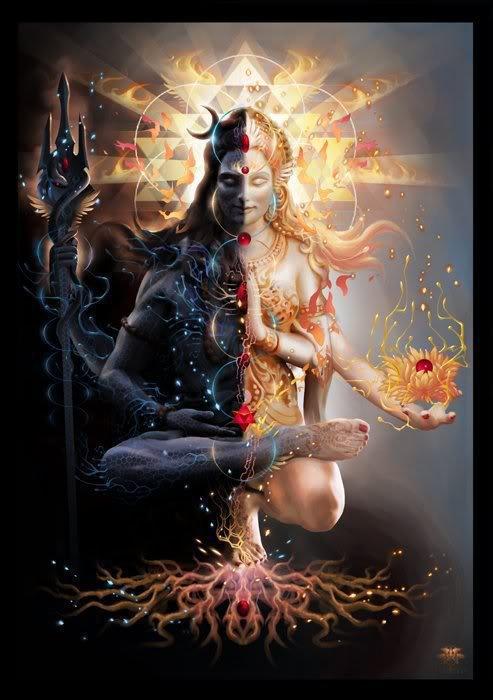
Shiva and Shakti-Jnaneshwar

I offer obeisance to the God and Goddess,
The limitless primal parents of the universe.

They are not entirely the same,
Nor are they not the same.
We cannot say exactly what they are.

Harsha's avatarLuthar.com

Here are some selected verses from Jnaneshwar, a 13th century Indian mystic.

Amritanubhav (The Nectar of Mystical Experience)

Siva Shakti

Chapter One: The Union of Shiva and Shakti

I offer obeisance to the God and Goddess,
The limitless primal parents of the universe.

They are not entirely the same,
Nor are they not the same.
We cannot say exactly what they are.

How sweet is their union!
The whole world is too small to contain them,
Yet they live happily in the smallest particle.

When He awakes, the whole house disappears,
And nothing at all is left.

Two lutes: one note.
Two flowers: one fragrance.
Two lamps: one light.

Two lips: one word.
Two eyes: one sight.
These two: one universe.

In unity there is little to behold;
So She, the mother of abundance,
Brought forth the world as play.

He takes the role of Witness
Out of love of watching Her.

View original post 83 more words

Harsha's avatar

On Ordinariness of Awakening: By Latha Ramanan

“We discover the ordinariness of awakening. Gratitude, compassion and universal love encompass us, as we realise that everything in this universe is part of us – the oneness is felt. There are no more enemies, no peaks to achieve and no resistance to the ordinary flow of life”. ~ Latha Ramanan

Harsha's avatarLuthar.com

It is the simple things in life that teach the greatest lessons in our lives.

View original post 940 more words

Harsha's avatar

The Destructive Dance of Monkey Mind

From the sacred journey of Mira Prabhu now residing at the holy mountain of Arunachala in India.

Mira Prabhu's avatarmira prabhu

6d683d43b8fae0a1465e0c51199d5190-1Last night something happened that disturbed my mind. Unable to sleep, I stayed awake until the wee hours, reading an illuminating book a friend had given me containing the reminiscences of those fortunate enough to have had personal contact with Bhagavan Ramana Maharshi.

I woke up feeling bedraggled—but the sun was shining through many windows, and doggies and humans would soon be calling for my attention, so I rose. I did my morning practice of diving into the Self and was able to dispassionately view the antics of my mind—as if I was a wise old grandfather indulgently watching his rambunctious grandson mess up the living room. Simply being watched with love stopped my mind from spinning into even more chaos—and then bliss arose in a strong wave.
FB_IMG_1472401603075As Gautama Buddha said so beautifully over two thousand years ago, sometimes the mind is like a drunken wild elephant in rut. Somehow we must…
View original post 138 more words

Harsha's avatar

The Path to Enlightenment: By Dr. Harsh K. Luthar

In this essay, I suggest that the philosophies and perspectives of the gradual or the direct path are not inherently meaningful. Their truth lies only in being teaching tools. Words and concepts such as the “direct path” and the “gradual path” are meant to point at the truth but they are not themselves the truth. The Truth must reveal itself to us in our own Heart.

Harsha's avatarLuthar.com

docimage138

A Popular Dichotomy

A popular dichotomy has emerged about Enlightenment in the West since the 1970s between the schools of “gradual enlightenment” and “instant enlightenment”. Some of this can probably be traced back to Poonja ji’s and Nisargadatta Maharaj’s disciples returning to the west in the 1970s and 1980s from India and bringing their understanding of Advaita Vedanta with them as given to them by their teachers. However, because many of these students deviate from traditional Advaita as taught in the classic lineage of Adi Shankracharya, they are referred to as neo-advaitins.

Given this thesis and antithesis between the gradual path and the direct path, I address the following question:

It is said that there are two approaches to the Truth of Being or Reality which some call Enlightenment or Self-Realization. A gradual path and a direct path. What is the truth of it? Are their really two paths? If…

View original post 2,125 more words