Harsha's avatar

Satsang with Robert Adams: By Kheyala

image

One of the first stops after leaving Colorado that my best friend and I took in our new home-on-wheels (“Lakshmi”) was in Sedona, AZ to go to satsang with Robert Adams. Many of you may know that Robert Adams (whose body died a few years ago) sat before Ramana for years in Tiruvannamalai.

We knew that Robert Adams was aging and that a special opportunity awaited us. Now, keep in mind that my conscious spiritual journey was rather new and I had previously immersed myself in the Satsang Mecca called Boulder.

I had really gotten a feeling for what satsang was “supposed to” look like and went to Robert Adams’ place fully armed with my finest “spiritual” clothing, “spiritual” face, “spiritual” voice, and “spiritual” sitting posture.

When we arrived, spiritually carrying our zaphus behind our hips in silence, heads held humbly down, we were quite surprised to find a room full of relaxed people hanging around, just acting normal. In fact, they were so talkative with each other and easy-going and animated that it made me wonder if we were really at the right house.

I came prepared for silence and holiness and the scene was unsettling being so ordinary. There was nothing spiritual about the place, like decorations or altars or anything that I recall. There may have been a small photo of Ramana. So I sat down and prepared to “meditate.”

Needless to say, I simply couldn’t keep my eyes closed. There was too much fun going on in the room. I struggled with it for a while, but that became so darned uncomfortable. Eventually, I just sat there figuring it would get holy, maybe, after Robert came in.

You can imagine my surprise when he did come in. While I was expecting a spiritual-looking man dressed in Indian garb, what he was actually wearing was a pair of baggy, silky jogging pants and a tee-shirt and he had on a hot pink rumpled-up baseball cap that was on crooked!

Because Robert had Parkinson’s Disease, he kind of made his way across the living room in a slow-motion shuffle and sat himself in the chair reserved for him. Everyone made room for him as he passed by and with great affection touched their palms together in reverence.

Robert sat on the chair for some time. It was real quiet in the room, but not an “it’s-time-to-be-quiet” kind of quiet. It was just naturally quiet. And no one said anything. So, trained as I was to recognize a jnani, well…. no way. This guy was plainly sitting there with his mouth open and his eyes half closed. He was hunched over with his skin just hanging on his face. There was nothing that I could “read.” And boy, did I try. I looked for some kind of radiant glow, some kind of visible wisdom, some hint of Ramana, and nothing! I looked into his eyes and it was as if no one was home. My mind was just struck dumb.

Eventually, Robert jerked his arm up, sort of pointing a finger. That was the cue for the person holding the boombox to hit “play.” I thought, “Oh. THIS must be the holy part.” I closed my eyes in full expectation of sacred words or ethereal music or at least some Sanskrit bhajans. To my utter shock, the thin and twangy voice of Willie Nelson’s “Always on my mind” came singing out!

The whole room went into an uproar. Everyone was laughing and swaying from side to side in enjoyment, singing dramatic crescendos at each chorus: “Telll meeeee. Tell me that your sweet love hasn’t died…etc.”

Robert? He just sat there, expressionless, his body unmoving, hunched in his chair. No sparkling eyes, no nothing. By then, my mouth was dangling open as well. My mind had completely come to a halt. It could not make sense of this at all. It didn’t know and could not begin to interpret what it was seeing.

The next musical selection was Kenny Rogers singing really sentimental love songs. These were no Sanskrit Bhajans about Enlightenment or God or anything. These were love songs riddled with illusion and duality. Rather than condemning them or spiritually correcting them, Robert Adams was just sitting there. Everyone was laughing so hard that tears were coming out. It was so infectious that before I knew it, I was singing along and laughing too. My sides were aching when we were through.

Afterwards, with everyone returning to normal breathing and with some sighs and residual giggles here and there, I had the thought, “Well, maybe now it will get serious.” There was a moment of silence. Then suddenly, someone said, “Hey! How about Mexican?!” This was met by an outburst of cheering! Soon everyone got up and grouped together in cars to go to a local Mexican restaurant.

Bewildered but happy to go along I arrived at a scene that I was dismayed to find rather loud and crowded and chaotic. Shortly after we were seated, I looked over at Robert. He had a bright green margarita in front of him.

Before leaving, I didn’t want to miss the opportunity to speak with Robert even though at the time I sure didn’t know what to make of him….but all that came out was something like, “I like your hat.” And he said something like, “Thanks.”

The sweet, natural happiness that I experienced in his presence was so very thick and blatant. All the ideas I had picked up about what it is to be in the presence of Truth were permanently cracked. The mind just couldn’t get around the chasm between what it thought holiness was supposed to be like and what it had actually met that day with Robert Adams. In its attempt to cross that chasm, it had fallen into it, giving rise to an absolutely undeniable experience of joyfulness and peace.

Editor’s note: Kheyala is a long term member of the HarshaSatsangh list. Her account of the Satsang with Robert Adams first appeared in Spring 2002 of the original HS-Ezine.

Harsha's avatar

The Eruption of Kundalini-Shakti: By Michael Hortling

(This article was originally published in HarshaSatsangh E- Magazine Volume I)

Twenty years ago, the kundalini-shakti erupted within myself. Since I didn’t have a clue about what had happened to me and I experienced some quite unpleasant side-effects of this awakening, I had to start looking for remedies in order to ease some of the discomfort. This has been a more or less ongoing process ever since and although I can’t say that all problems have disappeared, some interesting insights and experiences have been gained and that alone has made the journey very worthwhile.

The effects on the psyche, and on one’s ideas about oneself and life in general, that come about by an active kundalini are far reaching indeed, but this transformation seems to have a price attached to it. In my case I’ve been plagued by a variety of symptoms ranging from physical health problems to bouts of anxiety and depression. As a result, I’ve been led to closely observe and attempt to harmonize the innermost workings and mechanics of my mind and body using a variety of techniques and methods such as tai-chi, hatha-yoga and various types of meditation.

To Do Something, or Nothing?

As much as I agree with the advaitin conclusion about reality being One and the concept of separate personalities acting within reality being illusion, I think that the often heard claim that nothing actually needs to be done in order to realise this, will probably only be true for a small number of persons. I find that, in the case of myself at least, ( and I do believe this would apply to most people) some work on oneself using “techniques” is necessary in order to be able to experience this fundamental unity of life. The main reason appears to me to be the deeply ingrained innate patterns of body and mind that prevent a true perception of life.The experience of duality seems to be hardwired into our being by nature, so that definite changes have to take place within the perceiving mechanism of ourselves before reality becomes non-dualistic.

Doing Mantras

One spiritual discipline that seems to work on many different levels to me has been the practice of silent mantra-repetition. One of the first deeper insights or realisations came to me after I had practiced mantra-meditation for some time as taught by Transcendental Meditation or TM.

I was sitting in meditation one day, quietly repeating the mantra in thought, growing progressively calmer and relaxed as a result as the normal rush and clutter of the mind began to recede. Suddenly it hit hit me like bolt of lightning – I was inside “myself”, calmly watching the mantra repeating itself, calmly observing whatever thought-processes still passed through the mind – BUT I WASN’T THE MIND – I WAS THE OBSERVER OBSERVING THE MIND! An enormous sense of relief and gratitude welled up inside as I in one instant understood that everything that really created problems in my life was either mind or body, but that the real “I” was the silent and totally unaffected observer, calmly watching everything come and go.

This was a very profound experience since it in one instant blew the identification with the mind to bits. I had always somehow thought that I actually WAS the constant inner monologue and imagery playing themselves out and now this was shown to be not true at all in a perfectly clear way. I was actually the screen on which the mind with its movies was projected – but I wasn’t the images themselves.

I soon realised however that this was just a glimpse into the deeper reality, but not at all a permanent state of enlightened being – a lot of practice or sadhana seems to be necessary in order to shift the focus of consciousness for good, even though the awakened kundalini is a kind of automatic process in this direction.

After this, mantra practice began to intrigue me more and more, especially since I also became very sensitive to sound and music in particular. I would experience rushes of kundalini moving up the spine, followed by ecstatically blissful sensations listening to certain types of music or certain combinations of notes and harmonies.

I then began to experiment with other mantras and other methods of repetition. Whereas the TM-meditation in essence uses the mantra to really allow oneself to let go and relax completely, I found that mantra-repetition could also be used to direct and control the mind in a more active and deliberately focused manner. This is more in line with yoga as taught in the tradition of Patanjali. The aim here is the sharp one-pointedness of mind which prevents the scattering of thoughts in all directions and keeps the mind from going outwards through the senses. It seems to me that it really is this rapid movement of the mind, constantly going back and forth between the falsely perceived separateness of oneself and the equally false “outer world,” that is one of the main obstacles to just calmly resting in the unity of world and self.

Technically, what seems to happen is that the focusing of thought focuses energy and this usually leads to an increased flow of kundalini along the spine. When this burst of energy reaches the highest region of the brain, shifts in consciousness occur, spiritual insights come drifting into awareness automatically and there can be general feelings of being in tune with the All and Everything.

For this slightly different way of repeating, I try to focus with as much attention as I can on the sound and the shape of the mantra until it gradually fills out the whole space of the mind . I’ve often also done this walking outside with eyes open until sometimes the boundaries between inner world of thought and feeling and outer world of objects have more or less vanished and everything is just felt to be one big continuum with different degrees of density. If the focus is strong enough, it’s as if the whole outer universe becomes filled with the sound of the mantra as well and it can then seem as if the cosmos begins to chant back, which is quite nice.

Mantras and Side-Effects

Other interesting and spiritually useful side-effects of doing mantras over time, is that one develops an increased awareness of the shape and direction thoughts take and it becomes much easier to voluntarily direct the mind and consciously choose which thoughts to follow and which are best left to fade away by themselves. Since I firmly believe that thought determines action and ultimately the realities and life circumstances we find ourselves in, this aspect of mantra-practice is probably quite powerful, in terms of shaping the future and destiny.

A third approach to mantra-recitation that I’ve used with some results is more in line with tantric teachings which focus on the harmonising and control of the different chakras or areas of consciousness. This is also done in order to understand and streamline the physical and mental aspects of life, which manifest through the lower chakras. Mind and body in essence seem to be permutations and combinations of the 5 basic elements – ether or the space in which manifestation takes place, air, fire, water and then earth as the solid end-result. In tantra-speak all this is the Shakti side of the great universal polarity and is ruled by the kundalini. In order to experience Shiva, the silently witnessing consciousness, or the real, permanent “I” of non-duality, kundalini needs to be moved out from the lower chakras and made to unite with top area of the brain. Before that can happen in a steady and permanent manner, the chakras or in essence the elements they represent, need to be purified and strengthened. In practice, I find this to be quite demanding to say the least, but this is probably mainly due to my own shortcomings!

Mantra and Tantra

In the tantric traditions mantras have been used for this purification and as far as my humble experimentation has allowed me to see, the ancient yogis very much knew what they were doing. Reciting the mantra “Lam” at the end of the spine for instance, strengthens, energizes, opens and expands the root-chakra. Now, why is this so, why “Lam” and not any other sound ? I don’t know, but for me, taking the pragmatic approach of “if it works, use it” is the best one. Traditionally, the explanation given is that the ancient seers and rishis were given the various mantras in direct communion with the Infinite and I can go along with that. One day the science of physics will probably find out that the universe really is sound in motion and that different densities of matter correspond to different frequencies of sound. Humans, being part of the universe, will then correspondingly be found to also consist of various frequencies of sound and I believe great advances in the healing sciences will be made because of these discoveries.So, essentially, mantras can be seen to be a method of tuning the mind, body and awareness, harmonising frequencies, directing consciousness towards the light, instead of letting it scatter.

May all beings find peace and happiness.

About the Author:

Michael Hortling is currently residing in Germany. He combines mantra yoga practice with playing the guitar and creating music. As a youngster, he had a mystical experience while watching the Aurora Borealis drape itself across the Northern sky and this may have caused his energies to be like the Aurora, flowing, generously gentle and glowing brightly.

Seed Mantras

The following seed mantras are taken from the classic texts and schools of Kundalini Yoga based in Hinduism. The mantras used in Jainism and Buddhism are somewhat different. Traditionally, Kundalini Yoga in India was only practiced under the guidance of a Kundalini adept. The same advice holds today. Having a good teacher is essential in avoiding mental and physical challenges that may come with the practice of Kundalini Yoga.

LAM – the root (lessons related to the material world)

VAM – the belly (lessons related to sexuality, work and physical desire)

RAM – the solar plexus (lessons related to ego, personality, self-esteem)

YAM – the heart (lessons related to love, forgiveness and compassion)

HAM – the throat (lessons related to will and self expression)

OM – the brow (lessons related to mind, intuition, insight and wisdom)

All Sound – the crown (lessons related to spirituality) this is your quiet and all sounds around you. The sound of your being….

Harsha's avatar

A Dedication to My Father on His 70th Birthday: By Harsh K. Luthar

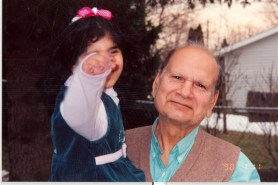
My father was my protector and best friend. I wrote the following in 1996 when my Father turned 70 as a dedication to him. The picture is of him at 72 holding my daughter. It was taken in the summer of 1998.

The last wonderful summer my father and I spent together was in 2003. Several months later in November of 2003 he fell ill. After that I was only able to see him at the hospital. My father passed away in early 2004 at the age of 78. I think of him everyday.

Summer time with my Father – 1998

A Dedication to My Father on His 70th Birthday in 1996

My father was a mathematics professor. He is now retired. I saw him spend countless hours writing papers and constructing new math problems. He involved the whole family in helping him with an undergraduate math journal, Delta, that he had founded, and of which he was both the editor and the publisher. It was too much work for one man, but my father persisted in doing the impossible for years. Delta later merged with the Mathematics Magazine issued by the Mathematics Association of America. We were all happy when that happened!

My father spent a lot of his evenings grading math exams. This used to irritate my mother. “Must you spend so much time reading student exams? Give them a grade and get it over with,” she would say. He usually replied, “What do you think I teach, sociology or philosophy? Can I just read the first and the last line and give a grade!” Then he would laugh heartily feeling he had uttered a profound truth.

My father actually loves the humanities but is of the opinion that everyone should have concrete skills to earn a living. He never hesitated to express his views to me and others about education. Once, in order to demonstrate the superiority of learning math over other disciplines he said to his colleague who taught astronomy the following: “If our students know math and statistics they can get a job at the plant (he was referring to the local GM Plant). If they take astronomy and don’t get a job what will they do? How will they eat? Maybe they can go to your house and you can all watch the stars together on an empty stomach!” My father thought what he had said was quite funny, although the astronomy professor did not. The following poem is dedicated to my father.

PROFESSORS DON’T GROW OLD

Professors don’t grow old

they just grade away

like a master jeweler

who has to differentiate

between precious rubies and stones

who with a heavy heart sings

and then has to part

with diamond rings

that must end up on

someone else’s finger.

Professors don’t grow old

they just grade away

like a gardener who

asks the birds to stay

in the nest he has made

so they can rest in the shade

of the tree of wisdom

carefully pruned

standing in the luscious grass

only to see them fly away.

Cool breezes and the

fresh waters of knowledge

is what we received

in the college

that was my father’s heart.

Yes, professors don’t grow old

they just grade away

and then slowly fade away

to pictures on the walls

leaving nothing behind

but the touch of ideas

given with humor and kindness

and their smiling eyes

bubbling forever in our mind.

Harsha's avatar

Bliss – The Source and Meaning of Life: By Michael Bowes

This article was originally written on May 9, 2006 and posted by Michael Bowes on the old HS blog.

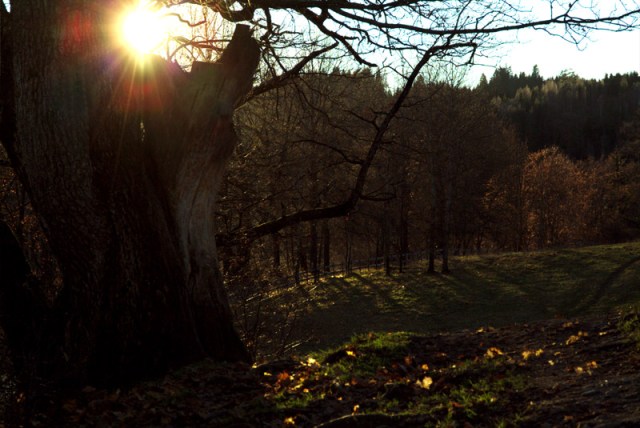
Picture below is by long term HarshaSatsangh member Alan Larus at http://www.ferryfee.com/tree.htm

One weekend in the early 1990s, my friend Narayan and I went to Saint Louis, Missouri to visit with Swami Chetanananda. Narayan and I have known Swami since the late 1980s. On Sunday morning of that weekend we were eating breakfast with Swami and the other residents of the temple, and according to the custom there, we were all reading a portion of the newspaper.

When reading the paper, Narayan nearly always goes straight to the “funnies”.

We were all reading and eating. Swami was at the head of the table, I was to his left, and Narayan was to my left. At some point Narayan nudges me and hands me the funnies. He pointed to the “Donald Duck” comic strip.

Donald Duck was in the Himalayas searching for his guru. And there were signs posted in the mountains that said “Guru”, and then an arrow would be pointing to a certain direction. And Donald followed the signs and arrows until finally, at the top of a mountain peak sat the guru with a personal computer in front of him.

Donald Duck asked the guru, “What is the meaning of life?”

The guru didn’t answer; but the computer started printing out something that couldn’t be read on the comic strip.

The gag was that personal computers were becoming the rage, and now even the guru was using one to divine the mystic truths.

But another peculiar thing was that Narayan and I were searching for a guru and a spiritual home; and now, thanks to Donald Duck, the stage was set for that possibility.

I nudged Swami and handed him the funnies while pointing to the Donald Duck comic strip. He read it and handed it back without saying a word, and continued to eat breakfast. After breakfast Swami went to prepare for his weekly public talk. The rest of us cleaned up after the meal and relaxed until the beginning of the service.

Swami began his Sunday morning talk and I really don’t remember the topic; but near the end he announced that he was going to reveal the “Meaning of Life”. He was going to reply to the question in the funnies.

Swami started by saying, “The meaning of life is bliss.”; and the following is a very loose paraphrase of what he said to explain that statement:

There is an “ocean of bliss” that is the source, the cause and support of all that we see; And in its manifest forms that bliss is experienced as amrita, rasa, love, joy, happiness, fun, hope, peace and even as pain and suffering. Pain and suffering serve as motivation for us to find a way to return to our original state of bliss.

We were all born from bliss. We arrive in this world because one day or one night our parents engaged in a blissful activity, and as a result we were born. From that day on, all of our conscious and even subconscious activities are meant to help us either directly or indirectly to achieve bliss and happiness.

As children all we really wanted to do was play. Our true unconditioned nature is playful. But, as we start to get a little older, we are forced to go to school and we are conditioned by society to perform certain useful functions.

But bliss, happiness, satisfaction, etc. are still the primary objective of all of our behaviors. Our parents and our society force us to go to school so that we can get a job, so that we can earn money, so that we can be happy.

We marry because we believe that another person will fulfill us and make us happy. We have children because we think that will make us happy. Everything that we do is ultimately for happiness and bliss. Even so called, “selfless love” only serves to satisfy ourselves. We believe that by performing our self-ordained duties that we will be satisfied.

A short time after I heard these words from Swami, I directly experienced that “ocean of bliss”. Our own true nature is something that cannot be imagined, and it is truly inexpressible. Since then, even though I have gone through some dark times, it isn’t possible for me to worry or lose my connection to that blissful being, the “ocean of bliss” that is our own true nature. And I have a lot of fun. I can’t seem to avoid it.

I began to experience this truth because of an encounter with the “funny paper”.

Love and peace to all,
Michael Bowes

Harsha's avatar

The Story of JaDa-Bharata By Professor V. Krishnamurthy

Professor V. Krishnamurthy is well known to the Advaitin Hindu community and deeply revered as both a practitioner and a scholar of the Upanishads, Bhagavad Gita, Shrimad Bhagavatam, and other ancient scriptures and texts. He has touched our lives through his healing words, wisdom, and authenticity.

Before his retirement, Professor Krishnamurthy was a professor of mathematics with a distinguished record of service and leadership in the academe. Along with that, he also demonstrated brilliant scholarship of Hinduism. His insight into the ancient texts should come as no surprise. He was trained from childhood by his father Sri R.Viswanatha Sastrigal who was a living example of the ideal Hindu way of life.

A more comprehensive description of Professor Krishnamurthy’s contributions to his profession of mathematics and to Hinduism can be found at the end of the article.

The Story of JaDa-Bharata the Jivan-mukta

By Professor. V. Krishnamurthy

The JaDa-bharata story in Shrimad Bhagavatam is the story of a superlative Brahma-jnAni. There are very few Brahma-jnAnis known to us either through the Puranas or through history. The example of Ramana Maharishi, of the 20th century, known to us in modern times, cannot be missed.

Going back in history, there is Sadashiva Brahmendra (of whom there is very little recorded history), Adi Shankara himself (of whom we know fairly well through his works), and Shuka Brahmam (whose Bhagavatam is very revealing).

The story of JaDa-Bharata is, however, unique among all of them. Lord Krishna describes a Brahma jnAni once each in the 2nd, 12th and 14th chapters of his Gita and also off and on in the fifth chapter.

The Lineage of Bharata

The history of Priyavrata, the first son of Manu Svayambhuva, occurs in the fifth skanda of Shrimad Bhagavatam. Priyavrata’s son was Agnidhra and his son was Nabhi. Nabhi was a great and devout ruler and to him was born another avatar of Mahavishnu, by name Rishabha.

Rishabha, also called Rishabhadeva, had one hundred sons of whom the eldest was Bharata whose story is the content of this article. Incidentally it is this Bharata after whom the country (India) was called BhArata-varsha; before that it was called aja-nAbha varsha.

King Rishaba Retires

King Rishabha on retirement from the duties of the state called his sons before him and gave them all a long sermon on the need to lead a spiritual life. This sermon constitutes the first 27 shlokas of the fifth chapter of the fifth skanda. It is sometimes called Rishabha-Gita. For a sample we take the first shloka here.

“This body is not meant to be used for sensuous enjoyments as done by lowly animals. There are two doors out of this life. One is the door for moksha and the other is the door for the darkness of hell”. (V – 5 – 2 –first half). “The door to moksha is by service to great people.”

Here the words used are *yoshhitAM sangi-sangaM*. To go upward on the spiritual path one needs a direct contact with great people. But to cause a slide downward even a secondary contact with the vile ones will do. The lesson is that one should select one’s friends very carefully.

“By the union of man and woman attachment arises to home, family, sons, wealth and property. Those who want to reach God must see to it that they should advise their children as a father, train their people as a boss or a leader, and teach their disciples as a Guru. A father who does not do so is not a father; a king who does not do so is not a king; a guru who does not do so is not a guru”.

After elaborating such teaching in very forceful words King Rishabhadeva relinquished his kingdom, left his palace and roamed about as one intoxicated with God and the godly, completely nude, with disheveled hair and uncouth appearance. Actually he moved about as if he were senseless, blind, dumb and deaf, a ghost or a drunkard; even though others spoke to him he did not speak, because he was observing total silence:

*jaDAndha-mUka-badhira-pishAchonmAdakavat avadhUta-veshaH abhibhAshhyamANo’pi janAnAM gRRihIta-mauna-vrataH tUshhNIM babhUva* (V – 5 – 29).

This avatara of the Lord is to teach us worldly minded people to change our ways and reach Moksha.

*ayam avatAro rajas-opapluta-kaivalyopa-sikshhaNArthaH*

[Note to Scholars: Incidentally the author Shuka adopts a prose style of narration for most of this fifth skanda. In the other skandas it was all verse; probably he wanted to stick to the way the narration was given by Maitreya to Vidhura in the earlier portions. But now in the fifth skanda he is himself telling the story and this time it is about two great Brahma-jnAnis – Rishabha and Bharata – and as a Brahma-jnAni himself Shuka probably did not want to be bound by meter, prosody etc. which usually are obligatory restrictions in the verse form of narration.]

Bharata As King

Bharata accepted his responsibility as the next king after his father Rishba renounced the world.

Bharata ruled the country for a long time in the most notable manner, without ever swerving from the dharmic path, the path of the holy ones. As a noble king of India, he set a wonderful example for his subjects. Not surprisingly, his people were also following dharma in a remarkable manner.

The yajnas and pUjAs that he performed incessantly purified his mind to such an extent that the Lord was residing in Bharata’s heart almost visibly. Eventually Bharata wished to spend all his time in meditation and solitude. Like his great father Rishaba before him, Bharata ultimately decided to take Sannyasa and retired from the world.

Bharata Leaves the Kingdom

After making his family and subjects aware of his decision, Bharata distributed his kingdom to his sons and and went over to distant pulahAshrama for a period of penance and whole-time spiritual pursuit.

Entirely devoid of any mundane desires or attachments, he was worshipping the Lord with all the flowers, leaves and fruits that he could get in the forest there. His bhakti towards the Lord increased day by day and he was living all the time in a state of total bliss in the company of the Lord in his heart.

The constant contemplation of the lotus feet of the Lord generated a superlative joy of devotional experience. In that joy he forgot himself as well as the very worship he was doing. He just lost himself in divine contemplation in a kind of spiritual trance.

Forming of a New Attachment

One day, after his daily routine bath, Bharata was sitting on the bank of the river for four and a half hours doing the japa of AUM. A solitary doe approached the river for drinking water. Suddenly there was a terrifying roar of a lion. By nature the doe trembled with fear on hearing the roar; frightened and shaken by that roar, the doe jumped across the river. In that frightful jump she gave birth to a young one which fell into the river. The mother doe, due to shock, process of delivery, and the act of springing, fell dead on the other side of the river.

Bharata saw all this and was overpowered with compassion at the poor little deer that had now lost its mother and was about to be itself lost in the current of the river. Instinctively he caught hold of the little one, brought it to his own ashram and started taking care of it. From that day onwards he started feeding it, searched for the proper grass for its food, protected it from wild animals and was doing everything for its care, nourishment and growth.

Gradually Bharata’s time was more and more occupied with caring and tending to the needs of the infant deer. The time that he usually allotted for his spiritual disciplines got reduced steadily to almost nothing.

Compassion and affection are not wrong; in fact they are very noble qualities. But when they become an attachment, the spiritual fall is imminent. Affection ennobles, but attachment enslaves. Love elevates, but desire entraps. This is what happened in the case of this great King Bharata.

Infatuation Clouds Bharata’s Mind

With the attachment to the deer growing in intensity day by day, Bharata started thinking all the time of this deer that was now dearest to him. *Asana-shayana-aTana-sthAna-ashanAdishhu* — whether he was sitting or sleeping, walking or standing, or was eating, he was not wanting to be separated from the young deer. If the deer even for a little time was away from him he worried about its safety and began to wail over the matter. Even when he was trying to do his daily japa the deer would come near him and cuddle around him and he would take pity on it and put it on his lap and appreciate how this pet of his behaves like an own son!

Let us recall that this great king Bharata had renounced his vast kingdom and all the riches which he acquired as well as his family and people, for the sake of pursuing a life of total renunciation and tapas.

How could such a renouncer fall into the trap of worldly affection for a deer-cub and forget even his daily spiritual routine like this? What else could it be but his prArabdha (fate) in the form of this deer? Time passed like this and all his Atma-vichAra had come to a dead stop.

Death Of Bharata

Death comes to everyone and Bharata was no exception. The hour of Death does not wait.

Bharata knew the end was coming. He worried about what would happen to this poor deer-cub when he was gone! He was thinking about it, when he breathed his last. According to Hindu scriptures, a person’s last thoughts and state of mind determine the next birth.

Rebirth of Bharata

Subsequently, in his next life, Bharata was born as a deer!

(Recall Gita: *yaM yaM vApi smaran bhAvam *.. . (VIII – 6).

But because of the intense pUjA and tapas Bharata had been doing in all his previous life, even in the body of the deer, his mind, by the Grace of God, remembered his life as King Bharata and the calamity that had befallen him at the end of that life.

A Meditative Deer

So now Bharata, even as a deer, decided that he would not develop any more attachment or VAsanA. The deer Bharata deserted his surrounding deer-family and somehow went over to the same Pulahashrama where he was doing his tapas in the previous life.

The deer Bharata did not eat tasty green grass or any of the other things that deer are fond of, lest any attachment to food may develop. He only subsisted on a minimum dried grass and lived aloof from any of his own species. He lived in the company of Sadhus who were doing tapas in the Ashrama and was waiting for this life to pass and his prArabdha (destiny) to spend itself. He had decided not to acquire any more vAsanA even if he got a human life.

The end came. When it came, the deer Bharata went to the river and stood up in neck-deep water and for the first time as a deer, raised his voice and ‘spoke’ God’s name, dipped in the water and died!

The Last Birth of Bharata

Bharata’s next birth was in a noble Brahmin family. This was his last birth. His father was a great, scholarly Brahmin with purest intentions who led a religious life, with his nine sons from his first wife and a twin-child from his second wife. Of the twins one was male and the other was female.

The male of the twin was JaDa-bharata, our hero. The name that applied to him in this birth is not mentioned by Shuka. So, to continue our story we shall still call him Bharata. But expositors refer to him as JaDa-bharata. ‘JaDa’ means inert; from his very birth Bharata remained totally silent and was behaving like an idiot, not responding to any provocation. By the Grace of God he had all the memory of his two previous lives, one as King Bharata and the next as the lone deer of Pulahashrama; naturally, he was scared of accumulation of any more vAsanA. So he showed himself as mad, inert, blind, deaf and dumb.

The father, wanting to discharge his responsibilities, and hoping that this jaDa nature of the boy might be cured by a proper samskAra, performed the Upanayanam (thread ceremony) for the boy and prodded him on to do the daily Sandhya worship. But the boy would do no such thing! He was already a Brahma-jnAni and was in that state all the time, though the outside world, including his own family, could not recognize him as such. All their teaching of the Vedas or the Gayatri was a failure as far as they were concerned! The father died in due time and the second wife, the mother of JaDabharata also followed him immediately.

JaDa-Bharata’s Indifference

The nine brothers of JaDa-bharata who were knowledgeable only about the karma-kANDa of the Vedas and had no idea of the Brahmavit among them treated him as a good-for-nothing fool. Consequently they simply extracted work from him and fed him only some rotten food, that deserved to be thrown in the garbage.

JaDa-Bharata came to be known in the entire neighborhood as a robust young man but a confirmed idiot. Whatever menial work anybody gave him he did it, but not intelligently. They put him as a sentry in the fields to ward off birds and he sat there unendingly. Some one gives him instructions to dig and he digs ; someone else comes along and asks him to stop and he stops. Some one gives him a beating for not doing his work properly and he receives it without murmur or protest. Whatever he gets he accepted it, without ever caring whether it is more or less, good or bad. Whatever they gave him, be it rice flour, oil-cake, chaff, spoilt pulses, or charred food – he ate up everything as if it were nectar.

*YadA tu parata AhAraM karma-vetana IhamAnaH sva-bhrAtRRibhirapi kedAra-karmaNi nirUpitaH tadapi karoti kintu na samaM vishhamaM nyUnaM adhikaM iti veda kaNa-piNyAka-palI-karaNa-kulmAsha-sthAlIpurIshhAdIny-api amRRitavad-abhyavaharati //* V- 9 – 11.

It went on like this day by day, year by year. He had decided not to care for this body and so his body was usually filthy, his dhoti dirty, and his face, with a long beard, looked like that of a caveman. He was living as a Brahmavit totally aloof from his body.

The Goddess Saves JaDa-Bharata

It turned out that some rich man wanted to give a nara-bali (sacrifice of a human) to Goddess Kali and had arranged for a captive intended for the nara-bali. But just on the previous night the captive escaped and they needed immediately a substitute for the next morning’s ritual. The rich man sent his assistants to look for a substitute.

They roamed about and found our JaDa-bharata sitting alone in the fields. His robust appearance and youth tempted them to choose him as their victim for the nara-bali and they simply led him on to their boss.

Never had a victim for nara-bali come along with them for his own human sacrifice, as this man did, without the least protest! It appeared to them he was almost willing to die for them.

The next day the ritual started in the presence of the Kali deity. JaDa-bharata was bathed in oil, washed clean, dressed gorgeously, decorated with sandal paste and other cosmetics. Finally the leader of the group got ready to cut off JaDa-Bharata’s head as a sacrifice.

At that time Mother Goddess Kali Herself appeared from the deity and chopped off the heads of the entire gang and saved JaDa-Bharata. We don’t know where JaDa-Bharata went from there.

Upholding Ahimsa (Non-violence) and Jolting the King

The story is picked up by Shuka in another scene. There was one King of Sauvira country, by name Rahugana. He had great intentions to have spirituality lessons from Kapila Muni and so he traveled, carried in a palanquin, to the northwest corner of this country in the hope of meeting Kapila. On the way, one of his eight palanquin-bearers became unable to do his duty and so they needed a substitute. They looked for one and they found our JaDa-Bharata roaming about as if for no purpose. Again his robustness and youth attracted them and he was used as the substitute palanquin bearer.

The strength of the vAsanAs that one inherits from the actions of the past is very great. Noble Sadhus, particularly in the Sannyasa-Ashrama, are so careful even while they walk to see they don’t trample on a living creature. It is an extreme discipline of this kind which is one of the reasons they have cAturmasya-vrata (the vrata during the rainy season of four months), the observance of which requires them, among other things, to stay in the same place and carry on their daily worship or meditation routine.

Our JaDabharata must have gone through such disciplines in his previous lives. That VasanA of ahimsA (non-violence) was so strong in him that as he was walking along carrying the palanquin of King Rahugana in the woods, now and then he jumped forward, still carrying the portion of the palanquin resting on his right shoulder. The jumping was to avoid trampling on some small crawling creature on the ground below. But this jumping of one of the bearers, without the concordant activity or consent of the other bearers, naturally created a sudden jolt and jerk to the occupant of the palanquin. The King opened his window, looked out, and faulted the bearers for jolting him like that. All seven of them said it was not their fault; it was the newcomer who joined them just a little while earlier who was jumping out of step unnecessarily!

JaDa-Bharata Speaks

And that was the starting point of a remarkable dialogue between the King Rahuguna and our hero JaDa-Bharata. The King chastises him in a satirical way, referring to his robust health, fat body and youth. When a second time this chastisement happens, JaDabharata, for the first time in his life, opens his mouth. This portion in the Bhagavatam, going through four chapters, is one of the most treasured pieces in the whole work.

My dear King, says JaDa-bharata, whatever you have spoken sarcastically is certainly true. Actually these are not simply words of chastisement, for the body is the carrier. The load carried by the body does not belong to me. There is no contradiction in your statements because I am different from the body. I am not the carrier of the palanquin; the body is the carrier. Certainly, as you have hinted, I have not labored carrying the palanquin, for I am detached from the body. Your words about my stoutness or otherwise are befitting a person who does not know the distinction between the body and the soul. The body may be fat or thin, but no learned man would say such things of the Atman. As far as the Atman is concerned, I am neither fat nor skinny; therefore you are correct when you say that I am not very stout. Also, if the object of this journey and the path leading there were mine, there would be many troubles for me, but because they relate not to me but to my body, there is no trouble at all.

Fatness, thinness, bodily and mental distress, thirst, hunger, fear, disagreement, desires for material happiness, old age, sleep, attachment for material possessions, anger, lamentation, illusion and identification of the body with the self are all transformations of the material covering of the Atman. Only a person who has identified himself with his body is affected by these things. Consequently I am neither fat nor skinny nor anything else you have mentioned.

My dear King, you have unnecessarily accused me of being dead though alive. In this regard, I can only say that this is the case everywhere because everything material has its beginning and end. As far as your thinking that you are the king and master and are thus trying to order me, this is also incorrect because these positions are temporary. Today you are a king and I am your servant, but tomorrow the position may be changed, and you may be my servant and I your master. These are temporary circumstances. The differentiation is temporary, and it expands only from usage or convention. I do not see any other cause. In that case, who is the master, and who is the servant? Nonetheless, if you think that you are the master and that I am the servant, I shall accept this. Please order me. What can I do for you? You said you are going to punish me severely. What will you gain by punishing me? You will be only punishing my body; but I have actually punished this body by never tending to it. You are only powdering the already powdered chaff. There will be no effect.

King Recognizes JaDa-Bharata As A Self-Realized Soul

The King was stunned and amazed when he heard this. He jumped from the palanquin, fell at the feet of JaDabharata and asked for being taught spiritual wisdom. There ensues then a three-chapter dialogue between the King and JaDabharata containing the essence of advaita. The King asks questions and the Brahma-jnAni JaDabharata answers them meticulously.

Material pains and pleasures are only external. People interested in them are far from spiritual advancement. It is the mind, contaminated by the three modes of Nature, that makes the living entity wander through different species of life. If the mind can become unattached to material enjoyment, it becomes the cause of liberation.

All things on earth, moving or unmoving are nothing but different combinations of substances coming from the earth. We are all but dust and dust shall we end in. This universe itself has no ultimate existence.

Non-duality is the ultimate truth. This material existence is a forest. The Jiva through various births wanders through this forest and suffers untold miseries but does not know how to get out of this. The only way to get out of this is through satsangh. And the Brahma-jnAni concludes his teaching with the following emphasis:

*rahUgaNa-etat tapasA na yAti na cejyayA nirvapaNAd-gRhAd-vA /

nac-chandasA naiva jalAgni-sUryaIH vinA mahat-pAda-rajobhishhekaM *// Bh. V – 12 – 12

Rahugana, Unless one bathes in the dust from the feet of the devotees, this Absolute Truth cannot be learnt. Not by penance, nor by yajna, nor by renouncing the household, nor by Vedas, nor by torturing oneself in water, fire or the Sun (can it be learnt).

Summary

To sum up we shall only recall the following four shlokas from the Gita which describe a Brahma-jnAni. There is perhaps nothing more telling than the story of JaDa-Bharata to illustrate these profound declarations of the Lord Himself:

V-17: Their intellect absorbed in That, their self being That, established in That, with That for their supreme goal, they go whence there is no return, their sins dispelled by knowledge.

V -18: The wise men look, by nature, equally upon a Brahmana, rich in learning and humility, on a cow, on an elephant, and on a mere dog and on a dog-cooker (an out-caste).

V -19: Here [i.e. even while living in the body.] itself is rebirth conquered by them whose minds are established on sameness. Since Brahman is the same (in all) and free from defects, therefore they are established in Brahman.

V- 20: Resting in Brahman, with steady intellect and unclouded, the knower of Brahman neither rejoices on obtaining what is pleasant nor grieves on obtaining what is unpleasant.

Om ShAntiH ShAntiH ShAntiH.

Prof. V. Krishnamurthy
profvk@yahoo.com

Also see, http://www.harshasatsangh.com/ProfVK/Raasa/LeelA.htm

Prof. V. Krishnamurthy M.A. of Madras University and Ph.D, of Annamalai University, is an ex-Director of K.K. Birla Academy, New Delhi. Formerly he was Dy. Director and Prof. of Mathematics at Birla Institute of Technology and Science, Pilani for two decades. While at Pilani he was one of the top-ranking academic administrators who were responsible for the multifarious academic reforms for which BITS is now well known. His wide and varied interests in teaching and research include assignments at the University of Illinois, Urbana, Ill., U.S.A. and University of Delaware, Newark, DE., U.S.A. His mathematical research contributions are in the areas of Functional Analysis, Topology, Combinatorics and Mathematics Education.

Professor Krishnamurthy has been the President of the Indian Mathematical Society, President of the Mathematics Section of the Indian Science Congress Association, Executive Chairman of Association of Mathematics Teachers of India, and National Lecturer and National Fellow of the University Grants Commission. He has been Leader of the Indian team for the International Mathematical Olympiad, held at Bombay in 1996. His books in Mathematics include: Combinatorics: Theory and Applications; Introduction to Linear Algebra (jointly with two others); The Culture, Excitement and Relevance of Mathematics; Challenge & Thrill of Pre-College Mathematics (jointly with three others)and, The Clock of the Night Sky. and What is Mathematics? – An explanation through two Puzzles (In Tamil).
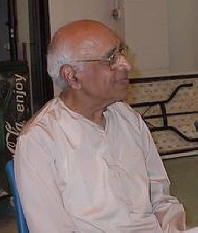

Professor Krishnamurthy was also trained systematically in the traditional Hindu scriptures by his father Sri R.Viswanatha Sastrigal, a scholarly exponent who was himself a living example of the ideal Hindu way of life. Prof. Krishnamurthy has given several successful lectures on Hinduism, the Ramayana, the Gita, the Upanishads, and Srimad Bhagavatam to Indian and American audiences. His expositions are known for their precision, clarity and an irresistible appeal to the modern mind. His books on religion include: Essentials of Hinduism; Hinduism for the next Generation; and, The Ten Commandments of Hinduism. He has also authored a series of 18 poster-size charts on Hinduism, entitled SADHARMA (= Sanatana Dharma Ratna Mala). These are unusual expositions with visual support, on the concepts ideals and traditions of the Hindu way of life, presented by an incisive scientific mind in a totally novel manner never before tried by any exponent of religion formally or informally.

A number of writings of his on Religion and Philosophy are on the web at http://www.geocities.com/profvk/ entitled: Science and Spirituality and Gems from the Ocean of Hindu Thought, Vision and Practice.

His recent books on religion are Kannan sorpadi vaazhvdeppadi (in Tamil) with an appendix on Dhruva-Stuti – An Upanishad Capsule (Published by Alliance Co., Mylapore, Chennai) and Science and Spirituality – A Vedanta Perception (Published by Bharatiya Vidya Bhavan).

Live Happily the Gita Way – An Advaitic approach” is under publication. He was given the Distinguished Service Award by the Mathematics Association of India in 1995, the Seva Ratna award by the Centenarian Trust, Chennai, in 1996, and the Vocational Service Award for Exemplary Contributions Education by the Rotary Clubs of Guindy and Chennai Samudra in September 2001.


Harsha's avatar

The Guru Came As Ramu- Part II: By Michael Bowes

Michael Bowes is well known to us as an authentic and genuine and a very experienced yogi and a devotee of Sri Bhagavan Ramana. Internationally, he is well travelled and has been to India. He has visited various Ashrams and Gurus and Swamis in both the U.S. and abroad.

Michael has an uncanny ability to see to the heart of the matter and his spiritual insights pierce through the veils of sentimentality and conceptual baggage. Michael is a long term member of the HarshaSatsangh community and his presence has been a gift.

Given below is the second part of a three part story from Michael about his visit to a Swami in India. This is Part II.

You can see Part I at the following link.

https://luthar.com/2006/01/page/2/

************************************************************************

By Sri Michael Bowes

Many persons would love to meet their guru. Imagine meeting a Swami of the Shankara Order who was exuding peace, love, and siddhis. Imagine an unknown Swami who, on his first trip to the West attracted a very large following in a very short time. Many persons were convinced that the Swami was an exceptional spiritual beacon. A letter came inviting me to India.

Thinking that I had met a true guru, a person who seemed to be surrounded by mystical events, I traveled to the other side of the earth to be with him in India. But after being there for a short time, and through the grace of the guru, I had already become wary.

The Ashram was situated on a quiet, peaceful farm in South India. The farm was owned by Govindan and his family. There was Mother, his wife, and there were daughter and son. I never got their names – they were Mother and daughter and son.

Govindan had a nice room with a bed and a desk and some chairs. There was a ceiling fan and he had a water purifier there. I would often go there and visit. Mother lived in the kitchen. She slept on a mat on the bare concrete floor. I never did find out where daughter and son slept; but I think that it might have been in the cowshed.

Mother and daughter cooked for us on a wood fire. Sometimes there were many persons there. The food was great. In part one, I mentioned that Govindan, and Shyam and I went to Ramana Ashrama and some other locations; but before we did, I wanted to give Mother a small gift. I also wanted to give something to daughter. I had already given a significant sum to Govindan because they were feeding me and giving me a nice place to stay.

Mother didn’t want to take the money, so I had to leave it on the floor in the kitchen. I also left some money for daughter and then Govindan, Shyam and I left for Tamil Nadu. A couple days after our return, and after the grace of Ramu, the Swami’s attendant called me to his room. Swami was just finishing the morning puja when I walked in. Mother and daughter were there along with some others.

The Swami welcomed me and I paid my respects to all. Mother and daughter were standing and the Swami was seated near the shrine. Swami said, “Mother has something to tell you.” I looked at Mother and her eyes revealed the depth of her emotion. The Swami spoke and said, “Mother wants you to know that she used the money that you gave her and bought these earrings. I have blessed these earrings, and Mother wants me to give these earrings to you and then she wants you to hand the earrings to her.”

I was overjoyed. The Swami placed these teeney, tiny, gold and diamond earrings on a flower, and handed them to me. Then I handed the flower with the earrings to Mother. Mother put them in her ears immediately and she was nearly shining. Daughter had bought a gold nose-pin with her money and so the same process was repeated for daughter. She also seemed quite happy. It was fun for me.

Then Swami said, “Mother has something else to tell you.” I looked at Mother and it seemed that she was about to cry. Swami said, “Mother wants you to know that no one has ever done such a wonderful thing for her. Mother says that men have always cursed her and abused her. Mother says that this is the best thing that has ever happened to her.”

I was stunned. I looked at Mother and I’ll never forget the look on her face. Suddenly I realized – they don’t say her name. She lives on the concrete floor in this primitive kitchen. She and daughter don’t even eat with us. She got this little bit of money and she wants me to know that this is the most wonderful thing that has ever happened to her. I was shocked. I could barely believe this. I can’t begin to explain how I felt.

As everyone was leaving, the Swami asked me to stay. I was really, really sad. I sat down next to him and he said: “Michael, don’t give these people anymore money.” If you want to give someone money, give it to me.”

My very limited patience began to wear thin. I tried to explain that I had given Mother and daughter just a little bit of money and that I gave money to Govindan because he had built a room and was feeding me and everything. Swami said, “Govindan is a retired railway station master. He gets Rupees 1800 every month. Don’t give them any money. If you want to give money, give it to me.” He went on to say that he had some kind of trust set up and that he already had $700 and that everything was all worked out. I told him that I understood, bowed and left the room. I knew that I needed to get away from this Swami; but I couldn’t go home just yet…

Harsha's avatar

The Guru Came As Ramu – Part I: By Michael Bowes

sri-yantra-23.gif

Michael Bowes is well known to us as an authentic and genuine and a very experienced yogi and a devotee of Sri Bhagavan Ramana. Internationally, he is well travelled and has been to India. He has visited various Ashrams and Gurus and Swamis in both the U.S. and abroad.

Michael has an uncanny ability to see to the heart of the matter and his spiritual insights pierce through the veils of sentimentality and conceptual baggage. Michael is a long term member of the HarshaSatsangh community and his presence has been a gift.

Given below is a three part story from Michael about his visit to a Swami in India. This is Part I.

************************************************************************

By Sri Michael Bowes

In the spring of 1992 I met a Swami who was making his first trip to the United States. By the time I met him he had been in the States for about two months and had already developed quite a following. It was easy to understand why so many people were following him because wherever he was many unusual things would occur. I myself witnessed several mystical events.

In late June he returned to India and several of us wanted to go there to see him. About a year later, I received a letter from the Swami. I knew that he had been living an itinerant life, often moving from one place to another; but the letter stated that he had established an ashram in the countryside of South India and he invited me to come and spend some time. I began making arrangements and in early October of 1994 I was on my way.

I landed in Madras where I was going to spend about a week before going to the Swami’s ashram in the interior. And even though I had many Indian friends who had given me a lot of advice about negotiating my way through this foreign culture, I soon realized that nothing could have prepared me for what I encountered. I was truly shocked by the situation.

Anytime I left my hotel room I was besieged by beggars, scam artists, rickshaw wallas, lepers, guides and touts. No matter what I did, I couldn’t seem to make any of them happy. If I paid an outrageous amount to a rickshaw walla to try to help, they responded by begging for more. The hassles and troubles went on and on and on.

I decided that I needed to get out of Madras earlier than planned and I called my contact in the interior. I explained what was happening and he told me to take the train to the town that was closest to the ashram. The hassles continued; but in a couple of days I was on the train to the interior.

I was greeted at the train station by my contact. His name was Shyam. He had a car and driver and we went to the ashram that was on a farm owned by a wonderful old man named Govindan and his family. It was a beautiful, peaceful place and they had just built a new room for me. They showed me my room and then we ate.

It was a tremendous relief to be there with these kind and gentle people. I had arrived earlier than planned and the Swami wasn’t there; but he was coming in a few days. While we were waiting for the Swami, we decided to take a trip and we went to Ramana Ashram, Aurobindo Ashram, and Auroville. It was a great trip and I wasn’t nearly as hassled because I was always surrounded by three or four Indians.

When we returned to the farm, the Swami was there and it was really great to see him. We talked and he gave me some instructions and I just settled into the daily routine. Govindan had built a small temple, complete with a tank and flower gardens. Every day we would arise and Govindan would go around the farm picking flowers for his morning puja (worship). The Swami also performed a very elaborate morning puja in his room. I didn’t talk to the Swami much. He was a man of few words. He didn’t even eat with us. But I would visit with him a little every day.

After a few days the word spread that an American was staying at the ashram and people started coming from all around to see me. On some days there were people lined up outside of my door to talk to me. They were curious about a lot of things. Primarily they wanted to know how to make money. But they also wanted to know how they could move to America, or they wanted to know how to sell goods in America. Some of them just wanted to talk to an American. And occasionally someone would ask about how to reach God-realization.

I couldn’t help them with any of that; but I listened and talked and generally found everyone to be quite pleasant. One day a whole group of children came and they couldn’t speak any English; but they had brought me a gift of some peanuts and they just hung out with me staring and laughing and giggling. They were very sweet.

About the time that the crowds of people thinned out, a new visitor, a starving dog arrived. A medium sized, starving black dog parked himself outside my door and didn’t leave for a couple of days. Govindan had three dogs and the Swami had a dog; but this dog didn’t hang out with the other dogs. Somehow this dog must have known that I was a Westerner and he must have thought that I could help him. But actually, he was there to help me.

When I would leave the room he would just lay there and look at me, and when I would come back – there he was. He would never leave and he was in very bad shape. His condition was very distressing. But he never bothered me. He never tried to come into the room. He just hung out at my door like a statue. His condition was so bad that I had to do something. So I told Govindan that a starving dog was hanging out at my door and that it was disturbing to me. Govindan laughed and said, “That’s not a starving dog. That is Ramu. He’s a dog from the village.”

I said that Ramu looked like he was starving to me and I told Govindan that I was going to talk to the Swami about using his car to go to a nearby large town to buy dog food for him.

I found the Swami and I asked him to come to see Ramu. I showed the dog to him and asked if he would allow his driver to take me to town to buy food for the dog.

The Swami said, “This dog is not starving”.

I said, “How can you say the dog isn’t starving? Just look at him you can see every bone in his body”.

The Swami said, “If the dog is starving then it is his karma to starve.”

“If the dog’s karma caused him to starve, then it is my karma to feed him”, I said.

The Swami relented and allowed his driver to take me to town. Shyam and Govindan went with me. I scoured the town for dog food. I found out that they didn’t really sell dog food; but I managed to find three big boxes of dog biscuits that were made of very nutritious ingredients. By the time we got back to the ashram, dinner was being served. I grabbed a few dog biscuits out of the box, left the rest in the car, ran to my room and gave them to Ramu. Then I ate supper.

After I ate, I went to get the dog biscuits out of the car; but they weren’t there anymore. I asked Govindan what happened to the dog biscuits and he said that the Swami had taken them and put them in his own room. I was dumb struck. The Swami had taken the dog biscuits – what kind of deal was that? His dog was nice and fat. They fed his dog every day like a king and yet he had appropriated the dog biscuits that I had bought for Ramu.

I was not happy. But it was too late that night to do anything about the situation, so I went to my room to meditate and sleep.

When I got to my room Ramu was gone. In fact, I never saw Ramu again. I guess it was a good thing because I didn’t have to confront the Swami about the dog biscuits. I didn’t need them anymore because Ramu was gone. This whole incident began to show me what the Swami was really like. I thought that it was very strange that Ramu should have come and gone in such a mysterious way. Why did he come and hang out at my door? And why did he just suddenly leave? I came to believe that the guru had come in the form of Ramu to begin to unmask the Swami. But I can assure you that it was only the beginning of the unmasking…..

To be continued……….
Love to all,
Michael

Harsha's avatar

A Meeting On A Forest Road: By Mazie Lane

shore

When I was ten years old, arthritis presented in my life and has remained my constant companion since. Not long after I became ill, my father, who worked for the state in the field of agriculture, was out on the road surveying orchards in Butte County. He had stopped by a river to eat his lunch and he settled down under a tree with a heavy heart, for he carried the Heartbreaking burden of a father who had to watch his Beloved child endure endless pain and a constant, relentless destruction of the body through joint deteriorization. He felt helpless in a way that might be rightly understood if one has ever had or has a child who is stricken with a catastrophic illness.

Continue reading