
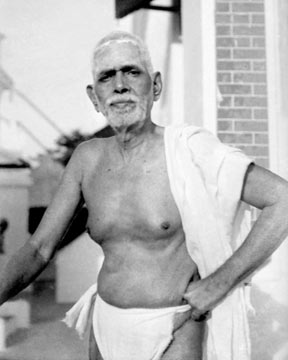
The practice of advanced yoga methods and pranayama with discipline along with meditation on the Chakras (Energy Centers in the body) leads to various mental and spiritual experiences. Sri Ramana’s teaching, however, views such yogic and meditative practices as preliminary to the real quest into the investigation of the nature of the “I”.
Visions of angels, deities, super conscious states, and various types of psychic abilities do manifest on the spiritual path. But fascinating as such things are to the human mind, these do not resolve the fundamental question about the nature and mystery of existence.
People say, “I like this”, “I dislike this”, “I am a doctor”, “I am a professor”, “I am a psychic”, “I am a student”, “I am good”, “I am a husband”, “I am a wife”, “I went here”, “I am strong”, “I am weak”, “I am happy”, “I am sad”, etc. The commonality in all we do and how we view our self is this, “I”
The method of Self-Inquiry is to ask oneself “KOHUM”. KOHUM in Sanskrit translated literally means “Who Is Me?” In English, we use the question, “Who Am I?” or Who is this “I” that is a constant reference point for us?
What is this sense of identity that engages in all these activities and has a variety of experiences, perceptions about the world and itself?
Who is the I that sees, dreams or has visions. According to Sri Ramana, without understanding the nature of the I and resolving the mystery of existence, permanent satisfaction and peace are not gained.
It is for this reason that great sages say that one should aspire for Self-Knowledge above all else.
Everything, absolutely without exception, is transient. One is born, one grows old, one has many experiences in the world, and then one dies.
Things have a beginning and then an inevitable end. All physical and mental abilities and powers eventually fade. Psychic abilities and every kind of experience, supernatural or otherwise meets the same fate. It ends.
What remains always present is simply the sense of existence, this sense of I. The method of self-inquiry involves a focus on this I, an awareness of this awareness, until the quality of self-awareness is known as the inner essence of our existence. The words cannot fully capture this approach. It is understood only with effort and practice.
Therefore, the aspirant should with confidence maintain the inner gaze focusing the “I” on “I”. Remaining in stillness with awareness aware of itself is the practice. Remaining with the sense of “I AM” is the practice.
It is this practice which is known as the direct path. It leads to the “I” merging into its Source. Immediately, it is seen that the Source is the Self, that the ancients called Sat-Chit-Ananda. There are no words to describe it fully. It knows nothing else other than It Self, there being nothing else to know.
It is only this that the sages have referred to as the Supreme and the Absolute Beauty, the Core of Being that is Reality itself which sits in the heart of all beings as their support. It is Knowledge, Existence, Bliss as one whole which animates existence and gives light and life to the mind.
Namaste
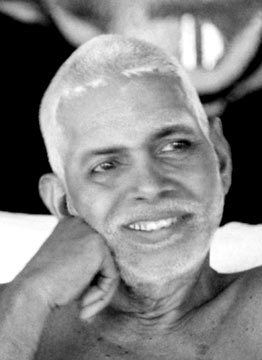
This posting is from a series of ‘sharings’ done by V. Ganesan in Tiruvannamalai in 2009.
Bhagavan Ramana emphasized that nothing is more productive of the highest spiritual results than concentration of the mind on one’s True Nature, which is the Absolute Reality, God and Inner Guru.
To adhere to this injunction of Sri Bhagavan, even the physical form of the Guru should not be an obstacle for a true seeker. Listen to the story of Uddhava in “Srimad Bhagavatham” :–
When Lord Krishna ended His mission on earth and was prepared to return to his eternal abode in Heaven, Uddhava, who was greatly attached to His person, appealed to Him with tears in his eyes to take him along with Him, saying : “I have strong forebodings, O Supreme Lord, that after destroying the Yadu race you will leave the earth altogether. I cannot bear to be away from your holy feet even for a moment. Grant that I may be taken with You to Your Divine Abode in Heaven. How can I now be separated from you ?”
Lord Krishna answered that it would be in Uddhava’s own interest not to cling to His body but to stay on after Him and practice the Inner Yoga in the Himalayas, after shaking off all attachments to his family and kinsfolk, keeping his mind fixed wholly on Him, within his Heart.
Sri Krishna added : “You must always remember, dear friend Uddhava, that whatever is thought by the mind, perceived by the eyes and ears and spoken by the tongue is the creation of the mind and therefore illusory. By controlling your mind and senses, you will see the world as only the projection of your own Self and that your Self is in ME, the Supreme Lord. Possessed of this Wisdom, be immersed in the Supreme Peace of Self-Realisation. Then, you will experience no obstruction in regaining ME, in your Heart.”
There was a pious lady, who once prayed to Sri Bhagavan to bless her by selecting a few important verses from his written works, so as to help her progress in her spiritual emancipation. Sri Bhagavan gave her a glance of compassion. It seemed to endorse Jesus Christ’s statement : “Ask, it shall be given”. Instantly, he quoted two verses from “Sri Bhagavad Gita ”. He had already selected 42 verses from out of the 700 and odd total verses of the ‘Gita ’ and had translated them into Tamil verses. They are :
“The faith of everyone is according to his nature. Man is
essentially endowed with faith. What his faith is, that
indeed is he.” — [xvii (3) ]
“One who has faith and one-pointed attention and has
subdued his senses, attains Wisdom. Having gained
Wisdom, he speedily attains Supreme Peace.” – [ iv (39) ]
These two are Verses 17 and 18 of “The Song Celestial ”- the 42 verses that Sri Bhagavan had selected from the ancient classical, spiritual treatise : ‘The Bhagavad Gita’ .
The first verse [ No.17 ] affirms the traditionally upheld ‘Law of Karma’, which dictates that one’s present life is due to the past actions and that one’s nature is thus ever controlled. The second verse [ No.18 ], however, postulates the certain possibility of one’s turning one’s attention within and thus getting rooted in Wisdom, resulting in the attainment of Supreme Peace.
Whatever is one’s sadhana-mode – as referred to in verse 17 – one is always free to make a concerted effort to turn one’s attention inwards and thus supersede the law of karma and be established in the SELF . The choice is all the time available to each seeker in the solid form of “ NOW”.
Ignore one should the ‘prarabdha’ and pay full attention [ within ] to ATTENTION ! The very effort of one to plunge within is due to Grace, affirms Bhagavan Ramana !
Attention is “NOW”, which swallows one’s ‘faith’ and one’s ‘nature’, thus establishing one in the Supreme Truth of Existence, the “ I AM ” .
All ‘karmas’ project a ‘past’ and then a ‘future’ – the two non-existents. Bhagavan Ramana’s commandment is :
“ Shift your attention from non-truth to Truth.”
Let us remove our attention from the ‘past’ and ‘future’ and one-pointedly plunge our full attention within – on NOW – and be supremely happy !
************************************************
Related post: Satsang with Ganesan
V. Ganesan Bio

Born in 1936, up to the age of 14 years old, Ganesan grew up in the presence and proximity of Bhagavan Sri Ramana Maharshi. His sacred memory of the Great Master is rich in its content; and, even at that tender age he could see Sri Ramana as the greatest compassionate human being.
On April 14, 1950 – the day the Great Master chose to leave the body – the adolescent Ganesan stood near the entrance to the room where Sri Ramana was lying and was fortunate to witness the brilliant flash of Light that later moved towards the top of the Holy Hill – Arunachala.
Ganesan obtained a Master’s Degree in Philosophy; and, then came to stay permanently at “Sri Ramanasramam, Tiruvannamalai” – the sacred abode of Sri Ramana Maharshi – taking care of the Old Devotees of Sri Ramana. He did it as his sole sadhana (spiritual practice). In that way, he collected the reminiscences of Sri Maharshi from those Old Devotees which have never before been recorded.
His close contacts with sages and saints, including Swami Ramdas, Mother Krishnabai, J. Krishnamurti, Nisargadatta Maharaj and Yogi Ramsuratkumar, he says, have deepened and widened his understanding of the ‘Direct Teaching’ of the Maharshi. However, he feels himself to be an insignificant ‘dust’ at the Holy Feet of Bhagavan Ramana.
He has traveled widely and spread the ‘Direct Teaching’ of Sri Ramana Maharshi, in its pristine purity, wherever he was invited to give talks.
He has authored a few books on the life and teaching of Bhagavan Ramana. Among others, “Purushothama Ramana”, “Be the Self”, “Moments Remembered”, “Direct Teaching of Bhagavan Ramana” and “Practising Self-Enquiry” , are very popular.
At the veranda of his cottage – “Ananda Ramana” – he meets earnest seekers, every Monday and Thursday, between 9.30 and 11 a.m., sharing with them the spiritual treasure entrusted with him by all these holy and sacred souls.
Dear Friends,
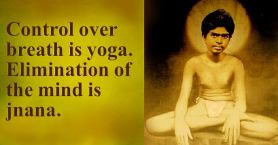
When consciousness focuses its attention on a perceived or imagined object (such as an energy center, point of light, sound, music, mantra, etc.), that is known as concentration and can lead to deeper meditation and samadhi or trance states.
Truly all such techniques, although useful, are inherently and fundamentally flawed in seeing our own nature.
Such methods presuppose that there is something to concentrate or meditate on outside of consciousness. But how could that be?
All point of concentration, all techniques and methods of meditation only exist in consciousness. A person who understands this deeply loses interest in methods of meditation. The consciousness of a Self-Realized sage has settled into its own nature. It is in perpetual communion with itself. Always new and alive and pure being whose very nature is meditation does not concentrate or meditate.
On What Shall I Meditate? And How!
Namaste
 Luthar.com
You must be logged in to post a comment.