Tag Archives: Meditation
Solitude Is A State of Mind!
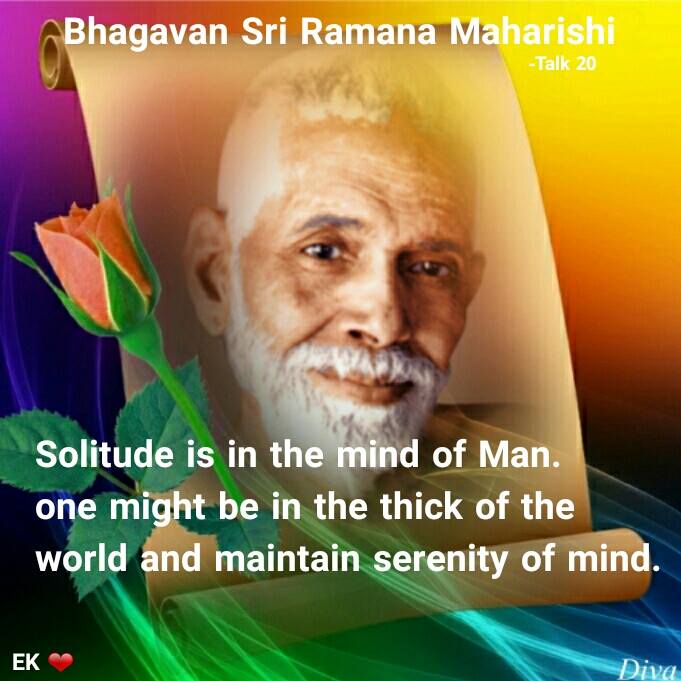
Sri Ramana used to say that wherever we go, we take our mind with us. Therefore, regardless of our circumstances, we have to create the mental atmosphere of satsang (company of the Self). Bhagavan’s teaching is that serenity is a state of mind and not our circumstances.
Sri Ramana says, “Solitude is in the mind of a man. One might be in the thick of the world and yet maintain perfect serenity of mind; such a person is always in solitude. Another may stay in the forest, but still be unable to control his mind. He cannot be said to be in solitude. Solitude is an attitude of the mind ; a man attached to the things of life cannot get solitude, wherever he may be. A detached man is always in solitude”.
Photo art is from Eden Kailash FB page.
It Is Only You
If with the mind, you look at the mind patiently, through the sorrows and tears, joys and laughter, the exaltation and humiliations, the lucky breaks and tragedies of your life, you will look through your mind.
You will find yourself as yourself as the very look itself.
And there will remain only this looking, this seeing, free from form.
it cannot be named. No one remains to name it. It is only you, in the pristine and ultimate nakedness of your being.
ANGEL IN MANHATTAN
From Mira Prabhu on her spiritual journey. Mira Prabhu is a gifted writer, yogini mystic, residing near the holy mountain of Arunachala in India.
It was a gorgeous fall morning and I woke up deliriously happy in my new apartment. The past couple of months had been crazy with all sorts of pressures, but finally the move from Carroll Gardens to Brooklyn Heights came; since this was post-divorce and I was on my own, the task of moving, then settling in, took up every bit of my remaining energy.
Now Saturday had dawned and all the grueling work was done, so I was free to enjoy my beautiful apartment in the St. George Tower, with its view of the Promenade, and beyond it, the regal Statue of Liberty, telling me I had made it against all odds in the land of the brave and the free.
In Manhattan, folks make plans way ahead of the weekend. I, however, had been too busy to do that; besides, my friends were in the city, and not in this…
View original post 725 more words
The Perfect Meeting_Ramana and Ramdas
The Perfect Meeting
Swami Ramdas describes how he attained the Divine Vision through the Grace of the Bhagavan Sri Ramana Maharshi. Swami Ramdas was called “Papa” by his devotees.
View original post 977 more words
ARUNACHALA, NOT ABRACADABRA
Mira Prabhu sharing and sending her greetings from Arunachala. ❤
“Why don’t you teach an analytical meditation at my learning center?” a woman asked me. It was a bright morning in Rishikesh, and while I loved my new apartment with its spectacular view of the Himalayas, my heart was heavy with confusion about the future. I did not like the commercialization of this ancient city, nor the sharks I encountered, mostly wealthy urban businessmen who had bought up all the apartments in my enclave for ‘investment’ purposes and appeared to have few ethics.
“All right,” I agreed, albeit reluctantly; perhaps it would do me good to teach the Seven Flavors of Samsara, an analytical meditation on the nature of relative reality that I had learned from a powerful guru, and which I occasionally shared with those perplexed about the nature of reality—particularly those who agonized over why bad things happened to good people and vice versa.
View original post 879 more words
Ahimsa Is The Highest Virtue
Ahimsa (nonviolence) is the primary ideal and the virtue to be cultivated on the yogic path to Self-Realization. This is a subtle, deep, and fundamental psychological and spiritual truth.
Why such an emphasis on Ahimsa by the sages?
It is because the perfect and calm state of relaxed awareness is only possible in a mind that is free of all violence.
It is in this state that Grace takes over and allows the pure devotee to surrender fully to God who sits in the Heart, as the Universal Heart, and recognize it to be the Self, one’s very own Self.
Dattatreya’s 24 Gurus and His Brilliant View
Dattatreya
Dattatreya blows my mind with the daring way he lived his life and the transcendent wisdom that emerged as a result. The word Datta means “given”—for it is said the Divine Trinity (Brahma, Vishnu and Shiva) “gave” one aspect of themselves in the form of a son to the sages Atri and Anasuya; Atreya was added on to his name, to indicate he was the son of Atri.
Born roughly 4000 years ago in an age when Veda and Tantra had once again fused, Dattatreya left home early, in search of the Absolute, roaming naked in the areas in and around Mysore, Maharashtra and Gujarat. Usually depicted with three heads, symbolizing Brahma, Vishnu and Shiva; past, present, and future; and the three states of consciousness: waking, dreaming, and dreamless sleep, he is shown sitting in meditation beside his shakti (mate) beneath the wish-fulfilling tree; in front of him is a fire pit, and around him are…
View original post 697 more words
Yoga And Advaita: By Dr. Harsh K. Luthar
Yoga and Advaita
These questions came up some years ago. My responses are included. (Photo art above is from Andreas Farasitis).
Question: Is the way and goal of Patanjali’s Yoga and Sri Sankara’s Advaita Vedanta the same?
View original post 413 more words
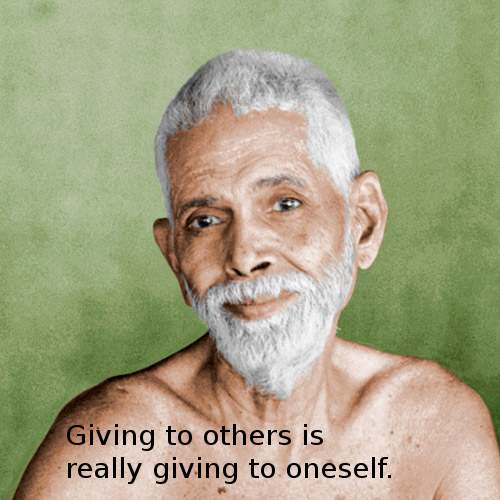
Giving to others is really giving to oneself ~ Sri Ramana
Giving to others is really giving to oneself. ~ Sri Ramana
Bhagavan says, “Giving to others is really giving to oneself.” Bhagavan continues, “If one knows this truth, would one ever remain without giving?” (See Chapter XIII “Gems from Bhagavan.” Bhagavan here states the fundamental truth of reality at every level.
View original post 238 more words


You must be logged in to post a comment.